The Meaning of the US-Iran MoU

18 June 2026

By Stephen Gowans

Below are my brief comments on some aspects of the 14-paragraph Memorandum of Understanding between Washington and Tehran.

Paragraph 1

In the first paragraph “The United States of America and the Islamic Republic of Iran” indicate that they are making commitments on behalf of themselves and “their allies in the current war.”  

The language of the MoU is ambiguous throughout, and the ambiguity is evident here. Who are the signatories’ allies? It’s clear that “allies” covers Israel in the case of the United States and Hezbollah in the case of Iran, but it’s notable that this isn’t spelled out, and that no effort is made to define who the allies are.

A further ambiguity: The paragraph says that military operations will end “on all fronts, including Lebanon.” The document, however, doesn’t define the fronts, other than Lebanon. Are the Persian Gulf countries fronts? Iraq? Jordan?

Implied in the definition of Lebanon as a front, is that Hezbollah’s current military operations are actions taken on behalf of Iran, rather than, or, in addition to, actions specifically related to Israel’s ongoing occupation of south Lebanon and its campaign to destroy the Shia organization. Are Hezbollah’s military operations a necessity of self-preservation in the face of Israeli efforts to annihilate the organization and empty south Lebanon of its Shia population, or are they aid to Iran, or both?

More significantly, the fact that both parties make pledges on behalf of their allies, indicates that Washington and Tehran consider themselves the senior partners and their allies subordinates.

This shouldn’t be controversial in the case of the United States and Israel, but has become so owing to a ridiculous popular fallacy that Israel, a country of 10 million people with a GDP of $720 billion, controls the foreign policy of the United States, a country with 34 times the population and 44 times the GDP, and which is a state, moreover, on which Israel depends for its survival.

No matter how ridiculous the idea is on the surface, legions of Americans have found some comfort in scapegoating Israel for their own government’s actions. It is much easier to blame Zionist Jews, working in the shadows, manipulating world events—a trope much beloved of reactionaries throughout history—than to recognize that murder, genocide, invasion, occupation, and conquest are the very hallmarks of US foreign policy. The US government was vicious and bloodthirsty long before there was an Israel and the Israel lobby.

It is instructive to recall that in 1895 US Senator Henry Cabot Lodge hailed the United States as unequalled in conquest, colonization, and territorial expansion in the nineteenth century.  Its record in the eighteenth century was no less unattractive, and the tens of millions slaughtered and burned to death in US colonial and neo-colonial wars of the twentieth and twenty-first centuries recall that sanguinary imperialism is embedded in the history and character of the United States.  

To believe that wars of aggression and support for colonial and apartheid regimes are somehow alien to the fundamental values of the US state – as John Mearsheimer and his votaries do – is to blind oneself to US history, even recent history, and to be ignorant of the fundamental nature of the US state.

Bernard DeVoto once remarked that US history “began in myth and has developed through three centuries of fairy stories.” The notion, conjured by Mearsheimer and his followers, that the United States wouldn’t be involved in wars of aggression, wouldn’t be participating in genocide, and wouldn’t be supporting a repressive, racist, and anti-democratic regime, were it not for the influence of Israel and its lobby, is yet another fairy story, added to the mountain of comforting illusions that make up US historiography and Americans’ sense of who they are—or who they wish they were—as a people.

In any event, “the Jews made us betray our fundamental values” theory of US foreign policy has been decisively refuted by events, no less by the MoU. The agreement:

  • Was negotiated without the involvement of the fantasized Israeli motive force of US foreign policy;
  • Achieves none of Israel’s war aims;
  • Is universally opposed by Jewish Israeli leaders across the entire political spectrum;
  • Is reviled by the Israel lobby.

On top of implicitly defining Israel as a US vassal state that marches to the beat of a US drummer, the first paragraph commits both parties and their allies to “refrain from the threat or use of force against each other,” (my emphasis). No sooner had Trump signed the MoU, than he violated it, warning the Iranians that “if they don’t behave, we’ll go right back to dropping bombs right smack in the middle of their head.” He added: “It’s amazing what bombs can do.”

On two occasions, as US and Iranian negotiators were meeting to work out the terms of the MoU, US war secretary Pete Hegseth equated negotiation with bombing.

In March he said: “We negotiate with bombs.” He repeated himself this month. “If we need to negotiate with bombs, we’ll negotiate with bombs. And we’re very good at it. Nobody better in the world.”

Hegseth’s threats, however, didn’t rise to the barbarity of Trump’s 7 April vow to annihilate “a whole civilization” if Tehran didn’t submit to his demands.

For their part, the Iranians could reply (but haven’t) that “We negotiate by shutting down the Strait of Hormuz and striking US Persian Gulf allies with ballistic missiles and drones.”

Paragraph 4

The fourth paragraph states that “The United States of America further undertakes to remove its forces from the proximity of the Islamic Republic of Iran within 30 days after the final deal.”

In keeping with the MoU’s ambiguity, no definition is offered of what “proximity” means or whether the United States will remove its forces permanently, or only temporarily. These questions are deferred to negotiations scheduled to take place over the next 60 days, or longer, if mutually agreed.

The United States will likely make withdrawal of its forces contingent on Iran meeting front-loaded commitments to scale back its nuclear program.  In this way, once Iran satisfies US demands, Washington can renege on the deal, a danger not to be taken lightly, given US conduct in the past, and Trump’s track record. Indeed, the reason Iran began enriching uranium to near military grade, was to pressure the United States to return to the JCPOA, after Trump disavowed the agreement, and after Biden declined to re-enter it, trying instead to coerce the Iranians into accepting new conditions.  

Paragraph 6

In the six paragraph Washington “undertakes with regional partners to develop a definitive, mutually agreed plan with at least U.S.D. 300 billion for the reconstruction and economic development.”  

Based on press reports, Washington sees this program as an investment opportunity, not reparations. We destroy your infrastructure and rebuild it at a profit for us, rather than repairing it at our expense.

Paragraph 7

In the seventh paragraph Washington pledges “to terminate all types of sanctions against the Islamic Republic of Iran … in an agreed-upon schedule as part of the final deal.”

This means that the United States agrees to lift sanctions contingent on Iran satisfying US demands regarding Iran’s nuclear program. It’s very unlikely that Washington will offer sanctions-relief before Iran eliminates its stockpile of highly enriched uranium or satisfies whatever other demands Washington makes regarding Iran’s nuclear capabilities.

There is a very real danger that if Iran complies with US demands, Washington will fail to honor its commitment to lift sanctions. If the Trump administration follows standard US operating procedure, it will either claim that Iran is cheating, and that sanctions therefore won’t be lifted, or will invent new reasons to impose new sanctions on Tehran for some new Iranian trespass. Or Trump could change his mind and decide he’s not going to honor the deal. He has done it before.

Paragraph 11

In the eleventh paragraph, Washington “undertakes to make fully available for use the frozen or restricted funds and assets of the Islamic Republic of Iran.” The assets will be unfrozen according to “procedures” to be “mutually agreed on” over the next 60 days. The fact that procedures to release the assets remain to be negotiated, means Washington could slow-roll negotiations of the procedure to hold up release of the assets in order to exert leverage on other issues.

In endlessly lambasting Obama for sending “pallets of cash” to Iran, Trump created the impression that Obama paid a ransom to get Tehran’s signature on the JCPOA. Of course, Obama was doing what Trump himself has pledged to do in the MoU: return to Iran what is rightfully Iran’s.

Having agreed to unfreeze Iran’s assets, Trump did a volte-face and came clean, explaining that: “We have taken a lot of their money, and we have their money. We have taken their money, it’s not our money, it’s their money, and we froze it. At a certain point in time I guess we’re going to have to give it back.”

The idea that in unfreezing Iran’s assets the United States is paying Iran a ransom is an inversion of reality. Meeting US demands to scale back its nuclear program will be the ransom Iran pays to Washington to recover its stolen assets.

Conclusion

Au fond, the MoU is an agreement to pause the war, open the Strait of Hormuz, and lift the US naval blockade, while Washington and Tehran negotiate a final agreement to scale back Iran’s nuclear program in return for sanctions relief, reconstruction, return of Iran’s stolen assets, and withdrawal of US forces from some undefined part of West Asia, either permanently or temporarily.  

Strictly speaking, the MoU does not commit the parties to only pause the war, but to end it. By signing the agreement, Washington and Tehran “declare the immediate and permanent termination of military operations on all fronts” (my emphasis.) Trump voided the declaration immediately, when he pledged to return to war if the parties fail to arrive at a final agreement, calling to mind the words of Otto von Bismarck: “Great questions of the time are decided not by words but by blood and iron.”

The Via Crucis of John Mearsheimer

John Mearsheimer developed the theory of the Israel lobby because the facts contradicted his Realist theory of international relations. Now the facts are contradicting the very same Israel lobby theory he developed to plug the holes in his IR theory.

15 June 2026

By Stephen Gowans

It’s difficult to argue that Israel and the Israel lobby control US foreign policy when Washington arrives at an agreement with Tehran:   

  • That Israel had no say in;
  • Achieves none of Israel’s war aims;
  • Is universally opposed by Jewish Israeli leaders across the political spectrum;
  • Is met with skepticism by pro-Israel hawks in the US.

Even if the agreement falls apart, it is still the case that Washington has acted in a manner that is hostile to what Israelis perceive as their interests.

“The Israel lobby” is a category of explanation invoked to account for the failure of certain theories to explain US actions (e.g., some Realist IR theories, or the theory that US foreign policy is fundamentally benign in its intentions if not always its actions.)

The problem lies with the theories. They don’t explain what they set out to explain.

John Mearsheimer is a Realist IR theorist, and the most vocal exponent of the theory that 1) Washington acts against US interests in West Asia and in favor of Israel’s and 2) it does so because its foreign policy has been hijacked by the Israel lobby. He readily acknowledges that his IR theory doesn’t explain US behavior in West Asia.

Steve Walt and I, who are both card-carrying Realists, wrote this book called the Israel Lobby and US Foreign Policy. And lots of people over the years have delighted in pointing out, in a “got-ya!” moment, that the Israel Lobby book contradicts our Realist theory. Because the Israel Lobby book says that domestic politics causes the United States to act in non-strategic ways. This is what the Israel Lobby book says. It says that when it comes to Israel, the United States is not behaving in a way a Realist would expect American policy-makers to behave. It’s because of the Lobby; domestic politics. And people expect us, when they level that charge at us, to be defensive and say ‘Oh no, the Lobby book really fits in with our theory.’ But our response is, ‘You’re absolutely correct. The Israel Lobby contradicts my basic theory of international politics.’ [1]

You may notice that Mearsheimer engages in some question-begging here (question-begging in the sense of assuming the truth of what he’s trying to prove in his premise.)  He says “that when it comes to Israel, the United States is not behaving in a way a Realist would expect American policy-makers to behave,” and then adds “It’s because of the Lobby.” An alternative explanation is that the United States is not behaving in a way a Realist would expect American policy-makers to behave because the theory is wrong. Instead, he assumes the theory is correct, and that something else must be going on to obscure its validity. Presto, the Israel lobby theory is born.

The problem, however, is that the Israel lobby theory has as many holes in it as there are holes in the original theory it was designed to plug. That’s evident in the obvious rift that has developed between Washington and Tel Aviv over the question of how to proceed on Iran.

Apart from being an add-on to save Mearsheimer’s IR theory, the Israel lobby theory is also a political tool used by some activists to mobilize support for pro-Palestinian positions by deliberately fostering a misunderstanding that a foreign power has hijacked the US state and that US citizens are paying for wars fought in Israel’s interests and not US interests.

The truth is that US citizens are paying for US wars—and the wars are being fought in the overlapping interests of US billionaires and Israeli colonizers. They may not want to face up to the fact that their government’s conduct is vicious and tyrannical, and may prefer, instead, to see the United States as a fundamentally benign but helpless giant manipulated by an Israeli Svengali, but this is nothing more than a comforting illusion.

The reality is that the domestic billionaire class that shapes US foreign policy goals has set objectives that, for the most part, mesh with the settler colonial project of Israel. Broadly speaking, the overarching US objective is to prevent the emergence of an independent regional hegemon in energy-rich West Asia.

Owing to its cultural, ethnic, demographic, and economic connections with the West (Israel sees itself as part of the West, a Western outpost in the East), and its complete dependency on Western support to survive, Israel is uniquely placed to act as a US janissary—a protector of US interests in the Land of the Five Seas [2] and elite combat force equipped and motivated to assert US interests. Guardian of the interests of great powers in the Arab and Muslim worlds has, from day one, been the role sought by Zionists for a Jewish state. The quid-pro-quo has always been understood as: We look after your interests in the region against those of local forces of independence, and you guarantee our survival.

A troubling aspect of the Israel lobby theory is its resonance with a Nazi theory.  

Hitler did much the same as Mearsheimer in explaining why something didn’t happen that he thought should have happened.  

Mearsheimer says the United States is not behaving in a way a Realist would expect American policy-makers to behave because policy-making in Washington has been taken over by decision-makers who are committed to Israeli goals and Israeli goals are inimical to US interests.

Similarly, Hitler said Germany should have won the First World War and didn’t because Jews penetrated German policy-making circles and took over German decision-making and pursued Zionist goals that were hostile to German interests. How else could one explain, asked Hitler, that no enemy troops had ever set foot on German soil, and still Germany lost the war? In this, Hitler anticipated Mearsheimer’s wondering how Realist IR theory failed to account for US behavior in West Asia. For both, a Zionist take-over offered a ready explanation of failed expectation.

Overlapping interests, not Israeli colonization of foreign policy decision-making in Washington, account for why US and Israeli decision-makers are so often in sync. Occasionally, however, the goals of the two states depart, as they do, now, on Iran. Israel wants to finish off Iran, destroy Hezbollah, and continue its expansion into Lebanon. Washington wants to prevent the world economy from going off an oil- and fertilizer-scarcity cliff, and is prepared to make concessions to Iran that Israel doesn’t like in order to avoid a world-wide calamity.

When US and Israeli interests fail to align, the US asserts its greater strength, and Israel tries to maintain some degree of autonomy by negotiating the terms of its subordination. But it remains, as always, a subordinate state and instrument of US policy. For its part, the US remains, as always, the guarantor of its janissary Jewish state’s survival.

1. John Mearsheimer in Athens: Why Realism Explains Better than Alternative Theories, Address to the Council for International Relations and the Institute of International Relations, Athens, Greece, 2 June, 2026. https://www.youtube.com/watch?v=PVuZbW4qKNY

2. The territory bounded by the Mediterranean Sea, Black Sea, Caspian Sea, Arabian Sea, and Red Sea.

Whether the West Bank, Gaza, East Jerusalem, the Golan Heights, or Israel, It’s All Stolen Land

By Stephen Gowans

13 June 2026

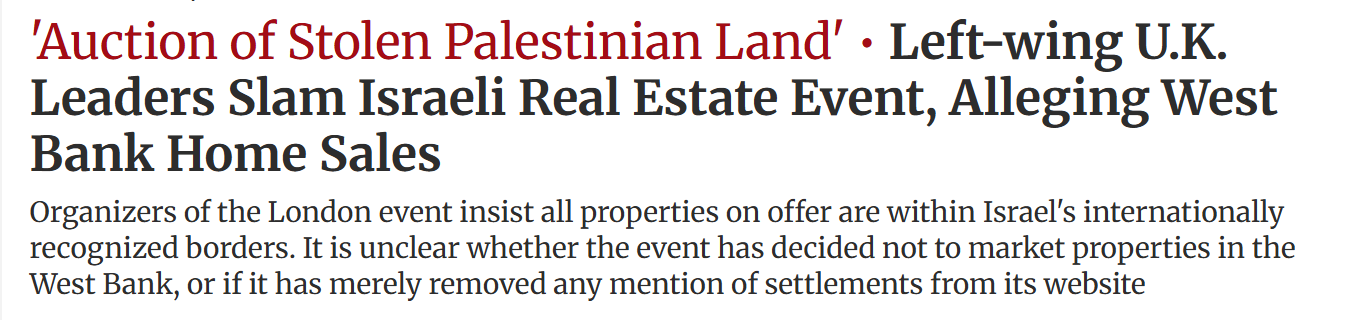
According to the Israeli daily Haaretz, “left-wing UK leaders” are “slamming” an Israeli real-estate event, alleging that it seeks to sell properties to Jews on stolen West Bank land.

While efforts to impede the ongoing Judaization of Palestine are commendable, there is a fundamental problem that lurks in the campaign’s understanding of what is and isn’t stolen Palestinian land. The reality is that all the land in historic Israel that is claimed by Jewish settlers—both within the 1967 borders and outside—is stolen.

Failing to acknowledge this reality implicitly legitimizes Israeli colonialism and all earlier thefts of Palestinian land. While it identifies land stolen in 1967 as Palestinian, it tacitly accepts land stolen in 1948 as legitimately belonging to Zionist settlers.

Of course, it can’t be true that land taken from Palestinians by Zionist violence in 1967 is Palestinian land, while land taken from Palestinians by Jewish settler violence in 1948 is not.

All the same, the illogic is concealed behind the claim that the violent transfer of Palestinian land to the new Israeli state in 1948 was legitimized by the UN partition plan.

This view, however, is wrong for a number of reasons.

1.) The plan was legally invalid, since it was based on a General Assembly resolution, and

1a.) General Assembly resolutions are non-binding, and

1b.) the General Assembly didn’t have the authority to partition Palestine. (Indeed, the UN Charter accords to neither the General Assembly or the Security Council the authority to create new states);

2.) The Palestinians rejected the plan;

3.) The Zionists also rejected it, as evidenced by the fact that:

3a.) They didn’t implement it; and

3b.) They conquered territory in excess of what the plan allocated to them.

The plan apportioned 56 percent of Palestine to one-third of the population that was Jewish (mainly settlers), and only 42 percent to the Palestinians, who comprised two-thirds of the population. (Two percent was allotted to what was to be an internationalized Jerusalem.)

By early 1949, the Zionists—keen to control as much of Palestine as they could—had conquered 78 percent of the territory (versus the 56 percent they were supposed to have under the plan.)

Still, even if the partition plan had been legally valid, it remained flagrantly colonial, since it endorsed the expropriation of the territory of the existing inhabitants by a group of settlers animated by the project of expelling as much of the Palestinian population as possible and them imposing a regime of Jewish ethnoreligious supremacy on those that remained.

The partition plan has become embedded in international law, but colonialism does not become just by virtue of its inclusion in international law. International law is the instrument of the colonial powers that formulated it. They formulated it to defend and promote their interests—not to protect weaker peoples and states.

The great powers make, and have made, international law, and when it doesn’t suit their purposes, they break it. So it is that they have read the partition plan into the global legal order, even though the plan was invalid under the very same order.

There exists today one Jewish supremacist state in all of historic Palestine. All the land, both within and beyond the 1967 borders, is stolen. The ineluctable conclusion is that home sales to Jewish settlers anywhere in historic Palestine, (not only in the West Bank), are auctions of stolen land.

The competing view that only settlements in the West Bank represent confiscated Palestinian land, endorses the colonial fiction that Jewish settlement within the 1967 borders is not colonial and has not taken place on the dispossessed land of the Palestinians. On the contrary, all the territory controlled by the US-backed colonial settler regime is colonized and stolen.

The solution to colonization is not colonization of all but 22 percent of a people’s territory—what’s proposed in the two-state “solution”—but decolonization, the creation of one democratic state, in which all people are equal, regardless of their ethnicity or religious identity.

That’s what Palestinians proposed from the very beginning. It is a multidimensional solution, one that remedies both the problems of settler colonialism (by creating its antithesis, the democratic state of all its citizens) and the problems of anti-Semitism and anti-Palestinianism (by depoliticizing ethnic and religious identity and thereby establishing the full equality of individuals, regardless of the religion they practice or the people they identify as.)

From the 22 percent of historic Palestine that the two-state proposal envisages for a Palestinian state; to Jawlan (called the Golan Heights by Israelis; conquered by the US-backed colonial settler regime in 1967; ethnically cleansed of its Syrian population; settled by Jews; and annexed by the Israeli state in 1981); to Israel itself: it is all stolen land. Failing to recognize this reality perpetuates an injustice and blocks implementation of the only fair and democratic solution to the multiple problems at the center of the Zionist colonization of historic Palestine and Jawlan.

Nazi Myth. Zionist Myth.

By Stephen Gowans

4 June 2026

A national Canadian newspaper, The Globe and Mail, published an editorial on 4 June 2026, lambasting Canadian prime minister Mark Carney for failing to condemn anti-Zionism. The editorial board pressed Carney to equate opposition to Israel’s existence with demonizing Canada’s Jews.

The editorial was titled “The Missing Words in Carney’s Speech”, a reference to a speech the prime minister had made to condemn what he described as a growing wave of anti-Semitism in Canada. “It was good that Mr. Carney went to a synagogue and addressed antisemitism,” argued the editorial, but added that “He should have said: ‘If you oppose Israel’s existence, if you demonize Jewish-Canadians, you are wrong, you are hateful and I stand against you.’”

The growing wave of anti-Semitism in Canada is a myth. As I explained in a previous post, B’nai Brith Canada, a pro-Israel lobby group, has invented “a national crisis” of antisemitism by defining opposition to Zionism and criticism of Israel’s conduct as Judeophobia. The organization, along with other pro-Israel partisans, are pressing Canadian governments at the federal, provincial, and municipal levels to implement legal measures to criminalize pro-Palestinian, pro-democracy and anti-Zionist, anti-colonial political positions. Carney’s speech added grist to the mill of the anti-Palestinian argument, but the Globe and Mail felt he hadn’t gone far enough.

Let’s be clear

1/ Zionism is not Judaism and nor are “Zionist” and “Jew” the same. Indeed, there are more Christian Zionists in Canada than there are Jewish Zionists.

Zionism is a settler colonial, ethno-supremacist, apartheid ideology, that is the foundation of laws and practices that maintain the dominance of one ethnic group (Jews) over all others in historic Palestine. Nazism, and the ideology of apartheid South Africa and Rhodesia, shared the same ethnic chauvinism and colonialist mentality.

2/ Conflating Jew and Judaism with Zionist and Zionism is reminiscent of the Nazis conflating, in one instance, Jew and Judaism with international banker and finance capitalism, and in another, with Bolshevik and Bolshevism. The Nazi’s “Judeobolsheviks” have become “Judeozionists” in the hands the Globe and Mail and other Israel supporters.

The conflation is a form of anti-Semitism, since it argues that ethno-supremacism and settler colonialism are inherent in Judaism (which they are not) and that all Jews, and only Jews, are ethno-supremacists who support settler colonialism (manifestly untrue.)

Neither were all Jews Bolsheviks or finance capitalists, though the Nazis would have had you believe they were. Likewise, The Globe and Mail would have you believe that all Jews in Canada are ardent Zionists and die-hard supporters of Israel. In point of fact, all Jews do not support an ideology and regime of ethnoreligious exclusion and rule over colonized natives and many of those who do support these abominations are not Jews. There is, therefore, no necessary connection between Jew and Zionist.

We can look at this another way.

Despite the Nazis’ self-appointment as representatives and champions of the German race, anti-Nazism was not hatred of Germans. Anti-Nazism=anti-German is an obvious logical fallacy, but one Nazis were happy to promote.

Likewise, despite Israel’s self-appointment as representative and champion of the world’s Jews, anti-Zionism is not hatred of Jews. Anti-Zionism=anti-Jew is also an obvious fallacy, but it is one, all the same, that Israel and its supporters are indefatigably keen to propagandize.

Having no other argument to make—how can one argue that settler colonialism and its offspring, apartheid and genocide, are good things?—Zionists reliably fall back on the myth that Nazis relied on to defend their own settler colonialism, apartheid, and genocide: Anyone who rejects the ethno-supremacist ideology I’ve adopted as self-appointed representative of my ethnic group, is obviously against my ethnic group.

Germans didn’t appoint the Nazis to represent their “race.” Nor did all Germans support the Nazis. Saying that all Germans were Nazis and that opposition to the Third Reich therefore amounted to demonizing Germans, is plainly absurd. It’s also a slur against Germans.

And yet this is precisely the argument Zionists, no less the Globe and Mail editorial board, make when they equate anti-Zionism with anti-Semitism.

The world’s Jews didn’t appoint Israel to represent them. Not all Jews support Zionism. (And most of the world’s Zionists are not Jews, but evangelical Christians. For example, CUFI, Christians United for Israel, has more members than all the Jews in the United States.) Saying that all Jews are Zionists and that criticism of Zionism is therefore demonization of Jews is no less absurd than saying all Germans were Nazis and anti-Nazism is demonization of Germans.

The truth of the matter is that Israel and its Zionist ideology are bleeding support, and the pro-settler colonial, apartheid, anti-Palestinian Israel lobby is trying to stop the hemorrhaging. Their answer: Invent a crisis of antisemitism, blame it on anti-Zionism, and press governments to implement laws and practices to silence activists calling for the decolonization and de-Zionization of historic Palestine.

Plus ca change. Throughout the late 1970s and 1980s, The Globe and Mail strongly supported apartheid South Africa and opposed the ANC, Nelson Mandela, and the liberation movement. Had it been able to, it might have argued that the prime ministers of the day should have dressed down ANC supporters, telling them that: ‘If you oppose the apartheid regime’s existence, you demonize white-Canadians.’” The newspaper, the organ of Bay Street, Canada’s financial center, will, it seems, forever be on the wrong side of history.

B’nai Brith Canada Invents a Crisis of Antisemitism to Pressure Governments to Criminalize Political Opposition to Israel

B’nai Brith Canada, a pro-Israel lobby group, has invented “a national crisis” of antisemitism by defining opposition to Zionism and criticism of Israel’s conduct as Judeophobia in order to press Canadian governments at the federal, provincial, and municipal levels to implement legal measures to criminalize pro-Palestinian and anti-Zionist political positions.

30 April 2026

By Stephen Gowans

On April 27 B’nai Brith Canada issued its Annual Audit of Antisemitic Incidents, arguing that “Canada is in the throes of a national crisis of antisemitism.” The report documented 6,800 incidents of antisemitism” in 2025, the “highest volume recorded” since the group began its tracking in 1982.

What is B’nai Brith, how does it define antisemitic incidents, and what actions does it want governments to take to address the crisis it has identified?

B’nai Brith is a pro-Israel lobby group which “works tirelessly to support and defend Israel” and whose mission is to “stand unequivocally with the State of Israel,” according to its website. The group does not represent Canadian Jews as a whole. Not all Canadian Jews are Zionists or supporters of Israel. Instead, the outfit represents Israel and Jews in Canada who stand firmly with the Jewish state.

Significantly, B’nai Brith describes its support for Israel as “unequivocal.” It backs Israel, right or wrong. In 1988, a US warship, the USS Vincennes, shot down an Iranian civilian airliner, killing 290 people. Then US president George H.W. Bush refused to apologize for the incident, saying that “I will never apologize for America.” B’nai Brith is the George W. Bush of Israel. It will never apologize for what it calls “the only Jewish state in the world.”

The group’s commitment to defending Israel is evidenced in its definition of antisemitism. The organization uses the International Holocaust Remembrance Alliance (IHRA) Working Definition of Antisemitism, prepared by an outfit that is as ardently pro-Israel as the B’nai Brith.  The IHRA definition has been widely criticized for 1) not being a definition at all, but a list of examples of what the group calls antisemitism, with no explanation of the principles than undergird the examples; and 2) for including anti-Zionism and criticism of Israel in three of its 11 examples.

The IHRA cites the following as an example of Jew hatred: “Denying the Jewish people their right to self-determination.” While anti-Zionists do not deny Jews the right to establish a state per se, they do deny Jews (and anyone else for that matter) the right to establish a national state on the country of another people. Israel’s existence depends on the non-existence of Palestine. In practice, Jewish self-determination is equivalent to the denial of Palestinian self-determination.

A careful and precise interpretation of the IHRA example above would exclude anti-Zionism as an example of antisemitism were an anti-Zionist willing to accept the creation of a Jewish state on a genuine terra nullius (unoccupied, unclaimed land). Indeed, I would argue that virtually all anti-Zionists fall into this category, since their opposition to Jewish nationalism lies not in Jews creating a state, but in the cancelation of one people’s right of self-determination (the Palestinians’) to assert another’s (that of Jews).

However, it is clear from the B’nai Brith report that the organization has interpreted the IHRA example to mean that anti-Zionism is antisemitism. The report describes criticism of Zionism, (e.g., that “Zionism is analogous to “settler colonialism”) as “demonization of Jews who believe in the right of the Jewish people to practice self-determination in their ancestral homeland,” and that this criticism, or “demonization”, creates “a moral justification for attacks that target the Jewish community.”

I would make a few points in reply:

  • Jews, to be sure, did have a state in Palestine in antiquity. But the Palestinians’ ancestral claim to the same land is equally strong. Indeed, it seems likely that today’s Palestinians are the descendants of Jews who lived in Palestine in antiquity, and were converted to Islam during the Muslim Expansion of the seventh century.
  • Palestine was the ancestral homeland of many peoples. That Jews once had a state there does not negate the rights of other peoples who have also had a presence in the same territory. The Palestinians, significantly, have an unbroken, multi-millennial presence in the land.
  • Criticism of Zionism does not create a moral justification for attacks that target the Jewish community. The categories Zionist and Jew are no more coterminous than are the categories Zionism and Judaism. There are more Christian Zionists in Canada than there are Jews, let alone Jewish Zionists. And not all Jews are Zionists; some are ardently anti-Zionist. Zionist and Jew are not the same. Criticism of Zionists is not equal to criticism of Jews. Likewise, criticism of Zionism is different from criticism of Judaism; one is a nationalist ideology, the other a religion.

It is likely that a majority of Jews in Canada support Israel and hold Zionist views. Based on this reality, B’nai Brith advances the sophistical argument that criticism of Zionism and Israel amounts to criticism of Jews (again, illegitimately conflating Jew and Zionist), and that, therefore, this criticism amounts to antisemitism. The argument is tantamount to claiming that anti-Nazism, at the height of the Nazi’s popularity, was an expression of hatred of Germans as a people. Only if one conflates Nazism with German ethnicity can this sleight of hand be pulled off.

Other indications that B’nai Brith defines anti-Zionism and pro-Palestinian positions as antisemitism:

  1. The pro-Zionist organization objects to pro-Palestinian student clubs at Canadian universities celebrating Palestinian resistance, decrying armed Palestinian resistance as “terrorism.” As an organization that stands unequivocally with Israel, we can be sure that the B’nai Brith regards the Irgun and Stern Gang—Jewish insurgent groups which, from 1931 to 1948, practiced terrorism in Palestine—as groups that resisted British colonialism.  Albert Einstein, Hannah Arendt, and the British preferred to call them terrorists, even fascists. Of course, one can be a resistance fighter and use terrorist methods, as much as a state can be a state and practice terrorism, Israel being an emblematic case. The categories are not mutually exclusive.
  • The pro-Israel group objects to the use of the terms “massacre” and “genocide” by Canadian journalists reporting on Israel’s conduct in Gaza and deplores the Canadian media’s “focus on civilian casualties and humanitarian imagery” along with the “presentation of casualty figures.” Moreover, it defines the following headlines as examples of anti-Israel media bias linked to antisemitism:
  • “Israel killing journalists and getting away with it, say advocates.”
  • “More than 400 dead in Gaza as Israel makes ‘extensive’ strikes ending ceasefire, standoff.”
  • “Winnipeggers rally to condemn Israel’s attacks on Iran, humanitarian crisis in Gaza.”

The points above make clear that the B’nai Brith is little more than a pro-Israel public relations outfit that objects to any and all criticism of Israel, and seeks to neutralize opposition to the state it tirelessly defends and stands by unequivocally by smearing the state’s opponents as Jew haters.  In the organization’s view, pro-Palestinian, anti-Zionist, and Israel-critical positions are antisemitic by definition. Political positions are cast as expressions of irrational hatred. When it reports that there is a crisis of antisemitism in Canada, what the Israel lobby group really means is that there is a growing tide of opposition to Zionism, hostility to Israel’s conduct toward the Palestinians, and intolerance of Israel’s character as an ethno-supremacist, apartheid, state.

Name-calling critics of Israel and anti-Zionists as anti-Semites is fairly harmless.  But B’nai Brith has no intention of stopping at traducing Israel’s opposition. Its real intention is to pressure Canadian governments at all levels to criminalize pro-Palestinian and anti-Zionist positions by portraying them as hate-speech.

The pro-Israel lobby group calls on the:

  • Federal government to designate the Lebanese, Egyptian, and Jordanian Muslim Brotherhood as terrorist organizations;
  • Provincial and territorial governments to prosecute antisemitic hate crimes, which, given the organization’s broad definition of antisemitic hate, includes any expression of opposition to Jewish nationalist ideology and ethno-supremacism and all support for pro-Palestinian positions;
  • Municipal authorities to ban “events that promote hatred”, by which it means pro-Palestinian and anti-Zionist events, including Al Quds Day.

To understand how dishonest both the B’nai Brith and its report are, consider what a pro-Palestinian report would look like if it mimicked the pro-Israeli lobby group’s approach. It would define denial of a Palestinian right of self-determination on the Palestinians’ ancestral homeland as anti-Palestinian hatred. Denouncing Hamas as a terrorist organization; denying the Nakba as a genocide; disputing the stamp of Israel’s conduct in Gaza as genocidal; dismissing as false or exaggerated reports of torture and sexual assault in Israeli prisons; denouncing the October 7 attacks as acts of terrorism rather a campaign of national liberation; rejecting the reality of Israeli apartheid; all of these–in other words, adopting the B’nai Brith’s own political positions—would be defined as hate speech rather than political speech. The media would be censured for describing October 7 as a massacre and focusing on Jewish casualties, as well as for failing to place Palestinian atrocities within the appropriate context. Media “bias” would be blamed for an avalanche of anti-Palestinian hate incidents. Finally, the report would call on governments at all levels to criminalize political speech that is critical of the Palestinian cause.

Canadians might think of the B’nai Brith as a Jewish advocacy group that works to overcome antisemitism. In reality, it is a pro-Israel lobby group that uses antisemitism as a weapon to smear people and organizations that oppose its pro-Israel political positions. The outfit poses as a representative of all Jews in Canada, but is, on the contrary, only a champion of Israel and Zionists, not Jews and Judaism. Its self-avowed mission is to work “tirelessly to support and defend Israel”, which it does, in part, by attacking opponents of Israel as antisemites, using a definition of Jew-hatred that includes opposition to Israel and the nationalist ideology on which the state is founded.

There is no crisis of antisemitism in Canada. The “crisis” is a myth invented by the Zionist outfit to pressure Canadian governments, at all levels, to criminalize pro-Palestinian positions and anti-Zionist advocacy—that is political speech—as hate speech. B’nai Brith must be resisted, exposed for the pro-Israel lobby group it truly is, and contained as a menace to the right of political advocacy.

They Demonize Our Revolutionaries

20 April 2026

By Stephen Gowans

On April 14, Ezra Klein, the New York Times’ columnist and podcaster, sought a “reckoning with Israel’s ‘one-state reality’.” He organized a discussion with Marc Lynch and Shibley Telhami, a pair of academics who had written a 15 July 2025 article in Foreign Affairs, The Promise and Peril of Recognizing Palestine. Their article asked whether “a two-state solution [could] emerge from a one-state reality?”

The discussion had two merits: First, it acknowledged that a Jewish supremacist state exists from the river to the sea. As Lynch and Telhami put it in their Foreign Affairs article:

Israel is not a democratic state incidentally occupying Palestinian territory. All the territory west of the Jordan River has long constituted a single state under Israeli rule, where the land and the people are subject to radically different legal regimes, and Palestinians are permanently treated as a lower caste.

Israel, in other words, is a democratic state for Jews, and a Jewish state for Palestinians, on whose country, land, and homes, Israel has been built. The philosopher Domenico Losurdo called it a Herrenvolk democracy—a democracy for (and only for) a master people. Others call it, correctly, an apartheid state. The three descriptions are congruent.

The second merit was Telhami, who offered a number of important insights. I’ll cite but one.

Israeli strategy from Day 1 has been to have what they call escalation dominance. It is a one-sided deterrence; it is that whenever there’s a fight with any party in the region, Israel can escalate it to the next level until it has the upper hand, and it will always have the upper hand. In effect, you’re saying you have to have strategic dominance over every conceivable party in the Arab world and the Middle East. That’s half a billion people. And you are a country of 10 million. That is why Israel doesn’t want Iran to have nuclear weapons

The last sentence, perhaps, requires some elaboration. Consider this: On April 18, New York Times’ reporters Mark Mazzetti, Adam Entous and Julian E. Barnes began a report on the US-Israeli war on Iran with the following: “The United States and Israel launched their war against Iran on the argument that if Iran one day got a nuclear weapon, it would have the ultimate deterrent against future attacks.”

Note that the reporters didn’t say the two aggressors attacked Iran because it had threatened either country or any of their allies, or because they were motivated by human rights considerations. Instead, they wrote that the United States and Israel launched their war to prevent Iran from acquiring the nuclear arms that would provide Tehran a means to deter future US and Israeli aggression. These arms would, in Telhami’s words, check US and Israeli escalation dominance. Were Iran to achieve this objective, it would deny the two aggressor states strategic dominance over “half a billion people” and “every conceivable party in the Arab world and the Middle East.” Thus, it is not a nuclear threat to the physical safety of Americans and Israelis that Washington and Tel Aviv seek to deter, but a threat to their ability to dominate West Asia and its hundreds of millions of people.

Klein, a man who acknowledges that he does not count himself among those who want to see Israel cease to exist (though the idea that anyone should want an apartheid state to continue exist is troubling), offered his own commentary, some of which had merit.

  • He argued that “the one-state reality” [which is to say, Israeli apartheid, is] not accidental. It was, and is, not intended to be transient. It was being etched into the land — in stone and cement, in settlements and checkpoints, in the construction of walls and the demolition of homes.”
  • He noted that “More settlements were approved in the last year alone than in the previous two decades combined.”
  • He lamented that “Israel has allowed — has protected — a terrifying rise in settler and military violence toward the Palestinians who live” in the West Bank, adding that “There is no doubt, if you go there, who rules the West Bank — and it is not the P.A.”
  • He pointed to how “Israel has used the war in Iran as cover to invade Lebanon, displacing more than a million people, adding that “it is an open question whether any of those 600,000 Lebanese will ever be able to return to their homes.”
  • He acknowledged that Israel has no intention of allowing the Palestinians a state of their own.

Sadly, Klein’s merits are outweighed by his egregious faults. Significantly, he fails to explain how Israel’s resolve to deny the Palestinians a state of their own has left the Palestinians bereft of any option but violence to redress a fundamental wrong; and that this, by itself, explains the outbreak of Palestinian violence on 7 October 2023.  

Palestinian rebellion was met on the Israeli side by Tel Aviv stepping up its decades-long efforts to erase the Palestinians as a people. These efforts have been evinced, to use the language of the Genocide Convention, in the:

  • Killing of Palestinians in large numbers;
  • Inflicting on them serious bodily and mental harm; and
  • Imposing on them conditions of life calculated to bring about their demise.

Klein excuses these genocidal acts as “what any state and any people would do.” That’s doubtful. What any state and people might have done, and certainly could have done, is begin to redress the historical injustices that produced the rebellion. As Marx observed about the 1857 Indian Rebellion against the country’s British colonizers: “There is something in human history like retribution.” (The Indian Revolt, 16 September 1857) Or, to borrow from Marx again, with appropriate alterations of language for time and place: “However infamous the conduct of the Palestinians on 7 October 2023, it was only the reflex, in a concentrated form, of Israel’s own conduct”. Any serious effort to prevent future Palestinian violence, would address the root of the violence, not try, by escalation dominance, to suppress it, so that the fruits of the injustice Zionists have visited upon their victims — the theft of their land, homes, property, and country — can continue to be enjoyed by Israeli Jews into the future. That is what is meant when one says Israel’s response to the Palestinian rebellion is justified because it is what any state or people would do.

Genocide is built into settler colonialism. Settlers seek the land of indigenous peoples for the exclusive use of their own ethnic group. European settlers did so in North America, Australia, and New Zealand; German settlers did so in southwest Africa; and the Nazis tried to do so in eastern Europe, where Slavs, Jews, and Roma–the occupants of the land Hitler coveted for Lebensraum and German settlement–paid a terrible price. Jewish settlers have done the same to the natives of Palestine. In all cases, the result has been genocide. Settlers drive indigenous peoples off land they covet by expulsion, extermination, or both. Settler colonialism rests on the logic of the elimination of the natives.

Settler colonial states of the past have acted just as Israel, a settler colonial state of the present, has. But that’s hardly a justification for genocide. The Nazi SS Einsatzgruppen shot 34,000 Soviet Jews and dumped then in the Babi Yar ravine in September 1941 in retaliation for Soviet agents detonating mines in occupied Kiev which killed as many a three-hundred German soldiers. This was an instance of settler colonial forces undertaking harsh reprisals against the violent rebellion of the natives, in this case, against an ethnic group, Jews, viewed by the Nazis as being intimately linked to the political leadership of the resistance, or terrorists, as the Nazis called them. According to Klein’s logic, the Nazi reprisal killings were justified as “what any state and any people would do.”

It might also be pointed out that if Israel did “what any state and any people would do,” then Hamas and Hezbollah have done what any colonized and oppressed people would do. Colonized people never allow the colonizer to despoil their country, land, homes, and property, without putting up a fight. We might call this an iron law of history. To borrow Marx’s language, the inevitable rebellion of the Palestinians on 7 October 2023 no more lends itself to moralizing – for or against – than does an earthquake in California or a snowstorm in Canada, both inevitable events. It’s what colonized and oppressed people have always done and will always do. So, if we can point to genocide as what any colonial settler state and settler people would do to the people it’s oppressing, we can also point to violent rebellion as what any colonized people would do to the people who are oppressing them.

Klein’s heart bleeds for Palestinians who have been denied a state of their own and for the Shia of south Lebanon who the Israelis have driven from their homes, perhaps never allowed to return. But in his view, Hamas and Hezbollah, the inevitable response to Zionist settler colonialism, are anathema. Israel’s “right to reprisal against Hamas and Hezbollah,” he says, “is undeniable.” Sure, as much as the SS’s right to reprisal against Jews for the killing of three-hundred German soldiers at Kiev was undeniable. Zionists will object that you can’t compare Israel to Nazi Germany. But you can. As a settler colonial state, Israel shares much in common with its settler colonial cohorts: the United States, Canada; Australia; New Zealand; and Germany.

Klein must, in the words of the Syrian singer Siba, “demonize our revolutionaries,” as much as Israel must “eradicate our roots; demolish our homes; criminalize our existence; falsify our origins; separate our loved ones; and slaughter our children.”

Those who pity the oppressed but condemn their rebellion and demonize their revolutionaries are no friend of the oppressed. They aid the oppressor. But, then, I suspect Klein is alright with that.

Who Rules the US Revealed in Washington’s Cuba Demands

The idea that US foreign policy is driven by national security and human rights considerations is contradicted by the list of demands the US State Department issued to Havana last week. In reality, US foreign policy is driven by the interests of US businesses and investors, as the US demands make clear.

Cuba must:

o Transition to a market-based economy;

 o Expand its private sector;

o Open its door to foreign-investment;

o Compensate U.S. citizens and corporations whose assets and properties were nationalized in the 1960s;

o Release political prisoners;

o Expand political freedoms.

Washington “signaled that the United States would not tolerate resistance to its demands.”

The New York Times’ headline that reported on this meeting said that US officials travelled to Havana to lay out proposals, when, in point of fact, as the text of the article indicated, the US delegation issued demands to which it said it “would not tolerate resistance.”

Jean-Jacques Rousseau: Epstein Avant La Lettre

I have been reading Jean-Jacques Rousseau’s Confessions, the first modern autobiography. I was shocked by one incident the eighteenth-century composer, novelist, and philosopher describes.

Rosseau writes of “a little girl of eleven or twelve,” named Anzoletta, who he and his friend, Carrio, bought from her mother with the aim of enjoying her “sensual pleasures,” that is, keeping her as a sex slave.

Carrio, who was a lady’s man, grew weary of always going to women who belonged to others and took it into his head to have one of his own; and as we were inseparable he suggested to me an arrangement which is not rare in Venice, that we should keep one between us. I agreed. The next question was to find a safe one. He made such thorough investigations that he unearthed a little girl of eleven or twelve, whom her wretched mother wanted to sell. We went to see her together…She was fair and gentle as a lamb. … We gave the mother some money, and made arrangements for the daughter’s keep. (The Confessions of Jean-Jacques Rousseau. Book Seven, Penguin, 1953, p. 302.)

Rousseau says that he developed a parental affection for the girl that prevented the relationship from developing into a sexual one. All the same, he and Carrio bought the girl with the intention of “being the corrupters of her innocence,” as Rousseau writes.

What is striking is that the theorist of liberalism passed over the incident without showing the faintest pang of conscience, though at other times he expressed great remorse for actions that by today’s standards pale in comparison with the intended sexual enslavement of a prepubescent girl.

Throughout his Confessions, Rousseau claims to tremble in outrage at wrongs and the exploitation of the weak, though clearly his aversion to injury inflicted on the weak was far from universal, and likely very much limited to inflictions upon people such as himself, and certainly not on little girls of poor families.

What Might Lenin Have Thought About the US-Israeli War on Iran (and the War in Ukraine)?

Facit indignatio versum

(Indignation makes my verses) – Juvenal

1 March 2026

Stephen Gowans

In his analyses of the causes of the first world war, Lenin stressed the importance of understanding the policies the belligerent states pursued before the war. Borrowing from the Prussian military theorist Carl von Clausewitz, the Bolshevik leader argued that war is politics by other (namely, violent) means. Clausewitz put it this way: “War is policy itself, which takes up the sword in place of the pen.” Lenin echoed Clausewitz: All “war is but a continuation by violent means of the politics which the belligerent states and their ruling classes had been conducting for many years, sometimes for decades, before the outbreak of war.”

So, what policies were the belligerents pursuing by the pen, before they took up the sword? The answer, in Lenin’s view, explained what caused the war. If “you have not studied the policies of [the] belligerent groups over a period of decades … then you don’t understand what this war is all about,” he wrote.

All the belligerents, argued Lenin, were pursuing the same policy: they were reaching across the world for opportunities to dominate its economic surpluses wherever they could be found.  They had been able to do this, for a time, without each greatly impeding the other. However, they had arrived at the point where this was no longer possible. The sum total of opportunities had been completely claimed, and acquiring new ones, could only mean encroaching upon the opportunities that other states, or more specifically, other ruling classes, claimed for their own. The cause of the war, then, was “the whole policy of the entire system of European states in their economic and political interrelations.” The war, said Lenin “steadily and inevitably grew out of this system.”

The word ‘system’ is important. Lenin saw powerful states as actors hopelessly entangled in a system of inter-state relations which pit one against the other for economic advantage. This was a system in which individual states, acting on behalf of, and as the instruments of, individual ruling classes, competed for opportunities to exploit labor and acquire raw materials in order to appropriate as much of the world’s economic surpluses as they possibly could. As a class, said Engels, the bourgeoisie has a common interest and this community of interest, which is directed against the proletariat inside the country, is directed against bourgeois of other nations outside the country. What do ruling classes do? Exploit the labor of subordinate classes. So, when the common interest of one ruling class is directed against the common interest of another, it is directed against encroaching on territory over which the other exploits labor.  The community of interest against the ruling classes of other states took both non-violent (by the pen) and violent (by the sword) forms. “These policies,” argued Lenin, “show … continuous economic rivalry between the world’s … greatest giants, capitalist economies.”  

In light of his analysis, Lenin believed that the question of which belligerent fired the first shot in the war—that is, which, in today’s terms, launched a war of aggression contra international law—was beside the point, for each was pursuing a policy that would inevitably lead to war.  As he put it: “This war is the continuation of a policy of … conquest, of capitalist robbery on the part of [the states] involved in the war. Obviously, the question of which [state] was the first to draw the knife is of small account to us.” Why? To reiterate: “Everybody was preparing for the war; the attack was made by the one who considered it most auspicious for himself at a given moment.” Another would have turned to the sword first, if, in the moment, violence was the means judged to be most suitable to the pursuit of policy.  For this reason, Lenin refused to blame Germany for starting the first world war, even though the Kaiser declared war on Russia and France and invaded Belgium.  “For decades,” explained Lenin, “three bandits (the bourgeoisie and governments of England, Russia, and France) armed themselves to despoil Germany. Is it surprising that the two bandits (Germany and Austria-Hungary) launched an attack before the three bandits succeeded in obtaining the new knives they had ordered?”

Much of the discourse on the current war in Ukraine is concerned with the question of which state started it. If we take Lenin’s view, the question is of no consequence, since the origin of the war lies not in Valdimir Putin’s decision to send Russian troops thundering across the border into Ukraine on 24 February 2022, or the decisions of US and NATO leaders to renege on their promises to assuage Russian security concerns by forbearing from NATO expansion into the former Russian sphere of influence. It lies instead in the rivalry between the Atlantic Alliance and Moscow for the economic interests of their respective ruling classes.

When I say the economic interests of the ruling classes I don’t mean specific deals, or pipeline routes, or mining concessions, although they may be involved. I mean, something broader: the ability of a ruling class to exploit opportunities for capital accumulation over as wide a territory as possible—which means at home, and if the state is strong enough, abroad. The existence of multiple ruling classes obviously complicates matters. Since there are multiple states, hence multiple ruling classes, there are multiple ongoing efforts to exploit the same economic spaces. This isn’t to say that security concerns aren’t relevant. The first job of a ruling class is to survive. Security concerns very likely played a part in Moscow’s decision to try to conquer Ukraine. But why do exploiting ruling classes want to survive? To exploit.

The Imperialism of Peace

Lenin’s analysis produces the interesting and important concept of the imperialism of peace. If war, in Lenin’s view is simply one means of pursuing a policy for economic space and opportunity, then soft-power, diplomacy, and other non-violent forms of inter-state intercourse, are but alternative methods of pursuing the same policy.  In the words of the German-Polish Marxist, and cofounder of the German Communist Party, the martyred Rosa Luxemburg, policy is pursued as either war or armed peace. Peace treaties may stay a violent hand for a time, but they do not eradicate the rivalry that gives rise to war. On this matter, Lenin and Luxemburg were ad idem with the eighteenth-century philosopher Immanuel Kant. Kant argued that a “treaty of peace makes an end to the war of the moment, but not to the conditions of war which at any time may afford a new pretext for opening hostilities” (emphasis added). This is a radical view. To end war, the conditions of war must be eradicated. Peace treaties simply paper over the problem and fail to address the root of war.

In the view of Lenin, Luxemburg, and Kant, inter-state rivalry is ubiquitous and interminable; competition among states is always present, even when violence is absent from their intercourse. If we define war as the effort of one ruling class to impose its will on another, then states are always at war, even if they are not using violence to get their way. Kant again: “A state of peace among men who live side by side is not the natural state, which is rather to be described as a state of war: that is to say, although there is not perhaps always actual open hostility, there is a constant threat that an outbreak may occur” and “the separate existence of a number of neighboring and independent states…is in itself already a state of war.”

Incessant struggle, even in times of formal peace, calls to mind the observations of numerous other thinkers. Lenin’s view was hardly novel.

Clinias of Crete, a character in Plato’s final dialogue, The Laws, contended that “Even what most men call peace is but a name. The reality is that every state, by a law of nature, is engaged at all times in an undeclared war against every other state.”

In 1651 Thomas Hobbes argued in Leviathan that: “In all times kings, and persons of sovereign authority, because of their independence, and in ceaseless competition [for power], are in the state and posture of gladiators; having their weapons pointing and their eyes fixed on one another; that is, their forts, garrisons, and guns, upon the frontiers of their kingdoms; and continual spies upon their neighbors; which is a position of war.”

British prime minister Pit the Elder in 1763 accurately predicted that the Treaty of Paris, ending the Seven Years’ War, would be nothing but an armed truce.

French marshal Ferdinand Foch presciently characterized the Treaty of Versailles as “not a peace [but] an armistice for 20 years.”

While every state may be at war with its neighbors, some states are more able, as a matter of their great size and strength, to wage it. Washington is at war with every state (that is every other ruling class) that does not submit to US hegemony. Almost always the war is carried out as the imperialism of peace. For decades, Washington has waged war on Iran by mainly economic means, punctuated, every now and then, by violence, but violence has been the exception. The rule has been daily non-violent coercion extending over decades. The US war on Iran aims to contain and weaken the state so that it is incapable of extending its own domain to territory the US state currently dominates; to demonstrate to other states that what happens to countries that fail to toe the US line is that they will be menaced, throttled, and undermined by the United States, its proxies, or both; and to make Tehran more compliant with US demands favorable to US ruling class interests.    

Washington has long held Iran in a cruel economic vice that has immiserated Iranians. The predictable and intended outcome of this campaign has been civil unrest. The program has paid off handsomely for Washington, with the Iranian economy collapsing under the weight of US cruelty. Iranians took the street to demand their government provide relief from the pain, relief Tehran had not the power to provide. Even capitulating to US demands would not bring about the desired relief, since Washington refused to provide any immediate easing of its sanctions. On 20 January, The Wall Street Journal quoted US Treasury Scott Bessent: “U.S. financial pressure ‘has worked because in December, their economy collapsed. This is why the people took to the street. This is economic statecraft, no shots fired.’” To be clear, the reason why civil unrest erupted in Iran was because the United States brought it about, not by accident, not unintentionally, but by malice aforethought.

Bessent’s acknowledgement that the collapse of the Iranian economy is the product of US “economic statecraft”, which is to say the imperialism of peace, is virtually absent from the analyses of the quality, but all the same, Chauvinist and pro-imperialist, US media. No matter how sound their analyses might otherwise be, they cannot help but propagate the fiction that the collapse of economies undermined by US “economic statecraft” is due to the “economic mismanagement” of the targeted “regime.”  Thus, the victim is blamed for the miseries the US ruling class visits upon the victim’s citizens. This is true of the US imperialism of peace in Venezuela and Cuba as much as Iran.

As shocking and deplorable as the current US-Israeli attack on Iran is, is it any more shocking and deplorable than the decades-long dropping of economic atom bombs on the people of Iran by the US state and its bootlicking vassals, Canada, the UK, Germany, and so on? Indeed, it may turn out that US “economic statecraft” has created more misery in Iran than will be created by all the US and Israeli bombs that will be dropped and all the missiles that will be fired in the current campaign of violence. This isn’t to lessen the gravity of the violence unleashed on the Iranians, but to point out that a program of deliberately wrecking an economy and immiserating a people in order to expand the domain over which US and allied billionaires can dominate the world’s economic surpluses is equally deplorable and is as richly deserving of condemnation and opposition as the use of violence to achieve the same end.

Mendacity

As to the claim that Washington and its toadies are engaged in an operation to deter an Iranian threat, we can dispense with this piece of nonsense immediately. The notion that Iran is developing a nuclear arsenal and ICBMs to reach the United States is the kind of bald-faced, shameless, mendacity in which the US administration specializes. As the New York Times reported two days ago:

President Trump and his aides assert that Iran:

  • Has restarted its nuclear program;
  • Has enough available nuclear material to build a bomb within days; and
  • Is developing long-range missiles that will soon be capable of hitting the United States.

But:

  • There is no evidence that Iran has made active efforts to resume enriching uranium or trying to build a mechanism to detonate a bomb.
  • American intelligence agencies believe Iran is probably years away from having missiles that can hit the United States.

What’s more, US intelligence is of the view that Iran is not actively pursuing nuclear weapons.

Iran, a country dwarfed in population, GDP, and military assets by the United States alone, to say nothing of the United States and its allies, is no more of a threat to the United States than a Boy Scout troop armed with peashooters is a threat to a platoon of US Marines. All threats the chronically mendacious Washington cites are greatly inflated because Washington regards as a threat any state that 1) does not submit to US “leadership” and 2) has a means of self-defense. Iran will only be characterized as a non-threat when it has given up every means of defending itself. Indeed, US demands in its phony negotiations with Iran can be understood as an ultimatum to surrender all means of self-defense or face a withering attack.

Even if Iran had ICBMs and nuclear-warheads to place atop them it still wouldn’t be a threat to the physical safety of any person in the United States. North Korea is a nuclear-armed state with, what might very well be the ability to deliver warheads to the continental US by ICBMs, but it is hardly a threat. The reason why is that Pyongyang can’t survive a war with the United States, and therefore would never start one. The same would be true of a nuclear-armed Iran. What a nuclear-armed Iran is a threat to is Washington’s latitude to bully Tehran and impose its will on the state. That, in turn, is a threat to the US ruling class project of dominating as much of the world as possible. This, of course, is the aim of every exploiting ruling class, but few have the resources to pursue the goal. Most must be content with defending spheres of exploitation within their own territory, either by resisting the aggressions of larger states seeking to encroach on their own domestic sphere of exploitation, or coming to an arrangement that makes concessions to the larger state’s menacing demands. As for Iran, its failure to follow the path of North Korea is largely responsible for the peril in which it now finds itself. No country in Iran’s position that wishes to pursue an independent path free from the domination of the United States (or any other meddling great power) can afford to be without a nuclear deterrent.* Washington may sincerely believe Tehran is pursuing a nuclear weapons program and developing ICBMs because it makes sense for the Iranian state to do so in light of Washington’s own conduct.  It should be clear by this point that a view that is consistent with Lenin’s would deny that Washington will ever refrain from behaving in ways that encourage its victims to proliferate. The raison d’etre of the US ruling class is not to live in peace with other ruling classes, but to weaken them and turn them into vassals, and if that can’t be done, to crush them. Letting them be is not an option, any more than choosing not to try to score goals is an option for a hockey team.

International Law

Lenin’s view of war raises a question about whether international law has any practical significance. I would say that the answer is manifestly in the negative and I would hardly be alone in this view. Kant, for example, observed that “Codes [of international law] whether couched in philosophical or diplomatic terms, have not—nor can have—the slightest legal force, because states, as such, are under no common external authority.” Nothing has changed in two hundred years to contradict Kant’s thinking. Large powers and their proteges regularly violate international law without the slightest reservation and do so with impunity. They get away with it because there is no overarching, independent, authority equipped with the means to enforce compliance with international law. The strong do as they will, and the weak suffer what they must. Given this sad reality, it is “an illusion,” remarked the Marxist economist Rudolf Hilferding, “to preach international law in a world … of capitalist struggle where [the] superiority of weapons is the final arbiter.”

I point this out because much discourse about war, apart from ignoring the imperialism of peace, attaches itself to outraged diatribes against the failure of various states (usually the United States and Israel, the accustomed miscreants) to abide by international law. Carrying on a discussion as if international law and the rules-based order have any significance as guardrails on the conduct of powerful states, focusses attention in the wrong place. The Tartuffe of international law, Canadian prime minister Mark Carney, admitted in his vaunted World Economic Forum address what anyone not stultified by the propaganda of the United States and its international lickspittles already knew: That “the story of the international rules-based order was partially false; that the strongest would exempt themselves when convenient; that trade rules were enforced asymmetrically. And we knew that international law applied with varying vigor depending on the identity of the accused or the victim.” If Venezuela, Iran, or Cuba were to violate international law, they would be held accountable and punished by the UN Security Council, largely a plaything and instrument of the United States.** When the United States and its proxies (Israel especially) violate international law, as they regularly do, nothing happens, except that a chorus of progressive voices bleats fecklessly about US and Israeli crimes, on the assumption presumably that ‘speaking truth to power’ will make the malefactors mend their ways. As the nineteenth-century French novelist Balzac is reputed to have observed: “Laws are spider webs through which big flies pass and little ones get caught.” Despite all the bleating, the big flies continue to pass through the spider webs with scarcely a concern.

To echo Hilferding, it is an illusion to preach international law in a world of struggle among states where the superiority of weapons is the final arbiter. As Lenin, and before him, Marx, argued, though not precisely in these words, inter-state war ends when inter-state rivalry ends. And inter-state rivalry ends, when states end. What should not be forgotten is that the long-range project of socialism is not only the end of class, which is to say the end of exploitation of one group by another, but, as a consequence of this, the end of states.  We say, declared Lenin in a lecture on war and revolution, our aim “is to achieve a socialist system of society, which, by eliminating the division of mankind into classes, by eliminating all exploitation of man by man and nation by nation, will inevitably eliminate the very possibility of war.”

Notes

*On the other hand, nuclear weapons would not be a panacea for Iran. While they would very like dampen the war-lust of Washington and Tel Aviv for bombing Iran, they would do little to stop the US-led siege warfare that cripples the country and immiserates its people.

Moreover, Iran’s geopolitical situation is different from that of North Korea, and concluding that what is strategically sound for North Korea is also strategically sound for Iran, may be an error.

North Korea borders two significant powers, Russia and China. As states outside the US orbit, Russia and China are willing to trade with Pyongyang if it’s to their advantage. This makes the DPRK less vulnerable to US economic warfare than Iran, which is isolated geographically from China.

Additionally, Iran is located in, what is for Washington, a strategically important region. West Asia produces a substantial fraction of the world’s petroleum resources, which Washington aims to control in order to exercise leverage over China, Japan, and Europe, which depend on energy imports from the region. In order to control the region, Washington needs regional states to be submissive to US preferences. Inasmuch as Iran refuses to act as a US client, it has been the target of US conventional and economic warfare.

North Korea, in contrast, occupies territory that is less strategically significant for Washington, and therefore, Pyongyang can be more readily ignored. It matters little from the US coign of vantage that North Korea zealously asserts its independence. Doing so doesn’t affect US strategic interests. While it is true that China is considered the United States’ single most important strategic threat, and North Korea abuts China, Washington’s focus on the Indo-pacific region is mainly confined to maintaining control of the First Island Chain, the belt of islands running from Japan through Tawain to the Philippines and Malaysia.

An independent North Korea, then, is less of an impediment to US geopolitical ambitions than an independent Iran, and the United States is therefore less likely to be moved to attack it, nuclear arms or otherwise. It’s not clear that the same calculations apply to Iran. Why take a gamble on attacking North Korea, if the outcome might be a nuclear counter-strike? On the other hand, Washington might be prepared to gamble on attacking a nuclear-armed Iran, in light of Iran’s greater strategic importance.

** While the Security Council by no means invariably produces resolutions reflecting US preferences, on matters that do not abridge the interests of other permanent members, the council tends to go along with US wishes. Witness, for example, UNSC Resolution 2803 of 17 November 2025, which effectively ceded Donald Trump a personal autocracy over Gaza.  It is from this very same resolution that Trump’s Board of Peace was born.  There has been much talk about Trump using his Board, of which he is the chairman, as an alternative to the Security Council.  A case might be made that the Security Council is not the plaything and instrument of the United States, for if it is, why would Trump seek to establish the Board of Peace as a new Security Council? It’s true that a whole loaf is better than nine-tenths of one, but wanting a whole loaf doesn’t prove that you don’t already have nine-tenths of it. In any event, the Board of Peace is comprised, apart from its chairman, of leaders of states with insignificant power that have joined to curry favor with the US president. The Board’s power is in no way equal, much less greater, than that of the Security Council.  It may be able to compel its few members to go along with Trump’s whims, but the Security Council, in theory anyway, can compel the compliance of every UN member state.  

The Historical Injustice Behind Palestinian Violence

29 December 2025

Stephen Gowans

There is a fundamental injustice at the root of Palestinian violence.  In 1948, Jewish settlers stole most of the Palestinians’ country. Israelis claim that part of historic Palestine was given to them by the United Nations, but the claim is false, and even if it were true, Palestine wasn’t the United Nation’s to give away. It’s true that the United Nations General Assembly in Resolution 181 of 29 November 1947 recommended a partition of Palestine between a state for recent Jewish immigrants and a state for indigenous Palestinians, but the recommendation was rejected by the Palestinians, and was never implemented. Moreover, the United Nations had no authority to deny the Palestinians self-determination in their own land, or to confiscate part of their country to create a Jewish state. There was no moral foundation or legal basis for the creation of a state for Jews in Palestine. Israel is not the child of moral necessity and law but the product of naked aggression, land theft, and ethnic cleansing.

In 1967, Israel conquered those parts of Palestine it had not stolen from the Palestinians in 1948. Its new conquests included the West Bank, the Gaza Strip, and East Jerusalem, along with parts of Egypt (the Sinai) and Syria (Golan). Since then, the newly-seized Palestinian territories have been occupied while the Sinai has been returned to Egypt (in return for Cairo renouncing Arab nationalism and becoming a US client state), and the occupied Golan has been annexed illegally with the blessing of the United States.  

Today, approximately seven million Jewish settlers live in conquered Palestine, occupying about 85 percent of the country. A roughly equal number of Palestinians live in the remaining 15 percent of their homeland (while some eight million are scattered abroad, many living in refugee camps in Lebanon, Syria, and Jordan). Israeli policy, as evidence by the country’s actions, is to gradually drive into exile as many of the seven million Palestinians who remain in historic Palestine as possible, mainly by usurping their land and making their lives miserable. The process echoes the efforts of the Nazis from 1933 to Kristallnacht of 9-10 November 1938 to drive Jews out of Germany in order to create an ethnically pure German state. The Israelis, for their part, aim to create nothing as extreme as the Nazi’s homogeneous ethnic state, but a demography that substantially favors Jews. With a rough balance of Jews and Palestinians currently living within the territory Israel controls, that means either significantly reducing the Palestinian population, or ceding a Palestinian state on the 15 percent of historic Palestine in which Palestinians are concentrated, and accepting that the land of Israel will not include what Jews of antiquity knew as Judea and Samaria. The latter option, however, is rejected, not only by the current Israeli government, but by Israeli society generally.

In the absence of any intention to concede a Palestinian state, the Zionist imperative of creating a Jewish majority within a territory in which as many Palestinians as Jews live, means either driving the indigenous people out of the country, or failing that, forcing them into an ever shrinking space, as Israel takes more and more of their land, homes, and property for the building of settlements for Jews (including newly immigrated Jews from such places as the United States, Canada, and Western Europe.) The process echoes the genocide of the indigenous peoples of Turtle Island and of the Slavs and Jews of the German East (the territory of Eastern Europe the Nazis sought to conquer as Lebensraum to settle the German Herrenvolk.)  It also means denying Palestinians political rights in the West Bank, Gaza Strip, and East Jerusalem—in other words, apartheid.

This raises a question. Why are the Israelis so adamant about refusing the Palestinians a state of their own, especially considering that the state would comprise only a tiny fraction of the Palestinians’ original country and leave the bulk of it to the Jews? The answer is surely that, from the perspective of the Zionist project, a Palestinian state represents an opportunity cost (giving up land that could be otherwise taken from the Palestinians for the use of Jews) but offers no clear benefit. The presumed benefit is peace. With their own state, it is supposed that the Palestinians will recognize the legitimacy of a Jewish state comprising the bulk of their country, making up that part the Zionists stole in 1948, plus part of the territory conquered in 1967 that has strategic value to Israel and which contains major Jewish settlements. True, the organized Palestinian resistance would gladly accept a Palestinian state in even only 15 percent of historic Palestine, but it has made clear that the realization of the two-state solution is not its end-game. Western states that back the two-state solution envisage something like a Palestinian protectorate with Israel as suzerain, controlling the state’s borders, police force, and foreign policy. The only way to persuade Israel to accept a Palestinian state, in their view, is to assure the Israelis that a Palestinian state will pose no threat to Israel’s existence as a Jewish state. And the way to do that is to insist that the state of Palestine have no military and that its leaders are quislings who serve at the pleasure of either Israel or Washington or both. This reflects an implicit acknowledgement that the dispossessed will always be a threat to those who dispossess them; that the dispossessed want returned to them what is rightfully theirs; and that unless a Palestinian state has no military and is governed by stooges of Israel and its Western patrons, the Palestinians will be at liberty to use the resources of their new state to attempt to recover, by force, what they have been unjustly denied.   

Of course, Israel could be strongarmed into acceding to a Palestinian state. The Zionist state depends significantly for survival on the support it receives from the United States and major US allies. By threatening to cut off or reduce arms transfers and diplomatic support, the West could compel its client state to comply with its demands to accept a state for the Palestinians. But the West has never used its leverage to force the Israelis to make any meaningful concessions to the Palestinians, and shows no sign of departing from this policy. Indeed, since the Oslo Accords of 1993, which were supposed to begin a process of moving toward the creation of a Palestinian state, the Israelis have consistently maneuvered to undermine the project, and the West has done precious little to stop them.  The number of Jewish settlers in the West Bank, which would form the largest part of a Palestinian state, has grown from 280,000 shortly after the Oslo Accords to 950,000 by 2023, more than a three-fold increase. [1] And Israeli efforts to sabotage a Palestinian state have only accelerated since 7 October 2023. The Zionist state unabashedly, even proudly, conducts itself in a manner aimed openly at denying the Palestinians a viable state. Western states occasionally utter protests, but fail to follow through with deeds that would induce Israel to abandon its ongoing sabotage.

Many states and political organizations in the West, including most far-left and progressive political parties, proclaim their affection for an independent Palestinian state along 1967 borders, along with the full right of return for Palestinian refugees (and their descendants) to the homes from which they were expatriated.  Advocates of this position have no answer to the question of why a Palestinian state should be constituted along 1967 borders, that is, why it should comprise only the West Bank, Gaza Strip, and East Jerusalem, territory not conquered in 1948? Implicitly the position endorses the 1948 theft by Zionist forces of most of the Palestinians’ country, but condemns the 1967 theft of the remaining part of the country. In this view, the second (1967) conquest is objectionable but the first and larger (1948) conquest is not. Moreover, Israel and its Western patrons would never accept the emergence of an independent, militarized, Palestinian state, for reasons cited above. Nor would they accept the repatriation of eight million Palestinians living in the shatat, a development that would radically alter the demographic balance of Israel, turning it into a Palestinian-majority state. The proposal, thus, is not only confused morally (why reject the 1967 conquest but not the 1948 one?) but is also pie-in-the-sky, since it assumes conditions (a truly independent Palestinian state and repatriation) that are completely unacceptable to the states that would need to accede to them. Moreover, were the Palestinians strong enough to compel Israel and its Western patrons to accept an independent Palestinian state on the 1967 borders, they would also be strong enough to press for the recovery of all their country. So why would they stop at the 1967 borders? The proposal, vaunted by its supporters as both morally defensible and pragmatic, turns out to be, on inspection, confused, inconsistent, and unrealistic.

Returning to the question of why Western states allow Israel to get away with blocking implementation of the two-state solution: The simple answer, favored by followers of the US political scientists John Mearsheimer and Stephen Walt, is that a lobby of Zionist Christians and Zionist Jews wields enormous political power, which it has used to hijack the foreign policy relevant to Israel and the Middle East of the United States, as well those of its major allies.  If this is indeed true, the obvious question is: How did this lobby get to be so powerful that it can make Washington do what Mearsheimer and Walt claim is at odds with American interests? The answer, never spelled out, lurks within the Mearsheimer-Walt theory: The lobby is made up of enormously rich Jewish financiers who identify with Israel because they’re Jews and as a consequence place Jewish interests above those of American interests. This echoes the Nazi view that Jewish international financiers, operating in the shadows, controlled German politics, to the detriment of the German Volk and to the benefit of the Jews. If, to Hitler, German Jews were committed to Jewish interests and not those of Germany, to Mearsheimer and Walt, Zionist American Jews are committed to Jewish interests and not those of America. It could also be said that the lobby comprises fabulously wealthy Zionist Christian moneybags who identify with Israel because they’re evangelical Christians and many evangelical Christians believe that God has ordered them to support Israel; as a consequence, they place evangelical Christian theological interests above those of US secular interests. But, were we to say this, we would invite an obvious question: Aren’t these evangelical Christians also Americans? If Zionist Christians define their interests as support for Israel, then support for Israel is an interest of these Americans. Likewise, if Zionist Jews define their interests as defending Israel, then the defense of Israel is an interest of these Americans. What are American interests but the interests of a group that includes Zionist Jews and Zionist Christians as much it includes those of anyone else? To say the interests of Zionist Jews and Zionist Christians are not American interests is to say Zionist Jews and Zionist Christians are not Americans—that they operate on behalf of temporal (Israel) or spiritual (evangelical Christian) constituencies whose agendas are independent of American agendas and are therefore potentially in conflict with them. This is only a way of saying “If you disagree with me about what America’s interests are, you’re not a loyal American; you are, instead, an agent of a Church or an agent of a foreign state.”

Obviously, there are many American views of what the American interest is, so many that the idea that there is one, single, American interest—the interest that Mearsheimer and Walt claim to know—is absurd. Sociologically, what is called “American interests” are the interests of the class of people who have the means to dominate the ideological sphere and represent their own class interests as the interests of everyone else. As Marx and Engels put it, the ruling ideas [about what American interests are] are the ideas of the [US] ruling class. And the US ruling class happens to be made up of fabulously wealthy Zionist Jews and fabulously wealthy Zionist Christians, along with fabulously wealthy people who identify neither as Zionist Jews nor Zionist Christians but who happen to believe that Israel is a useful instrument for defending US ruling class interests in the Middle East.  We should not, therefore, adopt a view that implies, as Mearsheimer and Walt do, that Zionist Jews are not true Americans, committed to true American interests, because they’re Jews (or that Zionist Christians are not true Americans, committed to true American interests, because they’re evangelical Christians).  

A better answer to the question of why Western states allow Israel to get away with blocking implementation of the two-state solution—even though these states profess to favor it—is that the United States and its North American and European clients:

  • Are committed to Israel as their instrument for defending their interests in the Middle East. Indeed, the entire history of political Zionism has been one of Zionists seeking the support of Western states to establish and then maintain a Jewish state in the heart of the Arab and Muslim worlds in return for acting as the paladin of Western interests in the Middle East, and Western states accepting the proposal. The Palestinians, in this view, are a threat to achieving Western aims, since they are a threat to the West’s instrument for achieving those aims.
  • Don’t really believe that an independent Palestinian state, existing side-by-side with Israel, constitutes a genuine solution to the problem of two national movements vying for the same space. A Palestinian state, for reasons explained above, does not make the Palestinians’ desire for the recovery of their country, and the concomitant end to the Jewish state, vanish. If anything, it strengthens it, especially if the Palestinian state is militarized and truly independent. Palestinians won’t long be satisfied with just a small fraction of their country. The dispossessed always aspire to recuperate what they have been dispossessed of, and will use an independent state as a base from which to pursue the liberation of their country in its entirety. That is why no Western proposal envisions a truly independent, militarized, Palestinian state.
  • Accept the view, articulated in 1923 by Ze’ev Jabotinisky, that the only way to make a Jewish state in the center of the Arab and Muslim worlds secure from Palestinian irridentism, is to overwhelm the Palestinians by force and military strength until they give up their dreams of recovering their country as futile. This accounts for why Western states, the United States and Germany especially, have been prepared to furnish Israel with munificent military aid, to the point of giving it a qualitative military edge over all regional states. Israeli military primacy in the Middle East allows the West’s outpost in the Arab and Persian worlds to a) defend itself from Palestinian irredentism and b) take on states and movements of national assertiveness and independence that threaten the West’s domination of an important petroleum-producing region.
  • Conceal their commitment to the strategy of the Iron Wall behind a professed commitment to the two-state solution as a way of managing the demands of their own populations to intercede on behalf of the Palestinians. We seek justice for the Palestinians through our advocacy of the two-state solution, they say, while failing to hinder Israel in its efforts to thwart the very possibility of even a non-militarized, vassal, Palestinian state.

On top of the genocidal violence Israel has inflicted on Palestinians in the Gaza Strip, it has waged a low-level war on the Palestinians of the West Bank. The war is multi-faceted: approval of new settlements; destruction of refugee camps; expulsion of Palestinians from their land and homes; settler attacks; pogroms.  Almost daily, newspapers are filled new Israeli horrors.

  • “The United Nations has warned of an alarming surge in attacks by Israeli settlers against Palestinians, with the number of incidents rising every year for almost a decade. This year, the U.N.’s humanitarian office, OCHA, has recorded more than 1,400 settler attacks that resulted in casualties or property damage.” [2]
  • “Since the attacks of Oct. 7, 2023, over 1,000 Palestinians in the West Bank have been killed by Israeli forces and settlers; one in every five dead was a child. In the same period, over 3,000 Palestinians say they have been displaced from their homes and lands largely because of Israeli settler violence. Anestimated40,000 Palestinians have been displaced in the northern West Bank by Israel Defense Forces operations. In the past two years, Israel has erected nearly 1,000 barriers and makeshift checkpoints across the West Bank, suffocating Palestinians’ ability to move and work freely.” [3]
  • “Pogroms in Palestinian villages have become routine, while the army and police stand by – or worse, assist the attackers. … These terrorists brag openly, knowing that even when settlers are filmed shooting and killing a Palestinian or beating an elderly woman with a nail-studded club, no one is prosecuted and the public remains indifferent. Settler violence isn’t outside the law – it is the law.” [4]
  • “Israel has also conducted extensive military operations that have uprooted entire neighborhoods in Palestinian cities. Historians and researchers say that has led to the largest wave of Palestinian displacement in the West Bank in a half-century.” [5]

Meanwhile, in Gaza, the genocide—established as a fact by the International Association of Genocide Scholars; the United Nations Human Rights Council; Amnesty International; Human Rights Watch; B’Tselem; Physicians for Human Rights—Israel; the United Nations Special Rapporteur on the Occupied Palestinian Territories; and the Palestinian Center for Human Rights—carries on, despite the 10 October 2025 halt to hostilities. From the start of the misnamed cease-fire through 27 December 2025, Israel killed 414 Palestinians and injured 1,142, according to the Palestinian Ministry of Health/Gaza.  The victims were mainly non-combatants—Palestinians who had never participated in hostilities or had but were observing the cease-fire. “When Israel targeted two cousins on Oct. 29 — it said they were both local militant commanders — overnight missile strikes destroyed both their homes,” reported the New York Times. “One of the men was killed. So were 18 other members of their extended family, including two 3-year-olds.” The report continues: “Maysaa al-Attar, 30, a pharmacy student was shot in the abdomen as she slept in her parents’ tent.” [6] 

In a 19 December 2025 report on the faux cease-fire, the Israel human rights organization, B’Tselem, made the following observations:

  • The ceasefire agreement between Israel and Hamas on 10 October 2025 did not lead to any meaningful change in Israel’s conduct.
  • Even within the territory that supposedly remained under Palestinian control beyond the “yellow line,” Israel continues to inflict extensive harm on civilians, homes, and infrastructure – often within the very area designated as the al-Mawasi “humanitarian zone,” where hundreds of thousands of displaced people currently live.
  • Moreover, as of November 2025, Israel refuses to open several commercial crossings through which it was supposed to allow humanitarian aid into Gaza, disrupts and delays the entry of essential aid through the crossings that have opened, and continues to impose draconian restrictions on humanitarian organizations and to prevent journalists from entering devastated Gaza.
  • UN agencies and international organizations reported that between the agreement’s entry into force and 21 October, Israel rejected approximately 75% of all requests submitted for the entry of aid into the Strip. [7]

The conclusion, according to Martin Shaw, a sociologist of global politics, war and genocide, is that “What we have is supposed to be a ceasefire, but Israel is still killing, starving and systematically destroying buildings; people are still dying and suffering. [8]

Lamenting the Zionist war on Palestinians, especially the largely unremarked war in the West Bank, Jack Khoury, a writer with the liberal Israeli newspaper Haaretz, wrote that “Neither the United Nations (and its agencies), nor the International Court of Justice, nor enlightened Europe, nor powerful China have been helping West Bank residents. There is also no point in trusting Arab countries.” [9] Strange that Khoury thinks any of these bodies can, or even wants to, help Palestinians. The United Nations and its agencies can’t help the Palestinians because the UN is an instrument of the five veto-wielding permanent members of the Security Council who dominate it, three of which, as we have seen (the United States, Britain, and France) conduct their foreign policies in a manner that strongly suggests they are committed to Jabotinsky’s Iron Wall view of dealing with the Palestinian threat to their outpost in the Middle East. Any one of these veto-wielding permanent members can stay the hand of UN humanitarians who take it into their heads to help the Palestinians in any material way. Western Europe fails to help the Palestinians because it too supports the Iron Wall, as evidenced by the colossal military contributions it provides Israel. China, however powerful it is, is not powerful enough to take on the United States in the Middle East, which it would have to do were it to help Palestinians against Washington’s Zionist protégé. Moreover, China is a country that exists for the Chinese; its leadership cares as much about the Palestinians as the Americans do, which is not at all. China is not a Soviet Union, pursuing universalist ideals (and even the USSR had limits on how far it would go on behalf of internationalism.) It is, by its own admission, focused on building the Central State and not interfering in the affairs of other countries (except insofar as doing so helps advance its project of national rejuvenation.) As to the Arab countries, Khoury implicitly acknowledges that they exist as what Norman Finkelstein has recently called slaves and stooges of the United States. They won’t help the Palestinians because 1) what’s in it for them? and 2) they don’t want to displease their master.  It’s true that the Arab states have to feign concern for the plight of the Palestinians in order to mollify the passion of the street for the Palestinian cause, but then so too do Western states.

Further evidence that the Western states view in Jabotinsky’s Iron Wall the correct way to manage the threat Palestinian irridentism presents to their outpost in the Middle East comes from their insistence that “Israel has a right to defend itself.” In practice this phrase means “Israel has a right to use overwhelming violence against Palestinians, far in excess of what is actually needed for defense.” Even if we accept that Israel has a legitimate right to defend itself from the recalcitrance of the people it oppresses, in the same manner that defenders of the slaveocracy of the American South might have said that the slave-owners had a right to defend themselves against the rebellion of their slaves,  or fascists might have asserted a Nazi right of self-defense against the uprising of the Jews in the Warsaw Ghetto, a critical question arises as to how much violence is necessary for Israel to provide itself an adequate defense? It is clear to all but biased observers that the level of violence Israel inflicted upon Palestinians in Gaza from October 2023 to October 2025 (with the substantial aid of arms flows and intelligence from the United States, Germany, and other Western states) was well beyond what was necessary to defend Israel. Instead, the level of violence was consistent with the aim of achieving permanent security, which is to say, annihilating the possibility of future Palestinian attacks altogether–in other words, preventive war. The threat of future rebellion can be construed as immanent in Hamas, or more broadly the Palestinian resistance, or most broadly of all, Palestinians as a whole, for it is from within the Palestinian community that the threat of violent rebellion against Israeli oppression arises. Did the Nazis have a right to defend themselves against the Warsaw uprising by annihilating the community from which the threat arose: the Jews? By the logic that underpins the slogan “Israel has a right to defend itself”, they did. The genocide scholar A. Dirk Moses has argued that genocide is a quest for permanent security.  The condition for genocide is an inverse relationship between the existence of one group and the existence of another. If the existence of Israel, as a Jewish state, is threatened by the existence of a Palestinian nation as a displaced people, then the Palestinians are at risk of genocide at the hands of the Israelis. Likewise, Israelis are at risk of genocide at the hands of the Palestinians, since the existence of a Jewish state in the Palestinian homeland threatens the existence of the Palestinian nation.  It is for this reason that the idea of one, democratic state from the River to the Sea, in which everyone is equal, regardless of ethnicity or religion, is preferable to a struggle between two peoples to build their own ethnic states in the same space. Struggles between ethnic groups have a high potential for genocide.

One way of achieving Israel’s permanent security is to eliminate the Palestinians as a people. This can be accomplished in various ways. One way is to disperse Palestinians throughout the world in order that they become assimilated into other communities and cultures. Israel would love nothing more than for Lebanon, Syria, and Jordan to accept the Palestinian refugees living within their borders as citizens. After a time, these Palestinians and their descendants would come to identify as citizens of the countries in which they live, rather than as Palestinian refugees waiting to return home. 

Another way of destroying the Palestinians as a nation is to destroy what makes them a nation—their heritage and culture; the things that bind them together as a people and make them more that just a collection of individuals. This is part of the reason why Israel has destroyed mosques, schools, universities, and other cultural infrastructure in its war on Gaza, and targeted the community’s intellectuals.

Physical annihilation of individual Palestinians is yet another way of achieving the same end, but killing every Palestinian, or even a substantial fraction of them, is too difficult to be considered a practical aim. Nevertheless, physical annihilation does have a role to play in Israel achieving permanent security. Overwhelming physical violence, along with the imposition on Palestinians of conditions that are inconducive to a thriving life—too little food; inadequate sanitation; shortages of potable water; inadequate shelter; no garbage collection; no schools; no universities; no recreation; no cultural activities; impoverished health care; i.e., the conditions that Israel has imposed on Gaza with Western backing— combine to limit population growth, if not reverse it, but more importantly, create significant incentives for self-exile.  The aim of Israel’s brutal war on Palestinians qua Palestinians is to make their conditions of life in the West Bank, Gaza Strip, and East Jerusalem, impossible, so that they vacate these territories to make way for Jewish settlers.

When Western states justify Israel’s massive violence against Palestinians as self-defense, they endorse their protégé’s adoption of a point of view that is no different from my telling you that if you bite my toe while I’m stepping on your head, I have a right to take a crow-bar to your skull and bash your brains in. That North American and European governments offer this justification is further evidence of their commitment to Israelis using massive reprisal violence to deter the future rebellions of the Palestinians. Massive violence as reprisal for rebellion has forever been the theory and practice of the oppressor.

If, as Khoury points out, the United Nations, the European Union, powerful China, and the Arab states, won’t help Palestinians, who will? The answer has always been no one but the Palestinians themselves. And the Palestinians have, for a very long time, asserted their own agency. They have launched massive strikes, practiced diplomacy, appealed to the conscience of humanity, invoked international law, inspired countless UN General Assembly and Security Council resolutions on their behalf, and used moral suasion. They have tried making concessions. They have also used violence. Nothing has worked…yet. That the Palestinians have resorted to armed force, and will continue to do so, is assured.

Simone de Beauvoir once remarked that “All oppression creates a state of war”.  I would say that all oppression is a state of war, and until the oppression of Palestinians is overcome, they will continue to turn to violence (along with other methods of struggle.) Anyone who condemns them for doing so sides with the oppressor.

1. Hamas Media Office, “Al-Aqsa Flood: Two Years of Steadfastness and the Will for Liberation”, Dec. 2025.

2. Feliz Solomon, “Israeli Settlers Burn Mosque as West Bank Violence Escalates”, The Wall Street Journal, Nov. 14, 2025.

3 Mairav Zonszein, “There Is No Cease-Fire in the West Bank”, The New York Times, Nov. 11, 2025.

4. Yoana Gonen, “Creative Use of Bullshit: Why Right-wing Populist ‘Journalist’ Amit Segal Calls Haaretz Israel’s Greatest Threat”, Haaretz, Oct 28, 2025.

5. Natan Odenheimer and Fatima AbdulKarim, “How Israel’s Settlement Surge in the West Bank Is Displacing Palestinians”, The New York Times, Dec. 4, 2025.

6. David M. Halbfinger, Bilal Shbair and Aaron Boxerman, “The Truce Is 2 Months Old. So Why Have Hundreds of Gazans Been Killed?” The New York Times, Dec. 24, 2025.

7 “No Place Under Heaven”: Forced displacement in the Gaza Strip, 2023-2025,” B’Tselem, Dec. 19, 2025.

8 Martin Shaw, “Freedom of Expression in the New Age of Genocide”, Substack, Nov 13, 2025.

9. Jack Khoury, “When Did Israeli Settler Attacks Become Official Netanyahu Government Policy in the West Bank?” Haaretz, Dec. 25, 2025

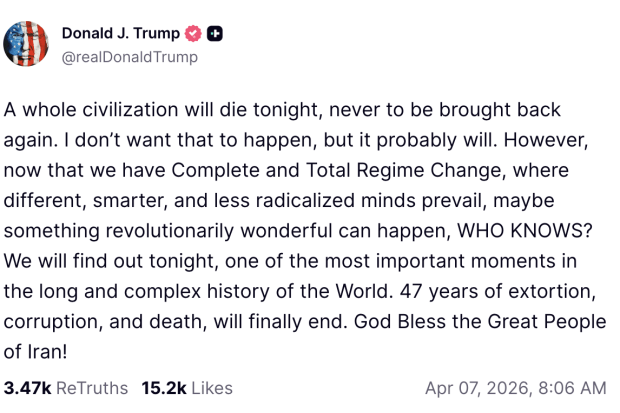
What “globalize the intifada” does and does not mean

19 December 2025

Stephen Gowans

The December 14 killing of 15 Jews by two ISIS-inspired gunmen at Sydney’s Bondi Beach has given rise to calls for a ban on the use of the phrase “globalize the intifada,” on the grounds that it is a call for the killing of Jews around the world.

The New York Times reported that “Two of Britain’s largest police forces announced that they would arrest protesters for using the phrase ‘globalize the intifada,’ saying in a joint statement that a ‘more assertive’ approach was needed after the terrorist attack in Australia and a previous assault on a synagogue in England.”

In Canada, the editorial board of the country’s largest newspaper, The Globe and Mail, argued—with not a shred of evidence—that the Bondi Beach killers were driven to their murderous spree by a desire to globalize the intifada. The board harrumphed, “And if anyone was still unclear as to what the chants heard in countless rallies in Canada and elsewhere to ‘globalize the intifada’ mean, the answer is to be found in the carnage at Bondi Beach. The two gunmen heard and heeded the call to intifada.”

British authorities, court journalists, Zionists, and defenders of Israel misrepresent “globalize the intifada” as a call to kill Jews everywhere, falsely citing the slogan as the inspiration for the Bondi Beach killings.

There are two problems with their argument.

  • Globalize the intifada is a call to bring global pressure to bear on Israel to end its occupation of Palestinian territories, not a call to kill Jews.
  • The Bondi Beach killings were not inspired by either the true meaning of the slogan or the false meaning that has been attributed to it by Israel’s supporters.

Globalize the intifada is a call to bring global pressure to bear on Israel to end its occupation of Palestinian territories

Intifada is an Arabic word meaning “to shake off.” It was used by Palestinians to describe two of their efforts to bring an end to, or shake off, the Israeli occupation of the Palestinian Territories of the West Bank, East Jerusalem, and the Gaza Strip. One of those efforts lasted from 1987-1993; another from 2000-2005.

At the heart of the word “intifada”, as Palestinians have used this term, is a political goal: an end to the occupation. However, Zionists and their supports misinterpret the word to mean violence against Jews. To be sure, violence is one way that Palestinians might try, and have tried, to achieve this goal. But calling for intifada—shaking off Israeli oppression—is a call for a campaign to achieve a political aim, not a specification of how the aim is to be achieved.

Still, political violence was part of the intifadas, but it was aimed, not at Jews qua Jews, but at Israelis.  So even if the call for intifada was specifically a call for political violence—and it isn’t—it wouldn’t be a call for violence against Jews as such, but against Jewish supremacist settlers in the Palestinians’ homeland.

To say, then, that “globalize the intifada” is a call to kill Jews everywhere is false. First, there is no inherent reference to violence in the word intifada. Second, even if there was, the violence would be directed not at Jews everywhere, but at Israelis specifically, and not for reasons of blind hatred of Jews but in pursuit of a legitimate Palestinian political objective.

I say the Palestinian political objective is legitimate for two reasons.

  • The Israeli occupation of the Palestinian territories is illegal under international law. This statement isn’t even remotely controversial.
  • A people’s redressing its dispossession and oppression is, on moral grounds, axiomatically legitimate.

The Palestinians’ pursuit of the goal embodied in the word intifada is, thus, a legitimate political project. To globalize the intifada is to internationalize the pursuit of this legitimate political objective; it is a call for people around the world to enter the fight, in whatever way they can, to help an oppressed people achieve their legitimate political aim.

In sum, the slogan:

  • Is not based in the psychopathology of Judeophobia, but in a legitimate political objective.
  • Is not a call for violence (nor at the same time a call for non-violence; it is a call for the achievement of a political objective, not a specification of how the objective is to be achieved).
  • Makes no allusion to Jews as such but only to Israelis who support and enforce the denial of the Palestinians’ legitimate aims.

The slogan is not, therefore, necessarily a call for violence against Israelis, and it is most especially not a call for violence against Jews outside Israel.

The Bondi Beach killings were not inspired by either the false or true meanings of the slogan

The killers, according to Australian officials, appear to have been motivated by Islamic State ideology. Islamic State thinking is pretty simple: kill the infidel—Yazidis, Christians, Shia Muslims, Alawi Muslims, Jews, and even non-fundamentalist Sunni Muslims. ISIS militants are not choosy. If you don’t believe what they believe, you’re fair game.

In June “a suicide bomber who was a member of the Islamic State opened fire before blowing himself up during the Sunday service at the Greek Orthodox church of Prophet Elias in Damascus, killing at least 30 and wounding more than 60 Greek Orthodox Christians.” 

For every Jew killed at Bondi Beach two Christians were killed at Damascus, by killers inspired by the same Islamic State ideology. Significantly, the killing of 30 Christians was a non-story, barely noticed anywhere, but the massacre of half as many Jews has widely reported and is now known by much of the world.

No one has cited the Damascus slaughter of Christians as evidence of a spike in anti-Christian hatred, or called for Christians to have their own ethno-state where they can feel safe, or demanded measures to combat a growing scourge of anti-Christian animus.

It would appear that the Bondi Beach killers did not target Jews to show solidarity with Palestinians. It is more likely that they slaughtered Jews for the reason ISIS militants slaughter anyone, including Christians and Shia Muslims: because, in ISIS’s view, they are heretics.

But even if the killers’ actions were intended as a show of solidarity with Palestinians, their decision to slaughter Jews on an Australian beach has no meaningful connection to any legitimate interpretation of “globalize the intifada.” The slogan is not a call to kill Jews as Jews, much less Jews living almost nine thousand miles away from Palestine, but to support Palestinians in their quest to overcome the opposition of Israelis to the achievement of a legitimate Palestinian political aim.

The politics of misinterpretation

Not surprisingly, the misinterpretation of the slogan comports with the political aims of Zionists, Israeli officials, and Israel’s supporters. They want to discredit the global movement which seeks to pressure Israel to end its occupation of the Palestinian territories by identifying its motivations as rooted in the psychopathology of Judeophobia. Zionists want to do this in order to draw attention away from the political questions at the heart of the Palestinian project: settler colonialism, apartheid, genocide, and international law. Zionists cannot win in this arena, and so they attempt to shift the debate to another question.  

Israeli officials are always quick to present any violence against Jews, whether directed against Jews qua Jews or otherwise, as evidence of an ineradicable worldwide Judeophobia. Zionism is predicated on the idea that non-Jews can’t help but hate Jews; that anti-Jewish violence is always simmering below the surface, ready to boil over; and that for these reasons, the existence of a Jewish state as a bulwark against the Judeophobic psychopathology of non-Jews is a moral and existential necessity. The slaughter of Jews by Islamic State killers at Bondi Beach has been dishonestly exploited by pro-Israel forces to strengthen this discourse. Violence against Jews is eternal, Zionists argue, and, what’s more, they say, it is inspired by the slogans of those who march in solidarity with the Palestinians. The argument seeks to achieve two objectives at one stroke: 1) To fear-monger in order to induce diaspora Jews to immigrate to Israel; 2) To depoliticize the Palestinians’ political project and situate it in anti-Semitism in order to discredit it.

“Globalize the intifada” is, unquestionably, anti-Zionist and expresses a point of view that is strenuously opposed to the continued Israeli denial of the Palestinians’ legitimate political aims. But it is not anti-Semitic. It is a political slogan based in opposition to the denial of the Palestinians’ legitimate political project. It is for this reason that the purveyors of Israeli hasbara invoke anti-Semitism as a smokescreen to conceal the political questions at the heart of the pro-Palestinian solidarity movement and its slogans. Having no argument to support settler colonialism, apartheid, genocide, and the continued Israeli violation of international law (condoned in deeds by the United States and its G7 allies), they conjure the red-herring of Jew-hatred. Western governments, such as the United Kingdom, and court journalists, such as the editorial board of The Globe and Mail, participate in this deception because they are as supportive of Israel and its denial of the Palestinians’ legitimate political aims as are the Israeli oppressors themselves. Support for Israel within the Western establishment is beyond question and based on the reality that the Zionist state has, from its birth, been child, extension, and outpost, of the West in the Middle East; the West’s, and especially the United States’, instrument for controlling the region’s petroleum resources and strategic position.

We can expect no honesty from Western governments and mainstream news media, anymore than we can from the Israeli government itself, on questions related to the Palestinians’ legitimate political project. The Western establishment and Israel maintain a symbiotic relationship, with Israel doing, as German Chancellor Friedrich Merz said not too long ago, the West’s dirty work, in exchange for the United States and its G7 subalterns, providing Israel with the political, economic, military, and diplomatic support it needs to keep the Palestinians down and West Asia under the bootheel of US imperialism.

Why Does Genocide Happen Again and Again?

9 December 2025

Stephen Gowans

The genocide scholar Raz Segal has written an insightful article for the Guardian (“The genocide in Gaza is far from over,” 20 November, 2025) which I am flagging because it addresses a question that is almost never asked in public discourse: Why do genocides happen?

Segal asks this question because it is clear that the Nuremberg Trials, the UN Convention on the Prevention and Punishment of the Crime of Genocide, and education programs designed to instil the idea of “never again”, have failed. For, in this post-Holocaust world, the slogan “never again” is belied by the reality of “again and again.”

The common understanding of genocides is that they are caused by bad people with evil in their hearts. This is The Christmas Carol version of the expunction of groups. Bob Cratchet was overworked and underpaid because his boss, Ebenezeer Scrooge, was a miser with a heart of adamant, not because he was a capitalist operating in a world of cut-throat competition. Scrooge had two choices: pay his employees as little as possible and work them as long as possible, or go under. It’s no surprise he chose the former.

How many progressives attribute the problems of the working class to the greed of corporations, as if greed can be disappeared in a poof of moral suasion, or a visit from the Ghost of Christmas Future? Where does greed come from?  Scrooge’s greed came, not from his heart, but from bourgeois society and the capitalist imperatives which enslaved him. “We shouldn’t despise human nature,” counseled the eighteenth-century philosophe, Denis Diderot, “but the despicable conventions that pervert it.” Scrooge’s perversion was the despicable convention of capitalism, not a lonely childhood and a love affair gone sour, as Dickens told the tale.

 What are the despicable conventions that pervert human nature to produce genocides? For Segal, and others, it is a political project—one of building ethnically homogenous societies.

British settlers in Turtle Island (North America), Australia, and Aotearoa (New Zealand), carried out genocides against the indigenous peoples of these territories, not so much with the conscious intention of building societies of, by, and for White people, but of integrating the land and resources of the indigenous people into a growing world bourgeois system of capitalist production. Inasmuch as the indigenous peoples couldn’t be, and didn’t want to be, forcibly integrated into this system, they were eliminated as obstacles. Thus, the creation of ethnically homogeneous White Christian societies in these lands was a consequence of a capitalist driven process.

Nazi Germany carried out a genocide in Eastern Europe against people it deemed Untermenschen (sub-humans)—Slavs, Jews, Romani, Blacks, and mixed-race people. Of 18 million non-combatants killed by bullets, gas, exposure, exhaustion, and disease in the German war in the European East from 1939 to 1945, 12 million were Slavs and six million Jews. Ninety-six percent of the victims were claimed by Nazi imperialist violence—that is, violence used by the Third Reich to conquer and depopulate Slav territory in order to repopulate it with German settlers.  

Significantly, most of the world’s Jews lived within the territory that was the object of the Nazis’ settler colonial ambitions. The Holocaust, in the view of Carrol P. Kakel III, a US historian who has written on the American and German genocides, cannot be separated from Nazi settler colonialism. Six million Jews were killed, not for the sole reason that Nazis hated Jews—a view ingrained in the ideological zeitgeist—but as a consequence of a political project, namely, 1) clearing the European East (where the majority of the world’s Jews lived) of non-Germans to make room for an expanded ethnically homogeneous Teutonic empire and 2) eliminating an ethnic group the Nazis believed was, through the instruments of international finance capitalism and Marxist internationalism, seeking to destroy the German people as a nation.

Raphael Lemkin, the Polish-Jewish lawyer who introduced the concept of genocide in his 1944 study Axis Rule in Occupied Europe, attributed the Nazi genocide of the Slavs to the German settler colonial project, but insisted that the genocide of the Jews, the Holocaust, originated in psychopathological Judeophobia, unconnected to any Nazi political aim. Lemkin’s insistence that Nazi violence toward Jews was driven by psychopathology (thus, bad people with evil in their hearts) likely originated in his Zionism. A core belief of political Zionism is that non-Jews can’t help but hate Jews. As a consequence, Jews can never safely live among non-Jews, and must therefore have their own state if they are to be safe and survive as a people. Genocide scholar A. Dirk Moses has argued vigorously against the view that the Holocaust was the consequence of apolitical hatred, rooting the Judeocide instead, along with other genocides, in political projects. He criticizes the Genocide Convention for depoliticizing genocide—that is, for failing to recognize that genocides are carried out by ethnic groups against other ethnic groups they see as economic or political competitors. Often, but not always, the competition is over land. Or one ethnic group sees another as a threat to its survival.

Certainly, the origins of the genocide of the Palestinians can be found in a political project—clearing Palestine of its indigenous population to make room for Jewish settlers and the creation of a Jewish ethnic state. Zionist settler colonialism has obvious connections to the British-settler colonial genocides of the indigenous peoples of Canada, the United States, Australia, and New Zealand, as well as the Nazi political project of creating an expanded German empire in the European East comprised solely of Aryan Germans.

Segal argues that the reason we live in a post-Holocaust world of again and again is because the political project that has regularly given rise to genocide—one of creating ethnically homogeneous states—continues to be seen as legitimate. One of the reasons (though not the only or even most important reason) the United States, Britian, Canada, and the Soviet Union backed the creation of an ethnic Jewish state in Palestine, was because they believed that ethnic states were legitimate, necessary, and desirable. Self-determination, the notion that every ethnic group should have its own state, enjoys considerable esteem. Thus, the idea of a single democratic state in Palestine, from the river to the sea, where everyone is equal, is frequently dismissed in preference to the creation of two ethnically homogeneous states existing side-by-side—one Jewish, the other Palestinian. This is the two-state solution. Zionists prefer one Jewish state in all of Palestine (today’s reality) and some Palestinians would like to see a Palestinian state from the river to the sea, cleansed of its Jewish inhabitants, save for the descendants of Jews who lived in the country prior to the political Zionist waves of European immigration.

Abolishing genocide and getting to a world of never again means abolishing the idea that the ethnic state is either necessary or desirable.  We don’t need ethnic states; we need civic states, where all people are equal and gender, sexual-orientation, ethnicity, national origin, religion, color, language, and all other ascriptive markers of identity have no political significance.  

However, ideas are not abolished by fiat; conduct is not deduced from principle. The fact that the land of the indigenous peoples of North America and Oceania offered attractive possibilities to metropolitan Europe, and the proletarians it disgorged to the colonies, created the idea of the desirability of settler colonialism. The idea of political Zionism arose in the anti-Semitism of Europe, which in turn arose in the need of Europe’s rulers to diffuse threats to their rule by turning their subjects’ anger against a scapegoat. The war against the Jews became a substitute for the class war against Tsarist oppression and capitalist exploitation.  A. Dirk Moses makes a compelling point that genocide is pursued as a solution to a political problem, but political problems arise not in the world of ideas, but in social and economic intercourse.

One of the surest ways of solving the political problem of two groups vying for political and economic resources within the same territory is for one or both of them to try to expel or physically destroy the other. So long as humanity is divided by ascriptive identity will identity groups vie for political and economic resources, and so long as identity groups vie for political and economic resources, the possibility of genocide will be ever present.