
18 June 2026
By Stephen Gowans
Below are my brief comments on some aspects of the 14-paragraph Memorandum of Understanding between Washington and Tehran.
Paragraph 1
In the first paragraph “The United States of America and the Islamic Republic of Iran” indicate that they are making commitments on behalf of themselves and “their allies in the current war.”
The language of the MoU is ambiguous throughout, and the ambiguity is evident here. Who are the signatories’ allies? It’s clear that “allies” covers Israel in the case of the United States and Hezbollah in the case of Iran, but it’s notable that this isn’t spelled out, and that no effort is made to define who the allies are.
A further ambiguity: The paragraph says that military operations will end “on all fronts, including Lebanon.” The document, however, doesn’t define the fronts, other than Lebanon. Are the Persian Gulf countries fronts? Iraq? Jordan?
Implied in the definition of Lebanon as a front, is that Hezbollah’s current military operations are actions taken on behalf of Iran, rather than, or, in addition to, actions specifically related to Israel’s ongoing occupation of south Lebanon and its campaign to destroy the Shia organization. Are Hezbollah’s military operations a necessity of self-preservation in the face of Israeli efforts to annihilate the organization and empty south Lebanon of its Shia population, or are they aid to Iran, or both?
More significantly, the fact that both parties make pledges on behalf of their allies, indicates that Washington and Tehran consider themselves the senior partners and their allies subordinates.
This shouldn’t be controversial in the case of the United States and Israel, but has become so owing to a ridiculous popular fallacy that Israel, a country of 10 million people with a GDP of $720 billion, controls the foreign policy of the United States, a country with 34 times the population and 44 times the GDP, and which is a state, moreover, on which Israel depends for its survival.
No matter how ridiculous the idea is on the surface, legions of Americans have found some comfort in scapegoating Israel for their own government’s actions. It is much easier to blame Zionist Jews, working in the shadows, manipulating world events—a trope much beloved of reactionaries throughout history—than to recognize that murder, genocide, invasion, occupation, and conquest are the very hallmarks of US foreign policy. The US government was vicious and bloodthirsty long before there was an Israel and the Israel lobby.
It is instructive to recall that in 1895 US Senator Henry Cabot Lodge hailed the United States as unequalled in conquest, colonization, and territorial expansion in the nineteenth century. Its record in the eighteenth century was no less unattractive, and the tens of millions slaughtered and burned to death in US colonial and neo-colonial wars of the twentieth and twenty-first centuries recall that sanguinary imperialism is embedded in the history and character of the United States.
To believe that wars of aggression and support for colonial and apartheid regimes are somehow alien to the fundamental values of the US state – as John Mearsheimer and his votaries do – is to blind oneself to US history, even recent history, and to be ignorant of the fundamental nature of the US state.
Bernard DeVoto once remarked that US history “began in myth and has developed through three centuries of fairy stories.” The notion, conjured by Mearsheimer and his followers, that the United States wouldn’t be involved in wars of aggression, wouldn’t be participating in genocide, and wouldn’t be supporting a repressive, racist, and anti-democratic regime, were it not for the influence of Israel and its lobby, is yet another fairy story, added to the mountain of comforting illusions that make up US historiography and Americans’ sense of who they are—or who they wish they were—as a people.
In any event, “the Jews made us betray our fundamental values” theory of US foreign policy has been decisively refuted by events, no less by the MoU. The agreement:
- Was negotiated without the involvement of the fantasized Israeli motive force of US foreign policy;
- Achieves none of Israel’s war aims;
- Is universally opposed by Jewish Israeli leaders across the entire political spectrum;
- Is reviled by the Israel lobby.
On top of implicitly defining Israel as a US vassal state that marches to the beat of a US drummer, the first paragraph commits both parties and their allies to “refrain from the threat or use of force against each other,” (my emphasis). No sooner had Trump signed the MoU, than he violated it, warning the Iranians that “if they don’t behave, we’ll go right back to dropping bombs right smack in the middle of their head.” He added: “It’s amazing what bombs can do.”
On two occasions, as US and Iranian negotiators were meeting to work out the terms of the MoU, US war secretary Pete Hegseth equated negotiation with bombing.
In March he said: “We negotiate with bombs.” He repeated himself this month. “If we need to negotiate with bombs, we’ll negotiate with bombs. And we’re very good at it. Nobody better in the world.”
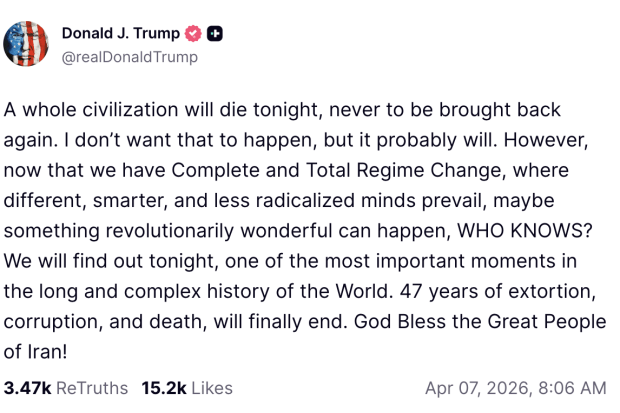
Hegseth’s threats, however, didn’t rise to the barbarity of Trump’s 7 April vow to annihilate “a whole civilization” if Tehran didn’t submit to his demands.
For their part, the Iranians could reply (but haven’t) that “We negotiate by shutting down the Strait of Hormuz and striking US Persian Gulf allies with ballistic missiles and drones.”
Paragraph 4
The fourth paragraph states that “The United States of America further undertakes to remove its forces from the proximity of the Islamic Republic of Iran within 30 days after the final deal.”
In keeping with the MoU’s ambiguity, no definition is offered of what “proximity” means or whether the United States will remove its forces permanently, or only temporarily. These questions are deferred to negotiations scheduled to take place over the next 60 days, or longer, if mutually agreed.
The United States will likely make withdrawal of its forces contingent on Iran meeting front-loaded commitments to scale back its nuclear program. In this way, once Iran satisfies US demands, Washington can renege on the deal, a danger not to be taken lightly, given US conduct in the past, and Trump’s track record. Indeed, the reason Iran began enriching uranium to near military grade, was to pressure the United States to return to the JCPOA, after Trump disavowed the agreement, and after Biden declined to re-enter it, trying instead to coerce the Iranians into accepting new conditions.
Paragraph 6
In the six paragraph Washington “undertakes with regional partners to develop a definitive, mutually agreed plan with at least U.S.D. 300 billion for the reconstruction and economic development.”
Based on press reports, Washington sees this program as an investment opportunity, not reparations. We destroy your infrastructure and rebuild it at a profit for us, rather than repairing it at our expense.
Paragraph 7
In the seventh paragraph Washington pledges “to terminate all types of sanctions against the Islamic Republic of Iran … in an agreed-upon schedule as part of the final deal.”
This means that the United States agrees to lift sanctions contingent on Iran satisfying US demands regarding Iran’s nuclear program. It’s very unlikely that Washington will offer sanctions-relief before Iran eliminates its stockpile of highly enriched uranium or satisfies whatever other demands Washington makes regarding Iran’s nuclear capabilities.
There is a very real danger that if Iran complies with US demands, Washington will fail to honor its commitment to lift sanctions. If the Trump administration follows standard US operating procedure, it will either claim that Iran is cheating, and that sanctions therefore won’t be lifted, or will invent new reasons to impose new sanctions on Tehran for some new Iranian trespass. Or Trump could change his mind and decide he’s not going to honor the deal. He has done it before.
Paragraph 11
In the eleventh paragraph, Washington “undertakes to make fully available for use the frozen or restricted funds and assets of the Islamic Republic of Iran.” The assets will be unfrozen according to “procedures” to be “mutually agreed on” over the next 60 days. The fact that procedures to release the assets remain to be negotiated, means Washington could slow-roll negotiations of the procedure to hold up release of the assets in order to exert leverage on other issues.
In endlessly lambasting Obama for sending “pallets of cash” to Iran, Trump created the impression that Obama paid a ransom to get Tehran’s signature on the JCPOA. Of course, Obama was doing what Trump himself has pledged to do in the MoU: return to Iran what is rightfully Iran’s.
Having agreed to unfreeze Iran’s assets, Trump did a volte-face and came clean, explaining that: “We have taken a lot of their money, and we have their money. We have taken their money, it’s not our money, it’s their money, and we froze it. At a certain point in time I guess we’re going to have to give it back.”
The idea that in unfreezing Iran’s assets the United States is paying Iran a ransom is an inversion of reality. Meeting US demands to scale back its nuclear program will be the ransom Iran pays to Washington to recover its stolen assets.
Conclusion
Au fond, the MoU is an agreement to pause the war, open the Strait of Hormuz, and lift the US naval blockade, while Washington and Tehran negotiate a final agreement to scale back Iran’s nuclear program in return for sanctions relief, reconstruction, return of Iran’s stolen assets, and withdrawal of US forces from some undefined part of West Asia, either permanently or temporarily.
Strictly speaking, the MoU does not commit the parties to only pause the war, but to end it. By signing the agreement, Washington and Tehran “declare the immediate and permanent termination of military operations on all fronts” (my emphasis.) Trump voided the declaration immediately, when he pledged to return to war if the parties fail to arrive at a final agreement, calling to mind the words of Otto von Bismarck: “Great questions of the time are decided not by words but by blood and iron.”
Discover more from What's Left
Subscribe to get the latest posts sent to your email.


Outstanding observations. Thanks.
No matter what, it is better than no progress at all. What the global community truly desires is peace, harmony, stability, and tranguility in their daily lives.