The Meaning of the US-Iran MoU

18 June 2026

By Stephen Gowans

Below are my brief comments on some aspects of the 14-paragraph Memorandum of Understanding between Washington and Tehran.

Paragraph 1

In the first paragraph “The United States of America and the Islamic Republic of Iran” indicate that they are making commitments on behalf of themselves and “their allies in the current war.”  

The language of the MoU is ambiguous throughout, and the ambiguity is evident here. Who are the signatories’ allies? It’s clear that “allies” covers Israel in the case of the United States and Hezbollah in the case of Iran, but it’s notable that this isn’t spelled out, and that no effort is made to define who the allies are.

A further ambiguity: The paragraph says that military operations will end “on all fronts, including Lebanon.” The document, however, doesn’t define the fronts, other than Lebanon. Are the Persian Gulf countries fronts? Iraq? Jordan?

Implied in the definition of Lebanon as a front, is that Hezbollah’s current military operations are actions taken on behalf of Iran, rather than, or, in addition to, actions specifically related to Israel’s ongoing occupation of south Lebanon and its campaign to destroy the Shia organization. Are Hezbollah’s military operations a necessity of self-preservation in the face of Israeli efforts to annihilate the organization and empty south Lebanon of its Shia population, or are they aid to Iran, or both?

More significantly, the fact that both parties make pledges on behalf of their allies, indicates that Washington and Tehran consider themselves the senior partners and their allies subordinates.

This shouldn’t be controversial in the case of the United States and Israel, but has become so owing to a ridiculous popular fallacy that Israel, a country of 10 million people with a GDP of $720 billion, controls the foreign policy of the United States, a country with 34 times the population and 44 times the GDP, and which is a state, moreover, on which Israel depends for its survival.

No matter how ridiculous the idea is on the surface, legions of Americans have found some comfort in scapegoating Israel for their own government’s actions. It is much easier to blame Zionist Jews, working in the shadows, manipulating world events—a trope much beloved of reactionaries throughout history—than to recognize that murder, genocide, invasion, occupation, and conquest are the very hallmarks of US foreign policy. The US government was vicious and bloodthirsty long before there was an Israel and the Israel lobby.

It is instructive to recall that in 1895 US Senator Henry Cabot Lodge hailed the United States as unequalled in conquest, colonization, and territorial expansion in the nineteenth century.  Its record in the eighteenth century was no less unattractive, and the tens of millions slaughtered and burned to death in US colonial and neo-colonial wars of the twentieth and twenty-first centuries recall that sanguinary imperialism is embedded in the history and character of the United States.  

To believe that wars of aggression and support for colonial and apartheid regimes are somehow alien to the fundamental values of the US state – as John Mearsheimer and his votaries do – is to blind oneself to US history, even recent history, and to be ignorant of the fundamental nature of the US state.

Bernard DeVoto once remarked that US history “began in myth and has developed through three centuries of fairy stories.” The notion, conjured by Mearsheimer and his followers, that the United States wouldn’t be involved in wars of aggression, wouldn’t be participating in genocide, and wouldn’t be supporting a repressive, racist, and anti-democratic regime, were it not for the influence of Israel and its lobby, is yet another fairy story, added to the mountain of comforting illusions that make up US historiography and Americans’ sense of who they are—or who they wish they were—as a people.

In any event, “the Jews made us betray our fundamental values” theory of US foreign policy has been decisively refuted by events, no less by the MoU. The agreement:

  • Was negotiated without the involvement of the fantasized Israeli motive force of US foreign policy;
  • Achieves none of Israel’s war aims;
  • Is universally opposed by Jewish Israeli leaders across the entire political spectrum;
  • Is reviled by the Israel lobby.

On top of implicitly defining Israel as a US vassal state that marches to the beat of a US drummer, the first paragraph commits both parties and their allies to “refrain from the threat or use of force against each other,” (my emphasis). No sooner had Trump signed the MoU, than he violated it, warning the Iranians that “if they don’t behave, we’ll go right back to dropping bombs right smack in the middle of their head.” He added: “It’s amazing what bombs can do.”

On two occasions, as US and Iranian negotiators were meeting to work out the terms of the MoU, US war secretary Pete Hegseth equated negotiation with bombing.

In March he said: “We negotiate with bombs.” He repeated himself this month. “If we need to negotiate with bombs, we’ll negotiate with bombs. And we’re very good at it. Nobody better in the world.”

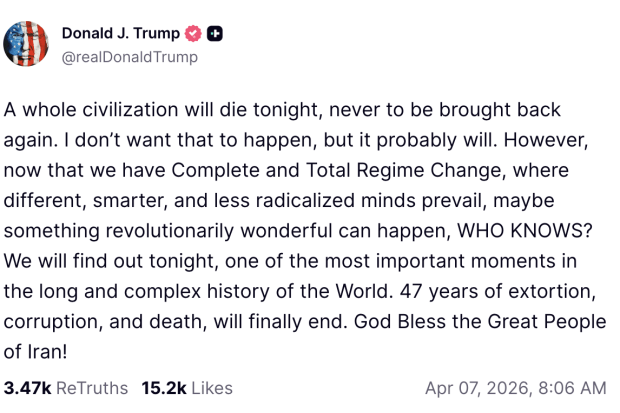
Hegseth’s threats, however, didn’t rise to the barbarity of Trump’s 7 April vow to annihilate “a whole civilization” if Tehran didn’t submit to his demands.
For their part, the Iranians could reply (but haven’t) that “We negotiate by shutting down the Strait of Hormuz and striking US Persian Gulf allies with ballistic missiles and drones.”

Paragraph 4

The fourth paragraph states that “The United States of America further undertakes to remove its forces from the proximity of the Islamic Republic of Iran within 30 days after the final deal.”

In keeping with the MoU’s ambiguity, no definition is offered of what “proximity” means or whether the United States will remove its forces permanently, or only temporarily. These questions are deferred to negotiations scheduled to take place over the next 60 days, or longer, if mutually agreed.

The United States will likely make withdrawal of its forces contingent on Iran meeting front-loaded commitments to scale back its nuclear program.  In this way, once Iran satisfies US demands, Washington can renege on the deal, a danger not to be taken lightly, given US conduct in the past, and Trump’s track record. Indeed, the reason Iran began enriching uranium to near military grade, was to pressure the United States to return to the JCPOA, after Trump disavowed the agreement, and after Biden declined to re-enter it, trying instead to coerce the Iranians into accepting new conditions.  

Paragraph 6

In the six paragraph Washington “undertakes with regional partners to develop a definitive, mutually agreed plan with at least U.S.D. 300 billion for the reconstruction and economic development.”  

Based on press reports, Washington sees this program as an investment opportunity, not reparations. We destroy your infrastructure and rebuild it at a profit for us, rather than repairing it at our expense.

Paragraph 7

In the seventh paragraph Washington pledges “to terminate all types of sanctions against the Islamic Republic of Iran … in an agreed-upon schedule as part of the final deal.”

This means that the United States agrees to lift sanctions contingent on Iran satisfying US demands regarding Iran’s nuclear program. It’s very unlikely that Washington will offer sanctions-relief before Iran eliminates its stockpile of highly enriched uranium or satisfies whatever other demands Washington makes regarding Iran’s nuclear capabilities.

There is a very real danger that if Iran complies with US demands, Washington will fail to honor its commitment to lift sanctions. If the Trump administration follows standard US operating procedure, it will either claim that Iran is cheating, and that sanctions therefore won’t be lifted, or will invent new reasons to impose new sanctions on Tehran for some new Iranian trespass. Or Trump could change his mind and decide he’s not going to honor the deal. He has done it before.

Paragraph 11

In the eleventh paragraph, Washington “undertakes to make fully available for use the frozen or restricted funds and assets of the Islamic Republic of Iran.” The assets will be unfrozen according to “procedures” to be “mutually agreed on” over the next 60 days. The fact that procedures to release the assets remain to be negotiated, means Washington could slow-roll negotiations of the procedure to hold up release of the assets in order to exert leverage on other issues.

In endlessly lambasting Obama for sending “pallets of cash” to Iran, Trump created the impression that Obama paid a ransom to get Tehran’s signature on the JCPOA. Of course, Obama was doing what Trump himself has pledged to do in the MoU: return to Iran what is rightfully Iran’s.

Having agreed to unfreeze Iran’s assets, Trump did a volte-face and came clean, explaining that: “We have taken a lot of their money, and we have their money. We have taken their money, it’s not our money, it’s their money, and we froze it. At a certain point in time I guess we’re going to have to give it back.”

The idea that in unfreezing Iran’s assets the United States is paying Iran a ransom is an inversion of reality. Meeting US demands to scale back its nuclear program will be the ransom Iran pays to Washington to recover its stolen assets.

Conclusion

Au fond, the MoU is an agreement to pause the war, open the Strait of Hormuz, and lift the US naval blockade, while Washington and Tehran negotiate a final agreement to scale back Iran’s nuclear program in return for sanctions relief, reconstruction, return of Iran’s stolen assets, and withdrawal of US forces from some undefined part of West Asia, either permanently or temporarily.  

Strictly speaking, the MoU does not commit the parties to only pause the war, but to end it. By signing the agreement, Washington and Tehran “declare the immediate and permanent termination of military operations on all fronts” (my emphasis.) Trump voided the declaration immediately, when he pledged to return to war if the parties fail to arrive at a final agreement, calling to mind the words of Otto von Bismarck: “Great questions of the time are decided not by words but by blood and iron.”

The Via Crucis of John Mearsheimer

John Mearsheimer developed the theory of the Israel lobby because the facts contradicted his Realist theory of international relations. Now the facts are contradicting the very same Israel lobby theory he developed to plug the holes in his IR theory.

15 June 2026

By Stephen Gowans

It’s difficult to argue that Israel and the Israel lobby control US foreign policy when Washington arrives at an agreement with Tehran:   

  • That Israel had no say in;
  • Achieves none of Israel’s war aims;
  • Is universally opposed by Jewish Israeli leaders across the political spectrum;
  • Is met with skepticism by pro-Israel hawks in the US.

Even if the agreement falls apart, it is still the case that Washington has acted in a manner that is hostile to what Israelis perceive as their interests.

“The Israel lobby” is a category of explanation invoked to account for the failure of certain theories to explain US actions (e.g., some Realist IR theories, or the theory that US foreign policy is fundamentally benign in its intentions if not always its actions.)

The problem lies with the theories. They don’t explain what they set out to explain.

John Mearsheimer is a Realist IR theorist, and the most vocal exponent of the theory that 1) Washington acts against US interests in West Asia and in favor of Israel’s and 2) it does so because its foreign policy has been hijacked by the Israel lobby. He readily acknowledges that his IR theory doesn’t explain US behavior in West Asia.

Steve Walt and I, who are both card-carrying Realists, wrote this book called the Israel Lobby and US Foreign Policy. And lots of people over the years have delighted in pointing out, in a “got-ya!” moment, that the Israel Lobby book contradicts our Realist theory. Because the Israel Lobby book says that domestic politics causes the United States to act in non-strategic ways. This is what the Israel Lobby book says. It says that when it comes to Israel, the United States is not behaving in a way a Realist would expect American policy-makers to behave. It’s because of the Lobby; domestic politics. And people expect us, when they level that charge at us, to be defensive and say ‘Oh no, the Lobby book really fits in with our theory.’ But our response is, ‘You’re absolutely correct. The Israel Lobby contradicts my basic theory of international politics.’ [1]

You may notice that Mearsheimer engages in some question-begging here (question-begging in the sense of assuming the truth of what he’s trying to prove in his premise.)  He says “that when it comes to Israel, the United States is not behaving in a way a Realist would expect American policy-makers to behave,” and then adds “It’s because of the Lobby.” An alternative explanation is that the United States is not behaving in a way a Realist would expect American policy-makers to behave because the theory is wrong. Instead, he assumes the theory is correct, and that something else must be going on to obscure its validity. Presto, the Israel lobby theory is born.

The problem, however, is that the Israel lobby theory has as many holes in it as there are holes in the original theory it was designed to plug. That’s evident in the obvious rift that has developed between Washington and Tel Aviv over the question of how to proceed on Iran.

Apart from being an add-on to save Mearsheimer’s IR theory, the Israel lobby theory is also a political tool used by some activists to mobilize support for pro-Palestinian positions by deliberately fostering a misunderstanding that a foreign power has hijacked the US state and that US citizens are paying for wars fought in Israel’s interests and not US interests.

The truth is that US citizens are paying for US wars—and the wars are being fought in the overlapping interests of US billionaires and Israeli colonizers. They may not want to face up to the fact that their government’s conduct is vicious and tyrannical, and may prefer, instead, to see the United States as a fundamentally benign but helpless giant manipulated by an Israeli Svengali, but this is nothing more than a comforting illusion.

The reality is that the domestic billionaire class that shapes US foreign policy goals has set objectives that, for the most part, mesh with the settler colonial project of Israel. Broadly speaking, the overarching US objective is to prevent the emergence of an independent regional hegemon in energy-rich West Asia.

Owing to its cultural, ethnic, demographic, and economic connections with the West (Israel sees itself as part of the West, a Western outpost in the East), and its complete dependency on Western support to survive, Israel is uniquely placed to act as a US janissary—a protector of US interests in the Land of the Five Seas [2] and elite combat force equipped and motivated to assert US interests. Guardian of the interests of great powers in the Arab and Muslim worlds has, from day one, been the role sought by Zionists for a Jewish state. The quid-pro-quo has always been understood as: We look after your interests in the region against those of local forces of independence, and you guarantee our survival.

A troubling aspect of the Israel lobby theory is its resonance with a Nazi theory.  

Hitler did much the same as Mearsheimer in explaining why something didn’t happen that he thought should have happened.  

Mearsheimer says the United States is not behaving in a way a Realist would expect American policy-makers to behave because policy-making in Washington has been taken over by decision-makers who are committed to Israeli goals and Israeli goals are inimical to US interests.

Similarly, Hitler said Germany should have won the First World War and didn’t because Jews penetrated German policy-making circles and took over German decision-making and pursued Zionist goals that were hostile to German interests. How else could one explain, asked Hitler, that no enemy troops had ever set foot on German soil, and still Germany lost the war? In this, Hitler anticipated Mearsheimer’s wondering how Realist IR theory failed to account for US behavior in West Asia. For both, a Zionist take-over offered a ready explanation of failed expectation.

Overlapping interests, not Israeli colonization of foreign policy decision-making in Washington, account for why US and Israeli decision-makers are so often in sync. Occasionally, however, the goals of the two states depart, as they do, now, on Iran. Israel wants to finish off Iran, destroy Hezbollah, and continue its expansion into Lebanon. Washington wants to prevent the world economy from going off an oil- and fertilizer-scarcity cliff, and is prepared to make concessions to Iran that Israel doesn’t like in order to avoid a world-wide calamity.

When US and Israeli interests fail to align, the US asserts its greater strength, and Israel tries to maintain some degree of autonomy by negotiating the terms of its subordination. But it remains, as always, a subordinate state and instrument of US policy. For its part, the US remains, as always, the guarantor of its janissary Jewish state’s survival.

1. John Mearsheimer in Athens: Why Realism Explains Better than Alternative Theories, Address to the Council for International Relations and the Institute of International Relations, Athens, Greece, 2 June, 2026. https://www.youtube.com/watch?v=PVuZbW4qKNY

2. The territory bounded by the Mediterranean Sea, Black Sea, Caspian Sea, Arabian Sea, and Red Sea.

Legal Illegal: The Question of Whether this War is Legal is the Wrong Question

2 March 2026

Stephen Gowans

Democrats are incensed that the US war on Iran is illegal. But how many US wars and other interventions, including sanctions, have been authorized by the Congress and blessed by the UN Security Council? Since 1945, the year the UN Charter came into force, most US wars and sanctions campaigns have either been undertaken without Congressional approval or have contravened international law or both. Criminal US wars and sanctions are not an anomaly; they’re the norm.

Reacting to the norm as if it’s an aberration is part of an ideological process of maintaining the legitimacy of the US state. The state’s lawless conduct is reliably characterized as a departure from the norm, rather than the norm. “This isn’t who we are. We uphold and live by international law. The current war is an exception.” No, it’s not. It’s precisely who you are.

Reacting to the norm as if it’s an aberration is a reflection of what the philosopher Charles Mills called ‘the epistemology of ignorance” – refusing to see what’s staring you in the face. For example, one can only believe that the United States is a beacon of liberty and paladin of democracy by refusing to see that:

  • the country carried out a genocide of the indigenous people and stole their land;
  • enslaved millions of Africans and exploited their labor;
  • didn’t give women the vote until 1920;
  • failed to provide blacks even formal civil liberties until 1965;
  • established formal colonies in Hawaii, Guam, the Philippines, Puerto Rico, and the US Virgin Islands, and informal colonies around the world;
  • practices democracy for the few billionaires and political impotence for the many;
  • defends and upholds the exploitation of wage and salary earners as a matter of law and high moral principle.

There has been a substantial increase in freedom and democracy since 1776, but that’s only because the people who were so long denied these advantages fought long and hard to win them. It would be more accurate to say that contained within the US nation has been a movement of the oppressed and exploited that has fought heroically against a contending movement of oppressors and exploiters. The two movements continue to define political struggle in the United States today, and around the world.

Democrats and liberals who oppose this war (mainly because it’s Trump’s war), also contribute to maintaining the fiction that the US state is legitimate by demonizing the war’s victims. The Nobel Prize-winning economist Paul Krugman began his blog today with a shockingly puerile assertion: “The Iranian regime is evil, and it would be a good thing if this war leads to its demise.” In other words, maybe the war is illegal, but the Iranian regime is heinous, so we can be assured that at the end of the day Washington’s intentions are good and everything will work out for the greater benefit of humanity. Apparently, childish analysis disqualifies no one from winning a Nobel Prize in economics. It may even be a prerequisite.

To return to the lawlessness of US wars. The trouble with dwelling on the illegality of US interventions, as if they could be expected to be otherwise given that they almost always are illegal, is that, not only does this buttress the notion that the conduct of the US state is, at its core, legitimate (when it clearly is not), but avoids asking the relevant question: Why is this intervention being undertaken?  For surely, if we’re troubled by the kinds of wars, both military and economic, that the United States and its pals wage against what are usually largely defenseless countries and peoples, we should want to know what causes them, so that we can know how to put an end to them.

Since February of 2022, the month Russia tried to conquer Ukraine, I’ve spent much of my time studying the origins of major wars. This has led me to the works of international relations (IR) scholars, including the neo-realists, the most visible of whom, these days, is John Mearsheimer. IR scholars can be commended, Mearsheimer included, for seeking the root causes of war, rather than indulging in pointless moral sermonizing. But they can’t be commended for their analyses.

Take Mearsheimer, for example. He began by articulating a model of major wars based on security competition within an anarchic inter-state system. States, he argued, try to maximize their military power in order to defend themselves against the possible aggressions of rival states. On this basis, he predicted that the United States would avoid major wars in the Middle East and Eastern Europe in order to concentrate on containing China, its closest near-peer rival. When Washington embroiled itself in major wars in the Middle East, contrary to Mearsheimer’s theorizing, he declared the Middle East an anomaly, and attributed the failure of his theory to account for US conduct to an alleged hijacking of the US state by Israel and its lobbyists.

In fact, Mearsheimer’s argument that the Israel lobby runs US foreign policy, while allowing him to get out from under the failures of his “offensive realism” thinking, is part of the same ideological process of maintaining the legitimacy of the US state that is expressed in portrayals of illegal US warfare as a departure from the norm. Don’t blame the US state for its malignant wars on West Asia; at their core, the US policy- and decision-makers are decent and benign human beings who want to do the right thing. The trouble is that they have fallen under the sway of the Israeli Svengali.  The idea that Jews lurk in the shadows manipulating world events refuses to die.

I have leaned toward Lenin’s analysis of war, articulated in his voluminous writings from 1914-1918 on the first world war. The obvious limitation of Lenin’s thinking is that it is based on one war and the events leading up to it. He didn’t undertake an historical survey of wars, and obviously, could not take account of wars that have been fought since. Moreover, he used the term imperialism in a highly inconsistent way which has led to no end of confusion. All the same, I have found his thinking to offer a useful way to think about war waged by major powers.

Unfortunately, those who might be interested in Lenin, often read him second hand, rather than exploring what he said in his own words, free from the interpretations of others. Furthermore, on matters of war, they usually consult his pamphlet on Imperialism, which, in my view, is the least interesting and useful of his war-related work, though, sadly, the most frequently consulted.

Unlike IR realists, such as Mearsheimer, who are IR theorists because they want to advise the US foreign policy establishment on grand strategy, Lenin’s aim was to understand the origin of war in order to bring about a world whose realization would mean the end of war. In this respect, his concerns resonate best with those of anti-war activists, a compelling reason for turning to him rather than Mearsheimer and his IR colleagues, whose careers in academe tend to depend on how helpful their work is to a US foreign policy establishment whose aim is to exploit other countries and cement US domination over the rest of humanity.

Back to legality. Should it matter whether a war is legal? Who decides what is legal or illegal? It certainly hasn’t been people trying to free their country or class from exploitation. The United States and other large powers wrote international law and control the Security Council. If the Security Council says a war is legal, does that make it just?

I would argue, and so did Lenin, that a just war is one that brings us closer to a world free from the exploitation of one class by another and of one state by another. That is a just war, worth fighting, even if it is condemned by the US Congress and prohibited by international law and the Security Council.

Musical coda