The Meaning of the US-Iran MoU

18 June 2026

By Stephen Gowans

Below are my brief comments on some aspects of the 14-paragraph Memorandum of Understanding between Washington and Tehran.

Paragraph 1

In the first paragraph “The United States of America and the Islamic Republic of Iran” indicate that they are making commitments on behalf of themselves and “their allies in the current war.”  

The language of the MoU is ambiguous throughout, and the ambiguity is evident here. Who are the signatories’ allies? It’s clear that “allies” covers Israel in the case of the United States and Hezbollah in the case of Iran, but it’s notable that this isn’t spelled out, and that no effort is made to define who the allies are.

A further ambiguity: The paragraph says that military operations will end “on all fronts, including Lebanon.” The document, however, doesn’t define the fronts, other than Lebanon. Are the Persian Gulf countries fronts? Iraq? Jordan?

Implied in the definition of Lebanon as a front, is that Hezbollah’s current military operations are actions taken on behalf of Iran, rather than, or, in addition to, actions specifically related to Israel’s ongoing occupation of south Lebanon and its campaign to destroy the Shia organization. Are Hezbollah’s military operations a necessity of self-preservation in the face of Israeli efforts to annihilate the organization and empty south Lebanon of its Shia population, or are they aid to Iran, or both?

More significantly, the fact that both parties make pledges on behalf of their allies, indicates that Washington and Tehran consider themselves the senior partners and their allies subordinates.

This shouldn’t be controversial in the case of the United States and Israel, but has become so owing to a ridiculous popular fallacy that Israel, a country of 10 million people with a GDP of $720 billion, controls the foreign policy of the United States, a country with 34 times the population and 44 times the GDP, and which is a state, moreover, on which Israel depends for its survival.

No matter how ridiculous the idea is on the surface, legions of Americans have found some comfort in scapegoating Israel for their own government’s actions. It is much easier to blame Zionist Jews, working in the shadows, manipulating world events—a trope much beloved of reactionaries throughout history—than to recognize that murder, genocide, invasion, occupation, and conquest are the very hallmarks of US foreign policy. The US government was vicious and bloodthirsty long before there was an Israel and the Israel lobby.

It is instructive to recall that in 1895 US Senator Henry Cabot Lodge hailed the United States as unequalled in conquest, colonization, and territorial expansion in the nineteenth century.  Its record in the eighteenth century was no less unattractive, and the tens of millions slaughtered and burned to death in US colonial and neo-colonial wars of the twentieth and twenty-first centuries recall that sanguinary imperialism is embedded in the history and character of the United States.  

To believe that wars of aggression and support for colonial and apartheid regimes are somehow alien to the fundamental values of the US state – as John Mearsheimer and his votaries do – is to blind oneself to US history, even recent history, and to be ignorant of the fundamental nature of the US state.

Bernard DeVoto once remarked that US history “began in myth and has developed through three centuries of fairy stories.” The notion, conjured by Mearsheimer and his followers, that the United States wouldn’t be involved in wars of aggression, wouldn’t be participating in genocide, and wouldn’t be supporting a repressive, racist, and anti-democratic regime, were it not for the influence of Israel and its lobby, is yet another fairy story, added to the mountain of comforting illusions that make up US historiography and Americans’ sense of who they are—or who they wish they were—as a people.

In any event, “the Jews made us betray our fundamental values” theory of US foreign policy has been decisively refuted by events, no less by the MoU. The agreement:

  • Was negotiated without the involvement of the fantasized Israeli motive force of US foreign policy;
  • Achieves none of Israel’s war aims;
  • Is universally opposed by Jewish Israeli leaders across the entire political spectrum;
  • Is reviled by the Israel lobby.

On top of implicitly defining Israel as a US vassal state that marches to the beat of a US drummer, the first paragraph commits both parties and their allies to “refrain from the threat or use of force against each other,” (my emphasis). No sooner had Trump signed the MoU, than he violated it, warning the Iranians that “if they don’t behave, we’ll go right back to dropping bombs right smack in the middle of their head.” He added: “It’s amazing what bombs can do.”

On two occasions, as US and Iranian negotiators were meeting to work out the terms of the MoU, US war secretary Pete Hegseth equated negotiation with bombing.

In March he said: “We negotiate with bombs.” He repeated himself this month. “If we need to negotiate with bombs, we’ll negotiate with bombs. And we’re very good at it. Nobody better in the world.”

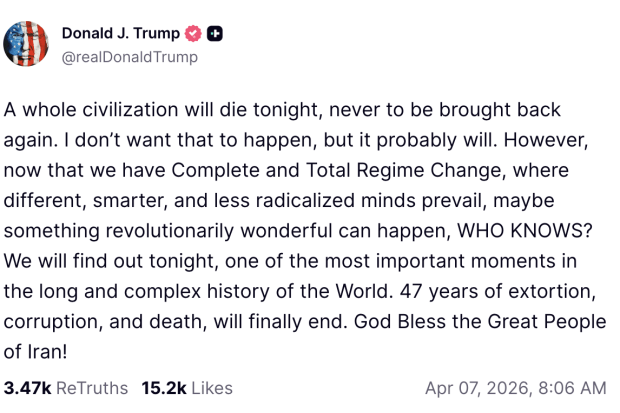
Hegseth’s threats, however, didn’t rise to the barbarity of Trump’s 7 April vow to annihilate “a whole civilization” if Tehran didn’t submit to his demands.

For their part, the Iranians could reply (but haven’t) that “We negotiate by shutting down the Strait of Hormuz and striking US Persian Gulf allies with ballistic missiles and drones.”

Paragraph 4

The fourth paragraph states that “The United States of America further undertakes to remove its forces from the proximity of the Islamic Republic of Iran within 30 days after the final deal.”

In keeping with the MoU’s ambiguity, no definition is offered of what “proximity” means or whether the United States will remove its forces permanently, or only temporarily. These questions are deferred to negotiations scheduled to take place over the next 60 days, or longer, if mutually agreed.

The United States will likely make withdrawal of its forces contingent on Iran meeting front-loaded commitments to scale back its nuclear program.  In this way, once Iran satisfies US demands, Washington can renege on the deal, a danger not to be taken lightly, given US conduct in the past, and Trump’s track record. Indeed, the reason Iran began enriching uranium to near military grade, was to pressure the United States to return to the JCPOA, after Trump disavowed the agreement, and after Biden declined to re-enter it, trying instead to coerce the Iranians into accepting new conditions.  

Paragraph 6

In the six paragraph Washington “undertakes with regional partners to develop a definitive, mutually agreed plan with at least U.S.D. 300 billion for the reconstruction and economic development.”  

Based on press reports, Washington sees this program as an investment opportunity, not reparations. We destroy your infrastructure and rebuild it at a profit for us, rather than repairing it at our expense.

Paragraph 7

In the seventh paragraph Washington pledges “to terminate all types of sanctions against the Islamic Republic of Iran … in an agreed-upon schedule as part of the final deal.”

This means that the United States agrees to lift sanctions contingent on Iran satisfying US demands regarding Iran’s nuclear program. It’s very unlikely that Washington will offer sanctions-relief before Iran eliminates its stockpile of highly enriched uranium or satisfies whatever other demands Washington makes regarding Iran’s nuclear capabilities.

There is a very real danger that if Iran complies with US demands, Washington will fail to honor its commitment to lift sanctions. If the Trump administration follows standard US operating procedure, it will either claim that Iran is cheating, and that sanctions therefore won’t be lifted, or will invent new reasons to impose new sanctions on Tehran for some new Iranian trespass. Or Trump could change his mind and decide he’s not going to honor the deal. He has done it before.

Paragraph 11

In the eleventh paragraph, Washington “undertakes to make fully available for use the frozen or restricted funds and assets of the Islamic Republic of Iran.” The assets will be unfrozen according to “procedures” to be “mutually agreed on” over the next 60 days. The fact that procedures to release the assets remain to be negotiated, means Washington could slow-roll negotiations of the procedure to hold up release of the assets in order to exert leverage on other issues.

In endlessly lambasting Obama for sending “pallets of cash” to Iran, Trump created the impression that Obama paid a ransom to get Tehran’s signature on the JCPOA. Of course, Obama was doing what Trump himself has pledged to do in the MoU: return to Iran what is rightfully Iran’s.

Having agreed to unfreeze Iran’s assets, Trump did a volte-face and came clean, explaining that: “We have taken a lot of their money, and we have their money. We have taken their money, it’s not our money, it’s their money, and we froze it. At a certain point in time I guess we’re going to have to give it back.”

The idea that in unfreezing Iran’s assets the United States is paying Iran a ransom is an inversion of reality. Meeting US demands to scale back its nuclear program will be the ransom Iran pays to Washington to recover its stolen assets.

Conclusion

Au fond, the MoU is an agreement to pause the war, open the Strait of Hormuz, and lift the US naval blockade, while Washington and Tehran negotiate a final agreement to scale back Iran’s nuclear program in return for sanctions relief, reconstruction, return of Iran’s stolen assets, and withdrawal of US forces from some undefined part of West Asia, either permanently or temporarily.  

Strictly speaking, the MoU does not commit the parties to only pause the war, but to end it. By signing the agreement, Washington and Tehran “declare the immediate and permanent termination of military operations on all fronts” (my emphasis.) Trump voided the declaration immediately, when he pledged to return to war if the parties fail to arrive at a final agreement, calling to mind the words of Otto von Bismarck: “Great questions of the time are decided not by words but by blood and iron.”

The Via Crucis of John Mearsheimer

John Mearsheimer developed the theory of the Israel lobby because the facts contradicted his Realist theory of international relations. Now the facts are contradicting the very same Israel lobby theory he developed to plug the holes in his IR theory.

15 June 2026

By Stephen Gowans

It’s difficult to argue that Israel and the Israel lobby control US foreign policy when Washington arrives at an agreement with Tehran:   

  • That Israel had no say in;
  • Achieves none of Israel’s war aims;
  • Is universally opposed by Jewish Israeli leaders across the political spectrum;
  • Is met with skepticism by pro-Israel hawks in the US.

Even if the agreement falls apart, it is still the case that Washington has acted in a manner that is hostile to what Israelis perceive as their interests.

“The Israel lobby” is a category of explanation invoked to account for the failure of certain theories to explain US actions (e.g., some Realist IR theories, or the theory that US foreign policy is fundamentally benign in its intentions if not always its actions.)

The problem lies with the theories. They don’t explain what they set out to explain.

John Mearsheimer is a Realist IR theorist, and the most vocal exponent of the theory that 1) Washington acts against US interests in West Asia and in favor of Israel’s and 2) it does so because its foreign policy has been hijacked by the Israel lobby. He readily acknowledges that his IR theory doesn’t explain US behavior in West Asia.

Steve Walt and I, who are both card-carrying Realists, wrote this book called the Israel Lobby and US Foreign Policy. And lots of people over the years have delighted in pointing out, in a “got-ya!” moment, that the Israel Lobby book contradicts our Realist theory. Because the Israel Lobby book says that domestic politics causes the United States to act in non-strategic ways. This is what the Israel Lobby book says. It says that when it comes to Israel, the United States is not behaving in a way a Realist would expect American policy-makers to behave. It’s because of the Lobby; domestic politics. And people expect us, when they level that charge at us, to be defensive and say ‘Oh no, the Lobby book really fits in with our theory.’ But our response is, ‘You’re absolutely correct. The Israel Lobby contradicts my basic theory of international politics.’ [1]

You may notice that Mearsheimer engages in some question-begging here (question-begging in the sense of assuming the truth of what he’s trying to prove in his premise.)  He says “that when it comes to Israel, the United States is not behaving in a way a Realist would expect American policy-makers to behave,” and then adds “It’s because of the Lobby.” An alternative explanation is that the United States is not behaving in a way a Realist would expect American policy-makers to behave because the theory is wrong. Instead, he assumes the theory is correct, and that something else must be going on to obscure its validity. Presto, the Israel lobby theory is born.

The problem, however, is that the Israel lobby theory has as many holes in it as there are holes in the original theory it was designed to plug. That’s evident in the obvious rift that has developed between Washington and Tel Aviv over the question of how to proceed on Iran.

Apart from being an add-on to save Mearsheimer’s IR theory, the Israel lobby theory is also a political tool used by some activists to mobilize support for pro-Palestinian positions by deliberately fostering a misunderstanding that a foreign power has hijacked the US state and that US citizens are paying for wars fought in Israel’s interests and not US interests.

The truth is that US citizens are paying for US wars—and the wars are being fought in the overlapping interests of US billionaires and Israeli colonizers. They may not want to face up to the fact that their government’s conduct is vicious and tyrannical, and may prefer, instead, to see the United States as a fundamentally benign but helpless giant manipulated by an Israeli Svengali, but this is nothing more than a comforting illusion.

The reality is that the domestic billionaire class that shapes US foreign policy goals has set objectives that, for the most part, mesh with the settler colonial project of Israel. Broadly speaking, the overarching US objective is to prevent the emergence of an independent regional hegemon in energy-rich West Asia.

Owing to its cultural, ethnic, demographic, and economic connections with the West (Israel sees itself as part of the West, a Western outpost in the East), and its complete dependency on Western support to survive, Israel is uniquely placed to act as a US janissary—a protector of US interests in the Land of the Five Seas [2] and elite combat force equipped and motivated to assert US interests. Guardian of the interests of great powers in the Arab and Muslim worlds has, from day one, been the role sought by Zionists for a Jewish state. The quid-pro-quo has always been understood as: We look after your interests in the region against those of local forces of independence, and you guarantee our survival.

A troubling aspect of the Israel lobby theory is its resonance with a Nazi theory.  

Hitler did much the same as Mearsheimer in explaining why something didn’t happen that he thought should have happened.  

Mearsheimer says the United States is not behaving in a way a Realist would expect American policy-makers to behave because policy-making in Washington has been taken over by decision-makers who are committed to Israeli goals and Israeli goals are inimical to US interests.

Similarly, Hitler said Germany should have won the First World War and didn’t because Jews penetrated German policy-making circles and took over German decision-making and pursued Zionist goals that were hostile to German interests. How else could one explain, asked Hitler, that no enemy troops had ever set foot on German soil, and still Germany lost the war? In this, Hitler anticipated Mearsheimer’s wondering how Realist IR theory failed to account for US behavior in West Asia. For both, a Zionist take-over offered a ready explanation of failed expectation.

Overlapping interests, not Israeli colonization of foreign policy decision-making in Washington, account for why US and Israeli decision-makers are so often in sync. Occasionally, however, the goals of the two states depart, as they do, now, on Iran. Israel wants to finish off Iran, destroy Hezbollah, and continue its expansion into Lebanon. Washington wants to prevent the world economy from going off an oil- and fertilizer-scarcity cliff, and is prepared to make concessions to Iran that Israel doesn’t like in order to avoid a world-wide calamity.

When US and Israeli interests fail to align, the US asserts its greater strength, and Israel tries to maintain some degree of autonomy by negotiating the terms of its subordination. But it remains, as always, a subordinate state and instrument of US policy. For its part, the US remains, as always, the guarantor of its janissary Jewish state’s survival.

1. John Mearsheimer in Athens: Why Realism Explains Better than Alternative Theories, Address to the Council for International Relations and the Institute of International Relations, Athens, Greece, 2 June, 2026. https://www.youtube.com/watch?v=PVuZbW4qKNY

2. The territory bounded by the Mediterranean Sea, Black Sea, Caspian Sea, Arabian Sea, and Red Sea.

Nazi Myth. Zionist Myth.

By Stephen Gowans

4 June 2026

A national Canadian newspaper, The Globe and Mail, published an editorial on 4 June 2026, lambasting Canadian prime minister Mark Carney for failing to condemn anti-Zionism. The editorial board pressed Carney to equate opposition to Israel’s existence with demonizing Canada’s Jews.

The editorial was titled “The Missing Words in Carney’s Speech”, a reference to a speech the prime minister had made to condemn what he described as a growing wave of anti-Semitism in Canada. “It was good that Mr. Carney went to a synagogue and addressed antisemitism,” argued the editorial, but added that “He should have said: ‘If you oppose Israel’s existence, if you demonize Jewish-Canadians, you are wrong, you are hateful and I stand against you.’”

The growing wave of anti-Semitism in Canada is a myth. As I explained in a previous post, B’nai Brith Canada, a pro-Israel lobby group, has invented “a national crisis” of antisemitism by defining opposition to Zionism and criticism of Israel’s conduct as Judeophobia. The organization, along with other pro-Israel partisans, are pressing Canadian governments at the federal, provincial, and municipal levels to implement legal measures to criminalize pro-Palestinian, pro-democracy and anti-Zionist, anti-colonial political positions. Carney’s speech added grist to the mill of the anti-Palestinian argument, but the Globe and Mail felt he hadn’t gone far enough.

Let’s be clear

1/ Zionism is not Judaism and nor are “Zionist” and “Jew” the same. Indeed, there are more Christian Zionists in Canada than there are Jewish Zionists.

Zionism is a settler colonial, ethno-supremacist, apartheid ideology, that is the foundation of laws and practices that maintain the dominance of one ethnic group (Jews) over all others in historic Palestine. Nazism, and the ideology of apartheid South Africa and Rhodesia, shared the same ethnic chauvinism and colonialist mentality.

2/ Conflating Jew and Judaism with Zionist and Zionism is reminiscent of the Nazis conflating, in one instance, Jew and Judaism with international banker and finance capitalism, and in another, with Bolshevik and Bolshevism. The Nazi’s “Judeobolsheviks” have become “Judeozionists” in the hands the Globe and Mail and other Israel supporters.

The conflation is a form of anti-Semitism, since it argues that ethno-supremacism and settler colonialism are inherent in Judaism (which they are not) and that all Jews, and only Jews, are ethno-supremacists who support settler colonialism (manifestly untrue.)

Neither were all Jews Bolsheviks or finance capitalists, though the Nazis would have had you believe they were. Likewise, The Globe and Mail would have you believe that all Jews in Canada are ardent Zionists and die-hard supporters of Israel. In point of fact, all Jews do not support an ideology and regime of ethnoreligious exclusion and rule over colonized natives and many of those who do support these abominations are not Jews. There is, therefore, no necessary connection between Jew and Zionist.

We can look at this another way.

Despite the Nazis’ self-appointment as representatives and champions of the German race, anti-Nazism was not hatred of Germans. Anti-Nazism=anti-German is an obvious logical fallacy, but one Nazis were happy to promote.

Likewise, despite Israel’s self-appointment as representative and champion of the world’s Jews, anti-Zionism is not hatred of Jews. Anti-Zionism=anti-Jew is also an obvious fallacy, but it is one, all the same, that Israel and its supporters are indefatigably keen to propagandize.

Having no other argument to make—how can one argue that settler colonialism and its offspring, apartheid and genocide, are good things?—Zionists reliably fall back on the myth that Nazis relied on to defend their own settler colonialism, apartheid, and genocide: Anyone who rejects the ethno-supremacist ideology I’ve adopted as self-appointed representative of my ethnic group, is obviously against my ethnic group.

Germans didn’t appoint the Nazis to represent their “race.” Nor did all Germans support the Nazis. Saying that all Germans were Nazis and that opposition to the Third Reich therefore amounted to demonizing Germans, is plainly absurd. It’s also a slur against Germans.

And yet this is precisely the argument Zionists, no less the Globe and Mail editorial board, make when they equate anti-Zionism with anti-Semitism.

The world’s Jews didn’t appoint Israel to represent them. Not all Jews support Zionism. (And most of the world’s Zionists are not Jews, but evangelical Christians. For example, CUFI, Christians United for Israel, has more members than all the Jews in the United States.) Saying that all Jews are Zionists and that criticism of Zionism is therefore demonization of Jews is no less absurd than saying all Germans were Nazis and anti-Nazism is demonization of Germans.

The truth of the matter is that Israel and its Zionist ideology are bleeding support, and the pro-settler colonial, apartheid, anti-Palestinian Israel lobby is trying to stop the hemorrhaging. Their answer: Invent a crisis of antisemitism, blame it on anti-Zionism, and press governments to implement laws and practices to silence activists calling for the decolonization and de-Zionization of historic Palestine.

Plus ca change. Throughout the late 1970s and 1980s, The Globe and Mail strongly supported apartheid South Africa and opposed the ANC, Nelson Mandela, and the liberation movement. Had it been able to, it might have argued that the prime ministers of the day should have dressed down ANC supporters, telling them that: ‘If you oppose the apartheid regime’s existence, you demonize white-Canadians.’” The newspaper, the organ of Bay Street, Canada’s financial center, will, it seems, forever be on the wrong side of history.

B’nai Brith Canada Invents a Crisis of Antisemitism to Pressure Governments to Criminalize Political Opposition to Israel

B’nai Brith Canada, a pro-Israel lobby group, has invented “a national crisis” of antisemitism by defining opposition to Zionism and criticism of Israel’s conduct as Judeophobia in order to press Canadian governments at the federal, provincial, and municipal levels to implement legal measures to criminalize pro-Palestinian and anti-Zionist political positions.

30 April 2026

By Stephen Gowans

On April 27 B’nai Brith Canada issued its Annual Audit of Antisemitic Incidents, arguing that “Canada is in the throes of a national crisis of antisemitism.” The report documented 6,800 incidents of antisemitism” in 2025, the “highest volume recorded” since the group began its tracking in 1982.

What is B’nai Brith, how does it define antisemitic incidents, and what actions does it want governments to take to address the crisis it has identified?

B’nai Brith is a pro-Israel lobby group which “works tirelessly to support and defend Israel” and whose mission is to “stand unequivocally with the State of Israel,” according to its website. The group does not represent Canadian Jews as a whole. Not all Canadian Jews are Zionists or supporters of Israel. Instead, the outfit represents Israel and Jews in Canada who stand firmly with the Jewish state.

Significantly, B’nai Brith describes its support for Israel as “unequivocal.” It backs Israel, right or wrong. In 1988, a US warship, the USS Vincennes, shot down an Iranian civilian airliner, killing 290 people. Then US president George H.W. Bush refused to apologize for the incident, saying that “I will never apologize for America.” B’nai Brith is the George W. Bush of Israel. It will never apologize for what it calls “the only Jewish state in the world.”

The group’s commitment to defending Israel is evidenced in its definition of antisemitism. The organization uses the International Holocaust Remembrance Alliance (IHRA) Working Definition of Antisemitism, prepared by an outfit that is as ardently pro-Israel as the B’nai Brith.  The IHRA definition has been widely criticized for 1) not being a definition at all, but a list of examples of what the group calls antisemitism, with no explanation of the principles than undergird the examples; and 2) for including anti-Zionism and criticism of Israel in three of its 11 examples.

The IHRA cites the following as an example of Jew hatred: “Denying the Jewish people their right to self-determination.” While anti-Zionists do not deny Jews the right to establish a state per se, they do deny Jews (and anyone else for that matter) the right to establish a national state on the country of another people. Israel’s existence depends on the non-existence of Palestine. In practice, Jewish self-determination is equivalent to the denial of Palestinian self-determination.

A careful and precise interpretation of the IHRA example above would exclude anti-Zionism as an example of antisemitism were an anti-Zionist willing to accept the creation of a Jewish state on a genuine terra nullius (unoccupied, unclaimed land). Indeed, I would argue that virtually all anti-Zionists fall into this category, since their opposition to Jewish nationalism lies not in Jews creating a state, but in the cancelation of one people’s right of self-determination (the Palestinians’) to assert another’s (that of Jews).

However, it is clear from the B’nai Brith report that the organization has interpreted the IHRA example to mean that anti-Zionism is antisemitism. The report describes criticism of Zionism, (e.g., that “Zionism is analogous to “settler colonialism”) as “demonization of Jews who believe in the right of the Jewish people to practice self-determination in their ancestral homeland,” and that this criticism, or “demonization”, creates “a moral justification for attacks that target the Jewish community.”

I would make a few points in reply:

  • Jews, to be sure, did have a state in Palestine in antiquity. But the Palestinians’ ancestral claim to the same land is equally strong. Indeed, it seems likely that today’s Palestinians are the descendants of Jews who lived in Palestine in antiquity, and were converted to Islam during the Muslim Expansion of the seventh century.
  • Palestine was the ancestral homeland of many peoples. That Jews once had a state there does not negate the rights of other peoples who have also had a presence in the same territory. The Palestinians, significantly, have an unbroken, multi-millennial presence in the land.
  • Criticism of Zionism does not create a moral justification for attacks that target the Jewish community. The categories Zionist and Jew are no more coterminous than are the categories Zionism and Judaism. There are more Christian Zionists in Canada than there are Jews, let alone Jewish Zionists. And not all Jews are Zionists; some are ardently anti-Zionist. Zionist and Jew are not the same. Criticism of Zionists is not equal to criticism of Jews. Likewise, criticism of Zionism is different from criticism of Judaism; one is a nationalist ideology, the other a religion.

It is likely that a majority of Jews in Canada support Israel and hold Zionist views. Based on this reality, B’nai Brith advances the sophistical argument that criticism of Zionism and Israel amounts to criticism of Jews (again, illegitimately conflating Jew and Zionist), and that, therefore, this criticism amounts to antisemitism. The argument is tantamount to claiming that anti-Nazism, at the height of the Nazi’s popularity, was an expression of hatred of Germans as a people. Only if one conflates Nazism with German ethnicity can this sleight of hand be pulled off.

Other indications that B’nai Brith defines anti-Zionism and pro-Palestinian positions as antisemitism:

  1. The pro-Zionist organization objects to pro-Palestinian student clubs at Canadian universities celebrating Palestinian resistance, decrying armed Palestinian resistance as “terrorism.” As an organization that stands unequivocally with Israel, we can be sure that the B’nai Brith regards the Irgun and Stern Gang—Jewish insurgent groups which, from 1931 to 1948, practiced terrorism in Palestine—as groups that resisted British colonialism.  Albert Einstein, Hannah Arendt, and the British preferred to call them terrorists, even fascists. Of course, one can be a resistance fighter and use terrorist methods, as much as a state can be a state and practice terrorism, Israel being an emblematic case. The categories are not mutually exclusive.
  • The pro-Israel group objects to the use of the terms “massacre” and “genocide” by Canadian journalists reporting on Israel’s conduct in Gaza and deplores the Canadian media’s “focus on civilian casualties and humanitarian imagery” along with the “presentation of casualty figures.” Moreover, it defines the following headlines as examples of anti-Israel media bias linked to antisemitism:
  • “Israel killing journalists and getting away with it, say advocates.”
  • “More than 400 dead in Gaza as Israel makes ‘extensive’ strikes ending ceasefire, standoff.”
  • “Winnipeggers rally to condemn Israel’s attacks on Iran, humanitarian crisis in Gaza.”

The points above make clear that the B’nai Brith is little more than a pro-Israel public relations outfit that objects to any and all criticism of Israel, and seeks to neutralize opposition to the state it tirelessly defends and stands by unequivocally by smearing the state’s opponents as Jew haters.  In the organization’s view, pro-Palestinian, anti-Zionist, and Israel-critical positions are antisemitic by definition. Political positions are cast as expressions of irrational hatred. When it reports that there is a crisis of antisemitism in Canada, what the Israel lobby group really means is that there is a growing tide of opposition to Zionism, hostility to Israel’s conduct toward the Palestinians, and intolerance of Israel’s character as an ethno-supremacist, apartheid, state.

Name-calling critics of Israel and anti-Zionists as anti-Semites is fairly harmless.  But B’nai Brith has no intention of stopping at traducing Israel’s opposition. Its real intention is to pressure Canadian governments at all levels to criminalize pro-Palestinian and anti-Zionist positions by portraying them as hate-speech.

The pro-Israel lobby group calls on the:

  • Federal government to designate the Lebanese, Egyptian, and Jordanian Muslim Brotherhood as terrorist organizations;
  • Provincial and territorial governments to prosecute antisemitic hate crimes, which, given the organization’s broad definition of antisemitic hate, includes any expression of opposition to Jewish nationalist ideology and ethno-supremacism and all support for pro-Palestinian positions;
  • Municipal authorities to ban “events that promote hatred”, by which it means pro-Palestinian and anti-Zionist events, including Al Quds Day.

To understand how dishonest both the B’nai Brith and its report are, consider what a pro-Palestinian report would look like if it mimicked the pro-Israeli lobby group’s approach. It would define denial of a Palestinian right of self-determination on the Palestinians’ ancestral homeland as anti-Palestinian hatred. Denouncing Hamas as a terrorist organization; denying the Nakba as a genocide; disputing the stamp of Israel’s conduct in Gaza as genocidal; dismissing as false or exaggerated reports of torture and sexual assault in Israeli prisons; denouncing the October 7 attacks as acts of terrorism rather a campaign of national liberation; rejecting the reality of Israeli apartheid; all of these–in other words, adopting the B’nai Brith’s own political positions—would be defined as hate speech rather than political speech. The media would be censured for describing October 7 as a massacre and focusing on Jewish casualties, as well as for failing to place Palestinian atrocities within the appropriate context. Media “bias” would be blamed for an avalanche of anti-Palestinian hate incidents. Finally, the report would call on governments at all levels to criminalize political speech that is critical of the Palestinian cause.

Canadians might think of the B’nai Brith as a Jewish advocacy group that works to overcome antisemitism. In reality, it is a pro-Israel lobby group that uses antisemitism as a weapon to smear people and organizations that oppose its pro-Israel political positions. The outfit poses as a representative of all Jews in Canada, but is, on the contrary, only a champion of Israel and Zionists, not Jews and Judaism. Its self-avowed mission is to work “tirelessly to support and defend Israel”, which it does, in part, by attacking opponents of Israel as antisemites, using a definition of Jew-hatred that includes opposition to Israel and the nationalist ideology on which the state is founded.

There is no crisis of antisemitism in Canada. The “crisis” is a myth invented by the Zionist outfit to pressure Canadian governments, at all levels, to criminalize pro-Palestinian positions and anti-Zionist advocacy—that is political speech—as hate speech. B’nai Brith must be resisted, exposed for the pro-Israel lobby group it truly is, and contained as a menace to the right of political advocacy.

The Historical Injustice Behind Palestinian Violence

29 December 2025

Stephen Gowans

There is a fundamental injustice at the root of Palestinian violence.  In 1948, Jewish settlers stole most of the Palestinians’ country. Israelis claim that part of historic Palestine was given to them by the United Nations, but the claim is false, and even if it were true, Palestine wasn’t the United Nation’s to give away. It’s true that the United Nations General Assembly in Resolution 181 of 29 November 1947 recommended a partition of Palestine between a state for recent Jewish immigrants and a state for indigenous Palestinians, but the recommendation was rejected by the Palestinians, and was never implemented. Moreover, the United Nations had no authority to deny the Palestinians self-determination in their own land, or to confiscate part of their country to create a Jewish state. There was no moral foundation or legal basis for the creation of a state for Jews in Palestine. Israel is not the child of moral necessity and law but the product of naked aggression, land theft, and ethnic cleansing.

In 1967, Israel conquered those parts of Palestine it had not stolen from the Palestinians in 1948. Its new conquests included the West Bank, the Gaza Strip, and East Jerusalem, along with parts of Egypt (the Sinai) and Syria (Golan). Since then, the newly-seized Palestinian territories have been occupied while the Sinai has been returned to Egypt (in return for Cairo renouncing Arab nationalism and becoming a US client state), and the occupied Golan has been annexed illegally with the blessing of the United States.  

Today, approximately seven million Jewish settlers live in conquered Palestine, occupying about 85 percent of the country. A roughly equal number of Palestinians live in the remaining 15 percent of their homeland (while some eight million are scattered abroad, many living in refugee camps in Lebanon, Syria, and Jordan). Israeli policy, as evidence by the country’s actions, is to gradually drive into exile as many of the seven million Palestinians who remain in historic Palestine as possible, mainly by usurping their land and making their lives miserable. The process echoes the efforts of the Nazis from 1933 to Kristallnacht of 9-10 November 1938 to drive Jews out of Germany in order to create an ethnically pure German state. The Israelis, for their part, aim to create nothing as extreme as the Nazi’s homogeneous ethnic state, but a demography that substantially favors Jews. With a rough balance of Jews and Palestinians currently living within the territory Israel controls, that means either significantly reducing the Palestinian population, or ceding a Palestinian state on the 15 percent of historic Palestine in which Palestinians are concentrated, and accepting that the land of Israel will not include what Jews of antiquity knew as Judea and Samaria. The latter option, however, is rejected, not only by the current Israeli government, but by Israeli society generally.

In the absence of any intention to concede a Palestinian state, the Zionist imperative of creating a Jewish majority within a territory in which as many Palestinians as Jews live, means either driving the indigenous people out of the country, or failing that, forcing them into an ever shrinking space, as Israel takes more and more of their land, homes, and property for the building of settlements for Jews (including newly immigrated Jews from such places as the United States, Canada, and Western Europe.) The process echoes the genocide of the indigenous peoples of Turtle Island and of the Slavs and Jews of the German East (the territory of Eastern Europe the Nazis sought to conquer as Lebensraum to settle the German Herrenvolk.)  It also means denying Palestinians political rights in the West Bank, Gaza Strip, and East Jerusalem—in other words, apartheid.

This raises a question. Why are the Israelis so adamant about refusing the Palestinians a state of their own, especially considering that the state would comprise only a tiny fraction of the Palestinians’ original country and leave the bulk of it to the Jews? The answer is surely that, from the perspective of the Zionist project, a Palestinian state represents an opportunity cost (giving up land that could be otherwise taken from the Palestinians for the use of Jews) but offers no clear benefit. The presumed benefit is peace. With their own state, it is supposed that the Palestinians will recognize the legitimacy of a Jewish state comprising the bulk of their country, making up that part the Zionists stole in 1948, plus part of the territory conquered in 1967 that has strategic value to Israel and which contains major Jewish settlements. True, the organized Palestinian resistance would gladly accept a Palestinian state in even only 15 percent of historic Palestine, but it has made clear that the realization of the two-state solution is not its end-game. Western states that back the two-state solution envisage something like a Palestinian protectorate with Israel as suzerain, controlling the state’s borders, police force, and foreign policy. The only way to persuade Israel to accept a Palestinian state, in their view, is to assure the Israelis that a Palestinian state will pose no threat to Israel’s existence as a Jewish state. And the way to do that is to insist that the state of Palestine have no military and that its leaders are quislings who serve at the pleasure of either Israel or Washington or both. This reflects an implicit acknowledgement that the dispossessed will always be a threat to those who dispossess them; that the dispossessed want returned to them what is rightfully theirs; and that unless a Palestinian state has no military and is governed by stooges of Israel and its Western patrons, the Palestinians will be at liberty to use the resources of their new state to attempt to recover, by force, what they have been unjustly denied.   

Of course, Israel could be strongarmed into acceding to a Palestinian state. The Zionist state depends significantly for survival on the support it receives from the United States and major US allies. By threatening to cut off or reduce arms transfers and diplomatic support, the West could compel its client state to comply with its demands to accept a state for the Palestinians. But the West has never used its leverage to force the Israelis to make any meaningful concessions to the Palestinians, and shows no sign of departing from this policy. Indeed, since the Oslo Accords of 1993, which were supposed to begin a process of moving toward the creation of a Palestinian state, the Israelis have consistently maneuvered to undermine the project, and the West has done precious little to stop them.  The number of Jewish settlers in the West Bank, which would form the largest part of a Palestinian state, has grown from 280,000 shortly after the Oslo Accords to 950,000 by 2023, more than a three-fold increase. [1] And Israeli efforts to sabotage a Palestinian state have only accelerated since 7 October 2023. The Zionist state unabashedly, even proudly, conducts itself in a manner aimed openly at denying the Palestinians a viable state. Western states occasionally utter protests, but fail to follow through with deeds that would induce Israel to abandon its ongoing sabotage.

Many states and political organizations in the West, including most far-left and progressive political parties, proclaim their affection for an independent Palestinian state along 1967 borders, along with the full right of return for Palestinian refugees (and their descendants) to the homes from which they were expatriated.  Advocates of this position have no answer to the question of why a Palestinian state should be constituted along 1967 borders, that is, why it should comprise only the West Bank, Gaza Strip, and East Jerusalem, territory not conquered in 1948? Implicitly the position endorses the 1948 theft by Zionist forces of most of the Palestinians’ country, but condemns the 1967 theft of the remaining part of the country. In this view, the second (1967) conquest is objectionable but the first and larger (1948) conquest is not. Moreover, Israel and its Western patrons would never accept the emergence of an independent, militarized, Palestinian state, for reasons cited above. Nor would they accept the repatriation of eight million Palestinians living in the shatat, a development that would radically alter the demographic balance of Israel, turning it into a Palestinian-majority state. The proposal, thus, is not only confused morally (why reject the 1967 conquest but not the 1948 one?) but is also pie-in-the-sky, since it assumes conditions (a truly independent Palestinian state and repatriation) that are completely unacceptable to the states that would need to accede to them. Moreover, were the Palestinians strong enough to compel Israel and its Western patrons to accept an independent Palestinian state on the 1967 borders, they would also be strong enough to press for the recovery of all their country. So why would they stop at the 1967 borders? The proposal, vaunted by its supporters as both morally defensible and pragmatic, turns out to be, on inspection, confused, inconsistent, and unrealistic.

Returning to the question of why Western states allow Israel to get away with blocking implementation of the two-state solution: The simple answer, favored by followers of the US political scientists John Mearsheimer and Stephen Walt, is that a lobby of Zionist Christians and Zionist Jews wields enormous political power, which it has used to hijack the foreign policy relevant to Israel and the Middle East of the United States, as well those of its major allies.  If this is indeed true, the obvious question is: How did this lobby get to be so powerful that it can make Washington do what Mearsheimer and Walt claim is at odds with American interests? The answer, never spelled out, lurks within the Mearsheimer-Walt theory: The lobby is made up of enormously rich Jewish financiers who identify with Israel because they’re Jews and as a consequence place Jewish interests above those of American interests. This echoes the Nazi view that Jewish international financiers, operating in the shadows, controlled German politics, to the detriment of the German Volk and to the benefit of the Jews. If, to Hitler, German Jews were committed to Jewish interests and not those of Germany, to Mearsheimer and Walt, Zionist American Jews are committed to Jewish interests and not those of America. It could also be said that the lobby comprises fabulously wealthy Zionist Christian moneybags who identify with Israel because they’re evangelical Christians and many evangelical Christians believe that God has ordered them to support Israel; as a consequence, they place evangelical Christian theological interests above those of US secular interests. But, were we to say this, we would invite an obvious question: Aren’t these evangelical Christians also Americans? If Zionist Christians define their interests as support for Israel, then support for Israel is an interest of these Americans. Likewise, if Zionist Jews define their interests as defending Israel, then the defense of Israel is an interest of these Americans. What are American interests but the interests of a group that includes Zionist Jews and Zionist Christians as much it includes those of anyone else? To say the interests of Zionist Jews and Zionist Christians are not American interests is to say Zionist Jews and Zionist Christians are not Americans—that they operate on behalf of temporal (Israel) or spiritual (evangelical Christian) constituencies whose agendas are independent of American agendas and are therefore potentially in conflict with them. This is only a way of saying “If you disagree with me about what America’s interests are, you’re not a loyal American; you are, instead, an agent of a Church or an agent of a foreign state.”

Obviously, there are many American views of what the American interest is, so many that the idea that there is one, single, American interest—the interest that Mearsheimer and Walt claim to know—is absurd. Sociologically, what is called “American interests” are the interests of the class of people who have the means to dominate the ideological sphere and represent their own class interests as the interests of everyone else. As Marx and Engels put it, the ruling ideas [about what American interests are] are the ideas of the [US] ruling class. And the US ruling class happens to be made up of fabulously wealthy Zionist Jews and fabulously wealthy Zionist Christians, along with fabulously wealthy people who identify neither as Zionist Jews nor Zionist Christians but who happen to believe that Israel is a useful instrument for defending US ruling class interests in the Middle East.  We should not, therefore, adopt a view that implies, as Mearsheimer and Walt do, that Zionist Jews are not true Americans, committed to true American interests, because they’re Jews (or that Zionist Christians are not true Americans, committed to true American interests, because they’re evangelical Christians).  

A better answer to the question of why Western states allow Israel to get away with blocking implementation of the two-state solution—even though these states profess to favor it—is that the United States and its North American and European clients:

  • Are committed to Israel as their instrument for defending their interests in the Middle East. Indeed, the entire history of political Zionism has been one of Zionists seeking the support of Western states to establish and then maintain a Jewish state in the heart of the Arab and Muslim worlds in return for acting as the paladin of Western interests in the Middle East, and Western states accepting the proposal. The Palestinians, in this view, are a threat to achieving Western aims, since they are a threat to the West’s instrument for achieving those aims.
  • Don’t really believe that an independent Palestinian state, existing side-by-side with Israel, constitutes a genuine solution to the problem of two national movements vying for the same space. A Palestinian state, for reasons explained above, does not make the Palestinians’ desire for the recovery of their country, and the concomitant end to the Jewish state, vanish. If anything, it strengthens it, especially if the Palestinian state is militarized and truly independent. Palestinians won’t long be satisfied with just a small fraction of their country. The dispossessed always aspire to recuperate what they have been dispossessed of, and will use an independent state as a base from which to pursue the liberation of their country in its entirety. That is why no Western proposal envisions a truly independent, militarized, Palestinian state.
  • Accept the view, articulated in 1923 by Ze’ev Jabotinisky, that the only way to make a Jewish state in the center of the Arab and Muslim worlds secure from Palestinian irridentism, is to overwhelm the Palestinians by force and military strength until they give up their dreams of recovering their country as futile. This accounts for why Western states, the United States and Germany especially, have been prepared to furnish Israel with munificent military aid, to the point of giving it a qualitative military edge over all regional states. Israeli military primacy in the Middle East allows the West’s outpost in the Arab and Persian worlds to a) defend itself from Palestinian irredentism and b) take on states and movements of national assertiveness and independence that threaten the West’s domination of an important petroleum-producing region.
  • Conceal their commitment to the strategy of the Iron Wall behind a professed commitment to the two-state solution as a way of managing the demands of their own populations to intercede on behalf of the Palestinians. We seek justice for the Palestinians through our advocacy of the two-state solution, they say, while failing to hinder Israel in its efforts to thwart the very possibility of even a non-militarized, vassal, Palestinian state.

On top of the genocidal violence Israel has inflicted on Palestinians in the Gaza Strip, it has waged a low-level war on the Palestinians of the West Bank. The war is multi-faceted: approval of new settlements; destruction of refugee camps; expulsion of Palestinians from their land and homes; settler attacks; pogroms.  Almost daily, newspapers are filled new Israeli horrors.

  • “The United Nations has warned of an alarming surge in attacks by Israeli settlers against Palestinians, with the number of incidents rising every year for almost a decade. This year, the U.N.’s humanitarian office, OCHA, has recorded more than 1,400 settler attacks that resulted in casualties or property damage.” [2]
  • “Since the attacks of Oct. 7, 2023, over 1,000 Palestinians in the West Bank have been killed by Israeli forces and settlers; one in every five dead was a child. In the same period, over 3,000 Palestinians say they have been displaced from their homes and lands largely because of Israeli settler violence. Anestimated40,000 Palestinians have been displaced in the northern West Bank by Israel Defense Forces operations. In the past two years, Israel has erected nearly 1,000 barriers and makeshift checkpoints across the West Bank, suffocating Palestinians’ ability to move and work freely.” [3]
  • “Pogroms in Palestinian villages have become routine, while the army and police stand by – or worse, assist the attackers. … These terrorists brag openly, knowing that even when settlers are filmed shooting and killing a Palestinian or beating an elderly woman with a nail-studded club, no one is prosecuted and the public remains indifferent. Settler violence isn’t outside the law – it is the law.” [4]
  • “Israel has also conducted extensive military operations that have uprooted entire neighborhoods in Palestinian cities. Historians and researchers say that has led to the largest wave of Palestinian displacement in the West Bank in a half-century.” [5]

Meanwhile, in Gaza, the genocide—established as a fact by the International Association of Genocide Scholars; the United Nations Human Rights Council; Amnesty International; Human Rights Watch; B’Tselem; Physicians for Human Rights—Israel; the United Nations Special Rapporteur on the Occupied Palestinian Territories; and the Palestinian Center for Human Rights—carries on, despite the 10 October 2025 halt to hostilities. From the start of the misnamed cease-fire through 27 December 2025, Israel killed 414 Palestinians and injured 1,142, according to the Palestinian Ministry of Health/Gaza.  The victims were mainly non-combatants—Palestinians who had never participated in hostilities or had but were observing the cease-fire. “When Israel targeted two cousins on Oct. 29 — it said they were both local militant commanders — overnight missile strikes destroyed both their homes,” reported the New York Times. “One of the men was killed. So were 18 other members of their extended family, including two 3-year-olds.” The report continues: “Maysaa al-Attar, 30, a pharmacy student was shot in the abdomen as she slept in her parents’ tent.” [6] 

In a 19 December 2025 report on the faux cease-fire, the Israel human rights organization, B’Tselem, made the following observations:

  • The ceasefire agreement between Israel and Hamas on 10 October 2025 did not lead to any meaningful change in Israel’s conduct.
  • Even within the territory that supposedly remained under Palestinian control beyond the “yellow line,” Israel continues to inflict extensive harm on civilians, homes, and infrastructure – often within the very area designated as the al-Mawasi “humanitarian zone,” where hundreds of thousands of displaced people currently live.
  • Moreover, as of November 2025, Israel refuses to open several commercial crossings through which it was supposed to allow humanitarian aid into Gaza, disrupts and delays the entry of essential aid through the crossings that have opened, and continues to impose draconian restrictions on humanitarian organizations and to prevent journalists from entering devastated Gaza.
  • UN agencies and international organizations reported that between the agreement’s entry into force and 21 October, Israel rejected approximately 75% of all requests submitted for the entry of aid into the Strip. [7]

The conclusion, according to Martin Shaw, a sociologist of global politics, war and genocide, is that “What we have is supposed to be a ceasefire, but Israel is still killing, starving and systematically destroying buildings; people are still dying and suffering. [8]

Lamenting the Zionist war on Palestinians, especially the largely unremarked war in the West Bank, Jack Khoury, a writer with the liberal Israeli newspaper Haaretz, wrote that “Neither the United Nations (and its agencies), nor the International Court of Justice, nor enlightened Europe, nor powerful China have been helping West Bank residents. There is also no point in trusting Arab countries.” [9] Strange that Khoury thinks any of these bodies can, or even wants to, help Palestinians. The United Nations and its agencies can’t help the Palestinians because the UN is an instrument of the five veto-wielding permanent members of the Security Council who dominate it, three of which, as we have seen (the United States, Britain, and France) conduct their foreign policies in a manner that strongly suggests they are committed to Jabotinsky’s Iron Wall view of dealing with the Palestinian threat to their outpost in the Middle East. Any one of these veto-wielding permanent members can stay the hand of UN humanitarians who take it into their heads to help the Palestinians in any material way. Western Europe fails to help the Palestinians because it too supports the Iron Wall, as evidenced by the colossal military contributions it provides Israel. China, however powerful it is, is not powerful enough to take on the United States in the Middle East, which it would have to do were it to help Palestinians against Washington’s Zionist protégé. Moreover, China is a country that exists for the Chinese; its leadership cares as much about the Palestinians as the Americans do, which is not at all. China is not a Soviet Union, pursuing universalist ideals (and even the USSR had limits on how far it would go on behalf of internationalism.) It is, by its own admission, focused on building the Central State and not interfering in the affairs of other countries (except insofar as doing so helps advance its project of national rejuvenation.) As to the Arab countries, Khoury implicitly acknowledges that they exist as what Norman Finkelstein has recently called slaves and stooges of the United States. They won’t help the Palestinians because 1) what’s in it for them? and 2) they don’t want to displease their master.  It’s true that the Arab states have to feign concern for the plight of the Palestinians in order to mollify the passion of the street for the Palestinian cause, but then so too do Western states.

Further evidence that the Western states view in Jabotinsky’s Iron Wall the correct way to manage the threat Palestinian irridentism presents to their outpost in the Middle East comes from their insistence that “Israel has a right to defend itself.” In practice this phrase means “Israel has a right to use overwhelming violence against Palestinians, far in excess of what is actually needed for defense.” Even if we accept that Israel has a legitimate right to defend itself from the recalcitrance of the people it oppresses, in the same manner that defenders of the slaveocracy of the American South might have said that the slave-owners had a right to defend themselves against the rebellion of their slaves,  or fascists might have asserted a Nazi right of self-defense against the uprising of the Jews in the Warsaw Ghetto, a critical question arises as to how much violence is necessary for Israel to provide itself an adequate defense? It is clear to all but biased observers that the level of violence Israel inflicted upon Palestinians in Gaza from October 2023 to October 2025 (with the substantial aid of arms flows and intelligence from the United States, Germany, and other Western states) was well beyond what was necessary to defend Israel. Instead, the level of violence was consistent with the aim of achieving permanent security, which is to say, annihilating the possibility of future Palestinian attacks altogether–in other words, preventive war. The threat of future rebellion can be construed as immanent in Hamas, or more broadly the Palestinian resistance, or most broadly of all, Palestinians as a whole, for it is from within the Palestinian community that the threat of violent rebellion against Israeli oppression arises. Did the Nazis have a right to defend themselves against the Warsaw uprising by annihilating the community from which the threat arose: the Jews? By the logic that underpins the slogan “Israel has a right to defend itself”, they did. The genocide scholar A. Dirk Moses has argued that genocide is a quest for permanent security.  The condition for genocide is an inverse relationship between the existence of one group and the existence of another. If the existence of Israel, as a Jewish state, is threatened by the existence of a Palestinian nation as a displaced people, then the Palestinians are at risk of genocide at the hands of the Israelis. Likewise, Israelis are at risk of genocide at the hands of the Palestinians, since the existence of a Jewish state in the Palestinian homeland threatens the existence of the Palestinian nation.  It is for this reason that the idea of one, democratic state from the River to the Sea, in which everyone is equal, regardless of ethnicity or religion, is preferable to a struggle between two peoples to build their own ethnic states in the same space. Struggles between ethnic groups have a high potential for genocide.

One way of achieving Israel’s permanent security is to eliminate the Palestinians as a people. This can be accomplished in various ways. One way is to disperse Palestinians throughout the world in order that they become assimilated into other communities and cultures. Israel would love nothing more than for Lebanon, Syria, and Jordan to accept the Palestinian refugees living within their borders as citizens. After a time, these Palestinians and their descendants would come to identify as citizens of the countries in which they live, rather than as Palestinian refugees waiting to return home. 

Another way of destroying the Palestinians as a nation is to destroy what makes them a nation—their heritage and culture; the things that bind them together as a people and make them more that just a collection of individuals. This is part of the reason why Israel has destroyed mosques, schools, universities, and other cultural infrastructure in its war on Gaza, and targeted the community’s intellectuals.

Physical annihilation of individual Palestinians is yet another way of achieving the same end, but killing every Palestinian, or even a substantial fraction of them, is too difficult to be considered a practical aim. Nevertheless, physical annihilation does have a role to play in Israel achieving permanent security. Overwhelming physical violence, along with the imposition on Palestinians of conditions that are inconducive to a thriving life—too little food; inadequate sanitation; shortages of potable water; inadequate shelter; no garbage collection; no schools; no universities; no recreation; no cultural activities; impoverished health care; i.e., the conditions that Israel has imposed on Gaza with Western backing— combine to limit population growth, if not reverse it, but more importantly, create significant incentives for self-exile.  The aim of Israel’s brutal war on Palestinians qua Palestinians is to make their conditions of life in the West Bank, Gaza Strip, and East Jerusalem, impossible, so that they vacate these territories to make way for Jewish settlers.

When Western states justify Israel’s massive violence against Palestinians as self-defense, they endorse their protégé’s adoption of a point of view that is no different from my telling you that if you bite my toe while I’m stepping on your head, I have a right to take a crow-bar to your skull and bash your brains in. That North American and European governments offer this justification is further evidence of their commitment to Israelis using massive reprisal violence to deter the future rebellions of the Palestinians. Massive violence as reprisal for rebellion has forever been the theory and practice of the oppressor.

If, as Khoury points out, the United Nations, the European Union, powerful China, and the Arab states, won’t help Palestinians, who will? The answer has always been no one but the Palestinians themselves. And the Palestinians have, for a very long time, asserted their own agency. They have launched massive strikes, practiced diplomacy, appealed to the conscience of humanity, invoked international law, inspired countless UN General Assembly and Security Council resolutions on their behalf, and used moral suasion. They have tried making concessions. They have also used violence. Nothing has worked…yet. That the Palestinians have resorted to armed force, and will continue to do so, is assured.

Simone de Beauvoir once remarked that “All oppression creates a state of war”.  I would say that all oppression is a state of war, and until the oppression of Palestinians is overcome, they will continue to turn to violence (along with other methods of struggle.) Anyone who condemns them for doing so sides with the oppressor.

1. Hamas Media Office, “Al-Aqsa Flood: Two Years of Steadfastness and the Will for Liberation”, Dec. 2025.

2. Feliz Solomon, “Israeli Settlers Burn Mosque as West Bank Violence Escalates”, The Wall Street Journal, Nov. 14, 2025.

3 Mairav Zonszein, “There Is No Cease-Fire in the West Bank”, The New York Times, Nov. 11, 2025.

4. Yoana Gonen, “Creative Use of Bullshit: Why Right-wing Populist ‘Journalist’ Amit Segal Calls Haaretz Israel’s Greatest Threat”, Haaretz, Oct 28, 2025.

5. Natan Odenheimer and Fatima AbdulKarim, “How Israel’s Settlement Surge in the West Bank Is Displacing Palestinians”, The New York Times, Dec. 4, 2025.

6. David M. Halbfinger, Bilal Shbair and Aaron Boxerman, “The Truce Is 2 Months Old. So Why Have Hundreds of Gazans Been Killed?” The New York Times, Dec. 24, 2025.

7 “No Place Under Heaven”: Forced displacement in the Gaza Strip, 2023-2025,” B’Tselem, Dec. 19, 2025.

8 Martin Shaw, “Freedom of Expression in the New Age of Genocide”, Substack, Nov 13, 2025.

9. Jack Khoury, “When Did Israeli Settler Attacks Become Official Netanyahu Government Policy in the West Bank?” Haaretz, Dec. 25, 2025

Capitalism, the US Senate, and the Zionist Genocide of the Palestinians

By Stephen Gowans

19 September 2025

What does this say about the US Senate?

Bernie Sanders is the only US senator to acknowledge the Israeli genocide against the Palestinians, and even he does so post festum, and grudgingly. Only after a mountain of evidence had been amassed by multiple organizations and experts—from the ICJ to human rights groups and genocide scholars (including Israeli ones) and finally from the United Nations Human Rights Council (to say nothing of what was evident for anyone to see in the overt expressions of genocidal intent and conduct of the Israeli leadership and its revenge-ravening military)—did Senator Sanders, the soi-disant democratic socialist from Vermont, get around to acknowledging that indeed a genocide is in progress. This, after months of being pressed by his supporters to concede the obvious. Having acquiesced to both political pressure and reality, he conciliated the genocidaire by blaming Hamas for the ongoing holocaust of the Palestinians, al-Nakba al-Mustimira. On top of that, he continued to endorse arms shipments to Israel in the form of “defensive arms”, thus drawing a misleading distinction between offensive and defensive weaponry.

But forget Sanders for the moment. What about the 99 other senators who haven’t even grudgingly acknowledged the genocide?

Most senators are millionaires or multimillionaires, who are intimately interconnected familialy, socially, politically, and professionally with the top investors and leading CEOs of the most profitable US companies, on whom they rely for campaign contributions and lucrative post-political-career opportunities. Accordingly, they are devoted to upholding the systems of capitalist exploitation and US imperialist competition—the foundation of their wealth and privilege, and more broadly, the wealth and privilege of their class.

West Asia is important to the senators’ class, and largely for one reason: petroleum. While the United States, the world’s largest oil and natural gas producer, draws the bulk of its oil and natural gas from the Americas, the price of energy depends on the unhindered flow of petroleum resources worldwide. Hence, West Asia—and Washington’s outpost in the region, Israel—is vital to the smooth functioning of capital accumulation at home, and therefore to the senators’ core personal and class interests.

Additionally, China depends on access to West Asian oil to fuel its military and keep its economy running. Controlling the region gives Washington considerable strategic leverage over its leading rival. What’s more, Japan and Western Europe—key US subordinates and potential strategic competitors—are also dependent on West Asian petroleum. Controlling the Arab world’s oil and natural gas helps Washington keep these states in line.

Hence, US capitalism has an interest in dominating West Asia and suppressing West Asian expressions of national assertiveness and local sovereignty. Arab and Iranian nationalists, were they allowed to thrive, would seek to turn the region’s petroleum resources to the benefit of local populations at the expense of US capitalist class imperatives. They’ve done it before, and would, if they could, do it again.

A Canadian diplomat once described Israel as an outpost “in the Eastern Mediterranean with close economic and cultural ties with the West generally and in particular with the United States.” Owing to these ties, it is the ideal candidate to assert US strategic interests in its region. As the late US Senator Jesse Helms, Chairman from 1995 to 2001 of the Senate Committee on Foreign Relations, remarked: “The United States has vital strategic interests in the Middle East, and it is imperative that we have a reliable ally whom we can trust, one who shares our goals and values. Israel is the only state in the Middle East that fits that bill.” What Helms meant by “vital US strategic goals,” is goals that comport with the interests of his class, not the interests of the larger subordinate class of which most US citizens are members.

Now, some would argue that Washington’s foreign policy is controlled by “the Israel lobby,” a group of Christian and Jewish Zionists who advance Israeli goals at the expense of US interests. To be sure, the Israel lobby has enormous influence in Washington, but key parts of this argument—articulated by political scientists John Mearsheimer and Stephen Walt—are often left unexamined.

  • When we say “US interests”, whose interests do we mean? Those of the bulk of the US population, or those of the approximately one percent of the population that owns and controls the economy and dominates the state (including the Senate)? (Mearsheimer and Walt see only one undifferentiated US interest, unmediated by class.)
  • Are the interests of the bulk of the US population at odds with the Zionist interests of Israel?
  • Do the interests of the US plutocracy mesh with the Zionist aims of the Jewish settler colonial state?

I would argue that US economic, military, and diplomatic support of Israel is at variance with the interests of the vast majority of US citizens (and therefore would agree with Mearsheimer and Walt, so far as they define “US interests” as the class interests of most US citizens—those of the employee class—as distinct from those of the US economic elite.) At the same time, I would argue that the interests of the US capitalist class mesh well with Zionist interests.

Significantly, the “Israel lobby” is largely made up of major US investors and the top CEOs of the United States’ leading companies. The group of Israel-zealots that Mearsheimer and Walt argue have highjacked US foreign policy, happen to be the elite of US capitalism, according to research by Laurence H. Shoup, whose has specialized in examining the contours of the US ruling class. If the Israel lobby has hijacked US foreign policy, then so too have the leaders of corporate America taken control of the levers of the US Departments of State, National Defense, and Treasury, along with the posts of National Intelligence Director and Ambassador to the UN. Shoup and others have shown that these key posts have long been dominated by the US capitalist elite. The Israel lobby exists, but it is a subset of the corporate lobby, a fact that points to a commonality of interest between the US capitalist class and its outpost in West Asia.

How are US capitalist and Israeli interests alike?

First, it should be noted that Israel is completely dependent on the United States. It could not survive without:

  • US military and economic subsidies, and US guarantees that the Israeli military will be equipped with a qualitative military edge over every other state in its region.
  • Unwavering diplomatic support, that allows Israel to act unconstrained by international law and over the objections of international public opinion and the expostulations of the states of the world, including US subordinates, without fear of penalty. (There are two roque states in the world: Israel and the United States. The former acts under the aegis of the latter and the latter under the aegis of its immense power.)

These supports are necessary because Israel is a tiny country, both geographically and demographically, which cannot survive on its own in the middle of a much larger Arab nation, whose enmity is directly traceable to Zionist settler colonialism. Israel’s founding fathers, and “its first leaders worried greatly that without alliances with stronger regional and global powers, the Zionist project would fail.” Today, Israelis acknowledge that the backing of the United States is one reason Israel has survived.

As a consequence of its dependence on the United States, the embattled Zionist state has no option but to pursue US goals as a condition of continuing to receive US support. The US goals it pursues include suppressing any force that might attempt to bring the region’s energy resources under local control for the purpose of uplifting the local population at the expense of aggrandizing the interests of US investors and oil companies and denying Washington control of West Asia, thereby negating US strategic leverage over China, Japan, and Western Europe. Moshe Dayan, an Israeli chief of defense staff, minister of defense, and minister of foreign affairs, is reputed to have said that Israel’s mission is “to be a rock, an extension of the West, against which the waves of…Arab nationalism will be broken.” Echoing Dayan, Israel’s current prime minister, Benjamin Netanyahu, wrote in 1998 that Israel acts as “the West’s policeman in the Middle East.” Referring to states in West Asia that are keen to assert their independence as “militant regimes”, Netanyahu declared that Israel’s role is to “safeguard the broader interests of peace” since no other state in the region can be relied on by Washington to check either the militant states’ “ambitions or obsessive plans for armament.” Safeguarding the broader interests of peace means safeguarding the status quo of US power in West Asia.

This is the fundamental quid-pro-quo of the US-Israeli relationship: Israel helps Washington stop the emergence of another Mohammad Mosaddegh, Gamal-Abdel Nasser, Colonel Gaddafi, Saddam Hussein, or Hafez or Bashar al-Assad—nationalist leaders who sought to put the interests of their own people above US capitalist class strategic interests and those of US oil companies and investors—and Washington provides Israel with the resources it needs to remain a viable state in West Asia.

It should be added, however, that Washington hardly needs to compel Israel to vigorously oppose West Asia’s nationalists. Whether expressed overtly, as a secular movement under an national liberationist label, or whether it lurks inside Islamist states or movements, like the Islamic Republic of Iran, Hezbollah, Hamas, and Ansar Allah, West Asian national liberation is irreconcilable with Zionism. The two movements are mutually antagonistic. Israel and the US capitalist elite, thus, share a common enemy. Both parties seek to despoil the peoples of West Asia of their land, labor, and resources, and West Asian nationalist forces seek to overcome the despoliation. To secure both Zionist and US capitalist class goals, West Asian nationalist movements must be crushed or at the very least contained. This makes US plutocrats and Israeli Zionists natural allies.

Adam Hanief, Robert Knox, and Rafeef Ziadah make this point well in their pamphlet Resisting Erasure: Capital, Imperialism and Race in Palestine. They write:

[S]ettler colonies are … typically highly militarized and violent societies, which tend to be reliant upon external support in order to maintain their material privileges in a hostile regional environment. … For this reason, settler colonies are much more dependable partners of Western imperial interests than ‘normal’ client states. In the Middle East, for instance, Arab governments supported by the US (such as today’s Egypt, Jordan, and Morocco) face repeated challenges from political movements within their own borders and are always forced to accommodate and respond to pressures coming from below. This is different from Israel, where the majority of the population views their interests and privileges as dependent upon continued outside support.

In upholding the interests of their class, US senators, then, naturally defend Israel, because it is a US instrument for the fulfillment of a common US capitalist class – Zionist project of dominating West Asia.  Israel’s character as a settler colony — from which flows its: multifarious familial, social, cultural, and economic ties to the United States; it’s violent, militaristic character; its complete dependence on US aid and support to survive; and its shared opposition with the US capitalist elite to West Asian national liberation — makes it the ideal candidate to represent US imperialist interests in West Asia.

Given who senators are, and their position at the apex—and as the beneficiaries—of the US capitalist system, it is unthinkable that they would exhibit even the slightest degree of solidarity with the enemies of their class and the targets of their exploitation. We can express outrage that only one senator has even acknowledged the Zionist genocide against the Palestinians, but to do so would fail to recognize the capitalist reality of the United States and its governing class. Expecting senators to concede that a genocide is underway, to say nothing of condemning it and acting to stop it, is tantamount to expecting wolves to become vegetarians.

As for Bernie Sanders, his reluctantly conceding that his beloved Israel is carrying out a genocide against the Palestinians confirms what is already obvious: he is no socialist. Socialists do not defend settler colonialism, apologize for apartheid, or tolerate Zionism. Nor do they uphold the status quo of Israeli oppression of the Palestinians by arguing that Israel has a right to defend itself. (Israeli Zionists have no more right to defend themselves than slave-owners have the right to defend themselves against the uprising of their slaves.) And socialists certainly don’t vote for the continued delivery of arms to genocidaires, in the form of “defensive” weaponry,  a sophism that obfuscates the reality that “defensive” weapons have a utility equal to offensive weapons in maintaining Israel’s regime of Jewish supremacy. Would a socialist advocate the provisioning of “defensive” weapons to slave-owners to defend themselves from the uprisings of their slaves? As a socialist Bernie is a fraud. As a senator, committed—with the rest of the Senate—to defending the interests of the US capitalist class and its overseas outposts, he’s more believable.

The Israel Lobby and US Foreign Policy: A Realistic Marxist View vs. Mearsheimer’s Realist View

By Stephen Gowans

May 21, 2024

Recently, Laurence H. Shoup presented data in Monthly Review that shows that the key personnel of the organizations comprising the Israel lobby, as identified by political scientists John Mearsheimer and Stephen Walt in their book The Israel Lobby and US Foreign Policy, are also the key personnel of the leading US foreign policy think-thank, the Wall Street-based Council on Foreign Relations (CFR). The key foreign policy members of the Biden cabinet, the secretaries of state, treasury, defense, along with the director of the CIA, national security advisor, and US ambassador to the UN, are all CFR members. Cabinets in previous administrations have also drawn heavily from the Wall Street-based organization to fill top cabinet posts.

Shoup has argued in two books and multiple articles that US foreign policy is shaped by a Wall Street power elite operating largely through the Council on Foreign Relations to serve the economic interests of the US economic elite, the country’s ruling class. This is a Marxist view.

The Marxist view contrasts with the view of John Mearsheimer who has recently argued that US foreign policy—not just that touching Israel, but all US foreign policy—is shaped by a powerful lobby of Jewish and Christian Zionist business people who have used their wealth and influence to pressure US decision-makers to put Zionist interests ahead of US interests.  

These two views differ on the following questions:

Who decisively influences US foreign policy? Mearsheimer says wealthy and powerful Zionists, both Jewish and Christian. A Marxist view says that a Wall Street power elite holds decisive sway over US foreign policy, and Shoup shows that the group includes members of and overlaps the Israel lobby.

What is the aim of US foreign policy? Mearsheimer says the aim is to protect and advance the Zionist project, in contrast to a Marxist view which says it is to protect and advance Wall Street’s interests around the world.

Is Israel a foreign policy asset? Mearsheimer says that far from being an asset, Israel is a liability, because Zionism creates problems in the Middle East which demand incessant US attention, diverting Washington from devoting its full energies to containing China, its principal foreign policy threat. A Marxist view holds that defending and promoting the interests of its patrons has always been central to the Zionist project and that this makes Israel a valuable instrument to be used in defending Wall Street’s interests in the Middle East.  

Mearsheimer recently presented an argument that supports the idea that the US foreign policy establishment subsumes the Israel lobby, as Shoup has shown, though it was hardly Mearsheimer’s intention to support a Marxist view. We might suppose that the Israel lobby focuses on US-Israel relations, while the ambit of the US foreign policy establishment is broader—the world as a whole. But Mearsheimer sees the lobby’s ambit as coterminous with that of the US foreign policy establishment; in his view, Israel is not the only matter that commands the Israel lobby’s attention; it is also concerned with US foreign policy as a whole.  Even to Mearsheimer, then, the Israel lobby looks like the US foreign policy establishment in the breadth of the regions in which it takes an interest.

But here’s where Mearsheimer introduces a new element into his thinking. Not only does he believe that the Israel lobby has pressured the US foreign policy establishment into robustly backing Israel, he also makes an argument that can be construed to mean he believes the Israel lobby has pressured US decision-makers into adopting an interventionist foreign policy everywhere in the world.  Asked whether the lobby is concerned with US-Israel relations alone, Mearsheimer replies (at 14:32):

“The fact is that the lobby is deeply interested in seeing the United States involved militarily all over the planet. The reason is, is that if the United States is intervening all over the planet, that means it will have a commitment to intervening in Israel. You don’t want a situation where the United States pulls back its forces, implements a policy, a foreign policy, of restraint, and is very reluctant to interfere in other places around the world, because if that’s the case it means that Israel may get into a conflict and the United States might not be willing to intervene on its behalf. So, the lobby has had an interest in seeing the United States pursue a very aggressive foreign policy all across the globe.”

One interpretation of the text above is that Mearsheimer believes the Israel lobby has caused US foreign policy to be globally interventionist. Another is that he sees the lobby as favoring a broadly interventionist policy, but doesn’t go so far as to suggest it has caused US decision-makers to adopt one. But if the Israel lobby is powerful enough to cause US decision-makers to support Israel unconditionally as Mearsheimer contends, we might expect it also to be powerful enough to cause decision-makers to support a globally interventionist foreign policy that supports the Jewish state. It seems likely that Mearsheimer is arguing that the Israel lobby not only causes US decision-makers to favor Israel unconditionally but that it also causes them to adopt a globally interventionist foreign policy.  This extends the Mearsheimer-Walt thesis considerably, from: the Israel lobby causes US decision-makers to back Israel unconditionally to: the Israel lobby causes US foreign policy to be robustly interventionist around the world.

Mearsheimer defines the lobby as a group of wealthy and powerful people who are committed to Israel. We might ask what lies behind their commitment. Mearsheimer cites Zionist convictions. The Israel lobby comprises people who are either Zionist Jews or Christian Zionists, he argues. But is that the only reason to be committed to Israel? Could one not also be committed to a policy of the United States backing Israel owing to the role the Jewish state is able to play as an outpost of US elite interests in the Middle East? Pace Mearsheimer, could it be that US foreign policy is shaped by US decision-makers guided by a Wall Street-based power elite that perceives Israel as an asset able to defend US ruling class interests in the Middle East in return for helping it carry forward the Zionist project?  

Political Zionism has always rested on the idea of a quid-pro-quo between settler Jews emigrating from the West and the governments of the Western states from which they emigrated. The former would represent the interests of the latter in West Asia and North Africa, serving as a bulwark against Arab and Muslim nationalist interests, in exchange for the latter’s support for the Jewish settler project in Palestine. That project would inevitably arouse the enmity of the natives, who would naturally bristle at their displacement and the negation of their national aspirations.  A Western backer would be vital to the project’s success, and Israel would return the favor by countering forces that opposed its sponsor’s interests in the region.

Israel, of course, isn’t the West’s only choice as proxy in the Arab and Muslim worlds. Washington could look to Arab states to help police the Middle East and assert US profit-making and strategic interests in the region. Indeed, Washington has done this, establishing relations with a series of royal and military dictatorships, including Egypt, Jordan, Saudi Arabia, the UAE, Oman, Bahrain, Qatar, and Kuwait.

The trouble is that US support in the Middle East is largely limited to the autocrats Washington helps keep in power over the opposition of their populations. It would be difficult for US-backed Arab despots to mobilize their countries against other Arabs and Muslims, specifically Iran, Syria, Hezbollah in Lebanon, and Ansar Allah in Yemen—states and movements which reject US domination of the Middle East. US-backed autocrats command little support at home. Their populations are imbued with nationalist aspirations, and unlike Israeli Jews, reject the idea that the region ought to be subordinate to US leadership. Tel Aviv, in contrast, can mobilize Israeli Jews against Arabs and Muslims, who are viewed as hostile barbarians, embittered against Israel, and bent on eliminating the Jews as a people.

To put it another way, Israeli Jews, who largely see themselves as Westerners, identify with the Western world and its project of imposing US leadership on the globe, including on the energy-rich and therefore strategically important Middle East; Arabs and Iranians are far less likely to share this view. Native states are, thus, poor choices as effective proxies for US interests in the Middle East. Israel, which sees itself as the West’s outpost in West Asia and North Africa, is, in contrast, a superb choice, motivated to cooperate with the US agenda by its security concerns which can only be satisfied by the United States and its Western partners and a common Western culture and commitment to the ideas of manifest destiny, Western superiority, and the desirability of US global leadership.

Mearsheimer has been known to reply to challenges to his view by asking, “Then why does the lobby exist?” The fact of the existence of an organization with a specific aim is hardly evidence that the organization has achieved its aim. The Democratic Socialists of America exist as an organization to bring socialism to the United States. Is the United States socialist?

The reason the Israel lobby exists is to shape public opinion, media coverage, intellectual discourse, and the research agendas and curricula of the universities and schools, and where public opinion cannot be manipulated to Israel’s advantage, to discourage elected representatives from responding to public opinion by initiating legislation or government action that could interfere with Washington’s accustomed support of its Israeli client. The lobby, as Shoup points out, is largely focused on electoral contests, not on twisting the arms of the unelected Wall Street-connected personnel who occupy the consequential foreign policy roles in the state—the secretaries of state, defense, treasury, chief of the CIA, and UN ambassador, and their phalanx of deputies and undersecretaries—all of whom are largely removed from the influence of public opinion. The role of the Israel lobby is, in short, to persuade US society and its elected representatives to accept US support of a client in the Middle East whose conduct is likely to inflame public opinion against it.

The idea that the Israel lobby is able to shape all of US foreign policy, as Mearsheimer contends, is, to use one of his favorite locutions, just not a serious argument. The idea that the Israel lobby causes US decision-makers to put Israeli interests ahead of US interests, fails to grasp (i) the complementarity of the two country’s interests; (ii) the trouble that local forces of independence and national assertiveness in the Middle East can create for US ruling class interests in the region; and (iii) the role Israel plays as the “rock, an extension of the West, against which the waves of… Arab [and Muslim] nationalism will be broken,” as Moshe Dayan, an Israeli chief of defense staff, minister of defense, and minister of foreign affairs, once put it.

Mearsheimer’s view comes perilously close to the idea that a cabal of rich Jews and their Christian Zionist friends pull the strings in Washington, diverting the country’s government from pursuing US interests to pursuing Jewish Zionist interests in the Middle East. Some might say the Marxist view is hardly different; it too attributes US foreign policy to a cabal, except, in this case, a cabal of Wall Street financiers. While it might seem on the surface that this is so, the Marxist view sees US foreign policy as reflecting the character of US society—one devoted to capitalism, indeed, thoroughly dominated by it, where the idea that billionaires, wealthy investors, and top-level corporate executives exercise considerable sway over almost every aspect of US society, including public policy, is almost axiomatic. As a 2014 study of over 1,700 US policy issues by the political scientists Martin Gilens and Benjamin I. Page showed, “economic elites and organized groups representing business interests have substantial impacts on government policy, while average citizens and mass-based interest groups have little or no independent influence.” The Council on Foreign Relations is only one of many instruments the US ruling class uses to influence public policy. It also funds the political campaigns of candidates that will support pro-business policies; donates to universities to shape their research agendas and influence who they hire and fire; owing to its significant wealth, lobbies the legislative and executive branches of government to a degree which unions, working people, and grassroots groups, which command significantly less wealth, are unable to do; and owns and controls the mass media, allowing it to shape public opinion and set the public policy agenda. The US ruling class uses all of these mechanisms to influence US foreign policy and tilt it in favor of US ruling class interests. The Marxist view, thus, holds that a class, not a cabal, pulls the strings in Washington, using its ownership and control of the economy to fund political campaigns, lobby government, and shape the public discourse, in its interests.

In contrast, Mearsheimer’s view is hardly different from the idea that a cabal of wealthy Zionist Jews and Zionist Christians has hijacked the US state in order to use it to serve the interests of Jews in Israel at the expense and to the detriment of the citizens of the United States. This view shares similarities with reactionary views that date as far back as 1789 and continued into the late nineteenth century and first half of the twentieth century–ideas about conspiracies of wealthy Jews operating in the background to pull strings and shape world politics to the benefit of Jews and at the expense of everyone else. If wealthy Jews were once thought by reactionaries to be behind everything they hated–the French Revolution, the Bolsheviks, international capitalism–they have become, in Mearsheimer’s hands, the reason why the United States supports Israel; in other words, they have been made to reprise their role as scapegoats.

Related:

Israel is a Class Issue

The Israel Lobby and the US Foreign Policy Establishment Are Largely the Same, Reflecting the Complementarity of US Elite and Israeli Colonial Settler Interests

Israel is a Class Issue

The Israel lobby is run by the same people who hold enormous sway over public policy, the universities, and the mass media: the corporate elite

May 16, 2024

Updated May 17, 2024

By Stephen Gowans

Political scientists John Mearsheimer and Stephen Walt believe Israel is a US foreign policy liability, and that the only reason Washington strongly backs the Zionist state is because US decision-making has been hijacked by a powerful Israel lobby that is able to use its vast resources to severely punish politicians and decision-makers who fail to support Israel. US politicians and cabinet officials, in their view, recognize that support for Israel is inimical to US foreign policy interests but support Israel anyway for fear of running afoul of the powerful Israel lobby.

 A recent study by Laurence H. Shoup in Monthly Review shows that the organizations Mearsheimer and Waltz identify as the Israel lobby are largely led by the same wealthy patrons who lead the United States’ premier foreign policy think-tank, the Council on Foreign Relations (CFR).  The think-tank is directed by the colossi of Wall Street.

Wall Street, the Israel lobby, the CFR, the boards of universities and large mass media companies, are all interconnected as part of the same moneyed class.

The CFR regularly places its members in the top foreign policy cabinet positions. The current secretaries of state, defense, and treasury are members of the Wall Street-directed group, as well as Biden’s national security adviser, the director of the CIA, and the US ambassador to the UN.

Hence, the people who occupy the commanding heights of the US business world lead both the Israel lobby and the US foreign policy think-tank which supplies the personnel to staff the key foreign policy posts in the US government. Washington is unreservedly pro-Israel, because Wall Street is.   

To illustrate the point, The New York Times reported on May 15 that “Wall Street’s big donors” are turning away from Biden owing to their “growing dissatisfaction with what [the donors] see as the White House’s hardening stance against Israel in its war on Gaza.” Biden’s pausing (not cancelling) a shipment of 2,000 lb. bombs in an effort to dissuade Israel from launching a major assault on Rafah (which was soon followed by Biden approving a major transfer of other arms to Israel), and the United States abstaining from a UN vote censuring Israel for its conduct in Gaza, hardly amount to much of a hardening stance against Israel. All the same, many “big donors are put off by [what they see as Biden’s] softening support for Israel,” the newspaper reports.

Today, the web site Responsible Statecraft posted an investigation, “Biden’s Gaza policy risks re-election but pleases his wealthiest donors“, which reveals that “over one third of the president’s top funders – those giving in excess of $900,000 to the Biden Victory Fund—appear to see little nuance in the conflict [between Israel and the Palestinians] and show overwhelming sympathy for Israel, at times verging into outright hostility to Palestinians and anti-Muslim bigotry.”

In contrast, a poll sponsored by The New York Times, Siena College and The Philadelphia Inquirer has found that young and non-white voters are also turning away from Biden, albeit for the opposite reason: Because they deplore his support for Israel.

On May 16, The Washington Post revealed that a group of approximately 100 “billionaires and business titans” was “formed shortly after the Oct. 7” revolt in order “to ‘change the narrative’ in favor of Israel, partly by conveying ‘the atrocities committed by Hamas … to all Americans.’” The group’s self-stated mission was to “’help win the war’ of U.S. public opinion by funding an information campaign against Hamas.”

The group was formed by “billionaire and real estate magnate Barry Sternlicht.” The Post cited a November report from the news site Semafor “that Sternlicht was launching a $50 million anti-Hamas media campaign with various Wall Street and Hollywood billionaires.”

The group includes “former CEO of Starbucks Howard Schultz, Dell founder and CEO Michael Dell, hedge fund manager Bill Ackman and Joshua Kushner, founder of Thrive Capital and brother to Jared Kushner, former president Donald Trump’s son-in-law.”

The business titans also include “Kind snack company founder Daniel Lubetzky, hedge fund manager Daniel Loeb, billionaire Len Blavatnik and real estate investor Joseph Sitt” who met with New York City mayor Eric Adams to pressure him to deploy the police to clear the anti-genocide encampment at Columbia University.

The obvious conclusion is that the US capitalist class—the country’s billionaires and top-level executives—are decidedly pro-Israel, while the rest of the population is either less so, or strongly opposed to Israel’s conduct in Gaza. To put it another way: Wall Street supports the genocide (and therefore so too does Washington) while many ordinary Americans are appalled.

Since the capitalist class holds enormous sway over public policy—through its funding of political campaigns; by underwriting think-tanks to recommend public policy; by placing its representatives in key positions in the state; by donating to universities to shape their research agendas and influence who they hire and fire; by means of its extensive lobbying of the legislative and executive branches of government; and by its control of the mass media—it is inevitable that public policy will reflect the corporate elite’s strong backing of Israel.

Saying, as Mearsheimer and Walt do, that the Israel lobby shapes US foreign policy conceals a more important truth. Economic elites and organized groups representing business interests both strongly support Israel and shape US foreign policy. The Israel lobby predisposes Washington to support Israel only so far as the lobby is part of, and directed by, a capitalist class that leans strongly toward the Zionist state and has the resources and connections to strongly influence US foreign policy positions.

A 2014 study of over 1,700 US policy issues by the political scientists Martin Gilens and Benjamin I. Page found that “economic elites and organized groups representing business interests have substantial impacts on government policy, while average citizens and mass-based interest groups have little or no independent influence.”

The Israel lobby has a substantial impact on government policy because it is run by economic elites and organized business interests and because these elites are strongly pro-Israel. Mearsheimer and Walt call the Israel lobby powerful, but don’t inquire into the source of its power. The lobby is powerful because it is handsomely funded. The only class in a position to handsomely fund a lobby to make it powerful enough to decisively shape public policy is the class of top-corporate executives, financiers, and billionaire investors.

So, why is the US capitalist class overwhelmingly supportive of Israel?

Among members of the US economic elite, support for Israel may derive in some cases from Zionist convictions (either Christian or Jewish), but Zionist beliefs are far less important as the basis for pro-Israel views among members of the US capitalist class than is elite consciousness of the reality that Israel serves their class interests in an economically rich and strategically significant part of the world. US control of Middle Eastern oil provides corporate America with a rich source of profits. It also gives the corporate elite leverage over its business rivals in Europe, Japan, and China, who depend critically on Middle Eastern petroleum resources for survival. Israel helps Washington control the Middle East in a way no other state in the region is able to do.

Arab nationalist leaders have always been clear about why the US capitalist class supports Israel unreservedly. Israel is a watchdog, a snarling beast, “a dagger pointed at the heart of the Arab world,” that Washington uses to hold Arab and Muslim nationalist forces in check, to ensure the vast economic and strategic prize of Middle Eastern oil remains under the control of corporate America’s political servants in Washington and their Arab satraps, the kings, emirs, sultans, and military dictators who, to a man, loath democracy, and collaborate with Wall Street-backed US power against the ordinary people of the Arab and Muslim worlds.

Middle Eastern oil is not a prize corporate America is willing to yield to local forces of independence and national assertiveness. In return for Washington supporting Israel in carrying the Zionist project forward, Israel helps look after corporate America’s interests in the Middle East. It’s a mutually beneficial pact of Jewish nationalist forces collaborating with US business interests to keep the Arabs and Iranians down, the Americans in charge, and the Israelis supplied with arms and diplomatic support to enforce their regime of Jewish supremacy in the Levant.