Allying with political Islam: The United States’ tactical alliances with Al Qaeda and its associates in Syria

Originally posted July 15, 2016
Updated July 18, 2016

By Stephen Gowans

Summary. The New York Times reported that the United States has refrained from systematically attacking Al Qaeda’s franchise in Syria because US-backed fighters coordinate and are enmeshed with the outfit. The newspaper also reported that the Pentagon had refrained in 2015 from attacking ISIS militants in and around the Syrian town of Palmyra in order to further the US foreign policy goal of regime change in Damascus. The United States has a long history of forming tactical alliances with political Islam to counter secular Arab nationalists, whom it views as inimical to its interests of dominating the Arab world, with its vast petroleum resources. Syria, whose constitution describes the country as “the beating heart of Arabism” and “bedrock of resistance against colonial hegemony on the Arab world,” is the last of the secular Arab nationalist states opposing US domination and control of the region.
Available from Baraka Books http://www.barakabooks.com/catalogue/washingtons-long-war-on-syria/
The New York Times reported on July 14, 2016 that the United States “has refrained from systematic attacks against the Nusra Front” because US-backed fighters coordinate with the outfit. The United States has also refrained from attacking ISIS, for example, in and around Palmyra, in order to counter the Arab nationalist Syrian government, whose removal remains Washington’s top priority in Syria. [/caption]A frank discussion in a July 14, 2016 New York Times article [1] acknowledged that US irritation over the Kremlin’s military intervention in Syria has been prompted by Russia focussing its attacks on Al Qaeda’s franchise in Syria, the Nusra Front, an outfit Washington views as an ally of convenience in pursuit of its goal of toppling the pro-independence Arab nationalist Assad government, at the same time it props up client state dictatorships in Egypt, Jordan, Saudi Arabia, Bahrain and Qatar, while robustly providing military, economic and diplomatic support to the settler regime in colonized Palestine. [2]

Unlike Russia, the United States “has refrained from systematic attacks against the Nusra Front,” the newspaper reported. That is because “United States-backed rebel groups often coordinate their activities” with Al Qaeda fighters, Times reporters Gardiner Harris and Anne Barnard wrote.

A myriad of articles in mainstream US newspapers, including the New York Times, have previously documented the existence of extensive combat coordination between al-Nusra and US-backed fighters, noting that so called “moderate” rebels are enmeshed with, cooperate with, are ideologically similar to, fight alongside of, coordinate with, share arms with, and operate under licence to, Al Qaeda in Syria. [3]

In fact, so highly integrated are US-backed fighters with Syrian Al Qaeda forces that Russian attacks on Nusra Front positions have amounted to attacks on US-proxies, raising objections from Washington, and denunciations of Moscow for what Washington says are actions to prop up the Syrian government rather than fight terrorists (creating a false narrative by implication that the forces on the ground acting to topple Arab nationalists in Damascus do not use terrorist methods.)

Yet, al-Nusra, the outfit the United States has refrained from systematically attacking, has been branded a terrorist organization by the United Nations Security Council. [4] The obvious implication is that if US-backed insurgents are fighting alongside of and coordinating with the terrorist Nusra Front, then they too are very likely using the same terrorist methods for which the Nusra fighters–with whom they’re enmeshed–have been condemned. This would explain why in 2013 US “President Obama waived a provision of (US) federal law designed to prevent the supply of arms to terrorist groups to clear the way for the U.S. to provide military assistance to ‘vetted’ groups fighting” the Syrian government. [5] Obama’s waving of the arms-to-terrorists ban amounts to a White House admission that the fighters it’s backing are terrorists.

Moreover, the Security Council’s resolution “Calls upon Member States… to redouble and coordinate their efforts to prevent and suppress terrorist acts committed specifically by (ISIS)…as well as (al-Nusra), and all other individuals, groups, undertakings, and entities associated with Al-Qaeda” (emphasis added). Clearly, the US-backed insurgents’ coordinating with, cooperating with, fighting alongside of, sharing arms with, and operating under license to, Al Qaeda’s Nusra Front, amounts to an association with the officially designated terrorist organization. The US-backed fighters, then, fall within the ambit of actions prescribed for UN member states by the Security Council. This means that not only is Washington not complying with the resolution, it is actively subverting it, by supporting individuals, groups, undertakings, and entities associated with Al Qaeda.

On July 14, US Secretary of State John Kerry met with Russian President Vladimir Putin to discuss a proposed agreement which would see the two countries coordinate their attacks “to ensure that strikes aimed at Nusra do not hit United States-backed groups.”

The proposed accord worries some members of the US political establishment, who believe Kerry has agreed to commit US forces to attacking the Nusra Front, which they see as a highly effective weapon against the Syrian Arab Republic. Since Arab nationalist-removal, not terrorist-removal, remains Washington’s principal goal in Syria, attacking the Qaeda fighters would militate against achievement of a key US foreign policy objective, these critics contend.

The Atlantic Council, for example, a US-based think tank funded by wealthy individuals and foundations, major corporations, and the US government, warns that combined US-Russian attacks on the Nusra Front could “effectively end the Syrian opposition,” an admission that the insurgency in Syria is dominated by Al Qaeda’s foot soldiers.

That there is no significant semblance of moderation in Syria’s armed opposition is indicated by concerns in Washington that weakening Al Qaeda will “effectively end the Syrian opposition,” and worries within the US political establishment that Kerry’s agreement with Putin could lead the United States to a point where it is “under Russian pressure to attack other rebel groups, like the Army of Islam,” an ideological cognate of al-Nusra, which also seeks to replace Syria’s secular republic with an Islamic state under Sharia law.

Washington has created a false dichotomy between terrorists and rebels, and the dichotomy has been adopted uncritically by the New York Times. Reporters Harris and Barnard wrote that, “One of the great complications…is figuring out which groups should be considered rebels focused on ousting the Assad government — a goal the United States supports — and which are aligned with Al Qaeda or the Islamic State, organizations that Washington has designated as terrorist and has vowed to defeat.”

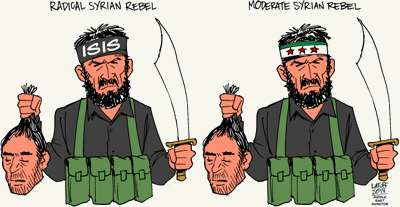
This draws a false distinction between rebels focused on ousting the Assad government (rebels who, it is implied, don’t use terrorist methods and aren’t committed to creating an Islamic state in Syria, though neither is true) and Al Qaeda and the Islamic State (who, Washington’s narrative implies, aren’t focussed on ousting the Assad government, which, of course, they are.) The reality is that Al Qaeda, ISIS, the Army of Islam, and a slew of other jihadist groups enmeshed with al-Nusra and backed by the United States do use terrorist methods, are focussed on ousting the Assad government, and do seek to create an Islamic state in its place. There is no dichotomy. When in 2012 the United States officially designated the Nusra Front a terrorist organization, “moderate” fighters launched a protest under the banner “We are all Jabhat al-Nusra,” [6] affirming the point.

As the veteran Middle East correspondent Patrick Cockburn wrote in 2014: The “Syrian military opposition is dominated by ISIS and by Jabhat al-Nusra… in addition to other extreme jihadi groups. In reality, there is no dividing wall between them and America’s supposedly moderate opposition allies.” [7]

Nusra Front is not the only UN Security Council-designated terrorist organization which the United States has been accused of refraining from attacking. Syrian president Bashar al-Assad has repeatedly argued that the United States is only managing ISIS—that is, attacking it enough to prevent it from threatening US oil interests in Iraq, but not so much that ISIS will be eliminated as a tool to counter secular Arab nationalists in Damascus. He cites as evidence the fact that ISIS continued to expand in Syria despite the United States leading a coalition of dozens of countries against the Al Qaeda break-away organization, and that Islamic States’ expansion was only halted and reversed when Russia intervened militarily in the country, with Damascus’s imprimatur. The United States, he concludes, lacks the political will to destroy ISIS, because the Islamist organization remains useful to Washington’s project of toppling the Syrian government. By contrast, Moscow, which doesn’t share Washington’s regime-change goal, has the political will to destroy ISIS, and therefore has been more effective against it. [8]

While it’s easy to dismiss Assad’s view as partial, it does resonate with mainstream Western sources. For example, on May 20, 2015, the New York Times’ Anne Barnard and Hwaida Saad reported that the United States refrained from attacking “Islamic State militants in and around Palmyra” in order “to avoid … aiding a leader whose ouster President Obama has called for.” [9] And the US Congressional Research Service has concluded that “US officials may be concerned that a more aggressive campaign against the Islamic State may take military pressure off the” Syrian government. [10]

Veteran Middle East correspondent Robert Fisk summed up the US-led coalition’s campaign against ISIS this way: “And so we went to war against Isis in Syria—unless, of course, Isis was attacking (the Syrian republic), in which case we did nothing at all…” [11]

“Many people do not realize that the United States has had a long history of flirting with political Islam,” writes scholar Mohammed Ayoob. That flirtation goes back to at least the 1950s when Washington enlisted “Saudi Arabia, the ‘fundamentalist’ kingdom par excellence” to help counter “Arab nationalism as the unifying force in the Arab world. American policy makers perceived Arab nationalist regimes, such as Egypt, Syria and Iraq…to be…inimical to American interests.” [12] Those interests included US control of the Arab world’s vast petroleum resources.

Washington has had considerable success in eliminating secular opposition to its hegemony in the Middle East and North Africa, the Mashriq and the Maghreb. Egypt has been co-opted; the Anglo-American 2003 invasion of Iraq eliminated that country’s Arab nationalists, who are now proscribed from holding positions in government; and Arab nationalists in Libya were swept away by a combined NATO-Islamist assault in 2011. Syria remains as the last redoubt of secular Arab nationalism. (The country’s constitution defines Syria as the “beating heart of Arabism” and “the bedrock of resistance against colonial hegemony on the Arab world and its capabilities and wealth.”) And Washington seems intent on relying on its hoary tactic of forming tactical alliances with jihadists to crush the opposition of secular nationalists to the region’s domination by the United States and its Western allies.

The United States has a troubled relationship with terrorism and terrorists. It has a long history of pursuing state-terrorist activities, defined as the deliberate politically motivated infliction of harm on non-combatants by a state, including fire bombings of German and Japanese cities during WWII; the nuclear annihilation of Hiroshima and Nagasaki; massive terror bombing campaigns, including napalm use, during the Korean War; the carpet bombing of Indochina; the deliberate destruction of civilian infrastructure during the first Gulf War and the 1999 air war on Yugoslavia; the 1990s sanctions of mass destruction against Iraqi civilians, which led to numberless deaths, reaching perhaps a million or more; the 2003 “shock and awe” campaign unleashed on Iraq, and on and on ad nauseam. This has been accompanied by temporary tactical alliances with non-state terrorists, including the mujahedeen in Afghanistan in the late 1970s and throughout the 1980s, the forerunners of Al Qaeda; the contras in Nicaragua; and today, a tactical alliance with ISIS, al-Nusra, and support for al-Nusra-embeds in Syria.

The US priority in Syria is Arab nationalist-elimination, and not the elimination of Islamist terrorists, who remain useful to Washington in clearing away the last of the Arab nationalist state obstacles to total US hegemony over the Arab world.

My book Washington’s Long War on Syria is forthcoming April 2017.

Notes

1. Gardiner Harris and Anne Barnard, “John Kerry meets Vladimir Putin to discuss new Syria plan,” The New York Times, July 14, 2016.

2. Journalist and writer Max Blumenthal has referred to Israel as JSIL, the Jewish State in the Levant. While the allusion to ISIL is intended facetiously, it does call to mind certain important parallels between Israel and the Islamic State.

First, both are founded on religion and give priority to anyone who adheres to the right one. Zionists go further than Islamists in referring to their co-religionists as a people whereas Islamists refer to Muslims only as members of a community. There exist no Jewish people, in the original sense of people as a group sharing a common language and territory.

Second, both ISIL and JSIL were founded on terrorism, that of the former obvious, and requiring no elaboration; that of the later, mostly absent from public discourse, but scholarly documented, all the same. Jewish irregulars, led by Yitzhak Shamir and Menachem Begin, men who would later become prime ministers of the Jewish state, used terrorist methods against British Mandate authorities in Palestine, and against the indigenous Palestinians; in the first case, to compel the British to end their mandate and turn Palestine over to Jewish rule, and in the second, to drive Palestinians from their homes, to alter the demographic character of a future Jewish state in order to ensure it included a large majority of Jews.

Third, both are implacably opposed to Syrian Arab nationalism. ISIL opposes the Syrian republic because it is a secular state based on ethnic identity rather than an Islamic state based on religious identity. JSIL opposes the Syrian republic, because the latter insists that the settler state based on Jewish religious identity which was implanted by force and colonization on Arab territory be dismantled and the usurped territory it occupies be returned to its rightful owners and incorporated into a larger Arab secular state.

3. Jay Solomon, “U.S., Russia agree to implement Syria cease-fire,” The Wall Street Journal, February 22, 2016; Karen de Young, “U.S. Russia hold Syria cease-fire talks as deadline passes without action,” The Washington Post, February 19, 2016; Karen Zraick and Anne Barnard, “Syrian war could turn on the battle for Aleppo,” The New York Times, February 12, 2016; Farnaz Fassihi, “U.N. Security Council unanimously votes to adopt France’s counterterrorism resolution,” The Wall Street Journal, November 20, 2015; Sam Dagher, “Syria’s Bashar al-Assad Tries to Force the West to Choose Between Regime, Islamic State,” The Wall Street Journal, October 9, 2015; Anne Barnard and Michael R. Gordon, “Goals diverge and perils remain as U.S. and Turkey take on ISIS,” The New York Times, July 27, 2015; Sam Dagher, “Militants seize oil field, expand Syrian domain”, The Wall Street Journal, July 3, 2014.

4. “Security Council ‘Unequivocally’ Condemns ISIL Terrorist Attacks, Unanimously Adopting Text that Determines Extremist Group Poses ‘Unprecedented’ Threat,” United Nations, November 20, 2015, http://www.un.org/press/en/2015/sc12132.doc.htm

5. Joel Gehrke, “Updated: Obama waives ban on arming terrorists to allow aid to Syrian opposition,” Washington Examiner, September 15, 2013.

6. Mark Landler, Michael R. Gordon and Anne Barnard, “US will grant recognition to Syrian rebels,” The New York Times, December 11, 2012.

7. Belen Fernandez, “Book review: The Jihadis Return: ISIS and the New Sunni Uprising,” The Middle East Eye, September 3, 2014.

8. In a July 1, 2016 interview with Australian television Assad said: “Actually, we welcome any effort to fight terrorism in Syria, any effort, but this effort first of all should be genuine, not window-dressing like what’s happening now in northern Syria where 60 countries couldn’t prevent ISIS from expanding. Actually, when the Russian air support started, only at that time when ISIS stopped expanding.” “President al-Assad to SBS Australia: Western nations attack Syrian government openly and deal with secretly,” SANA, July 1, 2016.

9. “ISIS fighters seize control of Syrian city of Palmyra, and ancient ruins,” The New York Times, May 20, 2015.

10. Christopher M. Blanchard, Carla E. Humud Mary Beth D. Nikitin, “Armed Conflict in Syria: Overview and U.S. Response,” Congressional Research Service,” October 9, 2015.

11. Robert Fisk, “I read the Chilcot report as I travelled across Syria this week and saw for myself what Blair’s actions caused,” The Independent, July 7, 2016.

12. Mohammed Ayoob, The Many Faces of Political Islam: Religion and Politics in the Muslim World, The University of Michigan Press, 2011, p. 164.

Defiant Syria: On A Journey Through Syria, A Canadian Anti-War Activist Discovers The Country’s Resilient Spirit

July 8, 2016

By Stephen Gowans

Last April, veteran anti-war activist Ken Stone travelled to Syria as part of a seven person solidarity mission with the people of Syria, becoming one of the first tourists to visit liberated Palmyra. Stone recounts his trip in Defiant Syria: Dispatches from the Second International Tour of Peace to Syria.

The short book is part travelogue, part diatribe against those sections of the political left which reliably support US-led interventions in formerly colonized countries, and part trenchant critique of Canadian foreign policy in connection with Syria.

Defiant SyriaStone’s journey through Syria left him struck by the defiance of Syrians in the face of the immense challenges they’ve confronted and the struggles they’ve endured.

“I was surprised,” he writes, “at the resilience of the Syrian spirit. I expected to find Syrians depressed, exhausted, and pessimistic after five long years of war. Instead, they were full of life and defiance.”

Part of that defiance was expressed in the Syrian government insisting, over the objections of Western powers, on holding parliamentary elections in April, as mandated by Syria’s 2012 constitution, which was drafted and popularly ratified in response to the demands of the opposition in 2011.

Stone was in Damascus on the day of the election, and devotes a chapter of his book to the mechanics of parliamentary democracy in Syria and what he observed as Syrians went to the polls. He draws a contrast between the government controlled capital, where calm prevailed and residents were determined to cast their ballots, and nearby Ghouta, where “all kinds of foreign mercenaries hold the population hostage and in terror.”

I was struck, reading this, by another contrast. On top of parliamentary elections, Syrians elect their president, and the last presidential election in 2012 was open to multiple candidates. In contrast, there are no elections held in jihadist-controlled territories. The jihadists, not only ISIS and al Nusra, but many of the mislabelled “moderate rebels,” doted on by Western countries, and who are enmeshed with al-Nusra, view democracy as idolatry, and don’t favor it for the successor state they envision.

None of this has stopped the former NATO colonial powers from backing the democracy-adverse jihadists. Nor has it stopped Washington and its NATO allies from working with democracy-abominating Arab monarchies—which, by the way, were installed by the colonial powers—to bring down an elected government in Damascus whose guiding political philosophy is anti-colonialism and freedom from foreign interference.

Framed this way, it’s not difficult to see who the villains are in this piece, and what lies at the root of the war—not a revolutionary eruption of civil society for democracy but a reactionary eruption of former colonial powers, in alliance with Wahhabi-inspired Islam, for renewed domination of Syria.

If the claim about the United States and its allies forging an alliance with Sunni sectarian Islamists seems extreme, consider this: In March, the Wall Street Journal quoted Michael Oren, former Israeli ambassador to the United States, and now a member of the Israeli parliament, declaring that “If we had to choose between ISIS and Assad, we’ll take ISIS.”

Mainstream commentators, from journalists Robert Fisk and Patrick Cockburn of the Independent to Anne Barnard and Hwaida Saad of the New York Times, along with the United States’ own Congressional Research Service, have either described the US-led coalition’s fight against ISIS in Syria as largely symbolic or standing down when Islamic State attacks Syrian government forces. Washington is reluctant to stop ISIS from doing as much damage as it can in Syria, a form of collusion with the Wahhabi-inspired Sunni sectarians, in pursuit of a shared goal of ousting Assad, whose crime appears to be adherence to secular Arab nationalist goals of freedom from foreign interference, Arab unity, and socialism.

In a similar manner, British foreign secretary Philip Hammond, with an imperial arrogance befitting an official of the empire, told the New York Times last November that if al-Qaeda accepts the West’s conditions, it should be allowed to contribute to shaping Syria’s future, but not Assad, the elected president.

As for al Nusra, whose fighters are regularly patched up in Israeli hospitals and then sent back across the border to continue their fight against secularism and non-sectarianism, the New York Times and Wall Street Journal have run article after article noting that US-trained rebels are enmeshed with, cooperating with, ideologically similar to, sharing arms with, and embedded with the al Qaeda affiliate in Syria.

None of this is lost on Stone, who blames Washington, and its military alliance NATO, for Syria’s tribulations. A “cabal of mainly western NATO countries with the help of various Arab monarchs” has “recruited, trained, and coordinated” the insurgents, he writes. NATO’s sponsorship of jihadists—whom Stone calls terrorist mercenaries—is the root cause, in his view, of the chaos that plagues the country.

Stone argues that a direct line of causation can be traced from another aspect of the chaos of Syria to the West’s interventionist policies in the Middle East, namely, the refugee crisis in Europe. “It’s no accident,” he writes, “that the wave of refugees that has literally washed ashore on the coastlines of Southern Europe, dead and alive, is composed mostly of Syrians, Libyans, and Afghanis, precisely the victims of NATO military interventions in those three countries.”

The implications for how to resolve the refugee crisis are clear, says Stone. The “lesson is that, if you don’t want to turn millions of innocent civilians into refugees and subsequently find them at your frontiers, you should oppose military interventions in other countries.”

This should resonate with Canadians, whose government has agreed to settle 25,000 refugees from the war-torn country. It is “a fine humanitarian gesture,” Stone notes, but is “treating the symptom rather than the disease.” The “war could end in months,” he predicts, “if the predominantly NATO countries, who have organized the aggression against Syria” brought an end to “their support of the foreign mercenaries operating in that country and leaned on Turkey and Jordan to close their borders to them.”

Stone fulminates against “otherwise intelligent people” who’ve fallen for the myth that the Syrian insurgency is a democratic uprising of civil society against a brutal dictator, rather than a regime change operation sponsored by Washington and its satellites, in the pattern of Afghanistan, Iraq, Haiti, Honduras, Libya, and Somalia.

“It’s not as if Syria is the very first government targeted for regime change by the USA,” he writes. Still, “there is never a shortage of ‘leftists’ in the West who can be either bought or convinced through their incredible naïveté, warped political outlook, or Eurocentric arrogance, that the motives of the Empire are good,” he observes.

Stone reserves particular venom for an article that appeared in the September 2015 issue of The New Internationalist. A retired teacher colleague of Stone’s went out of his way to place a copy of the magazine, featuring the article “The forgotten revolution of Syria,” in Stone’s hands so he could read it in advance of his trip to Syria. Stone dismissed it as “shit.”

The Hamilton-based activist bids us to contrast “the hostile treatment with which the Canadian government unfairly treats the secular and pluralist Syrian government to the friendly treatment (including arms sales and an open invitation to fund mosques across Canada) it offers to the despotic and sectarian Saudi Arabian monarchy, the fountainhead of Wahhabi terrorism around the world.”

Stone also takes Ottawa to task for provide refuelling, reconnaissance, and transport aircraft services to the US-led Coalition, which violates Syria’s sovereignty by carrying out military operations in the country without the slightest regard for the wishes of Syrians or their elected government. This makes Canada “an accomplice, not directly involved in bombing Syria, but doing something akin to driving the getaway car rather than actually robbing the bank,” Stone observes.

The veteran leftist also faults the Canadian government for sending 800 Canadian military trainers to reinforce Kurdish Peshmerga forces in northern Iraq. He argues that this is part of an effort to detach the pro-West Kurdish north completely from Iraq by making it militarily independent of Baghdad.

Stone left Syria sanguine about its future. Restaurants and nightclubs filled with people at night, Syrians singing patriotic songs, dancing, and making ambitious plans to reconstruct their lives—all of this imbued him with a spirit of optimism about a country whose people continue to defy Western machinations to undermine their right to choose their own government, guide their economy in their own way, and choose their own future.

Defiant Syria is available online as an e-book or in paper by sending an e-mail to the Hamilton Coalition to Stop the War at hcsw@cogeco.ca.

The book will be officially launched in Toronto on July 14. See here for details.

Amazon at https://www.amazon.ca/Defiant-Syria-Dispatches-Second-International-ebook/dp/B01HVGLIN8/ref=sr_1_1?s=digital-text&ie=UTF8&qid=1467771916&sr=1-1&keywords=defiant+Syria

Kobo at https://store.kobobooks.com/en-us/ebook/defiant-syria-dispatches-from-the-second-international-tour-of-peace-to-syria

Itunes (Canada) at https://itunes.apple.com/ca/book/defiant-syria-dispatches-from/id1127601566?mt=11

The Two-State Proposal for Palestine: Neither Practical nor Morally Defensible

July 6, 2016

By Stephen Gowans

I wrote on July 4 in The Jewish Colonization of Palestine and the Recalcitrance of the Natives that United Nations General Assembly Resolution 181 of 1947 was the first official two-state proposal. Actually, a decade earlier, in 1937, Britain’s Peel Commission recommended the partition of Palestine into separate Jewish and Arab states. The commission’s report, and not Resolution 181, contained the first official two-state proposal. The Peel Commission plan was rejected by both sides, adumbrating the repudiation of Resolution 181 a decade later. A two-state proposal, then, has been around, in one form or another, for nearly 80 years, and in all those years, one side or both, has rejected it in practice, if not always in words.

Given the proposal’s uninspiring record of repeated repudiation, it beggars belief that two-state proponents should continue to think it has much of a chance of being accepted. The only conditions under which one can conceive of it being accepted by the Palestinians is if they become so ground down that they eventually capitulate and accept whatever crumbs are offered them; that is, if after decades as refugees, under Israeli military occupation, incarcerated in the open air prison of the Gaza Strip, or as third class Israeli citizens, they finally give up, and accept to live forever on their knees, though the chances of that happening seem vanishingly small. All the same, two-state proponents may welcome this unlikely outcome, and celebrate it, but what they would celebrate? Peace? Perhaps. But also the triumph of a grave injustice. And without justice, peace cannot last long.

The moral case against Jewish colonization of Palestine is formidable. The legitimacy of political authority is derived from the consent of the governed. Neither the British colonial authorities nor the Zionist state ever had the consent of the Palestinians. UN Resolution 181 (which is irrelevant anyway since it has never been implemented and was rejected by Jewish forces in 1947 and 1948 when they conquered territory beyond the limits the resolution proposed for a Jewish state) was rejected by the Palestinian majority whose lives would have been profoundly and unalterably affected by it.

As Tomis Kapitan pointed out (The Israeli-Palestine Conflict, 1997), the British had no right to give Palestine as a gift to anyone, and even if they did, London had pledged support for Arab independence throughout the Middle East to an established monarch (Sheriff Hussein of Mecca) before it issued the Balfour Declaration, whose pledge was made to an amorphous body, “the Jews”, lacking political form and juridical definition.

Moreover, Palestinians have a natural right to self government, independent of the promises, declarations, resolutions and preferences of the British, the United States, the United Nations, and the Diplomatic Quartet.

Hence, add to the moral concerns about the two-state proposal, the reality that its history shows it to have long been considered by one or both sides as undesirable, and the conclusion must be that it is untenable as a serious proposal, on moral grounds as well as on the practical grounds that its proponents quite mistakenly believe recommends it.

An alternative proposal that at least has the benefit of being just, morally defensible, and sensitive to the rights of indigenous people to self-determination, is a single, secular, democratic state, in which all citizens, Jews, Muslims, and Christians, are equal, and to which all Palestinian refugees are free to return.

The Jewish Colonization of Palestine and the Recalcitrance of the Natives

July 4, 2016

“It is easy for us who have never been victims of foreign conquest and are still living in our homes to vehemently denounce the violence of evicted Palestinians.” [1]

“Palestine is an occupied land stolen from its native people and time does not make it a property of the thief.” [2]

By Stephen Gowans

In 1939, Hitler ordered Poland to be depopulated and colonized by Germans. Poland had a substantial Jewish population. Less than 10 years later, in 1947 and 1948, Zionists—who, like Hitler, believed that Jews were a national collectivity, in addition to being a religious one, and that Jews ought to establish a homeland outside of Europe—ethnically cleansed Palestine, a former Ottoman territory, of a large part of its indigenous Palestinian population. The goal was to establish a Jewish state in Palestine to be colonized by Jewish settlers, mainly from Europe. The Zionists used terrorist methods to induce the Palestinian population to flee, and refused to allow them to return, turning nearly a million of them into refugees. The property of Palestinians who took flight and were barred from returning was taken over—that is, expropriated without compensation—by Jewish settlers.

LeilaIn May of 1948, Zionist forces proclaimed the formation of a Jewish state in the Palestinians’ country, a date Palestinians mark as the Nakba, or catastrophe. The Jewish state controlled 78 percent of Palestine. Many of the Palestinians whom Jewish terrorists had forced from their homes lived in refugee camps in the remaining 22 percent of their country. This was made up of the West Bank, Gaza Strip and East Jerusalem. In 1967, Zionist forces completed their military conquest of Palestine in toto, imposing military rule on parts of the Palestinians’ country they had failed to conquer in 1948. Since then, Israel has engaged in a process of creeping Judaization of the West Bank and East Jerusalem, building Jewish-only settlements, connecting them by Jewish-only roads, and denying building permits to Palestinians.

There has been much talk of a two-state solution. But what, exactly, are two states a solution to? The proffered answer is that they are a solution to the irreconcilable goals of Zionists, on the one hand, who seek Jewish colonization of all of Palestine, and Palestinians, on the other, who refuse to accept the colonization of their country. The proposed solution, which isn’t a solution at all, but for both parties an unacceptable compromise, is for the Zionists to accept that they can’t have all of Palestine and for the Palestinians to accept they can’t keep all of their country. If we cast this in terms of the German conquest of Poland, we can see that the compromise entailed in the two-state proposal is completely unacceptable. Imagine that in 1939 the international community had called for Germany and the Poles to accept a two-state “solution” by which Germany colonized part of Poland, and the Poles kept another part—a fraction—of their own country. No one would have accepted this, neither the Germans, who were bent on the military conquest of Poland to establish lebensraum—and had the military muscle to achieve their goal—nor the Poles who, quite rightly, would have rejected the proposal outright, as would anyone else in the same circumstances, except under extreme duress, or unless they shared the politics of the invader as, say Petain shared the Nazi’s virulent antipathy to communism and sympathy for the ancient regime, and so accepted a two-state solution for France.

The first two-state proposal was implied in the Balfour Declaration of November 2, 1917, in which one country, Britain, pledged that another country, the Palestinians’, would provide the territory for a Jewish homeland. That declaration, which opened the doors to Jewish immigration to Palestine, sparked decades of conflict between Jewish immigrants to Palestine, the Palestinians and the British colonial authorities, culminating in a major Palestinian insurrection from 1936 to 1939.

The first formal explicit two-state proposal was UN General Assembly Resolution 181 of November 29, 1947, formulated by the United Nations after the British threw the mess they had created into the laps of the new world body. The resolution did nothing to sort out the mess. It called for a Jewish state to be carved out of 56 percent of the Palestinians’ country, and for the Palestinians to content themselves with the minority share of their territory. Hundreds of thousands of Palestinians who lived in the territory that would come under the jurisdiction of the Jewish state would be forced to live under Jewish rule in their own country. The Zionists were disappointed, because they wanted all of Palestine, but went along anyway because they were being offered more than they had. The Palestinians, not surprisingly, rejected the proposal outright, which, anyone else in their place also would have done. This was hardly an auspicious beginning for a proposal that has since been dubbed a “solution.” How could it be a solution, when a major party to the proposed arrangement rejected it from the very beginning, and for obvious, and entirely justifiable, reasons?

The two-state proposal, then, (not a solution—the term solution is a deception to suggest the scheme is workable) was a bad scheme from the very beginning, and has become significantly worse since. With Zionist forces conquering even more of the Palestinians’ country than Resolution 181 foresaw for a Jewish state, two-state exponents now envisioned a Jewish state in the 78 percent of Palestine that Israel controlled, following the armistice which brought the open hostilities of the Arab-Israeli war to a halt. In other words, the armistice line, rather than the frontiers envisioned by the UN, would now form the boundaries of a Jewish state. This, of course, was favorable to the Zionists, who would have a state even larger than the one they were to receive under Resolution 181. But if Palestinians thought that relinquishing 56 percent of their country to Jewish colonizers was unacceptable, how could they possibly be expected to think that ceding 78 percent was acceptable? Poles would hardly think that ceding one percent of their territory to Germany would have been tolerable, let alone 57 percent. The idea that anyone would think they would accept the loss of 78 percent of their country to a colonizing invader would be considered an insult.

It gets worse. Since its 1967 military conquest of the remainder of the Palestinians’ country, Israel has built Jewish settlements in the West Bank and East Jerusalem, connecting them by a reticulation of Jewish-only roads. Under the two-state proposal, Israel is expected to insist on including these Jewish “facts on the ground” in any negotiated arrangement, so that whatever state the Palestinians would be allowed to have, would be located on territory making up only a small fraction of their country, and the territory would be non-contiguous, divided by Jewish settlements, and criss-crossed by Jewish-only roads. Can proponents of the two-state proposal sincerely believe their scheme has the merits of pragmatism and achievability? It wasn’t pragmatic and achievable in its implicit form in 1917 under the Balfour Declaration, nor in 1947 in its explicit form in Resolution 181. What, then, makes two-state proponents think that their proposal is more pragmatic and achievable today, now that it asks Palestinians to accept an even smaller minority share of their country than the UN proposal would have given them?

The Palestinians have refused to capitulate to the colonization of their country. They will not to live on their knees. They are, accordingly, unremittingly censured by people who have never been colonized, and, to the contrary, are citizens of countries with histories of colonization, which either promised Palestine to the Jews in the first place, which they had no right to do, or participated in dividing up the Middle East into Mandates (thinly disguised colonial possessions) without the slightest regard for the wishes of the natives, or which today furnish the colonizers with the arms and diplomatic backing they require to carry out their project.

The major advocate of the two-state proposal, the Diplomatic Quartet, consisting of the United Nations, the United States, the European Union, and Russia, recently issued a report which takes the Palestinians to task for using violence to resist the Jewish colonization of the remaining parts of their country which Israel hasn’t annexed de jure. The Quartet accepts the violence Israel uses and has used to fit its yoke on the Palestinians, but condemns the violence of the Palestinians to throw off the yoke. The political violence of Nazi Germany in conquering Poland in order to colonize it is considered deplorable, and the Polish resistance to German military occupation is seen as heroic and praiseworthy, but the political violence of Zionist forces in conquering Palestine in order to colonize it is accepted, while the Palestinian resistance to Israeli military occupation is labelled as terrorism.

On July 1, two Jewish settlers were shot and killed, presumably by Palestinians aggrieved at the creeping Judaization of the West Bank. The settlers were attacked near Al-Khalil (also known by its Hebrew name, Hebron.) [3] This is territory Israel conquered in 1967, and has occupied since. International law prohibits colonization of occupied territory, and the slain settlers lived on the territory illegally. Had Germany colonized Poland, the killing of the Jewish settlers near Al-Khalil would have been tantamount to Polish insurgents (who the Germans would label terrorists) killing German settlers in their country.

But we can go further. Jews who live on territory conquered from the Palestinians prior to 1967 have settled on land from which Palestinians have been displaced by violence. If it would have been legitimate for Polish resistance fighters to attack German settlers on Polish territory, and is legitimate for Palestinian resistance fighters to attack settlers on Palestinian territory conquered since 1967, it is also legitimate for Palestinian resistance fighters to attack settlers on Palestinian territory conquered prior to 1967. The division of the conquest of Palestine along the armistice line of the Arab-Israeli War, marking territory on one side as legitimately conquered, and territory on the other as illegitimately occupied, is completely arbitrary. Zionists have no legitimate claim to any part of the Palestinians’ country, not the territory conquered before 1967, and not the territory conquered after; not up to the armistice line, and not beyond it.

In retaliation for the killing of the settlers, the occupation has locked down Al-Khalil and its surrounding area, and has ordered more occupation troops into the West Bank. [4]

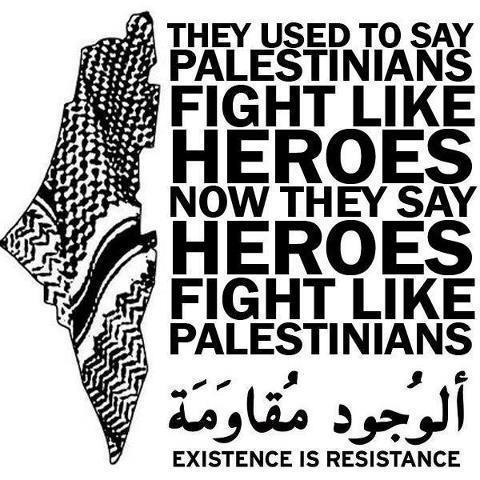
They used to say palestinians fight like heroes now they say heroes fight like palestinians existence is resistanceOn the same day, the Quartet identified incorrectly that continued Palestinian violence (i.e., resistance) and Palestinian attacks on civilians (i.e., settlers, but not Israeli attacks on Palestinians) are among the major threats to achieving the Quartet’s favored two-state arrangement. [5] To the contrary, the major threat to achieving the two-state scheme is immanent in the scheme itself; the proposal is, for reasons already stated, completely impractical and unachievable, having arrived stillborn in the world in 1947, and has shown no signs of life in all the decades since despite simulated efforts to breathe life into the corpse.

Complaints were also made by the Quartet that Palestinians who use violence to resist occupation and colonization of their country are depicted as heroes in the Palestinian media and on social media, that streets, squares and schools have been named after them, and that Palestinian leaders have not condemned them. In other words, Palestinians must not recognize efforts to liberate their country as legitimate and praiseworthy, nor bestow the mantle of hero on fighters for national liberation. Instead, Palestinian insurgents are to be demonized as terrorists.

The report correctly identifies the causes of Palestinian political violence. These include the building of new Jewish settlements, the expansion of existing ones, the construction of Jewish-only roads and the denial of building permits to Palestinians; in other words, colonization. But it does not label colonization as the cause of Palestinian violence. Instead, it presents Jewish colonization and the recalcitrance of the natives as two independent phenomena, the “bad” behavior of both parties. We’re to believe that if only both parties would stop behaving badly, the “solution” of two states could be brought to fruition.

The boldness of the Zionist land grab in the West Bank would be staggering, were it not for the fact that Israel’s audacity in expanding its territory is well established. Area C comprises 60 percent of the West Bank. It is intended to make up the bulk of land for a future Palestinian state under the two-state proposal, yet Israel has seized over 70 percent of the area and has designated it as solely for Jewish use. The remaining 30 percent is effectively off-limits to Palestinians, since it requires building permits which Israeli military authorities almost never grant. [6]

There are 570,000 Jewish settlers living in the West Bank and East Jerusalem, 370,000 in the former and 200,000 in the latter. Over 80,000 settlers live in isolated settlements deep inside the West Bank. The number of settlers in the West Bank and East Jerusalem has doubled since 1993, when the process of building a Palestinian state in a very small part of the Palestinians’ country was supposed to have begun in earnest. [7]

The Quartet report notes that Israeli settlement activity in the West Bank “raises legitimate questions about Israel’s long-term intentions,” and that these questions are buttressed “by the statements of some government ministers to the effect that the establishment of a Palestinian state will never be allowed.” It also refers to the current situation as “a one-state reality of perpetual occupation and conflict.” [8]

It’s difficult to deny that the Quartet is colluding in the Zionist project of Judaizing all of Palestine.

First, its demand that Palestinians abandon all resistance amounts to a call for Palestinian capitulation. The only force which has ever successfully opposed colonialism is the recalcitrance of the natives, and people have the right to resist the colonization of their country and to fight for its liberation. To deny them that right would be to accept colonialism as legitimate.

Second, while the Quartet identifies settlement activity as the cause of Palestinian violence, it doesn’t label it as a cause, and treats the cause (colonization) and effect (Palestinian resistance) as equal. Hence, Israel is called upon to stop settlement activity and the Palestinians are called upon to abandon resistance to it. But if settlement activity is wrong, and should cease, how can resistance to it also be wrong? Saeb Erekat, the PLO secretary general, quite rightly complained that the report tries to “equalize the responsibilities between a people under occupation and a foreign military occupier.” [9] We might also ask, if settlement activity is wrong, shouldn’t it not only be brought to an end, but reversed and undone? The Quartet didn’t call upon Israel to dismantle its settlements or end its military occupation. And the key members of the Quartet haven’t issued a UN Security Council resolution ordering Israel to undertake these actions, though, in principle, a resolution to this effect could be easily arranged were officials in Washington, London, Paris and Brussels so motivated.

Third, on the very same day Israel began meting out collective punishment to Palestinian residents of Al-Khalil for the crime of resistance, the New York Times reminded us who Israel’s principal arms supplier and military patron is. According to the newspaper, Washington has signalled that it is prepared to “substantially sweeten” a 10-year military aid package for Israel, already valued at $30 billion. The new deal would include a pledge to fund missile defense systems in Israel. This would further weaken the pressure Palestinians can bring to bear on Israel through rocket attacks, ensuring that Israel has even less incentive to discontinue its creeping Judaization of the West Bank and East Jerusalem and colonization of the rest of the Palestinian’s country. [10]

The White House wants the Israelis to use the aid to buy exclusively from US weapons providers, rather than spending some of it on Israeli arms manufacturers. Since 1980, “Israel has been permitted to spend about a quarter of the military aid it receives outside the United States.” It has used this provision to subsidize the development of a domestic arms industry, which is now one of the top 10 arms exporters in the world, competing with US arms makers. No other recipient of US military aid is permitted to make arms purchases outside the United States. [11]

US military aid is a mechanism for the upward redistribution of wealth from ordinary US citizens, who generate the bulk of tax revenue, to the high-level executives and shareholders of major US weapons manufacturers. Israel uses this transfer of wealth from Joe and Jane Average American to buy US arms to enforce and expand its colonization of the Palestinians’ country.

Washington, then, is completely complicit in the Jewish colonization of Palestine. Its complicity is evidenced in its expropriating part of the emoluments of US citizens to furnish Israel with the means of enforcing its oppression of the Palestinians, in its unquestioning diplomatic support of Tel Aviv, and in its refusal to use its economic, diplomatic and political leverage to facilitate Palestinian efforts to liberate their country from the Zionist yoke. Washington’s formal commitment to the two-state proposal is a ruse, a delaying tactic under the cover of which Israel can carry its modern-day colonization scheme through to its logical conclusion, namely, the total Judaization of the Palestinians’ country.

As for the two-state solution, well, it is not a solution at all. It is, to the contrary, the very problem it deceptively promises to resolve. The problem—the root cause of decades of violence in Palestine since the Balfour Declaration was promulgated in 1917, is the idea that an alien state can be implanted in the Palestinians’ country, whether as a single state encompassing Palestine in its entirety from the Mediterranean Sea to the Jordan River, or alongside a separate Palestinian state constituted on only a fraction of the Palestinians’ land. The two-state “solution”, then, is only a particular form of the problem, namely a settler state enveloping some part—and in all cases, two-state proposals have called for it to envelop the major part—of the Palestinians’ country. The solution to the problem is not two states, but a single, secular, democratic state, in which all citizens, Jews, Muslims, and Christians, are equal, and to which all Palestinian refugees are free to return.

1. John Glubb. Forward to George Hajjar, Leila Khaled: The Autobiography of a Revolutionary. Hodder and Stoughton, 1973.

2. Sayyed Hasan Nasrallah. Quoted in “We are required to stay firm,” Syria Times, July 2, 2016.

3. Diaa Hadis and Somini Sengupta, “Israel imposes restrictions on Palestinians in West Bank after attacks,” The New York Times, July 1, 2016.

4. Hadis and Sengupta.

5. “Diplomatic Quarter release report on advancing two-state solution to Israel-Palestine conflict,” UN News Centre, July 1, 2016.

6. Barak Ravid, “Quartet releases report on impasse in Israeli-Palestinian peace: ‘Two-state solution in danger,” Haaretz, July 1, 2016.

7. Ravid.

8. Hadis and Sengupta.

9. Hadis and Sengupta.

10. Julie Hirschfeld Davis, “U.S. offers to increase military aid to Israel,” The New York Times, July 1, 2016.

11. Hirschfeld Davis.

On Canada’s Sesquicentennial, What Does Humanity Have To Look Forward To? Not What Canada Represents

July 1, 2017

Today is Canada Day, an annual fete in Canada to honour the birth of the country. In Ottawa, the capital, Canadians dress in the red and white of their country’s flag, set baseball caps with CANADA emblazoned across the front atop their heads, clutch mini Canadian flags in their hands, and make their way to the annual Parliament Hill spectacle, which features massive flags, marching soldiers, and Canadian war planes roaring overhead—the same ones that engaged in foreign bombing missions, including in Libya, where Canadian pilots quipped facetiously but accurately that they were al-Qaeda’s air force.

Canadians have been led to believe by the people who foster mindless patriotism that their country stands for peace, democracy, human rights and freedom. This is eye wash.

A Canada that embraced the commitments of Norman Bethune, who fought fascism in Spain, helped overcome feudalism and colonialism in China, and pioneered the fight for universal healthcare in Canada, might provide a model of a world that humanity could look forward to, in contrast to a Canada that hammers out arms deals with medieval tyrannies and whose pilots fly bombing missions for al-Qaeda.
Consider a recent departure from the country’s self-declared but infrequently adhered to values. The Trudeau government, the latest in a long line of governments committed to facilitating the profit-making of the country’s substantial citizens, no matter what the consequences are for peace, democracy, human rights and freedom, is forging ahead with a $15 billion arms deal secured by the previous Harper government to sell light armoured vehicles to an oil rich medieval monarchy in the Middle East. Named after its ruling Saud family, this Arab tyranny abhors peace, democracy and fundamental human rights, leads an illegal unprovoked war on Yemen, and is one of the main arms supplier to al-Qaeda and its allies in Syria—the backward sectarian militants who carry out terrorists attacks which, on the occasions they spill over into Europe, provoke great outcries of indignation, but which occur on an almost daily basis in Syria, typically without comment in Canada.

Add to this the deplorable realities that the tyranny’s retrograde and hate-filled version of Islam is the ideological inspiration for al-Qaeda and Islamic State, and that, difficult as it is to credit, the kingdom’s male despots refuse to allow women to drive automobiles or to exercise much autonomy at all, and you would think that a country that prides itself as standing for peace, democracy, human rights and all that is virtuous, would regard its client as so noxious as to steer a wide berth around any business transactions with it.

Diderot once remarked that humanity would never be free until the last monarch was strangled with the entrails of the last cleric, which may sound anachronistic, considering that Europe was delivered from the oppressions of aristocracy at the end of World War I, or soon after. But the vile institution persists in the Arab world, concentrated among Canada’s principal Arab allies, and Diderot’s words hardly seem anachronistic or harsh to anyone who still has to bear monarchy’s oppressive weight. How could ostensibly democracy-loving Canada be so committed to such vigorously anti-democratic allies?

Ottawa has “recently hammered out” a deal with six Arab Gulf monarchies, including the aforesaid Saudi tyranny, “that spells out how Canada might deepen its relationship with these countries in coming years,” reports the Globe and Mail’s Steve Chase. To repeat: Ottawa plans to deepen its relationship with these vampires, not eschew them as affronts against humanity, as one might expect a country would which professes to be deeply devoted to progressive humanitarian values.

“The Joint Action Plan,” writes Chase “sets out areas of co-operation between Canada and Arab Gulf states on everything from politics and security dialogue to trade and investment, energy, education and health.”

And to ensure that Canadians continue to be deceived by twaddle about how their country is a paladin of so many virtues, Ottawa won’t let them see what’s in the agreement.

The key to Ottawa’s commitment to deepening its relationship with the Arab Gulf royal dictatorships is the promise of a cornucopia of profits for Canadian investors, banks and corporations. And in Canada, as in all countries where wealthy investors, banks and corporations use their wealth to dominate politics and the state, the decisive organizing principle of the society is not peace-keeping, or democracy, or human rights, but what matters to banks, wealthy investors and major corporations, namely, profit-making.

In the pursuit of private, profit-making, interests, Canada has generally been on the wrong side of history since its founding 150 years ago. And when it has been on the right side, it has been on the right side, for the wrong reasons.

My first rebellion against the cult of Canadian patriotism occurred more than 30 years ago when on a visit to the country’s war museum I came upon a celebratory reference to Canada’s 1918-1919 military intervention in Russia. The glorified Canadian military intervention was directed against a social revolution engendered by centuries of a Tsarist tyranny and the chaos, destruction and disorganization wrought by World War I. How was an intervention to quash a movement which authentically embodied the Enlightenment values of liberty, equality and fraternity, worthy of celebration? And what business was it of Canada’s to intervene militarily in the affairs of another people who posed not the slightest threat to Canada? Ottawa was terrified that the Bolsheviks were a source of inspiration to Canadians who might seek to replicate in Canada what was underway in Russia; that Canada might be made to stand for something meaningful to ordinary people, like: jobs for all; free education at all levels; universal public health care; public day care; inexpensive public transportation; an end to the exploitation of man by man; and recognition of the humanity of all people, regardless of color, ethnicity, religion and sex; in other words, all the virtues the Bolsheviks ended up bringing to the former Tsarist empire, and for which they are almost never recognized and to which Canada tried to put a stop. To paraphrase Victor Hugo’s remarks about the French Revolution, the Bolshevik Revolution may have been a great blow to the Russian aristocracy and the substantial citizens of Canada, but it was a warm caress for humanity.

Canada’s participation in the imperialist charnel house of World War I—a kind of holocaust against the working people of Europe and the colonial slaves whom the European elites threw into the conflagration—is in no way defensible, and was a reflexive, unthinking commitment to a mother country whose reason for entering the war had nothing whatever to do with the rights of small countries, as it was mendaciously professed to be, and everything to do with preserving the access of the British land-owning, industrial and financial elites to markets, investment opportunities and raw materials in competition with their German rivals.

In 1950, my maternal grandfather, who had enlisted in the Canadian Army during the Great Depression through a kind of economic conscription, joined other Canadians in the UN-denominated US-led “police action” in Korea—an indefensible meddling in someone’s else civil war, on the side of maintaining a US puppet state on the Korean peninsula, to provide Washington with a geostrategic perch from which to dominate East Asia on behalf of Wall Street financiers. The Americans, who arrived on the peninsula in 1945, and immediately swept away the People’s Committees, the first independent Korean government in decades, are still there.

Ever since, Canada has been willing to help the United States fight most of its subsequent neo-colonial wars of domination—in Iraq, Yugoslavia, Afghanistan, and now in Syria.

As for World War II, Canada was on the right side of that conflict, but for the wrong reason. The country entered the war, because Britain did, and not to fight fascism or the Nazi persecution of communists, socialists, trade union leaders, Slavs, Jews, Roma, homosexuals, and the disabled, or to defend the Soviet Union, or to give teeth to the Atlantic Charter, which promised sovereign rights and self-government, but which, as Churchill made clear, would only apply in practice to people under the Nazi yoke, not the British yoke, which included the hundreds of millions of Indians subjugated by Britain. Indeed, Britain’s great colony of India, along with the conquered space of the American West, were models Hitler sought to emulate for Germany. He would build Germany’s West, or its East Indies, in Eastern Europe. And if the project was carried out on a mountain of corpses it would hardly be without precedent. “We eat Canadian wheat,” remarked Hitler, “and don’t think about the Red Indians.”

Mackenzie King, Canada’s  prime minister during WWII, admired Hitler, and hated Jews. Before the war, Churchill also admired Hitler, and sang paeans to Mussolini. The fascist dictators were admired, not only by King and Churchill, but by large parts of the British and North American establishment, for their ardent anti-communism.
Mackenzie King, Canada’s wartime prime minister, admired Hitler, and hated Jews. Before the war, Churchill also admired Hitler, and sang paeans to Mussolini. The fascist dictators were admired, not only by King and Churchill, but by large parts of the British and North American establishment, for their ardent anti-communism.
Canada’s prime minister at the time, Mackenzie King, who had worked as head of industrial relations research for the Rockefeller Foundation to develop methods for big business to co-opt organized labor, was sympathetic to Hitler’s virulent antipathy to Jews (and communists.) King, who met Hitler, and expressed admiration for the Fuhrer in his diary, wrote that “I would have loathed living in Berlin with the Jews, and the way in which they had increased their numbers in the City, and were taking possession of it in the most important way…It was necessary to get them out, to have the German people really control their own City and affairs.”

Neither did Ottawa have trouble with fascists, so long as they confined their attention to fighting communists and organized labour and focussed their wrath on the citadel of communism, the Soviet Union. So-called premature anti-fascists, like Canada’s Norman Bethune, who travelled to Spain to fight Franco’s reaction to the country’s democratically elected Popular Front government, were looked upon with suspicion, and Ottawa erected legal impediments to Canadians traveling abroad to join the fight. Following World War II, Canada found that it could get along quite well with anti-democratic regimes in Spain and Portugal, to say nothing of the police state dictatorship it helped to defend on the Korean peninsula, or apartheid South Africa.

Behind Parliament, on a small island in the Ottawa River, sits a mock village of the indigenous people on whose land the capital—and country—has been built, an unintentional reminder (lost on most Canadians) that Canada was founded on the dispossession and genocide of the land’s aboriginal people. Canada is, after all, an expression of British colonialism, one of the most vile, destructive, brutal, sanguinary forces, in human history. The sun, it has been said, never set on the British Empire. But nor did the blood ever dry on it either. As Richard Gott has written,

“Wherever the British sought to plant their flag, they were met with opposition. In almost every colony, they had to fight their way ashore. While they could sometimes count on a handful of friends and allies, they never arrived as welcomed guests, for the expansion of empire was invariably conducted as a military operation.”

The British hacked, cut, pushed and slaughtered their way into other people’s lands to plant their flag, and to steal the natural resources of the natives, exploit their labour, and dominate their markets. Canada, a country founded by these colonizers, was no exception.

It’s consistent, then, that Ottawa should maintain an unwavering commitment to the Jewish colonization of Palestine, made possible by Britain’s conspiring with France and Tsarist Russia during the Great War to carve up the dying Ottoman Empire, and turn over Palestine to a British League of Nations mandate, in which was ensconced a commitment to create a Jewish homeland in the country of a third people, the Palestinians. Canada, not surprisingly, allies itself with the Jewish colonizers of Palestine, and therefore against its indigenous people, the Palestinians, and was opposed to the efforts of the autochthonous peoples of Zimbabwe to take back their land from the descendants of the British settlers who hacked, cut, pushed, and slaughtered their way into land they dubbed Rhodesia, after the great paladin of British imperialism, Cecil Rhodes. Rhodes once said “I would annex the planets if I could.” Rhodes is to the indigenous people of southern Africa what Hitler is to the Slavs and Jews.

The Bolsheviks, who were reviled in Ottawa, established suffrage for all, including for national minorities, long before Canada did. Canada didn’t offer universal suffrage, even Herrenvolk (master race) suffrage until after WWI, and true universal suffrage had to wait until 1960, when aboriginal Canadians, the dispossessed original inhabitants of the land, were belatedly allowed to vote.

The United States, another Herrenvolk democracy, didn’t effectively achieve universal suffrage until as late as 1965, when its regime of white supremacy was formally dismantled and the civil and political liberties of black Americans were finally formally secured throughout the country. This late and grudging surrender of white supremacy was partly due to Washington’s need to compete ideologically with the Soviet Union, where racial discrimination—and the idea of a master race—were unthinkable.

What many of us in the United States, Canada and Western Europe hold to be the great social achievements of our countries—the mitigation of discrimination on the basis of sex and religion and racial and national origin, and the development of the welfare state—owe much to the pressures Western elites felt to compete ideologically with the Soviet Union, where discrimination on these grounds was inconceivable and where a robust social welfare state prevailed. With the USSR now defunct, a suicide carried out by the country’s last president, Mikhail Gorbachev—who, for obvious reasons is celebrated in the West, but is widely reviled in Russia—the ideological competition has ceased, and with it, large parts of the welfare state have been dismantled and continue to be demolished.

The French novelist Henri Barbusse, once wrote that the burning question of all time is what is the future of the human race, so martyred by history. To what, he asked, have human beings to look forward to?

Not $15 billion arms deals with monarchs whom Diderot, where he alive, might say ought to be strangled by the entrails of the last Wahhabi cleric; not the dispossession of peoples of their land by usurping settlers from abroad; not denial of self-determination; not wars of neo-colonial re-conquest; not acting as al-Qaeda’s air force to re-colonize the world on behalf of the planet’s dominant imperialist power.

If Canada offered something for the human race, so martyred by history, to look forward to, I would celebrate its founding, or at least, the moment it changed course, and set itself to the service of humanity. But alas, Canada offers nothing but more of the same that has martyred the human race throughout history; not the liberation that Diderot foresaw, but the tyranny he opposed.

Is the United States Credible as a Guarantor of International Peace and Security?

May 31, 2016

By Stephen Gowans

On, March 2, 2016 the United Nations Security Council imposed sanctions on North Korea, citing the DPRK’s:

• Nuclear test of January 6, 2016;
• Its satellite launch of February 7, 2016, which the Security Council said relied on ballistic missile technology which could be used as a nuclear weapons delivery system. (Is it possible to launch a satellite without ballistic missile technology?)

UN Security Council Resolution 2270, championed by the United States, was approved unanimously by all 15 Security Council members, both permanent, and non-permanent, including Venezuela and Angola.

There is nothing in international law that says:

• A country cannot have nuclear weapons. True, there exists a Nuclear Non-Proliferation Treaty, but it is only binding on the parties to it, not on those who declined to join it, (like Israel), or have, (as North Korea has done), withdrawn from it.
• There is nothing in international law that says a country cannot have ballistic missiles.
• There is nothing in international law that says a country cannot launch a satellite.

So, on what grounds has the Security Council imposed sanctions on North Korea?

The Security Council defined the proliferation of nuclear, chemical and biological weapons, as well as their means of delivery, as threats to international peace and security, and therefore branded North Korea’s nuclear test and satellite launch as grave concerns. The Security Council also determined that North Korea’s nuclear test posed a danger “to peace and stability in the region and beyond.”

Article 39 of the UN Charter authorizes the Security Council to “determine the existence of any threat to peace” and to take appropriate measures to eclipse it.

North Korea objected, and for the following—I think, very compelling— reasons:

• The Security Council’s definition of what constitutes a threat to international peace and security makes no reference to violations of international law. All that North Korea has done wrong, it seems, is to have engaged in activities the Security Council doesn’t like, but which all of its permanent members have, themselves, engaged in.
• The resolution uniquely defines the DPRK’s nuclear test and satellite launch as threats to peace, but does not define the nuclear tests or satellite launches of its permanent members in the same way.

This naturally raises the question: Why is launching a satellite, developing ballistic missile technology, and nuclear weapons testing, threats when pursued by North Korea, but not when pursued by the United States, Britain, France, China and Russia—or any other country the Security Council chooses not to single out?

Let me suggest two answers.

#1. The first has to do with what the anthropologist Hugh Gusterson called nuclear Orientalism—the idea that we can live with nuclear weapons in the hands of the five permanent members of the Security Council, but proliferation to Third World countries is enormously dangerous. People in the Third World, according to this view, cannot be trusted to make responsible decisions.

The term Orientalism can be confusing, so let’s use another term—“us vs. them thinking.” That’s really what Gusterson means. In us versus them thinking, “they” are defined as the polar opposite of us. We’re rational, dispassionate, responsible, and adults. They’re irrational, lack impulse control, are irresponsible, and are children, requiring a guiding hand. We can be trusted with nuclear weapons and the means to deliver them. They cannot.

The Security Council engages in us vs. them thinking when it expresses great concern that Pyongyang is “diverting” resources to “the pursuit of nuclear weapons and ballistic missiles while DPRK citizens have great unmet needs.” But Gusterson points out that this argument—which was once used against Pakistan and India when they first acquired nuclear weapons— can be applied just as strongly to Western countries.

For example, the United States spends hundreds of billions of dollars on its military, far in excess of what’s required for national defense, while two million US citizens live without shelter, and another 36 million live below the official poverty line. So why isn’t the Security Council expressing great concern that Washington is “diverting” resources to “the pursuit of nuclear weapons and ballistic missiles while US citizens have great unmet needs”?

#2. Another reason for uniquely declaring North Korea’s nuclear test and rockets as threats to international peace and security, but not those of the permanent members of the Security Council, is the wish to enforce a nuclear apartheid, the idea of limiting the means of self-defense through nuclear deterrence to a small elite of nations—the permanent members of the Security Council, and a key US military asset, Israel—which can then use their privileged positions as holders of the world’s most formidable weapons to threaten the security, independence and sovereignty of non-nuclear states.

We might like to think of the UN Charter as the best way to promote peace and stability in the world, but whatever its merits as a charter for peace, it is also an instrument for the domination of small countries by the largest and most powerful states. What’s to protect those small states which seek to chart a course of independent self-development outside the orbit of the world’s imperial powers from the depredations of the Security Council’s permanent members? Certainly not the UN Charter, since it accords the Security Council—the world’s largest powers—illimitable authority to penalize small states simply for engaging in activities it doesn’t like, including developing the means to defend themselves, and to launch their own satellites rather than having to depend on large powers to do so on their behalf, for a profit.

And does anyone seriously think that the United States—whose leaders worship the cult of Mars, and which has spread death and destruction from Korea to Vietnam to Afghanistan to Iraq and points in between—can credibly act as the primus inter pares member of a council authorized to preserve peace and international security?

As the political scientist Kenneth Waltz has argued controversially, but not without cogency, the greatest deterrent to war may be nuclear weapons. War against a nuclear armed opponent makes the cost of aggression too incalculable and too uncertain to pursue. Yet, it is precisely the only effective means of deterrence against conquest available to North Korea—a country incessantly threatened by the United States and Washington’s neo-colony South Korea, and soon by its former colonial master, Japan (if Washington has its way)—which the UN Security Council seeks to deny the DPRK.

Is it a concern for peace and international security that motivates the United States and its Security Council cohorts to penalize North Korea ? No. UN Security Council Resolution 2270 originates in a desire–particularly that of the United States–to dominate.

North Korea Challenges Legal Basis for Latest UN Sanctions Resolution

May 26, 2016

By Stephen Gowans

The DPRK (North Korea) has asked the UN Secretary General to explain the legal grounds on which the Security Council issued a sanctions resolution branding the country’s recent satellite launch and nuclear test as a “threat to international peace and security.”

On May 23, the DPRK permanent representative to the UN, Pak Kil-yon, posed the following questions in a letter to UN Secretary General Ban Ki-Moon. The questions were formulated in light of the DPRK’s finding that nowhere “in related international laws, including the UN Charter, the UN General Assembly resolutions, the CTBT (Comprehensive Test Ban Treaty), the NPT (Nuclear Non-proliferation Treaty), (or) the Outer Space Treaty” are nuclear tests or satellite launches deemed a “threat to international peace and security.”

Pak asked:

o The UN Secretary General to clarify “the legal ground for determining the DPRK’s nuclear tests and satellite and ballistic rocket launches as a “threat to international peace and security.”
o Why “the UN Security Council … never made an issue of, nor enforced any, sanctions on the United States and other countries,” which have tested nuclear weapons and have “regular satellite and ballistic rocket launches,” if indeed these activities are truly considered threats to international peace and security.

The letter ends with a conclusion that it would be difficult for anyone of an unbiased mind not to draw, namely, that “the UN Security Council has gone beyond (its) powers,” and that those of its members who have themselves launched satellites and tested nuclear weapons have “committed an act of double standard.”

Indeed, the UN Security Council resolutions respecting North Korea’s nuclear tests and satellite launch can be, and ought to be, denounced as “nuclear orientalism” (the racist, colonialist idea that nuclear weapons are the most dangerous when in the hands of Third World leaders) and an attempt to enforce a “nuclear apartheid” (limiting the means of self-defense through nuclear deterrence to a small elite of nations, which can then use their privileged positions as holders of the world’s most formidable weapons to threaten the security, independence and sovereignty of non-nuclear states. This, the United States has done on innumerable occasions, and in doing so has created the structural logic that has compelled the DPRK to develop a nuclear deterrent.)

Pentagon working on plan to convert the Islamic State caliphate into a US-backed Syrian rebel redoubt

By Stephen Gowans

May 6, 2016

Washington is preparing to mount a campaign to transfer control of Syrian territory currently held by ISIS to rebels who operate under US influence, forming a rebel redoubt from which US proxies can continue to wage war on Damascus, and establishing the foundation of a US puppet state in Syria.

A key to US strategy is the artificial division of the conflict into a part to be resolved by military means, involving ISIS, and a part to be resolved through a political settlement, involving all other rebel formations. Nusra Front, the exception, is to be ignored, and rebranded. As Al-Qaeda’s Syria franchise, it can hardly be embraced openly by the United States, though there is evidence of its being equipped covertly by the CIA.

The designation of non-ISIS rebels as parties to a political settlement follows the shibboleth that the conflict, apart from ISIS’s role in it, cannot be resolved militarily. This may be true, but only because the non-ISIS rebels have been trained and armed by Western states and their regional allies and therefore have a military significance they would not otherwise possess. Damascus’s early efforts to arrive at a political settlement by lifting restrictions on political liberties and amending the constitution went nowhere. This is because the goal of the armed opposition is the replacement of a secular non-sectarian state with one based on a conservative Sunni interpretation of the Qur’an, and because the military backing of powerful Western and regional states offers no incentive for militant Islamists to compromise. At the same time, the reality that the Ba’athist government in Damascus hangs on despite the powerful international forces arrayed against it, speaks volumes about the strong public support it commands. Its political survival, in the fifth year of an open multi-national war against it, and more than a decade after Washington launched a covert program of regime change aimed at purging Ba’athist ideology from the Syrian state [1], would not be possible in the face of widespread opposition from the Syrian public.

US Special Forces are recruiting and equipping Sunni Arab fighters to capture Raqqa, the capital of ISIS’s caliphate. Once captured, the territory will likely remain in the hands of the US surrogates and almost certainly won't be returned to the legitimate Syrian government.
US Special Forces are recruiting and equipping Sunni Arab fighters to capture Raqqa, the capital of ISIS’s caliphate. Once captured, the territory will likely remain in the hands of the US surrogates and almost certainly won’t be returned to the legitimate Syrian government. Instead, it will form the core of a US-puppet regime in Syria.
The objective of sharply distinguishing between ISIS and other rebel organizations is to legitimize a US-led campaign against the former, and to undermine the legitimacy of the Syrian-Iranian-Russian-Hezbollah effort to defend the Syrian state and its loyalists against all other rebel forces, namely, those backed by the US and its allies. We are to believe that it is perfectly reasonable for the US to wage war on the sectarian, terrorist, ISIS, but that Damascus must negotiate a peace with ISIS’s sectarian, terrorist, ideological cousins.

It has been extensively reported in the leading US newspapers, and acknowledged by the US vice-president, that the Nusra Front is armed by US allies Saudi Arabia, Qatar, and Turkey. The same newspapers also frequently refer to Western backing of other rebel groups. These groups have been variously described by leading US journalists as working with, enmeshed with, cooperating with, fighting alongside of, and operating under license to Al-Qaeda’s Syrian franchise, and have been reported to share weapons with it [2]. Both Nusra and other non-ISIS rebel forces are ISIS’s ideological cognates, sharing its ultra-conservative, Saudi-inspired Islamist ideology, but rejecting the idea that a caliphate is the only legitimate form of government. Efforts to arm non-ISIS rebels are coordinated, according to The New York Times, by the CIA. [3] Putting two and two together, if US regional allies are equipping the Nusra Front, and the CIA is coordinating their efforts, then the CIA is arming the Qaeda franchise in Syria, on top of the other rebel groups which operate alongside of it. This likely accounts for why the CIA program is covert, while a parallel $500 million Pentagon program to train and equip rebels who had no ties to Al Qaeda, was not. That program was abandoned, after the Pentagon failed to recruit enough non-Qaeda aligned fighters. [4]

The Syrian government is asked to accept a political dialogue with non-ISIS rebels and to enter into cease-fire agreements with them, while at the same time the United States is to be left free to pursue, with its allies, a military campaign against ISIS—one that involves the injection of Western special forces into Syrian territory and therefore an illegal violation of Syrian sovereignty. That campaign, which is now underway, involves several hundred Western military personnel operating on the ground to recruit and equip Sunni Arab fighters to capture territory in Syria that is now held by ISIS.

It would appear that the strategy has two goals.

• To expand Syrian territory under the control of US proxy forces by capturing territory currently held by ISIS. Once captured, it will be held by US proxies.
• To stop further gains by Syrian-Iranian-Russian and Hezbollah forces against US-backed Islamists by insisting on the cessation of hostilities against them and political dialogue.

As the Syrian government engages in fruitless talks with Western-backed Islamist militants, a US-controlled rebel redoubt will be established in eastern Syria, from which the war on Damascus will continue to be prosecuted. The dialogue is fruitless because the rebels, and their paymasters, are implacably opposed to compromise. Anyone who believes that Washington is honestly trying to foster a peace in Syria (except on its own terms, namely, only if Ba’athist ideology is irrevocably effaced from the halls of power in Damascus) is deluded. Imperialists, as Mao observed, do not lay down their butcher knives to become Buddhists.

In the meantime, Nusra Front will operate under a variety of different names. Indeed, it appears, given the extensive inter-penetration of Western-backed rebels with the Qaeda franchise in Syria, that it already does. This meshes with head of US intelligence James Clapper’s admission that “moderate” means nothing more than “not ISIS” [5]; which is to say, it denotes nothing about a group’s aims or methods, and serves the propaganda function of connoting “good.” “Moderate” rebels, we are to understand, are “good” rebels, even though their aims and methods may be largely indistinguishable from those of ISIS and the Qaeda Syrian franchise they are enmeshed with.

The US can fight rebels, but the Syrian army must pursue a political settlement with them

“The White House,” according to The Wall Street Journal, “has said a political resolution in Syria is ultimately required to resolve the conflict there and to defeat ISIS, which opposes the (government) of President Bashar al-Assad.” [6] ISIS also opposes the Abadi government in Iraq, the Sisi dictatorship in Egypt, and the Saudi dictatorship on the Arabian Peninsula, but the White House isn’t calling for a political resolution in these states. Doing so would open itself to criticism that it is counselling capitulation to terrorism, a stance it would never adopt in dealing with terrorist threats to itself or its puppets but is prepared to adopt to eliminate a government in Syria that, unlike the Iraqi, Egyptian and Saudi regimes, insists on freedom from Western domination.

Privileging local populations over US corporations is a form of lese-majesty against US global primacy. The Ba’athists’ transgressions on the reigning hegemon’s ideology of globalization, a by-word for Americanization, is confirmed in Assad’s insistence that, “Syria is an independent state working for the interests of its people, rather than making the Syrian people work for the interests of the West.” [7] The US State Department complains that Syria has “failed to join an increasingly interconnected global economy” and is aggrieved that “ideological reasons” continue to prevent the Assad government from liberalizing Syria’s economy. The Wall Street Journal and Heritage Foundation lament that Damascus “dominates many areas of economic activity, and…marginalizes the private sector,” while the U.S. Library of Congress country study of Syria refers to “the socialist structure of the government and economy.” [8] The motto of the governing Ba’ath Party, unity (of the Arab nation), liberty (from foreign domination), and socialism, is light years from the motto Washington would prefer states emblazon on their banners. We embrace atomism, welcome foreign investment, apotheosize capitalism, and are open to US military bases on our territory, is more along the lines of a motto a good member of the “international community” is expected to adopt. You need know little more than the foregoing to understand why Washington insists that Assad and his fellow Ba’athists step down.

For counselling compromise with terrorists, Washington has not been lashed by criticism. Under other circumstances, it would be. But then, the United States has a complicated relationship with terrorism. Terrorism is the use of violence against civilians for political purposes. While Washington is one of the most vociferous opponents of the practice, it is also one of its most ardent practitioners. The atomic bombings of Hiroshima and Nagasaki, militarily insignificant cities, are egregious examples of terrorism on a grand scale. The terror bombings of German and Japanese civilians during WWII by conventional means, including the fire-bombings of Dresden, Hamburg and Tokyo, aimed at undermining civilian morale, are equally egregious examples of US terrorism in practice. NATO’s terror bombing of Yugoslavia in 1999 is a more recent case. U.S. Air Force Lt. General Michael Short’s explanation of the objectives of the 1999 U.S.-led NATO air war on the former Yugoslavia fits the definition of terrorism to a tee. “If you wake up in the morning and you have no power to your house and no gas to your stove and the bridge you take to work is down and will be lying in the Danube for the next 20 years, I think you begin to ask, ‘Hey, Slobo (a reference to the country’s leader at the time, Slobodan Milosevic)? How much more of this do we have to withstand?’” [9] The United States has also used terrorists to advance its foreign policy goals in Afghanistan against secular modernizers supported by the Soviet Union and in Cuba against the communist government in Havana, to name but two cases. Countless more could be adduced. On the other hand, Washington opposes terrorism strenuously when it is used against the United States. In this vein, ISIS is both a useful US foreign policy tool in weakening the Syrian state but at the same time an enemy in threatening the US-allied Abadi, Sisi and Saud regimes, and in challenging US domination of the Arab and Muslim worlds.

Conquering the caliphate

US Special Forces are recruiting and equipping Sunni Arab fighters to capture Raqqa, the capital of ISIS’s caliphate. So far they’ve recruited 6,000 fighters, and about 12,000 are being vetted. [10] The Pentagon has dispatched 250 military personnel to Syria, augmenting 50 who were already there. US allies have also sent special operations forces to Syria, to do “exactly the same thing,” according to US defense secretary Ash Carter. [11]

The introduction of Western ground forces into Syria is an illegal violation of Syrian sovereignty. This has been pointed out by Damascus, Moscow and Tehran, but Western countries, whose state officials are in the habit of sanctimoniously delivering sermons on the rule of law, hypocritically ignore it whenever it suits their purposes. International law is a spider’s web in which to entangle the weak, while the strong merely push through it, their chauvinist and complaisant mass media glossing over the crime.

An ulterior motive

If the United States’ only goal in waging war against ISIS was the organization’s elimination, it would have seized the opportunity to coordinate with Russian forces once Moscow entered the fray, in order to multiply the force of the campaign against the hyper-sectarian Islamist organization, and to hasten its quietus. Instead, Washington let the opportunity pass. More importantly, it would have teamed up with the Syrian army, the single biggest force fighting ISIS.

ISIS cannot be eliminated by air power alone; ground forces are essential. And so, the United States has undertaken to train and equip Sunni Arab fighters to fill the role. The United States has disdained any cooperation with the Syrian army, even though it could readily defeat ISIS with the assistance of US air power. On the contrary, Washington has deliberately refrained from taking steps to weaken the notorious Sunni Arab terrorist group, hoping that continued pressure from the Al-Qaeda offshoot would etiolate the Syrian army and, as a consequence, pressure the Ba’athists in Damascus to step down. [12] That Washington hasn’t taken the obvious route to the elimination of ISIS suggests that defeating the caliphate is not its primary goal. Instead, it has a higher objective and ulterior motive: the transfer of Syrian territory now in the hands of ISIS to biddable US surrogates.

US plan adumbrated

The Wall Street Journal sketched out how the United States will carry on its war against the Syrian state. [13] Reading between the lines, the war will be pursued under the guise of eliminating ISIS, and while this will be the immediate outcome of the war if the campaign is successful, the ultimate objective will be the conquest of Syrian territory held by the caliphate. The war will be pursued on the ground by Sunni Arab fighters trained and equipped by the special operations forces of the United States and its allies. US proxies on the ground—the Sunni Arab fighters recruited and equipped by the Pentagon—will capture territory currently held by ISIS, backed by US air strikes. Once captured, the territory will remain in the hands of the US surrogates. It will not be returned to the legitimate Syrian government, a point that will be overlooked in the celebration of ISIS’s defeat. Instead, it will become a base from which a continuing war will be waged against the pro-independence, secular, non-sectarian, socialist-oriented Syrian state. The conquered territory will be given a high-sounding name, likely conceived and vetted by a high-priced US PR firm, such as Free Syria or the Free Syrian Republic. It will not, however, be free from US domination, or free to put the interests of the local population above those of Washington and Wall Street, or free to foster Arab unity, pursue socialism, or aid Palestinians in their quest for self-determination. It will, however, be free to fill the coffers of Western banks and corporations, free to buy arms from Western weapons manufacturers, free to invite the Pentagon to establish military bases on its territory, free to allow the State Department to meddle in its internal affairs, and free to accept as legitimate the Zionist conquest of Arab territory. In short, it will be free to surrender its sovereignty and join the US empire.

1. Craig Whitlock, “US secretly backed Syrian opposition groups, cables released by Wikileaks show,” The Washington Post, April 17, 2011.

2. Stephen Gowans, “US Plan B for Syria: Give Al-Qaeda More Powerful Weapons,” what’s left, April17, 2016.

3. Mark Mazzetti and Matt Apuzzo, “U.S. relies heavily on Saudi money to support Syrian rebels,” The New York Times, January 23, 2016.

4. Robert Fisk, “David Cameron, there aren’t 70,000 moderate fighters in Syria—and whosever heard of a moderate with a Kalashnikov anyway?” The Independent, November 29, 2015.

5. James Clapper: US Director of Intelligence: http://www.cfr.org/homeland-security/james-clapper-global-intelligence-challenges/p36195

6. Carol E. Lee, “Political unrest tests U.S. influence in Iraq,” The Wall Street Journal, May 2, 2016.

7. Stephen Gowans, “Syria, The View From The Other Side,” what’s left, June 22, 2013.

8. Stephen Gowans, “The ‘Anti-Imperialist’ Who Got Libya Wrong Serves Up The Same Failed Analysis on Syria,” what’s left, January 23, 2016.

9. “What this war is really about,” The Globe and Mail, May 26, 1999.

10. Paul Sonne, “U.S. seeks Sunni forces to take militant hub,” The Wall Street Journal, April 29, 2016.

11. Gordon Lubold and Adam Entous, “U.S. to send 250 additional military personnel to Syria,” The Wall Street Journal, April 24, 2016.

12. Stephen Gowans, “What US Congress Researchers Reveal About Washington’s Designs on Syria,” what’s left, February 9, 2016.

13. Paul Sonne and Julian E. Barnes, “U.S. Cites Better Intelligence for Stepped-Up Airstrikes on Islamic State,” the Wall Street Journal, May 2, 2016.

US Plan B for Syria: Give Al-Qaeda More Powerful Weapons

April 17, 2016

By Stephen Gowans

According to the Wall Street Journal [1], Washington has a Plan B for Syria. If the UN-mediated Geneva talks between the Syrian government and foreign-backed opposition fail to bring about the resignation of Syrian president Bashar al-Assad (i.e., the regime change in Syria the United States wants) Washington will “up the ante” by equipping al-Qaeda-linked Islamist rebels with more powerful weapons than the CIA, and Washington’s regional allies, Turkey, Saudi Arabia, and Qatar, have already given them. The new weapons would place in the hands of so-called moderate rebels—Islamists who cooperate with, fight alongside of, are enmeshed with, share equipment with, and operate under license to, al-Qaeda’s franchise in Syria, the Nusra Front—the means to attack Syrian aircraft and artillery. In effect, “upping the ante” would amount to funnelling more powerful weapons to al-Qaeda—an organization Washington claims to be fighting a war on terror against—using the misleadingly labelled “moderate” rebels as an arms conduit.

Syrian rebels 1There are no “moderate” rebels in Syria. “Moderate” is a term of deception used by Washington to sanitize its collusion with al-Qaeda and other Islamists and to foster the appearance of US intervention on the side of the angels. Because Washington can’t give weapons directly to al-Qaeda’s Syrian franchise—a group it officially designated as a terrorist organization after it unleashed a string of suicide bombings in Syria, including against civilians [2]—it delivers arms indirectly through allied Islamists groups it dishonestly calls “moderates,” with the mainstream media actively participating in the deception by aping Washington’s use of the term.

As early as 2012, the US Defense Intelligence Agency concluded that the armed opposition in Syria was dominated by ultra-conservative Sunni jihadists, along with the Muslim Brotherhood (which has had a long history of violent insurrection in Syria to overthrow what it sees as the “infidel” and “apostate” non-sectarian secular government in Damascus, and AQI (al-Qaeda in Iraq, forerunner of Nusra Front and Islamic State.) [3] Even the Free Syrian Army, touted in the early days of the war by Western media as a secular, moderate group sharply differentiated from the jihadists, in reality hardly lived up to the carefully crafted image bestowed upon it by Western PR specialists to garner the support of Western public opinion. In December 2012, the New York Times’ Michael R. Gordon and Anne Barnard reported that not only did the Free Syrian Army coordinate with al-Qaeda fighters in Syria, it included groups with similar ideologies—that is, with ideologies similar to that of Osama bin Laden. [4] When in 2012 the United States officially designated al-Nusra a terrorist organization, “moderate” fighters launched a protest under the banner “We are all Jabhat al-Nusra.” [5]

Moderates, in the form of secular armed forces, or comprising fighters whose aim is not a constitution based on a conservative Sunni interpretation of the Qur’an, but on democratic principles, are virtually absent, a “fantasy” as US president Barack Obama has called them. [6] With no ready-made secular democratic force on which to build an armed opposition to the Syrian government that would be acceptable to Western populations, the United States tried to manufacture one, not once, not twice, but three times, according to Joshua Landis, a specialist on Syria. Each attempt ended in spectacular failure. [7] The Pentagon abandoned a $500 million program to recruit and train 3,000 “moderate” rebels after managing to graduate only 54 fighters. [8] Obama would tell New York Times columnist Thomas Friedman that the idea that there was ever a moderate opposition that was going to overthrow Assad and fight Islamic state “if we just sent a few arms is a fantasy.” [9]

latuff-syrian-rebels47According to US Director of Intelligence, James Clapper, “moderate these days is increasingly becoming anyone who’s not affiliated with ISIL.” [10] Hence, inasmuch as the armed opposition is largely, if not wholly, comprised of ultra-conservative Sunni Muslims, and has been since at least 2012—one rebel leader said the Western concept of secularist Syrian rebel is misguided [11]—“moderate” means a jihadist—just not one who holds an Islamic State membership card. This would include the Nusra Front. Indeed, attempts have been made to label al-Qaeda’s Syrian franchise a “moderate” fighting group through rebranding, replacing its name with the Army of Conquest (also Victory Army and Jaish al-Fatah) and then declaring the newly named group “moderate.” (Al-Nusra, or Nusra Front, in fact, is also a rebranding of al-Qaeda.)

That the Army of Conquest is simply a new cloak for al-Qaeda is a reality that’s not difficult to uncover. Supported by US allies Turkey, Saudi Arabia, and Qatar, the Army of Conquest “is led by al-Nusra Front…and by the ideologically similar Ahrar al Sham,” according to veteran Middle East correspondent Patrick Cockburn [12]; is built “around al-Nusra and Ahrar al-Sham, well armed and supported by the region’s Sunni states,” according to Syria specialists Joshua Landis and Steven Simon, writing in the unofficial magazine of the US State Department, Foreign Affairs [13]; “is an alliance of insurgent groups that includes the al-Nusra Front, al-Qaeda’s affiliate in Syria, and the hard-line Islamist group Ahrar al-Sham,” according to the Voice of America, the US government’s official propaganda arm [14]; and is a “rebel alliance in which Nusra plays an indispensable role,” according to the Wall Street Journal’s Yaroslav Trofimov [15].

It’s also clear that al-Qaeda’s idea of moderation leaves much to be desired. As part of its attempt to rebrand itself as moderate, the jihadist group has said that it would not automatically massacre people it sees as infidels, such as Syria’s Alawites, Druze and Christians, but would exercise moderation by allowing them to convert to ultra-conservative Saudi Wahhabi-inspired Islam. [16]

Syrian rebel 4The other significant player in the Army of Conquest, Ahrar al-Sham, is an al-Qaeda clone, according to Cockburn, which would make it a clone of al-Nusra itself. [17] The Wall Street Journal’s Nour Malas reports that the organization espouses “an ultraconservative Salafist brand of Islam and feature(s) political agendas and anti-Shiite sectarian rhetoric” and fights “alongside Nusra Front.” [18] In other words, Ahrar al-Sham is al-Nusra in all but name. Still, US secretary of state John Kerry calls the al-Qaeda clone “moderate” because it’s not ISIS or al-Nusra, extending Clapper’s definition of what a moderate is to any Sunni jihadist group that has yet to be designated a terrorist organization, regardless of whether it uses terrorist methods or not, or has the same goals as those that do. “I don’t want to categorize people except hard core like the Nusra Front and the Islamic State,” Kerry said, [19] revealing that the label “moderate” is meaningless and strictly serves a political function of concealing the true nature of the groups Washington has allied itself with in Syria. Ahrar al-Sham’s veridical nature as a violent Islamist organization of the al-Qaeda type hasn’t stopped Kerry from giving it his seal of approval or European diplomats from meeting with its political officers. [20]

Not only are the “moderates” ideologically similar to al-Qaeda, if not direct clones, they are part of the al-Qaeda nexus in all but name. As early as 2012, the paragon moderate rebel group, the Western-backed Free Syrian Army, was reported by the New York Times’ Tim Arango and Anne Barnard to have been working closely with al-Nusra. Not only that, FSA members expressed admiration for the al-Qaeda franchise. [21] Echoing the Times, the Wall Street Journal reported that the Western-backed rebel group cooperated with al-Qaeda in Syria. [22] Indeed, the conclusion drawn by Cockburn that “there is no dividing wall between” ISIS and Jabhat al-Nusra “and America’s supposedly moderate opposition allies” [23] is underscored almost daily in the leading US newspapers.

• “Many of the anti-Assad groups aligned with the United States fight alongside the Nusra Front.” New York Times, February 23, 2016 [24].
• “Nusra Front…fights alongside both Western-backed and Islamist rebels.” Wall Street Journal, February 22, 2016 [25].
• Nusra Front “forces are intermingled with moderate rebel groups.” Washington Post, February 19, 2016 [26].
• “The rebel groups that the West considers relatively moderate are … intertwined in places with the Nusra Front.” New York Times, February 12, 2016 [27].
• “Al-Nusra has fought alongside rebel units which the U.S. and its regional allies have backed.” Wall Street Journal, November 20, 2015 [28].
• “CIA-backed Free Syrian army factions and extremist elements such as Nusra Front and Ahrar al Sham…have been collaborating.” Wall Street Journal, October 9, 2015 [29]
• “…insurgents who have been trained covertly by the Central Intelligence Agency…are enmeshed with or fighting alongside more hard-line Islamist groups, including the Nusra Front, Al Qaeda’s Syria affiliate.” New York Times, July 27, 2015 [30]
• “Some of the same groups being backed by Washington are liaising and cooperating with the Nusra Front.” Wall Street Journal, July 3, 2014 [31]

Aligned with, fighting alongside of, liaising with, intermingled with, intertwined with, collaborating with, enmeshed with, cooperating with: In how many ways is it possible to say that the “moderate” rebels backed by the United States and its allies are part of an alliance dominated by al-Qaeda and its offshoot Islamic State—that they are nothing more than al-Qaeda’s foot soldiers?

“U.S. officials said the CIA has trained and equipped nearly 10,000 fighters sent into Syria over the past several years.” [32] In view of the reality that the moderates are mislabelled Islamists who are a part of an al-Qaeda-led alliance and that they “fight under license” to al-Nusra and Islamic State, as Cockburn reports, [33] who has the CIA been training and equipping over the past several years? The answer is clear: al-Qaeda-led jihadists. As Assad observes, “If Obama said the moderate opposition is fantasy, so who do you send the money and armaments to? Reality. You don’t send to the fantasy, you send it to the reality, and the reality are the extremists.” [34]

Hence, the idea that there exist in Syria secular moderates who follow the traditions of the Enlightenment is a con, designed to appeal to Western publics who are more likely to back efforts to aid secular democrats than al-Qaeda-led jihadists. British prime minister David Cameron claimed improbably—to hoots of well deserved derision—that there are 70,000 moderate fighters in Syria, which is indeed true if, like Humpty Dumpty, Cameron uses words to mean whatever he chooses them to mean. He probably meant, moderate fighters are whoever the West and its allies train and equip, regardless of the groups’ ideologies and methods.

Politicians and corporations are no strangers to this sort of definitional legerdemain. The Obama administration insists there are no more than 3,870 US troops in Iraq. Others say there are as many as 5,000. Who’s right? It depends of what definition of “in Iraq” you accept—the commonsense one, or Obama’s. If the number of US troops in Iraq at this moment is simply tallied, then, there are in the vicinity of 5,000 US military personnel in the country. On the other hand, if you mean what Obama, following Humpty Dumpty, means, then, there are indeed 3,870 US troops in Iraq. The key here is to understand that the US president defines “troops in Iraq” as US military personnel in the country minus those rotated in on a temporary basis. [35] The same principle would apply were it claimed that there are no US troops in Iraq, by defining US military personnel as all active US soldiers operating between the Tigris and Euphrates rivers who are over the age of 65. In other words, one can define “troops in Iraq” in whichever way one wants—and Obama does. The same definitional stratagem is used to deceive Western publics into believing that their governments back secular fighters in Iraq who thirst for democracy, by defining the word “moderate,” which everyone believes to mean one thing, and which connotes something desirable, to mean something entirely different, without disclosing the fact that the word is being used in a singular way.

Veteran Middle East correspondent Robert Fisk had challenged Cameron’s claim that there are tens of thousands of moderate fighters in Syria, putting the number at closer to 70, on par with the complement of about four dozen moderates the Pentagon was able to recruit despite a $500 million budget that would have been the envy of Croesus. [36]

The US plan, then, to up the ante if the Geneva talks fail to produce a political transition in Syria (i.e., Washington’s desired goal of regime change) by equipping al-Qaeda-led “moderate” rebels with more powerful weapons is a scheme to strengthen al-Qaeda’s Syrian franchise militarily. If it is not already clear that rebel groups will pass on US-supplied arms to the al-Qaeda franchise they are enmeshed with, cooperate with, fight alongside of, liaise with, and are ideological similar to, if not clones of, consider this: The rebel group Division 13, which received aid from the United States [37], “had a tacit collaboration with Nusra and even shared with the group some of its ammunition supplies,” according to the Wall Street Journal. [38]

Syrian rebels 2Still, concern that Western-backed rebels may act as an arms conduit to al-Qaeda if Washington carries through on its Plan B ought to go further. Shouldn’t we object just as strenuously to the arming of the so-called “moderates” themselves, since they are virtual replicas of al-Qaeda? They are ideologically similar to, if not clones, of the Sunni Islamist organization, and like al-Nusra, practice sectarian violence and are animated by an intolerant, ultra-conservative Saudi Wahhabi-inspired Islam which they aspire to make the constitutional foundation of a Syrian state. As if to underscore the similarities, in 2012, the West’s “moderate” jihadist darlings declared that “We are all Jabhat al-Nusra.” Arming the “moderates,” then, is equal in effect and principle to arming al-Qaeda. Washington and its allies, including the reactionary Gulf monarchies, have already accoutred al-Qaeda-led jihadists with weapons in Syria, and are now threatening to up the ante by giving their Islamist proxies even more deadly arms if they don’t get their way at the Geneva talks, visiting even more misery, bloodshed and terror than they have already done on Syria.

Washington cares not one iota for the welfare of the residents of this hapless country, long savaged by Western imperialism. On the contrary, it is willing to spill rivers of Syrian blood and foment sectarian terror, through its al-Qaeda-led proxies, in order to overthrow a government that insists on charting its own course to meet its people’s needs in their own way. This is the outcome of the United States’ imperialist project to secure a self-assigned “leadership” position in the Middle East, which is to say, to deny the region’s people the right to determine their own lives and future. Fortunately for humanity, but unfortunately for the US elite, on whose behalf the US imperial project pivots, the targets of imperialist eruptions have often felt it better to fight than to submit, Syrians no less so than the long string of heroes in the service of human progress who have resisted programs of exploitation by fighting back.

1. Adam Entous, “U.S. readies ‘Plan B’ to arm Syria rebels,” The Washington Post, April 12, 2016.

2. C.J. Chivers, “Life with Syria’s rebels in a cold and cunning war”, The New York Times, August 20, 2012; Ben Hubbard, “Islamist rebels create dilemma on Syria policy”, The New York Times, April 27, 2013; J. David Goodman and Nick Cuming-Bruce, “Syria bars 17 Western diplomats and allows increased aid agency presence”, The New York Times, June 5, 2012.

3. http://www.judicialwatch.org/wp-content/uploads/2015/05/Pg.-291-Pgs.-287-293-JW-v-DOD-and-State-14-812-DOD-Release-2015-04-10-final-version11.pdf

4. Michael R. Gordon and Anne Barnard, “US places militant Syrian rebel group on list of terrorist organizations,’ The New York Times, December 10, 2012

5. Mark Landler, Michael R. Gordon and Anne Barnard, “US will grant recognition to Syrian rebels,” the New York Times, December 11, 2012.

6. Thomas L. Friedman, “Obama on the world,” the New York Times, August 8, 2014.

7. Patrick Cockburn, “Britain is on the verge of entering into a long war in Syria based on wishful thinking 6and poor information,” The Independent, December 1, 2015

8. Eric Schmitt and Ben Hubbard, “U.S. revamping rebel force fighting ISIS in Syria,” The New York times, September 6, 2015.

9. Patrick Cockburn, “Syria conflict: Turkish threats of intervention after Ankara bombing taken seriously by Barack Obama,” The Independent, February 20, 2016.

10. James Clapper: US Director of Intelligence: http://www.cfr.org/homeland-security/james-clapper-global-intelligence-challenges/p36195

11. Nour Malas, “Islamists gain momentum in Syria,” The Wall Street Journal, February 27, 2013.

12. Patrick Cockburn, “Saudi Arabia intervening in the Syrian civil war would risk Russian wrath,” The Independent, February 11, 2016.

13. Joshua Landis and Steven Simon, “Assad has it his way: The peace talks and after,” Foreign Affairs, January 19, 2016.

14. Glen Greenwald, “BBC protects UK’s close ally Saudi Arabia with incredibly dishonest and biased editing,” The Intercept, October 26, 2015.

15. Yaroslav Trofimov, “To US allies, Al Qaeda affiliate in Syria becomes the lesser evil,” The Wall Street Journal, June 11, 2015.

16. Patrick Cockburn, “Syrian conflict: Al-Qaeda-linked Nusra Front abduct leader of US-backed rebels dealing blow to plans to build moderate opposition to regime,” The Independent, July 30, 2015.

17. Patrick Cockburn, “Egypt plane crash: This attack shows that Russia is hurting ISIS,” Independent. November 7, 2015.

18. Nour Malas, “Terrorist designation beleaguers Syria talks,” The Wall Street Journal, February 10, 2016.

19. David E. Sanger, “John Kerry adds voice to those urging bigger push against Islamic State in Syria,” The New York Times, November 23, 2015.

20. Ben Hubbard, “In Syria, potential ally’s Islamist ties challenge US,” The New York Times, August 25, 2015.

21. Tim Arango, Anne Barnard and Hwaida Saad, “Syrian rebels tied to al Qaeda play key role in war,” The New York Times, December 8, 2012.

22. Maria Abi-Habib, “Al Qaeda emissary in Syria killed by rival Islamist rebels,’ Wall Street Journal, February 23, 2014.

23. Belen Fernandez, “Book review: The Jihadis Return: ISIS and the New Sunni Uprising,” The Middle East Eye, September 3, 2014.

24. Neil Mac Farquhar, “Questions linger over Russia’s endgame in Syria, Ukraine and Europe,” The New York Times, February 23, 2016.

25. Jay Solomon, “U.S., Russia agree to implement Syria cease-fire,” The Wall Street Journal, February 22, 2016.

26. Karen de Young, “U.S. Russia hold Syria cease-fire talks as deadline passes without action,” The Washington Post, February 19, 2016.

27. Karen Zraick and Anne Barnard, “Syrian war could turn on the battle for Aleppo,” The New York Times, February 12, 2016.

28. Farnaz Fassihi, “U.N. Security Council unanimously votes to adopt France’s counterterrorism resolution,” The Wall Street Journal, November 20, 2015.

29. Sam Dagher, “Syria’s Bashar al-Assad Tries to Force the West to Choose Between Regime, Islamic State,” The Wall Street Journal, October 9, 2015.

30. Anne Barnard and Michael R. Gordon, “Goals diverge and perils remain as U.S. and Turkey take on ISIS,” The New York Times, July 27, 2015.

31. Sam Dagher, “Militants seize oil field, expand Syrian domain”, The Wall Street Journal, July 3, 2014.

32. Greg Miller and Karen De Young, “Secret CIA effort in Syria faces large funding cut,” the Washington Post, June 12, 2015.

33. Patrick Cockburn, “Britain is on the verge of entering into a long war in Syria based on wishful thinking and poor information,” The Independent, December 1, 2015.

34. President al-Assad to Portuguese State TV: International system failed to accomplish its duty… Western officials have no desire to combat terrorism, SANA, March 5, 2015.

35. William McGurn, “Obama hides his Iraq war,” the Wall Street Journal, April 11, 2016.

36. Robert Fisk, “David Cameron, there aren’t 70,000 moderate fighters in Syria—and whosever heard of a moderate with a Kalashnikov anyway?”, The Independent, November 29, 2015.

37. Dion Nissenbaum, Nathan Hodge, and Sam Dagher, “U.S. rebukes Russia over Syria strikes,” The Wall Street Journal, September 30, 2015.

38. Sam Dagher, “Al Qaeda affiliate attacks Western-backed Syria rebels,” The Wall Street Journal, March 13, 2016.

Zionism, Genocide and the Colonial Tradition in Contemporary Syria

April 2, 2016

By Stephen Gowans

ISIS “is genocidal by self-proclamation, by ideology, and by actions.” – US Secretary of State, John Kerry. [1]

“If we had to choose between ISIS and Assad, we’ll take ISIS.” – Former Israeli ambassador to the United States, Michael Oren, now a member of Israel’s Knesset. [2]

The International Association of Genocide Scholars has accused ISIS of carrying out a genocide against Shiite Muslims, as well as Yazidis and Kurds in the Middle East. The Knights of Columbus has expressed concern about the militant Sunni organization’s efforts to expunge Christians from its Caliphate in Syria and Iraq. And US Secretary of State John Kerry has denounced ISIS for its genocidal nature, expressed, he says, “in what it says, what it believes, and what it does.” [3] And yet, if given a choice between ISIS and Assad, Israel—a state which liberally invokes the Nazi anti-Jewish genocide to justify its existence—would take ISIS. At least, that’s what former Israeli ambassador to the United States and Knesset member, Michael Oren, says, and his view appears to be in the mainstream of Israeli strategic thought. Shimon Peres, when he was Israel’s president, anticipated Oren. He said he hoped the Syrian rebels—dominated by Al Qaeda and its progeny—would win. [4]

Al Qaeda’s official branch in Syria, Jabhat al-Nusra, controls the Syrian border with Israel [5], and along the Golan Heights, the Israeli military coordinates with the Qaeda militants. [6] Israeli military forces talk of having arrived at “an understanding” with a group Washington and its allies officially condemn as a terrorist organization, and of “familiarity” with Al Qaeda’s “forces on the ground.” The Israeli-Al Qaeda alliance is “extremely tactical,” Israeli military officials say. [7] This hasn’t escaped the attention of the government in Damascus. Syrian President Bashar al-Assad told Foreign Affairs that the Israelis “are supporting the rebels in Syria.”

It’s very clear. Because whenever we make advances in some place, they make an attack in order to undermine the army. It’s very clear. That’s why some in Syria joke, ‘How can you say that al Qaeda doesn’t have an air force? They have the Israeli air force.” [8]

“Sunni elements…control some two-thirds to 90 percent of the border on the Golan (and) aren’t attacking Israel,” says Amos Yadlin, a former head of Israel’s military intelligence, noting that the Qaeda militants “understand who is their real enemy” and it “isn’t Israel.” [9]

Israeli paramedics “patrol the border and provide treatment for casualties they encounter. Once (rebels) are evaluated, some are sewn up and treated on the ground. Others are taken to a makeshift field hospital for basic surgery and recovery. But patients who require extensive surgery are sent to a civilian hospital, Ziv Medical Center, in the Israeli town of Tsflat, about an hour away.” [10] From 2013 to 2015, 1,500 Sunni militants crossed into Israel to receive treatment. [11] Some, if not the bulk of the militants, were members of Al Qaeda’s Syrian branch.

So, if Israel isn’t Al Qaeda’s real enemy, as Yadlin says, who is? And why?

The Axis of Resistance

“There is no doubt that Hezbollah and Iran are the major threats to Israel, much more than the radical Sunni Islamists…” – Amos Yadlin. [12]

The philosopher Thomas Kapitan argues that the Israeli-Palestinian conflict can be posed in terms of a Western-Arab one, since Israel was created and has been sustained by Western intervention in the Middle East. At the same time, it can be posed as a Western-Islamic conflict, since it involves the implantation of a foreign Jewish state in the heart of the Islamic world. [13]

I would argue that Iran understands the conflict as a Western-Islamic one, Syria as a Western-Arab one, and Hezbollah, as both. The perspectives of these three parties, who make up what has been labelled the “Axis of Resistance,” are anti-imperialist, anti-colonialist, and anti-Zionist, though the parties have arrived at these positions from different starting points. The common thread of the alliance is political, not religious. As the New York Times’ Anne Barnard explains, “While President Bashar al-Assad and many security leaders belong to the Alawite sect, related to Shiism, they consider themselves secularists allied with Iran and Hezbollah for strategic and political, not religious, reasons.” [14]

The common political thread which unites the alliance is opposition to Zionism, which is to say, hostility to the idea that a Jewish state can be implanted on territory stolen from, and ethnically cleansed of, its indigenous Palestinian (and largely Muslim) population. Support for Palestinian self-determination is the central political theme of the Axis of Resistance.

In its constitution, Syria declares its enmity to an exclusivist Jewish state constructed on stolen Palestinian territory, and does so in the context of reference to Western colonial intervention in the Arab world. The constitution’s preamble declares that Syria is “the beating heart of Arabism, the forefront of confrontation with the Zionist enemy and the bedrock of resistance against colonial hegemony on the Arab world and its capabilities and wealth.” [15]

Iran’s opposition to Zionism is no less resolute, but has been misconstrued in the West as a military threat rooted in anti-Jewish xenophobia. But as the Washington Post’s Glen Kessler explains, Iran’s Supreme leader Ali Khamenei “has been consistent, stating repeatedly that the goal is not the military destruction of the Jewish state but the defeat of Zionist ideology and the dissolution of Israel through a popular referendum.” [16]

According to Khamenei,

The Islamic Republic’s proposal to help resolve the Palestinian issue and heal this old wound is a clear and logical initiative based on political concepts accepted by world public opinion…We do not suggest launching a classic war by armies of Muslim countries, or throwing immigrant Jews into the sea…We propose holding a referendum with the Palestinian nation. The Palestinian nation, like any other nation, has the right to determine their own identity and elect the governing system of the country. [17]

Hezbollah, formed to repel the 1982 Israeli invasion of southern Lebanon, to recover Lebanese territory still not returned by Israel (Shebaa Farms), and to safeguard Lebanon from future Israeli aggression, is also committed to the promotion of Palestinian self-determination. Its goal, as explained by its leader Sayyed Nasrallah, “is to topple the Zionist project,” by which he means dismantling the apparatus of the Zionist state established on stolen land and founded on the denial of Palestinian self-determination. [18] Achieving that goal, in Hezbollah’s view, means the return to the Palestinians, the rightful owners, of “all of Palestine…from the (Mediterranean) sea to the (Jordan) river”. [19]

The Popular Front for the Liberation of Palestine (PFLP), a Palestinian resistance organization, plays a small but important role in the Axis of Resistance. It sees the Arab-Zionist conflict as one that cannot be completed or ended through a two-state solution, but only with the establishment of a secular democracy on all of the land of historic Palestine, with equality for all its people. [20] The historical goal of the PFLP is to have a single democratic state in Palestine. [21] Ahmed Saadat, the group’s jailed leader, says the Middle East conflict can only be resolved through the creation of a state shared by Palestinians and Jews. [22] Significantly, the PFLP, a secular, Marxist, organization, is largely funded by Iran [23], belying the fiction that the Axis of Resistance is based on religious, rather than political, anti-Zionist, viz., anti-colonialist, ties.

The project of dismantling the Zionist state apparatus in Palestine is tantamount to the struggle against Apartheid in South Africa. The anti-Zionist project is no more anti-Jewish and aimed at the destruction of Jews than the anti-Apartheid struggle was anti-White and aimed at the destruction of South Africa’s European settler community. At the center of both is the fight against colonialism and for self-determination of indigenous peoples.

Saudi Arabia: Base of Arab Reaction

The perspective of Saudi Arabia, and that of its fellow Gulf tyrannies, is one of “loyalty to neo-colonial and Zionist forces,” a charge levelled by Arab parties in Israel’s Knesset, after the oil monarchs labelled Hezbollah a terrorist organization. [24] Hezbollah’s joining in the fight with Syria, Iran, and Russia against the sectarian depredations and terrorism of Al Qaeda and its offshoots is presumably the underlying reason for the reactionary Arab monarchies’ denunciation of the Lebanese resistance organization.

Hezbollah’s Nasrallah points out that “the only state or entity or existence that ‘Israel’ views as posing an existential threat is the Islamic Republic in Iran.” [25] But why not Saudi Arabia? An Arab and Muslim state–and therefore, if Israeli rhetoric is to be believed, one that ought to be adamantly hostile to Israel–Saudi Arabia has the world’s fourth largest military budget, exceeded only by the defense outlays of the United States, China and Russia. [26] Riyadh spends more per capita on the military than does any other country in the world, including Israel, which is second ranked, and the United States, ranked third. At $81 billion, the Saudi state’s annual military expenditures are over six times greater than Iran’s comparatively meager annual defense budget of $13 billion. Surely, given this significant imbalance, Israel should regard Saudi Arabia as a far larger threat than Iran. What’s more, the military outlays of the Saudi tyranny are five times greater than Israel’s military budget. And Israel spends more on its military than Iran does on its own. How, then, can Iran, but not the Saudi military colossus, be an existential threat to Israel? It doesn’t add up, unless we acknowledge that Saudi Arabia is, as the Arab parties in Israel’s Knesset observe, servants of “neo-colonial and Zionist forces.”

The Arab monarchies have, from their birth, been entangled with Western imperialism and have acted as their local agents in return for protection against their own people. Indeed, the states are creations of the West. The “artificial borders that demarcate their states, were designed by imperialists seeking to build fences around oil wells in the 1920s.” [27] Saudi Arabia is no exception. As Nasrallah observes, the Saud family dictatorship was “established with British support, British money, and British artillery, as part of the British colonial scheme to control” the Arabs. [28] British support for the Saud family tyranny remains as strong as ever. Britain’s Prime Minister David Cameron had the Union Jack lowered last year to mark the death of the Saudi despot, King Abdullah, emblematic of the utter hypocrisy of the British elite, which ingratiates itself with the head-chopping, misogynistic, Islamist tyrants on the Arabian peninsula, while strutting around the globe at the heels of their US master posing absurdly as champions of democracy.

Today, Saudi Arabia, along with Israel, stands as one of the most important regional allies of the international dictatorship of the United States. And, as protégés of the dictatorship, the Saudi rulers long ago reconciled themselves to the existence of a Jewish state as an outpost of Western imperialism in the middle (literally) of the Arab nation, bisecting its African and Asian spheres. As much as Israel, Saudi Arabia is a satrapy of the United States. It sends vast sums of its oil wealth to US investment banks and spends lavishly on the purchase of US arms; hence, its improbable position as the world’s fourth largest military power despite having a population of only 30 million, less than one-tenth of the United States’.

The dictatorship on the Arabian Peninsula leads from within the region a war against anti-neo-colonial forces which reject the hegemony of the United States and Israel and implacably insist on Palestinian self-determination. It seeks to weaken and undermine these progressive forces by using religion to achieve the profane end of diverting resistance to the Western imperialist project into wars on “apostates” and “infidels.” The infidels and apostates turn out to be none other than the region’s anti-colonialists, either secular nationalists, socialists or communists, or Iranians and the Iranian-backed Hezbollah, all of which reject Western intervention in the Arab and Muslim worlds, whether the intervention is direct, or through the proxies of Israel and the Arab monarchies. To obscure these political differences, Saudi-inspired political Islam denounces as infidels the secularists for rejecting the organization of society on the basis of the Qur’an, while the Iranians and Hezbollah are excoriated for “apostasy” because they hold a different view of Islam. Religious questions of infidelity and apostasy are exploited in Machiavellian fashion as a smokescreen to obscure signal political differences and to mobilize the Sunni faithful against progressive forces.

The nature of the Saudi tyranny was acknowledged recently in The New York Times. Reporter Ben Hubbard wrote, “The country was founded on an alliance between the Saud family, whose members became the monarchs, and a cleric named Sheik Muhammad ibn Abdul-Wahhab, whose teachings were used to justify military conquest by labelling it jihad against those deemed to be infidels, most of whom were other Muslims.” [29] Nothing has changed. With Saudi Arabia ensconced in the US empire, Wahhabi-inspired ideologies, such as those adhered to by Al Qaeda and its offshoots, are used to justify military conquest of territories in which there exists strong opposition to US domination and Zionist colonialism, by labelling it jihad against secular infidels (the Syrian government) and apostates (Shiite Iran and Hezbollah.)

Nasrallah points out that Arab and Muslim resistance to Israel has been continually channeled into other projects, to the delight of the Israelis. He questions the priorities of fighters “from all over the word” who joined “the war in Afghanistan” in the 1980s against a Marxist-Leninist government and Soviet military that intervened to prop it up. It is not that he questions the legitimacy of the fight, but he challenges the priority, defining the defeat of Zionist ideology and the dismantling of an exclusivist Jewish state apparatus in the middle of the Arab nation and Muslim world as the single most pressing objective for his co-religionists.

Saudi Arabia took a lead role in propagating Islamism, and “at various times over the past century” Islamists have been “useful allies” of Western powers, Israel, and Arab monarchies.

As one of many examples, during the 1980s, the Muslim Brotherhood in Gaza and the West Bank for years eagerly sent radical young Palestinian Muslims off to Afghanistan to combat the Soviet Army…It did so on the basis of the curious argument that the path of ‘true jihad’ could be found not in resisting the Israeli occupation of the Gaza Strip, but rather far away in Central Asia. The covert agencies of numerous states were involved in sponsoring this ‘jihad’ not the least of them the CIA and the Saudi and Pakistani intelligence services. Needless to say, the Israeli military occupation authorities and their attentive intelligence services regarded this development with benevolent indulgence, encouraging any movement that fostered the departure of these young radicals and that weakened the unpalatable nationalism represented by the PLO. [30]

After Afghanistan, they “immediately manufactured a new priority for us,” Nasrallah recounts. The Saudis “manufactured a war and invented a new enemy called the Iranian expansion.” He continued: They “implanted the notion that Iran is the enemy in the minds of many Islamic groups, that the priority is confronting the Shia danger, Shia thought and Shia expansion, and that this Shia danger is a bigger threat to the (Muslim world) than Israel and the Zionist scheme.” And yet, the Saudis evinced no hostility to the Shah of Iran, a Shiite, who was “close to ‘Israel’” and one of Washington’s policemen on the beat. [31] Most adherents to Saudi-inspired ideology believe that that fighting apostates and opposing Shiism is more important than opposing Zionist colonialism. [32] This, of course, has pleasing implications for the colonialists and their Western sponsors.

In Nasrallah’s view, the Saudis have cloaked political questions in “sectarian garb.”

“In Egypt today there is a political conflict, a deep polarization. Is this conflict sectarian? It isn’t sectarian but political. In Libya there is a major conflict and deep polarization. Is it sectarian? In Tunisia there is a major political conflict and in Yemen too. Yes, when we come to countries which are marked by religious pluralism and diversity, like Syria, Lebanon, Iraq and Bahrain, the issue becomes a sectarian one when it is, in fact, a political conflict. This conflict is political. Why are you turning it into a sectarian one? They do this intentionally, not out of ignorance. Today, this sectarianism is one of the most destructive weapons in the region.” [33]

“It is not a conflict between religions, but one between one force with a program of resistance” (Iran-Syria-Hezbollah) “and one that is pro-colonialist” (the Arab monarchies.) But they would like to make it seem like a religious conflict.” [34]

The Colonial Tradition

At the root of the conflict in the Middle East is the question of whether an exclusivist Jewish state settled on lands usurped from the Palestinians has the right to exist. The answer is clear: it has as much right to exist as did the Apartheid state of South Africa—which is none at all. This does not mean, however, that Jews should not be welcome in an equal, democratic, state in the territories of historic Palestine. On the contrary, it is unrealistic to expect that the eviction of Jewish settlers from Palestine is a workable solution to the conflict, anymore than it was reasonable to expect that by the 1990s the eviction of European settlers from South Africa was workable. But a single, democratic state, in which all citizens are equal, regardless of religion—given the resonance of this kind of arrangement with widely accepted political principles of equality and the precedent of the dismantling of a racist European settler regime in South Africa—appears to be not only desirable, but imaginable and able to command popular support throughout the world, if it doesn’t already. It’s not global public opinion that stands in the way of ending Zionist colonialism; it is the support Israel garners from Washington as an outpost of US imperialism in the Middle East that is the obstacle.

Finally, the recently WikiLeaks-disclosed e-mails of Hillary Clinton written while she was US secretary of state show that a goal of Washington’s Syria policy is to overthrow the pro-Palestinian Arab nationalist government in Damascus to weaken the Axis of Resistance, and its central cog, Iran. Nasrallah pointed this out publically almost three years ago. “Israel knows that the source or one of the most important sources of the strength of the resistance in Lebanon and Palestine is Syria and of course the Islamic Republic of Iran. For this reason it wants to take out Syria from the equation and corner the resistance in Palestine and Lebanon.” [35]

To accomplish the goal of “taking out” Syria, Israel, a state established in part as a refuge from anti-Jewish genocidal stirrings in Europe, is colluding with organizations pursuing their own genocidal agenda, as part of a larger neo-colonial project of fostering divisions in the Middle East to weaken forces committed to the project of the self-determination of the region’s indigenous people. Europe’s colonial project frequently relied on genocide to clear the way for the mastery of European settlers over indigenous populations. But it is not genocide itself that ought to agitate our minds, but a fortiori, it is its parent, the colonial tradition, of which Zionism itself is an expression, and of which genocide has been one of its accustomed practices, which deserves our resolute opposition.

The greatest holocaust of all was not the one carried out against Jews in Europe by Nazi Germany, though that genocide, accompanied by the systematic extermination of others, including Roma, communists and Slavs, was as obscene as any other. If we have to attach priority to genocide, as is done in capitalizing the anti-Jewish holocaust as the Holocaust, then a much larger genocide, of which there is little discussion if even acknowledgement, has a more compelling claim to this grim mantle—the holocaust of the indigenous people of the Americas. In terms of the number of human beings exterminated, the American Holocaust is perhaps the greatest crime of the European colonial tradition.

Hitler’s regime, it should be noted, represented European colonial ideology and practice in its highest form. Its methods were based on those pioneered by Britain, France and the United States to build vast empires, and Belgium and Portugal, to build smaller ones. What made Hitler reprehensible to the Western mind, was not the brutality of his methods and his racist ideology—for these came directly from the European colonial tradition—but his seeking to build a German empire to the East, thus bringing home to Europe the methods and racism the British had used in India, the French in Africa and Indo-China, and the young United States had used to build a continental empire. Hitler said Central and Eastern Europe, including Russia, would be to Germany what the American West was to the United States and India was to Britain. In Discourse on Colonialism, Aime Cesaire remarked that “What (Westerners) cannot forgive Hitler for is not the crime itself…it is the crime against the White man, and the fact that he applied to Europe colonial procedures which had until then been reserved exclusively for the Arabs of Algeria, the ‘coolies’ of India and the ‘niggers’ of Africa.” [36] Nazism was colonialism let loose on Europeans. Viewed from the perspective of the Nazi’s colonial horrors brought to Europe, Westerners may begin to understand the tantamount colonial horrors and oppressions the West visited upon Arabs and Persians and continues through its Israeli outpost to visit upon the Palestinians, to say nothing of the political character of the practices and ideology which Western governments and their allies follow, even to this day, in the Middle East.

1. Matthew Rosenberg, “Citing atrocities, John Kerry calls ISIS actions genocide,” The New York Times, March 17, 2016.

2. Yarolsav Trofimov, “Israel’s main concern in Syria: Iran, not ISIS,” The Wall Street Journal, March 17, 2016.

3. Rosenberg, March 17, 2016.

4. Patrick Seale, “Only a ceasefire will end the nightmare in Syria,” Gulf News, July 26, 2012.

5. Yarolsav Trofimov, “Al Qaeda a lesser evil? Syria war pulls U.S., Israel apart,” The Wall Street Journal, March 12, 2015; Trofimov, March 17, 2016.

6. Isabel Kershner, “Scanning borders, Israel surveys new reality of tunnels and terror,” The New York Times, February 11, 2016.

7. Trofimov, March 12, 2015.

8. “Syria’s president speaks,” Foreign Affairs, January 25, 2015.

9. Trofimov, March 12, 2015.

10. Ashley Gallagher, “Some wounded Syrians seek treatment from Israeli hospitals,” Al Jazeera America, March 18, 2014.

11. Trofimov, March 12, 2015.

12. Trofimov, March 12, 2015.

13. Thomas Kapitan, “The Israeli-Palestinian Conflict,” in Thomas Kapitan ed., Philosophical Perspectives on the Israeli-Palestinian Conflict, 1997.)

14. Anne Barnard, “Muslim shrine stands at crossroads in Syria’s unrest,” The New York Times, April 8, 2014.

15. http://sana.sy/en/?page_id=1489

16. Glen Kessler, “Did Ahmadinejad really say Israel should be ‘wiped off the map’?” The Washington Post, October 6, 2011.

17. Kessler, October 6, 2011.

18. “Sayyed Nasrallah: Never to leave Palestine, ‘Israel’ scheme toppled in Lebanon,” http://www.english.alahednews.com.lb/essaydetails.php?eid=30020&cid=385#.Vv_xacv2bcs

19. “Sayyed Nasrallah’s full speech on Al-Quds day,” July 10, 2015. http://www.english.alahednews.com.lb/essaydetails.php?eid=29890&cid=564#.Vv_xm8v2bcs

20. “PFLP affirms that PLO membership does not mean acceptance of the ‘two-state solution’”, PFLP web site, retrieved March 2, 2009, http://www.pflp.ps/english/?q=pflp-affirms-plo-membership-does-not-mean-acceptan

21. Paula Schmitt, “Interview with Leila Khaled,” 972 blog, May 17, 2014.

22. “Jailed PFLP leader, “Only a one-state solution is possible,” Haaretz, May 5, 2010.

23. Creede Newton, “Paradise is in the life, not the next: the Marxists of Gaza are fighting for a secular state,” vice.com, February 25, 2016.

24. Trofimov, March 17, 2016.

25. “Sayyed Nasrallah’s full speech on Al-Quds day,” July 10, 2015.

26. Bank of America Merrill Lynch, “Transforming World Atlas,” August 4, 2015.

27. Robert Dreyfuss, The Devi Game: How the United States Helped Unleash Fundamentalist Islam, Holt, 2005, p. 99.

28. Full speech delivered by Hizbullah Secretary General Sayyed Nasrallah, on the commemoration ceremony held in honor of Sheikh Mohammad Khatoun, delivered on January 3, 2016. http://en.abna24.com/service/middle-east-west-asia/archive/2016/01/03/728497/story.html

29. Ben Hubbard, “ISIS turns Saudis against the Kingdom, and families against their own,” The New York Times, March 31, 2016.

30. Rashid Khalidi, The Iron Cage: The Story of the Palestinian Struggle for Statehood, Beacon Press, 2006, xxx.

31. Sayyed Hassan Nasrallah’s speech on al-Quds Day, July 10, 2015. http://www.english.alahednews.com.lb/essaydetails.php?eid=29846&cid=385#.Vv_yjsv2bcs

32. Radwan Mortada, “Why isn’t the Islamic state fighting Israel?,” Al Akhbar English, August 2, 2014.

33. Sayyed Hassan Nasrallah’s live speech on al-Quds Day, 2013.

34. Workers World, June 1, 2008.

35. Sam Dagher, “Hezbollah says weapons coming from Damascus,” The Wall Street journal, May 9, 2013.

36. Aime Cesaire, Discourse on Colonialism, Monthly Review Press, 2000, p. 36.