Patriots, Traitors and Empires: The Story of Korea’s Fight for Freedom

Koreans have been fighting a civil war since 1932, when Kim Il Sung, the founder of the Democratic People’s Republic of Korea, along with other Korean patriots, launched a guerrilla war against Japanese colonial domination. Other Koreans, traitors to the cause of Korea’s freedom, including a future South Korean president, joined the side of Japan’s empire, becoming officers in the Japanese army or enlisting in the hated colonial police force.

But even before there was a civil war, Koreans fought for their freedom. From the early years of the twentieth century, when Japan incorporated Korea into its burgeoning empire, Koreans struggled against foreign domination, both that of Japan and the United States. At times they protested peacefully. At other times they rioted, launched insurrections, and fought sustained guerrilla wars. And after the United States engineered the political division of their country, they fought a conventional war, from 1950-1953, which cost three million Koreans their lives.

When the Japanese Empire collapsed in 1945, Koreans erupted in joy, quickly organizing an independent state, the Korean People’s Republic, to usher in the freedom they had long struggled for. But their joy quickly turned to bitterness as the United States refused to recognize the new republic, and soon declared war on it.

Koreans hungered for self-determination, land reform, and an economy directed to local needs, and they turned to communists as leaders, who had established great moral authority in the anti-colonial struggle for freedom, and looked to the Soviet Union for inspiration.

But a communist Korea failed to comport with the aspirations of US policy planners, mainly Wall Street lawyers and bankers, who sought a world in which US corporations and investors would be free to scour the globe in search of lucrative trade and investment opportunities. A Korea which handed control of the country’s land, resources, and factories to farmers, cooperatives and state-owned enterprises clashed sharply with the planners’ agenda.

In Patriots, Traitors and Empires: The Story of Korea’s Fight for Freedom, Stephen Gowans explores the fight of Korean patriots for freedom against the empires and traitors who opposed them, starting in 1905 and following the struggle through the Korean War to North Korea’s efforts to become a nuclear weapons-state, invulnerable to attack by the United States.

Coming in 2018 from Baraka Books.

The Myth of the Kurdish YPG’s Moral Excellence

July 11, 2017

By Stephen Gowans

A barbed criticism aimed at the International Socialist Organization, shown nearby, under the heading “If the ISO Existed in 1865” encompasses a truth about the orientation of large parts of the Western Left to the Arab nationalist government in Damascus. The truth revealed in the graphic is that the ISO and its cognates will leave no stone unturned in their search for an indigenous Syrian force to support that has taken up arms against Damascus, even to the point of insisting that a group worthy of support must surely exist, even if it can’t be identified.

If the ISO existed in 1865.
Of course, Washington lends a hand, helpfully denominating its proxies in the most laudatory terms. Islamist insurgents in Syria, mainly Al Qaeda, were not too many years ago celebrated as a pro-democracy movement, and when that deception proved no longer tenable, as moderates. Now that the so-called moderates have been exposed as the very opposite, many Leftists cling to the hope that amid the Islamist opponents of Syria’s secular, Arab socialist, government, can be found votaries of the enlightenment values Damascus already embraces. Surely somewhere there exist armed anti-government secular Leftists to rally behind; for it appears that the goal is to find a reason, any reason, no matter how tenuous, to create a nimbus of moral excellence around some group that opposes with arms the government in Damascus; some group that can be made to appear to be non-sectarian, anti-imperialist, socialist, committed to the rights of women and minorities, and pro-Palestinian; in other words, a group just like Syria’s Ba’ath Arab Socialists, except not them.

Stepping forward to fulfill that hope is the PKK, an anarchist guerrilla group demonized as a terrorist organization when operating in Turkey against a US ally, but which goes by the name of the YPG in Syria, where it is the principal component of the lionized “Syrian Democratic Force.” So appealing is the YPG to many Western Leftists that some have gone so far as to volunteer to fight in its units. But is the YPG the great hope it’s believed it to be?

Kurds in Syria

It’s difficult to determine with precision how many Kurds are in Syria, but it’s clear that the ethnic group comprises only a small percentage of the Syrian population (less than 10 percent according to the CIA, and 8.5 percent according to an estimate cited by Nikolaos Van Dam in his book The Struggle for Power in Syria. [1] Estimates of the proportion of the total Kurd population living in Syria vary from two to seven percent based on population figures presented in the CIA World Factbook. Half of the Kurd community lives in Turkey, 28 percent in Iran and 20 percent in Iraq. A declassified 1972 US State Department report estimated that only between four and five percent of the world’s Kurds lived in Syria [2]. While the estimates are rough, it’s clear that Kurds make up a fairly small proportion of the Syrian population and that the number of the group’s members living in Syria as a proportion of the Kurd community as a whole is very small.

The PKK

Kurdish fighters in Syria operate under the name of the YPG, which is “tied to the Kurdistan Workers’ Party, or PKK, a radical guerrilla movement combining [anarchist ideas] with Kurdish nationalism. PKK guerrillas [have] fought the Turkish state from 1978” and the PKK is “classified as a terrorist organization by the European Union, Turkey and the U.S.” [3]

Cemil Bayik is the top field commander of both the PKK in Turkey and of its Syrian incarnation, the YPG. Bayik “heads the PKK umbrella organization, the KCK, which unites PKK affiliates in different countries. All follow the same leader, Abdullah Ocalan, who has been in prison in Turkey” [4] since 1999, when he was apprehended by Turkish authorities with CIA assistance.

Ocalan “was once a devotee of Marxism-Leninism,” according to Carne Ross, who wrote a profile of the Kurdish nationalist leader in The Financial Times in 2015. But Ocalan “came to believe that, like capitalism, communism perforce relied upon coercion.” Imprisoned on an island in the Sea of Marmara, Ocalan discovered “the masterwork of a New York political thinker named Murray Bookchin.” Bookchin “believed that true democracy could only prosper when decision-making belonged to the local community and was not monopolized by distant and unaccountable elites.” Government was desirable, reasoned Bookchin, but decision-making needed to be decentralized and inclusive. While anarchist, Bookchin preferred to call his approach “communalism”. Ocalan adapted Bookchin’s ideas to Kurd nationalism, branding the new philosophy “democratic confederalism.” [5]

Labor Zionism has similar ideas about a political system based on decentralized communes, but is, at its core, a nationalist movement. Similarly, Ocalan’s views cannot be understood outside the framework of Kurdish nationalism. The PKK may embrace beautiful utopian goals of democratic confederalism but it is, at its heart, an organization dedicated to establishing Kurdish self-rule—and, as it turns out, not only on traditionally Kurdish territory, but on Arab territory, as well, making the parallel with Labour Zionism all the stronger. In both Syria and Iraq, Kurdish fighters have used the campaign against ISIS as an opportunity to extend Kurdistan into traditionally Arab territories in which Kurds have never been in the majority.

The PKK’s goal, writes The Wall Street Journal’s Sam Dagher, “is a confederation of self-rule Kurdish-led enclaves in Iran, Iraq, Syria and Turkey” [6] countries in which Kurdish populations have a presence, though, as we’ve seen, an insignificant one in Syria. In pursuit of this goal “as many as 5,000 Syrian Kurds have died fighting alongside the PKK since the mid-1980s, and nearly all of YPG’s top leaders and battle-hardened fighters are veterans of the decades-long struggle against Turkey.” [7]

In Syria, the PKK’s goal “is to establish a self-ruled region in northern Syria,” [8] an area with a significant Arab population.

When PKK fighters cross the border into Turkey, they become ‘terrorists’, according to the United States and European Union, but when they cross back into Syria they are miraculously transformed into ‘guerrilla” fighters waging a war for democracy as the principal component of the Syrian Democratic Force. The reality is, however, that whether on the Turkish or Syrian side of the border, the PKK uses the same methods, pursues the same goals, and relies largely on the same personnel. The YPG is the PKK.

An Opportunity

Washington has long wanted to oust the Arab nationalists in Syria, regarding them as “a focus of Arab nationalist struggle against an American regional presence and interests,” as Amos Ma’oz once put it. The Arab nationalists, particularly the Ba’ath Arab Socialist party, in power since 1963, represent too many things Washington deplores: socialism, Arab nationalism, anti-imperialism, and anti-Zionism. Washington denounced Hafez al-Assad, president of Syria from 1970 to 2000, as an Arab communist, and regards his son, Bashar, who succeeded him as president, as little different. Bashar, the State Department complains, hasn’t allowed the Syrian economy—based on Soviet models, its researchers say—to be integrated into the US-superintended global economy. Plus, Washington harbors grievances about Damascus’s support for Hezbollah and the Palestinian national liberation movement.

US planners decided to eliminate Asia’s Arab nationalists by invading their countries, first Iraq, in 2003, which, like Syria, was led by the Ba’ath Arab Socialists, and then Syria. However, the Pentagon soon discovered that its resources were strained by resistance to its occupations of Afghanistan and Iraq, and that an invasion of Syria was out of the question. As an alternative, Washington immediately initiated a campaign of economic warfare against Syria. That campaign, still in effect 14 years later, would eventually buckle the economy and prevent Damascus from providing education, health care and other essential services in some parts of the country. At the same time, Washington took steps to reignite the long-running holy war that Syria’s Islamists had waged on the secular state, dating to the 1960s and culminating in the bloody takeover of Hama, Syria’s fourth largest city, in 1982. Beginning in 2006, Washington worked with Syria’s Muslim Brotherhood to rekindle the Brother’s jihad against Assad’s secular government. The Brothers had two meetings at the White House, and met frequently with the State Department and National Security Council.

The outbreak of Islamist violence in March of 2011 was greeted by the PKK as an opportunity. As The Wall Street Journal’s Yaroslav Trofimov recounts, “The PKK, once an ally of…Damascus…had long been present among Kurdish communities in northern Syria. When the revolutionary tide reached Syria, the group’s Syrian affiliate quickly seized control of three Kurdish-majority regions along the Turkish frontier. PKK fighters and weapons streamed there from other parts of Kurdistan.”[9] The “Syrian Kurds,” wrote Trofimov’s colleagues, Joe Parkinson and Ayla Albayrak, viewed “the civil war as an opportunity to carve out a self-governing enclave—similar to the one established by their ethnic kin in neighboring Iraq.” [10] That enclave, long backed by the United States and Israel, was seen as a means of weakening the Iraqi state.

Damascus facilitated the PKK take-over by withdrawing its troops from Kurdish-dominated areas. The Middle East specialist Patrick Seale, who wrote that the Kurds had “seized the opportunity” of the chaos engendered by the Islamist uprising “to boost their own political agenda” [11] speculated that the Syrian government’s aims in pulling back from Kurd-majority areas was to redirect “troops for the defence of Damascus and Aleppo;” punish Turkey for its support of Islamist insurgents; and “to conciliate the Kurds, so as to dissuade them from joining the rebels.” [12] The PKK, as it turns out, didn’t join the Islamist insurgents, as Damascus hoped. But they did join a more significant part of the opposition to Arab nationalist Syria: the puppet master itself, the United States.

By 2014, the PKK had “declared three self-rule administrations, or cantons as they call them, in northern Syria: Afreen, in the northwest, near the city of Aleppo; Kobani; and Jazeera in the northeast, which encompasses Ras al-Ain and the city of Qamishli. Their goal [was] to connect all three.” [13] This would mean controlling the intervening spaces occupied by Arabs.

A Deal with Washington

At this point, the PKK decided that its political goals might best be served by striking a deal with Washington.

The State Department had “allowed for the possibility of a form of decentralization in which different groups” — the Kurds, the secular government, and the Islamist insurgents — each received some autonomy within Syria. [14] Notice the implicit assumption in this view that it is within Washington’s purview to grant autonomy within Syria, while the question of whether the country ought to decentralize, properly within the democratic ambit of Syrians themselves, is denied to the people who live and work in Syria. If we are to take seriously Ocalan’s Bookchin-inspired ideas about investing decision-making authority in the people, this anti-democratic abomination can hardly be tolerated.

All the same, the PKK was excited by the US idea of dividing “Syria into zones roughly corresponding to areas now held by the government, the Islamic State, Kurdish militias and other insurgents.” A “federal system” would be established, “not only for Kurdish-majority areas but for all of Syria.” A Kurd federal region would be created “on all the territory now held by the” PKK. The zone would expand to include territory the Kurds hoped “to capture in battle, not only from ISIS but also from other Arab insurgent groups.” [15]

The PKK “pressed U.S. officials” to act on the scheme, pledging to act as a ground force against ISIS in return. [16] The group said it was “eager to join the U.S.-led coalition against Islamic State in return for recognition and support from Washington and its allies for the Kurdish-dominated self-rule administrations they [had] established in northern Syria.” [17]

The only people pleased with this plan were the PKK, the Israelis and the Americans.

“US support for these Kurdish groups” not only in Syria, but in Iraq, where the Kurds were also exploiting the battle with ISIS to expand their rule into traditionally Arab areas, helped “to both divide Syria and divide Iraq,” wrote The Independent’s veteran Middle East correspondent Robert Fisk. [18] Division redounded to the benefit of the United States and Israel, both of which have an interest in pursuing a divide and rule policy to exercise a joint hegemony over the Arab world. Patrick Seale remarked that the US-Kurd plan for Kurdish rule in northern Syria had been met by “quiet jubilation in Israel, which has long had a semi-clandestine relationship with the Kurds, and welcomes any development which might weaken or dismember Syria.” [19]

For their part, the Turks objected, perceiving that Washington had agreed to give the PKK a state in all of northern Syria. [20] Meanwhile, Damascus opposed the plan, “seeing it as a step toward a permanent division of the nation.” [21]

Modern-day Syria, it should be recalled, is already the product of a division of Greater Syria at the hands of the British and French, who partitioned the country into Lebanon, Palestine, Transjordan, and what is now Syria. In March, 1920, the second Syrian General Congress proclaimed “Syria to be completely independent within her ‘natural’ boundaries, including Lebanon and Palestine.” Concurrently “an Arab delegation in Palestine confronted the British military governor with a resolution opposing Zionism and petitioning to become part of an independent Syria.” [22] France sent its Army of the Levant, mainly troops recruited from its Senegalese colony, to quash by force the Levantine Arabs’ efforts to establish self-rule.

Syria, already truncated by British and French imperial machinations after WWI “is too small for a federal state,” opines Syria’s president Bashar al-Assad. But Assad quickly adds that his personal view is irrelevant; a question as weighty as whether Syria ought to become a federal or confederal or unitary state, he says, is a matter for Syrians to decide in a constitutional referendum, [23] a refreshingly democratic view in contrast to the Western position that Washington should dictate how Syrians arrange their political (and economic) affairs.

Tip of the US Spear

For Washington, the PKK offers a benefit additional to the Kurdish guerrilla group’s utility in advancing the US goal of weakening Syria by fracturing it, namely, the PKK can be pressed into service as a surrogate for the US Army, obviating the necessity of deploying tens of thousands of US troops to Syria, and thereby allowing the White House and Pentagon to side-step a number of legal, budgetary and public relations quandaries. “The situation underscores a critical challenge the Pentagon faces,” wrote The Wall Street Journal’s Paul Sonne; namely, “backing local forces…instead of putting American troops at the tip of the spear.” [24]

Having pledged support for Kurdish rule of northern Syria in return for the PKK becoming the tip of the US spear, the United States is “providing “small arms, ammunition and machine guns, and possibly some nonlethal assistance, such as light trucks, to the Kurdish forces.” [25]

The arms are “parceled out” in a so called “drop, op, and assess” approach. The shipments are “dropped, an operation [is] performed, and the U.S. [assesses] the success of that mission before providing more arms.” Said a US official, “We will be supplying them only with enough arms and ammo to accomplish each interim objective.” [26]

PKK foot soldiers are backed by “more than 750 U.S. Marines,” Army Rangers, and US, French and German Special Forces, “using helicopters, artillery and airstrikes,” the Western marionette-masters in Syria illegally, in contravention of international law. [27]

Ethnic Cleansing

“Large numbers of Arab residents populate the regions Kurds designate as their own.” [28] The PKK has taken “over a large swath of territory across northern Syria—including predominantly Arab cities and towns.” [29] Raqqa, and surrounding parts of the Euphrates Valley on which the PKK has set its sights, are mainly populated by Arabs, observes The Independent’s veteran foreign correspondent Patrick Cockburn—and the Arabs are opposed to Kurdish occupation. [30]

Kurdish forces are not only “retaking” Christian and Muslim Arab towns in Syria, but are doing the same in the Nineveh province of Iraq—areas “which were never Kurdish in the first place. Kurds now regard Qamishleh, and Hassakeh province in Syria as part of ‘Kurdistan’, although they represent a minority in many of these areas.” [31]

The PKK now controls 20,000 square miles of Syrian territory [32], or roughly 17 percent of the country, while Kurds represent less than eight percent of the population.

In their efforts to create a Kurdish region inside Syria, the PKK “has been accused of abuses by Arab civilians across northern Syria, including arbitrary arrests and displacing Arab populations in the name of rolling back Islamic State.” [33] The PKK “has expelled Arabs and ethnic Turkmen from large parts of northern Syria,” reports The Wall Street Journal. [34] The Journal additionally notes that human rights “groups have accused [Syrian and Iraqi Kurdish fighters] of preventing Arabs from returning to liberated areas.” [35]

Neither Syrian nor Democratic

The PKK dominates the Syrian Democratic Forces, a misnomer conferred upon a group of mainly Kurdish fighters by its US patron. The group is not Syrian, since many of its members are non-Syrians who identify as Kurds and who flooded over the border from Turkey to take advantage of the chaos produced by the Islamist insurgency in Syria to carve out an area of Kurdish control. Nor is the group particularly democratic, since it seeks to impose Kurdish rule on Arab populations. Robert Fisk dismisses the “Syrian Democratic Forces” as a “facade-name for large numbers of Kurds and a few Arab fighters.” [36]

The PKK poses as a Syrian Democratic Force, and works with a token force of Syrian Arab fighters, to disguise the reality that the Arab populated areas it controls, and those it has yet to capture, fall under Kurd occupation.

A De Facto (and Illegal) No Fly Zone

In August, 2016, after “Syrian government bombers had been striking Kurdish positions near the city of Hasakah, where the U.S. [had] been backing Kurdish forces” the Pentagon scrambled “jets to protect them. The U.S. jets arrived just as the two Syrian government Su-24 bombers were departing.” This “prompted the U.S.-led coalition to begin patrolling the airspace over Hasakah, and led to another incident…in which two Syrian Su-24 bombers attempted to fly through the area but were met by coalition fighter jets.” [37]

The Pentagon “warned the Syrians to stay away. American F-22 fighter jets drove home the message by patrolling the area.” [38]

The New York Times observed that in using “airpower to safeguard areas of northern Syria where American advisers” direct PKK fighters that the United States had effectively established a no-fly zone over the area, but noted that “the Pentagon has steadfastly refused to” use the term. [39] Still, the reality is that the Pentagon has illegally established a de facto no-fly zone over northern Syria to protect PKK guerillas, the tip of the US spear, who are engaged in a campaign of creating a partition of Syria, including through ethnic cleansing of the Arab population, to the delight of Israel and in accordance with US designs to weaken Arab nationalism in Damascus.

An Astigmatic Analogy

Some find a parallel in the YPG’s alliance with the United States with Lenin accepting German aid to return from exile in Switzerland to Russia following the 1917 March Revolution. The analogy is inapt. Lenin was playing one imperialist power off against another. Syria is hardly an analogue of Imperial Russia, which, one hundred years ago, was locked in a struggle for markets, resources, and spheres of influence with contending empires. In contrast, Syria is and has always been a country partitioned, dominated, exploited and threatened by empires. It has been emancipated from colonialism, and is carrying on a struggle—now against the contrary efforts of the PKK—to resist its recolonization.

The PKK has struck a bargain with the United States to achieve its goal of establishing a Kurdish national state, but at the expense of Syria’s efforts to safeguard its independence from a decades-long US effort to deny it. The partition of Syria along ethno-sectarian lines, desired by the PKK, Washington and Tel Aviv alike, serves both US and Israeli goals of weakening a focus of opposition to the Zionist project and US domination of West Asia.

A more fitting analogy, equates the PKK in Syria to Labor Zionism, the dominant Zionist force in occupied Palestine until the late 1970s. Like Ocalan, early Zionism emphasized decentralized communes. The kibbutzim were utopian communities, whose roots lay in socialism. Like the PKK’s Syrian incarnation, Labor Zionism relied on sponsorship by imperialist powers, securing their patronage by offering to act as the tips of the imperialists’ spears in the Arab world. Zionists employed armed conquest of Arab territory, along with ethnic cleansing and denial of repatriation, to establish an ethnic state, anticipating the PKK’s extension by armed force of the domain of a Kurdish state into Arab majority territory in Syria, as well as Kurd fighters doing the same in Iraq. Anarchists and other leftists may have been inspired by Jewish collective agricultural communities in Palestine, but that hardly made the Zionist project progressive or emancipatory, since its progressive and emancipatory elements were negated by its regressive oppression and dispossession of the indigenous Arab population, and its collusion with Western imperialism against the Arab world.

Conclusion

Representing an ethnic community that comprises less than 10 percent of the Syrian population, the PKK, a Kurdish anarchist guerrilla group which operates in both Turkey and Syria, is using the United States, its Air Force, Marine Corps, Army Rangers and Special Forces troops, as a force multiplier in an effort to impose a partition of Syria in which the numerically insignificant Kurd population controls a significant part of Syria’s territory, including areas inhabited by Arabs in the majority and in which Kurds have never been in the majority. To accomplish its aims, the PKK has not only struck a deal with a despotic regime in Washington which seeks to recolonize the Arab world, but is relying on ethnic cleansing and denial of repatriation of Arabs from regions from which they’ve fled or have been driven to establish Kurdish control of northern Syria, tactics which parallel those used by Zionist forces in 1948 to create a Jewish state in Arab-majority Palestine. Washington and Israel (the latter having long maintained a semi-clandestine relationship with the Kurds) value a confederal system for Syria as a means of weakening Arab nationalist influence in Arab Asia, undermining a pole of opposition to Zionism, colonialism, and the international dictatorship of the United States. Forces which resist dictatorship, including the most odious one of all, that of the United States over much of the world, are the real champions of democracy, a category to which the PKK, as evidenced by its actions in Syria, does not belong.

1. Nikolaos Van Dam, The Struggle for Power in Syria: Politics and Society under Assad and the Ba’ath Party, IB Taurus, 2011, p.1.

2. “The Kurds of Iraq: Renewed Insurgency?”, US Department of State, May 31, 1972, https://2001-2009.state.gove/documents/organization/70896.pdf

3. Sam Dagher, “Kurds fight Islamic State to claim a piece of Syria,” The Wall Street Journal, November 12, 2014.

4. Patrick Cockburn, “War against ISIS: PKK commander tasked with the defence of Syrian Kurds claims ‘we will save Kobani’”, The Independent, November 11, 2014.

5. Carne Ross, “Power to the people: A Syrian experiment in democracy,” Financial Times, October 23, 2015.

6. Dagher, November 12, 2014.

7. Dagher, November 12, 2014.

8. Dagher, November 12, 2014.

9. Yaroslav Trofimov, “The State of the Kurds,” The Wall Street Journal, June 19, 2015.

10. Joe Parkinson and Ayla Albayrak, “Syrian Kurds grow more assertive”, The Wall Street Journal, November 15, 2013.

11. Patrick Seale, “Al Assad uses Kurds to fan regional tensions”, Gulf News, August 2, 2012.

12. Seale, August 2, 2012.

13. Dagher, November 12, 2014.

14. David E. Sanger, “Legacy of a secret pact haunts efforts to end war in Syria,” the New York Times, May 16, 2016.

15. Anne Barnard, “Syrian Kurds hope to establish a federal region in country’s north,” The New York Times, March 16, 2016.

16. Dagher, November 12, 2014.

17. Dagher, November 12, 2014.

18. Robert Fisk, “This is the aim of Donald Trump’s visit to Saudi Arabia – and it isn’t good for Shia communities,” The Independent, May 18, 2017.

19. Seale, August 2, 2012.

20. Yaroslav Trofimov, “U.S. is caught between ally Turkey and Kurdish partner in Syria,” The Wall Street Journal, May 4, 2017.

21. Anne Barnard, “Syrian Kurds hope to establish a federal region in country’s north,” The New York Times, March 16, 2016.

22. David Fromkin, A Peace to End All Peace: The Fall of the Ottoman Empire and the Creation of the Modern Middle East, Henry Holt & Company, 2009, p. 437.

23. “President al-Assad to RIA Novosti and Sputnik: Syria is not prepared for federalism,” SANA, March 30, 2016.

24. Paul Sonne, “U.S. seeks Sunni forces to take militant hub,” The Wall Street Journal, April 29, 2016.

25. Dion Nissenbaum, Gordon Lubold and Julian E. Barnes, “Trump set to arm Kurds in ISIS fight, angering Turkey,” The Wall Street Journal, May 9, 2017.

26. Nissenbaum et al, May 9, 2017.

27. Dion Nissenbaum and Maria Abi-Habib, “Syria’s newest flashpoint is bringing US and Iran face to face,” The Wall Street Journal, June 15, 2017; “Syria condemns presence of French and German special forces in Ain al-Arab and Manbij as overt unjustified aggression on Syria’s sovereignty and independence,” SANA, June 15, 2016; Michael R. Gordon. “U.S. is sending 400 more troops to Syria.” The New York Times. March 9, 2017.

28. Matt Bradley, Ayla Albayrak, and Dana Ballout, “Kurds declare ‘federal region’ in Syria, says official,” The Wall Street Journal, March 17, 2016.

29. Maria Abi-Habib and Raja Abdulrahim, “Kurd-led force homes in on ISIS bastion with assent of U.S. and Syria alike,” The Wall Street Journal, May 11, 2017.

30. Patrick Cockburn, “Battle for Raqqa: Fighters begin offensive to push Isis out of Old City,” The Independent, July 7, 2017.

31. Robert Fisk, “This is the aim of Donald Trump’s visit to Saudi Arabia – and it isn’t good for Shia communities,” The Independent, May 18, 2017.

32. Dion Nissenbaum and Maria Abi-Habib, “U.S. split over plan to take Raqqa from Islamic state,” The Wall Street Journal. March 9, 2017.

33. Raja Abdulrahim, Maria Abi_Habin and Dion J. Nissenbaum, “U.S.-backed forces in Syria launch offensive to seize ISIS stronghold Raqqa,” The Wall Street Journal, November 6, 2016.

34. Margherita Stancati and Alia A. Nabhan, “During Mosul offensive, Kurdish fighters clear Arab village, demolish homes,” The Wall Street Journal, November 14, 2016.

35. Matt Bradley, Ayla Albayrak, and Dana Ballout, “Kurds declare ‘federal region’ in Syria, says official,” The Wall Street Journal, March 17, 2016.

36. Robert Fisk, “The US seems keener to strike at Syria’s Assad than it does to destroy ISIS,” The Independent, June 20, 2017.

37. Paul Sonne and Raja Abdulrahim, “Pentagon warns Assad regime to avoid action near U.S. and allied forces,” The Wall Street Journal, August 19, 2016.

38. Michael R. Gordon and Neil MacFarquhar, “U.S. election cycle offers Kremlin a window of opportunity in Syria,” The New York Times, October 4, 2016.

39. Michael R. Gordon and Neil MacFarquhar, “U.S. election cycle offers Kremlin a window of opportunity in Syria,” The New York Times, October 4, 2016.

The Real Reason Washington is Worried about North Korea’s ICBM Test

With its ICBM test signaling its capability to retaliate against US aggression, North Korea has made clear that the United States’ seven decades long effort to topple its government may never come to fruition—a blow against US despotism, and an advance for peace, and for democracy on a world scale

July 5, 2017

By Stephen Gowans

A number of countries have recently tested ballistic or cruise missiles and a handful, not least Russia and China, possess nuclear-tipped ICBMs capable of striking the United States. And yet the missiles and nuclear weapons program of only one of these countries, North Korea, arouses consternation in Washington.

What makes tiny North Korea, within its miniscule defense budget, and rudimentary nuclear arsenal and missile capability, a threat so menacing that “worry has spread in Washington and the United Nations”? [1]

http://www.barakabooks.com/catalogue/patriots-traitors-and-empires/
“The truth,” it has been said, “is often buried on the front page of The New York Times.” [2] This is no less true of the real reason Washington frets about North Korea’s missile tests.

In a July 4, 2017 article titled “What can Trump do about North Korea? His options are few and risky,” reporter David E. Sanger, a member of the Council on Foreign Relations, the unofficial think-tank of the US State Department, reveals why Washington is alarmed by North Korea’s recent test launch of an intercontinental ballistic missile.

“The fear,” writes Sanger, “is not that [North Korean leader] Mr. Kim would launch a pre-emptive attack on the West Coast; that would be suicidal, and if the North’s 33-year-old leader has demonstrated anything in his five years in office, he is all about survival.”

Washington’s alarm, according to Sanger, is that “Mr. Kim [now] has the ability to strike back.” In other words, Pyongyang has acquired the means of an effective self-defense. That, writes Sanger, makes North Korea “a dangerous regime.”

Indeed, to a world hegemon like the United States, any renitent foreign government that refuses to place itself in the role of vassal becomes “a dangerous regime,” which must be eliminated. Accordingly, allowing pro-independence North Korea to develop the means to more effectively defend itself against US imperialist ambitions has no place in Washington’s playbook. The United States has spent the past 70 years trying to integrate the tiny, plucky, country into its undeclared empire. Now, with North Korea’s having acquired the capability to retaliate against US military aggression in a manner that would cause considerable harm to the US homeland, the prospects of those seven-decades of investment bearing fruit appear dim.

US hostility to North Korean independence has been expressed in multifarious ways over the seven decades of North Korea’s existence.

A three-year US-led war of aggression, from 1950 to 1953, exterminated 20 percent of North Korea’s population and burned to the ground every town in the country [3], driving the survivors into subterranean shelters, in which they lived and worked. US General Douglas MacArthur said of the destruction the United States visited upon North Korea that “I have never seen such devastation…After I looked at the wreckage and those thousands of women and children and everything, I vomited.” [4]

A vicious seven-decades-long campaign of economic warfare, aimed at crippling the country’s economy, and engendering attendant miseries among its people, has conferred upon North Korea the unhappy distinction of being the most heavily sanctioned nation on earth. Nestled among the tranches of US sanctions are those that have been imposed because North Korea has chosen “a Marxist-Leninist economy,” [5] revealing what lies at the root of US hostility to the country.

For decades, North Koreans have lived under a US nuclear Sword of Damocles, subjected repeatedly to threats of nuclear annihilation, including being turned into “charcoal briquettes” [6] and “completely destroyed,” so that they “literally cease to exist” [7]—and this before they had nuclear weapons and the rudimentary means to deliver them. In other words, in threats to vaporize North Koreans, Washington has threatened to make them the successors to aboriginal Americans as objects of US perpetrated genocides.

We should remind ourselves why North Korea withdrew from the Nuclear Non-Proliferation Treaty (NPT) in the first place. As University of Chicago history professor Bruce Cumings writes, for North Korea the nuclear crisis began in late February 1993, when

“General Lee Butler, head of the new U.S. ‘Strategic Command,’ announced that he was retargeting strategic nuclear weapons (i.e., hydrogen bombs) meant for the old U.S.S.R, on North Korea (among other places.) At the same time, the new CIA chief, James Woolsey, testified that North Korea was ‘our most grave current concern.’ By mid-March 1993, tens of thousands of [US] soldiers were carrying out war games in Korea…and in came the B1-B bombers, B-52s from Guam, several naval vessels carrying cruise missiles, and the like: whereupon the North pulled out of the NPT.” [8]

Two and half decades later the B1-B bombers and several naval vessels carrying cruise missiles—this time, US ‘power-projecting” aircraft carriers—are back.

Last month, Washington sent not one, but two aircraft carriers, the USS Carl Vinson and the USS Ronald Reagan, to the waters between Japan and Korea, to conduct “exercises,” “a show of force not seen there for more than two decades,” reported The Wall Street Journal. [9]

At the same time, the Pentagon sent B1-B strategic bombers, not once, but twice last month, to conduct simulated nuclear bombing runs “near the Military Demarcation Line that divides the two Koreas;” in other words, along the North Korean border. [10]

Understandably, North Korea denounced the simulated bombing missions for what they were: grave provocations. If the communist country’s new self-defensive capabilities spurred consternation in Washington, then Washington’s overt display of its offensive might legitimately enkindled alarm in Pyongyang. The Wall Street Journal summed up the US provocations this way: the “U.S. military has conducted several flyovers near the Korean Peninsula using B-1B [i.e., nuclear] bombers and directed a Navy aircraft carrier group to the region—all to North Korea’s consternation.” [11]

Robert Litwak, director of international security studies for the Wilson Center, explains the reason for Pyongyang’s consternation, if it’s not already blindingly obvious. US-led war games “[may look] like a defensive maneuver for us, [but] from North Korea‘s perspective, they may think we’re preparing an attack when you start bringing B2 fighters.” [12]

In January, North Korea offered to “sit with the U.S. anytime” to discuss US war games and its nuclear weapons and ballistic missile programs. Pyongyang proposed that the United States “contribute to easing tension on the Korean peninsula by temporarily suspending joint military exercises in south Korea and its vicinity this year, and said that in this case the DPRK is ready to take such responsive steps as temporarily suspending the nuclear test over which the U.S. is concerned.” [13]

The North Korean proposal was seconded by China and Russia [14] and recently by South Korea’s new president Moon Jae-in. [15] But Washington peremptorily rejected the proposal, refusing to acknowledge any equivalency between US-led war games, which US officials deem ‘legitimate’ and North Korea’s missile and nuclear tests, which they label ‘illegitimate.” [16]

US rejection of the China-Russia-South Korea-backed North Korean proposal, however, is only rhetorically related to notions of legitimacy, and the question of legitimacy fails to stand up under even the most cursory examination. How are US ballistic missiles and nuclear weapons legitimate and those of North Korea not?

The real reason Washington rejects the North Korean proposal is explained by Sanger: an agreed freeze “essentially acknowledges that the North’s modest arsenal is here to say;” which means that Pyongyang has achieved “the ability to strike back,” to stay the US hand, and deter Washington from launching a regime change aggression in the manner of wars it perpetrated against Saddam and Gaddafi, leaders who led pro-independence governments which, like North Korea, refused to be integrated into the informal US empire, but which, unlike North Korea, relinquished their means of self-defense, and once defenseless, were toppled by US-instigated aggressions.

“That is what Mr. Kim believes his nuclear program will prevent,” writes the Council on Foreign Relations member, referring to the US effort to bring the United States’ seven-decades-long campaign of regime change against Pyongyang to a head. And he may, Sanger concedes, “be right.”

Anyone concerned with democracy should take heart that North Korea, unlike Gaddafi’s Libya and Saddam’s Iraq, has successfully resisted US predations. The United States exercises an international dictatorship, arrogating onto itself the right to intervene in any part of the globe, in order to dictate to others how they should organize their political and economic affairs, to the point, in North Korea, of explicitly waging economic warfare against the country because it has a Marxist-Leninist economy at variance with the economic interests of the upper stratum of US society whose opportunities for profit-making through exports to and investments in North Korea have been accordingly eclipsed.

Those countries which resist despotism are the real champions of democracy, not those which exercise it (the United States) or facilitate it (their allies.) North Korea is calumniated as a bellicose dictatorship, human rights violator and practitioner of cruel and unusual punishment of political dissidents, a description to a tee of Washington’s principal Arab ally, Saudi Arabia, a recipient of almost illimitable military, diplomatic and other favors from the United States, showered on the Arabian tyranny despite its total aversion to democracy, reduction of women to the status of chattel, dissemination of a viciously sectarian Wahhabi ideology, an unprovoked war on Yemen, and the beheading and crucifixion of its political dissidents.

If we are concerned about democracy, we should, as Italian philosopher Domenico Losurdo argues, also be concerned about democracy on a global scale. The worry that has spread in Washington and the United Nations is a worry that democracy on a global scale has just been given a boost. And that should not be a worry for the rest of us, but a warm caress.

1. Foster Klug and Hyung-Jin Kim, “North Korea’s nukes are not on negotiation table: Kim Jong-un,” Reuters, July 5, 2017.

2. This may be attributable to Peter Kuznick, co-writer with Oliver Stone of The Untold History of the United States.

3. According to US Air Force General Curtis LeMay, head of Strategic Air Command during the Korean War, cited in Medi Hasan, “Why do North Koreans hate us? One reason—They remember the Korean War,” The Intercept, May 3, 2017. LeMay said, we “killed off…20 percent of the population…We went over there and fought the war and eventually burned down every town in North Korea.”

4. Glen Frieden, “NPR can’t help hyping North Korea threat,” FAIR, May 9, 2017.

5. “North Korea: Economic Sanctions,” Congressional Research Service, 2016.

6. Colin Powell warned North Korea that the United States could turn it into a “charcoal briquette.” Bruce Cumings, “Latest North Korean provocations stem from missed US opportunities for demilitarization,” Democracy Now!, May 29, 2009.

7. US General Wesley Clark, quoted in Domenico Losurdo, Non-Violence: A History Beyond the Myth, Lexington Books, 2015, Clark said, “The leaders of North Korea use bellicose language, but they know very well that they do not have a military option available…Were they to attack South Korea, their nation would be completely destroyed. It would literally cease to exist.”

8. Bruce Cumings, Korea’s Place in the Sun: A Modern History, W.W. Norton & Company, 2005. p. 488-489.

9. Gordon Lubold, “North Korea, South China Sea to dominate Defense Secretary’s Asia Trip,” The Wall Street Journal, June 2, 2017.

10. Jonathan Cheng, “U.S. bombers fly near North Korean border after missile launch,” The Wall Street Journal, May 30, 2017.

11. Jonathan Cheng, “North Korea compares Donald Trump to Adolph Hitler,” The Wall Street Journal, June 27, 2017.

12. “US experts argue in favor of scaling down S. Korea-US military exercises,” The Hankyoreh, June 20, 2017.

13. Korean Central News Agency, January 10, 2015.

14. Jonathan Cheng and Alastair Gale, “North Korea missile launch threatens U.S. strategy in Asia,” The Wall Street Journal, July 4, 2017.

15. David E. Sanger, “What can Trump do about North Korea? His options are few and risky,” The New York Times, July 4, 2017.

16. Jonathan Cheng and Alastair Gale, “North Korea missile launch threatens U.S. strategy in Asia,” The Wall Street Journal, July 4, 2017.

The Real Defenders of Democracy: Syria and the Struggle against the International Despotism of Wall Street

April 30, 2017

By Stephen Gowans

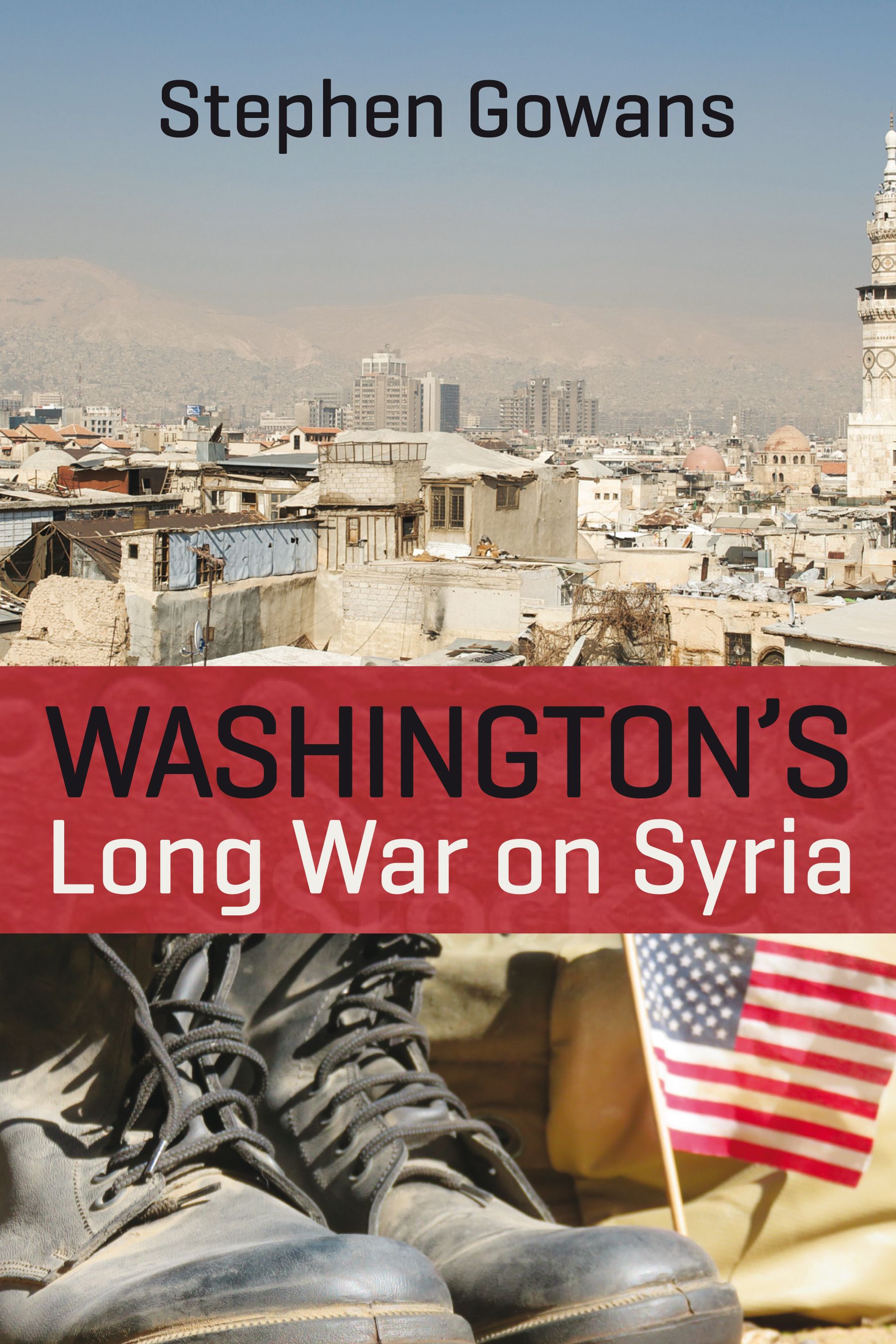
A day before my book Washington’s Long War on Syria was sent to the press, I read a short essay by a notable Canadian, Norman Bethune. The essay was titled Wounds. Bethune was a skilled and innovative surgeon who was at the forefront of the fight for public health care in Canada. But he’s mainly known for participating in two wars in the late 1930s: The Spanish Civil War and the Second Sino-Japanese War. In the Second Sino-Japanese War Bethune joined Mao’s forces as a frontline surgeon in the resistance against Japanese efforts to colonize China.

In an April 27, 2017 Telesur interview, Syrian President Bashar al-Assad argued that US presidents “merely implement” policies formulated by US “financial institutions,” “big arms and oil companies,” as well as “the intelligence agencies” and “the Pentagon.”
It was in China that Bethune wrote his essay, a meditation on the causes of the war in which he was entangled which produced the wounds he was called upon everyday to operate on.

As I read Bethune’s essay, it struck me that what he was saying, in very few words, was what I had tried in a whole book to say. So I quickly asked my publisher if he would include a short quote from Wounds as the epigraph of the book. He readily agreed. The epigraph reads:

Are wars of aggression, wars for the conquest of colonies … just big business? Yes, it would seem so, however much the perpetrators of such national crimes seek to hide their true purpose under banners of high-sounding abstractions and ideals. [1]

The idea that wars of aggression, wars for the conquest of colonies, are motivated by the profit-making interests of big business strike many as facile. But once you strip away the high-sounding abstractions and ideals Washington invokes to justify its wars of aggression, an obvious question remains: If the reasons Washington cites to justify its wars are bogus, what, then, are the real reasons?

In his book Towards a New Cold War: U.S. Foreign Policy from Vietnam to Reagan, Noam Chomsky argues that:

If we hope to understand anything about the foreign policy of any state, it is a good idea to begin by investigating the domestic social structure. Who sets foreign policy? What interests do these people represent? What is the domestic source of their power? It is a reasonable surmise that the policy that evolves will reflect the special interests of those who design it. [2]

In an article published yesterday in The New York Times, reporter Kate Kelly reveals that nearly 300 top executives have visited the White House in the president’s first 100 days, an average of three per day. [3] That offers a clue about who influences the public policy direction of the United States.

Here’s another: After examining over 1,700 policy issues, the political scientists Martin Gilens and Benjamin Page concluded that “economic elites and organized groups representing business interests have substantial impacts on government policy, while average citizens and mass-based interests groups have little or no independent influence.” [4]

The shoguns of finance and industry who have enjoyed access to the White House in Trump’s first 100 days include multi-billionaire Stephen Schwarzman, head of the giant equity manager Blackstone Group; near billionaire Jack Welch, the former chairman and chief executive of General Electric; billionaire Jamie Dimon, head of JPMorgan Chase; multi-millionaire Larry Fink, head of BlackRock, the world’s largest money-management firm; billionaire Eric Schmidt, head of Google’s parent company Alphabet; multimillionaire Andrew Liveris, head of Dow Chemical; Roy Harvey, chief executive of Alcoa. [5] The list goes on.

Not only is the administration lobbied directly by the heads of corporate America, but measures have been taken to systematize their influence. Blackstone’s Schwarzman, writes the New York Times’ Kelly, “recruited a range of business leaders, economists and policy experts for the president’s strategic and policy forum, which regularly meets at the White House and has emerged as the most elite outside counsel.” [6]

On top of titans of corporate America enjoying unfettered access to the president, Trump has appointed to posts in his administration billionaires and multi-millionaires whose fortunes come from the business world. A number of his top advisers had careers in the pharaonicly wealthy investment bank Goldman Sachs, known on Wall Street as “Government Sachs” for its history of placing top executives in commanding posts in the US state. [7]

Goldman Sachs’ ties to the White House (and to aspiring presidents) date back to the Clintons, if not earlier. As president, Bill Clinton appointed Goldman co-chair Robert Rubin to the post of Treasury Secretary. (The current Treasury Secretary, Steven Mnuchin had a 17 year career with Goldman, rising to the post of the firm’s Chief Information Officer.) Goldman chair and CEO Lloyd Blankfein raised funds for Hillary Clinton’s first presidential bid, and also paid Clinton $675,000 to deliver three speeches at Goldman events after she left the State Department. Blankfein was one of the guests at Clinton’s 64th birthday celebration. (Blankfein’s predecessor as Goldman’s top executive was Henry Paulson, who served as Treasury Secretary in the George W. Bush administration.) “Over 20-plus years,” observed The New York Times, “Goldman provided the Clintons with some of their most influential advisors, millions of dollars in campaign contributions and speaking fees, and financial support to the family foundation’s charitable programs.” [8]

Obama’s administration was no less in thrall to Wall Street. Seventeen members of the previous president’s administration were members of the Council on Foreign Relations, Wall Street’s foreign policy think tank. Council members included national security advisors James Jones Jr., Thomas Donilon, and Susan Rice, Defense Secretaries Robert Gates, Chuck Hagel and Ashton Carter, and CIA director David Petraeus.

Council members also include most of the captains of finance and industry who have paraded through Trump’s White House since the beginning of the year. The think tank is the chief interlock between Wall Street and US administrations, bringing together giants of US finance, banking and industry with scholars, military officers and ambitious politicians to address questions of US foreign policy. As of 2016 over 70 council members held key cabinet positions and were usually members of the Council before they were appointed or elected to these posts, including 10 National Security Advisers, 9 US Ambassadors to the United Nations, 8 Secretaries of State, 8 Secretaries of Defense, 8 CIA Directors, 4 Chairmen of the Joint Chiefs, 3 World Bank Presidents and 2 Presidents of the United States.

Given that Wall Street’s tentacles reach everywhere in Washington it is hardly surprising that successive US administrations have been hostile to the Syrian government. Since 1963, Syria has been ruled by the very antithesis of the world-leading financiers and industrialists who rule in Washington; Syria has been governed in contrast by people who call themselves and are called in Washington socialists.

Norman Bethune
For over half a century, Syria has been governed by the Baath Arab Socialist Party, which is guided by the party’s motto of unity (of the Arab world), freedom (from Western domination), and socialism (in contrast to Washington’s preferred paradigm of free enterprise, free markets and free trade.) The party presided over the drafting of Syria’s constitutions, which mandate government ownership of the commanding heights of the economy and a significant role for government in the guidance of the economy, i.e., socialism.

Ba’ath Arab Socialists have been seen in Washington as “Arab communists” [9] and the state they lead as “socialist Syria.” [10]

Indeed, Washington and Wall Street have long complained about Damascus’s refusal to fully integrate into a US-led global neo-liberal economic order, and about the “ideologues” in the Syrian government who refuse to disavow their commitment to socialism. The Wall Street Journal-Heritage Foundation Index of Economic Freedom is replete with grievances about the Syrian government’s economic policies, from its subsidies to local businesses, tariff barriers, state-owned enterprises, and restrictions on foreign investment. These policies are designed to overcome the injuries of under-development visited about the Arab world by colonialism, but severely limit US investment and trade opportunities, and are therefore anathema in free enterprise, profit-hungry, Washington.

That the US government is—as two German philosophers once described the governments of business-driven societies—a committee for managing the common affairs of the country’s business owners, is not lost on the current Syrian president, Bashar al-Assad. In an April 27, 2017 interview with Telesur, Assad described US foreign policy as being set by US “financial institutions” and “the big arms and oil companies” as well as “the intelligence agencies” and “the Pentagon.”

The American President merely implements these policies, and the evidence is that when Trump tried to move on a different track, during and after his election campaign, he couldn’t. He came under a ferocious attack. As we have seen in the past few weeks, he changed his rhetoric completely and subjected himself to the terms of the deep American state, or the deep American regime…[The president] ultimately does what these institutions dictate to him. This is not new. This has been ongoing American policy for decades. [11]

Bethune denounced as an enemy of the human race the very same class which rules in Washington. In his view, in its hunt for profits, this class starts the wars which create the wounds which he was, and all frontline surgeons are, called upon to heal. What do the members of this class, these enemies of humanity, look like, he wondered.

Do they wear on their foreheads a sign so that they may be told, shunned and condemned as criminals? No. On the contrary. They are the respectable ones. They are honoured. They call themselves, and are called, gentlemen. …They are the pillars of the state, of the church, of society. They support private and public charity out of the excess of their wealth. They endow institutions. In their private lives they are kind and considerate. …. But there is one sign by which these gentlemen can be told. Threaten a reduction [in their profits] and the beast in them awakes with a snarl. They become ruthless as savages, brutal as madmen, remorseless as executioners. [12]

Muamar Gaddafi was inspired by the same Baath Arab Socialist goals of unity, freedom and socialism that guide the Syrian state. A year after he was violently removed from power by Islamists backed by NATO (Canadian fighter pilots quipped that they were al-Qaeda’s air force), The Wall Street Journal revealed that Western oil companies had agitated for Gaddafi’s removal because he was driving hard bargains and insisting that Libyans benefit from their own oil resources. [13] Gaddafi had effectively threatened a reduction in the oil companies’ profits, awakening the beast in the respectable burghers and pillars of US society.

Bethune ended his essay with this: “Such an organization of human society as permits [these enemies of humanity] to exist must be abolished.” [14]

The overarching theme of my book follows along the very same lines: Washington’s long war on Syria can only be understood within the context of the organization of human society—one in which economic power, driven by profit-hunger, is coterminous with political power—as permits these enemies of humanity to exist.

A final thought. Many in the West have taken a stand against the Syrian government, arguing that it is not democratic, nor engaged in a fight for democracy. They also argue that amid the alliance of business-driven US foreign policy, the Arab monarchs who funnel support to the al-Qaeda and ISIS insurgents, and the US-backed guerrillas who are enmeshed with, cooperate on the battlefield with, and exchange weapons with, the former, that there can be found a pro-democratic element. The problem is that no one has ever been able to adduce the slightest evidence that such an element exists, and nor are the proponents of this view bold enough to assert that this hypothetical element plays anywhere near a consequential role in the conflict.

A more sophisticated view holds that there exists in Syria an indigenous Islamist movement which—though rejecting democracy as a man-made ideology and seeking rule by the Quran (Islam’s holy book) and Sunna (the record of the Islamic prophet Mohammad’s thought and actions)—is fundamentally democratic insofar as it represents the aspirations of the majority. This view, however, suffers from two fatal defects: (1) There is no evidence that a majority of Syrians hold Islamist aspirations; and (2) a significant part of the Islamist opposition to the secular Syrian government is of foreign origin.

Even if a genuinely democratic opposition element did exist, it does not follow that support for the Syrian government in its efforts to assert its sovereignty against neo-colonial efforts to negate it, is undemocratic. On the contrary:

If we are seriously concerned with the question of democracy [we should be concerned about] the democratization of international relations. If a country or a group of countries declare and decide that they have the right to provoke a war…without the authorization of the Security Council, they are developing a theory in which the West has the right to exercise despotism over the rest of humanity. It is open despotism; the United States and the West declare openly that they have the right to intervene in every corner of the world. That is despotism. [Washington] already said at the start of the century that Assad should be toppled. They said that they should carry out a change of regime in Syria because Assad is against Israel, against the West, etc. That is despotism, and those [who] struggle against such despots are the real defenders of democracy. [15]

1. Norman Bethune, “Wounds,” in Roderick Stewart, The Mind of Norman Bethune, Fitzhenry & Whiteside, 2002, pp. 183-186.

2. http://www.kropfpolisci.com/foreign.policy.chomsky2

3. Kate Kelly, “Persuasive business leaders parade through White House,” The New York Times, April 29, 2017

4. Martin Gilens and Benjamin I. Page, “Testing Theories of American Politics: Elites, Interest Groups, and Average Citizens,” Perspectives on Politics, Fall, 2014

5. Kelly

6. Kelly

7. Julie Creswell and Ben White, “The Guys from ‘Government Sachs’,” The New York Times, October 19, 2008

8. Nicholas Confessore and Susanne Craig, “2008 crisis deepened the ties between Clintons and Goldman Sachs,” The New York Times, September 24, 2016

9. Robert Baer, Sleeping with the Devil: How Washington Sold Our Soul for Saudi Crude, Three Rivers Press, 2003, p. 123

10. Baer, p. 193

11. President al-Assad to Telesur: Stopping outside support to terrorists and reconciliation among Syrians are means to restore security to Syria,” SANA, April 27, 2017, http://sana.sy/en/?p=105108

12. Bethune

13. Benoit Faucon, “For big oil, the Libya opening that wasn’t”, The Wall Street Journal, May 4, 2012

14. Bethune

15. Attributed to Domenico Losurdo. I cannot find the original source, and therefore cannot vouchsafe that Losurdo is the author. All the same, the words are worthy of repeating, whether they are those of Losurdo or not.

Cruise Missile Attacks: A New Step in Washington’s Long Class War on Syria

April 8, 2017

By Stephen Gowans

Washington has added a new dimension to its long war on Syria: direct military intervention.

Since the mid 1950s, the United States has tried to purge Damascus of an Arab nationalist leadership which has zealously guarded Syria’s freedom from US domination and follows an Arab socialist development path which is at odds with the global free enterprise project advanced by Washington on behalf of its Wall Street patron.

Available from Baraka Books http://www.barakabooks.com/catalogue/washingtons-long-war-on-syria/
Until now, Washington has refrained from directly attacking Syrian forces, though it has intervened manu militari in Syria to hold the Islamic State in check so that the militant group remains strong enough to weaken Syrian forces but not so strong that it captures the Syrian state. [1]

This limited Islamic State-directed US intervention in Syria has involved both airstrikes and an estimated 1,000 boots on the ground. [2] However, the principal modus operandi of Washington’s long war on Syria has been war waged through proxies, both Israel, which annexed Syria’s Golan Heights and has carried out innumerable small-scale attacks since, and Islamist guerrillas, who, from the 1960s, have waged a jihad against what they view as Syria’s heretical government. [3]

The United States contemplated direct military intervention in Syria in 2003, as a follow-up to its invasion of neighbouring Iraq, but found that its resources were strained by efforts to pacify Afghanistan and Iraq and that other means of regime change would have to be pursued. [4]

In place of a muscular boots on the ground strategy, Washington imposed an economic blockade in 2003, which, by 2012, had caused Syria’s economy to buckle, according to the New York Times. [5]

By the spring of 2012, sanctions-induced financial haemorrhaging had “forced Syrian officials to stop providing education, health care and other essential services in some parts of the country.” [6]

By 2016, “US and EU economic sanctions on Syria” were “causing huge suffering among ordinary Syrians and preventing the delivery of humanitarian aid, according to a leaked UN internal report.” [7] The report revealed that aid agencies were unable to obtain drugs and equipment for hospitals because sanctions prevented foreign firms from conducting commerce with Syria.

Veteran foreign correspondent Patrick Cockburn wrote that “the US and EU sanctions” resembled the Iraqi sanctions regime, and were “an economic siege on Syria”—a siege it might be recalled that led to the deaths of more than 500,000 Iraqi children, according to the UN, a death toll greater than that produced by all the weapons of mass destruction in history. [8] Cockburn surmised that the Syrian siege was killing numberless people through illness and malnutrition. [9]

On top of its merciless campaign of economic warfare, Washington enlisted the Arab nationalists’ longstanding foe, the Muslim Brotherhood, to provoke a civil revolt in Syria. The revolt, inaugurated by Islamist-instigated riots in Daraa in mid-March 2011, soon mushroomed into an all-out campaign of guerrilla warfare, fueled by Saudi, Qatari, Turkish, Jordanian and US money. U.S. and Western intelligence services trained thousands of guerrillas in Jordan and Qatar. [10]

In 2012, the US Defense Intelligence Agency reported that the insurgency was Islamist, led by the Muslim Brotherhood and Al-Qaeda in Iraq, Islamic State’s forerunner, and that Western powers and the kings, emirs and sultans who preside tyrannically over Gulf oil states, were the backers. According to the intelligence agency, Turkey’s Reccep Tayyip Erdogan, a man infatuated with dreams of becoming a neo-Ottoman sultan, and himself an Islamist, was also a major backer. [11]

But until Washington ordered cruise missiles to rain down on Shayrat Airfield near Homs on April 6, the United States had relied on proxies and siege to bring about regime change in a country which Moshe Ma’oz had termed “a focus of Arab nationalistic struggle against an American regional presence and interests.” [12]

The Shayrat Airfield attack was presented for world opinion as a response to Syrian forces allegedly gassing civilians at Khan Shaykum on 4 April. The allegations were levelled by blatantly partisan sources.

One source was the White Helmets, which bills itself as a neutral civil defense outfit, but is in reality funded by governments entangled with Washington in its long war on Syria. It is enmeshed, too, or at the very least, cooperates with, al-Qaeda. The Syrian Observatory for Human Rights, a one-person outfit based in the UK which overtly supports the guerrillas, was another source.

Significantly, no one even remotely impartial has investigated the allegations to determine whether (a) chemical agents were indeed used, (b) whether they were used deliberately, and (c) who used them? The Organization for the Prohibition of Chemical Weapons refuses to weigh in on any of these questions until an investigation has been completed, the only sound course of action.

All the same, Washington and its lickspittle allies, exuding colonial arrogance, immediately pronounced in Olympian fashion that the accusations were beyond dispute, an outcome which was hardly surprising given that the Western champions of neo-colonialism share with the White Helmets and Syrian Observatory for Human Rights a common goal of overthrowing Syria’s Arab nationalist government. Washington can always be counted on to publicize any calumny against its Syrian enemy, no matter how untenable.

Despite assurances that a gas attack had been undertaken at Khan Shaykum on 4 April, and that Syrian forces were responsible, the United States, France and Britain, if they, were not themselves implicated, could have had no certain knowledge of this, since these matters take weeks of on the ground investigation to offer sound judgment, and even then the question of attribution—that is, who did it?—is often unanswerable. The reality, of course, is that Western powers have no idea whether the accusation is valid but seized the opportunity to claim it was to establish a pretext for military action in furtherance of the United States’ long war on Syria.

Mainstream journalists also rushed to judgement in advance of even the barest resemblance of an impartial investigation, their assessments aligning with the assessments, sans evidence, of their own governments.

On top of being predicated on an untested allegation by unquestionably partial sources, the US attack was illegal—and on two levels: internationally, because it was undertaken without UN Security Council assent, and domestically, because it represented an unauthorized act of war. The act of war was ordered unilaterally by the White House, notwithstanding the fact that declarations of war are the exclusive remit of Congress, which did not confer—indeed, was not asked for—its authorization.

But the point is academic.

The United Sates has already amassed a sizable record of crimes in Syria, and an even more sizeable record in the larger Arab world, not the least of which crimes is the intrusion of US military personnel on Syrian soil, an act of war itself.

As a military colossus, the United States is at liberty to violate international law with impunity, since there exists no higher authority capable of enforcing international law through the threat of a force greater than that which the Pentagon itself can wield. Expecting the United States to yield to international law is naïve and therefore any discussion of whether this or that act of the United States violates international law is a discussion of no consequence.

The White House is able to violate US law without punishment by eliciting at least the passive acceptance of the US public and its representatives for its wars of aggression; accordingly, with the Congress and the US public on side, there’s no one to hold the White House to account before the US constitution.

White House efforts to secure the acquiescence of the public, if not its jingoistic support, are facilitated by the measures the Pentagon takes to limit US troop casualties, so that no matter how devastating US military operations are for the victims, the US public is not inconvenienced or traumatized psychologically by an accumulation of US combat casualties.

Equally helpful from the point of view of mobilizing support for war in violation of US law is the demonization of Washington’s targets, an activity in which the news media, which accept the pronouncements of US officials on foreign policy at face value, engage with enthusiasm. Witness how easily the Bush administration and Blair government were able to dupe the Western mainstream media into believing (or if they weren’t duped, to ardently propagate) fairy tales about Arab nationalist Iraq concealing chemical and biological weapons.

Moreover, witness how easily Washington shapes the intellectual environment. It has persuaded the world that chemical and biological weapons (which can kill tens or at most hundreds of people under ideal conditions, and many fewer under typical ones) belong to the same class of weapons as nuclear arms (which can kill tens or hundreds of thousands.) This false conflation of minor weapons with authentic weapons of mass destruction has proved useful in portraying such military non-threats as Arab nationalist Iraq under Saddam as signal threats whose elimination is imperative for the safety of the world.

Demonizing targets—often by accusing them of having, using, or intending to use either falsely classified or genuine weapons of mass destruction—creates, from the vantage point of the public, a moral obligation for the United States to act. The Leftists who have an insatiable appetite for moral lapidation and florid language about “murderous regimes,” brutal dictators,” and “moral disgrace,” in connection with the leaders of former colonies which the United States is endeavouring to re-colonize, contribute to the mobilization of consent for war and to an international class struggle from above.

Left collaborators see only the completely powerless as occupying morally tenable ground. Any state which pursues emancipatory goals is denounced as brutal, murderous, or a moral disgrace and arguments are mounted that the state’s emancipatory goals are a sham. Only people without formal power, by this way of thinking, engage in class struggle against oppression and exploitation, while those who exercise formal authority are viewed as agents of oppression by definition.

This view is too simple.

The Italian philosopher Domenic Losurdo argues for a tripartite model of class struggle linked to the division of labour on (1) an international level, (2) a national level and (3) within the household. [13]

Class struggle on an international level corresponds to the exploitation of the people of one nation by another nation; for example, by the relegation of one country by another to a subordinate role in the international division of labour.

Class struggle on a national level corresponds to the exploitation of labour by the owners of capital within a country, while class struggle within the household pertains to the exploitation of female domestic labour by males.

Class struggle so conceived can be coterminous as when, for example, the people in one country are exploited en masse as a source of labour by the owners of capital of a second.

Washington’s long—and now expanded—war on Syria, is a class struggle on an international level. It is a class struggle in which the United States, as champion of the profit-making interests of corporate America and the class of billionaires who lead it, seeks to permanently relegate Syrians to a subordinate role in the international division of labour, one in which they will be limited to low wage jobs in extractive and basic manufacturing industries, if not subsistence farming.

Washington aspires to sweep away the Arab socialist impediments to the free enterprise, free trade, and free market capitalist nirvana it seeks to establish on a global scale, where US corporations have space to dominate the commanding heights of every country’s economy, and local labour is relegated to low-wage roles, and permanent penury.

Former chief economist of the World Bank Joseph Stiglitz put it this way:

Colonialism left a mixed legacy in the developing world—but one clear result was the view among people there that they had been cruelly exploited…the political independence that came to scores of colonies after World War II did not put an end to economic colonialism. In some regions…the exploitation—the extraction of natural resources and the rape of the environment all in return for a pittance—was obvious. Elsewhere it was more subtle. In many parts of the world, global institutions such as the International Monetary Fund and the World Bank came to be seen as instruments of post-colonial control. These institutions pushed market fundamentalism…a notion idealized by Americans as ‘free and unfettered market.’ … Free-market ideology turned out to be an excuse for new forms of exploitation. [14]

Arab nationalists in Iraq and Libya waged a class war on an international scale, aiming to free the people of their countries from the disadvantages that colonialism had visited upon them and to end their continued economic exploitation by the West. Their struggle, while successful for a time, ultimately ended in failure, as the United States and its allies, through demonization, siege and warfare, overcame these struggles from below. These victories by Washington were victories in favor of exploitation.

The class struggle fought by Arab nationalists in Syria continues, despite the concerted efforts of Washington, its neo-colonial allies, its Arab satraps, apartheid Israel, and Leftist collaborators, to crush it. Concurrently, the Islamic Republic of Iran is conducting its own class struggle against Western efforts of re-colonization, though on a grander scale, with the larger Islamic world as the object of liberation.

The struggle between Iran and the United States is a class struggle on a colossal scale, with Washington seeking to open Iran while keeping the remainder of the Muslim world open to continued exploitation by US financial, industrial, commercial and petrochemical concerns, and Tehran leading a project to build “resistance” economies that prioritize the uplift of the people who live and work in the Muslim world over shareholders of US corporations. This struggle is intertwined with the class struggle at which Syria is the center.

Washington’s expanded war on Syria is, then, an expanded class war from above against an emancipatory struggle from below. Washington’s war-making relies on multiple weapons, from siege, to proxy war, to direct military intervention, and no less to information warfare aimed at demonizing Syria’s Arab nationalists.

1. See my Washington’s Long War on Syria. Baraka Books. 2017, chapter 4.
2. Thomas Walkom, “Putting Donald Trump’s strike against Syria in context,” The Toronto Star, April 7, 2017.
3. Washington’s Long War, chapter 2.
4. Ibid.
5. Nada Bakri, “Sanctions pose growing threat to Syria’s Assad”, The York Times, October 10, 2011.
6. Joby Warrick and Alice Fordham, “Syria running out of cash as sanctions take toll, but Assad avoids economic pain,” The Washington Post, April 24, 2012.
7. Patrick Cockburn, “US and EU sanctions are ruining ordinary Syrians’ lives, yet Bashar al-Assad hangs on to power,” The Independent, October 7, 2016.
8. John Mueller and Karl Mueller, “Sanctions of Mass Destruction,” Foreign Affairs, May/June 1999.
9. 60 Minutes, May 12, 1996; Patrick Cockburn, “US and EU sanctions are ruining ordinary Syrians’ lives, yet Bashar al-Assad hangs on to power,” The Independent, October 7, 2016.
10. Washington’s Long War, chapters 2, 3 and 4.
11. http://www.judicialwatch.org/wp-content/uploads/2015/05/Pg.-291-Pgs.-287-293-JW-v-DOD-and-State-14-812-DOD-Release-2015-04-10-final-version11.pdf
12. Moshe Ma’oz, Bruce Cumings, Ervand Abrahamian and Moshe Ma’oz, Inventing the Axis of Evil: The Truth about North Korea, Iran, and Syria, The New Press, 2004, p .207.
13. Domenico Losurdo. Class Struggle: A Political and Philosophical History. Palgrave MacMillan. 2006.
14. Quoted in Graham E. Fuller. A World without Islam. Back Bay Books. 2010. p. 262.

Pentagon Leads Over 300,000 Troops in a Rehearsal for an Invasion One Week after the White House Announces It’s Considering Military Action against North Korea

March 13, 2017

By Stephen Gowans

The United States and South Korea are conducting their largest-ever military exercises on the Korean peninsula [1], one week after the White House announced that it was considering military action against North Korea to bring about regime change. [2] The US-led exercises involve:

• 300,000 South Korea troops
• 17,000 US troops
• The supercarrier USS Carl Vinson
• US F-35B and F-22 stealth fighters
• US B-18 and B-52 bombers
• South Korean F-15s and KF-16s jetfighters. [3]

While the United States labels the drills as “purely defensive” [4] the nomenclature is misleading. The exercises are not defensive in the sense of practicing to repel a possible North Korean invasion and to push North Korean forces back across the 38th parallel in the event of a North Korean attack, but envisage an invasion of North Korea in order to incapacitate its nuclear weapons, destroy its military command, and assassinate its leader.

The exercises can only be construed as “defensive” if undertaken as preparation for a response to an actual North Korean first-strike, or as a rehearsed pre-emptive response to an anticipated first strike. In either event, the exercises are invasion-related, and Pyongyang’s complaint that US and South Korean forces are practicing an invasion is valid.

But the likelihood of a North Korean attack on South Korea is vanishingly small. Pyongyang is outspent militarily by Seoul by a factor of almost 4:1, [5] and South Korean forces can rely on more advanced weapons systems than can North Korea. Additionally, the South Korean military is not only backed up by, but is under the command of, the unprecedentedly powerful US military. A North Korean attack on South Korea would be suicidal, and therefore we can regard its possibility as virtually non-existent, especially in light of US nuclear doctrine which allows the use of nuclear weapons against North Korea. Indeed, US leaders have reminded North Korean leaders on numerous occasions that their country could be turned into “a charcoal briquette.” [6] That anyone of consequence in the US state truly believes that South Korea is under threat of an attack by the North is risible.

The exercises are being carried out within the framework of Operation Plan 5015 which “aims to remove the North’s weapons of mass destruction and prepare … for a pre-emptive strike in the event of an imminent North Korean attack, as well a ‘decapitation’ raids targeting the leadership.” [7]

In connection with decapitation raids, the exercises involve “US Special Missions Units responsible for the killing of Osama bin Laden in 2011, including SEAL Team Six.” [8] According to one newspaper report, the “participation of special forces in the drills…may be an indication the two sides are rehearsing the assassination of Kim Jong Un.” [9]

A US official told South Korea’s Yonhap news agency that “A bigger number of and more diverse US special operation forces will take part in this year’s … exercises to practice missions to infiltrate the North, remove the North’s war command and demolish its key military facilities.” [10]

Astonishingly, despite participating in the highly provocative exercises–which can have no other consequence than to rattle the North Koreans and place them under imminent threat—the South Korean ministry of national defense announced that “South Korea and the US were keenly monitoring the movements of North Korean soldiers in preparation for possible provocations.” [11]

The notion that Washington and Seoul must be on the alert for North Korean ‘provocations’, at a time the Pentagon and its South Korean ally are rehearsing an invasion and ‘decapitation’ strike against North Korea, represents what East Asia specialist Tim Beal calls a “special sort of unreality.” [12] Adding to the unreality is the fact that the rehearsal for an invasion comes on the heels of the White House announcing urbi et orbi that it is considering military action against North Korea to bring about regime change.

In 2015, the North Koreans proposed to suspend their nuclear weapons program in exchange for the United States suspending its military exercises on the peninsula. The US State Department peremptorily dismissed the offer, saying it inappropriately linked the United States’ “routine” military drills to what Washington demanded of Pyongyang, namely, denuclearization. [13] Instead, Washington “insisted the North give up its nuclear weapons program first before any negotiations” could take place. [14]

In 2016, the North Koreans made the same proposal. Then US president Barack Obama replied that Pyongyang would “have to do better than that.” [15]

At the same time, the high-profile Wall Street-directed Council on Foreign Relations released a task force report which advised Washington against striking a peace deal with North Korea on the grounds that Pyongyang would expect US troops to withdraw from the peninsula. Were the United States to quit the peninsula militarily, its strategic position relative to China and Russia, namely, its ability to threaten its two near-peer competitors, would be weakened, the report warned. Accordingly, Washington was adjured to refrain from promising Beijing that any help it provided in connection with North Korea would be rewarded by a reduction in the US troop presence on the peninsula. [16]

Earlier this month, China resurrected Pyongyang’s perennial proposal. “To defuse the looming crisis on the peninsula, China [proposed] that, as a first step, [North Korea] suspend its missile and nuclear activities in exchange for a halt in the large scale US – [South Korea] exercises. This suspension-for-suspension,” the Chinese argued, “can help us break out of the security dilemma and bring the parties back to the negotiating table.” [17]

Washington rejected the proposal immediately. So too did Japan. The Japanese ambassador to the UN reminded the world that the US goal is “not a freeze-for-freeze but to denuclearize North Korea.” [18] Implicit in this reminder was the addendum that the United States would take no steps to denuclearize its own approach to dealing with North Korea (Washington dangles a nuclear sword of Damocles over Pyongyang) and would continue to carry out annual rehearsals for an invasion.

Refusal to negotiate, or to demand that the other side immediately grant what is being demanded as a precondition for talks, (give me what I want, then I’ll talk), is consistent with the approach to North Korea adopted by Washington as early as 2003. Urged by Pyongyang to negotiate a peace treaty, then US Secretary of State Colin Powell demurred. “We don’t do non-aggression pacts or treaties, things of that nature,” Powell explained. [19]

As part of the special unreality constructed by the United States, Russia, or more specifically its president, Vladimir Putin, is routinely accused by Washington of committing “aggressions,” which are said to include military exercises along the Russian border with Ukraine. These exercises, hardly on the immense scale of the US-South Korean exercises, are labelled “highly provocative” [20] by US officials, while the Pentagon-led rehearsal for an invasion of North Korea is described as routine and “defensive in nature.”

But imagine that Moscow had mobilized 300,000 Russian troops along the Ukraine border, under an operational plan to invade Ukraine, neutralize its military assets, destroy its military command, and assassinate its president, one week after the Kremlin declared that it was considering military action in Ukraine to bring about regime change. Who, except someone mired in a special sort of unreality, would construe this as “purely defensive in nature”?

1. “THAAD, ‘decapitation’ raid add to allies’ new drills,” The Korea Herald, March 13, 2017; Elizabeth Shim, “U.S., South Korean drills include bin Laden assassination team,” UPI, March 13, 2017.

2. Jonathan Cheng and Alastair Gale, “North Korea missile test stirs ICBM fears,” The Wall Street Journal, March 7, 2017.

3. “S. Korea, US begins largest-ever joint military drills,” KBS World, March 5, 2017; Jun Ji-hye, “Drills to strike N. Korea taking place,” Korea Times, March 13, 2017.

4. Jun Ji-hye, “Drills to strike N. Korea taking place,” Korea Times, March 13, 2017.

5. Alastair Gale and Chieko Tsuneoka, “Japan to increase military spending for fifth year in a row,” The Wall Street Journal, December 21, 2016.

6. Bruce Cumings, “Latest North Korean provocations stem from missed US opportunities for demilitarization,” Democracy Now!, May 29, 2009.

7. “THAAD, ‘decapitation’ raid add to allies’ new drills,” The Korea Herald, March 13, 2017.

8. “U.S., South Korean drills include bin Laden assassination team,” UPI, March 13, 2017.

9. Ibid.

10. “U.S. Navy SEALs to take part in joint drills in S. Korea,” Yonhap, March 13, 2017.

11. Jun Ji-hye, “Drills to strike N. Korea taking place,” Korea Times, March 13, 2017.

12. Tim Beal, “Looking in the right direction: Establishing a framework for analyzing the situation on the Korean peninsula (and much more besides),” Korean Policy Institute, April 23, 2016.

13. Choe Sang-hun, “North Korea offers U.S. deal to halt nuclear test,” The New York Times, January 10, 2015.

14. Eric Talmadge, “Obama dismisses NKorea proposal on halting nuke tests,” Associated Press, April 24, 2016.

15. Ibid.

16. “A Sharper Choice on North Korea: Engaging China for a Stable Northeast Asia,” Independent Task Force Report No. 74, Council on Foreign Relations, 2016.

17. “China limited in its self-appointed role as mediator for Korean peninsula affairs,” The Hankyoreh, March 9, 2017.

18. Farnaz Fassihi, Jeremy Page and Chun Han Wong, “U.N. Security Council decries North Korea missile test,” The Wall Street Journal, March 8, 2017.

19. “Beijing to host North Korea talks,” The New York Times, August 14, 2003.

20. Stephen Fidler, “NATO struggles to muster ‘spearhead’ force to counter Russia,” The Wall Street Journal, December 1, 2014.

Washington Considers Military Action Against North Korea to Force Regime Change

March 7, 2017

By Stephen Gowans

The White House is considering “possible military action to force regime change” in North Korea, another in a long succession of threats Washington has issued against Pyongyang, piled atop unremitting aggression the United States has directed at the country from the very moment of its birth in 1948.

In addition to direct military action from 1950 to 1953 against the Democratic People’s Republic of Korea (the country’s official name), US aggression has included multiple threats of nuclear annihilation, and the deployment of tactical nuclear weapons into South Korea until 1991. Re-deployment is now under consideration in Washington.

Most US nuclear threats against Pyongyang were made before North Korea embarked upon its own nuclear weapons program, and constitute one of the principal reasons it did so. The country’s being declared an original member of the Bush administration’s Axis of Evil, along with Iraq and Iran, provided an additional impetus.

US aggression against Gaddafi’s Libya, after the Arab and African nationalist leader abandoned his country’s nuclear weapons program in a failed effort at an entente with the West, only affirmed Pyongyang’s view that its decision to acquire a nuclear deterrent was sound and imperative. To make Gaddafi’s blunder would be to commit suicide.

North Korea has additionally been menaced by annual US-directed war games involving hundreds of thousands of troops, carried out along North Korea’s borders. While US officials describe the twice yearly assembling of significant military forces within striking range of the DPRK as routine and defensive, it is never clear to the North Korean military whether the US–directed maneuvers are defensive exercises or preparations for an invasion. Accordingly, the exercises are objectively minatory.

US officials have described Russian war games along Russia’s western border as “provocations” and as a sign of Russian “aggression.” One US official said, “The Russians have been doing a lot of snap exercises right up against the borders, with a lot of troops. From our perspective, we could argue this is extraordinarily provocative behavior.” And yet when US and South Korean troops do the same, right up against North Korea’s borders, their actions are deemed routine and defensive. (Threats made routinely, it should be noted, do not become non-threats simply because they are routine.)

On top of military aggression, the United States has added economic aggression to its decades-long quest to bring about regime change in North Korea. For almost seven decades Washington has led a campaign of economic warfare against the DPRK, designed to do what economic sieges are always intended to do: make the lives of ordinary people sufficiently straitened and miserable that they rise in revolt against their own government.

While the United States struts around the globe as the self-proclaimed champion of democracy, while counting kings, emirs, sultans and military dictators among its closest allies, it has imposed sanctions on North Korea for the most profoundly undemocratic reason. A US Congressional Research Service 2016 report, “North Korea: Economic Sanctions,” enumerates a detailed list of economic penalties imposed on North Korea for having the temerity to operate a “Marxist-Leninist” economy contrary to Washington’s Wall Street-approved economic prescriptions. Hence, the United States wages economic warfare on people in other lands because it doesn’t like the decisions they make about how to organize their own economic lives (and more to the point, because those decisions fail to comport with the profit-making interests of corporate America, the only sector of the United States whose voice matters in US policy.) What could be more hostile to democracy—and more imperialist—than that?

The US decision to consider military action against North Korea to force regime change may be considered a response to Pyongyang’s “threats,” but the DPRK, regardless of its bluster, has never posed a threat to the physical safety of the United States. It is far too small (its population is only 25 million) and too weak militarily (its annual defense spending is less than $10 billion, swamped by the Himalayan military outlays of its adversaries, from South Korea’s $36 billion to Japan’s $41 billion to the United States’ $603 billion), to pose a significant threat, or even a derisory one. Moreover, it is totally devoid of the means to convey a military force to US soil, lacking long range bombers and a capable navy.

To be sure, Pyongyang may have developed ICBMs capable of reaching the United States, and it may have acquired the know-how to miniaturize nuclear warheads that can be carried atop them, but the notion that Pyongyang would undertake an offensive strike against the United States is risible. Doing so would be tantamount to a porcupine tangling with a mountain lion. Since porcupines have no hope of defeating mountain lions, and would be mangled in the attempt, they avoid confrontations with them. They do, however, have self-defensive quills—the equivalent of North Korea’s nuclear arms and ballistic missile programs—to deter mountain lions, and other predators, from tangling with them.

North Korea is often criticized for being a garrison state, closed off to the outside world, yet its insularity can be understood as an imperative of surviving as an independent, sovereign state, in a world in which the United States insists on exercising global “leadership” (i.e., denying other countries their sovereignty) and using its military supremacy to coerce the world to fall into step behind its leadership of the global economy.

Washington has been waging a cyber-war against North Korea, which it is speculated may be responsible for a string of missile test launch failures which recently plagued the DPRK’s missile program, and additionally explains why the country’s leadership is chary about openness. You don’t facilitate sabotage of your own country by opening up to a hostile government that is committed to your demise. And should there be any illusions about what Washington’s intentions are, consider the words of John R. Bolton. In 2003, Bolton was the US under secretary of state for arms control. Asked by New York Times’ reporter Christopher Marquis what Washington’s policy on North Korea was, Bolton “strode over to a bookshelf, pulled off a volume and slapped it on the table. It was called ‘The End of North Korea.'” “‘That,’ he said, ‘is our policy.'” North Korea’s nuclear arms and missile programs have nothing whatever to do with Washington’s desire to bring about the end of North Korea, since this has been US policy since 1948, the year the DPRK was founded, long before Pyongyang embarked on developing nuclear weapons and the means of delivering them. Instead, the reasons for Washington’s hostility lie in economics and Pyongyang’s refusal to submit to US leadership.

Next month, South Korea will significantly increase the rewards it pays to defectors from the north who treasonously disclose state secrets or surrender military equipment. High-ranking North Korean officials will receive $860,000 for defecting and selling out their compatriots, while pilots will be offered the same to fly their warplanes to South Korea. Sailors who surrender their warships to Seoul will also receive $860,000. At the same time, payouts from $43,000 to $260,000 will be handed to North Korean military personnel who defect, if they bring with them lesser weapons, such as tanks or machine guns.

South Korea, in contrast to the much-threatened North, is a US neo-colonial appendage which hosts tens of thousands of US troops on its soil, ostensibly for protection against the DPRK, even though North Korea is weaker militarily than its peninsular counterpart, has less advanced equipment and weapons systems, and its military outlays are only one-quarter of Seoul’s. South Korea denies itself sovereign control of its own military, yielding to de jure US command in times of emergency, and de facto US control otherwise. This reflects the history of the country. It began as a regime of collaborators with the Japanese, who shifted their collaboration to their new American overlords at the end of the Second World War. Meanwhile, to the north, it was guerrillas who fought Japanese colonization, and committed their lives to the manumission of Korea from foreign control, who founded the government in Pyongyang. Then as now, one half of the Korean peninsula exhibited a prickly independence, while the elite of the other half kow-towed to an imperialist behemoth (in contradistinction to a grassroots guerilla movement in the south that sought, unsuccessfully, to throw off the yoke of oppression by collaborationist governments and their US suzerain.)

South Korea’s hostility to its pro-independence northern neighbor, along with the United States’ nearly seven full decades of overt aggression against the DPRK, is directly responsible for the North Korean state’s closed, garrisoned, and authoritarian character. The country’s anti-liberal democratic orientation is not an expression of an ideological preference for police state rule, but an adaptation to a geopolitical reality. The nature of the North Korean state, its military strategy, and its nuclear weapons and missile programs, are consequences of its ideological commitment to independence intersecting with the difficulties of charting an independent course in the midst of hostile and much stronger neighbors whose US patron insists on North Korean submission.

When the infant Bolshevik state was surrounded by enemies who were stronger than the Bolsheviks by many orders of magnitude, Lenin argued that allowing the revolution’s enemies freedom of political organization would be self-defeating. “We do not wish to do away with ourselves by suicide and therefore will not do this,” the Bolshevik leader averred. North Korea’s voluntarily making over itself into an unrestricted liberal democracy—an open society—would likewise imperil the Korean nationalist project and amount to a self-engineered demise.

The DPRK is also criticized for being an economic basket-case, though its economic travails are almost invariably exaggerated. Nevertheless, nearly seven full decades of economic warfare and the imperatives of maintaining a military strong enough to deter the aggression of hostile neighbors and their imperialist patron must necessarily take a toll. Trying to bankrupt the DPRK by imposing on it trade sanctions, working to cut Pyongyang off from the world financial system, and maneuvering the country into a position where it has been forced to spend heavily on self-defense to survive (Pyongyang allocates an estimated 15%-24% of its GDP to defense compared to South Korea’s 2.6% and the United States’ 3.3%), and then attributing its economic difficulties to its “non-market” economy, as Washington has done, is dishonest in the extreme.

Perhaps it’s a measure of how bellicose the United States is that its threats of war are treated as sufficiently routine that they can be casually mentioned in the press without arousing much attention or protest. According to one calculation, the United States has been at war for 224 of its 241 years of existence. Against the background of its unceasing and devoted worship of Mars, Washington’s review of the merits of becoming embroiled in yet another war makes the latest eruption of belligerence an accustomed spectacle. This may explain the quietude with which the possibility of US military action against North Korea has been met. Contributing to the quiescence is the reality that war with the DPRK would require no direct participation from the vast majority of US citizens, short of their applauding from the sidelines. This, combined with North Korea’s total demonization, makes military action (should it be carried out) easy for the US public to accept, or at least to push it to the margins of its awareness.

The revelation that the White House is considering military action against its long-standing victim was casually tucked away in a Wall Street Journal article, and was thought so inconsequential as not to merit inclusion in the headline. Instead, the article’s headline mentioned that North Korea had fired “four ballistic missiles into waters off coast, South Korea says,” in keeping with the portrayal of the DPRK as a signal menace. Accordingly, the announcement of a considered US military strike on North Korea could be positioned as a legitimate response to an alleged North Korean provocation, rather than North Korea’s test firing of ballistic missiles being presented more reasonably as a legitimate reaction to nearly seven full decades of US belligerence.

Some liberals, worried by the increased tempo of US saber-rattling against Pyongyang, adjure Washington to negotiate a peace treaty with the DPRK, in exchange for North Korea undertaking Gaddafi’s folly and dismantling its nuclear weapons and ballistic missile programs. The idea that the United States reciprocate is never considered and is seen as Quixotic. The preferred arrangement is one of a nuclear weapons apartheid where the United States and its subalterns keep their nuclear arms as a “self-evident” necessity of self-defense and a bulwark against “nuclear blackmail,” while the rest of the world is expected to voluntarily submit to the nuclear weapons blackmail of the United States and the established members of the nuclear weapons club.

However, almost equally Quixotic is the idea that the DPRK will relinquish its nuclear arms and the means of delivering them. The United States has unintentionally created conditions which make a North Korean nuclear weapons program almost inevitable, and perfectly sound from Pyongyang’s point of view. For a nuclear deterrent not only forces Washington to exercise extreme circumspection in the deployment of its military assets against the DPRK, it also allows Pyongyang to reduce its expenditures on conventional deterrence, freeing up resources for its civilian economy. Nuclear weapons are cost-effective. This thinking is implicit in North Korea’s “Byungjin policy, “the “two-track program’ of building the economy and nuclear weapons, defined in the resolution adopted by the 7th Congress of the Korean Workers’ Party in May as its ‘permanent strategic course.’”

James Clapper, the former head of US intelligence, told the Wall Street-directed foreign policy think tank, The Council on Foreign Relations, to forget about negotiating a nuclear deal with Pyongyang. “I think the notion of getting the North Koreans to denuclearize is probably a lost cause,” said Clapper last October. “They are not going to do that. That is their ticket to survival. And I got a good taste of that when I was there about how the world looks from their vantage. And they are under siege…So the notion of giving up their nuclear capability, whatever it is, is a nonstarter with them.

“So an Iranian kind of negotiation that would put a cap or suspend is not—your experience in diplomacy is that it’s not likely to happen,” he was asked.

Clapper replied; “I don’t think so.”

Washington’s Long War on Syria

Publication date April 17.

Now available for order.

Available from Baraka Books http://www.barakabooks.com/catalogue/washingtons-long-war-on-syria/

Stephen Gowans paints a very clear portrait of the Syrian Arab Republic, and documents the extensive efforts from the Pentagon to bring it down. With the mainstream media spewing regime change propaganda 24-hours a day, Gowans’ book is a must-read. It tells the true story of the Syrian people and their struggles for independence and development, a story that desperately needs to be heard. This book would make even the most ardent interventionist question Washington’s policies. Gowans tells truths that are so deeply hidden in western countries, but yet are so vital in understanding world events.”Caleb Maupin

When in the summer of 2011 US President Barack Obama demanded that Syrian President Bashar al-Assad step down, it was not the first time Washington had sought regime change in Damascus. The United States had waged a long war against Syria from the very moment the country’s fiercely independent Arab nationalist movement came to power in 1963. Assad, and his father Hafez al-Assad, an “Arab communist” in the view of hardliners in Washington, were committed to independence, both for Syria and the larger Arab world.

Washington sought to purge Arab nationalist influence from the Syrian state and the Arab world more broadly. It was a threat to Washington’s agenda of establishing global primacy and promoting business-friendly investment climates for US banks, investors and corporations. Arab nationalists aspired to unify the world’s 400 million Arabs into a single super-state, strong enough, wealthy enough, and large enough to allow Arabs to chart their own course, in politics, economics, and diplomacy, free from the interference of foreign powers.

Washington had also waged long wars on the other leaders of the Arab nationalist movement, including Egypt’s Gamal Abdel Nasser, Iraq’s Saddam Hussein, and Libya’s Muammar Gaddafi, often allying, as in its war on Syria, with political Islam. By 2012, only one pan-Arabist state remained in the region—the self-proclaimed Den of Arabism, Syria.

In Washington’s Long War on Syria, Stephen Gowans examines the decades-long struggle of Ba’ath Arab Socialists, political Islamists, and US imperialists for control of Syria, the last redoubt of secular Arab nationalism.

“Gowans’ book is a timely and indispensable resource for those seeking to understand recent events in Syria.” Eva Bartlett

“The war over Syria has been, in truth, a fight for control over the global economic and political order—a last, failing stand for a declining American empire to forestall the current shift toward a new global balance of power. Unlike so many hastily-written books on Syria that miss this point, Stephen Gowans’ work will prove to be an essential primer on the Syrian conflict for years to come. A must read.” Sharmine Narwani

Gowans is a thorough researcher and top-notch writer with a deep knowledge of the Syrian situation and that of the broader Middle East.” – Dan Lazare

The Regime That Isn’t

December 19, 2016

By Stephen Gowans

“A substantial body of research conducted over many decades highlights the proximity between western news media and their respective governments, especially in the realm of foreign affairs,” writes Piers Robinson, Chair in Politics, Society and Political Journalism at the University of Sheffield. “For reasons that include overreliance on government officials as news sources, economic constraints, the imperatives of big business and good old-fashioned patriotism, mainstream western media frequently fail to meet democratic expectations regarding independence.” Robinson’s study of news coverage of the 2003 US-UK war on Arab nationalist Iraq found that mainstream media reinforced official views rather than challenged them. [1]

Available from Baraka Books http://www.barakabooks.com/catalogue/washingtons-long-war-on-syria/
One of the ways in which the mainstream media reinforce official views is by characterizing foreign governments which reject the United States’ self-proclaimed role as leader of the global order as violating Western democratic norms, regardless of whether they do or do not. At the same time, foreign governments which categorically reject Western democratic norms, but which agree that the United States “can and must lead the global economy” (as the 2015 National Security Strategy of the United States insists) are treated deferentially by the Western press. “We give a free pass to governments which cooperate and ream the others as best as we can,” a U.S. official explained, [2] a statement of modus operandi which applies as much to the New York Times, Wall Street Journal, Washington Post and other Western news media, as it does to the US government.

That there exists a glaring double-standard on democratic norms, under which lies a consistent standard of demonizing governments which reject US primacy while refusing to demonize governments that do not, is exemplified in a recent juxtaposition.

On December 18, US secretary of state John Kerry was in Riyadh, rhapsodizing about “His Majesty King Salman,” the head of an absolutist state which is the very antithesis of Western democratic norms. It “is good to have solid friends” in the Saudi monarchy, said the United States’ top diplomat. The “United States partnership with Saudi Arabia is, frankly, so valuable,” added Kerry. The “relationship between our countries remains strong in every dimension. It is a relationship that’s been a priority for President Obama and myself. We’re partners, but we’re also friends.” [3]

The US government’s friend and partner is a tyranny which crushed a 2011 Arab Spring uprising for democracy that erupted on the Arabian Peninsula, while sending tanks into Bahrain to crush a related uprising there. Saudi authorities suppressed a movement for democratic rule by executing the uprising’s leadership, relying on decapitation as the favored method of liquidating democratic trouble-makers. The regime practices an official misogyny that goes so far as to deny women the right to drive automobiles. Saudi clerics propagate worldwide an austere, hate-filled, anti-Shia strain of Islam that, along with Muslim Brotherhood ideology, inspires Al Qaeda, the Islamic State, and Jabhat al Nusra. And the House of Saud, the family dictatorship which tyrannizes the Arabian Peninsula, has not, for one second, tolerated the slightest democratic challenge to its autocratic and sectarian rule.

In short, Salman—good friend and partner of US presidents and secretaries of state, to say nothing of US arms dealers, the CIA, US oil companies, and New York investment bankers—is a dictator and a strongman who uses Western-supplied tanks to crush calls for democracy and leads a regime that is aptly characterized as a dictatorship. If ever these terms have been used by the mainstream media and US government officials to refer to the head of the Saudi state and the government he leads, I’m not aware of them. Yet these terms fit to a tee.

On the very same day Kerry was paying tribute to the anti-democratic strongman in Riyadh and celebrating the bonds of friendship between the United States and the despot in Riyadh, an article appeared in the Wall Street Journal, titled “The Dictator Who Stole Christmas.” [4] Therein Wall Street Journal editor Mary Anastasia O’Grady, a practitioner of journalism for the world’s “freest press,” labelled the subject of her article a “strongman” at the head of a government she called a “regime” and a “dictatorship.” O’Grady’s broadside was not targeted at an absolute monarch but at the president of a republic. It concerned not a leader who had assumed his role as head of state through hereditary succession, but through an election no one of an unbiased mind thought was coerced or unfair. Astonishingly, the alleged dictator O’Grady was writing about was Nicolas Maduro, the president of Venezuela, who was elected on April 14, 2013, defeating opposition candidate Henrique Capriles (much beloved by the Wall Street Journal and other Wall Street-types) in a free and fair election. The democratically-elected Maduro, according to O’Grady, contrary to what you and the Venezuelans who elected him may think, is a dictator and strongman who leads a regime.

That O’Grady can so easily label Maduro as an aberration from Western democratic norms in egregious contradiction of the facts only underscores “the proximity between western news media and their respective governments,” as Robinson put it, or the propaganda role played by the mainstream media on behalf of US foreign policy. This should remind us that other leaders of governments, who, like Maduro, govern with the consent of their people, but who refuse to kowtow to the international dictatorship of the United States, have also been demonized in the same manner, namely as dictators and strongmen at the head of regimes, not governments. The most salient current example of this style of propaganda is the depiction of Syrian president Bashar al-Assad along the same lines.

The depiction is completely undeserved, and is a reflection of US distaste for governments which insist on self-determination and sovereignty, instead of submission to its international dictatorship (which the mainstream media euphemize as the “Washington-led global order,” and Washington as “American global leadership.”)

Washington’s hostility to the Assad government is ideological, and is unrelated to the Syrian government’s response to the Islamist insurrection which broke out (afresh, given that similar insurrections have plagued Syria since the 1960s) in March, 2011, in no small measure helped along by the United States. Washington has conspired to oust the government of Bashar al-Assad since at least 2003, when it launched a vicious campaign of economic warfare against the country with the intention of undermining popular support for the government by making life miserable for ordinary Syrians. Soon after Washington began to conspire with the Syrian Muslim Brotherhood, historically the main internal opposition to the secular Arab nationalist governments of Bashar al-Assad, and his predecessor, Hafaz al-Assad, to resume jihad against secularism in Damascus. [5]

The Muslim Brothers, and their ideological descendants, the Islamic State, Jabhat Fatah al-Sham, Ahrar al-Sham, and the other Al Qaeda spinoffs, allies and auxiliaries which make up the main armed Syrian opposition, hate the Assad government because it is secular and non-sectarian, and because it rejects the Brotherhood tenet that the Quran and Sunna, the latter the record of the Prophet Muhammad’s actions and sayings, are a sufficient (and coming from God, perfect) legal foundation for Syrian society, jurisprudence and politics.

For its part, Washington hates the Syrian government for three reasons, which can be summed up in the three major goals of the Ba’ath Arab Socialist Party, the party Assad leads: unity of the Arab nation, which threatens US domination of the petroleum-rich Middle East and North Africa; freedom from foreign domination, a position that is inimical to the principle, expressed in multiple US strategy documents that “American leadership” is “indispensable,” [6] “U.S. leadership is essential,” [7] and that the United States “will lead the world” [8]; and socialism, a form of economic organization Washington abhors, to the point that it has been willing to carry out economic warfare against its practitioners with the explicit intention of coercing its abandonment.

For example, US president Eisenhower approved economic sanctions against Cuba, anticipating “that, as the situation unfolds, we shall be obliged to take further economic measures which will have the effect of impressing on the Cuban people the cost of this Communist orientation.” [9] Similarly, the reason some US sanctions have been imposed on North Korea is listed as either “communism”, “non-market economy” or “communism and market disruption,” according to the United States Congressional Research Service. [10] In other words, the US government believes it has a right to dictate to the people of other countries how they can organize their own economic affairs and to punish them by carrying out campaigns of economic warfare—and sometimes worse—if they fail to comply.

In short, Washington is hostile to the Syrian government because Damascus safeguards its sovereignty, insists on self-determination, and in its Arab nationalist aspirations, challenges US hegemony over the Arab world. “Syria,” Assad told an Argentine journalist, “is an independent state working for the interests of its people, rather than making the Syrian people work for the interests of the West.” [11] Washington abhors independent states.

Prior to 2012, Assad governed with the consent of the people obtained in a presidential referendum. While this fell short of the multi-candidate presidential elections favored in the West, it was far more democratic than the hereditary succession that brought the king of Saudi Arabia and emir of Qatar, key U.S. allies in the war against Syria, to power in their countries. In 2012, Assad led efforts to move Syria closer to Western-style representative democracy, amending the country’s constitution to transform presidential elections into multi-candidate contests. Assad stood for election against other candidates and won handily. This was not unexpected, since he is popular.

On the eve of the Islamist insurrection’s most recent outbreak, in March 2011, Time magazine reported that even “critics concede that Assad is popular” and that he had endeared himself, “personally, to the public.” [12] A week after the eruption of violence in Daraa, Time’s Rania Abouzeid would report that “there do not appear to be widespread calls for the fall of the regime or the removal of the relatively popular President.” [13] Moreover, the demands issued by the protesters and clerics did not include calls for Assad to step down. And the protests never reached a critical mass. On the contrary, the government continued to enjoy “the loyalty” of “a large part of the population,” reported Time. [14] Over a month after the outbreak of violence in Daraa, the New York Times’ Anthony Shadid would report that the protests fell “short of the popular upheaval of revolutions in Egypt and Tunisia.” [15]

That the government commanded popular support was affirmed when the British survey firm YouGov conducted a poll in late 2011 showing that 55 percent of Syrians wanted Assad to stay. The poll received almost no mention in the Western media, prompting the British journalist Jonathan Steele to ask: “Suppose a respectable opinion poll found that most Syrians are in favor of Bashar al-Assad remaining as president, would that not be major news?” Steele described the poll findings as “inconvenient facts” which were suppressed because Western media coverage of the events in Syria had ceased “to be fair” and had turned into “a propaganda weapon.” [16]

Hence, in 2011 Syria was closer to the Western model of democracy than virtually any other Arab country, and was certainly closer to Western-style democracy than were Washington’s principal Arab allies, which were all monarchical or military dictatorships.

Nevertheless, just days before flying to Riyadh to praise the Saudi dictatorship and wax rhapsodic about the strong bonds between King Salman’s regime and the United States, John Kerry offered remarks on Syria in which he referred repeatedly to the Syrian government as a regime. [17] Descriptions of Assad in the mainstream media as a dictator and strongman are commonplace.

The Syrian government is not a regime. Syria is a multi-party representative democracy headed by an elected president. Its leader is neither a strongman nor a dictator, anymore than is Venezuela’s president Nicolas Maduro. While the US government may not like the Arab nationalist orientation of the Syrian government as a repudiation of Washington’s self-appointed role as leader of a global order, this does not make the Assad government a dictatorship headed by a strongman. Syria, on the contrary, is closer to Western democratic norms than virtually any other Arab country, and is far closer to those norms than are the monarchies, sultanates, emirates, military dictatorships and settler colonial religious tyrannies which constitute Washington’s principal Middle Eastern allies.

If the Western mainstream media need to denounce heads of state as dictators and strongmen and foreign governments as dictatorships and regimes, they will find the list of their own governments’ strong allies and partners teeming with suitable candidates. Of course, asking them to draw from this list is to expect too much. They won’t. As Robinson notes, mainstream media are “overly deferential to the political and economic order.” [18] The reason why is that as large businesses themselves, owned by wealthy investors, news media are integral parts of the very same political and economic order they profess to police, but which they, in reality, defend, justify and promote. Labelling democrats dictators, and ignoring the dictatorships of allies, is simply part of the ideological role Western news media play to defend and promote the foreign policy interests of the interlocked US political and economic elite.

1. Piers Robinson, “Russian news may be biased—but so is much western media,” The Guardian, August 2, 2016

2. Craig Whitlock, “Niger rapidly emerging as a key U.S. partner,” The Washington Post, April 14, 2013

3. Joint Press Availability with Saudi Arabian Foreign Minister Adel al-Jubeir; Secretary of State John Kerry; Riyadh, Saudi Arabia, December 18, 2016 , http://www.state.gov/secretary/remarks/2016/12/265750.htm

4. Mary Anastasia O’Grady, “The Dictator Who Stole Christmas,” The Wall Street Journal, December 18, 2016

5. See my “The Revolutionary Distemper in Syria That Wasn’t,” what’s left, October 22, 2016

6. Remarks of President Barack Obama-State of the Union Address as Delivered,” January 13, 2016, whitehouse.gov/SOTU.

7. Mission Statement, FY 2004-2009 Department of State and USAID Strategic Plan.

8. National Security Strategy, February 2015.

9. Louis A Perez Jr., “Fear and loathing of Fidel Castro: Sources of US policy toward Cuba,” Journal of Latin American Studies, 34, 2002, 237-254.

10. Dianne E. Rennack, “North Korea: Economic Sanctions,” Congressional Research Service, October 17, 2006. http://www.au.af.mil/au/awc/awcgate/crs/rl31696.pdf

11. President al-Assad: Basis for any political solution for crisis in Syria is what the Syrian people want,” http://www.syriaonline.sy/?f=Details&catid=12&pageid=5835

12. Rania Abouzeid, “Sitting pretty in Syria: Why few go backing Bashar,” Time, March 6, 2011.

13. Rania Abouzeid, “Syria’s Friday of dignity becomes a day of death,” Time, March 25, 2011

14. Nicholas Blanford, “Can the Syrian regime divide and conquer its opposition?” Time, April 9, 2011

15. Anthony Shadid, “Security forces kill dozens in uprisings around Syria”, The New York Times, April 22, 2011

16. Jonathan Steele, “Most Syrians back President Assad, but you’d never know from western media,” The Guardian, January 17, 2012

17. Remarks on Syria; Secretary of State John Kerry; Washington, DC, December 15, 2016, http://www.state.gov/secretary/remarks/2016/12/265696.htm

18. Robinson

How an evidence-free CIA finding alleging Russian interference in the US election was turned into an indisputable ‘truth’

December 17, 2016
Updated December 18, 2016

By Stephen Gowans

Only a few days ago the New York Times acknowledged that the CIA finding that the Kremlin hacked the Democratic National Convention’s computers with the intention of influencing the US presidential election was based, not on evidence, but conjecture. Today, the newspaper’s reporters have forgotten their earlier caveats and have begun to treat the intelligence agency’s guess-work as an established truth.

Emblematic of the newspaper’s approach of acknowledging the uncertainty of many intelligence assessments only to quickly throw caution to the wind to embrace them as certain facts, was a December 15 report by Adam Goldman and Matt Apuzzo in which the two reporters wrote that the “hack influenced the course, if not the outcome, of a presidential campaign.” [1] The sentence is astonishing for not only stripping the CIA finding of its immanent uncertainty, but in venturing well beyond the intelligence agency’s judgement to aver what no one could possibly know, namely, whether the release of DNC e-mails influenced the presidential campaign.

york-headquarters-building-newThat it did, and at Clinton’s expense, is, of course, the conclusion the Democrats, if not a faction of the US ruling class associated with the Clintons, would like the US public to arrive at. In this, the New York Times has provided signal assistance as the unofficial propaganda arm of the US ruling class’s Democratic Party wing. Yet, we don’t even know if the DNC e-mails were hacked let alone by agents of the Russian government. One alternative explanation is that the e-mails were leaked by someone inside the DNC. Nevertheless, Goldman and Apuzzo claim to know far more than anyone could possibly know: that the CIA’s analysis is true despite the agency’s own admission of uncertainty and that, additionally, the Russian government intended to influence the outcome of the campaign and that its efforts bore fruit.

New York Times reporters Julie Hirschfeld Davis and David E. Sanger were slightly more circumspect than the omniscient Goldman and Apuzzo, but nevertheless wrote of “Russia’s efforts to influence the presidential election,” as if this is not a matter of conjecture but established fact. They also mentioned Trump’s refusal “to accept Moscow’s culpability,” as if Moscow’s culpability is indisputable. [2] Sanger is a member of the Wall Street-directed foreign policy think tank, the Council on Foreign Relations, of which most members of the Obama cabinet are also members, as were occupants of the most significant offices of the US state, going back to at least the Carter administration. [3] The CFR is likely the body through which the anti-Trump faction of the US ruling class organizes itself.

Let’s recall how much uncertainty underlies the CIA finding which the New York Times now accepts as fact, in the same way the newspaper quickly accepted as fact an equally tentative, and evidence-free US intelligence finding that the Syrian government had used chemical weapons in its war against Al Qaeda and the Islamist group’s allies, offshoots and auxiliaries. Today, “Assad’s use of chemical weapons” is bandied about in the Western media as if it were an incontrovertible fact, belying the reality that the US intelligence finding on the matter was based on belief, not evidence, and that there was, by Washington’s own admission, no “smoking gun.” What’s more, the idea that the Syrian military would use chemical weapons, which are less effective than conventional arms, when doing so would have crossed a redline drawn by Washington, and invited a more muscular US intervention in Syria, never made sense.

The US newspaper of record reported that “two Russian hacking groups” were “found at work inside the D.N.C. network,” “Cozy Bear” and “Fancy Bear.” Cozy Bear, according to the newspaper, “may or may not be associated with the F.S.B., the main successor to the Soviet-era K.G.B” (emphasis added.) Fancy Bear, it turns out, also may or may not be associated with the Russian government, in this case, “the G.R.U., Russia’s military intelligence agency.” Nevertheless, the New York Times revealed that both groups are “believed” by Washington to be Russian government operations (though they may or may not be.) [4]

How was this belief arrived at? Through a process the New York Times describes as attribution, “the skill of identifying a cyberattacker.” This is a fancy way of describing conjecture. Attribution is “more art than science,” the newspaper concedes, while acknowledging that it “is often impossible to name an attacker with absolute certainty.” [5] Finding water with a divining rod, and predicting the future with a Ouija board, are also more art than science, and both involve the process of attribution, the skill of identifying hidden water and hidden events, though it is often impossible to find water, and foretell the future, with absolute certainty. Divination and CIA analyses apparently have much in common.

Given that the CIA analysis appears to be more art than science, and more conjecture than evidence, how do we get from the multiple agnostic claims that a) the Russian government may or may not have initiated a cyberattack against the DNC; b) it’s impossible to say with certainty that it did; and c) it’s all guess work, to a definite declaration, as appeared in the New York Times on December 13? “Russian cyberpower invaded the U.S.”

The FBI began investigating the allegation that Russia meddled in the election over the summer. [6] The bureau doubted “the CIA had a basis for coming to (its) conclusions.” [7] As a consequence, the organization refused to “sign on to the public statement attributing the hacking to Russia.” [8]

The reasons for the FBI scepticism were outlined by the New York Times’ Mark Mazzetti and Eric Lichtblau on December 11. The reporters wrote that the CIA’s conclusion “is based on “circumstantial evidence…that others,” namely, the FBI and the CIA’s sister intelligence organizations “feel does not support firm judgments.” [9] “People familiar with the hacking investigation long have said that…it would be difficult to prove in court,” added the Wall Street Journal’s Shane Harris. [10] Intelligence “findings are more grounded in analysis” wrote Harris, as opposed to “the evidentiary standards the FBI typically uses.” [11] One of the “core realities of intelligence analysis,” reported Mazzetti and Lichtblau, is that they “are often made in a fog of uncertainty…based on putting together shards of a mosaic that do not reveal a full picture, and can always be affected by human biases.” [12] Echoing this, Washington Post reporters Ellen Nakashima and Adam Entous wrote that officials “are frequently looking at information that is fragmentary. They also face issues…that (make) it hard – if not impossible – to conclusively detect the Kremlin’s elusive fingerprints.” [13] (Note that in this sentence the truth of what is to be proved in already assumed, namely, that the Kremlin’s fingerprints are present—it’s just difficult to detect them.)

In short, the FBI “wants facts and tangible evidence.” The CIA “is more comfortable drawing inferences.” The FBI thinks “in terms of…can we prove this.” The CIA makes “judgment calls.” High confidence for the CIA “doesn’t mean they can prove it.” [14]

Other intelligence agencies, apart from the FBI, also doubted the CIA’s judgment call.

The CIA analysis “fell short of a formal U.S. assessment produced by all 17 intelligence agencies,” reported the Washington Post, owing to “disagreements among intelligence officials about the agency’s assessment.” [15] One disagreement related to the absence of “specific intelligence showing officials in the Kremlin” directing the hacking. It seemed that the people the CIA suspected of carrying out the hack were not employees of the Russian government. [16]

This called into question an earlier, October 7, finding from the Department of Homeland Security and Office of the Director of National Intelligence. In a joint declaration, the US intelligence czars said they were “confident that the Russian Government directed the … compromises of e-mails from US persons and institutions, including from US political organizations.” But the intelligence community’s confidence didn’t rest on direct evidence. Nothing tied the suspected hackers to the Kremlin. The finding was, instead, based on a belief—“that only Russia’s senior-most officials could have authorized these activities” and that “the alleged hacked e-mails … are consistent with the methods and motivations of Russian-directed efforts.” [17] In other words, the intelligence community had no proof.

The October 7 statement also referred to the hacked e-mails as “alleged,” suggesting that despite its claimed confidence, Washington wasn’t even sure the DNC servers were hacked. The e-mails could have been leaked from within.

It is a reality of everyday life that decisions are made in the face of uncertainty. We can’t always defer action until evidence accumulates. For this reason, the US intelligence community’s efforts to arrive at a judgment based on fragmentary evidence and analysis is perfectly reasonable. But once decisions that are, in effect, working hypotheses become received doctrine—when “the DNC servers may or may not have been hacked, and the Kremlin may or may not be the perpetrator” becomes — “Russian cyberpower invaded the U.S,” as the New York Times put it— the process degenerates into propaganda.

None of this is to acknowledge the sheer hypocrisy of the US government accusing the Kremlin of interfering in the US election when no other country has as extensively meddled in the electoral outcomes of foreign countries as has the United States. The New York Times offered a token admission of US culpability. “The United States, too, has carried out cyberattacks, and in decades past the C.I.A. tried to subvert foreign elections,” wrote Eric Lipton, David E. Sanger and Scott Shane. [18] A few days later, Sanger expanded on US subversion of foreign elections. It “is worth remembering that trying to manipulate elections is a well-honed American art form,” Sanger noted.

The C.I.A. got its start trying to influence the outcome of Italy’s elections in 1948, as the author Tim Weiner documented in his book “Legacy of Ashes,” in an effort to keep Communists from taking power. Five years later, the C.I.A. engineered a coup against Mohammad Mossadegh, Iran’s democratically elected leader, when the United States and Britain installed the Shah.

“The military coup that overthrew Mosaddeq and his National Front cabinet was carried out under CIA direction as an act of U.S. foreign policy, conceived and approved at the highest levels of government,” the agency concluded in one of its own reports, declassified around the 60th anniversary of those events, which were engineered in large part by Kermit Roosevelt Jr., a grandson of President Theodore Roosevelt.

There were similar interferences over the years in Guatemala, Chile and even in Japan, hailed as a model of post-World War II democracy, where the Liberal Democratic Party owes its early grip on power in the 1950s and 1960s to millions of dollars in covert C.I.A. support. [19]

Since World War II, Washington has grossly interfered in the elections of 30 foreign countries. Over the same period, the US government has attempted to overthrow more than 50 foreign governments and attempted to assassinate more than 50 foreign leaders–different means to accomplish the same end, namely, interfering in the politics of foreign countries. [20]

And while in decades past it may have been that the “CIA tried to subvert foreign elections,” as the New York Times acknowledges, what isn’t mentioned is that in recent decades foreign election meddling has been transferred to the US government-funded National Endowment for Democracy. The organization’s first president acknowledged that the NED’s role is to carry out overtly the task of influencing foreign elections that the CIA had once done covertly. The NED has been active in attempts to influence electoral outcomes in Serbia, Zimbabwe, Belarus, Georgia, Ukraine, and elsewhere. The NED interferes in the elections of countries in which the sitting government has refused to fall in behind the United States as self-appointed leader of the international order, preferring self-determination and sovereignty. So Washington has manoeuvred to install biddable governments in these countries that are amenable to acquiescing to US leadership, which is to say, submitting to the international dictatorship of the United States.

None of the foregoing is to suggest that Washington is getting its comeuppance. On the contrary, there’s no evidence that Russia intervened in the US election, much less that the DNC servers were hacked. (A group of former US intelligence officers believe the e-mails were leaked. [21])

The incident should remind us that the US government often makes allegations on the basis of nothing more than conjecture, which “can always be affected by human biases,” as the New York Times concedes, [22] or political pressure, as the failure to find weapons of mass destruction in Iraq affirms. No less worthy of our attention is the reality that the mass news media have agendas which comport with the interests of their owners, that their owners belong to the economic elite, and that the economic and political elites are intertwined. This explains why the mass media act as conduits of propaganda through which evidence-free intelligence findings are regularly disseminated to the public to manufacture consent for, or at least acquiescence to, elite agendas; Iraq’s non-existent WMD are emblematic of a fiction attributed to an intelligence “failure” that was used as a casus belli to rally support for war.

One can only guess—like the CIA guessing at who leaked the DNC e-mails and why—that there is a struggle within the US ruling class over the outcome of the US election, with the faction to which the Clintons belong resolved to prevent Trump from becoming president, or, at least, undermining his presidency. The reasons are likely due to intolerance of Trump’s promised departures from core US foreign policy tenets, especially his professed desire to treat Russia as a partner rather than adversary, his repudiation of the Trans-Pacific Partnership, and other heterodoxies.

1. Adam Goldman and Matt Apuzzo, “U.S. faces tall hurdles in detaining or deterring Russian hackers,” The New York Times, December 15, 2016

2. Julie Hirschfeld Davis and David E. Sanger, “Obama says U.S. will retaliate for Russia’s election meddling,” The New York Times, December 15, 2016

3. Laurence H.Shoup. Wall Street’s Think Tank: The Council on Foreign Relations and the Empire of Neoliberal Geopolitics, 1976-2014, Monthly Review Press, 2015

4. Eric Lipton, David E. Sanger and Scott Shane, “The perfect weapon: How Russian cyberpower invaded the U.S.,” The New York Times, December 13, 2016

5. Ibid.

6. Mark Mazzetti and Eric Lichtblau, “C.I.A. judgement on Russia built on swell of evidence,” The New York Times, December 11, 2016

7. Ellen Nakashima and Adam Entous, “FBI and CIA give differing accounts to lawmakers in Russia’s motives un 2016 hacks,” The Washington Post, December 10, 2016

8. Shane Harris, “Donald Trump fuels rift with CIA over Russian hack,” The Wall Street Journal, December 11, 2016

9. Mark and Lichtblau

10. Shane Harris, “Donald Trump fuels rift with CIA over Russian hack,” The Wall Street Journal, December 11, 2016

11. Harris, December 11, 2016

12. Mazzetti and Lichtblau

13. Ellen Nakashima and Adam Entous, “FBI and CIA give differing accounts to lawmakers in Russia’s motives un 2016 hacks,” The Washington Post, December 10, 2016

14. Ibid

15. Adam Entous, Ellen Nakaskis, and Greg Miller, “Secret CIA assessment says Russia was trying to help Trump win White House,” The Washington Post, December 9, 2016

16. Ibid

17. “Joint Statement from the Department of Homeland Security and Office of the Director of National Intelligence on Election Security,” October 7, 2016

18. Lipton, Sanger and Shane

19. David E. Sanger, “Obama confronts complexity of using a mighty cyberarsenal against Russia,” The New York Times, December 17, 2016

20. William Blum, “The Anti-Empire Report,” No. 146, November 6, 2016

21. Veteran Intelligence Professionals for Sanity, “US Intel Vets Dispute Russia Hacking Claims,” Common Dreams, December 15, 2016

22. Mazzetti and Lichtblau