Stephen Gowans is the author of The Killer's Henchman: Capitalism and the Covid-19 Disaster (2022); Israel, A Beachhead in the Middle East: From European Colony to US Power Projection Platform (2019); Patriots, Traitors and Empires: The Story of Korea's Struggle for Freedom (2018); and Washington's Long War on Syria (2017).
For notification of updates, send an e-mail to stephen.roy.gowans@gmail.com with "subscribe" in the subject line.
In a Jacobin interview, Gilbert Achcar, a man Lenin may have characterized as a ‘social parson and opportunist’, and thus fitting as a Jacobin contributor, makes some good points about the Israeli genocide of the Palestinians, but offers a facile assessment of Hamas’s Oct 7 action.
A meaningful evaluation of Operation Al Aqsa Flood would answer the following questions:
Against what goals should the attack be evaluated?
What were Hamas’s goals for the Oct 7 action?
Was the attack rational, given the goals set for it and the information available to Hamas at the time?
To what degree have Hamas’s goals been met?
Is it too early to say?
Achcar addresses none of these questions. Instead, he decries the Oct 7 action as a catastrophe that handed Israel a pretext to carry out a genocide. He argues instead for non-violent resistance.
Why? Because, he says, Israel is many times more powerful than the Palestinian resistance. Armed Palestinian action will inevitably be crushed, leaving non-violent resistance as the only safe option.
Fair point.
But Achcar also believes that any gains the Palestinians make will arise from whatever pressure they can place on Israel and its allies to accommodate their demands. In his view, non-violent action is more likely to create pressure without providing a pretext for violent retaliation, and therefore, is the safer path to follow.
What Achcar misses, however, is the critical point that the catastrophe he condemns as Hamas’s child—the mass atrocities Israel is carrying out against the Palestinians—has turned world public opinion against Israel and created enormous pressure on the Zionist state to accommodate the Palestinians’ demands.
Israel’s reaction to the Oct 7 operation has left Israel greatly weakened. Its standing in world opinion is in the toilet. More and more, people have woken up and taken a hard look at what Israel really is, and they’ve come to see it, in growing numbers, as a racist, apartheid, settler colonial abomination. The abomination’s allies are no longer as keen to offer their unqualified support. Serious efforts are afoot to create a Palestinian state—efforts that had slipped from the agenda prior to Oct 7.
In the face of the undeniable reality that Palestine has perhaps never been more on the agenda, Achcar stamps his foot and cries, ‘No, no, that’s not true. The idea that Oct 7 has put Palestine back on the agenda is absurd.’
But what’s absurd, as anyone of an unbiased mind and clear perception sees, is that the only absurdity here is Achcar’s idea that Oct 7 hasn’t put Palestine back on the agenda.
Thinking about Achcar’s patent aversion to the Palestinians’ use of violence calls to mind three socialist epigrams about class struggle which apply as strongly to national liberation.
The only just war is war against slavery. – Marx
An oppressed class [nation] which does not strive to learn to use arms, to acquire arms, only deserves to be treated like slaves. – Lenin
Socialism [national liberation] is not a … policy for the timid. – Oskar Lange
By Achcar’s logic, we can dismiss as ill-considered the Warsaw uprising, the French resistance, and indeed, the 1939-1948 Zionist settler war for independence from Britain, all violent movements against forces much more powerful than themselves.
NATO countries are on track to boost military spending at the expense of public services in order to deter a threat from Russia that has been vastly overstated.
By Stephen Gowans
June 11, 2025
It is almost certain that NATO governments will commit to spending 5 percent of their GDPs on their militaries and military-related infrastructure at the upcoming June 24-25 NATO summit, as demanded by US president Donald Trump. The US president has complained that the United States carries the burden of defending Europe and that NATO countries must do more to contribute to their own defense. NATO secretary general Mark Rutte has said that the 5 percent target—which would represent a substantial increase in military spending and would likely come at the expense of public services—is necessary to deter Russia from invading Europe. Russia, Rutte warns, “could mount an effective offensive against NATO in five years,” unless steps are taken now to boost military spending. [1]
The idea that the United States carries the burden of defending Europe and that Europe could not defend itself without US assistance, is false. In point of fact, the United States contributes much less to the defense of Europe than Europe does itself. Table 1 shows that the United States spends $50 billion annually on military operations in Europe, overshadowed by the $476 billion that Europe’s NATO members spend yearly. Whereas 100,000 US troops serve in Europe, the alliance’s European members contribute over 2 million infantry, air crew, and sailors to the continent’s defense.
Table 1. Russia vs. NATO in Europe
Military spending ($B)
Military personnel
Russia
$142
1,200,000
European NATO members
$476
2,041,300
US contribution to Europe
$50
100,000
European NATO members + US contribution
$526
2,141,300
(Europe + US contribution) / Russia
3.7
1.8
Sources: Russian military spending: Robyn Dixon, “Russian economy overheating, but still powering the war against Ukraine,” The Washington Post, October 27, 2024. Russian military personnel: CIA World Factbook. NATO military expenditures and personnel: “Defence Expenditure of NATO Countries (2014–2024)” NATO. March 2024. US military spending in Europe: Steven Erlanger, “NATO Wants a Cordial Summit, but Trump or Zelensky Could Disrupt It,” The New York Times, May 26, 2025. US military personnel: Daniel Michaels, Nancy A. Youssef and Alexander Ward, “Trump’s Turn to Russia Spooks U.S. Allies Who Fear a Weakened NATO,” The Wall Street Journal, Feb. 20, 2025.
What’s more, together, NATO’s European members spend over three times as much on their militaries as Russia does on its armed forces, while the number of NATO personnel in Europe, excluding the US contribution, is almost double Russia’s (Table 2). Were Europe’s NATO members to meet Trump’s 5 percent target, they would exceed Russia’s military spending by a factor of eight. To be sure, this would deter a Russian offensive in Europe, but it would be overkill. Six months ago, when the idea of the 5 percent target was first broached by the incoming Trump administration, former U.S. Ambassador to NATO Ivo Daalder dismissed it as “a made-up number with no basis in reality.” He said that “European NATO members now spend three times as much as Russia does on defense, and at 5% Europe would outspend Russia by $750 billion annually, spending roughly 10 times what Russia spends.” [2]Daalder’s numbers and those of Table 2, while differing slightly in some respects, point to the same conclusion: the 5 percent target is far too high.
Table 2. Russia vs. NATO (European members)
Russia
European NATO members
Europe / Russia
Population
143,800,000
592,872,386
4.1
GDP ($B)
$2,021
$23,023
11.4
Military spending ($B)
At current levels
$142
$476
3.4
At 5% of GDP (NATO)
$1,151
8.1
Military personnel
1,200,000
2,041,300
1.7
Sources: NATO population: CIA World Factbook. NATO GDP, military expenditures, and personnel: “Defence Expenditure of NATO Countries (2014–2024)” NATO. March 2024. Russian military spending: Robyn Dixon, “Russian economy overheating, but still powering the war against Ukraine,” The Washington Post, October 27, 2024. Russian military personnel: CIA World Factbook. Russian population and GDP: World Bank.
Russia is militarily incapable of territorial expansion beyond Ukraine, and even in Ukraine—a country with only one-quarter of Russia’s population—its capabilities are severely tested. Russia is no match for an alliance, whose European members alone, have four times its population and over 11 times its GDP. The idea that Russia has the capability to invade a NATO-alliance member is—to use a favorite phrase of US international relations specialist John Mearsheimer—“not a serious argument.”
Despite these realities, Rutte, along with various NATO governments, are trying to create the illusion that Russia threatens Europe. They are doing so in order to manufacture consent for a stepped-up level of military spending that is far in excess of what is necessary to defend the continent. Not only is military spending at this level unnecessary, it will harm the interests of the vast majority of Europeans. Higher defense spending will almost certainly mean cuts to public services. During a recent visit to Britain, the NATO secretary general warned British citizens that if they choose to funnel public-spending into maintaining the National Health Service and other public services, rather than meeting Trump’s arbitrary 5 percent target, they had “better learn to speak Russian.” [3] The message is clear: Important pubic services that benefit most of us, must be sacrificed in order to squander public funds on the military to meet a spurious threat. “Ramping up to 5 percent would necessitate politically painful trade-offs”, warns the New York Times. [4]Painful trade-offs mean painful for all but business owners and the wealthy. Within the current climate, the idea that higher military outlays will be underwritten by higher taxes on the rich and big business is unthinkable. Instead, the formula is: gull the public into believing a Russian offensive is imminent so they’ll accede to the gutting of public services.
Why would NATO countries commit to spending far more than they need to for defense? There are three reasons that suggest themselves as hypotheses.
The expenditures are intended for offense rather than defense. You don’t spend 8 to 10 times as much as your rival on weapons and troops to defend yourself. Doing so would be wasteful. But you do vastly outspend your rival if your intentions are intimidation and aggression, or your aim is to arms-race your opponent into bankruptcy and submission.
Punishingly high military expenditures offer a pretext for NATO governments to ween people off public services. Public services are increasingly starved of adequate funding, often to fund tax cuts for the wealthy and increases in military expenditures. That governments routinely make these trade-offs show that they favor the wealthy, who rely little, if at all, on public services, but benefit from tax cuts. The wealthy also benefit from robust military spending, inasmuch as it provides investment opportunities in arms industries and underwrites hard-power which can be used to defend investments and trade routes and exact trade and investment concessions around the world.
Much of the increased spending will flow into the coffers of US weapons makers, to the greater profit of investors who have stakes in the arms industry, while improving the balance of US trade, a major Trump administration obsession. By diverting public funds from public services to US arms dealers, NATO’s non-US members are submitting to US economic coercion and arm-twisting in order to placate their master.
Canada, also a NATO member, has recently pledged to significantly accelerate planned increases in military spending in order to “try to placate President Trump amid sensitive trade talks.” [5]The Wall Street Journal reported that “Canadian officials have been making the pitch to U.S. negotiators that Canada will now be in a position to make big deals with U.S. defense contractors.” [6] Given that the accelerated spending increases will almost certainly be financed by “painful” budget cuts to public services, Canadians will see their healthcare, education, and pensions suffer so US arms manufacturers can enjoy generous profits. Canadians, perhaps, should have expected no less for having recently elected as prime minister the former head of Brookfield, a leading global investment firm.
NATO governments are presenting their citizens with a spuriously inflated threat as a pretext to significantly increase military expenditures. We’re expected to believe that over 590 million Europeans are unable to defend themselves against 144 million Russians who, after more than three years, still can’t defeat 40 million Ukrainians. We’re expected to believe that even though Europe’s NATO members spend three times as much on the military as Russia does, and has almost twice as many troops, that the alliance is vulnerable to a Russian invasion. These military spending increases—totally unnecessary for self-defense—will not come without a cost. Already, officials of various NATO governments have initiated a discourse on the necessity of making painful cuts to public services. Already, US politicians are working on legislation to pay for tax cuts for the wealthy and significant increases in US military spending with cuts to public services and new debt. The Russia threat is phony—a stalking horse for advancing the sectoral interests of wealthy investors. If we allow this deception to stand and meekly submit to runaway militarism, all but the superrich—friends and class cohorts of the Trumps, Carneys, and Ruttes—will pay a heavy price.
1. Mark Landler, “NATO Chief Urges Members to Spend Far More on Military,” The New York Times, June 9, 2025.
2. Daniel Michaels, “Trump’s NATO Vision Spells Trouble for the Alliance,” The Wall Street Journal, Jan. 8, 2025.
3. Landler.
4. Landler.
5. Vipal Monga, “Canada to Boost Military Spending to Try to Placate Trump,” The Wall Street Journal, June 9, 2025.
The United States has been dropping economic atom bombs on designated enemies for decades, in order to pressure them into giving up their sovereignty and becoming US vassals—often with Canada’s assistance. Now Washington has dropped an economic atom bomb on its “closest friend and ally,” seeking its annexation.
March 12, 2025
By Stephen Gowans
Canadians like to think of their country as the United States’ closest friend and ally. They’re now coming to the conclusion that the aphorism, “countries don’t have allies, only interests,” is true. US president Donald Trump has repeatedly said that Canada needs to become the fifty-first US state, and that he’ll use economic coercion to ensure it does. His plan is to use tariffs to severely weaken Canada’s economy, until Canadians cry uncle, and beg to be annexed.
So far, Trump has offered a dizzying array of pretexts for his tariff action, but the key one is that Canada has been allowing illegal immigrants and fentanyl to pour across the border. Trump has invoked this false motivation in order to secure a legal foundation for his tariff measures. Its falsity, however, is obvious. Few illegal migrants and little fentanyl actually flow south across the US border. What’s more, the Canadian government has taken significant steps to reduce what began as a trickle and has become a mini-trickle.
Last week, Justin Trudeau, the outgoing prime minister, decried Trump’s fentanyl reason for imposing tariffs on Canada as “completely bogus.” He’s right. Trump’s response has been to double down on the necessity of Canada becoming the fifty-first US state. The only way Canadians can avoid tariffs (and the massive economic pain they’ll bring), he warns, is to allow their country to be annexed.
If Canadians fail to capitulate, they’ll pay a hefty price. The governor of Canada’s central bank, Tiff Macklem, has just lowered interest rates as a way of providing some protection against the coming economic storm. Canadians, he said, are “facing a new crisis” and, depending “on the extent and duration of new U.S. tariffs, the economic impact could be severe.” Trudeau has gone so far as to say that Trump wants to destroy the Canadian economy, “because that’ll make it easier to annex us.”
Evan Dyer, a veteran journalist with the publicly-owned Canadian broadcaster, the CBC, has recently posted an article titled “The U.S. has covertly destabilized nations. With Canada, it’s being done in public.” Dyer talked to former members of the Canadian intelligence community to find out how US destabilization efforts work, and how Trump’s destabilization will affect Canada.
Neil Bisson, a former intelligence officer who teaches at the University of Ottawa, told Dyer that “If you have individuals who are concerned about where their next meal is coming from or if they’re going to get a roof over their head, that supersedes [their commitment to] sovereignty.” These people will be inclined to pressure Ottawa to accede to US demands for annexation. Bisson also told Dyer that “there will be individuals within Canada who could potentially be co-opted to push [the] narrative forward” of US “citizenship as the answer to [the country’s] economic woes.”
Ward Elcock, who headed Canada’s intelligence agency for a decade, told Dyer that Trump “intends clearly to try and destabilize our economy. The reality is that if Canada is really impoverished, people may start to think about it. That’s always the possibility — that not all Canadians are going to be willing to endure economic deprivation. And so, some may start to think about it as time goes along.”
It’s revealing that Dyer approached former intelligence officials, who will have worked closely with their US counterparts on destabilization operations around the world, for insight into what the United States is up to. The United States has destabilized countries economically for decades, including Arab nationalist Iraq, communist Cuba and North Korea, Islamic nationalist Iran, and Arab nationalist Syria, among others. All these countries had one thing in common: They had their own developmental agenda which excluded their becoming vassals of the United States. For that, they were punished.
Significantly, US operations against these countries shared three key features with the current operation to destabilize Canada.
They aimed at destroying the target country’s economy in order to cause enough pain that the country’s citizens would pressure their government to accede to US demands.
The overarching goal of the operations was to bring the target country under US control.
The real motivation was hidden behind a false reason given to justify the action (fentanyl in Canada, WMDs in Iraq), as well as the claim that the country’s economic difficulties were due to the government’s economic mismanagement.
Cuba is a paradigmatic case. In the wake of the 1959 Cuban revolution, Deputy Assistant Secretary of State Lester Mallory, concluded that the only way to bring Cuba back under US supervision was to alienate internal support for the government by wrecking Cuba’s economy to cause disenchantment and disaffection among the Cuban people. The key was to make sure the blame for economic hardship was misdirected to the government’s socialist economic policies and away from US destabilization operations.
As historian Louis A Perez Jr. explained,
Mallory recommended that ‘every possible means should be undertaken promptly to weaken the economic life of Cuba’ as a means ‘to bring about hunger, desperation and [the] overthrow of the government’. Assistant Secretary Rubottom similarly outlined the approach by which ‘the United States use judiciously elected economic pressures … in order to engender more public discomfort and discontent and thereby to expose to the Cuban masses Castro’s responsibility for mishandling their affairs.’
The expansion of the embargo was designed to deepen Cuban economic distress as a means of political change, once more an effort to use hardship as a way to foment rebellion among the Cuban people. The Torricelli and Helms-Burton laws were particularly harsh, both in timing and in kind, for they sought to visit upon the Cuban people unrelieved punishment, to make daily life in Cuba as difficult and grim as possible, to increase Cuban suffering in measured but sustained increments, at every turn, at every opportunity at a time when Cubans were already reeling from scarcities in goods and the disruptions of services in the wake of the Soviet collapse. Cubans faced a new round of shortages, increased rationing, declining services, and growing scarcities, where the needs of everyday life in their most ordinary and commonplace form were met often only by Herculean efforts. Representative Torricelli proclaimed his intention succinctly: ‘My objective is to wreak havoc in Cuba … My task is to bring down Fidel Castro.’ [1]
Now, the economic warfare used to destabilize Cuba, as well as North Korea, Iraq, Iran, Syria, Zimbabwe, and Venezuela, is being turned on Canada. The irony is that Canada itself participated in US operations to destabilize many of these same countries, eagerly contributing to the immiseration of peoples who wanted to safeguard their own sovereignty, in order to soften them up for US domination. Canadians weren’t so concerned about sovereignty when that of other peoples was at stake and they were helping to undermine it. Now that the tables have turned, they’re beginning to discover that their neighbor to the south has no friends and allies, only interests—and that it doesn’t care a fig about their sovereignty.
Canadians’ outrage at Trump’s efforts to bully them into ceding their independence calls to mind Aime Cesaire’s analysis. He argued that Europeans were outraged at Hitler, not because of his Nazism, but because he had turned what Europeans collectively had done in Africa, Asia, and South America onto Europeans themselves. What the European “cannot forgive Hitler for,” wrote Cesaire, “is not the crime in itself, the crimes against man, it is … the fact that he applied to Europe colonialist procedures which until then had been reserved exclusively for the Arabs of Algeria, the ‘coolies’ of India, and the ‘niggers’ of Africa.” [2] Likewise, Canadians are outraged that what they have helped their “friend and neighbor” do to the Arab nationalists of Syria and Iraq, the communists of North Korea, and the economic nationalists of Venezuela, is now being done to themselves.
Finally, an explanation as to why I said the United States is dropping an economic atom bomb on Canada. The effects of economic warfare on countries are often more lethal than the consequences of conventional military coercion. Writing in Foreign Affairs, the unofficial journal of the US State Department, John Mueller and Karl Mueller showed that US economic warfare on Iraq during the 1990s produced more deaths than all the weapons of mass destruction in history, including all the chemical weapons used in the First World War and the atomic bombings of Hiroshima and Nagasaki. Indeed, the political scientists found sanctions to be so devastating to qualify as instruments of mass destruction, even more injurious to civilian populations that weapons of mass destruction. For this reason, some began to talk of economic warfare as an “economic atom bomb”—a way to achieve atom-bomb levels of destruction in human terms, without incurring the opprobrium of actually dropping one.
1) Louis A Perez Jr, “Fear and loathing of Fidel Castro: Sources of US policy toward Cuba,” Journal of Latin American Studies, 34, 2002, 237-254.
2) Aime Cesaire, “Discourse on Colonialism,” Monthly Review Press,2000, p. 36.
The arrest of Palestinian advocate Mahmoud Khalil for campaigning for an end to the oppression and genocide of Palestinians, would be un-American if the US state were devoted to ending exploitation and oppression. But inasmuch as it is ruled by and for an exploiting and oppressing class, Khalil’s arrest is American to the core.
By Stephen Gowans
March 11, 2025
US president Donald Trump has ordered the arrest and deportation of Mahmoud Khalil, a green card holder and legal permanent resident of the United States, for espousing what Trump denounces as “anti-American views” (which apparently means views at odds with his own.) Khalil’s arrest, Trump promises, is only the first of many. The US president has pledged to deport pro-Palestinian college students on visas who participate in what he deems “illegal” protests (which is to say those the monarch dislikes.) He has also threatened US citizens with permanent expulsion from their universities and their possible arrest for protesting against Israeli apartheid and the Zionist campaign of genocide.
As a student protest organizer at Columbia University, Khalil has been a vociferous advocate of an end to the oppression of Palestinians. This is what counts, to the fervently pro-Israeli Trump, as anti-Americanism. Trump professes to be (without hyperbole for once) the most pro-Israeli president ever. There is no question that he has made signal contributions to the Zionist project of despoiling Palestinians, as well as Syrians in the Golan Heights, of their countries, land, homes, and property—perhaps more than any other president has. As far as Trump is concerned, the rape of Palestine and southern Syria can proceed unhindered except for the resistance of Palestinians and Syrians, and with his unqualified support—not only in the provision of diplomatic and military aid in repressing the native resistance, but also in repressing the resistance at home.
Congresswoman Ilhan Omar has denounced Khalil’s arrest as “un-American.” It would be more accurate to say that the detention belies the myth of America; it hardly stands as an exception to the reality of America. Systematically suppressing political advocacy, where it opposes the right of the wealthy to exploit labor, and the prerogative of the strong to take the property of the weak by violence, extortion, or law, has been a regular and predictable feature of US political life since the country’s birth. After all, the United States was built on a policy of manifest larceny—the theft of the country, land, and property of indigenous Americans and the stolen labor of enslaved Africans.
The 1919-20 Palmer Raids (organized by Attorney General A. Mitchell Palmer) saw 6,000 people arrested and 556 deported for expressing views deemed anti-American (advocacy of socialism or opposition to war). Through the late 1940s and 1950s, the US engaged in widespread repression of political speech in what is now called the Second Red Scare. (The first red scare followed the 1917 Bolshevik Revolution).
The New York Times’ Julian E. Barnes recalled the repression of “anti-American” speech during the First World War.
Congress first passed the Espionage Act in 1917 at the urging of President Woodrow Wilson [in] a bid to quell dissent against the United States’ support for World War I…
In 1918, a set of amendments prohibited speech considered disloyal or abusive to the United States.
During the war, for example, the producer of a film, “The Spirit of ’76,” was prosecuted under the act and sentenced to prison in 1918 because the government believed the movie undermined the British, a World War I ally, and was therefore seditious.
In 1918, Eugene V. Debs, the socialist candidate for president, was sentenced to 10 years in prison for a speech criticizing the wartime draft. [1]
Political speech is regularly repressed in the United States when the business-connected elite that runs the state on behalf of its class believes that the values it defines as “American”—namely, its own—are threatened.
As the philosopher and historian Domenico Losurdo explained:
In reality, although protected by the Atlantic and Pacific, every time [the US ruling class] has rightly or wrongly felt imperilled, [it] has proceeded to a more or less drastic reinforcement of executive power and to more or less heavy restrictions on freedom of association and expression. This applies to the years immediately following the French Revolution (when its devotees on American soil were hit by the Alien and Sedition Acts), to the Civil War, the First World War, the Great Depression, the Second World War and the Cold War. Even in our day, the sequel to the attack of 11 September 2001 was the opening of a concentration camp at Guantanamo, where detainees have been imprisoned without trial, and without even being informed of a specific charge, regardless of age. [2]
Losurdo went on the point out that the principals of the US state are energetic critics of rival states that suppress political advocacy in times of crisis–for example during invasions, military occupation, and threats of nuclear destruction (often engineered by the United States itself)–yet ardently repress political advocacy within their own borders in response to crises that are far less formidable than those the United States visits upon enemy states through its aggressions.
The notion may be shocking in light of what we have been taught to believe about the United States, but the truth of the matter is that every state is a police state—the US, and other self-described “free world” and liberal-democratic states, included. States exist both to advance the interests of their society’s dominant class, and to repress the resistance of those who the dominant class exploits. The political advocacy of the resistance is policed by the state, hardly at all when the resistance is weak and quiet, and more openly and viciously when it gathers strength and raises its voice. It is in periods of political tranquility, when the resistance of the exploited class carries on as a largely silent part of everyday life, that the character of the state qua police state is hardly evident, and the state favored by quietude fosters the myth that it is not a police state at all, but a champion of political liberty. It is easy to champion freedom of political advocacy when no one advocates ideas you don’t like, or those who do are voices crying out in the wilderness. But when the quietude of the subordinate class is disturbed, when its voice begins to establish reach, when it mobilizes and its actions become disruptive, the proclivity of the class in control of the state is to repress the militants, coopt the moderates, and threaten the remainder until they return to their accustomed passivity—in other words, the inclination is to reveal the police state for what it truly is. We should not say at these times that this is un-American, or un-Canadian, or un-British, and so on, but that the veil has once again been lifted from the police state because we are once again growing strong.
It’s important to understand that:
The US state (hardly alone among capitalist states) represents the interests of its wealthiest citizens and cares only for the interests of the many so far as doing so is necessary to create stable conditions for the tranquil transfer of economic surplus from labor to itself.
US domination of West Asia, a strategic and economic area of colossal importance, is significantly aided by the presence in the region of a Jewish settler state committed, by the very demands of its own survival, to repress the Arab and Islamic opposition to both its existence as a state as well as the United States’ existence as a regional tyrant. The relationship of the United States to Israel is one of symbiosis, based on sharing a common enemy, namely, the region’s forces of independence and national assertiveness.
The United States is the largest settler colonial state in world history, and is thus predisposed by its own traditions to support other settler colonial states, ceterus paribus; that is, when it makes sense to do so in light of the strategic and profit-making interests of the United States’ wealthiest citizens.
Christian Zionists—who believe it is their religious duty to support Israel—comprise a sizeable part of the US electorate. While their views are a matter of indifference to US policy-makers, the reality that they broadly support US policy (one that, unbeknownst to them, is rooted in the economic and strategic interests of the US ruling elite), is helpful in hiding the authentic reasons for US support of Israel behind a democratic facade. It can be said, falsely, that US policy reflects, in large measure, what US voters want. In reality, it reflects what the corporate and finance elite wants.
In light of the foregoing, we can conclude that in the face of growing support for Palestinians, and in the context of increasing opposition to the Zionist project, that the inclination of the US state—despite its professed commitment to liberal democratic values—is to ignore popular opinion and to try to crush political advocacy which contradicts its policy preferences. The myth of America not only includes the notion that the state is committed to free expression and political advocacy, but that it is responsive to popular opinion. The latter myth is contradicted by two important studies.
One in 2005 by Benjamin Page and Lawrence Jacobs, found that “public opinion has virtually no effect on foreign policy, which instead strongly tracks the preferences of internationally oriented corporations, which favor open access to trade and investment abroad. Page and Jacobs noted that experts seemed to have some effect on foreign policy, but that experts are also likely influenced by business groups.” [3]
A 2014 study of over 1,700 US policy issues by Page and his fellow political scientist Martin Gilens discovered that “economic elites and organized groups representing business interests have substantial impacts on government policy, while average citizens and mass-based interest groups have little or no independent influence.” [4]
In other words, growing popular momentum on behalf of the Palestinians and against their oppression by Israel will not turn US policy-makers into pro-Palestinians or significantly shift US foreign policy. US policy-making and US public opinion operate in non-overlapping spheres, with the former largely immune and indifferent to the latter. To paraphrase George Carlin, US policy-makers and their wealthy backers belong to a club, and 99 percent of US citizens are not in it.
Accordingly, growing support for an end to Zionist apartheid and the genocide against Palestinians will cause officials, not to shift policy in the name of democracy, but to lift the veil from their police state and to crack down on resistance to their preferred pro-oppression policy positions.
Is the state’s aversion to popular opinion and democracy and preference for repression in the face of growing opposition to its conduct, a reason to return to quietude? Hardly. It’s an invitation to look at political struggle realistically, as a class war in which violations of ostensibly cherished rights will happen, as they have always happened, when the latitude of those at the top to exploit and oppress those below is threatened by resistance. Victory is possible only if illusions are shed about the identity of the enemy and its true character. The United States, as much as any other state, is not a paladin of political liberty, but a police state standing on guard for the political and economic interests of its ruling class. For the rest of us, it is a police state, and always has been.
1. Julian E. Barnes, “What Is the Espionage Act and How Has It Been Used? The New York Times, August 15, 2022.
2. Domenico Losurdo, War and Revolution: Rethinking the Twentieth Century, Verso, 2015, p. 258.
3. Christopher McCallion, “A Better Foreign Policy Abroad Requires a Strong Labor Movement at Home”, Jacobin, May 30, 2022
4. Martin Gilens and Benjamin I. Page, “Testing Theories of American Politics: Elites, Interest Groups, and Average Citizens,” Perspectives on Politics, September, 2014.
Jacobin’s Cloudy Thinking on Hamas’s Resistance and Palestinian Solidarity
“If no consideration in a political crisis has been addressed to the people of this country except to remember to hate violence and love order and exercise patience, the liberties of this country would never have been obtained.” British Prime Minister William E Gladstone [1]
November 1, 2024
By Stephen Gowans
Jacobin contributing editor BashirAbu-Manneh has written a criticism of the pro-Palestinian protest movement (“Palestine Needs Mass Support, Not Sectarian Marginalization,” Jacobin, October 30, 2024), arguing that its effectiveness is clouded by poor strategic thinking. It is not, however, the protest movement’s thinking which is clouded, but Abu-Manneh’s own thinking, which is contradictory and self-refuting. In effect, Abu-Manneh urges readers to hate Hamas’s violence, love international law, and exercise patience, while defining the Palestinian cause as the achievement of Palestinian Bantustans alongside a Zionist colonial settler state. To make his case, he deploys a series of arguments which collapse under the weight of their own contradictions. I have set out his arguments below, and show how they are based on poor—and, ultimately, anti-Palestinian—reasoning.
The Jacobin contributor begins his article by attributing what he calls the cloudy strategic thinking of the pro-Palestinian protest movement to its members’ anger and frustration at Israel’s indifference to “the wrath of global public opinion” and their being “ignored and sidelined by warmongering elites.” In his view, emotion has impaired judgment. A “very small minority of vocal activists,” he writes, “have turned legitimate anger and frustration … into a mindless embrace of violence” which is playing “into the hands of those who want to see a popular antiwar mass movement discredited.”
“Most worryingly,” he adds, “some voices in the Palestinian solidarity movement have glorified Hamas’s October 7 attacks,” quickly noting that: “There is no question that Palestinians have a right to resist foreign occupation. That is an achievement of the decolonization era enshrined in international law. But it does not follow that everything the Palestinian resistance movement does advances the Palestinian cause.”
Let’s unpack this paragraph.
Abu-Manneh attributes the Palestinians’ right to resist foreign occupation to international law. But where does international law come from? Does it exist independently of humanity, or is it written by humans? And which humans write it? International law is formulated, ignored, or enforced, by the most powerful states, at their discretion. The international system is characterized, not by “the rule of law”, in which no state stands above it, but “rule by law”, in which law is selectively applied by those who have sway over it, namely, states with permanent Security Council vetoes, at least four, and possibly all of which, can be characterized as formerly if not current colonial states. One, the United States, originated, as Israel has, in settler colonialism. [2, 3] If the states that dominate the international system, and therefore the formulation and (selective) application of international law, were to decide that the Palestinians have no right to resist occupation, would their resistance be illegitimate? By Abu-Manneh’s reasoning, it would be. This gives us the first clue about how the Jacobin contributing editor thinks about the Palestine question. He regards it not as a question of settler colonialism (the theft of the Palestinians’ country, land, homes, and property and what to do about it), but one of international law, a law over which powerful states, many of them with histories of colonial or settler colonial domination over other peoples, have always exercised an outsize influence. Palestinians may have the right of resistance in international law, but it amounts to little. Does international law, or the great powers who write and selectively enforce it, protect Palestinians as they exercise this right? On the contrary, these same powers raise Israel’s right of self-defense to an inviolable principle of the first order, while execrating, gagging, or punishing anyone bold enough to invoke the Palestinians’ right of resistance. At the same time, they sanction the killing of Palestinians who exercise their right as the necessary and desired outcome of Israel exercising its hallowed right of self-defense.
International law, in the form of the US, British, and Israeli-authored 1967 UN Security Council Resolution 242, recognizes as legitimate a settler colonial Israeli state, implanted by force and by means of ethnic cleansing, on the four-fifths of a country known as Palestine which Zionist settlers conquered in 1948. This law does not grant the Palestinians the right to resist the foreign occupation of this part of their country. So, yes, international law concedes a right to resist, but it is meaningless in fact, and to make matters worse, the right is conceded for only one-fifth of historic Palestine.
We can think of Israel as a settler colonial project which has consolidated its theft of Palestinian land, homes, and property in four-fifths of Palestine. We can think of it too as seeking to extend its larceny to the one-fifth of historic Palestine that has yet to be completely plundered. We can also think of international law as a means of legitimizing the theft. Alternatively, we can, as Abu-Manneh does, fetishize international law, seeing it not as the instrument of colonial and settler colonial states, used to legitimize the existence of Israel [4] but naively, as a neutral expression of universal justice.
After accepting the Palestinians’ right to resistance based on international law (and exercisable only in the one-fifth of the Palestinians’ country which Jewish settlers were unable to capture in 1948), Abu-Manneh writes: It “does not follow that everything the Palestinian resistance movement does advances the Palestinian cause.” This is true as far as it goes, but the statement is of little value unless we know what “the Palestinian cause” is. In Abu-Manneh’s view, the Palestinian cause has nothing whatever to do with decolonizing Palestine, dismantling apartheid, and overcoming Zionist racism. Instead, the cause, in his view, is bringing to fruition the two-state solution as laid out in the 1967 UN Security Council Resolution 242–that is, the achievement of a Palestinian state in one-fifth of the Palestinians’ country, alongside a Zionist colonial settler state, on the larger four-fifths.
Now that we’re clear on what Abu-Manneh thinks the Palestinian cause is, we can ask why he accepts Palestinian resistance (in the abstract) but rejects Hamas’s Operation Al Aqsa Flood (as a specific instance of Palestinian resistance.) According to the Jacobin contributor, any “reasonable cost-benefit analysis for the people of Gaza has to conclude that the price” of the 7 October attack (i.e., Israel’s retaliation) “is simply not worth it.” Owing to “a balance of power that is overwhelmingly to Israel’s advantage” the Hamas rebellion was, in his view, “a massive miscalculation.”
It is indeed true that there exists between Israel and the Palestinians a massive imbalance of power. But what does the fact that there is a massive imbalance of power mean? It means that Israel has been able to maintain an ongoing, unremitting, regime of aggression against the Palestinians, which continues the project, begun over one hundred years ago, of replacing one country, Palestine, with another, Israel, and displacing the indigenous Palestinians with transplanted Jews. This is an ongoing project. It didn’t stop in 1967, when the UN Security Council ordered Israel—without, as time has shown, the slightest intention of compelling Israel’s compliance—to withdraw from the new territories it had taken. It is not the case, as Abu-Manneh supposes, that the great imbalance of power is fixed and that the Zionist project is sated, with no further conquests on its agenda. On the contrary, before 7 October, each passing day was one in which ever more Palestinians were crushed under the wheels of the Zionist juggernaut. Settlements continued to be built in the West Bank. The Gaza blockade continued to make life miserable for Palestinians. Israel continued to threaten to Judaize the Haram al-Sharrif. Abu-Manneh assumes that there existed prior to 7 October a fixed status quo, which, however grim it was, was still better than what has befallen the Palestinians since. To the contrary, the condition of Palestinians was—despite the misplaced faith the Jacobin contributor has in international law—one of incessant weakening and deterioration. Palestinians faced, not a choice of standing still if they did nothing, or going backward if they provoked Israel’s fury, but if they did nothing, of going backward slowly, inexorably, until Palestinians and Palestine ceased to exist. It was a choice of dying on their knees or standing on their feet.
This is not to say that there are not miscalculations in struggle, and that Operation Al Aqsa Flood was not a miscalculation. It may have been. In fact, there is evidence to suggest that the attack didn’t unfold quite as the Hamas leadership intended. Far greater Israeli resistance was expected, and when Hamas fighters quickly achieved their limited objectives, the operation dissolved into chaos. [5] Yahya Sinwar, the Hamas leader who has since died in battle, remarked that “Things went out of control. People got caught up in this, and that should not have happened.” [6]
In decrying the 7 October Hamas operation as not worth the candle because the outcome has been a devastating Israeli retaliation, Abu-Manneh fails to blame the architects of the retaliatory ossuary: Israel and its principal backers, the United States and Germany, the former a veritable co-belligerent. One could argue that the carnage is due to both the provocation of Hamas (a distal cause) and Israel’s response to it (the proximal cause). Instead, Abu-Manneh chooses to lay 100 percent of the blame at Hamas’s door, removing the proximal cause (Israel and its backers and co-belligerent) from the equation altogether. This is blatant victim-blaming.
If that isn’t bad enough, the Jacobin contributing editor then denies Hamas any credit for the benefit of the 7 October rebellion. The benefit, as he puts it, is that “Palestine is now back in global political focus.” But why is it back? In Abu-Manneh’s view, “Because of Israel’s brutal genocide”, not because Hamas undertook an operation which included among its aims the rescue of the Palestinian cause from the oblivion into which it was rapidly sinking. [7] If Hamas is to be blamed for provoking Israel to accelerate the job of erasing the Palestinians—conduct hardly at odds with the history of Zionist settler colonialism (isn’t its point to eliminate the natives to make way for the settlers?)—then it must also be credited with placing Palestine back on the global agenda. Does Abu-Manneh believe that “the huge global protest movement … against colonization and occupation” and the radicalization of “a new generation of young activists,” would have occurred had Hamas or other resistance groups not carried out the Al-Aqsa Flood action or its equivalents? Palestine had fallen off the radar until Hamas acted. Now Palestine and the Palestinians are back with a vengeance. Abu-Manneh’s vaunted international law had done nothing, up to 7 October, to keep them on the agenda. Indeed, it was the failure of international law and the quietude of the Palestinian solidarity movement that galvanized Hamas to act.
Having dismissed Palestinian militant action as ill-advised in light of the enormous imbalance in power between Israel and the Palestinians, Abu-Manneh turns to international law as the Palestinians’ possible savior. In view of the fact that the UN and international law have played important roles in facilitating the Jewish settlers’ spoliation of Palestine and its indigenous people—especially UN General Assembly Resolution 181 of November 1947, which recommended the partition of the Palestinians’ country, and UN Security Council Resolution 242 of 1967, which legitimized the Zionist settler state’s capture of four-fifths of Palestine, and the ethnic cleansing of much of the Palestinian population from it—the idea that the Palestinians should look to international law for salvation is wholly unconvincing; one may as well have asked Hitler to solve the problem of anti-Semitism.
All the same, Abu-Manneh is particularly encouraged by “the July International Court of Justice (ICJ) ruling (July 19, 2024) [which] has deemed Israel’s occupation illegal.” But it should be understood thar the ICJ opinion has not deemed as illegal the Zionist occupation of a country called Palestine; it has only declared illegal the occupation of the one-fifth of Palestine which the settlers failed to conquer and ethnically cleanse in 1948. What encourages the Jacobin contributor, is thus, an ICJ ruling which presses Israel to accept the two-state solution, what Palestinian scholar Rashid Khalidi denounces as “a one-state, multiple-Bantustan solution.” [8] And how is the two-state solution—which Israelis vehemently oppose [9], and whose history is one of a false promise designed to keep the Palestinians passive while what remains of their country is gradually taken away from them—to be brought to fruition? Through “focussed political work and organization” counsels Abu-Manneh—in other words, by mobilizing radicalized youth and the “huge global protest movement” to press countries to pressure Israel to grant the Palestinians the sop of a few Bantustans. Abu-Manneh’s favored two-state solution, “has always been meaningless, a cruel Orwellian hoax,” concludes Khalidi. It “would effectively maintain the status quo in Palestine under a different form, with an externally controlled Quisling ‘Palestinian Authority’ lacking real jurisdiction or authority replaced by a Quisling ‘Palestinian state’ similarly devoid of the sovereignty and independence that attach to a real state.” [10]
Abu-Manneh’s thinking is problematic, if not naïve and, worse, revolting, on three levels.
First, it ignores his own assessment of public opinion. Israel, he notes correctly, is “protected from the wrath of global public opinion.” Moreover, “protesters and activists” are “ignored and sidelined by warmongering elites.” If Israel is insulated from public opinion, and protestors and activists are ignored, how is “focussed political work and organization” going to compel Israel to grant Palestinians the multiple Bantustans Abu-Manneh thinks will resolve the Palestine question? The imbalance in power between Israel and the Palestinians is indeed huge, but the yawning chasm is not only a military one, but a public diplomacy one, as well. If you’re going to say, don’t take on Israel militarily, because its military power is overwhelming, don’t, at the same time, say take on Israel in the realm of public opinion, without recognizing that Israel’s public diplomacy power is also overwhelming. This is surely clouded strategic thinking.
Second, in advocating a one-state-multiple-Bantustan solution, Abu-Manneh proposes that radicalized youth and the huge global protest movement accept Jewish settler colonialism and Zionist apartheid in four-fifths of the Palestinians’ country, in return for Palestinian Bantustans on the remaining one-fifth. Were the radicalized youth who Abu-Manneh celebrates to accept his program they would immediately become de-radicalized, for there is nothing radical about Abu-Manneh’s counsel. Neither is there anything progressive about it. Would a movement against apartheid in South Africa which advocated multiple Bantustans alongside a white supremacist state be called progressive? Of course not. So why would we think the equivalent for Palestine is acceptable? Indeed, it’s difficult not to conclude that the whole point of Abu-Manneh’s intervention is to persuade the global protest movement to deradicalize, on the grounds that this will somehow (he doesn’t quite say how) pay off in strategic gains. This comports with the mild, reformist, orientation of Jacobin—a periodical of the Left devoted to hating violence, loving order, exercising patience, and bartering principle for bourgeois respectability.
Third, the energy of the global protest movement and radicalized youth—energy Abu-Manneh seeks to mobilize on behalf of his favored one-state-multiple-Bantustan solution—would hardly exist had Hamas not undertaken the very same Operation Al-Aqsa Flood he so deplores. Had Hamas accepted anything like Abu-Manneh’s counsel, Palestine and the Palestinians would now be virtually invisible and teetering on the precipice of extinction.
The Jacobin contributor believes that “glorifying” Hamas’s violence will frighten people away from joining the protest movement he acknowledges is already huge and global. In fact, the movement Abu-Manneh has set out to save from cloudy strategic thinking is huge and global despite, or perhaps because of, the “cloudy” thinking he deplores. The Jacobin contributor also fears that failing to denounce Hamas’s 7 October resistance allows Israel and its supporters to discredit opponents of the Israeli’s genocide against the Palestinians. Operation Al Aqsa Flood, was, he argues, a miscalculation that is wholly responsible for the slaughter of tens of thousands of Palestinians. Yet, the operation hardly seems to have been a miscalculation from the point of view of preventing the erasure of Palestine and the Palestinians; it is responsible, at least distally, for revitalizing the pro-Palestinian movement, a revitalization Abu-Manneh welcomes, but all the same fails to give Hamas credit for. The Jacobin writer appears to believe that there are ever more legions of people ready to join the global protest movement if only a very few voices in the Palestinian solidarity movement stop glorifying Hamas’s 7 October attack. His assessment is unconvincing. If more people haven’t joined the already huge and global movement, a more plausible explanation is that they see –to invoke Abu-Manneh’s own assessment of the impotence of public opinion—little point in being “ignored and sidelined by warmongering elites” as Israel enjoys its protection “from the wrath of global public opinion.”
It is unclear why Abu-Manneh believes that failure to decry Hamas’s 7 October uprising plays into the hands of Israel and its supporters, unless he believes, notwithstanding his endorsement of resistance in the abstract, that violent resistance against Israel is illegitimate. Could it be that his reference to the right of Palestinian resistance is mere lip-service? He says resistance is legitimate, but despite this, insists that glorifying the resistance of Hamas on 7 October plays into the hands of the Palestinians’ enemies. This is a contradiction. How could glorifying a legitimate act discredit the movement? Abu-Manneh might say the reason why is because Hamas’s resistance, albeit legitimate, was a miscalculation. But how does glorifying a Hamas miscalculation play into Israeli hands? It doesn’t make sense. It seems more likely that Abu-Manneh is a supporter of violent rebellion in the abstract, as an idea alone, suitable only for discussion in university colloquia, and certainly not as a project to be carried out in the real world.
The reality is that the revitalization of the global Palestinian solidarity movement wouldn’t have happened had Hamas not launched its 7 October operation. Abu-Manneh fails to credit the very same operation whose glorification he deplores for re-igniting the mass movement he welcomes, presenting an argument that can hardly be taken seriously, namely, that the way to build mass support for Palestine is to glorify an international law which has achieved nothing for Palestinians, while defining the Palestinian cause as the achievement of an apartheid Zionist settler state in four-fifths of the Palestinians’ country, alongside multiple Bantustans in what is left over.
Abu-Manneh’s clouded thinking recalls E.H. Carr’s riposte to the advocates of peaceful change. In his Twenty Years’ Crisis, 1919-1939, Carr wrote, that the “attempt to make a moral distinction between wars of ‘aggression’ and wars of defense’ is misguided. If a change is necessary and desirable, the use or threatened use of force to maintain the status quo”—one thinks here of Israel’s vaunted right to defend itself—”may be more morally culpable than the use or threatened use of force to alter it.” [11] He continued: “The moral criterion must be not the ‘aggressive’ or ‘defensive’ character of the war, but the nature of the change which is being sought and resisted. ‘Without rebellion, [humanity] would stagnate and injustice would be irremediable.’ Few serious thinkers maintain that it is always unconditionally wrong to start a revolution; and it is equally difficult to believe that it is always and unconditionally wrong to start a war.” [12]
This isn’t to say that Hamas started a war on 7 October. The war is a long-running one, whose origins are found in the actions of Theodor Hertzl and his supporters and successors to create a Jewish state by making an existing country, Palestine, cease to exist. Hamas only opened a new battle in the long-running war on 7 October. The point is that the violent rebellion of the natives must be evaluated against the nature of the change that was sought and resisted (ultimately, the liberation of Palestine, and immediately, the arrest of the disappearance of Palestine and Palestinians.) Hamas appears to have accomplished its immediate aim and for this, for its fight against the iniquities of settler colonialism and apartheid, and for its role in helping to revitalize the pro-Palestinian movement, it deserves credit.
So, is glorifying Hamas’s 7 October rebellion strategically unsound? It may be, but not for the contradictory reasons Abu-Manneh adduces, and nor for any reason I can fathom. The Jacobin contributor has allowed his anger and frustration at Hamas’s Islamist character—which he revealed in an earlier Jacobin article [13]—cloud his judgment about the merits of the organization as a vehicle for the liberation of Palestine. I share Abu-Manneh’s opposition to Hamas’s Islamism, but I recognize the merits of the group’s Operation Al Aqsa Flood. Whether one agrees or disagrees with the political Islam of Hamas is of no relevance to the question of whether the organization’s conduct has advanced the aims of overcoming Zionist settler colonialism and apartheid. Neither Hamas nor its secular compatriot organizations will ever be acceptable to respectable opinion in colonial and settler colonial countries, and bartering away principle for respectability by denouncing Hamas or refusing to give it the credit it deserves, is a fool’s game.
1. Cited in E.H. Carr, The Twenty Years’ Crisis, 1919-1939, Palgrave MacMillan, 2016, p. 193
2. Three of the five permanent UN Security Council members, the United States, France, and Britain, were once self-declared colonial countries. All retain some colonies today under various euphemistic aliases, such as regions, protectorates, and territories. Puerto Rico, for example, is a de facto US colony, while Guadeloupe and Martinique count among a number of French colonies. Bermuda, Gibraltar, and the Falkland Islands, inter alia, are British colonies. Russia and China were empires, based on the domination of conquered peoples by a metropolitan ethnic elite.
3. For more on this perspective on international law see the Third World Approaches to International Law Review, https://twailr.com/
4. Benjamin Netanyahu has called Israel “the West’s outpost in the Middle East” (and hence, the instrument of the colonial and colonial settler powers which comprise the West). Quoted in Adam Shatz, “The sea is the same sea,” The London Review of Books, (Vol. 40 No. 16, 30 August 2018).
5. “A time of painful birth and major transformation’: a senior Hamas leader reflects on October 7 and its aftermath,” Mondoweiss, October 6, 2024; Our Narrative: Operation Al-Aqsa Flood, Hamas Media Office; Ben Hubbard and Maria Abi-Habib, “Behind Hamas’s Bloody Gambit to Create a ‘Permanent’ State of War,” New York Times, Nov. 8, 2023; Nelly Lahoud “A Catastrophic Success for Hamas?”, Foreign Affairs, October 23, 2023.
6. Summer Said and Rory Jones, “Gaza Chief’s Brutal Calculation: Civilian Bloodshed Will Help Hamas,” The Wall Street Journal, June 10, 2024.
7. “Sinwar certainly achieved his goal of bringing the Palestinian issue to the center of geopolitics,” writes Yaroslav Trofimov in “Sinwar’s Bloody Gambit Changed the Middle East—but Not as He Imagined”, The Wall Street Journal, Oct. 19, 2024: “We make the headlines only with blood,” Sinwar said. “No blood, no news.” Summer Said and Rory Jones, “Gaza Chief’s Brutal Calculation: Civilian Bloodshed Will Help Hamas,” The Wall Street Journal, June 10, 2024.
8. Rashid Khalidi, “The Neck and The Sword,” New Left Review, May/June, 2024.
9. “The U.S., Europe and many Arab governments insist the overdue answer is the two-state solution, under which Israel and a Palestinian state would exist side-by-side. The snag is that Israelis and Palestinians no longer believe in it.” Marcus Walker, Fatima Abdul Karim and Anat Peled, “The Way to Fix the Middle East Conflict Looks Obvious—Except to Israelis and Palestinians, The Wall Street Journal, Aug. 18, 2024.
10. Rashid Khalidi, ‘A new abyss’: Gaza and the hundred years’ war on Palestine, Guardian, 11 Apr 2024.
11. Carr, p. 193.
12. Carr, p. 193.
13. Bashir Abu-Manneh, “The Palestinian Resistance Isn’t a Monolith,” Jacobin, April 28, 2024.
Haaretz columnist Gideon Levy recently misattributed the Himalaya of injustices the Israelis have visited upon the Palestinians to ‘the army,’ as if, absent the IDF, Israel—not only its conduct but its very ethos—would become acceptable to world opinion. [1] But were the IDF to disband, or renounce its genocidal conduct, Israel would still be a Jewish state, founded on the robbery of the Palestinians, and committed to their continued dispossession and exile in order to maintain the state’s Jewish character.
The army’s role in Israel is to defend Jewish supremacy and extend the territory over which Jews come first and Palestinians matter not at all. The 1948-9 theft by Jewish nationalist settlers of the Palestinians’ country, along with their homes, land, and property, is Jewish supremacy’s original sin. The IDF defends and promotes it. The two-state solution ignores and conceals it.
The fruits of the Jewish nationalist plunder are thus defended by violence, and extended to such territory in the West Bank which Jewish settlers have not yet completely taken for their own use. The process is summarized by a single word: Zionism—the racist ideology of Jewish nationalism and Palestinian dispossession. Pro-Zionist, as the Palestinian revolutionary Leila Khaled once pointed out, equals anti-Palestinian.
It is Zionism (the project) and its child, Israel, not the IDF (the project’s instrument), that lies, contra Levy, at the root of the problem of Israel.
To correct Levy, the following injustices, which he attributes to the IDF, are properly understood as the bastards of settler colonial Jewish nationalism.
“…the Sde Teiman base is [Zionism], the human shields used in Gaza are [Zionism], the assassinations are [Zionism]. Forty thousand dead are [Zionism], the destruction of Gaza is [Zionism]; the cruel roadblocks in the West Bank are [Zionism]; the killing of the 3-day-old twins, along with their mother and grandmother, while the father was out obtaining their birth certificate, is [Zionism]; the growing use of drones for killing people in the West Bank is [Zionism]; the pilots, artillery units, armored units, bulldozers, canine units, they are all [Zionism].”
It is difficult to understand how the two-state solution continues to be seen by people ostensibly committed to Leftist or humane values as constituting either a just solution, or even a practical one. Levy himself rejects the two-state solution, not because he dislikes it, but because, with 700,000 Jews in the West Bank, he recognizes that the idea is no longer workable. Scholar Rashid Khalidi calls the two-state solution an Orwellian hoax—a promise to replace the quisling Palestinian Authority with a quisling Palestinian pseudo-state. The two-state solution has always meant one Jewish state plus Palestinian Bantustans, Khalidi argues.
The two-state solution in its current guise rests on UN Security Council Resolution 242, formulated by the United States and Israel, and ratified by the Soviet Union, as a solution to the 1967 Six-Day War, in which Israel conquered the Sinai, the Gaza Strip, the West Bank, East Jerusalem, and parts of Syrian territory in Jawlan (the Golan Heights).
The resolution (unheeded by Tel Aviv) demanded that Israel withdraw to its pre-1967 position, roughly the armistice lines which ended the conflict of 1948-9 between the Zionist settlers and four of the Arab states—Egypt, Lebanon, Syria, and Jordan. These states had intervened in the war between the Palestinians, who were seeking to keep their country, and the Zionists, who were seeking to make it their own.
At the heart of 1948-9 conflict was UN General Assembly Resolution 181 of 29 November 1947, which ended the British Mandate in Palestine and ordered the partition of the country between Jewish and Arab states, to be linked by an economic union, with Jerusalem under international control. The resolution assigned 56 percent of the Palestinians’ country to Jewish settlers, most of whom were recent immigrants, and who comprised less than one-third of the population. The Palestinians, the majority, were granted a state comprising only 42 percent of their country. The remaining two percent was allocated to an internationalized Jerusalem.
Neither the Palestinians, who had been disarmed by the British Mandate, and in any event had little military training, or the Arab armies, which were rendered ineffective by division and the absence of a central command, and were outnumbered by Jewish settler forces by at least three to one, could prevail against the well-organized, well-trained, and well-equipped Zionists. The Jewish nationalists could count on the assistance of Western imperialist countries as well as the Soviet Union, which shipped arms to the Zionists through Czechoslovakia. Indeed, it was the colonialist West in partnership with the USSR that presented and approved the partition of the Palestinians’ country. Little wonder that the great powers should play a key role in helping the settler army rob the Palestinians.
The outcome of the war was, from the Palestinians’ perspective, a Nakba. Zionist settlers conquered 80 percent of the Palestinians’ country—not just the 56 percent which Resolution 181 allocated to a Jewish state, but also half the territory allocated to an Arab state, and, on top of that, West Jerusalem. At the same time, they exiled (ethnically cleansed) 700,000 Palestinians, at least half and probably much more than half of the Palestinian population. In 1967, the Zionist settlers gobbled up the remaining 20 percent of the Palestinians’ country. It is on this one-fifth of Palestine—what is deceptively called ‘occupied Palestinian territories’—that apostles of the two-state solution propose to give the Palestinians a rump state. The term ‘occupied Palestinian territories’ is deceptive because it refers only to the territory Zionist settlers have occupied since 1967, and not the larger territory they’ve occupied since 1948.
The inequity of a two-state solution should be glaring enough. How is it fair to grant Palestinians a tiny, disjointed, fraction of their own country? But the problems run deeper than that. A two-state solution ratifies two fundamental injustices.
The first injustice is the decision of the UN General Assembly, under the influence of the United States and the Soviet Union, to partition Palestine, granting more than half the country to recent Jewish immigrants. The UN General Assembly had no more authority to rob Palestinians of a part of their country than did the British in the 1917 Balfour Declaration to promise Jews a homeland in Palestine. Au fond, Resolution 181 is a violation of two principles: democracy (the Palestinians were opposed to their country’s division) and self-determination. It is also an expression of US and Soviet imperialism. Gifting the larger part of Palestine to recent Jewish immigrants, a minority, contrary to the majority’s wish, and over its objection, suited the electoral goals of the US president, who hoped to strengthen his appeal to Jewish voters, and comported with the geopolitical aims of the Soviet Union, which hoped to build influence in the British-dominated Middle East. Palestinians didn’t count. What’s more, neither the General Assembly or the Security Council had the authority to create two new states, let alone, abolish another (Palestine.)
The second injustice is the ratification of Zionist conquests in the 1948-9 war, which allowed Jewish settler forces to extend their plunder of the Palestinians’ country to 80 percent of the territory from the 56 percent allocated in Resolution 181.
The two-state solution thus fails to address the fundamental injustices at the core of the problem, namely:
The negation of democratic principles;
The denial of Palestinian self-determination;
The spoliation of the Palestinians’ country and the forcible transfer of their land, homes, and property to Jewish settlers with the approval and aid of imperialist powers;
The immiseration of the Palestinians by the theft of their land, homes, and property and the corresponding enrichment of Israeli Jews in whose hands these stolen goods have been deposited. The two-state solution offers no mechanism for reversing the colossal inter-ethnic redistribution of wealth, whose major effects have been the ghettoization of millions of Palestinians in squalid refugee camps and the enrichment of Israel and its favored Jewish citizens.
Israel is the outcome of an enormous theft, and an affront against democracy and self-determination, approved (without authority) by the UN, sanctified by international law, backed by the colonialist West, and supported by the Soviet Union. The two-state solution ratifies these crimes, throwing a few crumbs to the plundered and immiserated Palestinians as a sop.
In The Palestine Question, legal scholar Henry Cattan asked whether a two-state solution based on the implementation of Resolution 242 would resolve the Palestine issue. Since it would simply restore the conflict that existed prior to 1967, he answered in the negative.
Would implementation of Resolution 181, and a two-state solution as originally envisaged by the UN in 1947—which at least condescended to allow the Palestinians to keep more of their country—work? No, insisted Cattan, since the resolution was rejected by both the Palestinians in words (who understandably objected to their victimization by a settler colonialism that would deny them self-determination) and Zionist settlers in deeds (who sought in 1948-9 to conquer as much of Palestine as their strength and Soviet arms would allow, and in 1967, when their strength had greatly increased, extended the conquest to the whole of the Palestinians’ country. It has been clear from the beginning, and is all the more evident today, that the Jewish nationalists want all of Palestine, and have no intention of settling for less.)
The solution to the Palestine problem is not, then, a ratification of Zionist settler colonialism, as the apostles of the two-state solution propose; settler colonialism, after all, lies at the heart of the problem. The problem can only be resolved at its core, which is to say, by de-colonizing Palestine, not just occupied ’67 Palestine, that part of the country which the two-state advocates propose to throw to the Palestinians as a sop in the hope of pacifying them, but also occupied ’48 Palestine, the greater part of the country conquered in the 1948-9 war by Jewish nationalist settlers.
Palestine must become a democratic country, from the River to the Sea, in which all people, regardless of religion or ethnicity, are equal. There should never have been a Jewish state in Palestine, any more than there should have been a white supremacist state in South Africa and another in Rhodesia. All the brutalities of the Zionist regime—the genocide, the official racism, the pogroms, the ethnic cleansing, the prison abuses and torture, the incessant colonial expansion—flow ineluctably from the project of maintaining a Jewish state on the stolen land of the Palestinians.
The solution to settler colonialism is de-colonization and equality among peoples—not the two-state solution’s ratification of settler-colonialism, not the repudiation of a democratic state in which settlers and natives are equal, and not the relegation of Palestinians to Bantustans within their own country.
1. There is a danger that I have created a misleading impression of Gideon Levy’s views. To be clear, Levy makes similar arguments to my own. He says that “The decisive moment is ‘48. A people came to a populated land and took it over. That’s the core of everything.” He adds that “any solution which will not include some kind of accountability of ‘48 and some kind of compensation — not only in terms of money — will not be a just solution.” For the future, he envisages “one vote, one person, as in any other democracy,” even though it means “the end of the Jewish state.” See “It’s too late for the Jewish state”.
The Soviet Union’s initial position on the Palestinian question, likely formulated under the influence of the Comintern and definitely under the influence of Marxism, was that there ought to be in Palestine an independent, non-national, democratic state, in which all citizens are equal, regardless of their ethno-religious identity.
This is the same view which was initially taken up by the PLO, and is the stance of those who today “support the dismantlement of Israel’s racist structures and laws and advocate for one decolonised state, from the river to the sea, in which everyone living within it is equal before the law and does not benefit from any racial, ethnic, or religious privileges,” as Joseph Massad recently put it.
It seems odd that a little over one year later, the USSR recognized “the state of Israel, three days after its founding,” and equally odd (or disappointing if not repugnant) that less than a year earlier it had backed the UN partition plan, which granted Jewish settlers in Palestine, who made up one-third of the population, over one-half of the Palestinian’s country.
Worse still, Moscow was recognizing a state that had no intention of even adhering to the legally and morally invalid UN plan, having taken territory by force slated for an Arab state, and expelling 800,000 Palestinians.
It gets worse. Stalin then sent arms via Czechoslovakia to the Israeli army, and dispatched “hundreds of Jewish officers from the Red Army,” to help put down the resistance of the Palestinians and their Arab compatriots to the theft of their land and expulsion.
Soviet support helped “Israel defeat the Arab countries, then seen as British allies by the Soviets.” In the settler-native war of 1948, the Soviets were clearly on the side of the settlers and against the oppressed. Moscow’s appeal to the oppressed to join hands with workers around the world under Soviet leadership, must have seemed to be, for good reason, a bad joke.
Why did the Soviets abandon a position of opposition to settler colonialism in favor of one supporting Zionism? Raison d’etat. Realpolitick. Moscow saw advantage for the Soviet state in backing a movement it saw as against British influence in the Middle East. Since the Zionists had engaged in a war of terrorism with the British mandate authorities, and London controlled Egypt, Iraq, and Transjordan, Stalin thought that support for Jewish settlers in Palestine would deal a blow to British influence in West Asia and North Africa.
It didn’t. The British continued to wield influence in the region and Israel looked to the West for support. Soviet influence in subsequent years remained limited to a few Arab nationalist states—Syria, Iraq, Libya—which had turned to the Soviets for aid against the British and Americans, who objected to their economic nationalism.
Even then, these states were wary of getting too close to Moscow for fear of being turned into Soviet vassals. Given Moscow’s capacity to sacrifice principle in pursuit of realpolitik and its immediate political aims, their fears were not without foundation.
Moscow’s shift from endorsing a decolonized Palestine to supporting Zionist settler colonialism was an instance of opportunism—sacrificing principal and fundamental goals to short-term advantage. Lenin railed against the opportunism of the Second International; on the Palestinian question, Stalin practiced it.
Of course, it could be quibbled that the Marxist notion of opportunism is specific to working class interests, not those of an agrarian people despoiled by settler colonialism. The reply, if we confine ourselves to the Marxist canon, is to paraphrase the words of Marx. No people can be free who help enslave another. Clearly, the Soviets, at Stalin’s direction, helped Zionists figuratively enslave the Palestinians.
It is said, though the story may be apocryphal, that Stalin later recognized his error and apologized. If true, we must ask ourselves—what did he apologize for? His opportunism, or the fact that he failed to obtain even an opportunistic advantage in his abandonment of principle?
In later years, the USSR would support the two-state solution, as do some previously Soviet-aligned communist parties today, for example, the Communist Party USA, the Communist Party of Canada, and the KKE. So accustomed to blindly following the Moscow line with all its twists, turns, opportunism, and raison d’etat, the leaders of these parties long ago lost the power of independent thought, if they ever had it to begin with. So, they ape what the Soviet position was in its final years, and one suspects without the foggiest idea of what they’re supporting or why.
The two-state solution has a practical problem. Exactly where is the Palestinian state to be located, now that the building of Jewish settlements in the West Bank has effectively denied the Palestinians territory on which to build a viable state? And why should Palestinians be crammed into an insignificant slice—or many insignificant, incontiguous, slices—of their own country?
But the practical problems of the two-state solution pale in comparison to the moral problem. A Palestinian state alongside Israel means the continued existence of a Jewish supremacist apartheid state, whose origin is found in settler colonialism, the theft of the Palestinians’ country, and ethnic cleansing.
The Jews are a nation, rather than a religious community;
Dismisses activism against antisemitism as futile (because Zionists believe antisemitism is ineradicable, built into the DNA of non-Jews); and
Favors, as antisemites do, the emigration of Jews from the countries in which they live to Israel.
Strange that no one with even a single progressive bone in their body would have accepted anything less than the complete dismantlement of apartheid South Africa, and the creation, in its place, of a single, unitary, non-national, democratic state in which all people, settlers and natives, were equal. And yet many of the same people, including communists, continue to support a two state solution in Palestine–the companion South African arrangement to a state for whites and Bantustans for blacks.
In 1973, Louis Eaks interviewed the historian Arnold Toynbee on the Palestinian question. Eaks began by outlining what, at the time, now largely forgotten, was the dominant Palestinian goal, “a unitary and democratic state” in all of historic Palestine. Eaks observed that this would offer, “both for the Jewish settlers in Palestine and for the Palestinians, safeguards for their existence in Palestine and for their civil rights.” He lamented, however, that “there doesn’t seem to be any kind of debate about the merits of the Palestinian plan.”
Toynbee opined that the plan “has two merits. It would produce the greatest possible amount of justice, with the least possible amount of suffering for everybody. Nobody would be turned out of his home.” Then Toynbee turned to what he saw as the plan’s weakness. It is “recognized to be politically impracticable. I don’t think that the Israelis would ever agree voluntarily, and I don’t think that America would be willing to compel them to agree to this. Therefore, I don’t think it is possible to carry out this plan.”
Eaks objected. “You say that it is a plan which is now almost impossible to achieve, but the United Nations solution [of cutting the Palestinian baby into two ethnic national states, one Jewish and one Arab] seems equally impossible to achieve, and particularly that aspect which the Palestinians must consider to be the most crucial paragraph, which concerns the right of the refugees to return.”
Eaks, of course, was right. A half century later, the two-state formula remains as much an unrealizable fantasy as it was in 1973, indeed as much as it was in 1947, when it was first proposed as the UN Partition Plan. It has been rejected in deeds and in some cases words by all parties involved ever since.
Eaks continued: “Do you think it is wise in the long run to compromise with Zionism, which is based very much on racial discrimination? Do you not see any future threat to the East if one accepts this kind of racialist state.”
“Yes,” conceded Toynbee, “I think a racialist state is as bad and as dangerous in the Middle East as it is in southern Africa.”
Eaks wasn’t finished. “It seems to me,” he continued, pressing the point, “that no one who says that apartheid is wrong would say that South Africa is here to stay, and that therefore the African states should accept it and recognize it. Yet many people who say that Zionism is evil and wrong, claim that Israel is here to stay and that we must accept it. Why is there this contradiction between the attitudes towards Zionism and towards apartheid?”
As for China, the capitalist giant which occasionally sings rhapsodies to Marx to excite its gullible communist supporters in the West, its president Xi Jinping “recently reiterated his support for a two-state solution”, which is to say, for the continued existence of a Jewish supremacist state based on settler colonialism, ethnic cleansing, and racist institutions.
As Xi rejects a two-state solution for China—where two independent Chinese states, Taiwan and the PRC, could live side by side, in peace—he endorses a two-state model for the Palestinians. The Chinese, in his view, deserve better. They won’t concede a part of their country in the name of peace—as Xi expects the Palestinians to do.
Xi cares about China, tout court, not the global south and not the Palestinians, any more than Stalin did. As leaders of major states, Stalin then and Xi now, pursue as their priority the interests of the states they lead; everything else is secondary, available to be sacrificed in pursuit of raison d’etat, realpolitik, and opportunism.
Follow-up
In his critique of the KKE’s endorsement of the two-state solution, Jorge Martin makes many of the same arguments I do, but develops some themes more fully. Here are what I think are the parts of his analysis that are particularly relevant to my discussion above.
“[T]he two-state solution has been proven to have been impossible in practice, as we have explained in detail elsewhere. The Oslo Accords of 1993 were seen precisely as a road map towards a two-state solution by the Palestinian leadership. In fact, they were a complete betrayal and sell out of the Palestinian struggle. Israel kept control of a large section of the West Bank and of the external borders, Jewish settlers were allowed to remain in the Palestinian territory and settlements have continued to expand.
“Meanwhile, the questions of the right of return and the state of East Jerusalem were postponed to be discussed in the long distant future (read: never) and in exchange a pitiful Palestinian ‘Authority’ with no real power was created with the sole aim of subcontracting the policing of the Palestinian masses to the rotten leadership of the PLO.
…
“So as long as the capitalist state of Israel exists, the Israeli bourgeoisie will never accept the existence of a genuine viable Palestinian state as it considers it a threat to its ‘national security’. This has been proven, not in theory, but in practice. Since the Oslo Accords, the number of Zionist settlements in the West Bank has continuously increased, while Gaza remains completely blockaded by the state of Israel. Israel’s military interventions in Gaza, as well as in the West Bank, have become increasingly frequent and violent, undermining the very existence of even the limited Palestinian entity that is the Palestinian Authority.
“Furthermore, it is difficult to see how a capitalist state of Palestine would be viable in the territory of the 1967 borders, side-by-side with a powerful imperialist capitalist state of Israel. Such a capitalist Palestine, if it were possible, would be economically dominated by its powerful neighbor and remain at best its semi-colony.
“It is the practical experience of the last 30 years that has led a majority of Palestinians to reject a two-state solution. In September this year, a poll by the Palestinian Center for Policy and Survey Research found that 67 percent of Palestinians reject a two-state solution, with only 32 percent in support. The same poll shows that “71 percent believe the two-state solution is no longer practical due to settlement expansion”. A separate poll conducted by the Arab World for Research and Development on 15 November found that 74 percent of Palestinians are in favor of one state, while only 17 percent want a two-state solution. An overwhelming majority of Palestinians reject the Oslo Accords altogether.
“Incidentally, even if one were to accept the idea of a two-state solution, why should a Palestinian state be established ‘on the 1967 borders’ (presumably what the KKE means is the pre-1967 war borders) which represented only 22 percent of historic Palestine? Why not go back to the 1947 UN partition plan borders, where a Palestinian state represented 44 percent? The 1967 borders represent not only accepting partition itself but also the further territorial conquests by the State of Israel in the period after it.
…
“In 1947, the Soviet Union backed the partition plan at the United Nations. This was not done in solidarity with the Jewish people .. but rather in an attempt to undermine the position of British imperialism in the Middle East. [My note: It could have been done for both reasons.] The USSR was the first country to recognize the newly created State of Israel and Stalin supplied the Zionists with weapons via Czechoslovakia. Soviet support for the setting up of the State of Israel in 1948 was a betrayal with catastrophic consequences for all the communist parties throughout the Middle East and beyond. Such a position cannot be justified and made the USSR complicit in the crime that was committed against the Palestinian people.”
Last October, Talk TV host Piers Morgan hectored Husam Zomlot, Palestinian ambassador to the UK, demanding to know whether Zomlot considered Hamas a terrorist organization. Zomlot countered by asking Morgan whether he thought Israel is a terrorist organization. Neither would answer the other.
Morgan’s show is a forum for entertainment, not insight, enlightenment, or rational debate. But if questions could be debated rationally on his show, how might the question of whether Hamas is a terrorist organization be answered?
The first thing we need to do is define our term. What is terrorism? In his exchange with Morgan, Homlot made a promising start by offering a definition: Terrorism is the unlawful use of violence against civilians for the sake of a political agenda.
There are many definitions of terrorism, but most feature the three elements Homlot included in his definition: (1) the actual or threatened use of violence, (2) against civilians, (3) in the pursuit of a political goal.
Terrorism, then, is a form of violent conduct, action, or behavior, aimed at civilians, with a political dimension. It is not a characteristic of an individual, group, or state. There are no definitions of a terrorist, terrorist organization, or terrorist state apart from definitions of what terrorist conduct is.
Obviously, it could be said that an organization that uses violence against civilians in pursuit of a political aim is a terrorist organization, but this is problematic. It is fairly certain that every person, organization, or state that has used violence against civilians to further a political agenda, has also used non-terrorist methods.
An organization might seek to achieve its political aims by lobbying, appeal to the courts, boycotts, strikes, demonstrations, civil disobedience, participation in elections, negotiations, diplomacy, or through armed conflict against enemy combatants.
So, if an organization does any of these non-terrorist things, and at the same time, engages in acts of terrorism, is it a terrorist organization or a non-terrorist one?
If we call it a terrorist organization because it has engaged in terrorist conduct then by the same reasoning, we must also call it a non-terrorist organization because it has engaged in non-terrorist conduct. The problem here is one of insisting on assignment to only one of two categories that are not mutually exclusive.
Few, if any, organizations with military branches have completely avoided or will in the future completely avoid the threatened or actual use of violence against civilians to further their aims. This means that these organizations are simultaneously terrorist organizations and not terrorist organizations. Trying to force people, organizations, and states into the Procrustean bed of one of two categories that are not mutually exclusive, misrepresents the world as it is.
We are encouraged to assign the United States to the category of non-terrorist state. And while it does engage in non-terrorist conduct in pursuit of its political goals, it also acts in terrorist ways.
To see this, consider Richard Grenell, a man burning with the ambition to be the next US secretary of state. Grenell worked for former president Donald Trump as his ambassador to Germany, acting national intelligence chief, and special envoy to the Balkans. Here he is explaining how he would handle negotiations with foreign states. Grenell says he would tell his interlocuters:
“Guys, if we don’t solve this here, if we don’t represent peace and figure out a tough way, I’ve got to take this file, go back to the United States and transfer it to the secretary of defense, who doesn’t negotiate. He’s going to bomb you.”
Since US bombing inevitably and knowingly produces civilian casualties, Grenell’s proposal to use the threat of bombing to achieve US political objectives is terrorism. What he proposes to do is use terrorism as his main method of statecraft.
But Grenell would only be carrying on a US tradition. The United States is history’s greatest practitioner of terror bombing—the raining of high explosive and incendiary munitions upon civilians and civilian targets to terrorize enemy populations. These campaigns of terrorism have produced massive civilian casualties, a point made recently by former US chairman of the joint chiefs Mark Milley. “Before we all get self-righteous about what Israel is doing,” intoned Milley, we should remember that “we slaughtered people in massive numbers, innocent people…men, women, and children.”
Ret. Gen. Mark Milley says the US has committed so many war crimes over the years, it has no right to criticize Israel's devastation of Gaza
Palantir CEO Alex Karp chimes in: "The peace activists are actually the war activists, and we're the peace activists."
US and Israeli generals say their use of violence against civilians in pursuit of state aims (that is political agendas) is not terrorism, claiming that they don’t deliberately target civilians. This is beside the point. Whether civilians are targeted or not, they are still exposed to massive violence even when they’re not targeted—slaughtered in massive numbers, innocent people, men, women, and children, as Milley reminds us.
Even if the violence to which civilians are exposed is incidental to the targeting of military objectives, it is still the inevitable and predictable consequence of the pursuit of these objectives—and hence represents terrorism.
In its campaign in Gaza, it is clear that Israel has exposed civilians to horrors beyond comprehension in the pursuit of military aims and a larger political agenda. There is no question that this is terrorism.
Has Hamas also undertaken terrorist acts? It appears so. But the violence it has inflicted on Israeli civilians is not on a scale that even remotely rises to the level of the violence Israel has visited upon Palestinian civilians.
Israel has killed or wounded almost 120,000 Palestinians in Gaza since October 7. Let us assume, for the sake of simplicity, that only women and children are civilians. They are estimated to make up 60 percent of Palestinian casualties. Israel has, then, used violence to harm 72,000 civilians (and likely more since many uncounted bodies are believed to remain buried beneath the rubble.)
Let us assume further that all of the roughly 1,200 people who were killed by Palestinian fighters on October 7 were civilians, and that all were targeted by Hamas. This isn’t true, but for the sake of simplicity, let’s assume it is.
Taking these simplifying assumptions into account (all of which favor Israel), the level of Israeli terrorist violence against Palestinian civilians since October 7 has been at least 60 times greater than the level of Hamas terrorist violence against Israeli civilians.
The level of Israeli terrorism thus greatly overshadows that of Hamas, and yet Israel and its backers would have us believe that the terrorist conduct of Hamas is heinous while the far greater terrorist conduct of Israel is not terrorism at all, but the just exercise of a state’s right to defend itself.
Does Hamas’s terrorism justify Israel’s terroristic response? Piers Morgan has tried to excuse Israel’s terrorism by pointing to US, British, and Canadian terror bombings in World War II, arguing that these responses were necessary to defeat a great evil (and therefore by implication that Israel’s greater terrorism is necessary to eliminate Hamas’s far lesser terrorism.) But the same argument can be used to justify Hamas’s terrorism. It too could be said that Hamas must use violence against civilians in order to defeat the evil of Israeli settler colonialism and apartheid.
In this case, whether terrorism is seen to be legitimate or not depends on which evil you support and which you oppose, that is, whose side you’re on—that of the oppressor or the oppressed?
So, has Hamas committed terrorist acts? Yes. But it’s doubtful that any organization with an active military branch, including most states, hasn’t done the same. States have carried out far more acts of terrorism with far deadlier consequences than Hamas—a small, weak, lightly armed non-state organization—has or ever will.
My aim in pointing this out is not to mount a tu quoque (yeah, but what about?) defense of Hamas’s use of violence against civilians, but to show that the understanding of the organization as a bloodthirsty outlier—which people who call Hamas a terrorist organization would like to instil in the public mind—is false. It has acted in far less violent ways toward civilians than the Palestinians’ oppressors have. This is explainable in part by the fact that Hamas lacks the means to mount massive campaigns of violence, while Israel—supplied by the United States, including with 2,000 lb. bombs, which, when used in the dense urban setting of Gaza, knowingly massacre civilians in large numbers —is able to inflict cruel horrors without end on Palestinian civilians—horrors rising to the level of genocide.
The Lemkin Institute has had it with the cynical lies and propaganda from Israel and the USA. One can have different views about the definition of genocide, but one may not use definitional disputes to deny genocide. If a genocide may be occurring, every nation is compelled by… pic.twitter.com/KTZrbACgyW
— Lemkin Institute for Genocide Prevention (@LemkinInstitute) May 28, 2024
A final question: Is Israel’s use of violence against Hamas fighters legitimate? The answer depends on what kind of conflict you think this is—a war of two states, in which contending ruling classes vie for advantage, or a conflict of oppressed against oppressor? There’s no question that this is a conflict of the latter type, that the Palestinians are oppressed by the Israelis, and that Hamas is fighting to overcome the oppression of its members and compatriots. Unless you think the violence of the slave master to crush the rebellion of the slave is legitimate, Israel’s use of violence against Hamas fighters has no sort of moral sanction at all.
The only legitimate response Israel has to the October 7 revolt is to end its oppression of Palestinians, to de-Zionize itself, and to accept a non-national, democratic political arrangement from the River to the Sea, in which all people—native Arabs (including returned refugees) and settler Jews—live together as equals.
Follow-up
US National Security Council spokesman John Kirby defended Israel’s terrorism by pointing to that of the United States, in the same way Mark Milley did earlier.
The premise lurking in the Kirby-Milley argument is that the use of violence against civilians in furtherance of a political agenda is okay when the United States, Israel (and other US allies) do it, but when the enemies of the United States and Israel do it, it is heinous, and is terrorism.
All armed organizations use violence against civilians in pursuit of political goals. Whether the violence is labelled as terrorism or not, depends on one’s relationship to the organization in question. If one is against the organization, its politically-inspired violence against civilians will be denounced as terrorism. If one is for the organization and its aims, the terrorism label will be avoided altogether in favor of a pleasing alternative which sets a halo upon the head of the organization in question.
Everyone does it. Here is the Leila Khaled version.
I admire Leila Khaled, support her struggle, and agree that Zionists have used terrorist methods liberally. But struggle and terrorism are not mutually exclusive terms. That the other side uses terrorism doesn’t mean that your side shuns it. That each side prefers to call their terrorism struggle or self-defense or what have you, doesn’t change the fact that it is politicly-inspired violence against civilians–which, perhaps, is the most fitting label to use to describe a form of warfare that appears to be an ubiquitous part of armed conflicts used by all sides.
Recently, Laurence H. Shoup presented data in Monthly Review that shows that the key personnel of the organizations comprising the Israel lobby, as identified by political scientists John Mearsheimer and Stephen Walt in their book The Israel Lobby and US Foreign Policy, are also the key personnel of the leading US foreign policy think-thank, the Wall Street-based Council on Foreign Relations (CFR). The key foreign policy members of the Biden cabinet, the secretaries of state, treasury, defense, along with the director of the CIA, national security advisor, and US ambassador to the UN, are all CFR members. Cabinets in previous administrations have also drawn heavily from the Wall Street-based organization to fill top cabinet posts.
Shoup has argued in two books and multiple articles that US foreign policy is shaped by a Wall Street power elite operating largely through the Council on Foreign Relations to serve the economic interests of the US economic elite, the country’s ruling class. This is a Marxist view.
The Marxist view contrasts with the view of John Mearsheimer who has recently argued that US foreign policy—not just that touching Israel, but all US foreign policy—is shaped by a powerful lobby of Jewish and Christian Zionist business people who have used their wealth and influence to pressure US decision-makers to put Zionist interests ahead of US interests.
These two views differ on the following questions:
Who decisively influences US foreign policy? Mearsheimer says wealthy and powerful Zionists, both Jewish and Christian. A Marxist view says that a Wall Street power elite holds decisive sway over US foreign policy, and Shoup shows that the group includes members of and overlaps the Israel lobby.
What is the aim of US foreign policy? Mearsheimer says the aim is to protect and advance the Zionist project, in contrast to a Marxist view which says it is to protect and advance Wall Street’s interests around the world.
Is Israel a foreign policy asset? Mearsheimer says that far from being an asset, Israel is a liability, because Zionism creates problems in the Middle East which demand incessant US attention, diverting Washington from devoting its full energies to containing China, its principal foreign policy threat. A Marxist view holds that defending and promoting the interests of its patrons has always been central to the Zionist project and that this makes Israel a valuable instrument to be used in defending Wall Street’s interests in the Middle East.
Mearsheimer recently presented an argument that supports the idea that the US foreign policy establishment subsumes the Israel lobby, as Shoup has shown, though it was hardly Mearsheimer’s intention to support a Marxist view. We might suppose that the Israel lobby focuses on US-Israel relations, while the ambit of the US foreign policy establishment is broader—the world as a whole. But Mearsheimer sees the lobby’s ambit as coterminous with that of the US foreign policy establishment; in his view, Israel is not the only matter that commands the Israel lobby’s attention; it is also concerned with US foreign policy as a whole. Even to Mearsheimer, then, the Israel lobby looks like the US foreign policy establishment in the breadth of the regions in which it takes an interest.
But here’s where Mearsheimer introduces a new element into his thinking. Not only does he believe that the Israel lobby has pressured the US foreign policy establishment into robustly backing Israel, he also makes an argument that can be construed to mean he believes the Israel lobby has pressured US decision-makers into adopting an interventionist foreign policy everywhere in the world. Asked whether the lobby is concerned with US-Israel relations alone, Mearsheimer replies (at 14:32):
“The fact is that the lobby is deeply interested in seeing the United States involved militarily all over the planet. The reason is, is that if the United States is intervening all over the planet, that means it will have a commitment to intervening in Israel. You don’t want a situation where the United States pulls back its forces, implements a policy, a foreign policy, of restraint, and is very reluctant to interfere in other places around the world, because if that’s the case it means that Israel may get into a conflict and the United States might not be willing to intervene on its behalf. So, the lobby has had an interest in seeing the United States pursue a very aggressive foreign policy all across the globe.”
One interpretation of the text above is that Mearsheimer believes the Israel lobby has caused US foreign policy to be globally interventionist. Another is that he sees the lobby as favoring a broadly interventionist policy, but doesn’t go so far as to suggest it has caused US decision-makers to adopt one. But if the Israel lobby is powerful enough to cause US decision-makers to support Israel unconditionally as Mearsheimer contends, we might expect it also to be powerful enough to cause decision-makers to support a globally interventionist foreign policy that supports the Jewish state. It seems likely that Mearsheimer is arguing that the Israel lobby not only causes US decision-makers to favor Israel unconditionally but that it also causes them to adopt a globally interventionist foreign policy. This extends the Mearsheimer-Walt thesis considerably, from: the Israel lobby causes US decision-makers to back Israel unconditionally to: the Israel lobby causes US foreign policy to be robustly interventionist around the world.
Mearsheimer defines the lobby as a group of wealthy and powerful people who are committed to Israel. We might ask what lies behind their commitment. Mearsheimer cites Zionist convictions. The Israel lobby comprises people who are either Zionist Jews or Christian Zionists, he argues. But is that the only reason to be committed to Israel? Could one not also be committed to a policy of the United States backing Israel owing to the role the Jewish state is able to play as an outpost of US elite interests in the Middle East? Pace Mearsheimer, could it be that US foreign policy is shaped by US decision-makers guided by a Wall Street-based power elite that perceives Israel as an asset able to defend US ruling class interests in the Middle East in return for helping it carry forward the Zionist project?
Political Zionism has always rested on the idea of a quid-pro-quo between settler Jews emigrating from the West and the governments of the Western states from which they emigrated. The former would represent the interests of the latter in West Asia and North Africa, serving as a bulwark against Arab and Muslim nationalist interests, in exchange for the latter’s support for the Jewish settler project in Palestine. That project would inevitably arouse the enmity of the natives, who would naturally bristle at their displacement and the negation of their national aspirations. A Western backer would be vital to the project’s success, and Israel would return the favor by countering forces that opposed its sponsor’s interests in the region.
Israel, of course, isn’t the West’s only choice as proxy in the Arab and Muslim worlds. Washington could look to Arab states to help police the Middle East and assert US profit-making and strategic interests in the region. Indeed, Washington has done this, establishing relations with a series of royal and military dictatorships, including Egypt, Jordan, Saudi Arabia, the UAE, Oman, Bahrain, Qatar, and Kuwait.
The trouble is that US support in the Middle East is largely limited to the autocrats Washington helps keep in power over the opposition of their populations. It would be difficult for US-backed Arab despots to mobilize their countries against other Arabs and Muslims, specifically Iran, Syria, Hezbollah in Lebanon, and Ansar Allah in Yemen—states and movements which reject US domination of the Middle East. US-backed autocrats command little support at home. Their populations are imbued with nationalist aspirations, and unlike Israeli Jews, reject the idea that the region ought to be subordinate to US leadership. Tel Aviv, in contrast, can mobilize Israeli Jews against Arabs and Muslims, who are viewed as hostile barbarians, embittered against Israel, and bent on eliminating the Jews as a people.
To put it another way, Israeli Jews, who largely see themselves as Westerners, identify with the Western world and its project of imposing US leadership on the globe, including on the energy-rich and therefore strategically important Middle East; Arabs and Iranians are far less likely to share this view. Native states are, thus, poor choices as effective proxies for US interests in the Middle East. Israel, which sees itself as the West’s outpost in West Asia and North Africa, is, in contrast, a superb choice, motivated to cooperate with the US agenda by its security concerns which can only be satisfied by the United States and its Western partners and a common Western culture and commitment to the ideas of manifest destiny, Western superiority, and the desirability of US global leadership.
Mearsheimer has been known to reply to challenges to his view by asking, “Then why does the lobby exist?” The fact of the existence of an organization with a specific aim is hardly evidence that the organization has achieved its aim. The Democratic Socialists of America exist as an organization to bring socialism to the United States. Is the United States socialist?
The reason the Israel lobby exists is to shape public opinion, media coverage, intellectual discourse, and the research agendas and curricula of the universities and schools, and where public opinion cannot be manipulated to Israel’s advantage, to discourage elected representatives from responding to public opinion by initiating legislation or government action that could interfere with Washington’s accustomed support of its Israeli client. The lobby, as Shoup points out, is largely focused on electoral contests, not on twisting the arms of the unelected Wall Street-connected personnel who occupy the consequential foreign policy roles in the state—the secretaries of state, defense, treasury, chief of the CIA, and UN ambassador, and their phalanx of deputies and undersecretaries—all of whom are largely removed from the influence of public opinion. The role of the Israel lobby is, in short, to persuade US society and its elected representatives to accept US support of a client in the Middle East whose conduct is likely to inflame public opinion against it.
The idea that the Israel lobby is able to shape all of US foreign policy, as Mearsheimer contends, is, to use one of his favorite locutions, just not a serious argument. The idea that the Israel lobby causes US decision-makers to put Israeli interests ahead of US interests, fails to grasp (i) the complementarity of the two country’s interests; (ii) the trouble that local forces of independence and national assertiveness in the Middle East can create for US ruling class interests in the region; and (iii) the role Israel plays as the “rock, an extension of the West, against which the waves of… Arab [and Muslim] nationalism will be broken,” as Moshe Dayan, an Israeli chief of defense staff, minister of defense, and minister of foreign affairs, once put it.
Mearsheimer’s view comes perilously close to the idea that a cabal of rich Jews and their Christian Zionist friends pull the strings in Washington, diverting the country’s government from pursuing US interests to pursuing Jewish Zionist interests in the Middle East. Some might say the Marxist view is hardly different; it too attributes US foreign policy to a cabal, except, in this case, a cabal of Wall Street financiers. While it might seem on the surface that this is so, the Marxist view sees US foreign policy as reflecting the character of US society—one devoted to capitalism, indeed, thoroughly dominated by it, where the idea that billionaires, wealthy investors, and top-level corporate executives exercise considerable sway over almost every aspect of US society, including public policy, is almost axiomatic. As a 2014 study of over 1,700 US policy issues by the political scientists Martin Gilens and Benjamin I. Page showed, “economic elites and organized groups representing business interests have substantial impacts on government policy, while average citizens and mass-based interest groups have little or no independent influence.” The Council on Foreign Relations is only one of many instruments the US ruling class uses to influence public policy. It also funds the political campaigns of candidates that will support pro-business policies; donates to universities to shape their research agendas and influence who they hire and fire; owing to its significant wealth, lobbies the legislative and executive branches of government to a degree which unions, working people, and grassroots groups, which command significantly less wealth, are unable to do; and owns and controls the mass media, allowing it to shape public opinion and set the public policy agenda. The US ruling class uses all of these mechanisms to influence US foreign policy and tilt it in favor of US ruling class interests. The Marxist view, thus, holds that a class, not a cabal, pulls the strings in Washington, using its ownership and control of the economy to fund political campaigns, lobby government, and shape the public discourse, in its interests.
In contrast, Mearsheimer’s view is hardly different from the idea that a cabal of wealthy Zionist Jews and Zionist Christians has hijacked the US state in order to use it to serve the interests of Jews in Israel at the expense and to the detriment of the citizens of the United States. This view shares similarities with reactionary views that date as far back as 1789 and continued into the late nineteenth century and first half of the twentieth century–ideas about conspiracies of wealthy Jews operating in the background to pull strings and shape world politics to the benefit of Jews and at the expense of everyone else. If wealthy Jews were once thought by reactionaries to be behind everything they hated–the French Revolution, the Bolsheviks, international capitalism–they have become, in Mearsheimer’s hands, the reason why the United States supports Israel; in other words, they have been made to reprise their role as scapegoats.
The Israel lobby is run by the same people who hold enormous sway over public policy, the universities, and the mass media: the corporate elite
May 16, 2024
Updated May 17, 2024
By Stephen Gowans
Political scientists John Mearsheimer and Stephen Walt believe Israel is a US foreign policy liability, and that the only reason Washington strongly backs the Zionist state is because US decision-making has been hijacked by a powerful Israel lobby that is able to use its vast resources to severely punish politicians and decision-makers who fail to support Israel. US politicians and cabinet officials, in their view, recognize that support for Israel is inimical to US foreign policy interests but support Israel anyway for fear of running afoul of the powerful Israel lobby.
A recent study by Laurence H. Shoup in Monthly Review shows that the organizations Mearsheimer and Waltz identify as the Israel lobby are largely led by the same wealthy patrons who lead the United States’ premier foreign policy think-tank, the Council on Foreign Relations (CFR). The think-tank is directed by the colossi of Wall Street.
Wall Street, the Israel lobby, the CFR, the boards of universities and large mass media companies, are all interconnected as part of the same moneyed class.
The CFR regularly places its members in the top foreign policy cabinet positions. The current secretaries of state, defense, and treasury are members of the Wall Street-directed group, as well as Biden’s national security adviser, the director of the CIA, and the US ambassador to the UN.
Hence, the people who occupy the commanding heights of the US business world lead both the Israel lobby and the US foreign policy think-tank which supplies the personnel to staff the key foreign policy posts in the US government. Washington is unreservedly pro-Israel, because Wall Street is.
To illustrate the point, The New York Times reported on May 15 that “Wall Street’s big donors” are turning away from Biden owing to their “growing dissatisfaction with what [the donors] see as the White House’s hardening stance against Israel in its war on Gaza.” Biden’s pausing (not cancelling) a shipment of 2,000 lb. bombs in an effort to dissuade Israel from launching a major assault on Rafah (which was soon followed by Biden approving a major transfer of other arms to Israel), and the United States abstaining from a UN vote censuring Israel for its conduct in Gaza, hardly amount to much of a hardening stance against Israel. All the same, many “big donors are put off by [what they see as Biden’s] softening support for Israel,” the newspaper reports.
Today, the web site Responsible Statecraft posted an investigation, “Biden’s Gaza policy risks re-election but pleases his wealthiest donors“, which reveals that “over one third of the president’s top funders – those giving in excess of $900,000 to the Biden Victory Fund—appear to see little nuance in the conflict [between Israel and the Palestinians] and show overwhelming sympathy for Israel, at times verging into outright hostility to Palestinians and anti-Muslim bigotry.”
On May 16, The Washington Post revealed that a group of approximately 100 “billionaires and business titans” was “formed shortly after the Oct. 7” revolt in order “to ‘change the narrative’ in favor of Israel, partly by conveying ‘the atrocities committed by Hamas … to all Americans.’” The group’s self-stated mission was to “’help win the war’ of U.S. public opinion by funding an information campaign against Hamas.”
The group was formed by “billionaire and real estate magnate Barry Sternlicht.” The Post cited a November report from the news site Semafor “that Sternlicht was launching a $50 million anti-Hamas media campaign with various Wall Street and Hollywood billionaires.”
The group includes “former CEO of Starbucks Howard Schultz, Dell founder and CEO Michael Dell, hedge fund manager Bill Ackman and Joshua Kushner, founder of Thrive Capital and brother to Jared Kushner, former president Donald Trump’s son-in-law.”
The business titans also include “Kind snack company founder Daniel Lubetzky, hedge fund manager Daniel Loeb, billionaire Len Blavatnik and real estate investor Joseph Sitt” who met with New York City mayor Eric Adams to pressure him to deploy the police to clear the anti-genocide encampment at Columbia University.
The obvious conclusion is that the US capitalist class—the country’s billionaires and top-level executives—are decidedly pro-Israel, while the rest of the population is either less so, or strongly opposed to Israel’s conduct in Gaza. To put it another way: Wall Street supports the genocide (and therefore so too does Washington) while many ordinary Americans are appalled.
Since the capitalist class holds enormous sway over public policy—through its funding of political campaigns; by underwriting think-tanks to recommend public policy; by placing its representatives in key positions in the state; by donating to universities to shape their research agendas and influence who they hire and fire; by means of its extensive lobbying of the legislative and executive branches of government; and by its control of the mass media—it is inevitable that public policy will reflect the corporate elite’s strong backing of Israel.
Saying, as Mearsheimer and Walt do, that the Israel lobby shapes US foreign policy conceals a more important truth. Economic elites and organized groups representing business interests both strongly support Israel and shape US foreign policy. The Israel lobby predisposes Washington to support Israel only so far as the lobby is part of, and directed by, a capitalist class that leans strongly toward the Zionist state and has the resources and connections to strongly influence US foreign policy positions.
A 2014 study of over 1,700 US policy issues by the political scientists Martin Gilens and Benjamin I. Page found that “economic elites and organized groups representing business interests have substantial impacts on government policy, while average citizens and mass-based interest groups have little or no independent influence.”
The Israel lobby has a substantial impact on government policy because it is run by economic elites and organized business interests and because these elites are strongly pro-Israel. Mearsheimer and Walt call the Israel lobby powerful, but don’t inquire into the source of its power. The lobby is powerful because it is handsomely funded. The only class in a position to handsomely fund a lobby to make it powerful enough to decisively shape public policy is the class of top-corporate executives, financiers, and billionaire investors.
So, why is the US capitalist class overwhelmingly supportive of Israel?
Among members of the US economic elite, support for Israel may derive in some cases from Zionist convictions (either Christian or Jewish), but Zionist beliefs are far less important as the basis for pro-Israel views among members of the US capitalist class than is elite consciousness of the reality that Israel serves their class interests in an economically rich and strategically significant part of the world. US control of Middle Eastern oil provides corporate America with a rich source of profits. It also gives the corporate elite leverage over its business rivals in Europe, Japan, and China, who depend critically on Middle Eastern petroleum resources for survival. Israel helps Washington control the Middle East in a way no other state in the region is able to do.
Arab nationalist leaders have always been clear about why the US capitalist class supports Israel unreservedly. Israel is a watchdog, a snarling beast, “a dagger pointed at the heart of the Arab world,” that Washington uses to hold Arab and Muslim nationalist forces in check, to ensure the vast economic and strategic prize of Middle Eastern oil remains under the control of corporate America’s political servants in Washington and their Arab satraps, the kings, emirs, sultans, and military dictators who, to a man, loath democracy, and collaborate with Wall Street-backed US power against the ordinary people of the Arab and Muslim worlds.
Middle Eastern oil is not a prize corporate America is willing to yield to local forces of independence and national assertiveness. In return for Washington supporting Israel in carrying the Zionist project forward, Israel helps look after corporate America’s interests in the Middle East. It’s a mutually beneficial pact of Jewish nationalist forces collaborating with US business interests to keep the Arabs and Iranians down, the Americans in charge, and the Israelis supplied with arms and diplomatic support to enforce their regime of Jewish supremacy in the Levant.


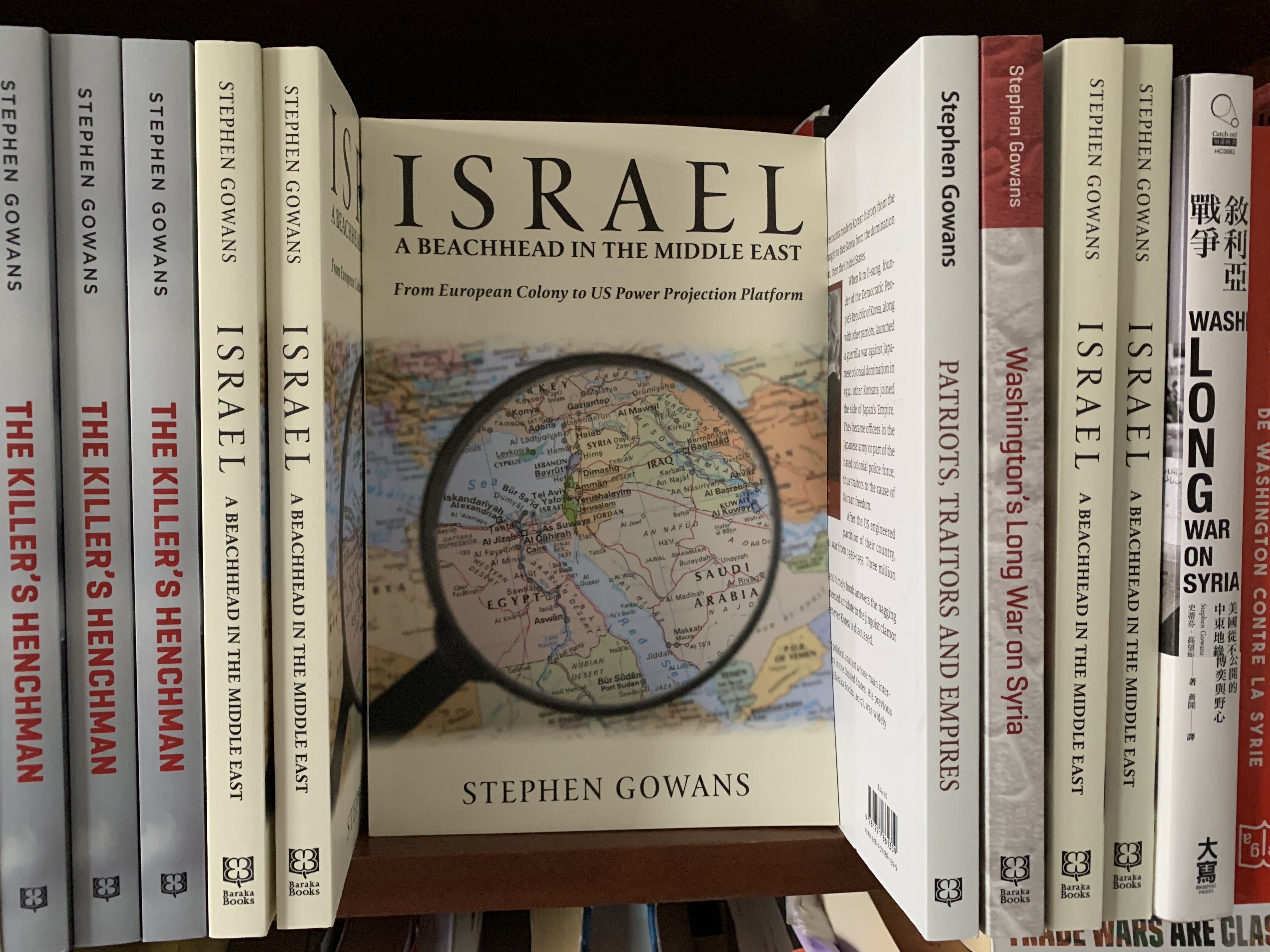

 What's Left