Israel is a Class Issue

The Israel lobby is run by the same people who hold enormous sway over public policy, the universities, and the mass media: the corporate elite

May 16, 2024

Updated May 17, 2024

By Stephen Gowans

Political scientists John Mearsheimer and Stephen Walt believe Israel is a US foreign policy liability, and that the only reason Washington strongly backs the Zionist state is because US decision-making has been hijacked by a powerful Israel lobby that is able to use its vast resources to severely punish politicians and decision-makers who fail to support Israel. US politicians and cabinet officials, in their view, recognize that support for Israel is inimical to US foreign policy interests but support Israel anyway for fear of running afoul of the powerful Israel lobby.

 A recent study by Laurence H. Shoup in Monthly Review shows that the organizations Mearsheimer and Waltz identify as the Israel lobby are largely led by the same wealthy patrons who lead the United States’ premier foreign policy think-tank, the Council on Foreign Relations (CFR).  The think-tank is directed by the colossi of Wall Street.

Wall Street, the Israel lobby, the CFR, the boards of universities and large mass media companies, are all interconnected as part of the same moneyed class.

The CFR regularly places its members in the top foreign policy cabinet positions. The current secretaries of state, defense, and treasury are members of the Wall Street-directed group, as well as Biden’s national security adviser, the director of the CIA, and the US ambassador to the UN.

Hence, the people who occupy the commanding heights of the US business world lead both the Israel lobby and the US foreign policy think-tank which supplies the personnel to staff the key foreign policy posts in the US government. Washington is unreservedly pro-Israel, because Wall Street is.   

To illustrate the point, The New York Times reported on May 15 that “Wall Street’s big donors” are turning away from Biden owing to their “growing dissatisfaction with what [the donors] see as the White House’s hardening stance against Israel in its war on Gaza.” Biden’s pausing (not cancelling) a shipment of 2,000 lb. bombs in an effort to dissuade Israel from launching a major assault on Rafah (which was soon followed by Biden approving a major transfer of other arms to Israel), and the United States abstaining from a UN vote censuring Israel for its conduct in Gaza, hardly amount to much of a hardening stance against Israel. All the same, many “big donors are put off by [what they see as Biden’s] softening support for Israel,” the newspaper reports.

Today, the web site Responsible Statecraft posted an investigation, “Biden’s Gaza policy risks re-election but pleases his wealthiest donors“, which reveals that “over one third of the president’s top funders – those giving in excess of $900,000 to the Biden Victory Fund—appear to see little nuance in the conflict [between Israel and the Palestinians] and show overwhelming sympathy for Israel, at times verging into outright hostility to Palestinians and anti-Muslim bigotry.”

In contrast, a poll sponsored by The New York Times, Siena College and The Philadelphia Inquirer has found that young and non-white voters are also turning away from Biden, albeit for the opposite reason: Because they deplore his support for Israel.

On May 16, The Washington Post revealed that a group of approximately 100 “billionaires and business titans” was “formed shortly after the Oct. 7” revolt in order “to ‘change the narrative’ in favor of Israel, partly by conveying ‘the atrocities committed by Hamas … to all Americans.’” The group’s self-stated mission was to “’help win the war’ of U.S. public opinion by funding an information campaign against Hamas.”

The group was formed by “billionaire and real estate magnate Barry Sternlicht.” The Post cited a November report from the news site Semafor “that Sternlicht was launching a $50 million anti-Hamas media campaign with various Wall Street and Hollywood billionaires.”

The group includes “former CEO of Starbucks Howard Schultz, Dell founder and CEO Michael Dell, hedge fund manager Bill Ackman and Joshua Kushner, founder of Thrive Capital and brother to Jared Kushner, former president Donald Trump’s son-in-law.”

The business titans also include “Kind snack company founder Daniel Lubetzky, hedge fund manager Daniel Loeb, billionaire Len Blavatnik and real estate investor Joseph Sitt” who met with New York City mayor Eric Adams to pressure him to deploy the police to clear the anti-genocide encampment at Columbia University.

The obvious conclusion is that the US capitalist class—the country’s billionaires and top-level executives—are decidedly pro-Israel, while the rest of the population is either less so, or strongly opposed to Israel’s conduct in Gaza. To put it another way: Wall Street supports the genocide (and therefore so too does Washington) while many ordinary Americans are appalled.

Since the capitalist class holds enormous sway over public policy—through its funding of political campaigns; by underwriting think-tanks to recommend public policy; by placing its representatives in key positions in the state; by donating to universities to shape their research agendas and influence who they hire and fire; by means of its extensive lobbying of the legislative and executive branches of government; and by its control of the mass media—it is inevitable that public policy will reflect the corporate elite’s strong backing of Israel.

Saying, as Mearsheimer and Walt do, that the Israel lobby shapes US foreign policy conceals a more important truth. Economic elites and organized groups representing business interests both strongly support Israel and shape US foreign policy. The Israel lobby predisposes Washington to support Israel only so far as the lobby is part of, and directed by, a capitalist class that leans strongly toward the Zionist state and has the resources and connections to strongly influence US foreign policy positions.

A 2014 study of over 1,700 US policy issues by the political scientists Martin Gilens and Benjamin I. Page found that “economic elites and organized groups representing business interests have substantial impacts on government policy, while average citizens and mass-based interest groups have little or no independent influence.”

The Israel lobby has a substantial impact on government policy because it is run by economic elites and organized business interests and because these elites are strongly pro-Israel. Mearsheimer and Walt call the Israel lobby powerful, but don’t inquire into the source of its power. The lobby is powerful because it is handsomely funded. The only class in a position to handsomely fund a lobby to make it powerful enough to decisively shape public policy is the class of top-corporate executives, financiers, and billionaire investors.

So, why is the US capitalist class overwhelmingly supportive of Israel?

Among members of the US economic elite, support for Israel may derive in some cases from Zionist convictions (either Christian or Jewish), but Zionist beliefs are far less important as the basis for pro-Israel views among members of the US capitalist class than is elite consciousness of the reality that Israel serves their class interests in an economically rich and strategically significant part of the world. US control of Middle Eastern oil provides corporate America with a rich source of profits. It also gives the corporate elite leverage over its business rivals in Europe, Japan, and China, who depend critically on Middle Eastern petroleum resources for survival. Israel helps Washington control the Middle East in a way no other state in the region is able to do.

Arab nationalist leaders have always been clear about why the US capitalist class supports Israel unreservedly. Israel is a watchdog, a snarling beast, “a dagger pointed at the heart of the Arab world,” that Washington uses to hold Arab and Muslim nationalist forces in check, to ensure the vast economic and strategic prize of Middle Eastern oil remains under the control of corporate America’s political servants in Washington and their Arab satraps, the kings, emirs, sultans, and military dictators who, to a man, loath democracy, and collaborate with Wall Street-backed US power against the ordinary people of the Arab and Muslim worlds.

Middle Eastern oil is not a prize corporate America is willing to yield to local forces of independence and national assertiveness. In return for Washington supporting Israel in carrying the Zionist project forward, Israel helps look after corporate America’s interests in the Middle East. It’s a mutually beneficial pact of Jewish nationalist forces collaborating with US business interests to keep the Arabs and Iranians down, the Americans in charge, and the Israelis supplied with arms and diplomatic support to enforce their regime of Jewish supremacy in the Levant.

The Israel Lobby and the US Foreign Policy Establishment Are Largely the Same, Reflecting the Complementarity of US Elite and Israeli Colonial Settler Interests

May 14, 2024

By Stephen Gowans

America is Israel. Israel is America and Europe combined in Palestine.”—Leila Khaled, 1973.

An article by Laurence H. Shoup in the May 2024 issue of Monthly Review, examining the Council on Foreign Relations (CFR), the premier think tank of the US foreign policy establishment, shows that the organization, whose members include the holders of the key US foreign policy cabinet positions, largely overlaps with the Israel lobby. The Israel lobby and the US foreign policy establishment are, in the main, the same. This poses problems for the Mearsheimer-Walt thesis, which holds that the US foreign policy establishment operates as a network of decision-makers that exists apart from an independent and powerful network of Israel supporters who twist the arms of the decision makers, compelling them to put Israeli goals ahead of US interests.

Shoup has written two books on the CFR—Imperial Brain Trust (with William Minter) and Wall Street’s Think Tank—as well as a number of articles on the think tank. His work explores the connections between Wall Street and the US foreign policy establishment, and focuses on the CFR as the organization that links the two.  

The Council is a private organization with a chairman (for years David Rockefeller, who, until his death, remained the honorary chairman) and board members (typically billionaires or near billionaires) and approximately 5,000 members, who are selected by the board.

The raison d’être of the organization is to bring together intellectuals, prominent business people, leading members of the media, state officials, and top military leaders, to formulate foreign policy recommendations and promote them to the public and government. The majority of the key foreign policy cabinet positions, State, Defense, Treasury, National Security Adviser, and US Ambassador to the UN, are filled by Council members.

Antony Blinken (Secretary of State), Janet Yellen (Secretary of the Treasury), Lloyd Austin (Secretary of Defense), Linda Thomas-Greenfield (UN Ambassador), William J. Burns (Director of Central Intelligence), and Jake Sullivan (National Security Advisor), are all members of the CFR.

The directors of the organization are drawn from the colossi of Wall Street. For example, Larry Fink, the longtime CEO of Blackrock, was a CFR director from 2013 until 2023. “Blackrock is the world’s biggest asset manager, to the tune of about $10 trillion in assets, a figure larger than every nation’s GDP outside of the United States and China,” notes Shoup.

Shoup’s latest inquiry into the CFR concerns its relationship to the Israel lobby. Political scientists John Mearsheimer and Stephen Walt (both CFR members) criticized the lobby in a major paper and subsequent book titled The Israel Lobby and US Foreign Policy. The authors argued that Israel is not a US foreign policy asset, and, to the contrary, is a liability. How is it, then, that Washington is unfailingly devoted to Israel, supplying it with weapons, shielding it from penalty for its violations of international law, and attacking its critics?  The answer, they argue, is the Israel lobby. In effect, a powerful network of Israel’s supporters has pressured the US foreign policy establishment to take positions that promote Israel’s interests at the expense of those of the United States.

Critics of the Mearsheimer-Walt thesis counter that even in the absence of an Israel lobby, Washington would support Israel, because the client state acts as a proxy for the United States in West Asia and North Africa in a way no other state in the region could.

What makes Israel especially suited for service as an outpost of the United States and the West in the Middle East, as Benjamin Netanyahu once described his country, are the cultural, familial, ideological, educational, and economic connections of a sizable portion of its leaders, military officials, and citizens to North America and Europe, the regions from which they, or their ancestors, arrived in Israel. Jewish settlers in Palestine see themselves as representatives of Western civilization in a land of barbarism. Bringing Western thought, culture, technology, and politics to the barbarian East is a leitmotif of political Zionist thinking, and has been since its origins in nineteenth century Europe.

Political Zionism has always rested on the idea of a quid-pro-quo between settler Jews emigrating from the West and the governments of the Western states from which they emigrated. The former would represent the interests of the latter in West Asia and North Africa, serving as a bulwark against Arab and Muslim nationalist interests, in exchange for the latter’s support for the Jewish settler project in Palestine. That project would inevitably arouse the enmity of the natives, who would naturally bristle at their displacement and the negation of their national aspirations.  A Western backer would be vital to the project’s success, and Israel would return the favor by countering forces that opposed its sponsor’s interests in the region.

Israel, of course, isn’t the West’s only choice as proxy in the Arab and Muslim worlds. Washington could look to Arab states to help police the Middle East and assert US profit-making and strategic interests in the region. Indeed, Washington has done this, establishing relations with a series of royal and military dictatorships, including Egypt, Jordan, Saudi Arabia, the UAE, Oman, Bahrain, Qatar, and Kuwait.

The trouble is that US support in the Middle East is largely limited to the autocrats Washington helps keep in power over the opposition of their subjects. It would be difficult for US-backed Arab despots to mobilize their countries against other Arabs and Muslims, specifically Iran, Syria, Hezbollah in Lebanon, and Ansar Allah in Yemen—states and movements which reject US domination of the Middle East. US-backed autocrats command little support at home. Their populations are imbued with nationalist aspirations, and unlike Israeli Jews, reject the idea that the region ought to be subordinate to US leadership. Tel Aviv, in contrast, can mobilize Israeli Jews against Arabs and Muslims, who are viewed as hostile barbarians, embittered against Israel, and bent on eliminating the Jews as a people.

To put it another way, Israeli Jews, who largely see themselves as Westerners, identify with the Western world and its project of imposing US leadership on the globe, including on the energy-rich and therefore strategically important Middle East; Arabs and Iranians are far less likely to share this view. Native states are, thus, poor choices as effective proxies for US interests in the Middle East. Israel, the West’s outpost in West Asia and North Africa, is, in contrast, a brilliant choice, motivated to cooperate with the US agenda by its security concerns which can only be satisfied by the United States and its Western partners and a common Western culture and commitment to the ideas of manifest destiny, Western superiority, and the desirability of US global leadership.

Shoup’s latest article, which examines the CFR and the Israel lobby, makes a few points which raise questions about the validity of the Mearsheimer-Walt thesis (though it’s not clear that it was Shoup’s intention to do so.)

Shoup argues that the CFR is part of the Israel lobby. He does so by showing extensive overlaps between the organizations that Mearsheimer and Walt identify as the principals of the lobby and the CFR itself. People who hold key positions in the lobby also hold key positions in the CFR and vice-versa. At the same time, people who hold key positions in the US state, tend to come from the CFR and hence, its overlapping Israel lobby.

If we consider Shoup’s findings, that (1) most of the people who direct US foreign policy are members of the CFR; (2) by implication the CFR is, in effect, the US foreign policy establishment, or at least the source of most its foreign policy-related cabinet members; and (3) the CFR is part of the Israel lobby and the Israel lobby is part of the CFR, then, it must be true that the US foreign policy establishment is the Israel lobby and the Israel lobby is the US foreign policy establishment.

Shoup’s findings therefore identify a critical flaw in the Mearsheimer-Walt thesis, namely, that it treats the Israel lobby as existing apart from the US foreign policy establishment. US decision-makers are presented as pressured by an external agency, one committed to protecting and advancing Israeli interests, which pressures US decision-makers to prioritize Israel’s goals over US interests. People who put Israel’s interests ahead of those of the United States, are, in the Mearsheimer-Walt view, pressuring the US foreign policy establishment to pursue Israel’s aims. This, however, cannot be true if the lobby and the foreign policy establishment are one and the same, as Shoup reveals. Indeed, in light of Shoup’s findings, the Mearsheimer-Walt thesis reduces to a necessary truth—the US foreign policy establishment influences the US foreign policy establishment.

Shoup shows that contrary to what is implicit in the Mearsheimer-Walt view, the US foreign policy establishment subsumes, overlaps, and is highly interlocked with the Israel lobby, and is not independent of it. The two do not exist as separate networks, but as highly interpenetrated ones. The US foreign policy establishment is the Israel lobby and the Israel lobby is the US foreign policy establishment. This reveals that the Mearsheimer-Walt thesis is a tautology: The US foreign policy establishment backs Israel because the lobby, i.e., the US foreign policy establishment, backs Israel.

Based on Shoup’s findings, Mearsheimer and Walt might reply that the problem is even worse than they had anticipated; that the US foreign policy establishment has been completely taken over by Israel’s supporters who have turned the US security state into an unqualified instrument of Israel. But this would merely assign to Israel’s backers the role of bouc emissaire, scapegoats, to blame for why US foreign policy hasn’t embraced Mearsheimer and Walt’s policy recommendations. From a psychological point of view this is what lies behind the Mearsheimer-Walt thesis, viz., we say, US policy should be x; it’s not x; therefore, some external force must have intervened to disrupt the causal path that goes from our identification of the best course for US foreign policy to take and the foreign policy establishment’s endorsement of it.  How could the foreign policy establishment not see the brilliance of our policy prescriptions? It must be that its members were suborned not to see it.

However, as we have seen, there are compelling reasons to reject the duo’s policy prescriptions on the grounds that the theorists have failed to grasp the role Israel plays to support US interests against Arab and Muslim nationalism, an enemy shared by both Israel and Wall Street. Washington opposes these forces because they threaten US control of the Middle East’s petroleum resources, a highly important strategic asset which is not only a source of immense profit for US corporations, but a source of considerable strategic leverage for Washington over Europe, Japan, and China, US economic rivals that depend for a good deal of their energy on the Middle East. Israel opposes forces of independence and nationalism in the Middle East because they threaten Israel’s continued existence as a colonial settler state. Israel critically depends on Washington to provide it the weapons, military and intelligence support, and diplomatic protection it needs for its colonial settler project to survive. Without US support, Israel would soon perish. For its part, Washington needs Israel to crush the nationalist aspirations of the natives which, if they were to flourish, would impede US profit making in a strategically significant region. The relationship is symbiotic.

The Israel lobby, which largely focusses on electoral contests and the shaping of public opinion in favor of Israel, is part of the US foreign policy establishment, and the US foreign policy establishment is part of the Israel lobby. The two networks overlap because the interests of Israel as a settler colonial state and the interests of Wall Street as an implacable opponent of foreign nationalism, intersect, not because Zionist Jews and Christian Zionists have hijacked the foreign policy establishment and turned the US government into an instrument of Israel against the interests of the United States. What Mearsheimer and Walt fail to grasp is that the interests of the two countries are not inimical; that Israel’s settler colonial interests and the profit-making and strategic goals of Wall Street, in large measure, complement each other. Israel is the tool of the United States, and the United States, as the guarantor of Israel’s survival, is the tool of Israel. The relationship between the two states is not, for the most part antagonistic, and is largely symbiotic and complementary.

Why then does the lobby exist? It exists, not to capture the apparatus of the state, which is already dominated by Wall Street interests which see US support for Israel as favorable to the goal of protecting US profit-making interests in the Middle East. The lobby exists, instead, to shape public opinion, media coverage, intellectual discourse, and the research agendas and curricula of the universities and schools, to favor Israel and, where public opinion cannot be manipulated to Israel’s advantage, to discourage elected representatives from responding to public opinion by backing legislation or government actions that could interfere with Washington’s accustomed support of its Israeli client. The lobby, as Shoup points out, is largely focused on electoral contests, not on twisting the arms of the unelected Wall Street-connected personnel who occupy the consequential foreign policy roles in the state—the secretaries of state, defense, treasury, director of national intelligence, chief of the CIA, and UN ambassador, and their phalanx of deputies and undersecretaries. The role of the Israel lobby is, in short, to persuade US society and its elected representatives to accept US support of a client in the Middle East whose conduct is likely to inflame public opinion against it.

Former Pentagon Chief Defends Israel’s Genocide Against Palestinians by Citing the US Record of Slaughtering Innocent Civilians

By Stephen Gowans

May 9, 2024

The war of the enslaved against their enslavers [is] the only justifiable war in history. – Karl Marx, The Civil War in France

The journalist Max Blumental, who edits the GRAYZONE, posted a video of former US chairman of the joint chiefs Mark Milley cataloguing, in a maladroit effort to justify Israeli atrocities in Gaza, US campaigns in which civilians were slaughtered in numbers matching or exceeding the Israeli-engineered, US-arms-supplied, Washington-approved, genocide in Gaza.  

“Before we all get self-righteous about what Israel is doing,” intoned Milley, we should remember that “we slaughtered people in massive numbers, innocent people…men, women, and children.”

“War is a terrible thing,” he added.

Unlike Milley, I don’t condone the killing of innocent civilians, including those killed by Hamas.

But this invites the question: Which civilians are innocent and which are not? Anyone incapable of fighting—children, the aged, the ill—must be considered innocent. Civilians who take up arms and thus become combatants, are not innocent. In a war of oppressors against the oppressed, are civilians who knowingly participate in, benefit from, or approve of oppression, innocent? Is a settler innocent?

We might ask too about how the US and Israeli goals in war compare with those of the Palestinian resistance.

The US goal is to impose the will of the US economic elite on other people so that the global economic order remains tilted in favor of US investors, billionaires, and corporations. Today, the United States overtly prepares for a war of aggression against China, openly acknowledging the reason: Because the East Asian giant, by its size and rapid economic development, threatens to disrupt the US-at-the-top global economic order and topple the US corporate class from its commanding position at the apex.  

The Israeli goal is to impose the will of the self-appointed leaders of an ethno-religious group, Jews, on Arabs in the Levant.

The goal of the Palestinian resistance, by contrast, is to liberate Palestinians from the ethno-religious oppression of a racist Zionism that is backed by Washington and which uses Israel as its instrument to pursue US economic and strategic goals in West Asia and North Africa against the interests of the local populations.   

By his words, Milley implies that US and Israeli wars are just, and that the killing of civilians in these wars is therefore acceptable. By contrast, his words suggest that the armed action of the Palestinian resistance is unjust and that the killing of civilians in pursuit of liberation is therefore horrible, brutal, and vicious. Twelve hundred people killed in a Hamas attack is flagitious and intolerable in Milley’s view, but tens of thousands of people, mostly women and children, slaughtered in a demented, openly genocidal Israeli campaign, is, in Milley’s view, just the regrettable reality of war.

Milley defends the consequences of US and Israeli aggressions by describing war as horrible, brutal, and vicious. In Milley’s words, US pilots don’t drop bombs and Israeli soldiers don’t fire US-supplied artillery shells; instead, civilians are slaughtered in sickening numbers by an impersonal thing called war. On the other hand, Israeli civilians are killed by a very personal thing called Hamas.

Milley’s tacit assertion that US and Israeli wars are just—wars which are, au fond, motivated by goals of exploitation and oppression—speaks volumes about what the Washington elite believes, as does the retired general’s implied condemnation of the war for liberation that lies at the center of the Palestinian resistance; a war of the enslaved against their enslavers.

In the world of the US ruling class, when Hamas does it, killing civilians is horrible, wicked, and intolerable, but when the US and Israel do it—producing civilian corpses in numbers vastly greater than any Hamas could ever come close to even remotely matching—it’s just the inevitable, yes, terrible, but all the same, excusable, consequence of war.

In the US view, then, killing many civilians in an unjust war is perfectly alright, even if horrible. On the other hand, killing comparatively few civilians in a just war is intolerable.

Given that Milley, not alone in the US-Israeli establishment, is willing to tolerate civilian deaths in massive numbers as, what he characterizes as, the regrettable but acceptable consequence of war, one can only conclude that what really bothers him and his fellow worshippers of Mars in the service of economic and ethno-religious elites, is not the killing of Israeli civilians by Hamas on October 7, but the reality that the enslaved Palestinians rose against their Israeli enslavers.  

Another victim of the war on the Palestinians: The crumbling of the myths of free speech and the West’s moral leadership

By Stephen Gowans

May 6, 2024

Paris is trying to shut down the anti-genocide campaign of the French political party, la France insoumise, by criminalizing it as antisemitic, pro-terrorist, and pro-Hamas. Prosecutors are investigating a number of the statements made by party leaders, including this blandly factual description: “The armed offensive by Palestinian forces led by Hamas comes in a context of intensification of Israeli occupation policy in Gaza, the West Bank and East Jerusalem.” The alleged crime in the party’s statement is its description of the October 7 attacks as an armed offensive rather than presumably, as a vile, reprehensible act of terror; description in lieu of denunciation has become verboten; failure to endorse the moral evaluations of established authority will be punished.

France’s tradition of resistance to occupation lives on, it seems, only in la France insoumise, and not in the current government. The orientation of bien pensant France appears to be more faithful to the Vichy tradition of complicity with an occupier. Inasmuch as France deplores the right of the occupied to use violence to resist their occupation (as the French did against Nazi occupiers in World War II), it condones the Israeli occupation and apartheid of which the armed offensive of Hamas is but the response. Describing the Hamas attack as an armed offensive in no way condones the killing of unarmed civilians, or their abduction, or even points to the right of the occupied to use violence to end their occupation. All the same, the right does exist. In my opinion, the right is not an unlimited one; the oppressed haven’t the right to use violence in any way they please. But the use of violence by the oppressed against those who oppress them is just. Whoever acts to pacify the slave, or impedes those who arouse him against his oppression, aids the slave-master.

France, as well as Germany, claim that their respective roles in the Holocaust obligate their support for Israel as atonement for past sins. This rests on an invalid idea: That because the Germans visited a holocaust on the Jews who were living on land in Eastern Europe that Germany coveted, that Zionists should be supported in visiting a holocaust on the Palestinians who live on land Zionists covet.  In other words, we will atone for our own crimes, say Paris and Bonn, by supporting the self-appointed leaders of the people we harmed to inflict the same harm upon another people. This isn’t atonement for a crime; it is the universalization of it; its redux.

French and German efforts to shut down support in their own countries for protests against Israeli apartheid and genocide, and efforts in the United States to punish students for participating in campus protests, as well as to produce legislation to gag critics of Israel by defining anti-Zionism as antisemitism, reveal a truth about free speech: it’s a myth. Free speech is tolerated, indeed, welcomed and boasted about, but only when it doesn’t challenge the established order, or does, but has limited reach. Speech which threatens to mobilize people against an order that favors those in power is almost always, and everywhere, prohibited, energetically discouraged, and punished. Often, verboten subjects are presented as that part of free speech that isn’t absolute, or as an abuse, where abuse, not expressed as such but implied all the same, means saying something that threatens to mobilize people against those who oppress and exploit. So it is that criticism of Zionism must be squelched by the enablers of Zionist crimes because too many people are rallying to oppose them; so it is that this speech must be calumniated as criminal and an abuse of the norms of free expression.    

“One of Brown University’s major donors, the billionaire real estate mogul Barry Sternlicht” has “sharply criticized the school’s agreement to hold a board vote on cutting investments tied to Israel.” The decision is “unconscionable” he says, and he has “paused” donations to the school, as a means of discouraging further outbreaks of advocacy he and his fellow Zionists despise. Sternlicht has invoked a tu quoque (you, as well) defense of Israel’s genocidal conduct. The moneybag’s argument takes the following form: The United States has slaughtered many more people in war than Israel has. If the United States can engage in wanton slaughter, then so too can Israel. Moreover, he asks, where were the protests against the hundreds of thousands of civilians killed in wars in Syria, Afghanistan, and Iraq? Tu quoque arguments are logically invalid, and so I will address this aspect of Sternlicht’s argument no further. There were indeed protests against the wars he cites; perhaps the real-estate mogul was too busy accumulating his billions to notice. However, it must be conceded that protests against the wars that the United States visibly and directly led were not generally as large or sustained as the current broad grassroots campaign against Israel’s genocide. This might be because US officials in recent US wars, unlike Israeli officials, soldiers, and citizens in their current war on Gaza, never expressed the intention or desire to exterminate a people. But there may be another reason, too. Radicals can generally be expected to be as fervent in their opposition to US wars as those of Israel, but is this true of non-radicals? Are they more likely to see their own country than others as, au fond, morally decent?

The idea that the United States, Germany, France and other US allies are not themselves directly implicated in the horrors perpetrated by Israel against the Palestinians is another myth. The Wall Street Journal recently warned that an Israeli attack on Rafah could further impair Tel Aviv’s relationship with the United States government. Further impair? In what way has it been impaired at all? Washington recently approved $26 billion in Israeli military aid (on top of regular annual contributions of $3.8 billion), and remains indefatigable in pledging ironclad support, despite Israel’s enforcement of apartheid in Palestine and pursuit of genocide against the Palestinians, despite settler pogroms against Palestinians in the West Bank, and despite a policy of starvation, destruction, and extermination in Gaza. The idea that the US-Israeli relationship has been impaired by Israeli atrocities is a myth, conjured, it would seem, to shield US citizens from the reality that their government is as much implicated in apartheid and genocide as is its Zionist protege. To paraphrase the iconic Palestinian revolutionary, Leila Khaled, the United States is Israel, and Israel is the United States in Palestine. The notion that the Zionist State is tarnishing the moral standing of its US patron, and that the malignant conduct of Tel Aviv is trying Joe Biden’s patience, is a fairy-tale manufactured to exculpate Washington for its contribution to efforts to erase the Palestinians.

Washington stands behind the war on Palestinians as much as it stood behind wars on Iraqis, Afghans, and Syrians. It ought to be opposed, criticized, and demonstrated against in measures equal to the opposition and criticism of Israel. Genocide Joe is as apt an epithet as Genocide Bibi, just as much as Genocide USA (and Genocide Germany, France, Britain, Canada, etc.) is as apt an epithet as Genocide Israel.

The Politics of Defining Antisemitism

May 2, 2024

By Stephen Gowans

Yesterday, the House of Representatives voted to pass the Antisemitism Awareness Act, which would require the Education Department to use the International Holocaust Remembrance Alliance’s working definition of antisemitism when enforcing federal antidiscrimination laws.

The IHRA defines the following as an example of “antisemitism in public life”: “Denying the Jewish people their right to self-determination, e.g., by claiming that the existence of a State of Israel is a racist endeavor.”

In connection with this, it should be noted that, “the Jewish people” do not have a right to self-determination senior to, or negating, the right of the Palestinian people to self-determination on the historic territory of the Palestinians.

Israel, exercising de facto control over the traditional territory of the Palestinians from the Jordan River to the Mediterranean Sea, by the force of arms largely supplied by the United States and Germany, is an apartheid, racist, state, which enforces Jewish supremacy over the native Palestinian population. Amnesty International, Human Rights Watch, B’Tselem, and other human rights organization have characterized Israel as an apartheid state.

Political Zionism, which elevates the interests of Jewish settlers above those of Palestinian natives in historic Palestine, is a racist doctrine.

Political Zionism has, from its inception, been a movement which has openly solicited the support of great powers in exchange for acting as their client and proxy in West Asia and North Africa against the interests of the Arab and Muslim worlds.

Political Zionism, Israel, and the settler colonial project in the Levant, are the instruments of great powers, and most especially, since 1967, the United States. They could not exist without Washington’s ironclad support. In return, they help keep Arab and Muslim nationalist forces in check in order to safeguard US domination of West Asia and its petroleum resources and key energy supply routes.

The IHRA does not deny that the State of Israel is a racist endeavor; it only seeks to discredit those who say it is, by labelling them antisemites.

The IHRA is far from a neutral organization. It is a political animal which represents the combined interests of the United States and its key allies, and their client, Israel, whose aim it is to police criticism of Israel and the US-backed settler colonial project in the Levant under the guise of combatting anti-Jewish racism and promoting remembrance of the Holocaust.

The IHRA and its supporters are keen to foster remembrance of the anti-Jewish genocide and are equally keen to suppress opposition to what the International Court of Justice has judged to be the plausible possibility of an Israeli-perpetrated genocide in progress against the Palestinians.

Whether the Israeli military assault on Palestinians in Gaza, on civilian infrastructure, and efforts to starve the population, along with the pogroms against Palestinians in the West Bank, rise to the ICJ definition of genocide, it is clear that key Israeli decision-makers and Israeli soldiers have expressed genocidal intent and that the Israeli military campaign in Gaza is undeniably one of massacre.    

The IHRA lists many examples of what it says is antisemitism but the list is open; the organization says there are other examples, which it does not enumerate. This allows the definition to expand in order to traduce critics of Israel and political Zionism’s racist settler colonial project as circumstances demand.  Doubtlessly, the IHRA definition will be used, and probably already has been, to define the designation of Israel as a state plausibly carrying out a genocide as an act of anti-Jewish hatred.

Apart from the problem of the IHRA definition’s manifest political intent to intimidate critics of Israel into silence, is its logical flaw. The definition illegitimately conflates Jews and Judaism with Israelis and Israel—not all Jews are Israeli, and many Jews reject any identification with the state—so that criticism of the Zionist project is dishonestly equated to hatred of Jews. The description of Germany from 1933 to 1945 as a racist, imperialist, state, bent on genocide, hardly amounts to hate speech against Germans. By the same principle, the description of Israel as a racist endeavor, carrying out a plausible genocide against a people it has been trying to erase since 1948, is not hate speech against Jews; it is criticism of Israel and its racist project.

Israeli officials employ the legerdemain favored by the IHRA to shelter the state from criticism and opposition. Israel’s prime minister, Benjamin Netanyahu, for example, is apt to defend every Israeli crime by labelling opposition to them as an assault on “the world’s one and only Jewish state”, as if criticizing Israel for a plausible genocide, or its apartheid, amounts to criticism of Jews as a people. Zionists would dearly love to be the spokespersons of the Jewish people, but the position is a self-appointed one, and the United States and Israel’s other patrons participate in the deception. Just as the Nazis appointed themselves as spokespeople for the Germans, over the opposition, it might be noted, of many million Germans, so too do the Israeli clients of the United States affect to be the spokespeople for the Jews (over the opposition of many Jews.).

Sadly, the frequent abuse of the word “antisemitism” for the political gain of Israel and its great power patrons, debases efforts to combat genuine anti-Jewish hatred.  Stretch a definition too far, and it becomes meaningless. Still, in their zeal to defend settler colonialism in the stolen country of the Palestinians, the Zionists and their great power patrons will stop at nothing, including turning the concept of antisemitism into a politicized slur. In so doing, they impede sincere efforts to combat genuine antisemitism.

This, however, is consistent with the fundamentally antisemitic character of Zionism, a doctrine which:

a) denigrates the fight against antisemitism as pointless, since, in the Zionists’ view, hatred of Jews is ineradicable;

b) promotes the view that to secure themselves against the ineradicable antisemitism of non-Jews, Jews must emigrate from the countries in which they now live to take up residence in the Jewish state erected on the stolen land of the Palestinians;

c) defines Jews as members of a nation, rather than followers of a religion.

Points (b) and (c) are consonant with the antisemites’ belief that Jews are aliens, a nation within the nation, who must emigrate from the lands in which they live.

Thus, apart from the racism inherent in Zionism as a doctrine of Jewish supremacism in the stolen country of the Palestinians, Zionism also rejects the project of combating antisemitism and shares with antisemites their core beliefs.

Israeli election makes it difficult to deny the character of Israel as a racist state

September 20, 2019

Mainstream Western newspapers would never brand Israel as a racist state, a reality which says more about the nature of Western newspapers than about the character of Israel. But occasionally newspapers in the West do make observations which reveal the racist character of Israel, if the observations are placed within the context of liberal democracy and are compared with what is formerly tolerable within such countries as the United States and Canada.

In a September 19 report on the Israeli election, The Wall Street Journal observed that “Mr. Netanyahu and other politicians have framed Arab-Israeli politicians as enemies who would undermine Israel’s…Jewish character.”

http://www.barakabooks.com

While the statement may clearly reveal Netanyahu’s narrow racism, the broader racism of the Israeli state may not be immediately apparent. But it becomes evident if it is placed within the framework of US or Canadian politics. Imagine the parallel of white US politicians framing black US politicians as enemies who would undermine the United States’ white character, or of a Roman Catholic Canadian politician framing a Muslim politician as an enemy who would undermine Canada’s ‘commitment to Western (i.e., Christian) values.’

Formally, the United States is a state of all its citizens, not a state of white people. Formally, Canada is a state of all its citizens, not a state of the English or of Christians. In contrast, Israel is not a state of all its citizens, but one in which Jews have priority. Netanyahu makes no apologies for this, and nor do most Jewish Israelis.

Netanhyahu’s equivalent in the United States, namely, US politicians who would identify their ‘whiteness’ as a significant political category, brand black politicians as enemies, and seek to defend the ‘white character’ of the United States, would quite rightly be denounced as racists. They would almost certainly be open or covert members of the KKK, or open or covert admirers.

Likewise, the notion that the ‘white character’ of the United States must be preserved would be clearly recognized as a white supremacist concept and anyone who spoke of, or even hinted at ‘the white character’ of the United States as a normative idea would be justifiably censured as an intolerable racist whose views must be immediately renounced and corrected. Why then would the parallel view of the Jewish character of Israel as a normative concept, when expressed by Israelis or their supporters, not be denounced as racist?

The New York Times has often dismissed as unthinkable the prospect of Palestinian refugees exercising their right, under international law, to return to the homes from which they were driven or fled on what is now Israeli-controlled territory. The “refugees number in the millions, and their return,” explained David M. Halbfinger in a 2018 article, “would probably spell the end of Israel as a Jewish state.” In other words, Palestinians cannot be repatriated otherwise the ethnic character of Israel as a Jewish state will be undermined.

This is not unlike justifying an immigration policy that bars the entry of non-whites into the United States on the grounds that the influx of millions of dark-skinned people would threaten the United States as a white state, or bars Muslims in order to preserve ‘the Christian character’ of the country. Such a policy would be recognized as racist in the US or Canadian contexts, so why would the parallel policy in the Israeli context not be branded as racist as well?

The case is made stronger, if we acknowledge that the parallel is imperfect. Unlike prospective immigrants to the United States, the Palestinians are natives of the territory to which they seek entry, not aliens. They have a right to be there, and many of them are not there, because the founders of the Jewish state organized a program of demographic engineering to create an artificial Jewish majority (that is, to create a state with a Jewish character) by ethnically cleansing a large part of the Palestinian homeland. The current caretakers of the state preserve the outcome of the founders’ demographic aggression by denying the Palestinians’ their UN-mandated and UN-enjoined right of repatriation.

Hence, the Israeli policy of denying natives repatriation to their own land in order to preserve the ethnic character of Israel as a Jewish state is indefensible on multiple grounds.

  • It defines the natives (Palestinians) as aliens and the aliens (Jewish immigrants who carried out the ethnic cleansing and their descendants) as the natives.
  • It violates international law.
  • It preserves the outcome of a program of ethnic cleansing.
  • It is racist.

Calling out Israel as a racist state is countered by Israel and its supporters by the levelling of accusations of anti-Semitism against anyone who dares to proclaim the obvious. Indeed, in some circles, defining as racist the notion that Israel ought to have a Jewish character is defined as anti-Semitic. This exercise in casuistry rests on the logical error of equating Zionism with Judaism, so that criticism of Zionism becomes construed as criticism of Judaism and Jews.

But by this logic anyone who decried the racism of apartheid South Africa or white supremacist Rhodesia, or decries the KKK as white supremacist, is anti-white. And by the logic that undergirds the Zionism equals Judaism formula, all whites are supporters of the KKK and apartheid South Africa, so that anyone who denounces the KKK or racist South Africa denounces whites as a category.

Imagine a definition of anti-white racism as denial of the Afrikaners’ right to a white settler state in southern Africa on the stolen land of the natives. If you can imagine this, then you’ve imagined the growing practice of formally defining anti-Zionism as an element of anti-Semitism. Denial of the Afrikaners’ right to a white settler state in southern Africa on the stolen land of the natives is also the denial of apartheid South Africa’s right to exist, and is equivalent to denying Israel’s right to exist as a Jewish state on the stolen land of Palestinians. To deplore racism while at the same time proclaiming Israel’s right to exist as a Jewish state is to deplore racism except when it is exercised by Zionists. By what logic is the racism of Zionism uniquely exempted as an instance of racism? By no logic at all, and instead by:

  • The illogic that holds that because Jews were the victims of a crime of great enormity perpetrated, not only by the Nazis, but by their European collaborators, that the actions of a state claiming to talk in the name of the Jews are beyond reproach.
  • The politics of power by which the United States defends Israel and allows it a free hand because it collaborates in the defense and promotion of US economic and strategic interests in the petroleum-rich Middle East.
  • Calumniating as an anti-Semite anyone who insists that Zionism is a form of racism.

Pointing out that Israel is a racist state that does not have a right to exist as an ethnic state for the Jews, nor as a settler colonial state whose Jewish majority is a product of demographic engineering, is not anti-Jewish racism; on the contrary, denunciation of any kind of ethnic privilege is not inherently hostile to the ethnic communities that seek it. It is, instead, inherently inimical to the assignment of rights, obligations, and privileges on the basis of ethnic hierarchies; that is, it supports universal equality and freedom from racist oppression.

Political Zionism, the ideological basis of the Israeli state, originated in an attempt to find a solution to anti-Jewish racism through separation. The trouble is that it did so by mimicking nineteenth century European nationalism, with all its racist underpinnings, and rejecting the growing movement for universal equality, which saw the solution to racism, including that of an anti-Jewish stripe, in the building of non-ethnic states of equality for all, regardless of one’s race, religion, language, and ethnicity, as well as one’s sex or possession of property. Jews were an important part of the movement for universal equality, and remain so today.

Indeed, Michael Oren, formerly an Israeli ambassador to the United States, identifies the Jewish community in the United States as belonging to the latter tradition of universal equality in contrast to Israeli Jews, who have embraced the former, Jewish nationalist solution to anti-Jewish racism. The Jewish nationalist solution is an anti-Arab racist solution to anti-Jewish racism of European origin, or of getting out from beneath one’s own oppression by oppressing someone else. The idea is inherently supremacist in defining the welfare of Jews as superior to that of Palestinians so that the welfare of Palestinians can be sacrificed in the service of the welfare of Jews. In this view, Jews and Palestinians are not equal; instead, Jewish rights trump Palestinian rights.

“The American Jewish idea is fundamentally different from the Jewish Zionist idea,” Oren told The Wall Street Journal. “The American Jewish idea is that Judaism is a universal religion, that we are not a nation or a people, that our duty is to all of humanity, and that America is the promised land, and that the Land of Israel is not the promised land,” he said.

“That fundamental gap, he added, has prompted many Israeli right-wing politicians to essentially give up on liberal American Jews and focus on friendlier constituencies such as evangelicals.” Significantly, US evangelicals, including US secretary of state Mike Pompeo, embrace Christian Zionism, the idea that the ingathering of Jews to Israel fulfills a biblical prophesy. In their view, by supporting Israel as a state with a Jewish character—that is, by colluding in racism—they’re abiding by their deity’s will.

Zionism is largely misunderstood as an exclusively Jewish ideology, when it has always also been strongly a Christian ideology, whose principal supporters have been officials of imperial states who read their bibles. This was as true in the early twentieth century when such statesmen as Arthur Balfour in England and Woodrow Wilson in the United States found support for the fledgling political Zionist movement in their reading of the bible, as it is today. Last year, Pompeo told a reporter for The New York Times Magazine that the Bible “informs everything I do.” The reporter noticed an open Bible in his office, with a Swiss Army knife marking his place at the end of the book of Queen Esther.” In the bible’s telling of the tale, Queen Esther saved Jews from being massacred by Persia (Iran’s forerunner.)

At the same time, historically, the movement for universal equality attracted Jews at a rate far in excess of their numbers in the population. As Benjamin Beit-Hallahmi wrote, Jews who fought alongside non-Jews in the struggle against racism and for universal equality “refused to limit their concerns to their own tribe. Theirs was a grander, purer dream. Salvation not just for Jews, but for the whole of humanity, and that would eliminate the ills of the Jewish condition once and for all.”

On the one hand, a pure and grand vision, dating from the French Revolution, of Liberté, Equalité, Fraternité, and the universalist idea of a state of all its citizens; on the other, the particularist idea of the ethnic state for Jews, made possible by the demographic engineering of a Jewish majority, obtained by the expulsion of the natives and denial of their repatriation, and the exercise of a racist regime over the natives who weren’t dispossessed; in short, the idea of universal equality versus the conservative tradition of hierarchy, racism, colonialism, and religious bigotry. To criticize Israel and Zionism is not to hate Jews, but to deplore the conservative tradition of ethnic privilege, racism, and colonialism from which Israel sprang and which it continues to exemplify.

The Jewish Colonization of Palestine and the Recalcitrance of the Natives

July 4, 2016

“It is easy for us who have never been victims of foreign conquest and are still living in our homes to vehemently denounce the violence of evicted Palestinians.” [1]

“Palestine is an occupied land stolen from its native people and time does not make it a property of the thief.” [2]

By Stephen Gowans

In 1939, Hitler ordered Poland to be depopulated and colonized by Germans. Poland had a substantial Jewish population. Less than 10 years later, in 1947 and 1948, Zionists—who, like Hitler, believed that Jews were a national collectivity, in addition to being a religious one, and that Jews ought to establish a homeland outside of Europe—ethnically cleansed Palestine, a former Ottoman territory, of a large part of its indigenous Palestinian population. The goal was to establish a Jewish state in Palestine to be colonized by Jewish settlers, mainly from Europe. The Zionists used terrorist methods to induce the Palestinian population to flee, and refused to allow them to return, turning nearly a million of them into refugees. The property of Palestinians who took flight and were barred from returning was taken over—that is, expropriated without compensation—by Jewish settlers.

LeilaIn May of 1948, Zionist forces proclaimed the formation of a Jewish state in the Palestinians’ country, a date Palestinians mark as the Nakba, or catastrophe. The Jewish state controlled 78 percent of Palestine. Many of the Palestinians whom Jewish terrorists had forced from their homes lived in refugee camps in the remaining 22 percent of their country. This was made up of the West Bank, Gaza Strip and East Jerusalem. In 1967, Zionist forces completed their military conquest of Palestine in toto, imposing military rule on parts of the Palestinians’ country they had failed to conquer in 1948. Since then, Israel has engaged in a process of creeping Judaization of the West Bank and East Jerusalem, building Jewish-only settlements, connecting them by Jewish-only roads, and denying building permits to Palestinians.

There has been much talk of a two-state solution. But what, exactly, are two states a solution to? The proffered answer is that they are a solution to the irreconcilable goals of Zionists, on the one hand, who seek Jewish colonization of all of Palestine, and Palestinians, on the other, who refuse to accept the colonization of their country. The proposed solution, which isn’t a solution at all, but for both parties an unacceptable compromise, is for the Zionists to accept that they can’t have all of Palestine and for the Palestinians to accept they can’t keep all of their country. If we cast this in terms of the German conquest of Poland, we can see that the compromise entailed in the two-state proposal is completely unacceptable. Imagine that in 1939 the international community had called for Germany and the Poles to accept a two-state “solution” by which Germany colonized part of Poland, and the Poles kept another part—a fraction—of their own country. No one would have accepted this, neither the Germans, who were bent on the military conquest of Poland to establish lebensraum—and had the military muscle to achieve their goal—nor the Poles who, quite rightly, would have rejected the proposal outright, as would anyone else in the same circumstances, except under extreme duress, or unless they shared the politics of the invader as, say Petain shared the Nazi’s virulent antipathy to communism and sympathy for the ancient regime, and so accepted a two-state solution for France.

The first two-state proposal was implied in the Balfour Declaration of November 2, 1917, in which one country, Britain, pledged that another country, the Palestinians’, would provide the territory for a Jewish homeland. That declaration, which opened the doors to Jewish immigration to Palestine, sparked decades of conflict between Jewish immigrants to Palestine, the Palestinians and the British colonial authorities, culminating in a major Palestinian insurrection from 1936 to 1939.

The first formal explicit two-state proposal was UN General Assembly Resolution 181 of November 29, 1947, formulated by the United Nations after the British threw the mess they had created into the laps of the new world body. The resolution did nothing to sort out the mess. It called for a Jewish state to be carved out of 56 percent of the Palestinians’ country, and for the Palestinians to content themselves with the minority share of their territory. Hundreds of thousands of Palestinians who lived in the territory that would come under the jurisdiction of the Jewish state would be forced to live under Jewish rule in their own country. The Zionists were disappointed, because they wanted all of Palestine, but went along anyway because they were being offered more than they had. The Palestinians, not surprisingly, rejected the proposal outright, which, anyone else in their place also would have done. This was hardly an auspicious beginning for a proposal that has since been dubbed a “solution.” How could it be a solution, when a major party to the proposed arrangement rejected it from the very beginning, and for obvious, and entirely justifiable, reasons?

The two-state proposal, then, (not a solution—the term solution is a deception to suggest the scheme is workable) was a bad scheme from the very beginning, and has become significantly worse since. With Zionist forces conquering even more of the Palestinians’ country than Resolution 181 foresaw for a Jewish state, two-state exponents now envisioned a Jewish state in the 78 percent of Palestine that Israel controlled, following the armistice which brought the open hostilities of the Arab-Israeli war to a halt. In other words, the armistice line, rather than the frontiers envisioned by the UN, would now form the boundaries of a Jewish state. This, of course, was favorable to the Zionists, who would have a state even larger than the one they were to receive under Resolution 181. But if Palestinians thought that relinquishing 56 percent of their country to Jewish colonizers was unacceptable, how could they possibly be expected to think that ceding 78 percent was acceptable? Poles would hardly think that ceding one percent of their territory to Germany would have been tolerable, let alone 57 percent. The idea that anyone would think they would accept the loss of 78 percent of their country to a colonizing invader would be considered an insult.

It gets worse. Since its 1967 military conquest of the remainder of the Palestinians’ country, Israel has built Jewish settlements in the West Bank and East Jerusalem, connecting them by a reticulation of Jewish-only roads. Under the two-state proposal, Israel is expected to insist on including these Jewish “facts on the ground” in any negotiated arrangement, so that whatever state the Palestinians would be allowed to have, would be located on territory making up only a small fraction of their country, and the territory would be non-contiguous, divided by Jewish settlements, and criss-crossed by Jewish-only roads. Can proponents of the two-state proposal sincerely believe their scheme has the merits of pragmatism and achievability? It wasn’t pragmatic and achievable in its implicit form in 1917 under the Balfour Declaration, nor in 1947 in its explicit form in Resolution 181. What, then, makes two-state proponents think that their proposal is more pragmatic and achievable today, now that it asks Palestinians to accept an even smaller minority share of their country than the UN proposal would have given them?

The Palestinians have refused to capitulate to the colonization of their country. They will not to live on their knees. They are, accordingly, unremittingly censured by people who have never been colonized, and, to the contrary, are citizens of countries with histories of colonization, which either promised Palestine to the Jews in the first place, which they had no right to do, or participated in dividing up the Middle East into Mandates (thinly disguised colonial possessions) without the slightest regard for the wishes of the natives, or which today furnish the colonizers with the arms and diplomatic backing they require to carry out their project.

The major advocate of the two-state proposal, the Diplomatic Quartet, consisting of the United Nations, the United States, the European Union, and Russia, recently issued a report which takes the Palestinians to task for using violence to resist the Jewish colonization of the remaining parts of their country which Israel hasn’t annexed de jure. The Quartet accepts the violence Israel uses and has used to fit its yoke on the Palestinians, but condemns the violence of the Palestinians to throw off the yoke. The political violence of Nazi Germany in conquering Poland in order to colonize it is considered deplorable, and the Polish resistance to German military occupation is seen as heroic and praiseworthy, but the political violence of Zionist forces in conquering Palestine in order to colonize it is accepted, while the Palestinian resistance to Israeli military occupation is labelled as terrorism.

On July 1, two Jewish settlers were shot and killed, presumably by Palestinians aggrieved at the creeping Judaization of the West Bank. The settlers were attacked near Al-Khalil (also known by its Hebrew name, Hebron.) [3] This is territory Israel conquered in 1967, and has occupied since. International law prohibits colonization of occupied territory, and the slain settlers lived on the territory illegally. Had Germany colonized Poland, the killing of the Jewish settlers near Al-Khalil would have been tantamount to Polish insurgents (who the Germans would label terrorists) killing German settlers in their country.

But we can go further. Jews who live on territory conquered from the Palestinians prior to 1967 have settled on land from which Palestinians have been displaced by violence. If it would have been legitimate for Polish resistance fighters to attack German settlers on Polish territory, and is legitimate for Palestinian resistance fighters to attack settlers on Palestinian territory conquered since 1967, it is also legitimate for Palestinian resistance fighters to attack settlers on Palestinian territory conquered prior to 1967. The division of the conquest of Palestine along the armistice line of the Arab-Israeli War, marking territory on one side as legitimately conquered, and territory on the other as illegitimately occupied, is completely arbitrary. Zionists have no legitimate claim to any part of the Palestinians’ country, not the territory conquered before 1967, and not the territory conquered after; not up to the armistice line, and not beyond it.

In retaliation for the killing of the settlers, the occupation has locked down Al-Khalil and its surrounding area, and has ordered more occupation troops into the West Bank. [4]

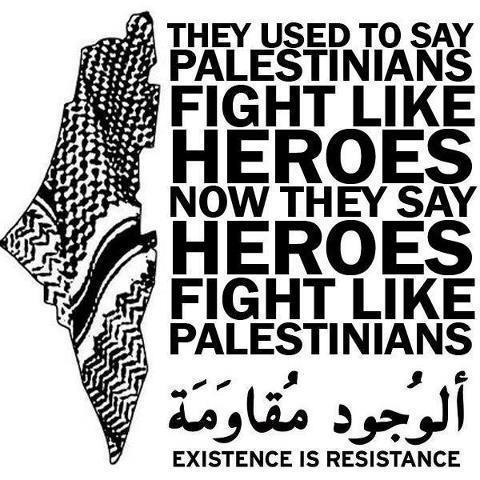
They used to say palestinians fight like heroes now they say heroes fight like palestinians existence is resistanceOn the same day, the Quartet identified incorrectly that continued Palestinian violence (i.e., resistance) and Palestinian attacks on civilians (i.e., settlers, but not Israeli attacks on Palestinians) are among the major threats to achieving the Quartet’s favored two-state arrangement. [5] To the contrary, the major threat to achieving the two-state scheme is immanent in the scheme itself; the proposal is, for reasons already stated, completely impractical and unachievable, having arrived stillborn in the world in 1947, and has shown no signs of life in all the decades since despite simulated efforts to breathe life into the corpse.

Complaints were also made by the Quartet that Palestinians who use violence to resist occupation and colonization of their country are depicted as heroes in the Palestinian media and on social media, that streets, squares and schools have been named after them, and that Palestinian leaders have not condemned them. In other words, Palestinians must not recognize efforts to liberate their country as legitimate and praiseworthy, nor bestow the mantle of hero on fighters for national liberation. Instead, Palestinian insurgents are to be demonized as terrorists.

The report correctly identifies the causes of Palestinian political violence. These include the building of new Jewish settlements, the expansion of existing ones, the construction of Jewish-only roads and the denial of building permits to Palestinians; in other words, colonization. But it does not label colonization as the cause of Palestinian violence. Instead, it presents Jewish colonization and the recalcitrance of the natives as two independent phenomena, the “bad” behavior of both parties. We’re to believe that if only both parties would stop behaving badly, the “solution” of two states could be brought to fruition.

The boldness of the Zionist land grab in the West Bank would be staggering, were it not for the fact that Israel’s audacity in expanding its territory is well established. Area C comprises 60 percent of the West Bank. It is intended to make up the bulk of land for a future Palestinian state under the two-state proposal, yet Israel has seized over 70 percent of the area and has designated it as solely for Jewish use. The remaining 30 percent is effectively off-limits to Palestinians, since it requires building permits which Israeli military authorities almost never grant. [6]

There are 570,000 Jewish settlers living in the West Bank and East Jerusalem, 370,000 in the former and 200,000 in the latter. Over 80,000 settlers live in isolated settlements deep inside the West Bank. The number of settlers in the West Bank and East Jerusalem has doubled since 1993, when the process of building a Palestinian state in a very small part of the Palestinians’ country was supposed to have begun in earnest. [7]

The Quartet report notes that Israeli settlement activity in the West Bank “raises legitimate questions about Israel’s long-term intentions,” and that these questions are buttressed “by the statements of some government ministers to the effect that the establishment of a Palestinian state will never be allowed.” It also refers to the current situation as “a one-state reality of perpetual occupation and conflict.” [8]

It’s difficult to deny that the Quartet is colluding in the Zionist project of Judaizing all of Palestine.

First, its demand that Palestinians abandon all resistance amounts to a call for Palestinian capitulation. The only force which has ever successfully opposed colonialism is the recalcitrance of the natives, and people have the right to resist the colonization of their country and to fight for its liberation. To deny them that right would be to accept colonialism as legitimate.

Second, while the Quartet identifies settlement activity as the cause of Palestinian violence, it doesn’t label it as a cause, and treats the cause (colonization) and effect (Palestinian resistance) as equal. Hence, Israel is called upon to stop settlement activity and the Palestinians are called upon to abandon resistance to it. But if settlement activity is wrong, and should cease, how can resistance to it also be wrong? Saeb Erekat, the PLO secretary general, quite rightly complained that the report tries to “equalize the responsibilities between a people under occupation and a foreign military occupier.” [9] We might also ask, if settlement activity is wrong, shouldn’t it not only be brought to an end, but reversed and undone? The Quartet didn’t call upon Israel to dismantle its settlements or end its military occupation. And the key members of the Quartet haven’t issued a UN Security Council resolution ordering Israel to undertake these actions, though, in principle, a resolution to this effect could be easily arranged were officials in Washington, London, Paris and Brussels so motivated.

Third, on the very same day Israel began meting out collective punishment to Palestinian residents of Al-Khalil for the crime of resistance, the New York Times reminded us who Israel’s principal arms supplier and military patron is. According to the newspaper, Washington has signalled that it is prepared to “substantially sweeten” a 10-year military aid package for Israel, already valued at $30 billion. The new deal would include a pledge to fund missile defense systems in Israel. This would further weaken the pressure Palestinians can bring to bear on Israel through rocket attacks, ensuring that Israel has even less incentive to discontinue its creeping Judaization of the West Bank and East Jerusalem and colonization of the rest of the Palestinian’s country. [10]

The White House wants the Israelis to use the aid to buy exclusively from US weapons providers, rather than spending some of it on Israeli arms manufacturers. Since 1980, “Israel has been permitted to spend about a quarter of the military aid it receives outside the United States.” It has used this provision to subsidize the development of a domestic arms industry, which is now one of the top 10 arms exporters in the world, competing with US arms makers. No other recipient of US military aid is permitted to make arms purchases outside the United States. [11]

US military aid is a mechanism for the upward redistribution of wealth from ordinary US citizens, who generate the bulk of tax revenue, to the high-level executives and shareholders of major US weapons manufacturers. Israel uses this transfer of wealth from Joe and Jane Average American to buy US arms to enforce and expand its colonization of the Palestinians’ country.

Washington, then, is completely complicit in the Jewish colonization of Palestine. Its complicity is evidenced in its expropriating part of the emoluments of US citizens to furnish Israel with the means of enforcing its oppression of the Palestinians, in its unquestioning diplomatic support of Tel Aviv, and in its refusal to use its economic, diplomatic and political leverage to facilitate Palestinian efforts to liberate their country from the Zionist yoke. Washington’s formal commitment to the two-state proposal is a ruse, a delaying tactic under the cover of which Israel can carry its modern-day colonization scheme through to its logical conclusion, namely, the total Judaization of the Palestinians’ country.

As for the two-state solution, well, it is not a solution at all. It is, to the contrary, the very problem it deceptively promises to resolve. The problem—the root cause of decades of violence in Palestine since the Balfour Declaration was promulgated in 1917, is the idea that an alien state can be implanted in the Palestinians’ country, whether as a single state encompassing Palestine in its entirety from the Mediterranean Sea to the Jordan River, or alongside a separate Palestinian state constituted on only a fraction of the Palestinians’ land. The two-state “solution”, then, is only a particular form of the problem, namely a settler state enveloping some part—and in all cases, two-state proposals have called for it to envelop the major part—of the Palestinians’ country. The solution to the problem is not two states, but a single, secular, democratic state, in which all citizens, Jews, Muslims, and Christians, are equal, and to which all Palestinian refugees are free to return.

1. John Glubb. Forward to George Hajjar, Leila Khaled: The Autobiography of a Revolutionary. Hodder and Stoughton, 1973.

2. Sayyed Hasan Nasrallah. Quoted in “We are required to stay firm,” Syria Times, July 2, 2016.

3. Diaa Hadis and Somini Sengupta, “Israel imposes restrictions on Palestinians in West Bank after attacks,” The New York Times, July 1, 2016.

4. Hadis and Sengupta.

5. “Diplomatic Quarter release report on advancing two-state solution to Israel-Palestine conflict,” UN News Centre, July 1, 2016.

6. Barak Ravid, “Quartet releases report on impasse in Israeli-Palestinian peace: ‘Two-state solution in danger,” Haaretz, July 1, 2016.

7. Ravid.

8. Hadis and Sengupta.

9. Hadis and Sengupta.

10. Julie Hirschfeld Davis, “U.S. offers to increase military aid to Israel,” The New York Times, July 1, 2016.

11. Hirschfeld Davis.