

Subscribe to continue reading
Subscribe to get access to the rest of this post and other subscriber-only content.
Subscribe to get access to the rest of this post and other subscriber-only content.
My talk on Israel’s relationship with Washington, given at the Institute for the Critical Study of Society’s Sunday Morning at the Marxist Library, May 30, 2021.
Israel’s relationship with Washington
60 minute talk followed by 60 minutes of questions and discussion.

Subscribe to get access to the rest of this post and other subscriber-only content.
Conversations with Greg Godels and Pat Cummings.
11-“Israel, A Beachhead in the Middle East” with guest Stephen Gowans – YouTube
I talk with Greg and Pat on their podcast Coming From Left Field about Israel, a US beachhead in the Middle East.
Pat Cummings grew up with middle-class privilege in a close and happy Irish-American military family. He came of age in the Vietnam era, beginning his activism in the antiwar movement. He spent his life in public education, where he saw first-hand the systemic inequalities that elevated some but suppressed many.
Greg Godels grew up in a working-class family and in a working-class neighborhood. His family’s strong labor ties lead him to anti-racist and anti-capitalist activism and to Marxism-Leninism. He identifies with the legacy of Communism in the US. His writings have appeared in a number of publications in the US and internationally.
Subscribe to get access to the rest of this post and other subscriber-only content.
Subscribe to get access to the rest of this post and other subscriber-only content.
By Stephen Gowans
April 3, 2021
On the eve of the First World War, and for a good many years thereafter, the bulk of humanity was in the thrall of a handful of great powers: Britain, France, Russia, and the rising powers of the United States, Japan, and Germany. These self-declared chosen nations and soi-disant models for humanity, enjoyed unexampled prosperity as the product of their ruthless despoliation of nine-tenths of humanity, made possible by their military and industrial supremacy.
In East Asia, the French raped Indochina; the British plundered Borneo, Malaya, Siam, and Hong Kong; Japan held Taiwan, Korea, and Manchuria in colonial subjection; the United States colonized the Philippines and Guam; the Netherlands looted Indonesia; the Portuguese enslaved Macau and East Timor; and China, as Sun Yat-sen remarked, was exploited by everyone.
The First World War—the Weltkrieg, or World War, as the Germans called it—marked the beginning of the end of the Columbian period, that era marked by the plunder of the world by Europe and its offshoots beginning with the voyages of Columbus to the Americas at the end of the fifteenth century and continuing through today. The 500-year-plus domination of Asia, Africa, and Latin America by the West has been aptly called “The 500 Year Reich,” an allusion to the identity of the practices used by the Nazis with those of their predecessors and contemporaries, not only by Germany, but also by the other ‘model nations’ as well. These practices comprised the methodology of colonialism. Deployed by Spain, Portugal, Britain, France, the United States, Italy, and Japan outside Europe, they became the paradigm for the Nazis, whose great crime in the eyes of their rivals was that, as Sven Lindqvist put it, they did in the heart of Europe what had theretofore only been done in the hearts of Africa, Asia, and the Americas. Racism, genocide, dispossession, and colonial subjugation outside of the metropole were acceptable in the capitals of Western Europe and North America, deemed necessary and inevitable, even extolled, but became great iniquities only when the Nazis inflicted them upon Europe.
Today, nearly half of the world’s wealth is controlled by the 10 percent the population that makes up the G7 countries, while the other half is shared by the remaining nine-tenths. The chasm dividing the East from the West has considerably narrowed with the Communist Party-orchestrated rise of China, a phenomenon ultimately traceable to what Domenico Losurdo argued was the signal event of the Weltkrieg.

The World War of 1914-1918 was many things, but among these it was “a war between two groups of the imperialist bourgeoisie for the division of the world, for the division of the booty, and for the plunder and strangulation of small and weak nations,” as Lenin put it. Lenin called for unity among the workers of the “model” nations, to emancipate, not only their labor from its exploitation by the bourgeoisie, but also to liberate their bodies from the war of industrial extermination the bourgeoisie had visited upon them. At the same time, the Bolshevik leader called for unity between the workers of the West and the oppressed peoples of India, China, Korea, Indochina, and elsewhere, against their common oppressor, the metropolitan bourgeoisie. Broadening the compass of Marxism, the Bolsheviks extended Marx’s and Engel’s 1848 battle cry “Workers of the world unite!” to “Workers of the world and oppressed peoples, unite!”
This widening orientation, along with the Bolsheviks’ success in using the state and patriotism to mobilize the Russian population against the intervention of the “model nations” in Russia’s Civil War of 1919–21, inspired revolutionary nationalists like Mao Zedong, Ho Chi Minh, and Kim Il Sung, inaugurating a movement to end the 500-year Reich.
The World War, and the Bolshevik Revolution that sprang from its womb, had generally positive effects in the East. The toll of the war weakened the grip of the exploiting nations upon the peoples they exploited, while the Bolshevik example precipitated the anti-colonial revolution in the East. An Eastern Marxism developed, responsive to the needs of colonial peoples to overcome their dependency and achieve political and economic sovereignty. Revolutionary nationalists would make good use of patriotism, the state, and industry to achieve political sovereignty and economic independence, as well as to protect dearly bought gains from the unceasing efforts of the imperialist Leviathans to reverse them.
By contrast, the Weltkrieg was a catastrophe in the West, and Western Marxism developed to reflect the experience of the war in Europe. Whereas the revolutionary nationalists of the East harnessed patriotism to the project of national liberation, Marxists in the West eschewed national devotion as a bourgeois subterfuge used to divide the proletariat along national lines. In the East, Marxists saw violence as a means of liberation and the military as an instrument for defending national revolutionary gains. In the West, the horrors of the war envenomed Marxists to violence and the military. Marxists of the Orient viewed the state as the means to organize economic development and as an instrument of repression to be ruthlessly deployed in the defense of revolutionary nationalist gains. Marxists of the Occident viewed the state with suspicion, an engine of class oppression, that had been used against them.
Each form of Marxism represented a set of proposed solutions to the problems of emancipation present at a specific time and place. In the East, the germane question concerned how people under colonial and semi-colonial domination could achieve political and economic sovereignty and safeguard their achievements once gained. In the West, the relevant question revolved around how to win political power to liberate industry from the control of shareholders and financiers and vest it in the hands of the proletariat.
Whether intentional or not, A.B. Abrams’ Immovable Object: North Korea’s 70 Years at War with American Power, examines the relationship between North Korea and the West from an Eastern Marxist perspective. Without using the idiom, Abrams presents the DPRK as a quintessential Eastern Marxist state. Korean patriotism, strong central authority, military preparedness, self-reliance, and the development of nuclear weapons and ballistic missiles are identified as sources of North Korea’s resilience in the face of Washington’s 73-year project to bring about “the end of North Korea”, as John Bolton once described Washington’s policy aim. These practices are presented as the bases for the DPRK’s success in achieving the revolutionary nationalist goals that lie at the center of the Eastern Marxist project.
Abrams’ history of the DPRK-US relationship begins with the arrival of US forces in Korea in 1945, after Koreans had declared a Korean People’s Republic, with which the US military government immediately went to war. Abrams devotes considerable attention to the Korean War, known as the Great Fatherland Liberation War in North Korea (memorializing the success of the combined Korean and Chinese forces in evicting the US invaders from territory administered by the DPRK), and the War to Resist America and Aid Korea, in China. Nearly half of the tome, weighing in at 675 pages, covers events since 1990, and a substantial part deals with recent events.
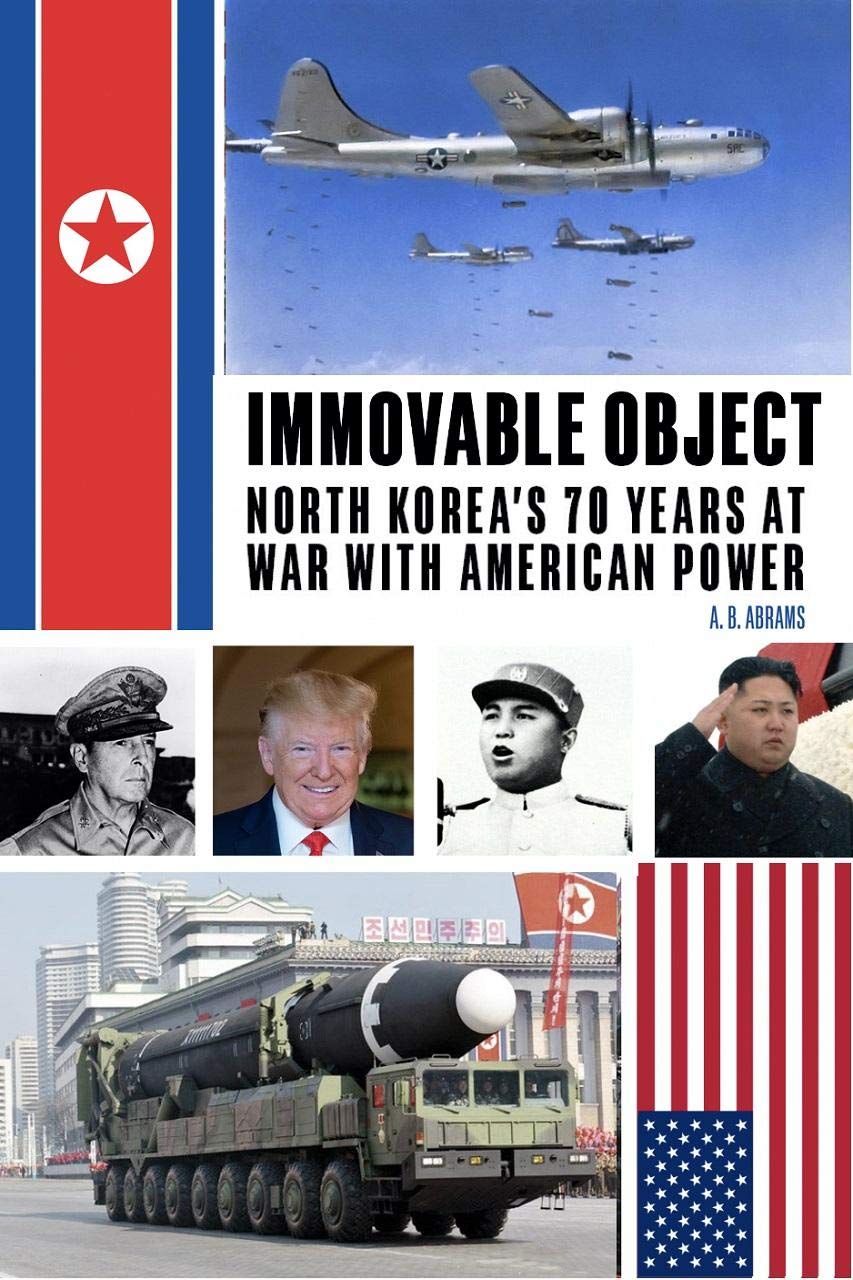
Abrams’ history is not archival; he uncovers no new facts. Instead, it is perspectival, offering a fresh take on what the archives have already revealed—or, what seems like a fresh take to those, like myself, who are familiar with an historiography that is congenial to the Western Marxist perspective. To illustrate, Abrams makes an observation and poses a question that, at best, are quickly passed over in Western accounts, if broached at all, but within the framework of Eastern Marxism, are critical. The observation is this: Of small countries that have liberated themselves from the iron-grip of colonialism, only North Korea, a country of a mere 24 million, has survived the aggressions of US imperialism, stood unbowed before relentless military pressure, withstood the burdens of sanctions, and developed its military strength to a high degree sufficient to take a US war on the East Asian state off the table. To be sure, in the realm of post-colonial resistance to US imperialism, Cuban resilience also stands out, but unlike the DPRK, Havana cannot stay the hand of US military aggression with a retaliatory strike capability.
Indeed, there is a lengthy list of states that have succumbed to US efforts to reverse the tide of national liberation. Egypt betrayed the Arab nationalist cause; the Soviet Union surrendered; Ba’athist Iraq was outmaneuvered; Gaddafi fell prey to the West’s blandishments and left his country defenseless; Ba’athist Syria has been partitioned among the United States, the Turks, the Israelis, Al Qaeda, and Kurd separatists; Iran’s economy is squeezed by a US blockade; and Venezuela is bedeviled by the twin demons of low oil prices and US sanctions. “Yugoslavia, Haiti, Cuba, Iran, Iraq, Sudan, Libya, Syria and others were all much softer targets,” writes Abrams.
“The KPA [Korean People’s Army] boasted the most sophisticated defense industry, densest air defense network, best trained soldiers, hardest fortifications, and largest submarine force and special forces of these states. Of America’s potential targets, Korean air, artillery, tank and ballistic missile forces were second only to those of China.”
North Korea’s borders are secure; it has a manufacturing economy that produces many of its own goods; it makes its own tanks, artillery, and submarines (including those capable of launching ballistic missiles), manufacturers MiG-29s domestically under license, and produces some of the world’s most advanced missiles. Pyongyang exports military gear to Cuba, Syria, Iran, and Hezbollah, and has provided special forces training to its allies. Its pilots flew missions on behalf of Arab nationalist forces in the 1967 Six Day War, the 1973 October War, and against US forces in the Vietnam War. Far from being a failed state and the impoverished, bizarre, laughing-stock of US propaganda, North Korea, in point of fact, is the most accomplished of the small post-colonial states. This gives rise to the central question that lies at the heart of Abrams’ book. How has Pyongyang managed to pull off this extraordinary feat?
“The successes of North Korea’s defense sector in developing high end missile technologies, and having done so in such a short time, with a very limited budget, totally contradicted predominant Western perceptions of the state as corrupt, inept, and backward. …[How] could the failed ‘Kim Regime’ have developed such technologies?”
In 1950, the DPRK fielded an army of soldiers equipped with rifles against a nuclear-armed military whose brutality knew few limits. In a footnote, Abrams observes: “It is estimated that the number of civilians killed by the IDF [Israeli military] in more than 70 years of frequent wars [is] less than the US-led coalition killed in an average week of war in Korea.”
Since the US war of mass extermination against the DPRK—at a minimum, 20 percent of the country’s population was killed by US and allied marauders from 1950 to 1953—the United States has continued to do everything in its power to enfeeble North Korea. It has deployed battlefield nuclear weapons to the peninsula; threatened the DPRK repeatedly with nuclear annihilation; and imposed the world’s longest lasting, and by now, most comprehensive, sanctions regime. Despite facing Himalayan obstacles, North Korea has advanced both economically and militarily. Its economy is stronger than ever, and it has replaced rifles with nuclear-tipped ICBMs as its principal means of self-defense. This represents a radical break from the Columbian era, when Europe and its offshoots felt free to wage war on the peoples it sought to conquer, knowing their victims were incapable of retaliating. No more will the DPRK face a nuclear-armed United States with rifles alone.
In Abrams’ view, the DPRK’s successful test launch in 2017 of an ICBM capable of striking the US mainland…
“represented the first time a medium or small state was able to effectively deter a superpower at such a peer level without need for support from a nuclear umbrella of a superpower sponsor of its own. In this respect North Korea’s achievement in 2017 was historically unprecedented, and was referred to by Vice Chairman of the Joint Chiefs of Staff and former Commander of the US Strategic Command John Kyten as having ‘changed the entire structure of the world.’”
This radical change, construed as ominous by Kyten, is assessed as a welcome development by Abrams—one which heralds peace and stability in East Asia.
“Considering the rationales widely expressed for American military action against the DPRK [and] the apparent willingness [of the United States] to bring death and destruction to supposedly allied Northeastern Asian states [in pursuit of the US foreign policy goal of bringing about the debellation of the DPRK] there is a strong argument that North Korea’s development of a viable nuclear deterrent with an intercontinental range is strongly in the interests not just of its own population—but of peace and stability in the entire region. Had the US and its Western allies been free to initiate a war, South Korea and Japan would have been devastated alongside North Korea and very likely parts of China and Russia, as well. By constraining America’s ability to start a war in East Asia through introduction of mutual vulnerability, North Korea’s deterrence program has ensured that extra-regional actors cannot initiate a regional war by ensuring that they too could be targeted should hostilities break out.”
What accounts for North Korea’s success? Abrams traces the DPRK’s achievements to:
“The Korean nationalist state’s rooting in both Korean history and culture, its ‘culture of resistance’ built on the potent historical memory of subjugation, and its firm commitment to the centrally organized party system…These often overlooked factors do much to explain its unique ability to sustain a conflict under immense pressure for so long.”
Immovable Object argues that Washington’s hostility to North Korea originates, not in the East Asian state’s proliferation activities, alleged human rights abuses, or mislabelled ‘provocations’ (North Korea doesn’t initiate provocations, but it does respond to them), but in Pyongyang’s embodiment of the fundamental values of the UN Charter—values which contradict Washington’s arrogation of world “leadership” (read dictatorship).
“North Korea’s existence is considered unacceptable [to Washington] because it refuses to submit to the imposition of Western leadership and become part of the Western-led order. For Pyongyang, the Western position is considered unacceptable because it is contrary to states’ right to self-defense as contravening international law and the UN Charter. The Western Bloc are so often referred to as ‘the imperialists’ in Korean rhetoric because they seek to impose their values, their ideologies, their economic and political systems and above all their soldiers and governance—whether direct or indirect—on the Korean people.”
In Abrams’ view, the mutual hostility of the United States and DPRK springs from a conflict between their antithetical Weltanschauungs. This isn’t…
“…a clash of capitalist and socialist ideologies, but rather of nations’ perceptions of the nature of international relations, world order and states’ rights to self-determination. The DPRK, like other East Asian states which won their independence in the aftermath of the Second World War, expressed a strong belief in global and regional orders comprised of nation states equal in their rights to their sovereignty, including self-defense and self-determination and prohibiting forced external interference into their domestic affairs. This is the same order enshrined in the United Nations Charter.”
While I agree to a point, I would argue that Washington is not opposed to Pyongyang’s embodying the UN Charter simply because it doesn’t like the UN Charter, but that it dislikes the UN Charter for legitimizing the right of countries to pursue their own economic development outside of a system that privileges Wall Street’s interests. This view is summarized in the words of Norman Bethune, a Canadian whose life anticipated that of Che Guevara: physician, communist, internationalist, martyr. Bethune died while serving with the Eight Route Army in China. He wrote: “Money, like an insatiable Moloch, demands its interest, its return, and will stop at nothing, not even the murder of millions, to satisfy its greed. Behind the army stands the militarists. Behind the militarists stands finance capital.” To which can be added: Behind finance capital stands a contempt for the UN Charter and any country that, exercising its Charter-defined right to independent economic development, denies the insatiable Wall Street Moloch its interest.
Abrams’ compares South Korea’s Westernized society, with its strong US cultural influences, to North Korea’s non-Westernized society, with its strong indigenous influences.
“[South] Korean society [values] US education ties more than any others—with the majority of professors at leading universities holding degrees from the US … Similar trends can be observed among the country’s political elite. From 1948-1968 much of the [South] Korean leadership boasted higher education in Japan, which, as the previous imperial power occupying Korea, had heavily influenced the Korean elite through education. This Japanese influence would gradually recede to be replaced by an American one, and from 1968 to 2001 71% of ministers in the ROK held degrees from the United States. This fosters not only positive views towards and close ties with the new hegemon, as it was intended to do towards Japan beforehand, but also ensures American thought will continue to have a major influence over scholarship and political discourse in the country.”
The contrast with North Korea is sharp.
“North Korea lacks the colonial-era foundations for Western soft influence and an idealization of the West common to many countries formerly under American or European rule. North Koreans were never second class citizens in their own country, which combined with a lack of Western soft influence and strongly nationalist ‘Korea-first’ identity, perpetuated through media and education, means its population are not moved to remake themselves in the image of or to idolize the West—esthetically or otherwise. The extent of Western influence in South Korea and other Asian client states, and the depths to which it has permeated, shows the alternative fate for the Korean population to that of resistance under the DPRK—namely life under a system which attributes the greatest value not to one’s own nation, culture and thought, but instead under one which is heavily influenced by and idolizes the Western hegemon.”
One important aspect of Abrams’ book is its delineation of North Korea’s foreign relations and the vital support it provides to other small- and medium-sized states that are on a congeneric path of development independent of US domination and control. This is a neglected area. In Western propaganda, North Korea is portrayed as a ‘hermit kingdom’, hermetically sealed and separated by choice from the family of nations. While it is undoubtedly a US aim to isolate North Korea, and block its commerce with other countries, the aim is not reality. Readers might be surprised to discover that the DPRK has long been engaged in aiding the struggles of other peoples to free themselves from the 500-year Reich. I will highlight two: Syria and Hezbollah, though Abrams also covers DPRK engagements with Vietnam, Iran, Libya, and southern Africa.
“Of all America’s adversaries,” notes Abrams, “it is the Syrian Arab Republic which has relied most heavily on North Korean support in the face of Western and allied military and economic pressure.” From 1980 to 2010 the KPA “bolstered Syria’s defenses with a permanent stationing of forces including pilots, tank operators, missile technicians, and officers who trained much of the country’s military.” North Korean engineers “developed a specialized class of missile specifically for Syria’s defense needs, known as the Scud-ER,” and the East Asian state furnished Damascus with nuclear technologies to construct a reactor based on the DPRK’s Yongbyon plutonium reactor. The Syrian reactor was destroyed by Israel in 2007.
“Without continued Korean assistance Syria’s deterrent capabilities likely would have eroded into obsolescence in the post-Soviet era,” writes Abrams, “leaving the state highly vulnerable. Korean actions thus served to severely constrain Western and allied freedom of military action against a leading regional adversary.”
The resurgence of the Islamist war on the secular Arab nationalist state in 2011 led to stepped up North Korean aid.
“Notably, in 2015, the Korean People’s Army reportedly set up a command and control logistic assistance center to support the Syrian war effort, with Korean officers deployed to multiple fronts, including the frontlines of engagement against jihadist forces in Aleppo. A number of Western sources have meanwhile claimed regarding the KPA role on a second front in 2013: ‘Arab-speaking North Korean military advisors were integral to the operational planning of the surprise attack and artillery campaign during the battle for Qusair. According [to one report] KPA pilots were operating Syrian aircraft against jihadist forces. Considering the significant shortages of trained pilots Syria has endured since the mid-1990s, this report has some plausibility. Other reports … indicate that North Korea dispatched two special forces units … to Syria to engage jihadist forces, and that these units proved ‘fatally’ dangerous on the battlefield.”
Notably, Syria established a park in 2015 to honor the founder of the North Korean state, Kim Il Sung. The park is adjacent to a street in Damascus named after the Korean leader.
The DPRK’s military aid to Hezbollah has also been extensive. Abrams notes that “much of Hezbollah’s central leadership, including current Secretary General Hassan Nasrallah, Security and Intelligence chief Ibrahim Akil and head of counter-espionage operations Mustapha Badreddine, were trained” in North Korea.
Hezbollah’s military wing is “effectively a smaller reproduction of the Korean People’s Army.”
“Some indications of the extent of defense cooperation between the two parties were highlighted in the aftermath of the 2006 Israeli-Hezbollah War—a conflict in which the militia’s means of waging war indicated strong Korean influence. Israeli experts described Hezbollah’s war effort as ‘a defensive guerilla force organized along North Korean lines,’ concluding ‘all the underground facilities [Hezbollah’s], including arms dumps, food stocks, dispensaries for the wounded, were put in place primarily in 2003-2004 under the supervision of North Korean instructors.’ Other intelligence sources indicated that the Korean People’s Army had a military presence on the ground, concluding that Hezbollah was ‘believed to be benefiting from assistance provided by North Korean advisors.’ A further decisive factor was Hezbollah’s high degree of discipline and effective command and control…These factors were reportedly strongly focused on by the KPA when training Hezbollah’s special forces and officer corps.”
Abrams’ attributes Hezbollah’s success in defeating the Israeli military in 2006—the first time Israel had been vanquished in war—to the assistance it received from Pyongyang.
“Had Hezbollah lacked the tunnel networks, intelligence network, high level training, or missile assets provided by the DPRK, it is highly likely that it would have faced a swift and outright defeat in the summer of 2006 as the Israeli government had initially predicted. The tunnel and bunker network in particular, alongside the communications network and fortified armouries, were all reportedly built by Korean Mining Development Trading Corporation.”
Abrams’ chapter on North Korean ideology is particularly valuable for Westerners, for whom North Korean thinking may seem to be opaque, and may to Marxists appear to be un-Marxist. The renowned Korean scholar Bruce Cumings was once asked: “How many liberal democrats are there in North Korea?” He replied: “As many as there are followers of Confucius in the United States.” Many Westerners fail to understand the DPRK because they view it from the lens of Western culture and fail to grasp the unique set of circumstances that created the Korean experience.
Abrams’ writes:
“From its formation North Korea’s ideology has been influenced by and has assimilated parts of the country’s traditional culture, Confucianism in particular, in a way that few if any other ideologies have in communist states. Premier Kim Il Sung’s reformism Juche speech in December 28, 1955, which outlined the country’s future ideological position … notably stressed the need to draw inspiration from national culture, history and traditions... While no mention was made of Marx, Engels, Lenin, Mao or even Stalin, the Korean leader warned against the ‘negation of Korean’ history with ‘foreign ideas,’ emphasizing above all else the importance of a Korean national identity. While the Stalinist economic model, which had rapidly industrialized the Soviet Union, would be largely adopted, this would be interpreted and applied in a way that was compatible with Korea’s own culture. As the Korean leader envisioned, the ‘essence’ and ‘principles’ of communist ideology would be ‘creatively applied’ in line with the needs of the Korean nation—the former would bend to the latter rather than vice-versa. He thus strongly criticized ‘dogmatism and formalism’ in ideological work and advised: ‘There can be no set principle that we must follow the Soviet fashion. Some advocate the Soviet way and others the Chinese but is it not high time to work out our own?’”
The coincidence of North Korea’s ‘Stalinist’ economic model with the ability of the country’s economy to weather the fierce storms of US hostility, raises two questions: Can the same model be exported to other countries to produce the same success? What could North Korea achieve without the unceasing efforts of the United States to bring about its destruction? While Abrams doesn’t address these questions, elsewhere he has written:
"If the country were free to trade and export its goods, capitalizing on advantages including a weak currency and a highly educated and skilled workforce and established technological and industrial bases, annual growth rates several times higher and likely significantly over 10% would be expected.”
Syria’s ambassador to North Korea in 2017, Tammam Sulaiman, intoned, “I visited many other countries. I look at this country I see that … they do miracles here, really. This country, after the sanctions and with the skills that they have, they are making miracles.” Pausing he asked, “What if they were not under sanctions? They would do even more.”
According to one view, communism is the politics of liberation. Indeed, communists have always been involved in, if not in the van of, the world’s greatest emancipatory struggles. “The socialist revolution is by no means a single battle,” Lenin wrote in his essay “The Revolutionary Proletariat and the Right of Nations to Self-Determination.” Instead, it is “a whole series of battles around all problems of economic and democratic reforms” including “equal rights for women” and—importantly from the perspective of people trying to free themselves from colonial subjugation— “self-determination.” Socialism “would remain an idle phrase,” Lenin insisted, “if it were not linked up with a revolutionary approach to all the questions of democracy, including the national question,” by which he meant the right of peoples, including Koreans, to exercise sovereignty over their own affairs, rather than being dominated by imperialist masters. Lenin envisaged what he termed “a truly democratic, truly internationalist” order, in which each nation is free to set its own course, and freely join with other states in relationships of mutual benefit. That, significantly, is the vision of the DPRK.
If Eastern Marxism is the use of patriotism, the military, and state-directed economic development to achieve and defend emancipatory goals, then the DPRK is, in practice, a quintessentially Eastern Marxist state. It is, moreover, a successful one, whose emulation by similar states in similar circumstances inspired by similar goals could significantly advance the world’s struggle to achieve a complete victory over the 500-year-plus Reich.
Immovable Object is published by Clarity Press.
Stephen Gowans is the author of Patriots, Traitors, and Empires: The Story of Korea’s Struggle for Freedom, and Washington’s Long War on Syria, both published by Baraka Books.
Subscribe to get access to the rest of this post and other subscriber-only content.
By Stephen Gowans
February 23, 2021
Sadly, a country that has played a significant role in what David E. Stannard called the American Holocaust, the massive depopulation of aboriginal people from the Americas, has blithely debased genocide by ignoring it where it occurs and condemning where it hasn’t.
In a vote of 266 for, and 0 against, the Canadian House of Commons declared on Monday that Chinese authorities committed atrocities in Xinjiang that contravene the United Nations’ Genocide Convention.
Canada’s parliamentarians made this declaration on the basis of dubious evidence, sourced to an ideologically-inspired researcher who opposes communism and openly seeks the demise of the Chinese Communist Party.
The allegation is politically contrived, not legally defensible.
On the eve of the vote, the magazine Foreign Policy reported that “The U.S. State Department’s Office of the Legal Advisor” had concluded that “there was insufficient evidence to prove genocide.”
Even John Ibbitson, a right-wing columnist with the Globe and Mail, a Canadian newspaper which has led the charge against China, conceded that the case that Beijing has breached the United Nations genocide convention had not been made. (That didn’t stop him, however, from insisting that China had committed genocide notwithstanding.)
The genocide allegation, the fantasy of German anthropologist Adrian Zenz, which was aped by Canada’s parliament, is “ridiculous to the point of being insulting to those who lost relatives in the Holocaust”, intoned Lyle Goldstein, a China specialist and Research Professor in the Strategic and Operational Research Department of the Naval War College, quoted by The Grayzone.
The Grayzone’s Gareth Porter and Max Blumenthal showed that the genocide charge—first made by former US secretary of state Mike Pompeo in the dying days of the Trump administration—rests on dubious analyses carried about by Zenz.
Zenz has argued that the evidence for a Beijing-orchestrated genocide lies in the decline in the birth rate of Xinjiang’s Uyghur population. While it is true that rate at which the Uyghur population is growing has slowed, slower growth does not mean no growth, or contraction. Indeed, the Uyghur population continues to grow. Growth has slowed because Beijing is enforcing measures to limit population growth in the form of a two child per couple limit (three in rural areas) which apply equally to Uyghurs, and the Han Chinese ethnic majority, alike. Previously, the policy was not rigidly enforced in Xinjiang. Today it is, with the consequence that the Uyghur population is growing, but not as rapidly as it once was. Zenz has seized on the change in birth rate as evidence of genocide. While the UN Convention would define the prevention of births with the intention of destroying the Uyghurs as genocide, Uyghurs aren’t prevented from having children. On the contrary, with a limit of two children per couple and three in rural areas–the same limit that applies to the Han majority–Uyghurs are hardly being subjected to a discriminatory policy of birth control or a demographic genocide.
The German researcher is a senior fellow with the US-government-founded Victims of Communism Memorial Foundation, which works toward the destruction of the Chinese Communist Party.
As for Pompeo—who did much to publicize Zenz’s nonsense–he once boasted that under his leadership the CIA “lied, cheated, and stole.”
It is no secret that the United States, and its ductile and craven subordinate Canada, regard China as an economic and ideological rival. Ever since the People’s Republic of China began to challenge US economic and technological primacy, departing from its Wall Street-desired role as low-wage manufactury for US corporations and market for advanced Western goods and services, the United States has pursued a campaign of information warfare to discredit Beijing and blacken China’s reputation.
Joe Biden endorsed this approach nearly a year ago in an article he wrote for Foreign Affairs.
“The most effective way to meet” the “challenge” of China getting “a leg up on dominating the technologies and industries of the future,” the future president wrote, is “to build a united front of US allies and partners to confront China’s abusive behaviors and human rights violations.”
If Biden had said that Chinese human rights violations in their own right merited a campaign to confront Beijing, the sincerity of his entreaty might, for a brief moment, have appeared to possess a jot of credibility. But Washington has shown itself to have an endless tolerance for human rights abuses, as long as they serve US corporate and strategic interests. And he didn’t say that China ought to be confronted over actual human rights abuses; he said that confronting China over human rights (presumably real or imagined) is an effective way to deal with China as an economic rival.
China’s economic rivalry is matched by its systemic rivalry. Where the Chinese government has overcome the Covid-19 pandemic, set its economy once again on a growth trajectory, and lifted hundreds of millions out of poverty (a project that continues unabated), governments in North America have proved themselves incapable of meeting the health, human welfare, and economic challenges of Covid-19. While Chinese citizens look to the future with optimism, their living standards ever improving, North Americans look to the future with pessimism, plagued by governments that fail to deliver, growing inequality, declining economic opportunity for all but the wealthiest, and incomes that, at best, stagnate.
As the former US diplomat Chas Freeman recently pointed out,
This year, China will celebrate the 100th anniversary of its ruling Communist Party. Chinese associate the Party with the astonishingly rapid transformation of their country from a poor and beleaguered nation to a relatively well off and strong one. Most Chinese … are optimistic that the enormous progress they have experienced in their lifetimes will continue. China’s decisive handling of the pandemic has bolstered its citizens faith in its system. Morale is high. China is focused on the future.
By contrast,
….the United States entered this year in an unprecedented state of domestic disarray and demoralization. A plurality of Americans disputes the legitimacy of the newly installed Biden administration. Despite a booming stock market supported by cheap money and chronic deficit spending, we are in an economic depression.
If a government fails to delivers for its citizens while its rival succeeds, what better way to divert attention from its failure and recover its credibility than to create a dark legend to vilify its successful rival and a golden legend to celebrate itself? Certain players in the United States and Canada—Biden, Pompeo, the Canadian parliament, and the mass news media—have chosen to follow this course, and are doing so by carelessly echoing accusations of genocide made by an anti-Communist fanatic with an ideological ax to grind. The practice debases the very concept of genocide. Sadly, it is hardly new.
From my window, I can see Canada’s National Holocaust Monument. A short distance away is the site of the as-yet-completed Memorial to the Victims of Communism. Canada commemorates the genocide of the Jews (carried out in another land by another people) but does not commemorate the Canadian Holocaust, carried out on its own territory by its own people. At the same time, it commemorates the Nazis, fascists, and their supporters, who perpetrated the Holocaust Canadians profess to abhor. The ‘victims’ the memorial honors, were, after all, the very same people the communists jailed and executed.
Canada has no monument to the Canadian Holocaust. While it is prepared to ensure “the lessons of the [Nazi] Holocaust … remain within the national consciousness for generations to come,” it makes no such commitment to ensuring the lessons of the Canadian holocaust remain in the national consciousness, much less enter it.
As for The Holocaust, with a capital H, the Canadian government defines that genocide as “the mass extermination of over six million Jews and countless other victims.”
Who are these countless other victims?
The United States Holocaust Memorial Museum, which defines the Holocaust as ‘the systematic, bureaucratic, state-sponsored persecution and murder of six million Jewish men, women, and children by the Nazi regime and its collaborators,” has the answer. Helpfully, the Museum enumerates its victims. Unhelpfully, it lists the victims in a way that obfuscates who the primary victims were.
The Museum claims there were nearly 12.5 million non-Jewish Slavs (comprising Soviet civilians, Soviet prisoners of war, and Poles) who were victims of the Holocaust and Nazi persecution, as against the usually cited six million Jews. The Museum breaks out the Slav groups separately, so that individually, neither group preponderates Jewish victims, and in listing the victims this way, the reality that the principal victim category was Slavs, not Jews, is obscured. Richard C. Lukas made a brave attempt to correct this oversight in his 1986 book Forgotten Holocaust.
The conclusion, then, is that while both Canada and the United States commemorate the genocide of the Jews, they have anonymized the more numerous Slav victims, and have largely made them invisible—consonant with the refusal of both countries to commemorate the much larger holocaust against American Indians perpetrated on their own territories.
The elevation of Jews to the status as principal–and in the pedestrian understanding, the sole—victims of the Nazi genocide, did not happen by accident. It is the outcome of a political agenda—one of legitimizing the Zionist settler colonial project in Palestine; sheltering it from criticism; and allowing Zionists to conceal the true motivations for their settler colonialism and aggression on behalf of US foreign policy behind a pretext of Holocaust-prevention. The entire project of Zionism in West Asia, sponsored and bankrolled by the US state, is to promote US corporate, and particularly energy, interests, contra indigenous movements for national independence and sovereignty, rationalizing every action taken on behalf of this project as necessary to prevent another Holocaust.
Likewise, the fabrication of a black legend about a Chinese holocaust in Xinjiang has a political purpose: to discredit an economic and systemic rival.
The holocaust against the Slavs; the Germans’ earlier holocaust against the Nama and Herero people of southwestern Africa; and countless other holocausts perpetrated by colonial powers against defenseless peoples, are marginalized and never memorialized for the simple reason that they were modelled, sometimes explicitly, on the American and Canadian Holocausts. Genocide, as Mahmood Mamdani has pointed out, is an act of nation building, and European settlers in North America provided the template.
Nazi Germany deliberately sought to exterminate the Slavs of Eastern Europe, a territory its leaders saw as equivalent to the North American West. Just as Europeans committed a genocide against the American Indians and stole their land, Germans, following the American model, would exterminate the Slavs and steal their land. It was on this very same territory that the majority of the world’s Jews lived, and were victimized—along with their non-Jewish Slav neighbors—by Germans inspired by the US and Canadian conquest of the North American West.
David Olusoga and Casper W. Erichsen recounted in their 2010 book, The Kaiser’s Holocaust, that “Hitler told his entourage that the peoples of the East were to suffer the same fate as the ‘Red Indians.’ They were to be exterminated and then simply forgotten. ‘We also eat Canadian wheat’, [Hitler] reminded his audience, ‘and don’t think about the Indians.’”
Beijing has had to contend with jihadist violence in Xinjiang, just as other governments have found it necessary to deal with violent jihadism on their own or other territories. The approach of the United States and Canada to violence inspired by political Islam has been war, military occupation, assassinations, torture, arbitrary detention, massive electronic surveillance of their own populations, and Islamophobia.
Beijing, by contrast, has followed an approach based on job training, economic development, and deradicalization. Part of the reason US and Canadian governments have called for boycotts against goods produced in Xinjiang is to stymy Beijing’s efforts to mitigate the problem of violent Jihadism through economic development.
That China is relying on uplift and deradicalization to conciliate its jihadists, rather than aping the US approach of assassination, torture, and secret prisons, explains why “the Organization of Islamic Cooperation — a group of 57 nations that has been a vocal defender of the Rohingyas and Palestinians” has “praised China for ‘providing care to its Muslim citizens.’” Similarly, in July, 2019, “a host of Muslim-majority nations, including Saudi Arabia, Iran, Egypt, Syria and the United Arab Emirates”, signed “a letter to the United Nations Human Rights Council praising China’s governance of Xinjiang.”
If the US response has been decidedly violent, the response of governments with significant Muslim populations has been similar to that of China. Egypt and the Gulf states detain jihadists and Islamist radicals and enrol them in ‘deradicalization’ programs. It is the similarity in approach to China, according to The Wall Street Journal, that accounts for why Muslim-majority countries have not censured China for its response to Islamist violence. On the contrary, they have praised Beijing for its treatment of China’s Muslim population.
The careless hurling of genocide charges, in the context of a commercial rivalry between a US-led West and China, stamps the practitioners of this regrettable act as chauvinists, prepared to stoop to any depth to give “their” bourgeoisie a leg up in a competition with an international rival. That the so-called progressive wing of Canada’s parliament, the New Democratic Party and Green Party, voted en masse for the anti-Chinese motion, is a stain on their record, but only one of many, and hardly surprising. Progressives have made a habit, dating back to World War One, of backing “their” bourgeoisie, even to the point of siding with their own ruling class in the industrial slaughter of their class cohorts. The infamy continues.
Rather than taking up the jingo’s cry against an emerging China by endorsing a politically-inspired confection concocted by Adrian Zenz, an anti-Communist fanatic who believes a supreme being has inspired him with a mission to destroy the Chinese Communist Party, Canada’s parliamentarians ought to address a genocide that really did happen—the one perpetrated on their own territory, which they continue to ignore.
January 27, 2021
US bombers, says a B-52 pilot at 8:20 of this video, “are what you send over there to change people’s minds when you want to get things done.” He doesn’t say what people’s minds are to be changed to, but there are plenty of indications that “getting things done” means making people ‘over there’ more accommodating to the demands of US investors and corporations. When minds need to be changed to accept unimpeded access to foreign markets by US businesses, protection of US intellectual property, and the opening of strategic industries to US investment, the bomber is a US instrument of choice. [1]
“Basic U.S. interests in the Indo-Pacific,” observes Chas Freeman, a retired US diplomat, “remain simple and straightforward:” They are: “Unimpeded access to the region’s markets, products, services, financial resources, and scientific and technological innovations.” [2]
Jacob J. Lew, a former US Treasury Secretary, and Richard Nephew, a researcher at the Brookings Institution, identify fundamental U.S. foreign policy interests as promoting free trade and creating foreign markets for U.S. goods and services. [3]
Which is to say, US foreign policy, backed by B-52 mind-changers, is guided by the goal of securing profit-making opportunities around the world for US investors and corporations. If “people over there” resist, well, the United States has plenty of B-52s to change minds and get things done.
The Pentagon, the Wall Street Journal informs us, plans to rely on B-52s “to prepare for the wars of the future.” [4] This suggests that US planners have already queued up a series of foreign aggressions, calling to mind the future wars once planned in Berlin (against a string of European countries) and Tokyo (against China, as well as the East Asian and Pacific colonial possessions of the United States, Britain, and the Netherlands.) Imagine the outcry, entirely warranted, were China’s Global Times to run a story under the headline, For Wars of the Future, PLA Looks to Hypersonic Missiles. Were China openly planning wars of the future, as the United States is, and crowing about them in its newspapers, it would be marked, quite justifiably, as a menace to humanity. The logic applies no less strongly to the United States.
China, it is no secret, will be the target of, if not a future war, then at least unrelenting US military pressure. True, China is very accommodating of US businesses—to a point. US business people lust after the vast Chinese market and cheap Chinese labor, and Beijing, in large measure, accommodates them. But at the same time, US investors and the CEOs of major US corporations complain bitterly about high Chinese import tariffs, competition from state-owned enterprises, and demands that foreign investors take on Chinese partners. [5] And some strategic industries remain closed to US investment.
In an effort to change minds over there, the United States has, since 2004, maintained a “continuous bomber presence” on the verges of Chinese airspace, including over waters claimed by China. [6]
A few days ago, the Wall Street Journal featured a story about a B-52 crew “lumbering 100 miles off China’s coast”—part of the continuous bomber presence Washington maintains to “demonstrate the US military’s long reach.” [7] This is an anodyne way of saying that the Pentagon is the ultima ratio regnum of the United States’ global economic empire, as the historian Arno J. Mayer once put it. When the crew was warned by Chinese air traffic control to turn back, it replied with a scripted response: it was conducting lawful military activities in international airspace. Michael R. Gordon, the author of the piece, explained that one of the goals of the Pentagon’s continuous bomber presence is “to preserve” the US “role as the region’s pre-eminent military power.” Gordon, of course, didn’t tarry over the question of why the United States needs to be the region’s pre-eminent military power, perhaps because asking the question would evoke the parallel questions: Why did Germany feel the need to be the pre-eminent military power in Europe, and why did Imperial Japan, like the United States today, pursue military pre-eminence in the Indo-Pacific region?
One would assume that an 18-year long unending US bomber presence on the margins of Chinese airspace might be considered an act of intimidation. Outside of US doctrine, it clearly is. Inside, it is not. That’s because, as the historian Marilyn B. Young once explained, US doctrine rests on “a set of axioms … as unquestionable as Euclid’s,” that purify every US action, no matter how heinous or despotic, and vilify every enemy action, no matter how benevolent. “We can summarize these axioms as follows,” wrote Young.
“The intentions of the United States are always good. It is possible that in pursuit of good ends, mistakes will be made. But the basic goodness of US intentions cannot ever be questioned. The intentions of the enemies of the United States are bad. It is possible that in the pursuit of bad ends, good things will seem to happen. But the basic badness of enemy intentions cannot ever by questioned.” [8]
Hence, an unremitting US bomber presence over the South China and East China seas, and open discourse in a major US newspaper about future wars, can only be good, because these actions are American. But any action, even remotely similar, carried out by a designated enemy, must be evil.
If proof of this is required, consider that on the same day it ran its jingoist encomium to B-52 warriors and the aircraft they fly, the Wall Street Journal also ran a story under the headline “China Flies Warplanes Near Taiwan in Show of Force, Promoting U.S. Warning.”
The story revealed that:
“China sent strategic bombers, jet fighters and a turboprop on 13 sorties into Taiwan’s southwestern air-defense identification zone on Saturday and followed up with 15 fighter and turboprop sorties into roughly the same area the next day, according to Taiwan’s Defense Ministry. On both days, the Taiwanese military responded by deploying aircraft, issuing radio warnings and tracking the Chinese planes with air-defense missile systems.” [9]
While the newspaper presented the projection of US strategic bombers into China’s air-defense identification zone as a legitimate exercise of “upholding the right of international passage in disputed airspace”—and not an act of intimidation—China’s deployment of strategic bombers within its own sovereign territory elicited implied censure and a rebuke from Washington. “U.S. State Department spokesman Ned Price voiced concern over what it called continuing Chinese attempts ‘to intimidate its neighbors, including Taiwan.’” [10] Washington followed up by admonishing Beijing to cease its military pressure against the Chinese island.
Congruent with its role in enforcing an ideological orthodoxy consistent with the interests of the US state’s corporate-based management committee, the Journal described Chinese, but not, US bombers, as warplanes. Instead, B-52s–the instruments by which US imperialism has spread its dark wings over the lands of oppressed people whose minds needed to be changed to accept their continued oppression–were described only in neutral terms; for example, as military aircraft carrying out lawful activities.
The narrative on behalf of US imperial objectives didn’t stop there. Taiwan, in the official discourse of the US state, and the unofficial discourse of its public relations arm, the US news media, is a country separate and sovereign from China, rather than what it truly is: a part of China which has never declared independence. China can’t invade, threaten to invade, intimidate, or exert military pressure on, China.
The Chinese island is important to Beijing for two reasons. Washington intervened in China’s civil war in 1950, to prevent communist forces gaining control of the island and unifying the country. This was an act equivalent to its contemporaneous intervention in the Korean civil war to prevent communist forces there from revolutionizing and unifying that country. China, just as much as Korea, remains divided today, as a consequence of US imperialism.
There is also a strategic motive to recover Taiwan. As the writer John MacDonald explains, the island “sits in the middle of a chain of small islands from Japan in the north to the Philippines in the south.” These islands, referred to by US military strategists as ‘the first island chain,’ are either directly or indirectly under US military control. “Together they block China’s access to the Pacific.” A hostile force—in this case, the United States—through its control of the first island chain, has the capability of bottling up China, denying it access to sea lanes—a capability that would allow the Pentagon to impose a naval blockade on China in a time of war. “Taiwan’s return to the mainland would open a crucial break in the wall.” [11] Today, US Marines train to operate from these islands with the explicit goal of bottling up China’s fleet [12], a malign and destabilizing project which the Wall Street Journal has documented on a number of occasions, but prefers to describe in strictly neutral terms. [13] Malignity and destabilization are terms in US propaganda practice that are reserved to describe the actions of official enemies, in order to justify malign and destabilizing actions against them.
Who, then, is intimidating who? Who is the aggressor, and who is aggressed upon?
In the upside-down world of US doctrine, US acts of intimidation against China are lawful exercises of upholding international law. China’s efforts to recover its territory are acts of intimidating a neighbor.
1. Another method of choice is the use of sanctions, economic warfare, and financial isolation to immiserate foreign populations, with the foreseeable consequence of producing widespread malnutrition and disease.
2. “The United States and a Resurgent Asia,” Remarks prepared for delivery to the Watson Institute for International and Public Affairs, Ambassador Chas W. Freeman, Jr. (USFS, Ret.), 14 April 2020.
3. Jacob J. Lew and Richard Nephew, “The use and misuse of economic statecraft: How Washington is abusing its financial might,” Foreign Affairs, October 15, 2018.
4. Michael R. Gordon, “For Wars of the Future, Pentagon Looks to Distant Past: The B-52,” The Wall Street Journal, January 24, 2021.
5. James T. Areddy, “Xi Jinping aims to rebrand China—as an importer,” The Wall Street Journal, November 5, 2018.
6. Jeremy Page and Gordon Lubold, “U.S. bomber flies over waters claimed by China,” The Wall Street Journal, December 18, 2015.
7. Gordon.
8. Marilyn B. Young. The Vietnam Wars: 1945-1990. Harper Perennial. 1991. p.27.
9. Chun Han Wong, “China Flies Warplanes Near Taiwan in Show of Force, Promoting U.S. Warning,” The Wall Street Journal, January 24, 2021.
10. Ibid.
11. John MacDonald. When Globalization Fails: The Rise and Fall of Pax Americana. Farrar, Straus and Giroux, 2015. p. 239.
12. Gordon; Page and Gordon.
13. See for example Gordon and Page.
 What's Left