The Illegitimacy of Both Israel and the Two-State Solution

August 19, 2024

By Stephen Gowans

Haaretz columnist Gideon Levy recently misattributed the Himalaya of injustices the Israelis have visited upon the Palestinians to ‘the army,’ as if, absent the IDF, Israel—not only its conduct but its very ethos—would become acceptable to world opinion. [1] But were the IDF to disband, or renounce its genocidal conduct, Israel would still be a Jewish state, founded on the robbery of the Palestinians, and committed to their continued dispossession and exile in order to maintain the state’s Jewish character.

The army’s role in Israel is to defend Jewish supremacy and extend the territory over which Jews come first and Palestinians matter not at all. The 1948-9 theft by Jewish nationalist settlers of the Palestinians’ country, along with their homes, land, and property, is Jewish supremacy’s original sin. The IDF defends and promotes it. The two-state solution ignores and conceals it.

The fruits of the Jewish nationalist plunder are thus defended by violence, and extended to such territory in the West Bank which Jewish settlers have not yet completely taken for their own use. The process is summarized by a single word: Zionism—the racist ideology of Jewish nationalism and Palestinian dispossession. Pro-Zionist, as the Palestinian revolutionary Leila Khaled once pointed out, equals anti-Palestinian.

It is Zionism (the project) and its child, Israel, not the IDF (the project’s instrument), that lies, contra Levy, at the root of the problem of Israel. 

To correct Levy, the following injustices, which he attributes to the IDF, are properly understood as the bastards of settler colonial Jewish nationalism.

“…the Sde Teiman base is [Zionism], the human shields used in Gaza are [Zionism], the assassinations are [Zionism]. Forty thousand dead are [Zionism], the destruction of Gaza is [Zionism]; the cruel roadblocks in the West Bank are [Zionism]; the killing of the 3-day-old twins, along with their mother and grandmother, while the father was out obtaining their birth certificate, is [Zionism]; the growing use of drones for killing people in the West Bank is [Zionism]; the pilots, artillery units, armored units, bulldozers, canine units, they are all [Zionism].”
It is difficult to understand how the two-state solution continues to be seen by people ostensibly committed to Leftist or humane values as constituting either a just solution, or even a practical one. Levy himself rejects the two-state solution, not because he dislikes it, but because, with 700,000 Jews in the West Bank, he recognizes that the idea is no longer workable. Scholar Rashid Khalidi calls the two-state solution an Orwellian hoax—a promise to replace the quisling Palestinian Authority with a quisling Palestinian pseudo-state. The two-state solution has always meant one Jewish state plus Palestinian Bantustans, Khalidi argues.

The two-state solution in its current guise rests on UN Security Council Resolution 242, formulated by the United States and Israel, and ratified by the Soviet Union, as a solution to the 1967 Six-Day War, in which Israel conquered the Sinai, the Gaza Strip, the West Bank, East Jerusalem, and parts of Syrian territory in Jawlan (the Golan Heights).

The resolution (unheeded by Tel Aviv) demanded that Israel withdraw to its pre-1967 position, roughly the armistice lines which ended the conflict of 1948-9 between the Zionist settlers and four of the Arab states—Egypt, Lebanon, Syria, and Jordan. These states had intervened in the war between the Palestinians, who were seeking to keep their country, and the Zionists, who were seeking to make it their own.

At the heart of 1948-9 conflict was UN General Assembly Resolution 181 of 29 November 1947, which ended the British Mandate in Palestine and ordered the partition of the country between Jewish and Arab states, to be linked by an economic union, with Jerusalem under international control. The resolution assigned 56 percent of the Palestinians’ country to Jewish settlers, most of whom were recent immigrants, and who comprised less than one-third of the population. The Palestinians, the majority, were granted a state comprising only 42 percent of their country. The remaining two percent was allocated to an internationalized Jerusalem.

Neither the Palestinians, who had been disarmed by the British Mandate, and in any event had little military training, or the Arab armies, which were rendered ineffective by division and the absence of a central command, and were outnumbered by Jewish settler forces by at least three to one, could prevail against the well-organized, well-trained, and well-equipped Zionists. The Jewish nationalists could count on the assistance of Western imperialist countries as well as the Soviet Union, which shipped arms to the Zionists through Czechoslovakia. Indeed, it was the colonialist West in partnership with the USSR that presented and approved the partition of the Palestinians’ country. Little wonder that the great powers should play a key role in helping the settler army rob the Palestinians.

The outcome of the war was, from the Palestinians’ perspective, a Nakba. Zionist settlers conquered 80 percent of the Palestinians’ country—not just the 56 percent which Resolution 181 allocated to a Jewish state, but also half the territory allocated to an Arab state, and, on top of that, West Jerusalem. At the same time, they exiled (ethnically cleansed) 700,000 Palestinians, at least half and probably much more than half of the Palestinian population. In 1967, the Zionist settlers gobbled up the remaining 20 percent of the Palestinians’ country. It is on this one-fifth of Palestine—what is deceptively called ‘occupied Palestinian territories’—that apostles of the two-state solution propose to give the Palestinians a rump state. The term ‘occupied Palestinian territories’ is deceptive because it refers only to the territory Zionist settlers have occupied since 1967, and not the larger territory they’ve occupied since 1948.

The inequity of a two-state solution should be glaring enough. How is it fair to grant Palestinians a tiny, disjointed, fraction of their own country? But the problems run deeper than that. A two-state solution ratifies two fundamental injustices.

The first injustice is the decision of the UN General Assembly, under the influence of the United States and the Soviet Union, to partition Palestine, granting more than half the country to recent Jewish immigrants. The UN General Assembly had no more authority to rob Palestinians of a part of their country than did the British in the 1917 Balfour Declaration to promise Jews a homeland in Palestine. Au fond, Resolution 181 is a violation of two principles: democracy (the Palestinians were opposed to their country’s division) and self-determination. It is also an expression of US and Soviet imperialism. Gifting the larger part of Palestine to recent Jewish immigrants, a minority, contrary to the majority’s wish, and over its objection, suited the electoral goals of the US president, who hoped to strengthen his appeal to Jewish voters, and comported with the geopolitical aims of the Soviet Union, which hoped to build influence in the British-dominated Middle East. Palestinians didn’t count. What’s more, neither the General Assembly or the Security Council had the authority to create two new states, let alone, abolish another (Palestine.)

The second injustice is the ratification of Zionist conquests in the 1948-9 war, which allowed Jewish settler forces to extend their plunder of the Palestinians’ country to 80 percent of the territory from the 56 percent allocated in Resolution 181.

The two-state solution thus fails to address the fundamental injustices at the core of the problem, namely:

  • The negation of democratic principles;
  • The denial of Palestinian self-determination;
  • The spoliation of the Palestinians’ country and the forcible transfer of their land, homes, and property to Jewish settlers with the approval and aid of imperialist powers;
  • The immiseration of the Palestinians by the theft of their land, homes, and property and the corresponding enrichment of Israeli Jews in whose hands these stolen goods have been deposited. The two-state solution offers no mechanism for reversing the colossal inter-ethnic redistribution of wealth, whose major effects have been the ghettoization of millions of Palestinians in squalid refugee camps and the enrichment of Israel and its favored Jewish citizens.

Israel is the outcome of an enormous theft, and an affront against democracy and self-determination, approved (without authority) by the UN, sanctified by international law, backed by the colonialist West, and supported by the Soviet Union. The two-state solution ratifies these crimes, throwing a few crumbs to the plundered and immiserated Palestinians as a sop.

In The Palestine Question, legal scholar Henry Cattan asked whether a two-state solution based on the implementation of Resolution 242 would resolve the Palestine issue. Since it would simply restore the conflict that existed prior to 1967, he answered in the negative.

Would implementation of Resolution 181, and a two-state solution as originally envisaged by the UN in 1947—which at least condescended to allow the Palestinians to keep more of their country—work? No, insisted Cattan, since the resolution was rejected by both the Palestinians in words (who understandably objected to their victimization by a settler colonialism that would deny them self-determination) and Zionist settlers in deeds (who sought in 1948-9 to conquer as much of Palestine as their strength and Soviet arms would allow, and in 1967, when their strength had greatly increased, extended the conquest to the whole of the Palestinians’ country. It has been clear from the beginning, and is all the more evident today, that the Jewish nationalists want all of Palestine, and have no intention of settling for less.)

The solution to the Palestine problem is not, then, a ratification of Zionist settler colonialism, as the apostles of the two-state solution propose; settler colonialism, after all, lies at the heart of the problem. The problem can only be resolved at its core, which is to say, by de-colonizing Palestine, not just occupied ’67 Palestine, that part of the country which the two-state advocates propose to throw to the Palestinians as a sop in the hope of pacifying them, but also occupied ’48 Palestine, the greater part of the country conquered in the 1948-9 war by Jewish nationalist settlers. 

Palestine must become a democratic country, from the River to the Sea, in which all people, regardless of religion or ethnicity, are equal. There should never have been a Jewish state in Palestine, any more than there should have been a white supremacist state in South Africa and another in Rhodesia. All the brutalities of the Zionist regime—the genocide, the official racism, the pogroms, the ethnic cleansing, the prison abuses and torture, the incessant colonial expansion—flow ineluctably from the project of maintaining a Jewish state on the stolen land of the Palestinians.   

The solution to settler colonialism is de-colonization and equality among peoples—not the two-state solution’s ratification of settler-colonialism, not the repudiation of a democratic state in which settlers and natives are equal, and not the relegation of Palestinians to Bantustans within their own country.

1. There is a danger that I have created a misleading impression of Gideon Levy’s views. To be clear, Levy makes similar arguments to my own. He says that “The decisive moment is ‘48. A people came to a populated land and took it over. That’s the core of everything.” He adds that “any solution which will not include some kind of accountability of ‘48 and some kind of compensation — not only in terms of money — will not be a just solution.”  For the future, he envisages “one vote, one person, as in any other democracy,” even though it means “the end of the Jewish state.” See  “It’s too late for the Jewish state”.

What does humanity have to look forward to? Not what Canada represents

June 11, 2021

By Stephen Gowans

I wrote this on July 1, 2017. July 1 is Canada Day, Canada’s equivalent of the fourth of July. July 1, 2017 was Canada’s sesquicentennial.

I am reposting it, with some edit, in light of calls, initiated by Idle No More, to cancel this year’s Canada Day.

Idle No More is an organization which “calls on all people to join in a peaceful revolution which honors and fulfills Indigenous sovereignty and which protects the land, the water, and the sky.” Equating Canada Day with a celebration of “stolen indigenous land and stolen indigenous lives,” the organization proposes that on July 1 “any individual, group or community who wants to challenge and disrupt Canada’s ongoing colonialism” undertake various actions in support of their call.

The call comes on the heels of the discovery of the remains of 215 indigenous children at a school in Kamloops, British Columbia, formerly run by the Catholic Church under Canada’s residential school system. The residential school system, which operated from 1831 to 1961, separated aboriginal children from their parents, and sequestered them in schools run by the Catholic Church or Canadian government. The aim was the forcible assimilation of indigenous peoples and the extermination of their cultures. Many children were subjected to abuse, rape, malnutrition, and unsanitary living conditions. Searches are underway at other sites and it is expected that more bodies will be found.

The city of Victoria, the capital of British Columbia, has announced it will cancel upcoming Canada Day festivities.

+++

Canada Day is an annual fete to honor the birth of the country. In Ottawa, the capital, Canadians, drunk on patriotism, dress in the red and white of their country’s flag, set baseball caps with CANADA emblazoned across the front atop their heads, clutch mini Canadian flags in their hands, and make their way to the annual spectacle on Parliament Hill, home of the country’s legislative building. The spectacle features massive flags, marching soldiers, and Canadian war planes roaring overhead—the same ones that engaged in foreign bombing missions, including in Libya, where Canadian pilots quipped facetiously but accurately that they were al-Qaeda’s air force.

Canadians have been led to believe by the people who foster mindless patriotism that their country stands for peace, democracy, equality, and freedom. This is eye wash.

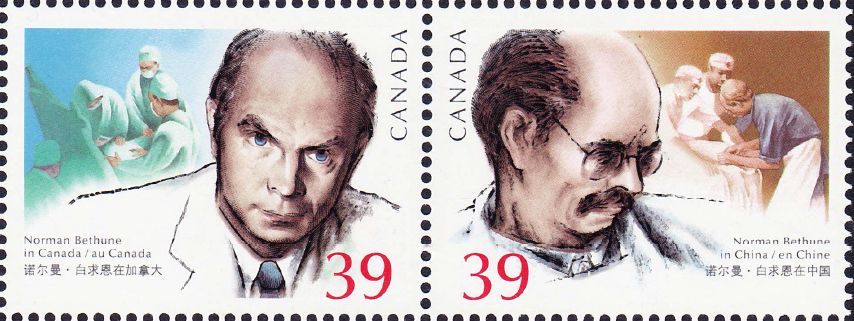
Norman Bethune

A Canada that embraced the commitments of Norman Bethune, a talented surgeon who fought fascism in Spain, helped overcome feudalism and foreign tyranny in China, and pioneered the fight for universal healthcare in Canada, might provide a model of a world that humanity could look forward to, in contrast to a Canada that hammers out arms deals with medieval tyrannies, supports a racist settler state in the Levant, and whose military helps enforce the international dictatorship of the USA.

Consider a departure in deed from the country’s self-declared but infrequently adhered to values. The Trudeau government, the latest in a long line of governments committed to facilitating the profit-making of the country’s substantial citizens, no matter what the consequences for peace, democracy, equality, and freedom, forged ahead with a $15 billion arms deal secured by the previous Harper government to sell light armored vehicles to an oil rich medieval monarchy in Arabia. Named after its ruling Saud family, this Arab tyranny abhors peace, democracy, gender equality, and religious freedom, wages an illegal, unprovoked, war on Yemen, and was one of the main arms supplier to al-Qaeda and its allies in Syria—the sectarian militants who carried out terrorist attacks which, on the occasions they spilled over into Europe, provoked great outcries of indignation in Ottawa, but when they occurred on an almost daily basis in Syria, were met by silence by Canada’s leaders.

Add to this the deplorable realities that the tyranny’s retrograde and hate-filled version of Islam was the ideological inspiration for al-Qaeda and Islamic State, and that, difficult as it is to credit, the kingdom’s male despots refuse to allow women to exercise much autonomy at all, and you would think that a country that prides itself as standing for peace, democracy, equality, religious tolerance, and all that is virtuous, would regard its client as so noxious as to steer a wide berth around any business transactions with it.

Diderot once remarked that humanity would never be free until the last monarch was strangled with the entrails of the last cleric, which may sound anachronistic, considering that Europe was delivered from the oppressions of aristocracy at the end of World War I, or soon after. But the vile institution persists in the Arab world, concentrated among Canada’s principal Arab allies, and Diderot’s words hardly seem anachronistic or harsh to anyone who still has to bear monarchy’s oppressive weight. How could ostensibly democracy-loving Canada be so committed to such vigorously anti-democratic allies?

Ottawa hammered out a deal with six Arab Gulf monarchies, including the aforesaid Saudi tyranny, “that spells out how Canada might deepen its relationship with these countries in coming years,” reports the Globe and Mail’s Steve Chase. To repeat: Ottawa plans to deepen its relationship with these vampires, not eschew them as affronts to humanity, as one might expect a country would which professes to be deeply devoted to progressive humanitarian values.

“The Joint Action Plan,” writes Chase “sets out areas of co-operation between Canada and Arab Gulf states on everything from politics and security dialogue to trade and investment, energy, education and health.”

And to ensure that Canadians continue to be deceived by twaddle about how their country is a paladin of so many virtues, Ottawa won’t let them see what’s in the agreement.

The key to Ottawa’s commitment to deepening its relationship with the Arab Gulf dictatorships is the promise of a cornucopia of profits for Canadian investors, banks and corporations. And in Canada, as in all countries where wealthy investors, banks and corporations use their wealth to dominate politics and the state, the decisive organizing principle of the society is not peace-keeping, or democracy, or equality, or religious tolerance, but what matters to banks, wealthy investors, and major corporations: profits.

In the pursuit of private, profit-making, interests, Canada has generally been on the wrong side of history since its founding more than 150 years ago. And when it has been on the right side, it has been on the right side, for the wrong reasons.

My first rebellion against the cult of Canadian patriotism occurred more than 35 years ago when on a visit to the country’s war museum I came upon a celebratory reference to Canada’s 1918-1919 military intervention in Russia. The glorified Canadian military intervention was directed against a social revolution engendered by centuries of a Tsarist tyranny and the chaos, destruction and disorganization wrought by World War I. How was an intervention to quash a movement which authentically embodied the values of liberty, equality and fraternity, worthy of celebration? And what business was it of Canada’s to intervene militarily in the affairs of another people who posed not the slightest threat to Canada? Ottawa was terrified that the Bolsheviks were a source of inspiration to Canadians who might seek to replicate in Canada what was underway in Russia; that Canada might be made to stand for something meaningful to ordinary people, like: jobs for all; free education at all levels; universal public health care; public day care; inexpensive public transportation; an end to the exploitation of humans by humans; and recognition of the humanity of all people, regardless of color, ethnicity, religion, and sex; in other words, all the virtues the Bolsheviks brought to the former Tsarist empire, and for which they are almost never recognized and to which Canada tried to put a stop. To paraphrase Victor Hugo’s remarks about the French Revolution, the Bolshevik Revolution may have been a great blow to the Russian aristocracy and the industrialists and financiers of the world, but it was a warm caress for the rest of us.

Canada’s participation in the imperialist charnel house of World War I—a kind of holocaust against the working people of Europe and the colonial slaves whom the European elites threw into the conflagration—is in no way defensible, and was a reflexive, unthinking commitment to a mother country, Britain, whose reason for entering the war had nothing whatever to do with the rights of small countries, as it was mendaciously professed to be, and everything to do with preserving the access of the British land-owning, industrial and financial elites to markets, investment opportunities, and raw materials in competition with their German rivals. Britain declared war on Canada’s behalf, and the Canadian government dutifully committed its sons to the Moloch.

In 1950, my maternal grandfather, who had enlisted in the Canadian Army during the Great Depression through a kind of economic conscription, joined other Canadians in the UN-denominated US-led “police action” in Korea—a project of frustrating the attempts of Koreans to liberate and revolutionize their country, in favor of maintaining a US puppet state on the Korean peninsula, to provide Washington with a geostrategic perch from which to dominate East Asia on behalf of Wall Street financiers. The Americans, who arrived on the peninsula in 1945, and immediately swept away the People’s Republic of Korea, the first independent Korean government in decades, are still there.

Ever since, Canada has been willing to help the United States fight most of its subsequent wars of domination—in Iraq, Yugoslavia, Afghanistan, now in Syria, and on the horizon, possibly in Russia and China.

Canada’s National War Memorial in Ottawa. If it is unacceptable for Germans and Japanese to honor their countries’ wars of aggression (and it is), is not equally unacceptable for Canadians to honor Canada’s wars of aggression, including the war on Korea and the war on Afghanistan?

As for World War II, Canada was on the right side of that conflict, but for the wrong reason. The country entered the war, because the mother country, Britain, did, and not to fight fascism or the Nazi persecution of communists, socialists, trade union leaders, Slavs, Jews, Roma, homosexuals, and the disabled, or to defend the Soviet Union, or to give teeth to the Atlantic Charter, which promised sovereign rights and self-government, but which, as Churchill made clear, would only apply in practice to people under the Nazi yoke, not the British yoke, which included the hundreds of millions of Indians subjugated by Britain. Indeed, Britain’s great colony of India, along with the conquered space of the American West, were models Hitler sought to emulate for Germany. He would build Germany’s American West, or its East Indies, in Eastern Europe. And if the project was carried out on a mountain of corpses it would hardly be without precedent. “We eat Canadian wheat,” remarked Hitler, “and don’t think about the Red Indians.”

Mackenzie King, Canada’s wartime prime minister, admired Hitler, and hated Jews. Before the war, Churchill also admired Hitler, and sang paeans to Mussolini. The fascist dictators were admired, not only by King and Churchill, but by large parts of the British and North American establishment, for their ardent anti-communism.

Mackenzie King, Canada’s wartime prime minister, admired Hitler, and hated Jews. Before the war, Churchill also admired Hitler, and sang paeans to Mussolini. The fascist dictators were revered, not only by King and Churchill, but by large parts of the British and North American establishment, for their ardent anti-communism. Canada’s prime minister at the time, Mackenzie King, who had worked as head of industrial relations research for the Rockefeller Foundation to develop methods for big business to co-opt organized labor, was sympathetic to Hitler’s virulent antipathy to Jews (and communists.) King, who met Hitler, and expressed admiration for the Fuhrer in his diary, wrote that “I would have loathed living in Berlin with the Jews, and the way in which they had increased their numbers in the city, and were taking possession of it in the most important way…It was necessary to get them out, to have the German people really control their own City and affairs.”

Neither did Ottawa have trouble with fascists, so long as they confined their attention to fighting communists and organized labor and focused their wrath on the citadel of communism, the Soviet Union. So-called premature anti-fascists, like Norman Bethune, who travelled to Spain to fight Franco’s reaction to the country’s democratically elected Popular Front government, were looked upon with suspicion, and Ottawa erected legal impediments to Canadians traveling abroad to join the fight. Following World War II, Canada found that it could get along quite comfortably with fascist regimes in Spain and Portugal, to say nothing of the police state dictatorship it helped to defend on the Korean peninsula, or apartheid South Africa.

+++

Behind Parliament, on a small island in the Ottawa River, sits a mock village of the indigenous people on whose land the capital—and country—has been built, an unintentional reminder (lost on most Canadians) that Canada was founded on the dispossession and genocide of the land’s aboriginal people. Canada is, after all, an expression of British settler colonialism, one of the most vile, destructive, brutal, sanguinary forces, in human history. The sun, it has been said, never set on the British Empire. But nor did the blood ever dry on it either. As Richard Gott has written,

“Wherever the British sought to plant their flag, they were met with opposition. In almost every colony, they had to fight their way ashore. While they could sometimes count on a handful of friends and allies, they never arrived as welcomed guests, for the expansion of empire was invariably conducted as a military operation.”

The British hacked, cut, pushed and slaughtered their way into other people’s lands to plant their flag, and to steal the land and natural resources of the natives. Canada, a country founded by settlers, was no exception.

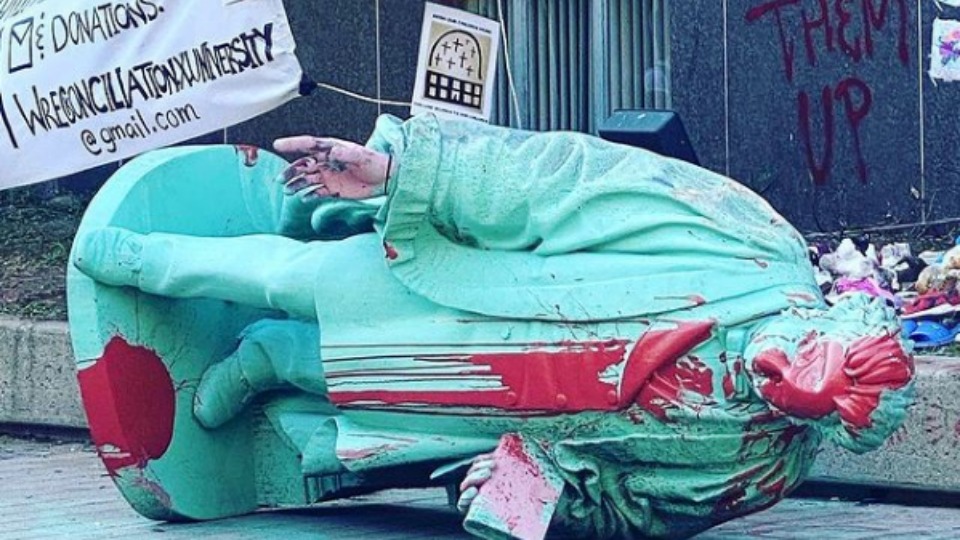
It’s consistent, then, that Ottawa should maintain an unwavering commitment to the racist Jewish settler state in the Levant, known as Israel, made possible by Britain’s conspiring with France and Tsarist Russia during the Great War to carve up the dying Ottoman Empire, and turn over the southern Levant (Palestine and Transjordan) to a British League of Nations mandate, in which was ensconced a commitment to create a Jewish homeland. Canada, not surprisingly, allies itself with the Jewish settlers, and therefore against the indigenous people of the Levant, and was opposed to the efforts of the autochthonous peoples of Zimbabwe to take back their land from the descendants of the British settlers who hacked, cut, pushed, and slaughtered their way into land they dubbed Rhodesia, after the great paladin of British imperialism, Cecil Rhodes. Rhodes is to the indigenous people of southern Africa what Hitler is to the Slavs and Jews. This raises a question about whether Egerton Ryerson, the architect of the residential school system, can be similarly compared. [A statue honoring Ryerson, situated on the campus of the eponymous Ryerson University in Toronto, was recently, and thankfully, toppled.]

The Bolsheviks, who were reviled in Ottawa, established suffrage for all, including for national minorities, before Canada did. Canada didn’t offer universal suffrage, even Herrenvolk (master race) suffrage until after WWI, and true universal suffrage had to wait until 1960, when aboriginal Canadians, the dispossessed original inhabitants of the land, were belatedly allowed to vote.

The United States, another Herrenvolk democracy, didn’t effectively achieve universal suffrage until as late as 1965, when its regime of white supremacy was formally dismantled and the civil and political liberties of black Americans were finally formally secured throughout the country. This late and grudging surrender of white supremacy was partly due to Washington’s need to compete ideologically with the Soviet Union, where racial discrimination—and the idea of a master race—were unthinkable.

What many of us in the United States, Canada and Western Europe hold to be the great social achievements of our countries—the mitigation of discrimination on the basis of sex and religion and racial and national origin, and the development of the welfare state—owe much to the pressures Western elites felt to compete ideologically with the Soviet Union, where discrimination on these grounds was inconceivable and where a robust social welfare state prevailed. With the USSR now defunct, a suicide carried out by the country’s last president, Mikhail Gorbachev—who, for obvious reasons is celebrated in the West, but is widely reviled in Russia—the ideological competition has ceased, and with it, large parts of the welfare state have been dismantled and continue to be demolished.

The French novelist Henri Barbusse, once wrote that the burning question of all time is what is the future of the human race, so martyred by history. To what, he asked, has humanity to look forward to?

Not $15 billion arms deals with monarchs whom Diderot, where he alive, might say ought to be strangled by the entrails of the last Wahhabi cleric; not the dispossession of peoples of their land by usurping settlers from abroad; not denial of self-determination; not wars of neo-colonial re-conquest; not acting as al-Qaeda’s air force to re-colonize the world on behalf of the planet’s dominant imperialist power.

If Canada offered something for humanity, so martyred by history, to look forward to, I would celebrate its founding, or at least, the moment it changed course, and set itself to the service of the vast majority of us—not the centimillionaires and decabillionaires, not the Saudi and Emirati monarchs, not the Jewish usurpers in the Levant, not the international dictatorship of the United States, not the continued colonial dispossession of the aboriginal peoples—but to a world free from the exploitation of humans by humans, where each person is an end in their self and not means to others’ ends.

Israel’s relationship with Washington: Talk at the Institute for the Critical Study of Society

My talk on Israel’s relationship with Washington, given at the Institute for the Critical Study of Society’s Sunday Morning at the Marxist Library, May 30, 2021.

Israel’s relationship with Washington

60 minute talk followed by 60 minutes of questions and discussion.

http://www.barakabooks.com