The genocide scholar Raz Segal has written an insightful article for the Guardian (“The genocide in Gaza is far from over,” 20 November, 2025) which I am flagging because it addresses a question that is almost never asked in public discourse: Why do genocides happen?
Segal asks this question because it is clear that the Nuremberg Trials, the UN Convention on the Prevention and Punishment of the Crime of Genocide, and education programs designed to instil the idea of “never again”, have failed. For, in this post-Holocaust world, the slogan “never again” is belied by the reality of “again and again.”
The common understanding of genocides is that they are caused by bad people with evil in their hearts. This is The Christmas Carol version of the expunction of groups. Bob Cratchet was overworked and underpaid because his boss, Ebenezeer Scrooge, was a miser with a heart of adamant, not because he was a capitalist operating in a world of cut-throat competition. Scrooge had two choices: pay his employees as little as possible and work them as long as possible, or go under. It’s no surprise he chose the former.
How many progressives attribute the problems of the working class to the greed of corporations, as if greed can be disappeared in a poof of moral suasion, or a visit from the Ghost of Christmas Future? Where does greed come from? Scrooge’s greed came, not from his heart, but from bourgeois society and the capitalist imperatives which enslaved him. “We shouldn’t despise human nature,” counseled the eighteenth-century philosophe, Denis Diderot, “but the despicable conventions that pervert it.” Scrooge’s perversion was the despicable convention of capitalism, not a lonely childhood and a love affair gone sour, as Dickens told the tale.
What are the despicable conventions that pervert human nature to produce genocides? For Segal, and others, it is a political project—one of building ethnically homogenous societies.
British settlers in Turtle Island (North America), Australia, and Aotearoa (New Zealand), carried out genocides against the indigenous peoples of these territories, not so much with the conscious intention of building societies of, by, and for White people, but of integrating the land and resources of the indigenous people into a growing world bourgeois system of capitalist production. Inasmuch as the indigenous peoples couldn’t be, and didn’t want to be, forcibly integrated into this system, they were eliminated as obstacles. Thus, the creation of ethnically homogeneous White Christian societies in these lands was a consequence of a capitalist driven process.
Nazi Germany carried out a genocide in Eastern Europe against people it deemed Untermenschen (sub-humans)—Slavs, Jews, Romani, Blacks, and mixed-race people. Of 18 million non-combatants killed by bullets, gas, exposure, exhaustion, and disease in the German war in the European East from 1939 to 1945, 12 million were Slavs and six million Jews. Ninety-six percent of the victims were claimed by Nazi imperialist violence—that is, violence used by the Third Reich to conquer and depopulate Slav territory in order to repopulate it with German settlers.
Significantly, most of the world’s Jews lived within the territory that was the object of the Nazis’ settler colonial ambitions. The Holocaust, in the view of Carrol P. Kakel III, a US historian who has written on the American and German genocides, cannot be separated from Nazi settler colonialism. Six million Jews were killed, not for the sole reason that Nazis hated Jews—a view ingrained in the ideological zeitgeist—but as a consequence of a political project, namely, 1) clearing the European East (where the majority of the world’s Jews lived) of non-Germans to make room for an expanded ethnically homogeneous Teutonic empire and 2) eliminating an ethnic group the Nazis believed was, through the instruments of international finance capitalism and Marxist internationalism, seeking to destroy the German people as a nation.
Raphael Lemkin, the Polish-Jewish lawyer who introduced the concept of genocide in his 1944 study Axis Rule in Occupied Europe, attributed the Nazi genocide of the Slavs to the German settler colonial project, but insisted that the genocide of the Jews, the Holocaust, originated in psychopathological Judeophobia, unconnected to any Nazi political aim. Lemkin’s insistence that Nazi violence toward Jews was driven by psychopathology (thus, bad people with evil in their hearts) likely originated in his Zionism. A core belief of political Zionism is that non-Jews can’t help but hate Jews. As a consequence, Jews can never safely live among non-Jews, and must therefore have their own state if they are to be safe and survive as a people. Genocide scholar A. Dirk Moses has argued vigorously against the view that the Holocaust was the consequence of apolitical hatred, rooting the Judeocide instead, along with other genocides, in political projects. He criticizes the Genocide Convention for depoliticizing genocide—that is, for failing to recognize that genocides are carried out by ethnic groups against other ethnic groups they see as economic or political competitors. Often, but not always, the competition is over land. Or one ethnic group sees another as a threat to its survival.
Certainly, the origins of the genocide of the Palestinians can be found in a political project—clearing Palestine of its indigenous population to make room for Jewish settlers and the creation of a Jewish ethnic state. Zionist settler colonialism has obvious connections to the British-settler colonial genocides of the indigenous peoples of Canada, the United States, Australia, and New Zealand, as well as the Nazi political project of creating an expanded German empire in the European East comprised solely of Aryan Germans.
Segal argues that the reason we live in a post-Holocaust world of again and again is because the political project that has regularly given rise to genocide—one of creating ethnically homogeneous states—continues to be seen as legitimate. One of the reasons (though not the only or even most important reason) the United States, Britian, Canada, and the Soviet Union backed the creation of an ethnic Jewish state in Palestine, was because they believed that ethnic states were legitimate, necessary, and desirable. Self-determination, the notion that every ethnic group should have its own state, enjoys considerable esteem. Thus, the idea of a single democratic state in Palestine, from the river to the sea, where everyone is equal, is frequently dismissed in preference to the creation of two ethnically homogeneous states existing side-by-side—one Jewish, the other Palestinian. This is the two-state solution. Zionists prefer one Jewish state in all of Palestine (today’s reality) and some Palestinians would like to see a Palestinian state from the river to the sea, cleansed of its Jewish inhabitants, save for the descendants of Jews who lived in the country prior to the political Zionist waves of European immigration.
Abolishing genocide and getting to a world of never again means abolishing the idea that the ethnic state is either necessary or desirable. We don’t need ethnic states; we need civic states, where all people are equal and gender, sexual-orientation, ethnicity, national origin, religion, color, language, and all other ascriptive markers of identity have no political significance.
However, ideas are not abolished by fiat; conduct is not deduced from principle. The fact that the land of the indigenous peoples of North America and Oceania offered attractive possibilities to metropolitan Europe, and the proletarians it disgorged to the colonies, created the idea of the desirability of settler colonialism. The idea of political Zionism arose in the anti-Semitism of Europe, which in turn arose in the need of Europe’s rulers to diffuse threats to their rule by turning their subjects’ anger against a scapegoat. The war against the Jews became a substitute for the class war against Tsarist oppression and capitalist exploitation. A. Dirk Moses makes a compelling point that genocide is pursued as a solution to a political problem, but political problems arise not in the world of ideas, but in social and economic intercourse.
One of the surest ways of solving the political problem of two groups vying for political and economic resources within the same territory is for one or both of them to try to expel or physically destroy the other. So long as humanity is divided by ascriptive identity will identity groups vie for political and economic resources, and so long as identity groups vie for political and economic resources, the possibility of genocide will be ever present.
In a Jacobin interview, Gilbert Achcar, a man Lenin may have characterized as a ‘social parson and opportunist’, and thus fitting as a Jacobin contributor, makes some good points about the Israeli genocide of the Palestinians, but offers a facile assessment of Hamas’s Oct 7 action.
A meaningful evaluation of Operation Al Aqsa Flood would answer the following questions:
Against what goals should the attack be evaluated?
What were Hamas’s goals for the Oct 7 action?
Was the attack rational, given the goals set for it and the information available to Hamas at the time?
To what degree have Hamas’s goals been met?
Is it too early to say?
Achcar addresses none of these questions. Instead, he decries the Oct 7 action as a catastrophe that handed Israel a pretext to carry out a genocide. He argues instead for non-violent resistance.
Why? Because, he says, Israel is many times more powerful than the Palestinian resistance. Armed Palestinian action will inevitably be crushed, leaving non-violent resistance as the only safe option.
Fair point.
But Achcar also believes that any gains the Palestinians make will arise from whatever pressure they can place on Israel and its allies to accommodate their demands. In his view, non-violent action is more likely to create pressure without providing a pretext for violent retaliation, and therefore, is the safer path to follow.
What Achcar misses, however, is the critical point that the catastrophe he condemns as Hamas’s child—the mass atrocities Israel is carrying out against the Palestinians—has turned world public opinion against Israel and created enormous pressure on the Zionist state to accommodate the Palestinians’ demands.
Israel’s reaction to the Oct 7 operation has left Israel greatly weakened. Its standing in world opinion is in the toilet. More and more, people have woken up and taken a hard look at what Israel really is, and they’ve come to see it, in growing numbers, as a racist, apartheid, settler colonial abomination. The abomination’s allies are no longer as keen to offer their unqualified support. Serious efforts are afoot to create a Palestinian state—efforts that had slipped from the agenda prior to Oct 7.
In the face of the undeniable reality that Palestine has perhaps never been more on the agenda, Achcar stamps his foot and cries, ‘No, no, that’s not true. The idea that Oct 7 has put Palestine back on the agenda is absurd.’
But what’s absurd, as anyone of an unbiased mind and clear perception sees, is that the only absurdity here is Achcar’s idea that Oct 7 hasn’t put Palestine back on the agenda.
Thinking about Achcar’s patent aversion to the Palestinians’ use of violence calls to mind three socialist epigrams about class struggle which apply as strongly to national liberation.
The only just war is war against slavery. – Marx
An oppressed class [nation] which does not strive to learn to use arms, to acquire arms, only deserves to be treated like slaves. – Lenin
Socialism [national liberation] is not a … policy for the timid. – Oskar Lange
By Achcar’s logic, we can dismiss as ill-considered the Warsaw uprising, the French resistance, and indeed, the 1939-1948 Zionist settler war for independence from Britain, all violent movements against forces much more powerful than themselves.
Jacobin’s Cloudy Thinking on Hamas’s Resistance and Palestinian Solidarity
“If no consideration in a political crisis has been addressed to the people of this country except to remember to hate violence and love order and exercise patience, the liberties of this country would never have been obtained.” British Prime Minister William E Gladstone [1]
November 1, 2024
By Stephen Gowans
Jacobin contributing editor BashirAbu-Manneh has written a criticism of the pro-Palestinian protest movement (“Palestine Needs Mass Support, Not Sectarian Marginalization,” Jacobin, October 30, 2024), arguing that its effectiveness is clouded by poor strategic thinking. It is not, however, the protest movement’s thinking which is clouded, but Abu-Manneh’s own thinking, which is contradictory and self-refuting. In effect, Abu-Manneh urges readers to hate Hamas’s violence, love international law, and exercise patience, while defining the Palestinian cause as the achievement of Palestinian Bantustans alongside a Zionist colonial settler state. To make his case, he deploys a series of arguments which collapse under the weight of their own contradictions. I have set out his arguments below, and show how they are based on poor—and, ultimately, anti-Palestinian—reasoning.
The Jacobin contributor begins his article by attributing what he calls the cloudy strategic thinking of the pro-Palestinian protest movement to its members’ anger and frustration at Israel’s indifference to “the wrath of global public opinion” and their being “ignored and sidelined by warmongering elites.” In his view, emotion has impaired judgment. A “very small minority of vocal activists,” he writes, “have turned legitimate anger and frustration … into a mindless embrace of violence” which is playing “into the hands of those who want to see a popular antiwar mass movement discredited.”
“Most worryingly,” he adds, “some voices in the Palestinian solidarity movement have glorified Hamas’s October 7 attacks,” quickly noting that: “There is no question that Palestinians have a right to resist foreign occupation. That is an achievement of the decolonization era enshrined in international law. But it does not follow that everything the Palestinian resistance movement does advances the Palestinian cause.”
Let’s unpack this paragraph.
Abu-Manneh attributes the Palestinians’ right to resist foreign occupation to international law. But where does international law come from? Does it exist independently of humanity, or is it written by humans? And which humans write it? International law is formulated, ignored, or enforced, by the most powerful states, at their discretion. The international system is characterized, not by “the rule of law”, in which no state stands above it, but “rule by law”, in which law is selectively applied by those who have sway over it, namely, states with permanent Security Council vetoes, at least four, and possibly all of which, can be characterized as formerly if not current colonial states. One, the United States, originated, as Israel has, in settler colonialism. [2, 3] If the states that dominate the international system, and therefore the formulation and (selective) application of international law, were to decide that the Palestinians have no right to resist occupation, would their resistance be illegitimate? By Abu-Manneh’s reasoning, it would be. This gives us the first clue about how the Jacobin contributing editor thinks about the Palestine question. He regards it not as a question of settler colonialism (the theft of the Palestinians’ country, land, homes, and property and what to do about it), but one of international law, a law over which powerful states, many of them with histories of colonial or settler colonial domination over other peoples, have always exercised an outsize influence. Palestinians may have the right of resistance in international law, but it amounts to little. Does international law, or the great powers who write and selectively enforce it, protect Palestinians as they exercise this right? On the contrary, these same powers raise Israel’s right of self-defense to an inviolable principle of the first order, while execrating, gagging, or punishing anyone bold enough to invoke the Palestinians’ right of resistance. At the same time, they sanction the killing of Palestinians who exercise their right as the necessary and desired outcome of Israel exercising its hallowed right of self-defense.
International law, in the form of the US, British, and Israeli-authored 1967 UN Security Council Resolution 242, recognizes as legitimate a settler colonial Israeli state, implanted by force and by means of ethnic cleansing, on the four-fifths of a country known as Palestine which Zionist settlers conquered in 1948. This law does not grant the Palestinians the right to resist the foreign occupation of this part of their country. So, yes, international law concedes a right to resist, but it is meaningless in fact, and to make matters worse, the right is conceded for only one-fifth of historic Palestine.
We can think of Israel as a settler colonial project which has consolidated its theft of Palestinian land, homes, and property in four-fifths of Palestine. We can think of it too as seeking to extend its larceny to the one-fifth of historic Palestine that has yet to be completely plundered. We can also think of international law as a means of legitimizing the theft. Alternatively, we can, as Abu-Manneh does, fetishize international law, seeing it not as the instrument of colonial and settler colonial states, used to legitimize the existence of Israel [4] but naively, as a neutral expression of universal justice.
After accepting the Palestinians’ right to resistance based on international law (and exercisable only in the one-fifth of the Palestinians’ country which Jewish settlers were unable to capture in 1948), Abu-Manneh writes: It “does not follow that everything the Palestinian resistance movement does advances the Palestinian cause.” This is true as far as it goes, but the statement is of little value unless we know what “the Palestinian cause” is. In Abu-Manneh’s view, the Palestinian cause has nothing whatever to do with decolonizing Palestine, dismantling apartheid, and overcoming Zionist racism. Instead, the cause, in his view, is bringing to fruition the two-state solution as laid out in the 1967 UN Security Council Resolution 242–that is, the achievement of a Palestinian state in one-fifth of the Palestinians’ country, alongside a Zionist colonial settler state, on the larger four-fifths.
Now that we’re clear on what Abu-Manneh thinks the Palestinian cause is, we can ask why he accepts Palestinian resistance (in the abstract) but rejects Hamas’s Operation Al Aqsa Flood (as a specific instance of Palestinian resistance.) According to the Jacobin contributor, any “reasonable cost-benefit analysis for the people of Gaza has to conclude that the price” of the 7 October attack (i.e., Israel’s retaliation) “is simply not worth it.” Owing to “a balance of power that is overwhelmingly to Israel’s advantage” the Hamas rebellion was, in his view, “a massive miscalculation.”
It is indeed true that there exists between Israel and the Palestinians a massive imbalance of power. But what does the fact that there is a massive imbalance of power mean? It means that Israel has been able to maintain an ongoing, unremitting, regime of aggression against the Palestinians, which continues the project, begun over one hundred years ago, of replacing one country, Palestine, with another, Israel, and displacing the indigenous Palestinians with transplanted Jews. This is an ongoing project. It didn’t stop in 1967, when the UN Security Council ordered Israel—without, as time has shown, the slightest intention of compelling Israel’s compliance—to withdraw from the new territories it had taken. It is not the case, as Abu-Manneh supposes, that the great imbalance of power is fixed and that the Zionist project is sated, with no further conquests on its agenda. On the contrary, before 7 October, each passing day was one in which ever more Palestinians were crushed under the wheels of the Zionist juggernaut. Settlements continued to be built in the West Bank. The Gaza blockade continued to make life miserable for Palestinians. Israel continued to threaten to Judaize the Haram al-Sharrif. Abu-Manneh assumes that there existed prior to 7 October a fixed status quo, which, however grim it was, was still better than what has befallen the Palestinians since. To the contrary, the condition of Palestinians was—despite the misplaced faith the Jacobin contributor has in international law—one of incessant weakening and deterioration. Palestinians faced, not a choice of standing still if they did nothing, or going backward if they provoked Israel’s fury, but if they did nothing, of going backward slowly, inexorably, until Palestinians and Palestine ceased to exist. It was a choice of dying on their knees or standing on their feet.
This is not to say that there are not miscalculations in struggle, and that Operation Al Aqsa Flood was not a miscalculation. It may have been. In fact, there is evidence to suggest that the attack didn’t unfold quite as the Hamas leadership intended. Far greater Israeli resistance was expected, and when Hamas fighters quickly achieved their limited objectives, the operation dissolved into chaos. [5] Yahya Sinwar, the Hamas leader who has since died in battle, remarked that “Things went out of control. People got caught up in this, and that should not have happened.” [6]
In decrying the 7 October Hamas operation as not worth the candle because the outcome has been a devastating Israeli retaliation, Abu-Manneh fails to blame the architects of the retaliatory ossuary: Israel and its principal backers, the United States and Germany, the former a veritable co-belligerent. One could argue that the carnage is due to both the provocation of Hamas (a distal cause) and Israel’s response to it (the proximal cause). Instead, Abu-Manneh chooses to lay 100 percent of the blame at Hamas’s door, removing the proximal cause (Israel and its backers and co-belligerent) from the equation altogether. This is blatant victim-blaming.
If that isn’t bad enough, the Jacobin contributing editor then denies Hamas any credit for the benefit of the 7 October rebellion. The benefit, as he puts it, is that “Palestine is now back in global political focus.” But why is it back? In Abu-Manneh’s view, “Because of Israel’s brutal genocide”, not because Hamas undertook an operation which included among its aims the rescue of the Palestinian cause from the oblivion into which it was rapidly sinking. [7] If Hamas is to be blamed for provoking Israel to accelerate the job of erasing the Palestinians—conduct hardly at odds with the history of Zionist settler colonialism (isn’t its point to eliminate the natives to make way for the settlers?)—then it must also be credited with placing Palestine back on the global agenda. Does Abu-Manneh believe that “the huge global protest movement … against colonization and occupation” and the radicalization of “a new generation of young activists,” would have occurred had Hamas or other resistance groups not carried out the Al-Aqsa Flood action or its equivalents? Palestine had fallen off the radar until Hamas acted. Now Palestine and the Palestinians are back with a vengeance. Abu-Manneh’s vaunted international law had done nothing, up to 7 October, to keep them on the agenda. Indeed, it was the failure of international law and the quietude of the Palestinian solidarity movement that galvanized Hamas to act.
Having dismissed Palestinian militant action as ill-advised in light of the enormous imbalance in power between Israel and the Palestinians, Abu-Manneh turns to international law as the Palestinians’ possible savior. In view of the fact that the UN and international law have played important roles in facilitating the Jewish settlers’ spoliation of Palestine and its indigenous people—especially UN General Assembly Resolution 181 of November 1947, which recommended the partition of the Palestinians’ country, and UN Security Council Resolution 242 of 1967, which legitimized the Zionist settler state’s capture of four-fifths of Palestine, and the ethnic cleansing of much of the Palestinian population from it—the idea that the Palestinians should look to international law for salvation is wholly unconvincing; one may as well have asked Hitler to solve the problem of anti-Semitism.
All the same, Abu-Manneh is particularly encouraged by “the July International Court of Justice (ICJ) ruling (July 19, 2024) [which] has deemed Israel’s occupation illegal.” But it should be understood thar the ICJ opinion has not deemed as illegal the Zionist occupation of a country called Palestine; it has only declared illegal the occupation of the one-fifth of Palestine which the settlers failed to conquer and ethnically cleanse in 1948. What encourages the Jacobin contributor, is thus, an ICJ ruling which presses Israel to accept the two-state solution, what Palestinian scholar Rashid Khalidi denounces as “a one-state, multiple-Bantustan solution.” [8] And how is the two-state solution—which Israelis vehemently oppose [9], and whose history is one of a false promise designed to keep the Palestinians passive while what remains of their country is gradually taken away from them—to be brought to fruition? Through “focussed political work and organization” counsels Abu-Manneh—in other words, by mobilizing radicalized youth and the “huge global protest movement” to press countries to pressure Israel to grant the Palestinians the sop of a few Bantustans. Abu-Manneh’s favored two-state solution, “has always been meaningless, a cruel Orwellian hoax,” concludes Khalidi. It “would effectively maintain the status quo in Palestine under a different form, with an externally controlled Quisling ‘Palestinian Authority’ lacking real jurisdiction or authority replaced by a Quisling ‘Palestinian state’ similarly devoid of the sovereignty and independence that attach to a real state.” [10]
Abu-Manneh’s thinking is problematic, if not naïve and, worse, revolting, on three levels.
First, it ignores his own assessment of public opinion. Israel, he notes correctly, is “protected from the wrath of global public opinion.” Moreover, “protesters and activists” are “ignored and sidelined by warmongering elites.” If Israel is insulated from public opinion, and protestors and activists are ignored, how is “focussed political work and organization” going to compel Israel to grant Palestinians the multiple Bantustans Abu-Manneh thinks will resolve the Palestine question? The imbalance in power between Israel and the Palestinians is indeed huge, but the yawning chasm is not only a military one, but a public diplomacy one, as well. If you’re going to say, don’t take on Israel militarily, because its military power is overwhelming, don’t, at the same time, say take on Israel in the realm of public opinion, without recognizing that Israel’s public diplomacy power is also overwhelming. This is surely clouded strategic thinking.
Second, in advocating a one-state-multiple-Bantustan solution, Abu-Manneh proposes that radicalized youth and the huge global protest movement accept Jewish settler colonialism and Zionist apartheid in four-fifths of the Palestinians’ country, in return for Palestinian Bantustans on the remaining one-fifth. Were the radicalized youth who Abu-Manneh celebrates to accept his program they would immediately become de-radicalized, for there is nothing radical about Abu-Manneh’s counsel. Neither is there anything progressive about it. Would a movement against apartheid in South Africa which advocated multiple Bantustans alongside a white supremacist state be called progressive? Of course not. So why would we think the equivalent for Palestine is acceptable? Indeed, it’s difficult not to conclude that the whole point of Abu-Manneh’s intervention is to persuade the global protest movement to deradicalize, on the grounds that this will somehow (he doesn’t quite say how) pay off in strategic gains. This comports with the mild, reformist, orientation of Jacobin—a periodical of the Left devoted to hating violence, loving order, exercising patience, and bartering principle for bourgeois respectability.
Third, the energy of the global protest movement and radicalized youth—energy Abu-Manneh seeks to mobilize on behalf of his favored one-state-multiple-Bantustan solution—would hardly exist had Hamas not undertaken the very same Operation Al-Aqsa Flood he so deplores. Had Hamas accepted anything like Abu-Manneh’s counsel, Palestine and the Palestinians would now be virtually invisible and teetering on the precipice of extinction.
The Jacobin contributor believes that “glorifying” Hamas’s violence will frighten people away from joining the protest movement he acknowledges is already huge and global. In fact, the movement Abu-Manneh has set out to save from cloudy strategic thinking is huge and global despite, or perhaps because of, the “cloudy” thinking he deplores. The Jacobin contributor also fears that failing to denounce Hamas’s 7 October resistance allows Israel and its supporters to discredit opponents of the Israeli’s genocide against the Palestinians. Operation Al Aqsa Flood, was, he argues, a miscalculation that is wholly responsible for the slaughter of tens of thousands of Palestinians. Yet, the operation hardly seems to have been a miscalculation from the point of view of preventing the erasure of Palestine and the Palestinians; it is responsible, at least distally, for revitalizing the pro-Palestinian movement, a revitalization Abu-Manneh welcomes, but all the same fails to give Hamas credit for. The Jacobin writer appears to believe that there are ever more legions of people ready to join the global protest movement if only a very few voices in the Palestinian solidarity movement stop glorifying Hamas’s 7 October attack. His assessment is unconvincing. If more people haven’t joined the already huge and global movement, a more plausible explanation is that they see –to invoke Abu-Manneh’s own assessment of the impotence of public opinion—little point in being “ignored and sidelined by warmongering elites” as Israel enjoys its protection “from the wrath of global public opinion.”
It is unclear why Abu-Manneh believes that failure to decry Hamas’s 7 October uprising plays into the hands of Israel and its supporters, unless he believes, notwithstanding his endorsement of resistance in the abstract, that violent resistance against Israel is illegitimate. Could it be that his reference to the right of Palestinian resistance is mere lip-service? He says resistance is legitimate, but despite this, insists that glorifying the resistance of Hamas on 7 October plays into the hands of the Palestinians’ enemies. This is a contradiction. How could glorifying a legitimate act discredit the movement? Abu-Manneh might say the reason why is because Hamas’s resistance, albeit legitimate, was a miscalculation. But how does glorifying a Hamas miscalculation play into Israeli hands? It doesn’t make sense. It seems more likely that Abu-Manneh is a supporter of violent rebellion in the abstract, as an idea alone, suitable only for discussion in university colloquia, and certainly not as a project to be carried out in the real world.
The reality is that the revitalization of the global Palestinian solidarity movement wouldn’t have happened had Hamas not launched its 7 October operation. Abu-Manneh fails to credit the very same operation whose glorification he deplores for re-igniting the mass movement he welcomes, presenting an argument that can hardly be taken seriously, namely, that the way to build mass support for Palestine is to glorify an international law which has achieved nothing for Palestinians, while defining the Palestinian cause as the achievement of an apartheid Zionist settler state in four-fifths of the Palestinians’ country, alongside multiple Bantustans in what is left over.
Abu-Manneh’s clouded thinking recalls E.H. Carr’s riposte to the advocates of peaceful change. In his Twenty Years’ Crisis, 1919-1939, Carr wrote, that the “attempt to make a moral distinction between wars of ‘aggression’ and wars of defense’ is misguided. If a change is necessary and desirable, the use or threatened use of force to maintain the status quo”—one thinks here of Israel’s vaunted right to defend itself—”may be more morally culpable than the use or threatened use of force to alter it.” [11] He continued: “The moral criterion must be not the ‘aggressive’ or ‘defensive’ character of the war, but the nature of the change which is being sought and resisted. ‘Without rebellion, [humanity] would stagnate and injustice would be irremediable.’ Few serious thinkers maintain that it is always unconditionally wrong to start a revolution; and it is equally difficult to believe that it is always and unconditionally wrong to start a war.” [12]
This isn’t to say that Hamas started a war on 7 October. The war is a long-running one, whose origins are found in the actions of Theodor Hertzl and his supporters and successors to create a Jewish state by making an existing country, Palestine, cease to exist. Hamas only opened a new battle in the long-running war on 7 October. The point is that the violent rebellion of the natives must be evaluated against the nature of the change that was sought and resisted (ultimately, the liberation of Palestine, and immediately, the arrest of the disappearance of Palestine and Palestinians.) Hamas appears to have accomplished its immediate aim and for this, for its fight against the iniquities of settler colonialism and apartheid, and for its role in helping to revitalize the pro-Palestinian movement, it deserves credit.
So, is glorifying Hamas’s 7 October rebellion strategically unsound? It may be, but not for the contradictory reasons Abu-Manneh adduces, and nor for any reason I can fathom. The Jacobin contributor has allowed his anger and frustration at Hamas’s Islamist character—which he revealed in an earlier Jacobin article [13]—cloud his judgment about the merits of the organization as a vehicle for the liberation of Palestine. I share Abu-Manneh’s opposition to Hamas’s Islamism, but I recognize the merits of the group’s Operation Al Aqsa Flood. Whether one agrees or disagrees with the political Islam of Hamas is of no relevance to the question of whether the organization’s conduct has advanced the aims of overcoming Zionist settler colonialism and apartheid. Neither Hamas nor its secular compatriot organizations will ever be acceptable to respectable opinion in colonial and settler colonial countries, and bartering away principle for respectability by denouncing Hamas or refusing to give it the credit it deserves, is a fool’s game.
1. Cited in E.H. Carr, The Twenty Years’ Crisis, 1919-1939, Palgrave MacMillan, 2016, p. 193
2. Three of the five permanent UN Security Council members, the United States, France, and Britain, were once self-declared colonial countries. All retain some colonies today under various euphemistic aliases, such as regions, protectorates, and territories. Puerto Rico, for example, is a de facto US colony, while Guadeloupe and Martinique count among a number of French colonies. Bermuda, Gibraltar, and the Falkland Islands, inter alia, are British colonies. Russia and China were empires, based on the domination of conquered peoples by a metropolitan ethnic elite.
3. For more on this perspective on international law see the Third World Approaches to International Law Review, https://twailr.com/
4. Benjamin Netanyahu has called Israel “the West’s outpost in the Middle East” (and hence, the instrument of the colonial and colonial settler powers which comprise the West). Quoted in Adam Shatz, “The sea is the same sea,” The London Review of Books, (Vol. 40 No. 16, 30 August 2018).
5. “A time of painful birth and major transformation’: a senior Hamas leader reflects on October 7 and its aftermath,” Mondoweiss, October 6, 2024; Our Narrative: Operation Al-Aqsa Flood, Hamas Media Office; Ben Hubbard and Maria Abi-Habib, “Behind Hamas’s Bloody Gambit to Create a ‘Permanent’ State of War,” New York Times, Nov. 8, 2023; Nelly Lahoud “A Catastrophic Success for Hamas?”, Foreign Affairs, October 23, 2023.
6. Summer Said and Rory Jones, “Gaza Chief’s Brutal Calculation: Civilian Bloodshed Will Help Hamas,” The Wall Street Journal, June 10, 2024.
7. “Sinwar certainly achieved his goal of bringing the Palestinian issue to the center of geopolitics,” writes Yaroslav Trofimov in “Sinwar’s Bloody Gambit Changed the Middle East—but Not as He Imagined”, The Wall Street Journal, Oct. 19, 2024: “We make the headlines only with blood,” Sinwar said. “No blood, no news.” Summer Said and Rory Jones, “Gaza Chief’s Brutal Calculation: Civilian Bloodshed Will Help Hamas,” The Wall Street Journal, June 10, 2024.
8. Rashid Khalidi, “The Neck and The Sword,” New Left Review, May/June, 2024.
9. “The U.S., Europe and many Arab governments insist the overdue answer is the two-state solution, under which Israel and a Palestinian state would exist side-by-side. The snag is that Israelis and Palestinians no longer believe in it.” Marcus Walker, Fatima Abdul Karim and Anat Peled, “The Way to Fix the Middle East Conflict Looks Obvious—Except to Israelis and Palestinians, The Wall Street Journal, Aug. 18, 2024.
10. Rashid Khalidi, ‘A new abyss’: Gaza and the hundred years’ war on Palestine, Guardian, 11 Apr 2024.
11. Carr, p. 193.
12. Carr, p. 193.
13. Bashir Abu-Manneh, “The Palestinian Resistance Isn’t a Monolith,” Jacobin, April 28, 2024.
Haaretz columnist Gideon Levy recently misattributed the Himalaya of injustices the Israelis have visited upon the Palestinians to ‘the army,’ as if, absent the IDF, Israel—not only its conduct but its very ethos—would become acceptable to world opinion. [1] But were the IDF to disband, or renounce its genocidal conduct, Israel would still be a Jewish state, founded on the robbery of the Palestinians, and committed to their continued dispossession and exile in order to maintain the state’s Jewish character.
The army’s role in Israel is to defend Jewish supremacy and extend the territory over which Jews come first and Palestinians matter not at all. The 1948-9 theft by Jewish nationalist settlers of the Palestinians’ country, along with their homes, land, and property, is Jewish supremacy’s original sin. The IDF defends and promotes it. The two-state solution ignores and conceals it.
The fruits of the Jewish nationalist plunder are thus defended by violence, and extended to such territory in the West Bank which Jewish settlers have not yet completely taken for their own use. The process is summarized by a single word: Zionism—the racist ideology of Jewish nationalism and Palestinian dispossession. Pro-Zionist, as the Palestinian revolutionary Leila Khaled once pointed out, equals anti-Palestinian.
It is Zionism (the project) and its child, Israel, not the IDF (the project’s instrument), that lies, contra Levy, at the root of the problem of Israel.
To correct Levy, the following injustices, which he attributes to the IDF, are properly understood as the bastards of settler colonial Jewish nationalism.
“…the Sde Teiman base is [Zionism], the human shields used in Gaza are [Zionism], the assassinations are [Zionism]. Forty thousand dead are [Zionism], the destruction of Gaza is [Zionism]; the cruel roadblocks in the West Bank are [Zionism]; the killing of the 3-day-old twins, along with their mother and grandmother, while the father was out obtaining their birth certificate, is [Zionism]; the growing use of drones for killing people in the West Bank is [Zionism]; the pilots, artillery units, armored units, bulldozers, canine units, they are all [Zionism].”
It is difficult to understand how the two-state solution continues to be seen by people ostensibly committed to Leftist or humane values as constituting either a just solution, or even a practical one. Levy himself rejects the two-state solution, not because he dislikes it, but because, with 700,000 Jews in the West Bank, he recognizes that the idea is no longer workable. Scholar Rashid Khalidi calls the two-state solution an Orwellian hoax—a promise to replace the quisling Palestinian Authority with a quisling Palestinian pseudo-state. The two-state solution has always meant one Jewish state plus Palestinian Bantustans, Khalidi argues.
The two-state solution in its current guise rests on UN Security Council Resolution 242, formulated by the United States and Israel, and ratified by the Soviet Union, as a solution to the 1967 Six-Day War, in which Israel conquered the Sinai, the Gaza Strip, the West Bank, East Jerusalem, and parts of Syrian territory in Jawlan (the Golan Heights).
The resolution (unheeded by Tel Aviv) demanded that Israel withdraw to its pre-1967 position, roughly the armistice lines which ended the conflict of 1948-9 between the Zionist settlers and four of the Arab states—Egypt, Lebanon, Syria, and Jordan. These states had intervened in the war between the Palestinians, who were seeking to keep their country, and the Zionists, who were seeking to make it their own.
At the heart of 1948-9 conflict was UN General Assembly Resolution 181 of 29 November 1947, which ended the British Mandate in Palestine and ordered the partition of the country between Jewish and Arab states, to be linked by an economic union, with Jerusalem under international control. The resolution assigned 56 percent of the Palestinians’ country to Jewish settlers, most of whom were recent immigrants, and who comprised less than one-third of the population. The Palestinians, the majority, were granted a state comprising only 42 percent of their country. The remaining two percent was allocated to an internationalized Jerusalem.
Neither the Palestinians, who had been disarmed by the British Mandate, and in any event had little military training, or the Arab armies, which were rendered ineffective by division and the absence of a central command, and were outnumbered by Jewish settler forces by at least three to one, could prevail against the well-organized, well-trained, and well-equipped Zionists. The Jewish nationalists could count on the assistance of Western imperialist countries as well as the Soviet Union, which shipped arms to the Zionists through Czechoslovakia. Indeed, it was the colonialist West in partnership with the USSR that presented and approved the partition of the Palestinians’ country. Little wonder that the great powers should play a key role in helping the settler army rob the Palestinians.
The outcome of the war was, from the Palestinians’ perspective, a Nakba. Zionist settlers conquered 80 percent of the Palestinians’ country—not just the 56 percent which Resolution 181 allocated to a Jewish state, but also half the territory allocated to an Arab state, and, on top of that, West Jerusalem. At the same time, they exiled (ethnically cleansed) 700,000 Palestinians, at least half and probably much more than half of the Palestinian population. In 1967, the Zionist settlers gobbled up the remaining 20 percent of the Palestinians’ country. It is on this one-fifth of Palestine—what is deceptively called ‘occupied Palestinian territories’—that apostles of the two-state solution propose to give the Palestinians a rump state. The term ‘occupied Palestinian territories’ is deceptive because it refers only to the territory Zionist settlers have occupied since 1967, and not the larger territory they’ve occupied since 1948.
The inequity of a two-state solution should be glaring enough. How is it fair to grant Palestinians a tiny, disjointed, fraction of their own country? But the problems run deeper than that. A two-state solution ratifies two fundamental injustices.
The first injustice is the decision of the UN General Assembly, under the influence of the United States and the Soviet Union, to partition Palestine, granting more than half the country to recent Jewish immigrants. The UN General Assembly had no more authority to rob Palestinians of a part of their country than did the British in the 1917 Balfour Declaration to promise Jews a homeland in Palestine. Au fond, Resolution 181 is a violation of two principles: democracy (the Palestinians were opposed to their country’s division) and self-determination. It is also an expression of US and Soviet imperialism. Gifting the larger part of Palestine to recent Jewish immigrants, a minority, contrary to the majority’s wish, and over its objection, suited the electoral goals of the US president, who hoped to strengthen his appeal to Jewish voters, and comported with the geopolitical aims of the Soviet Union, which hoped to build influence in the British-dominated Middle East. Palestinians didn’t count. What’s more, neither the General Assembly or the Security Council had the authority to create two new states, let alone, abolish another (Palestine.)
The second injustice is the ratification of Zionist conquests in the 1948-9 war, which allowed Jewish settler forces to extend their plunder of the Palestinians’ country to 80 percent of the territory from the 56 percent allocated in Resolution 181.
The two-state solution thus fails to address the fundamental injustices at the core of the problem, namely:
The negation of democratic principles;
The denial of Palestinian self-determination;
The spoliation of the Palestinians’ country and the forcible transfer of their land, homes, and property to Jewish settlers with the approval and aid of imperialist powers;
The immiseration of the Palestinians by the theft of their land, homes, and property and the corresponding enrichment of Israeli Jews in whose hands these stolen goods have been deposited. The two-state solution offers no mechanism for reversing the colossal inter-ethnic redistribution of wealth, whose major effects have been the ghettoization of millions of Palestinians in squalid refugee camps and the enrichment of Israel and its favored Jewish citizens.
Israel is the outcome of an enormous theft, and an affront against democracy and self-determination, approved (without authority) by the UN, sanctified by international law, backed by the colonialist West, and supported by the Soviet Union. The two-state solution ratifies these crimes, throwing a few crumbs to the plundered and immiserated Palestinians as a sop.
In The Palestine Question, legal scholar Henry Cattan asked whether a two-state solution based on the implementation of Resolution 242 would resolve the Palestine issue. Since it would simply restore the conflict that existed prior to 1967, he answered in the negative.
Would implementation of Resolution 181, and a two-state solution as originally envisaged by the UN in 1947—which at least condescended to allow the Palestinians to keep more of their country—work? No, insisted Cattan, since the resolution was rejected by both the Palestinians in words (who understandably objected to their victimization by a settler colonialism that would deny them self-determination) and Zionist settlers in deeds (who sought in 1948-9 to conquer as much of Palestine as their strength and Soviet arms would allow, and in 1967, when their strength had greatly increased, extended the conquest to the whole of the Palestinians’ country. It has been clear from the beginning, and is all the more evident today, that the Jewish nationalists want all of Palestine, and have no intention of settling for less.)
The solution to the Palestine problem is not, then, a ratification of Zionist settler colonialism, as the apostles of the two-state solution propose; settler colonialism, after all, lies at the heart of the problem. The problem can only be resolved at its core, which is to say, by de-colonizing Palestine, not just occupied ’67 Palestine, that part of the country which the two-state advocates propose to throw to the Palestinians as a sop in the hope of pacifying them, but also occupied ’48 Palestine, the greater part of the country conquered in the 1948-9 war by Jewish nationalist settlers.
Palestine must become a democratic country, from the River to the Sea, in which all people, regardless of religion or ethnicity, are equal. There should never have been a Jewish state in Palestine, any more than there should have been a white supremacist state in South Africa and another in Rhodesia. All the brutalities of the Zionist regime—the genocide, the official racism, the pogroms, the ethnic cleansing, the prison abuses and torture, the incessant colonial expansion—flow ineluctably from the project of maintaining a Jewish state on the stolen land of the Palestinians.
The solution to settler colonialism is de-colonization and equality among peoples—not the two-state solution’s ratification of settler-colonialism, not the repudiation of a democratic state in which settlers and natives are equal, and not the relegation of Palestinians to Bantustans within their own country.
1. There is a danger that I have created a misleading impression of Gideon Levy’s views. To be clear, Levy makes similar arguments to my own. He says that “The decisive moment is ‘48. A people came to a populated land and took it over. That’s the core of everything.” He adds that “any solution which will not include some kind of accountability of ‘48 and some kind of compensation — not only in terms of money — will not be a just solution.” For the future, he envisages “one vote, one person, as in any other democracy,” even though it means “the end of the Jewish state.” See “It’s too late for the Jewish state”.
I wrote this on July 1, 2017. July 1 is Canada Day, Canada’s equivalent of the fourth of July. July 1, 2017 was Canada’s sesquicentennial.
I am reposting it, with some edit, in light of calls, initiated by Idle No More, to cancel this year’s Canada Day.
Idle No More is an organization which “calls on all people to join in a peaceful revolution which honors and fulfills Indigenous sovereignty and which protects the land, the water, and the sky.” Equating Canada Day with a celebration of “stolen indigenous land and stolen indigenous lives,” the organization proposes that on July 1 “any individual, group or community who wants to challenge and disrupt Canada’s ongoing colonialism” undertake various actions in support of their call.
The call comes on the heels of the discovery of the remains of 215 indigenous children at a school in Kamloops, British Columbia, formerly run by the Catholic Church under Canada’s residential school system. The residential school system, which operated from 1831 to 1961, separated aboriginal children from their parents, and sequestered them in schools run by the Catholic Church or Canadian government. The aim was the forcible assimilation of indigenous peoples and the extermination of their cultures. Many children were subjected to abuse, rape, malnutrition, and unsanitary living conditions. Searches are underway at other sites and it is expected that more bodies will be found.
The city of Victoria, the capital of British Columbia, has announced it will cancel upcoming Canada Day festivities.
+++
Canada Day is an annual fete to honor the birth of the country. In Ottawa, the capital, Canadians, drunk on patriotism, dress in the red and white of their country’s flag, set baseball caps with CANADA emblazoned across the front atop their heads, clutch mini Canadian flags in their hands, and make their way to the annual spectacle on Parliament Hill, home of the country’s legislative building. The spectacle features massive flags, marching soldiers, and Canadian war planes roaring overhead—the same ones that engaged in foreign bombing missions, including in Libya, where Canadian pilots quipped facetiously but accurately that they were al-Qaeda’s air force.
Canadians have been led to believe by the people who foster mindless patriotism that their country stands for peace, democracy, equality, and freedom. This is eye wash.
Norman Bethune
A Canada that embraced the commitments of Norman Bethune, a talented surgeon who fought fascism in Spain, helped overcome feudalism and foreign tyranny in China, and pioneered the fight for universal healthcare in Canada, might provide a model of a world that humanity could look forward to, in contrast to a Canada that hammers out arms deals with medieval tyrannies, supports a racist settler state in the Levant, and whose military helps enforce the international dictatorship of the USA.
Consider a departure in deed from the country’s self-declared but infrequently adhered to values. The Trudeau government, the latest in a long line of governments committed to facilitating the profit-making of the country’s substantial citizens, no matter what the consequences for peace, democracy, equality, and freedom, forged ahead with a $15 billion arms deal secured by the previous Harper government to sell light armored vehicles to an oil rich medieval monarchy in Arabia. Named after its ruling Saud family, this Arab tyranny abhors peace, democracy, gender equality, and religious freedom, wages an illegal, unprovoked, war on Yemen, and was one of the main arms supplier to al-Qaeda and its allies in Syria—the sectarian militants who carried out terrorist attacks which, on the occasions they spilled over into Europe, provoked great outcries of indignation in Ottawa, but when they occurred on an almost daily basis in Syria, were met by silence by Canada’s leaders.
Add to this the deplorable realities that the tyranny’s retrograde and hate-filled version of Islam was the ideological inspiration for al-Qaeda and Islamic State, and that, difficult as it is to credit, the kingdom’s male despots refuse to allow women to exercise much autonomy at all, and you would think that a country that prides itself as standing for peace, democracy, equality, religious tolerance, and all that is virtuous, would regard its client as so noxious as to steer a wide berth around any business transactions with it.
Diderot once remarked that humanity would never be free until the last monarch was strangled with the entrails of the last cleric, which may sound anachronistic, considering that Europe was delivered from the oppressions of aristocracy at the end of World War I, or soon after. But the vile institution persists in the Arab world, concentrated among Canada’s principal Arab allies, and Diderot’s words hardly seem anachronistic or harsh to anyone who still has to bear monarchy’s oppressive weight. How could ostensibly democracy-loving Canada be so committed to such vigorously anti-democratic allies?
Ottawa hammered out a deal with six Arab Gulf monarchies, including the aforesaid Saudi tyranny, “that spells out how Canada might deepen its relationship with these countries in coming years,” reports the Globe and Mail’s Steve Chase. To repeat: Ottawa plans to deepen its relationship with these vampires, not eschew them as affronts to humanity, as one might expect a country would which professes to be deeply devoted to progressive humanitarian values.
“The Joint Action Plan,” writes Chase “sets out areas of co-operation between Canada and Arab Gulf states on everything from politics and security dialogue to trade and investment, energy, education and health.”
And to ensure that Canadians continue to be deceived by twaddle about how their country is a paladin of so many virtues, Ottawa won’t let them see what’s in the agreement.
The key to Ottawa’s commitment to deepening its relationship with the Arab Gulf dictatorships is the promise of a cornucopia of profits for Canadian investors, banks and corporations. And in Canada, as in all countries where wealthy investors, banks and corporations use their wealth to dominate politics and the state, the decisive organizing principle of the society is not peace-keeping, or democracy, or equality, or religious tolerance, but what matters to banks, wealthy investors, and major corporations: profits.
In the pursuit of private, profit-making, interests, Canada has generally been on the wrong side of history since its founding more than 150 years ago. And when it has been on the right side, it has been on the right side, for the wrong reasons.
My first rebellion against the cult of Canadian patriotism occurred more than 35 years ago when on a visit to the country’s war museum I came upon a celebratory reference to Canada’s 1918-1919 military intervention in Russia. The glorified Canadian military intervention was directed against a social revolution engendered by centuries of a Tsarist tyranny and the chaos, destruction and disorganization wrought by World War I. How was an intervention to quash a movement which authentically embodied the values of liberty, equality and fraternity, worthy of celebration? And what business was it of Canada’s to intervene militarily in the affairs of another people who posed not the slightest threat to Canada? Ottawa was terrified that the Bolsheviks were a source of inspiration to Canadians who might seek to replicate in Canada what was underway in Russia; that Canada might be made to stand for something meaningful to ordinary people, like: jobs for all; free education at all levels; universal public health care; public day care; inexpensive public transportation; an end to the exploitation of humans by humans; and recognition of the humanity of all people, regardless of color, ethnicity, religion, and sex; in other words, all the virtues the Bolsheviks brought to the former Tsarist empire, and for which they are almost never recognized and to which Canada tried to put a stop. To paraphrase Victor Hugo’s remarks about the French Revolution, the Bolshevik Revolution may have been a great blow to the Russian aristocracy and the industrialists and financiers of the world, but it was a warm caress for the rest of us.
Canada’s participation in the imperialist charnel house of World War I—a kind of holocaust against the working people of Europe and the colonial slaves whom the European elites threw into the conflagration—is in no way defensible, and was a reflexive, unthinking commitment to a mother country, Britain, whose reason for entering the war had nothing whatever to do with the rights of small countries, as it was mendaciously professed to be, and everything to do with preserving the access of the British land-owning, industrial and financial elites to markets, investment opportunities, and raw materials in competition with their German rivals. Britain declared war on Canada’s behalf, and the Canadian government dutifully committed its sons to the Moloch.
In 1950, my maternal grandfather, who had enlisted in the Canadian Army during the Great Depression through a kind of economic conscription, joined other Canadians in the UN-denominated US-led “police action” in Korea—a project of frustrating the attempts of Koreans to liberate and revolutionize their country, in favor of maintaining a US puppet state on the Korean peninsula, to provide Washington with a geostrategic perch from which to dominate East Asia on behalf of Wall Street financiers. The Americans, who arrived on the peninsula in 1945, and immediately swept away the People’s Republic of Korea, the first independent Korean government in decades, are still there.
Ever since, Canada has been willing to help the United States fight most of its subsequent wars of domination—in Iraq, Yugoslavia, Afghanistan, now in Syria, and on the horizon, possibly in Russia and China.
As for World War II, Canada was on the right side of that conflict, but for the wrong reason. The country entered the war, because the mother country, Britain, did, and not to fight fascism or the Nazi persecution of communists, socialists, trade union leaders, Slavs, Jews, Roma, homosexuals, and the disabled, or to defend the Soviet Union, or to give teeth to the Atlantic Charter, which promised sovereign rights and self-government, but which, as Churchill made clear, would only apply in practice to people under the Nazi yoke, not the British yoke, which included the hundreds of millions of Indians subjugated by Britain. Indeed, Britain’s great colony of India, along with the conquered space of the American West, were models Hitler sought to emulate for Germany. He would build Germany’s American West, or its East Indies, in Eastern Europe. And if the project was carried out on a mountain of corpses it would hardly be without precedent. “We eat Canadian wheat,” remarked Hitler, “and don’t think about the Red Indians.”
Mackenzie King, Canada’s wartime prime minister, admired Hitler, and hated Jews. Before the war, Churchill also admired Hitler, and sang paeans to Mussolini. The fascist dictators were admired, not only by King and Churchill, but by large parts of the British and North American establishment, for their ardent anti-communism.
Mackenzie King, Canada’s wartime prime minister, admired Hitler, and hated Jews. Before the war, Churchill also admired Hitler, and sang paeans to Mussolini. The fascist dictators were revered, not only by King and Churchill, but by large parts of the British and North American establishment, for their ardent anti-communism. Canada’s prime minister at the time, Mackenzie King, who had worked as head of industrial relations research for the Rockefeller Foundation to develop methods for big business to co-opt organized labor, was sympathetic to Hitler’s virulent antipathy to Jews (and communists.) King, who met Hitler, and expressed admiration for the Fuhrer in his diary, wrote that “I would have loathed living in Berlin with the Jews, and the way in which they had increased their numbers in the city, and were taking possession of it in the most important way…It was necessary to get them out, to have the German people really control their own City and affairs.”
Neither did Ottawa have trouble with fascists, so long as they confined their attention to fighting communists and organized labor and focused their wrath on the citadel of communism, the Soviet Union. So-called premature anti-fascists, like Norman Bethune, who travelled to Spain to fight Franco’s reaction to the country’s democratically elected Popular Front government, were looked upon with suspicion, and Ottawa erected legal impediments to Canadians traveling abroad to join the fight. Following World War II, Canada found that it could get along quite comfortably with fascist regimes in Spain and Portugal, to say nothing of the police state dictatorship it helped to defend on the Korean peninsula, or apartheid South Africa.
+++
Behind Parliament, on a small island in the Ottawa River, sits a mock village of the indigenous people on whose land the capital—and country—has been built, an unintentional reminder (lost on most Canadians) that Canada was founded on the dispossession and genocide of the land’s aboriginal people. Canada is, after all, an expression of British settler colonialism, one of the most vile, destructive, brutal, sanguinary forces, in human history. The sun, it has been said, never set on the British Empire. But nor did the blood ever dry on it either. As Richard Gott has written,
“Wherever the British sought to plant their flag, they were met with opposition. In almost every colony, they had to fight their way ashore. While they could sometimes count on a handful of friends and allies, they never arrived as welcomed guests, for the expansion of empire was invariably conducted as a military operation.”
The British hacked, cut, pushed and slaughtered their way into other people’s lands to plant their flag, and to steal the land and natural resources of the natives. Canada, a country founded by settlers, was no exception.
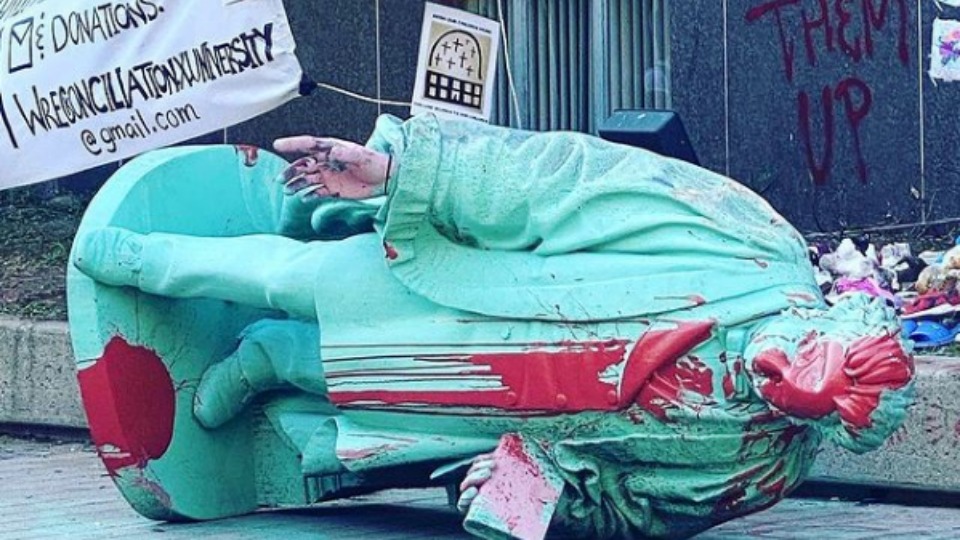
It’s consistent, then, that Ottawa should maintain an unwavering commitment to the racist Jewish settler state in the Levant, known as Israel, made possible by Britain’s conspiring with France and Tsarist Russia during the Great War to carve up the dying Ottoman Empire, and turn over the southern Levant (Palestine and Transjordan) to a British League of Nations mandate, in which was ensconced a commitment to create a Jewish homeland. Canada, not surprisingly, allies itself with the Jewish settlers, and therefore against the indigenous people of the Levant, and was opposed to the efforts of the autochthonous peoples of Zimbabwe to take back their land from the descendants of the British settlers who hacked, cut, pushed, and slaughtered their way into land they dubbed Rhodesia, after the great paladin of British imperialism, Cecil Rhodes. Rhodes is to the indigenous people of southern Africa what Hitler is to the Slavs and Jews. This raises a question about whether Egerton Ryerson, the architect of the residential school system, can be similarly compared. [A statue honoring Ryerson, situated on the campus of the eponymous Ryerson University in Toronto, was recently, and thankfully, toppled.]
The Bolsheviks, who were reviled in Ottawa, established suffrage for all, including for national minorities, before Canada did. Canada didn’t offer universal suffrage, even Herrenvolk (master race) suffrage until after WWI, and true universal suffrage had to wait until 1960, when aboriginal Canadians, the dispossessed original inhabitants of the land, were belatedly allowed to vote.
The United States, another Herrenvolk democracy, didn’t effectively achieve universal suffrage until as late as 1965, when its regime of white supremacy was formally dismantled and the civil and political liberties of black Americans were finally formally secured throughout the country. This late and grudging surrender of white supremacy was partly due to Washington’s need to compete ideologically with the Soviet Union, where racial discrimination—and the idea of a master race—were unthinkable.
What many of us in the United States, Canada and Western Europe hold to be the great social achievements of our countries—the mitigation of discrimination on the basis of sex and religion and racial and national origin, and the development of the welfare state—owe much to the pressures Western elites felt to compete ideologically with the Soviet Union, where discrimination on these grounds was inconceivable and where a robust social welfare state prevailed. With the USSR now defunct, a suicide carried out by the country’s last president, Mikhail Gorbachev—who, for obvious reasons is celebrated in the West, but is widely reviled in Russia—the ideological competition has ceased, and with it, large parts of the welfare state have been dismantled and continue to be demolished.
The French novelist Henri Barbusse, once wrote that the burning question of all time is what is the future of the human race, so martyred by history. To what, he asked, has humanity to look forward to?
Not $15 billion arms deals with monarchs whom Diderot, where he alive, might say ought to be strangled by the entrails of the last Wahhabi cleric; not the dispossession of peoples of their land by usurping settlers from abroad; not denial of self-determination; not wars of neo-colonial re-conquest; not acting as al-Qaeda’s air force to re-colonize the world on behalf of the planet’s dominant imperialist power.
If Canada offered something for humanity, so martyred by history, to look forward to, I would celebrate its founding, or at least, the moment it changed course, and set itself to the service of the vast majority of us—not the centimillionaires and decabillionaires, not the Saudi and Emirati monarchs, not the Jewish usurpers in the Levant, not the international dictatorship of the United States, not the continued colonial dispossession of the aboriginal peoples—but to a world free from the exploitation of humans by humans, where each person is an end in their self and not means to others’ ends.







 What's Left