The genocide scholar Raz Segal has written an insightful article for the Guardian (“The genocide in Gaza is far from over,” 20 November, 2025) which I am flagging because it addresses a question that is almost never asked in public discourse: Why do genocides happen?
Segal asks this question because it is clear that the Nuremberg Trials, the UN Convention on the Prevention and Punishment of the Crime of Genocide, and education programs designed to instil the idea of “never again”, have failed. For, in this post-Holocaust world, the slogan “never again” is belied by the reality of “again and again.”
The common understanding of genocides is that they are caused by bad people with evil in their hearts. This is The Christmas Carol version of the expunction of groups. Bob Cratchet was overworked and underpaid because his boss, Ebenezeer Scrooge, was a miser with a heart of adamant, not because he was a capitalist operating in a world of cut-throat competition. Scrooge had two choices: pay his employees as little as possible and work them as long as possible, or go under. It’s no surprise he chose the former.
How many progressives attribute the problems of the working class to the greed of corporations, as if greed can be disappeared in a poof of moral suasion, or a visit from the Ghost of Christmas Future? Where does greed come from? Scrooge’s greed came, not from his heart, but from bourgeois society and the capitalist imperatives which enslaved him. “We shouldn’t despise human nature,” counseled the eighteenth-century philosophe, Denis Diderot, “but the despicable conventions that pervert it.” Scrooge’s perversion was the despicable convention of capitalism, not a lonely childhood and a love affair gone sour, as Dickens told the tale.
What are the despicable conventions that pervert human nature to produce genocides? For Segal, and others, it is a political project—one of building ethnically homogenous societies.
British settlers in Turtle Island (North America), Australia, and Aotearoa (New Zealand), carried out genocides against the indigenous peoples of these territories, not so much with the conscious intention of building societies of, by, and for White people, but of integrating the land and resources of the indigenous people into a growing world bourgeois system of capitalist production. Inasmuch as the indigenous peoples couldn’t be, and didn’t want to be, forcibly integrated into this system, they were eliminated as obstacles. Thus, the creation of ethnically homogeneous White Christian societies in these lands was a consequence of a capitalist driven process.
Nazi Germany carried out a genocide in Eastern Europe against people it deemed Untermenschen (sub-humans)—Slavs, Jews, Romani, Blacks, and mixed-race people. Of 18 million non-combatants killed by bullets, gas, exposure, exhaustion, and disease in the German war in the European East from 1939 to 1945, 12 million were Slavs and six million Jews. Ninety-six percent of the victims were claimed by Nazi imperialist violence—that is, violence used by the Third Reich to conquer and depopulate Slav territory in order to repopulate it with German settlers.
Significantly, most of the world’s Jews lived within the territory that was the object of the Nazis’ settler colonial ambitions. The Holocaust, in the view of Carrol P. Kakel III, a US historian who has written on the American and German genocides, cannot be separated from Nazi settler colonialism. Six million Jews were killed, not for the sole reason that Nazis hated Jews—a view ingrained in the ideological zeitgeist—but as a consequence of a political project, namely, 1) clearing the European East (where the majority of the world’s Jews lived) of non-Germans to make room for an expanded ethnically homogeneous Teutonic empire and 2) eliminating an ethnic group the Nazis believed was, through the instruments of international finance capitalism and Marxist internationalism, seeking to destroy the German people as a nation.
Raphael Lemkin, the Polish-Jewish lawyer who introduced the concept of genocide in his 1944 study Axis Rule in Occupied Europe, attributed the Nazi genocide of the Slavs to the German settler colonial project, but insisted that the genocide of the Jews, the Holocaust, originated in psychopathological Judeophobia, unconnected to any Nazi political aim. Lemkin’s insistence that Nazi violence toward Jews was driven by psychopathology (thus, bad people with evil in their hearts) likely originated in his Zionism. A core belief of political Zionism is that non-Jews can’t help but hate Jews. As a consequence, Jews can never safely live among non-Jews, and must therefore have their own state if they are to be safe and survive as a people. Genocide scholar A. Dirk Moses has argued vigorously against the view that the Holocaust was the consequence of apolitical hatred, rooting the Judeocide instead, along with other genocides, in political projects. He criticizes the Genocide Convention for depoliticizing genocide—that is, for failing to recognize that genocides are carried out by ethnic groups against other ethnic groups they see as economic or political competitors. Often, but not always, the competition is over land. Or one ethnic group sees another as a threat to its survival.
Certainly, the origins of the genocide of the Palestinians can be found in a political project—clearing Palestine of its indigenous population to make room for Jewish settlers and the creation of a Jewish ethnic state. Zionist settler colonialism has obvious connections to the British-settler colonial genocides of the indigenous peoples of Canada, the United States, Australia, and New Zealand, as well as the Nazi political project of creating an expanded German empire in the European East comprised solely of Aryan Germans.
Segal argues that the reason we live in a post-Holocaust world of again and again is because the political project that has regularly given rise to genocide—one of creating ethnically homogeneous states—continues to be seen as legitimate. One of the reasons (though not the only or even most important reason) the United States, Britian, Canada, and the Soviet Union backed the creation of an ethnic Jewish state in Palestine, was because they believed that ethnic states were legitimate, necessary, and desirable. Self-determination, the notion that every ethnic group should have its own state, enjoys considerable esteem. Thus, the idea of a single democratic state in Palestine, from the river to the sea, where everyone is equal, is frequently dismissed in preference to the creation of two ethnically homogeneous states existing side-by-side—one Jewish, the other Palestinian. This is the two-state solution. Zionists prefer one Jewish state in all of Palestine (today’s reality) and some Palestinians would like to see a Palestinian state from the river to the sea, cleansed of its Jewish inhabitants, save for the descendants of Jews who lived in the country prior to the political Zionist waves of European immigration.
Abolishing genocide and getting to a world of never again means abolishing the idea that the ethnic state is either necessary or desirable. We don’t need ethnic states; we need civic states, where all people are equal and gender, sexual-orientation, ethnicity, national origin, religion, color, language, and all other ascriptive markers of identity have no political significance.
However, ideas are not abolished by fiat; conduct is not deduced from principle. The fact that the land of the indigenous peoples of North America and Oceania offered attractive possibilities to metropolitan Europe, and the proletarians it disgorged to the colonies, created the idea of the desirability of settler colonialism. The idea of political Zionism arose in the anti-Semitism of Europe, which in turn arose in the need of Europe’s rulers to diffuse threats to their rule by turning their subjects’ anger against a scapegoat. The war against the Jews became a substitute for the class war against Tsarist oppression and capitalist exploitation. A. Dirk Moses makes a compelling point that genocide is pursued as a solution to a political problem, but political problems arise not in the world of ideas, but in social and economic intercourse.
One of the surest ways of solving the political problem of two groups vying for political and economic resources within the same territory is for one or both of them to try to expel or physically destroy the other. So long as humanity is divided by ascriptive identity will identity groups vie for political and economic resources, and so long as identity groups vie for political and economic resources, the possibility of genocide will be ever present.
The arrest of Palestinian advocate Mahmoud Khalil for campaigning for an end to the oppression and genocide of Palestinians, would be un-American if the US state were devoted to ending exploitation and oppression. But inasmuch as it is ruled by and for an exploiting and oppressing class, Khalil’s arrest is American to the core.
By Stephen Gowans
March 11, 2025
US president Donald Trump has ordered the arrest and deportation of Mahmoud Khalil, a green card holder and legal permanent resident of the United States, for espousing what Trump denounces as “anti-American views” (which apparently means views at odds with his own.) Khalil’s arrest, Trump promises, is only the first of many. The US president has pledged to deport pro-Palestinian college students on visas who participate in what he deems “illegal” protests (which is to say those the monarch dislikes.) He has also threatened US citizens with permanent expulsion from their universities and their possible arrest for protesting against Israeli apartheid and the Zionist campaign of genocide.
As a student protest organizer at Columbia University, Khalil has been a vociferous advocate of an end to the oppression of Palestinians. This is what counts, to the fervently pro-Israeli Trump, as anti-Americanism. Trump professes to be (without hyperbole for once) the most pro-Israeli president ever. There is no question that he has made signal contributions to the Zionist project of despoiling Palestinians, as well as Syrians in the Golan Heights, of their countries, land, homes, and property—perhaps more than any other president has. As far as Trump is concerned, the rape of Palestine and southern Syria can proceed unhindered except for the resistance of Palestinians and Syrians, and with his unqualified support—not only in the provision of diplomatic and military aid in repressing the native resistance, but also in repressing the resistance at home.
Congresswoman Ilhan Omar has denounced Khalil’s arrest as “un-American.” It would be more accurate to say that the detention belies the myth of America; it hardly stands as an exception to the reality of America. Systematically suppressing political advocacy, where it opposes the right of the wealthy to exploit labor, and the prerogative of the strong to take the property of the weak by violence, extortion, or law, has been a regular and predictable feature of US political life since the country’s birth. After all, the United States was built on a policy of manifest larceny—the theft of the country, land, and property of indigenous Americans and the stolen labor of enslaved Africans.
The 1919-20 Palmer Raids (organized by Attorney General A. Mitchell Palmer) saw 6,000 people arrested and 556 deported for expressing views deemed anti-American (advocacy of socialism or opposition to war). Through the late 1940s and 1950s, the US engaged in widespread repression of political speech in what is now called the Second Red Scare. (The first red scare followed the 1917 Bolshevik Revolution).
The New York Times’ Julian E. Barnes recalled the repression of “anti-American” speech during the First World War.
Congress first passed the Espionage Act in 1917 at the urging of President Woodrow Wilson [in] a bid to quell dissent against the United States’ support for World War I…
In 1918, a set of amendments prohibited speech considered disloyal or abusive to the United States.
During the war, for example, the producer of a film, “The Spirit of ’76,” was prosecuted under the act and sentenced to prison in 1918 because the government believed the movie undermined the British, a World War I ally, and was therefore seditious.
In 1918, Eugene V. Debs, the socialist candidate for president, was sentenced to 10 years in prison for a speech criticizing the wartime draft. [1]
Political speech is regularly repressed in the United States when the business-connected elite that runs the state on behalf of its class believes that the values it defines as “American”—namely, its own—are threatened.
As the philosopher and historian Domenico Losurdo explained:
In reality, although protected by the Atlantic and Pacific, every time [the US ruling class] has rightly or wrongly felt imperilled, [it] has proceeded to a more or less drastic reinforcement of executive power and to more or less heavy restrictions on freedom of association and expression. This applies to the years immediately following the French Revolution (when its devotees on American soil were hit by the Alien and Sedition Acts), to the Civil War, the First World War, the Great Depression, the Second World War and the Cold War. Even in our day, the sequel to the attack of 11 September 2001 was the opening of a concentration camp at Guantanamo, where detainees have been imprisoned without trial, and without even being informed of a specific charge, regardless of age. [2]
Losurdo went on the point out that the principals of the US state are energetic critics of rival states that suppress political advocacy in times of crisis–for example during invasions, military occupation, and threats of nuclear destruction (often engineered by the United States itself)–yet ardently repress political advocacy within their own borders in response to crises that are far less formidable than those the United States visits upon enemy states through its aggressions.
The notion may be shocking in light of what we have been taught to believe about the United States, but the truth of the matter is that every state is a police state—the US, and other self-described “free world” and liberal-democratic states, included. States exist both to advance the interests of their society’s dominant class, and to repress the resistance of those who the dominant class exploits. The political advocacy of the resistance is policed by the state, hardly at all when the resistance is weak and quiet, and more openly and viciously when it gathers strength and raises its voice. It is in periods of political tranquility, when the resistance of the exploited class carries on as a largely silent part of everyday life, that the character of the state qua police state is hardly evident, and the state favored by quietude fosters the myth that it is not a police state at all, but a champion of political liberty. It is easy to champion freedom of political advocacy when no one advocates ideas you don’t like, or those who do are voices crying out in the wilderness. But when the quietude of the subordinate class is disturbed, when its voice begins to establish reach, when it mobilizes and its actions become disruptive, the proclivity of the class in control of the state is to repress the militants, coopt the moderates, and threaten the remainder until they return to their accustomed passivity—in other words, the inclination is to reveal the police state for what it truly is. We should not say at these times that this is un-American, or un-Canadian, or un-British, and so on, but that the veil has once again been lifted from the police state because we are once again growing strong.
It’s important to understand that:
The US state (hardly alone among capitalist states) represents the interests of its wealthiest citizens and cares only for the interests of the many so far as doing so is necessary to create stable conditions for the tranquil transfer of economic surplus from labor to itself.
US domination of West Asia, a strategic and economic area of colossal importance, is significantly aided by the presence in the region of a Jewish settler state committed, by the very demands of its own survival, to repress the Arab and Islamic opposition to both its existence as a state as well as the United States’ existence as a regional tyrant. The relationship of the United States to Israel is one of symbiosis, based on sharing a common enemy, namely, the region’s forces of independence and national assertiveness.
The United States is the largest settler colonial state in world history, and is thus predisposed by its own traditions to support other settler colonial states, ceterus paribus; that is, when it makes sense to do so in light of the strategic and profit-making interests of the United States’ wealthiest citizens.
Christian Zionists—who believe it is their religious duty to support Israel—comprise a sizeable part of the US electorate. While their views are a matter of indifference to US policy-makers, the reality that they broadly support US policy (one that, unbeknownst to them, is rooted in the economic and strategic interests of the US ruling elite), is helpful in hiding the authentic reasons for US support of Israel behind a democratic facade. It can be said, falsely, that US policy reflects, in large measure, what US voters want. In reality, it reflects what the corporate and finance elite wants.
In light of the foregoing, we can conclude that in the face of growing support for Palestinians, and in the context of increasing opposition to the Zionist project, that the inclination of the US state—despite its professed commitment to liberal democratic values—is to ignore popular opinion and to try to crush political advocacy which contradicts its policy preferences. The myth of America not only includes the notion that the state is committed to free expression and political advocacy, but that it is responsive to popular opinion. The latter myth is contradicted by two important studies.
One in 2005 by Benjamin Page and Lawrence Jacobs, found that “public opinion has virtually no effect on foreign policy, which instead strongly tracks the preferences of internationally oriented corporations, which favor open access to trade and investment abroad. Page and Jacobs noted that experts seemed to have some effect on foreign policy, but that experts are also likely influenced by business groups.” [3]
A 2014 study of over 1,700 US policy issues by Page and his fellow political scientist Martin Gilens discovered that “economic elites and organized groups representing business interests have substantial impacts on government policy, while average citizens and mass-based interest groups have little or no independent influence.” [4]
In other words, growing popular momentum on behalf of the Palestinians and against their oppression by Israel will not turn US policy-makers into pro-Palestinians or significantly shift US foreign policy. US policy-making and US public opinion operate in non-overlapping spheres, with the former largely immune and indifferent to the latter. To paraphrase George Carlin, US policy-makers and their wealthy backers belong to a club, and 99 percent of US citizens are not in it.
Accordingly, growing support for an end to Zionist apartheid and the genocide against Palestinians will cause officials, not to shift policy in the name of democracy, but to lift the veil from their police state and to crack down on resistance to their preferred pro-oppression policy positions.
Is the state’s aversion to popular opinion and democracy and preference for repression in the face of growing opposition to its conduct, a reason to return to quietude? Hardly. It’s an invitation to look at political struggle realistically, as a class war in which violations of ostensibly cherished rights will happen, as they have always happened, when the latitude of those at the top to exploit and oppress those below is threatened by resistance. Victory is possible only if illusions are shed about the identity of the enemy and its true character. The United States, as much as any other state, is not a paladin of political liberty, but a police state standing on guard for the political and economic interests of its ruling class. For the rest of us, it is a police state, and always has been.
1. Julian E. Barnes, “What Is the Espionage Act and How Has It Been Used? The New York Times, August 15, 2022.
2. Domenico Losurdo, War and Revolution: Rethinking the Twentieth Century, Verso, 2015, p. 258.
3. Christopher McCallion, “A Better Foreign Policy Abroad Requires a Strong Labor Movement at Home”, Jacobin, May 30, 2022
4. Martin Gilens and Benjamin I. Page, “Testing Theories of American Politics: Elites, Interest Groups, and Average Citizens,” Perspectives on Politics, September, 2014.
Jacobin’s Cloudy Thinking on Hamas’s Resistance and Palestinian Solidarity
“If no consideration in a political crisis has been addressed to the people of this country except to remember to hate violence and love order and exercise patience, the liberties of this country would never have been obtained.” British Prime Minister William E Gladstone [1]
November 1, 2024
By Stephen Gowans
Jacobin contributing editor BashirAbu-Manneh has written a criticism of the pro-Palestinian protest movement (“Palestine Needs Mass Support, Not Sectarian Marginalization,” Jacobin, October 30, 2024), arguing that its effectiveness is clouded by poor strategic thinking. It is not, however, the protest movement’s thinking which is clouded, but Abu-Manneh’s own thinking, which is contradictory and self-refuting. In effect, Abu-Manneh urges readers to hate Hamas’s violence, love international law, and exercise patience, while defining the Palestinian cause as the achievement of Palestinian Bantustans alongside a Zionist colonial settler state. To make his case, he deploys a series of arguments which collapse under the weight of their own contradictions. I have set out his arguments below, and show how they are based on poor—and, ultimately, anti-Palestinian—reasoning.
The Jacobin contributor begins his article by attributing what he calls the cloudy strategic thinking of the pro-Palestinian protest movement to its members’ anger and frustration at Israel’s indifference to “the wrath of global public opinion” and their being “ignored and sidelined by warmongering elites.” In his view, emotion has impaired judgment. A “very small minority of vocal activists,” he writes, “have turned legitimate anger and frustration … into a mindless embrace of violence” which is playing “into the hands of those who want to see a popular antiwar mass movement discredited.”
“Most worryingly,” he adds, “some voices in the Palestinian solidarity movement have glorified Hamas’s October 7 attacks,” quickly noting that: “There is no question that Palestinians have a right to resist foreign occupation. That is an achievement of the decolonization era enshrined in international law. But it does not follow that everything the Palestinian resistance movement does advances the Palestinian cause.”
Let’s unpack this paragraph.
Abu-Manneh attributes the Palestinians’ right to resist foreign occupation to international law. But where does international law come from? Does it exist independently of humanity, or is it written by humans? And which humans write it? International law is formulated, ignored, or enforced, by the most powerful states, at their discretion. The international system is characterized, not by “the rule of law”, in which no state stands above it, but “rule by law”, in which law is selectively applied by those who have sway over it, namely, states with permanent Security Council vetoes, at least four, and possibly all of which, can be characterized as formerly if not current colonial states. One, the United States, originated, as Israel has, in settler colonialism. [2, 3] If the states that dominate the international system, and therefore the formulation and (selective) application of international law, were to decide that the Palestinians have no right to resist occupation, would their resistance be illegitimate? By Abu-Manneh’s reasoning, it would be. This gives us the first clue about how the Jacobin contributing editor thinks about the Palestine question. He regards it not as a question of settler colonialism (the theft of the Palestinians’ country, land, homes, and property and what to do about it), but one of international law, a law over which powerful states, many of them with histories of colonial or settler colonial domination over other peoples, have always exercised an outsize influence. Palestinians may have the right of resistance in international law, but it amounts to little. Does international law, or the great powers who write and selectively enforce it, protect Palestinians as they exercise this right? On the contrary, these same powers raise Israel’s right of self-defense to an inviolable principle of the first order, while execrating, gagging, or punishing anyone bold enough to invoke the Palestinians’ right of resistance. At the same time, they sanction the killing of Palestinians who exercise their right as the necessary and desired outcome of Israel exercising its hallowed right of self-defense.
International law, in the form of the US, British, and Israeli-authored 1967 UN Security Council Resolution 242, recognizes as legitimate a settler colonial Israeli state, implanted by force and by means of ethnic cleansing, on the four-fifths of a country known as Palestine which Zionist settlers conquered in 1948. This law does not grant the Palestinians the right to resist the foreign occupation of this part of their country. So, yes, international law concedes a right to resist, but it is meaningless in fact, and to make matters worse, the right is conceded for only one-fifth of historic Palestine.
We can think of Israel as a settler colonial project which has consolidated its theft of Palestinian land, homes, and property in four-fifths of Palestine. We can think of it too as seeking to extend its larceny to the one-fifth of historic Palestine that has yet to be completely plundered. We can also think of international law as a means of legitimizing the theft. Alternatively, we can, as Abu-Manneh does, fetishize international law, seeing it not as the instrument of colonial and settler colonial states, used to legitimize the existence of Israel [4] but naively, as a neutral expression of universal justice.
After accepting the Palestinians’ right to resistance based on international law (and exercisable only in the one-fifth of the Palestinians’ country which Jewish settlers were unable to capture in 1948), Abu-Manneh writes: It “does not follow that everything the Palestinian resistance movement does advances the Palestinian cause.” This is true as far as it goes, but the statement is of little value unless we know what “the Palestinian cause” is. In Abu-Manneh’s view, the Palestinian cause has nothing whatever to do with decolonizing Palestine, dismantling apartheid, and overcoming Zionist racism. Instead, the cause, in his view, is bringing to fruition the two-state solution as laid out in the 1967 UN Security Council Resolution 242–that is, the achievement of a Palestinian state in one-fifth of the Palestinians’ country, alongside a Zionist colonial settler state, on the larger four-fifths.
Now that we’re clear on what Abu-Manneh thinks the Palestinian cause is, we can ask why he accepts Palestinian resistance (in the abstract) but rejects Hamas’s Operation Al Aqsa Flood (as a specific instance of Palestinian resistance.) According to the Jacobin contributor, any “reasonable cost-benefit analysis for the people of Gaza has to conclude that the price” of the 7 October attack (i.e., Israel’s retaliation) “is simply not worth it.” Owing to “a balance of power that is overwhelmingly to Israel’s advantage” the Hamas rebellion was, in his view, “a massive miscalculation.”
It is indeed true that there exists between Israel and the Palestinians a massive imbalance of power. But what does the fact that there is a massive imbalance of power mean? It means that Israel has been able to maintain an ongoing, unremitting, regime of aggression against the Palestinians, which continues the project, begun over one hundred years ago, of replacing one country, Palestine, with another, Israel, and displacing the indigenous Palestinians with transplanted Jews. This is an ongoing project. It didn’t stop in 1967, when the UN Security Council ordered Israel—without, as time has shown, the slightest intention of compelling Israel’s compliance—to withdraw from the new territories it had taken. It is not the case, as Abu-Manneh supposes, that the great imbalance of power is fixed and that the Zionist project is sated, with no further conquests on its agenda. On the contrary, before 7 October, each passing day was one in which ever more Palestinians were crushed under the wheels of the Zionist juggernaut. Settlements continued to be built in the West Bank. The Gaza blockade continued to make life miserable for Palestinians. Israel continued to threaten to Judaize the Haram al-Sharrif. Abu-Manneh assumes that there existed prior to 7 October a fixed status quo, which, however grim it was, was still better than what has befallen the Palestinians since. To the contrary, the condition of Palestinians was—despite the misplaced faith the Jacobin contributor has in international law—one of incessant weakening and deterioration. Palestinians faced, not a choice of standing still if they did nothing, or going backward if they provoked Israel’s fury, but if they did nothing, of going backward slowly, inexorably, until Palestinians and Palestine ceased to exist. It was a choice of dying on their knees or standing on their feet.
This is not to say that there are not miscalculations in struggle, and that Operation Al Aqsa Flood was not a miscalculation. It may have been. In fact, there is evidence to suggest that the attack didn’t unfold quite as the Hamas leadership intended. Far greater Israeli resistance was expected, and when Hamas fighters quickly achieved their limited objectives, the operation dissolved into chaos. [5] Yahya Sinwar, the Hamas leader who has since died in battle, remarked that “Things went out of control. People got caught up in this, and that should not have happened.” [6]
In decrying the 7 October Hamas operation as not worth the candle because the outcome has been a devastating Israeli retaliation, Abu-Manneh fails to blame the architects of the retaliatory ossuary: Israel and its principal backers, the United States and Germany, the former a veritable co-belligerent. One could argue that the carnage is due to both the provocation of Hamas (a distal cause) and Israel’s response to it (the proximal cause). Instead, Abu-Manneh chooses to lay 100 percent of the blame at Hamas’s door, removing the proximal cause (Israel and its backers and co-belligerent) from the equation altogether. This is blatant victim-blaming.
If that isn’t bad enough, the Jacobin contributing editor then denies Hamas any credit for the benefit of the 7 October rebellion. The benefit, as he puts it, is that “Palestine is now back in global political focus.” But why is it back? In Abu-Manneh’s view, “Because of Israel’s brutal genocide”, not because Hamas undertook an operation which included among its aims the rescue of the Palestinian cause from the oblivion into which it was rapidly sinking. [7] If Hamas is to be blamed for provoking Israel to accelerate the job of erasing the Palestinians—conduct hardly at odds with the history of Zionist settler colonialism (isn’t its point to eliminate the natives to make way for the settlers?)—then it must also be credited with placing Palestine back on the global agenda. Does Abu-Manneh believe that “the huge global protest movement … against colonization and occupation” and the radicalization of “a new generation of young activists,” would have occurred had Hamas or other resistance groups not carried out the Al-Aqsa Flood action or its equivalents? Palestine had fallen off the radar until Hamas acted. Now Palestine and the Palestinians are back with a vengeance. Abu-Manneh’s vaunted international law had done nothing, up to 7 October, to keep them on the agenda. Indeed, it was the failure of international law and the quietude of the Palestinian solidarity movement that galvanized Hamas to act.
Having dismissed Palestinian militant action as ill-advised in light of the enormous imbalance in power between Israel and the Palestinians, Abu-Manneh turns to international law as the Palestinians’ possible savior. In view of the fact that the UN and international law have played important roles in facilitating the Jewish settlers’ spoliation of Palestine and its indigenous people—especially UN General Assembly Resolution 181 of November 1947, which recommended the partition of the Palestinians’ country, and UN Security Council Resolution 242 of 1967, which legitimized the Zionist settler state’s capture of four-fifths of Palestine, and the ethnic cleansing of much of the Palestinian population from it—the idea that the Palestinians should look to international law for salvation is wholly unconvincing; one may as well have asked Hitler to solve the problem of anti-Semitism.
All the same, Abu-Manneh is particularly encouraged by “the July International Court of Justice (ICJ) ruling (July 19, 2024) [which] has deemed Israel’s occupation illegal.” But it should be understood thar the ICJ opinion has not deemed as illegal the Zionist occupation of a country called Palestine; it has only declared illegal the occupation of the one-fifth of Palestine which the settlers failed to conquer and ethnically cleanse in 1948. What encourages the Jacobin contributor, is thus, an ICJ ruling which presses Israel to accept the two-state solution, what Palestinian scholar Rashid Khalidi denounces as “a one-state, multiple-Bantustan solution.” [8] And how is the two-state solution—which Israelis vehemently oppose [9], and whose history is one of a false promise designed to keep the Palestinians passive while what remains of their country is gradually taken away from them—to be brought to fruition? Through “focussed political work and organization” counsels Abu-Manneh—in other words, by mobilizing radicalized youth and the “huge global protest movement” to press countries to pressure Israel to grant the Palestinians the sop of a few Bantustans. Abu-Manneh’s favored two-state solution, “has always been meaningless, a cruel Orwellian hoax,” concludes Khalidi. It “would effectively maintain the status quo in Palestine under a different form, with an externally controlled Quisling ‘Palestinian Authority’ lacking real jurisdiction or authority replaced by a Quisling ‘Palestinian state’ similarly devoid of the sovereignty and independence that attach to a real state.” [10]
Abu-Manneh’s thinking is problematic, if not naïve and, worse, revolting, on three levels.
First, it ignores his own assessment of public opinion. Israel, he notes correctly, is “protected from the wrath of global public opinion.” Moreover, “protesters and activists” are “ignored and sidelined by warmongering elites.” If Israel is insulated from public opinion, and protestors and activists are ignored, how is “focussed political work and organization” going to compel Israel to grant Palestinians the multiple Bantustans Abu-Manneh thinks will resolve the Palestine question? The imbalance in power between Israel and the Palestinians is indeed huge, but the yawning chasm is not only a military one, but a public diplomacy one, as well. If you’re going to say, don’t take on Israel militarily, because its military power is overwhelming, don’t, at the same time, say take on Israel in the realm of public opinion, without recognizing that Israel’s public diplomacy power is also overwhelming. This is surely clouded strategic thinking.
Second, in advocating a one-state-multiple-Bantustan solution, Abu-Manneh proposes that radicalized youth and the huge global protest movement accept Jewish settler colonialism and Zionist apartheid in four-fifths of the Palestinians’ country, in return for Palestinian Bantustans on the remaining one-fifth. Were the radicalized youth who Abu-Manneh celebrates to accept his program they would immediately become de-radicalized, for there is nothing radical about Abu-Manneh’s counsel. Neither is there anything progressive about it. Would a movement against apartheid in South Africa which advocated multiple Bantustans alongside a white supremacist state be called progressive? Of course not. So why would we think the equivalent for Palestine is acceptable? Indeed, it’s difficult not to conclude that the whole point of Abu-Manneh’s intervention is to persuade the global protest movement to deradicalize, on the grounds that this will somehow (he doesn’t quite say how) pay off in strategic gains. This comports with the mild, reformist, orientation of Jacobin—a periodical of the Left devoted to hating violence, loving order, exercising patience, and bartering principle for bourgeois respectability.
Third, the energy of the global protest movement and radicalized youth—energy Abu-Manneh seeks to mobilize on behalf of his favored one-state-multiple-Bantustan solution—would hardly exist had Hamas not undertaken the very same Operation Al-Aqsa Flood he so deplores. Had Hamas accepted anything like Abu-Manneh’s counsel, Palestine and the Palestinians would now be virtually invisible and teetering on the precipice of extinction.
The Jacobin contributor believes that “glorifying” Hamas’s violence will frighten people away from joining the protest movement he acknowledges is already huge and global. In fact, the movement Abu-Manneh has set out to save from cloudy strategic thinking is huge and global despite, or perhaps because of, the “cloudy” thinking he deplores. The Jacobin contributor also fears that failing to denounce Hamas’s 7 October resistance allows Israel and its supporters to discredit opponents of the Israeli’s genocide against the Palestinians. Operation Al Aqsa Flood, was, he argues, a miscalculation that is wholly responsible for the slaughter of tens of thousands of Palestinians. Yet, the operation hardly seems to have been a miscalculation from the point of view of preventing the erasure of Palestine and the Palestinians; it is responsible, at least distally, for revitalizing the pro-Palestinian movement, a revitalization Abu-Manneh welcomes, but all the same fails to give Hamas credit for. The Jacobin writer appears to believe that there are ever more legions of people ready to join the global protest movement if only a very few voices in the Palestinian solidarity movement stop glorifying Hamas’s 7 October attack. His assessment is unconvincing. If more people haven’t joined the already huge and global movement, a more plausible explanation is that they see –to invoke Abu-Manneh’s own assessment of the impotence of public opinion—little point in being “ignored and sidelined by warmongering elites” as Israel enjoys its protection “from the wrath of global public opinion.”
It is unclear why Abu-Manneh believes that failure to decry Hamas’s 7 October uprising plays into the hands of Israel and its supporters, unless he believes, notwithstanding his endorsement of resistance in the abstract, that violent resistance against Israel is illegitimate. Could it be that his reference to the right of Palestinian resistance is mere lip-service? He says resistance is legitimate, but despite this, insists that glorifying the resistance of Hamas on 7 October plays into the hands of the Palestinians’ enemies. This is a contradiction. How could glorifying a legitimate act discredit the movement? Abu-Manneh might say the reason why is because Hamas’s resistance, albeit legitimate, was a miscalculation. But how does glorifying a Hamas miscalculation play into Israeli hands? It doesn’t make sense. It seems more likely that Abu-Manneh is a supporter of violent rebellion in the abstract, as an idea alone, suitable only for discussion in university colloquia, and certainly not as a project to be carried out in the real world.
The reality is that the revitalization of the global Palestinian solidarity movement wouldn’t have happened had Hamas not launched its 7 October operation. Abu-Manneh fails to credit the very same operation whose glorification he deplores for re-igniting the mass movement he welcomes, presenting an argument that can hardly be taken seriously, namely, that the way to build mass support for Palestine is to glorify an international law which has achieved nothing for Palestinians, while defining the Palestinian cause as the achievement of an apartheid Zionist settler state in four-fifths of the Palestinians’ country, alongside multiple Bantustans in what is left over.
Abu-Manneh’s clouded thinking recalls E.H. Carr’s riposte to the advocates of peaceful change. In his Twenty Years’ Crisis, 1919-1939, Carr wrote, that the “attempt to make a moral distinction between wars of ‘aggression’ and wars of defense’ is misguided. If a change is necessary and desirable, the use or threatened use of force to maintain the status quo”—one thinks here of Israel’s vaunted right to defend itself—”may be more morally culpable than the use or threatened use of force to alter it.” [11] He continued: “The moral criterion must be not the ‘aggressive’ or ‘defensive’ character of the war, but the nature of the change which is being sought and resisted. ‘Without rebellion, [humanity] would stagnate and injustice would be irremediable.’ Few serious thinkers maintain that it is always unconditionally wrong to start a revolution; and it is equally difficult to believe that it is always and unconditionally wrong to start a war.” [12]
This isn’t to say that Hamas started a war on 7 October. The war is a long-running one, whose origins are found in the actions of Theodor Hertzl and his supporters and successors to create a Jewish state by making an existing country, Palestine, cease to exist. Hamas only opened a new battle in the long-running war on 7 October. The point is that the violent rebellion of the natives must be evaluated against the nature of the change that was sought and resisted (ultimately, the liberation of Palestine, and immediately, the arrest of the disappearance of Palestine and Palestinians.) Hamas appears to have accomplished its immediate aim and for this, for its fight against the iniquities of settler colonialism and apartheid, and for its role in helping to revitalize the pro-Palestinian movement, it deserves credit.
So, is glorifying Hamas’s 7 October rebellion strategically unsound? It may be, but not for the contradictory reasons Abu-Manneh adduces, and nor for any reason I can fathom. The Jacobin contributor has allowed his anger and frustration at Hamas’s Islamist character—which he revealed in an earlier Jacobin article [13]—cloud his judgment about the merits of the organization as a vehicle for the liberation of Palestine. I share Abu-Manneh’s opposition to Hamas’s Islamism, but I recognize the merits of the group’s Operation Al Aqsa Flood. Whether one agrees or disagrees with the political Islam of Hamas is of no relevance to the question of whether the organization’s conduct has advanced the aims of overcoming Zionist settler colonialism and apartheid. Neither Hamas nor its secular compatriot organizations will ever be acceptable to respectable opinion in colonial and settler colonial countries, and bartering away principle for respectability by denouncing Hamas or refusing to give it the credit it deserves, is a fool’s game.
1. Cited in E.H. Carr, The Twenty Years’ Crisis, 1919-1939, Palgrave MacMillan, 2016, p. 193
2. Three of the five permanent UN Security Council members, the United States, France, and Britain, were once self-declared colonial countries. All retain some colonies today under various euphemistic aliases, such as regions, protectorates, and territories. Puerto Rico, for example, is a de facto US colony, while Guadeloupe and Martinique count among a number of French colonies. Bermuda, Gibraltar, and the Falkland Islands, inter alia, are British colonies. Russia and China were empires, based on the domination of conquered peoples by a metropolitan ethnic elite.
3. For more on this perspective on international law see the Third World Approaches to International Law Review, https://twailr.com/
4. Benjamin Netanyahu has called Israel “the West’s outpost in the Middle East” (and hence, the instrument of the colonial and colonial settler powers which comprise the West). Quoted in Adam Shatz, “The sea is the same sea,” The London Review of Books, (Vol. 40 No. 16, 30 August 2018).
5. “A time of painful birth and major transformation’: a senior Hamas leader reflects on October 7 and its aftermath,” Mondoweiss, October 6, 2024; Our Narrative: Operation Al-Aqsa Flood, Hamas Media Office; Ben Hubbard and Maria Abi-Habib, “Behind Hamas’s Bloody Gambit to Create a ‘Permanent’ State of War,” New York Times, Nov. 8, 2023; Nelly Lahoud “A Catastrophic Success for Hamas?”, Foreign Affairs, October 23, 2023.
6. Summer Said and Rory Jones, “Gaza Chief’s Brutal Calculation: Civilian Bloodshed Will Help Hamas,” The Wall Street Journal, June 10, 2024.
7. “Sinwar certainly achieved his goal of bringing the Palestinian issue to the center of geopolitics,” writes Yaroslav Trofimov in “Sinwar’s Bloody Gambit Changed the Middle East—but Not as He Imagined”, The Wall Street Journal, Oct. 19, 2024: “We make the headlines only with blood,” Sinwar said. “No blood, no news.” Summer Said and Rory Jones, “Gaza Chief’s Brutal Calculation: Civilian Bloodshed Will Help Hamas,” The Wall Street Journal, June 10, 2024.
8. Rashid Khalidi, “The Neck and The Sword,” New Left Review, May/June, 2024.
9. “The U.S., Europe and many Arab governments insist the overdue answer is the two-state solution, under which Israel and a Palestinian state would exist side-by-side. The snag is that Israelis and Palestinians no longer believe in it.” Marcus Walker, Fatima Abdul Karim and Anat Peled, “The Way to Fix the Middle East Conflict Looks Obvious—Except to Israelis and Palestinians, The Wall Street Journal, Aug. 18, 2024.
10. Rashid Khalidi, ‘A new abyss’: Gaza and the hundred years’ war on Palestine, Guardian, 11 Apr 2024.
11. Carr, p. 193.
12. Carr, p. 193.
13. Bashir Abu-Manneh, “The Palestinian Resistance Isn’t a Monolith,” Jacobin, April 28, 2024.
Haaretz columnist Gideon Levy recently misattributed the Himalaya of injustices the Israelis have visited upon the Palestinians to ‘the army,’ as if, absent the IDF, Israel—not only its conduct but its very ethos—would become acceptable to world opinion. [1] But were the IDF to disband, or renounce its genocidal conduct, Israel would still be a Jewish state, founded on the robbery of the Palestinians, and committed to their continued dispossession and exile in order to maintain the state’s Jewish character.
The army’s role in Israel is to defend Jewish supremacy and extend the territory over which Jews come first and Palestinians matter not at all. The 1948-9 theft by Jewish nationalist settlers of the Palestinians’ country, along with their homes, land, and property, is Jewish supremacy’s original sin. The IDF defends and promotes it. The two-state solution ignores and conceals it.
The fruits of the Jewish nationalist plunder are thus defended by violence, and extended to such territory in the West Bank which Jewish settlers have not yet completely taken for their own use. The process is summarized by a single word: Zionism—the racist ideology of Jewish nationalism and Palestinian dispossession. Pro-Zionist, as the Palestinian revolutionary Leila Khaled once pointed out, equals anti-Palestinian.
It is Zionism (the project) and its child, Israel, not the IDF (the project’s instrument), that lies, contra Levy, at the root of the problem of Israel.
To correct Levy, the following injustices, which he attributes to the IDF, are properly understood as the bastards of settler colonial Jewish nationalism.
“…the Sde Teiman base is [Zionism], the human shields used in Gaza are [Zionism], the assassinations are [Zionism]. Forty thousand dead are [Zionism], the destruction of Gaza is [Zionism]; the cruel roadblocks in the West Bank are [Zionism]; the killing of the 3-day-old twins, along with their mother and grandmother, while the father was out obtaining their birth certificate, is [Zionism]; the growing use of drones for killing people in the West Bank is [Zionism]; the pilots, artillery units, armored units, bulldozers, canine units, they are all [Zionism].”
It is difficult to understand how the two-state solution continues to be seen by people ostensibly committed to Leftist or humane values as constituting either a just solution, or even a practical one. Levy himself rejects the two-state solution, not because he dislikes it, but because, with 700,000 Jews in the West Bank, he recognizes that the idea is no longer workable. Scholar Rashid Khalidi calls the two-state solution an Orwellian hoax—a promise to replace the quisling Palestinian Authority with a quisling Palestinian pseudo-state. The two-state solution has always meant one Jewish state plus Palestinian Bantustans, Khalidi argues.
The two-state solution in its current guise rests on UN Security Council Resolution 242, formulated by the United States and Israel, and ratified by the Soviet Union, as a solution to the 1967 Six-Day War, in which Israel conquered the Sinai, the Gaza Strip, the West Bank, East Jerusalem, and parts of Syrian territory in Jawlan (the Golan Heights).
The resolution (unheeded by Tel Aviv) demanded that Israel withdraw to its pre-1967 position, roughly the armistice lines which ended the conflict of 1948-9 between the Zionist settlers and four of the Arab states—Egypt, Lebanon, Syria, and Jordan. These states had intervened in the war between the Palestinians, who were seeking to keep their country, and the Zionists, who were seeking to make it their own.
At the heart of 1948-9 conflict was UN General Assembly Resolution 181 of 29 November 1947, which ended the British Mandate in Palestine and ordered the partition of the country between Jewish and Arab states, to be linked by an economic union, with Jerusalem under international control. The resolution assigned 56 percent of the Palestinians’ country to Jewish settlers, most of whom were recent immigrants, and who comprised less than one-third of the population. The Palestinians, the majority, were granted a state comprising only 42 percent of their country. The remaining two percent was allocated to an internationalized Jerusalem.
Neither the Palestinians, who had been disarmed by the British Mandate, and in any event had little military training, or the Arab armies, which were rendered ineffective by division and the absence of a central command, and were outnumbered by Jewish settler forces by at least three to one, could prevail against the well-organized, well-trained, and well-equipped Zionists. The Jewish nationalists could count on the assistance of Western imperialist countries as well as the Soviet Union, which shipped arms to the Zionists through Czechoslovakia. Indeed, it was the colonialist West in partnership with the USSR that presented and approved the partition of the Palestinians’ country. Little wonder that the great powers should play a key role in helping the settler army rob the Palestinians.
The outcome of the war was, from the Palestinians’ perspective, a Nakba. Zionist settlers conquered 80 percent of the Palestinians’ country—not just the 56 percent which Resolution 181 allocated to a Jewish state, but also half the territory allocated to an Arab state, and, on top of that, West Jerusalem. At the same time, they exiled (ethnically cleansed) 700,000 Palestinians, at least half and probably much more than half of the Palestinian population. In 1967, the Zionist settlers gobbled up the remaining 20 percent of the Palestinians’ country. It is on this one-fifth of Palestine—what is deceptively called ‘occupied Palestinian territories’—that apostles of the two-state solution propose to give the Palestinians a rump state. The term ‘occupied Palestinian territories’ is deceptive because it refers only to the territory Zionist settlers have occupied since 1967, and not the larger territory they’ve occupied since 1948.
The inequity of a two-state solution should be glaring enough. How is it fair to grant Palestinians a tiny, disjointed, fraction of their own country? But the problems run deeper than that. A two-state solution ratifies two fundamental injustices.
The first injustice is the decision of the UN General Assembly, under the influence of the United States and the Soviet Union, to partition Palestine, granting more than half the country to recent Jewish immigrants. The UN General Assembly had no more authority to rob Palestinians of a part of their country than did the British in the 1917 Balfour Declaration to promise Jews a homeland in Palestine. Au fond, Resolution 181 is a violation of two principles: democracy (the Palestinians were opposed to their country’s division) and self-determination. It is also an expression of US and Soviet imperialism. Gifting the larger part of Palestine to recent Jewish immigrants, a minority, contrary to the majority’s wish, and over its objection, suited the electoral goals of the US president, who hoped to strengthen his appeal to Jewish voters, and comported with the geopolitical aims of the Soviet Union, which hoped to build influence in the British-dominated Middle East. Palestinians didn’t count. What’s more, neither the General Assembly or the Security Council had the authority to create two new states, let alone, abolish another (Palestine.)
The second injustice is the ratification of Zionist conquests in the 1948-9 war, which allowed Jewish settler forces to extend their plunder of the Palestinians’ country to 80 percent of the territory from the 56 percent allocated in Resolution 181.
The two-state solution thus fails to address the fundamental injustices at the core of the problem, namely:
The negation of democratic principles;
The denial of Palestinian self-determination;
The spoliation of the Palestinians’ country and the forcible transfer of their land, homes, and property to Jewish settlers with the approval and aid of imperialist powers;
The immiseration of the Palestinians by the theft of their land, homes, and property and the corresponding enrichment of Israeli Jews in whose hands these stolen goods have been deposited. The two-state solution offers no mechanism for reversing the colossal inter-ethnic redistribution of wealth, whose major effects have been the ghettoization of millions of Palestinians in squalid refugee camps and the enrichment of Israel and its favored Jewish citizens.
Israel is the outcome of an enormous theft, and an affront against democracy and self-determination, approved (without authority) by the UN, sanctified by international law, backed by the colonialist West, and supported by the Soviet Union. The two-state solution ratifies these crimes, throwing a few crumbs to the plundered and immiserated Palestinians as a sop.
In The Palestine Question, legal scholar Henry Cattan asked whether a two-state solution based on the implementation of Resolution 242 would resolve the Palestine issue. Since it would simply restore the conflict that existed prior to 1967, he answered in the negative.
Would implementation of Resolution 181, and a two-state solution as originally envisaged by the UN in 1947—which at least condescended to allow the Palestinians to keep more of their country—work? No, insisted Cattan, since the resolution was rejected by both the Palestinians in words (who understandably objected to their victimization by a settler colonialism that would deny them self-determination) and Zionist settlers in deeds (who sought in 1948-9 to conquer as much of Palestine as their strength and Soviet arms would allow, and in 1967, when their strength had greatly increased, extended the conquest to the whole of the Palestinians’ country. It has been clear from the beginning, and is all the more evident today, that the Jewish nationalists want all of Palestine, and have no intention of settling for less.)
The solution to the Palestine problem is not, then, a ratification of Zionist settler colonialism, as the apostles of the two-state solution propose; settler colonialism, after all, lies at the heart of the problem. The problem can only be resolved at its core, which is to say, by de-colonizing Palestine, not just occupied ’67 Palestine, that part of the country which the two-state advocates propose to throw to the Palestinians as a sop in the hope of pacifying them, but also occupied ’48 Palestine, the greater part of the country conquered in the 1948-9 war by Jewish nationalist settlers.
Palestine must become a democratic country, from the River to the Sea, in which all people, regardless of religion or ethnicity, are equal. There should never have been a Jewish state in Palestine, any more than there should have been a white supremacist state in South Africa and another in Rhodesia. All the brutalities of the Zionist regime—the genocide, the official racism, the pogroms, the ethnic cleansing, the prison abuses and torture, the incessant colonial expansion—flow ineluctably from the project of maintaining a Jewish state on the stolen land of the Palestinians.
The solution to settler colonialism is de-colonization and equality among peoples—not the two-state solution’s ratification of settler-colonialism, not the repudiation of a democratic state in which settlers and natives are equal, and not the relegation of Palestinians to Bantustans within their own country.
1. There is a danger that I have created a misleading impression of Gideon Levy’s views. To be clear, Levy makes similar arguments to my own. He says that “The decisive moment is ‘48. A people came to a populated land and took it over. That’s the core of everything.” He adds that “any solution which will not include some kind of accountability of ‘48 and some kind of compensation — not only in terms of money — will not be a just solution.” For the future, he envisages “one vote, one person, as in any other democracy,” even though it means “the end of the Jewish state.” See “It’s too late for the Jewish state”.
The Soviet Union’s initial position on the Palestinian question, likely formulated under the influence of the Comintern and definitely under the influence of Marxism, was that there ought to be in Palestine an independent, non-national, democratic state, in which all citizens are equal, regardless of their ethno-religious identity.
This is the same view which was initially taken up by the PLO, and is the stance of those who today “support the dismantlement of Israel’s racist structures and laws and advocate for one decolonised state, from the river to the sea, in which everyone living within it is equal before the law and does not benefit from any racial, ethnic, or religious privileges,” as Joseph Massad recently put it.
It seems odd that a little over one year later, the USSR recognized “the state of Israel, three days after its founding,” and equally odd (or disappointing if not repugnant) that less than a year earlier it had backed the UN partition plan, which granted Jewish settlers in Palestine, who made up one-third of the population, over one-half of the Palestinian’s country.
Worse still, Moscow was recognizing a state that had no intention of even adhering to the legally and morally invalid UN plan, having taken territory by force slated for an Arab state, and expelling 800,000 Palestinians.
It gets worse. Stalin then sent arms via Czechoslovakia to the Israeli army, and dispatched “hundreds of Jewish officers from the Red Army,” to help put down the resistance of the Palestinians and their Arab compatriots to the theft of their land and expulsion.
Soviet support helped “Israel defeat the Arab countries, then seen as British allies by the Soviets.” In the settler-native war of 1948, the Soviets were clearly on the side of the settlers and against the oppressed. Moscow’s appeal to the oppressed to join hands with workers around the world under Soviet leadership, must have seemed to be, for good reason, a bad joke.
Why did the Soviets abandon a position of opposition to settler colonialism in favor of one supporting Zionism? Raison d’etat. Realpolitick. Moscow saw advantage for the Soviet state in backing a movement it saw as against British influence in the Middle East. Since the Zionists had engaged in a war of terrorism with the British mandate authorities, and London controlled Egypt, Iraq, and Transjordan, Stalin thought that support for Jewish settlers in Palestine would deal a blow to British influence in West Asia and North Africa.
It didn’t. The British continued to wield influence in the region and Israel looked to the West for support. Soviet influence in subsequent years remained limited to a few Arab nationalist states—Syria, Iraq, Libya—which had turned to the Soviets for aid against the British and Americans, who objected to their economic nationalism.
Even then, these states were wary of getting too close to Moscow for fear of being turned into Soviet vassals. Given Moscow’s capacity to sacrifice principle in pursuit of realpolitik and its immediate political aims, their fears were not without foundation.
Moscow’s shift from endorsing a decolonized Palestine to supporting Zionist settler colonialism was an instance of opportunism—sacrificing principal and fundamental goals to short-term advantage. Lenin railed against the opportunism of the Second International; on the Palestinian question, Stalin practiced it.
Of course, it could be quibbled that the Marxist notion of opportunism is specific to working class interests, not those of an agrarian people despoiled by settler colonialism. The reply, if we confine ourselves to the Marxist canon, is to paraphrase the words of Marx. No people can be free who help enslave another. Clearly, the Soviets, at Stalin’s direction, helped Zionists figuratively enslave the Palestinians.
It is said, though the story may be apocryphal, that Stalin later recognized his error and apologized. If true, we must ask ourselves—what did he apologize for? His opportunism, or the fact that he failed to obtain even an opportunistic advantage in his abandonment of principle?
In later years, the USSR would support the two-state solution, as do some previously Soviet-aligned communist parties today, for example, the Communist Party USA, the Communist Party of Canada, and the KKE. So accustomed to blindly following the Moscow line with all its twists, turns, opportunism, and raison d’etat, the leaders of these parties long ago lost the power of independent thought, if they ever had it to begin with. So, they ape what the Soviet position was in its final years, and one suspects without the foggiest idea of what they’re supporting or why.
The two-state solution has a practical problem. Exactly where is the Palestinian state to be located, now that the building of Jewish settlements in the West Bank has effectively denied the Palestinians territory on which to build a viable state? And why should Palestinians be crammed into an insignificant slice—or many insignificant, incontiguous, slices—of their own country?
But the practical problems of the two-state solution pale in comparison to the moral problem. A Palestinian state alongside Israel means the continued existence of a Jewish supremacist apartheid state, whose origin is found in settler colonialism, the theft of the Palestinians’ country, and ethnic cleansing.
The Jews are a nation, rather than a religious community;
Dismisses activism against antisemitism as futile (because Zionists believe antisemitism is ineradicable, built into the DNA of non-Jews); and
Favors, as antisemites do, the emigration of Jews from the countries in which they live to Israel.
Strange that no one with even a single progressive bone in their body would have accepted anything less than the complete dismantlement of apartheid South Africa, and the creation, in its place, of a single, unitary, non-national, democratic state in which all people, settlers and natives, were equal. And yet many of the same people, including communists, continue to support a two state solution in Palestine–the companion South African arrangement to a state for whites and Bantustans for blacks.
In 1973, Louis Eaks interviewed the historian Arnold Toynbee on the Palestinian question. Eaks began by outlining what, at the time, now largely forgotten, was the dominant Palestinian goal, “a unitary and democratic state” in all of historic Palestine. Eaks observed that this would offer, “both for the Jewish settlers in Palestine and for the Palestinians, safeguards for their existence in Palestine and for their civil rights.” He lamented, however, that “there doesn’t seem to be any kind of debate about the merits of the Palestinian plan.”
Toynbee opined that the plan “has two merits. It would produce the greatest possible amount of justice, with the least possible amount of suffering for everybody. Nobody would be turned out of his home.” Then Toynbee turned to what he saw as the plan’s weakness. It is “recognized to be politically impracticable. I don’t think that the Israelis would ever agree voluntarily, and I don’t think that America would be willing to compel them to agree to this. Therefore, I don’t think it is possible to carry out this plan.”
Eaks objected. “You say that it is a plan which is now almost impossible to achieve, but the United Nations solution [of cutting the Palestinian baby into two ethnic national states, one Jewish and one Arab] seems equally impossible to achieve, and particularly that aspect which the Palestinians must consider to be the most crucial paragraph, which concerns the right of the refugees to return.”
Eaks, of course, was right. A half century later, the two-state formula remains as much an unrealizable fantasy as it was in 1973, indeed as much as it was in 1947, when it was first proposed as the UN Partition Plan. It has been rejected in deeds and in some cases words by all parties involved ever since.
Eaks continued: “Do you think it is wise in the long run to compromise with Zionism, which is based very much on racial discrimination? Do you not see any future threat to the East if one accepts this kind of racialist state.”
“Yes,” conceded Toynbee, “I think a racialist state is as bad and as dangerous in the Middle East as it is in southern Africa.”
Eaks wasn’t finished. “It seems to me,” he continued, pressing the point, “that no one who says that apartheid is wrong would say that South Africa is here to stay, and that therefore the African states should accept it and recognize it. Yet many people who say that Zionism is evil and wrong, claim that Israel is here to stay and that we must accept it. Why is there this contradiction between the attitudes towards Zionism and towards apartheid?”
As for China, the capitalist giant which occasionally sings rhapsodies to Marx to excite its gullible communist supporters in the West, its president Xi Jinping “recently reiterated his support for a two-state solution”, which is to say, for the continued existence of a Jewish supremacist state based on settler colonialism, ethnic cleansing, and racist institutions.
As Xi rejects a two-state solution for China—where two independent Chinese states, Taiwan and the PRC, could live side by side, in peace—he endorses a two-state model for the Palestinians. The Chinese, in his view, deserve better. They won’t concede a part of their country in the name of peace—as Xi expects the Palestinians to do.
Xi cares about China, tout court, not the global south and not the Palestinians, any more than Stalin did. As leaders of major states, Stalin then and Xi now, pursue as their priority the interests of the states they lead; everything else is secondary, available to be sacrificed in pursuit of raison d’etat, realpolitik, and opportunism.
Follow-up
In his critique of the KKE’s endorsement of the two-state solution, Jorge Martin makes many of the same arguments I do, but develops some themes more fully. Here are what I think are the parts of his analysis that are particularly relevant to my discussion above.
“[T]he two-state solution has been proven to have been impossible in practice, as we have explained in detail elsewhere. The Oslo Accords of 1993 were seen precisely as a road map towards a two-state solution by the Palestinian leadership. In fact, they were a complete betrayal and sell out of the Palestinian struggle. Israel kept control of a large section of the West Bank and of the external borders, Jewish settlers were allowed to remain in the Palestinian territory and settlements have continued to expand.
“Meanwhile, the questions of the right of return and the state of East Jerusalem were postponed to be discussed in the long distant future (read: never) and in exchange a pitiful Palestinian ‘Authority’ with no real power was created with the sole aim of subcontracting the policing of the Palestinian masses to the rotten leadership of the PLO.
…
“So as long as the capitalist state of Israel exists, the Israeli bourgeoisie will never accept the existence of a genuine viable Palestinian state as it considers it a threat to its ‘national security’. This has been proven, not in theory, but in practice. Since the Oslo Accords, the number of Zionist settlements in the West Bank has continuously increased, while Gaza remains completely blockaded by the state of Israel. Israel’s military interventions in Gaza, as well as in the West Bank, have become increasingly frequent and violent, undermining the very existence of even the limited Palestinian entity that is the Palestinian Authority.
“Furthermore, it is difficult to see how a capitalist state of Palestine would be viable in the territory of the 1967 borders, side-by-side with a powerful imperialist capitalist state of Israel. Such a capitalist Palestine, if it were possible, would be economically dominated by its powerful neighbor and remain at best its semi-colony.
“It is the practical experience of the last 30 years that has led a majority of Palestinians to reject a two-state solution. In September this year, a poll by the Palestinian Center for Policy and Survey Research found that 67 percent of Palestinians reject a two-state solution, with only 32 percent in support. The same poll shows that “71 percent believe the two-state solution is no longer practical due to settlement expansion”. A separate poll conducted by the Arab World for Research and Development on 15 November found that 74 percent of Palestinians are in favor of one state, while only 17 percent want a two-state solution. An overwhelming majority of Palestinians reject the Oslo Accords altogether.
“Incidentally, even if one were to accept the idea of a two-state solution, why should a Palestinian state be established ‘on the 1967 borders’ (presumably what the KKE means is the pre-1967 war borders) which represented only 22 percent of historic Palestine? Why not go back to the 1947 UN partition plan borders, where a Palestinian state represented 44 percent? The 1967 borders represent not only accepting partition itself but also the further territorial conquests by the State of Israel in the period after it.
…
“In 1947, the Soviet Union backed the partition plan at the United Nations. This was not done in solidarity with the Jewish people .. but rather in an attempt to undermine the position of British imperialism in the Middle East. [My note: It could have been done for both reasons.] The USSR was the first country to recognize the newly created State of Israel and Stalin supplied the Zionists with weapons via Czechoslovakia. Soviet support for the setting up of the State of Israel in 1948 was a betrayal with catastrophic consequences for all the communist parties throughout the Middle East and beyond. Such a position cannot be justified and made the USSR complicit in the crime that was committed against the Palestinian people.”
The Israel lobby is run by the same people who hold enormous sway over public policy, the universities, and the mass media: the corporate elite
May 16, 2024
Updated May 17, 2024
By Stephen Gowans
Political scientists John Mearsheimer and Stephen Walt believe Israel is a US foreign policy liability, and that the only reason Washington strongly backs the Zionist state is because US decision-making has been hijacked by a powerful Israel lobby that is able to use its vast resources to severely punish politicians and decision-makers who fail to support Israel. US politicians and cabinet officials, in their view, recognize that support for Israel is inimical to US foreign policy interests but support Israel anyway for fear of running afoul of the powerful Israel lobby.
A recent study by Laurence H. Shoup in Monthly Review shows that the organizations Mearsheimer and Waltz identify as the Israel lobby are largely led by the same wealthy patrons who lead the United States’ premier foreign policy think-tank, the Council on Foreign Relations (CFR). The think-tank is directed by the colossi of Wall Street.
Wall Street, the Israel lobby, the CFR, the boards of universities and large mass media companies, are all interconnected as part of the same moneyed class.
The CFR regularly places its members in the top foreign policy cabinet positions. The current secretaries of state, defense, and treasury are members of the Wall Street-directed group, as well as Biden’s national security adviser, the director of the CIA, and the US ambassador to the UN.
Hence, the people who occupy the commanding heights of the US business world lead both the Israel lobby and the US foreign policy think-tank which supplies the personnel to staff the key foreign policy posts in the US government. Washington is unreservedly pro-Israel, because Wall Street is.
To illustrate the point, The New York Times reported on May 15 that “Wall Street’s big donors” are turning away from Biden owing to their “growing dissatisfaction with what [the donors] see as the White House’s hardening stance against Israel in its war on Gaza.” Biden’s pausing (not cancelling) a shipment of 2,000 lb. bombs in an effort to dissuade Israel from launching a major assault on Rafah (which was soon followed by Biden approving a major transfer of other arms to Israel), and the United States abstaining from a UN vote censuring Israel for its conduct in Gaza, hardly amount to much of a hardening stance against Israel. All the same, many “big donors are put off by [what they see as Biden’s] softening support for Israel,” the newspaper reports.
Today, the web site Responsible Statecraft posted an investigation, “Biden’s Gaza policy risks re-election but pleases his wealthiest donors“, which reveals that “over one third of the president’s top funders – those giving in excess of $900,000 to the Biden Victory Fund—appear to see little nuance in the conflict [between Israel and the Palestinians] and show overwhelming sympathy for Israel, at times verging into outright hostility to Palestinians and anti-Muslim bigotry.”
On May 16, The Washington Post revealed that a group of approximately 100 “billionaires and business titans” was “formed shortly after the Oct. 7” revolt in order “to ‘change the narrative’ in favor of Israel, partly by conveying ‘the atrocities committed by Hamas … to all Americans.’” The group’s self-stated mission was to “’help win the war’ of U.S. public opinion by funding an information campaign against Hamas.”
The group was formed by “billionaire and real estate magnate Barry Sternlicht.” The Post cited a November report from the news site Semafor “that Sternlicht was launching a $50 million anti-Hamas media campaign with various Wall Street and Hollywood billionaires.”
The group includes “former CEO of Starbucks Howard Schultz, Dell founder and CEO Michael Dell, hedge fund manager Bill Ackman and Joshua Kushner, founder of Thrive Capital and brother to Jared Kushner, former president Donald Trump’s son-in-law.”
The business titans also include “Kind snack company founder Daniel Lubetzky, hedge fund manager Daniel Loeb, billionaire Len Blavatnik and real estate investor Joseph Sitt” who met with New York City mayor Eric Adams to pressure him to deploy the police to clear the anti-genocide encampment at Columbia University.
The obvious conclusion is that the US capitalist class—the country’s billionaires and top-level executives—are decidedly pro-Israel, while the rest of the population is either less so, or strongly opposed to Israel’s conduct in Gaza. To put it another way: Wall Street supports the genocide (and therefore so too does Washington) while many ordinary Americans are appalled.
Since the capitalist class holds enormous sway over public policy—through its funding of political campaigns; by underwriting think-tanks to recommend public policy; by placing its representatives in key positions in the state; by donating to universities to shape their research agendas and influence who they hire and fire; by means of its extensive lobbying of the legislative and executive branches of government; and by its control of the mass media—it is inevitable that public policy will reflect the corporate elite’s strong backing of Israel.
Saying, as Mearsheimer and Walt do, that the Israel lobby shapes US foreign policy conceals a more important truth. Economic elites and organized groups representing business interests both strongly support Israel and shape US foreign policy. The Israel lobby predisposes Washington to support Israel only so far as the lobby is part of, and directed by, a capitalist class that leans strongly toward the Zionist state and has the resources and connections to strongly influence US foreign policy positions.
A 2014 study of over 1,700 US policy issues by the political scientists Martin Gilens and Benjamin I. Page found that “economic elites and organized groups representing business interests have substantial impacts on government policy, while average citizens and mass-based interest groups have little or no independent influence.”
The Israel lobby has a substantial impact on government policy because it is run by economic elites and organized business interests and because these elites are strongly pro-Israel. Mearsheimer and Walt call the Israel lobby powerful, but don’t inquire into the source of its power. The lobby is powerful because it is handsomely funded. The only class in a position to handsomely fund a lobby to make it powerful enough to decisively shape public policy is the class of top-corporate executives, financiers, and billionaire investors.
So, why is the US capitalist class overwhelmingly supportive of Israel?
Among members of the US economic elite, support for Israel may derive in some cases from Zionist convictions (either Christian or Jewish), but Zionist beliefs are far less important as the basis for pro-Israel views among members of the US capitalist class than is elite consciousness of the reality that Israel serves their class interests in an economically rich and strategically significant part of the world. US control of Middle Eastern oil provides corporate America with a rich source of profits. It also gives the corporate elite leverage over its business rivals in Europe, Japan, and China, who depend critically on Middle Eastern petroleum resources for survival. Israel helps Washington control the Middle East in a way no other state in the region is able to do.
Arab nationalist leaders have always been clear about why the US capitalist class supports Israel unreservedly. Israel is a watchdog, a snarling beast, “a dagger pointed at the heart of the Arab world,” that Washington uses to hold Arab and Muslim nationalist forces in check, to ensure the vast economic and strategic prize of Middle Eastern oil remains under the control of corporate America’s political servants in Washington and their Arab satraps, the kings, emirs, sultans, and military dictators who, to a man, loath democracy, and collaborate with Wall Street-backed US power against the ordinary people of the Arab and Muslim worlds.
Middle Eastern oil is not a prize corporate America is willing to yield to local forces of independence and national assertiveness. In return for Washington supporting Israel in carrying the Zionist project forward, Israel helps look after corporate America’s interests in the Middle East. It’s a mutually beneficial pact of Jewish nationalist forces collaborating with US business interests to keep the Arabs and Iranians down, the Americans in charge, and the Israelis supplied with arms and diplomatic support to enforce their regime of Jewish supremacy in the Levant.
“America is Israel. Israel is America and Europe combined in Palestine.”—Leila Khaled, 1973.
An article by Laurence H. Shoup in the May 2024 issue of Monthly Review, examining the Council on Foreign Relations (CFR), the premier think tank of the US foreign policy establishment, shows that the organization, whose members include the holders of the key US foreign policy cabinet positions, largely overlaps with the Israel lobby. The Israel lobby and the US foreign policy establishment are, in the main, the same. This poses problems for the Mearsheimer-Walt thesis, which holds that the US foreign policy establishment operates as a network of decision-makers that exists apart from an independent and powerful network of Israel supporters who twist the arms of the decision makers, compelling them to put Israeli goals ahead of US interests.
Shoup has written two books on the CFR—Imperial Brain Trust (with William Minter) and Wall Street’s Think Tank—as well as a number of articles on the think tank. His work explores the connections between Wall Street and the US foreign policy establishment, and focuses on the CFR as the organization that links the two.
The Council is a private organization with a chairman (for years David Rockefeller, who, until his death, remained the honorary chairman) and board members (typically billionaires or near billionaires) and approximately 5,000 members, who are selected by the board.
The raison d’être of the organization is to bring together intellectuals, prominent business people, leading members of the media, state officials, and top military leaders, to formulate foreign policy recommendations and promote them to the public and government. The majority of the key foreign policy cabinet positions, State, Defense, Treasury, National Security Adviser, and US Ambassador to the UN, are filled by Council members.
Antony Blinken (Secretary of State), Janet Yellen (Secretary of the Treasury), Lloyd Austin (Secretary of Defense), Linda Thomas-Greenfield (UN Ambassador), William J. Burns (Director of Central Intelligence), and Jake Sullivan (National Security Advisor), are all members of the CFR.
The directors of the organization are drawn from the colossi of Wall Street. For example, Larry Fink, the longtime CEO of Blackrock, was a CFR director from 2013 until 2023. “Blackrock is the world’s biggest asset manager, to the tune of about $10 trillion in assets, a figure larger than every nation’s GDP outside of the United States and China,” notes Shoup.
Shoup’s latest inquiry into the CFR concerns its relationship to the Israel lobby. Political scientists John Mearsheimer and Stephen Walt (both CFR members) criticized the lobby in a major paper and subsequent book titled The Israel Lobby and US Foreign Policy. The authors argued that Israel is not a US foreign policy asset, and, to the contrary, is a liability. How is it, then, that Washington is unfailingly devoted to Israel, supplying it with weapons, shielding it from penalty for its violations of international law, and attacking its critics? The answer, they argue, is the Israel lobby. In effect, a powerful network of Israel’s supporters has pressured the US foreign policy establishment to take positions that promote Israel’s interests at the expense of those of the United States.
Critics of the Mearsheimer-Walt thesis counter that even in the absence of an Israel lobby, Washington would support Israel, because the client state acts as a proxy for the United States in West Asia and North Africa in a way no other state in the region could.
What makes Israel especially suited for service as an outpost of the United States and the West in the Middle East, as Benjamin Netanyahu once described his country, are the cultural, familial, ideological, educational, and economic connections of a sizable portion of its leaders, military officials, and citizens to North America and Europe, the regions from which they, or their ancestors, arrived in Israel. Jewish settlers in Palestine see themselves as representatives of Western civilization in a land of barbarism. Bringing Western thought, culture, technology, and politics to the barbarian East is a leitmotif of political Zionist thinking, and has been since its origins in nineteenth century Europe.
Political Zionism has always rested on the idea of a quid-pro-quo between settler Jews emigrating from the West and the governments of the Western states from which they emigrated. The former would represent the interests of the latter in West Asia and North Africa, serving as a bulwark against Arab and Muslim nationalist interests, in exchange for the latter’s support for the Jewish settler project in Palestine. That project would inevitably arouse the enmity of the natives, who would naturally bristle at their displacement and the negation of their national aspirations. A Western backer would be vital to the project’s success, and Israel would return the favor by countering forces that opposed its sponsor’s interests in the region.
Israel, of course, isn’t the West’s only choice as proxy in the Arab and Muslim worlds. Washington could look to Arab states to help police the Middle East and assert US profit-making and strategic interests in the region. Indeed, Washington has done this, establishing relations with a series of royal and military dictatorships, including Egypt, Jordan, Saudi Arabia, the UAE, Oman, Bahrain, Qatar, and Kuwait.
The trouble is that US support in the Middle East is largely limited to the autocrats Washington helps keep in power over the opposition of their subjects. It would be difficult for US-backed Arab despots to mobilize their countries against other Arabs and Muslims, specifically Iran, Syria, Hezbollah in Lebanon, and Ansar Allah in Yemen—states and movements which reject US domination of the Middle East. US-backed autocrats command little support at home. Their populations are imbued with nationalist aspirations, and unlike Israeli Jews, reject the idea that the region ought to be subordinate to US leadership. Tel Aviv, in contrast, can mobilize Israeli Jews against Arabs and Muslims, who are viewed as hostile barbarians, embittered against Israel, and bent on eliminating the Jews as a people.
To put it another way, Israeli Jews, who largely see themselves as Westerners, identify with the Western world and its project of imposing US leadership on the globe, including on the energy-rich and therefore strategically important Middle East; Arabs and Iranians are far less likely to share this view. Native states are, thus, poor choices as effective proxies for US interests in the Middle East. Israel, the West’s outpost in West Asia and North Africa, is, in contrast, a brilliant choice, motivated to cooperate with the US agenda by its security concerns which can only be satisfied by the United States and its Western partners and a common Western culture and commitment to the ideas of manifest destiny, Western superiority, and the desirability of US global leadership.
Shoup’s latest article, which examines the CFR and the Israel lobby, makes a few points which raise questions about the validity of the Mearsheimer-Walt thesis (though it’s not clear that it was Shoup’s intention to do so.)
Shoup argues that the CFR is part of the Israel lobby. He does so by showing extensive overlaps between the organizations that Mearsheimer and Walt identify as the principals of the lobby and the CFR itself. People who hold key positions in the lobby also hold key positions in the CFR and vice-versa. At the same time, people who hold key positions in the US state, tend to come from the CFR and hence, its overlapping Israel lobby.
If we consider Shoup’s findings, that (1) most of the people who direct US foreign policy are members of the CFR; (2) by implication the CFR is, in effect, the US foreign policy establishment, or at least the source of most its foreign policy-related cabinet members; and (3) the CFR is part of the Israel lobby and the Israel lobby is part of the CFR, then, it must be true that the US foreign policy establishment is the Israel lobby and the Israel lobby is the US foreign policy establishment.
Shoup’s findings therefore identify a critical flaw in the Mearsheimer-Walt thesis, namely, that it treats the Israel lobby as existing apart from the US foreign policy establishment. US decision-makers are presented as pressured by an external agency, one committed to protecting and advancing Israeli interests, which pressures US decision-makers to prioritize Israel’s goals over US interests. People who put Israel’s interests ahead of those of the United States, are, in the Mearsheimer-Walt view, pressuring the US foreign policy establishment to pursue Israel’s aims. This, however, cannot be true if the lobby and the foreign policy establishment are one and the same, as Shoup reveals. Indeed, in light of Shoup’s findings, the Mearsheimer-Walt thesis reduces to a necessary truth—the US foreign policy establishment influences the US foreign policy establishment.
Shoup shows that contrary to what is implicit in the Mearsheimer-Walt view, the US foreign policy establishment subsumes, overlaps, and is highly interlocked with the Israel lobby, and is not independent of it. The two do not exist as separate networks, but as highly interpenetrated ones. The US foreign policy establishment is the Israel lobby and the Israel lobby is the US foreign policy establishment. This reveals that the Mearsheimer-Walt thesis is a tautology: The US foreign policy establishment backs Israel because the lobby, i.e., the US foreign policy establishment, backs Israel.
Based on Shoup’s findings, Mearsheimer and Walt might reply that the problem is even worse than they had anticipated; that the US foreign policy establishment has been completely taken over by Israel’s supporters who have turned the US security state into an unqualified instrument of Israel. But this would merely assign to Israel’s backers the role of bouc emissaire, scapegoats, to blame for why US foreign policy hasn’t embraced Mearsheimer and Walt’s policy recommendations. From a psychological point of view this is what lies behind the Mearsheimer-Walt thesis, viz., we say, US policy should be x; it’s not x; therefore, some external force must have intervened to disrupt the causal path that goes from our identification of the best course for US foreign policy to take and the foreign policy establishment’s endorsement of it. How could the foreign policy establishment not see the brilliance of our policy prescriptions? It must be that its members were suborned not to see it.
However, as we have seen, there are compelling reasons to reject the duo’s policy prescriptions on the grounds that the theorists have failed to grasp the role Israel plays to support US interests against Arab and Muslim nationalism, an enemy shared by both Israel and Wall Street. Washington opposes these forces because they threaten US control of the Middle East’s petroleum resources, a highly important strategic asset which is not only a source of immense profit for US corporations, but a source of considerable strategic leverage for Washington over Europe, Japan, and China, US economic rivals that depend for a good deal of their energy on the Middle East. Israel opposes forces of independence and nationalism in the Middle East because they threaten Israel’s continued existence as a colonial settler state. Israel critically depends on Washington to provide it the weapons, military and intelligence support, and diplomatic protection it needs for its colonial settler project to survive. Without US support, Israel would soon perish. For its part, Washington needs Israel to crush the nationalist aspirations of the natives which, if they were to flourish, would impede US profit making in a strategically significant region. The relationship is symbiotic.
The Israel lobby, which largely focusses on electoral contests and the shaping of public opinion in favor of Israel, is part of the US foreign policy establishment, and the US foreign policy establishment is part of the Israel lobby. The two networks overlap because the interests of Israel as a settler colonial state and the interests of Wall Street as an implacable opponent of foreign nationalism, intersect, not because Zionist Jews and Christian Zionists have hijacked the foreign policy establishment and turned the US government into an instrument of Israel against the interests of the United States. What Mearsheimer and Walt fail to grasp is that the interests of the two countries are not inimical; that Israel’s settler colonial interests and the profit-making and strategic goals of Wall Street, in large measure, complement each other. Israel is the tool of the United States, and the United States, as the guarantor of Israel’s survival, is the tool of Israel. The relationship between the two states is not, for the most part antagonistic, and is largely symbiotic and complementary.
Why then does the lobby exist? It exists, not to capture the apparatus of the state, which is already dominated by Wall Street interests which see US support for Israel as favorable to the goal of protecting US profit-making interests in the Middle East. The lobby exists, instead, to shape public opinion, media coverage, intellectual discourse, and the research agendas and curricula of the universities and schools, to favor Israel and, where public opinion cannot be manipulated to Israel’s advantage, to discourage elected representatives from responding to public opinion by backing legislation or government actions that could interfere with Washington’s accustomed support of its Israeli client. The lobby, as Shoup points out, is largely focused on electoral contests, not on twisting the arms of the unelected Wall Street-connected personnel who occupy the consequential foreign policy roles in the state—the secretaries of state, defense, treasury, director of national intelligence, chief of the CIA, and UN ambassador, and their phalanx of deputies and undersecretaries. The role of the Israel lobby is, in short, to persuade US society and its elected representatives to accept US support of a client in the Middle East whose conduct is likely to inflame public opinion against it.
The war of the enslaved against their enslavers [is] the only justifiable war in history. – Karl Marx, The Civil War in France
The journalist Max Blumental, who edits the GRAYZONE, posted a video of former US chairman of the joint chiefs Mark Milley cataloguing, in a maladroit effort to justify Israeli atrocities in Gaza, US campaigns in which civilians were slaughtered in numbers matching or exceeding the Israeli-engineered, US-arms-supplied, Washington-approved, genocide in Gaza.
“Before we all get self-righteous about what Israel is doing,” intoned Milley, we should remember that “we slaughtered people in massive numbers, innocent people…men, women, and children.”
“War is a terrible thing,” he added.
Ret. Gen. Mark Milley says the US has committed so many war crimes over the years, it has no right to criticize Israel's devastation of Gaza
Palantir CEO Alex Karp chimes in: "The peace activists are actually the war activists, and we're the peace activists."
Unlike Milley, I don’t condone the killing of innocent civilians, including those killed by Hamas.
But this invites the question: Which civilians are innocent and which are not? Anyone incapable of fighting—children, the aged, the ill—must be considered innocent. Civilians who take up arms and thus become combatants, are not innocent. In a war of oppressors against the oppressed, are civilians who knowingly participate in, benefit from, or approve of oppression, innocent? Is a settler innocent?
We might ask too about how the US and Israeli goals in war compare with those of the Palestinian resistance.
The US goal is to impose the will of the US economic elite on other people so that the global economic order remains tilted in favor of US investors, billionaires, and corporations. Today, the United States overtly prepares for a war of aggression against China, openly acknowledging the reason: Because the East Asian giant, by its size and rapid economic development, threatens to disrupt the US-at-the-top global economic order and topple the US corporate class from its commanding position at the apex.
The Israeli goal is to impose the will of the self-appointed leaders of an ethno-religious group, Jews, on Arabs in the Levant.
The goal of the Palestinian resistance, by contrast, is to liberate Palestinians from the ethno-religious oppression of a racist Zionism that is backed by Washington and which uses Israel as its instrument to pursue US economic and strategic goals in West Asia and North Africa against the interests of the local populations.
By his words, Milley implies that US and Israeli wars are just, and that the killing of civilians in these wars is therefore acceptable. By contrast, his words suggest that the armed action of the Palestinian resistance is unjust and that the killing of civilians in pursuit of liberation is therefore horrible, brutal, and vicious. Twelve hundred people killed in a Hamas attack is flagitious and intolerable in Milley’s view, but tens of thousands of people, mostly women and children, slaughtered in a demented, openly genocidal Israeli campaign, is, in Milley’s view, just the regrettable reality of war.
Milley defends the consequences of US and Israeli aggressions by describing war as horrible, brutal, and vicious. In Milley’s words, US pilots don’t drop bombs and Israeli soldiers don’t fire US-supplied artillery shells; instead, civilians are slaughtered in sickening numbers by an impersonal thing called war. On the other hand, Israeli civilians are killed by a very personal thing called Hamas.
Milley’s tacit assertion that US and Israeli wars are just—wars which are, au fond, motivated by goals of exploitation and oppression—speaks volumes about what the Washington elite believes, as does the retired general’s implied condemnation of the war for liberation that lies at the center of the Palestinian resistance; a war of the enslaved against their enslavers.
In the world of the US ruling class, when Hamas does it, killing civilians is horrible, wicked, and intolerable, but when the US and Israel do it—producing civilian corpses in numbers vastly greater than any Hamas could ever come close to even remotely matching—it’s just the inevitable, yes, terrible, but all the same, excusable, consequence of war.
In the US view, then, killing many civilians in an unjust war is perfectly alright, even if horrible. On the other hand, killing comparatively few civilians in a just war is intolerable.
Given that Milley, not alone in the US-Israeli establishment, is willing to tolerate civilian deaths in massive numbers as, what he characterizes as, the regrettable but acceptable consequence of war, one can only conclude that what really bothers him and his fellow worshippers of Mars in the service of economic and ethno-religious elites, is not the killing of Israeli civilians by Hamas on October 7, but the reality that the enslaved Palestinians rose against their Israeli enslavers.
Paris is trying to shut down the anti-genocide campaign of the French political party, la France insoumise, by criminalizing it as antisemitic, pro-terrorist, and pro-Hamas. Prosecutors are investigating a number of the statements made by party leaders, including this blandly factual description: “The armed offensive by Palestinian forces led by Hamas comes in a context of intensification of Israeli occupation policy in Gaza, the West Bank and East Jerusalem.” The alleged crime in the party’s statement is its description of the October 7 attacks as an armed offensive rather than presumably, as a vile, reprehensible act of terror; description in lieu of denunciation has become verboten; failure to endorse the moral evaluations of established authority will be punished.
France’s tradition of resistance to occupation lives on, it seems, only in la France insoumise, and not in the current government. The orientation of bien pensant France appears to be more faithful to the Vichy tradition of complicity with an occupier. Inasmuch as France deplores the right of the occupied to use violence to resist their occupation (as the French did against Nazi occupiers in World War II), it condones the Israeli occupation and apartheid of which the armed offensive of Hamas is but the response. Describing the Hamas attack as an armed offensive in no way condones the killing of unarmed civilians, or their abduction, or even points to the right of the occupied to use violence to end their occupation. All the same, the right does exist. In my opinion, the right is not an unlimited one; the oppressed haven’t the right to use violence in any way they please. But the use of violence by the oppressed against those who oppress them is just. Whoever acts to pacify the slave, or impedes those who arouse him against his oppression, aids the slave-master.
France, as well as Germany, claim that their respective roles in the Holocaust obligate their support for Israel as atonement for past sins. This rests on an invalid idea: That because the Germans visited a holocaust on the Jews who were living on land in Eastern Europe that Germany coveted, that Zionists should be supported in visiting a holocaust on the Palestinians who live on land Zionists covet. In other words, we will atone for our own crimes, say Paris and Bonn, by supporting the self-appointed leaders of the people we harmed to inflict the same harm upon another people. This isn’t atonement for a crime; it is the universalization of it; its redux.
French and German efforts to shut down support in their own countries for protests against Israeli apartheid and genocide, and efforts in the United States to punish students for participating in campus protests, as well as to produce legislation to gag critics of Israel by defining anti-Zionism as antisemitism, reveal a truth about free speech: it’s a myth. Free speech is tolerated, indeed, welcomed and boasted about, but only when it doesn’t challenge the established order, or does, but has limited reach. Speech which threatens to mobilize people against an order that favors those in power is almost always, and everywhere, prohibited, energetically discouraged, and punished. Often, verboten subjects are presented as that part of free speech that isn’t absolute, or as an abuse, where abuse, not expressed as such but implied all the same, means saying something that threatens to mobilize people against those who oppress and exploit. So it is that criticism of Zionism must be squelched by the enablers of Zionist crimes because too many people are rallying to oppose them; so it is that this speech must be calumniated as criminal and an abuse of the norms of free expression.
“One of Brown University’s major donors, the billionaire real estate mogul Barry Sternlicht” has “sharply criticized the school’s agreement to hold a board vote on cutting investments tied to Israel.” The decision is “unconscionable” he says, and he has “paused” donations to the school, as a means of discouraging further outbreaks of advocacy he and his fellow Zionists despise. Sternlicht has invoked a tu quoque (you, as well) defense of Israel’s genocidal conduct. The moneybag’s argument takes the following form: The United States has slaughtered many more people in war than Israel has. If the United States can engage in wanton slaughter, then so too can Israel. Moreover, he asks, where were the protests against the hundreds of thousands of civilians killed in wars in Syria, Afghanistan, and Iraq? Tu quoque arguments are logically invalid, and so I will address this aspect of Sternlicht’s argument no further. There were indeed protests against the wars he cites; perhaps the real-estate mogul was too busy accumulating his billions to notice. However, it must be conceded that protests against the wars that the United States visibly and directly led were not generally as large or sustained as the current broad grassroots campaign against Israel’s genocide. This might be because US officials in recent US wars, unlike Israeli officials, soldiers, and citizens in their current war on Gaza, never expressed the intention or desire to exterminate a people. But there may be another reason, too. Radicals can generally be expected to be as fervent in their opposition to US wars as those of Israel, but is this true of non-radicals? Are they more likely to see their own country than others as, au fond, morally decent?
The idea that the United States, Germany, France and other US allies are not themselves directly implicated in the horrors perpetrated by Israel against the Palestinians is another myth. The Wall Street Journal recently warned that an Israeli attack on Rafah could further impair Tel Aviv’s relationship with the United States government. Further impair? In what way has it been impaired at all? Washington recently approved $26 billion in Israeli military aid (on top of regular annual contributions of $3.8 billion), and remains indefatigable in pledging ironclad support, despite Israel’s enforcement of apartheid in Palestine and pursuit of genocide against the Palestinians, despite settler pogroms against Palestinians in the West Bank, and despite a policy of starvation, destruction, and extermination in Gaza. The idea that the US-Israeli relationship has been impaired by Israeli atrocities is a myth, conjured, it would seem, to shield US citizens from the reality that their government is as much implicated in apartheid and genocide as is its Zionist protege. To paraphrase the iconic Palestinian revolutionary, Leila Khaled, the United States is Israel, and Israel is the United States in Palestine. The notion that the Zionist State is tarnishing the moral standing of its US patron, and that the malignant conduct of Tel Aviv is trying Joe Biden’s patience, is a fairy-tale manufactured to exculpate Washington for its contribution to efforts to erase the Palestinians.
Washington stands behind the war on Palestinians as much as it stood behind wars on Iraqis, Afghans, and Syrians. It ought to be opposed, criticized, and demonstrated against in measures equal to the opposition and criticism of Israel. Genocide Joe is as apt an epithet as Genocide Bibi, just as much as Genocide USA (and Genocide Germany, France, Britain, Canada, etc.) is as apt an epithet as Genocide Israel.
In the context of the October 7 Hamas attacks and Israel’s response to them, the statements: “Israel has a right to defend itself” and “Palestinians have a right to resist” are shibboleths that conceal an unstated suffix: “By any means necessary.”
Those who say “Israel has a right to defend itself” mean to say that Israel has a right to reply to the Hamas attacks in a manner of its own choosing, unrestrained by international humanitarian law, and that it ought to be able to do so free from the censure of outside parties.
They may also mean that Israel has a right to exist as an ethno-religious state, that it has national rights, and that its national rights are superior to those of Palestinians, whose own rights must give way to those of Zionist Jews.
What’s more, lurking within demands to acknowledge Israel’s right to defend itself is a threat: fail to do so and live with the ignominy of being branded an anti-Semite.
Likewise, the expression in connection with the October 7 attacks of solidarity with the Palestinian people conveys an implicit message: The Palestinians have a right to conduct their struggle by any means necessary and that the October 7 attacks are therefore just and ought to be free from censure.
In this, the stance of many supporters of the Palestinians parallels the position of many supporters of Israel.
The parallel shibboleths of both groups reduce the question of jus in bello (is a war conducted justly?) to the question of jus ad bellum (is the reason for the war just?) Both sides argue implicitly that as their side’s part in the war is just, their side’s conduct of the war must also be just (and that the other side’s is unjust). This, however, is an non sequitur. Whether a war is just has no bearing on the question of whether it is pursued in a just way. Similarly, whether a war is conducted in a just way tells us nothing about whether it is undertaken for just reasons.
By confusing justice in war with the justness of a war, supporters of the two sides evade tough questions, or recoil in fear from asking them. If we can be accused of anti-Semitism for refusing to concede Israel’s declared right to defend itself, we can also be accused of supporting Israel, or denying the justness of the Palestinian struggle, for criticizing Hamas.
Was Hamas’s decision to undertake a war [1] it hasn’t the slightest hope of winning, and for which Palestinian civilians will bear the brunt, defensible on either strategic or moral grounds? It was obvious that Hamas’s October 7 attack would inevitably elicit a typically disproportionate Israeli reply that would kill many Palestinian civilians, injure many more, destroy homes, schools, healthcare facilities, and other civilian infrastructure, and degrade the conditions of life in Gaza even beyond their already abysmally low level. The pattern of Hamas attacks followed by overwhelming Israel retaliation and significant damage to Palestinian civilians and infrastructure is well established. Hamas had an obligation to ensure that the enormous cost its actions would ultimately visit upon Gazans—who had no say in the matter of their bearing these costs—were likely to be preponderated by the gain. Did it meet that obligation?
What’s more, does a shared opposition with Hamas to Israel obligate any of us to defend Hamas’s actions no matter what they are? And to what extent do the reasons for our opposition overlap those of Hamas? Being against the same thing doesn’t mean being for the same thing. Various groups are against the oppression of Palestinians, but have very different views about how to bring about oppression’s end, and what the end of oppression looks like. Likewise, the non-Zionist Left may share with Zionists an antipathy to anti-Semitism, but that doesn’t mean they have the same vision of how to achieve a world free from it.
On the Israeli side, how can Israel be a haven for Jews, when the conduct and very nature of it, as an apparatus of Jewish primacy and subordination of Palestinians, promotes Palestinian violence against Israeli citizens? Marx’s observations about the Indian Revolt of 1857 applies just as strongly to the October 7 Hamas revolt. He said that while the conduct of the Indian rebels was repugnant and unspeakable, it was the reflex, in concentrated form ,of Britain’s own conduct in India. Likewise, the infamous and ineffable conduct of Hamas is the reflex of the Zionists’ own repugnant and unspeakable conduct in Palestine. If Hamas lashes out violently against Jewish residents of Israel, it does so, not because the residents are Jews, but because they accept, tolerate, and defend an ethno-religious hierarchy that subordinates the lives, safety, and wellbeing of Palestinians to that of Jews.
As a matter of reality, and not right, anyone who is complicit in, or accepting of, an injury to others, may become the object of retaliation by the injured party. Israeli Jews are vulnerable to attack by some Palestinians, not because they’re Jews, but because they participate in a project of Jewish primacy and Palestinian subordination.
There are important questions that are little examined in these parallel shibboleths.
For example, what is a right, and where does it come from? Is the concept of right simply a way of justifying conduct whose origin lies, not in considerations of justice, but in self-, class-, or national-interest? Is saying Israel has a right to exist no more than saying we should accept Israel’s assertion of Jewish primacy and its subordination of Palestinians? Is saying that Palestinians have a right to resist no more than a demand that we accept, if not celebrate, all Palestinian actions in the name of resistance, even those that are fatuous or infamous?
What cause is being defended when we say we’re showing solidarity with the Palestinian people? Palestinians are not a monolith; Hamas does not equal the Palestinian people. For which Palestinians and which Palestinian cause are we expressing support? Hamas represents only one of many, conflicting, Palestinian visions. Are we expressing support for the creation of an ethnic Palestinian state (one of Palestinian primacy and Jewish subordination) alongside an ethnic Jewish state? Does the ethnic supremacy of one state balance the ethnic supremacy of another, making ethnic supremacy somehow acceptable? Or are we supporting a single liberal democratic state, in which all people are equal and none have primacy and none are subordinate? Is an Islamic state from the river to the sea, where Islam has primacy and Jews are expelled, our vision?
The best way for Israelis to defend themselves is by working out a modus vivende with Palestinians, in good faith, rather than continuing to subject Palestinians to infamous and ineffable injuries with the inevitable consequence of infamous and ineffable responses such as the one that materialized on October 7.
But the reality is that Israel doesn’t have to work out a modus vivende with Palestinians and so doesn’t. It is far stronger than its Palestinian opponents, largely because it has the unqualified support of the United States and other members of the G7 and can readily limit whatever dangers Palestinian recalcitrance presents. There is little reason for Israel to make concessions. Demosthenes observed that “all men have their rights conceded to them in the proportion to the power at their disposal.” Palestinians have little power at their disposal, and so their rights are not conceded to them. In a similar vein, Thucydides noted that “Right is in question only between equals in power, while the strong do what they can and the weak suffer what they must.” Israel, far stronger than the Palestinians, does what it can and the Palestinians, far weaker than Israel, suffer what they must.
In 1973, Louis Eaks interviewed the historian Arnold Toynbee on the Palestinian question [2]. Eaks began by outlining what, at the time, now largely forgotten, was the dominant Palestinian goal, “a unitary and democratic state” in all of historic Palestine. Eaks observed that this would offer, “both for the Jewish settlers in Palestine and for the Palestinians, safeguards for their existence in Palestine and for their civil rights.” He lamented, however, that “there doesn’t seem to be any kind of debate about the merits of the Palestinian plan.”
Toynbee opined that the plan “has two merits. It would produce the greatest possible amount of justice, with the least possible amount of suffering for everybody. Nobody would be turned out of his home.” Then Toynbee turned to what he saw as the plan’s weakness. It is “recognized to be politically impracticable. I don’t think that the Israelis would ever agree voluntarily, and I don’t think that America would be willing to compel them to agree to this. Therefore, I don’t think it is possible to carry out this plan.”
Eaks objected. “You say that it is a plan which is now almost impossible to achieve, but the United Nations solution [of cutting the Palestinian baby into two ethnic national states, one Jewish and one Arab] seems equally impossible to achieve, and particularly that aspect which the Palestinians must consider to be the most crucial paragraph, which concerns the right of the refugees to return.”
Eaks, of course, was right. A half century later, the two-state formula remains as much an unrealizable fantasy as it was in 1973, indeed as much as it was in 1947, when it was first proposed as the UN Partition Plan. It has been rejected in deeds and in some cases words by all parties involved ever since.
Eaks continued: “Do you think it is wise in the long run to compromise with Zionism, which is based very much on racial discrimination? Do you not see any future threat to the East if one accepts this kind of racialist state.”
“Yes,” conceded Toynbee, “I think a racialist state is as bad and as dangerous in the Middle East as it is in southern Africa.”
Eaks wasn’t finished. “It seems to me,” he continued, pressing the point, “that no one who says that apartheid is wrong would say that South Africa is here to stay, and that therefore the African states should accept it and recognize it. Yet many people who say that Zionism is evil and wrong, claim that Israel is here to stay and that we must accept it. Why is there this contradiction between the attitudes towards Zionism and towards apartheid?”
There are three points in the Eaks-Toynbee exchange that are worth highlighting. The first is that what was once recognized as the just solution to the Palestinian question, and was favored by the Palestinian resistance itself, was damned to oblivion by (a) the argument that it was politically unworkable and (b) the accompanying fiction that a two-state arrangement was a pragmatic, if a less morally acceptable, alternative. What the two-state proposal has turned out to be is a false promise, which no one intends to keep, whose purpose is to pacify the Palestinians while a regime of Jewish primacy slowly engulfs that remainder of Palestinian territory that Israel has not already taken by force. It is a false sop thrown to Palestinians while the Zionist project is pursued to completion, much beloved by the Machiavels who pay lip service to it and the simpletons who accept it.
The second point is that of the four major proposals for the resolution of the Palestinian question, only one addresses the concerns of all parties to the conflict, with the exception of the demands of religious fanatics [3], and therefore only one has any realistic chance of success.
The four major proposals are:
A nation of Jews. Jewish primacy and Palestinian subordination or expulsion.
A nation of Palestinians. Palestinian primacy and Jewish subordination or expulsion.
A nation of Jews side by side with a nation of Palestinians. Jewish primacy and Palestinian subordination on at least three-quarters of historic Palestine and Palestinian primacy and Jewish subordination or expulsion on the remaining one-quarter.
A nation of all its citizens (not a nation of Jews or a nation of Palestinians.) A liberal democratic state in all of historic Palestine, with equality for all regardless of ethnicity, religion, or nation, and the guarantee of minority rights.
Proposal one ignores the Palestinians and proposal two ignores the concern of Jews that credible and sound safeguards exist to protect them from the recrudescence of violence and persecution that has historically plagued their community in Europe (the motive foundation of Israel and the Zionist project.) Proposal three is blatantly unfair to the Palestinians, and therefore has little chance of resolving Palestinian antagonism and Israel’s oppressive response to it.
Proposal three is often accompanied by the demand for the return of Palestinian refugees to the territory from which they or their ancestors fled or were driven and were not allowed by Israel to return. The return of refugees would create a Palestinian majority in Israel, that is, an Arab majority in a Jewish state. The paradox of a Jewish state with an Arab majority would have to be addressed in one of two ways: The Arab majority would be denied suffrage, to maintain the Jewish character of the state; or the returned Arab refugees would be granted suffrage, in which case the state would no longer be Jewish but a state of all its citizens (proposal four). There would, therefore, exist a liberal democratic state on the bulk of historical Palestinian territory, and a small ethnic Arab Palestinian state on the remaining territory. Were Arabs denied suffrage, their antagonism would continue and nothing would be resolved. Alternatively, suffrage for returned Arab refugees would make option three more or less the same as option four. It’s not clear why anyone would propose option three together with the return of the refugees since this would either result in the intensification of conflict if the Arab majority was denied suffrage or it would mean a democratic state if the majority was granted suffrage. Since proposal three has no hope of securing civic harmony unless it evolves into a democratic state by the granting of suffrage to returned refugees, why not simply promote proposal four as the more elegant and certain solution?
Proposal four, a nation of all its citizens, addresses the aspirations of all people, both Jews and Arabs, settlers and indigenous, for freedom from ethnic, national, and religious oppression, persecution, and inequality. It would lead to a significant improvement in the lives of Arabs and guarantees for Jews of equality and freedom from persecution. Because this proposal addresses the concerns of both sides, and the others favor one side over the other, it has the greatest probability of success. That doesn’t mean its success is guaranteed, only that its chance of success is greater than that of its rival proposals. The idea that a two-state arrangement is the only realistic proposal is a myth.
The two-state formula depends on demographic engineering. The goal is to provide political rights only within territory in which the favored ethnic group comprises a majority. If one ethnic group can, through its superior numbers, outvote all others, the favored ethnic group has political primacy, despite the presence of democratic institutions. Various manoeuvres must therefore be undertaken to secure a majority for the favored ethnic group if its primacy is to flourish within a democratic framework. Ensuring that a rump Arab state, covering, at best, one-quarter of historic Palestine, contains a majority of Arabs, presents no obstacle, since Palestinians (residing in historic Palestine or outside as refugees) preponderate Jewish residents. While Israel controls all of historic Palestine, and, in its annexation of the Golan Heights, a part of Syria, Jews are not a majority in all the territory it controls. So, through a sleight of hand, it arbitrarily declares only those parts of historic Palestine in which Jews constitute a majority to be Israel. It can thus be at once a democratic and a Jewish majority state. But were democratic institutions to be extended to all the territory Israel controls—Gaza, the West Bank, Jerusalem, and the Golan Heights—Arabs would comprise a slight majority. But if Palestinian refugees and their descendants were allowed to return to the territories from which they were expelled, Arabs would comprise a firm majority. Would they use their majority against the Jewish community? Not in a liberal democracy. The liberal part of liberal democracy, means that minority rights are guaranteed against the tyranny of the majority. It can be rejoined that Israel’s own liberal democracy has failed in many ways to protect the Palestinian citizens of Israel, who comprise a minority population; that protections against the tyranny of the majority are fine and well until the majority dissolves them. Yet it would be going to too far to describe Israel, an ethno-state, as a liberal democracy. The majority’s encroaching on the rights of minorities, despite minority protections, appears to be more a phenomenon of a de facto ethnic state masquerading as a liberal democracy than a nation of all its citizens. Israel, it has been pointed out sardonically, is a liberal democratic state for Jews, and a Jewish state for its Arab citizens. Proposal four seeks to avoid this weakness by making a unitary state covering all of historic Palestine as a civic, as opposed to ethnic, nation, that is, a state of all its citizens, not a liberal democracy for Jews and a Jewish state for the rest alongside a rump-Arab state, as the two-state formula envisages.
Earlier, it was noted that inasmuch as the motive foundation of Israel and the Zionist project is to protect Jews from anti-Semitism, that any proposed alternative to the project must establish credible and sound protections for Jews against the recrudescence of violence and persecution that have historically plagued their community, if the proposal is to be acceptable to them. This must be realized, not only in the establishment of a liberal democratic state in all of historic Palestine, with guaranteed minority rights, but also in the advance of liberal democratic values and minority protections throughout the world. Jews must feel safe and comfortable everywhere. The reality that more Jews choose to live outside Israel than within, and mainly in liberal democratic societies, is testament to the power of liberal democratic institutions as safeguards against anti-Jewish persecution and violence. Jews are the most successful minority population in the United States, and are more secure there, than are Jews who live in Israel, who must rely on an iron wall as protection against the Palestinian population whose oppression is the sine-qua-non of Jewish primacy in Israel.
This may be true, reply diaspora Zionist Jews, from the safety of the liberal democracies in which they choose to live, but Israel stands as a haven (a kind of back-up plan) to which we may flee, in the event our countries are envenomed by the recrudescence of a Nazi-like anti-Jewish terrorism. This is pure delusion. Israel would collapse within a week without the massive military, economic, and diplomatic support it depends on from the United States and its allies. And what would be one of the first acts of these countries were they to turn to a feared methodical anti-Semitism? Terminate their support for the self-proclaimed Jewish state. The supposed haven for Jews would quickly disappear. The reality is that Israel is no haven for Jews; it’s an instrument of US foreign policy in the Arab world which uses Jews against Arabs.
The third point is that the better alternative of a unitary democratic state, in which all peoples are equal, and none are subordinate to the other, can only become a possibility if the gross disparity in power between the G7-backed Israelis and the Palestinians is redressed. It can be redressed only by citizens of the G7 demanding the projection of liberal democratic values into the Palestinian question, in lieu of the current promotion of the illiberal and undemocratic value that supports an ethnic state of Jewish primacy and Palestinian subordination, and holds out the false hope of creating an ethnic state of Palestinian primacy and Jewish subordination as its complement. The two-state formula not only tolerates Zionist racism, it proposes Palestinian racism as the antidote, as if, to paraphrase Fred Hampton, the better way to fight fire is not with water, but with more fire.
The fantasy, that some will indubitably entertain, that the power imbalance can be rectified by the emergence of a multipolar world, is sheer naivete. Russia and China are not going to enroll as champions of the Palestinians, largely because they are too many realpolitik advantages in staying on good terms with the Israelis, and because states look after their own interests, not those of other peoples. The two US rivals are no more inclined to become paladins of the weak, dispossessed, and wronged, than is their chief competitor.
In light of this, the appropriate shibboleths are “equality for all, regardless of race, culture, or religion” and “a civic nation and state of all its citizens from the river to the sea.” Since what happens in historic Palestine largely depends on what the US-led G7 allows to happen, bringing to flower the best in the Western tradition (equality) and eradicating the worst (colonialism and ethno-religious hierarchy) will depend on the exponents of equality pressuring their governments to abominate the project of Jewish primacy and Palestinian subordination and live up to their declared liberal democratic values.
The best way to show solidarity with the aspirations of Palestinians for equality and Jews for freedom from persecution is to demand a liberal democracy of universal equality in all of historic Palestine, or, in broader terms, working for the universalization of equality throughout the world and an end to the division of humanity by nation and class.
[1] War is defined here as the overt use of major violence. The Hamas-Israel War can be defined as an ongoing conflict, characterized by the more or less continuous use of low-level violence, punctuated by periods of major violence, or as a series of wars in which each war is defined as a period of major violence within a larger ongoing conflict. The October 7 attacks marked the beginning of a new round of major violence in the ongoing conflict, or a new war in a series of inter-related wars
[2] Arnold Toynbee and Louis Eaks “Arnold Toynbee on the Arab-Israeli Conflict,” Journal of Palestine Studies, Vol. 2, No. 3 (Spring, 1973), pp. 3-13).
[3] These include (a) Jews who believe that a supernatural being gave all of Palestine to a group of people called the Jews and that this being’s will must be realized; (b) Muslims who believe that all territory conquered in the Muslim expansion must be governed by the Quran; and (c) evangelical Christians who believe that a Jewish conquest of all of Palestine is necessary to bring about the return of Jesus.


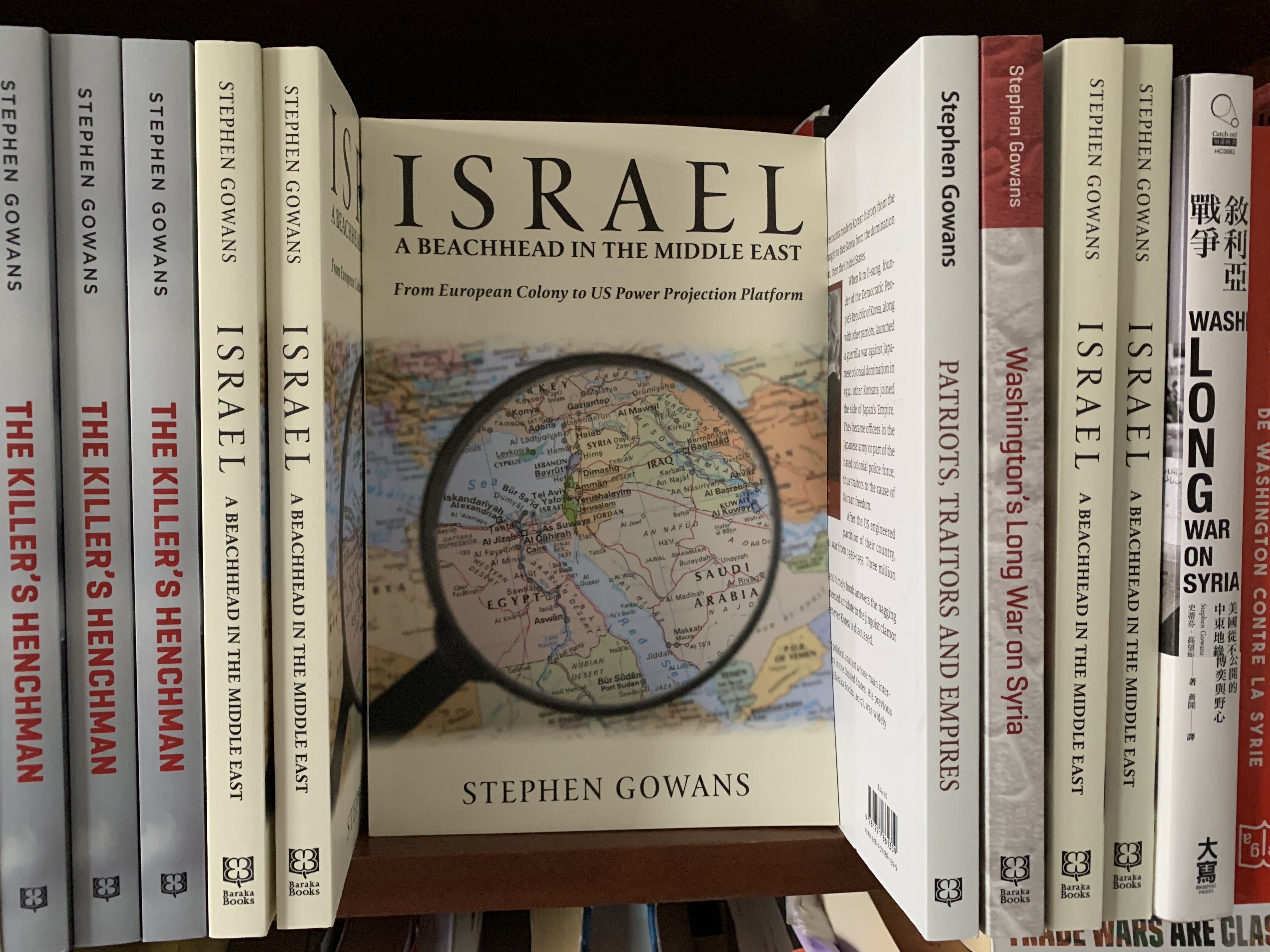

 What's Left