
9 December 2025
Stephen Gowans
The genocide scholar Raz Segal has written an insightful article for the Guardian (“The genocide in Gaza is far from over,” 20 November, 2025) which I am flagging because it addresses a question that is almost never asked in public discourse: Why do genocides happen?
Segal asks this question because it is clear that the Nuremberg Trials, the UN Convention on the Prevention and Punishment of the Crime of Genocide, and education programs designed to instil the idea of “never again”, have failed. For, in this post-Holocaust world, the slogan “never again” is belied by the reality of “again and again.”
The common understanding of genocides is that they are caused by bad people with evil in their hearts. This is The Christmas Carol version of the expunction of groups. Bob Cratchet was overworked and underpaid because his boss, Ebenezeer Scrooge, was a miser with a heart of adamant, not because he was a capitalist operating in a world of cut-throat competition. Scrooge had two choices: pay his employees as little as possible and work them as long as possible, or go under. It’s no surprise he chose the former.
How many progressives attribute the problems of the working class to the greed of corporations, as if greed can be disappeared in a poof of moral suasion, or a visit from the Ghost of Christmas Future? Where does greed come from? Scrooge’s greed came, not from his heart, but from bourgeois society and the capitalist imperatives which enslaved him. “We shouldn’t despise human nature,” counseled the eighteenth-century philosophe, Denis Diderot, “but the despicable conventions that pervert it.” Scrooge’s perversion was the despicable convention of capitalism, not a lonely childhood and a love affair gone sour, as Dickens told the tale.
What are the despicable conventions that pervert human nature to produce genocides? For Segal, and others, it is a political project—one of building ethnically homogenous societies.
British settlers in Turtle Island (North America), Australia, and Aotearoa (New Zealand), carried out genocides against the indigenous peoples of these territories, not so much with the conscious intention of building societies of, by, and for White people, but of integrating the land and resources of the indigenous people into a growing world bourgeois system of capitalist production. Inasmuch as the indigenous peoples couldn’t be, and didn’t want to be, forcibly integrated into this system, they were eliminated as obstacles. Thus, the creation of ethnically homogeneous White Christian societies in these lands was a consequence of a capitalist driven process.
Nazi Germany carried out a genocide in Eastern Europe against people it deemed Untermenschen (sub-humans)—Slavs, Jews, Romani, Blacks, and mixed-race people. Of 18 million non-combatants killed by bullets, gas, exposure, exhaustion, and disease in the German war in the European East from 1939 to 1945, 12 million were Slavs and six million Jews. Ninety-six percent of the victims were claimed by Nazi imperialist violence—that is, violence used by the Third Reich to conquer and depopulate Slav territory in order to repopulate it with German settlers.
Significantly, most of the world’s Jews lived within the territory that was the object of the Nazis’ settler colonial ambitions. The Holocaust, in the view of Carrol P. Kakel III, a US historian who has written on the American and German genocides, cannot be separated from Nazi settler colonialism. Six million Jews were killed, not for the sole reason that Nazis hated Jews—a view ingrained in the ideological zeitgeist—but as a consequence of a political project, namely, 1) clearing the European East (where the majority of the world’s Jews lived) of non-Germans to make room for an expanded ethnically homogeneous Teutonic empire and 2) eliminating an ethnic group the Nazis believed was, through the instruments of international finance capitalism and Marxist internationalism, seeking to destroy the German people as a nation.
Raphael Lemkin, the Polish-Jewish lawyer who introduced the concept of genocide in his 1944 study Axis Rule in Occupied Europe, attributed the Nazi genocide of the Slavs to the German settler colonial project, but insisted that the genocide of the Jews, the Holocaust, originated in psychopathological Judeophobia, unconnected to any Nazi political aim. Lemkin’s insistence that Nazi violence toward Jews was driven by psychopathology (thus, bad people with evil in their hearts) likely originated in his Zionism. A core belief of political Zionism is that non-Jews can’t help but hate Jews. As a consequence, Jews can never safely live among non-Jews, and must therefore have their own state if they are to be safe and survive as a people. Genocide scholar A. Dirk Moses has argued vigorously against the view that the Holocaust was the consequence of apolitical hatred, rooting the Judeocide instead, along with other genocides, in political projects. He criticizes the Genocide Convention for depoliticizing genocide—that is, for failing to recognize that genocides are carried out by ethnic groups against other ethnic groups they see as economic or political competitors. Often, but not always, the competition is over land. Or one ethnic group sees another as a threat to its survival.
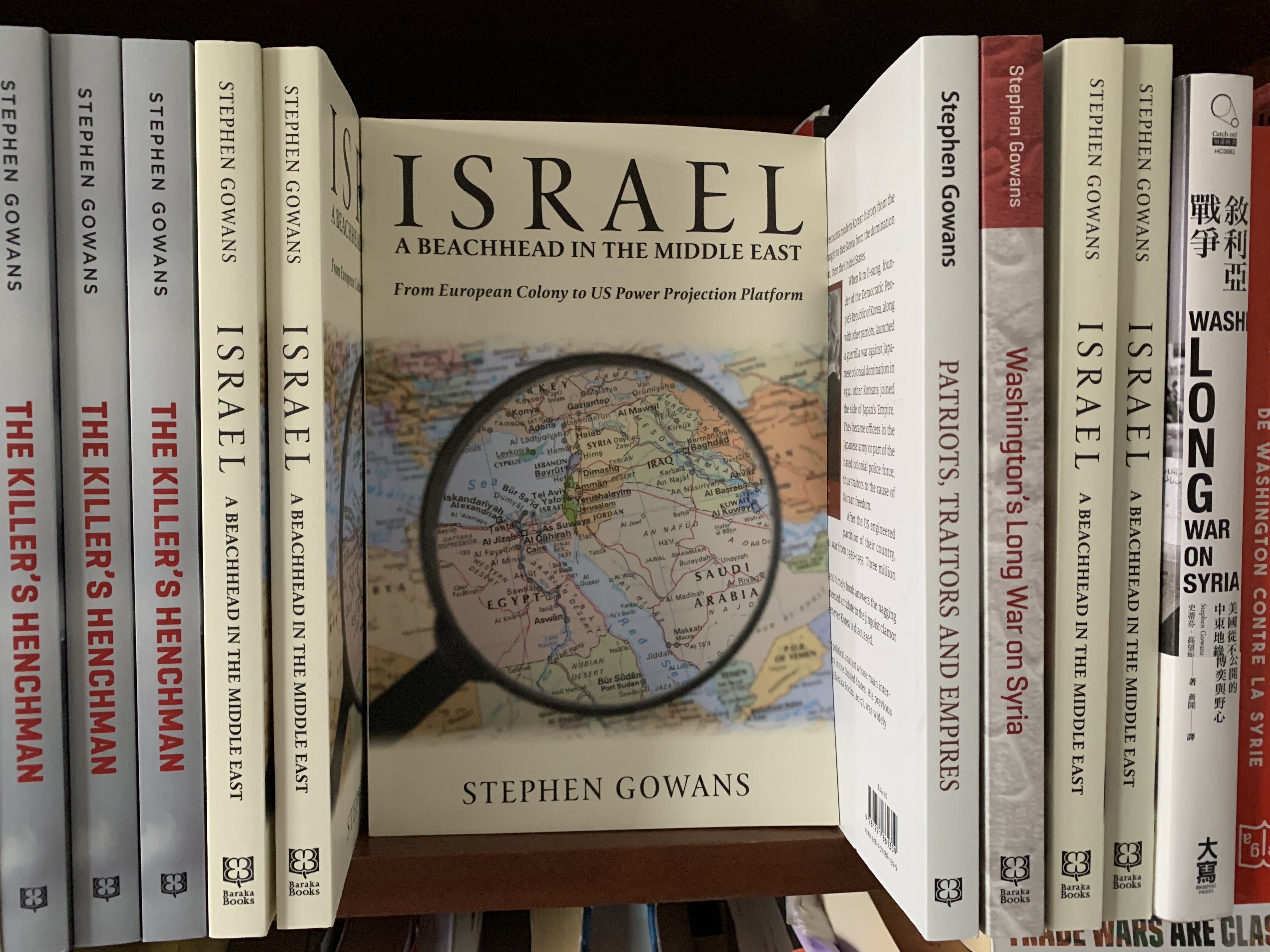
Certainly, the origins of the genocide of the Palestinians can be found in a political project—clearing Palestine of its indigenous population to make room for Jewish settlers and the creation of a Jewish ethnic state. Zionist settler colonialism has obvious connections to the British-settler colonial genocides of the indigenous peoples of Canada, the United States, Australia, and New Zealand, as well as the Nazi political project of creating an expanded German empire in the European East comprised solely of Aryan Germans.
Segal argues that the reason we live in a post-Holocaust world of again and again is because the political project that has regularly given rise to genocide—one of creating ethnically homogeneous states—continues to be seen as legitimate. One of the reasons (though not the only or even most important reason) the United States, Britian, Canada, and the Soviet Union backed the creation of an ethnic Jewish state in Palestine, was because they believed that ethnic states were legitimate, necessary, and desirable. Self-determination, the notion that every ethnic group should have its own state, enjoys considerable esteem. Thus, the idea of a single democratic state in Palestine, from the river to the sea, where everyone is equal, is frequently dismissed in preference to the creation of two ethnically homogeneous states existing side-by-side—one Jewish, the other Palestinian. This is the two-state solution. Zionists prefer one Jewish state in all of Palestine (today’s reality) and some Palestinians would like to see a Palestinian state from the river to the sea, cleansed of its Jewish inhabitants, save for the descendants of Jews who lived in the country prior to the political Zionist waves of European immigration.
Abolishing genocide and getting to a world of never again means abolishing the idea that the ethnic state is either necessary or desirable. We don’t need ethnic states; we need civic states, where all people are equal and gender, sexual-orientation, ethnicity, national origin, religion, color, language, and all other ascriptive markers of identity have no political significance.
However, ideas are not abolished by fiat; conduct is not deduced from principle. The fact that the land of the indigenous peoples of North America and Oceania offered attractive possibilities to metropolitan Europe, and the proletarians it disgorged to the colonies, created the idea of the desirability of settler colonialism. The idea of political Zionism arose in the anti-Semitism of Europe, which in turn arose in the need of Europe’s rulers to diffuse threats to their rule by turning their subjects’ anger against a scapegoat. The war against the Jews became a substitute for the class war against Tsarist oppression and capitalist exploitation. A. Dirk Moses makes a compelling point that genocide is pursued as a solution to a political problem, but political problems arise not in the world of ideas, but in social and economic intercourse.
One of the surest ways of solving the political problem of two groups vying for political and economic resources within the same territory is for one or both of them to try to expel or physically destroy the other. So long as humanity is divided by ascriptive identity will identity groups vie for political and economic resources, and so long as identity groups vie for political and economic resources, the possibility of genocide will be ever present.
 What's Left