
7 December 2025
“The rich, in particular, are necessarily interested to support that order of things which can alone secure them in the possession of their own advantages.”—Adam Smith
“The enemies of the working class travel in private jets, not migrant dinghies.”—Zarah Sultana
By Stephen Gowans
US National Security Strategy documents are expressions of the interests of the world’s richest country in securing that order of things which can alone secure it in the possession of its own advantages. But more specifically, I think it is fair to say, considering that the ultrarich wield outsize influence over the US state, that US strategy is aimed at securing the advantages of the rich themselves directly, and all other Americans incidentally, if at all. Moreover, to the extent the rich are made richer by the Strategy, it may only be a result of the poor being made poorer. In the view of Adam Smith in The Theory of Moral Sentiments: “The affluence of the rich supposes the indigence of the many”; of Victor Hugo in The Man Who Laughs: “The paradise of the rich is made out of the hell of the poor”; and Karl Marx in Capital: “Accumulation of wealth at one pole is at the same time accumulation of misery, agony of toil, slavery, ignorance, brutality, mental degradation at the opposite pole.” In line with these arguments, we might expect that in proportion as the Strategy makes the lives of the rich richer, it will make those of the working class meaner.
The National Security Strategy 2025 is a plan, as Trump’s White House puts it, “To ensure that America remains the world’s strongest, richest, most powerful, and most successful country for decades to come.” We can be sure that when the White House says “America” its means “America’s billionaires,” which the administration includes, in greater numbers than any other in history, and which is openly and unapologetically backed by billionaires and is ardently committed to securing them in the possession of their own advantages, through numerous blessings, from munificent tax cuts, to deregulation, to ample opportunities for corruption.
There are at least a dozen billionaires in Trump’s cabinet and among those appointed to major roles. Steve Witkoff, Jared Kushner, and Tom Barrack, Trump envoys working on key foreign policy issues, are confirmed billionaires, as is commerce secretary Howard Lutnick. Treasury secretary Scott Bessent is a near billionaire. David Sacks, a near billionaire, oversees AI and crypto, the industries in which he has accumulated his wealth. [See note 1 below.] The world’s richest people contributed to Trump’s re-election campaign, transition, and inauguration.
“There were at least 17 billionaires in attendance at Donald Trump’s second inauguration, collectively worth more than $1 trillion”, according to The Washington Post. They included the world’s top three wealthiest people: Elon Musk, Jeff Bezos, and Mark Zuckerberg, who “took places of honor next to Trump’s family.” Seated nearby were several other billionaires, including Louis Vuitton, the world’s fifth richest person, “Apple CEO Tim Cook, former Marvel owner Isaac Perlmutter and media mogul Rupert Murdoch.”
Billionaires back Trump because he is, himself, a billionaire—the first ever to hold the office of president; because he has loaded his cabinet with their class brethren, other billionaires, who are sure to see the world as they see it and favor their interests; and because he unapologetically caters to billionaire interests. He does so at the expense of the polloi, while aiming to maintain political and social stability by persuading a substantial fraction of the White Christian working class, that he is, notwithstanding the reality, their champion.
This isn’t to say that a cabinet with fewer or no billionaires, or even completely devoid of people of wealth, would produce a national security strategy that is any less ardently committed to securing an order of things that delivers enormous advantages to the wealthy as its priority. Politicians, whether wealthy or not, are dependent on the rich for campaign contributions and post-political-career opportunities. They naturally try to stay on the good side of the rich, and are greatly inclined to lick their boots, since servility to the wealthy eases the road to office.
In addition, the wealthy exercise an enormous sway over public opinion through their control of mass media, think-tanks, public relations firms, and the research agenda at universities. More importantly, their ownership and control of the economy give them the power to make or break governments. The only way governments can act against the interests of the wealthy and for the interests of the working class is by taking capital, enterprises, and investment decisions out of private hands and bringing them under democratic control. What this means is that capitalist control of the state is over-determined. It is affected by the participation of members of the capitalist class in key positions of the state and the class’s control of the ideological environment. But it is also affected by the influence the class exercises through its ownership and control of the economy—a power which allows it to cripple governments that fail to promote its agenda by ceasing to invest or by moving capital to other countries. No government wants to lose major investments and will kowtow to investor needs to keep capital flowing. The abundance of billionaires in the Trump administrations is an instance of the wealthy exercising direct control over public policy and the day-to-day decision-making of the White House, but even without billionaires in the cabinet, the manifold indirect influences of the wealthy class on government constrains the state to pursue capitalist class interests.
The Biden administration had far fewer billionaires and people of significant wealth, but its key players were members of billionaire-controlled and -directed think-tanks, such as The Council on Foreign Relations, and were thus loyal servants of the US capitalist class. The Biden administration’s national security strategy was no less committed to defending and promoting US billionaire interests around the world than the Trump administration’s is, though the means of accomplishing this goal and the justifications were not wholly the same. For example, the Trump White House is quite open about using its security strategy to pursue profit-making opportunities for US investors and businesses, while the Biden administration cloaked its pursuit of advantages for US billionaires and corporate America in the language of defending and promoting democracy. The New York Times, virtually the house organ of the Democratic Party, complained in a headline that “Trump’s Security Strategy Focuses on Profit, Not Spreading Democracy“, an allusion to the allegedly loftier aims of the Biden administration’s national security strategy. In 1966, the songwriter Phil Ochs wrote a song about US national security strategy titled Cops of the World, which contained a line that perfectly anticipated the Biden administration’s approach to presenting how it would use the power of the US military to defend and promote the welfare of the US business class. The line was “the name for our profits is democracy.”
Analysis of the Security Strategy
The National Security Strategy 2025 has, for me, five salient themes.
#1. Washington will prevent any rival state from doing the following in the Western Hemisphere:
- Positioning military “forces or other threatening capabilities”; and
- Owning or controlling assets that Washington deems strategically vital.
While the document doesn’t spell out who the rival states are, there can be little doubt that they are China and Russia. And while the Strategy doesn’t define what strategically vital assets are, they likely include the Panama Canal and Greenland, at minimum. The White House has titled the pledge to keep competitors out of the Western Hemisphere, The Trump Corollary to the Monroe Doctrine.
The Monroe Doctrine, promulgated by President James Monroe in 1823, warned European powers that the United States would not allow them to acquire new territory in the Western Hemisphere or form alliances with hemispheric states. In exchange, the United States would stay out of Europe’s wars.
In 1904, Theodore Roosevelt updated the doctrine with his eponymous Roosevelt Corollary. Washington, the president warned, would intervene in any country in the Western Hemisphere that engaged in conduct of which it did not approve. Roosevelt’s corollary was a statement of the principle of suprema lex regis voluntas—the supreme law of the Western Hemisphere is the will of the US government, and, I would add, as a matter of sociology, the class that dominates it. It was also, obviously, a statement of informal empire.
Trump’s corollary is not so much a corollary as a restatement of the Monroe Doctrine, aimed not at Europe, as the original was, but at Russia and China.
#2. Washington will continue to engage in a struggle with China over control of sea lanes in the Indian and Pacific Oceans. The struggle, from Washington’s point of view, will pivot on preventing Beijing from controlling Taiwan.
Washington, along with its court journalists and intellectuals, is fond of pointing out how much of the world’s shipping flows through the South China Sea. “Given that one-third of global shipping passes annually through the South China Sea,” the document declares, disruptions would have “major implications for the U.S. economy.” Were “a potentially hostile power to impose a toll system over one of the world’s most vital lanes of commerce or—worse—to close and reopen it at will,” the consequences could be catastrophic for the US economy. Hence, no US rival (i.e., China) must be allowed to control this body of water.
The tendentious character of the Strategy’s argument is evident if we consider that much of the shipping that passes through the South China Sea flows to and from China. If any state has an interest in keeping the South China Sea open, China is it. Beijing’s planners can reasonably fear that the United States, a competitor, could impose a toll system over this vital (to China) lane of commerce or—worse—close and reopen it at will, severing China’s imports of oil from the Persian Gulf, impeding the flow of raw materials from around the globe, and blocking its exports to foreign markets.
The United States controls the sea lanes of the Indian and Pacific Oceans, and would like to maintain its control, not because US planners are worried about threats to the US economy if control slips away, but because exercising control over the shipping lanes means leverage over China. US control of critical commercial maritime routes comports with a key goal of the Strategy: “To prevent the emergence of dominant adversaries.” A China that could be blockaded at any moment by the US military, is not likely to grow large enough to surpass the United States as the world’s supreme economic and military power. Hence, Washington has an interest in projecting prepotent military power into the Indian and Pacific Oceans. At the same time, China would like to control the very same maritime routes to protect its own economy from US blockade, disruption, and blackmail, and very likely as well, to gain power over its regional rivals, India and Japan.
The key to this struggle is Taiwan. The Chinese navy is hemmed in by a series of islands, running from Japan to Taiwan to the Philippines to the Malay Peninsula, known as the First Island Chain. The islands are under the influence and control, to various degrees, of the US military. The weakest link in the chain is Taiwan. There is no meaningful US military presence on the island, and Beijing claims it as its own territory, but has yet to bring the island under its control. If Beijing achieves its ambition to recover Taiwan, it will be able to more readily project its navy into the South China and Philippine Seas, and from there to the Indian and Pacific Oceans, reducing the chances the US Navy will be able to enforce a blockade.
To keep Taiwan out of Beijing’s hands, Washington proposes to:
- Preserve “military overmatch”, that is, to deploy greater firepower to the Indo-Pacific region than China can match.
- Increase the US military presence in the First Island Chain.
- Press Japan, South Korea, and Australia to increase their contributions of military equipment and personnel to US-led alliances in order to strengthen the US effort to keep China bottled up within the First Island Chain.
The plan is, thus, in large part, the outline of a program to use the US military to obtain an ongoing commercial advantage over China.
#3. Washington will pressure its allies to increase their contributions to the maintenance of US global military supremacy. The Strategy argues that the United States counts among its “many allies and partners dozens of wealthy, sophisticated nations that must assume primary responsibility for their regions and contribute far more to our collective defense.” It goes on to note that “President Trump has set a new global standard with the Hague Commitment, which pledges NATO countries to spend 5 percent of GDP on defense and which our NATO allies have endorsed and must now meet.”
Notwithstanding the foregoing, Washington is not asking its allies to assume primary responsibility for their regions. Japan, South Korea, and Australia, for example, are not being asked to defend themselves, or lead military efforts, against China. Instead, they are being asked to spend more money on arms (which, owing to the size of the US arms industry means much of the higher military spending will benefit US merchants of death) and on personnel, all of which are part of formal military alliances under the control of the United States. Ancient Roman armies were comprised of legionaries (soldiers from Rome) and auxiliaries (soldiers from allied states) under the command of a Roman general. When allies committed more soldiers, Rome grew in strength. Washington is simply following the same logic. What allies contribute redounds directly to US military power. Japan, South Korea, Australia, and NATO countries are being asked to contribute more money, more soldiers, and more (mainly US-purchased) equipment to their US-led military alliances; hence, to US military projects and supremacy.
The same is true of Europe. Washington makes a pretense of Europe being asked to take on greater responsibility for its defense. But that’s nonsense. The principal European military organization, NATO, is an alliance that is always under the command of a US general, as the NATO charter stipulates. NATO is a US instrument; it always has been and will always remain. Washington isn’t asking Europe to take command of NATO or the defense of Europe, nor the task of confronting Russia. That remains a US leadership responsibility. It’s being asked, nay, told, to contribute more money and troops to what will always be a US-directed project. This will allow the Pentagon to shift a significant part of its forces currently deployed to Europe to the Indo-Pacific region to help impede China’s efforts to recover Taiwan. The project of confronting Russia will remain one in which Europe contributes the bulk of the equipment and personnel, as it always has done, but it will commit more than in the past, and the US contribution will correspondingly diminish, though US leadership will continue.
Two other points, both significant.
First, it is not the case that Washington believes that Europe has underspent on its militaries and has thus left the continent vulnerable to Russian aggression. On the contrary, the Strategy document declares that “European allies enjoy a significant hard power advantage over Russia by almost every measure, save nuclear weapons.” This is obvious to anyone who has taken the time to look at the numbers. What this means is that the discourse favored by the news media, NATO’s secretary-general, and some governments, that European countries must increase their military spending, because Russia stands as a looming threat, is utter nonsense. Even the White House doesn’t believe this.
Second, the Strategy seeks to “restabilize” Europe by seeking to bring about an end to the conflict in Ukraine and, importantly, an end to “the reality of NATO as a perpetually expanding alliance.”
#4. The White House believes that Europe is imperiled, not by Russia, but by liberal immigration policies and the suppression of White nationalist political parties and their anti-immigrant discourse. “The larger issues facing Europe,” the strategy document opines, “include”:
- “Migration policies that are transforming the continent and creating strife”, and
- “Censorship of free speech and suppression of political opposition.”
The Strategy’s authors worry that demographic change in Europe is undermining the continent’s Western Civilizational values, noting that it “is more than plausible that within a few decades at the latest, certain NATO members will become majority non-European” (in other words, majority non-White and Muslim). “As such, it is an open question whether they will view their place in the world, or their alliance with the United States, in the same way as those who signed the NATO charter.”
The fear of Eastern peoples undermining Western Civilization was a particular concern of the Nazis, who saw Jews and Communists as Eastern. The White House’s concerns about immigration are not only consistent with those of the Nazis and contemporary White nationalist parties in Europe today, but also with the Trump administration’s own racist domestic policy of mass deportations of illegal immigrants and banning immigration from such countries as Afghanistan and Somalia. The Washington Post summarized White House thinking on immigration as: “Somalis are ‘garbage,’ and ‘we don’t want them in our country.’ Migration from ‘all Third World countries’ should be halted. Any foreign national deemed ‘noncompatible with Western civilization’ must be deported.” Like the Nazis, who worked to replace Klassenkampf (the struggle of classes) with Razzenkampf (the struggle of races) in order to divert the working class from its efforts to liberate itself from the miseries and disadvantages of capitalism, the Trump administration is likewise engaged in a project of scapegoating immigrants to keep the White Christian working class from blaming its woes on Trump’s billionaire cohorts and their program of exploitation of the poor and left-behind and indulgence for the rich and comfortable.
#5. The United States will continue to dominate West Asia to ensure the region’s oil resources remain under US supervision, while at the same time maintaining the US position as the world’s top exporter of oil and gas. In this way, Washington will control a vital input into the economies of Japan and Germany, potentially threatening economic competitors, and its top rival, China. Regarding the latter, US strategy stipulates that Washington will control not only West Asia, a major source of energy for China, but also the sea lanes connecting the Middle East to China. This goes a long way toward meeting the major US strategy objective of preventing the emergence of a dominant adversary.
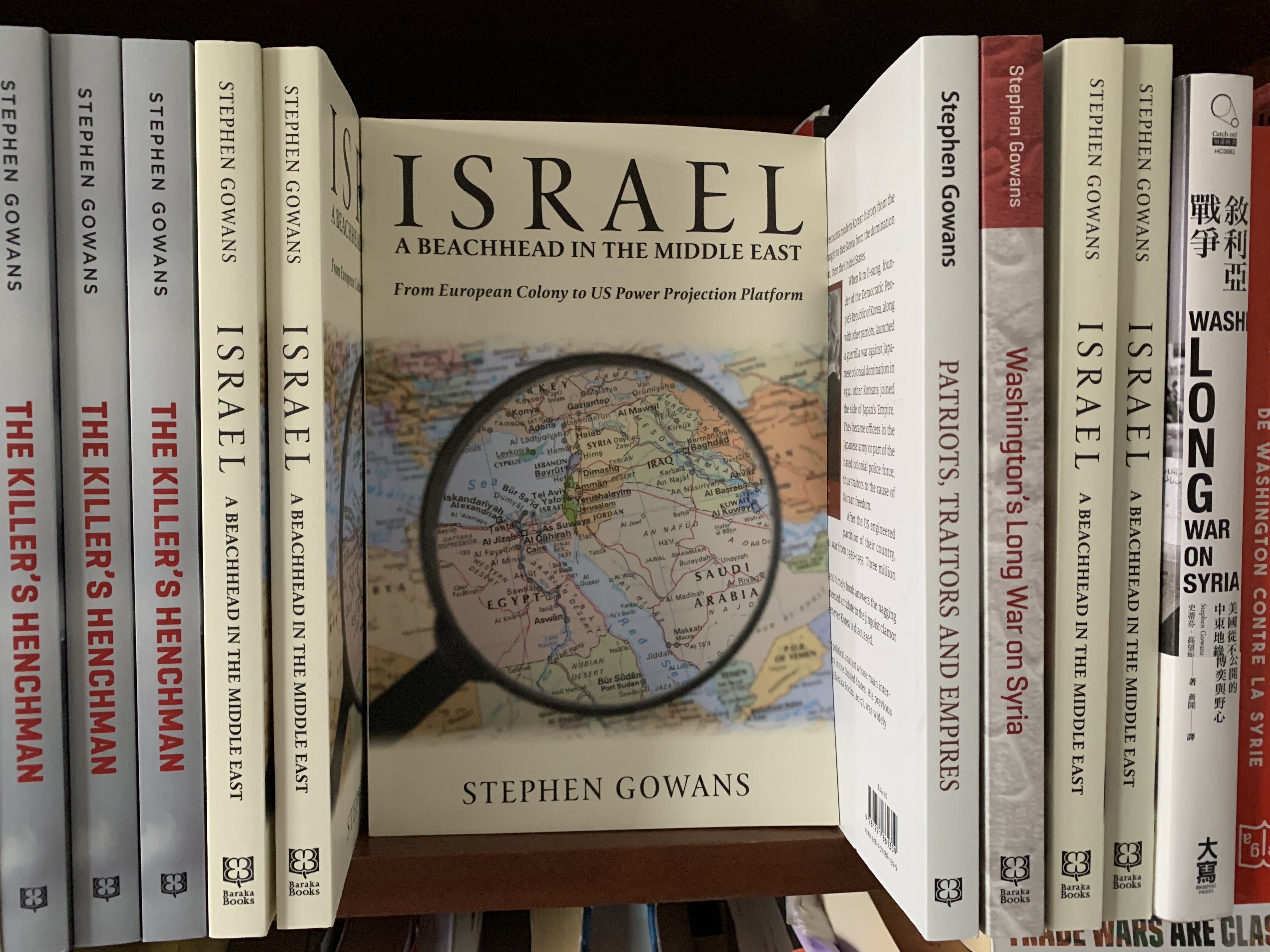
Finally, I will note that, as an obiter dictum, the White House says that it will continue to protect Israel. It doesn’t say why. I can’t help but think that one of the reasons is that Israel is viewed as an outpost of Western Civilization in the East and that, comprising a Jewish master race that is mostly white, it is, as a consequence, a White supremacist regime—one moreover that embodies the most repugnant aspects of the Western tradition (settler colonialism, racism, genocide, imperialism), the very foundations of US wealth and power. Israel is a model of the White nationalist golden age that appears to lie so close to the heart of the US president. In chiding the Europeans for allowing their continent to undergo an immigration-induced demographic change, and then censuring various European powers for repressing anti-immigrant, White nationalist, discourse, the Trump White House poses as a champion of Western (i.e., White Christian) Civilization. This is a civilization which, under the guidance of Trump and his Corollary, aims to keep Eastern power out of the Western Hemisphere, but claims a prerogative to impose Western power on the East. So it is that while re-asserting the Monroe Doctrine, Washington at the same time makes clear that it intends to control the Eastern Hemisphere, especially the sea lanes that connect China to the rest of the world.
The Indo-Pacific region is very important to the Trump White House. It is, the Strategy notes, “already the source of almost half of the world’s GDP based on purchasing power parity (PPP), and one third based on nominal GDP. That share is certain to grow over the 21st century. Which means that the Indo-Pacific is already and will continue to be among the next century’s key economic and geopolitical battlegrounds. To thrive at home, we must successfully compete there.”
Thriving at home can be taken to mean the US billionaire class growing fatter, while it sucks the blood of the US working class, as it endeavors to keep it in a state of stupefaction by recruiting it to a campaign of saving Western Civilization from the immigration of “garbage” from the global south. Concurrently, the US state will plunder the working class of allied countries that will be forced to contribute money, equipment, and personnel to US-led military projects aimed at making Trump’s fellow US billionaires richer. At the same time, Washington will keep its boot-heel on Chinese energy sources and vital sea lanes, aided amply by its allies. This will be done in the service of the White House’s overarching goal: Ensuring that US investors and corporate America secure possession of the lion’s share of the major profit-making opportunities of the Western Hemisphere and Asia.
The New York Times’ take on the security strategy is that it reflects the “world as seen from the White House”—one in which “America can use its vast powers to make money.” I would amend the assessment somewhat. The strategy reflects a world as seen from a White House that is controlled by a battalion of billionaires, and that uses race and anti-immigrant rhetoric to divert the White Christian working class from the reality that it is being fleeced and immiserated. The world the billionaires see is one in which US investors and major US businesses use the vast power of the US state to cut Chinese enterprises and billionaires out of the action to ensure that the lion’s share of the world’s economic surplus remains in the hands of the Donald Trumps, Steve Witkoffs, Jared Kushners, Howard Luttnicks, and their friends, associates, business and golf partners, and political backers, among them Elon Musk, Jeff Bezos, and Mark Zuckerberg—in other words, the US capitalist class.
1. According to The Washington Post, 13 billionaires — including Donald Trump —have held roles in the administration this year. They are:
- Donald Trump, President of the United States, Net worth: $5.1 billion
- Howard Lutnick, Secretary, Commerce Department, Net worth: $3.2 billion
- Linda McMahon, Secretary, Education Department, Net worth: $3 billion
- Steve Witkoff, Assistant to the president and special envoy for peace missions, Net worth: $2 billion
- Kelly Loeffler, Administrator, Small Business Administration, Net worth: $1.3 billion
- Elon Musk, Leader, U.S. DOGE Service (resigned in late May), Net worth: $342 billion
- Joe Gebbia, Chief design officer, Net worth: $8.3 billion
- Antonio Gracias, Volunteer, DOGE (left in July), Net worth: $2.2 billion
- Tilman Fertitta, Ambassador to Italy and San Marino, Net worth: $11.3 billion
- Melinda Hildebrand, Ambassador to Costa Rica, Net worth: $7.7 billion
- Stephen Feinberg, Deputy secretary, Defense Department, Net worth: $5 billion
- Warren Stephens, Ambassador to Britain, Net worth: $3.4 billion,
- Paul Atkins, Chairman, Securities and Exchange Commission, Net worth: $1.2 billion
The list omits Jared Kushner and Tom Barrack, who may not be billionaires, but near billionaires.


 What's Left