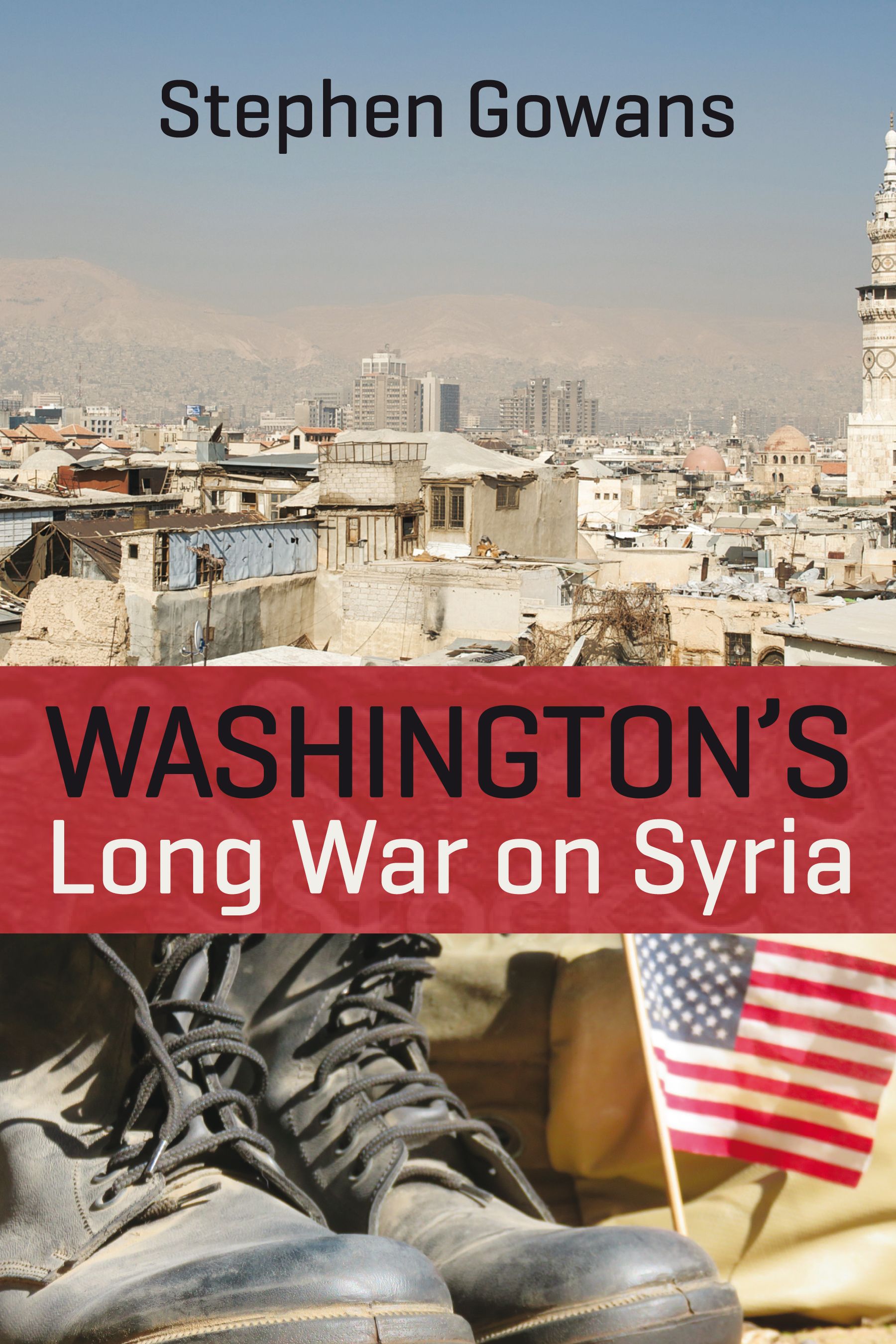
Stephen Gowans is the author of The Killer's Henchman: Capitalism and the Covid-19 Disaster (2022); Israel, A Beachhead in the Middle East: From European Colony to US Power Projection Platform (2019); Patriots, Traitors and Empires: The Story of Korea's Struggle for Freedom (2018); and Washington's Long War on Syria (2017).
For notification of updates, send an e-mail to stephen.roy.gowans@gmail.com with "subscribe" in the subject line.
Who says you can’t form accurate judgments of people on the basis of first impressions? Long before he was Canada’s foreign minister, before he was even elected to public office, John Baird knocked at my door and introduced himself as a candidate in my riding for an election that had yet to be called. From the moment he spoke, I took a visceral dislike to him and pegged him for what he is: a demagogic creep whose life mission is pandering to the powerful.
His actions since have done nothing to soften my view. Consider, for example, his recent announcement that Canada will impose a total trade ban on Iran. Canada exports a few bushels of wheat to Iran in return for a truckload of Persian rugs. The ban means little sacrifice at home—and little pain for Iranians. In other words, it’s symbolic.
But it gives Baird a platform from which to demonize Iran and, in doing so, to ingratiate himself with Washington and Tel Aviv. Baird says the ban is necessary to punish Iran’s “reckless and irresponsible” behaviour in increasing its uranium enrichment activities. Problem is, there’s nothing reckless or irresponsible about Iran enriching uranium. Indeed, if anyone is reckless and irresponsible, it’s Canada.
As a non-nuclear weapons party to the Non-Proliferation Treaty, Iran has a right to enrich uranium, as long as it refrains from diverting fissile material to military use. The International Atomic Energy Agency—which monitors Iran’s enrichment activities—has never reported a single instance of Iran diverting fissile material. What’s more, Argentina, Brazil, Germany and Japan also enrich uranium on their own soil. When last I checked, Baird wasn’t denouncing these countries’ enrichment activities as reckless and irresponsible.
Iran has no nuclear weapons. And the US intelligence community says that, in its view, the Iranians aren’t developing them. As to the charge that Iran is just a few years away from a bomb, that canard has been around since the mid-1980s. And still Iran hasn’t a single nuclear weapon.
There’s nothing about Iran’s enrichment activities that are worthy of a trade ban. Except pandering to Israel. Which is kind of tricky considering that unlike Iran, Israel actually does have nuclear weapons—an estimated 400, and the means to deliver them by missiles, aircraft and submarines. Even if it did have nuclear weapons, Iran would—without long range bombers and submarines, and with missiles of limited range—struggle to deliver them.
Moreover, unlike Iran, Israel bars IAEA inspectors from monitoring its nuclear facilities. It won’t join the Non-Proliferation Treaty, despite UN resolutions directing it to do so. If any country were deserving of a total trade ban, Israel would seem to fit the bill, not only for its nuclear activities, but for its ongoing oppression of Palestinians and habit of attacking its neighbors.
Baird, then, can’t possibly be concerned about the presence of nuclear weapons in the Middle East.
Or anywhere else, for that matter.
In 2010—and here’s where Canadian recklessness and irresponsibility come in–Canada signed off on a deal to export uranium to India, despite concerns that the south Asian country would use the uranium to free up its domestic supply for military use. It’s widely believed that India used a research reactor sold to it by Canada to obtain weapons-grade plutonium to develop its first nuclear weapons. Because India, like Israel, is not a party to the Non-Proliferation Treaty, there are no international inspectors in India to ensure that uranium is used for peaceful purposes alone, as there are in Iran.
All of which means that Canada is about to sell uranium to a south Asian proliferator for commercial gain while imposing a symbolic trade ban on a non-proliferator to curry favour with a west Asian proliferator. And the west Asian proliferator is the regional attack dog of a country loaded to the gunwales with nuclear weapons, and no intention of relinquishing the political utility they provide in bullying other countries.
As I said: pandering to the powerful.
Finally, let’s be clear. As Peter Oborne and David Morrison point out in their excellent book, A Dangerous Delusion: Why the West is Wrong about Nuclear Iran, the West never had a problem with Iran’s nuclear program when Washington’s marionette, Shah Mohammad Reza Pahlavi, ruled with an iron fist in Tehran. It was only when the Iranians sent Pahlavi packing and asserted their independence that the United States turned sour on Iran’s civilian nuclear energy program—and much else about the country too.
The idea that the uprising against the Syrian government is inspired by a grassroots movement thirsting for a pluralist, democratic state is a fiction. The opposition’s chief elements are Islamists who seek to establish a Sunni-dominated Islamic state in place of a Syrian government they revile for being secular and dominated by Alawi “heretics.” “Al Qaeda-linked groups…dominate rebel ranks,” notes The Wall Street Journal. [1] “There is frustration with the West’s inability to help nurture a secular military or political opposition to replace Mr. Assad,” echoes The New York Times. [2] “Islamic forces seem to be ascendant within the opposition,” observes Gerald F. Seib. [3]
Available from Baraka Books http://www.barakabooks.com/catalogue/washingtons-long-war-on-syria/Indeed, almost from the opening moments of the latest outbreak of Islamic unrest in Syria, the government has said that while some protesters have legitimate grievances, the uprising is driven by militant Islamists with foreign backing.” [4] It’s no secret that Saudi Arabia and Qatar- monarchies which abominate democracy—are furnishing Islamist militants with arms, while Turkey, Jordan, Israel, France, Britain and the United States are also lending support.
Syria’s post-colonial history is punctuated by Islamist uprisings. The Muslim Brotherhood organized riots against the government in 1964, 1965, 1967 and 1969. It called for a Jihad against then president Hafiz al-Assad, the current president’s father, denigrating him as “the enemy of Allah.” By 1977, the Mujahedeen were engaged in a guerrilla struggle against the Syrian army and its Soviet advisers, culminating in the 1982 occupation of the city of Hama. The Syrian army quelled the occupation, killing 20,000 to 30,000. Islamists have since remained a perennial source of instability in Syria and the government has been on continual guard against “a resurgence of Sunni Islamic fundamentalists.” [5] The resurgence, touched off by uprisings in surrounding countries, prompted Glen E. Robinson to write in Current History that the rebellion was a continuation of “Syria’s Long Civil War.” [6]
But the Western media, echoing former colonialist powers and high officials in Washington, would call it something different: a popular, grassroots uprising against a brutal dictator. Today, however, the flood of YouTube videos by Islamic terrorists, chronicling their killings of POWs, eviscerations of captured soldiers, and barbecuing of heads, has spoiled the narrative. It’s no longer possible to angelize the Syrian rebellion as a popular insurrection against dictatorship. Now even the Wall Street Journal and New York Times share Assad’s view.
Still, the rebels’ spin doctors aren’t yielding entirely. They insist that while the rebellion may be dominated by religious fanatics with a penchant for terrorism, that it wasn’t always so. Instead, they say, it began as a peaceful plea for democracy that was eventually hijacked by jihadists only after the government used brute force to crush a protest movement. At that point, protesters were forced to take up arms in self-defense.
This view is dishonest. To start, it sweeps aside the reality that the rebellion is dominated by Islamists who care not one whit for democracy and indeed are actively hostile to it. What’s more, it conceals the fact that the Assad government made substantial concessions in the direction of creating the kind of pluralist, democratic society the rebels are said to thirst for. The rebels rejected the concessions, and that they did, underscores the fact that the rebellion’s origins are to be found in Islamist, not democratic, ambitions.
In response to protestors’ demands, Damascus made a number of concessions that were neither superficial nor partial.
First, it cancelled the long-standing abridgment of civil liberties that had been authorized by the emergency law. The law, invoked because Syria is technically in a state of war with Israel, gave Damascus powers it needed to safeguard the security of the state in wartime, a measure states at war routinely take. Many Syrians, however, chaffed under the law, and regarded it as unduly restrictive. Bowing to popular pressure, the government lifted the security measures.
Second, the government proposed a new constitution to accommodate protestors’ demands to strip the Ba’ath Party of its special status, which had reserved for it a lead role in Syrian society. Additionally, the presidency would be open to anyone meeting basic residency, age and citizenship requirements. Presidential elections would be held by secret vote every seven years under a system of universal suffrage.
Here was the multi-party democracy the opposition was said to have clamored for. A protest movement thirsting for a democratic, pluralist society could accept the offer, its aspirations fulfilled. The constitution was put to a referendum and approved. New parliamentary multi-party elections were held. Multi-candidate presidential elections were set for 2014. A new democratic dawn had arrived. The rebels could lay down their arms and enjoy the fruits of their victory.
Or so you might expect. Instead, the insurrectionists escalated their war against Damascus, rejecting the reforms, explaining that they had arrived too late. Too late? Does pluralist democracy turn into a pumpkin unless it arrives before the clock strikes twelve? Washington, London and Paris also dismissed Assad’s concessions. They were “meaningless,” they said, without explaining why. [7] And yet the reforms were all the rebels had asked for and that the West had demanded. How could they be meaningless? Democrats, those seeking a peaceful resolution to the conflict, and the Assad government, could hardly be blamed for concluding that “democracy was not the driving force of the revolt.” [8]
Elaborating on this theme, the Syrian president noted:
It was seemingly apparent at the beginning that demands were for reforms. It was utilized to appear as if the crisis was a matter of political reform. Indeed, we pursued a policy of wide scale reforms from changing the constitution to many of the legislations and laws, including lifting the state of emergency law, and embarking on a national dialogue with all political opposition groups. It was striking that with every step we took in the reform process, the level of terrorism escalated. [9]
From Washington’s perspective, the new constitution opened space for alternative political parties. Washington could exploit this new openness to gain leverage in Syria by quietly backing parties that favor pro-US positions—a plus.
From the Islamists’ point of view, however, there were only negatives. First, the constitution was secular, and not rooted in Islam. Second, it proposed to ban political parties or movements that were formed on the basis of religion, sect, tribe, or region, as well as on the basis of gender, origin, race or color. This would effectively ban any party whose aim was to establish an Islamic state.
There were negatives too for Washington, London, Paris and Tel Aviv.
First, the constitution’s preamble defined Syria as “the beating heart of Arabism,” and “the forefront of confrontation with the Zionist enemy and the bedrock of resistance against colonial hegemony on the Arab world and its capabilities and wealth.” This hardly accorded with Washington’s desire to turn Syria into a “peace-partner” with Israel and clashed with the Western project of spreading neo-colonial tentacles across the Arab world.
Second, the constitution formalized the political orientation of the Syrian Ba’athists. This has been summed up by Assad as “Syria is an independent state working for the interests of its people, rather than making the Syrian people work for the interests of the West.” [10] Accordingly, the constitution mandated that important sectors of the Syrian economy would remain publicly owned and operated in the interests of Syrians as a whole. Western firms, then, were to be frozen out of profit-making opportunities in key sectors of the Syrian economy, a prospect hardly encouraging to the Wall Street financial interests that dominate decision-making in Washington.
Ba’ath socialism has long irritated Washington. The Ba’athist state has always exercised considerable influence over the Syrian economy, through ownership of enterprises, subsidies to privately-owned domestic firms, limits on foreign investment, and restrictions on imports. These are the necessary economic tools of a post-colonial state trying to wrest its economic life from the grips of former colonial powers and to chart a course of development free from the domination of foreign interests.
Washington’s goals, however, are obviously antithetical. It doesn’t want Syria to nurture its industry and jealously guard its independence, but to serve the interests of the bankers and major investors who truly matter in the United States, by opening Syrian labor to exploitation and Syria’s land and natural resources to foreign ownership.
Prior to Assad drafting the new constitution, the US State Department complained that Syria had “failed to join an increasingly interconnected global economy,” which is to say, had failed to turn over its state-owned enterprises to private investors, among them Wall Street financial interests. The State Department also expressed dissatisfaction that “ideological reasons” had prevented Assad from liberalizing Syria’s economy, that “privatization of government enterprises was still not widespread,” and that the economy “remains highly controlled by the government.” [11]
Were Assad to demonstrate a readiness to appease Wall Street’s demands he would have departed holus bolus from the dirigiste practices that had irritated the State Department. Instead, he did the opposite, drafting a constitution that mandated that the government maintain a role in guiding the economy on behalf of Syrian interests, and that the Syrian government would not make Syrians work for the interests of Western banks, oil companies, and other corporations. This was effectively a slap in Washington’s face.
He then compounded the sin by writing certain social rights into the constitution: security against sickness, disability and old age; access to health care; and free education at all levels. Now these rights would be placed beyond the easy reach of legislators and politicians who could sacrifice them on the altar of creating a low-tax, foreign-investment-friendly climate. To make matters worse, he included an article in the constitution which declared that “taxes shall be progressive.”
Finally, he took a step toward real, genuine democracy—a kind that decision-makers in Washington, with their myriad connections to the banking and corporate world—could hardly tolerate. He included a provision in the constitution requiring that at minimum half the members of the People’s Assembly are to be drawn from the ranks of peasants and workers.
Therein were the real reasons Washington, London and Paris rejected Assad’s concessions. It wasn’t that they weren’t genuine. It was that they were made to the wrong people: to Syrians, rather than Wall Street; to the Arabs, rather than Israel. And nor was it that his reforms weren’t democratic enough. It was that they were too democratic, too focussed on safeguarding and promoting the interests of Syrians, rather than making Syrians promote the interests of Wall Street, Washington and Tel Aviv.
The Syrian constitution clarifies the orientation of the Syrian Ba’athists and underscores why the Syrian government ought to be supported in its struggle against foreign-backed Islamist rebels. In short, because it is, on balance, progressive, and the forces arrayed against it are retrograde. The Syrian government is pro-Palestinian, anti-Zionist, anti-colonialist, and anti-imperialist. It is committed to secularism, non-sectarianism, and public ownership of the commanding heights of its economy. These are values that have traditionally been held high by the political left. Were the Syrian government to fall, it is almost certain that a US-client regime would be implanted in Damascus that would quickly adopt a pro-US foreign policy, abandon the Palestinians, capitulate to Israel, and cater to Western investors and corporations. The left project would, accordingly, be dealt a serious blow, and yet another state, dedicated to national liberation—not to say one with a sufficient democratic orientation to enshrine social rights in its constitution—would be crushed under the steamroller of US imperialism.
1. Adam Entous, “White House readies new aid for Syrian rebels”, The Wall Street Journal, April 10, 2013.
2. Anne Barnard, “Syria campaigns to persuade U.S. to change sides”, The New York Times, April 24, 2013.
3. Gerald F. Seib, “The risks holding back Obama on Syria”, The Wall Street journal, May 6, 2013.
4. Anthony Shadid, “Assad says he rejects West’s call to resign”, The New York Times, August 21, 2011.
5. US Library of Congress. A Country Study: Syria. http://lcweb2.loc.gov/frd/cs/sytoc.html
6. December 2012.
7. David M. Herszenhorn, “For Syria, Reliant on Russia for weapons and food, old bonds run deep”, The New York Times, February 18, 2012.
8. Zeina Karam, “In rare public appearance, Syrian president denies role in Houla massacre”, The Associated Press, June 3, 2012.
9. Bashar al-Assad May 19, 2013 interview with Clarin newspaper and Telam news agency
10. Bashar al-Assad May 19, 2013 interview with Clarin newspaper and Telam news agency
11. US State Department website. http://www.state.gov/r/pa/ei/bgn/3580.htm#econ. Accessed February 8, 2012.
There is no compelling evidence that the Syrian government has used chemical weapons against the rebel forces which seek its overthrow. But even if chemical weapons have been used, a military intervention by the United States, its NATO allies, or its regional proxies, would fail the test of humanitarian intervention. First, it would exacerbate, not reduce, the suffering of Syrians. Second, it would be undertaken for concealed reasons of economic and geostrategic gain, not to protect Syrians from chemical weapons, not for the promotion of multi-party representative democracy, and not to encourage tolerance of dissent, as the promoters of intervention would have us believe.
Moreover, a successful US-led intervention would eliminate a pro-Palestinian, anti-Zionist, anti-colonialist, anti-imperialist state committed to secularism, non-sectarianism, and public ownership of the commanding heights of its economy, and would, install, in its place, a US-client regime that would adopt a pro-US foreign policy, abandon the Palestinians, capitulate to Israel, and cater to Western investors and corporations. “Syria,” remarked president Bashar al-Assad, not without substance, “is an independent state working for the interests of its people, rather than making the Syrian people work for the interests of the West.” [1] This orientation would be completely reversed if a US intervention succeeded.
Three reasons the chemical weapons case against the Syrian government is weak at best
1. Britain and Israel claim to have evidence that the Syrian army used chemical agents against armed rebels. The British evidence is based on tissue samples taken from armed rebels who claim to have been gassed by loyalist forces. To concretely make the case that the Syrian army used chemical weapons:
• The tissue samples would have to test positive for chemical agents.
• There could be no possibility the samples were tampered with.
• A direct link between the contaminated tissue and an attack by Syrian forces would need to be established.
Concerning the first point, we have nothing to rely on but the word of British authorities. Should we believe them? Britain has been implicated in attempts to concoct pretexts for military intervention with phony evidence before (see the bogus WMD claims used to justify the war on Iraq and the genocide fear-mongering pressed into service to justify NATO’s 1999 air war on Yugoslavia.)
What’s more, Britain is hardly a neutral party to the conflict in Syria, and therefore has an interest in manufacturing justifications for more open and direct meddling. That’s not to say that the tissue sample didn’t test positive, only that it would be foolhardy to suppose that a country that “sexed up” evidence to justify a war on Iraq can be trusted.
Secondly, “the samples collected by Britain may have been tainted by rebels who want to draw the West into the conflict on their side” [2], a point made by US officials.
Third, “the detection of chemical agents doesn’t necessarily mean they were used in an attack by the Syrian” army. [3] Rebels, for example, may have been accidentally exposed to chemical agents they, themselves, had in their possession.
The key point is that evidence of tissue contamination (if indeed such evidence exists) is not evidence that the Syrian army used chemical agents, since there are multiple possible ways in which the tissue could have become contaminated.
2. Once US president Barack Obama declared that the use of chemical weapons by the Syrian government was a red line that would trigger a more muscular US intervention, the Syrian calculus turned decidedly against their use. Using chemical agents against rebels would play directly into Washington’s hands, giving the bellicose superpower a pretext to intervene militarily in an open and direct fashion. This would be a disadvantage that would grossly outweigh any advantage that accrued from the weapons’ use. On the other hand, once Obama announced his red line, it made a ton of sense for the rebels to falsely claim they were gassed.
3. While an investigation by the United Nations independent commission of inquiry on Syria has found evidence that the rebels used sarin gas, no evidence has been found that the Syrian government has done the same. Commission member Carla Del Ponte reported that, “We collected some witness testimony that made it appear that some chemical weapons were used, in particular, nerve gas. What appeared to our investigation was that was used by the opponents, by the rebels. We have no, no indication at all that the government, the authorities of the Syrian government, had used chemical weapons.” (Emphasis added.) [4]
An intervention would create harm
To reduce suffering, a military intervention would need to reduce harm to a greater degree than the military intervention itself would produce. Judging by previous US-led interventions undertaken for professedly humanitarian reasons, a military intervention in Syria would likely involve air strikes on Syrian military, government and even civilian facilities, with attendant civilian casualties, disruption of essential services, and massive displacement of non-combatants. According to The New York Times’ Elisabeth Bummiler, senior Pentagon officials have warned that “military intervention would be a daunting and protracted operation, requiring at least weeks of exclusively American airstrikes, with the potential for killing vast numbers of civilians.” (Emphasis added.) [5]
To be sure, an open and direct military intervention would be ardently welcomed by Syrian rebels, and their co-sectarian arms suppliers, the Turks, Saudis and Qataris. But it would kill many and make life even more miserable and uncertain for Syrians, especially those living in areas under loyalist control.
Far better to reach a political solution. But one of the reasons the Syrian civil war carries on is because the United States refuses to back a political resolution that would fall short of achieving its chief Syria foreign policy goal, namely, the ouster of Assad and his replacement by a pliant, pro-US government. A genuinely humanitarian intervention would set as its goal an end to hostilities, not the absorption of Syria into the US-Israeli camp.
Intervention would not be based on humanitarian concern
There is no reason to believe that the United States has any genuine interest in protecting Syrians from chemical weapons attacks. Washington dismissed out of hand evidence presented by the United Nations that the rebels used sarin gas, which is hardly what a government would do were it genuinely keen on protecting all Syrians from chemical attack, no matter which side of the conflict they’re on.
Significantly, US regime change policy in Syria antedates Syria’s civil war. The outbreak of the “Arab Spring” in Syria, and Damascus’s response to it, didn’t start the ball rolling on US efforts to force Assad from power. US regime change policy, linked to Damascus’s refusal to become a “peace-partner” with Israel, its alliance with Iran and Hezbollah, and its refusal to fully open its economy to US capital, existed long before the Syrian government cracked down on opposition forces. In fact, one element of US foreign policy was to encourage opposition to the Assad government, [6] that is, to foment the kind of civil unrest that eventually morphed into a full blown civil war.
Multi-party representative democracy, a tolerant attitude to dissent, and eschewal of chemical weapons, have not been relevant components of US foreign policy decision making. Indeed, Washington has shown itself willing to overlook the absence of multi-party representative democracy, to ignore an intolerant attitude to dissent, and to turn a blind eye to the deployment of chemical weapons, where US corporate interests are promoted, either directly, or indirectly through the strengthening of United States’ geostrategic position. For example, Washington and its NATO allies have adopted a tolerant attitude to the violent suppression (aided by Saudi tanks) of a Shiite rebellion in Bahrain against an absolutist Sunni monarchy, while at the same time casually dismissing the UN’s concrete suspicions that the Syrian rebels used sarin gas. Significantly, Bahrain, a paragon of free-markets and free-enterprise, is home to the US Fifth Fleet; Saudi Arabia is a source of generous profits for US oil majors and New York investment banks; and the Syrian rebels are instruments through which US foreign policy goals of regime change in Damascus are to be achieved. If US foreign policy was indeed driven by democracy-promotion, human rights objectives, and non-proliferation goals, its attitude toward Bahrain, Saudi Arabia, Qatar, the UAE, Jordan and the possibility of sarin gas use by Syrian rebels, would be very different.
Conclusion
There are sound strategic reasons for the Syrian army to leave chemical weapons in storage. Deploying them would play into Washington’s hands by providing the United States with a pretext to escalate its intervention in the Syrian civil war. On the other hand, any force that would benefit from a more muscular US intervention on the rebels’ behalf has an interest in manufacturing evidence of the use of chemical agents by Syrian forces. This would include the rebels themselves and those of the United States’ allies that would like Washington to refashion Syria in their political or sectarian interests.
Much as intervention by the United States is sold as a humanitarian exercise, it fails the humanitarian test on two levels. First, it would create substantial harm. US military officials have warned that direct military intervention—which would take the form of US air strikes—would create massive civilian casualties. Second, US foreign policy is based on commercial, financial, and geostrategic goals, not the promotion of multi-party representative democracy, tolerance of dissent, and anti-proliferation. This is clear from a simple examination of the countries Washington supports: those with a congenial attitude to US free enterprise and a willingness to submit to US domination, regardless of their practices in connection with multiparty representative democracy, civil liberties and weapons of mass destruction.
For all these reasons the United States should not bomb Syria, and nor should it provide military, diplomatic, or any other kind of assistance to the Syrian rebels. Of course, what it should do and what it will do are very different matters, but all the same we should be clear that the chemical weapons case against Syria is a fraud, as is the idea that direct US military intervention in the Syrian conflict would have either a humanitarian basis or humanitarian outcome.
According to the White House, Israel has the right to defend itself (1). I would argue that it doesn’t. Based on the theft of another people’s land and denial of their right to return to the homes from which they fled or were driven, Israel no more than any other thief has the right to defend itself.
Judging by its indulgent attitude to Israeli aggressions, Washington claims that Israel has the right to defend itself in any way it pleases: by unprovoked airstrikes across international borders; by meting out collective punishment; by carrying out extrajudicial assassinations; by invasions and occupations; and through other outrages against international law, sovereignty and humanity. In fact, by doing what the United States, itself, regularly does.
The White House says that the most recent Israeli aggression, airstrikes carried out over the last few days against Syrian military facilities, were intended to stop a shipment of advanced surface-to-surface missiles from Iran to the Lebanese resistance organization, Hezbollah. Striking a dissenting note, The New York Times reported that, “Some American officials are unsure whether the new shipment was intended for use by Hezbollah or by the Assad government.” (2) Which means the airstrikes may have nothing to do with Israel “defending itself” and everything to do with Tel Aviv helping Syria’s Sunni rebels in what is, in large measure, a sectarian war, inflamed by outside interference, against an Alawi-dominated state that has (from Washington’s perspective) the wrong attitude to US free enterprise and (from Israel’s) the wrong attitude to the dispossession of the Palestinians. Or it may be that the missiles were intended for the Syrian military, but the Israelis struck as a precaution, in case the missiles were indeed destined for Hezbollah.
While indulging Israel for its aggressions, Washington denies North Korea the right to develop nuclear weapons and ballistic missiles for self-defense, for the obvious reason that North Korea’s self-defense is self-defense against the United States. Likewise, the threat posed to Israel of Iranian-made Fateh-110 missiles in Hezbollah’s hands is that they bolster the resistance organization’s ability to defend both itself, and its benefactor, Iran, from Israeli attack. It’s no secret that Israel has been threatening war on Iran for some time on grounds that Iran’s civilian nuclear energy industry may, at some point, provide Tehran with the capability of developing what Israel already has in abundance: nuclear weapons.
What’s more, if Israel has the right to defend itself, why not Syria? It’s not as if the Assad government’s actions, in defense of secular pan-Arabism, have come anywhere close to matching the level of barbarity regularly visited by the Zionist regime on its opponents in defense of its settler ideology, or in helping to promote the imperial interests of its American benefactor and sponsor.
Earlier, the White House declared that Syria’s use of chemical weapons against terrorist insurgents would be a red line whose crossing would trigger a strong US response, presumably direct US military intervention in Syria’s civil war. Recent claims by Israel, Britain and one US intelligence agency of evidence that the Syrian government has used chemical weapons against rebel forces—evidence the White House says is inconclusive—touched off a controversy over whether the Obama administration had blundered in setting a red line, and whether failure to act on even weak evidence undermines US credibility.
Lost in the polemic is the telling reality that Washington has set no red line for the insurgents’ use of the same weapons.
And that can’t be because there are no grounds to believe rebel forces would use deadly gas against Syrian loyalists. The UN independent commission of inquiry on Syria says there are strong, concrete suspicions that the rebels have used sarin gas (but has no evidence the Syrian government has deployed chemical weapons against the rebels.) (3)
Okay, let’s assume that the UN’s strong and concrete suspicions do reflect the rebels’ actual use of sarin gas against loyalist forces.
The obvious question (unasked as far as I can tell by the mass media) is where did the rebels’ chemical weapons come from? Were they captured from the Syrian military, or procured through a supplier of the rebels’ other weapons—Saudi Arabia, Qatar or a NATO state?
And does the United States plan to act on the UN’s strong and concrete suspicions?
The answer to the first question is uncertain. As to the second, the US might intervene to secure the rebels’ chemical weapons if the weapons have been captured from the Syrian army by jihadists acting independently of US control, but it would likely be done quietly, to avoid raising embarrassing questions about the rebellion putting dangerous weapons into the hands of Islamists who might use them later against US targets (including, if the Assad government falls, a US-client regime in Damascus.)
On the other hand, if the weapons have been used by US-controlled opposition factions, an intervention won’t occur, unless the weapons were used without US approval. If so, measures—again quiet ones—will likely to be taken to curb their use, or to use them only at Washington’s direction.
Another possibility is that Washington colluded in the weapons’ use.
Clearly, Washington’s chemical weapons standards are contigent and not absolute. The red line against the Syrian defense forces provides Washington with a pretext for direct and open military intervention against Damascus when and if intervention is feasible. Since no intervention against the rebel forces is desired—on the contrary, only intervention on their behalf is on the agenda—a rebel red line is unnecessary, and restrictive. It’s not the use of chemical weapons that Washington opposes, but their use by a government fighting for survival against US predations. Anyone else can use chemical weapons with impunity so long as it’s done in the service of US foreign policy goals.
Finally, we might ask whether the country that has the greatest store of weapons of mass destruction, is the world’s largest manufacturer of them, and has been the most ardent user of them, would act to stop their use by rebel forces it has backed against a pan-Arab nationalist regime it has for decades sought to overthrow? Again, subject to the condition the rebels were under US control, not likely.
The United States professed opposition to weapons of mass destruction is entirely one-sided. It is applied selectively to governments and organizations that it, itself, or its proxies, are opposed to, typically because they have the wrong attitude to US free enterprise, or the wrong attitude to their proxies’ plunder of the land, natural resources and markets of other people.
1. Sam Dagher, Nour Malas and Joshua Mitnick, “Strikes in Syria raise alarm”, The Wall Street Journal, May 5, 2013.
2. Anne Barnard, Michael R. Gordon and Jodi Rudoren, “Israel targeted Iranian missiles in Syria attack”, The New York Times, May 4, 2013.
3. “Syrian rebels may have used Sarin” Reuters, May 5, 2013: “UN: ‘Strong suspicions’ that Syrian rebels have used sarin nerve gas,” Euronews, May 6, 2013.
In an April 3 Wall Street Journal article, “U.S. dials back on Korean show of force,” reporters Adam Entous and Julian E. Barnes revealed that the White House approved a detailed plan, called ‘the playbook,’ to ratchet up tension with North Korea during the Pentagon’s war games with South Korea.
The war games, which are still in progress, and involve the deployment of a considerable amount of sophisticated US military hardware to within striking distance of North Korea, are already a source of considerable tension in Pyongyang, and represent what Korean specialist Tim Beal dubs “sub-critical” warfare.
The two-month-long war games, directed at and carried out in proximity to the Democratic People’s Republic of Korea, force the North Korean military onto high alert, an exhausting and cripplingly expensive state of affairs for a small country whose economy has already been crippled by wide-ranging sanctions. North Korea estimates that sanctions and US military aggression have taken an incalculable toll on its economy. [1]
The playbook was developed by the Pentagon’s Pacific Command, to augment the war games that began in early March, and was discussed at several high-level White House meetings, according to the Wall Street Journal reporters.
The plan called for low-altitude B-52 bomber flights over the Korean peninsula, which happened on March 8. A few weeks later, two nuclear-capable B-2 bombers dropped dummy payloads on a South Korean missile range. The flights were deliberately carried out in broad daylight at low altitude, according to a U.S. defense official, to produce the intended minatory effect. “We could fly it at night, but the point was for them to see it.” [2]
A few days ago, the Pentagon deployed two advanced F-22 warplanes to South Korea, also part of the ‘play-book’ plan to intimidate Pyongyang.
According to Entous and Barnes, the White House knew that the North Koreans would react by threatening to retaliate against the United States and South Korea.
In a March 29 article, Barnes wrote that “Defense officials acknowledged that North Korean military officers are particularly agitated by bomber flights because of memories of the destruction wrought from the air during the Korean War.” [3] During the war, the United States Air Force demolished every target over one story. It also dropped more napalm than it did later in Vietnam. [4]
The reality, then, is exactly opposite of the narrative formulated in the Western mass media. Washington hasn’t responded to North Korean belligerence and provocations with a show of force. On the contrary, Washington deliberately planned a show of force in order to elicit an angry North Korean reaction, which was then labelled “belligerence” and “provocation.” The provocations, coldly and calculatingly planned, have come from Washington. North Korea’s reactions have been defensive.
Pressed to explain why North Korea, a military pipsqueak in comparison to the United States, would deliberately provoke a military colossus, Western journalists, citing unnamed analysts, have concocted a risible fiction about Pyongyang using military threats as a bargaining chip to wheedle aid from the West, as a prop to its faltering “mismanaged” economy. The role of sanctions and the unceasing threat of US military intervention are swept aside as explanations for North Korea’s economic travails.
However, Entous’s and Barnes’s revelations now make the story harder to stick. The North Koreans haven’t developed a nuclear program, poured money into their military, and made firm their resolve to meet US and South Korean aggression head-on, in order to inveigle aid from Washington. They’ve done so to defend themselves against coldly calculated provocations.
According to the Wall Street Journal staffers, the White House has dialled back its provocations for now, for fear they could lead to a North Korean “miscalculation.” In street language, Washington challenged the DPRK to a game of chicken, and broke it off, when it became clear the game spin out of control.
1. According to the Korean Central News Agency, March 26, 2013, “The amount of human and material damage done to the DPRK till 2005 totaled at least 64,959 854 million U.S. dollars.”
2. Jay Solomon, Julian E. Barnes and Alastair Gale, “North Korea warned”, The Wall Street Journal, March 29, 2013
3. Julian E. Barnes, “U.S. pledges further show of force in Korea”, The Wall Street journal, March 29, 2013
4. Bruce Cumings. The Korean War: A History. Modern Library. 2010.
The Americans, and their friends and allies, tend to have a disengaged attitude toward sanctions—disengaged both ethically and in terms of causality. Sanctions are, after all, but the modern version of the age-old military tactic of the siege. The aim of the siege is to reduce the enemy to such a state of starvation and deprivation that they open the gates, perhaps killing their leaders in the process, and throw themselves on the mercy of the besiegers.”
Later, Beal adds, “There are strong parallels between sanctions/sieges and terrorism: both inflict pain on ordinary, vulnerable people in order to turn them against their leaders…”
While Beal writes in connection with North Korea, Washington’s use of the modern-day siege extends to other countries, as well. Like North Korea, Iran is despised by Washington for its insistence on using its labor, markets and natural resources, not for Wall Street’s profits, but for self-directed development. And like North Korea, Iran is menaced by a campaign of sanctions. These sanctions, too, aim, as terrorism does, to make ordinary people suffer so they’ll pressure their government to change its policies to accommodate the interests of the besieger/terrorist (in this case, to replace the current economically nationalist government with one that will open the Iranian economy to ownership by foreigners and create business conditions favorable to foreign investors reaping handsome returns, albeit under the guise of building “democracy” and relinquishing an independent nuclear energy industry.)
The accustomed practice in mainstream journalism is to gloss over the effects of sanctions on besieged countries, or to insist that they’re targeted at a country’s leadership and therefore do no harm to ordinary people.
But in a March 17 Washington Post article, reporters Joby Warrick and Anne Gearan acknowledge that the sanctions on Iran are aimed at hurting ordinary people.
Warrick and Gearan write,
Harsh economic sanctions have taken a serious toll on Iran’s economy, but U.S. and European officials acknowledge that the measures have not yet produced the kind of public unrest that could force Iranian leaders to change their nuclear policies.
Nine months after Iran was hit with the toughest restrictions in its history, the nation’s economy appears to have settled into a slow, downward glide, hemorrhaging jobs and hard currency but appearing to be in no immediate danger of collapse, Western diplomats and analysts say.
At the same time, the hardships have not triggered significant domestic protests or produced a single concession by Iran on its nuclear program.
They continue,
The impact has been hardest on the middle and working classes, which have seen savings evaporate and purchasing power dry up. Yet, in recent months, Iran’s fiscal crisis appears to have eased, and economists say neither complete collapse nor widespread rioting appears likely in the near term.
So, sanctions aren’t working because they haven’t inflicted enough suffering to engender widespread unrest and rioting.
If sanctions do produce their desired effect, and wide-spread rioting does break out, the public unrest most assuredly will not be blamed by Western reporters on the suffering produced by sanctions, but dishonestly on Tehran’s “economic mismanagement.” And aid will continue to flow to opposition forces in Iran, who will be presented as “thirsting for democracy” (rather than relief from the suffering inflicted by the United States and European Union) to help them topple their government (which is to say, open the gate to let the besiegers in.)
The Warrick and Gearan article’s emphasis on the sanctions’ failure to promote rioting, may signal that policy-makers are coming to the conclusion that Washington’s goals for Iran cannot be achieved by sanctions alone, and that military intervention is also required.
Military intervention, however, may not be an alternative to the siege, but its complement. US Air Force Lt. General Michael Short’s explanation of the objectives of the 1999 US-led NATO air war on the former Yugoslavia resonates with the aim of the besieger/terrorist. Explained Short,
“If you wake up in the morning and you have no power to your house and no gas to your stove and the bridge you take to work is down and will be lying in the Danube for the next 20 years, I think you begin to ask, ‘Hey, Slobo, what’s this all about? How much more of this do we have to withstand?'” (“What this war is really about,” The Globe and Mail (Toronto), May 26, 1999.)
The modus operandi, then, of US foreign policy is to inflict pain on ordinary people who live in countries whose governments resist integration into the US-superintended system of global capitalist exploitation, in order to create public unrest that will either force the country’s leaders to change their policies, or step down and yield power to local representatives of global capitalist interests (deceptively labeled by Western state officials and establishment journalists as “pro-democracy” or “democratic” forces.)
The only thing “democratic” about US foreign policy is its insistence on democratizing suffering.
Why has North Korea withdrawn from an armistice agreement that has kept overt hostilities on the Korean peninsula at bay since 1953? Does the withdrawal portend an imminent North Korean aggression? Hardly. North Korea is in no position to launch an attack on its Korean neighbour, or on the United States, at least not one that it would survive. North Korean forces are dwarfed by the US and South Korean militaries in size, sophistication and fire-power. The withdrawal serves, instead, as a signal of North Korean resolve to defend itself against growing US and South Korean harassment, both military and economic.
US provocations
For decades, North Korea has been subjected to the modern form of the siege. “The aim of the siege is to reduce the enemy to such a state of starvation and deprivation that they open the gate, perhaps killing their leaders in the process and throw themselves on the mercy of the besiegers.” [1] North Korea withstood the siege, and even flourished, during the years it was able to trade with the Soviet Union and Eastern Europe’s socialist countries. But with the demise of Soviet socialism, the country has bent, but not broken, under the pressure of US-led sanctions of mass destruction.
Sanctions against North Korea are multi-form, and include a trade blockade and financial isolation. Significantly, no country in history has been menaced by such wide-ranging sanctions for so long. North Korea is, as then US president George W. Bush once remarked, the most sanctioned nation on earth. [2] Sanctions, military harassment (which I’ll come back to in a moment), and the US nuclear threat—Washington has threatened North Korea with nuclear annihilation on countless occasions [3]—have forced the North Koreans to bulk up militarily, build ballistic missiles, and test nuclear devices in order to survive.
Led by Washington, the UN Security Council has authored a number of resolutions to deny North Korea rights of self-defense and other rights that other countries are free to exercise: the rights to: build ballistic missiles; withdraw from the Nuclear Non-proliferation Treaty; launch satellites; sell arms abroad; and transfer nuclear technology to other countries. These are rights that every permanent member of the UN Security Council exercises freely. They are also rights that many other countries enjoy with impunity.
On top of besieging North Korea, Washington and South Korea have for decades kept up a campaign of unrelenting military harassment in the form of regular war games. The latest war games began March 1 and will last for two months. Undertaken as practice in mobilizing US troops and military hardware from abroad for rapid deployment to the Korean peninsula, the war games this year have activated not only US and South Korean militaries, but British, Canadian, and Australian forces, as well. While labelled “defensive,” the war games force the North Koreans onto a permanent war footing. It can never be clear to North Korean generals whether the latest US-South Korean mobilization is a drill or preparation for an invasion. The effect is to force Pyongyang to maintain its military on high alert, an exhausting and expensive exercise.
The view propagated by Western officials and, in train, the Western mass media, is that the sanctions are aimed at correcting North Korea’s “bad behaviour” and that the war games are carried out to deter North Korean aggression. But what’s called “bad behaviour”—the building of nuclear weapons and ballistic missiles—is Pyongyang’s reaction to the US-led permanent state of siege. A tiny country with a military budget dwarfed by South Korea’s and the United States’ [4] is not credibly an offensive threat to Washington and Seoul, but the United States and South Korea are unquestionably offensive threats to the DPRK (the Democratic People’s Republic of Korea, North Korea’s official name.)
After the UN manoeuvred the Security Council to slap still more sanctions on North Korea, and began its latest round of war games, the Wall Street Journal alerted the world that “North Korea [had] moved to further stoke tensions with South Korea…” [5] On the contrary, the United States had further stoked tensions with North Korea.
A dead letter
There are three reasons to regard the armistice agreement as existing in form alone, and not substance.
First, the purpose of the agreement was to set the stage for a permanent peace. Despite North Korea repeatedly asking Washington to enter into a peace agreement, none has been struck. After one North Korean entreaty for peace, then US secretary of state Colin Powell said “We don’t do non-aggression pacts or treaties, things of that nature.” [6]
Second, the agreement was to be followed by the withdrawal of all foreign troops from the Korean peninsula. The Chinese withdrew, as did most members of the UN forces. But US forces, which have remained in South Korea for the last 60 years, have become a permanent fixture on the peninsula. Incredibly, South Korean forces remain under US command.
Third, the agreement prohibits “the introduction into Korea of reinforcing combat aircraft, armoured vehicles, weapons and ammunition…” The US violated the agreement by introducing nuclear weapons into South Korea in 1958. And it’s questionable whether the war games-related deployment of massive amounts of US military hardware to Korea doesn’t violate the agreement, as well.
What Washington wants from North Korea
On March 11, U.S. national security adviser Tom Donilon announced publicly that what Washington wants from North Korea is open markets and the country’s integration into the US-led system of global capitalist exploitation. At least, that’s what he meant when he said, “I urge North Korea’s leaders to reflect on Burma’s experience.” [7]
Burma (Myanmar) turned its self-directed, locally-, and largely publicly-owned economy into a capitalist playground for foreign investors.
When Myanmar’s military took power in a 1962 coup, it nationalized most industries and brought the bulk of the economy under government control, which is the way it stayed until three years ago. Major utilities were state-owned and health-care and education were publicly provided. Private hospitals and private schools were unheard of. Ownership of land and local companies was limited to the country’s citizens. Companies were required to hire Myanmar workers. And the central bank was answerable to the government. In other words, Myanmar’s economy, inasmuch as it markets, labor and natural resources were used for the country’s self-directed development, was very much like North Korea’s. And like North Korea, Myanmar was an object of US hostility, subject to sanctions, and targeted by US-orchestrated low-level warfare.
Bowing to US pressure, Myanmar’s government began in the last few years to sell off government buildings, its port facilities, its national airline, mines, farmland, the country’s fuel distribution network, and soft drink, cigarette and bicycle factories. The doors to the country’s publicly-owned health care and education systems were thrown open, and private investors were invited in. A new law was drawn up to give more independence to the central bank, making it answerable to its own inflation control targets, rather than directly to the government.
To top it all off, a foreign-investment law was drafted to allow foreigners to control local companies and land, permit the entry of foreign telecom companies and foreign banks, allow 100 percent repatriation of profits, and exempt foreign investors from paying taxes for up to five years. What’s more, foreign enterprises would be allowed to import skilled workers, and wouldn’t be required to hire locally.
With Myanmar signalling its willingness to turn over its economy to outside investors, US hostility abated and the sanctions were lifted. President Obama dispatched then US secretary of state Hillary Clinton to meet with Myanmar’s leaders, the first US secretary of state to visit in more than 50 years. William Hague soon followed, the first British foreign minister to visit since 1955. Other foreign ministers beat their own paths to the door of the country’s military junta, seeking to establish ties with the now foreign investment-friendly government on behalf of their own corporations, investors, and banks. And business organizations sent their own delegations, including four major Japanese business organizations, all looking to cash in on Myanmar’s new opening. Announcing the easing of US sanctions, then US secretary of state Hilary Clinton enthused, “Today we say to American business: Invest in Burma!” [8]
That, then, is what the United States wants for North Korea: for a US secretary of state to one day announce, “Today we say to American business: Invest in North Korea!”
Effects, not causes
In the US view, North Korea is a militaristic, aggressive state, bent on provoking South Korea and its American overlords and setting the peninsula aflame, for reasons that are never made clear. Pyongyang must, therefore, be deterred by sanctions and displays of US military “resolve.” Yet North Korea has never pursued an aggressive foreign policy, hasn’t the means to do so, and unlike the United States and South Korea, has never sent troops into battle on foreign soil. (South Korea hired out its military to the United States as a mercenary force to battle nationalists seeking independence in Vietnam.) By contrast, the DPRK’s militarism, expressed in its Songun (military first) policy, is defensive, not aggressive, mercenary or imperialist.
It is a misconception that the incursion of North Korean forces into the south in 1950, marking the formal start of the Korean War, was an invasion across an international border. The boundary dividing the two Koreas had been drawn unilaterally by the United States in 1945, and never agreed to by Koreans. The Korean War was a civil war in which sovereigntists, and collaborators with the Japanese, now with the Americans, battled over control of their country, aided by foreign militaries. Had the United States not intervened the country would have been re-united under a socialist government committed to independence.
The US view, far from providing an accurate account of North Korea and its relationship with the United States, turns reality on its head. The reality is that US public policy, including foreign policy, is largely shaped by corporations, banks, and elite investors, through lobbying, the funding of think tanks, and placement of corporate officers, Wall Street lawyers, and ambitious politicians dependent on the wealthy for campaign financing and lucrative post-political job opportunities, into key positions in the state.
US foreign policy seeks to protect and enlarge the interests of the class that shapes it, by safeguarding existing, and securing new, foreign investment opportunities, opening markets abroad for US goods and services, and ensuring business conditions around the world are conducive to the profit-making imperatives of US corporations.
From the perspective of the goals of US foreign policy, North Korea’s publicly-owned, planned economy commits the ultimate sin: it reserves North Korean labor, markets and natural resources for the country’s own welfare and self-development. Accordingly, US foreign policy aims to reduce North Korea to such a level of deprivation and misery that the people overthrow their leaders and open the gate, or the leaders capitulate and heed Donilon’s urging to follow Myanmar’s capitulatory path. All attempts to resist integration into the US-superintended global capitalist system are deceptively presented by the United States as evidence of North Korea’s bellicosity, rather than what they are: acts of self-defense against an imperialist predator.
1. Tim Beal. Crisis in Korea: America, China and the Risk of War. Pluto Press, 2011, p. 180.
2. U.S. News & World Report, June 26, 2008; The New York Times, July 6, 2008.
3. For more on US threats of nuclear annihilation against North Korea see Stephen Gowans, “Why North Korea needs nuclear weapons”, what’s left, February 16, 2013.
The mass media’s near universal defamation of Hugo Chavez, presumably to counter the outpouring of eulogies and tributes that attended the Venezuelan president’s death, illustrates the lengths to which the wealthy (in whose hands the mass media repose) will go to vilify anyone who commits the highest international crime: curbing free enterprise.
To say that the anti-Chavez obloquies have been over the top would hardly be an exaggeration. Author and journalist Terry Glavin, whose credentials as a propagandist on behalf of the capitalist faith have been solidly affirmed by his loosing possibly the most extreme diatribe against Chavez ever written, assures us the Bolivarian revolutionary was “a sadistic, egomaniacal thug,” a “megalomaniac” at the center of an “autocracy,” who left “millions of Venezuelans living in fear of the knock on the door in the night.” (“Hugo Chavez, incompetent fake socialist,” The Ottawa Citizen, March 7, 2013.)
Sparing no slur, Glavin adds “strongman” and “hysterical paranoid” to his Himalaya of affronts against the deceased Venezuelan president, at the same time accusing Chavez of creating a police state where “an off-the-cuff remark could land you in jail.” Glavin, needless to say, doesn’t trouble himself to marshal any evidence to support his slanders, and his editors apparently didn’t ask him to either.
To explain away the difficulties of smearing the four-time elected Chavez as a dictator, Gavin invokes the concept of the “glorious contradiction, as in “…a deep contradiction was always at the heart of the Chavez pathology. Venezuela under his rule became ‘a glorious contradiction—an autocracy with a popular, elected megalomaniac at its center.’” This is the same glorious contradiction that once turned Chilean dictator Augusto Pinochet, an ardent friend of free enterprise, the wealthy, and Wall Street, into a champion of democracy. Here’s how it works: If the characterization contradicts the evidence, so much worse for the evidence.
In the hands of the mass media, then, a popularly elected socialist is demonized as an autocratic thug, while a servant of the super-rich who comes to power in a military coup that topples a socialist government is hailed as a democrat. The same logic allows the United States and its circle of free-enterprise, free-market-promoting allies to rail and plot against a secular Arab nationalist in Syria on grounds his rule is an affront to democracy, while propping up Arab autocracies in the Persian Gulf who are running guns to religious fanatics bent on bringing down the same secular forces that happen to put local interests ahead of Wall Street’s.
The contradictions—hardly glorious—should disabuse leftists who haven’t already been disabused of the illusion that securing a popular mandate at the polls confers an immunity against defamation by the wealthy class’s ideological prizefighters, an important element of which are mainstream writers and journalists. By the same token, failing to secure a popular mandate will hardly earn you a thrashing in the Western press so long as you subordinate local interests and those of the oppressed, afflicted, and exploited to the foreign interests of comfortable bankers on Wall Street and oil company executives in Texas.
No matter how they come to power, effective leftist and nationalist leaders will be smeared as “thugs,” “strongmen,” “autocrats,” and “paranoids,” by Wall Street’s ideological handmaidens. Ineffective leftist leaders and false messiahs (Polish trade union Solidarity and Mikhail Gorbachev come to mind) will be celebrated. In southern Africa, Robert Mugabe, who democratized patterns of land ownership, has received the same demonizing treatment at the hands of imperialist ideologues as Chavez has, while Nelson Mandela, whose revolution left property relations intact, is celebrated.
It might be worthwhile, then, to consider whether other leaders of popular causes, who themselves have been run through the mass media demonization machine, are as bad as the imperial class’s ideological prizefighters have made them out to be. If the four-time elected social reformer Chavez can be turned into a sadistic, egomaniacal thug at the center of an autocracy, imagine the extremes that defenders of capitalist privilege will go (and have gone) to vilify leaders who, in their championing the interests of the poor and exploited, pose (and have posed) an even greater threat than Chavez did to free enterprise, free markets and domination by capitalist masters from abroad.
The army and people of the DPRK are no longer what they used to be in the past when they had to counter the U.S. nukes with rifles–Rodong Sinmun, August 17, 2015
February 16, 2013
Updated August 17, 2015
By Stephen Gowans
Is North Korea’s recent nuclear test, its third, to be welcomed, lamented or condemned? It depends on your perspective. If you believe that a people should be able to organize their affairs free from foreign domination and interference; that the United States and its client government in Seoul have denied Koreans in the south that right and seek to deny Koreans in the north the same right; and that the best chance that Koreans in the north have for preserving their sovereignty is to build nuclear weapons to deter a US military conquest, then the test is to be welcomed.
Available from Baraka Books http://www.barakabooks.com/catalogue/washingtons-long-war-on-syria/If you’re a liberal, you might believe that the United States should offer the DPRK (the Democratic People’s Republic of Korea, North Korea’s official name) security guarantees in return for Pyongyang completely, permanently and verifiably eliminating its nuclear weapons program. If so, your position invites three questions.
• Contrary to the febrile rhetoric of high US officials, the United States is not threatened by North Korea. North Korea’s nuclear weapons capability is a defensive threat alone. The DPRK’s leaders are not unaware that a first-strike nuclear attack would trigger an overwhelming US nuclear retaliatory strike, which, as then US president Bill Clinton once warned, “would mean the end of their country as we know it”. Since a North Korean first-strike would be suicidal (and this is not lost on the North Korean leadership), whether Pyongyang has or doesn’t have nuclear weapons makes little difference to US national security. What, then, would motivate Washington to offer genuine security guarantees? It can’t be argued that US national security considerations form the basis of the guarantees, since the threat to the United States of a nuclear-armed North Korea is about the same as a disarmed North Korea—approximately zero.
• How credible could any security guarantee be, in light of the reality that since 1945 Washington has invested significant blood and treasure in eliminating all expressions of communism and anti-imperialism on the Korean peninsula. The argument that the United States could issue genuine security guarantees would have to explain what had transpired to bring about a radical qualitative shift in US policy from attempting to eliminate communism in Korea to détente with it.
• Why is it incumbent on North Korea alone to disarm? Why not the United States too?
The conservative view, on which I shall not tarry, is simple. Anything North Korea does, except surrender, is blameworthy.
Finally, you might lament Pyongyang’s nuclear test for running counter to nuclear non-proliferation, invoking the fear that growth in the number of countries with nuclear weapons increases the risk of war. But this view crumbles under scrutiny. The elimination of weapons of mass destruction (WMDs) in Iraq didn’t reduce the chances of US military intervention in that country—it increased them. Libyan leader Muammar Gaddafi’s voluntary elimination of his WMD didn’t prevent a NATO assault on Libya—it cleared the way for it. The disarming of countries that deny the US ruling class access to markets, natural resources, and investment opportunities, in order to use these for their own development, doesn’t reduce the risk of wars of conquest—it makes them all the more certain.
The radical view locates the cause of wars of conquest since the rise of capitalism in the drive for profits. This compulsion chases the goods, services and capital of corporate-dominated societies over the face of the globe to settle everywhere, nestle everywhere, and establish connections everywhere, irrespective of the wishes, interests, development needs and welfare of the natives. If territories aren’t voluntarily opened to capital penetration through trade and investment agreements, their doors are battered down by the Pentagon, the enforcer of last resort of a world economic order supporting, as its first commitment, the profit-making interests of the US ruling class.
Background
Because North Korea has long been vilified and condemned by the Western press as bellicose, provocative and unpredictable, it’s difficult to cut through the fog of vituperation that obscures any kind of dispassionate understanding of the country to grasp that the DPRK represents something praiseworthy: a tradition of struggle against oppression and foreign domination, rooted in the experience of a majority of Koreans dating back to the end of WWII and the period of Japanese colonial rule. This tradition found expression in the Korean People’s Republic, a national government, created by, for, and of Koreans, that was already in place when US troops landed at Inchon in September, 1945. The new government was comprised of leftists who had won the backing of the majority, partly because they had led the struggle against Japan’s colonial occupation, and partly because they promised relief from exploitation by landlords and capitalists. The USSR, which occupied the north of the country until 1948, worked with the KPR in its occupation zone, but the United States suppressed the KPR in the south, worked to exterminate leftist forces in its zone, and backed conservatives reviled by Koreans for their oppressions and collaboration with the Japanese. By 1948, the peninsula was divided between a northern government led by guerrillas and activists who fought to liberate Korea from Japanese rule, and a southern government led by a US-installed anti-communist backed by conservatives tainted by collaboration with colonial oppression. For the next 65 years, the essential character of the competing regimes has remained the same. Park Geun-hye, the incoming South Korean president is the daughter of a former president, Park Chung-hee, who came to power in a military coup in 1961. The elder Park had served in the Japanese Imperial Army. Kim Il Sung, grandfather of North Korea’s current leader, Kim Jong-eun, was an important guerrilla leader who, unlike the collaborator Park, fought, rather than served, the Japanese. The North represents the traditions of struggle against foreign domination, both political and economic, while the South represents the tradition of submission to and collaboration with a foreign hegemon. Significantly, there are no foreign troops stationed in North Korea, but are in South Korea. North Korean troops have never fought abroad, but South Korea’s have, odiously in Vietnam, in return for infusions of mercenary lucre from the Americans, and later in Iraq. As regards repression, South Korea’s authoritarianism on behalf of rightist causes is long and enduring, typified in the virulently anti-communist National Security Law, which metes out harsh punishment to anyone who so much as publicly utters a kind word about North Korea. The South Korean police state also blocks access to pro-North Korean websites, bans books, including volumes by Noam Chomsky and heterodox (though pro-capitalist) economist Ha Joon-chang, and imprisons anyone who travels to the North.
Pressure
Since the Korean War the United States and South Korea have maintained unceasing pressure on North Korea through subversion, espionage, propaganda, economic warfare and threats of nuclear attack and military invasion. Low-intensity warfare sets as its ultimate objective the collapse of the North Korean government. Unremitting military pressure forces Pyongyang to maintain punishingly high expenditures on defense (formalized in the country’s Songun, or “army first” policy). Massive defense expenditures divert critical resources from the civilian economy, retarding economic growth. At the same time, trade and financial sanctions heap further harm on the economy. Economic dislocations disrupt food supplies, make life harsh for many North Koreans, and breed discontent. Discontent in turn engenders political opposition, which is beaten back and contained by measures of repression and restriction of civic and political liberties. In response, Washington disingenuously deplores Pyongyang’s military expenditures at a time North Koreans “are starving”; denounces Pyongyang’s nuclear weapons program as a “provocation” (rather than a defense against US military threat); dishonestly attributes the country’s economic difficulties to allegedly inherent weaknesses in public ownership and central planning (rather than sanctions and financial strangulation); and chastises the DPRK for its repressive measures to check dissent (ultimately traceable to US pressures.) In other words, the regrettable features of North Korea that Washington highlights to demonize and discredit the DPRK are the consequences, not the causes, of US North Korea policy. To view US policy as a reaction to the DPRK’s nuclear weapons program, economic difficulties, and repressions is to get the causal direction wrong.
US foreign policy
US foreign policy aims to secure and defend access to foreign markets, natural resources and investment opportunities and deny communists and nationalists control because access might be blocked, limited or freighted with social welfare and domestic development considerations.
As a general rule, the American government’s attitude to governments in the Third World …depends very largely on the degree to which these governments favour American free enterprise in their countries or are likely to favour it in the future…In this perspective, the supreme evil is obviously the assumption of power by governments whose main purpose is precisely to abolish private ownership and private enterprise…Such governments are profoundly objectionable not only because their actions profoundly affect foreign-owned interests and enterprises or because they render future capitalist implantation impossible [but also] because the withdrawal of any country from the world system of capitalist enterprise is seen as constituting a weakening of that system and as providing encouragement to further dissidence and withdrawal. [1]
North Korea is one of the few countries left that commits “the supreme evil.” Allowed to develop in peace, unimpeded by military pressure and economic warfare, it might become an inspiration for other countries to follow. From the perspective of the US ruling class, the United States’ North Korea policy must have one overarching objective: the DPRK’s demise. Asked by The New York Times to explain the aim of US policy on North Korea, then US under secretary of state for arms control John Bolton “strode over to a bookshelf, pulled off a volume and slapped it on the table. It was called ‘The End of North Korea.'” “‘That,’ he said, ‘is our policy.'” [2]
On top of profit-making goals, and crippling North Korea economically, politically and socially to prevent its emergence as an inspiring example to other countries, Washington seeks to maintain access to its strategic position on a peninsula whose proximity to China and Russia provides a forward operating base from which to pressure these two significant obstacles to the United States’ complete domination of the globe.
Threats of nuclear war
According to declassified and other US government documents, some released on the 60th-anniversary of the Korean War, from “the 1950s’ Pentagon to today’s Obama administration, the United States has repeatedly pondered, planned and threatened the use of nuclear weapons against North Korea.” [3] These documents, along with the public statements of senior US officials, point to an ongoing pattern of US nuclear intimidation of the DPRK.
• The United States introduced nuclear weapons to the Korean peninsula as early as 1950. [4]
• During the Korean War, US president Harry Truman announced that the use of nuclear weapons was under active consideration; US Air Force bombers flew nuclear rehearsal runs over Pyongyang; and US commander General Douglas MacArthur planned to drop 30 to 50 atomic bombs across the northern neck of the Korean peninsula to block Chinese intervention. [5]
• In the late 1960s, nuclear-armed US warplanes were maintained on 15-minute alert to strike North Korea. [6]
• In 1975, US defense secretary James Schlesinger acknowledged for the first time that US nuclear weapons were deployed in South Korea. Addressing the North Koreans, he warned, “I do not think it would be wise to test (US) reactions.” [7]
• In February 1993, Lee Butler, head of the US Strategic Command, announced the United States was retargeting hydrogen bombs aimed at the old USSR on North Korea (and other targets.) One month later, North Korea withdrew from the Nuclear Non-proliferation Treaty. [8]
• On July 22, 1993, US president Bill Clinton said if North Korea developed and used nuclear weapons “we would quickly and overwhelmingly retaliate. It would mean the end of their country as we know it.” [9]
• In 1995, Colin Powell, who had served as chairman of the US joints chiefs of staff and would later serve as US secretary of state, warned the North Koreans that the United States had the means to turn their country into “a charcoal briquette.” [10]
• Following North Korea’s first nuclear test on October 9, 2006, US secretary of state Condoleezza Rice reminded North Korea that “the United States has the will and the capability to meet the full range—and I underscore full range of its deterrent and security commitments to Japan [emphasis added].” [11]
• In April 2010, US defense secretary Leon Panetta refused to rule out a US nuclear attack on North Korea, saying, “all options are on the table.” [12]
• On February 13, 2013, Panetta described North Korea as “a threat to the United States, to regional stability, and to global security.” He added: “Make no mistake. The US military will take all necessary steps to meet our security commitments to the Republic of Korea and to our regional allies [emphasis added].” [13]
As the North Koreans put it, “no nation in the world has been exposed to the nuclear threat so directly and for so long as the Koreans.”[14]
“For over half a century since early in the 1950s, the US has turned South Korea into the biggest nuclear arsenal in the Far East, gravely threatening the DPRK through ceaseless manoeuvres for a nuclear war. It has worked hard to deprive the DPRK of its sovereignty and its right to exist and develop….thereby doing tremendous damage to its socialist economic construction and the improvement of the standard of people’s living.” [15]
Economic warfare
The breadth and depth of US economic warfare against North Korea can be summed up in two sentences:
• North Korea is “the most sanctioned nation in the world” — George W. Bush. [16]
• …”there are few sanctions left to apply.” – The New York Times [17]
From the moment it imposed a total embargo on exports to North Korea three days after the Korean War began in June 1950, the United States has maintained an uninterrupted regimen of economic, financial, and diplomatic sanctions against North Korea. These include:
o Limits on the export of goods and services.
o Prohibition of most foreign aid and agricultural sales.
o A ban on Export-Import Bank funding.
o Denial of favourable trade terms.
o Prohibition of imports from North Korea.
o Blocking of any loan or funding through international financial institutions.
o Limits on export licensing of food and medicine for export to North Korea.
o A ban on government financing of food and medicine exports to North Korea.
o Prohibition on import and export transactions related to transportation.
o A ban on dual-use exports (i.e., civilian goods that could be adapted to military purposes.)
o Prohibition on certain commercial banking transactions. [18]
In recent years, US sanctions have been complemented by “efforts to freeze assets and cut off financial flows” [19] by blocking banks that deal with North Korean companies from access to the US banking system. The intended effect is to make North Korea a banking pariah that no bank in the world will touch. Former US president George W. Bush was “determined to squeeze North Korea with every financial sanction possible” until its economy collapsed. [20] The Obama administration has not departed from the Bush policies.
Washington has also acted to sharpen the bite of sanctions, pressing other countries to join its campaign of economic warfare against a country it faults for maintaining a Marxist-Leninist system and non-market economy. [21] This has included the sponsoring of a United Nations Security Council resolution compelling all nations to refrain for exporting dual-use items to North Korea (a repeat of the sanctions regime that led to the crumbling of Iraq’s healthcare system in the 1990s.) Washington has even gone so far as to pressure China (unsuccessfully) to cut off North Korea’s supply of oil. [22]
Drawing the appropriate lesson
On the day Baghdad fell to invading US forces, John Bolton warned Iran, Syria and North Korea to “draw the appropriate lesson from Iraq.” [23] There can be no doubt that Pyongyang drew a lesson, though not the one Bolton intended. The North Koreans did not conclude, as Bolton hoped, that peace and security could be achieved by relinquishing WMDs. Instead, the North Koreans couldn’t fail to grasp the real lesson of the US assault on Iraq. The United States had invaded Iraq only after Saddam Hussein had cleared the way by complying with US demands to destroy his weapons of mass destruction. Had he actually retained the weapons he was falsely accused of hiding and holding in reserve, the Americans would likely have never attacked.
Subsequent events in Libya have only reinforced the lesson. Muammar Gaddafi had developed his own WMD program to protect Libya from Western military intervention. But Gaddafi also faced an internal threat—Islamists, including jihadists linked to Al Qaeda, who sought to overthrow him to create an Islamist society in Libya. After 9/11, with the United States setting out to crush Al Qaeda, Gaddafi sought a rapprochement with the West, becoming an ally in the international battle against Al Qaeda, to more effectively deal with his own Islamist enemies at home. The price of being invited into the fold was to abandon his weapons of mass destruction. When Gaddafi agreed to this condition he made a fatal strategic blunder. An economic nationalist, Gaddafi irritated Western oil companies and investors by insisting on serving Libyan interests ahead of the oil companies’ profits and investors’ returns. Fed up with his nationalist obstructions, NATO teamed up with Gaddafi’s Islamist enemies to oust and kill the Libyan leader. Had he not surrendered his WMDs, Gaddafi would likely still be playing a lead role in Libya. “Who would have dared deal with Gaddafi or Saddam Hussein if they had a nuclear capability?” asks Major General Amir Eshel, chief of the Israeli army’s planning division. “No way.” [24]
Having unilaterally disarmed, Gaddafi was hailed in Western capitals, and world leaders hastened to Tripoli to sign commercial agreements with him. Among Gaddafi’s visitors was the South Korean minister of foreign affairs, and Ban Ki-moon, later to become the UN secretary general. Both men urged the “rehabilitated” Libyan leader to persuade the North Koreans to give up their nuclear weapons. [25] Whether Gaddafi acceded to the Koreans’ request is unclear, but if he did, his advice was wisely ignored. In the North Korean view, Gaddafi fell prey to a “bait and switch.” The lesson the DPRK drew from Libya was that the only guarantee of peace on the Korean peninsula is a powerful military, backed by nuclear weapons. [26]
This is neither an irrational view, nor one the West, for all its pieties about nuclear non-proliferation (for others), rejects for itself. Britain, for example, justifies its own nuclear weapons program with reference to the need “to deter and prevent nuclear blackmail and acts of aggression against our vital interests that cannot be countered by other means.” [27] If the UK requires nuclear weapons to deter and prevent nuclear blackmail and acts of aggression, then surely the North Koreans—long on the receiving end of these minatory pressures—do as well. Indeed, the case can be made that the North Koreans have a greater need for nuclear arms than the British do, for whom nuclear blackmail and acts of aggression are only hypotheticals.
General Kevin P. Chilton, head of the US Strategic Command from 2007 to 2011, told Washington Post columnist Walter Pincus in 2010 that, “Throughout the 65-year history of nuclear weapons, no nuclear power has been conquered or even put at risk of conquest.” [28] On the other hand, countries that comply with demands to abandon their WMDs soon find themselves conquered, by countries with nuclear weapons aplenty and no intention of giving them up. Pincus used Chilton’s words to advocate a pre-emptive strike on North Korea to prevent the country from developing a large enough nuclear arsenal to make itself invulnerable to conquest. That no nuclear power has been conquered or put at risk of conquest is “a thought others in government ought to ponder as they watch Iran and North Korea seek to develop nuclear capability,” Pincus wrote. [29]
Conclusion
Nuclear arms have political utility. For countries with formidable nuclear arsenals and the means of delivering warheads, nuclear weapons can be used to extort political concessions from non-nuclear-armed states through terror and intimidation. No country exploits the political utility of nuclear weapons as vigorously as the United States does. In pursuing its foreign policy goals, Washington threatened other countries with nuclear attack on 25 separate occasions between 1970 and 2010, and 14 occasions between 1990 and 2010. On six of these occasions, the United States threatened the DPRK. [30] There have been more US threats against North Korea since. (The United States’ record of issuing threats of nuclear attack against other countries over this period is: Iraq, 7; China, 4; the USSR, 4; Libya, 2; Iran, 1; Syria, 1. Significantly, all these countries, like the DPRK, were under communist or economically nationalist governance when the threats were made.)
Nuclear weapons also have political utility for countries menaced by nuclear and other military threats. They raise the stakes for countries seeking to use their militaries for conquest, and therefore reduce the chances of military intervention. There is little doubt that the US military intervention in Iraq and NATO intervention in Libya would not have been carried out had the targets not disarmed and cleared the way for outside forces to intervene with impunity.
A North Korean nuclear arsenal does not increase the chances of war—it reduces the likelihood that the United States and its South Korean marionette will attempt to bring down the communist government in Pyongyang by force. This is to be welcomed by anyone who opposes imperialist military interventions; supports the right of a people to organize its affairs free from foreign domination; and has an interest in the survival of one of the few top-to-bottom, actually-existing, alternatives to the global capitalist system of oppression, exploitation, and foreign domination.
1. Ralph Miliband, The State in Capitalist Society, Merlin Press, 2009, p. 62.
2. “Absent from the Korea Talks: Bush’s Hard-Liner,” The New York Times, September 2, 2003.
3. Charles J. Hanley and Randy Hershaft, “U.S. often weighed N. Korea nuke option”, The Associated Press, October 11, 2010.
4. Hanley and Hershaft.
5. Hanley and Hershaft.
6. Hanley and Hershaft.
7. Hanley and Hershaft.
8. Bruce Cumings, Korea’s Place in the Sun: A Modern History, W.W. Norton & Company, 2005. p. 488-489.
9. William E. Berry Jr., “North Korea’s nuclear program: The Clinton administration’s response,” INSS Occasional Paper 3, March 1995.
10. Bruce Cumings, “Latest North Korean provocations stem from missed US opportunities for demilitarization,” Democracy Now!, May 29, 2009.
11. Lou Dobbs Tonight, October 18, 2006.
12. Hanley and Hershaft.
13. Choe Sang-hun, “New leader in South criticizes North Korea,” The New York Times, February 13, 2013.
14. “Foreign ministry issues memorandum on N-issue,” Korean Central News Agency, April 21, 2010.
15. Korean Central News Agency, February 13, 2013.
16. U.S. News & World Report, June 26, 2008; The New York Times, July 6, 2008.
17. Neil MacFarquhar and Jane Perlez, “China looms over response to nuclear test by North Korea,” The New York Times, February 12, 2013.
19. Mark Landler, “Envoy to coordinate North Korea sanctions”, The New York Times, June 27, 2009.
20. The New York Times, September 13, 2006.
21. According to Rennack, the following US sanctions have been imposed on North Korea for reasons listed as either “communism”, “non-market economy” or “communism and market disruption”: prohibition on foreign aid; prohibition on Export-Import Bank funding; limits on the exports or goods and services; denial of favorable trade terms.
22. The Washington Post, June 24, 2005.
23. “U.S. Tells Iran, Syria, N. Korea ‘Learn from Iraq,” Reuters, April 9, 2003.
24. Ethan Bronner, “Israel sense bluffing in Iran’s threats of retaliation”, The New York Times, January 26, 2012.
25. Chosun Ilbo, February 14, 2005.
26. Mark McDonald, “North Korea suggests Libya should have kept nuclear program”, The New York Times, March 24, 2011.
A February 21, 2013 comment by Pyongyang’s official Korean Central News Agency (“Nuclear test part of DPRK’s substantial countermeasures to defend its sovereignty”) noted that,
“The tragic consequences in those countries which abandoned halfway their nuclear programs, yielding to the high-handed practices and pressure of the U.S. in recent years, clearly prove that the DPRK was very far-sighted and just when it made the option. They also teach the truth that the U.S. nuclear blackmail should be countered with substantial countermeasures, not with compromise or retreat.”
An article in the February 22, 2013 issue of Rodong Sinmun, the official newspaper of the Central Committee of North Korea’s ruling Workers Party (“Gone are the days of US nuclear blackmail”) observed that “Had it not been the nuclear deterrence of our own, the U.S. would have already launched a war on the peninsula as it had done in Iraq and Libya and plunged it into a sorry plight as the Balkan at the end of last century and Afghanistan early in this century.”
In the January 20th New York Times, Steven Erlanger justifies the French intervention in Mali on these grounds:
• It responds to “a direct request from a legitimate government.”
• It combats “the spread of radical Islamists, some of them foreign jihadists, strongly connected to terrorist groups like Al Qaeda in the Islamic Maghreb.”
Erlanger uses the word “legitimate” to describe Mali’s government. “Democratic” carries more weight, but Mali is governed by a military dictatorship, a truth one suspects Erlanger would prefer not to draw attention to. Neither does Erlanger’s report mention that Human Rights Watch accuses the Malian military of killing civilian Tuareg and Arab minorities (1). Being every bit a salesman, Erlanger presses “legitimate” into use as an inferior, though still high-sounding, surrogate for “democratic” and ignores the civilian killings. A military operation to help a legitimate government must be legitimate, right? In any event, it sounds a whole lot better than the truth, namely, that the West has mounted a military operation to prop up a dictatorship that kills its own people.
The intervention, of course, is far from legitimate. How can a French military operation in a North African country be legitimate, when not too long ago France undertook what was then called a legitimate intervention in another North African country, Libya, with the opposite aims:
• Not to support, but to topple a legitimate government;
• Not to stop the spread of radical Islam, but to help radical Islamists, some of them foreign jihadists, strongly connected to terrorist groups like Al Qaeda in the Islamic Maghreb, overthrow a legitimate government?
In other words, the Mali operation is the very antithesis of the Libyan one. Yet, according to state officials in France, the United States and Britain, along with their jingoist Western mass media cheerleaders, both interventions are legitimate. Where the Mali intervention protects a legitimate government, the Libyan intervention toppled one. Where the Mali operation opposes radical Islamists, the Libyan operation aided them.
It can’t possibly be true that Western governments are against radical Islamists as a matter of principle, when the principal financial and ideological backer of militant Sunni Islamism, Saudi Arabia, is a treasured ally.
Nor can it be true when Western powers backed radical Islamists against:
• The leftist Afghan government in the 1980s,
• Yugoslavia’s social democracy in the 1990s,
• Gaddafi’s economic nationalism in Libya,
• Assad’s secular nationalist government in Syria.
It can’t be true that Western powers are against despots, dictators, and absolutist monarchs, when they’ve backed so many of them in the past, and continue to back them in the present, from the potentates of the Gulf Cooperation Council to the military regime in Mali.
Neither are Western powers committed to backing struggles against tyrannies as struggles against tyrannies. On countless occasions, they’ve either stood idly by as tyrannies repressed democratic rebellions, or energetically aided their autocratic allies’ efforts to crush opposition. For a recent example, we need only turn to the crackdown on the rebellion in absolutist Bahrain, assisted by the same countries which supplied arms to misnamed “democrats” in Libya and equip the Muslim Brothers and foreign jihadists in Syria. Washington has done nothing to stop the crackdown in Bahrain, let alone vigorously protested it. The British, for their part, invited the offending tyrant to the royal wedding of Kate and William.
What then is the intervention all about? Profits. According to the New York Times’ Michael R. Gordon, the West needs to intervene militarily in northern Africa because the “region is rich with oil, gas, uranium and other international ventures that clearly represent Western interests and in some cases are poorly defended” (my emphasis) (2). That natural resources in northern Africa clearly represent Western interests defies both geography and democracy. It does, however, fit imperialist logic to a tee.
Erlanger notes that the Mali intervention “has been popular” and that it commands the support of three quarters of the French, according to one poll. This is a nod to the prowess of Erlanger’s cohorts in the trade of shaping public opinion, and the superficial attention most people pay to foreign affairs. It’s also an attempt to prop up his argument that the intervention is legitimate. After all, a military operation supported by a solid majority can hardly be a base affair, corrupted by hypocrisy and crass commercial interests, can it? And if you should happen to be against the French helping an ally defend itself against jihadists, Erlanger’s letting you know you’re on the wrong side of public opinion.
“The French people are ready to support a military operation as long as the objectives are clear and seem legitimate,” a French analyst told Erlanger. Well, no, the French people are willing to support a military operation so long as no one calls upon them to risk their lives and pay higher taxes, what “support for war” used to mean. No longer. Today, support means feeling good about France and nothing more.
The French will continue to feel good about their country so long as there are few French fatalities in Mali and so long as the connection between covering the costs of the war and higher taxes, is obscured. Payment for the war must be deferred, and then concealed, preferably in tax hikes on the poor and middle class to cover (wink-wink) skyrocketing social welfare expenditures.
So here we are. Gaddafi was sneered at when he said that the rebellion that erupted against him in Benghazi was the work of radical Islamists, some of them foreign jihadists, strongly connected to terrorist groups like Al Qaeda in the Islamic Maghreb. He was just as contemptuously dismissed when he warned, “if he fell, chaos and holy war would overtake North Africa.” Now that chaos and holy war threaten to overtake a Western client, Gaddafi’s words are being treated with new respect. In death, the man once ridiculed as a buffoon has become a sage.
1. Geoffrey York, “Ethnic violence flares in Mali”, The Globe and Mail, January 21, 2013
2. Michael R. Gordon, “North Africa is a new test”, The New York Times, January 20, 2013