The Siege and Terrorism

By Stephen Gowans

In his 2011 book Crisis in Korea: America, China and the Risk of War, Tim Beal writes,

The Americans, and their friends and allies, tend to have a disengaged attitude toward sanctions—disengaged both ethically and in terms of causality. Sanctions are, after all, but the modern version of the age-old military tactic of the siege. The aim of the siege is to reduce the enemy to such a state of starvation and deprivation that they open the gates, perhaps killing their leaders in the process, and throw themselves on the mercy of the besiegers.”

Later, Beal adds, “There are strong parallels between sanctions/sieges and terrorism: both inflict pain on ordinary, vulnerable people in order to turn them against their leaders…”

While Beal writes in connection with North Korea, Washington’s use of the modern-day siege extends to other countries, as well. Like North Korea, Iran is despised by Washington for its insistence on using its labor, markets and natural resources, not for Wall Street’s profits, but for self-directed development. And like North Korea, Iran is menaced by a campaign of sanctions. These sanctions, too, aim, as terrorism does, to make ordinary people suffer so they’ll pressure their government to change its policies to accommodate the interests of the besieger/terrorist (in this case, to replace the current economically nationalist government with one that will open the Iranian economy to ownership by foreigners and create business conditions favorable to foreign investors reaping handsome returns, albeit under the guise of building “democracy” and relinquishing an independent nuclear energy industry.)

The accustomed practice in mainstream journalism is to gloss over the effects of sanctions on besieged countries, or to insist that they’re targeted at a country’s leadership and therefore do no harm to ordinary people.

But in a March 17 Washington Post article, reporters Joby Warrick and Anne Gearan acknowledge that the sanctions on Iran are aimed at hurting ordinary people.

Warrick and Gearan write,

Harsh economic sanctions have taken a serious toll on Iran’s economy, but U.S. and European officials acknowledge that the measures have not yet produced the kind of public unrest that could force Iranian leaders to change their nuclear policies.

Nine months after Iran was hit with the toughest restrictions in its history, the nation’s economy appears to have settled into a slow, downward glide, hemorrhaging jobs and hard currency but appearing to be in no immediate danger of collapse, Western diplomats and analysts say.

At the same time, the hardships have not triggered significant domestic protests or produced a single concession by Iran on its nuclear program.

They continue,

The impact has been hardest on the middle and working classes, which have seen savings evaporate and purchasing power dry up. Yet, in recent months, Iran’s fiscal crisis appears to have eased, and economists say neither complete collapse nor widespread rioting appears likely in the near term.

So, sanctions aren’t working because they haven’t inflicted enough suffering to engender widespread unrest and rioting.

If sanctions do produce their desired effect, and wide-spread rioting does break out, the public unrest most assuredly will not be blamed by Western reporters on the suffering produced by sanctions, but dishonestly on Tehran’s “economic mismanagement.” And aid will continue to flow to opposition forces in Iran, who will be presented as “thirsting for democracy” (rather than relief from the suffering inflicted by the United States and European Union) to help them topple their government (which is to say, open the gate to let the besiegers in.)

The Warrick and Gearan article’s emphasis on the sanctions’ failure to promote rioting, may signal that policy-makers are coming to the conclusion that Washington’s goals for Iran cannot be achieved by sanctions alone, and that military intervention is also required.

Military intervention, however, may not be an alternative to the siege, but its complement. US Air Force Lt. General Michael Short’s explanation of the objectives of the 1999 US-led NATO air war on the former Yugoslavia resonates with the aim of the besieger/terrorist. Explained Short,

“If you wake up in the morning and you have no power to your house and no gas to your stove and the bridge you take to work is down and will be lying in the Danube for the next 20 years, I think you begin to ask, ‘Hey, Slobo, what’s this all about? How much more of this do we have to withstand?'” (“What this war is really about,” The Globe and Mail (Toronto), May 26, 1999.)

The modus operandi, then, of US foreign policy is to inflict pain on ordinary people who live in countries whose governments resist integration into the US-superintended system of global capitalist exploitation, in order to create public unrest that will either force the country’s leaders to change their policies, or step down and yield power to local representatives of global capitalist interests (deceptively labeled by Western state officials and establishment journalists as “pro-democracy” or “democratic” forces.)

The only thing “democratic” about US foreign policy is its insistence on democratizing suffering.

Armistice Agreement Withdrawal: North Korean Belligerence?

By Stephen Gowans

Why has North Korea withdrawn from an armistice agreement that has kept overt hostilities on the Korean peninsula at bay since 1953? Does the withdrawal portend an imminent North Korean aggression? Hardly. North Korea is in no position to launch an attack on its Korean neighbour, or on the United States, at least not one that it would survive. North Korean forces are dwarfed by the US and South Korean militaries in size, sophistication and fire-power. The withdrawal serves, instead, as a signal of North Korean resolve to defend itself against growing US and South Korean harassment, both military and economic.

US provocations

For decades, North Korea has been subjected to the modern form of the siege. “The aim of the siege is to reduce the enemy to such a state of starvation and deprivation that they open the gate, perhaps killing their leaders in the process and throw themselves on the mercy of the besiegers.” [1] North Korea withstood the siege, and even flourished, during the years it was able to trade with the Soviet Union and Eastern Europe’s socialist countries. But with the demise of Soviet socialism, the country has bent, but not broken, under the pressure of US-led sanctions of mass destruction.

Sanctions against North Korea are multi-form, and include a trade blockade and financial isolation. Significantly, no country in history has been menaced by such wide-ranging sanctions for so long. North Korea is, as then US president George W. Bush once remarked, the most sanctioned nation on earth. [2] Sanctions, military harassment (which I’ll come back to in a moment), and the US nuclear threat—Washington has threatened North Korea with nuclear annihilation on countless occasions [3]—have forced the North Koreans to bulk up militarily, build ballistic missiles, and test nuclear devices in order to survive.

Led by Washington, the UN Security Council has authored a number of resolutions to deny North Korea rights of self-defense and other rights that other countries are free to exercise: the rights to: build ballistic missiles; withdraw from the Nuclear Non-proliferation Treaty; launch satellites; sell arms abroad; and transfer nuclear technology to other countries. These are rights that every permanent member of the UN Security Council exercises freely. They are also rights that many other countries enjoy with impunity.

On top of besieging North Korea, Washington and South Korea have for decades kept up a campaign of unrelenting military harassment in the form of regular war games. The latest war games began March 1 and will last for two months. Undertaken as practice in mobilizing US troops and military hardware from abroad for rapid deployment to the Korean peninsula, the war games this year have activated not only US and South Korean militaries, but British, Canadian, and Australian forces, as well. While labelled “defensive,” the war games force the North Koreans onto a permanent war footing. It can never be clear to North Korean generals whether the latest US-South Korean mobilization is a drill or preparation for an invasion. The effect is to force Pyongyang to maintain its military on high alert, an exhausting and expensive exercise.

The view propagated by Western officials and, in train, the Western mass media, is that the sanctions are aimed at correcting North Korea’s “bad behaviour” and that the war games are carried out to deter North Korean aggression. But what’s called “bad behaviour”—the building of nuclear weapons and ballistic missiles—is Pyongyang’s reaction to the US-led permanent state of siege. A tiny country with a military budget dwarfed by South Korea’s and the United States’ [4] is not credibly an offensive threat to Washington and Seoul, but the United States and South Korea are unquestionably offensive threats to the DPRK (the Democratic People’s Republic of Korea, North Korea’s official name.)

After the UN manoeuvred the Security Council to slap still more sanctions on North Korea, and began its latest round of war games, the Wall Street Journal alerted the world that “North Korea [had] moved to further stoke tensions with South Korea…” [5] On the contrary, the United States had further stoked tensions with North Korea.

A dead letter

There are three reasons to regard the armistice agreement as existing in form alone, and not substance.

First, the purpose of the agreement was to set the stage for a permanent peace. Despite North Korea repeatedly asking Washington to enter into a peace agreement, none has been struck. After one North Korean entreaty for peace, then US secretary of state Colin Powell said “We don’t do non-aggression pacts or treaties, things of that nature.” [6]

Second, the agreement was to be followed by the withdrawal of all foreign troops from the Korean peninsula. The Chinese withdrew, as did most members of the UN forces. But US forces, which have remained in South Korea for the last 60 years, have become a permanent fixture on the peninsula. Incredibly, South Korean forces remain under US command.

Third, the agreement prohibits “the introduction into Korea of reinforcing combat aircraft, armoured vehicles, weapons and ammunition…” The US violated the agreement by introducing nuclear weapons into South Korea in 1958. And it’s questionable whether the war games-related deployment of massive amounts of US military hardware to Korea doesn’t violate the agreement, as well.

What Washington wants from North Korea

On March 11, U.S. national security adviser Tom Donilon announced publicly that what Washington wants from North Korea is open markets and the country’s integration into the US-led system of global capitalist exploitation. At least, that’s what he meant when he said, “I urge North Korea’s leaders to reflect on Burma’s experience.” [7]

Burma (Myanmar) turned its self-directed, locally-, and largely publicly-owned economy into a capitalist playground for foreign investors.

When Myanmar’s military took power in a 1962 coup, it nationalized most industries and brought the bulk of the economy under government control, which is the way it stayed until three years ago. Major utilities were state-owned and health-care and education were publicly provided. Private hospitals and private schools were unheard of. Ownership of land and local companies was limited to the country’s citizens. Companies were required to hire Myanmar workers. And the central bank was answerable to the government. In other words, Myanmar’s economy, inasmuch as it markets, labor and natural resources were used for the country’s self-directed development, was very much like North Korea’s. And like North Korea, Myanmar was an object of US hostility, subject to sanctions, and targeted by US-orchestrated low-level warfare.

Bowing to US pressure, Myanmar’s government began in the last few years to sell off government buildings, its port facilities, its national airline, mines, farmland, the country’s fuel distribution network, and soft drink, cigarette and bicycle factories. The doors to the country’s publicly-owned health care and education systems were thrown open, and private investors were invited in. A new law was drawn up to give more independence to the central bank, making it answerable to its own inflation control targets, rather than directly to the government.

To top it all off, a foreign-investment law was drafted to allow foreigners to control local companies and land, permit the entry of foreign telecom companies and foreign banks, allow 100 percent repatriation of profits, and exempt foreign investors from paying taxes for up to five years. What’s more, foreign enterprises would be allowed to import skilled workers, and wouldn’t be required to hire locally.

With Myanmar signalling its willingness to turn over its economy to outside investors, US hostility abated and the sanctions were lifted. President Obama dispatched then US secretary of state Hillary Clinton to meet with Myanmar’s leaders, the first US secretary of state to visit in more than 50 years. William Hague soon followed, the first British foreign minister to visit since 1955. Other foreign ministers beat their own paths to the door of the country’s military junta, seeking to establish ties with the now foreign investment-friendly government on behalf of their own corporations, investors, and banks. And business organizations sent their own delegations, including four major Japanese business organizations, all looking to cash in on Myanmar’s new opening. Announcing the easing of US sanctions, then US secretary of state Hilary Clinton enthused, “Today we say to American business: Invest in Burma!” [8]

That, then, is what the United States wants for North Korea: for a US secretary of state to one day announce, “Today we say to American business: Invest in North Korea!”

Effects, not causes

In the US view, North Korea is a militaristic, aggressive state, bent on provoking South Korea and its American overlords and setting the peninsula aflame, for reasons that are never made clear. Pyongyang must, therefore, be deterred by sanctions and displays of US military “resolve.” Yet North Korea has never pursued an aggressive foreign policy, hasn’t the means to do so, and unlike the United States and South Korea, has never sent troops into battle on foreign soil. (South Korea hired out its military to the United States as a mercenary force to battle nationalists seeking independence in Vietnam.) By contrast, the DPRK’s militarism, expressed in its Songun (military first) policy, is defensive, not aggressive, mercenary or imperialist.

It is a misconception that the incursion of North Korean forces into the south in 1950, marking the formal start of the Korean War, was an invasion across an international border. The boundary dividing the two Koreas had been drawn unilaterally by the United States in 1945, and never agreed to by Koreans. The Korean War was a civil war in which sovereigntists, and collaborators with the Japanese, now with the Americans, battled over control of their country, aided by foreign militaries. Had the United States not intervened the country would have been re-united under a socialist government committed to independence.

The US view, far from providing an accurate account of North Korea and its relationship with the United States, turns reality on its head. The reality is that US public policy, including foreign policy, is largely shaped by corporations, banks, and elite investors, through lobbying, the funding of think tanks, and placement of corporate officers, Wall Street lawyers, and ambitious politicians dependent on the wealthy for campaign financing and lucrative post-political job opportunities, into key positions in the state.

US foreign policy seeks to protect and enlarge the interests of the class that shapes it, by safeguarding existing, and securing new, foreign investment opportunities, opening markets abroad for US goods and services, and ensuring business conditions around the world are conducive to the profit-making imperatives of US corporations.

From the perspective of the goals of US foreign policy, North Korea’s publicly-owned, planned economy commits the ultimate sin: it reserves North Korean labor, markets and natural resources for the country’s own welfare and self-development. Accordingly, US foreign policy aims to reduce North Korea to such a level of deprivation and misery that the people overthrow their leaders and open the gate, or the leaders capitulate and heed Donilon’s urging to follow Myanmar’s capitulatory path. All attempts to resist integration into the US-superintended global capitalist system are deceptively presented by the United States as evidence of North Korea’s bellicosity, rather than what they are: acts of self-defense against an imperialist predator.

1. Tim Beal. Crisis in Korea: America, China and the Risk of War. Pluto Press, 2011, p. 180.

2. U.S. News & World Report, June 26, 2008; The New York Times, July 6, 2008.

3. For more on US threats of nuclear annihilation against North Korea see Stephen Gowans, “Why North Korea needs nuclear weapons”, what’s left, February 16, 2013.

4. The combined US-South Korean 2010 military budget was $739B (US, $700B; South Korea, $39K), 74 times greater than North Korea’s $10B expenditure. For more see Stephen Gowans, “Wars for Profits: A No-Nonsense Guide to Why the United States Seeks to Make Iran an International Pariah,” what’s left, November 9, 2011.

5. Alastair Gale, “Kim’s visit to bases raises tension”, The Wall Street Journal, March 12, 2013.

6. New York Times, August 14, 2003.

7. Alastair Gale and Keith Johnson, “North Korea declares war truce ‘invalid’”, The Wall Street Journal, March 12, 2013.

8. On Myanmar’s transition to open markets and free enterprise see Stephen Gowans, “Myanmar learns the lesson of Libya,” what’s left, May 20, 2012.

Chavez’s Enemies Hand Him His Greatest Tribute: Defamation

By Stephen Gowans

The mass media’s near universal defamation of Hugo Chavez, presumably to counter the outpouring of eulogies and tributes that attended the Venezuelan president’s death, illustrates the lengths to which the wealthy (in whose hands the mass media repose) will go to vilify anyone who commits the highest international crime: curbing free enterprise.

To say that the anti-Chavez obloquies have been over the top would hardly be an exaggeration. Author and journalist Terry Glavin, whose credentials as a propagandist on behalf of the capitalist faith have been solidly affirmed by his loosing possibly the most extreme diatribe against Chavez ever written, assures us the Bolivarian revolutionary was “a sadistic, egomaniacal thug,” a “megalomaniac” at the center of an “autocracy,” who left “millions of Venezuelans living in fear of the knock on the door in the night.” (“Hugo Chavez, incompetent fake socialist,” The Ottawa Citizen, March 7, 2013.)

Sparing no slur, Glavin adds “strongman” and “hysterical paranoid” to his Himalaya of affronts against the deceased Venezuelan president, at the same time accusing Chavez of creating a police state where “an off-the-cuff remark could land you in jail.” Glavin, needless to say, doesn’t trouble himself to marshal any evidence to support his slanders, and his editors apparently didn’t ask him to either.

To explain away the difficulties of smearing the four-time elected Chavez as a dictator, Gavin invokes the concept of the “glorious contradiction, as in “…a deep contradiction was always at the heart of the Chavez pathology. Venezuela under his rule became ‘a glorious contradiction—an autocracy with a popular, elected megalomaniac at its center.’” This is the same glorious contradiction that once turned Chilean dictator Augusto Pinochet, an ardent friend of free enterprise, the wealthy, and Wall Street, into a champion of democracy. Here’s how it works: If the characterization contradicts the evidence, so much worse for the evidence.

In the hands of the mass media, then, a popularly elected socialist is demonized as an autocratic thug, while a servant of the super-rich who comes to power in a military coup that topples a socialist government is hailed as a democrat. The same logic allows the United States and its circle of free-enterprise, free-market-promoting allies to rail and plot against a secular Arab nationalist in Syria on grounds his rule is an affront to democracy, while propping up Arab autocracies in the Persian Gulf who are running guns to religious fanatics bent on bringing down the same secular forces that happen to put local interests ahead of Wall Street’s.

The contradictions—hardly glorious—should disabuse leftists who haven’t already been disabused of the illusion that securing a popular mandate at the polls confers an immunity against defamation by the wealthy class’s ideological prizefighters, an important element of which are mainstream writers and journalists. By the same token, failing to secure a popular mandate will hardly earn you a thrashing in the Western press so long as you subordinate local interests and those of the oppressed, afflicted, and exploited to the foreign interests of comfortable bankers on Wall Street and oil company executives in Texas.

No matter how they come to power, effective leftist and nationalist leaders will be smeared as “thugs,” “strongmen,” “autocrats,” and “paranoids,” by Wall Street’s ideological handmaidens. Ineffective leftist leaders and false messiahs (Polish trade union Solidarity and Mikhail Gorbachev come to mind) will be celebrated. In southern Africa, Robert Mugabe, who democratized patterns of land ownership, has received the same demonizing treatment at the hands of imperialist ideologues as Chavez has, while Nelson Mandela, whose revolution left property relations intact, is celebrated.

It might be worthwhile, then, to consider whether other leaders of popular causes, who themselves have been run through the mass media demonization machine, are as bad as the imperial class’s ideological prizefighters have made them out to be. If the four-time elected social reformer Chavez can be turned into a sadistic, egomaniacal thug at the center of an autocracy, imagine the extremes that defenders of capitalist privilege will go (and have gone) to vilify leaders who, in their championing the interests of the poor and exploited, pose (and have posed) an even greater threat than Chavez did to free enterprise, free markets and domination by capitalist masters from abroad.

Why North Korea Needs Nuclear Weapons

The army and people of the DPRK are no longer what they used to be in the past when they had to counter the U.S. nukes with rifles–Rodong Sinmun, August 17, 2015

February 16, 2013
Updated August 17, 2015

By Stephen Gowans

Is North Korea’s recent nuclear test, its third, to be welcomed, lamented or condemned? It depends on your perspective. If you believe that a people should be able to organize their affairs free from foreign domination and interference; that the United States and its client government in Seoul have denied Koreans in the south that right and seek to deny Koreans in the north the same right; and that the best chance that Koreans in the north have for preserving their sovereignty is to build nuclear weapons to deter a US military conquest, then the test is to be welcomed.

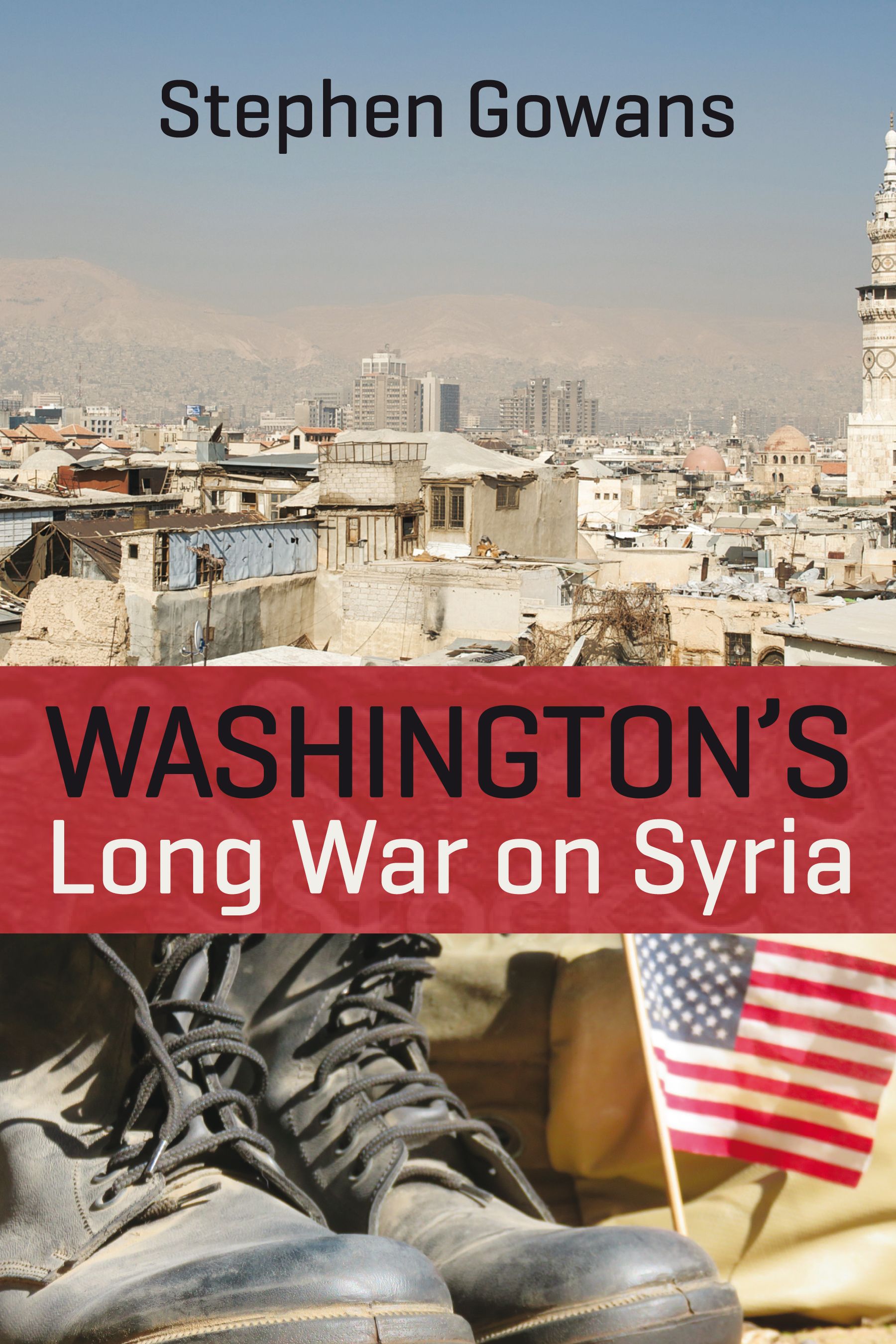
Available from Baraka Books http://www.barakabooks.com/catalogue/washingtons-long-war-on-syria/
If you’re a liberal, you might believe that the United States should offer the DPRK (the Democratic People’s Republic of Korea, North Korea’s official name) security guarantees in return for Pyongyang completely, permanently and verifiably eliminating its nuclear weapons program. If so, your position invites three questions.

• Contrary to the febrile rhetoric of high US officials, the United States is not threatened by North Korea. North Korea’s nuclear weapons capability is a defensive threat alone. The DPRK’s leaders are not unaware that a first-strike nuclear attack would trigger an overwhelming US nuclear retaliatory strike, which, as then US president Bill Clinton once warned, “would mean the end of their country as we know it”. Since a North Korean first-strike would be suicidal (and this is not lost on the North Korean leadership), whether Pyongyang has or doesn’t have nuclear weapons makes little difference to US national security. What, then, would motivate Washington to offer genuine security guarantees? It can’t be argued that US national security considerations form the basis of the guarantees, since the threat to the United States of a nuclear-armed North Korea is about the same as a disarmed North Korea—approximately zero.

• How credible could any security guarantee be, in light of the reality that since 1945 Washington has invested significant blood and treasure in eliminating all expressions of communism and anti-imperialism on the Korean peninsula. The argument that the United States could issue genuine security guarantees would have to explain what had transpired to bring about a radical qualitative shift in US policy from attempting to eliminate communism in Korea to détente with it.

• Why is it incumbent on North Korea alone to disarm? Why not the United States too?

The conservative view, on which I shall not tarry, is simple. Anything North Korea does, except surrender, is blameworthy.

Finally, you might lament Pyongyang’s nuclear test for running counter to nuclear non-proliferation, invoking the fear that growth in the number of countries with nuclear weapons increases the risk of war. But this view crumbles under scrutiny. The elimination of weapons of mass destruction (WMDs) in Iraq didn’t reduce the chances of US military intervention in that country—it increased them. Libyan leader Muammar Gaddafi’s voluntary elimination of his WMD didn’t prevent a NATO assault on Libya—it cleared the way for it. The disarming of countries that deny the US ruling class access to markets, natural resources, and investment opportunities, in order to use these for their own development, doesn’t reduce the risk of wars of conquest—it makes them all the more certain.

The radical view locates the cause of wars of conquest since the rise of capitalism in the drive for profits. This compulsion chases the goods, services and capital of corporate-dominated societies over the face of the globe to settle everywhere, nestle everywhere, and establish connections everywhere, irrespective of the wishes, interests, development needs and welfare of the natives. If territories aren’t voluntarily opened to capital penetration through trade and investment agreements, their doors are battered down by the Pentagon, the enforcer of last resort of a world economic order supporting, as its first commitment, the profit-making interests of the US ruling class.

Background

Because North Korea has long been vilified and condemned by the Western press as bellicose, provocative and unpredictable, it’s difficult to cut through the fog of vituperation that obscures any kind of dispassionate understanding of the country to grasp that the DPRK represents something praiseworthy: a tradition of struggle against oppression and foreign domination, rooted in the experience of a majority of Koreans dating back to the end of WWII and the period of Japanese colonial rule. This tradition found expression in the Korean People’s Republic, a national government, created by, for, and of Koreans, that was already in place when US troops landed at Inchon in September, 1945. The new government was comprised of leftists who had won the backing of the majority, partly because they had led the struggle against Japan’s colonial occupation, and partly because they promised relief from exploitation by landlords and capitalists. The USSR, which occupied the north of the country until 1948, worked with the KPR in its occupation zone, but the United States suppressed the KPR in the south, worked to exterminate leftist forces in its zone, and backed conservatives reviled by Koreans for their oppressions and collaboration with the Japanese. By 1948, the peninsula was divided between a northern government led by guerrillas and activists who fought to liberate Korea from Japanese rule, and a southern government led by a US-installed anti-communist backed by conservatives tainted by collaboration with colonial oppression. For the next 65 years, the essential character of the competing regimes has remained the same. Park Geun-hye, the incoming South Korean president is the daughter of a former president, Park Chung-hee, who came to power in a military coup in 1961. The elder Park had served in the Japanese Imperial Army. Kim Il Sung, grandfather of North Korea’s current leader, Kim Jong-eun, was an important guerrilla leader who, unlike the collaborator Park, fought, rather than served, the Japanese. The North represents the traditions of struggle against foreign domination, both political and economic, while the South represents the tradition of submission to and collaboration with a foreign hegemon. Significantly, there are no foreign troops stationed in North Korea, but are in South Korea. North Korean troops have never fought abroad, but South Korea’s have, odiously in Vietnam, in return for infusions of mercenary lucre from the Americans, and later in Iraq. As regards repression, South Korea’s authoritarianism on behalf of rightist causes is long and enduring, typified in the virulently anti-communist National Security Law, which metes out harsh punishment to anyone who so much as publicly utters a kind word about North Korea. The South Korean police state also blocks access to pro-North Korean websites, bans books, including volumes by Noam Chomsky and heterodox (though pro-capitalist) economist Ha Joon-chang, and imprisons anyone who travels to the North.

Pressure

Since the Korean War the United States and South Korea have maintained unceasing pressure on North Korea through subversion, espionage, propaganda, economic warfare and threats of nuclear attack and military invasion. Low-intensity warfare sets as its ultimate objective the collapse of the North Korean government. Unremitting military pressure forces Pyongyang to maintain punishingly high expenditures on defense (formalized in the country’s Songun, or “army first” policy). Massive defense expenditures divert critical resources from the civilian economy, retarding economic growth. At the same time, trade and financial sanctions heap further harm on the economy. Economic dislocations disrupt food supplies, make life harsh for many North Koreans, and breed discontent. Discontent in turn engenders political opposition, which is beaten back and contained by measures of repression and restriction of civic and political liberties. In response, Washington disingenuously deplores Pyongyang’s military expenditures at a time North Koreans “are starving”; denounces Pyongyang’s nuclear weapons program as a “provocation” (rather than a defense against US military threat); dishonestly attributes the country’s economic difficulties to allegedly inherent weaknesses in public ownership and central planning (rather than sanctions and financial strangulation); and chastises the DPRK for its repressive measures to check dissent (ultimately traceable to US pressures.) In other words, the regrettable features of North Korea that Washington highlights to demonize and discredit the DPRK are the consequences, not the causes, of US North Korea policy. To view US policy as a reaction to the DPRK’s nuclear weapons program, economic difficulties, and repressions is to get the causal direction wrong.

US foreign policy

US foreign policy aims to secure and defend access to foreign markets, natural resources and investment opportunities and deny communists and nationalists control because access might be blocked, limited or freighted with social welfare and domestic development considerations.

As a general rule, the American government’s attitude to governments in the Third World …depends very largely on the degree to which these governments favour American free enterprise in their countries or are likely to favour it in the future…In this perspective, the supreme evil is obviously the assumption of power by governments whose main purpose is precisely to abolish private ownership and private enterprise…Such governments are profoundly objectionable not only because their actions profoundly affect foreign-owned interests and enterprises or because they render future capitalist implantation impossible [but also] because the withdrawal of any country from the world system of capitalist enterprise is seen as constituting a weakening of that system and as providing encouragement to further dissidence and withdrawal. [1]

North Korea is one of the few countries left that commits “the supreme evil.” Allowed to develop in peace, unimpeded by military pressure and economic warfare, it might become an inspiration for other countries to follow. From the perspective of the US ruling class, the United States’ North Korea policy must have one overarching objective: the DPRK’s demise. Asked by The New York Times to explain the aim of US policy on North Korea, then US under secretary of state for arms control John Bolton “strode over to a bookshelf, pulled off a volume and slapped it on the table. It was called ‘The End of North Korea.'” “‘That,’ he said, ‘is our policy.'” [2]

On top of profit-making goals, and crippling North Korea economically, politically and socially to prevent its emergence as an inspiring example to other countries, Washington seeks to maintain access to its strategic position on a peninsula whose proximity to China and Russia provides a forward operating base from which to pressure these two significant obstacles to the United States’ complete domination of the globe.

Threats of nuclear war

According to declassified and other US government documents, some released on the 60th-anniversary of the Korean War, from “the 1950s’ Pentagon to today’s Obama administration, the United States has repeatedly pondered, planned and threatened the use of nuclear weapons against North Korea.” [3] These documents, along with the public statements of senior US officials, point to an ongoing pattern of US nuclear intimidation of the DPRK.

• The United States introduced nuclear weapons to the Korean peninsula as early as 1950. [4]

• During the Korean War, US president Harry Truman announced that the use of nuclear weapons was under active consideration; US Air Force bombers flew nuclear rehearsal runs over Pyongyang; and US commander General Douglas MacArthur planned to drop 30 to 50 atomic bombs across the northern neck of the Korean peninsula to block Chinese intervention. [5]

• In the late 1960s, nuclear-armed US warplanes were maintained on 15-minute alert to strike North Korea. [6]

• In 1975, US defense secretary James Schlesinger acknowledged for the first time that US nuclear weapons were deployed in South Korea. Addressing the North Koreans, he warned, “I do not think it would be wise to test (US) reactions.” [7]

• In February 1993, Lee Butler, head of the US Strategic Command, announced the United States was retargeting hydrogen bombs aimed at the old USSR on North Korea (and other targets.) One month later, North Korea withdrew from the Nuclear Non-proliferation Treaty. [8]

• On July 22, 1993, US president Bill Clinton said if North Korea developed and used nuclear weapons “we would quickly and overwhelmingly retaliate. It would mean the end of their country as we know it.” [9]

• In 1995, Colin Powell, who had served as chairman of the US joints chiefs of staff and would later serve as US secretary of state, warned the North Koreans that the United States had the means to turn their country into “a charcoal briquette.” [10]

• Following North Korea’s first nuclear test on October 9, 2006, US secretary of state Condoleezza Rice reminded North Korea that “the United States has the will and the capability to meet the full range—and I underscore full range of its deterrent and security commitments to Japan [emphasis added].” [11]

• In April 2010, US defense secretary Leon Panetta refused to rule out a US nuclear attack on North Korea, saying, “all options are on the table.” [12]

• On February 13, 2013, Panetta described North Korea as “a threat to the United States, to regional stability, and to global security.” He added: “Make no mistake. The US military will take all necessary steps to meet our security commitments to the Republic of Korea and to our regional allies [emphasis added].” [13]

As the North Koreans put it, “no nation in the world has been exposed to the nuclear threat so directly and for so long as the Koreans.”[14]

“For over half a century since early in the 1950s, the US has turned South Korea into the biggest nuclear arsenal in the Far East, gravely threatening the DPRK through ceaseless manoeuvres for a nuclear war. It has worked hard to deprive the DPRK of its sovereignty and its right to exist and develop….thereby doing tremendous damage to its socialist economic construction and the improvement of the standard of people’s living.” [15]

Economic warfare

The breadth and depth of US economic warfare against North Korea can be summed up in two sentences:

• North Korea is “the most sanctioned nation in the world” — George W. Bush. [16]

• …”there are few sanctions left to apply.” – The New York Times [17]

From the moment it imposed a total embargo on exports to North Korea three days after the Korean War began in June 1950, the United States has maintained an uninterrupted regimen of economic, financial, and diplomatic sanctions against North Korea. These include:

o Limits on the export of goods and services.
o Prohibition of most foreign aid and agricultural sales.
o A ban on Export-Import Bank funding.
o Denial of favourable trade terms.
o Prohibition of imports from North Korea.
o Blocking of any loan or funding through international financial institutions.
o Limits on export licensing of food and medicine for export to North Korea.
o A ban on government financing of food and medicine exports to North Korea.
o Prohibition on import and export transactions related to transportation.
o A ban on dual-use exports (i.e., civilian goods that could be adapted to military purposes.)
o Prohibition on certain commercial banking transactions. [18]

In recent years, US sanctions have been complemented by “efforts to freeze assets and cut off financial flows” [19] by blocking banks that deal with North Korean companies from access to the US banking system. The intended effect is to make North Korea a banking pariah that no bank in the world will touch. Former US president George W. Bush was “determined to squeeze North Korea with every financial sanction possible” until its economy collapsed. [20] The Obama administration has not departed from the Bush policies.

Washington has also acted to sharpen the bite of sanctions, pressing other countries to join its campaign of economic warfare against a country it faults for maintaining a Marxist-Leninist system and non-market economy. [21] This has included the sponsoring of a United Nations Security Council resolution compelling all nations to refrain for exporting dual-use items to North Korea (a repeat of the sanctions regime that led to the crumbling of Iraq’s healthcare system in the 1990s.) Washington has even gone so far as to pressure China (unsuccessfully) to cut off North Korea’s supply of oil. [22]

Drawing the appropriate lesson

On the day Baghdad fell to invading US forces, John Bolton warned Iran, Syria and North Korea to “draw the appropriate lesson from Iraq.” [23] There can be no doubt that Pyongyang drew a lesson, though not the one Bolton intended. The North Koreans did not conclude, as Bolton hoped, that peace and security could be achieved by relinquishing WMDs. Instead, the North Koreans couldn’t fail to grasp the real lesson of the US assault on Iraq. The United States had invaded Iraq only after Saddam Hussein had cleared the way by complying with US demands to destroy his weapons of mass destruction. Had he actually retained the weapons he was falsely accused of hiding and holding in reserve, the Americans would likely have never attacked.

Subsequent events in Libya have only reinforced the lesson. Muammar Gaddafi had developed his own WMD program to protect Libya from Western military intervention. But Gaddafi also faced an internal threat—Islamists, including jihadists linked to Al Qaeda, who sought to overthrow him to create an Islamist society in Libya. After 9/11, with the United States setting out to crush Al Qaeda, Gaddafi sought a rapprochement with the West, becoming an ally in the international battle against Al Qaeda, to more effectively deal with his own Islamist enemies at home. The price of being invited into the fold was to abandon his weapons of mass destruction. When Gaddafi agreed to this condition he made a fatal strategic blunder. An economic nationalist, Gaddafi irritated Western oil companies and investors by insisting on serving Libyan interests ahead of the oil companies’ profits and investors’ returns. Fed up with his nationalist obstructions, NATO teamed up with Gaddafi’s Islamist enemies to oust and kill the Libyan leader. Had he not surrendered his WMDs, Gaddafi would likely still be playing a lead role in Libya. “Who would have dared deal with Gaddafi or Saddam Hussein if they had a nuclear capability?” asks Major General Amir Eshel, chief of the Israeli army’s planning division. “No way.” [24]

Having unilaterally disarmed, Gaddafi was hailed in Western capitals, and world leaders hastened to Tripoli to sign commercial agreements with him. Among Gaddafi’s visitors was the South Korean minister of foreign affairs, and Ban Ki-moon, later to become the UN secretary general. Both men urged the “rehabilitated” Libyan leader to persuade the North Koreans to give up their nuclear weapons. [25] Whether Gaddafi acceded to the Koreans’ request is unclear, but if he did, his advice was wisely ignored. In the North Korean view, Gaddafi fell prey to a “bait and switch.” The lesson the DPRK drew from Libya was that the only guarantee of peace on the Korean peninsula is a powerful military, backed by nuclear weapons. [26]

This is neither an irrational view, nor one the West, for all its pieties about nuclear non-proliferation (for others), rejects for itself. Britain, for example, justifies its own nuclear weapons program with reference to the need “to deter and prevent nuclear blackmail and acts of aggression against our vital interests that cannot be countered by other means.” [27] If the UK requires nuclear weapons to deter and prevent nuclear blackmail and acts of aggression, then surely the North Koreans—long on the receiving end of these minatory pressures—do as well. Indeed, the case can be made that the North Koreans have a greater need for nuclear arms than the British do, for whom nuclear blackmail and acts of aggression are only hypotheticals.

General Kevin P. Chilton, head of the US Strategic Command from 2007 to 2011, told Washington Post columnist Walter Pincus in 2010 that, “Throughout the 65-year history of nuclear weapons, no nuclear power has been conquered or even put at risk of conquest.” [28] On the other hand, countries that comply with demands to abandon their WMDs soon find themselves conquered, by countries with nuclear weapons aplenty and no intention of giving them up. Pincus used Chilton’s words to advocate a pre-emptive strike on North Korea to prevent the country from developing a large enough nuclear arsenal to make itself invulnerable to conquest. That no nuclear power has been conquered or put at risk of conquest is “a thought others in government ought to ponder as they watch Iran and North Korea seek to develop nuclear capability,” Pincus wrote. [29]

Conclusion

Nuclear arms have political utility. For countries with formidable nuclear arsenals and the means of delivering warheads, nuclear weapons can be used to extort political concessions from non-nuclear-armed states through terror and intimidation. No country exploits the political utility of nuclear weapons as vigorously as the United States does. In pursuing its foreign policy goals, Washington threatened other countries with nuclear attack on 25 separate occasions between 1970 and 2010, and 14 occasions between 1990 and 2010. On six of these occasions, the United States threatened the DPRK. [30] There have been more US threats against North Korea since. (The United States’ record of issuing threats of nuclear attack against other countries over this period is: Iraq, 7; China, 4; the USSR, 4; Libya, 2; Iran, 1; Syria, 1. Significantly, all these countries, like the DPRK, were under communist or economically nationalist governance when the threats were made.)

Nuclear weapons also have political utility for countries menaced by nuclear and other military threats. They raise the stakes for countries seeking to use their militaries for conquest, and therefore reduce the chances of military intervention. There is little doubt that the US military intervention in Iraq and NATO intervention in Libya would not have been carried out had the targets not disarmed and cleared the way for outside forces to intervene with impunity.

A North Korean nuclear arsenal does not increase the chances of war—it reduces the likelihood that the United States and its South Korean marionette will attempt to bring down the communist government in Pyongyang by force. This is to be welcomed by anyone who opposes imperialist military interventions; supports the right of a people to organize its affairs free from foreign domination; and has an interest in the survival of one of the few top-to-bottom, actually-existing, alternatives to the global capitalist system of oppression, exploitation, and foreign domination.

1. Ralph Miliband, The State in Capitalist Society, Merlin Press, 2009, p. 62.

2. “Absent from the Korea Talks: Bush’s Hard-Liner,” The New York Times, September 2, 2003.

3. Charles J. Hanley and Randy Hershaft, “U.S. often weighed N. Korea nuke option”, The Associated Press, October 11, 2010.

4. Hanley and Hershaft.

5. Hanley and Hershaft.

6. Hanley and Hershaft.

7. Hanley and Hershaft.

8. Bruce Cumings, Korea’s Place in the Sun: A Modern History, W.W. Norton & Company, 2005. p. 488-489.

9. William E. Berry Jr., “North Korea’s nuclear program: The Clinton administration’s response,” INSS Occasional Paper 3, March 1995.

10. Bruce Cumings, “Latest North Korean provocations stem from missed US opportunities for demilitarization,” Democracy Now!, May 29, 2009.

11. Lou Dobbs Tonight, October 18, 2006.

12. Hanley and Hershaft.

13. Choe Sang-hun, “New leader in South criticizes North Korea,” The New York Times, February 13, 2013.

14. “Foreign ministry issues memorandum on N-issue,” Korean Central News Agency, April 21, 2010.

15. Korean Central News Agency, February 13, 2013.

16. U.S. News & World Report, June 26, 2008; The New York Times, July 6, 2008.

17. Neil MacFarquhar and Jane Perlez, “China looms over response to nuclear test by North Korea,” The New York Times, February 12, 2013.

18. Dianne E. Rennack, “North Korea: Economic sanctions”, Congressional Research Service, October 17, 2006. http://www.au.af.mil/au/awc/awcgate/crs/rl31696.pdf

19. Mark Landler, “Envoy to coordinate North Korea sanctions”, The New York Times, June 27, 2009.

20. The New York Times, September 13, 2006.

21. According to Rennack, the following US sanctions have been imposed on North Korea for reasons listed as either “communism”, “non-market economy” or “communism and market disruption”: prohibition on foreign aid; prohibition on Export-Import Bank funding; limits on the exports or goods and services; denial of favorable trade terms.

22. The Washington Post, June 24, 2005.

23. “U.S. Tells Iran, Syria, N. Korea ‘Learn from Iraq,” Reuters, April 9, 2003.

24. Ethan Bronner, “Israel sense bluffing in Iran’s threats of retaliation”, The New York Times, January 26, 2012.

25. Chosun Ilbo, February 14, 2005.

26. Mark McDonald, “North Korea suggests Libya should have kept nuclear program”, The New York Times, March 24, 2011.

A February 21, 2013 comment by Pyongyang’s official Korean Central News Agency (“Nuclear test part of DPRK’s substantial countermeasures to defend its sovereignty”) noted that,

“The tragic consequences in those countries which abandoned halfway their nuclear programs, yielding to the high-handed practices and pressure of the U.S. in recent years, clearly prove that the DPRK was very far-sighted and just when it made the option. They also teach the truth that the U.S. nuclear blackmail should be countered with substantial countermeasures, not with compromise or retreat.”

An article in the February 22, 2013 issue of Rodong Sinmun, the official newspaper of the Central Committee of North Korea’s ruling Workers Party (“Gone are the days of US nuclear blackmail”) observed that “Had it not been the nuclear deterrence of our own, the U.S. would have already launched a war on the peninsula as it had done in Iraq and Libya and plunged it into a sorry plight as the Balkan at the end of last century and Afghanistan early in this century.”

27. http://www.mod.uk/NR/rdonlyres/AC00DD79-76D6-4FE3-91A1-6A56B03C092F/0/DefenceWhitePaper2006_Cm6994.pdf

28. Quoted in Walter Pincus, “As missions are added, Stratcom commander keeps focus on deterrence,” The Washington Post, March 30, 2010.

29. Pincus.

30. Samuel Black, “The changing political utility of nuclear weapons: Nuclear threats from 1970 to 2010,” The Stimson Center, August 2010, http://www.stimson.org/images/uploads/research-pdfs/Nuclear_Final.pdf

Once derided, Gaddafi’s warnings about jihadists now used to justify Mali intervention

By Stephen Gowans

In the January 20th New York Times, Steven Erlanger justifies the French intervention in Mali on these grounds:

• It responds to “a direct request from a legitimate government.”
• It combats “the spread of radical Islamists, some of them foreign jihadists, strongly connected to terrorist groups like Al Qaeda in the Islamic Maghreb.”

Erlanger uses the word “legitimate” to describe Mali’s government. “Democratic” carries more weight, but Mali is governed by a military dictatorship, a truth one suspects Erlanger would prefer not to draw attention to. Neither does Erlanger’s report mention that Human Rights Watch accuses the Malian military of killing civilian Tuareg and Arab minorities (1). Being every bit a salesman, Erlanger presses “legitimate” into use as an inferior, though still high-sounding, surrogate for “democratic” and ignores the civilian killings. A military operation to help a legitimate government must be legitimate, right? In any event, it sounds a whole lot better than the truth, namely, that the West has mounted a military operation to prop up a dictatorship that kills its own people.

The intervention, of course, is far from legitimate. How can a French military operation in a North African country be legitimate, when not too long ago France undertook what was then called a legitimate intervention in another North African country, Libya, with the opposite aims:

• Not to support, but to topple a legitimate government;
• Not to stop the spread of radical Islam, but to help radical Islamists, some of them foreign jihadists, strongly connected to terrorist groups like Al Qaeda in the Islamic Maghreb, overthrow a legitimate government?

In other words, the Mali operation is the very antithesis of the Libyan one. Yet, according to state officials in France, the United States and Britain, along with their jingoist Western mass media cheerleaders, both interventions are legitimate. Where the Mali intervention protects a legitimate government, the Libyan intervention toppled one. Where the Mali operation opposes radical Islamists, the Libyan operation aided them.

It can’t possibly be true that Western governments are against radical Islamists as a matter of principle, when the principal financial and ideological backer of militant Sunni Islamism, Saudi Arabia, is a treasured ally.

Nor can it be true when Western powers backed radical Islamists against:

• The leftist Afghan government in the 1980s,
• Yugoslavia’s social democracy in the 1990s,
• Gaddafi’s economic nationalism in Libya,
• Assad’s secular nationalist government in Syria.

It can’t be true that Western powers are against despots, dictators, and absolutist monarchs, when they’ve backed so many of them in the past, and continue to back them in the present, from the potentates of the Gulf Cooperation Council to the military regime in Mali.

Neither are Western powers committed to backing struggles against tyrannies as struggles against tyrannies. On countless occasions, they’ve either stood idly by as tyrannies repressed democratic rebellions, or energetically aided their autocratic allies’ efforts to crush opposition. For a recent example, we need only turn to the crackdown on the rebellion in absolutist Bahrain, assisted by the same countries which supplied arms to misnamed “democrats” in Libya and equip the Muslim Brothers and foreign jihadists in Syria. Washington has done nothing to stop the crackdown in Bahrain, let alone vigorously protested it. The British, for their part, invited the offending tyrant to the royal wedding of Kate and William.

What then is the intervention all about? Profits. According to the New York Times’ Michael R. Gordon, the West needs to intervene militarily in northern Africa because the “region is rich with oil, gas, uranium and other international ventures that clearly represent Western interests and in some cases are poorly defended” (my emphasis) (2). That natural resources in northern Africa clearly represent Western interests defies both geography and democracy. It does, however, fit imperialist logic to a tee.

Erlanger notes that the Mali intervention “has been popular” and that it commands the support of three quarters of the French, according to one poll. This is a nod to the prowess of Erlanger’s cohorts in the trade of shaping public opinion, and the superficial attention most people pay to foreign affairs. It’s also an attempt to prop up his argument that the intervention is legitimate. After all, a military operation supported by a solid majority can hardly be a base affair, corrupted by hypocrisy and crass commercial interests, can it? And if you should happen to be against the French helping an ally defend itself against jihadists, Erlanger’s letting you know you’re on the wrong side of public opinion.

“The French people are ready to support a military operation as long as the objectives are clear and seem legitimate,” a French analyst told Erlanger. Well, no, the French people are willing to support a military operation so long as no one calls upon them to risk their lives and pay higher taxes, what “support for war” used to mean. No longer. Today, support means feeling good about France and nothing more.

The French will continue to feel good about their country so long as there are few French fatalities in Mali and so long as the connection between covering the costs of the war and higher taxes, is obscured. Payment for the war must be deferred, and then concealed, preferably in tax hikes on the poor and middle class to cover (wink-wink) skyrocketing social welfare expenditures.

So here we are. Gaddafi was sneered at when he said that the rebellion that erupted against him in Benghazi was the work of radical Islamists, some of them foreign jihadists, strongly connected to terrorist groups like Al Qaeda in the Islamic Maghreb. He was just as contemptuously dismissed when he warned, “if he fell, chaos and holy war would overtake North Africa.” Now that chaos and holy war threaten to overtake a Western client, Gaddafi’s words are being treated with new respect. In death, the man once ridiculed as a buffoon has become a sage.

1. Geoffrey York, “Ethnic violence flares in Mali”, The Globe and Mail, January 21, 2013
2. Michael R. Gordon, “North Africa is a new test”, The New York Times, January 20, 2013

Al Qaeda’s enemy in Mali, friend in Syria, and air force in Libya

By Stephen Gowans

New York Times reporters Mark Mazzetti and Eric Schmitt, writing on January 16 about the “hazy threat from Mali militants,” note that, “The group most worrisome to American officials is Al Qaeda in the Islamic Maghreb, which emerged out of Algeria’s civil war in the 1990s and originally was strictly focused on overthrowing Algeria’s government.”

US officials didn’t find AQIM so worrisome when the Islamist group was focused on overthrowing Libya’s government. At the time, Washington was happy to allow Islamist militants to destabilize a government that wasn’t wholly congenial to US business interests.

As the Ottawa Citizen’s David Pugliese reported last year, Libyan leader Muamar Gaddafi had “said the rebellion had been organized by AQIM and his old enemies the (Libyan Islamic Fighting Group), who had vowed to overthrow the colonel and return the country to traditional Muslim values, including Sharia law.”

AQIM’s goals for Libya raised no alarm in Washington, but according to Mazzetti and Schmitt, the organization’s vow to convert Mali to Sharia law is setting off alarm bells in Washington.

To assist AQIM and other Islamist rebels in Libya, the United States led NATO into an air war against the Gaddafi government. Acknowledging AQIM’s role in the Libyan rebellion, some of the Canadian pilots who participated in the NATO air campaign jokingly referred to themselves as part of “Al-Qaeda’s air force.”

Washington’s use of jihadists to topple leftist and nationalist governments stretches back to its 1980s alliance with Islamist rebels, including Osama bin Laden, in Afghanistan. Today, al Qaeda-linked militants play an important part in the US-backed effort to overthrow the Syrian government.

To mobilize public support for jihadist rebellions, US officials and news media sanitize Islamist militants as “freedom fighters” or part of a “popular movement for democracy.” Few people anymore believe that the Islamists seeking to overthrow the Syrian government represent a popular movement for democracy. They are, instead, a movement for Sunni religious domination.

After the AQIM triumph in Libya, the organization turned to attacking the US consular building in Benghazi. With its transition from US cat’s paw to US enemy, Washington changed its naming protocol. Now AQIM would go by the moniker Gaddafi favored–terrorists. Which is also how Western officials and news media prefer to describe the organization today, now that AQIM’s goals in Mali collide with the West’s goal of maintaining a puppet regime in the country.

Were the AQIM working in Mali to topple a leftist or economically nationalist government, Washington and Western news media would be hailing the jihadists as a force for democracy.

The Syrian conflict is not about democracy

Reprinted from Mark Thomas, “The Syrian conflict is not about democracy”, October 22, 2012 http://www.extension.harvard.edu/hub/blog/extension-blog/syrian-conflict-not-about-democracy

By Mark Thomas

Many foreign policy advocates are dismayed by the lack of US leadership in establishing no-fly, no-drive zones along the Syrian borders with Turkey, Jordan, and Lebanon. Along these lines army defectors and rebels could stage military operations to bring about the downfall of the Assad regime.

The truth about US support of Syrian rebels

The Obama administration has thus far provided political support to the Syrian rebels. But it has limited military aid to intelligence, training, and logistics.

The administration is betting this kind of qualified support will help overturn the regime. And the United States will appear to be on the side of victors.

Its real motive is to weaken Iran’s regional influence by a proxy war that would destroy its ally.

The Syrian rebellion is more antigovernment than prodemocracy

US support for the rebels and those who call for an interventionist US policy are under the illusion that the antigovernment rebellion is a prodemocracy one. But the rebels have no conception of freedom and democracy in the Western tradition.

The spontaneous rebellion that aimed to topple the Syrian regime soon mutated into a sectarian civil war between two sects: Sunnis and Alawis.

The Sunnis are represented by local fighters, international jihadists, and regional Sunni states, such as Turkey, Saudi Arabia, and Qatar.

The Alawis control the army and have grassroots support from secularists, heterodox Muslim sects, Christians, leftists, nationalists, and feminists.

Classified intelligence briefings have made Congress aware of this. Yet the administration, the republican presidential candidate, and the mainstream media still present a misleading picture to the US public.

The conflict in Syria is not simply between a tyrant and his people. If that were the case, Assad would have been overthrown in a few weeks, like Ben Ali of Tunis and Mubarak of Egypt.

The sectarian character of the conflict

The advocates for military intervention underplay the sectarian character of the conflict. They claim that the Assad family fomented sectarian strife to convince members of their sect, the Alawis, that the fall of the regime would be catastrophic for Alawis.

But the Alawis needed no convincing. Their nonliteral reading of Islamic scriptures makes them susceptible to secular ideology. They are apostates in the eyes of the dominant Sunni orthodoxy. And apostasy in Islam is a capital offense.

Throughout history, the Alawis were subjected to campaigns of mass murder. The first religious judgment was issued against them in 1305 by a Damascus based Sunni religious scholar. The Sunni Ottoman state issued similar decrees in 1516 and 1820 to kill Alawi men, enslave their women and children, and loot their property.

When the Alawis were not being pursued, they were boycotted and ostracized. They lived for centuries in appalling conditions, often forced to give up their children into servitude to escape starvation.

After Syria’s independence from France, Alawis filled the ranks of the army and the emerging secular Baath party, whose ethos suited them as much as it did the rest of the persecuted heterodox Muslims and Christians who sought equality.

Democracy would mean majority rule, not constitutional democracy

The Alawis, rich and poor alike, understand that democracy in the Middle East implies majority rule rather than a constitutional democracy. They understand that under the pretense of democracy, Syria would gradually become like Saudi Arabia.

For them, giving up power implies the tyranny of the Sunni majority. Sunni religious authorities have shown for the past millennium that there is no place for freedom of thought and religious heterodoxy within Islam.

Indeed, the religious orthodoxy that emerged by the end of the Crusades was only sidelined after the 1966 Alawi officers’ coup that endorsed the more enlightened Sufi clerics among Sunni religious scholars. The latter focused on the universal values of Islam. They sought reconciliation with other sects and religions.

The Alawis have two options

For those of us who grew up in the Middle East, the sectarian divide is a reality. Those who claim that Assad stirred up sectarianism either are ill-informed outsiders, who formed their image of Syria by reading politically correct discourse, or are in denial.

Bear in mind that this secular authoritarian and arguably brutal Alawi regime granted religious freedom to all sects. It appointed the first woman vice president in the entire Muslim world.

Convinced that the present rebellion is not a prodemocracy one, the Alawis have two options. They can continue to rule Syria to guarantee their security and thereby continue their repression of the rebellious Sunnis. Or they can rule their own territories in the Alawi Mountains and the Syrian coast, thereby provoking painful sectarian cleansing.

The second option would leave the rest of Syria in chaos, fighting to host the armed groups the West dreads (much like the Syrian regions currently under rebel control).

A recommended US policy

A wise US policy toward the Syrian crisis would persuade its Turkish, Saudi, and Qatari allies to stop arming and recruiting international jihadists to fight a war that would further destabilize a volatile region.

Moreover, the United States should encourage the domestic opposition to negotiate a settlement with the regime that ensures a reasonable transition to a pluralistic and secular political system and saves what is left from pre-Abrahamic civilizations from imminent destruction.

Most importantly, it should cease emboldening the rebels by continuing to predict the demise of the regime, thereby causing more unnecessary bloodshed.

For Whom the War Bill Tolls

The $1 trillion-plus Iraq and Afghanistan wars were the first US wars since the American Revolution to have been fought without a general tax increase to cover them. Without tax increases to pay for the Pentagon’s ballooning budget, the country’s debt as a percentage of GDP has grown. Since a rise in debt relative to income can’t continue indefinitely, politicians are looking for ways to arrest the trend. It’s very likely that the burden of covering the costs of run-away US military spending will fall upon poor and middle-income Americans. High-profile economists like N. Gregory Mankiw are preparing public opinion for eventual rate hikes, concealing the role played by US war spending in driving up the percentage of debt to GDP, and blaming growing entitlement spending on the need to raise taxes.

By Stephen Gowans

Harvard economics professor N. Gregory Mankiw, economic policy adviser to George W. Bush and Mitt Romney, and author of a widely used introductory economics textbook, weighed in this Sunday in The New York Times on the growing ratio of US debt to gross domestic product and what to do about it. [1] Forget about raising taxes on the wealthy, counselled Mankiw. Instead, stick it to everyone else. Here’s Mankiw’s reasoning:

• Debt as a proportion of national income is growing “thanks largely to growth in entitlement spending.”
• If debt to GDP continues to grow, investors will eventually refuse to lend at manageable rates, tipping the United States into a Greek-style financial crisis.
• The crisis can’t be averted simply by raising taxes on the rich. There just aren’t enough wealthy taxpayers around to make much of a difference. Nor would tax increases on the wealthy be fair. “The current tax system looks plenty progressive,” says Mankiw. “The rich are not…shirking their responsibilities.”
• Instead, entitlements need to be scaled back and taxes hiked on the vast majority of Americans.

Mankiw presents this as a corrective to too much wishful thinking on middle-class tax rates. But his argument is more snow job than corrective.

Wasteful Military Spending

Mankiw misses the elephant in the room on federal spending: the military and the wars in Iraq and Afghanistan. According to World Bank figures, from 1999 US military expenditures have steadily increased as a share of national income, rising from 3.0 percent of GDP to 4.7 percent by 2011. [3] New York Times’ reporters Thom Shanker and Elisabeth Bumiller reported last year that the US military budget “has doubled to $700 billion a year since the terrorist attacks of Sept. 11, 2001.” [3] Yes, doubled. If anything is growing, the military is. The Pentagon’s budget is now “the highest in absolute and in inflation-adjusted, constant (for any year) dollars since 1946, the year after the Second World War ended. Adding non-Pentagon defense-related spending, the total may exceed $1 trillion.” [4]

The US defense budget exceeds the combined expenditures of the next 14 highest spenders—China, Russia, the UK, France, Japan, Saudi Arabia, India, Germany, Brazil, Italy, South Korea, Australia, Canada and Turkey. All but two of these countries are US allies. [5] China and Russia are not part of a US-led military alliance. But their combined military expenditures are less than one-third of the Pentagon’s budget. It’s difficult to fathom why soi disant hard-headed deficit hawks aren’t scolding Washington for wasteful overspending on defense, unless the professed deficit hawks are using debt as a pretext to argue for cut-backs in programs for poor and middle-income Americans.

The Pentagon’s obesity is largely due to the United States starting two completely unnecessary and extremely expensive wars: one on Iraq, based on the lie that Saddam Hussein had weapons of mass destruction, and one on Afghanistan, to topple the Taliban who will likely return to power in a negotiated settlement.

Bumiller reported in 2010 that both wars had “cost Americans a staggering $1 trillion to date, second only in inflation-adjusted dollars to the $4 trillion price tag for World War II, when the United States put 16 million men and women into uniform and fought on three continents.” [6] With the war in Afghanistan dragging on at a cost of “about $2 billion a week” [7] another $200 billion has come due since Bumiller tallied up the original $1 trillion price tag. Genuine concern about managing US finances would have long ago led to an end to both wars (not just one), if not complete avoidance of either to begin with.

Taxes were not raised to pay for either war. These are the first wars since the American Revolution for which Washington hasn’t called upon taxpayers to ante up. [8] The reason is clear. Neither war was likely to galvanize Americans to accept sacrifices. So, the only way to get Americans behind them was to fight the wars in a way that allowed the country to avoid “breaking a sweat,” as historian David Kennedy put it. [9]

Many Americans are willing to acknowledge that the wars should never have been fought, but rationalize them by pointing to the supposed good they’ve done (the toppling of Saddam Hussein, improved conditions for women in Afghanistan.) But how accepting will they be when they’re presented with the bill, as they most assuredly will be? Someone will have to pay eventually. The trick for politicians will be to blame the bill on something else. Entitlements come to mind.

The Flat Tax System

If Mankiw ignores the obvious links among rising military expenditures, absent tax increases, and a climbing debt to GDP ratio, he also ignores property, state, excise, and sales taxes, to argue that the wealthy are already paying their fair share, and that “the current tax system looks pretty progressive.” Well, yes, the current federal income tax system does look progressive, and Mankiw would be on target if the federal income tax was the only tax Americans pay. But they also pay sales taxes, property taxes and more. Factor in all other taxes and the tax system isn’t quite as progressive as Mankiw would have us believe. As Washington Post reporter Ezra Klein noted in September, “Confining the discussion to the federal income tax…makes the tax code look much more progressive than it actually is.” [10]

So, just how unprogressive is the tax system? According to the Institute on Taxation and Economic Policy, total taxes in 2011 as a percentage of income were:

• Top 1% of income earners, 29.0%
• Bottom 99%, 27.5% [11].

In other words, taking into account all the taxes Americans pay and not just the one Mankiw wants to confine the discussion to, the real tax system is essentially flat. The super-wealthy are paying about the same rate as everyone else. And yes, while the poor pay little if anything in federal taxes, they make up for it in state, local and other levies. Which means that were federal income taxes hiked on the bottom 99 percent, as Mankiw urges, the real tax system would go from flat to regressive.

taxday2012table

Who Benefits?

It’s widely believed that taxes on the wealthy are redistributed to the poor. It’s true that some redistribution of tax revenue from the wealthy to the poor does occur, but what’s less widely known, and rarely talked about, is that federal tax revenue flows mainly from the bottom 99 percent to the top one percent. This is clear if we recognize that:

• The bulk of taxes are paid by the bottom 99 percent (which is why defenders of the current flat tax system, like Mankiw, keep reminding us that hiking taxes on the rich will make little difference to government finances. The heavy lifting is done by poor and middle-income Americans.)
• A large fraction of tax revenue is used to fund activities the wealthy disproportionately benefit from.

What do federal income taxes pay for?

The US war machine, for one. A large part of federal income tax is paid to defense contractors, companies like Lockheed-Martin, Boeing, Northrop Grumman, Raytheon and General Dynamics. The top executives and shareholders of these companies make off like bandits in regular times, but have benefited even more handsomely ever since post 9/11 military expenditures doubled. The profits of the top five defense contractors “rose from $2.4 billion in 2002, adjusted for inflation, to $13.4 billion in 2011,” a 450 percent increase. [12]

US federal income tax also helps finance US wars. And US wars almost invariably create profit-making opportunities for banks and corporations. For example, then US ambassador to Libya Gene Cretz was positively rhapsodic about the business opportunities that were opened by the US-led (from behind) Nato assault that toppled Muammar Gadhafi, not just petroleum-related but infrastructure contracts too. [13] In the charmed circle of US capitalism, defense contractors reap a bonanza of profits by supplying the Pentagon with arms, which the Pentagon use to destroy infrastructure that US engineering giants, like Bechtel, rebuild.

Military and non-military aid to other countries is also underwritten by federal income tax revenue. The bottom 99 percent, who contribute the bulk of funds to these programs, benefit only indirectly, if at all. Instead, their tax dollars are converted into credits, which are doled out to other countries to purchase goods and service from US corporations, the direct beneficiaries. For example, the $3 billion in annual military aid Israel receives travels from taxpayers’ pockets to US defense contractors’ coffers. The arms industry sends military equipment to Israel, with payment for the purchase never leaving the United States. The same kind of arrangement is used to provide economic aid to poor countries. These countries don’t get cash to spend as they see fit. They get credits to spend on American goods and services. There may be benefits to poor and middle-income Americans in job opportunities, but the benefits are disproportionately enjoyed by the top executives and shareholders of the companies on which the credits are spent.

Another sizeable part of US federal income tax revenue goes to purchasers of US debt—the debt that piled up to pay for the wars Washington didn’t want to raise taxes to pay for. Needless to say, it is the super-rich, not poor and middle-income Americans, who are the major holders of US debt. And super-wealthy bondholders are often the same people who own shares in companies that supply the Pentagon and benefit from the new foreign business opportunities that US military interventions secure.

So, no, the tax system doesn’t work against the wealthy, as Mankiw and others would have us believe. Instead, a large part of the tax system’s function is to transfer tax revenues from the bottom 99 percent to foreign aid, military appropriations, wars, and interest on debt that the top one percent disproportionately benefit from.

Conclusion

The United States has doubled military spending since 9/11, outspending its peer competitors, China and Russia, by more than a factor of three. It has squandered more than $1 trillion on wars that never should have been fought, and continues to waste $2 billion a week on war in Afghanistan. This excess has been paid for by borrowing rather than taxes, presumably to avoid hurting Americans in their pocketbooks, a pain that would likely provoke anti-war opposition. But the bills are coming due. Mankiw, and other prizefighters for the super-wealthy, are drawing attention away from outsize military spending—a significant contributor to burgeoning debt—and directing it instead to entitlements. They’re also deceptively ignoring payroll, property, sales and other taxes, to argue that the US tax system is progressive and that the wealthy already pay their fair share. In other words, Mankiw is arguing for higher taxes on poor and middle-income Americans, misdirecting attention to entitlement spending to conceal what the bill is really for: military spending that the super-rich have used to fatten their bank accounts.

Lessons learned.

A. Nothing comes free. Military spending can’t be doubled—and $1 trillion-plus wars fought— without someone eventually being handed the bill. And in the United States, the bill is always paid by the bottom 99 percent. This bill will be paid in entitlement cutbacks and tax increases.

B. The job of establishment economists is to make robbing poor and middle-income Americans seem both necessary and desirable. Feudal lords relied on priests to justify the exploitation of working people. Bankers, top executives and investors have economists.

1. N. Gregory Mankiw, “Wishful thinking and middle-class taxes”, The New York Times, December 29, 2012.
2. The World Bank, http://data.worldbank.org/indicator/MS.MIL.XPND.GD.ZS
3. Thom Shanker and Elisabeth Bumiller, “Weighing Pentagon cuts, Panetta faces deep pressures”, The New York Times, November 6, 2011.
4. Thom Shanker and Elisabeth Bumiller, “Weighing Pentagon cuts, Panetta faces deep pressures”, The New York Times, November 6, 2011.
5. Stockholm International Peace Research Institute, 2012
6. Elisabeth Bumiller, “The war: A trillion can be cheap”, The New York Times, July 24, 2010.
7. David E. Sanger, Eric Schmitt and Thom Shanker, “Steeper pullout is raised as option for Afghanistan”, The New York Times, June 5, 2011.
8. Elisabeth Bumiller, “The war: A trillion can be cheap”, The New York Times, July 24, 2010.
9. Ibid.
10. Ezra Klein, “The one tax graph you really need to know”, The Washington Post, September 19, 2012.
11. http://ctj.org/images/taxday2012table.jpg
12. Study co-written by Lawrence J. Korb for the Center for American Progress, cited by Walter Pincus in “Excess-profits tax on defense contractors during wartime is long overdue”, The Washington Post, December 31, 2012.
13. David D. Kirkpatrick, “U.S. reopens its embassy in Libya”, The New York Times, September 22, 2011. Cretz said, “We know that oil is the jewel in the crown of Libyan natural resources, but even in Qaddafi’s time they were starting from A to Z in terms of building infrastructure and other things. If we can get American companies here on a fairly big scale, which we will try to do everything we can to do that, then this will redound to improve the situation in the United States with respect to our own jobs.”

Washington balking at democratic transition in Syria

By Stephen Gowans

Last June world powers called for a transitional government to succeed the current government in Syria.

The United Nations and Arab League appointed Lakhdar Brahimi to negotiate a settlement with the Syrian government and opposition forces.

So far, Brahimi has made little headway. That’s to be expected. The deck is stacked against him.

With Washington, London, Paris and various Sunni Arab monarchies providing political and military support, the opposition has little motivation to negotiate. They must see their eventual victory as all but guaranteed.

At the same time, Washington must see recent rebel military gains as a sign that an opposition military victory is a very real possibility. It, too, then, has little motivation to see a settlement arrived at which stops short of its regime change objective.

Brahimi met this week with Syrian president Bashar Assad and various opposition groups and will meet with Russian foreign minister, Sergey Lavrov, on Saturday. Russia has also held talks with Syria.

One proposal under discussion, which has the backing of Assad’s allies in Moscow, would see the Syrian president’s authority gradually transferred to a transitional government, while Assad stays on as a figurehead president until his term expires in 2014. At that point, elections would be held.

If accepted, the proposal would end a civil war that has displaced hundreds of thousands and killed tens of thousands. It would also allow Syrians to decide their future peacefully in free elections, rather than at the point of a gun.

Given that (1) Assad’s ally, Russia, floated the proposal; (2) that Assad’s position is weakening; and (3) that the proposal allows him to stay in the game, it’s likely that Assad is onboard.

Not so the other side.

Predictably, Radwan Ziadeh of the Syrian National Council dismissed the proposal, while Washington, equally predictably, insists that Assad step down as a precondition for talks.

But that’s not all. Washington is also demanding Assad’s disqualification from running in future elections.

Neither condition helps end the conflict, nor serves the interests of Syrians as a whole.

Allowing Assad to stay on as a figurehead president is a concession of little significance, since power would eventually reside with a transitional government.

And why shouldn’t Assad be permitted to stand for re-election? If Syrians truly despise him, and wish to see him gone—as Washington and its allies would have us believe—he won’t survive an election.

Moreover, if the opposition is truly a popular movement for democracy, it can hardly object to Assad standing for election.

On the other hand, if Assad isn’t as unpopular as Washington and the rebels insist, he might emerge from a free election as victor, dashing the regime change agenda of the Sunni jihadists and US imperialists who object to Assad’s secular Arab nationalism.

Do Publicly Owned, Planned Economies Work?

Subscribe to continue reading

Subscribe to get access to the rest of this post and other subscriber-only content.