Stephen Gowans is the author of The Killer's Henchman: Capitalism and the Covid-19 Disaster (2022); Israel, A Beachhead in the Middle East: From European Colony to US Power Projection Platform (2019); Patriots, Traitors and Empires: The Story of Korea's Struggle for Freedom (2018); and Washington's Long War on Syria (2017).
For notification of updates, send an e-mail to stephen.roy.gowans@gmail.com with "subscribe" in the subject line.
http://www.barakabooks.com/catalogue/patriots-traitors-and-empires/The Soviet Union was dissolved 22 years ago, on December 26, 1991. It’s widely believed outside the former republics of the USSR that Soviet citizens fervently wished for this; that Stalin was hated as a vile despot; that the USSR’s socialist economy never worked; and that the citizens of the former Soviet Union prefer the life they have today under capitalist democracy to, what, in the fevered parlance of Western journalists, politicians and historians, was the repressive, dictatorial rule of a one-party state which presided over a sclerotic, creaky and unworkable socialist economy.
None of these beliefs is true.
Myth #1. The Soviet Union had no popular support. On March 17, 1991, nine months before the Soviet Union’s demise, Soviet citizens went to the polls to vote on a referendum which asked whether they were in favor of preserving the USSR. Over three-quarters voted yes. Far from favoring the breakup of the union, most Soviet citizens wanted to preserve it. [1]
Myth #2. Russians hate Stalin. In 2009, Rossiya, a Russian TV channel, spent three months polling over 50 million Russians to find out who, in their view, were the greatest Russians of all time. Prince Alexander Nevsky, who successfully repelled an attempted Western invasion of Russia in the 13th century, came first. Second place went to Pyotr Stolypin, who served as prime minister to Tsar Nicholas II, and enacted agrarian reforms. In third place, behind Stolypin by only 5,500 votes, was Joseph Stalin, a man that Western opinion leaders routinely describe as a ruthless dictator with the blood of tens of millions on his hands. [2] He may be reviled in the West, not surprisingly, since he was never one after the hearts of the corporate grandees who dominate the West’s ideological apparatus, but, it seems, Russians have a different view—one that fails to comport with the notion that Russians were victimized, rather than elevated, by Stalin’s leadership.
In a May/June 2004 Foreign Affairs article, (Flight from Freedom: What Russians Think and Want), anti-communist Harvard historian Richard Pipes cited a poll in which Russians were asked to list the 10 greatest men and women of all time. The poll-takers were looking for significant figures of any country, not just Russians. Stalin came fourth, behind Peter the Great, Lenin, and Pushkin…much to Pipes’ irritation. [3]
Myth #3. Soviet socialism didn’t work. If this is true, then capitalism, by any equal measure, is an indisputable failure. From its inception in 1928, to the point at which it was dismantled in 1989, Soviet socialism never once, except during the extraordinary years of World War II, stumbled into recession, nor failed to provide full employment. [4] What capitalist economy has ever grown unremittingly, without recession, and providing jobs for all, over a 56 year span (the period during which the Soviet economy was socialist and the country was not at war, 1928-1941 and 1946-1989)? Moreover, the Soviet economy grew faster than capitalist economies that were at an equal level of economic development when Stalin launched the first five year plan in 1928—and faster than the US economy through much of the socialist system’s existence. [5] To be sure, the Soviet economy never caught up to or surpassed the advanced industrial economies of the capitalist core, but it started the race further back; was not aided, as Western countries were, by histories of slavery, colonial plunder, and economic imperialism; and was unremittingly the object of Western, and especially US, attempts to sabotage it. Particularly deleterious to Soviet economic development was the necessity of diverting material and human resources from the civilian to the military economy, to meet the challenge of Western military pressure. The Cold War and arms race, which entangled the Soviet Union in battles against a stronger foe, not state ownership and planning, kept the socialist economy from overtaking the advanced industrial economies of the capitalist West. [6] And yet, despite the West’s unflagging efforts to cripple it, the Soviet socialist economy produced positive growth in each and every non-war year of its existence, providing a materially secure existence for all. Which capitalist economy can claim equal success?
Myth #4. Now that they’ve experienced it, citizens of the former Soviet Union prefer capitalism. On the contrary, they prefer the Soviet system’s state planning, that is, socialism. Asked in a recent poll what socio-economic system they favor, Russians answered [7]:
• State planning and distribution, 58%
• Private property and distribution, 28%
• Hard to say, 14%
• Total, 100%
Pipes cites a poll in which 72 percent of Russians “said they wanted to restrict private economic initiative.” [8]
Myth #5. Twenty-two years later, citizens of the former Soviet Union see the USSR’s demise as more beneficial than harmful. Wrong again. According to a just-released Gallup poll, for every citizen of 11 former Soviet republics, including Russia, Ukraine and Belarus, who thinks the breakup of the Soviet Union benefited their country, two think it did harm. And the results are more strongly skewed toward the view that the breakup was harmful among those aged 45 years and over, namely, the people who knew the Soviet system best. [9]
According to another poll cited by Pipes, three-quarters of Russians regret the Soviet Union’s demise [10]—hardly what you would think of people who were reportedly delivered from a supposedly repressive state and allegedly arthritic, ponderous economy.
Myth #6. Citizens of the former Soviet Union are better off today. To be sure, some are. But are most? Given that more prefer the former socialist system to the current capitalist one, and think that the USSR’s breakup has done more harm than good, we might infer that most aren’t better off—or at least, that they don’t see themselves as such. This view is confirmed, at least as regards life expectancy. In a paper in the prestigious British medical journal, The Lancet, sociologist David Stuckler and medical researcher Martin McKee, show that the transition to capitalism in the former USSR precipitated a sharp drop in life-expectancy, and that “only a little over half of the ex-Communist countries have regained their pre-transition life-expectancy levels.” Male life expectancy in Russia, for example, was 67 years in 1985, under communism. In 2007, it was less than 60 years. Life expectancy plunged five years between 1991 and 1994. [11] The transition to capitalism, then, produced countless pre-mature deaths—and continues to produce a higher mortality rate than likely would have prevailed under the (more humane) socialist system. (A 1986 study by Shirley Ciresto and Howard Waitzkin, based on World Bank data, found that the socialist economies of the Soviet bloc produced more favorable outcomes on measures of physical quality of life, including life expectancy, infant mortality, and caloric intake, than did capitalist economies at the same level of economic development, and as good as capitalist economies at a higher level of development. [12])
As regards the transition from a one-party state to a multi-party democracy, Pipes points to a poll that shows that Russians view democracy as a fraud. Over three-quarters believe “democracy is a facade for a government controlled by rich and powerful cliques.” [13] Who says Russians aren’t perspicacious?
Myth #7. If citizens of the former Soviet Union really wanted a return to socialism, they would just vote it in. If only it were so simple. Capitalist systems are structured to deliver public policy that suits capitalists, and not what’s popular, if what’s popular is against capitalist interests. Obamacare aside, the United States doesn’t have full public health insurance. Why not? According to the polls, most Americans want it. So, why don’t they just vote it in? The answer, of course, is that there are powerful capitalist interests, principally private insurance companies, that have used their wealth and connections to block a public policy that would attenuate their profits. What’s popular doesn’t always, or even often, prevail in societies where those who own and control the economy can use their wealth and connections to dominate the political system to win in contests that pit their elite interests against mass interests. As Michael Parenti writes,
Capitalism is not just an economic system, but an entire social order. Once it takes hold, it is not voted out of existence by electing socialists or communists. They may occupy office but the wealth of the nation, the basic property relations, organic law, financial system, and debt structure, along with the national media, police power, and state institutions have all been fundamentally restructured. [14]
A Russian return to socialism is far more likely to come about the way it did the first time, through revolution, not elections—and revolutions don’t happen simply because people prefer a better system to the one they currently have. Revolutions happen when life can no longer be lived in the old way—and Russians haven’t reached the point where life as it’s lived today is no longer tolerable.
Interestingly, a 2003 poll asked Russians how they would react if the Communists seized power. Almost one-quarter would support the new government, one in five would collaborate, 27 percent would accept it, 16 percent would emigrate, and only 10 percent would actively resist it. In other words, for every Russian who would actively oppose a Communist take-over, four would support it or collaborate with it, and three would accept it [15]—not what you would expect if you think Russians are glad to get out from underneath what we’re told was the burden of communist rule.
So, the Soviet Union’s passing is regretted by the people who knew the USSR firsthand (but not by Western journalists, politicians and historians who knew Soviet socialism only through the prism of their capitalist ideology.) Now that they’ve had over two decades of multi-party democracy, private enterprise and a market economy, Russians don’t think these institutions are the wonders Western politicians and mass media make them out to be. Most Russians would prefer a return to the Soviet system of state planning, that is, to socialism.
Even so, these realities are hidden behind a blizzard of propaganda, whose intensity peaks each year on the anniversary of the USSR’s passing. We’re supposed to believe that where it was tried, socialism was popularly disdained and failed to deliver—though neither assertion is true.
Of course, that anti-Soviet views have hegemonic status in the capitalist core is hardly surprising. The Soviet Union is reviled by just about everyone in the West: by the Trotskyists, because the USSR was built under Stalin’s (and not their man’s) leadership; by social democrats, because the Soviets embraced revolution and rejected capitalism; by the capitalists, for obvious reasons; and by the mass media (which are owned by the capitalists) and the schools (whose curricula, ideological orientation and political and economic research are strongly influenced by them.)
So, on the anniversary of the USSR’s demise we should not be surprised to discover that socialism’s political enemies should present a view of the Soviet Union that is at odds with what those on the ground really experienced, what a socialist economy really accomplished, and what those deprived of it really want.
1.”Referendum on the preservation of the USSR,” RIA Novosti, 2001, http://en.ria.ru/infographics/20110313/162959645.html
2. Guy Gavriel Kay, “The greatest Russians of all time?” The Globe and Mail (Toronto), January 10, 2009.
3. Richard Pipes, “Flight from Freedom: What Russians Think and Want,” Foreign Affairs, May/June 2004.
4. Robert C. Allen. Farm to Factory: A Reinterpretation of the Soviet Industrial Revolution, Princeton University Press, 2003. David Kotz and Fred Weir. Revolution From Above: The Demise of the Soviet System, Routledge, 1997.
5. Allen; Kotz and Weir.
6. Stephen Gowans, “Do Publicly Owned, Planned Economies Work?” what’s left, December 21, 2012.
7. “Russia Nw”, in The Washington Post, March 25, 2009.
8. Pipes.
9. Neli Espova and Julie Ray, “Former Soviet countries see more harm from breakup,” Gallup, December 19, 2013, http://www.gallup.com/poll/166538/former-soviet-countries-harm-breakup.aspx
10. Pipes.
11. Judy Dempsey, “Study looks at mortality in post-Soviet era,” The New York Times, January 16, 2009.
12. Shirley Ceresto and Howard Waitzkin, “Economic development, political-economic system, and the physical quality of life”, American Journal of Public Health, June 1986, Vol. 76, No. 6.
13. Pipes.
14. Michael Parenti, Blackshirts & Reds: Rational Fascism and the Overthrow of Communism, City Light Books, 1997, p. 119.
15. Pipes.
It can’t be said that the media failed to mention it altogether, because The New York Times made passing reference to it on December 12 (Chemical Arms Used Repeatedly in Syria, U.N. Says).Other media outlets did too. They just didn’t give it much coverage.
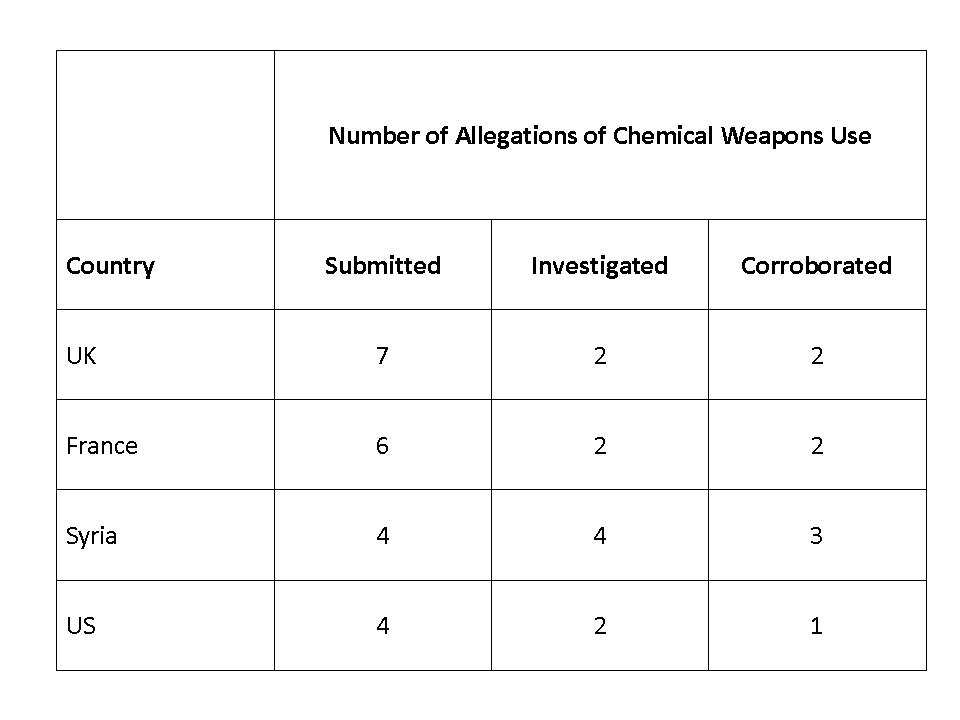
The ‘it’ was the finding of the UN inspector mission in Syria that chemical weapons were used on two occasions against Syrian soldiers and on one occasion against soldiers and civilians (presumably by insurgents.)
This is the same mission whose report on the August Ghouta incident is now widely misreported in the Western media to have strongly suggested that the Syrian army was responsible for the gassing deaths of hundreds. In fact, while the UN report concluded that a chemical weapons attack had occurred, it did not assign blame for the attack, and noted that physical evidence at the site had been manipulated, complicating whatever inferences one cared to make about who the perpetrators were.
The mission’s final report—presented to the UN Secretary General on December 12 – explores a number of other incidents in which chemical weapons were allegedly used.
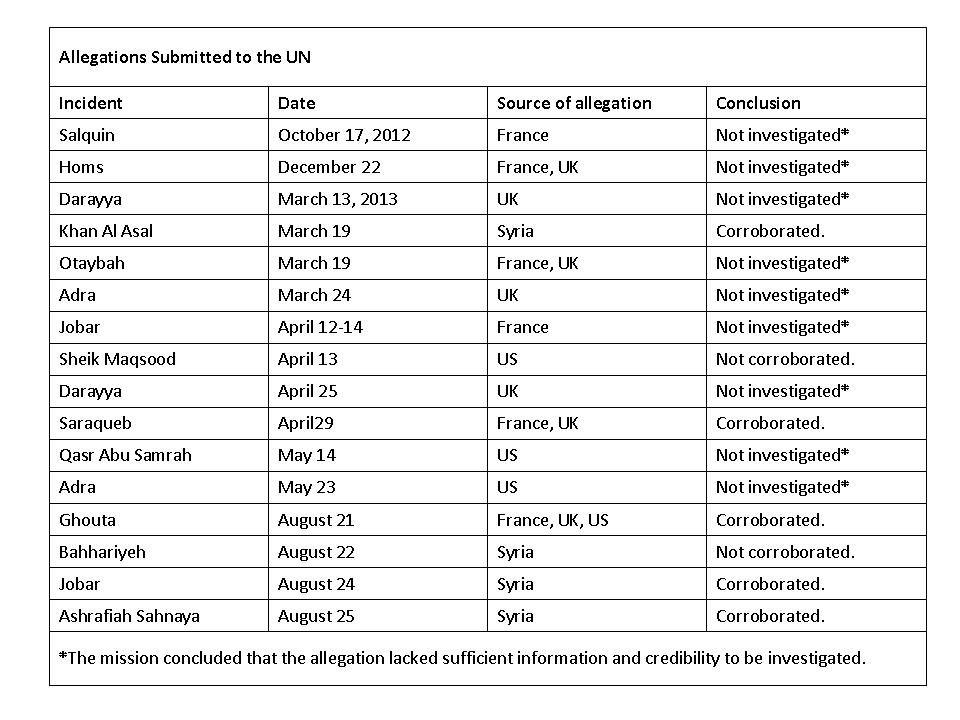
The inspectors corroborated three of four Syrian government allegations that its troops had been gassed. In one of the alleged incidents (on March 19 at Khan Al Asal) civilians were also gassed. That incident “reportedly resulted in the deaths of 25 people and injured more than 110 civilians and soldiers,” according to the UN report.
Given that Syrian soldiers were the targets of these attacks, it seems very likely that insurgent forces were responsible. Of course, that’s by no means certain. It’s possible that the soldiers were exposed to sarin after mishandling their own weapons. But the balance of probabilities favors the view that the insurgents were the culpable party.
Had UN inspectors concluded that chemical weapons were used against insurgents and civilians, killing two dozen and injuring over 100, it is nearly certain that this would be the top news story in Western media for days to come. However, given that the report points, instead, to the insurgents using chemical weapons, and not Syrian forces, it has been given little play.
The New York Times limits to three paragraphs its reporting on those elements of the UN report that point strongly to the culpability of insurgent forces, and reporters Somini Sengupta and Rick Gladstone take pains to minimize the mission’s findings, noting that “verification was impossible” and that in the Jobar and Ashrafiah cases “the report said, chemical weapons may have been used on ‘a relatively small scale against soldiers’” (emphasis added).
In fact, the relevant conclusions from the report, reproduced below, evince more certainty than Sengupta’s and Gladstone’s use of “may” acknowledges.
• “The United Nations Mission collected credible information that corroborates the allegations that chemical weapons were used in Khan Al Asal on 19 March 2013 against soldiers and civilians.”
• “The United Nations Mission collected evidence consistent with the probable use of chemical weapons in Jobar on 24 August 2013 on a relatively small scale against soldiers.”
• “The United Nations Mission collected evidence that suggests that chemical weapons were used in Ashrafiah Sahnaya on 25 August 2013 on a small scale against soldiers.”
Interestingly, the report reveals that the UN team felt that most of the French, British and US allegations against Syria lacked sufficient information and credibility, and so were never investigated. On the other hand, the mission found all four of Syria’s allegations to be sufficiently credible to investigate, and corroborated three of them.
This suggests that in most instances, the allegations made by the Western powers were propaganda-driven, and were intended to manipulate public opinion through the innuendo effect—the tendency of people to regard allegations as fact, especially if viewed to come from a credible source. The UN mission, however, had other ideas about how credible these sources were.
Also under-reported is the investigative work of Seymour Hersh, who in a December 8 online article for the London Review of Books, titled Whose Sarin?, revealed that Washington had “evidence that the al-Nusra Front, a jihadi group affiliated with al-Qaida, had mastered the mechanics of creating sarin and was capable of manufacturing it in quantity.”
According to Hersh, the Joint Chiefs of Staff “concluded that the rebel forces were capable of attacking an American force with sarin because they were able to produce the lethal gas.”
On the other hand, Hersh revealed that Washington had no evidence that the Syrian army was responsible for the August 21 Ghouta attack.
The New Yorker and Washington Post, which usually run Hersh’s investigative reporting, refused to publish his story. With the UN report offering credible evidence that the insurgents have used chemical weapons, it’s difficult to attribute the media outlets’ rejection of the Hersh story to concerns about the credibility of Hersh’s reporting. It’s more likely that they, along with media outlets who are underplaying the UN report, are trying not to draw too much attention to the use of chemical weapons by insurgents.
David Cohen, a US Treasury Department undersecretary, took pains in The Wall Street Journal (December 10) to point out that despite the sanctions relief provided for in the November interim nuclear agreement between Tehran and the P5+1 [1], that the US-led economic war on Iran continues largely unabated. Cohen’s message is that the relief package “is economically insignificant to Iran,” while US-led oil sanctions, trade disruptions, and efforts to isolate Iran from the US banking system—which remain in place despite the deal—continue to hobble Iran’s economy.
I warned in an October article that no matter how it looked on the surface, an accord with Iran would represent an insignificant concession by Washington, a point Cohen confirms. The reality, however, has not been widely grasped, and the deal has been misconstrued in many quarters as a possible precursor to a detente and normalization of relations between the West and Iran. Cohen dashes this illusion.
Washington estimates that Iran “will stand to receive $6 billion to $7 billion in relief” over the agreement’s six-month term but lose “about $30 billion in oil revenue” as a result of continued “oil, financial and banking sanctions.” In other words, the relief package will mitigate the impact of sanctions, but only mildly—and the remaining sanctions will continue to bite deeply.
What’s more, the insignificant level of sanctions relief comes on top “of the roughly $80 billion Iran has lost since early 2012 because of US and European Union oil sanctions, and of the nearly $100 billion in Iran’s foreign exchange holdings that are mostly restricted or inaccessible due to U.S. financial and banking sanctions.”
Cohen reminds us that the US economic war has badly battered Iran’s economy. GDP contracted by five percent last year. Inflation is running at about 40 percent. And Iran’s currency, the rial, has lost 60 percent of its value against the US dollar in the last two years. For Tehran, the prognosis is grim. And sanctions relief—what little there is—is insufficient to brighten the outlook. The economy continues to shrink.
Cohen says Washington will continue to make Iran’s economy “suffer,” maintain the “pressure,” keep “Iran’s oil revenues depressed,” and ensure that “latent interest in trade” with Iran will be held back by bullying anyone “who thinks now might be a good time to test the waters.”
No matter how far Tehran goes in the final negotiations in limiting its nuclear program, it’s unlikely the West will abandon its efforts to bring about regime change in Tehran, or relinquish economic warfare as a regime change tool. Sanctions are likely to be a permanent feature of US policy on Iran, ending only when, and if, US foreign policy goals are brought to fruition and a Western oriented, pro-foreign investment regime comes to power in Tehran.
That’s because Washington’s ambitions go beyond depriving Iran of an independent means of producing nuclear fuel and preventing it from securing the theoretical capability of mounting a nuclear self-defense, to changing its economic and foreign policies. This can be seen in the reality that the US-led economic war didn’t begin in response to Iran enriching uranium. It began when Iran extricated itself from the US orbit by overthrowing Washington’s puppet, Mohammad Reza Pahlavi, in 1979. Ever since, Washington has deployed sanctions to prevent Iran from:
• Building ballistic missiles;
• Supporting Hezbollah, Hamas and Islamic Jihad;
• Exercising influence in the Middle East;
• Exporting arms;
• Dealing with unrest and subversion at home (stoked by the misery created by Western sanctions);
• Monitoring and censoring domestic internet communications. [2]
So, even if Iran agreed to give up uranium enrichment altogether and to permanently shut-down its Arak heavy-water reactor, Tehran’s support for Palestinian and Lebanese resistance organizations, its backing of Syria, and its predilection for promoting local enterprise and maintaining state-owned enterprises at the expense of foreign investors, would continue to evoke US hostility.
As Cohen points out, the idea that Washington has suspended its punishing economic war on Iran is an illusion. Until Iran’s independence from US domination is brought to an end, Washington’s war on Iran’s economy—and its people—will continue.
1. The five permanent members of the UN Security Council (the United States, Britain, Russia, China and France) plus Germany, also known as the E3/EU+3, E3 referring to the United States, Russia and China and the EU3 denoting the three largest countries of the EU: Germany, France, and Britain.
2. Kenneth Katzman, “Iran Sanctions”, Congressional Research Service, July 26, 2013.
In the wake of Nelson Mandela’s death, hosannas continue to be sung to the former ANC leader and South African president from both the left, for his role in ending the institutional racism of apartheid, and from the right, for ostensibly the same reason. But the right’s embrace of Mandela as an anti-racist hero doesn’t ring true. Is there another reason establishment media and mainstream politicians are as Mandela-crazy as the left?
According to Doug Saunders, reporter for the unabashedly big business-promoting Canadian daily, The Globe and Mail, there is.
In a December 6 article, “From revolutionary to economic manager: Mandela’s lesson in change,” Saunders writes that Mandela’s “great accomplishment” was to protect the South African economy as a sphere for exploitation by the white property-owning minority and Western corporate and financial elite from the rank-and-file demands for economic justice of the movement he led.
Saunders doesn’t put it in quite these terms, hiding the sectional interests of bond holders, land owners, and foreign investors behind Mandela’s embrace of “sound” principles of economic management, but the meaning is the same.
Saunders quotes Alec Russell, a Financial Times writer who explains that under Mandela, the ANC “proved a reliable steward of sub-Sahara Africa’s largest economy, embracing orthodox fiscal and monetary policies…” That is, Mandela made sure that the flow of profits from South African mines and agriculture into the coffers of foreign investors and the white business elite wasn’t interrupted by the implementation of the ANC’s economic justice program, with its calls for nationalizing the mines and redistributing land.
Instead, Mandela dismissed calls for economic justice as a “culture of entitlement” of which South Africans needed to rid themselves. That he managed to persuade them to do so meant that the peaceful digestion of profits by those at the top could continue uninterrupted.
But it was not Mandela’s betrayal of the ANC’s economic program that Saunders thinks merits the right’s admiration, though the right certainly is grateful. Mandela’s genius, according to Saunders, was that he did it “without alienating his radical followers or creating a dangerous factional struggle within his movement.”
Thus, in Saunder’s view, Mandela was a special kind of leader: one who could use his enormous prestige and charisma to induce his followers to sacrifice their own interests for the greater good of the elite that had grown rich off their sweat, going so far as to acquiesce in the repudiation of their own economic program.
“Here is the crucial lesson of Mr. Mandela for modern politicians,” writes Saunders. “The principled successful leader is the one who betrays his party members for the larger interests of the nation. When one has to decide between the rank-and-file and the greater good, the party should never come first.”
For Saunders and most other mainstream journalists, “the larger interests of the nation” are the larger interests of banks, land owners, bond holders and share holders. This is the idea expressed in the old adage “What’s good for GM, is good for America.” Since mainstream media are large corporations, interlocked with other large corporations, and are dependent on still other large corporations for advertising revenue, the placing of an equal sign between corporate interests and the national interest comes quite naturally. Would we be shocked to discover that a mass-circulation newspaper owned by environmentalists (if such a thing existed) opposed fracking? (Journalists will rejoin, “I say what I like.” But as Michael Parenti once pointed out, journalists say what they like because their bosses like what they say.)
Predictably, Saunders ends his encomium to the party-betraying Mandela, the ‘good’ liberation hero, with a reference to the ‘bad’ south African liberation hero, Robert Mugabe. “One only needs look north to Zimbabwe to see what usually happens when revolutionaries” fail to follow Mandela’s economically conservative path, writes Saunders.
At one point, Mugabe’s predilection for orthodox fiscal and monetary policy was a strong as Mandela’s. Yet after almost a decade-and-a-half of the Western media demonizing Mugabe as an autocratic thug, it’s difficult to remember that he, too, was once the toast of Western capitals.
The West’s love affair with Mugabe came to an abrupt end when he rejected the Washington Consensus and embarked on a fast-track land reform program. Its disdain for him deepened when he launched an indigenization program to place majority control of the country’s mineral resources in the hands of black Zimbabweans.
Mugabe’s transition from ‘good’ liberation hero to ‘bad’, from saint to demon, coincided with his transition from “reliable steward” of Zimbabwe’s economy (that is, reliable steward of foreign investor and white colonial settler interests) to promoter of indigenous black economic interests.
That’s a transition Mandela never made. Had he, the elite of the imperialist world would not now be flocking to South Africa for Saint Mandela’s funeral, overflowing with fulsome eulogies.
It seemed almost inevitable that on the new day Western newspapers were filled with encomia to the recently deceased South African national liberation hero Nelson Mandela that another southern African hero of national liberation, Robert Mugabe, should be vilified. “Nearly 90, Mugabe still driving Zimbabwe’s economy into the ground,” complained Geoffrey York of Canada’s Globe and Mail.
Mandela and Mugabe are key figures in the liberation of black southern Africa from white rule. So why does the West overflow with hosannas for Mandela and continue to revile Mugabe? Why is Mandela the good national liberation leader and Mugabe the bad?
A lot of it has to do with the extent to which the liberation projects in South Africa and Zimbabwe have threatened white and Western economic interests—hardly at all in Mandela’s South Africa and considerably in Mugabe’s Zimbabwe.
The media-propagated narrative is that Mandela is good because he was ‘democratic’ and Mugabe is bad because he is ‘autocratic.’ But scratch the surface and economic interests peek out.
Land ownership in South Africa continues to be dominated by the white minority, just as it was under apartheid. What land redistribution has occurred has been glacial at best. In Zimbabwe, land has been redistributed from white colonial settlers and their descendants to the black majority. South Africa’s economy is white- and Western-dominated. Zimbabwe is taking steps to indigenize its economy, placing majority control of the country’s natural wealth and productive assets in the hands of blacks.
The centrality of economic interests in the Western demonization of Mugabe are revealed in York’s complaint about Mugabe’s plan to indigenize Canadian-owned New Dawn Mining company, a process which would force a few wealthy Canadians to surrender a majority stake in the mining of Zimbabwe’s mineral wealth. In York’s view, an African government giving its people an ownership stake in their own economy is unthinkable, but many wealthy countries, including Canada, have done the same.
Mandela, in contrast, rejected calls to nationalize South Africa’s mines, accepting Western and white domination of the country’s economy as a bedrock principle of sound economic management.
And so it is that Mugabe, the redistribtor of land and mineral wealth away from the descendants of white colonial settlers and foreign owners to black Africans is seen as devil incarnate in a Canadian newspaper that concerns itself with reporting the news from the perspective Canadian corporate interests. Canadian business wants the world to be open to profit-taking, and doesn’t care for governments that stand in their way. York reflects that bias. And Mandela didn’t get in the way of it.
Recycling the usual myths that make up the anti-Mugabe demonology, the Globe and Mail propagandist writes that Zimbabwe’s economic difficulties are due to Mugabe’s mismanagement, not to Western sanctions, erroneously describing sanctions as limited to travel restrictions on Mugabe and his closest associates. This overlooks Washington’s Zimbabwe Democracy and Economic Recovery Act, which has blocked financial assistance to Zimbabwe from international lending institutions, a major impediment to the country’s economic development. It’s as if York blamed the Soviet Union’s crippled post-WWII economy on communist mismanagement, eliding Operation Barbarossa and the Nazi invasion from history. In this, York follows the standard operating procedure of the Western propaganda system, attributing a country’s economic troubles to mismanagement and not the sanctions that cause them.
As to the democrat vs. autocrat dichotomy, it is a propaganda contrivance. It’s what Western governments and media use to legitimize leaders who protect Western corporate interests and demonize leaders who threaten them.
Reading Paul Krugman’s New York Times column today, A Permanent Slump?, I couldn’t help but get the feeling that the IMF, Larry Summers and Paul Krugman, had belatedly discovered an idea that Paul Sweezy, a Marxist economist who died in 2004, had elaborated on decades ago, namely that stagnation is the normal state of contemporary capitalist economies.
Krugman writes,
…the case for “secular stagnation” — a persistent state in which a depressed economy is the norm, with episodes of full employment few and far between — was made forcefully recently at the most ultrarespectable of venues, the I.M.F.’s big annual research conference. And the person making that case was none other than Larry Summers. Yes, that Larry Summers.
Summers is a Harvard economist whose career has included stints as chief economist of the World Bank, US Secretary of the Treasury and chief economic adviser to US president Barack Obama.
Krugman paraphrases Summers:
We have, he suggested, an economy whose normal condition is one of inadequate demand — of at least mild depression — and which only gets anywhere close to full employment when it is being buoyed by bubbles.
The idea that financial bubbles have counteracted the economy’s slide into permanent stagnation was also explored by Sweezy. But he cited other countervailing effects, too, including military spending, and in the post-war period, pent-up demand and the building of the interstate highway system, with its concomitant boom in the construction of the suburbs and expansion of the automobile industry.
Krugman concludes that “the evidence suggests that we have become an economy whose normal state is one of mild depression, whose brief episodes of prosperity occur only thanks to bubbles and unsustainable borrowing.”
Sweezy, I think, would have agreed, but added that the tendency to stagnation is hardly new, but has been an enduring characteristic of contemporary capitalist economies, traceable to their internal logic.
Not too many years ago, when protesters were running riot through the streets, disrupting meetings of the WTO, G7, and other international organizations, the Canadian newspaper The National Post served up a flattering and generous portrait of young people who had eschewed the streets as a terrain for political struggle and turned instead to what the newspaper considered the responsible and laudatory path of seeking nomination to run as candidates for the mildly social democratic (but in the newspaper’s view, rabidly leftwing) New Democratic Party. This was a curious turn of events, for the National Post, a newspaper founded by the notoriously rightwing, white-collar criminal, Lord Conrad Black, was as likely in normal times to heap praise on anyone associated with the NDP as George Bush was to sing the praises of Kim Il Sung. But these were not normal times. In retrospect it’s easy to see that the protests, demonstrations, and strikes of the time, would fizzle and die, as the Occupy movement would also fizzle and die years later. Lacking a central organizing idea and concrete vision of where they wanted to go, they were too hobbled by anarchist nonsense to achieve much more than to sell a few more copies of Z Magazine and to create a decent phrase about the 1% making off with all the wealth at the expense of the 99%. But it was clear that the editors of the National Post were worried enough to recommend a path other than the streets to those who burned with the desire for political change. That they should recommend electoral politics was predictable. Young people who plowed their energies into the NDP would soon get bogged down in the harmless, ineffectual, routines of political campaigns, and be kept safely off the streets.
Available from Baraka Books http://www.barakabooks.com/catalogue/washingtons-long-war-on-syria/The wealthy are keen on electoral politics—when they go their way, as they often do. Elections in capitalist society can be dominated by money, as can the larger political process. Banks, corporations and major investors lobby politicians, fund political campaigns, bribe legislators with the promise of lucrative post-political jobs, place their representatives in key positions in the state, and shape the ideological environment through their control of the media, creation of think-tanks, hiring of PR firms, and funding of university chairs. Those without wealth can hardly compete, except, in principle, by pooling their resources and hoping to tilt the balance the other way against a formidable foe that controls infinitely more resources. The absence of organization and class consciousness, however, routinely assures this doesn’t happen. Moreover, the electoral arena channels dissent into predictable, controllable paths, keeping it off the streets, where it might become unpredictable and therefore dangerous. Additionally, the sway that corporate, banking and investor groups exercise behind the scenes is masked by the egalitarian spectacle of elections. One person, one vote. What could be more equal?
I was reminded of this after reading the Russell Brand-edited issue of The New Statesman [1], not because it was in any particular way an endorsement of capitalist democracy, but because, like the National Post, it defined legitimate political change within parameters favorable to the established order. Of course, Brand wasn’t advocating electoral politics as the National Post was. On the contrary, he spoke out against voting in an interview with the BBC’s Jeremy Paxman, and called for a revolution. But Brand’s New Statesman went further than the National Post. Where the National Post said that those who fight for political change within the established system are admirable, while those who step outside it are not, Brand, as editor, tackled the larger idea of revolution (the only way, he said, he could get interested in politics. ) Mind you, a mass circulation magazine was not about to become a platform to rally the masses to armed insurrection to overthrow the established order. “The revolution,” observed Gil Scott-Heron, “will not be televised.” Nor will it be found in the pages of the New Statesman. Predictably, the outcome of Brand’s editing exercise was the redefining of the entire idea of revolution, or, I should say, the destroying of it altogether, turning it into something vague and difficult to put your finger on, except to say it was good, and true, and safe to bring home to mother. But not at all like what Lenin, Stalin, Mao and Kim Il sung were implicated in. According to the luminaries Brand assembled to hold forth on what revolution means, revolution isn’t the transfer of productive property from one group to another –from, say, private owners to workers, or colonial settlers to those they dispossessed, or even owners who reside outside a country to the people within. Instead, it means many things, but not what you thought it did. [2]
In Brand’s issue of The New Statesman, film-maker Judd Apatow writes that revolution is telling authority figures to fuck off…in a funny way. “Comedy itself is revolutionary,” he says, whatever that means. Deepak Chopra rejects politics altogether as “irrelevant” and writes that he puts his “trust in inner revolution,” as priests and other religious figures have done for centuries, counselling the exploited to look inward rather than outward, leaving the exploiters to carry on exploiting free from the inconvenience of anyone fighting back. Comedian Francesca Martinez seeks, not a revolution in who owns productive property, but “of our ideas.” Author Howard Marks begins on a promising note, writing that he would like to see a revolution along the lines of the “Marxist notions of transferring power from reactionary to progressive classes,” but quickly plunges into the ridiculous by expressing the hope that such a revolution will create an immediate utopia, where we can all smoke dope, love each other, and never fight. The model he would like to see realized on a grand scale is the “wine-drinking, dancing, pagan society without a written language” of the Kalash Valleys in northern Pakistan. “There are no prisons, no laws, no police and no vested interests.” Tim Street, director of UK Uncut Legal Action calls “democracy” the most revolutionary idea, and offers a vision of revolution in which the corporate ruling class remains in place (hence, no revolution at all), but where the people try to hold it in check. Street writes, “we can begin by holding corporations which put profit before people to account and fight back when they bully and threaten us. We can begin by using our voices and our bodies to protest, to take direct action against the cuts and tax dodging.” How depressingly far the idea of revolution has drifted (or has been pushed) from its moorings, when anti-capitalist revolution once meant abolition of the profit system, not pressuring corporations to put people before profits (a Quixotic project, since it is both legally and systemically impossible for capitalism to put people before profits. Street has set a rather ambitious goal for himself if he thinks he’s going to hold all the corporations that put profits before people (i.e., all of them) to account. He’ll hardly have time to keep abreast of the latest Noam Chomsky interviews on YouTube.) Newspaper owner Evgeny Lebedev offers nothing better, but at least knows what a revolution is, pointing to the American, French and Russian revolutions as revolutions. But Lebedev’s view of these revolutions is precisely what you might expect of a business owner. The American Revolution, he says, was “mostly very good”. The French is to be applauded, in part. But the Bolshevik revolution had no redeeming features whatever, except this: It showed “that Marx’s method was incompatible with freedom and dignity.” Lebedev endorses “evolution” as “the better guide to human affairs” (now that the bourgeois revolutions have succeeded.) [3]
Oliver Stone and Peter Kuznick, authors of The Untold History of the United States, offer a 1960s New Left anarchist vision, where the only good revolutions are the ones that never happened and the bad ones are the ones that did. This meshes well with a brief entry by anarchist Noam Chomsky on how utopia can be brought about (about which more in a moment.) Stone and Kuznick find inspiration in former US Vice President Henry Wallace’s idea of a worldwide people’s revolution, which would “end militarism, imperialism and economic exploitation, redistribute wealth on a global scale, and spread the fruits of science and industry.” Great, but there are two problems here. For Stone and Kuznick, who, by the way, make no apologies for engaging in utopian (i.e., unrealistic) thinking, revolution is the answer to an intellectual problem: how to eliminate militarism, imperialism, and exploitation, which they regard as morally insupportable. But revolutions don’t work that way. People don’t overturn an existing political and economic order because they dislike militarism intellectually or regard exploitation as morally indefensible. They overturn existing orders when the conditions of their lives become intolerable, and revolution becomes the only way out—which is more likely to happen in the countries which are the victims of militarism and imperialism than in the ones which are the perpetrators and within whose borders lie the audience Stone’s and Kuznick’s comments are presumably directed at. Secondly, the duo seems to want to arrive at utopia without violence, conflict, hierarchy or power politics—in other words, a utopian path to utopia, where a utopia must first exist before it can be realized. We “have too often seen the use of violence unleash emotions and forces that beget more violence and new forms of tyranny and oppression,” they write. [4]
It was the New Left’s desire for the ocean without the roar of the river that led to the movement’s denunciation by its critics as comprising those who “combine the luxury of being eternally in the right without the obligation of ever actually being responsible for anything.” And indeed, the New Left, and its successors, managed to escape responsibility by never actually achieving anything that would require that they bear it. Arnold Kettle noted in 1960 that “What the New Left seems not to be able to stomach is that (the countries that actually had revolutions) should have not only principles but also a strategy, a diplomacy, a defense policy…and all the responsibilities and consequent impurities… Power politics is always used by New Left writers in a derogatory sense, as if there were some other form of politics.” As for the New Left vision of what a revolution was to achieve, “it was a reality beyond class struggle, a society which is neither capitalist nor socialist, but simply nice.” [5] Indeed, Stone and Kuznick express their vision in terms of a nice world of “creativity, kindness and generosity” where “greed and the lust for power” have no place, rather than a world of jobs for all, free heath care and education, cheap public transportation, subsidized housing, and affordable childcare, racial and gender equality, and investment of the social surplus into raising the living standards of all. If you want a nice world of kindness and charity where greed and lust for power have no place, there are plenty of religions around to take care of that. But that’s not revolution.
Stone and Kuznick reserve special scorn for “Stalin, Mao and the Kims”, who they depict as power-hungry defilers of “the noble concept of revolution” who grabbed power to aggrandize themselves. Fuck them, they write. One day someone will have to write The Untold History of 20th Century Revolutions to correct Stone’s and Kuznick’s defiling of accomplished revolutionaries. For now, suffice to say that the title of duo’s book ought to be changed to The Untold History of the United States by Two Confused Leftists Who Have Yet to Be Told the Untold History of Russia, China and Korea.
For Stone’s and Kuznick’s benefit here’s a brief history to fill the gaps of their knowledge.
Kim
Kim Il Sung was an effective guerrilla leader who made an enormous contribution to the liberation of Korea from Japanese colonial rule, and from the form of residual rule by Japanese collaborators that took hold in the south, and has echoes today. South Korea’s current president, Park Geun-hye, is the daughter of the military dictator, Park Chung-hee, who served in the Japanese imperial army, hunting down Kim and his guerrillas. Whatever one might say about the de facto, but hardly de jure, Kim dynastic succession, the Kims trace their lineage to a leading anti-colonial guerrilla who played a lead role in building an independent state, free from domination by outside powers. The south, in contrast, is a neo-colony of the United States, where the armed forces are under the war-time command of the Pentagon, and anti-communist descendants of Japanese collaborators exercise local control. Had Kim anticipated Deepak Chopra’s path and declared politics “irrelevant” and put his “trust in inner revolution”, Oliver Stone and Peter Kuznick might have lauded him, rather than blurting “Fuck…the Kims.” Yet, the price of Kim’s earning the respect of the New Left film-makers would likely have been Korea remaining a colony of Japan, or more likely, a neo-colony of the United States from the south to the north.
Mao
Before the Mao-led revolution in China, 55 to 65 percent of the land was owned by 10 percent of the population–parasites who exploited the labor of peasants by virtue of claiming ownership of the land and holding it by law and force. Hundreds of millions eked out bare existences on tiny plots and forever faced the threat of famine. The country had less industrial power than Belgium. Long dominated by outside powers, the Chinese lived as untermenschen in their own country. “Everything fed the revolution. Only by revolution could China’s peasants get land, get out from under landlord control…Without revolution, China would have remained in the grip of imperialism, a semi-colony, dominated and exploited by the United States.” [6] Domenico Losurdo points out that, “It is widely known that Mao Zedong declared at the foundation of the Peoples Republic of China that the Chinese nation had risen up and nobody would tread on it again. Perhaps he was thinking about the years when a sign at the entrance to the French consulate in Shanghai forbade entrance to Chinese and dogs.” Losurdo asks: “Is the new situation in the great Asian country a result of ‘failure’?” [7] To be sure, the Chinese Revolution falls well short of Stone’s and Kuznick’s vision of a world free from militarism, imperialism, and exploitation, and where creativity, kindness, and generosity have replaced greed and lust for power, but it did improve the lives of hundreds of millions. As the privileged son of a stockbroker who has lived his life in a country that dominates others, Stone may regard Mao’s revolution as a defiling of the noble concept of revolution, but he’d find few Chinese to agree with him.
Stalin
Stalin made enormous contributions to socialism, decolonization, and indirectly, to the emergence of the welfare state in the West. He played a lead role in the building of the first publicly-owned, planned, economy –one free from unemployment and the insecurities and injustices of the past. He was at the forefront of the project to lift Russia from backwardness, succeeding spectacularly in short order. His contributions to the defeat of fascism were unparalleled, exceeding those of any other individual. Under his leadership, the monarchies and military dictatorships of Eastern Europe were overthrown and, no, the socialist societies that replaced them were not simply new forms of oppression. Their economies grew rapidly and with them standards of living rose, while the insecurities, injustices, inequalities and exploitation of the past were eliminated. The national liberation movement had no greater friend than Stalin’s Soviet Union. By successfully creating an alternative to capitalism, Stalin forced Western governments to build robust programs of social welfare to maintain the allegiance of their populations. And the Soviet Union’s policy of racial equality embarrassed the United States into improving the conditions of its black citizens.
It’s instructive to consider the Soviet Union in 1936. Soviet democracy, based on the constitution Stalin played a key role in writing, was being rolled out. The constitution mandated the creation of a system of elected representatives. Stalin was elected the representative of a Moscow constituency of the Supreme Soviet of the USSR. By this assembly he was elected as one of 30 members of the Presidium, which in turn elected a Council of Commissars. He did not call himself a dictator, nor was there a position of dictator to be occupied.
Soviet democracy has been derided and ridiculed in the West. But let’s consider the Soviet form of democracy in 1936 versus the Western form. At the time, Britain had an unelected House of Lords (still does), while Canada had, and continues to have, an unelected Senate. Of 500 million inhabitants of the British Empire, only 70 million, or 1/7th, lived in political democracies. South Africa denied suffrage to its black population. In Canada and Australia, aboriginal people were not allowed to vote. India had no political democracy at all, and was governed by the British civil service. The United States denied civil rights to its black citizens, who lived in a state of oppression. [8] In contrast, suffrage in the USSR was universal, hardly the tyranny by comparison with the West that Stone and Kuznick would have us believe it was.
As to the perennial charge that Stalin murdered millions, we can dismiss this as an unexamined legend that everyone believes to be true because someone (they just can’t remember who) told them it was, and about which they can provide no details, like who, how, when and why? William Blum writes:
“We’ve all heard the figures many times…10 million…20 million…40 million…60 million…died under Stalin. But what does the number mean, whichever number you choose? Of course many people died under Stalin, many people died under Roosevelt….Dying appears to be a natural phenomenon in every country. The question is how did those people die under Stalin? Did they die from the famines that plagued the USSR in the 1920s and 30s? Did the Bolsheviks deliberately create those famines? How? Why? More people certainly died in India in the 20th century from famines than in the Soviet Union, but no one accuses India of the mass murder of its own citizens. Did the millions die from disease in an age before antibiotics? In prison? From what causes? People die in prison in the United States on a regular basis. Were millions actually murdered in cold blood? If so, how? How many were criminals executed for non-political crimes? The logistics of murdering tens of millions of people is daunting.” [9]
The numbers are, in fact, estimates derived by comparing the Soviet population with projections of whatever the author making the estimate thinks the population would have been at a given point had Stalin never existed. The difference between the two figures is then said to represent the missing population, or people Stalin “murdered.” It’s obvious that this method is open to abuse and that attributing excess deaths to mass murder has no other intention than to bamboozle people into believing that Stalin ordered the cold-blooded killing of tens of millions. This isn’t to say that Stalin didn’t order executions, and lots of them. He did. But executions in times of exceptional circumstances, when the revolution was under threat from within and without—as the Soviet Union was throughout the Stalin era–are no less necessary than the killing of soldiers of an invading army. It was war. Unless action fitting to war was taken, the revolution would fail. Everywhere fifth columnists facilitated the Nazi invasions, except in the Soviet Union where there was no fifth column. Stalin had eliminated it. He may have uniquely accomplished this feat by accepting a high false positive rate as the cost of extirpating the disease, catching the innocent and harmless in his net as well as the dangerous and guilty. But when it’s unclear whether the tissue is diseased or healthy, the surgeon who saves the patient cuts out both the clearly diseased and the surrounding suspicious (though possibly healthy) tissue. The question is: Did Stalin order executions to satisfy a personal lust for power, or to safeguard the revolution bequeathed by Lenin? Stalin’s political enemies have always favored the first explanation. And the CIA has ensured that those who favored it had a platform from which to spread it far and wide.
When Stalin came to power, the Soviet Union was in a precarious position—its agriculture backward, its industry stunted, its military feeble. What’s more, fierce and fissiparous debate within the Communist Party about the way forward had produced paralysis, infighting and intrigues. The country was going nowhere, fast. Three decades later Stalin was dead. But in those three decades, with Stalin at the helm, the country had advanced from the wooden plow to the atomic pile.
“When Stalin died in 1953, the Soviet Union was the second greatest industrial, scientific, and military power in the world and showed clear signs of moving to overtake the United States in all these areas. This was despite the devastating losses it suffered while defeating the fascist powers of Germany, Romania, Hungary and Bulgaria. The various peoples of the U.S.S.R were unified. Starvation and illiteracy were unknown throughout the country. Agriculture was completely collectivized and extremely productive. Preventive health care was the finest in the world, and medical treatment of exceptionally high quality was available free to all citizens. Education at all levels was free. More books were published in the U.S.S.R than in any other country. There was no unemployment.
“Meanwhile, in the rest of the world, not only had the main fascist powers of 1922-1945 been defeated, but the forces of revolution were on the rise everywhere. The Chinese Communist Party had just led one fourth of the world’s population to victory over foreign imperialism and domestic feudalism and capitalism. Half of Korea was socialist…In Vietnam, a strong socialist power, which had already defeated Japanese imperialism, was administering the final blows to the beaten army of the French empire. The monarchies and fascist dictatorships of Eastern Europe had been destroyed by a combination of partisan forces, led by local Communists, and the Soviet Army…The largest political party in both France and Italy was the Communist Party. The national liberation movement among the European colonies and neo-colonies was surging forward…The entire continent of Africa was stirring.” [10]
Were these the accomplishments of a “failed” revolution? Domenico Losurdo demands that critics like Stone and Kuznick,
“explain how a ‘failure’…has managed to make such an enormous contribution to the emancipation of the colonial people and, in the West, to the destruction of the old regime and the emergence of the welfare state. In 1923, when Lenin, gravely ill, is forced to release the reins of power, the state that emerged from the October Revolution, mutilated in the peace treaty of Brest-Litovsk, is leading a paltry and precarious life. In 1953, at Stalin’s death, the Soviet Union and the socialist camp are enjoying enormous growth, power, and prestige. A few more of these (‘defilers of the noble concept of revolution’) and the situation of the imperialist and capitalist world system would have become precarious and untenable indeed!” [11]
Contrary to Stone’s and Kuznick’s falsifications, Stalin did more to bring the world closer to their vision of freedom from militarism, imperialism and exploitation than anyone else. Yet the two Americans say “Fuck Stalin.” They don’t, however, say “Fuck Castro.” Why not? The Cuban revolution was guerrilla-led, like Mao’s and Kim’s, assisted by the Soviet Union, like Mao’s and Kim’s, and Cuban socialism is based largely on the “Stalinist” model. Yet, Stone, whose three documentaries on the Cuban revolutionary reveal a soft spot for Castro, doesn’t accuse the leader of the Cuban revolution of defiling the concept of revolution in the interests of power, self-aggrandizement, repression and iron-fisted control.
The inconsistencies don’t stop there. Stone, it seems, also has a soft spot for Barack Obama, who he reportedly voted for in 2008 and 2012. [12] Shouting “Fuck Stalin, Mao and the Kims” while voting for Obama calls to mind Michael Parenti’s criticism of the hypocrisy of left anti-communists who profess revulsion at the “crimes of communism” while facilitating the crimes of Democratic presidents by voting for them.
Parenti explains:
“Under one or another Democratic administration, 120,000 Japanese Americans were torn from their homes and livelihoods and thrown into detention camps; atomic bombs were dropped on Hiroshima and Nagasaki with an enormous loss of innocent life; the FBI was given authority to infiltrate political groups; the Smith Act was used to imprison leaders of the Trotskyist Socialist Workers Party and later on leaders of the Communist party for their political beliefs; detention camps were established to round up political dissidents in the event of a ‘national emergency’; during the late 1940s and 1950s, eight thousand federal workers were purged from government because of their political association and views, with thousands more in all walks of life witch-hunted out of their careers; the Neutrality Act was used to impose an embargo on the Spanish Republic in favor of Franco’s fascist legions; homicidal counterinsurgency programs were initiated in various Third World countries; and the Vietnam War was pursued and escalated. And for the better part of a century, the Congressional leadership of the Democratic party protected racial segregation and stymied all anti-lynching and fair employment bills. Yet all these crimes, bringing ruination and death to many, have not moved the liberals, the social democrats, and the ‘democratic socialist’ anticommunists to insist repeatedly that we issue blanket condemnation of either the Democratic party or the political system that produced it…” [13]
Stone and Kuznick may deplore these Democratic party crimes, but it’s unlikely they’d ever say “Fuck the Democrats.” It’s more likely they’d say, “Vote Democrat.” So, let’s forget about “Fuck Stalin, Mao and the Kims.” If Stone is really interested in ending militarism, imperialism, and exploitation, why isn’t he telling us to “Fuck Obama,” a major promoter of the scourges Stone says he hates, rather than running down historical figures who actually fought against imperialism and exploitation, and won?
The Stone and Kuznick view is, really, rather quite silly. They believe that Mao and Kim decided to become guerrillas, and Stalin, a Bolshevik, because these were routes to the acquisition of personal power, self-aggrandizement, and iron-fisted control. Yet, at the time, guerrilla and underground revolutionary were hardly the most promising career paths for people who lusted for power and self-aggrandizement. If Stalin really lusted after these things, why didn’t he link up with Tsarist forces, rather than the Bolsheviks, which until mid-1917 were a minor political force that no one (including many Bolsheviks) expected to take power? Chinese and Koreans who became guerrillas were more likely to find themselves dead, tortured or imprisoned, than rising to the head of a bureaucracy administering a new state. They became guerrillas because they found feudal and imperialist oppression intolerable and wanted to put an end to them. A Georgian like Stalin became a Bolshevik because he hated Tsarist oppression and wanted to replace it. Stalin lived much of his early life underground, trying to keep one step ahead of the Tsarist police, and serving long stretches in internal exile. As leader of the Soviet Union he lived a modest, almost Spartan life. He was not a Red Tsar, living in the lap of luxury, as Stone’s and Kuznick’s crude myth-making would have us believe. Stalin, Mao and Kim understood that ending oppression meant taking political power, which meant, in turn, a disciplined, organized approach to the project—one that involved leaders and hierarchy. The idea that the politically-inspired seek power for power’s sake is an anarchist confusion. As Richard Levins points out, even George W. Bush would never have promoted universal free health care, subsidized Venezuela, or renounced Jesus just to stay in power. Behind “every facade of power-hunger, there lurks a person of principles, though (as in Bush’s case) these may be noxious principles.” [14] Revolutionaries seek power to aggrandize the position of the class they represent. People in leadership positions may be in positions to exercise power, but that doesn’t mean they seek power as an end in itself. They seek power as an instrument to accomplish goals that comport with the aspirations of the class or people they represent. Stone’s and Kuznick’s cynicism tars the disciplined, organizational forms necessary for revolution. In their view, and that of anarchists generally, hierarchical, disciplined organizations are vehicles of tyranny and oppression that will inevitably be used by tyrants-in-embryo to catapult themselves to power, whereupon they will subvert the revolution’s beautiful goals to aggrandize themselves and exercise an iron-fisted control. Did Kim subvert the goal of achieving Korean independence? Did Mao not overturn centuries of feudalism and great power domination? Did Stalin fail to abolish unemployment, homelessness, national oppression, and racial inequality? The view that the leaders of successful revolutions betrayed the revolution’s goals to aggrandize themselves is not only bad history, it’s bad politics. It encourages people seeking political change to eschew any form of “Leninist” politics, in favor of “leaderless” agglomerations, which practice decentralized decision-making, and accomplish not much of anything.
Noam Chomsky is an endless source of slurs against Leninism, which he equates with “counterrevolution”, [15] a heterodox view of what revolution is, but certainly consistent with the Brand-edited New Statesman view that it’s something other than what you always thought it was, and what you always thought it was is actually quite a bad thing that should be avoided altogether. I suppose it should come as no surprise that Chomsky answers the question, “What does revolution mean to you?”, with an attack on Lenin, the leader of a revolution that succeeded, and praise for Rosa Luxemburg, a leader of an attempted socialist revolution that failed. Chomsky writes,
“I cannot improve on Rosa Luxemburg’s eloquent critique of Leninist doctrine: a true social revolution requires a ‘spiritual transformation in the masses degraded by centuries of bourgeois class rule…it is only by extirpating the habits of obedience and servility to the last root that the working class can acquire the understanding of a new form of discipline, self-discipline arising from free consent.’ And as part of this ‘spiritual transformation’, a true social revolution will, furthermore create—by the spontaneous activity of the mass of the population—the social forms that enable people to act as free creative individuals, with social bonds replacing social fetters, controlling their own destiny in freedom and solidarity.” [16]
Here’s A.J. Ryder, an historian of the German Revolution, on Luxemburg’s role in the failure to bring about a socialist revolution in Germany in 1918-1919.
“Spartacists (Karl) Liebknecht and Rosa Luxemburg…were conscious revolutionaries in deed as well as in word. They were bent on using the opportunity presented by the fall of the Hohenzollern regime to set in motion the socialist revolution which they believed would carry them to power in place of Ebert as Lenin had displaced Kerensky….Few (of the leaders) possessed the qualities of a successful revolutionary leader. By common consent Rosa Luxemburg was the outstanding personality of the left, but her intellectual gifts and personal fanaticism were not matched by a grasp of reality. She was at heart a romantic, a visionary appearing in the garb of ‘scientific socialism.’” [17]
Ryder sums up the failure of the revolution by reference to the failings of its key personalities. They “were amateurs compared with Lenin.” [18] Luxemburg, the romantic, emphasized spontaneity and ‘spiritual transformation.’ Lenin, the hard-headed realist, emphasized planning and organization. Luxemburg was murdered by proto-fascist thugs, her bloodied corpse tossed into a canal, as the revolution she sought to midwife, sputtered and failed. Lenin seized power to set in motion a socialist, anti-imperialist project that spanned over seven decades—one that played the key role in exterminating the fascism that, in its embryonic stage, murdered Luxemburg.
Chomsky has enormous respect for those who have failed at revolution, and enormous contempt for those who have succeeded. If we were to follow his lead and emulate the failures, while eschewing the successes, we would be sure to arrive at the same place the National Post wanted young political activists to arrive at: a political dead-end. Brand’s edition of the New Statesman follows in the same vein. Its positive statements are reserved for political action that leaves the established order in place: Chopra’s “internal revolution”; Apatow’s comedy; Lebedev’s evolution; Martinez’s new thinking; Tim Street’s “democracy.” Its negative statements are reserved for the revolutions that actually brought about the “revolutionary transformations of the deepest and most profound sort” that Stone and Kuznick say they want. So, the message is clear. Light a joint, work on your kindness and generosity, demand that corporations put people before profits, watch a Marx Brother’s movie, and tell Lenin, Stalin, Mao and Kim to fuck off.
1. New Statesman, October 24, 2013, http://www.newstatesman.com/Russell%20Brand
2. What Does Revolution Mean to You? The New Statesman, October 30, 2013, htt://www.newstatesman.com/2013/10/what-does-revolution-mean-you
3. Ibid.
4. Ibid.
5. Arnold Kettle, “How new is the ‘New Left’”, Marxism Today, October, 1960, http://www.unz.org/Pub/MarxismToday-1960oct-00302
6. Edward and Regula Boorstein. Counterrevolution: U.S. Foreign Policy. International Publishers. 1990. p. 73.
7. Domenico Losurdo, “History of the Communist Movement: Failure, Betrayal, or Learning Process?”, Nature, Society, and Thought, Vol. 16, no 1 (2003). http://homepages.spa.umn.edu/~marquit/nst161a.pdf
8. Sydney and Beatrice Webb. The Truth about Soviet Russia. Nabu Public Domain Reprints. pp. 21-22.
9. William Blum. Freeing the World to Death: Essays on the American Empire. Common Courage Press. 2005. p. 194.
10. Bruce Franklin, “An Introduction to Stalin,” excerpted from Bruce Franklin (Ed.). The Essential Stalin: Major Theoretical Writings, 1905-52 (Anchor Books, 1972). http://anti-imperialism.com/2012/11/02/an-introduction-to-stalin/
11. Losurdo.
12. Solvej Schou, “Oliver Stone on Obama: ‘I hope he wins’”, Entertainment Weekly, November 6, 2012. http://insidemovies.ew.com/2012/11/06/oliver-stone-obama-presidential-election/
13. Michael Parenti. Blackshirts & Reds: Rational Fascism & the Overthrow of Communism. City Light Books. 1997. pp. 48-49.
14. Richard Levins, “How to Visit a Socialist Country”, Monthly Review, 2010, Volume 61, Issue 11, (April), http://monthlyreview.org/2010/04/01/how-to-visit-a-socialist-country
15. Parenti, pp. 46-47.
16. “What Does Revolution Mean to You?”
17. A.J. Ryder. The German Revolution of 1918: A Study of German Socialism in War and Revolt. Cambridge University Press. 2008. p. 7.
18. Ibid.
No one would be surprised these days to open a newspaper to read: Violence in Syria has risen dramatically since the spring of 2011, when a mostly Sunni and primarily peaceful protest movement against the Alawite-dominated government in Damascus drew a violent response from regime forces.
But would they be surprised to read the same sentence, with Shiite replacing Alawite, and Baghdad in place of Damascus?
Probably.
Yet much the same sentence appeared in the Wall Street Journal on October 24. Reporters Matt Bradley and Ali A. Nabhan wrote that, “Violence (in Iraq’s Anbar province) has risen dramatically since the spring, when a mostly Sunni and primarily peaceful protest movement against the Shiite-dominated government in Baghdad drew a violent response from security forces.”
Anbar borders Syria.
The Western narrative on Syria is that a government dominated by one religious group used violence to quell a largely peaceful protest movement of another, triggering an armed rebellion. Just like Anbar.
The government’s actions, and the uprising that followed, were labelled a problem by Western news media and governments—a problem to be resolved by removing a president who is “killing his own people” (and who also, just happens, to refuse to play along with Washington’s economic and foreign policy agenda.) Not like Anbar.
Hence, while two very similar situations exist side-by-side, they have been met by completely different reactions in the West, not only on the part of governments, but also the news media, and a certain faction of leftists that mistake reaction for revolution.
The Western news media have been virtually silent on Maliki’s cracking down violently on a mostly Sunni and primarily peaceful protest movement, yet fevered and voluble in its coverage of the Syrian insurgency, and was, even in the uprising’s early days. Practically everyone knows about Syria. How many know about Anbar?
Western governments have designated Syrian president Bashar al-Assad a pariah, but haven’t demonized Iraqi prime minister Nouri al-Maliki, have refused to denounce him as a brute who kills his own people, and haven’t told him he has lost his legitimacy, and must step down, as Assad has been told.
And yet as the Washington Post’s Liz Sly noted on 8 February,
The grievances [against Maliki]…are real, as was articulated last week in a Human Rights Watch report condemning the “draconian” measures used by the Maliki government to curtail its opponents. The report cited widespread allegations of abuse within the criminal justice system including torture, the rape of female prisoners and arbitrary arrests, as well as the successful suppression of an earlier attempt to organize Arab Spring-style demonstrations in Baghdad and elsewhere in 2011 (“Arab Spring-style protests take hold in Iraq”).
While some leftists in the West have embraced the Syrian insurgency as if it were a modern day October Revolution in embryo, they have not rallied to the cause of the Anbar insurgents. Probably because they’ve never heard of them, and maybe because the Western news media have yet to invent a faction of moderate (i.e., ‘good’) rebels that the kind souls of the left can embrace. The field, instead, is dominated by the same al-Qaeda-linked Islamists who lead Syria’s insurgency.
According to the Wall Street Journal, the Anbar fighters “flow fluidly back and forth across the Iraq-Syria border, staging attacks on both sides…” These are the same fighters the US occupation army battled in Iraq during the surge of 2007. Of course, back then, they were called “terrorists”, and were considered “legitimate” targets in a war on terror.
Funny, “terrorists” is what the Syrian government calls them today, when they set off car bombs, execute captives, eviscerate bodies, and saw off heads, on the Syrian side of the border. All the same, this is considered illegitimate terminology by Western governments, who prefer that terrorists who work on their side be called rebels, freedom fighters, or part of a popular, democratic, uprising.
Maliki, the prime minister who wields violence to crush largely peaceful protest movements, remains Washington’s man in Baghdad. As a consequence, he need not worry about getting the Assad-treatment…for now. Just as Ethiopia’s Meles Zenawi was in reality the monster Zimbabwe’s Robert Mugabe is made out to be by Western governments and news media, Meles escaped sanction and demonization from the West, and was lionized when he died last year, because he did the West’s bidding. Mugabe is more interested in his country’s independence from the West—hence, the sullying of his name in Western capitals and newsrooms.
It didn’t matter how many people Meles locked up, killed and tortured, he remained the model statesman in Western eyes, as Maliki may, so long as he doesn’t develop too much of an independent streak. Assad, the president who says “Syria is an independent state working for the interests of its people, rather than making the Syrian people work for the interests of the West,” is, however, quite another matter.
The Friends of Syria—an 11 country coalition ranged against the Syrian government—favors what it calls a “democratic” transition in Damascus. There are multiple problems with this.
The coalition says that the current president, Bashar al-Assad, must have “no role in Syria.” How odd that an ostensibly democracy-promoting coalition should dictate to Syrians who it is who can’t be president of their country, rather than democratically leaving the question up to Syrians themselves.
Equally strange is that half of the coalition members do not support democracy in their own countries. Five of the 11—nearly one-half—are not, themselves, democracies, but are monarchies and emirates (Jordan, Qatar, Saudi Arabia, and the United Arab Emirates) and one, Egypt, is a military dictatorship.
The formal democracies that make up the coalition’s other half—the United States, Britain, France, Germany, Italy and Turkey—are not promoting democratic transitions within the territories of their coalition partners, limiting their intervention to Syria alone.
Yet, while Syria has hardly conformed to the Western model of a multi-party democracy, it is not at all the undemocratic dictatorship it has been made out to be. It is not, for example, a Saudi Arabia. It has a parliament. It is anti-colonial and anti-imperialist. And parts of the state, much to the annoyance of the US State Department, remain committed to socialist goals. Presidential elections are scheduled for 2014. Any Syrian, so long as he or she meets minimal basic criteria, is free to run. If Syrians don’t want Assad, they’ll be free to toss him out then.
On the other hand, coalition member Saudi Arabia is a family business. The Saud family calls the shots. There’s no chance they’ll be tossed out in elections, since they’ll never have any. If Washington were truly interested in cobbling together “Friends of” coalitions to promote democratic transitions in undemocratic countries, it would have long ago put together a Friends of the Saudi People group.
Not that the United States ought to be ranging the globe, foisting its brand of democracy on others. Rather, its selective commitment to democracy promotion (only in countries not under its thumb but not in satellite states), speaks volumes about what US foreign policy is really about—and just how far removed from a meaningful democracy the US version is.
Equally fatal to the idea that the Friends seek democracy in Syria is this: one of its number, Egypt, is ruled by a government installed by the military, after it ousted a democratically-elected government. The charge that Syria’s Assad has to go because he is killing his own people (insurgents) hasn’t stopped the Egyptian military from killing demonstrators who call for the restoration of their elected government. They deserve the appellation “pro-democracy protestors” more than do the Islamist insurgents who used turmoil in Arab countries to inspire a return to jihad against the secular Arab nationalists in Damascus.
And what of the coalition’s formal democracies? All are former colonial powers. They cared not one whit about democracy when they held the greater part of humanity in colonial thrall, including the people who lived in what is modern day Syria. By their actions and duplicity, they’ve revealed themselves to care as little about democracy in the Arab world as they did when four of them (the Turks, Italians, British and French) ruled Arabs by edict from afar.
Six former colonial powers in a coalition with five tyrannies, telling Syrians who they can’t have as president, supporting a group of exiles who wait in the wings for the signal to traipse onto the Syrian stage as Washington’s marionette, is hardly the picture of democracy-promoters. If you believe otherwise, then democracy is nothing but a euphemism for imperialism, an emotionally appealing word tossed around as a cover for the very negation of what the Friends of Syria profess to seek.
US hostility to Iran didn’t begin with the latter enriching uranium. It began in 1979, when Iran extricated itself from US domination by overthrowing the US-backed Shah, who had been installed after the United States and Britain engineered the overthrow of Iran’s democratically-elected, and economically nationalist, prime minister, Mohammad Mosaddegh. Mosaddegh irked the British and Americans by nationalizing his country’s oil industry. Ever since the Shah’s overthrow, Washington has been waging war on Iran, through a proxy (Saddam Hussein’s Iraq), by sanctions, assassinations, cyber-warfare and threats of military intervention. The goal is to bring Iran back under US domination. Ending Iran’s nuclear program—or more specifically, its domestic production of nuclear fuel—is only part of the larger goal.
Recently, there has been talk of relaxing” or “easing” (though not ending) sanctions and of a possible “thaw” in US-Iranian relations. Washington sees, in the new Iranian president, the possibility of concessions, and wants to facilitate Iran’s partial capitulation. Israel fears that Iran is sending false signals, and is playing for time.
Iran is seeking an end to sanctions and recognition of its right to enrich uranium. [1] This conflicts with Washington’s view that Iran has the right to nuclear energy, but not to domestic production of nuclear fuel. Washington wants Iran to:
• Halt work on a heavy water reactor at Arak (which could produce plutonium);
• Destroy the subterranean Fordo uranium enrichment facility (which is invulnerable to air attack);
• Suspend production of uranium enriched to 20 percent purity (deemed dangerously close to weapons grade);
• Relinquish its existing stockpile of nuclear fuel;
• Allow international inspectors to talk to Iran’s top nuclear scientist Mohsen Fakhrizadeh (who has been hidden away, out of reach of Israeli assassins. [2]
Even if Iran acceded to all of Washington’s demands, a number of US sanctions would remain. These include sanctions intended to stop Iran from:
• Developing other weapons of mass destruction;
• Building ballistic missiles;
• Supporting Hezbollah, Hamas and Islamic Jihad;
• Exercising influence in the Middle East;
• Exporting arms;
• Dealing with unrest and subversion at home (stoked by the misery created by Western sanctions);
• Monitoring and censoring domestic internet communications. [3]
In previous talks with Iran, US and European negotiators have offered to relax some sanctions. For example, they proposed to end trade sanctions banning exports of airplane parts to Iran, in return for Iran suspending domestic production of nuclear fuel. This is a mild trade sanction, hardly punitive in comparison to the ban on Iranian oil exports and isolation of Iranian banks that have taken a heavy toll on Iran’s economy and the lives of its people.
Background
In return for forswearing the development of nuclear weapons, the Nuclear Non-Proliferation Treaty (NPT) grants to non-nuclear weapons states the right to develop and use nuclear technology for peaceful purposes. Iran is a member of the treaty, and its nuclear facilities are monitored by the International Atomic Energy Agency (IAEA). IAEA monitors have never reported that Iran has diverted nuclear material to military use.
Whether the right to develop and use nuclear technology for peaceful purposes includes the right to enrich uranium is disputed, but some NPT members, including Argentina, Brazil, Germany, Japan and the Netherlands, have domestic uranium enrichment programs which operate without sanction or threat. Only Iran is denied this right.
Israel refused to become a member of the NPT, presumably to allow itself the option to develop nuclear weapons. The country has an estimated 400 nuclear warheads, and the aircraft, ballistic missiles and submarine-launched cruise missiles to deliver them anywhere in the Middle East. In contrast, even if Iran did have nuclear warheads, it hasn’t anywhere near the range of delivery options Israel has, and would struggle to develop them.
This raises an embarrassing question for the United States. Why is Iran the object of sanctions, bombing threats, cyber-warfare, and an assassination campaign targeting its nuclear scientist, despite its forswearing the development of nuclear weapons and opening its nuclear facilities to the IAEA, when Israel, which actually has nuclear weapons and refuses to join the NPT, faces no similar pressure? The answer, according to John Bolton, who was deputy secretary of arms control under George W. Bush, is that “The issue for us is what poses a threat to the United States.” [4] In other words, the key here is not a nuclear weapons capability but whether the country that possesses it is under US domination.
The United States supplied the Shah’s Iran with the Tehran research reactor, which began operations in 1967, and is still used to produce medical isotopes. It is this reactor which requires uranium enriched to 20 percent purity. In 1974, with Washington’s approval, the Shah announced plans to build two reactors at Bushehr. At the time of the 1979 revolution, the reactors were nearing completion. After the revolution, the United States tore up its nuclear agreements with Iran and pressured other countries to treat the country as a pariah.
The history of Iran’s nuclear program can be divided into two periods: Before the revolution, and after. Before the revolution, the United States and other Western countries helped Iran acquire nuclear technology. After the revolution, they did their best to freeze Iran out.
In the mid-1980s, Iran asked the IAEA for assistance in enriching uranium. The NPT directs nuclear powers to furnish non-nuclear member states with information, equipment and materials for the peaceful use of nuclear energy. The idea is that there’s a quid-pro-quo: non-nuclear states agree to foreswear nuclear weapons in return for the nuclear weapons states helping them develop nuclear energy for peaceful purposes. Under US pressure, Iran’s request for assistance was rejected. With this avenue blocked, Iran turned to AQ Khan, the father of the Pakistan bomb. The AQ Khan network provided Iran with design information and equipment for uranium enrichment facilities, enabling Iran to build an enrichment plant at Natanz.
Crying Wolf
US, Israeli and other US-ally intelligence agencies, western politicians, and the western media, have cried wolf about Iran developing nuclear arms since the early 1980s. In 1984, Jane’s Defence Quarterly reported that Iran was “entering the final stage of the production of a bomb.” [5] In 1995, The New York Times reported that US and Israel officials believed that Iran would have nuclear weapons by the year 2000. [6] Thirteen years later, Iran still doesn’t have a bomb. “It’s 1938 and Iran is Germany, and it’s racing to arm itself with atomic bombs,” warned Israel’s current prime minister, Benjamin Netanyahu in 2006. [7] Netanyahu has been raising the same alarm for years. In 1992, he predicted that Iran was three to five years away from producing a warhead. [8] Today, he says Iran is only a few months away from developing a nuclear bomb.
No intelligence agency has ever produced hard evidence that Iran is developing nuclear weapons. The IAEA has never found that Iran has diverted nuclear material to military use. The US intelligence community’s Intelligence Estimate says that Iran abandoned a nuclear weapons program in 2003. The opinion that Iran had a nuclear weapons program to abandon in the first place is probably based on Iran acquiring information and equipment from AQ Khan. [9] Whatever the case, the US intelligence community doesn’t believe that Iran is developing nuclear weapons today, and has said so repeatedly. Even so, major US news media regularly assert that the West believes Iran is secretly developing nuclear weapons. If so, who in any official capacity in the West truly believes this?
In 2006, the United Nations Security Council passed six resolutions on Iran’s nuclear energy program, demanding that Iran suspend its uranium enrichment program. But the Security Council had no legal basis to claim that Iran’s nuclear energy program is a threat to international peace and security, and therefore, no basis to pass its resolutions. To repeat:
• There is no evidence Iran has nuclear weapons.
• The country’s nuclear facilities are monitored by the IAEA.
• The IAEA hasn’t uncovered any diversion of nuclear material for military use. [10]
What’s more, Iran hasn’t attacked another country in 200 years. And if Iran’s enriching uranium is a threat to international peace and security, why isn’t Argentina’s, Brazil’s, Germany’s, Japan’s and the Netherland’s? The answer is plain from Bolton: They’re US satellites; Iran isn’t.
Double Standards
Washington Post columnist Walter Pincus argues that the Israelis insist Iran is secretly developing nuclear weapons despite Tehran’s assurances they are not, because that’s what the Israelis themselves did. Pincus wrote that:
Israeli Prime Minister Benjamin Netanyahu and other Israeli leaders continue to accuse Tehran of deceit in describing its nuclear program as peaceful.
Perhaps Netanyahu sees Iran following the path Israel took 50 years ago when it’s known that his country joined the relatively small nuclear weapons club.
Back in the 1960s, Israel apparently hid the nuclear weapons program being carried on at its Negev Nuclear Research Center (NNRC) at Dimona. It deceived not only the international community but also its close U.S. ally. It repeatedly pledged “it would not be the first to introduce nuclear weapons into the area.”
In early 1966, at the time of a U.S. sale of F-4 fighter-bombers to Israel, the Johnson administration insisted that Israel reaffirm that pledge. “Foreign Minister Abba Eban told Secretary of Defense Robert S. McNamara that Israel did not intend to build nuclear weapons, ‘so we will not use your aircraft to carry weapons we haven’t got and hope we will never have,’” according to the State Department’s Foreign Relations of the United States, 1964–1968, Volume XVIII.
Sound familiar? Maybe that’s why Netanyahu was so tough Tuesday during his U.N. General Assembly speech when attacking Iranian President Hassan Rouhani’s statements that Tehran’s nuclear program is peaceful. When the Israeli prime minister asked, “Why would a country that claims to only want peaceful nuclear energy, why would such a country build hidden underground enrichment facilities?” I thought Dimona.
According to the bipartisan, Washington-based, Nuclear Threat Initiative, the Machon 2 facility at Dimona “is reportedly the most sensitive building in the NNRC, with six floors underground dedicated to activities identified as plutonium extraction, production of tritium and lithium-6,” for use in nuclear weapons. [11]
The answer to Netanyahu’s question about why Iran would bury its enrichment facilities deep underground is obvious: to protect them from an Israeli air attack. Israel destroyed Iraq’s Osirak nuclear facility in 1981 and bombed a suspected nuclear facility in Syria in 2007, and has repeatedly threatened to bomb Iran’s nuclear facilities. It would be criminally stupid not to hide enrichment facilities underground with Mars-worshiping Israel in the neighbourhood, since the Zionist settlers are bent on denying any country in the Middle East that is not under the sway of its patron, the United States, access to nuclear technology, whether for peaceful or military purposes.
The important point that Pincus misses is that Israel never joined the NPT, thereby giving itself the legal latitude to pursue nuclear weapons, but more importantly, remaining free from IAEA monitoring, which would have made keeping the development of nuclear weapons under wraps inordinately difficult, and more likely, impossible. A country that intends to develop nuclear weapons on the sly doesn’t want international inspectors poking around its nuclear installations. That’s why non-nuclear countries that have gone on to develop nuclear weapons have either not joined the NPT, or have withdrawn from it before embarking on nuclear weapons development. The fact that Iran continues to belong to the NPT and therefore submits to ongoing monitoring, even though its treaty rights have been abridged and nuclear member states have failed to live up to their treaty obligations to share nuclear technology and know-how with Iran, is a compelling reason to doubt the country is trying to follow the path Israel did of developing nuclear arms covertly.
Washington’s Aims
What Washington ultimately wants is the replacement of Iran’s independent government with a pliable regime, that is, regime change in Tehran—a return to the time before the 1979 revolution. A recent US Congressional Research Service report notes that “observers believe that the international community should offer incentives—such as promises of aid, investment, trade preferences, and other benefits—if Iran were to completely abandon uranium enrichment in Iran or were there to be a new regime formed in Iran (emphasis added.)” [12] If the goal of sanctions is to deter Iran from enriching uranium, why offer to lift sanctions were there to be a new regime formed in Tehran? In this can be glimpsed the ultimate aim of anti-Iran economic warfare: Not to force Tehran to relinquish its right to enrich uranium, but to install a new regime. The United States already allows its satellites Argentina, Brazil, Germany, Japan, and the Netherlands to enrich uranium, and doubtlessly would allow Iran to do the same were the regime in Tehran as committed to acquiescing to Washington’s leadership as US satellites are.
As it manoeuvres to bring about regime change in Tehran, the United States pursues its intermediate goal of containing Iran, to limit its influence. Crippling Iran’s economy through sanctions serves two goals: weakening Iran and warning other countries of what happens to those who do not submit to US hegemony. The prospect of Washington even relaxing some sanctions has agitated Saudi Arabia, Bahrain and the United Arab Emirates who fear that, with some of the fetters on Iran’s economy removed, the country will be better able to challenge them economically. [14]
Many US sanctions against Iran and those of US satellites are rooted in the pretext that Iran has a secret nuclear weapons program, or at the very least is developing a nuclear weapons capability, that must be stopped because it is a threat to Israel. Attributing a covert nuclear weapons program to Iran while propagating a farrago of nonsense about Iran seeking to annihilate Israel militarily, allows Israel to remain militarily bulked up and immune from calls to relinquish its weapons of mass destruction, ostensibly in order to defend itself, but actually to be intimidating enough to act as Washington’s policeman on the beat. How, it is asked, can Israel disarm when its security is under unceasing threat from hostile neighbors? The necessity of guarding against a wide array of vastly exaggerated threats is a pretext all aggressive powers use, including the United States and Britain, to justify the maintenance of vast and multifariously dangerous arsenals, less for self-defense and more for aggression and to cow other countries into submission. Britain, for example, says it needs its nuclear arsenal for self-defense, but denies that North Korea needs nuclear weapons for the same purpose. However, of the pair, North Korea is the most likely to come under attack. Indeed, it has been the object of unceasing hostility from the world’s greatest military power for over six decades. The chances of Britain being attacked, even absent its nuclear weapons, are about as great as the chances that nuclear-weapons-free Canada will be—approximately zero.
Iran’s military capabilities pale in comparison with those of Israel, which are subsidized by the United States. Moreover, Israel’s security is vouchsafed by US military power. Iran poses no military threat to Israel of consequence, and, even in possession of a few warheads, would be greatly outclassed by Israel, both in the size and sophistication of its nuclear arsenal, and in the means of delivery. As a supporter of Hamas, Islamic Jihad and Hezbollah, Iran is more of a nuisance to Israel than a direct threat. The idea that a nuclear-weapons-equipped Iran would pose an existential threat to Israel is a canard, of no more substance than Netanyahu’s frequent warnings, dating back to the early 1990s, that Iran is on the threshold of going nuclear.
Regime Change
Sanctions are a pathway to regime change. Their purpose is to create enough suffering that Iranians will rise in revolt and open the gate from within. That economic warfare has created suffering is not in doubt. Oil sales, which account for 80 percent of the country’s revenue, have been halved. Iran’s foreign exchange reserves have dwindled. Financing business deals has become terribly complicated. [14]
Bahman Eshghi, who owns a bus manufacturing company, told The New York Times that “he ‘nearly had a heart attack’ when he found out that President Obama had imposed sanctions against any company working with Iran’s automotive industry. ‘That’s me,’ he said. ‘I feed 100 families in a city where nobody has work. Is Mr. Obama waging economic war on our leaders or on us?’ [15]
The answer is “us.” When the hardships the US government imposes become unendurable, it’s hoped that ordinary Iraninas will rise in revolt and topple their government, allowing Obama or his successors to install a US puppet, to return Iran to its status before the 1979 revolution. At that point, if it is ever reached, US foreign policy goals for Iran will have come to fruition.
There’s little chance of Washington significantly relieving its pressure on Iran. The United States may make insignificant concessions in return for Iran curtailing its production of nuclear fuel. This would leave Iran dependent on the West for fuel to power its reactors, and therefore more pliant, and more apt to make concessions on other matters, from reducing support to its Axis of Resistance partners to “reforming” its economy to accommodate Wall Street. Apart from making these minor concessions, it’s difficult to see Washington lifting sanctions en masse or normalizing relations with Iran until a pliant puppet regime has taken up residence in Tehran. For Washington, the name of the game is regime change. Arms control alone falls well short of the goal-line.
1. Michael Schwirtz and David E. Sanger, “Dueling narratives in Iran over U.S. relations”, The New York Times, September 29, 2013.
2. David E. Sanger, “Big challenges remain despite progress on Iran”, The New York Times, September 28, 2013; Jodi Rudoren, “Israel and others in Mideast view overtures of U.S. and Iran with suspicion”, The New York Times, September 28, 2013.
3. Kenneth Katzman, “Iran Sanctions”, Congressional Research Service, July 26, 2013.
4. This section based on Peter Oborne and David Morrison, A Dangerous Delusion: Why the West is Wrong about Nuclear Iran, Elliot and Thompson, London, 2013.
5. Oborne and Morrison.
6. Oborne and Morrison.
7. Joel Greenberg, “Benjamin Netanyahu invokes Holocaust in push against Iran”, The Washington Post, February 29, 2012.
8. Oborne and Morrison.
9. Oborne and Morrison.
10. Oborne and Morrison.
11. Walter Pincus, “Fineprint: A new approach for Israel?” The Washington Post, October 2, 2013.
12. Katzman.
13. Sanger; Jay Solomon and Carol E. Lee, “Netanyahu, in U.N. speech, assails Iran’s new president”, The Wall Street Journal, October 1, 2013.
14. Thomas Erdbrink, “Iran staggers as sanctions hit economy”, The New York Times, September 30, 2013.