Stephen Gowans is the author of The Killer's Henchman: Capitalism and the Covid-19 Disaster (2022); Israel, A Beachhead in the Middle East: From European Colony to US Power Projection Platform (2019); Patriots, Traitors and Empires: The Story of Korea's Struggle for Freedom (2018); and Washington's Long War on Syria (2017).
For notification of updates, send an e-mail to stephen.roy.gowans@gmail.com with "subscribe" in the subject line.
Paul Graham: Stephen, the title of your latest book pretty much says it all. “Israel serves Western imperialism” would be a, a shorter title perhaps. Can we begin at the beginning? Where did the idea of Israel as a modern Jewish state originate?
Stephen Gowans: It originates in the thought of Theodore Hertzel or not only him, but he has probably the most consequential figure. He was a 19th century secular Austrian Jew who was searching for a solution to the problem of antisemitism. And his solution was for Jews to get out of Europe and establish a Jewish majority state elsewhere. I think it’s important to note that his solution contrasts with an alternative solution of building a world of universal equality where all would be equal and free from prejudice and discrimination, as well as free from oppression and exploitation. This latter view was the view proposed by socialists and more robustly, by communists. And it’s a very different view from, the view espoused by Herzl and the solution that he proposed.
Paul Graham: In reading your book, I was amazed to learn that Napoleon Bonaparte was an early proponent of some kind of a Jewish homeland in Palestine. Who were some of the other early Zionists?
Stephen Gowans: Well, Zionism was not originally an idea of Jews as one might think today, but of Christians, and they took their Zionist views from their reading of the Old Testament. Indeed, Western statesmen who were the most ardent supporters of political Zionism were usually men who read their Bible regularly. So they believed and evangelical Christians believe today that Palestine was promised to the Jews by their gods, that is, the god of the Christians and the Jews and the Muslims, and that the return of the Jews to Palestine fulfills a biblical prophecy. So you know, evangelical Christians today, and previous decades, believed that anti Zionism or any political position at odds with wholehearted support for Israel is against biblical prophecy. So consequently, they are ardent supporters of a Jewish state in Palestine.
Imperialism has penetrated the fabric of our culture, and infected our imagination, more deeply than we usually think.—Martin Green. [1]
[Americans] have produced very, very few anti-imperialists. Our idiom has been empire.—William Appleman Williams. [2]
November 3, 2019
By Stephen Gowans
In a recent Intercept interview with the beautiful soul Mehdi Hassan, Noam Chomsky resumed his efforts to recruit the political Left into a scheme to support US imperialism.
In the interview, Chomsky spoke about his reasons for trying “to organize support for opposition to the withdrawal” of US troops from Syria. US troops ought to remain in Syria, he said, to deter a planned Turkish invasion and to prevent what he warned would be the massacre of the Kurds. Yet weeks after the Turks moved into northeastern Syria nothing on the scale of massacres had occurred.
The high-profile anarchist, former champion of international law, and one-time outspoken critic of wars of aggression, supports the uninterrupted invasion of Syria by US forces, despite the fact that the invasion is illegal and contravenes the international law to which he had so frequently sung paeans.
But the principles he once upheld appear to have been sacrificed to the higher goal of defending the anarchist-inspired YPG, the Kurdish group which had sought and received support from Washington to establish a Kurdish mini-state in Syria in return for acting as a Pentagon asset in the US war on the Arab nationalist government in Damascus. In this, the YPG recapitulated the practice of political Zionism, offering to act as muscle in the Levant in exchange for imperialist sponsorship of its own political aspirations. For Chomsky, the desired end-state—what he would like the political Left to rally in support of—is the restoration of the status-quo ante, namely, robust US support for a Kurd mini-state in Syria.
Washington’s illegal military intervention has been the guarantor of the YPG’s aspirations to create a state on approximately one-third of Syrian territory. A YPG state east of the Euphrates would be an asset to the US imperialist project of expanding Washington’s already considerable influence in the Middle East. A Kurd-dominated state under the leadership of the YPG would function as what some have called a second Israel. As Domenico Losurdo put it in a 2018 interview,
In the Middle East, we have the attempted creation of a new Israel. Israel was an enclave against the Arab World, and now the US and Israel are trying to realize something similar with the Kurds. That doesn’t mean to say that the Kurds don’t have rights and that they haven’t been oppressed for a long time, but now there’s the danger of them becoming the instruments of American imperialism and Zionism. This is the danger—this the situation, unfortunately. [3]
To make the US invasion palatable to the political Left, Chomsky misrepresents the US aggression as small-scale and guided by lofty motives. “A small US contingent with the sole mission of deterring a planned Turkish invasion,” he says, ‘is not imperialism.” But the occupation is neither small, nor guided by a mission limited to deterring a planned Turkish invasion. Either Chomsky’s grasp of the file is weak, or he’s not above engaging in a spot of sophistry.
Last year, the Pentagon officially admitted to having 2,000 troops in Syria [4] but a top US general put the number higher, 4,000. [5] But even that figure was, according to the Pentagon, an “artificial construct,” [6] that is, a deliberate undercount. On top of the infantry, artillery, and forward air controllers the Pentagon officially acknowledges as deployed to Syria, there is an additional number of uncounted Special Operations personnel, as well as untallied troops assigned to classified missions and “an unspecified number of contractors” i.e., mercenaries. Additionally, combat aircrews are not included, even though US airpower is critical to the occupation. [7] There are, therefore, many more times the officially acknowledged number of US troops enforcing an occupation of parts of Syria. Last year, US invasion forces in Syria (minus aircrew located nearby) operated out of 10 bases in the country, including “a sprawling facility with a long runway, hangars, barracks and fuel depots.” [8]
In addition to US military advisers, Army Rangers, artillery, Special Operations forces, satellite-guided rockets and Apache attack helicopters [9], the United States deployed US diplomats to create government and administrative structures to supersede the legitimate government of the Syrian Arab Republic. [10]
“The idea in US policy circles” was to create “a soft partition” of Syria between the United States and Russia along the Euphrates, “as it was among the Elbe [in Germany] at the end of the Second World War.” [11]
During the war on ISIS, US military planning called for YPG fighters under US supervision to push south along the Euphrates River to seize Syria’s oil-and gas-rich territory, [12] located within traditionally Arab territory. While the Syrian Arab Army and its allies focused on liberating cities from Islamic State, the YPG, under US direction, went “after the strategic oil and gas fields,” [13] holding these on behalf of the US government. The US president’s recent boast that “we have secured the oil” [14] was an announcement of a longstanding fait accompli.
The United States has robbed Syria of “two of the largest oil and gas fields in Deir Ezzour”, including the al-Omar oil field, Syria’s largest. [15] In 2017, the United States plundered Syria of “a gas field and plant known in Syria as the Conoco gas plant” (though its affiliation with Conoco is historical; the plant was acquired by the Syrian Gas Company in 2005.) [16] Russia observed that “the real aim” of the US forces’ (incontestably denominated) “illegal” presence in Syria has been “the seizure and retention of economic assets that only belong to the Syrian Arab Republic.” [17] The point is beyond dispute: The United States has stolen resources vital to the republic’s reconstruction, using the YPG to carry out the crime (this from a country which proclaims property rights to be humanity’s highest value.)
Joshua Landis, a University of Oklahoma professor who specializes in Syria, has argued that by “controlling half of Syria’s energy resources…the US [is] able to keep Syria poor and under-resourced.” [18] Bereft of its petroleum resources, and deprived of its best farmland, Syria is hard-pressed to recover from a war that has left it in ruins.
To sum up, the notion that the US occupation is small-scale is misleading. The Pentagon acknowledges that it deliberately undercounts the size of its contingent in Syria. But even if there are as few US boots on the ground in Syria as the US military is prepared to acknowledge, that still wouldn’t make the US intervention trivial.
US boots on the ground are only one part of the occupation. Not counted are the tens of thousands of YPG fighters who operate under the supervision of US ground forces, acting as the tip of the US spear. These troops, it should be recalled, acted as muscle for hire to seize and secure farmland and oil wells in a campaign that even US officials acknowledge is illegal. [19]
Another part of the occupation—completely ignored by Chomsky—is US airpower, without which US troops and their YPG-force-multiplier would be unable to carry out their crimes of occupation and theft. US fighter jets and drones dominate the airspace over the US occupation zone. Ignoring the significant role played by the US Air Force grossly distorts the scale of the US operation.
What’s more, Chomsky’s reference to the scale of the intervention as anodyne is misdirection. It is not the size of an intervention that makes it imperialist, but its motivations and consequences.
Additionally, Chomsky completely misrepresents the aim of the US occupation. It’s mission, amply documented, is to: sabotage Damascus’s reconstruction efforts by denying access to revenue-generating territory; to provide Washington with leverage to influence the outcome of any future political settlement; and to block a land route over which military assets can easily flow from Tehran to its allies Syria and Hezbollah. [20] In other words, the goal of the occupation is to impose the US will on Syria—a textbook definition of imperialism.
The idea that it is within the realm of possibility for Washington to deploy forces to Syria with the sole mission of deterring aggression is naïveté on a grand scale, and entirely at odds with the history and mechanisms of US foreign policy. Moreover, it ignores the reality that the armed US invasion and occupation of Syrian territory is an aggression itself. If a man who has been called the principal critic of US foreign policy can genuinely hold these views, then Martin Green’s contention that “Imperialism has penetrated the fabric of our culture, and infected our imagination, more deeply than we usually think,” is surely beyond dispute.
The US occupation, then, is more substantial than Chomsky alleges; it is an aggression under international law, not to say under any reasonable definition; the claim is untenable that the sole motivation is to deter Turkish aggression; and the US project in Syria is imperialist. All the same, one could still argue that US troops should not be withdrawn because their presence protects the YPG and the foundations of the mini-state is has built. If so, one has accepted the YPG’s and political Zionism’s argument that it is legitimate to rent oneself out as the tool of an empire in order to achieve one’s own narrow aims, even if it is at the expense of the right of others to be free from domination and exploitation.
Quoted in William Appleman William, Empire as a Way of Life, IG Publishing, 2007, p. 10.
Ibid. p. 33-34.
Domenico Losurdo, “Crisis in the Imperialist World Order,” Revista Opera, March 2, 2018
Nancy A. Yousef, “US to remain in Syria indefinitely, Pentagon officials say, The Wall Street Journal, December 8, 2017.
Andrew deGrandpre, “A top US general just said 4,000 American troops are in Syria. The Pentagon says there are only 500,” The Washington Post, October 31, 2017.
John Ismay, “US says 2,000 troops are in Syria, a fourfold increase,” The New York Times, December 6, 2017; Nancy A. Yousef, “US to remain in Syria indefinitely, Pentagon officials say,” The Wall Street Journal, December 8, 2017.
Ibid.
Dion Nissenbaum, “Map said to show locations of US forces in Syria published in Turkey,” The Wall Street Journal, July 19, 2017.
Michael R. Gordon, “In a desperate Syrian city, a test of Trump’s policies,” The New York Times, July 1, 2017.
Nancy A. Yousef, “US to send more diplomats and personnel to Syria,” The Wall Street Journal, December 29, 2017.
Yaroslav Trofimov, “In Syria, new conflict looms as ISIS loses ground,” The Wall Street Journal, September 7, 2017.
Ibid.
Raj Abdulrahim and Ghassan Adnan, “Syria and Iraq rob Islamic State of key territory,” The Wall Street Journal, November 3, 2018.
Michael R. Gordon and Gordon Lubold, “Trump weights leaving small number of troops in Syria,” The Wall Street Journal, October 21, 2019.
Abdulrahim and Adnan, November 3, 2018.
Ibid.
Raja Abdulrahim and Thomas Grove, “Syria condemns US airstrike as tension rise,” The Wall Street Journal, February 8, 2018.
Joshua Landis, “US policy toward the Levant, Kurds and Turkey,” Syria Comment, January 15, 2018.
Michael Crowley, “’Keep the oil’: Trump revives charged slogan for new Syria troop mission,” The New York Times, October 26, 2019.
Gordon Lubold and Nancy A. Youssef, “US weights leaving more troops, sending battle tanks to Syria,” The Wall Street Journal, October 24, 2019; Gordon and Lubold, October 21, 2019.
Renewed talks between Washington and Pyongyang Saturday quickly fell apart, as North Korean diplomats said the US brought nothing new to the table. With past talks collapsing due to US intransigence to compromise, future talks are unlikely to be any more effective, no matter how great a negotiator US President Donald Trump believes himself to be.
Stephen Gowans joined Radio Sputnik’s By Any Means Necessary Monday to discuss how the US is failing to build the much-needed confidence of North Korea that’s necessary to strike a working deal on denuclearizing the Korean Peninsula.
Mainstream Western newspapers would never brand Israel as a racist state, a reality which says more about the nature of Western newspapers than about the character of Israel. But occasionally newspapers in the West do make observations which reveal the racist character of Israel, if the observations are placed within the context of liberal democracy and are compared with what is formerly tolerable within such countries as the United States and Canada.
In a September 19 report on the Israeli election, The Wall Street Journal observed that “Mr. Netanyahu and other politicians have framed Arab-Israeli politicians as enemies who would undermine Israel’s…Jewish character.”
While the statement may clearly reveal Netanyahu’s narrow racism, the broader racism of the Israeli state may not be immediately apparent. But it becomes evident if it is placed within the framework of US or Canadian politics. Imagine the parallel of white US politicians framing black US politicians as enemies who would undermine the United States’ white character, or of a Roman Catholic Canadian politician framing a Muslim politician as an enemy who would undermine Canada’s ‘commitment to Western (i.e., Christian) values.’
Formally, the United States is a state of all its citizens, not a state of white people. Formally, Canada is a state of all its citizens, not a state of the English or of Christians. In contrast, Israel is not a state of all its citizens, but one in which Jews have priority. Netanyahu makes no apologies for this, and nor do most Jewish Israelis.
Netanhyahu’s equivalent in the United States, namely, US politicians who would identify their ‘whiteness’ as a significant political category, brand black politicians as enemies, and seek to defend the ‘white character’ of the United States, would quite rightly be denounced as racists. They would almost certainly be open or covert members of the KKK, or open or covert admirers.
Likewise, the notion that the ‘white character’ of the United States must be preserved would be clearly recognized as a white supremacist concept and anyone who spoke of, or even hinted at ‘the white character’ of the United States as a normative idea would be justifiably censured as an intolerable racist whose views must be immediately renounced and corrected. Why then would the parallel view of the Jewish character of Israel as a normative concept, when expressed by Israelis or their supporters, not be denounced as racist?
The New York Times has often dismissed as unthinkable the prospect of Palestinian refugees exercising their right, under international law, to return to the homes from which they were driven or fled on what is now Israeli-controlled territory. The “refugees number in the millions, and their return,” explained David M. Halbfinger in a 2018 article, “would probably spell the end of Israel as a Jewish state.” In other words, Palestinians cannot be repatriated otherwise the ethnic character of Israel as a Jewish state will be undermined.
This is not unlike justifying an immigration policy that bars the entry of non-whites into the United States on the grounds that the influx of millions of dark-skinned people would threaten the United States as a white state, or bars Muslims in order to preserve ‘the Christian character’ of the country. Such a policy would be recognized as racist in the US or Canadian contexts, so why would the parallel policy in the Israeli context not be branded as racist as well?
The case is made stronger, if we acknowledge that the parallel is imperfect. Unlike prospective immigrants to the United States, the Palestinians are natives of the territory to which they seek entry, not aliens. They have a right to be there, and many of them are not there, because the founders of the Jewish state organized a program of demographic engineering to create an artificial Jewish majority (that is, to create a state with a Jewish character) by ethnically cleansing a large part of the Palestinian homeland. The current caretakers of the state preserve the outcome of the founders’ demographic aggression by denying the Palestinians’ their UN-mandated and UN-enjoined right of repatriation.
Hence, the Israeli policy of denying natives repatriation to their own land in order to preserve the ethnic character of Israel as a Jewish state is indefensible on multiple grounds.
It defines the natives (Palestinians) as aliens and the aliens (Jewish immigrants who carried out the ethnic cleansing and their descendants) as the natives.
It violates international law.
It preserves the outcome of a program of ethnic cleansing.
It is racist.
Calling out Israel as a racist state is countered by Israel and its supporters by the levelling of accusations of anti-Semitism against anyone who dares to proclaim the obvious. Indeed, in some circles, defining as racist the notion that Israel ought to have a Jewish character is defined as anti-Semitic. This exercise in casuistry rests on the logical error of equating Zionism with Judaism, so that criticism of Zionism becomes construed as criticism of Judaism and Jews.
But by this logic anyone who decried the racism of apartheid South Africa or white supremacist Rhodesia, or decries the KKK as white supremacist, is anti-white. And by the logic that undergirds the Zionism equals Judaism formula, all whites are supporters of the KKK and apartheid South Africa, so that anyone who denounces the KKK or racist South Africa denounces whites as a category.
Imagine a definition of anti-white racism as denial of the Afrikaners’ right to a white settler state in southern Africa on the stolen land of the natives. If you can imagine this, then you’ve imagined the growing practice of formally defining anti-Zionism as an element of anti-Semitism. Denial of the Afrikaners’ right to a white settler state in southern Africa on the stolen land of the natives is also the denial of apartheid South Africa’s right to exist, and is equivalent to denying Israel’s right to exist as a Jewish state on the stolen land of Palestinians. To deplore racism while at the same time proclaiming Israel’s right to exist as a Jewish state is to deplore racism except when it is exercised by Zionists. By what logic is the racism of Zionism uniquely exempted as an instance of racism? By no logic at all, and instead by:
The illogic that holds that because Jews were the victims of a crime of great enormity perpetrated, not only by the Nazis, but by their European collaborators, that the actions of a state claiming to talk in the name of the Jews are beyond reproach.
The politics of power by which the United States defends Israel and allows it a free hand because it collaborates in the defense and promotion of US economic and strategic interests in the petroleum-rich Middle East.
Calumniating as an anti-Semite anyone who insists that Zionism is a form of racism.
Pointing out that Israel is a racist state that does not have a right to exist as an ethnic state for the Jews, nor as a settler colonial state whose Jewish majority is a product of demographic engineering, is not anti-Jewish racism; on the contrary, denunciation of any kind of ethnic privilege is not inherently hostile to the ethnic communities that seek it. It is, instead, inherently inimical to the assignment of rights, obligations, and privileges on the basis of ethnic hierarchies; that is, it supports universal equality and freedom from racist oppression.
Political Zionism, the ideological basis of the Israeli state, originated in an attempt to find a solution to anti-Jewish racism through separation. The trouble is that it did so by mimicking nineteenth century European nationalism, with all its racist underpinnings, and rejecting the growing movement for universal equality, which saw the solution to racism, including that of an anti-Jewish stripe, in the building of non-ethnic states of equality for all, regardless of one’s race, religion, language, and ethnicity, as well as one’s sex or possession of property. Jews were an important part of the movement for universal equality, and remain so today.
Indeed, Michael Oren, formerly an Israeli ambassador to the United States, identifies the Jewish community in the United States as belonging to the latter tradition of universal equality in contrast to Israeli Jews, who have embraced the former, Jewish nationalist solution to anti-Jewish racism. The Jewish nationalist solution is an anti-Arab racist solution to anti-Jewish racism of European origin, or of getting out from beneath one’s own oppression by oppressing someone else. The idea is inherently supremacist in defining the welfare of Jews as superior to that of Palestinians so that the welfare of Palestinians can be sacrificed in the service of the welfare of Jews. In this view, Jews and Palestinians are not equal; instead, Jewish rights trump Palestinian rights.
“The American Jewish idea is fundamentally different from the Jewish Zionist idea,” Oren told The Wall Street Journal. “The American Jewish idea is that Judaism is a universal religion, that we are not a nation or a people, that our duty is to all of humanity, and that America is the promised land, and that the Land of Israel is not the promised land,” he said.
“That fundamental gap, he added, has prompted many Israeli right-wing politicians to essentially give up on liberal American Jews and focus on friendlier constituencies such as evangelicals.” Significantly, US evangelicals, including US secretary of state Mike Pompeo, embrace Christian Zionism, the idea that the ingathering of Jews to Israel fulfills a biblical prophesy. In their view, by supporting Israel as a state with a Jewish character—that is, by colluding in racism—they’re abiding by their deity’s will.
Zionism is largely misunderstood as an exclusively Jewish ideology, when it has always also been strongly a Christian ideology, whose principal supporters have been officials of imperial states who read their bibles. This was as true in the early twentieth century when such statesmen as Arthur Balfour in England and Woodrow Wilson in the United States found support for the fledgling political Zionist movement in their reading of the bible, as it is today. Last year, Pompeo told a reporter for The New York Times Magazine that the Bible “informs everything I do.” The reporter noticed an open Bible in his office, with a Swiss Army knife marking his place at the end of the book of Queen Esther.” In the bible’s telling of the tale, Queen Esther saved Jews from being massacred by Persia (Iran’s forerunner.)
At the same time, historically, the movement for universal equality attracted Jews at a rate far in excess of their numbers in the population. As Benjamin Beit-Hallahmi wrote, Jews who fought alongside non-Jews in the struggle against racism and for universal equality “refused to limit their concerns to their own tribe. Theirs was a grander, purer dream. Salvation not just for Jews, but for the whole of humanity, and that would eliminate the ills of the Jewish condition once and for all.”
On the one hand, a pure and grand vision, dating from the French Revolution, of Liberté,Equalité, Fraternité, and the universalist idea of a state of all its citizens; on the other, the particularist idea of the ethnic state for Jews, made possible by the demographic engineering of a Jewish majority, obtained by the expulsion of the natives and denial of their repatriation, and the exercise of a racist regime over the natives who weren’t dispossessed; in short, the idea of universal equality versus the conservative tradition of hierarchy, racism, colonialism, and religious bigotry. To criticize Israel and Zionism is not to hate Jews, but to deplore the conservative tradition of ethnic privilege, racism, and colonialism from which Israel sprang and which it continues to exemplify.
The US Treasury Department has accused North Korea of stealing “around $700 million in the last three years and” attempting “to steal nearly $2 billion” by means of cyber operations.
The accusation, by itself, is evidence of nothing. North Korea may have done this, or not.
Here are three reasons to doubt the Treasury Department’s allegation:
#1. The intelligence on which the allegation is based may be genuine, but flawed. “The problem with intelligence is it’s always contentious. It’s always arguable,” warns John E. McLaughlin, former deputy director of the CIA.
#2. Washington has a long record of lying to justify aggressive actions against states it seeks to discredit, undermine, or overthrow. Recall Iraq’s non-existent weapons of mass destruction.
#3. “I was the director of the CIA. We lied, cheated, and stole,” boasted US Secretary of State Mike Pompeo, adding that US lying, cheating, and stealing “reminds you of the glory of the American experiment.”
On the other hand, here’s a reason to believe the allegation might be true.
Washington has tried to asphyxiate the DPRK economically via its ‘maximum pressure’ campaign. In so doing, it has created an existential imperative for North Korea to find a way around the blockade, or face mass hunger. Cyber-theft may be one of the few ways the besieged country can prevent the collapse of its economy and starvation of its people.
The Wall Street Journal says that “U.S. intelligence, security companies and North Korea watchers say that” the cyber-operations “are largely for revenue-generation purposes,” and that the “cyber operations have become a crucial revenue stream.”
Sanctions kill.
US-led sanctions on Iraq during the 1990s produced over 500,000 deaths among children under the age of 5 through disease and malnutrition, more than the number of people killed by the US atomic bombings of Hiroshima and Nagasaki. US Secretary of State Madeline Albright didn’t deny this was true, but said it was ‘worth it.”
Recently economists Mark Weisbrot and Jeffrey Sachs found that sanctions on Venezuela “have inflicted, and increasingly inflict, very serious harm to human life and health, including an estimated more than 40,000 deaths from 2017–2018.”
Washington is trying to starve Iran, Venezuela, and North Korea into submission. It also has its hands on the necks of Syria and Cuba. These countries are linked in this: They allow a significant role for the state in their economies and refuse to grant unfettered US access to their markets, their resources, their land, and their labor, preferring economic sovereignty.
Would it be any surprise if one of one or all of these targets resorted to illegal means to combat sanctions of mass destruction?
Some will rejoin that North Korea does have an option: It could surrender its nuclear weapons. The problem with this option is that it ignores a few crucial points.
First, the United States has been trying to asphyxiate North Korea economically since 1948, the year the state was born, long before it had nuclear weapons. Washington’s problem with the DPRK is not Pyongyang’s nuclear arsenal, but its refusal to become part of the US-superintended world economic order. If Pyongyang abandons its nuclear arms, it can expect to continue to face sanctions of mass starvation. Iran’s agreement to abridge its rights under international law to process uranium hasn’t stopped the United States from using siege tactics to try to coerce Tehran into yielding to other demands, unrelated to nuclear technology. Libyan leader Muammar Gaddafi’s abandonment of his nascent nuclear weapons program didn’t make life better for Libyans; on the contrary, it produced a humanitarian disaster whose end is nowhere in sight.
Second, North Korea developed nuclear weapons to defend itself against seven decades of US hostility—hostility that predated it decision to build a nuclear deterrent. Giving up its means of defense wouldn’t persuade US officials to drop their butcher knives and become Buddhists. Indeed, the DPRK’s nuclear weapons are the only guarantee of North Korea’s continued existence as an independent state.
Third, the demand that North Korea surrender its nuclear weapons, invites the obvious question: If North Korea must do this, why not the United States? Those who insist North Korea bow to US demands and abandon its nuclear deterrent have no answer for why the United States shouldn’t do the same. If the military behemoth United States needs nuclear weapons to defend itself, then surely the military pipsqueak North Korea has an even stronger self-defensive need of nuclear weapons.
In short, Washington won’t stop trying to starve the DPRK into submission until Pyongyang capitulates totally, and allows Korea north of the 38th parallel to be annexed to the United States economically and militarily, as Korea south of the parallel is.
Do North Korea’s nuclear warheads and ballistic missiles pose a threat to US national security? The Treasury Department warns that “North Korean hacking groups … have been perpetrating cyber attacks to support illicit weapon and missile programs,” leading The Wall Street Journal to characterize the cyber-operations as a “national security threat.”
The idea that DPRK cyber-operations would threaten US national security is ludicrous, even if the revenue gained were used exclusively to develop nuclear arms and the means to deliver them, rather than to prevent the collapse of the economy and mass starvation.
North Korea’s nuclear weapons and ballistic missile programs are strictly defensive, a point on which the US foreign policy establishment, and South Koreans, agree. As the New York Times’ Choe Sang-hun observed, “To South Koreans, the idea that North Korea would fire a nuclear-armed ICBM at the United States without being attacked is absurd. They argue that Mr. Kim knows the United States would retaliate by destroying the North and that they do not regard him as suicidal.”
The only threat North Korea’s nuclear weapons and ICBMs pose to the United States is the threat of self-defense. As former US Secretary of Defense Jim Mattis once said, “Defensive weapons are not provocative unless you are an aggressor.” He said this in response to complaints about the United States supplying advanced arms to Ukraine, but the principle is the same.
The US military budget is 18 times the size of North Korea’s entire GDP. Washington has threatened North Korea with total destruction on numerous occasions. Anyone who thinks the United States isn’t the aggressor, hasn’t been paying attention.
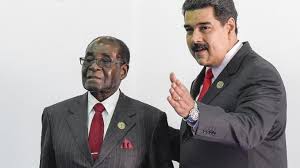
It seemed almost inevitable six years ago that on the day Western newspapers were filled with encomia to the recently deceased South African national liberation hero, Nelson Mandela, that another southern African hero of national liberation, Robert Mugabe, would be vilified. “Nearly 90, Mugabe still driving Zimbabwe’s economy into the ground,” complained one Western newspaper.
Mandela and Mugabe were key figures in the liberation of black southern Africa from white rule. So why did the West overflow with hosannas for Mandela and revile Mugabe? Why was Mandela the ‘good’ national liberation hero and Mugabe the ‘bad’?
A lot of it had to do with the extent to which the liberation projects in South Africa and Zimbabwe threatened or didn’t threaten white and Western economic interests—hardly at all in Mandela’s South Africa and considerably in Mugabe’s Zimbabwe.
The media-propagated narrative was that Mandela was good because he was ‘democratic’ and Mugabe was bad because he was ‘autocratic.’ But scratch the surface and Western and white-elite economic interests burst forth.
Land ownership in South Africa continues to be dominated by the white minority, just as it was under apartheid. What land redistribution has occurred has proceeded at a glacial pace, at best. In Zimbabwe, in contrast, land was redistributed from white colonial settlers and their descendants to the black majority. South Africa’s economy is white- and Western-dominated. Under Mugabe, Zimbabwe was taking steps to indigenize its economy, placing majority control of the country’s natural wealth and productive assets in the hands of its indigenous people.
The centrality of economic interests in the Western demonization of Mugabe was revealed in complaints about his plan to indigenize Western-owned mining companies, a process which would force a few wealthy investors in the West to surrender a majority stake in the mining of Zimbabwe’s mineral wealth. To the Western media, an African government giving its people an ownership stake in their own economy was unthinkable.
Mandela, in contrast, rejected calls to nationalize South Africa’s mines, accepting Western and white domination of the country’s economy as a bedrock principle of sound economic management.
In 2013, The Financial Times celebrated the South African leader for acting as “a reliable steward of sub-Sahara Africa’s largest economy, embracing orthodox fiscal and monetary policies.” That is, Mandela made sure that the flow of profits from South African mines and agriculture into the coffers of foreign investors and the white business elite wasn’t interrupted by the implementation of the ANC’s economic justice program, which called for nationalizing the mines and redistributing land. Nationalization, and redistribution of land, would become the sole project of Mugabe.
But at one point, Mugabe too was a Western-approved liberation hero, in the days when he shared Mandela’s predilection for orthodox fiscal and monetary policy, that is, putting Western business interests ahead of those of the people he was supposed to represent.
But the West’s love affair with Mugabe came to an abrupt end when the Zimbabwean president changed course and embarked on a fast-track land reform program. The West’s disdain for him deepened when he launched an indigenization program to place majority control of the country’s mineral resources in the hands of indigenous Zimbabweans.
Hence, Mugabe’s transition from ‘good’ liberation hero to ‘bad’, from saint to demon, coincided with his transition from “reliable steward” of Zimbabwe’s economy (that is, reliable steward of foreign investor and white colonial settler interests) to promoter of indigenous economic interests. And as he moved to invest Zimbabwe’s liberation project with real meaning, giving Zimbabweans both political and economic sovereignty, the West responded with sanctions aimed at starving the country to force it to reverse course. “When a colonial and imperialist power is forced to give independence to a people,” remarked Frantz Fanon, the “imperialist power says: ‘you want independence? Then take it and die of hunger.’”
As the West’s campaign of economic warfare plunged Zimbabwe’s economy into chaos, Western journalists attributed the country’s economic difficulties to what they called Mugabe’s ‘mismanagement’, overlooking Washington’s Zimbabwe Democracy and Economic Recovery Act, which blocked financial assistance to Harare from international lending institutions, a major impediment to the country’s economic development. It’s as if the Soviet Union’s crippled post-WWII economy had been blamed on socialism, rather than the destruction wrought by war and the Nazi invasion. In this, Western media followed their standard operating procedure in dealing with pro-independence Third World governments, attributing a sanctioned country’s economic difficulties to mismanagement and not the sanctions that caused them. The practice is evident today in connection with Venezuela, where the oil-rich country’s economic distress is discussed in Western media with a studious disregard of Washington’s detonation of an economic atom bomb in the middle of Caracas in the form of a program of economic warfare.
As to the democrat vs. autocrat dichotomy, it was a propaganda contrivance. It’s what Western governments and media use to legitimize leaders who protect and promote Western corporate interests and demonize leaders (from Castro to Kim Jong Un to Maduro to Xi Jinping to Mugabe) who protect and promote the interests and development needs of their own people.
We can argue about whether Mugabe failed to calibrate the pace of his land reform and economic indigenization programs to take account of the power of Western governments to counter them, but we can’t argue about whether he was a genuine hero of national liberation—one who recognized that a country whose economy is controlled by outsiders and a settler minority is independent in name alone.
Billionaire investor Wilbur Ross, who currently serves as US Commerce Secretary, recently unveiled Washington’s plan for a post-coup Venezuela. The natural resources-rich country is to be transformed into a theme park for wealthy US investors, bursting with profit-making opportunities for US businesses. ’Socialism,’ announced Ross, will be reversed. That Washington feels it can define the economic system of another country, and conspire to install a proxy, Juan Guaido, to impose a US-investor-friendly system upon its citizens, speaks volumes about what US leaders—all of them connected to corporate America in multiple, significant ways—really think about democracy. That the plan, if implemented, would present them with a bonanza of profit-making opportunities, reveals their true motivation in seeking the ouster of the resource nationalist Maduro.
By Stephen Gowans
In Inventing Reality: The Politics of the News Media, political scientist Michael Parenti wrote that, “Even when we don’t believe what the media say, we are still hearing or reading their viewpoints rather than some other. They are still setting the agenda.” [1] And the agenda they’ve set on Venezuela is built on the questions of whether the government of Nicolas Maduro is authoritarian and whether its so-called ‘socialist’ policies have ruined the country’s economy.
This agenda affords ample space for anarchists, such as Noam Chomsky and others, to criticize what they regard as Caracas’s arbitrary use of state authority. And it allows others to play Sunday morning quarterback, speculating on how Venezuela’s economic situation may have worked out differently if only Maduro, and his predecessor, Hugo Chavez, had pursued different policies.
Billionaire investor Wilbur Ross, currently serving as US Commerce Secretary, recently unveiled Washington’s plans for a post-coup Venezuela. The natural resources-rich country is to be turned over to corporate America. ‘Socialism’ is to be reversed.
As the Left engages with conservative forces on these questions, it locks itself into the latter’s agenda. And in accepting that agenda, a key issue is missed: The real reason Washington seeks to replace Maduro, the elected resource-nationalist president, with the unelected foreign-investment supporting Juan Guaido.
If you believe Washington, the goals of its campaign to replace Maduro with Guaido are to restore democracy and stabilize Venezuela’s economy. A premise of this argument is that democracy has been lost in Venezuela. It hasn’t. Yet, even if it had been—and, on the contrary, by any meaningful definition of the word democracy, Venezuela has become, with the government’s emphasis on the needs of the majority, more strongly democratic—you would have to be seriously misinformed to believe that Washington cares one iota about democracy. Whatever hillock of evidence one can marshal to show that the US government has ever promoted or defended democracy, a Himalaya of evidence can be marshalled on the other side.
Washington’s shameful history of overthrowing democratically elected governments around the world, including in Latin America, and not least its support for the 2002 coup d’état that briefly ousted Chavez, reveals what US leaders really think about rule by the people. So too does the US government’s notorious support for authoritarian governments, dictatorships, and monarchies.
For example, Washington counts Egypt among its best friends in the Middle East, a country whose leader, President Abdel Fatah al-Sisi (formerly field marshal Sisi) overthrew the only democratically elected president Egypt has ever had. Afterward, Washington’s good friend rounded up and jailed tens of thousands of the ousted president’s supporters. Sisi continues to receive over a billion dollars annually in US military aid, the largest recipient of US military aid after Israel. [2]
Little needs to be said about the anti-democratic character of another top Washington ally, the Saudi dictatorship, upon which Washington lavishes extravagant attention and to which it extends unceasing support.
And then there’s Mohammed bin Zayed. However much Washington dotes on Sisi and the Saudi tyrants, to “many in Washington…America’s best friend in the region” is MBZ, the unelected ruler of the United Arab Emirates. MBZ abhors democracy as much as Sisi and the House of Saud do, declaring that “the Arab world is not ready for democracy,” a viewpoint that has hardly made him persona non grata at the White House, State Department, or on Capitol Hill—odd, since you would think a government so invested rhetorically with an affection for democracy would find the Emerati despot distasteful. [3]
The democracy-abominating, US-loving, prince has “recruited American commanders to run his military and former spies to set up his intelligence services.” Before becoming secretary of defense, Jim Mattis, worked as an unpaid advisor. Mercenary Erik Prince, brother of billionaire US Education Secretary Betsy DeVos, created the royal dictator’s internal security apparatus to prevent democratic uprisings from threatening his rule. [4]
This only scratches the surface of Washington’s disdain for democracy. The Monroe Doctrine, which defines all of Latin America as a US sphere of interest, along with the 1905 Roosevelt Corollary and the recent 2019 Bolton Corollary, is a doctrine of empire—hardly the kind of thing you would think a genuine democracy-loving country would countenance.
And while Washington may celebrate and call its own political system a democracy, the United States is no more a democracy because it holds regularly scheduled competitive elections than a sow is a race horse because it has four legs. Democracy means something more than elections; it means, in part, a government that is responsive to the majority. By this criterion, the US government fails miserably.
In their 2014 study of over 1,700 US policy issues, the political scientists Martin Gilens and Benjamin I. Page found that “economic elites and organized groups representing business interests have substantial impacts on government policy, while average citizens and mass-based interest groups have little or no independent influence.”In other words, the United States is not a democracy, where influence is distributed uniformly, but a plutocracy, where political power is concentrated in the hands of a numerically insignificant elite of wealthy investors and shareholders who, by virtue of their outsized wealth, are able to dominate US public policy. [5]
A plutocracy doesn’t promote democracies around the world; it promotes regimes that open their doors to US exports and investments and provide plenty of handsome profit-making opportunities to wealthy investors. Plutocracies favor foreign governments that are willing, indeed eager, to preside over pro-foreign-investment business-oriented regimes that offer corporate America generous rewards.
At a breakfast meeting in Brazil a few days ago, billionaire investor Wilbur Ross, currently the US Secretary of Commerce, quietly unveiled US plans for a post-coup Venezuela and, in so doing, revealed what the pro-Guaido, anti-Maduro, campaign is all about: lust for profits, not love of democracy.
Ross announced that at the request of the National Security Council his department had taken the lead in developing an economic program for Venezuela, to be implemented by Washington’s errand boy Guaido, if US efforts to topple Maduro come to fruition.
The program features “Liberalization of Venezuela’s business climate, the removal of state controls, a privatization strategy [and] the reform of commercial law [to] attract foreign investment.” [6]
“Venezuela’s central bank, tax system, fiscal institutions, debt, and banking sector” are to be overhauled, to suit US businesses and to shower investors, including Ross and DeVos, and their friends and relatives, with handsome business opportunities. [7]
The energy sector—that is, Venezuela’s El Dorado of black gold—is to be liberalized and “the participation of private firms, including from the U.S” is to be promoted. The entire program is built around facilitating “private investment,” [8] that is, supplanting Venezuela’s public ownership with the United States’ free enterprise.
The US government has already “engaged with the private sector and international financial institutions to move [infrastructure] projects forward,” announced the investment banker, so that US engineering firms can build roads, ports, and bridges, “vital for the mining and the oil and gas sector,” [9] enabling Western energy and mining companies to easily access Venezuela’s cornucopia of natural resources.
The Ross plan pledges to “revers[e] socialism.” Venezuela is to be transformed into a Disney World for the US business elite. “The U.S. will remove commercial restrictions for U.S. firms, mobilize business contacts with Venezuela, and foster a constituency for pro-market, pro-business reforms,” Ross announced. The “Department,” he added, “will promptly create a virtual and then in-country clearing house with real time intel on trade and investment opportunities for U.S. and international businesses.” [10]
In other words, the point of the campaign is the same as the point of every US regime change operation, now, and in the past—promotion of US free enterprise. As the US Army acknowledged in a classified document, a goal of US foreign policy is “Furthering free trade, unencumbered by tariffs, interdictions, and other economic barriers, and furthering capitalism to foster economic growth, improve living conditions, and promote the sale and mobility of US products to international consumers.” [11] The US Army’s admission corroborates US Marine General Smedley Butler’s confession that he was “a high class muscle man for Big Business, for Wall Street and the bankers…a gangster for capitalism.” [12] The Ross plan is simply the expression of this goal for Venezuela.
Unfortunately, much of the discussion about Venezuela side-steps the issue of the real reasons for the US campaign against Maduro. Instead, debate focuses, as stated previously, on the democratic credentials of the Maduro government and the reasons the Venezuelan economy is in crisis. Or it digresses into the question of whether Maduro’s policies are really socialist. The debate misses the point. Washington decries as socialism any policy that diverts the flow of wealth from private US investors to anyone else, and therefore as dangerous (to US investors) and a threat to the foreign policy of the United States (i.e., the foreign policy of corporate America.) As the political sociologist Albert Szymanski observed,
To continue to secure sizable profits from its activities in Asia, Africa, and Latin America, the United States has had to continually intervene against attempts to establish Socialist, Communist, or nationalist regimes. US foreign and military policy stresses the preservation of submissive regimes throughout the world. Nationalists who threaten to expropriate US interests and turn them over to local capitalists are as dangerous as Socialists and Communists who would turn them over to local workers or the state. All three alternatives threaten the profitability of American corporations, and therefore all are opposed by the US government. [13]
The US historian William Appleman Williams once remarked that “Joseph Stalin maintained that America’s record in world affairs was exactly the reverse of [its] view [of itself].” [14] The Soviet leader made an astute observation. The US record—one of expropriating the land of native Americans, stealing the labor of enslaved Africans, and plundering the natural resources and markets of Latin Americans and Asians—is certainly the reverse of the fairy tale Washington and the plutocrat-owned US media promotes. US citizens may be willing to support high-minded crusades, but not interventions whose goals are to defend and fatten the investment portfolios of US Brahmins. Consequently, the unholy trinity of Washington, Wall Street, and the US news media, validate US historian Bernard DeVoto’s observation that US history “began in myth and has developed through three centuries of fairy stories.” [15] The idea that the US regime change plan for Venezuela is aimed at “restoring democracy” (when democracy, in any meaningful definition of the word, has grown stronger) and stabilizing the economy on behalf of long-suffering Venezuelans (rather than in the interests of US corporations) piles yet another fairy story atop a mountain of fantasies.
Stalin made another observation, namely, that unconditional US economic expansion into the territory of a developing country is “as dangerous to a nation as foreign military invasion.” [16]
China’s refusal to accept the Open Door Policy is the main reason why the Trump administration is locked in a tariff war with Beijing. It hopes, by pressure, to force China to abandon its program of state-directed economic development, which favors Chinese firms at the expense of US companies, in certain areas.
Stalin’s point was that once the United States is in a position to dominate a country economically, it can impose its will. And since the objective of war is for one state to impose its will on another, the outcome of the Open Door Policy is the same as the outcome of a war.
Whatever you want to call the Maduro government’s economic policies—socialist or nationalist or otherwise—they are aimed at overcoming poverty and asserting national independence. To accept the antithetical program formulated by Ross, to be implemented by the Venezuelan Quisling, Guaido, would be tantamount to inviting a foreign military invasion.
Lastly, it should be noted that the Ross plan, at its base, is the same plan the United States has imposed on Latin America for over a century. And in that time, despite following US economic diktats, Washington’s informal colonies have remained mired in poverty. No, in that time, because they have followed US economic diktats, Latin Americans have remained poor and dependent. If the Open Door is supposed to benefit Latin America as much as it does US investors, why is that US investors have grown immensely wealthy and Latin Americans fall ever further behind?
Washington’s Open Door Policy demands that local governments implement policies favorable to the requirements of giant US businesses. Since these businesses have immense market power, their free entry into a country’s economic space means that locally-owned and indigenously–directed industries cannot even get off the ground, let alone compete. Infrastructure development is undertaken by US engineering firms, paid for with interest by loans from US banks, so that US energy and mining companies can extract the country’s natural resources. While the Open Door is portrayed as a level playing field, in reality, the pre-existing economic supremacy of US firms tilts the field decisively in their favor. Indeed, US governments have favored the Open Door Policy precisely because it effectively closes the door on all but the major privately-owned enterprises of the United States (and other allied Western powers.)
Chavez, and his successor, Maduro, have tried to change this equation, so that Venezuela’s markets, land, natural resources, and labor are used to lift Venezuelans out the poverty to which decades of the Open Door Policy and over five centuries of plunder by Europe and its offshoots have condemned them. Washington, for obvious reasons, is opposed. Dominated by corporate lobbies, teeming with state officials who move in and out of top level careers in major US corporations, peopled by politicians whose election campaigns depend on the money of the wealthy few, and led by a cabinet of billionaire investors and their wealthy advisors, Washington wants the plunder of Venezuela to resume.
A propos of Latin America, Butler confessed that
I helped make Mexico, especially Tampico, safe for American oil interests in 1914. I helped make Haiti and Cuba a decent place for the National City Bank boys to collect revenues in. I helped in the raping of half a dozen Central American republics for the benefits of Wall Street. The record of racketeering is long. I helped purify Nicaragua for the international banking house of Brown Brothers in 1909-1912. I brought light to the Dominican Republic for American sugar interests in 1916. [17]
At the head of the long line of those who have facilitated the plunder of the poor on behalf of “Big Business [and] for Wall Street and the bankers,” stands Juan Guaido, eager to play the role of the doorman, as well as all those who, in engaging in self-promoting virtue-signalling by deprecating Maduro’s alleged democratic lapses, are helping Washington galvanize support for its campaign to sweep away an obstacle to the rape of Venezuela.
Stephen Gowans is the author of Washington’s Long War on Syria (2017), Patriots, Traitors, and Empires: The Story of Korea’s Struggle for Freedom (2018), and Israel, A Beachhead in the Middle East: From European Colony to US Power Projection Platform (2019). All are published by Baraka Books.
Michael Parenti, Inventing Reality: The Politics of News Media, St. Martins Press, 1993, p. 1.
Jared Malsin, “US releases $195 million in military aid to Egypt,” The Wall Street Journal, July 25, 2018.
David D. Kirkpatrick, “The most powerful Arab ruler isn’t MBS, it’s MBZ,” The New York Times, June 2, 2019.
Kirkpatrick.
Martin Gilens and Benjamin I. Page, “Testing Theories of American Politics: Elites, Interest Groups, and Average Citizens,” Perspectives on Politics, Fall 2014.
Noam Chomsky recently co-authored an op-ed in The New York Times, portraying the embattled Venezuelan government as an arbitrary undemocratic state, and calling upon it “to liberate all political prisoners, both military and civilian.” The occasion for the op-ed was the release from parole of Venezuelan judge María Lourdes Afiuni. Chomsky had weighed in on her case in 2011, in an interview with the British newspaper, The Observer. The newspaper ran the interview under the headline “Noam Chomsky criticises old friend Hugo Chavez for ‘assault’ on democracy”. The linguist denied he had done this, calling the headline “a complete deception.” It turned out the only deception was Chomsky’s denial.
Chomsky took issue with Chavez jailing people who threatened the Bolivarian Revolution, arguing that such harsh measures were only warranted “for specific circumstances, let’s say fighting world war two.” The implication was that US efforts to block the reform program set in train by Hugo Chavez—the 2002 coup, the attempted 2019 coup, economic warfare, destabilization, military intimidation, the attempted assassination of Maduro, US-organized diplomatic pressure on the government to step down—were not of the same magnitude as WWII and therefore emergency measures were unwarranted.
During both the first and second world wars, the United States suspended civil liberties, jailed dissidents and potential fifth columnists, and concentrated authority in the presidency, including the authority to direct the economy. Yet the threat posed to the United States by its enemies was vanishingly small. The United States, or at least the North American part of it, was protected on either side by two vast oceans and two friendly countries. There was no chance the WWI Central Powers would cross the Atlantic to invade the United States, and no chance either of fascist Italy, Nazi Germany, or militarist Japan crossing thousands of miles of ocean to launch a general assault on continental US soil. Nor were any of these enemies in a position to engage in anti-US economic warfare of any consequence, or to engineer a coup d’état in Washington.
The same, however, cannot be said about the power of the United States, its allies, and myrmidons, to topple the Venezuelan government. Venezuela has unquestionably faced a severe emergency from the moment Hugo Chavez came to power, with a vision of overcoming a semi-colonial past and resisting an imperialist present. At that point, Washington began organizing the overthrow of his revolution. To suggest, as Chomsky does, that the Venezuelan government has the latitude to assert a program of national independence in the face of US hostility while according full freedom to the US-backed opposition to organize its downfall, is either naïve, or artful. Whatever the case, it’s an invitation to the Maduro government to commit suicide.
Chomsky frequently complained that The New York Times wouldn’t run his op-eds because his points of view were outside the acceptable limits of ruling class opinion. Well, it seems that not all of them are.
No sooner had Chomsky performed his valuable service to Washington of traducing the Venezuelan government as undemocratic and arbitrary, than Gilbert Achcar, a Chomsky co-author, was revealed to be doing his own service to the United States’ global dictatorship by working with the British Ministry of Defense. Anyone who has followed Achcar’s work won’t be surprised. The University of London professor hasn’t met a US intervention he didn’t like. His speciality is to formulate arguments to prove that interventions against forces of national assertiveness and local sovereignty are, despite appearances, actually anti-imperialist and pro-socialist.
Achcar has been training the” British military “on ‘Islamic fundamentalism’ and other topics,” for the past two years, according to The Morning Star. Why the British military would pay the slightest attention to him is mind-boggling. Achcar is a charlatan, much given to double-talk and sophistry, whose analyses of the topics on which he holds forth with studied authority are stunningly wrong.
I wrote an essay on Achcar in December of 2015 and January 2016, titled “The ‘Anti-Imperialist’ Who Got Libya Wrong Serves Up The Same Failed Analysis on Syria.” The essay examined Achcar’s arguments for Western intervention in Libya and Syria, showing that his grasp of the facts was not even shaky but dead wrong. As for his predictions, they turned out to be stunningly off the mark.
This raised the question of why an analyst with such a horrible track record would be sought after for articles, co-authorship, interviews, and training, by the likes of Jacobin, Chomsky, Democracy Now, and the British military? That, I guess, says something about Jacobin, Chomsky, Democracy Now, and the British military.
There has long been a cankered part of the political Left that has used sophistry to justify support for imperialism. Jacobin, Chomsky, Democracy Now, and Achcar, stand in a long tradition, stretching back to the socialists who supported their own governments in WWI, and presented what they said were perfectly sound socialist and anti-imperialist reasons for doing so. Then as now, their arguments and actions were a betrayal of the socialism and anti-imperialism to which they affected fidelity.
The “Iranian leadership has to make a decision that they want their people to eat.” – US Secretary of State Mike Pompeo, November 7, 2018 [1]
June 17, 2019
By Stephen Gowans
Who is responsible for the recent attacks on the fuel tankers in the Gulf of Oman?
Washington blames Iran, and has offered what it calls proof—a grainy video allegedly showing what are said to be Iranians removing what is said to be a mine from what is said to be the hull of a stricken tanker. But the video proves nothing more than someone removed, or appeared to remove, (not affixed but removed) something from the hull of a ship. Even The New York Times was skeptical of the video-graphic indictment. US secretary of state Mike Pompeo argued that the attacks could only have been carried out by a perpetrator with “a high level of expertise,” i.e., a state, and not just any state, but Iran. But the Times pointed out that “the video depicts a curiously haphazard operation, with an ill-advised placement of the mine on the ship, careless safety procedures to remove it and little effort to hide the activity.” [2] This is hardly what you would expect of a sophisticated perpetrator with a high level of expertise. That this so-called proof of Iranian culpability was provided by Pompeo, who in May crowed that as director of the CIA “we lied, cheated, and stole” [3] hardly makes the case more convincing.
On the other hand, while Iran fervently denies responsibility for the attacks, its denials carry little weight. The country has very good reason to disrupt the flow of oil through the Strait of Hormuz, and equally good reason to deny it is doing so. Iran is the target of an undeclared but hardly secret war by the United States and of efforts by Washington to reduce Iranian oil exports—the country’s major source of revenue—to zero. Tehran warned as long ago as 2011 that it would retaliate against efforts to block its oil shipments, and that it would do so by dint of lex talionis—that is, via the Old Testament justice of an eye for an eye. [4] The logic is clear. Since continued access to oil revenue is a sine qua non of Iran’s existence as a viable independent state, it cannot afford to allow the United States to sever it connections to the world economy. One of the few effective measures it can take to force Washington to back off is use its geostrategic position in the Gulf to disrupt the flow of oil on which US investors depend for profits and US allies depend for energy. Accordingly, Tehran has “repeatedly threatened to shut down the Strait of Hormuz if Iran isn’t allowed to export oil.” [5] The idea, then, that Iranian operatives may be behind the oil tanker attacks is hardly far-fetched. And, Iran’s leaders, hardly simpletons, would never willingly acknowledge responsibility, since an admission would quickly be turned by Washington into a casus belli.
This isn’t to say that Iran is indeed the perpetrator; only that it may be the perpetrator, and that if it is, the fact that it is, is entirely predictable. As William J. Burns, a former deputy secretary of state in the Obama administration put it, “If the Iranians were responsible for the attacks on shipping in the gulf, it is … a predictable consequence of an American coercive diplomacy strategy.” [6] What’s more, considering the nature of the undeclared US war on Iran—one led by a program of what Iranian foreign Minister Mohammad Javad Zarif aptly calls ‘economic terrorism’—Iranian retaliation against US-allied shipping is not only predictable, but legitimate, as one of the few, if not only, means available to the Iranian state to safeguard its existence against an unprovoked attack by the United States.
Speaking at the Heritage Foundation in May, 2018, Pompeo issued a list of 12 demands to Iran, [7] reducible to three overarching requirements:
End support for opponents of US allies Israel and Saudi Arabia;
Abandon the Syrian government in its fight against a Western-backed Sunni Islamist insurgency;
Forebear from enriching uranium and developing ballistic missiles, activities that could provide the basis for a militarized nuclear self-defense in posse.
In short, Pompeo demanded that Iran capitulate to a US dictatorship over the region.
There is only a vanishingly small chance that the current government in Tehran, which is constitutionally opposed to monarchy (Saudi Arabia, UAE, Bahrain, Jordan, Qatar, hence, Washington’s Arab allies), European settler colonialism (Israel), and submission to US tyranny, will prostrate itself before Pompeo’s diktats. Which means the only way Washington could possibly achieve Iranian compliance is by replacing the country’s current government with a regime of marionettes. While Washington denies it seeks regime change in Tehran, Brett McGurk, the former US envoy for the fight against ISIS, acknowledges the obvious. “Trump may not even realize it, but particularly since the arrival of John Bolton as national security adviser last year, his administration has been pursuing what are effectively regime-change policies in not one but three countries: Venezuela, Syria, and Iran.” McGurk explains that while the United States is not explicitly calling for regime change, it is pursuing policies “that, if carried to their logical conclusion, necessitate a change of government.” [8]
There is no doubt that, its denials notwithstanding, Washington seeks regime change in Iran. Former U.S. Ambassador Robert Blackwill points out that Pompeo’s 12 demands are “effectively impossible for Iran to accommodate without fundamentally changing its leadership and system of government.” [9] Pompeo admitted to “Michael J. Morell, a former acting director of the C.I.A., that the administration’s strategy would not coerce Iranian leaders into a friendlier stance. But, he said, ‘I think what can change is, the people can change the government.’” [10] In other words, since the current government is unlikely to bow to US demands, a new government must be installed, one willing to pander to US requirements. This accords with the thinking of US national security advisor John Bolton. In July 2017, Bolton opined, “The behavior and the objectives of the regime are not going to change and, therefore, the only solution is to change the regime itself.’” [11] If any further proof is needed that Washington is pursuing a regime change program, consider this:
Bolton has long been on record as demanding regime change in Iran. “The declared policy of the United States should be the overthrow of the mullahs’ regime in Tehran,” Bolton said before being hired by US president Donald Trump. [12] Michael McFaul, a former US ambassador to Russia, argues that given Bolton’s very clear positions, “If you hire him, you’re making a clear signal that’s what you want.” [13] “In May 2018, Trump attorney Rudy Giuliani told reporters that the administration is ‘committed to regime change’ in Iran.” [14]
Bolton “warned Iran’s leader, Ayatollah Khamenei, after the 40th anniversary of Iran’s 1979 revolution, that he should not expect ‘many more to enjoy’ (suggesting that Khamenei may be gone in a year).” [15]
Pompeo has referred to the US “effort to make sure that the Iranian people get control of their capital” [16] and has “suggested the Iranian public could take matters into its own hands.” [17]
If the US goal of regime change in Iran isn’t secret, then neither are the means by which Washington intends to achieve its objective. The methods are clearly spelled out in open source documents and have been reported widely in the US news media. In sum, the United States seeks to recruit Iranian citizens en masse as US agents of regime change. The goal is to induce Iranian citizens to “take matters into [their] own hands” and “get control of their capital.” The lash that will drive them to do this, according to the plan, will be the misery created by US efforts to destroy the Iranian economy, chiefly by driving Iran’s oil revenue to zero, a goal to be achieved by threatening secondary sanctions on any country that does business with the Islamic Republic. Driven by economic desperation, Iranians will channel their energies into movements to overthrow the government, facilitated by a CIA-led program of subversion, if the plan proves successful. At the same time, the CIA will stir up unrest among Iran’s ethnic minorities, adding to the maelstrom.
Washington has subjected Iran to what Pompeo calls “the strongest sanctions in history,” [18] which he describes “as being calculated to produce domestic political unrest in Iran.” [19] “What Mr. Trump and his team are trying to do,” observed The Wall Street Journal, “is to use economic sanctions to generate unprecedented pressure on Iran … to create enough economic distress in Iran that the regime could buckle under the weight of popular discontent.” [20]
Whether the sanctions are the strongest in history, as Pompeo claims, is unclear. But what is clear is that they attack the length and breadth of the Iranian economy. The United States “has sanctioned the oil sector, the metals industry and military leaders by cutting them off from the American-led international financial system. To compel unhappy allies to go along, it has threatened to cut off their companies as well if they continue doing business with Iran.” [21]
More “than 700 Iranian banks, companies and individuals, have been targeted. [22] And Washington imposed “sanctions that would severely penalize any foreign or U.S. company that does business with Iran.” [23] The US goal is to completely cut off all Iranian oil sales [24] and to blockade the country economically.
Iran’s foreign secretary calls the sanctions economic terrorism, and with good reason. If terrorism is the threat, or infliction, of harm on civilians in order to achieve political ends, then the US measures clearly constitute terrorism. There’s no doubt that the measures are intended to achieve the political goal of regime change; that they’re intended to pressure Iranian civilians; and that they’re causing harm to civilians.
As a result of US economic coercion, Iran’s economy is cratering, according to The Wall Street Journal. [25] The New York Times says the Iranian economy is “reeling from sanctions” [26] and that it is “in a bad state.” [27] Iran’s president, Hassan Rouhani, says his country is facing the worst economic challenge in forty years. [28]
US economic warfare on Iran has caused the value of the country’s currency, the rial, to plunge. [29] This, in turn, has “led to a sharp increase in the prices of imported goods.” [30] “By raising the cost of imports, the currency collapse” has sparked a massive inflation. Inflation is running at 40 per cent. [31] Inflation has bankrupted businesses and put many imported goods, such as critical medicines, beyond the reach of ordinary Iranians. [32] The IMF predicts that the economy will continue to undergo significant contraction. [33] In turn, the misery of ordinary Iranians will increase.
The cratering of the Iranian economy by itself creates the possibility of social unrest, but leaving nothing to chance, Washington has established a CIA program to help the process along. “In 2017, John Bolton—not yet national security adviser—recommended in a memo to President Trump that the U.S. support ‘internal resistance’ and minorities inside Iran,” according to The Wall Street Journal. [34] As it turned out, the administration was already working along these lines. HR McMaster, Bolton’s predecessor as national security advisor, had “signed and put out a 27-page methodical Iran strategy with two prongs. The first was…a subversion campaign to influence Iran’s population. The second was confrontation,” according to Bob Woodward, in his book about the Trump White House, Fear. [35] The New York Times’ Matthew Rosenberg and Adam Goldman had reported in June 2017 that the US president had “appointed to the National Security Council hawks eager to contain Iran and push regime change, the groundwork for which would most likely be laid through C.I.A. covert action.” According to the reporters, “Ezra Cohen-Watnick, the council’s senior director for intelligence — the main White House liaison to intelligence agencies” had told other administration officials that he wanted “to use American spies to help oust the Iranian government.” Appointed to lead the subversion operation was Michael D’Andrea, “the Central Intelligence Agency officer who oversaw the hunt for Osama bin Laden.” D’Andrea goes by the sobriquets “Dark Prince or Ayatollah Mike.” [36]
In late December 2017 and early January 2018 economic “problems and political complaints led to a wave of public protests in more than 100 Iranian cities.” [37] Trump aides pointed “to outbursts of protest in the streets of Iranian cities as a sign that, maybe” Pompeo’s “strongest sanctions in history” were producing their intended effect. One senior administration aide acknowledged “that the protests are ’sporadic’ and without any central organization, but” said: “In a hundred cities and towns in the country there is enormous dissatisfaction.” [38] According to The New York Times, “with runaway inflation, broad economic problems and labor unrest, the Iranian government believes its popularity is weakening.” [39]
Bolton had also called on Washington to foment secessionist unrest among “minorities inside Iran.” [40] Ethnic minorities, including Kurds, Arabs, and Baluchis, account for one-third or more of Iran’s population, [41] and uprisings by these communities could substantially add to the chaos already occasioned by Washington’s economic war on the Persian Gulf state. The Wall Street Journal reported that “Iran’s non-Persian ethnic groups, once relatively quiet, are increasingly discontented with the regime,” and that the “wave of protests across much of the country … has been strongest in the predominantly non-Persian districts.” [42] “Kurdish groups have been clashing with Iranian forces with increasing frequency in the northwest, where most of Iran’s roughly 8 million Kurds live.” To the south, Arab separatists launched a September 2018 attack on a military parade in Iran’s main oil hub. Meanwhile, “to the east, insurgents fighting for greater autonomy or independence for the Baluch people of Iran have hit military posts in an area bordering Pakistan.” [43]
Bad enough as these malign US actions are, US economic terrorism and CIA subversion are only two layers of a palimpsest of US aggression, overlaid upon ongoing US military pressure. As The New York Times notes, “The United States Navy’s Fifth Fleet patrols the Persian Gulf. American forces are deployed in Iraq to the east, Afghanistan to the west and in other regional neighbors including Turkey, Bahrain and Qatar.” [44] Iran is hemmed in by hostile US forces.
The country has also been the target of a major US cyberwarfare effort. “In the early years of the Obama administration,” wrote David E. Sanger and Mark Mezzetti in The New York Times, “the United States developed an elaborate plan for a cyberattack on Iran in case the diplomatic effort to limit its nuclear program failed and led to a military conflict. The plan, according to the reporters, is “code-named Nitro Zeus,” and is “devised to disable Iran’s air defenses, communications systems and crucial parts of its power grid.” At its zenith, “the planning for Nitro Zeus involved thousands of American military and intelligence personnel, spending tens of millions of dollars and placing electronic implants in Iranian computer networks to ‘prepare the battlefield,’ in the parlance of the Pentagon.” [45]
Earlier, the United States’ “fast-growing ranks of secret cyberwarriors” had blown up nuclear centrifuges in Iran in an effort to prevent the country from acquiring a latent nuclear weapons capability that could be actualized in an emergency to defend itself. “The attacks on Iran’s Natanz nuclear facility, begun in the George W. Bush administration and code-named Olympic Games, destroyed roughly 1,000 centrifuges and set back the Iranians by a year or so,” according to The New York Times. [46]
Recently, Washington has ratchetted up its military pressure on Iran, sending a carrier, the USS Abraham Lincoln, “and its accompanying ships as well as what is known as a bomber task force to the region.” [47] The US warship carries more than 40 F-18 Super Hornets, which are “now conducting ‘persistent presence’ missions in international airspace near Iran,” [48] that is, unremitting patrols along the edge of Iranian airspace with one purpose: intimidation. “The U.S. also is sending the amphibious assault ship USS Arlington to the Middle East. The ship carries U.S. marines, amphibious vehicles and helicopters that can be used in a range of military operations.” [49]
Additionally, “Acting Defense Secretary Patrick Shanahan presented an updated military plan that envisions sending as many as 120,000 troops to the Middle East.” Some US officials dismiss the plans as a scare tactic, [50] a bluff designed to frighten the Iranians. But bluff or not, the intent is to intimidate, and is thus part of the undeclared war on Iran.
If Iran is indeed responsible for disrupting the flow of oil from the Persian Gulf (and it may not be), its actions are only the predictable consequence of the multilayered US aggression. What’s more, attacks on Persian Gulf shipping may be the only practicable means by which Iran can defend itself against a threat to its very existence as a viable independent state. What recourse has Iran to avert the complete collapse of its economy, and the starvation of its citizens, while retaining its independence, but to carry out deniable attacks on Persian Gulf shipping to disrupt the tranquil digestion of US oil company profits and uninterrupted delivery of oil supplies to US allies? Despite the promises of the European Union to rescue Iran from economic collapse by way of a financial mechanism that would allow the country to circumvent the US blockade, Brussels has failed to deliver. “These days, the biggest, baddest weapon in the American arsenal isn’t a missile, or a tank, or a fighter jet. It is America’s economic clout,” observes The Wall Street Journal’s Gerald F. Seib. [51] The Iranians, it seems, are on their own, fated to mount a defense against the economic clout of the world’s largest economy and the military clout of the planet’s biggest war machine.
US chauvinists will retort that while the war on Iran is undeclared and may be reasonably described as terrorism that it is, all the same, justifiable as a measure to prevent Iran from acquiring nuclear weapons and the means to deliver them, to say nothing of pressuring Tehran to curb its support for Hezbollah, Hamas, Islamic Jihad, and the Syrian government, and to cease its opposition to Israel and Saudi Arabia. There is insufficient space to reply in full here, except to make the following points:
If Iran had ever been working on a militarized nuclear program, it abandoned the work as long ago as 2003, according to the US intelligence community. [52]
If Iran embarks on a militarized nuclear program, it will be the predictable consequence of ongoing US and Israeli military pressure.
If the United States, Israel, Britain, France, and other countries can maintain nuclear arsenals in order, they say, to protect themselves from nuclear blackmail, why should that option be permanently foreclosed to Iran (or any other country whose sovereignty is outraged by more militarily formidable opponents)? If nuclear weapons are to be counted among the military equipment available to imperialist powers and settler colonial states, should they not also be available to states seeking to defend themselves against the formers’ predations?
Using pressure to coerce Iran to alter its foreign policy to accommodate US needs is an act of imperialism and a violation of Iran’s independence, to say nothing of its being an incentive to Iran to develop the nuclear weapons Washington claims it seeks to prevent Iran from developing.
Iran’s foreign policy is rooted in the country’s opposition to monarchy and European settler colonialism, along with its intolerance of Western domination of the Muslim world. Since most of Washington’s Arab allies collude in the US tyranny over West Asia, and since most of its Arab allies are monarchies, and since Israel is a settler colonial state, Iran, quite naturally, finds itself at odds with Washington’s satraps in the region, and allied to Syria and movements opposed to Israeli apartheid and US dictatorship. It ought to be clear who the good guys are in this struggle—or at the very least, who they aren’t. Iran may not be on the right side of every progressive struggle, but it is clearly on the right side of this one—a struggle against three of humanity’s most abhorrent institutions: monarchy, settler colonialism, and empire.
1 Quoted in “Iran letter to the UNSG and UNSC on Pompeo provocative statement,” Permanent Mission of the Islamic Republic of Iran, November 30, 2018.
4 David E. Sanger and Annie Lowrey, “Iran threatens to block oil shipments, as U.S. prepares sanctions,” The New York Times, December 27, 2011.
5 Benoit Faucon, Costas Paris, and Summer Said, “Gulf of Oman attacks trigger together security on key shipping routes,” The Wall Street Journal, June 14, 2019.
6 David E. Sanger and Edward Wong, “After placing blame for attacks, Trump faces difficult choices on confronting Iran,” The New York Times, June 13, 2019.
7 Michael R. Gordon, “US lays out demands for new Iran deal,” The Wall Street Journal, May 21, 2018.
8 Brett McGurk, “American foreign policy adrift: Pompeo is calling for realism—Trump isn’t delivering,” Foreign Affairs, June 5, 2019.
9 Edward Wong, “Trump pushes Iraq to stop buying energy from Iran,” The New York Times, February 11, 2019.
10 Vivian Yee, “US sanctions cut deep, but Iran seems unlikely to budge,” The New York Times, May 12, 2019.
11 Walter Russel Mead, “Trump’s Iran gambit,” The Wall Street Journal, June 8, 2018.
12 Patrick Cockburn, “The mysterious ‘sabotage’ of Saudi oil tankers is a dangerous moment in Trump’s pumped up feud with Iran,” The Independent, May 13, 2019.
13 David E. Sanger and Gardiner Harris, “’America First’ bears a new threat: military force,” The New York Times, March 24, 2018.
14 Walter Russel Mead, “Trump’s Iran gambit,” The Wall Street Journal, June 8, 2018.
15 Brett McGurk, “American foreign policy adrift: Pompeo is calling for realism—Trump isn’t delivering,” Foreign Affairs, June 5, 2019.
16 Edward Wong and Ben Hubbard, “Pompeo’s anti-Iran tour faces obstacles of a fractious Middle East,” The New York Times, January 14, 2019.
17 Ian Talley, “US toughens stance on future Iran oil exports,” The Wall Street Journal, June 26, 2018.
18 Michael R. Gordon, “US lays out demands for new Iran deal,” The Wall Street Journal, May 21, 2018.
19 Mark Landler, Maggie Haberman and Eric Schmitt, “Trump tells Pentagon chief he does not want war with Iran,” The Wall Street Journal, May 16, 2019.
20 Gerald F. Seib, “Amid the fog, Trump’s real agenda in Iran,” The Wall Street Journal, May 20, 2019.
21 Gerald F. Seib, “The risks in overusing America’s big economic weapon,” The Wall Street Journal, May 13, 2019.
22 Ian Talley and Courtney McBride, “As new Iran sanctions loom, US aims to plug gaps,” The Wall Street Journal, November 2, 2018.
23 Greg Ip, “Trump trade levers test long-term US alliances,” The Wall Street Journal, June 2, 2019.
24 Ian Talley and Courtney McBride, “As new Iran sanctions loom, US aims to plug gaps,” The Wall Street Journal, November 2, 2018.
25 Grep Ip, “Trump trade levers test long-term US alliances,” The Wall Street Journal, June 2, 2019.
26 Edward Wong and Clifford Krauss, “US moves to stop all nations from buying Iranian oil, but China is defiant,” The New York Times, April 22, 2019.
27 Thomas Erdbrink, “Iran is changing, but not in ways Trump thinks,” The New York Times, June 25, 2018.
28 Thomas Erdbrink, “Iran faces worst economic challenge in 40 years, president says,” The New York Times, January 30, 2019.
29 Sune Engel Rasmussen and Michael R. Gordon, “Iran defies US bid to curb its Middle East influence,” The Wall Street Journal, September 7, 2018.
30 Thomas Erdbrink, “Iran is changing, but not in ways Trump thinks,” The New York Times, June 25, 2018.
31 Patrick Cockburn, “The mysterious ‘sabotage’ of Saudi oil tankers is a dangerous moment in Trump’s pumped up feud with Iran,” The Independent, May 13, 2019.
32 Edward Wong and Clifford Krauss, “US moves to stop all nations from buying Iranian oil, but China is defiant,” The New York Times, April 22, 2019; Thomas Erdbrink, “Iran’s economic crisis drags down the middle class almost overnight,” The New York Times, December 26, 2018.
33 Patrick Cockburn, “Europe doesn’t have the power to be much more than a spectator in the escalating US-Iran conflict,” The Independent, May 11, 2019.
34 Isabel Coles and Ali Nabhan, “Iranian groups press for rights—and Tehran hits back,” The Wall Street Journal, October 1, 2018.
35 Bob Woodward. Fear: Trump in the White House. Simon & Shuster. 2018. p. 133.
36 Matthew Rosenberg and Adam Goldman, “CIA names the ‘dark prince’ to run Iran operations, signaling a tougher stance,” The New York Times, June 2, 2017.
37 Asa Fitch, “New unrest roils Iran as US ramps up pressure,” The Wall Street Journal, July 1, 2018.
38 Gerald F. Seib, “Amid the fog, Trump’s real agenda in Iran,” The Wall Street Journal, May 20, 2019.
39 Julian E. Barnes and Eric Schmitt, “Pentagon builds deterrent force against possible Iranian attack,” The New York Times, May 10, 2019.
40 Isabel Coles and Ali Nabhan, “Iranian groups press for rights—and Tehran hits back,” The Wall Street Journal, October 1, 2018.
41 Isabel Coles and Ali Nabhan, “Iranian groups press for rights—and Tehran hits back,” The Wall Street Journal, October 1, 2018.
42 Walter Russel Mead, “Trump’s Iran gambit,” The Wall Street Journal, June 8, 2018.
43 Isabel Coles and Ali Nabhan, “Iranian groups press for rights—and Tehran hits back,” The Wall Street Journal, October 1, 2018.
44 Rick Gladstone, “Iran’s missile tests and the nuclear deal,” The New York Times, March 10, 2016.
45 David E. Sanger and Mark Mazzetti, “U.S. had cyberattack plan if Iran nuclear dispute led to conflict,” The New York Times, February 16, 2016.
46 David E. Sanger and Eric Schmitt, “U.S. cyberweapons, used against Iran and North Korea, are a disappointment against ISIS,” The New York Times, June 12, 2017.
47 Gordon Lubold and Michael R. Gordon, “US deploys forces to Mideast to deter Iran,” The Wall Street Journal, May 5, 2019.
48 Gordon Lubold, “US commander weighs an expanded Mideast force to counter Iran,” The Wall Street Journal, June 9, 2019.
49 Nancy A. Yousef, “US bolsters its Gulf defense to counter Iran,” The Wall Street Journal, May 10, 2019.
50 Eric Schmitt and Julian E. Barnes, “White House reviews military plans against Iran, in echoes of Iraq war,” The New York Times, May 13, 2019.
51 Gerald F. Seib, “The risks in overusing America’s big economic weapon,” The Wall Street Journal, May 13, 2019.
52 David E. Sanger, “US says Iran could expedite nuclear bomb,” The New York Times, September 10, 2009.
Below is an excerpt from my new book, Israel, A Beachhead in the Middle East: From European Colony to US Power Projection Platform. The excerpt is from Chapter 3, titled Nakba. The book is available from Baraka Books.
May 14, 2019
By Stephen Gowans
On November 29, 1947, the United Nations General Assembly approved Resolution 181, calling for the partition of Palestine into separate Jewish and Arab states, linked by an economic union, with Jerusalem set aside as an international territory outside the jurisdiction of either state. Palestine would be divided into eight parts. Three parts would constitute the Jewish state, while the Arab state would be comprised of three other parts, plus a fourth, Jaffa, which would be an Arab exclave within the territory of the Jewish state. Jerusalem—envisaged as a corpus separatum, or international city—was the eighth part.
The Jewish population had grown rapidly from World War I under the stewardship of the British colonial administration from approximately 10 percent of the population to about one-third. Yet, while Jewish settlers remained in the minority and were outnumbered two to one by the indigenous Arabs, the resolution granted the Jewish state 56 percent of the Palestinians’ country, while the Arabs, with two-thirds of the population, were given only 42 percent. The balance, two percent, represented Jerusalem.
Some people continue to see the partition resolution—and its descendant, the two-state solution—as fair and practical, but it was neither of these things. Laying aside the inequitable apportionment of a greater territory for a Jewish state to a smaller Jewish population, there are larger issues to confront.
The first is the denial of Palestinian sovereignty. There is no question that the indigenous population was adamantly opposed to the expropriation of its land. While it made up the majority of Palestine’s inhabitants, its wishes were completely ignored by the United Nations. This was predictable. At the time the world body was dominated by First World powers steeped in the colonial tradition. Many of the countries that voted for the resolution were settler colonial states themselves: Britain, France and Belgium, and the British settler offshoots, the United States, Canada, Australia, New Zealand, and South Africa. There was no chance that a similar resolution would have passed from the 1960s onwards, when the balance of power in the United Nations General Assembly shifted from the First World to the Third World. Countries with colonial pasts unwaveringly considered Zionism a legitimate political ideology, while countries victimized by colonialism regarded it as a form of colonialism.
The second issue, following from the first, is that the partition resolution called for the creation of an unacceptable institution: a colonial settler state. Colonial settler states have been overcome one by one by determined resistance—in Algeria, Rhodesia, South Africa, and elsewhere—to the deserved applause of the majority of humanity. The demise of each settler colonial state is a sign post in the progress of humanity. The question of whether the Jewish state envisioned by the partition resolution, or Israel today, is a colonial settler state isn’t even controversial. Neither Theodore Herzl, the founder of political Zionism, David Ben-Gurion, the father of the state of Israel, nor Le’ev Jabotinsky, founder of revisionist Zionism, were in any doubt that a Jewish state built by settlers on the land of another people was unequivocally settler colonialism.
As to the practicality of Resolution 181, it is as indefensible as the partition plan’s alleged equity. A practical settlement to the conflict would have been one that all sides accepted. But neither side accepted the resolution. The indigenous population rejected it for the obvious reason that it denied them sovereignty over 56 percent of their territory and handed it to a minority population of recent immigrants. No people on earth would have accepted this proposal for themselves; why the Palestinians were expected to accept it, boggles the mind. Ben-Gurion accepted the resolution in words, but only as a tactical manoeuvre, recognizing that an embryo Jewish state could be incubated into the Land of Israel through military conquest. The Revisionists rejected the planned partition, because it fell short of fulfilling Zionist aspirations for a Jewish state in all of south Syria (the name by which Palestine and Jordan were known by the indigenous population.)
For the settlers, the demographics of the partition plan were all wrong. The Jewish state would contain 500,000 Jews but almost as many Arabs. There would be 440,000 Arabs living in the territory Resolution 181 envisioned for the Jewish state. Jews, then, would constitute only a bare majority. A bare majority could quickly become a minority, depending on immigration, and on the birth rates of the two communities. Moreover, how could 500,000 Jews rule almost as many Arabs, considering that the Arabs rejected Jewish rule? The plan was completely unworkable. The only way to create a viable Jewish state would be to engineer a radical reduction in the number of Arabs living within its frontiers while at the same time expanding its borders to absorb as many of the 10,000 Jewish settlers the resolution had assigned to the Arab state.
The resolution’s proclamation immediately touched off fighting between the native Arabs and the immigrant Jewish settlers. The settlers were determined to drive as many natives as possible out of the territory assigned by the UN to a Jewish state, while capturing territory assigned by the UN to an Arab state. When the dust settled, a Jewish state, named Israel, was proclaimed, comprising 78 percent of Palestinian territory, not the 56 percent envisaged by the resolution. Meanwhile, 700,000 Arab natives had been exiled from their homes and the settlers refused their repatriation, keen to protect the outcome of their demographic engineering.
Today, Israelis insist their state grew out of a UN resolution that Arabs rejected and Jewish settlers accepted. While the Arab natives certainly rejected the resolution, the settlers rejected most of it as well, accepting only one small part of it—the call for the creation of a Jewish state. They rejected all the other parts, including the call for the creation of an Arab state within specified borders; the prohibition against expropriating Arab land within the Jewish state; the designation of Jaffa as an Arab exclave; the creation of an international Jerusalem; and the creation of an economic union between two states.
British rule of Palestine came to an end on May 15, 1948. On May 14, Ben-Gurion proclaimed the State of Israel, sparking what has become known as the 1948 Arab-Israeli War. It was the first in a series of settler-native wars—armed conflicts between the army of the Jewish colonial settler state and various Arab armies and Arab irregulars.
The Arab belligerents in 1948—Egypt, Jordan, Iraq, Lebanon, and Syria—dispatched some 20,000 troops to help their compatriots resist settler efforts to transform Palestine into the Land of Israel. Only three of these states— Egypt, Jordan, and Iraq—had armies of consequence, and only one, Jordan, had an army that was prepared for war. All three states were British clients, governed by kings who served at the pleasure of London. All were armed by John Bull, and Jordan’s army was under the direct command of 21 British officers who took their orders from London. This was significant, since Britain favored the settlers, and could—and did—restrict the flow of weapons and ammunition to their client states. It’s not by accident that the core Arab armies did not intervene in Palestine until after British forces exited Palestine, even though settler forces began operations to drive the Arab natives out of Palestine five months earlier. When the British-controlled Arab armies did finally intervene, the settlers had largely ethnically-cleansed Palestine, and their entry into the affray was a near farce.
The Arab forces had no central command and no coordination. It has been remarked that one of the reasons five Arab armies were defeated by one Israeli army was because there were five Arab armies.
Worse, there were inter-Arab rivalries that further weakened the combined Arab forces. Jordan and Iraq, led by British-installed kings, brothers of the Hashemite dynasty, were eager to see the defeat of the Egyptian army of King Farouk. Farouk was a rival for influence in the Arab world, and the Hashemites desired his defeat. Jordan and Iraq, then, had no intention of doing anything to help their rival’s military forces.
On top of these problems, was the general weakness of the Arab armies. The Egyptian forces were under equipped and poorly led. They had no maps, no tents, and insufficient logistical support. Their officers were generally incompetent, having attained their rank through political connections. When orders were issued to soldiers in the field, they were often contradictory. The Iraqi army was even worse; it was sent into battle without ammunition.
Finally, there was betrayal. Abdullah, the king of Jordan, had secretly worked out an arrangement with the settlers to annex the West Bank to his kingdom. Glubb Pasha, the British officer who commanded Abdullah’s army, deliberately restrained his forces, ordering them not to enter territory assigned by the UN to a Jewish state, though Israeli forces had seized territory assigned to an Arab state.
It would have been difficult enough for the Arab armies to prevail under these trying circumstances, but the fact that they were outnumbered made victory all but impossible. Under-manned, lacking coordination, incompetently-led, ill-equipped, largely untrained, betrayed from within by Abdullah, and sabotaged by their British masters, 20,000 Arab soldiers were no match for the 60,000 unified and determined settlers under arms, many of whom were highly trained soldiers, having served in the British Army during the Second World War.
The Israelis have misnamed the First Settler-Native War as The War of Independence, as if it were a national liberation struggle of an oppressed people against a colonial power, Britain. On the contrary, it was a colonial war fought by Jewish settlers whose victory was aided in the background by the British. It was a war of dispossession, not a war of restitution.