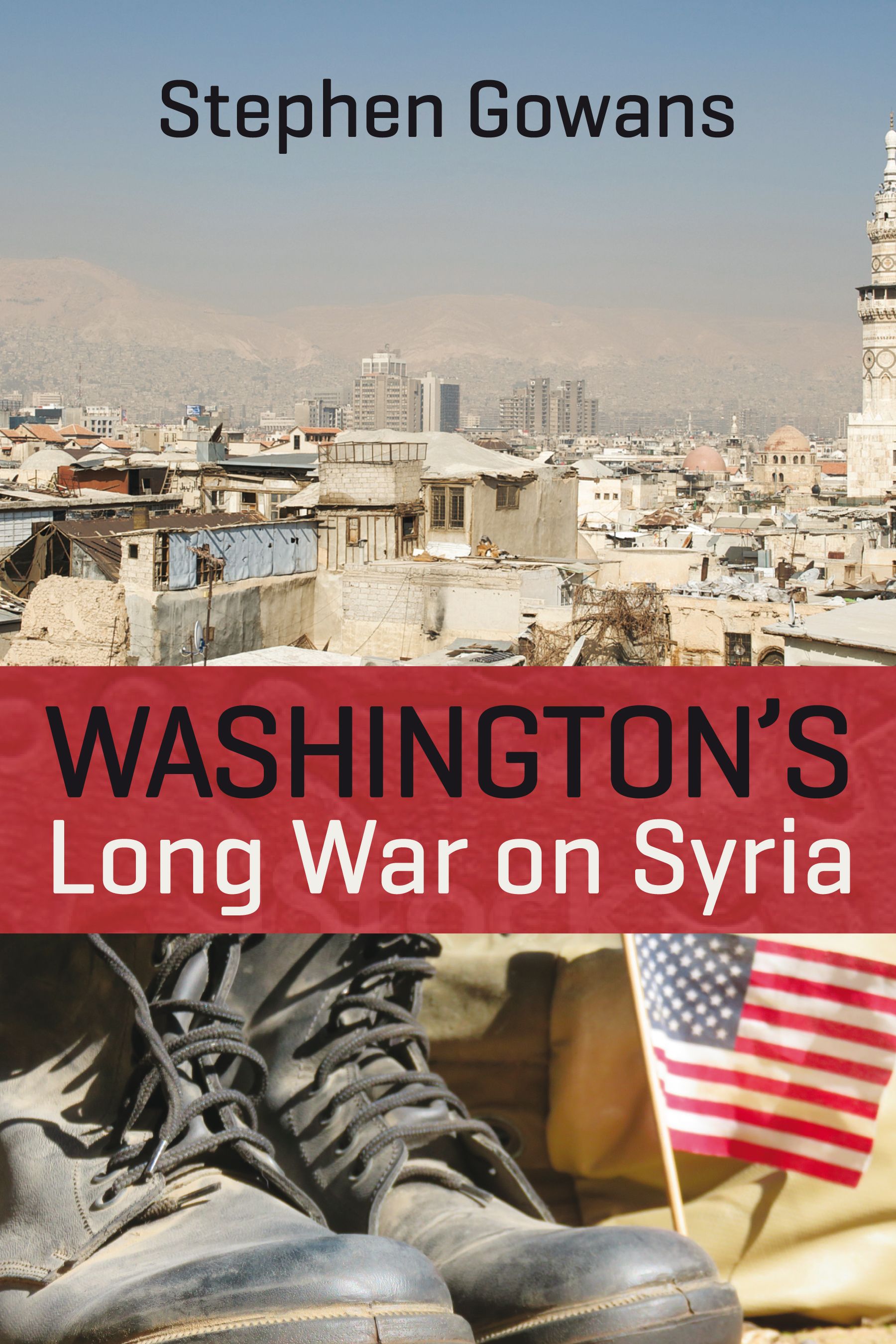
Stephen Gowans is the author of The Killer's Henchman: Capitalism and the Covid-19 Disaster (2022); Israel, A Beachhead in the Middle East: From European Colony to US Power Projection Platform (2019); Patriots, Traitors and Empires: The Story of Korea's Struggle for Freedom (2018); and Washington's Long War on Syria (2017).
For notification of updates, send an e-mail to stephen.roy.gowans@gmail.com with "subscribe" in the subject line.
A recent independent investigation sponsored by the United Nations Human Rights Council into the killing and injury of unarmed Palestinian refugees who were participating in peaceful demonstrations demanding that they be allowed to return to territories they, or their forbears, had been driven from, concluded that Israeli security forces unlawfully killed almost 200 and injured over 9,000 over a nine-month period last year.
The February 28 report of the Human Rights Council’s independent international commission of inquiry into the protests in Gaza, concluded that Israeli snipers “killed and maimed Palestinian demonstrators who did not pose an imminent threat of death or serious injury to others when they were shot, nor where they directly participating in hostilities.”
Israeli snipers killed 183 Palestinians and injured 6,106 by live ammunition; 1,576 by bullet fragmentation or shrapnel; 1,084 by direct tear gas canister hits; and 438 by rubber-coated metal bullets, the investigation found.
The overwhelming majority of victims, including clearly marked journalists and medical personnel, as well as children, women and persons with disabilities, “were hundreds of metres away from the Israeli forces and visibly engaged in civilian activities” when they were shot. Of the thousands of cases of injury or fatality, the commission found only two in which an individual was engaged in hostilities or posed an imminent threat to life or serious injury.
The commission concluded that “the use of live ammunition by Israeli security forces was unlawful” and observed that “intentionally killing a civilian not directly participating in hostilities is a war crime.” It also raised the possibility that Israeli actions constituted a crime against humanity.
In less diplomatic language, Israel behaved as a gangster state, murdering nearly 200 Palestinians in cold blood, who posed no direct threat to Israel and injured over 9,000 others. Some of the injuries, the investigation found, were “long-term” and “life-changing” and in some cases led to “paralysis” or “amputations.”
These thuggish, criminal acts are hardly Israel’s worst atrocities. Tel Aviv’s contempt for international law is unmatched, except by its patron, the United States. It has undertaken a series of wars of aggression and territorial annexations, both de jure and de facto. The state is based on a racist doctrine that demands the differential assignment of rights to Jews and non-Jews. It constructs Jewish-only colonies on land it hasn’t already plundered from the original Arab occupants. The enterprise is redolent with the stench of settler colonialism, an institution long recognized as an abomination against humanity, which, all the same, carries on in Palestine under the aegis of the United States, Canada, and European Union.
If we are to enumerate the crimes of Israel and conclude that it is a gangster state, we will almost certainly be accused of practicing the ‘new’ anti-Semitism, an accusation no more meaningful than denouncing critics of Al Capone’s crimes as practicing a new anti-Italian bigotry.
The United States, Canada, and the EU—advocates of this new approach to silencing critics of the West’s beachhead in the Middle East—sanction dozens of countries, including Venezuela, Syria, and North Korea, and do so in many cases illegally, without the authorization of the UN Security Council, knowing that there are no legal grounds on which the sanctions can be based, and so bypass the Council altogether. These self-designated ‘rule of law’ states do not, however, sanction Israel.
Read that again. Western states, which never tire of presenting themselves as champions of an international order based on the rule of law, are unlawfully sanctioning Venezuela, while overlooking Israel’s cold-blooded murder of almost 200 Palestinians—people who were peacefully demanding their rights and asking for nothing more than to be granted the charter of humanity.
The sanctions on Venezuela have created untold economic hardship, according to Alfred de Zayas, an independent expert who wrote a report for the Human Rights Council in the autumn of last year. De Zayas wrote:
Modern-day economic sanctions and blockades are comparable with medieval sieges of towns with the intention of forcing them to surrender. Twenty-first century sanctions attempt to bring not just a town, but sovereign countries to their knees. A difference, perhaps, is that twenty-first century sanctions are accompanied by the manipulation of public opinion through “fake news”, aggressive public relations and a pseudo-human rights rhetoric so as to give the impression that a human rights “end” justifies the criminal means. There is not only a horizontal juridical world order governed by the Charter of the United Nations and principles of sovereign equality, but also a vertical world order reflecting the hierarchy of a geopolitical system that links dominant States with the rest of the world according to military and economic power. It is the latter, geopolitical system that generates geopolitical crimes, hitherto in total impunity.
The ostensible reason for imposing a medieval siege on Venezuela is to drive the resource nationalist Maduro government from power for its alleged departure from democratic norms.
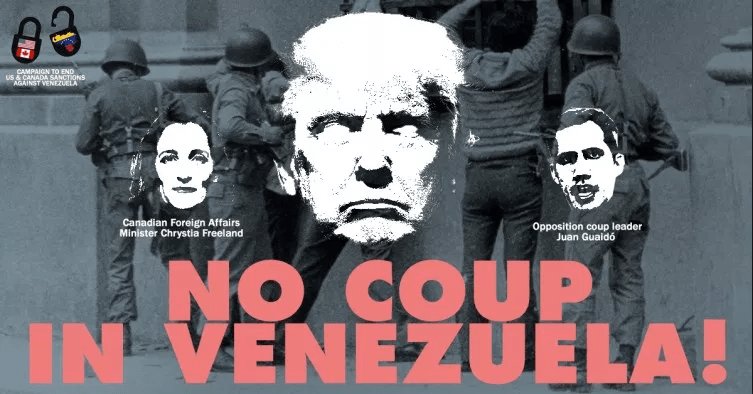
Set aside for the moment that Maduro’s favored replacement, the foreign-investment-friendly Juan Gauidó, intends to sell off Venezuela’s publicly-owned oil to private interests, and that this is a flagrant oil-grab, as US National Security Adviser, John Bolton, has frankly acknowledged.
Even were it true that Maduro’s election was fraudulent—and there isn’t a scintilla of evidence that it was—this would hardly compare to the massacre of longsuffering residents of Gaza, who, it should be added, are living under an Israeli-imposed medieval siege which the “United Nations and the International Committee of the Red Cross have both found” to constitute “collective punishment”—that is, to violate international law.
So, Israeli murderers gun down Palestinians who peacefully demand what is due to them as human beings, and this passes without comment by the self-proclaimed defenders of the rule of law. In Western capitals, the only discussion about Israel is one pivoting on the contrived concept of the ‘new’ anti-Semitism, an all too transparent ploy to suppress criticism of Al Capone’s crimes, while John Dillinger gets on with robbing Venezuela of its treasure trove of oil and gold.
In the last few days Venezuela has been afflicted by power failures, escalating the misery of a population already menaced by an ongoing economic crisis.
Two explanations are offered to account for the outages.
Western news media point to the alleged economic mismanagement of the Maduro government, which has, in their view, crippled Venezuela’s power gird via under-investment.
The Maduro government counters that the United States has brought down the power grid through a cyberwarfare attack, part of its project of bringing Juan Guaidó, the US-backed Venezuelan legislator to power, by plunging the country into chaos and blaming the crisis on Maduro.
The US news media say that Caracas has offered no evidence to back up its accusation that Washington has unleashed a cyberattack on Venezuela, but equally offer no evidence to substantiate their own accusation that the Maduro government’s economic policies are to blame for the crisis.
We are thus presented with a fact (the outage) and two competing narratives, neither based on hard evidence. Which of these narratives is more credible?
Washington very likely has the cyberwarfare capability to cripple Venezuela’s power grid. On November 12, 2018, David Sanger reported in the New York Times that,
The United States had a secret program, code-named “Nitro Zeus,” which called for turning off the power grid in much of Iran if the two countries had found themselves in a conflict over Iran’s nuclear program. Such a use of cyberweapons is now a key element in war planning by all of the major world powers.
If the United States can turn off the power grid in Iran, using a cyberweapon that is now a key element in war planning of all the major world powers, it’s highly likely that it can do the same in Venezuela.
What’s more, the United States has on at least two occasions carried out cyberattacks against foreign states. Significantly, the attacks were unleashed against governments which, like Venezuela’s, have refused to submit to US hegemony. US cyberattacks were used to cripple Iran’s uranium enrichment program (now widely acknowledged) and to sabotage North Korea’s rocket program, the latter revealed by various sources, including, again, by the New York Time’s Sanger: “[F]or years….the United States has targeted the North’s missile program with cyberattacks,” the reporter wrote in August, 2017.
The aforesaid, of course, is only evidence of capability, not of commission, but when placed within the context of Washington making clear its intention to topple the resource nationalist Maduro government, US capability, motivation, and practice, does very strongly cast suspicion on the US government.
Last week, US National Security Adviser John Bolton conceded (even boasted) that US policy in Venezuela is guided by the Monroe Doctrine, a doctrine which effectively claims US hegemony over the Western Hemisphere. In November, he used florid language to rail against Venezuela and other Latin American states which have rejected the Monroe Doctrine as belonging to a “Troika of Tyranny,” and forming part of a “triangle of terror” while acting as “a sordid cradle of communism in the Western Hemisphere.”
In 2002, as undersecretary of state, Bolton added Syria, Libya, and Cuba to George W. Bush’s infamous “Axis of Evil,” a regime change hit list which initially included Iraq, Iran and North Korea. All of the designated states were regime-changed or subjected to attempted regime change by Washington. Iraq, Iran, Libya, and Syria were or are resource nationalist states, like Venezuela.
Revealingly, Bolton used the occasion of denouncing what he called Venezuela’s “poisonous” ideology of socialism (more accurately termed resource nationalism) to sing hosannas to Brazil’s new president, Jair Bolsonaro, an unequivocal reactionary, who Bolton lauded as a positive “sign for the future of the region” in light of Bolsanaro’s “commitment to free-market principles.”
Commitment to free-market principles is code for welcoming the takeover of a country’s land, labour, markets and resources by US free enterprise. Bolton infamously told Fox Business that “It’ll make a big difference to the United States economically, if we could have American oil companies really invest in and produce the oil capabilities in Venezuela.” Indeed it will. Venezuela has the world’s largest reserves of oil, and is teeming with other natural resources, including gold, coveted by wealthy investors, including those with stakes in Canada’s giant mining companies (explaining why Ottawa has played a lead role in the Lima Group’s efforts to drive Maduro from power in favor of the foreign investment-friendly Guaidó.)
Guaidó showed why he has been decried as a US puppet when he said his economic “plan called for … opening up Venezuela’s vast oil sector to private investment,” along the lines envisaged by Bolton. The self-proclaimed president’s plan “includes privatizing assets held by state enterprises,” according to the Wall Street Journal. Under the Maduro government, investment in Venezuela’s oil industry must take the form of joint ventures with the country’s state-owned oil company, PDVSA, which is required to hold a majority share. Under a Guaidó government, that would change. Foreign private-owned companies would be allowed to own a majority stake in any joint-venture, and reap higher profits.
To return to the US narrative: If we accept the US-directed view that the power outages are caused by the Maduro government’s putative mismanagement of the electrical system, it appears all too convenient that the blackouts should happen precisely at the moment Washington is engaged in an effort to drive Maduro, and his “poisonous” ideology of resource nationalism, from power.
It seems more likely, given Washington’s long history of sabotaging the economies of countries that are insufficiently accommodating of US free enterprise, that US cyberwarfare capabilities were pressed into service to force Venezuelans to endure even more misery than has already been engendered by US-orchestrated sanctions. The aim is to increase pressure on Maduro to step down. As the Economist revealed, “Mr Guaidó and Mr Trump are betting that hardship will topple the regime.”
This parallels US efforts to overthrow Fidel Castro in Cuba. As historian Louis A Perez Jr. explained in a 2002 article in the Journal of Latin American Studies,
[C]entral to US objectives was the need to maintain the appearance that the collapse of Fidel Castro was the result of conditions from within, by Cubans themselves, the product of government economic mismanagement, and thereby avoiding appearances of US involvement. The United States sought to produce disarray in the Cuban economy but in such a fashion as to lay responsibility directly on Fidel Castro.
US officials affirmed that the goal was to make “Castro’s downfall seem to be the result of his own mistakes’.”
[US Ambassador Philip Bonsal] in Havana early stressed the importance of appearance: ‘ It is important that the inevitable downfall of the present Government not be attributed to any important extent to economic sanctions from the United States as major factor.’ The United States, Bonsal wrote … sought ‘ to make it clear that when Castro fell, his overthrow would be due to inside and not outside causes’. This was the purport of a lengthy memorandum by George Denney, Director of State Department Bureau of Intelligence and Research. The idea was to eliminate Castro ‘without resort to invasion or attributable acts of violence and violations of international law’, specifically by ‘creating the necessary preconditions for nationalist upheaval inside Cuba … as a result of internal stresses and in response to forces largely, if not wholly, unattributable to the US’.
If the “Castro Communist experiment” was to “appear to have failed not on its own merits but as a result of obvious or inadequately disguised US intervention,… the validity of Castro’s revolutionary course might remain unquestioned.” Denney warned that if Cuba’s socialism was interrupted by the force of the world’s foremost ‘imperialist’ and ‘capitalist’ power in the absence of a major provocation, such action [would] discredit the US and tend to validate the uncompleted experiment.”
In Cuba, the United States sabotaged the economy through sanctions and tried to pin the blame on Castro and socialism. In Venezuela, the United States appears to have sabotaged the electrical grid and pinned the blame on Maduro
To be sure, there is, at this point, no concrete evidence that Washington has sabotaged Venezuela’s electrical grid, but it has the capability to do so, a record of using cyberattacks against countries slated for regime change, a motivation to throw Venezuela into crisis, and a game plan it has used repeatedly in other countries.
The US hand may be absent from this week’s power failures in Venezuela, but chances are it wasn’t.
As a summary of what’s happening in the oil-rich South American country, Maduro couldn’t have done better.
As the Canadian Press reported, Canada and other members of the so-called Lima Group, an ad hoc body formed to oust Maduro, encouraged the opposition to find a new face without political baggage around whom it could unite. This is a standard US regime change tactic, previously used to attempt to bring about a change in government in Yugoslavia and Zimbabwe.
Venezuela’s opposition, comprised mainly of representatives of the middle and upper classes, selected Guaidó, a young unknown. One poll indicated that most Venezuelans had never heard of him.
Soon after being anointed as leader, Guaidó slipped into Washington to secretly meet with the Trump administration, presumably to secure its blessing.
Guaidó then hastened back to Venezuela where the opposition followed through on the Lima Group’s pre-arranged plan to elect the young unknown as head of the National Assembly. According to a recent poll, the assembly has a 70 percent disapproval rating.
Next, Guaidó declared himself president—also, one gathers, part of the pre-conceived Lima Group plan– arguing that Maduro’s election was fraudulent and that the presidency was therefore vacant.
If that isn’t enough to paint Guaidó as a treasonous figurehead of a plot orchestrated by Washington and Ottawa, consider this: According the Wall Street Journal, Guaidó’s plan for reviving the sanctions-crippled economy is to open Venezuela’s vast oil sector to foreign investment, privatize assets held by state enterprises, and indulge wealthy investors.
In other words, the US-Canadian agent plans to substantially scale back the public sector, surrender Venezuela’s economic sovereignty, and turn over the country’s vast treasure trove of natural resources to foreign investors.
Is it any surprise that the United States and Canada, home to big oil and big mining, have taken a leadership role in sponsoring him?
Carried through, Guaidó’s plan would re-Americanize the Venezuelan economy and reverse the Bolivarian Revolution initiated by Hugo Chavez and backed by Venezuela’s teeming poor.
US oil companies would benefit, a matter US national security adviser John Bolton alluded to in a recent television interview. Canadian mining companies would make off like bandits. And Venezuela’s economic elite would return to the good old days. Meanwhile, the Venezuelan people would find, once again, that they exist to make the wealthy wealthier.
The Lima Group is nothing more than an ad hoc assemblage of countries brought together for the sole purpose of overthrowing the Maduro government in order to open Venezuela’s oil and gold industries to ownership by wealthy US and Canadian investors.
It excludes the United States to disguise the obvious imperialist character of the project, and it deliberately excludes members of the Organization of American States who oppose the blatant interference in a member’s internal affairs.
And here’s a warning.
Venezuela is only the first of three Latin American countries the United States is targeting for regime change, according to US administration officials. The other two are Cuba and Nicaragua, which, together with Venezuela, make up what the administration calls a Troika of Tyranny, but in reality represent states engaged in the project of putting the interests of their own populations ahead of those of North American businesses. The administration says that “the attempt to force out the president of Venezuela” marks “the opening of a new strategy to exert greater US influence over Latin America.”
The United States is no stranger to overthrowing governments. In the twentieth century, Washington undertook 41 successful regime change interventions in the hemisphere, an average of one every two and a half years. And that doesn’t count the unsuccessful ones, like the Bay of Pigs invasion.
In this century, the United States, working with Canada, overthrew left-wing governments in Haiti in 2004 and Honduras in 2009, and tried but failed to overthrow Hugo Chavez in 2002. The narrative of the failed overthrow of Chavez anticipated the one Washington and its Lima Group co-conspirators are using today—the president’s policies no longer work for Venezuelans and the people are rising to defend democracy.
Western politicians and major news media say that the liberal democratic order is under threat. But what do they mean by ‘liberal democracy’?
January 30, 2019
By Stephen Gowans
Early in a series of lectures delivered in 1965, the political scientist C.B Macpherson observed that, “Democracy used to be a bad word.” [1] Little did he know that in 2019 “used to be” would no longer fit, and that democracy, the concept, would become a foul thing in the pages of the United States’ newspaper of record, the New York Times, even if democracy, the word, would retain its favourable connotations.
In what is surely an extraordinary pair of articles, the first on 1 November (“The weaknesses in liberal democracy that may be pulling it apart”) and the second on 21 January (“When more democracy isn’t more democratic”), Max Fisher, whose job at the New York Times is to “explore the ideas and context behind major world events,” presents an essentially Marxist critique of liberal democracy, albeit in a non-Marxist idiom, and with the Marxist valorization turned on its head; rather than praising majority rule and the popular will as good things, Fisher presents them as evils.
The New York Times says there’s a specter haunting the West: the people’s will.
Fisher argues that democracy comprises “two conflicting imperatives: majority rule and liberalism.” Majority rule serves the interests of the majority (as the majority understands it) and liberalism protects the interests of the establishment, which the establishment defines as universal and equal to the common good.
Voting creates the illusion of legitimacy—that the system is responsive to the popular will, when, in reality, it resists it—while liberalism checks the popular will so that establishment interests remain ascendant in the face of the latent threat of the majority to elite interests.
In “recent years a series of changes, including the rise of social media and online fund-raising, have severely weakened the establishments’ power,” Fisher observes, undermining its ability to hold the popular will in check. This is the danger inherent in democracy, or its promise, depending on whether you come down on the side of the establishment or the majority. In Fisher’s account, the only tolerable democracy is one that isn’t a democracy—that is, one in which liberalism, the instrument of the elite, is used to negate majority rule, the instrument of the many.
Fisher doesn’t present all of his argument in quite these terms, but that’s the gist of it. And where a Marxist would condemn the check on the popular will exerted by the establishment through its institutions and representatives, Fisher treats liberal democracy as a system working as it was designed to work, namely, against the majority, and not on its behalf.
Here’s a summary of his argument, in his own words.
Liberalism, the columnist writes, creates “institutions and representatives” which “balance majority opinion against considerations like universal rights and the common good.” In a democracy “the people’s will is carefully incorporated but rarely intended to dominate” (emphasis added.) This invites the questions: Who established the system’s aims? Why shouldn’t the popular will dominate? And how is the people’s will incorporated, if it is not allowed to dominate?
Lurking in Fisher’s account of liberal democracy is the idea that it is not the people who define the common good but “institutions and representatives.” At the same time, evident in his view, plainly exposed on its surface, is the notion that in a liberal democracy the people’s will is not decisive; it is, instead, the institutions and representatives of the establishment that dominate.
Empirically, this is the case. In their 2014 study of over 1,700 US policy issues, the political scientists Martin Gilens and Benjamin I. Page demonstrated that “economic elites and organized groups representing business interests”—the establishment—“have substantial impacts on government policy, while average citizens and mass-based interest groups have little or no independent influence.” [2]
The reality is amply evident to the majority. Since 1958 the University of Michigan has conducted a public opinion survey every two years in which a broad range of Americans are asked this question: “Would you say that the government is pretty much run by a few big interests looking out for themselves or that it is run for the benefit of all the people?” In 2012, 79 percent said “a few big interests.” [3]
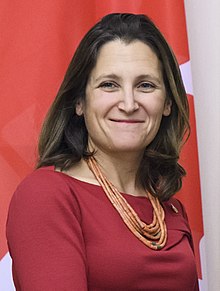
Canada’s global affairs minister, Chrystia Freeland, says the liberal democratic world is under strategic threat.
In Fisher’s view, this is hardly a reality that needs to be challenged and transformed, but accepted, even celebrated, as the best of worlds. The people do not know the common good; they’re incapable of understanding it. The common good must therefore be protected from the people’s whims and misapprehensions. It is incumbent on those of mature judgment to define the common good and protect universal rights from majoritarian impulses.
To make his point, Fisher cites Edmund Burke, a giant of 18th century reactionary thought, whose concern was for the universal rights and common good of the aristocracy. Burke was an adamantine opponent of democracy, and Fisher’s citing the conservative icon in this context has all the persuasiveness of invoking Hitler to make the case that checks on democracy are desirable. Burke and Hitler belong to a reactionary tradition which regards democracy as an abomination. Fisher appears to fit comfortably in this trend—and it is fitting and predictable and hardly surprising that a major columnist of a major newspaper owned by the establishment of the major world imperialist power holds these views.
Fisher shares Burke’s solicitude for the universal rights and common good of the establishment, and contempt for the right to self-determination of the majority. “Leaders have always needed the support of both voters and establishments to win elections,” Fisher explains. “Voters wanted popular rule, establishments wanted checks and institutions; the two held each other in balance.” And that—the negation of the popular will by a minority—is a good thing, if we’re to believe the Burke-quoting Fisher.
But voters have grown “skeptical of the entire idea of accruing power to bureaucrats and elites” Fisher warns, and now want (gasp!) “to replace institutions with … direct rule by the people.” Direct rule by the people would be a tyranny, Fisher warns—of the majority over “the common good” and “universal rights.” He doesn’t spell out what rights are universal, but we can be pretty sure he means the right to live on rent, profits and interest, the right to resist the people’s will, and the right of establishment figures “of mature judgment” to define the common good. In other words, universal rights and the common good are none other than the rights and common good of the economic elite and organized business interests.
In the Fisherian view, democracy as it is practiced in the West, creates a tension between the tyranny of the majority (majority rule, or the dictatorship of the proletariat in the Marxist vernacular) and the tyranny of the establishment (liberalism, or the Marxists’ dictatorship of the bourgeoisie) in which the latter tyranny almost always—and should almost always—prevail over the former.
Majority rule “feels democratic to members of the majority,” Fisher observes, but when the tyranny of the establishment checks the majoritarian impulse of the masses, it “can feel tyrannical.” It is, but that’s how the system is supposed to work, he explains.
Sometimes the inherent tensions within the system threaten to be resolved in the majority’s favor, and Fisher fears that the balance is tipping threateningly close to majority rule. Fisher discerns a specter haunting the West—“the vision of democracy as rule by the people.” It “persists.”
Railing against the people’s revolt against “the entire idea of accruing power to bureaucrats and elites,” Fisher reminds us that democracies “are not designed for direct popular rule.” They are “designed to resist” it. Sure, the “checks imposed on popular will can feel like democracy failing,” he explains, but that “is actually the system working as intended.”
The French Marxist Henri Barbusse defined liberal democracy as a system with “a President instead of an Emperor, an armchair instead of a throne” [4]—much the same as the elite tyranny which preceded it, if different on the surface. This is essentially Fisher’s view, but Barbusse rejected Fisher’s acceptance of elite tyranny as desirable.
Of course, what Fisher is really raising the alarm about is the growing refusal of the majority to allow liberal institutions and representatives to resist the popular will, reflected, for example, in the Brexit vote, or in the election of leaders of whom the establishment disapproves whose route to power has been through their promises to address the basic existential concerns of the majority: jobs, a liveable income, and economic security.
In the 1970s, the establishment’s Trilateral Commission defined the demand that government policy reflect the will of the majority as a “crisis of democracy”—a sickness originating in democratic “excess.” In the 1920s in Italy and in the 1930s in Germany, earlier crises of democracy were resolved by fascism, another instrument of the establishment.
Clearly, the New York Times, and the economic elite and organized business interests it represents, are not prepared to tolerate a democracy of the many, or simply, democracy as it has always been understood. A democracy of the few, one of which Burke would approve—namely, not a democracy at all but a tyranny of the economic elite, a plutocracy—is more in line with the newspaper’s, and the establishment’s, predilections.
All the same, that won’t stop the New York Times, the US government, and the Western intelligentsia, from appropriating the good name of democracy to beautify and disguise their preferred system of anti-democratic rule, all the while defaming the people as democracy’s enemies.
1. C.B. Macpherson, The Real World of Democracy, CBC Enterprises, 1990, (1).
2. Martin Gilens and Benjamin I. Page, “Testing Theories of American Politics: Elites, Interest Groups, and Average Citizens,” Perspectives on Politics, Fall 2014.
3. H. Bruce Franklin, Crash Course: From the Good War to the Forever War, Rutgers University Press, 2018, (72)
4. Henri Barbusse, Stalin: A New World Seen Through One Man, Read Books, 2011, (50).
A lot of good people signed the statement opposing US interference in Venezuela’s internal affairs, posted at Venezuelanalysis.com on January 24, but one wonders whether they gave the particulars of the statement sufficient thought.
The Chomsky et al statement called on Washington to cease interfering in Venezuela’s internal politics, “especially for the purpose of overthrowing the country’s government.” Excellent. But it should have added a call to support the Maduro government’s project of overcoming Venezuela’s racial and socioeconomic oppression. And stopped there.
Instead, it proposed US intervention in the form of support for what it defined as “the only solution”: negotiations to resolve the country’s longstanding racial and socioeconomic divisions. Thus, the statement defined division (that is, conflict), and not racial and socioeconomic oppression, as Venezuela’s core problem.
The proposal that the United States sponsor negotiations is problematic.
First, the question of negotiations is one for Venezuelans to decide. If sovereignty means anything, then a people has the right to choose the methods by which it resolves its problems, free from outsiders telling it how it ought to be done.
What’s more, the proposal calls to mind Western-sponsored negotiations to resolve the so-called Palestinian-Israeli conflict. How well has that worked out? And what is the end state sought: justice for the oppressed, or only their quiescence?
Second, negotiation implies conceding ground to a racial and socioeconomic elite that wants to continue its exploitation of the majority. If that’s how Venezuelans, together, wish to proceed, fine. But the idea that all conflicts can or ought to be resolved through negotiation is naïve. The statement’s drafters appear to be more interested in averting violence than achieving justice.
http://www.barakabooks.comImagine a slave rebellion, in which the slave owners are supported by a foreign state, and the citizens of that state call on their government to end its intervention on the side of the slave owners, but at the same time call on their government to sponsor negotiations between the slaves and slave owners to find a solution to the ongoing crisis and the country’s racial and socioeconomic divisions. Would these foreign citizens be calling for an end to the injustice of slavery or an end to the violence of rebellion?
While it begins strongly, the statement ends by standing for nothing; certainly not for the Maduro government and its aims. Nor does it stand against anything, except (though importantly) against a US supported coup d’état, but not against all intervention. Intervention of the kind that leads to a negotiated stalemate in a struggle against racial and socioeconomic oppression and the continuation of injustice is deemed desirable.
The following statement would have been stronger.
o The US government should cease its efforts to overthrow the Maduro government.
o The US government should provide what reasonable assistance it can to the Maduro government’s requests for aid in carrying out its program of overcoming the racial and socioeconomic oppression that has afflicted Venezuela for far too long.
Stronger still would have been a statement that made these points:
o The Maduro government has worked to put the interests of ordinary Venezuelans ahead of those of foreign investors;
o The opposition, backed by Western governments, has sought to frustrate those aims;
o Now the United States and a number of other countries are encouraging a coup d’etat;
o If successful, a coup d’état will lead to a rightwing government that will implement policies that indulge foreign investors and treat ordinary Venezuelans harshly; Venezuela’s longstanding racial and socioeconomic oppression will continue;
o We stand with the Maduro government’s efforts to build a society and economy that puts the needs of the majority of Venezuela’s citizens first;
o At the same time, we oppose the efforts of the United States and its allies to impede, undermine and eliminate the Maduro government’s program to end the racial and socioeconomic oppression that has afflicted Venezuela for far too long.
The US-led and coordinated intervention to overthrow Venezuelan president Nicolas Maduro by recognizing Juan Guaidó, the leader of Venezuela’s National Assembly as the interim president, has nothing whatever to do with restoring democracy in Venezuela (which was never overturned) and everything to do with promoting US business interests.
Washington’s imperial arrogance in effectively appointing Guaidó as president, attempting to go over the heads of Venezuelans—who alone have the right to decide who their leaders are—is motivated by the same concerns that have motivated other US interventions around the world: toppling governments that put their citizens’ interests above those of US investors.
That Washington has a propensity to engage in destabilization operations against leftwing governments is hardly a secret. From 1898 to 2004, the US government undertook 41 successful regime change interventions in Latin America, an average of one every two-and-a-half years. And that excludes the unsuccessful ones, such as the Bay of Pigs invasion.
In almost every instance, US regime change interventions around the world have been motivated either directly or indirectly by commercial considerations, and were undertaken to restore or protect the primacy of US business interests in foreign lands. And in many cases, the interventions paved the way for the installation of rightwing dictatorships.
One ultimately unsuccessful US intervention was the 2002 coup d’état against Hugo Chavez, Maduro’s predecessor. Washington immediately recognized the coup, hailing it as a victory for democracy, but privately recognized it as a major win for US business interests in an oil-rich state teeming with potential profit-making opportunities for US free enterprise.
Washington disliked Chavez because the charismatic leftist leader promoted the welfare of ordinary Venezuelans, rather than pandering to US investors. But the coup against Chavez was short-lived. In a blow against tyranny, the regime change was quickly reversed and Chavez, the country’s legitimate leader, was restored to the presidency.
Determined to eliminate leftist governments in Latin America, Washington stepped up its campaign of economic warfare against the South American country, aiming to plunge its economy into ruin and the Venezuelan people into misery. This was a game plan Washington had followed countless times before and since, in China, Cuba, North Korea, Chile, Zimbabwe, Yugoslavia, Iraq, Syria, and Iran: ruin the target country’s economy, attribute the chaos to “the failures of socialism” and economic mismanagement, and wait for the people to rise in revolt against their misery.
http://www.barakabooks.comThe idea that Washington’s intervention in Venezuela has even the slightest connection to protecting democracy is laughable. The US government has notoriously supported a string of rightwing dictatorships throughout Latin America, including that of Augusto Pinochet, who was installed in the wake of a 1973 US-engineered coup against Salvador Allende. Allende crossed Washington by doing what Maduro, and a host of other Third World leaders, had done: put the interests of the local population ahead of those of corporate America.
In the Middle East, the United States’s closest Arab allies are a military dictatorship (Egypt) and absolutist monarchies, chief among them Saudi Arabia, whose abhorrence of democracy is absolute. Washington rewards Egypt with $1.3 billion in military aid annually, and robustly supports the Saudi tyranny.
Saudis regard their parasitical royal family as completely unacceptable. To protect itself from its own population, the monarchy maintains a 250,000 troop-strong National Guard. The Guard exists, not to defend Saudi Arabia from external aggression, but to protect the monarchy from its own subjects. The al-Saud family’s protectors are trained and equipped by the United States and its satellites, including Canada, which has a $10-billion contract to supply the force with armored personnel carriers, used to put down the frequent uprisings of disgruntled Saudi subjects.
The National Guard’s armorer, Canada, also recognized Guaidó as Venezuela’s interim president, dishonestly attributing its decision to follow the US-lead to its purported commitment to democracy. Ottawa has colluded with the dictators of Riyadh in their crackdown on long-suffering, democracy-deprived, Saudi citizens, at the same time supporting General Dynamics Canada’s efforts to rake in Pharaonic profits from arms sales to the democracy-hating Saudi despots.
Let’s be honest about a few things.
First, the agendas of US and Canadian political leaders are set by the economic elites and organized business interests on which they depend for campaign contributions, policy recommendations, and lucrative post political career job opportunities, and with which they’re tightly integrated personally and professionally. Accordingly, they care about the profits of US and Canadian investors, not about the welfare, freedoms or democracy of ordinary Venezuelans. Indeed, they secretly harbor contempt for the bulk of their own citizens and wouldn’t, for a moment, tolerate the flowering of an authentic, robust, democracy in their own countries. The idea that they care about the residents of a distant South American land is a fantasy for political innocents and the weakly naïve.
Second, US-led campaigns of economic warfare do make people’s lives miserable, and many people may attribute their misery to the actions of their own government and wish to see it step down. Others may recognize that sanctions are the cause of their misery, and may support regime change as a way of winning relief from foreign-imposed misery. Indeed, the logic of economic warfare depends on these assumptions being true.
Third, governments threatened by foreign-sponsored regime change face legitimate national emergencies. Maduro is not a dictator. He is the elected head of a government confronting a genuine national emergency engineered by hostile foreign powers. Measures taken by the government to defend its citizens against the determination of the United States to impose on Venezuela policies which cater to the interests of corporate America at Venezuelans’ expense are wholly legitimate; they represent the actions of a democracy against a US-led international tyranny.
It is important to remember that Maduro’s government, like Chavez’s, has sought to put the interests of ordinary Venezuelans ahead of those of US investors. As a result, it has provoked Washington’s enmity. The US intervention in Venezuela in recognizing Guaidó as interim president is emblematic of countless other US regime change interventions. Invariably, these interventions are targeted at leftwing governments that threaten the profit making interests of US businesses. The interventions have nothing whatever to do with democracy; on the contrary, where successful, they are almost always followed by rightwing regimes that build US investor-friendly business climates and integrate their countries economically, militarily, and diplomatically into the US-superintended and Wall Street-led global order. Foreign investors are indulged, and the local population is treated harshly. Far from spurring transitions to democracy, US regime change interventions aim to reverse democracy, and strengthen US global tyranny. The latest US-led intervention in Venezuela is no different, and is just a repeat, with local variations, on similar efforts in Syria, Iran, Cuba and North Korea.
The growing hostility of Western governments to China is more about the interests of Western investors than legitimate security fears
December 30, 2018
By Stephen Gowans
The United States stations 320,000 troops in the vicinity of China [1], maintains a continuous B-52 bomber presence in the region, including over waters claimed by the East Asian giant, [2] and has sent its “most advanced warfighting platforms to the region, including multi-mission ballistic missile defense-capable ships, submarines, and intelligence, surveillance and reconnaissance aircraft.” [3] The 2018 US National Defense Strategy lists China first among the United States’s “five central external threats” including “Russia, North Korea, Iran, and terrorist groups with global reach.” [4] The secretary of state, Mike Pompeo, has called China the “great threat for the U.S. in the long term.” [5] According to The Washington Post’s Bob Woodward, the Trump administration considers China “the real enemy.” [6]
What has China done to make successive US administrations see it as a major external threat and the real enemy? The answer is that China has developed a state-led economic model that limits the profit-making opportunities of US investors and challenges their control of high-technology sectors, including artificial intelligence (AI) and robotics, essential to US military supremacy. Washington is engaged in a multi-faceted war “to prevent Beijing from advancing with plans … to become a global leader in 10 broad areas of technology, including information technology, aerospace and electric vehicles.” [7] Washington aims to “hobble China’s plans to develop advanced technology” [8] and to “force China to allow American companies to sell their goods and operate freely” in China, under conditions conducive to maintaining US economic and military supremacy. [9]
For its part, China seeks to alter a global economic system in which it is allowed only “to produce T-shirts” while the United States produces high-tech, according to Yang Weimin, a senior economic adviser to China’s president Xi Jinping. [10] Xi is “determined that China master its own microchips, operating systems and other core technologies” [11] in order to become “technologically self-reliant.” [12] But self-reliance in industries like aerospace, telecommunications, robotics, and AI means removing China, a large market, from the ambit of US high-tech firms. [13] Moreover, since Western military supremacy has always relied on Western technological superiority, Chinese efforts to challenge the Western monopoly on high-tech translates directly into an effort to challenge Washington’s ability to use the Pentagon as an instrument for obtaining investment and trade advantages for US investors.
China’s economic model
China’s economic model is often called “state capitalist” or “market socialist.” Both terms refer to two important elements of the Chinese model: the presence of markets, for materials, products and labor, and a role for the state, through industrial planning and ownership of enterprises. [14]
The “mainstay of the economy” [15] is China’s over 100,000 state owned enterprises. [16] The state has a strong presence in the commanding heights of the economy. “Key sectors such as banking are…dominated by state-controlled companies.” [17] State-owned enterprises “account for about 96% of China’s telecom industry, 92% of power and 74% of autos.” [18] Beijing “is the biggest shareholder in the country’s 150 biggest companies.” [19] The combined profit of state-owned “China Petroleum & Chemical and China Mobile in 2009 alone was greater than all the profit of China’s 500 largest private firms.” [20]
Industrial planning is carried out by the National Development and Reform Commission. The commission uses various means to incubate Chinese industry in key sectors [21] and drafts plans “to give preferential treatment” to Chinese firms in strategic areas. [22]
Beijing is counting on state owned firms “to become global leaders in semiconductors, electric vehicles, robotics and other high-technology sectors and is funding them through subsidies and financing from state banks.” [23] The planning commission also guides the development of steel, photovoltaics, high-speed trains, and other critical industries. [24]
http://www.barakabooks.comBeijing has closed sectors it considers strategic or vital to national security to foreign ownership. These include “finance, defense, energy, telecommunications, railways and ports” [25] as well as steel. All steel industry firms are state-owned and all are financed by state-owned banks. [26] In total, “China … has restricted or closed off 63 sectors of its own economy to foreign investors, such as stem-cell research, satellites, exploration and exploitation of numerous minerals and media, as well as humanities and social-sciences research institutes.” [27]
China also relies heavily on joint venture arrangements to acquire Western technology and know-how. This idea was initially introduced to China by General Motors, which proposed a joint venture in 1978 with the Chinese car industry. GM’s idea was to trade off its technology and know-how for access to a vast market and low-wage labor. [28]
Chinese leaders saw joint ventures as a way “to propel its industries up the value chain into more sophisticated sectors and the country into rich-nation ranks.” [29] Technology acquired from Western partnerships diffused into the Chinese economy, allowing Chinese firms to become competitors of the Western companies. [30] For example, Chinese rail companies used technology acquired through joint ventures with Japanese and European firms to become giants in high-speed rail. [31]
China seeks to achieve self-sufficiency in high-tech by 2025 under a plan called Made in China 2025. The idea is to vault into the top ranks of high-tech, matching and eventually overtaking the West. Xi has complained that Chinese “technology still generally lags that of developed countries” and that China must “catch up and overtake” the West in “core technological fields.” [32] To help achieve this goal, Beijing plans to “spend billions in the coming years to make the country the world’s leader in A.I,” [33] among other areas.
China’s economic model is not new. According to the economist, Chang Ha-joon:
“In a way, what it is doing is actually not that different from what the more advanced countries were doing in the late 19th century and early 20th century. Many countries, including Japan and Germany, like China today, were using state-owned enterprises to develop their strategic industries. You can say that China is going through what all the other economically advanced countries have been through, and examples range from the U.S. in the mid-19th century to South Korea in the 1970s and 80s.”[34]
US objections
Countries which dominated the globe economically, politically, and militarily have always been the great champions of free trade. The United States had no use for free trade until it became the dominant economic power in the wake of the Second World War. Until the end of WWII, US tariffs were among the world’s highest. Emerging from the war as the planet’s strongest economic power, the United States did all it could to impose free trade, free markets and US free enterprise on as much of the world as it could, and wasn’t shy about using economic warfare, the CIA, and military force to accomplish its goal.
Today, Washington objects strenuously to the Chinese economic model, to the point that it’s willing to use economic warfare, military intimidation, and perhaps even outright war (see below) to impede it. Access to Chinese markets and low-wage labor is highly valued by the US state, but Washington resents access being made contingent on joint venture arrangements which allow US technology to be absorbed by Chinese businesses. The United States demands that US investors be freed from such conditions, that US corporations be granted unfettered access to all Chinese markets, and that US firms be allowed to compete with Chinese enterprises on equal terms, without favor for Chinese companies. There are two reasons Washington makes these demands: to maximize the profit-making opportunities available to US investors in China and to prevent Beijing from building ‘national champions’ able to compete with US corporations. [35]
http://www.barakabooks.com/The US economic elite has for years expressed its grievances over China’s state owned enterprises. It complains that it is “denied lucrative government business, which goes instead to the state champions.” [36] US business people grouse that “In the past few years, China has significantly increased the government’s role in the economy, pumping up the state sector and crowding out private and foreign businesses.” [37] And they lament that the “heavily protected and subsidized Chinese state-owned enterprises … are pounding U.S. companies not just in China but in competition globally.” [38] In response to these grievances, Washington is pushing for “reducing the role of state-owned firms in China’s economy.” [39]
Made in China 2025 is a significant irritant to Washington. Peter Navarro, US president Donald Trump’s trade adviser, denounces it as “economic aggression” because it “threatens the U.S. technology sector.” [40] US vice-president Mike Pence calls it Beijing’s master plan to bring “90% of the world’s most advanced industries” under the control of the Chinese Communist Party. [41] An emblematic US media description of the Chinese plan is: “Made in China 2025 is Beijing’s plan to dominate global markets in a wide range of high-tech products. China’s strategy is to give large government subsidies to state-owned companies and supplement their research with technology” acquired from Chinese partnerships with, or purchase of, US firms. [42] The description contains within it a diagnosis and implied US treatment plan: Compel Beijing to a) end subsidies to state-owned enterprises; b) lift joint venture conditions which allow Chinese firms to acquire US technology; and c) prevent Chinese companies from buying Western firms as a means of acquiring Western technology.
The New York Times has reported that the US trade representative Robert Lighthizer “wants China to reduce subsidies and other aid to Chinese firms competing internationally in advanced technology” [43] and that one US “demand is for China to halt its subsidies for its ‘Made in China 2025’ program aimed at giving its companies a foothold in aircraft, robotics and other areas of advanced manufacturing.” [44]
“Beijing believes in state-driven research to help state-owned industries,” observes The Wall Street Journal, “while the U.S. depends on the private sector, along with a healthy dose of government-funded basic research.” [45] That’s not entirely true. The privately-owned Chinese telecom equipment maker, Huawei, spent “$13 billion last year … developing its own technologies, outpacing Intel Corp. and spending almost as much as Google parent Alphabet Inc.” [46] And corporate America’s reliance on government-funded R&D is far greater than usually acknowledged.
Washington started investing heavily in R&D after the allegedly innovation-stifling Soviet economy allowed the USSR to beat the United States into space, and then chalk up a series of other firsts: the first animal in orbit, first human in orbit, first woman in orbit, first spacewalk, first moon impact, first image of the far side of the moon, first unmanned lunar soft landing, first space rover, first space station and first interplanetary probe. Beat by the Russians, the United States was galvanized to take a leaf from the Soviet book. Just as the Soviets were doing, Washington would use public funds to power research into innovations. This would be done through the Defense Advanced Research Projects Agency. The DARPA would channel public money to scientists and engineers for military, space and other research. Many of the innovations to come out of the DARPA pipeline would eventually make their way to private investors, who would use them for private profit. [47] In this way, private investors were spared the trouble of risking their own capital, as free enterprise mythology would have us believe they do. In this myth, far-seeing and bold capitalists reap handsome profits as a reward for risking their capital on research that might never pay-off. Except this is not how it works. It is far better for investors to invest their capital in ventures with less risk and quicker returns, while allowing the public to shoulder the burden of funding R&D with its many risks and uncertainties. Using their wealth, influence and connections, investors have successfully pressed politicians into putting this pleasing arrangement in place. Free enterprise reality, then, is based on the sucker system: Risk is “socialized” (i.e., borne by the public, the suckers) while benefits are “privatized” (by investors who have manipulated politicians into shifting to the public the burden of funding R&D.)
A study by Block and Keller [48] found that between 1971 and 2006, 77 out of R&D Magazine’s top 88 innovations had been fully funded by the US government. Summarizing research by economist Mariana Mazzucato, former Guardian columnist Seumas Milne pointed out that the
[a]lgorithms that underpinned Google’s success were funded by the public sector. The technology in the Apple iPhone was invented in the public sector. In both the US and Britain it was the state, not big pharma, that funded most groundbreaking ‘new molecular entity’ drugs, with the private sector then developing slight variations. And in Finland, it was the public sector that funded the early development of Nokia – and made a return on its investment. [49]
Nuclear power, satellite and rocket technology, the internet and self-driving cars are other examples of innovations that were produced with public money, and have since been used for private profit. When he was US president, Barack Obama acknowledged the nature of the swindle in his 2011 State of the Nation Address. “Our free-enterprise system,” began the president, “is what drives innovation.” However, he immediately contradicted himself by saying, “But because it’s not always profitable for companies to invest in basic research, throughout history our government has provided cutting-edge scientists and inventors with the support that they need.”
Today, the United States “is spending roughly $1 billion to $2 billion annually, much of it federal funds, to build the first ‘exascale’ supercomputer—capable of a quintillion calculations a second, which is at least 100 times faster than today’s champion. Such a machine would help in everything from designing futuristic weapons to investigating brain science.” [50] The US government is also “boosting spending in semiconductor research, an area of intense Chinese interest.” [51] Meanwhile, the White House’s Office of Science and Technology Policy is funding research on “quantum mechanics to eventually make computers and communications operate at speeds and efficiency well beyond anything possible today.” [52] And on top of these public R&D expenditures, the DARPA continues to fund advanced research, including on A.I. [53] Simultaneously, Washington is demanding that China halt its own R&D spending in the same areas.
All of this points to a number of important facts. (1) The United States kick-started innovation in its own economy by emulating the Soviet model of state-directed research because free enterprise was not up to the task. (2) Rather than emulate the Soviet model for public benefit, the United States channels public money into R&D for private profit. (3) US high technology supremacy relies significantly on public funding, yet (or rather because of this) Washington demands that China forbear from its own public funding of innovation research. Washington will only tolerate public funding of basic research that benefits US investors.
Explaining US hostility to China
Understanding the economic and political organization of the United States helps understand why Washington is antagonistic to China’s economic model. The following explains the US political elite’s hostility, currently expressed in the declaration of China as the United States’ top external threat; in the US-instigated trade war against China; in the blocking of Chinese purchases of US companies; and in the exclusion of, or threat to exclude, such Chinese corporations as Huawei and ZTE from Western markets.
http://www.barakabooks.comThe US political elite is interlocked with the community of major US investors. US administrations, the US senate, and the top strata of the US bureaucracy, are mainly staffed by wealthy individuals whose wealth derives from investment income. Additionally, organized business groups and major corporations exert significant influence on the political elite through lobbying, via the funding of policy formation think-tanks, and by ownership of the mass media. In their 2014 study of over 1,700 US policy issues, the political scientists Martin Gilens and Benjamin I. Page demonstrated that “economic elites and organized groups representing business interests have substantial impacts on government policy, while average citizens and mass-based interest groups have little or no independent influence.” [54] Accordingly, US foreign policy defines external threats as threats to the interests of US “economic elites and organized groups representing business interests”—the very same community which dominates the formulation of public policy.
The US National Defense Strategy does not define China as a threat to the United States but as threat to US interests. Unlike the United States, which has a significant military presence in the air, sea and land around China, the East Asian giant does not have a military presence in the Western hemisphere, and is not currently capable of projecting force into it. China does not therefore constitute a military threat to the United States. What, then, are the US interests that China’s threatens? Consistent with the interlocked nature of the US political and economic elites, US interests refer to the profit-making interests of US investors.
China’s economic model threatens the profit-making interests of US economic elites and organized business groups in the following ways.
• State-owned enterprises are closed to US investors and compete against US investment.
• Protected sectors deny US investors profit-making opportunities.
• Joint venture requirements limit US investment and are used to acquire technology to develop enterprises which become capable of competing with US firms.
• State incubation of national champions develops competitors to US investment.
• Made in China 2025 locks US investment out of Chinese high-tech markets, competes against US high-tech investment globally, allows China to contest US military supremacy, and undermines US capabilities to use force to obtain trade and investment opportunities under favorable conditions.
China’s economic model also threatens US (investor) interests by offering an exemplar for other countries to follow, which, if followed, would reduce US profit-making opportunities even more significantly. The Chinese model has had undoubted success in lifting China from poverty. In 1984, three-quarters of the Chinese population still lived in extreme poverty. By 2018, extreme poverty had fallen to less than one percent. [55] And China is poised to challenge the West’s technological supremacy. These extraordinary accomplishments were not the product of Beijing following Washington’s economic advice; they are “due to planning in a socialist market, not conventional capitalism,” observes Robert C. Allen, a specialist in economic development. [55] Even The Wall Street Journal acknowledges that China’s “rapid economic development” is due to “state enterprises operating under an industrial plan.” [57] Washington cannot allow such a model to take hold and spread, for if it does, the profit-making opportunities on which US investors depend will shrink. US free enterprise, from Washington’s point of view, must be welcomed everywhere—and the division of the world between exploiting countries and exploited ones must continue ad infinitum.
Time and again, underdeveloped countries have implemented economic models at the core of which have been state-owned enterprises and industrial planning. In almost every case, Washington has used sanctions, the CIA, or the Pentagon, or all three, to put a stop to this threat to the profit-making interests of the United States’s ‘substantial’ citizens. Today, the US elite is agreed that China must be ‘contained’, even if there is no agreement on how. The think-tank, the RAND Corporation, funded by the US government, US corporations, and US investors, has even contemplated open war as a solution, in a 2016 study titled War with China: Thinking Through the Unthinkable. [58]
The words of Norman Bethune, a Canadian surgeon who served in Mao’s Eighth Route Army, come to mind.
“Behind all stands that terrible, implacable God of Business and Blood, whose name is Profit. Money, like an insatiable Molloch, demands its interest, its return, and will stop at nothing, not even the murder of millions, to satisfy its greed. Behind the army stands the militarists. Behind the militarists stands finance capital, and the capitalists. Brothers in blood; companions in crime.” [59]
1. Elisabeth Bumiller, “Words and deeds show focus of the American military on Asia”, The New York Times, September 10, 2012.
2. Jeremy Page and Gordon Lubold, “U.S. bomber flies over waters claimed by China,” The Wall Street Journal, December 18, 2015.
3. Trefor Moss and Jeremy Page, “U.S. stationing warplanes in Philippines amid South China Sea tensions,” The Wall Street Journal, April 15, 2016.
5. Steven Erlanger, “Tillerson’s ouster has allies hoping for coherence, but fearing the worst,” The New York Times, March 14, 2018.
6. Bob Woodward. Fear: Trump in the White House, (Simon & Schuster, 2018), 298.
7. Bob Davis, “Trade rift within Trump administration sends stocks on wild ride,” The Wall Street Journal, June 25, 2018.
8. Bob Davis, Vivian Salama and Lingling Wei, “China issues retaliatory tariffs as trade fight heats up,” The Wall Street Journal, June 15, 2018.
9. Neil Irwin, “The Trump trade strategy is coming into focus. That doesn’t necessarily mean it will work.” The New York Times, October 6, 2018.
10. Lingling Wei, “US and China dive in for prolonged trade talks,” The Wall Street Journal, May 3, 2018.
11. Chris Buckley and Paul Mozur, “What keeps Xi Jinping awake at night,” The New York Times, May 11, 2018.
12. Ibid.
13. Adam Segal, “Why does everyone hate Made in China 2025?” Council on Foreign Relations blog, March 28, 2018.
14. Robert C. Allen, The Industrial Revolution: A Very Short Introduction. (Oxford University Press, 2017), 126.
15. James T. Areddy, “Xi Jinping aims to rebrand China—as an importer,” The Wall Street Journal, November 5, 2018.
16. New York Times, June 3, 2009.
17. The Globe and Mail, October 17, 2008.
18. John Bussey, “Tackling the many dangers of China’s state capitalism”, The Wall Street Journal, September 27, 2012.
19. “The rise of state capitalism”, The Economist, January 21, 2012.
20. Bussey, September 27, 2012.
21. Allen, 126.
22. Michael Wines, “China takes a loss to get ahead in the business of fresh water”, The New York Times, October 25, 2011.
23. Bob Davis, “When the world opened the gates of China,” The Wall Street Journal, July 27, 2019.
24. Allen, 127.
25. Michael Wines, “China fortifies state businesses to fuel growth”, The New York Times, August 29, 2010.
26. Allen, 126.
27. Steven Chase and Robert Fife, “CSIS report warns of Chinese interference in New Zealand,” The Globe and Mail, May 30, 2018.
28. Lingling Wei and Bob Davis, “How China systematically pries technology from US companies,” The Wall Street Journal, September 26, 2018.
29. Ibid.
30. Ibid.
31. Carlos Tejada, “Beg, borrow or steal: How Trump says China takes technology,” The New York Times, March 22, 2018.
32. Chris Buckley and Paul Mozur, “What keeps Xi Jinping awake at night,” The New York Times, May 11, 2018.
33. Cade Metz, “Mark Zuckerberg, Elon Musk and the feud over killer robots,” the New York Times, June 9, 2018.
34. Seung-yoon Lee, “Ha-Joon Chang: Economics Is A Political Argument,” World Post, June 4, 2014.
35. Yoko Kubota, “Trade war punctures China’s price in its technology,’ The Wall Street Journal, June 28, 2018.
36. John Bussey, “Tackling the many dangers of China’s state capitalism”, The Wall Street Journal, September 27, 2012.
37. Lingling Wei and Bob Davis, “China prepares policy to increase access for foreign companies,” The Wall Street Journal, December 12, 2018.
38. John Bussey, “U.S. attacks China Inc.”, The Wall Street Journal, February 3, 2012.
39. Bob Davis, “US tariffs on China aren’t a short-term strategy,” The Wall Street Journal, October 6, 2018.
40. Michael C. Bender, Gordon Lubold, Kate O’Keeffe and Jeremy Page, “US edges toward new Cold-War era with China,” The Wall Street Journal, October 12, 2019.
41. Martin Feldstein, “Tariffs should target Chinese lawlessness, not the trade deficit,” the Wall Street Journal, December 27, 2018.
42. Ibid.
43. Bob Davis, Peter Nicholas and Lingling Wei, “”Get moving’: How Trump ratcheted up the trade battle with China,” The New York Times, June 7, 2018.
44. Neil Irwin, “The Trump trade strategy is coming into focus. That doesn’t necessarily mean it will work.” The New York Times, October 6, 2018.
45. Bob Davis, “The country’s R&D agenda could use a shake-up, scientists say,” The Wall Street Journal, December 22, 2018.
48. Fred Block and Matthew R. Keller, “Where do innovations come from? Transformations in the U.S. national innovation system, 1970-2006,” Technology and Innovation Foundation, July 2008.
49. Seumas Milne, “Budget 2012: George Osborne is stuck in a failed economic model, circa 1979,” The Guardian (UK), March 20, 2012.
50. Bob Davis, “The country’s R&D agenda could use a shake-up, scientists say,” The Wall Street Journal, December 22, 2018.
51. Ibid.
52. Ibid.
53. Ibid.
54. Martin Gilens and Benjamin I. Page, “Testing Theories of American Politics: Elites, Interest Groups, and Average Citizens,” Perspectives on Politics, Fall 2014.
55. Phillip P. Pan, “The West was sure the Chinese approach would not work. It just had to wait. It’s still waiting.” The New York Times, November 18, 2018.
56. Allen, 127.
57. Andrew Browne, “China builds bridges and highways while the US mouths slogans,” The Wall Street Journal, January 30, 2018.
He’s just shifting the burden to allies and relying more on mercenaries
December 23, 2018
By Stephen Gowans
The announced withdrawal of US troops from Syria and the drawdown of US occupation forces in Afghanistan very likely do not represent the abandonment of US aims in the Middle East, and instead more likely reflect the adoption of new means of achieving longstanding US foreign policy goals. Rather than renouncing the US objective of dominating the Arab and Muslim worlds through a system of veiled colonialism and direct military occupation, US president Donald Trump is merely implementing a new policy—one based on shifting the burden of maintaining the US empire increasingly to allies and private soldiers bankrolled by oil monarchies.
Trump’s foreign relations modus operandi have been guided consistently by the argument that US allies are failing to pull their weight and ought to contribute more to the US security architecture. Recruiting Arab allies to replace US troops in Syria and deploying mercenaries (euphemistically called security contractors) are two options that have been actively under consideration at the White House since last year. What’s more, there already exists a significant ally and mercenary presence in Afghanistan and the planned withdrawal of 7,000 US troops from that country will only marginally reduce the Western military footprint.
http://www.barakabooks.comUS defense secretary Jim Mattis’s clash of worldviews with Trump is misperceived as a contradiction of views about US objectives, rather than how to achieve them. Mattis favors prosecution of US imperial aims through the significant participation of the US military, while Trump favors pressuring allies to shoulder more of the burden of US-empire maintenance while hiring security contractors to fill in the gaps. Trump’s goal is to reduce the empire’s drain on the US treasury and to secure his voting base, to whom he has promised, as part of his “America First” plan, to bring US troops home.
Significantly, Trump’s plan is to reduce expenditures on US military activity abroad, not as an end in itself, but as a means of freeing up revenue for domestic investment in public infrastructure. In his view, expenditures on the republic ought to have priority over expenditures on the empire. “We have [spent] $7 trillion in the Middle East,” complained the US president to members of his administration. “We can’t even muster $1 trillion for domestic infrastructure.”[1] Earlier, on the eve of the 2016 election, Trump groused that Washington had “wasted $6 trillion on wars in the Middle East — we could have rebuilt our country twice — that have produced only more terrorism, more death, and more suffering — imagine if that money had been spent at home. … We’ve spent $6 trillion, lost thousands of lives. You could say hundreds of thousands of lives, because look at the other side also.” [2]
In April of this year, Trump “expressed growing impatience with the cost and duration of the effort to stabilize Syria,” and spoke about the urgency of speeding the withdrawal of US troops. [3] Administration officials scrambled “to develop an exit strategy that would shift the U.S. burden to regional partners.” [4]
The national security adviser, John Bolton, “called Abbas Kamel, Egypt’s acting intelligence chief, to see if Cairo would contribute to the effort.” [5] Next Saudi Arabia, Qatar and the United Arab Emirates were “approached with respect to financial support and more broadly to contribute.” Bolton also asked for “Arab nations to send troops.” [6] The Arab satellites were pressured to “work with the local Kurdish and Arab fighters the U.S. has been supporting” [7]—in other words, to take the baton from the United States.
Soon after, Erik Prince, founder of Blackwater USA, the mercenary firm, was “informally contacted by Arab officials about the prospect of building a force in Syria.” [8] In the summer of 2017, Prince—the brother of US education secretary Betsy DeVos—approached the White House about the possibility of withdrawing US forces from Afghanistan and sending mercenaries to fight in their place. [9] The scheme would see the Persian Gulf oil monarchies pay Prince to field a mercenary force to take over from US troops.
Trump announced in April that “We have asked our partners to take greater responsibility for securing their home region.” [10] The editorial board of The Wall Street Journal applauded the move. Trump’s plan, it said, was “the better strategy”—it would enlist “regional opponents of Iran,” i.e., the Arab potentates who rule at Washington’s pleasure, in the project of turning “Syria into the Ayatollah’s Vietnam.” [11]
There are currently 14,000 acknowledged US troops in Afghanistan, of whom half, or 7,000, will soon be withdrawn. But there are somewhere around 47,000 Western forces in the country, including NATO troops and mercenaries (14,000 US troops, 7,000 NATO forces [12], and 26,000 private soldiers [13]). Cutting the US contribution in half will still leave 40,000 Western troops as an occupation force in Afghanistan. And the reduction in US forces can be made up easily by hiring 7,000 mercenary replacements, paid for by Persian Gulf monarchs. “The drawdown,” reported The Wall Street Journal, “could pave the way for more private contractors to take over support and training roles,” as outlined in “the long-time campaign by Erik Prince.” The Journal noted that education secretary’s brother “has carried out an aggressive campaign to persuade Mr. Trump to privatize the war.” [14]
Mattis’s resignation has been interpreted as a protest against Trump’s “ceding critical territory to Russia and Iran” [15] rather than a rebuke to Trump for relying on allies to bear the burden of pursuing US goals in Syria. The defense secretary’s resignation letter was silent on Trump’s decision to bring US troops home from Syria and Afghanistan, and instead dwelled on “alliances and partnerships.” The letter outlined Mattis’s concerns that Trump’s turn in direction fails to pay adequate attention to “maintaining strong alliances and showing respect” to allies. While this has been construed as a reprimand for abandoning the US tip of the spear in Syria, the Kurds, Mattis referred to “alliances and partnerships” in the plural, indicating that his grievances go further than US relations with the Kurds. Instead, Mattis expressed concerns that are consistent with a longstanding complaint within the US foreign policy establishment that Trump’s incessant efforts to pressure allies to bear more of the cost of maintaining the US empire are alienating US allies and undermining the “system of alliances and partnerships” that comprise it. [16]
The notion, too, that Mattis’s resignation is a rebuke to Trump for abandoning the Kurds, is baseless. The Kurds are not being abandoned. British and French commandos are also present in the country and “are expected to remain in Syria after the American troops leave.” [17] Mattis appears to have been concerned that by extracting US forces from Syria, Trump is placing the weight of securing US goals more heavily on the British and French, who can hardly be expected to tolerate for long an arrangement whereby they act as Washington’s expeditionary force while US troops stay at home. At some point, they will realize they might be better off outside the US alliance. For Mattis, long concerned with maintaining a “comprehensive system of alliances and partnerships” as the means to “advance an international order that is most conducive to [US] security, prosperity and values,” Trump’s burden-shifting hardly amounts to “treating allies with respect” or “providing effective leadership,” as Mattis said in his resignation letter that Washington ought to do.
Russian president Vladimir Putin greeted the Trump announcement with skepticism. “We don’t see any signs yet of the withdrawal of U.S. troops,” he said. “How long has the United States been in Afghanistan? Seventeen years? And almost every year they say they’re pulling out their troops.”[18] Already, the Pentagon is talking about shifting US troops “to neighboring Iraq, where an estimated 5,000 United States forces are already deployed,” who will “’surge’” into Syria for specific raids.” [19] The force would also be able to “return to Syria for specific missions when critical threats arise,” [20] which might include the Syrian army attempting to recover its territory from Kurd occupation forces. What’s more, the Pentagon retains the capability of “continued airstrikes and resupplying allied Kurdish fighters with arms and equipment” from Iraq. [21]
Trump never intended to bring a radical redefinition of the aims of US foreign policy to the presidency, only a different way of achieving them, one that would take advantage of his self-proclaimed prowess at negotiation. Trump’s negotiation tactics involve nothing more than pressuring others to pick up the tab, which is what he has done here. The French, the British, and other US allies will replace US boots on the ground, along with mercenaries who will be bankrolled by Arab oil monarchies. To be sure, US foreign policy as an instrument for the protection and promotion of US profit-making has always relied on someone else to foot the bill, namely, ordinary Americans, who pay through their taxes and in some cases with their lives and bodies as US soldiers. As wage- and salary-earners they reap none of the benefits of a policy that is shaped by “economic elites and organized groups representing business interests,” as the political scientists Martin Gilens and Benjamin I. Page showed in their 2014 study of over 1,700 US policy issues. Big business, the scholars concluded, “have substantial impacts on government policy, while average citizens and mass-based interest groups have little or no independent influence.” [22] In other words, big business formulates US foreign policy to its benefit, and gets ordinary Americans to shoulder the cost.
That’s the way things ought to be, in the view of Mattis, and other members of the US foreign policy elite. The trouble with Trump, from their perspective, is that he is trying to shift part of the burden that presently weights heavily upon the shoulders of ordinary Americans to the shoulders of ordinary people in the countries who make up the subordinate parts the US empire. And while allies are expected to bear part of the burden, the increased share of the burden Trump wants them to carry is inimical to maintenance of the alliances on which the US empire depends.
1. Bob Woodward, Fear: Trump in the White House, (Simon & Shuster, 2018) 307.
2. Jon Schwarz, “This Thanksgiving, I’m Grateful for Donald Trump, America’s Most Honest President,” The Intercept, November 21, 2018.
3. Michael R. Gordon, “US seeks Arab force and funding for Syria,” The Wall Street Journal, April 16, 2018.
4. Gordon, April 16, 2018.
5. Gordon, April 16, 2018.
6. Gordon, April 16, 2018.
7. Gordon, April 16, 2018.
8. Gordon, April 16, 2018.
9. Michael R. Gordon, Eric Schmitt and Maggie Haberman, “Trump settles on Afghan strategy expected to raise troop levels,” The New York Times, August 20, 2017.
10. Gordon, April 16, 2018.
11. The Editorial Board, “Trump’s next Syria challenge,” The Wall Street Journal, April 15, 2018.
12. Julian E. Barnes, “NATO announces deployment of more troops to Afghanistan,” The Wall Street Journal, June 29, 2017.
13. Erik Prince, “Contractors, not troops, will save Afghanistan,” The New York Times, August 30, 2017.
14. Craig Nelson, “Trump withdrawal plan alters calculus on ground in Afghanistan,” The Wall Street Journal, December 21, 2018.
15. Helene Cooper, “Jim Mattis, defense secretary, resigns in rebuke of Trump’s worldview,” The New York Times, December 20, 2018.
16. “Read Jim Mattis’s letter to Trump: Full text,” The New York Times, December 20, 2018.
17. Thomas Gibbons-Neff and Eric Schmitt, “Pentagon considers using special operations forces to continue mission in Syria,” The New York Times, December 21, 2018.
18. Neil MacFarquhar and Andrew E. Kramer, “Putin welcomes withdrawal from Syria as ‘correct’,” The New York Times, December 20, 2018.
19. Thomas Gibbons-Neff and Eric Schmitt, “Pentagon considers using special operations forces to continue mission in Syria,” The New York Times, December 21, 2018.
20. Gibbons-Neff and Schmitt, December 21, 2018.
21. Gibbons-Neff and Schmitt, December 21, 2018.
22. Martin Gilens and Benjamin I. Page, “Testing Theories of American Politics: Elites, Interest Groups, and Average Citizens,” Perspectives on Politics, Fall 2014.
One US military leader has called Israel “the intelligence equivalent of five CIAs.” An Israeli cabinet minister likens his country to “the equivalent of a dozen US aircraft carriers,” while the Jerusalem Post defines Israel as the executive of a “superior Western military force that” protects “America’s interests in the region.” Arab leaders have called Israel “a club the United States uses against the Arabs,” and “a poisoned dagger implanted in the heart of the Arab nation.”
Israel’s first leaders proclaimed their new state in 1948 under a portrait of Theodore Herzl, who had defined the future Jewish state as “a settler colony for European Jews in the Middle East under the military umbrella of one of the Great Powers.” The first Great Power to sponsor Herzl’s dream was Great Britain in 1917 when foreign secretary Sir Arthur Balfour promised British support for a Jewish homeland in Palestine.
In 1967 Israel launched a successful war against the highly popular Arab nationalist movement of Egyptian leader Gamal Abdel Nasser, the most popular Arab leader since the Prophet Mohammed. Nasser rallied the world’s oppressed to the project of throwing off the chains of colonialism and subordination to the West. He inspired leaders such as Nelson Mandela, Fidel Castro, Hugo Chavez, and Muammar Gaddafi.
Viewing Israel as a potentially valuable asset in suppressing liberation movements, Washington poured billions into Israel’s economy and military. Since 1967, Israel has undertaken innumerable operations on Washington’s behalf, against states that reject US supremacy and economic domination. The self-appointed Jewish state has become what Zionists from Herzl to an editor of Haaretz, the liberal Israeli newspaper, have defined as a watch-dog capable of sufficiently punishing neighboring countries discourteous towards the West.
Stephen Gowans challenges the specious argument that Israel controls US foreign policy, tracing the development of the self-declared Jewish state, from its conception in the ideas of Theodore Herzl, to its birth as a European colony, through its efforts to suppress regional liberation movements, to its emergence as an extension of the Pentagon, integrated into the US empire as a pro-imperialist Sparta of the Middle East.
Stephen Gowans is an independent political analyst whose principal interest is in who influences formulation of foreign policy in the United States. His writings, which appear on his What’s Left blog, have been reproduced widely in online and print media in many languages and have been cited in academic journals and other scholarly works. He is the author of two acclaimed books Washington’s Long War on Syria (2017) and Patriots Traitors and Empires, The Story of Korea’s Struggle for Freedom (2018), both published by Baraka Books.
The United States has a new strategy for Syria, according to The Washington Post and The Wall Street Journal. The new direction, however, is simply the old, largely unrecognized, one, transformed from a de facto status to official one by presidential authorization. In other words, an aggressive US policy on Syria will continue to be implemented—one the US president had, for a time, openly mused about reversing, but has now accepted.
The strategy, crafted by “the steady state”, and now acquiesced to by the US president, features the continued illegal and indefinite occupation of roughly one-third of Syrian territory by US forces as well as US interference in Syrian attempts to liberate Idlib from the control of Al Qaeda forces allied to Washington, its Arab monarchist collaborators, and their partner, Israel. It also features US pressure, military and otherwise, to confront Iranian forces and to drive them out of Syria. The overarching goal of the strategy, clearly articulated by US officials, is to dictate the form, nature and raison d’être of the Syrian state, the self-appointed prerogative of a globe-girding dictatorship. In the words of US officials, Washington seeks to build “a stable, nonthreatening government acceptable to all Syrians and the international community”. The goal, redolent with the stench of imperialism, can be challenged on democratic and liberal grounds, as well as on legal and moral ones.
First, it might be noted that almost every state in the Arab world was created by the dominant imperialist powers of the day, Britain and France, to serve their own interests at the expense of the Arabs they subordinated to their rule, occasionally directly but usually indirectly. London and Paris partitioned West Asia and North Africa without the slightest regard to the aspirations of the people who inhabited these regions, and imposed rulers upon them, quislings who collaborated with their imperial patrons in plundering the region’s resources. Washington’s plan to establish a government in Syria acceptable to the international community, i.e., the United States, continues a long imperialist tradition of indirect rule by outside powers.
Partisans of democracy should object to this plan for three reasons.
First, a Syrian government doesn’t have to be acceptable to the United States or any other country. It only needs to be acceptable to Syrians.
Second, democracy has both intra- and inter-national aspects. Internationally, it means that peoples have the right to organize their own affairs, free from the interference of foreign states. Governments need only answer to their own people; not to Washington. While the point should be obvious, it is studiously avoided in public discourse and therefore needs to made: US “leadership” and democracy are antitheses.
Third, there can be no democracy intra-nationally, if a government has been imposed on a people by outside powers, as provided for in Washington’s plan. Clearly, a government acceptable to Washington would be a government willing to do Washington’s bidding; one that would assent to reshaping Syria’s economy and politics to comport with US business and military-strategic interests, not with the interests of Syrians. There are already too many quisling governments in the Arab world; another is not needed.
Washington’s objection to the Assad government is of a piece with its fierce opposition to Nasser’s Egypt, Saddam’s Iraq, and Gaddafi’s Libya. All these governments pursued the Arab socialist project of breaking the control of the region’s wealth by the Western oil companies and their Arab Petains in order to direct it to the uplift of Arabs. While the Western-backed emirs, kings and sultans built pharaonic palaces and lived lives of luxury in exchange for allowing Western oil corporations to pile up a Himalaya of profits, their subjects wallowed in poverty. Meanwhile, in Iraq, during the 1970s, the Arab socialists used their country’s oil wealth to build a Golden Age. In Libya, Muamar Gaddafi, inspired by Nasser’s Arab socialism, built a society beyond the dreams of his compatriots who had lived lives of stark under-privilege under the tyranny of the Western-imposed King Idris I. In Syria and Egypt, Arab socialists implemented social reforms to uplift the poor, and asserted the right of women to equality. At the same time, they brought large parts of the economy under public control and implemented plans to overcome the economic legacy of colonialism. In Egypt, the president Gamal Abdel Nasser, the most popular Arab since the Prophet Mohamed, lived in the modest house he occupied as an army colonel, while sending his children to public school. He threatened the West by proclaiming the democratic slogan “Arab oil for Arabs”. All these governments were assisted ably by the Soviet Union. Syria’s government stands in this tradition. It is the only Arab socialist government that has withstood the anti-democratic designs of Washington, Israel and the Saudi kings, to bring the entire Arab world, from the Atlantic to the Gulf, under their uncontested domination.
As part of its campaign to topple the last force of Arab independence, the United States currently controls about one-third of Syrian territory, by means of an unspecified number of US service personnel who direct a mercenary force of Kurds, and some traitorous Arabs under Kurd control. Dennis Ross, who held several senior national security positions in the US state, says that “the U.S. and its partners control about 40% of Syrian territory.” The Pentagon says there are some 2,500 US troops in Syria, but acknowledges the number is higher, since covert forces and aircrew are not counted. The Pentagon, then, is running a semi-covert war on a sovereign Arab state, having obtained no legal authorization for its actions, either from the United Nations Security Council or the US Congress. The point is only partly relevant, since even if the Pentagon had obtained legal authorization for its actions, the legal cover would in no way justify the occupation. Still, failure to obtain legal authorization is significant in bringing to the fore the question of why US forces are in the country. Trump raised the question, though predictably not on moral or legal grounds, but in relation to the implications that US entanglement in Syria have for the US Treasury. This, of course, reflects Trump’s Mattis-identified inability to grasp the subtleties of US imperial strategy.
The ostensible purpose of the US presence in Syria is to defeat ISIS. Washington says that it must maintain its presence in the Levantine country to prevent an ISIS resurgence. This implies an indefinite occupation, based on the pretext of the occupation acting as an anti-ISIS prophylaxis. But US officials acknowledged earlier this year that the Pentagon plans to occupy the territory to a) prevent its recovery by the Syrian government; b) to create administrative structures, i.e., to impose a government on the US-controlled portion of a partitioned Syria; and c) to rebuild the territory under US control, using Saudi financing, while denying reconstruction funds to Damascus.
Another plank of the US strategy is to interfere in the Syrian government’s campaign to liberate Idlib from Al Qaeda. “Brett McGurk, the U.S. envoy to the international coalition fighting Islamic State, has called Idlib ‘the largest al Qaeda safe haven since 9/11.’” The joint Syrian-Russian campaign will resemble other campaigns that have been waged by Syria, Russia, the United States and Iraq to wrest control of territory captured by Islamist guerillas. What has distinguished these campaigns is not the military methods used, but the way they have been presented by the Western media. Western news organizations have condemned ISIS as the bad jihadists and lionized Al Qaeda as the good ones. The US-directed campaigns in Mosul and Raqqa to wrest control of these cities from ISIS were portrayed as laudable US-Iraqi military victories against a foe, ISIS, of ineffable depravity, whose fighters were branded as “terrorists.” In contrast, the Russia-Syria campaigns in Aleppo and now Idlib have been painted as murderous projects aimed at good jihadists, Al Qaeda, branded as “opposition fighters”. In the former case, civilians caught in the crossfire were presented as a grim but necessary cost that regrettably needed to be incurred to eradicate the ISIS evil. US Defense Secretary James Mattis, in reference to the US campaign to capture Raqqa, intoned: “Civilian casualties are a fact of life in this sort of situation.” In the latter case, civilian casualties become a humanitarian tragedy that evidences the evil of the Russian and Syrian governments. The fact of the matter is that Mattis is right: civilian casualties are unavoidable.
Added to the patent double standard is a clear attempt to build public support for US intervention against the Idlib campaign and therefore on behalf of Al Qaeda by announcing that the United States has information that Damascus is planning to use chemical weapons in liberating Idlib. Making the allegation appear credible to an all too frequently lied to public is facilitated by the single voice with which the Western media proclaim matter-of-factly that Damascus has built a track record of using chemical weapons in the long-running war. And yet the only so-called evidence presented of Syrian chemical weapons use are assessments by US officials that amount to: “We believe the Syrians have used chemical agents, but have no definitive evidence to back up our claim; still this is the kind of thing the evil Assad would do.”
Inasmuch as the Syrians dismantled their chemical weapons under an internationally supervised process and inasmuch as no credible evidence exists that they have retained or regained access to weaponized chemicals, any discussion of the possible future use of chemical arms by the Syrian military represents a descent into a world of fantasy. What’s more, even if Syrian forces had gas to use, “with the Russians positioning forces to carry out naval and air bombardments,” they have no need to use gas, as former US national security official Dennis Ross argues.
Lest we take Syria’s previous possession of chemical weapons as emblematic of a unique Syrian evil and menace, we ought to give the matter some thought.
First, Israel, with which Syria remains in a state of de jure and de facto war, has its own stock of chemical weapons. If Syria’s former possession of chemical weapons makes it evil, then what are we to make of Israel?
Second, the United States and its satraps, Israel included, use their military superiority to dominate, oppress, and exploit poor countries. What options are open to Syria to defend itself? Achieving parity in conventional arms is out of the question. On top of monopolizing the world’s wealth, the United States and its allies monopolize the world’s weapons systems. Syria can’t hope to compete with the United States or US-subsidized Israel in conventional military terms.
Israel’s function within the US Empire is to weaken Arab and Islamic nationalism and prevent either from becoming a significant force that would challenge US control of the Arab world’s oil resources. As the last bastion of Arabism, Syria quite naturally is a target for Israeli aggression. Munificent US military aid has made the Jewish nationalist settler colonial state into the region’s military Leviathan. Not only is it more formidable than every Arab country in conventional arms, it is also much stronger militarily than the Persian country, Iran. Additionally, Israel holds a regional nuclear weapons monopoly, and boasts stocks of chemical and biological weapons. Moreover, the United States exempts Israel, as it does itself, from any legal constraints on its right to use force. The only way Syria can defend itself against the imperialist predations of the United States and its Jewish nationalist janissary, both bursting at the seams with the world’s most sophisticated conventional arms and formidable collections of WMD, and unrestrained by international law, is to develop an equalizer. That means nuclear weapons, or, failing that, chemical and biological arms. It also means achieving parity with its adversaries by operating outside the constraints of international law.
We’re taught to shudder at the idea of chemical weapons (that is, when they’re used by a country that defies the international dictatorship of the United States, not when they’re used in its service, as they were in the 1980s by Iraq, then a temporary US ally of convenience against Iran, a US target. Washington accepted Iraq’s use of the chemical weapons it had helped the Arab state acquire.) But why should we shudder at the thought of chemical weapons any more than we do at cruise missile strikes, the Pentagon’s Mother of All Bombs, the incendiaries fighter pilot John McCain dropped on Vietnamese peasants and light bulb factory workers, Israeli snipers gunning down unarmed Palestinians in Gaza demanding their internationally-recognized right of return, and so on? In all these cases, the outcome is death or disability, often brutal, regularly painful, and frequently prolonged. Does it matter how the death was brought about? The United States doesn’t use guillotines on the battlefield to kill quickly, painlessly and humanely; it maims, crushes, pulverizes, vaporizes, incinerates and leaves bodies to slowly bleed to death. And it reserves to right to use nuclear weapons, and assorted other WMD.
Shuddering at the methods available to the weak, the oppressed, the exploited, and the plundered, to fight back and defend themselves while accepting the more formidable weapons of the strong as legitimate makes no sense. Insisting we shudder at one but not the other is part of a class war of the oppressors against the oppressed, of tyrants against the tyrannized, carried out at an ideological level. To deplore the weapons of the weak is to concede ground in this war of class. Syria hasn’t a stock of chemical weapons to use, but if it did, far from condemning their use, the only defensible course would be to welcome it as one of the few effective means by which a secular, republican, Arab socialist state can assert its independence and preserve its freedom against the intolerable despotism and anti-democratic machinations of the world’s paramount tyranny, the United States.