How Aid to Ukraine Harms Most Canadians (and Most Citizens of Other NATO States) and What to Do About It

4 December 2025

By Stephen Gowans

Canada has shelled out $22-billion of taxpayer money on assistance to Ukraine since Russia invaded the country in February, 2022. [1] Might our money have been better spent on other matters?

For example, 20 percent of Canadian adults do not have a family doctor. [2] Could this money have been used to help provide Canadians with access to physicians and nurse practitioners?

“Affordable housing,” according to The Globe and Mail, “is out of reach everywhere in Canada.” [3] Could Ottawa’s generous aid to Ukraine have been spent instead on helping to solve Canada’s housing and rental crisis?

Ottawa plans to cut over 11 percent of the federal public service, a move which, on top of increasing the jobless rate—already near 7 percent—will likely mean longer wait times for unemployment benefits, passports, and government assistance programs. [4] Might future outlays slated for aid to Ukraine be better spent on maintaining public services for Canadians?

According to the government’s own statistics agency, “Over one in four Canadians live in a household experiencing financial difficulties.” [5] Could $22 billion have helped relieve these Canadians of their financial burdens?

Prime Minister Mark Carney says that “Canada will always stand in solidarity with Ukraine.” [6] In practice, helping Ukraine means doing less for Canadians. It means poorer public services, under-funded health care, less affordable housing, and more economic insecurity. Carney doesn’t say why Canadians must make sacrifices to stand with Ukraine, but knowing why is important if pressing domestic needs are to be ignored. Is the diversion of funds that could be used to meet Canadians’ needs justified?

To answer that question, we must first understand why Ottawa is backing Ukraine. The answer has a lot to do with Canada’s place in the informal US empire.

Canada is part of a US-led alliance that regards Russia as a “revisionist” power—that is, as a country which challenges the US-led world order—an order which naturally puts the United States at the top. The war in Ukraine is a contest between Washington, on one side, and Moscow, on the other. Russia is one of two states (along with China) powerful enough to challenge US ‘leadership’, or, to put it less euphemistically, US tyranny. While the word tyranny seems harsh, what else would one call a US-led global defined by Washington to, by its own admission, put US interests above all others? [7] Napoleon’s order in Europe was summed up by the watchword France avant tout, while Nazi Germany sought to create an order in Europe defined by the phrase Deutschland uber alles. Implicitly, Washington predicates its own global order on the idea of the United States above all others, or, America First.

Russia, Washington says, wants to revise the US-led world order. There’s no question that Moscow wants to do this. It has no intention of acquiescing to the will of Washington, and because it’s strong enough—unlike most other states—to challenge US primacy, it resists integration into the informal US empire. Russia prefers to carve out its own empire, where its own billionaires exercise influence and monopolize profit-making opportunities. The war is, thus, au fond, a contest over which country’s billionaires will get to exploit the profit-making opportunities Ukraine has to offer—the United States’ or Russia’s?

On a broader level, the war is being fought—with Ukraine as the tip of the US spear, or proxy—over the question of who will dominate parts of Eastern Europe that have historically fallen under Russian, or Soviet, domination. Will it be Russia or the United States? Ukraine, being the largest and most significant part of the contested territory, is the cockpit of the current struggle. The prize for the winner is lucrative investment opportunities and strategic territory, vital to the questions of a) whether the United States will continue to lead a world order as rex, and b) whether Russia will successfully resist US efforts to make it bow to US pre-eminence.

In disbursing $22 billion to the US side of the contest, instead of using the funds to improve the lives of Canadians at home, Ottawa is playing a vassal role to US investor and corporate interests and aiding, what in the end, is a project of furnishing US billionaires with investment opportunities at the expense of Russian magnates.

Defenders of Ottawa’s decision to aid Ukraine will point to a moral obligation on the part of Canadians to defend a victim of illegal aggression. To be sure, the Russian invasion of Ukraine is both a contravention of international law and an aggression.

However, Canada does not aid all, or even many, countries that fall prey to the aggression of imperialist marauders. If it did, it would soon fall out with its patron, the United States, the world’s imperialist marauder par excellence. If Ottawa genuinely stands with the victims of aggression as a matter of principle, it would have funneled military and other aid to Iran (only recently the target of a blatant and flagrantly unlawful US-Israeli aggression); to Syria, when Washington was bankrolling Al-Qaeda to bring down the Arab nationalist state (which it did do, successfully); to Cuba, the victim of a cruel six-decade-long campaign of US economic warfare aimed at ensuring that an alternative to the capitalist order will never thrive; to Venezuela today, the target of a US military pressure campaign whose object is to install a puppet regime in Caracas to better loot the country’s land, labor, and resources, especially its oil; and on and on, ad nauseum.  Need I mention Korea, Vietnam, Granada, Panama, Yugoslavia, Iraq, Afghanistan, and Libya?

Which brings us to the Palestinians. If the Canadian government was really motivated to defend the victims of expansionary rogue regimes that flagrantly violate international law, it would have provided aid to the Palestinian national liberation movement long ago. Palestinians are the principal victims of Israel, a notorious practitioner of rapine, aggression, territorial expansion, and contempt for the UN Charter. Instead, Canada has faithfully assisted the Zionist state to carry out what the United Nations, countless human rights organizations, and top genocide scholars, have called a genocide. Ottawa has sent arms to Israel; banned Canadians from sending aid to Palestinians standing up to the aggression and demonized Palestinian freedom fighters as terrorists; lavished diplomatic support on the Zionist state; and has refused to take meaningful action to pressure Tel Aviv to abide by the countless UN resolutions directing Israel to end its illegal occupations of the West Bank, Gaza, East Jerusalem, and the Golan Heights.   

So, no, Ottawa isn’t sending billions of dollars to Kyiv because it deplores aggression, champions international law, and feels morally bound to stand with the victims of Russian imperialism. To believe this is to close one’s eyes to Canada’s record as faithful backer of US and Israeli imperial aggressions. The reality is that Canada is furnishing Kyiv with generous aid because Ottawa’s standard operating procedure is to support—or at the very least, not get in the way of—the foreign policy preferences of its US master. If backing Washington and its proxies in West Asia (Israel) and Eastern Europe (Ukraine) means skimping on satisfying the needs of ordinary Canadians, then, from Ottawa’s perspective, so be it.

While this is bad enough, it’s about to get much worse.  Ottawa has committed, along with other NATO countries, to significantly increasing its military spending to five percent of GDP from a little over one percent today.  This is part of a Pentagon strategy to shift responsibility for confronting Russia from the United States to Washington’s NATO subalterns, so the US military can either turn its full attention to intimidating China [8], by one plan, favored by so-called prioritizers in the US state, or concentrate on shoring up US hegemony in the Western Hemisphere, advocated by so-called restrainers [9].

The problem here is that there is no compelling rationale to increase military spending almost five-fold. The ostensible reason for the increase is to ‘deter’ Russia from further aggression in Europe. But no serious observer believes Russia is able to take on NATO, even at NATO’s allegedly paltry current levels of spending.  Recently, The Wall Street Journal reported that “A senior NATO official said Russia doesn’t have the troop numbers or military capability to defeat the North Atlantic Treaty Organization in Europe.” [10]

The idea that the United States carries the burden of defending Europe and that Europe could not defend itself without US assistance—and that therefore Washington’s NATO subalterns must significantly boost their military outlays—is false. In point of fact, the United States contributes much less to the defense of Europe than Europe does itself. Table 1 shows that the United States spends $50 billion annually on military operations in Europe, overshadowed by the $476 billion that Europe’s NATO members spend yearly. Whereas 100,000 US troops serve in Europe, the alliance’s European members contribute over 2 million infantry, air crew, and sailors to the continent’s defense.

Table 1. Russia vs. NATO in Europe
 Military spending ($B)Military personnel
Russia$1421,200,000
European NATO members$4762,041,300
US contribution to Europe$50100,000
European NATO members + US contribution$5262,141,300
(Europe + US contribution) / Russia3.71.8
Sources:
Russian military spending: Robyn Dixon, “Russian economy overheating, but still powering the war against Ukraine,” The Washington Post, October 27, 2024.
Russian military personnel: CIA World Factbook. NATO military expenditures and personnel: “Defence Expenditure of NATO Countries (2014–2024)” NATO. March 2024.
US military spending in Europe: Steven Erlanger, “NATO Wants a Cordial Summit, but Trump or Zelensky Could Disrupt It,” The New York Times, May 26, 2025.
US military personnel: Daniel Michaels, Nancy A. Youssef and Alexander Ward, “Trump’s Turn to Russia Spooks U.S. Allies Who Fear a Weakened NATO,” The Wall Street Journal, Feb. 20, 2025.

What’s more, together, NATO’s European members spend over three times as much on their militaries as Russia does on its armed forces, while the number of NATO personnel in Europe, excluding the US contribution, is almost double Russia’s (Table 2).  Were Europe’s NATO members to meet Trump’s five percent target, they would exceed Russia’s military spending by a factor of eight. To be sure, this would deter a Russian offensive in Europe, but it would be overkill. When the idea of the five percent target was first broached by the incoming Trump administration, former U.S. Ambassador to NATO Ivo Daalder dismissed it as “a made-up number with no basis in reality.” He said that “European NATO members now spend three times as much as Russia does on defense, and at five percent Europe would outspend Russia by $750 billion annually, spending roughly 10 times what Russia spends.” [11] Daalder’s numbers and those of Table 2, while differing slightly in some respects, point to the same conclusion: the five percent target is far too high.

Table 2. Russia vs. NATO (European members)
RussiaEuropean NATO membersEurope / Russia
Population143,800,000592,872,3864.1
GDP ($B)$2,021$23,02311.4
Military spending ($B)   
   At current levels$142$4763.4
   At 5% of GDP (NATO) $1,1518.1
Military personnel1,200,0002,041,3001.7
Sources:
NATO population: CIA World Factbook.
NATO GDP, military expenditures, and personnel: “Defence Expenditure of NATO Countries (2014–2024)” NATO. March 2024.
Russian military spending: Robyn Dixon, “Russian economy overheating, but still powering the war against Ukraine,” The Washington Post, October 27, 2024.
Russian military personnel: CIA World Factbook.
Russian population and GDP:  World Bank.

Russia is militarily incapable of territorial expansion beyond Ukraine, and even in Ukraine—a country with only one-quarter of Russia’s population—its capabilities are severely tested.  Russia is no match for an alliance, whose European members alone, have four times its population and over 11 times its GDP. The idea that Russia has the capability to invade a NATO-alliance member is—to use a favorite phrase of US international relations specialist John Mearsheimer—“not a serious argument.”

Despite these realities, various NATO governments, Canada among them, are trying to foster the illusion that Russia threatens Europe. They are doing so in order to manufacture consent for a stepped-up level of military spending that is far in excess of what is necessary to defend the continent from a Russian invasion.  Not only is military spending at this level unnecessary, it will harm the interests of the vast majority of Europeans and Canadians. Higher defense spending will almost certainly mean cuts to public services. During a visit to Britain, the NATO secretary general warned British citizens that if they chose to funnel public-spending into maintaining the National Health Service and other public services, rather than meeting Trump’s arbitrary five percent target, they had “better learn to speak Russian.” [12] The message is clear: Important pubic services that benefit most of us, must be sacrificed in order to squander public funds on the military to meet a spurious threat. “Ramping up to 5 percent would necessitate politically painful trade-offs”, warns the New York Times. [13] Painful trade-offs mean painful for all but business owners and the wealthy. Within the current climate, the idea that higher military outlays will be underwritten by higher taxes on the rich and big business is unthinkable. Instead, the formula is: gull the public into believing a Russian offensive is imminent so they’ll accede to the gutting of public services.

Why would NATO countries commit to spending far more than necessary? There are three reasons that suggest themselves as hypotheses.

  1. The expenditures are intended for offense rather than defense. You don’t spend 8 to 10 times as much as your rival on weapons and troops to defend yourself. Doing so would be wasteful. But you do vastly outspend your rival if your intentions are intimidation and aggression, or your aim is to arms-race your opponent into bankruptcy and submission.
  2. Punishingly high military expenditures offer a pretext for NATO governments to ween people off public services. Public services are increasingly starved of adequate funding, often to fund tax cuts for the wealthy and increases in military expenditures. That governments routinely make these trade-offs show that they favor the wealthy, who rely little, if at all, on public services, but benefit from tax cuts. The wealthy also benefit from robust military spending, inasmuch as it provides investment opportunities in arms industries and underwrites hard-power which can be used to defend investments and trade routes and exact trade and investment concessions around the world.
  3.  Much of the increased spending will flow into the coffers of US weapons makers, to the greater profit of investors who have stakes in the arms industry, while improving the balance of US trade, a major Trump administration obsession. By diverting public funds from public services to US arms dealers, NATO’s non-US members are submitting to US economic coercion and arm-twisting in order to placate their master.

Given that the accelerated spending increases will almost certainly be financed by budget cuts to public services, Canadians will see their healthcare, education, and pensions suffer—even more than they already do—so US arms manufacturers can enjoy generous profits. Canadians, perhaps, should have expected no less for having recently elected as prime minister the former head of Brookfield, a leading global investment firm. But even if they hadn’t, Canada, like all other capitalist countries, is so thoroughly under the sway of the leading lights of the business community—as a result of the community’s lobbying and other direct efforts to influence the government and its policies, but also as a consequence of the power the community wields by virtue of its ownership and control of the economy—that it doesn’t matter who is prime minister. With or without Carney, the policy and direction of the government would be the same.  The only way it is going to change is if the power of private business to dominate government and public policy is ended by bringing private industry and private investment under democratic control.

NATO governments are presenting their citizens with a spuriously inflated threat as a pretext to significantly increase military expenditures.  We’re expected to believe that over 590 million Europeans are unable to defend themselves against 144 million Russians who, after almost four years, still can’t defeat 40 million Ukrainians. (Of course, a big reason they can’t defeat Ukraine is because they’re also fighting the United States and its NATO lackeys, Canada included, who furnish Ukraine with training, weapons, and intelligence.) We’re expected to believe that even though Europe’s NATO members spend three times as much on the military as Russia does, and have almost twice as many troops, that the alliance is vulnerable to a Russian invasion. These military spending increases—totally unnecessary for self-defense—will not come without a cost. Already, officials of various NATO governments have initiated a discourse on the necessity of making painful cuts to public services. The Russia threat is spurious—a stalking horse for advancing the sectoral interests of wealthy investors. If we allow this deception to stand and meekly submit to runaway militarism, all but the superrich—friends and class cohorts of the Trumps, the Carneys, the Merzs, the Macrons, and the Starmers—will pay a heavy price.

With one in five Canadians without a family doctor, one in four households in financial straits, 40,000 public servants on the chopping block, and the housing and rental markets in crisis, we are already paying a price. Unless we act now—by withdrawing from the war over Ukraine for billionaire profits, prioritizing the needs of Canadians, and bringing industry and investment decisions under democratic control—the price will grow larger still.

 1. Steven Chase, “Canada buying $200-million in weapons for Ukraine from U.S. stockpile,” The Globe and Mail, 3 December 2025.

2. Tia Pham and Tara Kiran, “More than 6.5 million adults in Canada lack access to primary care,” Healthy Debate, 14 March 2023.

3. Steven Globerman, Joel Emes, and Austin Thompson “Affordable housing is out of reach everywhere in Canada,” the Globe and Mail, 2 December, 2025.

4. https://www.youtube.com/watch?v=FQHljrFMbfA&t=46s

5. Labour Force Survey, October 2025, Statistics Canada, https://www150.statcan.gc.ca/n1/daily-quotidien/251107/dq251107a-eng.htm

6. Bill Curry and Melissa Martin “Carney pledges support for Ukraine, unveils defence aid details at Independence Day visit,” The Globe and Mail August 24, 2025.

7. John McCain once wrote that “We are the chief architect and defender of an international order governed by rules derived from our political and economic values. We have grown vastly wealthier and more powerful under those rules.” John McCain, “John McCain: Why We Must Support Human Rights,” The New York Times, 8 May 2017.

8.  Michael R. Gordon and Lara Seligman, “Pentagon Official at Center of Weapons Pause on Ukraine Wants U.S. to Focus on China,” The Wall Street Journal, 13 July 2025.

9. Yaroslav Trofimov, “A Newly Confident China Is Jockeying for More Global Clout as Trump Pulls Back, The Wall Street Journal, 2 December 2025.

10. Matthew Luxmoore and Robbie Gramer, “Marathon Russia-U.S. Meeting Yields No Ukraine Peace Deal”, The Wall Street Journal, 2 December 2025.

11. Daniel Michaels, “Trump’s NATO Vision Spells Trouble for the Alliance,” The Wall Street Journal, 8 January 2025. 

12. Mark Landler, “NATO Chief Urges Members to Spend Far More on Military,” The New York Times, 9 June 2025. 

13. Landler.

NATO Invents Russia Threat to Justify Military Spending Increases and Painful Budget Cuts

NATO countries are on track to boost military spending at the expense of public services in order to deter a threat from Russia that has been vastly overstated.

By Stephen Gowans

June 11, 2025

It is almost certain that NATO governments will commit to spending 5 percent of their GDPs on their militaries and military-related infrastructure at the upcoming June 24-25 NATO summit, as demanded by US president Donald Trump. The US president has complained that the United States carries the burden of defending Europe and that NATO countries must do more to contribute to their own defense. NATO secretary general Mark Rutte has said that the 5 percent target—which would represent a substantial increase in military spending and would likely come at the expense of public services—is necessary to deter Russia from invading Europe. Russia, Rutte warns, “could mount an effective offensive against NATO in five years,” unless steps are taken now to boost military spending. [1]

The idea that the United States carries the burden of defending Europe and that Europe could not defend itself without US assistance, is false. In point of fact, the United States contributes much less to the defense of Europe than Europe does itself. Table 1 shows that the United States spends $50 billion annually on military operations in Europe, overshadowed by the $476 billion that Europe’s NATO members spend yearly. Whereas 100,000 US troops serve in Europe, the alliance’s European members contribute over 2 million infantry, air crew, and sailors to the continent’s defense.

Table 1. Russia vs. NATO in Europe
 Military spending ($B)Military personnel
Russia$1421,200,000
European NATO members$4762,041,300
US contribution to Europe$50100,000
European NATO members + US contribution$5262,141,300
(Europe + US contribution) / Russia3.71.8
Sources:
Russian military spending: Robyn Dixon, “Russian economy overheating, but still powering the war against Ukraine,” The Washington Post, October 27, 2024.
Russian military personnel: CIA World Factbook. NATO military expenditures and personnel: “Defence Expenditure of NATO Countries (2014–2024)” NATO. March 2024.
US military spending in Europe: Steven Erlanger, “NATO Wants a Cordial Summit, but Trump or Zelensky Could Disrupt It,” The New York Times, May 26, 2025.
US military personnel: Daniel Michaels, Nancy A. Youssef and Alexander Ward, “Trump’s Turn to Russia Spooks U.S. Allies Who Fear a Weakened NATO,” The Wall Street Journal, Feb. 20, 2025.

What’s more, together, NATO’s European members spend over three times as much on their militaries as Russia does on its armed forces, while the number of NATO personnel in Europe, excluding the US contribution, is almost double Russia’s (Table 2).  Were Europe’s NATO members to meet Trump’s 5 percent target, they would exceed Russia’s military spending by a factor of eight. To be sure, this would deter a Russian offensive in Europe, but it would be overkill. Six months ago, when the idea of the 5 percent target was first broached by the incoming Trump administration, former U.S. Ambassador to NATO Ivo Daalder dismissed it as “a made-up number with no basis in reality.” He said that “European NATO members now spend three times as much as Russia does on defense, and at 5% Europe would outspend Russia by $750 billion annually, spending roughly 10 times what Russia spends.” [2] Daalder’s numbers and those of Table 2, while differing slightly in some respects, point to the same conclusion: the 5 percent target is far too high.

Table 2. Russia vs. NATO (European members)
RussiaEuropean NATO membersEurope / Russia
Population143,800,000592,872,3864.1
GDP ($B)$2,021$23,02311.4
Military spending ($B)   
   At current levels$142$4763.4
   At 5% of GDP (NATO) $1,1518.1
Military personnel1,200,0002,041,3001.7
Sources:
NATO population: CIA World Factbook.
NATO GDP, military expenditures, and personnel: “Defence Expenditure of NATO Countries (2014–2024)” NATO. March 2024.
Russian military spending: Robyn Dixon, “Russian economy overheating, but still powering the war against Ukraine,” The Washington Post, October 27, 2024.
Russian military personnel: CIA World Factbook.
Russian population and GDP:  World Bank.

Russia is militarily incapable of territorial expansion beyond Ukraine, and even in Ukraine—a country with only one-quarter of Russia’s population—its capabilities are severely tested.  Russia is no match for an alliance, whose European members alone, have four times its population and over 11 times its GDP. The idea that Russia has the capability to invade a NATO-alliance member is—to use a favorite phrase of US international relations specialist John Mearsheimer—“not a serious argument.”

Despite these realities, Rutte, along with various NATO governments, are trying to create the illusion that Russia threatens Europe. They are doing so in order to manufacture consent for a stepped-up level of military spending that is far in excess of what is necessary to defend the continent.  Not only is military spending at this level unnecessary, it will harm the interests of the vast majority of Europeans. Higher defense spending will almost certainly mean cuts to public services. During a recent visit to Britain, the NATO secretary general warned British citizens that if they choose to funnel public-spending into maintaining the National Health Service and other public services, rather than meeting Trump’s arbitrary 5 percent target, they had “better learn to speak Russian.” [3] The message is clear: Important pubic services that benefit most of us, must be sacrificed in order to squander public funds on the military to meet a spurious threat. “Ramping up to 5 percent would necessitate politically painful trade-offs”, warns the New York Times. [4] Painful trade-offs mean painful for all but business owners and the wealthy. Within the current climate, the idea that higher military outlays will be underwritten by higher taxes on the rich and big business is unthinkable. Instead, the formula is: gull the public into believing a Russian offensive is imminent so they’ll accede to the gutting of public services.

Why would NATO countries commit to spending far more than they need to for defense? There are three reasons that suggest themselves as hypotheses.

  1. The expenditures are intended for offense rather than defense. You don’t spend 8 to 10 times as much as your rival on weapons and troops to defend yourself. Doing so would be wasteful. But you do vastly outspend your rival if your intentions are intimidation and aggression, or your aim is to arms-race your opponent into bankruptcy and submission.
  2. Punishingly high military expenditures offer a pretext for NATO governments to ween people off public services. Public services are increasingly starved of adequate funding, often to fund tax cuts for the wealthy and increases in military expenditures. That governments routinely make these trade-offs show that they favor the wealthy, who rely little, if at all, on public services, but benefit from tax cuts. The wealthy also benefit from robust military spending, inasmuch as it provides investment opportunities in arms industries and underwrites hard-power which can be used to defend investments and trade routes and exact trade and investment concessions around the world.
  3.  Much of the increased spending will flow into the coffers of US weapons makers, to the greater profit of investors who have stakes in the arms industry, while improving the balance of US trade, a major Trump administration obsession. By diverting public funds from public services to US arms dealers, NATO’s non-US members are submitting to US economic coercion and arm-twisting in order to placate their master.

Canada, also a NATO member, has recently pledged to significantly accelerate planned increases in military spending in order to “try to placate President Trump amid sensitive trade talks.” [5] The Wall Street Journal reported that “Canadian officials have been making the pitch to U.S. negotiators that Canada will now be in a position to make big deals with U.S. defense contractors.” [6] Given that the accelerated spending increases will almost certainly be financed by “painful” budget cuts to public services, Canadians will see their healthcare, education, and pensions suffer so US arms manufacturers can enjoy generous profits. Canadians, perhaps, should have expected no less for having recently elected as prime minister the former head of Brookfield, a leading global investment firm.

NATO governments are presenting their citizens with a spuriously inflated threat as a pretext to significantly increase military expenditures.  We’re expected to believe that over 590 million Europeans are unable to defend themselves against 144 million Russians who, after more than three years, still can’t defeat 40 million Ukrainians. We’re expected to believe that even though Europe’s NATO members spend three times as much on the military as Russia does, and has almost twice as many troops, that the alliance is vulnerable to a Russian invasion. These military spending increases—totally unnecessary for self-defense—will not come without a cost. Already, officials of various NATO governments have initiated a discourse on the necessity of making painful cuts to public services. Already, US politicians are working on legislation to pay for tax cuts for the wealthy and significant increases in US military spending with cuts to public services and new debt. The Russia threat is phony—a stalking horse for advancing the sectoral interests of wealthy investors. If we allow this deception to stand and meekly submit to runaway militarism, all but the superrich—friends and class cohorts of the Trumps, Carneys, and Ruttes—will pay a heavy price.

1. Mark Landler, “NATO Chief Urges Members to Spend Far More on Military,” The New York Times, June 9, 2025.

2. Daniel Michaels, “Trump’s NATO Vision Spells Trouble for the Alliance,” The Wall Street Journal, Jan. 8, 2025.

3. Landler.

4. Landler.

5. Vipal Monga, “Canada to Boost Military Spending to Try to Placate Trump,” The Wall Street Journal, June 9, 2025.

6. Monga.

The War in Ukraine Didn’t Split the Left—It Exposed Pre-Existing Divisions

September 13, 2023

By Stephen Gowans

In his latest Berlin Bulletin the Leftist writer Victor Grossman describes “further splits in weak, divided peace and leftist movements around the world” as the byproduct of the war in Ukraine. If the war has, indeed, fragmented the Left (rather than simply exposed pre-existing divisions), Grossman lets us know on which side of the divide he can be found. Putin’s decision to invade Ukraine, the US expatriate insists, is “primarily motivated by the wish to defend Russia against encirclement, suffocation followed by subservience or dismemberment.” Brendan Simms made the case, explored in a post I wrote yesterday, that Hitler’s decision to invade Ukraine in 1941 was motivated by his wish to defend Germany against encirclement, and suffocation followed by subservience or dismemberment by the far stronger Anglo-American alliance. In other words, the proximal cause of Putin’s invasion of Ukraine is precisely the same as the proximal cause of Hitler’s invasion of the same territory. Yet no Leftist, much less a communist, would have adduced this motivation as an apology for an act of aggression. Grossman, however, does.

Notwithstanding Grossman, the war in Ukraine has produced no split in the Left. It has simply exposed a rift that has existed at least as far back as the Second international, and indeed, was the reason for the organization’s dissolution. The split can be described as one of reform vs. revolution, or a disagreement about what the Left should do in times of war: Support one side against the other, or work to bring about the demise of the very system that gives rise to war?

The split can also be described as a disagreement over what causes war and therefore over how war can be brought to an end.  One side says that wars are caused by belligerent states that have an inherent drive to war. To prevent these states from acting on their belligerent compulsion, popular opposition must be mobilized to act as a restraining hand.

Grossman is clearly on this side. Responsibility for the war in Ukraine falls squarely on the shoulders of the US state. He writes,

[M]ost of the violence in the world was a product of the intrigues, the aggression, the weapons managed and controlled by those powerful clusters who maintain such a tight control of congressmen and senators, half of them millionaires, of Supreme Court majorities, almost always of the White House, also of the Pentagon, CIA, NED, FBI and dozens of other institutions.  It is they, a tiny number, less than 0.1%, whose wealth outweighs that of half the world’s population, but who can never be sated. They want to rule the whole world.

In Grossman’s view, it is not capitalism, or the nature of international system, that caused the war in Ukraine, but the US ruling class, which, uniquely, in his view, wants to rule the world. Apparently, neither the Russian or Chinese ruling classes are gripped by the same ambition.

This calls to mind an observation the classicist scholar Mary Beard made about the Romans: They were no more belligerent than their neighbors and no more voracious for the spoils of war. They operated, as did the states with whom they went to war, within a system of international relations in which disputes, usually traceable to the clashing economic ambitions of their ruling classes, were usually resolved by violence. Their belligerence and lust for booty was no different from that of rival states. The Romans, however, were just more successful.

The reality that the US ruling class has had more success than its Russian counterpart in projecting economic, political, military, and ideological power abroad does not explain why there is a war. Grossman might as well say that Muhammad Ali caused the violence of boxing because he was the most successful pugilist.

The opposing position, the classical Marxist view, locates the cause of war in the system of international relations within a capitalist world economy. The Bolsheviks Bukharin and Preobrazhensky developed a succinct summary of this position:  Each “producer wants to entice away the others’ customers, to corner the market. This struggle assumes various forms: it begins with the competition between two factory owners; it ends in the world wherein capitalist States wrestle with one another for the world market.”

Yes, indeed, the US capitalist class wants to rule the whole world. But so too does the Russian and the Chinese.

At the core of the classical Marxist theory of war are two propositions:

  • Capitalism incessantly drives states to seek expanded profit-making opportunities beyond their borders.
  • In a world divided among states, where each competes against the other, war is inevitable.

This view was expressed in the resolution of the 1907 Stuttgart Congress of the Second International, which Lenin and Luxemburg took a hand in writing. “Wars between capitalist states are as a rule the consequence of their competition in the world market, for every state is eager to preserve its markets but also to conquer new ones.”

The theory follows naturally from Marx and Engel’s observation in the Communist Manifesto about the expansionary nature of capitalism. “It must nestle everywhere, settle everywhere, establish connections everywhere.”  Significantly, all of capitalism’s nestling, settling, and connecting, has been orchestrated by states, each vying with the other.

The classical view was hardly new or unique to Lenin and Luxemburg. It was expressed at the Second International’s London Congress as early as 1896. “Under capitalism the chief causes of war are not religious or national differences but economic antagonisms.” In 1910, the Copenhagen Conference reiterated this view: “Modern wars are the result of capitalism, and particularly of rivalries of the capitalist classes of the different countries over the world market.”

The solutions to the problem of war differ between Grossman’s analysis of the cause of war and that of Lenin et al. If the causes of war are, as Lenin argued, the division of humanity into classes and nations, then the solution to war is to overcome the divisions which set humanity against itself, beginning with the socialist revolution. That’s why Lenin and his colleagues always maintained that the problem of war should be met, not by choosing sides in disputes between bourgeois states, but by overthrowing them all.

If, on the other hand, you believe that war is caused by bad actors following their bad urges, then the solution to war lies in pressuring bad actors to behave more congenially and erecting guardrails to prevent disputes from getting out of hand.

Here’s Grossman:

The world needs to drop a curtain on this confrontation, increasingly threatening in Ukraine, increasingly dangerous in East Asia. Regardless of differences it must be halted. … Such a cease fire and successful negotiations must be the world’s immediate and urgent goal. Ultimately it must face a deeper imperative; not only reining in the super-rich, super-powerful intriguers – but, as they are an outdated but constant source of danger and dismay, their total banning from the world stage.

There’s little substance here. Grossman’s endorsement of a cease fire and successful negotiations is nothing more than an expression of pious benevolence. Who doesn’t want a cease fire and successful negotiations? Everyone wants a resolution to the war—but on their own terms, which is the problem. Cease fires and negotiations, are, then, never ends in themselves, but means to ends, and wishing they weren’t, won’t make them so.

Grossman’s hope that the “super-rich and super-powerful intriguers,” i.e., the US ruling class, will be restrained, and then banned, is utopian nonsense. How will it be restrained, and then banned? By moral suasion? If it can be restrained, haven’t we the power to ban it? And why only the US ruling class? Brecht’s observation that the bitch that gave birth to fascism is still in heat, can be extended: the bitch that gave birth to war is still in heat, which is why wars, like the one in Ukraine, continue to happen. Grossman seems to think that the bitch only gives birth to American pups.

The split in the Left over the war in Ukraine is reflected in the world’s Communist parties.  The European Communist Initiative, a grouping of European Communist and Workers parties, recently dissolved over differences related to the war in Ukraine, but the differences go much deeper than the war itself. The Greek Communist Party (KKE), which vigorously champions the classical Marxist position, objected to the positions taken by some member parties. In the party’s view:

Positions were expressed that limited imperialism to the USA and its foreign policy and disputed that each capitalist state participates in the imperialist system according to its economic, political and military power, in the context of uneven development.

A number of Parties sided with capitalist Russia in the imperialist war. They justified and supported the Russian leadership and the invasion of the Ukrainian territory by claiming that this war is anti-fascist, opposing the position that the war is imperialist, expresses acute capitalist rivalries and is waged for the control of markets and wealth-producing resources, for energy and transport routes, leading the peoples to the slaughterhouse of war.

Furthermore, some parties presented China as a socialist state, while capitalist relations of production have long prevailed in China and the exploitation of the working class and of man by man, which is the very definition of capitalism, is intensifying. Chinese monopolies are leading in the international market, exporting capital and commodities, while China and the USA are competing for supremacy in the capitalist system.

The split recapitulates a division within the Second International circa 1914—one  which led to the creation of the Third International and the Communist parties to which the current internal communist movement is its nominal heir. 

Last year, Eliseos Vagenas, a member of the KKE’s central committee, argued that the Russian invasion of Ukraine didn’t foster a split in the international communist movement; the split had existed long before the Russian invasion.

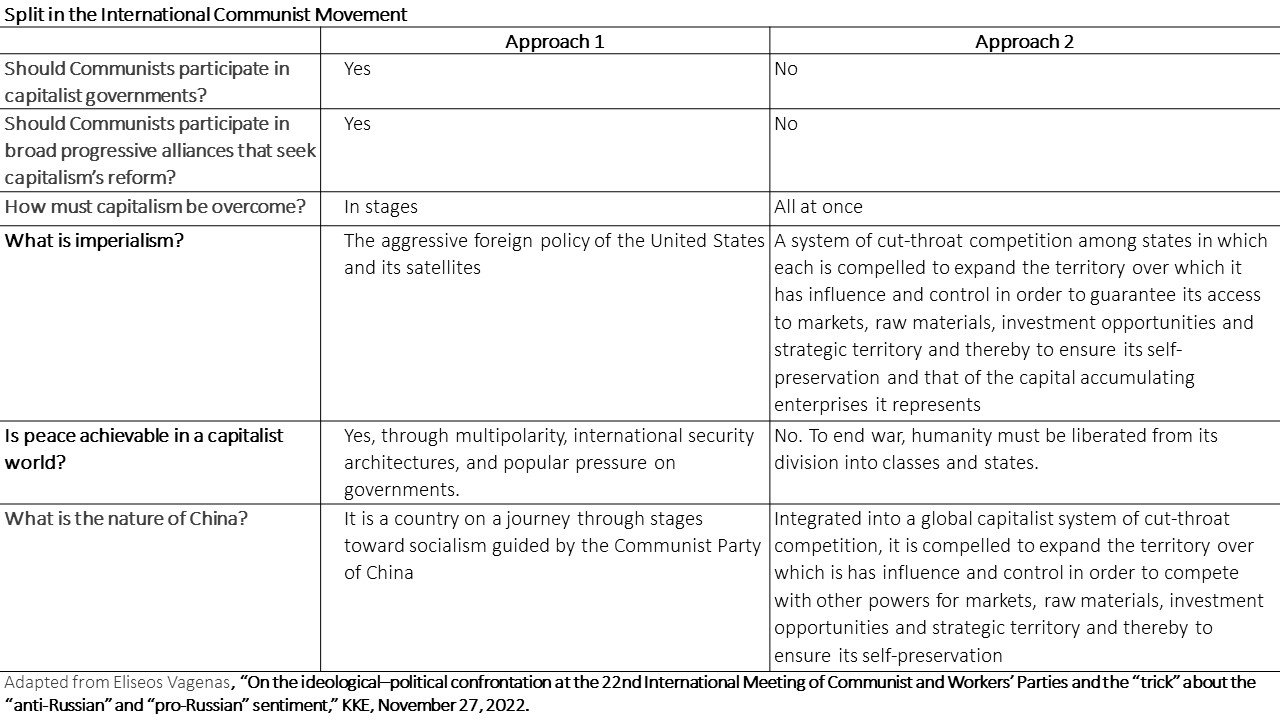
According to the Greek communist, communist parties had been split for some time on a least five questions, summarized below. When Russia invaded Ukraine, the parties moved to support or oppose Moscow, based on their pre-existing orientations, defined by either approach 1 or approach 2.

Two questions are critical to the positions the various ICM parties have taken on the war in Ukraine:

  • What causes war?
  • Is peace achievable in a capitalist world?

Communist parties that have either leaned toward outright support of Russia or greater condemnation of the United States and NATO, tend to view war in a manner that departs significantly from the classical Marxist view and have developed an understanding of how to end war that revises Marx and borrows from liberalism. These parties see war as developing from the aggressive foreign policy of one capitalist state, the United States (and its satellites), and regard Russia as a victim of a US drive to war. For them, the term ‘US imperialism’ is redundant, because imperialism is a monopoly of the United States.

What’s more, these parties tend to equate imperialism with war, and reject the notion that it has other dimensions, including peaceful capitalist competition, diplomacy, and even international security architectures. (Ask the North Koreans whether the UN Security Council is an expression of imperialism.) For these parties, imperialism is US war-making and little else. 

In contrast, parties that view the war in Ukraine as an inter-imperialist conflict cleave to the classical Marxist view of imperialism. For them, imperialism is a system of cut-throat competition among states in which each is compelled to expand the territory over which it has influence and control in order to guarantee its access to markets, raw materials, investment opportunities and strategic territory and thereby to ensure its self-preservation and that of the capital accumulating enterprises it represents. The competition is expressed in multiple ways, including war, but not limited to it. It may be, and has more often than not been, expressed in trade and investment agreements. See, for example, Robinson’s and Gallagher’s The Imperialism of Free Trade.

Kenneth Waltz’s review of the split in the socialist movement precipitated by WWI, which he presents in his classic Man, The State, and War, calls to mind the current split in the international communist movement as identified by Vagenas.

Parties which support Russia in its war on Ukraine tend to embrace, as Waltz puts it, “the techniques of the bourgeois peace movement—arbitration, disarmament, open diplomacy” as well as the belief that popular opinion “can exert enough pressure upon national governments to ensure peace.” This, Waltz argues, is a revision of Marx’s view, which “points to capitalism as the devil.” The “socialism that would replace capitalism was for Marx the end of capitalism and the end of states,” and it was the end of states, for Marx, that meant the end of war. An anti-war movement founded on the notion that popular pressure and international security architectures can ensure peace, is a tradition that Waltz identifies as originating in the Second international as a revision of Marx.

Waltz elaborates: Members of the Second International “were united in that they agreed that war is bad, yet they differed on how socialists were to behave in a war situation. … Jean Jaures and Keir Hardie eloquently urged a positive program of immediate application. Socialists, they said, can force capitalist states to live at peace.”  

In contrast, some “French and most German socialists argued that capitalist states are by their very nature wedded to the war system; the hope for the peace of the world is then to work for their early demise.” It is not, to bring the argument up to date, to support the weaker capitalist states in order to balance the strongest in a multipolar system. Indeed, this view is anti-Marxist in the extreme. For Marx, war ends when states end, not when weaker states balance the strongest and the world becomes multipolar.

The precursors of the Third International, Communists avant la lettre, argued that wars “are part and parcel of the nature of capitalism; they will cease only when the capitalist system declines, or when the sacrifices in men and money has become so great as a result of the increased magnitude of armaments that the people will rise in revolt against them and sweep capitalism out of existence.”

Compare this view with that of Vagenas, advocating for approach 2 as presented in the table above: The “capitalist world cannot be ‘democratized’.” It “cannot escape from wars no matter how many ‘poles’ it has.” War can only be escaped through “the struggle for the overthrow of capitalism, for the new, socialist society.”

Approach 1, then, looks very much like that embodied in the deeds of the Second International, while approach 2 resonates with that of the Third International (and the words of the Second). It is regrettable that some Communist parties have suffered an ideological drift toward positions that the founders of the international communist movement, Lenin and his colleagues, repudiated. Indeed, it can be said that there is no coherent international communist movement, except the one that comprises parties that have kept faith with Lenin’s view and have rallied around the KKE. As to the others, they have willingly become (to borrow Lenin’s phrase) playthings in the hands of belligerent powers and apologists for capitalism.

Colonizing Others to Pre-Empt Your Own Colonization

By Stephen Gowans

September 12, 2023

Brendan Simms, a Cambridge University professor who specializes in the history of international relations, has written an article for The New Statesman that comports in large measure with positions I’ve taken in connection with the war in Ukraine. Given the resonance of Simms’ views with my own, I wanted to build on his article by presenting his major themes through a Marxist lens.

The history of relations among states is a history of ruling classes attempting to expand the domain over which they accumulate wealth and appropriate the product of others’ labor. Imperialism is Janus-faced. Every ruling class strives to encroach on the wealth-accumulating sphere of other ruling classes, but at the same time acts to defend its own sphere. This means a state can be both anti-imperialist (defending itself against the encroachment of other ruling classes) and imperialist (impinging on other states). Indeed, a ruling class may even seek to enlarge its domain (act imperialistically) in order to more successfully defend itself against the imperialist designs of other ruling classes.

In discussing Russia’s invasion of Ukraine, I’ve pointed to parallels with Imperial Japan. The Japanese developed and articulated an accurate critique of Western imperialism, and used its critique to present itself as a leader of oppressed peoples in the struggle against Dutch, French, British, and US imperialism in East Asia. But Japanese anti-imperialism was at the same time imperialist: East Asian countries that had been exploited by the West would be folded into a Greater East Asian Co-Prosperity Sphere under Japanese leadership. That Japan’s anti-imperialist rhetoric was no more than a cover for its own imperialist machinations, was revealed in its use of the word “leader.” As the self-appointed leader of the oppressed peoples of East Asia, Japan elevated itself above the countries it claimed to be liberating. In reality, Japanese imperialism would simply replace the imperialism of the West.

Simms’ focus is not on the parallels between Russia’s use of anti-imperialist rhetoric to justify its own imperialism and the commensurate conduct of Imperial Japan, but on the similarities of Putin’s foreign policy with that of Hitler in its aims and methods. Unfortunately, because the zeitgeist understands Hitler as sui generis (in a class of his own), comparisons with the Nazi leader tend to be dismissed out of hand. That’s unfortunate, for while the magnitude of the genocide Hitler perpetrated against Jews, Slavs, and Roma may be unprecedented, genocide, conquest, plunder, and aggression are hardly unique. History abounds with Hitler-like figures, almost of all whom remain, unlike Hitler, greatly admired, among them Alexander the Great, Julius Caeser, and Napoleon.  Saint Augustine accurately described Alexander as a rogue with a global appetite for plunder. Dante relegated him to the seventh circle of his Inferno along with other thieves, murderers and tyrants. Julius Caeser and Napoleon, both of whom admired Alexander and measured themselves against him, fit in the same class. One reason tyrants who plunder and murder on a grand scale are admired is because we’ve come to accept tyranny, genocide, and conquest as a Hitler-monopoly, with the consequence that the grand crimes of his equivalents and epigones tend to be overlooked.

That’s not to say that Putin sinks to anywhere near the depths of Alexander, Caeser, Napoleon, or Hitler, and nor does Simms say he does. Instead, Simms is concerned only with examining the similarities in foreign policy and use of anti-imperialist rhetoric between Putin and Hitler. Simms thesis is that “both Putin and Hitler were anti-colonial colonisers. Their treatment of Ukraine has a common root: they saw – or see – themselves as colonising others to pre-empt their own colonisation.” Both used anti-colonial rhetoric.

Putin recently “told the assembled Brics dignitaries and delegates from the Global South that his attack on Ukraine had been a response to Western ‘neocolonialism – the same colonialism in a new package’.” Simms observes:

We tend, for good reason, to think of Adolf Hitler as the quintessential coloniser. In fact…not only was Hitler also an anti-colonialist (of sorts), but his imperialist project was driven by his fear of being colonised. Throughout the early 1920s, Hitler repeatedly claimed that Germany had been “enslaved” by the Jews, the forces of international capitalism and the victor powers, especially the “Anglo-Saxon” British and Americans. He claimed that they sought to break down “national states” because they represented an obstacle to “international money powers”. “World enslavement”, Hitler said, meant “world stock exchange”. 

Hitler’s concerns anticipate Putin’s anxieties about defending national states and traditional values against globalists, liberalism, and international money powers.

The “‘left-wing’ Strasser faction of the Nazi Party saw Germany as leading a ‘League of Oppressed Peoples’ in alliance with Russia, Morocco, Persia, India and other victims of Western imperialism. ‘The fragmented, martyred, exploited and enslaved Germany,” Otto Strasser argued, ‘was the natural protagonist and ally of all national liberation fighters’, whether they were ground down by ‘French tyranny, British imperialism [or] American financial exploitation’.”

We hear echoes of Strasser in many leftwing voices today, not least Caleb Maupin’s Strasser-like Patriotic Socialists, who believe that because Russia is against French tyranny in Africa, British imperialism, American financial exploitation, and the US military alliance NATO, that it is the natural protagonist and ally of all national liberation fighters, and cannot, therefore, be an imperialist state itself.

Simms continues:

Hitler, by contrast [to Strasser], saw Germany’s salvation not in solidarity with the other wretched of the Earth, whom he despised, but in establishing its own colonial project. He envisaged an overseas empire not in the Anglo-French style as attempted by Wilhelmine Germany, but as a vast land grab in eastern Europe contiguous with the old Reich. This, he argued, would give Germany the critical mass and resources necessary to survive against the force of Anglo-America and international capitalism. The demand for “living space” or Lebensraum – which Hitler first voiced in the mid-1920s – was thus both a colonial and an anti-colonial project.

Similarly, Putin is attempting a vast land grab in Eastern Europe contiguous with the Russian Federation and commensurate with the old Russian Empire to give Russia the critical mass and resources necessary to survive against the forces of what Putin calls “the collective West”, international capitalism, and the liberal order.

Today, the supposed heirs of Marx and Lenin see international relations more as Hitler did than as Marxists have. “For Hitler,” observes Simms, “the battle against the British empire was an international class struggle, which pitted classes of nations against each other, rather than a Marxist conflict between transnational classes,” the latter perspective being one Hitler was resolved to expunge for all time (my emphasis). Many contemporary Marxist-Leninists likewise see the war in Ukraine as a war between two classes of nations (the United States as imperialist and Russia as anti-imperialist) and are as dismissive as Hitler was of the view that conflicts between states are conflicts between transnational classes. They tend to dismiss the Marxist view of the war as Trotskyism and accept the Hitlerite view as anti-imperialist (which, indeed it is, though in the Hitlerite, and not Marxist, sense.)

Then as now, there was “no solidarity between working classes.” Instead, many Marxist-Leninists today, as Hitlerites did then, promote “a common cause between the ‘have-not’ nations against the ‘haves’,” that is, between the BRICs against the US-led West, as part of a project of promoting “multipolarity.” “The Second World War was thus framed not just as a German war of national liberation against British domination of the Continent, but as a global insurrection against Anglo-American capitalism and imperialism,” just as Russia’s war on Ukraine is framed today as a Russian insurrection against US capitalism and imperialism. The Axis powers, with Hitler in the lead, were as much advocates of multipolarity as are many Marxist-Leninists today.

In June 1941 Hitler launched Operation Barbarossa. The invasion of the Soviet Union was avowedly colonial in design because it envisaged the seizure of land, particularly in Ukraine, to be settled by German emigrants. But the attack was also anti-colonial in conception because Hitler believed that only possession of an empire of its own would enable Germany to emancipate itself from Anglo-American and international capitalist subjection. It was, in his mind, a case of dominate or be dominated.

Simms argues that like Hitler, Putin employs anti-imperialist rhetoric to justify Russia’s own imperialism.

Over the past 15 years or so, [Putin] has inveighed against the ‘imperialism’ of the ‘collective West’ and sought to preserve Russian power and sovereignty in the face of what he regards as the West’s universalising claims in favour of democracy and human rights. In Putin’s eyes the protection of Russia requires hegemony over her neighbours; the emancipation of Russians means the subjection of others.

At first, he sought to dominate the wider Eurasian space through a combination of market measures, such as the establishment of a Eurasian Economic Union, and military interventions such as the invasion of Georgia. More recently, the Russian president moved to direct territorial aggression, beginning with the annexation of Crimea and culminating in the attack on Ukraine last year.

The imperial nature of the invasion was clear for all to see. Putin justified it by simply denying the nationhood and sovereignty of Ukraine, an internationally recognised state. In a series of speeches leading up to and following his attack, the Russian president declared the Russian and Ukrainian peoples to be one and the same. He attributed any suggestion to the contrary to the evil machinations of outside powers. Yet the wider context to his move was the desire to defend Russian sovereignty against supposed Western imperialism.

In Simms’ view, the parallels between Putin and Hitler are striking.

Both considered or consider themselves to be in a life-and-death struggle with Western capitalist imperialism, and in particular with the “Anglo-Saxons”. Both reject the Anglo-Saxons’ claims that they are imposing universal values, and both dismissed or dismiss the “rules-based” order – of the League of Nations and the liberal international order respectively – as self-serving hogwash. In response, both articulated projects that are both colonial and decolonising.

“You might think that the real Global South, then and now, would have given these ambitions short shrift, but you would be wrong,” remarks Simms. To this we could add that you might think that Marxist-Leninists, whose ideological forebears developed a detailed analysis of imperialism and the use, by imperialist leaders, of anti-imperialist rhetoric, would have seen Putin’s war and rhetoric on Ukraine for what they are, but you would be wrong.

The Nazi and Putin projects were and have been widely taken at face value by “subaltern” (in the post-colonial sense) actors for whom the main enemy was the West in both its imperialist and international capitalist guises. They had and have at least a sneaking regard for Hitlerist or Putinesque challenges to the prevailing order, which they felt and continue to feel shortchanges them. Many educated Arabs, Africans or Asians who had an issue with Western imperialism in the 1930s and early 1940s either welcomed the humbling of the British empire by the advancing Wehrmacht, or at least felt a frisson of satisfaction at the discomfiture of their masters.

Today, many educated Arabs, Africans and Asians, along with many Western Leftists, who have a legitimate grievance with Western imperialism, have either welcomed the advancing Russian army, or at least felt a frisson of satisfaction at Washington’s discomfiture.

As I have, Simms likens those who align with Russia on the grounds that Moscow is challenging US imperialism to the Grand Mufti of Jerusalem and Subhas Chandra Bose.

The Grand Mufti of Jerusalem…was so outraged by British plans for Palestine that he endorsed Hitler’s anti-Semitic policies and urged Arabs to collaborate with the Third Reich. Further east, Subhas Chandra Bose, a long-standing critic of British rule in India, set up a legion that was eventually deployed to fight for the Germans in north-west Europe. Across the Middle East, Caucasus and South Asia, hundreds of thousands heeded these calls to serve the Axis powers militarily or politically and millions more sympathised with them.

“The ironies of the situation were and are obvious, even to the protagonists themselves,” writes Simms. “Anti-colonial agitators such as Bose and the Mufti knew perfectly well that Hitler held them in contempt, just as their successors today know that the nationalist discourse in Putin’s Russia is virulently hostile to people of color, and that his regime is far more murderously behaved towards Muslims and other groups in its neighborhood than the West, which it so persistently criticizes. In both cases, though, the overriding imperative was or is to confront the common Western enemy.”

We might add that the ironies of the situation ought also to be obvious to Putin’s Marxist-Leninist supporters, whose theory, practice, and aims Putin holds in contempt. The Russian leader reviles Lenin and the Bolsheviks, going so far as to blame the war on Lenin, yet some communist ignoramuses see Putin as the second-coming of the Bolshevik leader—a reflection of their predilection for understanding international conflict through the Hitlerite lens of the clash of different classes of states rather than the Marxist lens of the clash of different economic classes.

The Communist Party of Canada has has rejected the Marxist-Leninist perspective on the war as “not a completely accurate or particularly helpful assessment, especially at this critical moment.” As Hitler viewed his own aggression as an effort to preempt Germany’s colonization by Anglo-American forces, the CPC, not alone among many Leftist voices, favors the view that Putin’s aggression is an effort to preempt Russia’s colonization by the US empire. It is not only sad but deplorable, and a measure of how deeply parts of the Marxist-Leninist movement have decayed, that they not only align with, but celebrate a figure whose foreign policy stands in the same tradition of that of Hitler, and who, at the same time, dismiss the Marxist-Leninist class perspective theory of imperialism.

Swapping France for Russia in Niger and Lenin for Putin in Edmonton

August 8, 2023

By Stephen Gowans

Kim Il Sung, the Korean guerilla leader and founder of the Democratic People’s Republic of Korea, once warned colonized people about inviting the robber lurking outside their house to help evict the robber already in it.

Kim was worried that his compatriots calling upon the United States for help in ejecting Japan from Korea, would lead to disaster. Koreans would swap one imperialist master (Japan) for another (the United States.). Kim’s warning was realized when Syngman Rhee, who had advocated an alliance with the United States to defeat Japanese imperialism, was brought to power by Washington as president of South Korea. Since then, South Korea has been a semi-autonomous state dominated by Washington.

Canadian Communist Alex Boykowich wants Nigeriens to make the same mistake Koreans made.

When French communists repeated Kim’s warning in connection with Niger, pointing out that Nigeriens asking Russia for help in ejecting France from Niger, would amount to accepting Niger’s continued exploitation by an outside power, Boykowich objected.

Boykowich is a member of the Putin Club, a group of self-proclaimed communists and socialists whose grasp of communist history and thought appears to be tenuous, and who believe, as Syngman Rhee did, that alliances with imperialist powers can be a good thing.

The Canadian Communist’s view is that, when it comes to Russia, activists in the Marxist-Leninist tradition should concern themselves with affairs inside their own country, and remain silent on matters in countries in which Russia is trying to extend its influence. To put it another way, Boykowich wants Canadian communists to pressure Ottawa to stop contributing to the US-led project of impeding Russia from extending its influence in Ukraine and Niger, rather than telling Nigeriens it would be a mistake to ally with Moscow.

The alternative, that communists oppose (1) the rivalry of both the United States and Russia to exploit Ukraine and (2) the contest of France and Russia to despoil Niger, is excluded from Boykowich’s and the Putin Club’s way of thinking.

Boykowich’s demand that communists forebear from offering advice, warnings, or encouragement to people beyond the borders of their own country, conflicts sharply with the history of Boykowich’s own political party, the Communist Party of Canada.

In Boykowich’s way of thinking:

  • The scores of Canadian communists who joined the International Brigades to the defend the Spanish Republic should have stayed home, and instead pressured Ottawa to change its policy toward Spain.
  • Canadian Communist Norman Bethune should have remained in Canada to press Ottawa to stop supporting British imperialism, rather than travelling to China to join Mao’s Eighth Route Army and meddle in the affairs of a foreign people.

Che Guevera, an Argentine who involved himself in the struggle of Cuba against US imperialism, is also worthy of condemnation in Boykowich’s manner of thinking.

Lenin, who was forever writing resolutions on how working people across national lines—and outside his own country—should conduct their struggle against imperialism, falls foul of Boykowich’s demands.

As do Hilferding, Bukharin, Trotsky, and Luxemburg, who, in the Boykowich view, arrogantly lectured workers of countries other than their own on how to defeat imperialism.

If in WWI the SDP wanted to vote for war credits, and German workers wanted to support the Kaiser, who were Lenin, Bukharin, and Trotsky—all Russians—to object? After all, the conduct of German workers was an internal German matter, to be settled by Germans, without arrogant outsiders obtruding their advice, in the Boykowich view. Lenin, Bukharin, and Trotsky should have focused on the Tsar, and held their tongue when it came to the question of whether German workers and their political party, the SDP, should have supported the Kaiser. When Lenin condemned the SDP for its betrayal of the working class, he was, as Boykowich sees the world, wrong. “We must deal with our own imperialism first,” councels Boykowich and the Putin Club. We must say nothing about how workers in other countries deal with theirs.  

Boykowich, who seems to admire Stalin, should review the conduct of his hero and docent. The Soviet leader was forever issuing guidance, instruction, advice, warnings, and encouragement to workers around the world, not least in Russia, despite the fact that he was a Georgian. If Boykowich had his way, Stalin would have stayed home in Georgia to organize the Baku oil workers.

As for Marx, the thinker who proclaimed “Working men have no country,” Boykowich must harbor an especial disdain. How can we expect working people to remain silent on what’s happening in other countries if they think they have no country?

The Multipolaristas’ Theory of Ultra-Imperialism Doesn’t Fit a Multipolar World

December 27, 2022

By Stephen Gowans

Recently, The Wall Street Journal reported that “Mr. Putin” is “convinced Russia’s Western enemies” are “seeking to yank Ukraine from Russia’s orbit.” Clearly, the United States and Russia are locked in a struggle over Ukraine; each wants the territory in its own orbit—that is, in its own empire. US efforts to yank Ukraine from the Russian orbit have been largely successful. Russia is yanking back, but it’s unlikely to win the tug of war.

The idea that the war in Ukraine is but one battlefield in a larger war between two empires is difficult to grasp for people whose understanding of imperialism is influenced by dependency theories developed in the immediate post-WWII period. That period was characterized by one capitalist empire, that of the United States, absorbing most of its former capitalist rivals into its orbit. Under US supervision, the now combined powers, once rivals, jointly exploited the periphery.

People who subscribe to this view, whether consciously or through osmosis, look at the world through a lens whose purpose, when the lens was crafted, was to explain the international system at a time when neither Russia nor China existed as capitalist powers and rivalry among capitalist powers was muted by US primacy. Glimpsed through this lens, Russia and China appear as what they once were, but are no longer: socialist counterweights to a capitalist metropolis.

This, to be sure, is a view of a world that expired 30 years ago, when the Soviet Union was succeeded by a capitalist Russia, and China was at least a decade along the path of capitalist development and integration into the US economy as a low-wage manufacturing center.

Today, Russia and China are capitalist powers. But if they appear to some, not as metropolitan powers keen on integrating regions into their own expanding economies, but as powers lying outside the metropolis, as opposed to merely outside the US empire, it’s because they are understood incorrectly as being what they once were, rather than what they have since become. Both powers are external to the US empire (to some degree; China is so only partially), but the US empire is no longer equal to the metropolis; it is now only one part of it.

Karl Kautsky developed a theory of ultra-imperialism. Kautsky argued that the stress might shift from conflict between imperialist powers to maintenance of a world system of exploitation, i.e., conflict between the metropolis and periphery. It is surely the latter, the worldwide exploitation of colonial peoples by the metropolitan bourgeoisie, observed Anthony Brewer, which is generally understood by the term ‘imperialism’ today. At the time, the very suggestion that such a shift was possible aroused vehement hostility from the left. For the left, inter-imperialist rivalry leading to war was the very essence of imperialism. The concept of imperialism has shifted its meaning between then and now, but the emergence of a multipolar international system, or of great power rivalry in Washington’s terms, means that the understanding of imperialism now lags developments in international relations. Contemporary international relations now bear a greater affinity with the classical Marxist theory of imperialism than with Kautsky’s ultra-imperialism.

None of this is to say that theories about metropolitan exploitation of the periphery are wrong, only that the notion that Russia and China are external to the capitalist metropolis is mistaken. The former socialist giants have joined the metropolis, not as a part of a Kautskyist ultra-imperialism led by Washington, but as rivals of the USA, EU, and Japan.

Is there a better theory?

In its emphasis on rivalry among capitalist powers, the classical Marxist theory of imperialism comports more fully with contemporary developments than dependency theories. If we accept that the contemporary international system is marked by an emerging multipolarity, and that the principal powers in the multipolar system are capitalist, then the world of today bears a much stronger resemblance to the late 19th and early 20th centuries, to which the classical Marxist theories of imperialism referred, than it does to the 20th century period of US-led ultra-imperialism.  

That’s not to say that the classical Marxist theory is without its problems. But it does say that despite its problems, the classical theory is a better fit with an emerging multipolar world than theories which were developed to explain a world characterized by a US-led metropolis exploiting a periphery, opposed by a socialist Russia and socialist China.

Continuing to see Russia and China as socialist powers that lie outside the metropolis, when they are now large capitalist powers with unconcealed projects of integrating regions into their own economies, is tantamount to applying the geology of the desert to the rainforest, and on this basis, declaring that trees (i.e., an imperialist Russia and an imperialist China) don’t exist.

To summarize, here are four errors that are made by seeing the contemporary multipolar world through a Kautskyist ultra-imperialist lens.

  1. Adopting the now extremely dated view that Russia and China are socialist, rather than capitalist.
  2. Seeing Russian and Chinese opposition to the US empire as rooted in socialism, rather than capitalist rivalry for economic territory.
  3. Perceiving the US empire as equal to the metropolis, rather than as only one part of it, along with Russia and China.
  4. Regarding the periphery as exploited by the US empire alone, rather than by Russia and China, as well.

There Are No Lesser Evils in Imperialism

December 19, 2022

By Stephen Gowans

According The New York Times, the US arms industry is profiting handsomely from the war in Ukraine.

  • The Pentagon has awarded at least $6 billion to arms companies to resupply weapons sent to Ukraine.
  • Raytheon has secured $2 billion in contracts to expand or replenish weapons used to help Ukraine.
  • Lockheed has secured nearly $1 billion to refill stockpiles being used in Ukraine.
  • The share prices of Lockheed and Northrop Grumman have jumped more than 35% this year.
  • US arms sales to foreign militaries—many of which have boosted military spending in response to the Russian invasion of Ukraine—total $81 billion this year.

In response I tweeted the following.

Had Moscow not pulled the trigger on war in Ukraine, the conditions would never have been set for Lockheed Martin and Raytheon to swim in a sea of new orders.

This elicited the following reply: “The bigger thanks goes to all the people who have blocked or refused to negotiate to end this war. Like the state department, Biden etc.”

Why would we expect the people who desired the war, viz., “the state department, Biden etc.”, to have the slightest inclination to want the war to end, when its clients—the US arms industry, the US oil and gas industry, and US industry generally—profit handsomely from it? Expecting Washington to negotiate the end of the war is tantamount to expecting wolves to become vegetarians—especially when the wolves have discovered a toothsome feast.

Did I mention that with Europe looking for a new energy supplier, after Washington pressed the EU to wean itself off Russian energy in the wake of the Kremlin’s assault on Ukraine, that the United States has become the world’s leading exporter of liquid natural gas? It is also the planet’s top petroleum producer.

At the same time, we wouldn’t expect Russia, the party that instigated the war and has failed to achieve its war aims, to have much desire to bring its assault to an end. It too is a wolf, with a hunger for sheep, so far unsated.

The notion that either the Russian wolf or a lupine Washington have, at this point, strong motivations to end their hunt for Ukrainian sheep is Quixotic.

The additional notion that the Fata Morgana of “the antiwar movement” can pressure “the state department, Biden etc.” or Moscow to negotiate an end to the war is equally illusory.

In the West, there exists a farrago of Washington-haters who call themselves antiwar but are merely anti-US. They flatter themselves that they are the nucleus of an antiwar movement. If capitalist imperialism is one of the greatest causes of human misery, they don’t know it. The critical problem, in their minds, is the people who run US foreign policy. If only the right people were elected, or the current set of leaders were pressured by popular opinion to conduct the country’s foreign policy differently, all would be well.

Almost to a person, this group of activists argued vehemently before the war, and with unbridled certitude, that Moscow would never invade Ukraine. In their astigmatic and decidedly un-Marxist Weltanschauung, military aggression, like imperialism, is a US monopoly. Russia would never, therefore, behave in so scurvy a (US) manner. To US warnings that Russia was about to invade Ukraine, they thundered scornfully, “US propaganda!” Despite Putin providing them with ample reason to revise their view of Moscow’s nature and capabilities, and notwithstanding the egg that still drips from their faces, they cling tenaciously to the now discredited theory that Putin’s Russia is not imperialist. They have discovered a multitude of reasons why it was obvious from 2014 that an invasion was not only predictable but desirable…and un-imperialist, of course. But if before the war they denounced the claim that Russia was capable of launching a war of aggression on its neighbor as a slander against Moscow, viz., that Moscow would never carry out so heinous an act (after all, wasn’t Moscow a member of the now forgotten Friends of the UN Charter?), how is that they have so quickly come to regard what they once saw as heinous as justifiable and even desirable?

If states were free to act just as they pleased, Russia could end the war now by reversing the act that instigated it. But true to their inability to see beyond Washington to rivalry among states as an immanent characteristic of the capitalist world economy, and one with a high probability of ending in war, the Friends of Neo-Imperial Russia demand Biden negotiate an end to the war, not that Russia do the same, and not that Putin withdraw his forces from Ukraine. They believe implicitly that the Kremlin is champing at the bit to negotiate a peace, out of a strong devotion to international harmony, and all that prevents the flower of peace from blooming is Washington’s intransigence. What they fail to mention is that the peace Putin aspires to is a peace in which Russia is allowed to digest those parts of Ukraine it has already gobbled up. In other words, it wants to achieve at least some of its war aims, and then to be left in peace to enjoy them. It is a commonplace that all belligerents want peace. What’s rarely acknowledged is that they want peace on their own terms. Peace preferably; war if necessary.

An antiwar movement, if one existed in either the West or Russia, would seek to end the war in order to lift the burden it has imposed on ordinary people. People everywhere, in Russia as much as Europe and North America, struggle to make ends meet as the war sends energy, food, and housing costs soaring.

Instead, Westerners who say they are against the war, but are really against the US part in it, seek fecklessly to mobilize energy for an antiwar movement based on the following arguments:

  • Putin’s cause is just.
  • The war escalates the risk of a nuclear exchange.
  • A world where Russia and China, and not just the United States, can throw around their weight, is desirable.

The trouble is that the power of any of these arguments to arouse opposition to the war is approximately zero, which is why there is no antiwar movement.

First, it is difficult enough to justify a war of aggression with good arguments. But the arguments for war offered by Moscow have been so risible that no one, except Russian chauvinists and a few mental defectives in the West, have taken them seriously. If we accept the argument that Russia has been provoked by escalating NATO military threats and that Moscow’s efforts to project influence into Ukraine through diplomatic means were rebuffed by Washington and NATO, there remain two objections: (1) Being provoked is not a legitimate reason for war; and (2) imperialist goals achieved through diplomatic means are still imperialist goals; they are no more acceptable for being achieved through soft power than hard.

Second, the threat of nuclear annihilation is a constant. People have learned to live with it. It will not move them to action and the intensity and scope of this war has not been great enough to meaningfully escalate the risk of a nuclear exchange.

Third, you can put lipstick on the idea of Russia and China having as much clout as the United States by calling three-power imperialism “multipolarity”, but the idea remains a pig no matter how much lipstick the sow is forced to wear. Anyone who thinks it’s possible to mobilize large numbers of people under the banner “we need three strong imperialist powers instead of one”, is detached from reality.

But what if people were mobilized for reasons that resonate with their suffering to oppose the war in numbers large enough to pressure governments to act? Would the movement not also be large enough to bring about a social revolution to overcome the very roots of the problem, namely, capitalist-driven competition for markets, raw materials, investment opportunities and strategic territory? In other words, wouldn’t a movement large enough and powerful enough to end a symptom of the disease also not be large enough and powerful enough to end the disease itself? Should the goal be to end this particular war, or to significantly reduce the probability of war by overthrowing the conditions that conduce to it?

Finally, is there much point in calling for an antiwar movement here, and not one there? The war affects all working people, Russians as much, indeed more than North Americans and (Ukrainians excepted) Europeans. An antiwar movement ought to unite, across international lines, all people affected deleteriously by it against the class that wills it and the system of capital accumulation that demands it. It must be international, not confined to one side.

People who call for Washington to negotiate an end to the war, but not Russia to reverse the act that instigated it; who argue that the ultimate responsibility for the war lies with US foreign policy and not the global capitalist economy (like saying flu is caused by a sore throat); whose reasons for opposing the war having nothing to do with the effect it has on ordinary people, and only on the effect it has on the imperialist aspirations of Moscow; and who call, not for a union of antiwar voices across international lines, but an antiwar parochialism confined to the West, are arguing for the side of the Russian ruling class against that of the United States.

Marxism, socialism, the workers’ movement, are not movements against US foreign policy alone, but against the capitalist class, no matter what its postal address. These movements are also for something: Not the rise of two great capitalist powers, Russia and China, against a third, the United States, but for socialism and workers of the world uniting. They are for an end to the division of humanity into classes and nations, and not, as the bogus antiwar activists would have it, the persistence of class and the rise of great nation states.

How Did Inflation Get So High?

June 24, 2022

By Stephen Gowans

“How did inflation get so high?” asks Paul Krugman, from the perch of his column in the New York Times.  

“A large part of the story involves shocks like rising oil and food prices … that are outside the control of policymakers,” writes the Nobel prize-winning economist.  “These nonpolicy shocks explain why inflation has soared almost everywhere — for example, British inflation just clocked in at 9.1 percent.”

But rising oil and food prices are not outside the control of policymakers.

Oil prices are rising largely because US, Canadian, and EU policymakers imposed an embargo on imports of Russian hydrocarbons.

And food prices likely wouldn’t be rising had the US and NATO negotiated a new security architecture in Europe when Moscow pleaded for one in December. The West summarily dismissed Moscow’s overtures, seeing greater advantage in letting Russia—which Washington views as a great power rival—weaken itself by stepping into the quagmire of a war in Ukraine. The war is disrupting Ukraine grain exports, putting upward pressure on food prices globally.

If energy and food inflation is beyond the control of Western policymakers, as Krugman alleges, how do we explain this: The Washington Post revealed that the Biden administration anticipated that its response to a Russian invasion of Ukraine would precipitate rising energy prices and a food crisis, but was prepared to “countenance” these outcomes, despite the widespread pain they would cause.

The Post says Biden believed the stakes of allowing Russia to swallow up Ukraine were greater than the harm of spiraling energy and food prices.

The newspaper, however, didn’t explain what the stakes are, in the administration’s view. A good guess is that they are seen as the possible failure of the longstanding project of the United States absorbing Ukraine—seen in Moscow as part of the Russian sphere of influence and vital to its prosperity—into a US-led anti-Russia alliance.  

Is a US victory in the game of grab really worth the pain of a growing affordability crisis, to say nothing of a looming food crisis in Africa and the Middle East?

Monetary authorities are now jacking up interest rates to extirpate underlying inflationary pressures, running the risk of precipitating a global recession. But Fed chair Jerome Powell admits that a tighter monetary policy won’t tame rising energy and food costs. In other words, Powell is on the cusp of producing a full-fledged stagflation.

The truth of the matter is that soaring oil, gas, and grocery prices—and a looming recession accompanied by climbing energy and food bills—are sequalae of decisions made by policymakers.

Krugman wants to lay the blame for the economic train-wreck on Putin. His “invasion of Ukraine has seriously damaged the world economy,” he writes.

This is too simple.

The proximal cause of the train-wreck is not the Russian invasion of Ukraine. It’s the West’s response to it. US, Canadian, and EU policymakers didn’t have to impose a fossil fuel embargo on Russia. Nor were they compelled to bolster Kyiv with tens of billions of dollars of aid, ensuring the war would drag on. (The longer the war lasts, the longer Ukraine’s grain exports will be disrupted, and the longer food prices will remain artificially high.) This was a decision policymakers freely took, with foreknowledge of the consequences.

The sad reality is that Western policymakers decided to become embroiled in a war they might have averted, had they seized the opportunity when offered. In maneuvering to weaken Russia by imposing a hydrocarbons ban, and furnishing Ukraine with aid to draw out the war (fighting Russia to the last Ukrainian), they have knowingly imposed substantial costs on their own citizens.

High inflation, then, is not the uncontrollable consequence of Putin’s decision to invade Ukraine. It is the anticipated and countenanced corollary of the pursuit of the US foreign policy goal of weakening Russia.

What should happen?

  • Russia should end its war on Ukraine and withdraw its forces.
  • The United States, Canada, and European Union should lift their embargo on imports of Russian oil, gas, and coal and cease other measures of economic warfare against the country.
  • NATO, little more than an instrument of US foreign policy and the means by which Washington dominates Europe, should be disbanded. The European Union, whose combined military spending and armed forces overshadow Russia’s, is capable of defending itself.
  • US and Canadian troops should be withdrawn from Europe and reoriented to territorial defense from power projection.
  • Brussels should negotiate a security architecture for Europe with Russia.

This is what we might wish to happen, but realistically, none of it is likely to happen. The expansionary imperatives of capitalism compel each state to compete on behalf of their capital-accumulating enterprises for investment opportunities, markets, sources of raw materials, and strategic opportunity on a world scale. Capitalism-induced rivalry creates tensions among countries—antagonisms that have a high likelihood of escalating to war. Therein is found the roots of the struggle among the United States, Europe, Russia, and Ukraine—a struggle that has burst forth in overt violence and produced a looming economic catastrophe.

Until economies are re-oriented to satisfying human needs rather than investors’ needs for handsome returns, until capitalism is overcome, there is no real hope for any meaningful turning away from the inauspicious path on which humanity now treads.

You Don’t Matter, and Washington’s Response to the Russian Invasion of Ukraine Proves It

By Stephen Gowans

June 22, 2022

Journalist Patrick Cockburn decries Russian president Vladmir Putin’s decision to invade Ukraine as manifestly dumb. Putin, “convinced himself,” writes Cockburn, “that a Russian army of inadequate size would easily topple the government in Kyiv and the Ukrainian army would meekly surrender.” [1]

If Putin believed about Ukraine that he only had to kick in the doors and the whole rotten structure would come tumbling down (as Hitler believed about the Soviet Union), the expectation has, to be sure, turned out to be decidedly wrong. But we’ll have to wait to find out whether the invasion represents “the most disastrous decision in Russian history,” as Cockburn contends. The key question, from the perspective of Russian raison d’état, is whether the decision makes the Russian state and the elites it represents stronger relative to what they would have been had the invasion not been carried out. It’s too early to tell.

If Putin has blundered, and he may have, then so too, on the surface, has Biden. Biden’s decision to embargo Russian hydrocarbons, and to pressure Canada and the EU to do the same, has hurt Western consumers far more than it has hurt Russia.

According to the New York Times, “oil and refined fuel prices” in the United States “have risen to their highest levels in 14 years, due largely to sanctions on Russia oil.” Gasoline prices are up by more than 60 percent over last year. And higher fuel prices are rippling through the US economy, contributing to record high inflation. [2]

The Eurozone is dealing with a similar set of problems. “High prices are already sending shudders through an economy that is geared up to run on cheap Russian energy,” reports the Wall Street Journal. This has fueled record-high inflation and prompted some industrial companies to close. [3]

With monetary authorities raising interest rates to temper strong upward pressure on prices, Western economies are on the brink of a recession, and tens of millions teeter on the precipice of economic hardship. [4]

Meanwhile, this month alone, Moscow’s “coffers were expected to receive $6 billion more in oil and gas revenue than anticipated because” embargo-induced supply restrictions sent oil prices soaring.  As the New York Times reports, “China and India, the world’s most populous countries, have swooped in to buy roughly the same volume of Russian oil that would have gone to the West. Oil prices are so high that Russia is making even more money now from sales than it did before the war began four months ago. And its once-flailing currency has surged in value against the dollar.” [5]

An embargo to punish Russia that ends up punishing Western consumers with higher energy prices, but allows Russia to reap the benefit of rising prices, surely rivals Putin’s decision to invade Ukraine for sheer stupidity.

Or does it?

If Biden’s goal is to punish Russia while protecting Western consumers, then his embargo decision has clearly backfired. But are these his goals?

Another view is that the US aim is to shift Europe’s energy dependence from Russia to sources under US control, in order to weaken Russia, and its oil and gas industry, and strengthen the oil and gas industries of the United States and its allies. Europe stands to lose big time, since sourcing energy from further afield will raise the continent’s energy bill. Additionally, by shifting Europe’s energy dependence to US-controlled suppliers, Washington increases its leverage over a Europe that increasingly seeks strategic autonomy at US expense. Washington has complained about Russia’s ability to use its energy supplies to blackmail Europe. Dependence on US-controlled suppliers simply shifts the role of potential blackmailer from Moscow to Washington.

According to the Washington Post, the Biden administration had discussed, even before Russia launched its invasion in February, the possibility that its response to the invasion would cause global spillover effects, in rising energy costs, food shortages, and a global recession. Moreover, US officials said they were willing to countenance these consequences. [6]  (Fine for them; buffered by great wealth, they’ll hardly feel the effects themselves.)

If Western consumers are paying more for gasoline, natural gas, and groceries; if Africa and the Middle East are on the brink of a food crisis; if hundreds of millions are teetering on the edge of joblessness as the world economy slips closer to recession; it’s not because a stupid decision was made by a blundering Biden administration that has had calamitous unanticipated consequences; it’s because these are the anticipated and countenanced consequences of a US strategy to weaken Russia and bring Europe more firmly under the US thumb.

If Biden is stupid, his stupidity promises to produce welcome results for US energy companies, to say nothing of corporate America as a whole, which, on balance, stands to profit from Washington gaining greater leverage over Europe, one of the world’s largest economies and rival for world economic supremacy with corporate USA.

If there’s stupidity at play here, it’s the stupidity of believing that Washington’s actions are aimed at protecting and enlarging the interests of ordinary people. On the contrary, you and I are merely the means to the ends of—and collateral damage of the decisions taken to benefit—the elite of billionaires and wealthy investors who are the only people who really matter in Washington.

The war in Ukraine didn’t have to happen. For months, Moscow pressed Washington and NATO to negotiate a new security architecture in Europe. Moscow’s entreaties were dismissed out of hand. Once the war began, Washington could have launched efforts to bring about a diplomatic solution. Instead, it did the opposite, pumping billions of dollars of arms into Ukraine, and pressing its allies to do the same. This has been a boon for investors in US arms manufacturing, but a menace to the world, which now lives under a sword of Damocles in an elevated risk of nuclear war with Russia.

Tally up the consequences of Washington’s response to Russia’s invasion of Ukraine.

  • Rising energy prices.
  • Record-high inflation.
  • A world economy on the brink of a recession.
  • A looming food crisis.
  • An increased risk of nuclear war.

These consequences harm you and me, and everyone else like us, but they hardly affect the wealthy, if they affect them at all (with the exception of the last.)

But there are other consequences—effects that are hardly calamitous but, on the contrary, are pleasing to a narrow spectrum of the population, namely, corporate USA and wealthy US investors. These are:

  • Soaring demand for US arms.
  • The promise of a cornucopia of future profits for US weapons makers as NATO members hike their military outlays and two new members, Finland and Sweden, join the alliance. (To ensure interoperability of forces, NATO members largely buy their equipment from a common provider, the US arms industry.)
  • Growing opportunity for the US hydrocarbons industry.
  • US control of Europe’s energy supplies and therefore greater US political leverage over Europe.
  • Higher energy costs for European businesses, reducing their competitiveness relative to US firms.

Government decisions that hurt you and me may appear to be evidence of government stupidity. It’s more likely that the consequences are not calamitous for everyone, and the calamity for the rest of us is anticipated and countenanced.  

1. Patrick Cockburn, The Age of Stupidity: From Johnson and Biden to Putin and Xi Jinping, counterpunch.org, June 21, 2022.

2. Clifford Krauss and Marie Solis, “U.S. Gas Prices Hit a New High: $5 a Gallon,” The New York Times, June 11, 2022.

3. Joe Wallace and Eric Sylvers, “European Natural-Gas Prices Jump as Russia Cuts Supplies Again,” The Wall Street Journal, June 15, 2022.

4. Paul Hannon, Yuliya Chernova and Georgi Kantchev, “Russian Inflation Makes U.S. Price Rises Look Tame,” The Wall Street Journal May 20, 2022.

5. Victoria Kim, Clifford Krauss and Anton Troianovski, “Western Move to Choke Russia’s Oil Exports Boomerangs, for Now,” The New York Times, June 21, 2022.

6. Missy Ryan and Dan Lamothe, “With scant options in Ukraine, U.S. and allies prepare for long war,” The Washington Post, June 17, 2022.

The Real Cause of the War in Ukraine: Capitalism

“Capitalism can pursue no other policy than that of imperialism.” Rudolph Hilferding

“Imperialism is an inevitable accompaniment of capitalist development.” Nikolai Bukharin

“Colonial politics and imperialism are … the inevitable consequences of the very foundations of capitalism.” V.I. Lenin

By Stephen Gowans

June 18, 2022

Blaming the war in Ukraine on Russian aggression or, alternatively, NATO provocations, represents a failure to understand capitalist imperialism as a system of rivalry among states for economic advantage. Imperialism is not what Russia alone does, or only what the United States and its janissaries do, but is, instead, a system in which all capitalist powers and blocs are enmeshed. It is not a policy choice, but the inevitable outcome of rivalry among states that originates in the expansionary imperatives of capitalism. To borrow from Lenin, capitalist imperialism is “the struggle for the sources of raw materials, for the export of capital, for spheres of influence, i.e., for spheres for profitable deals, concessions, monopolist profits, and so on, in fine, for economic territory in general.” [1] Blame for wars that spring from this system cannot be assigned to only one state or alliance. The blame lies with capitalism itself. Capitalism inevitably creates antagonisms among states, and the antagonisms can, and often do, escalate to war.

The historian William Appleman Williams explained this well.

The issue is not whether capitalism is a unique cause of war. It is not. The causes of war, including the economic ones, operate within capitalism just as they have within other systems of political economy. It does seem demonstrable, however, that capitalism heightens and intensifies the role and impact of economic factors in causing wars. The essential dynamic engine of capitalism, after all, is held to be a never-ending economic competition within a world marketplace. … the competition has an inherent tendency to escalate into political tension and conflict, and that exacerbates and reinforces other causes of such contention. For this reason, capitalism reveals a strong propensity to produce or result in organized violence … [The] capitalist outlook structures the world in such a way that capitalist leadership often sees itself as being confronted with a choice between war or defeat in the competitive marketplace. [2]

Assigning blame for war to one bloc or state, rather than to the internal workings of capitalism, was denounced by all leading Bolsheviks, and much later, by Domenico Losurdo, who faulted the historian Fritz Fischer for blaming WWI on Germany alone. Losurdo wrote: “Fritz Fischer’s weighty monograph, [Germany’s Aims in the First World War] published in the early 1960s, makes the mistake of always defining imperialism in the singular, as if the German variety alone were operative.” [3] In a similar vein, we can fault many contemporary Marxists and anti-imperialists for making Fischer’s mistake of always defining imperialism in the singular, in this case, as if the US variety alone is operative.

Lenin wrote of one imperialist war, WWI, as “the natural continuation of the policies of the capitalist class and of the governments of all countries” (emphasis added). [4]  Commenting on the same war, Lenin’s colleagues, Bukharin and Preobrazhensky, contended that “Undisputedly, the game of grab played by all the great powers was the real cause of the war. Only an idiot can continue to believe that the war took place because the Serbs killed the Austrian crown prince or because the Germans invaded Belgium” (emphasis added). [5]

They continued:

“The German capitalists maintained that Russia was the aggressor, whereas the Russians proclaimed everywhere that Germany began it. In Britain word went round that the British had entered the struggle on behalf of ‘gallant little Belgium.’ In France, everyone was writing, screaming, and singing to prove how gloriously France was behaving in defense of the heroic Belgian nation. Simultaneously in Austria and Germany it was being trumpeted that these two countries were repelling a Cossack invasion and were waging a purely defensive war.” [6]

“This “was all nonsense,” declared the two Bolsheviks, “a fraud.” [7] In truth, they said, “The essence of the imperialist war was … that in it, all were aggressors” (emphasis added). [8] That’s because the “essential desire of every one of the financial capitalist [States] is to dominate the world; to establish a world empire, wherein the small group of capitalists belonging to the victorious nations shall hold undivided sway” (emphasis added). [9] “In this manner,” Bukharin and Preobrazhensky argued, “the reign of financial capital must inevitably hurl all mankind into the bloody abyss of war for the benefit of bankers and [billionaires]; a war which is not for a people’s own land but for the plunder of other lands; a war that is waged in order that the world be subjugated by the financial capital of the conquering country.” [10]

It’s a surprise, then, to find that a Communist-led organization should make the same error the Bolsheviks and Losurdo condemned.  “The West – driven by the imperialist ambitions of the United States and its NATO allies … provoked the actions of the Russian government,” declares the Canadian Peace Congress. [11] This is no different from saying, Germany, driven by imperialist ambitions, provoked the actions of the Entente. In a prize fight, the fighter who lands the first blow has not—driven by his ambition to win the fight—provoked the actions of his opponent. If we want to understand prize fighting, we have to understand it as an institution, as a system of rivalry in which the actors seek the same prize at the expense of their rivals. The same is true of capitalism on a world stage.  

In concert with the Peace Congress’s attempt to identify the guiltier party, a recent online discussion panel, sponsored by the Toronto Association for Peace and Solidarity [12], also promoted an erroneous understanding of imperialism. Rather than locating the root cause of the war in rivalry among states driven by capitalist compulsions, it focused, in a climate of febrile attention to the war on Ukraine, exclusively on NATO, as if a war that is at the fore of public awareness can be understood in the motivations of one belligerent alone, or that the central problem is NATO (just one of many instruments of imperialism) rather than the capitalism-driven system of rivalry itself.

One cannot help but think that were the Bolshevik intellectuals transported across time to the present, they would, contrary to the approach of the Peace Congress, take a whole-system perspective, examining the role of capitalism and its imperatives in creating multiple antagonisms among the United States and its NATO alliance, the EU, Russia, and Ukraine. 

The Canadian Peace Congress tries to explain the war in Ukraine as an outcome of the United States’ “imperialist ambitions,” but says nothing about the source of these ambitions (where do they come from?) and nothing about the imperialist ambitions of Russia (as if Russia, a country as thoroughly capitalist as any of those of the NATO alliance, is somehow immune to ambitions to defend and expand its economic territory.) That’s odd, considering the Congress is Communist-led. You might expect Communists to point out that:

  • Imperialist ambitions arise inevitably from the internal workings of capitalism.
  • Capitalism compels business people to nestle everywhere, settle everywhere, and set up connections everywhere, as the Communist Manifesto explained, which means that capitalists from various countries are always bumping up against each other in pursuit of the same profit-making opportunities in the world market.
  • The compulsive drive for markets, investment opportunities, and raw materials creates antagonisms among states.
  • Capitalism is a danger because it incubates imperialist ambitions that conduce to war.
  • Blame for capitalism-driven war lies, not in the actions of a single belligerent state or bloc, but in capitalism itself.
  • Ending the seemingly interminable succession of capitalism-driven wars will only happen when, as Lenin put it, “the class which is conducting the imperialist war, and is bound to it by millions of economic threads (and even ropes), is really overthrown and is replaced at the helm of state by the really revolutionary class, the proletariat” (emphasis in the original).[13]
  • These wars won’t be ended by cheering on one or more of the contestants, hoping that in the struggle for the world market one side grows stronger and the other weaker, as the apostles of multipolarity do today.

Instead of a communist, or class, analysis of the war in Ukraine we have been presented, not only by the Canadian Peace Congress, but by many groups and people who present themselves as Marxist-Leninists, with a Fritz Fischer-like perspective—one that makes the mistake of always defining imperialism in the singular, as if the US variety alone or the Russian variety alone is operative. This perspective transforms the meaning of imperialism from a system of rivalry for markets, raw materials, investment opportunities, and strategic territory into a denunciatory label to be attached to whichever bourgeois power one happens to dislike. 

Similarly indefensible and often sophistical arguments are presented by soi-disant Marxist-Leninists to justify departures from class analyses.

For example, some say that while they recognize all parties to the war in Ukraine to be aggressors, they reserve their condemnation for their own country’s government because it is the only one over which they can exert some influence. There are two problems with this argument.

First, people can, and have, exerted influence over foreign governments. The movements to pressure South Africa to abandon apartheid, and the similar BDS movement aimed at apartheid Israel, represent such efforts. The worldwide demonstrations for peace in the lead-up to the 2003 Anglo-American invasion of Iraq, were also efforts to influence what, for most of the participants, was a foreign government: that of the United States. Those who refuse to condemn Russia on the grounds that it is a foreign country over which they have no control, have had no reservations in the past about condemning the United States, Israel, and South Africa, and seeking to alter these countries’ courses of action. The argument they make to justify their silence on Russia, therefore, lacks credibility.

Second, even if it were true that no pressure can be exerted on foreign governments, it does not follow that this binds one to omerta, a code of silence on the actions of foreign governments. The related argument that one’s main duty is to oppose one’s own government fails for the same reason; opposing one’s own government is not equal to refusing to acknowledge that other states, also enmeshed in a system of rivalry for markets, investment opportunities, and strategic territory, also behave, as a consequence, in repugnant ways. What’s on trial, or ought to be, is not the United States or Russia, but imperialism, a system of rivalry in which all states under the sway of capitalism (including China) are ensconced. As much as I can walk and talk at the same time, so too can I condemn Russia for its aggression in Ukraine and oppose my own government’s contributions to the war, while at the same time locating the source of their imperialist ambitions and belligerent actions in the systemic imperatives and logic of capitalism.

Others say they fault all belligerents, but refuse to cite Russia’s aggression for fear of adding to the weight of pro-war sentiment in their own country. This view is problematic. Failing to acknowledge Russia’s aggression when it has been visibly brought to the public’s attention, in no way challenges one’s own government’s arguments for war or makes the argument against war any stronger. It does, however, guarantee that, in failing to acknowledge the obvious, building credibility with the larger public becomes unnecessarily difficult. It seems far more likely that a public, in Europe anyway, that already sees Russia as an aggressor, but favors a rapid end to the war and opposes military build-ups [13], will be more receptive to an argument that acknowledges the apodictic reality of Russian aggression. A sounder approach to refusing to acknowledge Russia’s belligerent actions, or worse, to defend or excuse them, is to argue thus: Russia’s attempt to retain Ukraine within its sphere of influence by war is indefensible, but at the same time, so too are the actions of the United States and its allies, to draw Ukraine into the EU sphere, and therefore, the larger US ambit. Two blocs are fighting over the profit-making opportunities and strategic assets that repose within the borders of Ukraine, and the victims are the ordinary people around the world who are paying, if not in their lives or displacement through war, through their pocket books, in increasingly unaffordable energy and food, and higher taxes or foregone social expenditures due to increased military outlays, to say nothing of facing an elevated threat of nuclear war. This is not a war of justice, where one bloc has virtue on its side, but a war against humanity in which all participating governments are aggressors.

Perhaps thinking wrongly that organizing against the war in Ukraine amounts to supporting Russia, the Peace Congress avers that it takes courage to promote “peace and solidarity in moments of crisis and in an atmosphere of pro-war frenzy and propaganda.” But what courage is really needed to say what a majority of the population already thinks, namely, that

  • Russia’s actions are deplorable;
  • the US and NATO should have accommodated Russia’s request to negotiate a security architecture in December;
  • Washington should not be taking measures to prolong and intensify the war; it should be working toward a diplomatic solution.

(The Congress doesn’t say who it is promoting solidarity with, but one gets the sinking feeling it’s Russia. No wonder it thinks courage is required.)

One especially vacuous argument presented by those who misunderstand imperialism holds that failing to take a side in a rivalry among capitalist states for markets, spheres of influence, and investment opportunities is an exercise in cowardice. A side must be taken, these imbeciles insist. As a matter of logic, there is no compelling reason why one must take a side in a conflict. This is particularly true if the disputants pursue goals that are either indifferent or inimical to one’s own interests. In point of fact, the Bolshevik view of imperialism does take a side: that of the proletariat. What it doesn’t do is take the side of one bourgeoisie against another.  The imbeciles demand we do.

Finally, some have dismissed the Bolsheviks’ analysis of imperialism as outdated, faulting it for being specific to conditions that prevailed in WWI, and therefore incapable of capturing the dynamics of a world dominated by a single hegemon. Two points can be made about this objection.

First, the early twentieth century was characterized by the predominance of the British Empire, which held large parts of the world under its sway, if not in its thrall. Britain’s primacy may not have been as strong as that of the United States today, but the empire was unquestionably first among great powers. The difference between a world dominated in the early twentieth century by the British Empire and the world dominated by the United States today, is quantitative, not qualitative, a matter of degree, not kind.

Second, while for a very brief period the United States was almost completely unchallenged as a global leviathan, both Russia and China have emerged as “revisionist” capitalist powers, to challenge the primacy of the United States and “revise” the US-superintended world order. By revise the world order, I mean repartition the world’s economic and strategic territory. Some people think there’s something progressive about this. If so, then World Wars I and II were progressive events, for they were the outcomes of Germany’s and Japan’s attempts to revise the world order to create greater multipolarity.

Germany and Japan, driven by the needs of their growing capitalist economies, emerged in the early twentieth century to challenge the British Empire, and to revise the global order London led—that is, to take from Britain and other great powers, the economic territory Berlin and Tokyo said they needed to thrive. Germany at a minimum lusted after a sphere of influence in all of continental Europe, while Japan sought pre-eminence in East Asia. Russia, today, is driven to protect its economic territory from US-led encroachments, while China’s capitalism-driven need for foreign markets and secure access to raw materials entangles it in a rivalry (along with complementarity) with the United States and the European Union. The rivalry may lead to war.

The period of conflict between the United States as the leader of the capitalist world, and the Soviet Union and Maoist China, as large powers, is different in one fundamental respect from the great power rivalry that marks the present: Russia is not a socialist country (and neither, by any common definition of the word “socialist”, is China.) That it is necessary to make a statement as blindingly obvious as this, one on par with, the earth is a sphere, is testament to the fact that some Marxist-Leninists are in the grips of an extraordinary delusion about the political economy of Russia and China. No, Russia is not the Soviet Union, and China, highly integrated into the US economy as a sphere of exploitation for US corporate behemoths seeking low-wage labor, while at the same time, a hot house for a growing clutch of billionaires with interests around the world, are not tribunes of the people, as some luftmenschen would like to believe.

The world politics on which the Bolsheviks cut their analytical teeth bears a much stronger resemblance to that of the world today than to the post-1945 twentieth century struggle between capitalist and communist blocs. Today, capitalist Russia and a China very much under the sway of capitalism, appear more like Germany and Japan during the so-called Second Thirty Year War, 1914-1945, namely, as rising capitalist powers with a mission, developed under the lash of capitalist expansionary imperatives, to repartition the world, than they resemble the Soviet Union and Mao’s China.

While NATO has unquestionably played a role in bringing about the war in Ukraine, focusing on NATO, and identifying the United States and its allies as bearing the greater guilt for the conflict, presents imperialism as if it were a policy that governments can adopt or reject at will rather than a capitalism-driven rivalry for the world market in which antagonisms among states are inevitable and wars are nearly ineluctable. We ought to be at a place where we can, to borrow from Bukharin and Preobrazhensky, explain the cause of the war in Ukraine as the outcome of “the game of grab played by all the great powers” and not—as “only an idiot can continue to believe”—either NATO provocations or Russian aggression.

[1] V.I. Lenin, Imperialism: The Highest Stage of Capitalism. International Publishers. 1939. P. 124.

[2] William Appleman Williams. The Great Evasion. Quadrangle Books. 1964. P. 75.

[3] Domenico Losurdo. War and Revolution. Verso. 2015. P. 137.

[4] “Resolution introduced by the delegation of the central committee of the RSDLP to the International Socialist Women’s Conference at Berne”, in Lenin: The Imperialist War. International Publishers. 1930. P. 472.

[5] N. Bukharin and E. Preobrazhensky. The ABC of Communism.Penguin Books. 1970. P. 158.

[8] Bukharin and Preobrazhensky, p. 159.

[7] Bukharin and Preobrazhensky, p. 159.

[8] Bukharin and Preobrazhensky, p. 159.

[9] Bukharin and Preobrazhensky, p. 155.

[10] Bukharin and Preobrazhensky, p. 155.

[11] “Negotiate to End the War in Ukraine Now!” The Canadian Peace Congress, April 22, 2022. https://www.canadianpeacecongress.ca/statements-cpcon/negotiate-to-end-the-war-in-ukraine-now/

[12] https://www.youtube.com/watch?reload=9&v=7bFEdpj5dYU While this may not be true of the Toronto Association for Peace and Solidarity, some solidarity groups see their mission in connection with the war in Ukraine as one of expressing solidarity with one capitalist country, Russia, against an alliance of other capitalist countries, NATO, rather than solidarity with the proletariat, whose blood, labor, and future, is threatened by the struggle between these two bourgeois blocs.

[13] V.I Lenin, “The Proletarian Revolution and the Renegade Kautsky,” 1918, in Lenin’s Collected Works, Progress Publishers, Moscow, Volume 28, 1974, pp. 227-325.

[14] See, Ivan Krastev  and Mark Leonard, “Peace versus Justice: The coming European split over the war in Ukraine,” European Council on Foreign Relations, June 15, 2022. https://ecfr.eu/publication/peace-versus-justice-the-coming-european-split-over-the-war-in-ukraine/