“Non”-State Actors Construct a Case for War on Iran

By Stephen Gowans

“There have been,” write Julian E. Barnes and Jay Solomon in the Wall Street Journal (November 8, 2012), “a series of provocations by Iran in recent years. US officials say Iran has been responsible for a series of cyberattacks this year on US banks. There have also been incidents in the Persian Gulf, where Iranian fast boats have threatened US and British warships.”

Barnes and Solomon make no mention of the more frequent and menacing provocations aimed at Iran by the United States and its Middle East partner in aggression, Israel:

• Washington virtually declaring war on Iran when it designated the country a member of an “axis of evil.”
• Cyberattacks on Iran’s uranium enrichment facilities.
• Assassinations of Iranian nuclear scientists.
• Penetration of Iranian airspace by US drones.
• Massing of US and British warships in the Persian Gulf.
• US deployment of anti-missile systems to its Gulf allies (what an aggressor preparing for an attack does to protect its allies from retaliation.)
• Innumerable threats to bomb Iran’s nuclear facilities.
• Economic warfare of crippling trade sanctions and financial isolation which is destroying Iran’s economy and its ability to provide medical care to its population.

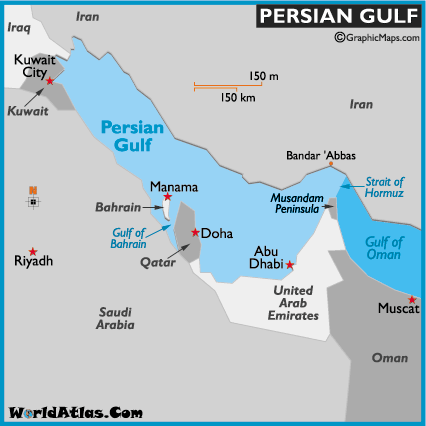
The United States bases its Fifth Fleet in Bahrain, only 150 miles from Iran. It has an aircraft carrier-led battle group in the Persian Gulf. Its warplanes and thousands of US troops are stationed in Kuwait and Qatar. In terms of provocation, this is roughly equivalent to the Chinese basing a naval fleet in Havana, a battle group in the Caribbean, warplanes in Venezuela and Nicaragua, and troops in Guatemala, El Salvador and Honduras. We needn’t ask whether Washington would denounce China’s massive deployment of military force close to US borders as provocative, doubly so were this accompanied by Beijing branding the United States part of an axis of evil and declaring that in its dealings with Washington all options are on the table.

And this tells only part of the story. China is no match militarily for the United States, but US military capabilities overwhelmingly outclass Iran’s. The hypothetical aggressive deployment of Chinese military force to US borders isn’t a tenth as provocative as Washington’s actual deployment of massive military force to the Persian Gulf.

So it is that no one with a rudimentary grasp of current international relations could possibly conceive of the relationship between the United States and Iran as one of Iran provoking the former, rather than the other way around. Since it’s fair to assume that the journalists Barnes and Solomon are not without a rudimentary grasp of the subject, it can only be concluded that they write propaganda for the US state despite working for a private organization—and that the propaganda is every bit as much chauvinist and congenial to US foreign policy goals as the bilge pumped out of Washington’s official propaganda agency, Radio Free Europe/Radio Liberty.

So how does the Journal reporters’ selective-references to provocation aid US foreign policy? In this way: There is a pattern of aggressive powers—from imperial Britain to Nazi Germany to the United States—justifying their military interventions as necessary responses to “provocation.” If cruise missiles are to smash into Iran, it will be helpful to justify Washington’s unleashing of its military force as a response to Iranian provocations, since a legitimate casus belli doesn’t exist. Even a case for war that public relations specialists could falsely invest with the appearance of legitimacy—namely, eliminating an Iranian nuclear weapons program—has become impossible ever since the US intelligence community declared that there is no credible evidence Iran has one. This led George W. Bush to lament in his memoirs, “How could I possibly explain using the military to destroy the nuclear facilities of a country the intelligence community said had no active nuclear weapons?”(1)—a question that doubtlessly troubles his successor. Iranian “provocations,” then, become a useful pretext for the use of military force in the absence of a legitimate case for war.

That Barnes and Solomon should act as imperialist-friendly propagandists is hardly surprising, since any dispassionate analysis of the mass media’s multiple linkages to the state through the corporate ruling class inevitably leads to the conclusion that the mainstream media’s take on foreign affairs will portray US foreign policy as admirable, virtuous and right, while the intended victims of the profit-driven quest to extend US hegemony will be depicted as democracy-hating, terrorist-promoting, economy-mismanaging, human rights-abusing, provocateurs (which, come to think of it, is a fairly apt description of the US government itself.)

(1) David Morrison, “George Bush was ‘angry’ when US intelligence said Iran hadn’t got an active nuclear weapons programme,” http://www.david-morrison.org.uk/iran/iran-bush-on-nie.htm . Morrison has written a number of trenchant and beautifully crafted analyses, available on his website http://www.david-morrison.org.uk/.

When will the Killing War in Iran Begin? It Already Has

Economic sanctions are, at their core, a war against public health.”
–The New England Journal of Medicine [1]

By Stephen Gowans

While campaigns are organized to deter the United States and Israel from acting on threats to launch an air war against Iran, both countries, in league with the European Union (winner of this year’s Nobel Peace Prize) carry on a low-intensity war against Iran that is likely to be causing more human suffering and death than strikes on Iran’s nuclear facilities would. This is a war against public health, aimed at the most vulnerable: cancer patients, hemophiliacs, kidney dialysis patients, and those awaiting transplants. Its victims are unseen, dying anonymously in hospitals, not incinerated in spectacular explosions touched off by cruise missiles and bunker buster bombs. But ordinary Iranians who can’t get needed medications are every bit as much victims of war as those blown apart by bombs. And yet, we think, that as long as the bombs don’t rain down, that peace has been preserved. Perhaps it has, in formal terms, but bleeding to death in the crater of a bomb, or bleeding to death because you can’t get hemophilia drugs, is, in either case, death.

In Iran today there is an acute shortage of pharmaceuticals for kidney dialysis and transplants and for treating cancer, hemophilia, thalessemia, multiple sclerosis, and other disorders. Hospital equipment is breaking down for want of spare parts. And raw materials used by domestic pharmaceutical manufacturers—blocked by Western sanctions—are in short supply. It adds up to a healthcare crisis. The United States and European Union say their sanctions don’t apply to drugs and medical equipment, but US and European banks are unwilling to handle financial transactions with Iran. If they do, the US Treasury Department will deny them access to the US banking system. Since isolation from the world’s largest economy would guarantee their demise, banks comply and shun Iran. As a consequence, few goods from the West make their way into the country, the exemptions for drugs and medical equipment being nothing more than a public relations ruse to disguise the barbarity of the sanctions. Not that Washington is denying that its sanctions are hurting ordinary Iranians. It’s just that responsibility for their consequences is denied. US president Barak Obama “has said the Iranian people should blame their own leaders.” [2] For what—failing to knuckle under?

“In contrast to war’s easily observable casualties, the apparently nonviolent consequences of economic intervention seem like an acceptable alternative. However…economic sanctions can seriously harm the health of persons who live in targeted nations.” [3] This has been well established and widely accepted in the cases of Iraq in the 1990s and the ongoing US blockade of Cuba. Political scientists John Mueller and Karl Mueller wrote an important paper in Foreign Affairs, in which they showed that economic sanctions “may have contributed to more deaths during the post-Cold War era than all weapons of mass destruction throughout history.” [4]

“The dangers posed today by such enfeebled, impoverished, and friendless states as Iraq and North Korea are minor indeed”, they wrote in 1999. It might be added that the dangers posed by Iran to the physical safety of US citizens are not only minor but infinitesimally small. Notwithstanding the fevered fantasies of rightwing commentators, Iran has neither the means, nor the required death wish, to strike the United States. Nor Israel, which has the means—an arsenal of 200 nuclear weapons—to wipe Iran off the face of the earth. However, the danger the country poses to the idea of US domination – and hence, to the banks, corporations, and major investors who dominate US policy-making – are admittedly somewhat greater.

“Severe economic sanctions”, the Muellers contend, ought to be “designated by the older label of ‘economic warfare’”. “In past wars economic embargoes caused huge numbers of deaths. Some 750,000 German civilians may have died because of the Allied naval blockade during World War I.” [5]

“So long as they can coordinate their efforts,” the two political scientists continue, “the big countries have at their disposal a credible, inexpensive and potent weapon for use against small and medium-sized foes. The dominant powers have shown that they can inflict enormous pain at remarkably little cost to themselves or the global economy. Indeed, in a matter of months or years whole economies can be devastated…” [6] And with devastated economies, come crumbling healthcare systems and failure to provide for the basic healthcare rights of the population.

We might ask, then, why the United States and European Union, practitioners of economic warfare against Iran, are bent on destroying Iran’s economy, along with its public health system. “Sanctions,” New York Times’ reporter Rick Gladstone writes, have subjected “ordinary Iranians” to “increased deprivations” in order to “punish Iran for enriching uranium that the West suspects is a cover for developing the ability to make nuclear weapons.” [7] In other words, Iran is suspected of having a secret nuclear weapons program, and so must be sanctioned to force it to abandon it.

Contrary to Gladstone, the West doesn’t really believe that Tehran has a secret nuclear weapons program, yet even if we accept it does believe this, the position is indefensible. Why should Iranians be punished for developing a capability that the countries that have imposed sanctions already have?

The reason why, it will be said, is because Iranians are bent on developing nuclear weapons to destroy Israel. Didn’t Iranian president Mahmoud Ahmadinejad threaten to “wipe Israel off the map”?

Regurgitated regularly by US hawks and Israeli politicians to mobilize support for the bombing of Iran, the claim is demagogic rubbish. Ahmadinejad predicted that Israel as a Zionist state would someday disappear much as South Africa as an apartheid state did. He didn’t threaten the physical destruction of Israel and expressed only the wish that historic Palestine would become a multinational democratic state of Arabs and the Jews whose ancestors arrived in Palestine before Zionist settlers. [8]

No less damaging to the argument that Iranians aspire to take Israel out in a hail of nuclear missiles is the reality that it would take decades for Iran to match Israel’s already formidable nuclear arsenal, if indeed it aspires to. For the foreseeable future, Israel is in a far better position to wipe Iran off the map. And given Israel’s penchant for flexing its US-built military muscle, is far more likely to be the wiper than wipee. Already it has almost wiped an entire people from the map of historic Palestine.

But this is irrelevant, for the premise that the West suspects Iran of developing a nuclear weapons capability is false. To be sure, the mass media endlessly recycle the fiction that the West suspects Iran’s uranium enrichment program is a cover for a nuclear weapons program, but who in the West suspects this? Not high officials of the US state, for they have repeatedly said that there’s no evidence that Iran has a secret nuclear weapons program.

The consensus view of the United States’ 16 intelligence agencies is that Iran abandoned its nuclear weapons program years ago. Director of US intelligence James Clapper “said there was no evidence that (Iran) had made a decision on making a concerted push to build a weapon. David H. Petraeus, the C.I.A. director, concurred with that view…. Other senior United States officials, including Defense Secretary Leon E. Panetta and Gen. Martin E. Dempsey, the chairman of the Joint Chiefs of Staff, have made similar statements.” [9]

Rather than weakening this conclusion, stepped up US espionage has buttressed it. Iran’s leaders “have opted for now against…designing a nuclear warhead,” said one former intelligence official briefed on US intelligence findings. “It isn’t the absence of evidence, it’s the evidence of an absence. Certain things are not being done” [10] that would indicate that Iran is working on nuclear weapons. Even Mossad, Israeli’s intelligence agency “does not disagree with the US on the weapons program,” according to a former senior US intelligence official. [11]

So, contrary to the claim that the West “suspects” Iran of concealing a nuclear weapons program, no one in a position of authority in the US state believes this to be true. Neither does Israeli intelligence. Why, then, is the United States and its allies subjecting ordinary Iranians to increased deprivations through sanctions?

The answer, according to Henry Kissinger, is because US policy in the Middle East for the last half century has been aimed at “preventing any power in the region from emerging as a hegemon.” This is another way of saying that the aim of US Middle East policy is to stop any Middle Eastern country from challenging its domination by the United States. Iran, Kissinger points out, has emerged as the principal challenger. [12]

Indeed, it did so as long ago as 1979, when the local extension of US power in Iran, the Shah, was overthrown, and the country set out on a path of independent economic and political development. For the revolutionaries’ boldness in asserting their sovereignty, Washington pressed Saddam Hussein’s Iraq into a war with Iran. This served the same purpose as today’s economic warfare, sabotage, threats of military intervention, and assassinations of Iran’s nuclear scientists: to weaken the country and stifle its development; to prevent it from thriving and thereby becoming an example to other countries of development possibilities outside US domination.

Uranium enrichment has emerged as point of conflict for two reasons.

First, a civilian nuclear power industry strengthens Iran economically and domestic uranium enrichment provides the country with an independent source of nuclear fuel. Were Iran to depend on the West for enriched uranium to power its reactors, it would be forever at the mercy of a hostile US state. Likewise, concern over energy security being in the hands of an outside power has led Turkey, Saudi Arabia, Vietnam and South Korea to insist over US objections that they be allowed to produce nuclear fuel domestically, without sanction. With US nuclear reactor sales hanging in the balance, it appears that their wishes will be respected. [13] Iran will be uniquely denied.

Secondly, uranium enrichment provides Tehran with the capability of developing nuclear weapons quickly, if it should ever feel compelled to. Given Washington’s longstanding hostility to an independent Iran, there are good reasons why the country may want to strengthen its means of self-defense. The hypocrisy of the United States championing counter-proliferation—and only selectively since no one is asking Israel to give up its nuclear weapons, and the United States hasn’t the slightest intention of ever relinquishing its own—reveals the illegitimacy of the exercise.

The reason, then, for waging war on Iran’s public health, a war that intensifies the suffering of the sick and kills cancer, kidney dialysis and other patients, is not because their government has a secret nuclear weapons program —which no one in the US intelligence community believes anyway—but because a developing Iran with independent energy, economic and foreign policies threatens Washington’s preferred world political order—one in which the United States has unchallenged primacy. Primacy is sought, not to satisfy ambitions for power for power’s sake, or to provide ordinary US citizens with economic opportunities at home, or to protect them from dangers that originate abroad, but to secure benefits for the plutocrats who dominate US public policy. The benefits uniquely accrue to plutocrats: opportunities to squeeze more for themselves from our labor, our land, and our resources and from those of our brethren abroad—the 99% in other lands, with whom we’re linked by a common economic position and interests. If the plutocrats and their loyal political servants in Washington and Brussels have to kill numberless Iranians to secure these benefits, they will. And are.

1. Eisenberg L, “The sleep of reason produces monsters—human costs of economic sanctions,” New England Journal of Medicine, 1997; 336:1248-50.
2. Thomas Erdbrink, “Iran sanctions take unexpected toll on medical imports”, The New York times, November 2, 2012; Najmeh Bozorgmehr, “In Iran, sanctions take toll on the sick”, The Washington Post, September 4, 2012
3. Karine Morin and Steven H. Miles, “Position paper: The health effects of economic sanctions and embargoes: The role of health professionals”, Annals of Internal Medicine, Volume 132, Number 2, 18 January 2000.
4. John Mueller and Karl Mueller, “Sanctions of mass destruction”, Foreign Affairs, Volume 78, Number 3, May/June 1999.
5. Ibid.
6. Ibid.
7. Rick Gladstone, “Iranian President Says Oil Embargo Won’t Hurt”, The New York Times, April 10, 2012.
8. Glenn Kessler, “Did Ahmadinejad really say Israel should be ‘wiped off the map’?” The Washington Post, October 6, 2011.
9. James Risen and Mark Mazzetti, “U.S. agencies see no move by Iran to build a bomb”, The New York Times, February 24, 2012.
10. Joby Warrick and Greg Miller, “U.S. intelligence gains in Iran seen as boost to confidence”, The Washington Post, April 7, 2012.
11. James Risen, “U.S. faces a tricky task in assessment of data on Iran”, The New York Times, March 17, 2012.
12. Henry A. Kissinger, “A new doctrine of intervention?” The Washington Post, March 30, 2012.
13. Carol E. Lee and Jay Solomon, “Obama to discuss North Korea, Iran”, The Wall Street Journal, March 21, 2012.

The Most Significant Threat to Global Peace and Security in the World Today

Canada has severed diplomatic relations with Iran, a country it decries as “the most significant threat to global peace and security in the world today,” and it has done so as part of the Harper government’s re-orienting Canada’s foreign policy to more vigorously back Israel. But it is Israel—which daily clamours for an attack on Iran and threatens to undertake one itself—that is the greatest current threat to world peace and international security.

Canada has withdrawn its diplomats from Tehran and ordered Iran’s out of Canada. Ottawa says it has suspended diplomatic relations because Iran is:

 Providing military assistance to the Syrian government;
 Refuses to comply with UN resolutions pertaining to its nuclear program;
 Routinely threatens the existence of Israel;
 Engages in racist anti-Semitic rhetoric and incitement to genocide;
 Is among the world’s worst violators of human rights;
 Shelters and materially supports terrorist groups.

Given rampant speculation in Canada about the real reasons Ottawa has suddenly broken off relations with Iran, it’s clear that Ottawa’s purported reasons have been dismissed as empty rhetoric.

And so they should be.

If Ottawa were genuinely concerned about the world’s worst violators of human rights giving military assistance to tyrannical regimes to put down peaceful uprisings, it would have shut its embassy in Saudi Arabia long ago. Human Rights Watch describes rights violations in Saudi Arabia, an absolute monarchy that refuses to tolerate meaningful democratic reforms, as “pervasive.” And when Bahrainis rose up in peaceful protest against their country’s despotic rulers last year, Saudi troops and tanks spilled into the country to help Bahrain’s absolute monarchy violently suppress the uprising. Canadian diplomats remain on station in both countries.

The United States refuses to comply with innumerable UN resolutions to lift its illegal blockade on Cuba, and yet Ottawa continues to maintain diplomatic relations with Washington. UN resolutions in connection with the Palestinians are regularly ignored by Israel, but all the same Canadian diplomats are not withdrawn from Tel Aviv.

Indeed, Israel offers multiple reasons for Ottawa to close its embassy in that country and boot Israeli diplomats out of Canada. Human Rights Watch describes conditions in territories occupied by Israel as a “human rights crisis.” Within Israel proper, Arabs are treated as second-class citizens, subordinate to the favoured children, the Jews.

Israel’s record of furnishing military aid to repressive, retrograde regimes is long and shameful. After the Carter administration suspended military aid to the Chilean regime of Augusto Pinochet in 1977, Israel stepped in to become the dictator’s major arms supplier. Israel ran guns to Iran soon after the 1979 Islamic Revolution, to fan the flames of war between Iran and Iraq, and before that was a major supporter of the Shah’s dictatorial, human rights charnel house. [1] In the 1970s, it entered into a secret military alliance with South Africa’s racist apartheid regime, offering to sell it nuclear weapons.

As for the Canadian government’s professed opposition to nuclear weapons proliferation, Tel Aviv’s nuclear program should be ringing alarm bells in Ottawa. Israel is estimated to have some 200 nuclear weapons. It refuses to hear any discussion about giving them up, won’t join the Nuclear Non-proliferation Treaty, and bars international inspectors from entering the country.

By contrast, the Iranians have no nuclear weapons—and as US military and intelligence officials continue to affirm—there is no evidence they’re working to acquire them (see here, here, here, here, here, and here.) More than that, there is evidence of absence. “Certain things are not being done,” a former US intelligence official told the Washington Post, that would have to be done were the Iranians working to weaponize their civilian nuclear energy program.

And unlike Israel, Iran is a member of the Nuclear Non-proliferation Treaty. Its nuclear facilities are regularly scrutinized by international inspectors. And while it is true that Tehran refuses to comply with some UN resolutions related to its civilian nuclear program, it does so because the resolutions would uniquely deny its right to process uranium—a right the non-proliferation treaty guarantees.

And as for supporting terrorists, in the early 1980s Tel Aviv groomed Christian Phalangist right-wing militias to act as Israel’s proconsul in Lebanon. When a bomb killed the Phalanges’ leader Bashir Jumayal, who had been recently elected president, the militias went on a rampage, terrorizing Palestinians and Shiite Lebanese in the Sabra and Shatila refugee camps in Beirut. As the Phalanges rampaged through the camps, killing men, women and children, the Israeli army threw up a cordon around the camps, firing flares into the night sky to provide illumination to help the terrorists do their grisly work. [2]

Far worse is the reality that the Israeli state was founded on terrorism. For one thing, Zionists used terrorism to try to drive the British out of mandate Palestine, bombing the King David hotel, headquarters of the British mandate authority, in 1946. But that was small potatoes compared to what was to come. Exhausted, and no longer willing to administer Palestine, the British transferred responsibility to the UN in 1947. Over the objections of the majority Arab inhabitants, the UN developed a partition plan which would allocate 56 percent of mandate Palestine to a Jewish state. Jews made up only one-third of the population. The Arabs, two-thirds of the population, would receive only 42 percent (Jerusalem, the remaining two percent, would become an international city.) The Jewish state would have a rough demographic balance of 500,000 Jews and 400,000 Arabs (the Arab state 800,000 Arabs and 100,000 Jews.) Recognizing that a democratic Jewish state could not long exist without a preponderance of Jews, Zionists terrorized Arab villages to depopulate them, sending hundreds of thousands of Arab Palestinians fleeing for safety. They were later barred from returning. Zionists claim the Arabs fled only to get out of the way of advancing armies from neighbouring Arab states. But the terror, formalized as Plan Dalet, was well underway before the Arab armies intervened. In end, the Zionists seized 80 percent of Palestinian territory, and were only prevented from seizing all of it by the intervention of Egypt and Jordan. [3]

What’s more, Canada might consider its own support for terrorists. Some Canadian military officers who had participated in last year’s NATO air war against the government of Libya referred to NATO jets bombing Gadhafi’s troops as “al-Qaeda’s air force,” a recognition that Islamist terrorists made up part of the opposition that NATO, with Canada’s participation, intervened on behalf of.

As for the Canadian government’s claim that Iran “routinely threatens the existence of Israel,” this is pure wind. Tehran is certainly hostile to Zionism—the idea that European Jewish settlers, through a program of ethnic cleansing, have a legitimate right to found a state on someone else’s land. And there can be little doubt that Iran is ready to do all it can to facilitate the demise of the Zionist regime. But the notion that Iran has the intention—even the capability—to bring about the physical destruction of Israel is absurd in the extreme. Iran is severely outclassed militarily by Israel, and its possession of a handful of nuclear weapons—if it were ever to acquire them—would be no match for Israel’s hundreds, or the formidable military might of Israel’s sponsor, the United States. The idea that Iran threatens Israel is a silly fiction cooked up by Israeli warmongers to justify an attack on Iran to prevent the latter from ever acquiring even the potential to develop nuclear weapons in order to preserve Tel Aviv’s monopoly of nuclear terror in the Middle East. Canadian politicians simply ape the line that Israel is threatened, a canard Zionists have used since 1948 to justify their aggressions. On the contrary, it is Israel—a super-power-sponsored nuclear weapons state—which threatens Iran, to say nothing of Syria and Lebanon.

So why has Ottawa really suspended diplomatic relations with Tehran? Iran’s foreign minister Ali Akbar Salehi says Canada’s government is “neo-conservative”, “extremist”, and “boundlessly defending international Zionism.” These are apt descriptions. Canada has practically outsourced its Middle East foreign policy to Israel, letting it be known that it will unquestioningly prop up Israeli interests. Extremist? Since Ottawa’s outsourcing of Middle East foreign policy to Israel yokes Canada to a bellicose regime with an atrocious human rights record, how could it be otherwise?

But Salehi’s description, no matter how apt, does not explain why Ottawa has severed ties with Iran now.

Former Canadian ambassador to Iran John Mundy raises the possibility that Ottawa is pulling its diplomats out of the country in anticipation of a unilateral Israeli strike on Iran. Since Canada has offered unqualified support to Israel, Canadian diplomats would be in danger if Israel followed through on its threats. Britain recalled its diplomats when, last November, protesters stormed the British Embassy in Tehran. Canada may be seeking to avoid a similar occurrence. Ottawa may have no specific knowledge of an impending Israeli strike, but may be playing it safe all the same. Or it might be participating in an Israeli-sponsored ruse to ratchet up psychological pressure on Tehran, withdrawing its diplomats to falsely signal an imminent Israeli strike.

Whatever the case, it’s clear that Canada has adopted the extremist position of supporting a rogue regime in Tel Aviv that, to quote Ottawa’s misplaced description of Iran, is “the most significant threat to global peace and security in the world today.”

1. Patrick Seale. Asad of Syria: The Struggle for the Middle East. University of California Press. 1988.
2. Seale.
3. Ilan Pappe. The Ethnic Cleasning of Palestine. One World. 2006.

The UN Secretary General and the One Percent

It’s clear whose side UN Secretary General Ban Ki-moon is on.

On August 17, Ban denounced Iran’s supreme leader Sayyed Ali Hosseini Khamenei‘s condemnation of Zionism as a political system. Khamenei’s remarks were “offensive and inflammatory,” Ban cautioned, adding that the UN Charter prohibits member states from threatening one another.

Iran’s “threats” against Israel, including president Mahmoud Ahmadinejad’s alleged threat to “wipe Israel off the map” have the appearance, though not the substance, of threats. They’re predictions about the inevitable collapse of a morally indefensible political system. Zionism will eventually fade from the pages of history, the Iranian president augured, not in a hail of nuclear missiles, but because its racial exclusion and ethnic cleansing are the rotten timbers upon which it rests.

Anyone who had prophesied that the days of Apartheid—another morally indefensible political system—were numbered, would hardly have been accused of threatening to bomb South Africa. But Ahmadinejad, as president of an economically nationalist state that exhibits little enthusiasm for hitching its wagon economically and politically to Wall Street and Washington, gets special treatment.

Khamenei’s prediction, and Ahmadinejad’s rendering of it, was soon turned into a canard about Iran threatening to bomb Israel, which demagogues in Tel Aviv and Washington have been using since to sanitize Israel’s threats to wage war on Iran. Use bombs, sanctions, isolation, and a foreign-trained domestic overthrow movement to usher Khamenei and Ahmadinejad off the stage of history, install pliant local rulers, and Iran’s back in the Wall Street camp.

While Iran’s leaders predict Zionism’s downfall under the weight of its own injustices, Israel has been making real threats–and not predictions about the collapse of the Islamic state, but promises to rain death and destruction on Iran from the air. All the same, Ban has been silent. Some UN member states, it seems, are afforded the privilege of threatening other member states, without a dressing down by the Secretary General.

Israel’s “entire existence is premised on the forced removal of Palestinians from their land,” Mazda Majidi points out in a recent Liberation article. Israel’s origins in ethnic cleansing might have led Ban to denounce Zionism as “offensive and inflammatory,” rather than Khamenei’s screed against it. Israel has amassed a robust record of serial aggressions, invading “every single one of its neighbors: Egypt, Syria, Lebanon and Jordan.” And much “of the territory it has occupied it has refused to ever return.”

What’s more, its aggressions have “gone beyond its borders, including its bombing of the Osirak nuclear plant in Iraq in 1981 and its military assistance to reactionary states around the globe, including apartheid South Africa.”

So how could Ban miss the pimple on Israel’s face, considering the country was born with it, and that it has once again become red and angry? More to the point, how could he play to Israel’s modus operandi, which goes back to Israel’s founding in 1948, of justifying its aggressions on the wholly laughable grounds of being under an existential threat? Iran, a non-nuclear-arms country without superpower patronage, no more poses an existential threat to the US-backed, nuclear-arms-wielding Israel, than Canada does to the United States.

Ban’s bias is inevitable. Like all UN secretaries general, he’s simply an extension of the countries that make up the permanent membership of the United Nations Security Council–the most important of which, of course, is the United States.

Washington and its other extensions, which include Tel Aviv and the Western mass media, have been engaged in a long-running campaign of manipulating public opinion to make Iran loom large in the minds of the public as a major threat to Israel—all in the service of building a pretext for war. There’s a broader campaign of which this is only a part: to eliminate every state that refuses to subordinate itself economically and politically to the profit-making interests of the banks, corporations and major investors of the United States and its major allies—the one (or more precisely, the fraction of the one) percent.

Milosevic’s Yugoslavia was sanctioned and bombed because it was a social democracy that resisted a free-market take-over, not because—as the story goes—ethnic Albanians were ill-treated. Libyan leader Muamar Gadaffi’s sin, according to a leaked US State Department cable, was that he practiced “resource nationalism”, insisting his country’s resources be used to benefit Libyans, not because he was allegedly about to unleash a genocide. The US State Department complains that Syria has “failed to join an increasingly interconnected global economy,” which is to say, has failed to turn over its state-owned enterprises to private investors, and that “ideological reasons” continue to prevent the Asad government from liberalizing Syria’s economy, not that the country’s president, Bashar al-Asad, hates democracy and tramples human rights. (Were this the reason Washington opposes Asad’s government, how would we explain US support for the monarchical, misogynist, opposition-jailing, democracy-abominating tyrannies of Saudi Arabia and Bahrain?)

Iran, too, has committed its share of transgressions against free-market, free-enterprise, free-trade theology. The country’s constitution defines the public sector as primary, and “the private sector as the means of furnishing the government’s needs rather than responding to market requirements.” Democratic socialists will be shocked to discover that this is the very same economic model that such New Left socialists as Ralph Miliband defined as emblematic of what a democratic socialism ought to be (which isn’t to say that Iran is a democratic socialist state, only that economically it is very close to what many socialist thinkers have envisaged for Western socialism.)

Needless to say, countries that limit room for foreign investors, and subordinate the private sector to public policy goals, rather than Wall Street’s goals, are an anathema in Washington, and must be eliminated. The UN General Secretary is on board.

The United States’ Barbarous Policy on Iran

“Sanctions,” New York Times’ reporter Rick Gladstone writes, have subjected “ordinary Iranians” to “increased deprivations” in order to “punish Iran for enriching uranium that the West suspects is a cover for developing the ability to make nuclear weapons.” [1] In other words, Iran is suspected of having a secret nuclear weapons program, and so must be sanctioned to force it to abandon it.

Contrary to Gladstone, the West doesn’t really believe that Tehran has a secret nuclear weapons program, yet even if we accept it does believe this, the position is indefensible. Why should Iranians be punished for developing a capability that the countries that have imposed sanctions already have?

The reason why, it will be said, is because Iranians are bent on developing nuclear weapons to destroy Israel. Didn’t Iranian president Mahmoud Ahmadinejad threaten to “wipe Israel off the map”?

Regurgitated regularly by US hawks and Israeli politicians to mobilize support for the bombing of Iran, the claim is demagogic rubbish. Ahmadinejad predicted that Israel as a Zionist state would someday disappear much as South Africa as an apartheid state did. He didn’t threaten the physical destruction of Israel and expressed only the wish that historic Palestine would become a multinational democratic state of Arabs and the Jews whose ancestors arrived in Palestine before Zionist settlers. [2]

No less damaging to the argument that Iranians aspire to take Israel out in a hail of nuclear missiles is the reality that it would take decades for Iran to match Israel’s already formidable nuclear arsenal, if indeed it aspires to. For the foreseeable future, Israel is in a far better position to wipe Iran off the map. And given Israel’s penchant for flexing its US-built military muscle, is far more likely to be the wiper than wipee. Already it has almost wiped an entire people from the map of historic Palestine.

But this is irrelevant, for the premise that the West suspects Iran of developing a nuclear weapons capability is false. To be sure, the mass media endlessly recycle the fiction that the West suspects Iran’s uranium enrichment program is a cover for a nuclear weapons program, but who in the West suspects this? Not high officials of the US state, for they have repeatedly said that there’s no evidence that Iran has a secret nuclear weapons program.

The consensus view of the United States’ 16 intelligence agencies is that Iran abandoned its nuclear weapons program years ago. Director of US intelligence James Clapper “said there was no evidence that (Iran) had made a decision on making a concerted push to build a weapon. David H. Petraeus, the C.I.A. director, concurred with that view…. Other senior United States officials, including Defense Secretary Leon E. Panetta and Gen. Martin E. Dempsey, the chairman of the Joint Chiefs of Staff, have made similar statements.” [3]

Rather than weakening this conclusion, stepped up US espionage has buttressed it. Iran’s leaders “have opted for now against…designing a nuclear warhead,” said one former intelligence official briefed on US intelligence findings. “It isn’t the absence of evidence, it’s the evidence of an absence. Certain things are not being done” [4] that would indicate that Iran is working on nuclear weapons. Even Mossad, Israeli’s intelligence agency “does not disagree with the US on the weapons program,” according to a former senior US intelligence official. [5]

So, contrary to the claim that the West “suspects” Iran of concealing a nuclear weapons program, no one in a position of authority in the US state believes this to be true. Neither does Israeli intelligence. Why, then, is the United States and its allies subjecting ordinary Iranians to increased deprivations through sanctions?

The answer, according to Henry Kissinger, is because US policy in the Middle East for the last half century has been aimed at “preventing any power in the region from emerging as a hegemon.” This is another way of saying that the aim of US Middle East policy is to stop any Middle Eastern country from challenging its domination by the United States. Iran, Kissinger points out, has emerged as the principal challenger. [6]

Indeed, it did so as long ago as 1979, when the local extension of US power in Iran, the Shah, was overthrown, and the country set out on a path of independent economic and political development. For the revolutionaries’ boldness in asserting their sovereignty, Washington pressed Saddam Hussein’s Iraq into a war with Iran. This served the same purpose as today’s economic warfare, sabotage, threats of military intervention, and assassinations of Iran’s nuclear scientists: to weaken the country and stifle its development; to prevent it from thriving and thereby becoming an example to other countries of development possibilities outside US domination.

Uranium enrichment has emerged as point of conflict for two reasons.

First, a civilian nuclear power industry strengthens Iran economically and domestic uranium enrichment provides the country with an independent source of nuclear fuel. Were Iran to depend on the West for enriched uranium to power its reactors, it would be forever at the mercy of a hostile US state. Likewise, concern over energy security being in the hands of an outside power has led Turkey, Saudi Arabia, Vietnam and South Korea to insist over US objections that they be allowed to produce nuclear fuel domestically, without sanction. With US nuclear reactor sales hanging in the balance, it appears that their wishes will be respected. [7] Iran will be uniquely denied.

Secondly, uranium enrichment provides Tehran with the capability of developing nuclear weapons quickly, if it should ever feel compelled to. Given Washington’s longstanding hostility to an independent Iran, there are good reasons why the country may want to strengthen its means of self-defense. The hypocrisy of the United States championing counter-proliferation—and only selectively since no one is asking Israel to give up its nuclear weapons, and the United States hasn’t the slightest intention of ever relinquishing its own—reveals the illegitimacy of the exercise.

The reason, then, for punishing Iranians with new and more debilitating privations is not because their government has a secret nuclear weapons program —which no one in the US state believes anyway—but because a developing Iran with independent energy, economic and foreign policies threatens Washington’s preferred world political order—one in which the United States has unchallenged primacy.

1. Rick Gladstone, “Iranian President Says Oil Embargo Won’t Hurt”, The New York Times, April 10, 2012.
2. Glenn Kessler, “Did Ahmadinejad really say Israel should be ‘wiped off the map’?” The Washington Post, October 6, 2011.
3. James Risen and Mark Mazzetti, “U.S. agencies see no move by Iran to build a bomb”, The New York Times, February 24, 2012.
4. Joby Warrick and Greg Miller, “U.S. intelligence gains in Iran seen as boost to confidence”, The Washington Post, April 7, 2012.
5. James Risen, “U.S. faces a tricky task in assessment of data on Iran”, The New York Times, March 17, 2012.
6. Henry A. Kissinger, “A new doctrine of intervention?” The Washington Post, March 30, 2012.
7. Carol E. Lee and Jay Solomon, “Obama to discuss North Korea, Iran”, The Wall Street Journal, March 21, 2012.

Kindergarten Threats

By Stephen Gowans

New York Times reporter William J. Broad wrote today about the apocalyptic vision of fiction-writer and Republican presidential hopeful Newt Gingrich. [1] Gingrich warns that U.S. bêtes noire Iran or North Korea could send the United States back to the Middle Ages, detonating a nuclear missile high above the United States, which would create an electromagnetic pulse that knocks out anything that runs on electricity.

“Millions would die in the first week alone,” Gingrich cautions in the foreword to “One Second After,” a novel written by William R. Forstchen, a Gingrich friend and co-writer with Gingrich of historical novels. The novel describes a calamitous scenario in which an electromagnetic pulse (EMP) attack cripples the United States.

Gingrich announced before the American Israel Public Affairs Committee’s annual policy conference in May 2009 that he favored “taking out Iranian and North Korean missiles on their sites” to prevent either country from delivering an EMP Armageddon to the United States.

Gingrich is not alone in calling for strikes on Iran and North Korea.

In a March 30, 2010 piece, Washington Post columnist Walter Pincus wrote that the then head of the US strategic nuclear command, former astronaut General Kevin P. Chilton, had told US senators that “no nuclear power has been conquered or even put at risk of conquest.” Chillingly, Pincus added that Chilton’s observation is something that “others in government ought to ponder as they watch Iran and North Korea seek to develop nuclear capability”…a not so veiled call for wars to prevent North Korea and Iran from eliminating the risk of their being conquered. [2]

Equally chillingly, in a July 18, 2008 New York Times op-ed, Israeli historian Benny Morris urged the United States “to use bombs to stave off war”…that is, for “the US to use its formidable military to destroy Iran’s nuclear facilities”. (Using bombs to stave off war is like using famine to stave off hunger.) To make his case, Morris constructed a fantasy about Israel being “threatened almost daily with destruction by Iran’s leaders,” adding bizarrely that they “are likely to use any bomb they build…because of fear of Israeli nuclear pre-emption.” [3] In other words, because Israel threatens to pre-empt Iran, Iran must be pre-empted, otherwise it might pre-empt Israel’s pre-emption.

Creating Fictions

As the Cold War drew to a close, Colin Powell, at the time the top US solider, warned: “I’m running out of demons, I’m running out of villains. I’m down to Castro and (then North Korean leader) Kim Il Sung.” [4] On the eve of the Soviet Union’s demise, cold warriors Robert McNamara, Carl Kaysen and George W. Rathjens echoed Powell’s warning in an autumn 1991 Foreign Policy piece: “With the end of the Cold War,” they wrote, “it is hard to construct even a semi-plausible military threat to the United States.” [5]

Keen to keep US taxes flowing to the Pentagon and straight to the bottom lines of Lockheed-Martin, Northrop Grumman, Boeing, and other profit-soaked US defense contractors, US officials took on what the cold warriors envisaged as a difficult task. They puffed up military midgets into military Gargantua, and found dire threats—an alleged genocide in Kosovo and WMDs in Iraq—where none existed. 9/11 sealed the deal.

Today Pentagon chief Leon Panetta can cite “North Korea and Iran as persistent threats” which the US military must remain bulked up to “to deter and defeat,” [6] with few people batting an eye. At $700 billion per year [7], US military spending is greater than that of the next 19 biggest spending countries combined, [8] many of which are US allies, and none of which are North Korea or Iran. And the New York Times turn over its pages to the Benny Morrises of the world as a platform to urge the United States to prevent wars by waging more of them. It turns out that Powell’s and McNamara’s fears that the United States had run out of demons to justify the pumping of billions in profits into defense contractors were based on a misjudgment of the prowess of the propaganda system to crank out compelling fiction.

Getting Gingrich

Maybe it was a desire to discredit Gingrich, a Republican whose hand on the tiller of the ship of state may be too frightening for the liberal New York Times to contemplate that led Broad to puncture some of the myths that have been carefully constructed about Iran and North Korea as nuclear menaces–myths the Times itself has been no stranger to lending credence to. Whatever the case, the Broad article ran against form, challenging Gingrich’s fear-mongering.

Broad cited Philip E. Coyle III, a former head of Pentagon arms testing, who has complained that Gingrich and his fellow fear-mongers are puffing up Iran and North Korea “with the capabilities of giants.” Broad then pointed to other military experts who say that North Korea and Iran “are at the kindergarten stage of developing nuclear arms.” To this might be added that it’s far from certain that Iran is even at the kindergarten stage, while North Korea, the most sanctioned country on earth [9], will find its US-imposed poverty keeps it at the kindergarten stage well into the future.

“To even begin to attempt to do what Mr. Gingrich fears,” Broad writes, Iran and North Korea “would have to perfect big rockets, powerful bombs and surreptitious ways to loft them high above America.” Yet “Iran is having trouble keeping its missile bases from blowing up and North Korea cannot seem to get a big rocket off the ground without it tumbling out of control.”

Broad’s reporting deflates myths about an EMP attack, but it is just as damning to the more widely-circulated myths about North Korea and Iran threatening the United States and its allies with a garden variety nuclear strike.

The Real Threat

Still, it’s true that both countries pose a threat—though not a military one and not to the bulk of US citizens. Iran and North Korea, like Gaddafi’s Libya, Saddam Hussein’s Iraq, Milosevic’s Yugoslavia, and Mugabe’s Zimbabwe, defy a US-favored regime of free-trade, free-markets and free-enterprise–one that opens doors to US enterprises and keeps foreign profits pouring into Wall Street.

According to the US Congressional Research Service, numerous US sanctions have been imposed on North Korea for reasons listed as either “communism”, “non-market economy” or “communism and market disruption.” [10] Iran, as the US Congress of Library’s country study documents [11], favors a host of state-led economic development measures that, like North Korea’s publically-owned and planned economy, walls off large parts of the country’s markets, resources and labor from foreign corporations, banks and investors.

It is the limitations on US elite economic interests, and the threat of their becoming a model for other developing countries, that drives Gingrich, Pincus and others to puff up military pipsqueaks into giants and to elevate kindergarten students into MIT graduates. Transformed into threats, they become seemingly legitimate targets for all manner of aggressions—sabotage, economic warfare, funding of overthrow movements, military harassment, and, at times, overt war. The aim is replace leaders who favor independent, self-directed economic development, with puppets who will throw open the country’s doors to US exports and investment and co-operate with the United States militarily.

Marionettes

Burhan Ghalioun is a fine example of an aspiring puppet. He is the president of the Syrian National Council, an exile group linked to the Movement for Justice and Development [12]. The latter has received $6 million in US government funding to organize opposition to the Assad government, according to a WikiLeaks cable [13]. The supplicant marionette, who has met with Hilary Clinton and has already persuaded French Foreign Minister Alain Juppe and British Foreign Secretary William Hague to declare his organization “a legitimate representative of the Syrian people” [14] is promising US officials that if they bring him to power he will “cut Damascus’s military relationship to Iran and end arms supplies to Middle East militant groups such as Hezbollah and Hamas” while integrating Syria with “the region’s major Arab powers”, [15] a reference to the Gulf Cooperation Council, the club of US-allied oil tyrannies which recently used military force to crack down on a democratic uprising in Bahrain, a member country, and home to the US 5th Fleet, the main military threat against Iran. (Bahrain, for the record, is a foreign investor’s paradise, ranking number 10 on the Wall Street Journal/Heritage Foundation Index of Economic Freedom). Ghalioun’s eagerness to become entangled with a conspiracy of democracy-abominating absolute monarchies speaks volumes about his commitment to democracy and the direction of a possible Syrian National Council-led revolution in Syria.

1. William J. Broad, “Among Gingrich’s passions, a doomsday vision”, The New York Times, December 11, 2011.
2. Walter Pincus, “As missions are added, Stratcom commander keeps focus on deterrence”, The Washington Post, March 30, 2010.
3. Benny Morris, “Using Bombs to Stave Off War,” New York Times, July 18, 2008.
4. Carl Kaysen, Robert S. McNamara and George W. Rathjens, “Nuclear Weapons After the Cold War”, Foreign Affairs, Fall 1991.
5. Ibid.
6. Thom Shanker and Elisabeth Bumiller, “Weighing Pentagon cuts, Panetta faces deep pressures”, The New York Times, November 6, 2011.
7. Ibid.
8. “Defence spending: The world’s biggest armies in stats,” The Daily Telegraph, http://www.telegraph.co.uk/news/uknews/defence/8002911/Defence-spending-the-worlds-biggest-armies-in-stats.html
9. Then US President George W. Bush had called North Korea “the most sanctioned nation in the world”. U.S. News & World Report, June 26, 2008; The New York Times, July 6, 2008.
10. Dianne E. Rennack, “North Korea: Economic sanctions”, Congressional Research Service, October 17, 2006. http://www.au.af.mil/au/awc/awcgate/crs/rl31696.pdf
11. The Library of Congress. Iran: A Country Study. 2008. http://lcweb2.loc.gov/frd/cs/irtoc.html
12. The leader of the Movement for Justice and Democracy is Anas Al-Abdah. He is a member of the SNC.
13. James Rosen, “U.S. Fears Syrian Reprisals After WikiLeaks Disclosure,” FoxNew.com, April 18, 2011.
14. Jay Solomon, “Clinton Meets With Syrian Opposition”, The Wall Street Journal, December 6, 2011.
15. Jay Solomon and Nour Malas, “Syria would cut Iran military tie, opposition head says”, The Wall Street Journal, December 2, 2011

Seeing the US Everywhere

By Stephen Gowans

The New York Times ran an article today about Washington’s plans to strengthen its military presence in Australia. Australia is to be used by the US military “as a new center of operations in Asia” from which the United States will seek “to reassert itself in the region and grapple with China’s rise.”

The problem for policy planners in Washington is that “China has become the largest trading partner with most of the countries in the region, undercutting American economic influence.” And so the United States will beef up its presence in the Pacific to prove that “it intends to remain a crucial military and economic power” in Asia.

In simple language this means that China has secured export and investment opportunities in its own backyard and that US corporations, banks and investors want them for themselves. So Washington will use its military to take them away from the Chinese.

For obvious reasons, China thinks this smacks of old-fashioned gun-boat imperialism.

Not so curiously, the headline of the Ian Johnson and Jackie Calmes article announcing Washington’s plan to muscle China out of economic primacy in the region put a chauvinistic spin on the story: “As US looks to Asia, it sees China everywhere.”

Imagine China setting up military bases in Venezuela and sending aircraft carriers to the Gulf of Mexico in order to “assert itself in the region.” How strange would seem a newspaper headline that read: “As China looks to the Gulf of Mexico, it sees the United States everywhere,” as if this were an unexpected discovery.

The New York Times’ headline could have been more aptly written this way: As China looks around its neighborhood, it sees the US military everywhere. But then this would have made US imperialism uncomfortably obvious.

An article by Johnson and Calmes’ New York Times’ colleagues Nada Bakri and Rick Gladstone, also in today’s edition of the newspaper (“Syria faces new threats as opposition seeks allies”) is equally worthy of comment. Their article used “one human rights group, the Syrian Observatory for Human Rights” as a source for the number of people killed in recent clashes with Syrian government forces.

One might get the impression that the Syrian Observatory for Human Rights is a neutral human rights monitor without a political agenda. After all, Bakri and Gladstone refer to it as “one human rights group”, and nothing more.

Were it an opposition group seeking to overthrow the Syrian government we might think twice about trusting it as a source of unbiased information.

Well, think twice.

A statement posted to the group’s website on November 15, 2011, makes clear that it is more than just “one human rights group.” In the statement, the group calls for a no-fly zone over Syria “in accordance with its duty and commitment to echo the voice of Syrian Popular Revolution.”

The Observatory makes no secret of the reason it wants “the international community” (which is to say, Nato) dropping bombs on Syrian military installations and Assad supporters: “the acceleration of overthrowing Syrian brutal regime.”

Meanwhile, the Gulf Cooperation Council, the group of US-allied oil autocracies that had been acting as arms and propaganda suppliers to Libyan rebels, played a key role in pushing through the recent Arab League suspension of Syria.

The Council has also become a key to Washington’s plans to continue to dominate the Persian Gulf, even as—or rather, precisely because–US troops are being withdrawn from Iraq.

Both US Defense Secretary Leon Panetta and the Chairman of the Joint Chiefs of Staff have said that the United States will “maintain a large military presence in the region, in part as a counterweight to Iran.” The US military will rely on “the six nations in the Gulf Cooperation Council — Saudi Arabia, Kuwait, Bahrain, Qatar, the United Arab Emirates and Oman. While the United States has close bilateral military relationships with each, the administration and the military are trying to foster a new ‘security architecture’ for the Persian Gulf that would integrate air and naval patrols and missile defense.”

It’s not only China that is hemmed in by the US military. As Iran looks around its neighborhood, it too sees the US everywhere.

In Libya, the end of 42 years of….

…self-directed economic development aimed at giving Libyans a stake in their economy.

I’m not saying Gaddafi’s Libya was a model society, but it did offer its own citizens advantages that are conspicuously missing in Washington’s Third World satellites.

Margaret Coker, writing in today’s Wall Street Journal (“Libya speeds oil output but sees hurdles ahead”) serves up an example of Gaddafi’s friendly-to-Libyans, not-so-friendly-to-overseas-investor policies. Among “many of (Gadaffi’s) heavy-handed state policies” were “foreign-currency exchange limits and a law that forced private enterprises to make Libyan employees shareholders of the business.” These policies “crimped corporate work during the Gadhafi regime,” writes Coker, by which she means encroached on the profits of Western banks, corporations and investors. Bad man.

In the same issue of the WSJ we learn that Washington is quietly funnelling bunker buster bombs and other ammunition to the group of anti-democratic oil monarchies that make up the Gulf Cooperation Council. The aim is to build up these despotic regimes as “a unified counter-weight to Iran” (“U.S. plans bomb sales in Gulf to counter Iran.”)

The GCC, it will be recalled, dispatched tanks and troops to crush a popular uprising in one of its member states, Bahrain, while it was also helping rebels oust the Gaddafi government in Libya. GCC member, Qatar, an absolutist state, was particularly helpful to the Libyan rebels, dispatching hundreds of ground troops to aid the cause of…

• (A) Building democracy in Libya?
• (B) Ending Gaddafi policies that crimped corporate work?

You decide.

Finally, yesterday’s WSJ ( “U.S. to build up military in Australia”) points to plans for “a new and permanent U.S. military presence in Australia…a step aimed at countering China’s influence and reasserting U.S. interests in the region.” Notes WSJ reporter Laura Meckler, the “South China Sea, which China considers as its sovereign territory…is important economically.”

Indeed it is.

Fortunately, the combined forces of the US Army, US Navy, US Marine Corps, US Air Force and the CIA exist to make sure the South China Sea—and every other economically important region of the globe—is available to Wall Street for its aggrandizement…and free from anyone who might exercise their sovereignty to impose policies that crimp corporate work.

Wars for Profits: A No-Nonsense Guide to Why the United States Seeks to Make Iran an International Pariah

By Stephen Gowans

Flipping idly through my morning newspaper, my eyes fell upon a headline, which, given its significance, should have appeared on the front page, but instead was tucked away at the back, on page A9.

“Israel won’t rule out attack on Iran”. (1)

Now, it’s true that Israel’s threatening to attack Iran is hardly news. Here was Ehud Barak, Israeli defense minister, over two years ago, talking about measures to dissuade Iran from continuing to process uranium: “We clearly believe that no option should be removed from the table. This is our policy. We mean it.” (2) And here was Barak just the other day: “We strongly believe that…no option should be removed from the table.” (3) Same defense minister. Same words. Same threat.

Yet while the threat may be old, its significance remains undiminished. One country is threatening to commit the supreme international crime: to attack another even though it, itself, has not been attacked by the country it rattles its saber at. Were Iran to threaten Israel, the headline “Iran won’t rule out attack on the Jewish state” wouldn’t be tucked away inconspicuously in the back pages of my newspaper. Instead, it would be shouted in bold letters across the front page. “My God!”, NATO state officials and editorialists would cry. “Iran is threatening to attack the Jewish state. Something must be done!”

But in this case it is Israel that is issuing the threat against a country which has, since its escape from US domination in 1979, been limned as dark and menacing, and so while no one wants war, surely it’s all perfectly understandable that the plucky Israelis should be declaring their determination to stand against the Judeophobic menace of the Islamic Republic. After all, isn’t Iran building nuclear weapons to wipe Israel off the map? Well, if you listen to the Israelis and their US protector, the answer is yes.

The Strangelovian Israeli historian Benny Morris declares that Israel is “threatened almost daily with destruction by Iran’s leaders.” To eclipse this threat, Iran must be wiped off the map before Iran does any wiping of its own. “Israel has no option,” Morris chillingly says, “but to use its nuclear arsenal to destroy Iran, unless the US uses its formidable military to destroy Iran’s nuclear facilities first.” (4)

Israeli prime minister Benjamin Netanyahu warns: “Iran is even arming itself with nuclear weapons to realize that goal (the obliteration of the Jewish state), and until now the world has not stopped it. The threat to our existence, is not theoretical. It cannot be swept under the carpet; it cannot be reduced. It faces us and all humanity, and it must be thwarted.” (5)

Ominous. But the idea that Iran intends to acquire nuclear weapons to obliterate Israel is pure flummery; a work of fiction, intended to create a frisson of fear.

So, why do I say this? First, we don’t know whether Iran intends to acquire nuclear weapons, or only the capability of producing them, or even that. An International Atomic Energy Agency report, released yesterday, tables evidence that Iran is secretly working on a nuclear bomb. So let’s assume for the moment that Iran’s leaders do indeed intend to build nuclear weapons.

It’s widely agreed that it’s highly unlikely that Iran would be able to build nuclear weapons while its nuclear energy program is still under the scrutiny of UN inspectors. A more likely scenario is that Tehran would develop the capability to produce a bomb from within the Nuclear Non-Proliferation Treaty (NPT), and once it had reached the point of being able to do so, would turn its capability into reality by withdrawing from the treaty, ejecting inspectors, and making a mad dash to develop a rudimentary arsenal. That’s what North Korea did, when, following the demise of the Soviet Union, the United States decided to re-target some its nuclear missiles from the USSR to the DPRK.

But would Iran ever get as far as being able to make a mad dash to status as the world’s newest nuclear-weapons state? The United States and Israel have made plenty of noise about bombing Iran’s nuclear facilities before Iran’s nuclear scientists ever reach the point of having the capability of producing nuclear weapons. Indeed, the threat to attack Iran’s nuclear facilities has been trotted out anew because the steps the United States and Israel have taken to sabotage Iran’s nuclear program–from the Stuxnet computer virus to the assassination of Iran’s nuclear scientists to punitive sanctions–haven’t stopped the program’s development, although they have certainly slowed it.

But let’s make another assumption. Let’s assume that despite US and Israeli efforts to cripple Iran’s ability to produce nuclear weapons, that Iran, despite these impediments, brings this capability to fruition, and furthermore, manages against the concerted opposition of the United States and Israel to develop a few nuclear warheads. Does the possession of warheads mean that Iran will use them–either to wipe Israel off the map or attack the United States?

No, it does not.

The idea that Iran is an “existential” threat to Israel comes from Iranian president Mahmoud Ahmadinejad’s alleged promise to wipe Israel off the map. US and Israeli political leaders have been invoking this chestnut for years to justify the assassinations, economic warfare, covert destabilization, and threats of military intervention used to undermine Iran’s nuclear energy program. The problem is, the allegation is groundless.

The firestorm started when Nazila Fathi, then the Tehran correspondent of The New York Times, reported a story almost six years ago that was headlined: “Wipe Israel ‘off the map’ Iranian says.” The article attributed newly elected Iranian President Mahmoud Ahmadinejad’s remarks to a report by the ISNA press agency.

Specialists such as Juan Cole of the University of Michigan and Arash Norouzi of the Mossadegh Project pointed out that the original statement in Persian did not say that Israel should be wiped from the map, but instead that it would collapse.

Khamenei stated, “Iran’s position, which was first expressed by the Imam [Khomeini] and stated several times by those responsible, is that the cancerous tumor called Israel must be uprooted from the region.” He went on to say in the same speech that “Palestinian refugees should return and Muslims, Christians and Jews could choose a government for themselves, excluding immigrant Jews.”

Khamenei has been consistent, stating repeatedly that the goal is not the military destruction of the Jewish state but “the defeat of Zionist ideology and the dissolution of Israel through a ‘popular referendum.’” (6)

To be sure, anyone who regards Israel as a “cancerous tumor” that “must be uprooted from the region” and replaced by a government freely chosen by the people who lived in Palestine prior to its conquest by Zionist settlers, is an existential threat to the idea of Israel as a Jewish state. But while the designation of Iran as an existential threat to the idea of Israel is literally true (in the sense that Iran doesn’t accept Zionism and therefore works against it by supporting such anti-Zionist groups as Hamas), the phrase “existential threat” is twisted to mean something more than intended: military destruction rather than collapse through a referendum.

Political leaders are in the habit of presenting non-threats into dire ones. A not particularly egregious example is provided by US Defense Secretary Leon Panetta, who, needing to defend the Pentagon’s Brobdignagian budget against possible cuts, recently “cited North Korea and Iran as persistent threats, and said that the military had to maintain ‘the ability to deter and defeat them.’” (7) Yet North Korea and Iran are not threats to the physical safety and welfare of a single US civilian.

First, Iran’s military is built for self-defense. It doesn’t have aircraft carriers, a large fleet of warships, strategic bombers, foreign military bases or a naval presence near US waters. The United States, by contrast, bases its Fifth Fleet in Bahrain, within shouting distance of Iran, directly across the Persian Gulf. Iranian warships won’t be found lingering menacingly in the Gulf of Mexico or patrolling the edges of US territorial waters.
Second, a graph nearby shows that Iran’s military spending, at $20B per annum, pales in comparison to the budgets of the United States ($700B) and even that of the United States’ regional allies ($102B). The US military budget is 35 times larger than Iran’s, and the sum of that of the United States, its invariable co-belligerent the United Kingdom, and Washington’s regional allies, is 43 times larger. The gulf in fighting ability supported by these expenditures is as yawning as the one between the New York City Police Department and a troop of Boy Scouts armed with BB guns.

As regards North Korea, the idea that it is a threat to the security of a single US civilian is even more absurd. Like Iran, North Korea’s military is built for defense, and it too has no foreign military bases, no aircraft carriers, no nuclear armed submarines and no strategic bombers, and it has never—unlike its compatriot neighbor to the south—sent troops abroad to fight in other country’s wars (as South Korean troops have fought in US wars.)

North Korean military expenditures are even more modest than Iran’s. Pyongyang spends an estimated $10B on its military (and that’s probably stretching it), many of whose members are engaged in agriculture and other civilian activities. (8) By comparison, South Korea (on whose soil are resident close to 30,000 US troops), spends $39B, while nearby Japan (home to 40,000 US troops) spends $34B. Together, these two US allies outspend Pyongyang on their militaries by a factor of 7 to 1. Add to this US defense expenditures and those of Britain—a country that can be counted on to docilely follow the United States into any war–and North Korea, surrounded by US troops and warships and whose air borders are incessantly menaced by the US Air Force, is outspent over 80 to 1. A threat? The claim is laughable.

And that understates the imbalance. What military budgets don’t reveal is the vastly superior destructive power of US military hardware (and that of many of its allies) compared to Iran’s and North Korea’s. The kill capacity of US strike aircraft, cruise missiles, and battleships is far in excess of the heavy artillery that figures so prominently in the North Korean armamentarium, for example.

And then there’s nuclear weapons. North Korea may (or may not) have an arsenal of a few warheads, and Iran may (or may not) be seeking one, but these rudimentary collections pale in comparison with the US, British, and Israeli arsenals arrayed against them. Would Iran attack Israel, or North Korea attack South Korea, with one or two nuclear missiles, knowing that to do so would invite a retaliatory tsunami of missiles from the target (in the case of an attack on Israel) or its hyper-armed patron, the United States, or both? The outcome of so foolhardy an attack would be game-over for either country.

“During the Democratic primaries, then candidate Hilary Clinton (now US Secretary of State) warned that if Iran attacked Israel, the United States would ‘totally obliterate’ Iran.” (9) Three years ago, Israeli “Infrastructure Minister Benjamin Ben-Eliezer went on record saying, ‘We must tell them: ‘If you so much as dream of attacking Israel, before you even finish dreaming there won’t be an Iran anymore.’” (10) It’s doubtful that the Iranians failed to get the message.

And then there’s the matter of Washington’s 2010 Nuclear Posture Review (NPR). If read superficially, the NPR would lead one to believe that US policy makers have finally figured out that the cardinal rule of nonproliferation is to abjure military aggression against non-nuclear states. Countries that aren’t threatened by nuclear powers have no need to develop nuclear weapons for self-defense. However, a closer reading of the review shows that nothing has changed. US president Barack Obama has stayed true to form, obscuring his pursuit of his predecessors’ policies beneath honeyed phrases that create the impression of change, where no change of substance exists.

The NPR declares “that the United States will not use or threaten to use nuclear weapons against non-nuclear weapons states”, even if they attack the United States, its vital interests or allies and partners with chemical or biological weapons. This differs, but only on the surface, from the policy of preceding administrations which refused to renounce the use of nuclear weapons against non-nuclear states. There are a number of reasons why the difference is apparent only.

While nuclear weapons are widely regarded as unparalleled in their destructive power, the United States is able to deliver overwhelming destructive force through its conventional military capabilities. A promise not to use or threaten to use nuclear weapons against non-nuclear states is not the same as an assurance not to use or threaten to use devastating military force. Six decades ago it was possible to obliterate a city through conventional means, as the Western Allies demonstrated in the firebombing of Dresden. If a city could be destroyed by conventional means more than half a century ago, imagine what the Pentagon could do today through conventional forces alone. Indeed, the NPR makes clear that the United States is prepared to shrink its nuclear arsenal partly because “the growth of unrivalled U.S. conventional military capabilities” allows Washington to fulfill its geostrategic goals “with significantly lower nuclear force levels and with reduced reliance on nuclear weapons.”

The NPR also provides a number of escape hatches that allow Washington to continue to dangle a nuclear sword of Damocles over the heads of Iran and North Korea. One is that nuclear weapons can be used, or their use threatened, against a country that is not “party to the NPT” even if the country doesn’t yet have nuclear weapons, or it is unclear whether it does. This is the North Korea escape clause. It allows Washington to continue to threaten North Korea with nuclear obliteration, just as it has done since the early 1990s when the US Strategic Command announced it was re-targeting some of its strategic nuclear missiles on the DPRK (the reason why North Korea withdrew from the NPT.)

Another escape clause allows Washington to reach for the nuclear trigger whenever it deems a country to have fallen short of “compliance with [its] nuclear non-proliferation obligations,” even if the country doesn’t have nuclear weapons and is a party to the NPT. This is the Iran escape hatch, intended to allow Washington to maintain the threat of nuclear annihilation vis-à-vis Iran or any other country Washington unilaterally declares to be noncompliant with the treaty’s obligations.

As for the United States’ commitment to refrain from reaching for its nuclear arsenal in response to a chemical or biological attack on itself, its vital interests (a term that defies geography and democracy, for how is it that the United States’ vital interests extend to other people’s countries?) its allies and its partners, this too is verbal legerdemain. As a careful reading of the NPR makes clear, the truth of the matter is that the United States will attack any country with nuclear weapons if such an attack is deemed necessary by Washington to protect its interests. According to the NPR, “the United States reserves the right to make any adjustment in [its commitment] that may be warranted…” Translation: We won’t attack non-nuclear weapons states with nuclear weapons unless we decide it’s in our interests to do so.

Finally, we need to ask whether either Iran or North Korea have a motive to attack the United States, and whether Iran has a motive to attack Israel. Iran’s leaders may abhor the Zionist conquest of what they see as territory important to Islam, but that doesn’t mean they’re willing to take on a suicide mission to deal a one- or two-nuclear missile blow to Israel—one which, by the way, probably wouldn’t destroy Israel, but would in all likelihood elicit a hail of retaliatory blows that would produce devastating damage to Iran. As for tangling with the United States, neither Iran nor North Korea want that. What they want is peaceful coexistence—to be left alone to develop in their own way.

The trouble is, the United States hasn’t the barest interest in peaceful coexistence, and the reason why is the key, not only to understanding US foreign policy, but to understanding why a US-led NATO spent months bombing Libya to drive Muamar Gaddafi from power.

But first, a digression. Critiques of US foreign policy often involve exposes of US hypocrisy. For example, critics might point out that the United States defends Israel, which has nuclear weapons and doesn’t belong to the NPT, while threatening to attack Iran, which belongs to the NPT, and doesn’t have nuclear weapons. Or that NATO bombed Libya to prevent the government there from using its military to put down an uprising but condoned Bahrain and Saudi Arabia using their militaries to put down an uprising in Bahrain. Some critics stop there, reasoning that if they’re going to muster opposition to US foreign policy, it’s enough to show that it’s built on hypocrisy. Or they show US behavior to be immoral, undemocratic or against international law and figure that showing this will rouse the indignation of people of good conscience. Other US foreign policy critics cogently show why US foreign policy couldn’t possibly be guided by the objectives US leaders say it is. But they stop there, leaving their audiences to scratch their heads, wondering, if not for the reasons stated, then why?

Liberals insist that US foreign policy makes no sense and that US leaders are confused, myopic, poorly motivated, or just plain dumb. An example of this point of view is offered by former US president Jimmy Carter, who contends that the conflict with North Korea can be resolved in half a day (11). Apparently US leaders have neither the political will nor smarts to do so.

The truth of the matter is that there is nothing to be gained for the corporations, investors and banks that dominate US foreign policy—the one percent who really matter in the United States–from peaceful coexistence with North Korea. Peaceful coexistence implies that each side poses a threat to the other, but North Korea, despite the rhetorical nonsense of political leaders seeking to justify Pentagon budgets, poses no threat to the United States. A $10B defense budget against a $700B one; aging aircraft whose pilots are grounded most of the time due to shortages of fuel; a puny arsenal of nuclear weapons; an army whose training time is partly displaced by engagement in farming; the most sanctioned country on earth, whose economy has been crippled by six decades of US economic warfare; a country of 24 million hemmed in to the south and east by US allies and US troops; no, North Korea is not a threat.

So how is it that peaceful coexistence would deliver anything in the way of improved security for Americans, which they already have in abundance anyway? It wouldn’t. The demand for peaceful coexistence is little more than a Quixotic plea from Pyongyang to be left alone to develop in a self-directed manner in exchange for giving up a few nuclear weapons that at best, are, to use an Edward Herman term, a “threat of self-defense.” The benefits of peaceful coexistence are all on the North Korean side.

What does the United States get for promising to leave North Korea to develop in its own way? An open door for exports and investments? North Korea’s integration into a US-dominated system of global capitalism? US troops on North Korean soil? North Korea’s incorporation into a US-led military alliance against China? No. What it gets is North Korea giving up a deterrent to attack in exchange for the United States promising not to attack. This is a one-sided deal. No wonder North Korea wants it, and Washington keeps turning it down. David Straub, director of the US State Department’s Korea desk from 2002 to 2004 sums up nicely why peaceful coexistence isn’t on Washington’s Korea agenda. “North Korea’s closed economic and social system means the country has virtually nothing of value to offer the United States.” (12) What the United States wants from North Korea (an open door to investment, exports, ownership and political influence) is the opposite of what North Korea offers (a closed door and a prickly sense of independence—both political and economic). Washington abandoned the policy of peaceful coexistence with the USSR, which was militarily strong enough to make the US a miserable place if the Pentagon ever decided to start a US-Soviet war. So why would it accept peaceful coexistence with a hated closed system that poses a minor threat at best?

Other critics of US foreign policy explain their subject in terms of power. US leaders want to preserve or expand US power (or primacy or hegemony) against such “peer competitors” as China or Russia or such regional powers as Iran. Of course, it’s never said what US leaders (or Chinese or Russian leaders) want power for. To believe these critics, power is what everyone wants, and the quest for it, as an end in itself, is what makes the world go around. But the trick here is to inquire into why power is sought. Washington doesn’t seek to enlarge its power to strong-arm governments around the world into furnishing their citizens with public healthcare, guaranteed employment and free education. On the contrary, it seeks power to do the very opposite. Power serves some end, and in the case of US state power, it serves the end of protecting and enlarging the big business interests of the big business people who run the state of a big business country; it protects profits and establishes the conditions that allow them to grow—both at home and overseas.

It’s curious that the power-is-the-alpha-and-omega-of-world-politics view should hold such a strong sway among critics of US foreign policy, when in the internal affairs of capitalist countries the organizing principle is private business, and the alpha and omega of private business, is profits. Sure, it’s understood that business leaders want power, but not so they can lord it over others, and take pleasure in its trappings, but so they can enlarge their capital. Power is a means to an end.

So why should foreign policy be any different? The moment Gaddafi was toppled by NATO bombs, a stream of NATO foreign ministers traipsed to Benghazi, their countries’ corporate CEOs in tow, to line up new business deals. It was clear the National Transitional Council (NTC), whose key members—one, an exile who had been teaching economics in the United States for years; another, who earned his PhD in 1985 from the University of Pittsburgh under the late Richard Cottam, a former US intelligence official in Iran; and a third, who had been living within hailing distance of CIA headquarters in Langley, Virginia, before being spirited back to Libya– would be a good deal more accommodating of US business interests than Gaddafi had ever been. For all his turning over a new leaf to befriend the West, Gaddafi had irked the US State Department by practicing “resource nationalism” and trying to “Libyanize” the economy, (13) which is to say, turn foreign investment to the advantage of Libyans. His threat in 2009 to re-nationalize Libya’s oil fields, stirred up old fears. (14) Now, the NTC—with its US-friendly principals–promises juicy plums to the countries whose bombs ousted Gaddafi.

The US ambassador to Libya, Gene A. Cretz, channeling the ghost of uber-imperialist, Cecil Rhodes, acknowledged that Libyan oil was “the jewel in the crown” but that there would be broader profit-making opportunities to lay hold of, now that Gaddafi had been bombed from power. Even “in Qaddafi’s time,” he observed, the Libyans “were starting from A to Z in terms of building infrastructure and other things. If we can get American companies here on a fairly big scale, which we will try to do everything we can to do that, then this will redound to improve the situation in the United States with respect to our own jobs.” (15) US Senator John McCain, for his part, noted that “American investors were watching Libya with keen interest and wanted to do business” in Libya as soon as the country was pacified. (16)

The New York Times’ Scott Shane summed up the excitement.

Western security, construction and infrastructure companies that see profit-making opportunities receding in Iraq and Afghanistan have turned their sights on Libya, now free of four decades of dictatorship. Entrepreneurs are abuzz about the business potential of a country with huge needs and the oil to pay for them, plus the competitive advantage of Libyan gratitude toward the United States and its NATO partners.

A week before Colonel Qaddafi’s death on Oct. 20, a delegation from 80 French companies arrived in Tripoli to meet officials of the Transitional National Council, the interim government. Last week, the new British defense minister, Philip Hammond, urged British companies to “pack their suitcases” and head to Tripoli. (17)

Shane’s summing up provides a pretty good account of what the NATO bombing campaign had been all about, with one exception. Western security, construction and infrastructure companies aren’t turning their sights on Libya because it is now free of four decades of dictatorship, but because it is now free of four decades of economic nationalism—an economic nationalism that once privileged Libyans over Western banks, investors and corporations. The country is now open for business…on the West’s terms.

The view that US foreign policy is shaped by considerations related to preserving and enlarging profit-making opportunities for investors, banks and corporations headquartered in the United States is based on two realities.

• The formulation of US foreign policy is dominated by the CEO’s, corporate lawyers and major investors who circulate between Wall Street and Washington.
• The countries that the United States has singled out for regime change, without exception, pursue self-directed economic policies aimed at fostering self-development and therefore deny or limit US investment and export opportunities.

Every rich country, with the exception of Britain, became rich through active state intervention in their economies to create industries, subsidize them and protect them from competition while they grew. The United States, as much as Germany, Japan, and other now rich industrialized countries, followed this path. (18) At one point, the United States had the world’s highest tariff barriers, which it used to shelter its nascent manufacturing industries against competition from established British firms. As protected industries matured under the guiding hand of a dirigiste state, they naturally sought to expand beyond their borders, as the possibilities offered by national markets were exhausted. Now, the policies that served their development so ably in the past, became fetters. Rather than protected markets at home, they needed open markets abroad. Poor countries couldn’t be allowed to emulate the policies that made the rich countries rich, because state-ownership, subsidies and trade barriers would eclipse the further development of the once protected industries of the rich countries. Poor countries would have to open themselves up as fields for exploitation by the banks, investors and corporations of the rich countries that had grown fat on the dirigiste policies some poor countries were now seeking to emulate.

A glance through the US Library of Congress’s country study on Iran reveals a truth that US officials never mention and that US foreign policy critics seem unaware of. Iran is not the kind of place an enterprising US business can hope to make money in. “The public sector dominates the economic scene, and the subordination of the private sector is observed in all industries and commerce.” (19) Worse, “Public-sector investments in transportation…utilities, telecommunications, and other infrastructure have grown over time.” (20) “The government plays a significant role in Iran’s economy, either directly through participation in the production and distribution of goods and services, or indirectly through policy intervention.” (21) Indeed, Iran’s constitution defines the public sector as primary, and “the private sector as the means of furnishing the government’s needs rather than responding to market requirements.” (22) Democratic socialists will be shocked to discover that this is the very same economic model that such New Left socialists as Ralph Miliband defined as emblematic of what a democratic socialism ought to be (which isn’t to say that Iran is a democratic socialist state, only that economically it is very close to what many socialist thinkers have envisaged for Western socialism.) In any event, it will be conceded that any economy that bears even a passing resemblance to that favored by radical democratic socialists is not likely to get a ringing endorsement from the kinds of people who formulate US foreign policy.

Other reasons why Iran’s economic policies are likely to have provoked the animosity of the US State Department: Despite its leaders making noises about going on a privatizing binge, Iran’s public sector has soberly grown rather than shrunk. (23) What’s more, large sectors of Iran’s economy remain off-limits to private ownership. ”Since the Revolution, the government has retained monopoly rights to the extraction, processing, and sales of minerals from large and strategic mines.” (24) Iran’s “agricultural policy is intended to support farmers and encourage production of strategically important crops” (25), not to open doors to US agribusiness. ”After the Revolution, many transportation companies, banks, and insurance companies were nationalized” (26) while price controls and subsidies have been used to make important consumer goods affordable (though many subsidies have been lifted recently.)

Wall Street and the US State Department dislike state-owned enterprises that serve the self-directed development goals of independent foreign countries, because they displace private investment by US capital. They abhor the practice of foreign governments subsidizing and protecting local business enterprises because it makes the task of US firms competing in overseas markets more difficult, and thereby limits the overseas profits of US firms. They revile regulations that protect local populations from pollution, desperation wages and deplorable working conditions, because they cut into profits. Some or all of these practices form significant parts of the economic policies of every country in the cross-hairs of US foreign policy, including Libya under Gaddafi and Iran today.

Washington doesn’t want to bring about a change of regime in Tehran to install a pliant government that will help expand US power. It wants to bring about a change of regime in Tehran that will cancel economic policies aimed at Iran’s self-development and replace them with policies that will open up the country’s resources, markets, labor and land to US banks, corporations and investors. It wants the holy trinity of free-trade, free-enterprise and free-markets at the center of poor countries’ economic policies, not protected trade, not state-owned and subsidized enterprises, and not trade barriers. (But while preaching the holy trinity abroad, the United States reserves the right to deploy subsidies, impede imports, and rely on state-intervention to support key industries at home. Consistency doesn’t matter. Profits do.)

To reach the goal of turning Iran into a country that can disgorge a bonanza of profits to US corporations and investors, Iran must first be denied the capability of mounting an effective defense against military intervention by the United States and its allies. It is for this reason that the United States and its Middle Eastern Doberman, Israel, have embarked upon a program of sabotage, assassinations and threats of aerial bombing aimed at crippling even the possibility of Iran acquiring a nuclear deterrent. The idea that Tehran is bent on lobbing a few nuclear-tipped missiles toward Israel, to complete what the Fuhrer had left undone, is demagogic nonsense, intended to provide a compelling justification for aggression against Iran. Evoking Hitler’s campaign of genocide against the Jews to invest contrived existential threats with gravitas has been a standard operating procedure of Zionist leaders dating to 1948. (27) Iran has no intention of attacking Israel, and would commit suicide if it did, a reality we can be certain has not escaped its leaders’ ken.

All of this to say that in order to understand US foreign policy it’s necessary to examine who rules in the United States, who formulates its foreign policy, and how the policy the rulers formulate intersects with their economic interests. (28) This is an inquiry into class. For if an economic elite dominates foreign policy, we should expect to find that the outcomes of foreign policy favor elite economic interests, and that foreign countries that pursue economic policies that are not agreeable to those interests will be harassed, sabotaged, sanctioned, destabilized, and possibly bombed or invaded, until the policies are changed.

It may be objected that the cost to the United States of military intervention in Iran would surely exceed any economic gain that would accrue to the country as a whole. For liberals, this would count as evidence that US foreign policy makers had once again made an error. For others, it would stand as a challenge to the idea that a war on Iran would be a war for profits.

But the costs of military intervention are what economists call externalities—costs created by a firm, an industry or a class, but borne by others. Hydraulic fracturing—the high-pressure injection of fluids into rock to release fossil fuels—creates costs in water pollution and wear and tear on roads used by trucks and heavy machinery. If these costs are internalized—borne by the oil companies whose activities have created them—then hydraulic fracturing makes no sense economically–its costs exceed its returns. But if the costs are externalized—left to society as a whole to absorb—hydraulic fracturing becomes an attractive way for oil companies to turn a profit. (29)

Here’s the parallel with military intervention. The giant engineering firm Bechtel would absorb virtually none of the costs of a successful war on Iran, but if one happens, Bechtel is likely to reap enormous profits in contracts to rebuild the infrastructure that the US Air Force would raze to the ground. For Bechtel, then, US military intervention in Iran would be highly profitable, even though it might not make sense economically when viewed from the perspective of the United States as a whole. Lockheed-Martin, Boeing, Northrop Grumman, General Dynamics and Raytheon—the top five defense contractors–don’t foot the Pentagon’s massive $700B per annum bill, but large portions of that budget are transferred to them in the form of contracts for military hardware. While bloated military expenditures make no sense from the point of view of the country as a collectivity, major defense contractors reap enormous profits from them.

The problem, then, of arguing that military intervention in Iran would make no sense because the costs would exceed the economic gains that would accrue to the United States as a whole, is failure to recognize that the country is class-divided, and that the gains of war are internalized within the dominant class while the costs are externalized to the bottom 99 percent. Hence, war doesn’t make sense for the bulk of us, but the problem is that decisions about military expenditures, foreign policy and war are in the hands of the top one percent and their loyal servants, who privatize the benefits and socialize the costs. When liberals say US foreign policy makes no sense, they’re being misguided by a set of erroneous assumptions: that the United States has only one class, the middle-class, that it is not class-divided, that everyone within it has the same middle-class interests, and that the state rules in the interests of all.

Like all US wars, the war on Iran of sanctions, sabotage, assassinations and saber-rattling is a class war. It is a war of class in two respects. First, it is waged on behalf of a class of bankers, major investors, and corporate titans, to knock down walls in Iran that deny this elite access to markets and investment opportunities. Second, it is a war carried out on the back of a class of employees, pensioners, unemployed, and armed forces members—the bottom 99 percent–who bear the cost, through their taxes (and in the future their lives.)

The aim is to install local politicians, most of whom have been educated at US universities where they have been instilled with imperialist values, who can, assisted by US advisors, make over Iran into an agricultural, natural resources, low-wage appendage of the US economy in the service of Wall Street and the class of owners and high-level managers who occupy its commanding heights. In short, a war for profits.

1. Adam Blomfield, “Israel won’t rule out attack on Iran,” The Ottawa Citizen, November 7, 2011.
2. Associated Press, July 27, 2009.
3. Blomfield.
4. Benny Morris, “Using Bombs to Stave Off War,” The New York Times, July 18, 2008.
5. Isabel Kershner, “Israeli strike on Iran would be ‘stupid,’ ex-spy chief says”, The New York Times, May 8, 2011.
6. Glenn Kessler, “Did Ahmadinejad really say Israel should be ‘wiped off the map’?” The Washington Post, October 6, 2011.
7. Thom Shanker and Elisabeth Bumiller, “Weighing Pentagon cuts, Panetta faces deep pressures”, The New York Times, November 6, 2011.
8. Bruce Cumings. Korea’s Place in the Sun: A Modern History. W.W. Norton & Company. 2005.
9. Mark Landler, “Iran policy now more in sync with Clinton’s views,” The New York Times, February 17, 2010.
10. Mazda Majidi, “What lies behind US policy toward Iran?” Liberation, June 12, 2008.
11. Tim Beal. Crisis in Korea: America, China and the Risk of War. Pluto Press.2011. p. 71.
12. Kim Hyun, “US ‘Has No Intention to Build Close Ties with N Korea’: Ex-official,” Yonhap News, September 2, 2009.
13. Steven Mufson, “Conflict in Libya: U.S. oil companies sit on sidelines as Gaddafi maintains hold”, The Washington Post, June 10, 2011.
14. Thomas Walkom, “What Harper and co. got from the Libyan war”, The Toronto Star, October 21, 2011.
15. David D. Kirkpatrick, “U.S. reopens its embassy in Libya”, The New York Times, September 22, 2011.
16. Kareem Fahim and Rick Gladstone, “U.S. Senate delegation offers praise and caution to Libya’s new leaders”, The New York Times, September 29, 2011.
17. Scott Shane, “West sees opportunity in postwar Libya for businesses”, The New York Times, October 28, 2011.
18. Erik S. Reinert. How Rich Countries Got Rich and Why Poor Countries Stay Poor. Public Affairs. New York. 2007; Ha-Joon Chang. Bad Samaritans: The Myth of Free Trade and the Secret History of Capitalism. Bloomsbury Press. 2008.
19. The Library of Congress. Iran: A Country Study. 2008. p. 143. http://lcweb2.loc.gov/frd/cs/irtoc.html
20. Iran: A Country Study, p. 145.
21. Iran: A Country Study, p. 150.
22. Iran: A Country Study, p. 151.
23. Iran: A Country Study, p. 152.
24. Iran: A Country Study, p. 167.
25. Iran: A Country Study, p. 170.
26. Iran: A Country Study, p. 181.
27. Ilan Pappe. The Ethnic Cleansing of Palestine. Oneworld Publications. 2006.
28. Albert Szymanski. The Capitalist State and the Politics of Class. Winthrop Publishers. 1978.
29. Paul Krugman, “Here comes the sun,” The New York Times, November 6, 2011.

I recognize that in my views and even use of certain phrases that I have been influenced by Michael Parenti, and that needs to be acknowledged here. Of particular influence is Parenti’s latest book, The Face of Imperialism, Paradigm Publishers, 2011 and his earlier Against Empire, City Light Books, 1995.

Who Is Killing Iran’s Nuclear Scientists – And Why?

By Stephen Gowans

One day last November, assassins on motorbikes drove up to the cars of two of Iran’s nuclear scientists as they were leaving for work and attached bombs to their vehicles. The bombs detonated in seconds, killing Majid Shahriari, a member of the engineering faculty at a Tehran university, and Fereydoon Abbasi, a professor at Shahid Besheshti University. 

Last week, in an eerie reprise, Darioush Rezaei, a physics professor working in the field of nuclear chain reactions, was killed in his car. This time by a pair of gunmen on a motorcycle. 

Suspicion immediately fell upon the United States, and for good reason. The CIA is running a program to sabotage Iran’s nuclear program by eliminating its nuclear scientists. Until recently, the program has sought to create a brain drain by luring physicists and engineers out of the country.(1) But now it appears that the nuclear scientists who won’t or can’t be lured away are being targeted for elimination – either by assassination or abduction. 

Another Iranian nuclear scientist, Shahram Amiri, was abducted while on a pilgrimage to Saudi Arabia and “spirited quickly to the United States.” (2) 

It should be recalled that while the United States and its possible partner in the assassinations, Israel, are working to undermine Iran’s nuclear program, both have their own civilian nuclear power industries plus more than a few nuclear weapons. 

So why are they adamant about denying Iran what they, themselves, already have?

And just to be clear, what Washington and the Israelis don’t want Iran to have is the capability of processing nuclear fuel at home. While this would allow the Iranians to convert Iran’s vast supplies of uranium into fuel to power a civilian nuclear energy industry, it would also furnish Iran with the means to quickly develop nuclear weapons, something it might want to do if, say, the United States threatened to attack (hardly an improbable scenario).

Denying Iran its own nuclear fuel processing industry has obvious advantages to rich countries.

  • They derive profits from the sale of nuclear fuel.
  • With their hands on the nuclear fuel spigot, they acquire political leverage over Tehran.
  • Iran’s ability to resist US pressure by developing nuclear arms is severely crimped.

The official story on why Iran mustn’t have its own nuclear fuel processing capability is that if Iran can process uranium it can secretly develop nuclear arms. And the country must not be allowed to go nuclear because its president is a Judeophobic madman who, if he gets the chance, will send a barrage of nuclear-tipped missiles hurtling toward Israel to complete what Hitler had left undone.

This view is utter nonsense.

First, the United States would incinerate Iran in a second if Tehran used nuclear weapons against Israel. And if Washington couldn’t do the job, the Israelis, with their own formidable nuclear arsenal, surely would. At best, Iran’s possession of nuclear arms (and it doesn’t have them now and it’s not clear it seeks them) would provide a deterrent against attacks on its own territory.

What’s more, Iran’s president, Mahmoud Ahmadinejad, never promised to “wipe Israel off  the map,” as some Western and Israeli political leaders demagogically claim. Instead, he predicted that Israel as a Jewish state would dissolve, as the Soviet Union once did. Hardly the same.   

Another view is that Ahmadinejad intends to attack Israel in order to return Palestine to the Palestinians. Except this would turn Palestine into a nuclear wasteland, not what the Palestinians want. And why would Ahmadinejad risk Iran’s nuclear annihilation to advance the Palestinian cause? Sure, Iran is a big booster of the Palestinians, but not to the point of imperilling its own existence. 

No, the real reason Washington seeks to sabotage Iran’s nuclear program is to deny the country a means by which it can resist efforts to bring it within the US imperial orbit, that is, to eliminate the threat of Iranian self-defense. 

Iran is charting its own course. Its economic policies, which emphasize state-ownership of key sectors of the economy, and the sheltering of manufacturing behind high tariff walls, are an anathema to the ultra-wealthy bankers and investors who dominate US foreign policy and insist that profit-making opportunities be made available to them just as much beyond US borders as within.

As an example of the opportunities that Iran’s nationalist policies deny investors and corporations of rich countries, consider the country’s automobile industry. It operates behind steep tariff walls which allow two domestic firms, both partly government-owned, to absorb 97 percent of all automobile sales in the country. Sales reached 1.6 million units last year. (3) Were Iran’s high tariff barriers toppled, US, European and East Asian automobile manufacturers could add handsomely to their bottom lines.

But a nuclear-armed Iran—even one which doesn’t have nuclear weapons, but has the knowledge and means to quickly develop them—could strongly resist demands made at gunpoint that it turn over its markets, natural resources and enterprises to foreign capital.

Of course, US sophistry holds that that’s not what Washington wants. It’s not seeking economic domination, only a level playing field. The trouble is, asking a Third World country to compete with rich countries on a level playing field is like asking high school football teams to compete in the NFL – without assistance. 

Since US foreign policy is all about opening doors to US investors and exporters, and Iranian policy is focussed on using state-ownership, subsidies and tariffs to develop the country’s economy, Washington and Tehran are in conflict. Washington wants Tehran’s economic policy to accommodate the profit-making interests of US banks, corporations and investors, while Tehran fashions its economic policy to accommodate the interests of Iranians.

For Washington, the route to resolving the conflict lies in ushering in a new regime in Tehran, one more attentive to the needs of US capital. It would be pro-foreign investment and committed to free markets, free trade and free enterprise.  

Since Iranians don’t seem to be heading in this direction as rapidly as Wall Street would like, Washington hopes to change their minds through sanctions, threats of war, financial isolation, and destabilization, centred on demonization of Iran’s political leadership.  

Oh, and abduction and assassination too.

1. Greg Miller, “US now sees Iran as pursuing nuclear bombs,” Los Angeles Times, February 12, 2009.

2. David E. Sanger, “Scientist heads home, Iran says”, The New York Times, July 14, 2010; Alan Cowell, “Pakistan says Iran scientists in U.S.flees to its embassy”, The New York Times, July 13, 2010.

3. “Iranian car lines keep rolling despite sanctions”, Reuters, June 29, 2011.