
By Stephen Gowans
19 September 2025
What does this say about the US Senate?
Bernie Sanders is the only US senator to acknowledge the Israeli genocide against the Palestinians, and even he does so post festum, and grudgingly. Only after a mountain of evidence had been amassed by multiple organizations and experts—from the ICJ to human rights groups and genocide scholars (including Israeli ones) and finally from the United Nations Human Rights Council (to say nothing of what was evident for anyone to see in the overt expressions of genocidal intent and conduct of the Israeli leadership and its revenge-ravening military)—did Senator Sanders, the soi-disant democratic socialist from Vermont, get around to acknowledging that indeed a genocide is in progress. This, after months of being pressed by his supporters to concede the obvious. Having acquiesced to both political pressure and reality, he conciliated the genocidaire by blaming Hamas for the ongoing holocaust of the Palestinians, al-Nakba al-Mustimira. On top of that, he continued to endorse arms shipments to Israel in the form of “defensive arms”, thus drawing a misleading distinction between offensive and defensive weaponry.
But forget Sanders for the moment. What about the 99 other senators who haven’t even grudgingly acknowledged the genocide?
Most senators are millionaires or multimillionaires, who are intimately interconnected familialy, socially, politically, and professionally with the top investors and leading CEOs of the most profitable US companies, on whom they rely for campaign contributions and lucrative post-political-career opportunities. Accordingly, they are devoted to upholding the systems of capitalist exploitation and US imperialist competition—the foundation of their wealth and privilege, and more broadly, the wealth and privilege of their class.
West Asia is important to the senators’ class, and largely for one reason: petroleum. While the United States, the world’s largest oil and natural gas producer, draws the bulk of its oil and natural gas from the Americas, the price of energy depends on the unhindered flow of petroleum resources worldwide. Hence, West Asia—and Washington’s outpost in the region, Israel—is vital to the smooth functioning of capital accumulation at home, and therefore to the senators’ core personal and class interests.
Additionally, China depends on access to West Asian oil to fuel its military and keep its economy running. Controlling the region gives Washington considerable strategic leverage over its leading rival. What’s more, Japan and Western Europe—key US subordinates and potential strategic competitors—are also dependent on West Asian petroleum. Controlling the Arab world’s oil and natural gas helps Washington keep these states in line.
Hence, US capitalism has an interest in dominating West Asia and suppressing West Asian expressions of national assertiveness and local sovereignty. Arab and Iranian nationalists, were they allowed to thrive, would seek to turn the region’s petroleum resources to the benefit of local populations at the expense of US capitalist class imperatives. They’ve done it before, and would, if they could, do it again.
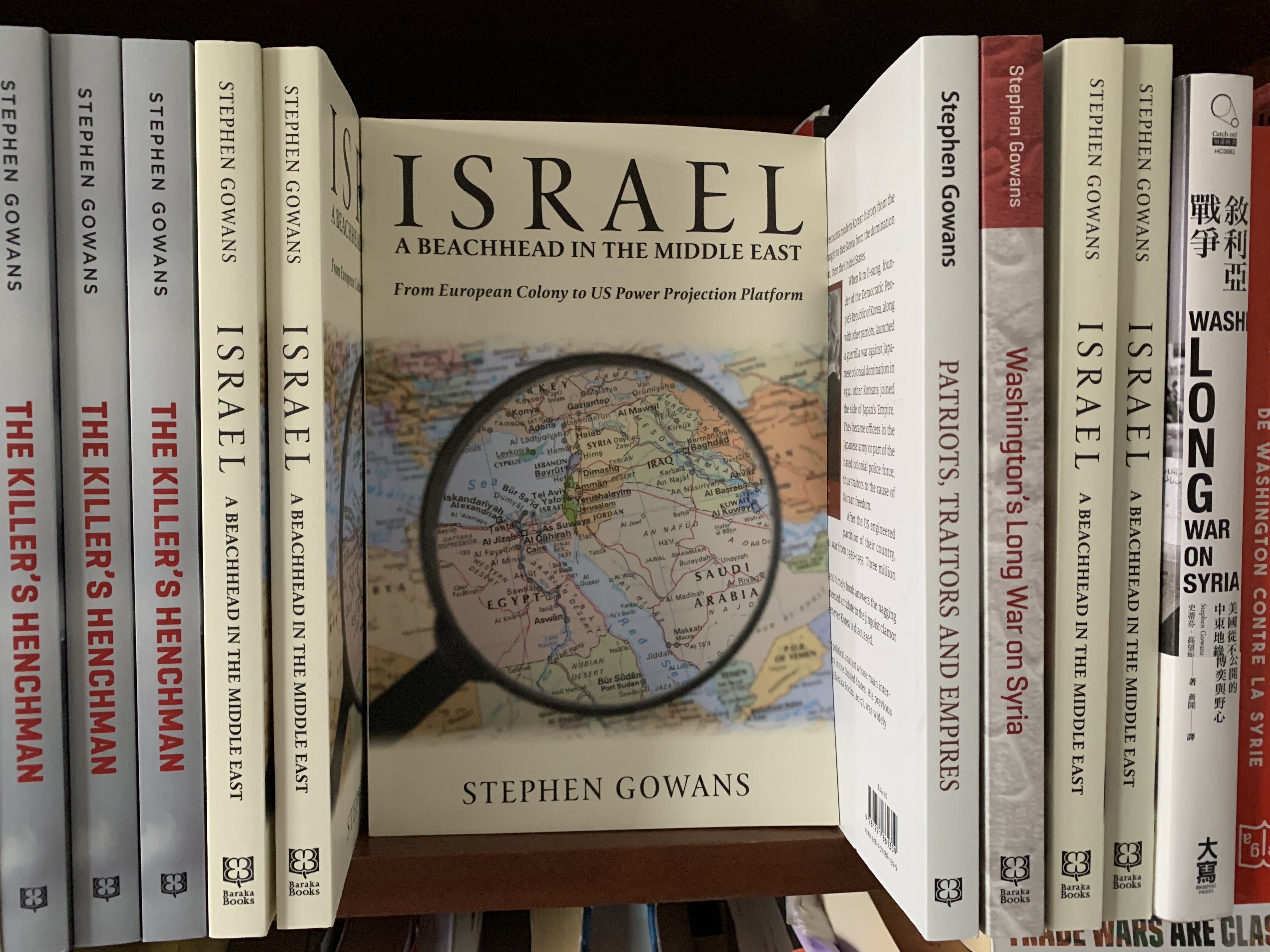
A Canadian diplomat once described Israel as an outpost “in the Eastern Mediterranean with close economic and cultural ties with the West generally and in particular with the United States.” Owing to these ties, it is the ideal candidate to assert US strategic interests in its region. As the late US Senator Jesse Helms, Chairman from 1995 to 2001 of the Senate Committee on Foreign Relations, remarked: “The United States has vital strategic interests in the Middle East, and it is imperative that we have a reliable ally whom we can trust, one who shares our goals and values. Israel is the only state in the Middle East that fits that bill.” What Helms meant by “vital US strategic goals,” is goals that comport with the interests of his class, not the interests of the larger subordinate class of which most US citizens are members.
Now, some would argue that Washington’s foreign policy is controlled by “the Israel lobby,” a group of Christian and Jewish Zionists who advance Israeli goals at the expense of US interests. To be sure, the Israel lobby has enormous influence in Washington, but key parts of this argument—articulated by political scientists John Mearsheimer and Stephen Walt—are often left unexamined.
- When we say “US interests”, whose interests do we mean? Those of the bulk of the US population, or those of the approximately one percent of the population that owns and controls the economy and dominates the state (including the Senate)? (Mearsheimer and Walt see only one undifferentiated US interest, unmediated by class.)
- Are the interests of the bulk of the US population at odds with the Zionist interests of Israel?
- Do the interests of the US plutocracy mesh with the Zionist aims of the Jewish settler colonial state?
I would argue that US economic, military, and diplomatic support of Israel is at variance with the interests of the vast majority of US citizens (and therefore would agree with Mearsheimer and Walt, so far as they define “US interests” as the class interests of most US citizens—those of the employee class—as distinct from those of the US economic elite.) At the same time, I would argue that the interests of the US capitalist class mesh well with Zionist interests.
Significantly, the “Israel lobby” is largely made up of major US investors and the top CEOs of the United States’ leading companies. The group of Israel-zealots that Mearsheimer and Walt argue have highjacked US foreign policy, happen to be the elite of US capitalism, according to research by Laurence H. Shoup, whose has specialized in examining the contours of the US ruling class. If the Israel lobby has hijacked US foreign policy, then so too have the leaders of corporate America taken control of the levers of the US Departments of State, National Defense, and Treasury, along with the posts of National Intelligence Director and Ambassador to the UN. Shoup and others have shown that these key posts have long been dominated by the US capitalist elite. The Israel lobby exists, but it is a subset of the corporate lobby, a fact that points to a commonality of interest between the US capitalist class and its outpost in West Asia.
How are US capitalist and Israeli interests alike?
First, it should be noted that Israel is completely dependent on the United States. It could not survive without:
- US military and economic subsidies, and US guarantees that the Israeli military will be equipped with a qualitative military edge over every other state in its region.
- Unwavering diplomatic support, that allows Israel to act unconstrained by international law and over the objections of international public opinion and the expostulations of the states of the world, including US subordinates, without fear of penalty. (There are two roque states in the world: Israel and the United States. The former acts under the aegis of the latter and the latter under the aegis of its immense power.)
These supports are necessary because Israel is a tiny country, both geographically and demographically, which cannot survive on its own in the middle of a much larger Arab nation, whose enmity is directly traceable to Zionist settler colonialism. Israel’s founding fathers, and “its first leaders worried greatly that without alliances with stronger regional and global powers, the Zionist project would fail.” Today, Israelis acknowledge that the backing of the United States is one reason Israel has survived.
As a consequence of its dependence on the United States, the embattled Zionist state has no option but to pursue US goals as a condition of continuing to receive US support. The US goals it pursues include suppressing any force that might attempt to bring the region’s energy resources under local control for the purpose of uplifting the local population at the expense of aggrandizing the interests of US investors and oil companies and denying Washington control of West Asia, thereby negating US strategic leverage over China, Japan, and Western Europe. Moshe Dayan, an Israeli chief of defense staff, minister of defense, and minister of foreign affairs, is reputed to have said that Israel’s mission is “to be a rock, an extension of the West, against which the waves of…Arab nationalism will be broken.” Echoing Dayan, Israel’s current prime minister, Benjamin Netanyahu, wrote in 1998 that Israel acts as “the West’s policeman in the Middle East.” Referring to states in West Asia that are keen to assert their independence as “militant regimes”, Netanyahu declared that Israel’s role is to “safeguard the broader interests of peace” since no other state in the region can be relied on by Washington to check either the militant states’ “ambitions or obsessive plans for armament.” Safeguarding the broader interests of peace means safeguarding the status quo of US power in West Asia.
This is the fundamental quid-pro-quo of the US-Israeli relationship: Israel helps Washington stop the emergence of another Mohammad Mosaddegh, Gamal-Abdel Nasser, Colonel Gaddafi, Saddam Hussein, or Hafez or Bashar al-Assad—nationalist leaders who sought to put the interests of their own people above US capitalist class strategic interests and those of US oil companies and investors—and Washington provides Israel with the resources it needs to remain a viable state in West Asia.
It should be added, however, that Washington hardly needs to compel Israel to vigorously oppose West Asia’s nationalists. Whether expressed overtly, as a secular movement under an national liberationist label, or whether it lurks inside Islamist states or movements, like the Islamic Republic of Iran, Hezbollah, Hamas, and Ansar Allah, West Asian national liberation is irreconcilable with Zionism. The two movements are mutually antagonistic. Israel and the US capitalist elite, thus, share a common enemy. Both parties seek to despoil the peoples of West Asia of their land, labor, and resources, and West Asian nationalist forces seek to overcome the despoliation. To secure both Zionist and US capitalist class goals, West Asian nationalist movements must be crushed or at the very least contained. This makes US plutocrats and Israeli Zionists natural allies.
Adam Hanief, Robert Knox, and Rafeef Ziadah make this point well in their pamphlet Resisting Erasure: Capital, Imperialism and Race in Palestine. They write:
[S]ettler colonies are … typically highly militarized and violent societies, which tend to be reliant upon external support in order to maintain their material privileges in a hostile regional environment. … For this reason, settler colonies are much more dependable partners of Western imperial interests than ‘normal’ client states. In the Middle East, for instance, Arab governments supported by the US (such as today’s Egypt, Jordan, and Morocco) face repeated challenges from political movements within their own borders and are always forced to accommodate and respond to pressures coming from below. This is different from Israel, where the majority of the population views their interests and privileges as dependent upon continued outside support.
In upholding the interests of their class, US senators, then, naturally defend Israel, because it is a US instrument for the fulfillment of a common US capitalist class – Zionist project of dominating West Asia. Israel’s character as a settler colony — from which flows its: multifarious familial, social, cultural, and economic ties to the United States; it’s violent, militaristic character; its complete dependence on US aid and support to survive; and its shared opposition with the US capitalist elite to West Asian national liberation — makes it the ideal candidate to represent US imperialist interests in West Asia.
Given who senators are, and their position at the apex—and as the beneficiaries—of the US capitalist system, it is unthinkable that they would exhibit even the slightest degree of solidarity with the enemies of their class and the targets of their exploitation. We can express outrage that only one senator has even acknowledged the Zionist genocide against the Palestinians, but to do so would fail to recognize the capitalist reality of the United States and its governing class. Expecting senators to concede that a genocide is underway, to say nothing of condemning it and acting to stop it, is tantamount to expecting wolves to become vegetarians.
As for Bernie Sanders, his reluctantly conceding that his beloved Israel is carrying out a genocide against the Palestinians confirms what is already obvious: he is no socialist. Socialists do not defend settler colonialism, apologize for apartheid, or tolerate Zionism. Nor do they uphold the status quo of Israeli oppression of the Palestinians by arguing that Israel has a right to defend itself. (Israeli Zionists have no more right to defend themselves than slave-owners have the right to defend themselves against the uprising of their slaves.) And socialists certainly don’t vote for the continued delivery of arms to genocidaires, in the form of “defensive” weaponry, a sophism that obfuscates the reality that “defensive” weapons have a utility equal to offensive weapons in maintaining Israel’s regime of Jewish supremacy. Would a socialist advocate the provisioning of “defensive” weapons to slave-owners to defend themselves from the uprisings of their slaves? As a socialist Bernie is a fraud. As a senator, committed—with the rest of the Senate—to defending the interests of the US capitalist class and its overseas outposts, he’s more believable.
 What's Left