Holiday Reading on Zimbabwe

With the holidays fast approaching, you may find yourself with time to get in some extra reading. If you’re interested in why the US and Britain are dead set on dumping Zimbabwe’s President Robert Mugabe, you may want to give these books, articles and commentary a try.

While it has been available since 2006, Gregory Elich’s Strange Liberators: Militarism, Mayhem and the Pursuit of Profit is one of the best treatments of Zimbabwe around. Anyone looking for a thoughtful, critical and evidence-based understanding of Zimbabwe’s place in international politics (hard to find these days) should pick up Elich’s book.

Solidly ensconced at the other end of the spectrum is Abdiel’s Book of Demonology. Abdiel is a true believer who has rejected the inconvenience of having to think critically for the warm comforts of the absolutes of a new secular religion – one which features Robert Mugabe as the Prince of Darkness and a Jesus who bears a vague resemblance to Leon Trotsky. If you’re one of Abdiel’s co-religionists, steer clear of Elich’s brain-hurter. It’s tough slogging. Too many facts.

Instead, track down one of Pope Patrick Bond’s many homilies, written from his strategic coign of vantage just across the Limpopo River. Sing the old hymns. “Deliver Us From Mugabe,” “What a Friend We Have in the US-Funded “Independent’ Left,” And “Hark! The Independent Media Sings.”

Those who have a fondness for Ian Fleming novels, will want to curl up with one of Keith Harmon Snow’s tales of international intrigue and mystery.

The novelist’s latest potboiler, set in Zimbabwe, has Robert Mugabe being brought to power by an international conspiracy led by the British Croesus John Bredenkamp. Bredenkamp initially conspires to put the Rhodesian ship of state into Mugabe’s hands, but his plans go terribly awry when Mugabe successfully leads a national liberation struggle.

Snow follows Mugabe’s years in power. By rejecting the IMF, expropriating and redistributing land and setting out to indigenize the economy, Mugabe tricks the British and US governments into believing he’s an anti-imperialist.

(In an interstitial chapter, the author explains how, by writing Mien Kampf, whipping up nationalist fervor, and setting out to destroy Communism, Hitler gulled the world into believing he was a fascist.)

When a B-52 runs into trouble off the coast of Somalia and drops its nuclear payload into the sea, Bredenkamp launches a mission to retrieve the weapons. Fearing Mugabe is conspiring with Bredenkamp to hold the world to nuclear ransom for a million, kajillion dollars, the Americans declare Mugabe to be one of their most wanted. “That is why Mubage is under attack,” explains private investigator Keifer Snow Flake, the novel’s protagonist. “He’s too close to Bredenkamp. It’s really Bredenkamp they want.”

This is the first installment of a planned Zimbabwe trilogy by the novelist fans affectionately call Snow Job. In the second book, Bredenkamp and Mugabe hole up in Dr. Evil’s secret lair, and come face to face with Austin Powers, international man of mystery. In the trilogy’s final installment, the evil duo hijack a space shuttle the Americans have been secretly running to Mars, and meet up with the novelist himself at his Martian headquarters.

So, three choices for those interested in Zimbabwe this holiday season.

For escapist fiction: Keith Harmon Snow.

For the fictions of religion: Abdiel and Pope Bond.

For down-to-earth critical analysis: Gregory Elich.

New Imperialism, Old Justifications

The old imperialism, backed up by an old set of racist justifications, is back in fashion.

By Stephen Gowans

British politicians say Britons must stop apologizing, and start celebrating, their imperial past. Conservative historians say Africa was better off under British rule. Top political advisors promote renewed colonialism as a solution to Africa’s problems. Journalists write nostalgically about “the lost paradise of the big white chief” (Rhodesia’s Ian Smith) and point to the descent of Zimbabwe into economic chaos as a cautionary tale about what happens when enlightened white administration is ceded to benighted, corrupt natives.

“Barely a generation after the ignominious end of the British empire,” observes Guardian columnist Seamus Milne, “there is now a quiet but concerted drive to rehabilitate it, by influential newspapers, conservative academics, and at the highest level of government.” (1)

Why has the drive occurred?

One reason is that intervention in other countries is now more of a possibility than it was three decades ago when the Soviet Union was still around. Jonathan Powell, former British Prime Minister Tony Blair’s longtime chief of staff, argues that Britain should not fear to intervene in Zimbabwe and Myanmar to defend “our interests” and promote “our values” because “intervening in another country no longer risks tipping the two superpowers into global war, because there is only one superpower.” (2)

The other reason is because the structural compulsion to exploit other countries economically has never gone away.

With the compulsion still there, and a major deterrent to exercising it gone, an ideology is needed to justify it.

The Ideology

“In the Ancient world, order meant empire,” observes the man who served as Blair’s foreign policy guru, Robert Cooper. “Those within the empire had order, culture and civilization. Outside it lay barbarians, chaos and disorder.” (3)

Today chaos is found in what Cooper classifies as “pre-modern states” — “often former colonies – whose failures have led to a Hobbesian war of all against all.” (4)

Writer Peter Godwin thinks the chaos in pre-modern states is attributable to Britain abandoning its colonies. “The disengagement from Africa was irresponsible,” he writes. It was “little more than a hasty jettisoning of colonies, however ill-prepared they were for self-rule, and a virtual guarantee that they would fail as autonomous states.” (5)

British historian Andrew Roberts echoes Godwin’s reasoning. “Africa,” he says, “has never known better times than during British rule.” (6)

Top politicians also seem to agree. Gordon Brown sprang to the defense of Britain’s colonial record in Africa after South Africa’s President Thabo Mbeki justifiably complained about British imperialists “doing terrible things wherever they went.” Brown, then chancellor of the exchequer, used a trip to former British colony Tanzania to declare that “the days of Britain having to apologize for its colonial history are over,” and that “we should celebrate much of our past, rather than apologize for it.” (7)

Godwin points specifically to Zimbabwe to make the case that Africa was better off under white rule. “The terrible situation in Zimbabwe,” he writes, “today conforms in many ways to the worst of everything Ian Smith had feared of black majority rule, and is the very specter that inspired him to fight so hard to prevent it.” (8)

The Telegraph’s Graham Boynton seconds Godwin’s point, arguing that Ian Smith, who said blacks could never rule themselves successfully, “has sadly been proved right.” (9)

“Today, Zimbabwe is a failed state with a non-functioning economy, a once flourishing agricultural sector now moribund, and a population on the brink of starvation….So much for liberation.” (10)

If Boynton and his empire-nostalgics are to be believed, the natives can’t be trusted to run their own affairs. But there are many other places bedeviled by war, poverty, misery and chaos that are never pointed to as crying “out for the sort of enlightened foreign administration once provided by self-confident Englishmen in jodhpurs and pith helmets,” as former Wall St. Journal editor, Max Boot, once put it. (11)

One such troubled land is Ethiopia. Its army invaded Somalia, contrary to the UN Charter (a crime on par with Iraq’s invasion of Kuwait), and is fighting an anti-insurgency war in the Ogaden region of the country that has provoked a humanitarian disaster. The country’s leader, Meles Zenawi, jails political opponents, threatens them with the death sentence, limits press freedom, and has been accused of rigging elections.

Ethiopia sounds like one of Cooper’s pre-modern states, complete with a Hobbesian war of all against all raging within its bosom. But Ethiopia — which receives hundreds of millions of dollars in military aid from the US and Britain — is not on the empire-nostalgics’ radar screen. Could it be that the “failed” states empire-boosters say need to be brought under the wing of enlightened Western rule are simply states that aren’t doing the West’s bidding? Is it chaos, or independence, that’s the problem?

Iraq, too, is a troubled land, one for which the idea of a Hobbesian war of all against all seems especially fitting. And yet chaos in Iraq is a product of the “enlightened” Western rule people like Max Boot call for.

The Solution

“The most logical way to deal with chaos, and the one employed most often in the past, is colonization,” writes Cooper boldly. Today, colonialism needs to be practiced as “a new kind of imperialism…an imperialism which aims to bring order and organization.” (12)

Cooper sets out his case in an article titled “Why we still need empires.”

“The postmodern world has to start to get used to double standards. Among ourselves, we operate on the basis of laws and open cooperative security. But, when dealing with old-fashioned states outside the postmodern continent of Europe, we need to revert of the rougher methods of an earlier era – force, pre-emptive attack, deception, whatever is necessary to deal with those who still live in the nineteenth century world of every state for itself. Among ourselves, we keep the law but when we are operating in the jungle, we must also use the laws of the jungle.” (13)

That the rougher methods of an earlier era have already been deployed against Zimbabwe is fairly obvious. The US, Britain and other “postmodern” states organize, fund and provide support to civil society groups within and outside Zimbabwe to bring down the Mugabe government. In place of the current government, Britain seeks a new government willing to accommodate “our values” and “our interests.”

As prime minister, Tony Blair even went so far as to privately argue for an invasion of Zimbabwe, but the head of the armed forces, General Sir Charles Guthrie, counseled Blair against it. You’d lose too many African allies, he warned. (14)

The Nazi Theory of International Relations

While Cooper seeks to give a pleasing gloss to his “we still need empires” view, it is at odds with the foundations of post-war international law. More than that, it is tantamount to the Nazi’s theory of international relations.

The Nuremberg Tribunal’s affirmation “of national sovereignty as the cornerstone of the international system…stood in marked contrast to the political philosophy of the Nazis, who had treated the concept of state sovereignty with contempt,” explains John Laughland.

Any state that intends to intervene in the affairs of other states for the purpose of dominating them will, naturally, express contempt for national sovereignty. This, NATO, and other “postmodern” states, began to do so in the run up to the 1999 bombing of Yugoslavia – and have been doing so since.

“One can say,” adds Laughland, “that the commitment to non-interference in the internal affairs of states…is an attempt to institutionalize an anti-fascist theory of international relations.” (15) By the same token, an attempt to establish a justification for forcibly re-imposing colonial domination on independent Third World countries is an attempt to revivify a Nazi theory.

If you’re going to knock down the doors of other countries, you have to find some pretty reasons for doing so. People like Cooper, Roberts, Max Boot in the US, and liberals like Michael Ignatieff, are only too happy to supply the justification.

Our Interests and Values?

The imperial ideologues always eventually get around to pinning the necessity of the new imperialism on the pursuit of “our interests” and “our values,” implying that the interests of everyone in the West are common and that our values (also assumed to be homogeneous) have something vaguely to do with human rights. But are the interests of a bus driver in Liverpool the same as those of a London investment banker who collects board appointments? Which of these two has the greatest chance of shaping British foreign policy?

In a certain sense it is true that we all share interests in common. We share an interest in being free from violence. Pro-imperial ideologues cite this interest to justify the unapologetic resurrection of open imperialism. Unless we bring the war to them, they’ll bring the war to us. Unless we impose order, chaos will spread.

This is a good argument, if you’re trying to sell a Nazi theory of international relations. But it’s more likely that “our interests” and “our values” refer to the interests and values of the economic class that has a firm grip on the media and state. It’s not our interests and values that are being pursued, but theirs.

Investors, financial houses and corporations – tied to the media, universities and state in a thousand different ways — suck mountains of profits out of Third World countries. They have an interest in a muscular foreign policy to safeguard their investments and to open doors that have been closed by communist, socialist and economic nationalist governments that pursue social improvement, rather than foreign investment-friendly, objectives. Is it any surprise, then, that the media, conservative academics and state officials are rehabilitating colonialism?

In an article on Ian Smith in the Sunday Times, RW Johnson draws an invidious comparison between Smith’s Rhodesia and Mugabe’s Zimbabwe. Smith, he tells us, had “run the country and economy surprisingly well in the face of tough international sanctions,” unlike Mugabe, who has presided over an economy that has faltered under the weight of sanctions.

When “Mugabe gained power in 1980, Smith…rolled up every day at Government House to offer his help” and “Mugabe was delighted to accept” it. Significantly, “the two men worked happily together for some time, until one day Mugabe announced plans for sweeping nationalization. Smith told him bluntly he thought this a mistake. Their cooperation ended on the spot.” (16) And Zimbabwe, we’re to believe, from that point forward, began its descent into economic chaos.

In a certain respect, this is true. Britain, which still dominated Zimbabwe’s economy, had no truck for Mugabe’s nationalizations, and nor for his refusal to follow IMF prescriptions or his expropriation of farm land. These sins against private property — which Smith would have steered clear of — set off Britain’s resort to the rougher methods of an earlier era to push Mugabe aside. Along with its imperialist senior partner, the United States, Britain schemed to make Zimbabwe’s economy scream, hoping to galvanize Zimbabweans to throw Mugabe out of office, either at the polls or in the streets. Drought and region-wide energy shortages helped crank up the misery.

But what was the real problem? That Mugabe, as a black man, was too stupid to know how to run the country? Or that Mugabe took on white economic interests?

Conclusion

Politicians, journalists and academics, have launched an ideological assault to justify a new imperialism — an aggressive and expansionary foreign policy whose aim is to bring to heel countries resisting integration into the Anglo-American orbit.

Under the “enlightened” domination of the US and Britain these countries will be expected to open their doors to foreign investment, privatize state-owned enterprises, tear down tariff walls, and rescind performance requirements on foreign firms. Above all, they’ll be expected to respect the property Western investors and the decendants of white settlers lay claim to.

The assault is based on two deceptions.

The first is that that Englishmen in jodhpurs and pith helmets once provided enlightened administration. The second is that we need (an American-led) empire to impose organization and order on chaos.

But much of the chaos in the Third World is a product of, not a reason for, Western intervention. Iraq was once a thriving modern secular state, until Anglo-American imperialism visited upon it chaos of unprecedented scope.

“We hear a lot about the rule of law, incorruptible government and economic progress, but the reality was tyranny, oppression, poverty and the unnecessary deaths of countless millions of human beings,” points out Cambridge historian Richard Drayton. (17)

And so it goes.

1. Seamus Milne, “New Labour, Old Britain,” Le Monde Diplomatique, May 2005
2. Jonathan Powell, “Why the West should not fear to intervene,” Observer, November 18, 2007
3. Robert Cooper, “Why we still need empires,” The Observer, April 7, 2002
4. Cooper
5. Peter Godwin, “If only Ian Smith had shown some imagination, then more of his people might live at peace,” The Observer, November 25, 2007
6. Quoted in Milne
7. Daily Mail, January 15, 2005
8. Godwin
9. Graham Boynton, “Ian Smith has sadly been proved right,” Telegraph, November 25, 2007
10. Ibid
11. Max Boot, “The case for American empire,” The Weekly Standard, October 15, 2001
12. Cooper
13. Ibid
14. Milne; Agence France Presse, November 21, 2007
15. John Laughland, Travesty: The Trial of Slobodan Milosevic and the Corruption of International Justice, Pluto Press, 2007, p. 66
16. RW Johnson, “Lost paradise of the big white chief”, The Sunday Times, November 25, 2007
17. Quoted in Milne

Inversion of Perspective

By Stephen Gowans

According to today’s Washington Post “nearly three weeks after (Pakistan’s President Pervez) Musharraf declared emergency rule, sacked members of the Supreme Court and began a roundup of journalists, lawyers and human rights activists” George Bush said that Musharraf “truly is somebody who believes in democracy.”

Also today, The New York Times ran an obituary of Ian Smith, the former prime minister of apartheid Rhodesia, suggesting that compared to Mugabe, Smith wasn’t such a bad fellow after all.

You’d get the impression from the Times obituary that Smith and Mugabe are cut from the same repressive cloth, only Smith (a white man) knew how to run the economy while Mugabe (a black man) doesn’t.

“Political opposition to Mr. Mugabe’s regime has been suppressed with the same zeal as Mr. Smith himself once displayed in the fight against African nationalist strivings for majority rule,” the obituary says, with a breathtaking blindness to the true nature of the Smith regime.

Smith, as prime minister of an apartheid government, jailed Mugabe, but Mugabe, as president of an independent Zimbabwe, allowed Smith to go about his business, a free man, who continued to farm freely on two estates. If Mugabe was running a black supremacist apartheid state that oppressed whites and killed those who resisted, he would have long ago been hauled before a Western war crimes tribunal and shown the hangman’s noose.

Mugabe drew attention to this when he addressed the 62nd session of the UN General Assembly in September.

“Ian Smith is responsible for the death of well over 50,000 of my people. I bear scars of his tyranny which Britain and America condoned. I meet his victims everyday. Yet he walks free. He farms free. He talks freely, associates freely under a black government. We taught him democracy. We gave him back his humanity.

“He would have faced a different fate here (in the US) and in Europe if the 50,000 he killed were Europeans. Africa has not called for a Nuremberg trial against the white world which committed heinous crimes against its own humanity.

“It has not hunted perpetrators of this genocide, many of whom live to this day, nor has it got reparations from those who offended against it. Instead, it is Africa which is in the dock, facing trial from the same world that persecuted it for centuries.”

Smith was a racist to the end and the Times obituary gave him a platform to promote the ideology of white (Western) rule over Africa from the grave.

“I’m pleasantly surprised at the number of people who come to me and say, when you were in the chair, we thought you were too inflexible and unbending; we now see that you were right,” (about blacks being unable to manage their own affairs) he’s quoted as saying.

The obituary ends with Smith telling us that “There are millions of black people who say things were better when I was in control. I have challenged Mugabe to walk down the street with me and see who has most support. I have much better relations with black people than he does.”

When the New African magazine carried out a public opinion poll asking who the greatest Africans were, Smith’s name, not surprisingly, didn’t come up. Mugabe was ranked third, behind Nelson Mandela and Kwame Nkrumah.

So, what are we to make of this?

The West’s newspaper of record intimates that Smith and Mugabe share an equal brutality, but that the country was better off under Smith.

Musharraf truly does what Mugabe is only accused of doing, but, all the same, is rewarded with over $10 billion in US aid and is called someone who truly believes in democracy.

Musharraf (who Pakistanis call Busharraf for a reason) is acting as Washington’s strongman in Pakistan, promoting the project of Western domination. Mugabe, who would never be called Bush’s or Brown’s strongman, (except by certain leftist groups suffering from collective detachment from reality) is doing the opposite. For this crime against privileged interests in the West, he’s called the leader of a brutal regime.

It would be truly surprising if the local collaborators with Western imperialism weren’t rewarded with aid and honors, and equally surprising if fighters against Western imperialism weren’t vilified by West’s state officials and mimetic media.

Musharraf is a brutal dictator. Smith was a vile racist. Mugabe is neither of these things.

Looking For Evil In All The Wrong Places

There are dozens of US client states whose leaders fit the description “cruel dictator” who most people don’t know rig elections, jail opponents, close newspapers and start wars. On the other hand, there are a few leaders, invariably elected, who preside over governments that pursue traditional leftist goals of socialism or escape from neo-colonialism or both who many people understand incorrectly to be cruel dictators (Hugo Chavez, Fidel Castro, Alexander Lukashenko, Mahmoud Ahmadinejad, Robert Mugabe.) Government officials, news media and even many leftists in the West reserve the term cruel dictator for the opponents of imperialism, while saying virtually nothing about the real dictators who defend and promote Western strategic and economic interests at the expense of their own people. This essay focuses on Robert Mugabe, one leader the West vilifies as a cruel dictator, and compares the accusations made against him with the records of such US allies as Hosni Mubarak, Meles Zenawi, Gloria Macapagal Arroyo, Mikheil Saakashvili and Pervez Musharraf.

By Stephen Gowans

The government of Zimbabwe’s Robert Mugabe is accused by Western governments and assorted left-wing groups of breaching the civil and political liberties of Zimbabweans and of operating a human rights horror show. Were all of the accusations against Mugabe’s government true, Harare’s actions would still pale in comparison to those of scores of other governments that imperialist powers support and the anti-Mugabe left says nothing about. While the left critics of Mugabe are vociferous in their condemnation of the Zimbabwean president, and prepared to accept uncritically all damning accusations against him, they remain virtually silent on the grave assaults on civil and political liberties carried out by US client states.

The charge sheet against Mugabe includes intimidation of political opponents, restrictions on press freedoms and electoral fraud. But there are dozens of US client states whose leaders steal elections, shut down newspapers, arrest bloggers, jail opposition leaders and ban opposition political parties. These assaults on civil and political liberties are as grave, if not graver, than anything the Mugabe government has been accused of, and yet the leaders of these governments are not widely vilified in the West (though they are in their own countries.) The point, here, is not to engage in apologetics by saying that even if we assume all the charges against Mugabe are true his actions are still minor in comparison to those of scores of other governments, but to ask why imperialist powers, their media, and assorted left-wing groups remain virtually silent on the grave human rights violations committed by scores of other governments. Why Mugabe and not Seles or Mubarak?

North Africa

Those who rail against Mugabe as Africa’s great anti-democratic Satan appear to have failed to recognize that, in every country in north Africa, Islamist opposition parties have been banned. Significantly, these parties are acknowledged to be sufficiently popular to win large parliamentary blocs, if not outright majorities. (1) While Mugabe is accused of using the state to intimidate Zimbabwe’s main opposition party, he has never banned it, though some would say as a Western-created and funded organization, Zimbabwe’s Movement for Democratic Change, the MDC, ought to be banned. The MDC was cobbled together through funding provided by the Westminster Foundation for Democracy, the British equivalent of the US National Endowment for Democracy. The NED does overtly what the CIA used to covertly (i.e., destabilize foreign governments.) Both the Bush administration and the British government acknowledge that they are working with the opposition to bring down the Mugabe government. (2) Certainly, neither the US nor Britain would tolerate outside interference in their own electoral politics. Zimbabwe, held to a higher standard, is expected to, and does.

While Zimbabwe is sanctioned and demonized by the US, Egypt’s government, whose leader Hosni Mubarak rules with an iron fist, is showered with Washington’s largesse, and only occasionally shows up on the radar screens of the West’s anti-Mugabe left. Mubarak, and his son Gamal — who is expected to succeed his father as president, and not through means that would be considered fair in the West — are regarded by Egyptians as US lackeys. (3) Mubarak bans the Muslim Brotherhood, a party strong enough to unseat him, and by implication, to end US domination of Egypt. He also jails opposition figures, locks up bloggers who criticize him, but receives over $1 billion a year in US military aid. The US may present itself as the world’s champion of civil and political liberties, but it rewards dozens of states that severely limit formal political rights with billions of dollars in aid. In return, foreign strongmen keep their countries open to US trade and investment, carry out proxy wars on Washington’s behalf, and repress their own populations.

Late last year, Mubarak announced a full-scale retreat from the social security gains of the 50s and 60s. The socialist principles the country adopted in the 60s would be scrapped to establish conditions more favorable to the profit-making interests of US banks, corporations and investors. (4) This came in the wake of strides the government had already taken to impose neo-liberal reforms, which have seen illiteracy rise and social services crumble, in a country teeming with the poor.

The Muslim Brotherhood, banned since 1954, has moved in to fill the gaps left by the retreating state, setting up clinics, nurseries and after-school tutoring. (5) Hezbollah, in a similar way, has built support in southern Lebanon by providing social services the state won’t provide. Not surprisingly, the Muslim Brotherhood’s popularity has soared. Its members, running as independents, contested 161 seats in the 454 member Egyptian parliament, and won 88 of them. Mubarak countered by rounding up hundreds of party members (paralleling the Israeli practice of jailing Hamas legislators.)

The comparison with Zimbabwe is instructive. The MDC operates freely and has contested elections. But unlike the banned Muslim Brotherhood, the freely operating MDC favors a neo-liberal tyranny. This is no surprise, given the MDC’s connections to the dominant economic interests in Britain and the United States.

In September, an Egyptian “judge ordered a year’s hard labor for the editors of four leading opposition newspapers, saying they had made the ruling party, Mubarak, and his son Gamal, appear dictatorial.” (6) Had Mugabe jailed the editors of Zimbabwe’s opposition newspapers, complaining they had portrayed him as a dictator, the story would be blanketed across the Western media, state officials in the West would howl with outrage, and demands would be made for immediate intervention to turn back Mugabe’s intolerable tyranny. Soon after, three more opposition journalists were sentenced to two year prison terms for impugning Egypt’s justice system. On top of this, an Egyptian human rights organization was banned. One thousand of its members have been jailed over the past year. Perhaps all the indignation of newspaper editorial writers, Western state officials, and various left-wing groups was exhausted in denunciations of Mugabe. It certainly hasn’t been exhausted in denunciations of Mubarak.

Jordan

Jordan, a centralized monarchy with a largely ceremonial parliament, jailed government critic Toujan al-Faisal for criticizing the state’s auto-insurance policies. Author Ahmad Oweidi, who wrote e-mails critical of the government, was arrested for harming the government’s reputation. (7) By comparison, the Mugabe government not only tolerates critics but also tolerates those who openly call for its forcible removal. Hajia Aminata Sow, a retired Guinean jurist attended NGO meetings in Zimbabwe at which “speaker after speaker openly advocated for forcible removal of Mugabe’s government.” She was astonished the speakers weren’t arrested. (8) The principal leaders of the opposition routinely threaten violence to drive Mugabe from office, but nevertheless remain free to continue to call for insurrection. MDC faction leader Morgan Tsvangirai’s threats began early on, and have continued since. In 2000, he told Mugabe that if he didn’t step down peacefully, “we will remove you violently.” (9) The then Archbishop of Bulawayo Pius Ncube told the London Sunday Times that he thought “it is justified for Britain to raid Zimbabwe and remove Mugabe.” He complained that though he was ready “to lead the people, guns blazing” nobody was willing to follow him. (10) Last Easter, the Roman Catholic Church posted messages on church bulletin boards around the country calling on Mugabe to leave office or face “open revolt.” Mugabe’s failure to step down, the Church warned, would lead to bloodshed and a mass uprising. (11) Arthur Mutambara, leader of a breakaway MDC faction, pledged to “remove Robert Mugabe…with every tool at my disposal.” Asked what tools he was referring to, Mutambara replied, “We’re not going to rule out or in anything – the sky’s the limit.” (12) Unlike Jordanians Toujan al-Faisal and Ahmad Oweidi, who were jailed for merely criticizing their government, Tsvangairai, Ncube and Mutambara are free to issue threats to remove the Mugabe government through extra-constitutional means, to call on foreign powers to impose sanctions, and to importune a former colonial power to intervene militarily – a freedom few governments, including those in the West, are willing to grant. In light of revelations that Britain has considered attacking Zimbabwe on several occasions (13) and that the US is bankrolling opposition activities aimed at regime change (14) some measure of restriction on fifth column activities is wholly justified and is a necessary part of defending the gains of Zimbabwe’s program of breaking free of neo-colonial domination. If Mugabe is to be criticized, he should be criticized for allowing agents of imperialism too much latitude, not too little.

On top of the Jordanian government’s other affronts to civil and political liberties, it can be faulted for drawing electoral boundaries to favor rural areas in which support for pro-government parties is strong, threatening to ban election monitors, and ordering soldiers to vote for pro-government candidates. (15) Such blatant contempt for basic standards of representative democracy, displayed by the Mugabe government, would elicit howls of outrage from Whitehall and indignant editorials calling for immediate action, from an escalation of sanctions to military intervention. But Jordan, a US ally, can practice a tyranny that exceeds anything Mugabe is accused of, without comment. George Bush calls Mugabe’s government “a brutal regime.” (16) Washington’s March 2006 National Security Strategy refers to Zimbabwe as a “stronghold of tyranny.” Jordan, which fits these categories, is called neither of these things.

The Philippines

In the Philippines another US ally, president Gloria Macapagal-Arroyo, is waging an all-out war against communist militants. Karapatan, a Philippines human rights organization, has documented 900 cases of extra-judicial killings, in which the Philippine military has hunted down militants and summarily executed them. Human Rights Watch complains that in failing to prosecute members of the military implicated in the killings, Arroyo has failed to uphold international law. But the larger crime lies in the fact that an all-out war (i.e., one outside the rule of law) is being waged to eliminate a militant opposition. (17) Dispatching the military to take out members of a political opposition, even if it is a militant one, would be loudly decried as a heinous crime, meriting military intervention on humanitarian grounds, if undertaken by a leader of a country resisting imperialist domination. Were the Zimbabwean military to hunt down MDC militants for summary execution, there would be no end to the incensed cries for justice from the West. It’s no so outlandish to suggest a war crimes tribunal would be established, and the accused dragged before the court. Arroyo, however, can hunt down and exterminate as many militant opponents as she likes, with little fear anyone in the West will notice, and even less fear of being dragged before a tribunal. Tribunals are reserved for leaders who resist imperial domination, not accept, welcome and promote it.

In Zimbabwe, “there are frequent calls by the opposition party and its allied trade unions for street protests. Once, in what they termed as the ‘Final Push’, the opposition called for a march on the State House, the seat of government, for its overthrow. No government folds its arms in the face of such provocations. And when the police are used to restore law and order, it becomes a human rights violation.” (18) That is, in Zimbabwe and elsewhere outside the US imperial orbit. Inside, it becomes a justified police action to restore law and order.

The Mugabe government was roundly criticized earlier this year for a crackdown on demonstrators, especially when police beat Morgan Tsvangirai, who had tried to force his way past police lines into a police station. Demonstrations had been banned in the wake of several fire-bombing incidents, but the opposition chose to defy the ban. When the police moved in to disperse demonstrators, the opposition, predictably, cried foul, and the Western media, NGOs (funded by Western governments), opposition newspapers, and Western state officials echoed the cry.

Not too many weeks later, 900 German police officers swept down on 40 sites in half a dozen German cities in a “show of force against potentially violent demonstrators” who were planning to protest outside the G8 summit. German authorities said they were investigating 18 people they believed were planning fire-bombings. (19) Although clearly intended to intimidate a civil opposition movement, no hue and cry was raised at the heavy-handed tactics of the German police. The protests that accompanied the actions of Zimbabwe’s authorities were, however, deafening, even though actual, and not anticipated, fire-bombings had occurred in Zimbabwe. A show of force by 900 Zimbabwean police swooping down on hundreds of MDC activists to prevent possible fire-bombings would have been denounced by state officials, journalists and various left groups in the West as blatant political intimidation, the work of a strongman. The German incident passed virtually unnoticed.

Ethiopia and Somalia

The Meles government of Ethiopia receives hundreds of millions of dollars in military and humanitarian aid from the US and Britain. These injections have been used to build one of the largest and strongest armies in Africa, which stands ready to be deployed to enlarge and defend US and British economic and strategic interests in the Horn of Africa. Ethiopian forces invaded neighboring Somalia late last year at the behest of US officials, a blatant violation of international law on par with Iraq’s invasion of Kuwait, for which Ethiopia has not been censured at the UN, bombed by a coalition of the willing, or sanctioned by the international community. No one has denounced Meles as a strongman, said the world would be a better place without him, or deplored the humanitarian disaster the invasion has touched off. An estimated 850,000 Somalis have been displaced, almost one-tenth of the population. (20) The New York Times acknowledges that “the worst humanitarian crisis in Africa may not be unfolding in Darfur” but in Somalia. (21) The head of the United Nations humanitarian operations in Somalia complains that “if this were happening in Darfur, there would be a big fuss.” (22) But it’s not happening in Darfur, it’s happening in Somalia, as a result of an illegal invasion undertaken by Ethiopia, assisted by US military forces, and at the request of the United States. It’s for this reason there has been no big fuss. Washington had pushed for the invasion to oust a popular Islamist government Somalis had embraced and to restore the rule of the unpopular US-backed government that US firms had been planning undercover missions to support, with the full knowledge of the CIA. (23) For doing the West’s bidding in this and other ways, the murderous Meles was handpicked by then British Prime Minister Tony Blair to sit on Britain’s Commission for Africa, to lead the “African renaissance.”

Meles’ repugnant behavior goes further than this. Following Ethiopia’s May 2005 general election, which the opposition claimed was rigged, Ethiopian authorities opened fire on protesters, killing 193 people. Thousands of opposition supporters and leaders were rounded up and jailed. Meles asked that the death penalty be imposed on 38 opposition leaders, including the founder of the Ethiopian Human Rights Council, a former UN war crimes prosecutor and the mayor-elect of Addis Ababa. The court rejected Meles’ request, but imposed life sentences (overturned after the US, embarrassed by its client’s actions, intervened.)

Meles is all that Mugabe is accused of being, and more. He’s a strongman who rigs elections, and then beats, shoots at, jails and threatens to execute the opposition when it protests. He’s a war criminal. And he’s the architect of an unfolding humanitarian tragedy. Yet 99 percent of those who rail against Mugabe have never heard of Meles. How curious that Meles, whose government has engaged in far more repressive actions than any Mugabe has even been accused of, is showered with honors and aid, while Mugabe is treated as Africa’s version of Hitler. How curious that such patently silly charges as come from some fairly visible Western leftists can be made (among them that Mugabe is, appearances aside, an agent of imperialism ), while the same people have next to nothing to say about such conspicuous agents of imperialism as Meles and Mubarak.

Pakistan

Only recently, after Pakistan’s military ruler Pervez Musharraf invoked a state of emergency, has Western media coverage and left-wing commentary got around to lambasting Musharaff for his restrictions on civil and political liberties. Significantly, this sudden concern for human rights coincides with Washington’s realizing that Musharraf has lost control and bungled the war against militants on Afghanistan’s border. The Bush regime is making clear to Pakistan’s military, and in particular, to the favored successor to Musharraf, General Ashfaq Parvez Kayani, that the $1 billion in military aid it receives every year is in jeopardy, unless Musharraf is gently pushed aside. Washington would like a civilian president to be appointed to douse the flames of growing civil unrest, who would call for new elections. De facto power, however, would remain with the military, and, by implication, with Washington, through the leverage over Pakistan’s military its substantial military aid provides.

One would think the sudden flowering of concern for human rights in Pakistan is a reflection of Musharaff doing a sudden about-face, but the Pakistani strongman is doing nothing new. He has been arresting opposition activists and blocking transmission of TV coverage critical of his rule for some time, and he has been doing so with the full knowledge of his paymasters in Washington. (Pakistanis call their president Busharraf, an acknowledgement of Musharraf’s role as a proxy for Washington.) Even so, the various left-wing groups, and the Western media, who seem to know no limit when it comes to denouncing Mugabe’s government for imagined lapses, have been largely silent on the human rights violations of Musharraf’s government, until now. Now that it serves US interests to harp on Musharraf’s generous abridgment of liberties in Pakistan in order to justify his removal have the Western media and pro-imperialist left decided to loudly condemn Musharraf.

Press Freedom

While there are two state-owned newspapers in Zimbabwe, The Herald and Sunday Mail, most newspapers, including the Zimbabwe Independent, The Standard, Financial Gazette, The Zimbabwean and The Mail & Guardian of South Africa are pro-opposition and are sold freely on the streets. You would think, from the tales that are told about Zimbabwe, that there are no opposition newspapers and that they have all been closed by a tyrannical government that brooks no opposition. On the other hand, press freedoms are restricted in dozens of countries in which US strongmen rule as virtual dictators, and yet these affronts against freedom of the press are barely acknowledged, let alone condemned. This is another case of the Mugabe government being demonized for something it hasn’t done, while those who are actually engaged in practices the Mugabe government is accused of, get a pass because they are US client states.

The list of US allies that have jailed journalists or banned newspapers or both is endless. An impartial list, counting only recent crackdowns on press freedoms: Saudi Arabia, a human rights horror show if ever there was one, but one that rarely provokes much complaint from Western state officials, the media and the left groups that deplore the Mugabe government, recently banned a leading Arab newspaper, al-Hayat, because one of the newspaper’s columnists criticized the government.” (24) In September, Egypt’s Mubarak government sentenced four newspaper editors to one year jail sentences, and sentenced three journalists to two-year prison terms, because they criticized the government and made Mubarak look like a dictator. (25) In Georgia, the darling of the Rose Revolution, Mikheil Saakashvili, has moved to crush the Rose Revolution II, in part by violently closing down the country’s most popular television station, because, he said, it was fomenting a coup. (26) Predictably, the people power enthusiasts who thrilled at protests against US target governments in Serbia, Georgia, Ukraine and Zimbabwe, have shown no interest in the people power protests of Hezbollah supporters against the US-supported Lebanese government or of Georgians against Washington’s man in Tbilisi, Saakashvili. It seems that what represents a genuine expression of people power depends on whether it is instigated and bankrolled by the West and elevated to significance by the Western media.

Saakashvili deserves more attention from the anti-Mugabe left than he gets. The color revolution poster boy is described by many of the tens of thousands of demonstrators who marched against his government in early November in a way that is reminiscent of the picture the anti-Mugabe forces paint of Mugabe. He is described as “domineering and abrasive.” His opponents accuse him of “hoarding and abusing power, and of running the nation through a clique that will neither tolerate dissent nor engage in dialogue with the opposition, which Mr. Saakashvili has repeatedly made clear he despises and considers weak.” On top of that “the government also faces pressure from rising prices and lingering underemployment” and “economic conditions remain difficult enough that many Georgians travel abroad for work.” (27) Surely, those who thunder against Mugabe should be expressing their outraged indignation at Saakashvili, for, in the real world, Saakashvili is all they imagine Mugabe to be. Tony Blair’s chief of staff for 10 years, Jonathan Powell, says that Britain should intervene militarily in Zimbabwe, rather than standing back and watching Zimbabweans suffer. (28) He’s silent on Georgia.

Charges of Economic Mismanagement

On top of accusing Mugabe of rigging elections, repressing the opposition and stifling a free press, the Zimbabwean president is also accused of grossly mismanaging the Zimbabwean economy, turning the breadbasket of southern Africa into a basket-case. Even if you show that all the other accusations against Mugabe are gross hyperbole at best, and that there are dozens of other governments doing with impunity what Mugabe’s government is falsely accused of, one charge remains: Mugabe has wrecked Zimbabwe’s economy by carrying out a misguided land redistribution program.

There’s no doubt Zimbabwe is in the grips on an economic crisis. Food and electricity shortages plague the country. But not all of Zimbabwe’s economic problems are unique. In fact, many of its problems are part of a wider pattern of scarcity in sub-Saharan Africa. Last summer, The Washington Post (29) pointed out that “daily power outages are forcing Zimbabweans to light fires to cook and to heat water.” The result is that wood poaching has stripped nearly 500 acres of conservation woodland. But what the Post didn’t point out was that it’s not only Zimbabweans, but people throughout sub-Saharan Africa, who are stripping forests bare to provide heat and cooking fuel. (30) Because rolling power blackouts are depriving southern Africans of electricity to cook their food, they’re turning to wood fires. Drought, climbing oil prices, and the chaos caused by the privatization of formerly state-owned power companies have created an “unprecedented” power crisis that not only affects Zimbabwe, but Zambia, Nigeria, Angola, Mozambique, the Democratic Republic of Congo, Kenya, Uganda and Togo. Even South Africa was hit by rolling blackouts in January and sporadic power failures continue to bedevil the country.

But it is in Zimbabwe alone that the electricity shortages are attributed to economic mismanagement. The Washington Post noted that Zimbabwe’s “power, water, health and communications systems are collapsing,” and that “there are acute shortages of staple foods and gasoline.” These problems are attributed to economic mismanagement and Harare’s land reform policies. But acute food and gasoline shortages are common to neighboring countries. If Zimbabwe is short of gasoline, “Uganda’s gas stations are…short of diesel for vehicles.” (31) If there are shortages of food staples in Zimbabwe, there are close to two dozen other sub-Saharan countries that are contending with food scarcity, according to the UN’s Food and Agricultural Organization. Since neighboring countries have not pursued Zimbabwe’s fast track land reform policies, and have tended to shy away from the economic indigenization policies Harare favors, gasoline, electricity and food shortages can hardly be attributed to policies uniquely pursued by Harare.

Sanctions

The US and its Western allies use sanctions to pressure Zimbabwe to adopt policies that welcome, promote and defend foreign ownership. The former US ambassador to Zimbabwe, Christopher Dell, urged Mugabe to “implement the market reforms the IMF and others, including the United States, have been recommending.” Dell emphasized “the importance of a free-market economy and security of property,” which is to say, abandonment of the expropriation policies Harare has used to redistribute land to Africans. (32) It’s clear that sanctions would be lifted if Mugabe were to return Zimbabwe to neo-colonialism.

The sanctions, imposed by the US and EU, deny Zimbabwe access to international development aid. NGOs, following the Western governments that provide their funding, have also cut off assistance. These aren’t trade sanctions, but even so they have a devastating bite, making region-wide drought and the oil-price-rise-induced energy shortages more acute. It may seem as if Mugabe has mismanaged the economy, but Zimbabwe’s economic troubles are exogenous: drought and oil price increases, worsened by economic sanctions. In a pastoral letter issued last spring, 13 Anglican bishops and one canon of the Anglican Church, observed that Zimbabwe’s economic troubles have “been exacerbated by the economic sanctions imposed by the Western countries” which have “affected the poor Zimbabweans who have borne the brunt of the sanctions.” The clergymen called upon “the Western countries to lift the economic sanctions imposed on Zimbabwe.” (33) To paraphrase Tim Beal, who has followed the effects of sanctions on north Korea, sanctions have three great advantages for the West. They cause virtually no pain to Americans and Europeans, they produce no Western casualties, and the results – the misery of ordinary Zimbabweans – can be blamed on Mugabe, which in turn is produced as evidence the sanctions are desirable and necessary. (34)

Conclusion

Edward Herman points out that “in the real world, both Musharraf and the Shah of Iran fit comfortably the category of ‘cruel dictator,’ whereas (Iranian president Mahmoud) Ahmadinejad does not.” And yet when Ahmadinejad visited Columbia University this year he was a called a ‘cruel dictator’ by university president Lee Bollinger. When Musharraf visited Columbia, Bollinger showered the Pakistani strongman with praise, calling him “a leader of global importance” and gushed “it is rare we have a leader of his stature at campus.” (35) Likewise, while in the real world Musharraf, Mubarak and Seles fit the description of cruel dictators, Mugabe, who was elected in a contest the Southern African Development Community declared to be free and fair, does not. Still, if you polled 100 people who claim to be well-informed, 99 would, like Bollinger, echo a line that reflects the interests of Western powers in demonizing a leader who opposes “our interests” and “our values”, to borrow the rhetoric of Blair advisor Jonathan Powell. What it’s important to recognize is that “our” does not refer to you and me, but to the dominant economic interests of the US and Britain, who would profit from Mugabe adopting IMF reforms, a free market, and safeguarding the property rights (of foreign firms and descendants of European settlers.)

What Western state officials and the media who amplify their words say about Zimbabwe should be considered critically and treated with the skepticism that is due highly partial sources that have well-established records of making false accusations (Western governments) and uncritically propagating them (the Western media.) One need point no further than the weapons of mass destruction that never were to make the case that what the US and Britain say and the media passes on should be considered with a healthy dose of skepticism. In taking on the project of liberating the country from neo-colonial domination, the Mugabe government has challenged powerful interests in the West. We should expect that Western governments, Western news media and NGOs (which are funded by wealthy Westerners to promote their privileged interests under the guise of doing good works) to be hostile to the Mugabe government, and to portray it accordingly. By the same token, we should expect these same forces to portray the affronts against international law and civil and political liberties of states that act to defend and promote privileged interests in the West in a dispassionate, if not, apologetic manner, according them little notice. The Bollingers and Blairs of the world will continue to bestow honors and flattery upon cruel dictators who serve US and British interests, while reserving the label ‘cruel dictator’ for leaders of struggles against imperial domination. We need not follow the same pro-imperialist practice. Politicians, state officials, university presidents, CEOs, NGOs, and editorial writers are not politically neutral. When we mimic their positions on foreign affairs, we’re not showing solidarity with all oppressed people, though we might think we are in opposing the people dominant Western interests call ‘cruel dictators’. More often than not we’re showing solidarity with people who are accepting money from Western powers to oppose governments motivated by traditional leftist values of socialism or national liberation. At the same time, we’re failing to show solidarity with people oppressed by strongmen the US has brought to power to ensure Western corporate and financial interests prevail over the interests of local populations.

1. New York Times, April 15, 2007
2. Guardian, August 22, 2002
3. New York Times, September 20, 2006
4. Al-Ahram Weekly, February 21, 2007
5. Guardian, July 19, 2007
6. Washington Post, October 1, 2007
7. Los Angeles Times, August 14, 2007
8. Hajia Aminata Sow, “Zimbabwe: Burying the truth,” New African, November 2007
9. BBC, September 30, 2000
10. The Sunday Times, July 1, 2007
11. The Herald, April 15, 2007
12. Times Online, March 5, 2006
13. According to General Lord Charles Guthrie, The Sunday Mail, November 18, 2007
14. US State Department, “Supporting Human Rights and Democracy: The US Record, 2006”, http://www.state.gov/g/drl/rls/shrd/2006/
15. New York Times, November 11, 2007
16. Address to the United Nations General Assembly, September 25, 2007
17. New York Times, June 29, 2007
18. Hajia Aminata Sow
19. New York Times, May 10, 2007
20. Washington Post, November 14, 2007
21. New York Times, November 20, 2007
22. Ibid
23. New York Times, December 14, 2006; Observer, September 10, 2006
24. Financial Times, August 29, 2007
25. Washington Post, October 1, 2007
26. New York Times, November 8, 2007; New York Times, November 18, 2007
27. New York Times, November 3, 2007
28. Jonathan Powell, “Why the West should not fear to intervene,” Observer, November 18, 2007
29. July 28, 2007
30. New York Times, July 29, 2007
31. Ibid
32. Christopher Dell, “Response to Reserve Bank of Zimbabwe monetary policy statement,” February 7, 2007
33. Pastoral letter issued by 14 Anglican bishops and one canon of the Anglican Church, Province of Central Africa, April 12, 2007
34. Pyongyang Report, October, 2007, http://www.vuw.ac.nz/~caplabtb/dprk/pyr9_4.mht
35. “More Nuggets From A Nut House, reprinted from Z Magazine at http://www.globalresearch.ca, November 17, 2007

Blair’s Goebbels Justifies Wars of Aggression

The Nazis held the idea of national sovereignty in contempt and would have had little patience with a national sovereignty-based international law. The reasons are obvious. The Nazis needed to justify their wars of aggression and the idea of the inviolability of national sovereignty stood in the way.

In the following essay, Jonathan Powell, former British Prime Minister Tony Blair’s chief of staff for 10 years, embraces Nazi foreign policy, without actually mentioning (or recognizing) it’s Nazi foreign policy he’s embracing. He argues that military interventions in Yugoslavia, Afghanistan and Iraq were just, and that interventions elsewhere, including in Zimbabwe, would defend “our” interests and values, and should be pursued without hesitation.

Although he doesn’t say it, “our” does not refer to you and me, but to the dominant economic interests of the US and Britain, who have an interest in Zimbabwe’s President Robert Mugabe adopting IMF reforms, a free market, and safeguarding property rights. Likewise, NATO’s war of aggression on Yugoslavia served dominant Western economic interests in dismantling Yugoslavia’s socialism, while the conquest of Iraq serves US and British oil interests.

The problem is, it’s difficult to elicit popular support for a policy of plunder, despoliation, renewed colonialism and aggressive war. Imperialist aggression has to be dressed up in the rhetoric of a high moral mission, if the public’s consent, cooperation, and at minimum, acquiescence is to be secured. Goebbels played the role of investing Nazi imperialism with a moral gravitas. Powell does the same for Anglo-American imperialism.  

Why the West should not fear to intervene

Jonathan Powell
Sunday November 18, 2007

Observer
The principle of non-interference in other nations’ affairs was established by the Peace of Westphalia in 1648 and brought to an end the 30 Years War. Unprecedented devastation had been visited on the continent by armies trying to impose the Reformation or the Counter-Reformation on neighbouring states and the two sides had fought themselves to a draw. The monarchs of the day decided to bring these wars to a permanent end. In future, it would be OK to defend yourself against attack and OK to fight over territory or succession, but countries could no longer fight for ideas.

The principle of non-interference lasted through the succeeding centuries and was regularly invoked by the Soviet Union. We in the West used it as an excuse to avoid doing anything about the Hungarian Uprising or the Prague Spring. It was morally questionable but probably sensible in a nuclear-backed stand-off.

The world has changed since then. Intervening in another country no longer risks tipping the two superpowers into global war, because there is only one superpower. More important, the force of globalisation has changed the world. With 24-hour news, massive global travel and migration, the world has become a much smaller place.

So whether or not isolationism was ever sensible or moral, it is no longer practical. We can’t protect our industries from competition by erecting tariff barriers and we can’t protect our citizens from terrorist attack simply by better border controls. If we stand by while other peoples are brutally suppressed in other parts of the world, from Kosovo to Iraq, and if we turn a blind eye when countries disintegrate into anarchy, as we did in Afghanistan and Somalia, we will face the consequences at home. And that is why what is happening now in Pakistan is so important to us.

Let me look at the lessons to be drawn from the 10 years of the Blair administration and our four wars. First, Sierra Leone. We could hardly claim self-defence for our military action there. As it was a success, no one questioned its theoretical justification. Now, with a democratic change of government in Sierra Leone, and democratic government established in neighbouring Liberia, there is real hope for the people of that part of West Africa.

Kosovo was trickier. First, the Clinton administration did not want to deploy ground troops after what had happened in Somalia. We applied pressure because we believed, correctly, it was impossible to win the war from the air. They did the right thing and Milosevic crumbled. But we never managed to secure UN support for the war because of the Russian veto. No one in the West questioned that because the operation was a success.

Afghanistan, again, was not self-defence. The ultimatum to the Taliban was clear – give up al-Qaeda or we will topple your regime. And that is what the US did. This time, no one complained, even though the intervention has not yet been a sustained success.

Iraq was the most difficult, even if not very different theoretically from our other interventions. No one in their right mind would wish to see the blood-letting and chaos that is going on in Iraq today. There is no point in trying to pretend it is all a wonderful success. But equally, I don’t think there are many people in Iraq or the rest of the world who want Saddam back. There was, however, a problem with the justification of the invasion – the holding of weapons of mass destruction in breach of UN resolutions. We now know Saddam didn’t have them. But to suggest it was all a conspiracy between Tony Blair and George W Bush to pretend he did is nonsense. We believed he had them, as did pretty much every other government in the world, whatever they say now. We didn’t kit our troops up in chemical warfare suits in the desert every time a missile was fired just for fun. So suggesting it was all a matter of Alastair Campbell cobbling together a dossier to pretend there were weapons of mass destruction is nonsense.

We should have been clear we were removing Saddam because he was a ruthless dictator suppressing his people. But the lawyers said there was no legal basis for proceeding on these grounds, and so we were not able to make this case as wholeheartedly as I would have liked.

Next the UN. The argument goes that we should not have intervened without a second United Nations Security Council resolution. But we intervened in Kosovo without such a resolution. The two crucial differences from Afghanistan and Kosovo were that a) we could not get a majority of countries on our side and b) we were not successful on the ground.

One of the reasons we argued so hard for a second resolution and tried so hard to get countries such as Mexico and Chile on side was that we believed if things got difficult in Iraq, we would do much better if we had the balance of the international community with us. And it is clearly true that if we had secured that support, we would be in a different place today, with a major UN role in Iraq and majority support around the world.

So if success on the ground was one of the big differences with Kosovo, why were we so relatively unsuccessful in Iraq? The biggest failing in my view was not fully to understand the consequences of our intervention. When you remove a brutal dictator who has annihilated all opposition for 30 years, it is inevitable you will face a period of anarchy when he is gone. All the basics of an ordinary society and law and order are not there. And when you superimpose that on a country where the minority, the Sunni, have ruled the majority, the Shia, for centuries, and you are trying to replace that with a majoritarian regime, it takes a long time to shake out the problems.

Let me draw some lessons from our 10 years of experience. We need a rules-based system. As other big countries rise to be superpowers they will have very different value systems from us. So it is in the US interest, as it is in the interest of medium-sized powers like the UK, to have the rule of law applied internationally as it is domestically.

We need a strong and reformed UN Security Council with the addition of Japan, Germany, India and Brazil. We need to make sure we have effective alliances that allow intervention to be undertaken when it can’t be done by medium-sized countries like ours alone. That means working with France to develop effective European intervention forces. And most of all it means trying to ensure that the US does not revert to isolationism. If it withdraws into itself as it did after Vietnam and Somalia, I fear it will face another 9/11 and all the rest of us will suffer.

We need to be better prepared for the aftermath of intervention. We weren’t properly prepared in Kosovo, in Afghanistan or in Iraq. It is no good saying as Donald Rumsfeld did, ‘We don’t do nation building.’ That is exactly what we do need to be able to do.

In making the argument for interventionism, I am not suggesting we should go around invading countries willy-nilly. Tony Blair’s Chicago speech of 1998, in which he made the case for liberal interventionism, set out five conditions in which intervention may be appropriate and I think these still hold:

1. We need to be sure of our case. War is a very imperfect instrument for righting wrongs, but armed force is sometimes the only way of replacing dictatorships.
2. Have we exhausted all diplomatic options? We should always give peace every chance.
3. Are there practical and sensible military options? Sending gunboats to Zimbabwe won’t work.
4. Are we prepared for the long term? We talk about exit strategies, but we cannot just walk away when a fight is over.
5. Do we have national interests engaged? That does not mean oil, but do we promote our own security better by protecting the rights of others in a particular situation?

I think there are cases today where the application of those tests would lead to a more robust approach.

Take Burma. What about actually doing something about the obscene regime of the generals? Are we just spectators as the monks march and are killed? Of course, the primary responsibility lies in the hands of its neighbours, but we can do far more to encourage them to be more robust in their attitudes.

Or Zimbabwe? Mugabe can use anything we say or do to stir the dying embers of anti-colonialism. And again, the primary responsibility lies with its neighbours, particularly South Africa, but are we really saying we just have to watch while his people suffer?
What are we going to do in Iraq? The first thing is to recognise that the solution is political rather than military. Now the danger of the country splitting apart is past, it is the moment to concentrate on trying to get the Shia and Sunni to come to an accommodation. Once the Sunnis have come to terms with sharing power with the Shia, our task will be done. It is only when there is a political settlement that we will be able to leave.

In Iran, I am not in favour of a military option because I don’t think it is practical. No one is suggesting invading Iran to overthrow the regime. That is the task of the overwhelmingly young population that wants to be rid of the corrupt mullahs. The difficulty we face is one of timelines. The regime will be overthrown. And if there was a democratic and stable regime in place, I suppose, as in the case of India, we would not object so much to a nuclear-armed Iran. But we don’t know when it will be overthrown. In the meantime, they are developing nuclear weapons, helping attacks on our troops in Iraq and in Afghanistan and supporting Hizbollah and Hamas. Western policymakers have yet to come up with a way of dealing with these different timelines and I do not have the answer either, although I suspect it lies in a combination of sanctions targeted on the regime. There is nothing like measures that affect the bank accounts of the Republican Guard to get their attention quickly.

My former boss is fond of saying that the political divide that matters in the world now is not that between left and right but that between open and closed. The threat we face is from those that advocate isolationism, protectionism and nativism – and it is striking how the debate on immigration has taken off in Europe and in the US. The enemy are the people who want to divide us into groups, to turn people against one another and take society backwards. The only hope we have is that those who want openness, tolerance and progress still have the political will to fight that battle and resist the tide of Luddism.

I believe the idea of liberal interventionism will survive as the best way of defending our interests and the moral way of promoting our values.

Why Palestinians Hate Israel

If you were Palestinian, you would too.

By Stephen Gowans

Mandate Palestine, the territory that now comprises Israel, the West Bank and Gaza Strip, was still very much Arab when the British transferred its control of the territory to the UN in 1947. Two-thirds of the population was Arab and only six percent of the cultivable land was in Jewish hands.

The UN initially considered creating one democratic state in Palestine whose future would be determined by a majority vote of the population, the same proposal put forward by Iran’s president Mahmoud Ahmadinejad today.

But the UN abandoned the proposal in favor of partition, which the British favored and the Jewish population accepted. The views of the Arabs – the majority – were ignored.

The UN plan assigned over one-half of the territory to the Jewish one-third of the population and 42 percent to the Arab two-thirds – a highly unbalanced and unfair partition, but more than that, illegal and immoral for being forced on the majority over its vehement objections.

The Arabs, understandably, were aggrieved. But their reasons to be aggrieved were soon to grow more numerous.

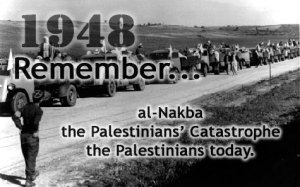
War broke out between the two populations soon after the UN partition plan was announced in 1947. Six months later, 800,000 Palestinians had either been forcibly expelled from their homes by the Jewish militia, the Haganah, or had fled, later to be prevented from returning. The Jewish population now claimed 80 percent of the territory, an addition of a further 24 percent to the already unbalanced 56 percent pledged by the UN.

1948 – the root of Palestinian hatred of Israel.

It doesn’t take an ethicist or jurist to see that the creation of Israel was an illegal and immoral act, and that Arab Palestinian hatred of Israel, and a desire to see Israel’s dissolution, is not rooted in irrational hatred or anti-Semitism, but in dispossession.

In 1967, Israel gobbled up the remaining 20 percent of ex-Mandate Palestine it hadn’t conquered in 1948. The call for Israel to withdraw to its pre-1967 borders – a plea made by many liberals and progressives as a solution for “peace in the Middle East” – does nothing to address the original ethnic cleansing of 1948, and could hardly, therefore, constitute a just, equitable or even practical solution.

Partition, the solution put forward since 1947, has never worked, not even when the Arab majority was promised 42 percent of the territory. To declare as workable a partition plan that promises a Bantustan-like state on 15 percent of ex-Mandate Palestine and a permanent surrender of the Palestinian right to return is astonishingly naïve.

Apart from dispossession as a reason for hating Israel, Palestinians have other, more quotidian and visceral reasons. These are starkly illustrated in an October 21 2007 Observer article by Conal Urquhart, excerpted below. The article describes, in the words of Israeli soldiers, the brutal and inhuman treatment they mete out to Arab Palestinians in the occupied Gaza Strip and West Bank.

“Nufar Yishai-Karin, a clinical psychologist at the Hebrew University in Jerusalem, interviewed 21 Israeli soldiers and heard confessions of frequent brutal assaults against Palestinians, aggravated by poor training and discipline. In her recently published report, co-authored by Professor Yoel Elizur, Yishai-Karin details a series of violent incidents, including the beating of a four-year-old boy by an officer.

“The soldiers described dozens of incidents of extreme violence. One recalled an incident when a Palestinian was shot for no reason and left on the street. ‘We were in a weapons carrier when this guy, around 25, passed by in the street and, just like that, for no reason – he didn’t throw a stone, did nothing – bang, a bullet in the stomach, he shot him in the stomach and the guy is dying on the pavement and we keep going, apathetic. No one gave him a second look,’ he said.

Brutal mistreatment by Israeli soliders intensifies Palestinian hostility.

“The soldiers developed a mentality in which they would use physical violence to deter Palestinians from abusing them. One described beating women. ‘With women I have no problem. With women, one threw a clog at me and I kicked her here [pointing to the crotch], I broke everything there. She can’t have children. Next time she won’t throw clogs at me. When one of them [a woman] spat at me, I gave her the rifle butt in the face. She doesn’t have what to spit with any more.’

“Yishai-Karin found that the soldiers were exposed to violence against Palestinians from as early as their first weeks of basic training. On one occasion, the soldiers were escorting some arrested Palestinians. The arrested men were made to sit on the floor of the bus. They had been taken from their beds and were barely clothed, even though the temperature was below zero. The new recruits trampled on the Palestinians and then proceeded to beat them for the whole of the journey. They opened the bus windows and poured water on the arrested men.

“Yishai-Karin, in an interview with Haaretz, described how her research came out of her own experience as a soldier at an army base in Rafah in the Gaza Strip. She interviewed 18 ordinary soldiers and three officers whom she had served with in Gaza. The soldiers described how the violence was encouraged by some commanders. One soldier recalled: ‘After two months in Rafah, a [new] commanding officer arrived… So we do a first patrol with him. It’s 6am, Rafah is under curfew, there isn’t so much as a dog in the streets. Only a little boy of four playing in the sand. He is building a castle in his yard. He [the officer] suddenly starts running and we all run with him. He was from the combat engineers.

“’He grabbed the boy. I am a degenerate if I am not telling you the truth. He broke his hand here at the wrist, broke his leg here. And started to stomp on his stomach, three times, and left.”

Liberal Israelis fervently deplore the treatment of Palestinians by the Israel military and find revelations such as these to be deeply distressing. Most, however, are Zionist, and no matter how much they disapprove of the brutality of the occupation are not prepared to consider, or provide redress, to the events of 1948 – the root of Palestinian hatred of Israel. Forcing the Israeli military to live up to its rhetoric about being the most ethical military in the world, will not put an end to Palestinian hatred.

Darfur vs. Ogaden, Mugabe vs. Meles

If the neutral left is really neutral, why does it keep coming down hard on the West’s official enemies while ignoring the West’s henchmen?

By Stephen Gowans

Many left activists and progressives claim to be equally opposed to oppression, whether practiced by the friends of imperialist powers or their enemies, but are virtually silent on the well documented oppressions of such US client states as Saudi Arabia, Egypt and Ethiopia, while exhibiting an uncritical zeal in denouncing the enemies of Anglo-American imperialism, often for crimes that have been exaggerated or invented to be used as pretexts for Western intervention and fulfillment of imperialist goals.

There is no better illustration of this tendency to profess principled neutrality while regularly exhibiting a pro-imperialist bias, than the current obsession with the alleged genocide in Darfur and the claims of unjustified political oppression in Zimbabwe, while a virtually unremarked series of crimes and oppressions is carried out by the US and British client government of Meles Zenawi in Ethiopia.

In an anti-guerilla war conducted in the country’s Ogaden region, “Ethiopian troops are burning villages, raping women and killing civilians as part of a systematic campaign to drive them from their homes.” Refugees say dozens of villages have been destroyed and have “accused the Ethiopian government of forcibly starving its own people by preventing food convoys reaching villages and destroying crops and livestock.”*

“A former Ethiopian soldier who defected from the army said how he had been ordered to burn villages and kill all their inhabitants. He said the Ethiopian air force would bomb a village before a unit of ground troops followed, firing indiscriminately at civilians. ‘Men, women, children – we killed them all,’ he said.”

The little-known conflict in Ogaden parallels the more widely known war in Darfur. The conflict began when rebels killed scores of Ethiopian guards and Chinese employees at a Chinese-run oil field. The government replied with a harsh crackdown.

“Human rights investigators are gathering evidence of widespread use of rape, with women reporting gang-rapes by up to a dozen soldiers. In some villages, men have been abducted at night, their bodies dumped in the village the next morning.

“While in Darfur, aid agencies have been able to establish camps and provide humanitarian support, they have been blocked from setting up operations in the Ogaden. The International Committee of the Red Cross has been thrown out and Medicins Sans Frontieres has also been prevented from working. Journalists trying to enter have also been banned – those that have tried have been promptly arrested.”

But while neutral leftists have worked themselves into a state of high moral dudgeon over Sudan’s counter-insurgency in Darfur, which “has been described by the US as ‘genocide’ and by the UN as ‘crimes against humanity’”, they have been virtually silent on Ethiopia, a recipient of US and British military and humanitarian aid.

“America’s top official on African affairs, assistant secretary of state, Jendayi Frazer, visited one town in the Ogaden last month.

“On her return to Ethiopia’s capital, Addis Ababa, she criticized the rebels and said the reports of military abuses were merely allegations. ‘We urge any and every government to respect human rights and to try to avoid civilian casualties but that’s difficult in dealing with an insurgency,’ she said.”

The West’s official enemies are never allowed the same latitude in dealing with their own (often US and British financed and instigated) insurgencies – a double standard backed by neutral leftists through their voluble condemnations of the anti-insurgency efforts of official enemies and comparative silence on those of Western client states.

“The US provides some $283m (£140m) in military and humanitarian aid to Ethiopia and has trained its military – one of the largest and strongest in Africa.”

Compare Zimbabwe’s Robert Mugabe with Ethiopia’s Prime Minister Meles Zenawi. For trying to invest Zimbabwean independence with real content (land reform and indigenization of the economy), Mugabe has been calumniated by British and US officials and the Western media as a strongman who will do anything to stay in power, from stealing elections to repressing the opposition. The elections Mugabe was said to have stolen were endorsed by the South African Development Community, an organization of neighboring states, and the opposition operates freely, despite being openly backed and financed by Western powers in pursuit of a regime-change, anti-independence agenda.

For doing the West’s bidding in the Horn of Africa, Ethiopia’s Meles is showered with US and British aid and was handpicked by Tony Blair to sit on Britain’s Commission for Africa, to lead the “African renaissance.” Neutral leftists say little about “the British Government’s – and the West’s – favorite African leader”, channeling their energies instead into calling on the US to intervene militarily in Darfur and in competing to see who can exercise the greatest stridency in denouncing the Mugabe government (contributing to the program of ushering Mugabe and his pro-independence policies out and the MDC and its pro-Western dependence policies in.) Somehow, the end result of all this is to put the West more firmly in control of Africa.

And yet the political repressions of which Mugabe is accused are practiced ardently by Meles. Indeed, even if every charge leveled against Mugabe were true (and most are not), he would still be an angel against Meles.

Following Ethiopia’s May 2005 general election, which the opposition claimed was rigged, “security forces opened fire on protesters, killing 193 people.” Thousands of opposition supporters and leaders were rounded up and thrown in jail.

“More than 100 opposition leaders were put on trial for treason while the police crackdown intensified. Text messages, which had been used to organize the demonstrations in 2005, were banned.”

The state asked that the death penalty be imposed on 38 opposition leaders, including the founder of the Ethiopian Human Rights Council, a former UN war crimes prosecutor and the mayor-elect of Addis Ababa. The court rejected the prosecution’s recommendation, but sentenced the opposition leaders to life imprisonment. They were later freed, but only after the US intervened.

“Britain still gives Ethiopia £130m in humanitarian aid each year – more than any other African country,” while carrying out an unremitting campaign of demonization against Robert Mugabe and blocking Zimbabwe’s access to international credit.

How it is it that Meles, who has carried out much graver crimes than any Mugabe has been accused of, is showered with honors and humanitarian aid, while Mugabe is treated as Africa’s version of Hitler and his country is subjected to a campaign of economic warfare?

The answer lies in the reality that Meles acts as Washington’s attack dog in the Horn of Africa, invading Somalia to put down a pro-independence government, while Mugabe pursues an independent foreign policy and implements reforms to give Zimbabwean independence meaningful content.

How is that many left activists and progressives, though professing neutrality, channel much of their energy into campaigns deploring the official enemies of Anglo-American imperialism, while remaining virtually silent on oppressions carried out by US and British client states?

The answer has much to the do with the media and how left activists and progressives react to it. The news media are structured to report on what state officials say and do. To garner support for their policies, state officials make public statements on issues they want to draw public attention to, while steering clear of events they prefer remain unnoticed. Because Western state officials make frequent references to Zimbabwe, and few, if any, to Ethiopia, dozens of media news stories appear on Zimbabwe for every one that appears on Ethiopia. In this way, state officials, working through the media, are able to establish a public agenda, not only for the media but for the neutral left to follow – one which places Mugabe scores of rungs ahead of Meles, and Darfur much higher than Ogaden. Left activists and progressives talk about Mugabe and Darfur because the media do and the media do because Western state officials do. But neutral leftists hardly ever talk about Meles and Ogaden because the media hardly do, and the media hardly do because Western state officials almost never do (and don’t want to.) The result is that while professing neutrality, many left activists and progressives have been unwittingly recruited into agendas set in Washington and London.

These are the conditions that, in part, lead the neutral left to channel considerable energy into denouncing the official enemies of Western governments, while spending little time talking about or campaigning against oppressive regimes that receive Western aid and support. Neutral leftists are quick to denounce the military government of Myanmar (an official enemy) for its crackdown on a religious group, while saying virtually nothing about the military government of Pakistan (a client state) for an equally bloody crackdown on a religious group. Neutral leftists are acutely sensitive to the humanitarian crisis in Darfur (officially condemned), while saying virtually nothing about the much larger humanitarian crisis in Iraq (officially ignored) or the humanitarian crisis in Ogaden (also officially ignored.) Neutral leftists say virtually nothing about Meles Zenawi, a strongman accused of rigging elections who threatens political opponents with the death penalty, has invaded another country, and carries out crimes against humanity within his own borders (and is supported by the West) while spitting out contempt for Robert Mugabe, who has done none of these things (but isn’t supported by the West).

In all it does, despite professions of neutrality, the neutral left is pro-imperialist, not neutral. The moment its members devote half as much energy to railing against the governments of Egypt, Ethiopia, Pakistan, Saudi Arabia, and Turkey as they do against Zimbabwe, the Taliban, north Korea, Belarus and Iran, will be the moment their claims to support neither imperialism nor its official enemies unconditionally become something more substantial than deceptive rhetoric.

* All quotes from Steve Bloomfield, “Ethiopia’s ‘own Darfur’ as villagers flee government-backed violence,” The Independent, October 17, 2007, http://news.independent.co.uk/world/africa/article3067244.ece

A Model Social State

By Stephen Gowans

As he stepped off his plane at the Minsk airport two summers ago to begin a two-day visit to Belarus, Venezuelan President Hugo Chavez pointed to a connection between his country and that of his host, President Alexander Lukashenko. “Belarus,” he declared, “is a model of a social state, which we are also building.” (1) That Chavez’s model state exists in an infrequently remarked upon corner of Europe may be a surprise to most admirers of the Bolivarian Revolution.

Called Europe’s last dictator by Condoleezza Rice and a “brother in arms” by Chavez (2), Lukashenko oversees over a “socially-oriented market economy” in which 80 percent of the enterprises are state-owned and collective farms still feed the country.

He has “presided over a continual increase in real wages for several years…cut the (value added tax), brought down inflation, halved the number of people in poverty”…and created “the fairest distribution of incomes of any country in the region.” (3)

He has done “what the conventional wisdom in the West says is not possible: maintaining a state run economy with one of the strongest growth rates in Europe, generating increases in wages and pensions, boosting productivity and minimizing the disparities in wealth that have destabilized so many of the former Soviet republics in their transition to market economies.” (4)

What may be equally surprising to Chavez admirers is that Lukashenko has done all this by “steadily turn(ing) Belarus into a miniature version of the Soviet Union, with a state-run economy.” (5)

The only deputy of the Belarusian Soviet Socialist Republic to vote against the dissolution of the USSR in 1991, Lukashenko talks fondly of the Soviet Union — “my country,” he called it in 2005 before the UN General Assembly. (6) Statues of Lenin and busts of Stalin — some newly erected — can still be found in Belarus.

This hardly sits well with state officials in the West who accuse Lukashenko of stealing elections and smothering democracy – the usual charge leveled against leaders who haven’t signed on to the project of fattening the bottom lines of Western corporations and investment banks at the expense of their own people. Lukashenko wins elections by landslides because he is widely popular, and he’s widely popular because he puts the interests of Belarus’ people first.

So Washington and London fund subversion projects under the guise of promoting democracy, funneling millions of dollars to youth groups, anti-Lukashenko media and opposition parties to bring down the government. The New York Times remarked that in the last presidential election the US and British-backed opposition “seemed not to be running an election campaign, as much as they (were) trying to organize an uprising.” (7)

The opposition failed miserably, both at the polls and in the streets.

Check out Stewart Parker’s new book, The Last Soviet Republic: Alexander Lukashenko’s Belarus (http://www.belarussolidaritycampaign.co.uk/) as well as “Belarus struggles to defend workers’ interests” in the latest issue of Proletarian http://www.cpgb-ml.org/index.php?secName=proletarian&subName=display&art=338 .

Both go a long way to setting the record straight on the hold-out Soviet republic Chavez calls a model of a social state.

1. New York Times, July 24, 2006
2. Financial Times, August 2, 2007.
3. Times Online, March 10, 2006.
4. Los Angeles Times, March 19, 2006.
5. New York Times, January 1, 2006.
6. Lukashenko address to the 60th Session of the General Assembly of the United Nations, September 15, 2005.
7. New York Times, January 1, 2006.

21st or 19th Century Socialism?

By Stephen Gowans

“Che was one of the greatest Latin Americans in history but ours is 21st Century Socialism,” remarked Rafael Correa, president of Ecuador in early October.

“We don’t believe in class war or dialectical materialism. We believe it’s possible to bring about profound radical socialist change using current structures, democratic means.”

So too did many other people reject the orthodox Marxist emphasis on class war and believe it was possible to bring about profound radical socialist change using current structures, democratic means.

Bernstein, Bauer, Ebert, the British Labour Party when it professed to be a socialist party and proud of it. These people believed in 21st Century Socialism too. Only they believed in it in the 19th and 20th centuries.

Correa, Chavez and others talk about 21st Century Socialism as if it’s new, fresh and exciting, rather than a warmed-over version of something that has been showing up, and then fading away, regularly, like a full moon or a new season.

“Bernstein was the first to celebrate abstract democracy and freedom in contradistinction to the orthodox Marxist emphasis” on class war and dialectical materialism, wrote sociologist Albert Szymanski in the 1980s.*

“Indeed virtually all the basic arguments of (contemporary) reformists and progressives ….were more or less fully developed in 1899 (by Eduard Bernstein in his Evolutionary Socialism) and reasserted again in the late 1920s as well as in the 1950s and early 1960s” and later in the 1980s. And now in the 21st century as 21st Century Socialism.

“In some ways,” observed Szymanksi, “the same (ideas) are (discovered), confined to the mice, and eventually rediscovered again (and again.)”

Szymanski pointed out that while in certain periods reformist ideas traceable to Bernstein resonate and seem to make sense of people’s experiences and point the way to future change, at other times they appear to be superficial and naïve.

For example, “while such terms as ‘imperialism’, ‘capitalism’, revolutions’, and ‘working class’ were scoffed at in the early 1960s because of their dogmatic, sectarian and inappropriate air, after 1966 they very rapidly became central. But ‘by 1980 things had once again turned full circle from where they were a decade before. Bernstein’s ideas now resonate(d) (once again).”

Correa’s claims today, and Bernstein’s in 1899, would have been meet with sardonic laughter in Germany from 1933-1945, or throughout all of Europe in the late 1930s. They would also meet derisive dismissal in Chile after 1973, or today in Palestine where it is impossible to bring about profound change, much less socialist change, using current structures and parliamentary means. European parliamentary socialism, which aimed to bring about socialist change within current structures by democratic means, failed miserably, and nowadays is dead in all but name.

While 21st Century Socialism claims to be a fresh alternative to the orthodox Marxist revolutionary approach that led to the really-existing socialism of the Soviet Union and Eastern Europe, it’s just an old, not terribly roadworthy car, with fresh paint.

Really-existing socialism of the 20th century – the implicit foil to 21st Century Bernsteinism — had the advantage of accomplishing deep transformations that materially advanced the human condition, until counter-revolution, celebrating Bernstein’s concepts of freedom and democracy in the abstract, threw the whole machine into reverse gear. 21st Century Socialism, in its 19th and 20th century guises, can lay claim to no such transformations – only minor modifications around the edges, often instigated by the capitalist class and its representatives, but claimed by the reformers as fruits of their own efforts.

21st Century Socialism is a welcome advance over what came before, but it will not produce the profound radical socialist change Correa promises. Deep radical transformation within current structures is impossible – and an attempt at profound radical socialist transformation without an emphasis on the orthodox Marxists ideas Correa eschews, is, at best, naïve.

* Albert Szymanski, “Crisis and Vitalization: An Interpretive Essay on Marxist Theory,” in Recapturing Marxism: An Appraisal of Recent Trends in Sociological Theory, (Rhonda F. Levine and Jerry Lembcke, eds.), Praegar. 1987.

Sanctions of Mass Destruction

Tim Beal and Don Borrie challenge the view that north Korea’s recent economic difficulties are attributable to mismanagement, pointing to new sanctions as the likely cause of economic contraction after seven consecutive years of growth.

One of the advantages of sanctions for US foreign policy, they write, is that its effects, “those malnourished babies – can be blamed on the Koreans, which in turn is produced as evidence that the sanctions are desirable and necessary.”

See the Pyongyang Report