Why Palestinians Hate Israel

If you were Palestinian, you would too.

By Stephen Gowans

Mandate Palestine, the territory that now comprises Israel, the West Bank and Gaza Strip, was still very much Arab when the British transferred its control of the territory to the UN in 1947. Two-thirds of the population was Arab and only six percent of the cultivable land was in Jewish hands.

The UN initially considered creating one democratic state in Palestine whose future would be determined by a majority vote of the population, the same proposal put forward by Iran’s president Mahmoud Ahmadinejad today.

But the UN abandoned the proposal in favor of partition, which the British favored and the Jewish population accepted. The views of the Arabs – the majority – were ignored.

The UN plan assigned over one-half of the territory to the Jewish one-third of the population and 42 percent to the Arab two-thirds – a highly unbalanced and unfair partition, but more than that, illegal and immoral for being forced on the majority over its vehement objections.

The Arabs, understandably, were aggrieved. But their reasons to be aggrieved were soon to grow more numerous.

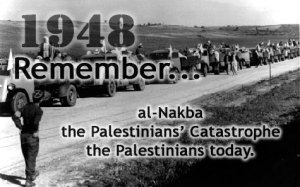
War broke out between the two populations soon after the UN partition plan was announced in 1947. Six months later, 800,000 Palestinians had either been forcibly expelled from their homes by the Jewish militia, the Haganah, or had fled, later to be prevented from returning. The Jewish population now claimed 80 percent of the territory, an addition of a further 24 percent to the already unbalanced 56 percent pledged by the UN.

1948 – the root of Palestinian hatred of Israel.

It doesn’t take an ethicist or jurist to see that the creation of Israel was an illegal and immoral act, and that Arab Palestinian hatred of Israel, and a desire to see Israel’s dissolution, is not rooted in irrational hatred or anti-Semitism, but in dispossession.

In 1967, Israel gobbled up the remaining 20 percent of ex-Mandate Palestine it hadn’t conquered in 1948. The call for Israel to withdraw to its pre-1967 borders – a plea made by many liberals and progressives as a solution for “peace in the Middle East” – does nothing to address the original ethnic cleansing of 1948, and could hardly, therefore, constitute a just, equitable or even practical solution.

Partition, the solution put forward since 1947, has never worked, not even when the Arab majority was promised 42 percent of the territory. To declare as workable a partition plan that promises a Bantustan-like state on 15 percent of ex-Mandate Palestine and a permanent surrender of the Palestinian right to return is astonishingly naïve.

Apart from dispossession as a reason for hating Israel, Palestinians have other, more quotidian and visceral reasons. These are starkly illustrated in an October 21 2007 Observer article by Conal Urquhart, excerpted below. The article describes, in the words of Israeli soldiers, the brutal and inhuman treatment they mete out to Arab Palestinians in the occupied Gaza Strip and West Bank.

“Nufar Yishai-Karin, a clinical psychologist at the Hebrew University in Jerusalem, interviewed 21 Israeli soldiers and heard confessions of frequent brutal assaults against Palestinians, aggravated by poor training and discipline. In her recently published report, co-authored by Professor Yoel Elizur, Yishai-Karin details a series of violent incidents, including the beating of a four-year-old boy by an officer.

“The soldiers described dozens of incidents of extreme violence. One recalled an incident when a Palestinian was shot for no reason and left on the street. ‘We were in a weapons carrier when this guy, around 25, passed by in the street and, just like that, for no reason – he didn’t throw a stone, did nothing – bang, a bullet in the stomach, he shot him in the stomach and the guy is dying on the pavement and we keep going, apathetic. No one gave him a second look,’ he said.

Brutal mistreatment by Israeli soliders intensifies Palestinian hostility.

“The soldiers developed a mentality in which they would use physical violence to deter Palestinians from abusing them. One described beating women. ‘With women I have no problem. With women, one threw a clog at me and I kicked her here [pointing to the crotch], I broke everything there. She can’t have children. Next time she won’t throw clogs at me. When one of them [a woman] spat at me, I gave her the rifle butt in the face. She doesn’t have what to spit with any more.’

“Yishai-Karin found that the soldiers were exposed to violence against Palestinians from as early as their first weeks of basic training. On one occasion, the soldiers were escorting some arrested Palestinians. The arrested men were made to sit on the floor of the bus. They had been taken from their beds and were barely clothed, even though the temperature was below zero. The new recruits trampled on the Palestinians and then proceeded to beat them for the whole of the journey. They opened the bus windows and poured water on the arrested men.

“Yishai-Karin, in an interview with Haaretz, described how her research came out of her own experience as a soldier at an army base in Rafah in the Gaza Strip. She interviewed 18 ordinary soldiers and three officers whom she had served with in Gaza. The soldiers described how the violence was encouraged by some commanders. One soldier recalled: ‘After two months in Rafah, a [new] commanding officer arrived… So we do a first patrol with him. It’s 6am, Rafah is under curfew, there isn’t so much as a dog in the streets. Only a little boy of four playing in the sand. He is building a castle in his yard. He [the officer] suddenly starts running and we all run with him. He was from the combat engineers.

“’He grabbed the boy. I am a degenerate if I am not telling you the truth. He broke his hand here at the wrist, broke his leg here. And started to stomp on his stomach, three times, and left.”

Liberal Israelis fervently deplore the treatment of Palestinians by the Israel military and find revelations such as these to be deeply distressing. Most, however, are Zionist, and no matter how much they disapprove of the brutality of the occupation are not prepared to consider, or provide redress, to the events of 1948 – the root of Palestinian hatred of Israel. Forcing the Israeli military to live up to its rhetoric about being the most ethical military in the world, will not put an end to Palestinian hatred.

Darfur vs. Ogaden, Mugabe vs. Meles

If the neutral left is really neutral, why does it keep coming down hard on the West’s official enemies while ignoring the West’s henchmen?

By Stephen Gowans

Many left activists and progressives claim to be equally opposed to oppression, whether practiced by the friends of imperialist powers or their enemies, but are virtually silent on the well documented oppressions of such US client states as Saudi Arabia, Egypt and Ethiopia, while exhibiting an uncritical zeal in denouncing the enemies of Anglo-American imperialism, often for crimes that have been exaggerated or invented to be used as pretexts for Western intervention and fulfillment of imperialist goals.

There is no better illustration of this tendency to profess principled neutrality while regularly exhibiting a pro-imperialist bias, than the current obsession with the alleged genocide in Darfur and the claims of unjustified political oppression in Zimbabwe, while a virtually unremarked series of crimes and oppressions is carried out by the US and British client government of Meles Zenawi in Ethiopia.

In an anti-guerilla war conducted in the country’s Ogaden region, “Ethiopian troops are burning villages, raping women and killing civilians as part of a systematic campaign to drive them from their homes.” Refugees say dozens of villages have been destroyed and have “accused the Ethiopian government of forcibly starving its own people by preventing food convoys reaching villages and destroying crops and livestock.”*

“A former Ethiopian soldier who defected from the army said how he had been ordered to burn villages and kill all their inhabitants. He said the Ethiopian air force would bomb a village before a unit of ground troops followed, firing indiscriminately at civilians. ‘Men, women, children – we killed them all,’ he said.”

The little-known conflict in Ogaden parallels the more widely known war in Darfur. The conflict began when rebels killed scores of Ethiopian guards and Chinese employees at a Chinese-run oil field. The government replied with a harsh crackdown.

“Human rights investigators are gathering evidence of widespread use of rape, with women reporting gang-rapes by up to a dozen soldiers. In some villages, men have been abducted at night, their bodies dumped in the village the next morning.

“While in Darfur, aid agencies have been able to establish camps and provide humanitarian support, they have been blocked from setting up operations in the Ogaden. The International Committee of the Red Cross has been thrown out and Medicins Sans Frontieres has also been prevented from working. Journalists trying to enter have also been banned – those that have tried have been promptly arrested.”

But while neutral leftists have worked themselves into a state of high moral dudgeon over Sudan’s counter-insurgency in Darfur, which “has been described by the US as ‘genocide’ and by the UN as ‘crimes against humanity’”, they have been virtually silent on Ethiopia, a recipient of US and British military and humanitarian aid.

“America’s top official on African affairs, assistant secretary of state, Jendayi Frazer, visited one town in the Ogaden last month.

“On her return to Ethiopia’s capital, Addis Ababa, she criticized the rebels and said the reports of military abuses were merely allegations. ‘We urge any and every government to respect human rights and to try to avoid civilian casualties but that’s difficult in dealing with an insurgency,’ she said.”

The West’s official enemies are never allowed the same latitude in dealing with their own (often US and British financed and instigated) insurgencies – a double standard backed by neutral leftists through their voluble condemnations of the anti-insurgency efforts of official enemies and comparative silence on those of Western client states.

“The US provides some $283m (£140m) in military and humanitarian aid to Ethiopia and has trained its military – one of the largest and strongest in Africa.”

Compare Zimbabwe’s Robert Mugabe with Ethiopia’s Prime Minister Meles Zenawi. For trying to invest Zimbabwean independence with real content (land reform and indigenization of the economy), Mugabe has been calumniated by British and US officials and the Western media as a strongman who will do anything to stay in power, from stealing elections to repressing the opposition. The elections Mugabe was said to have stolen were endorsed by the South African Development Community, an organization of neighboring states, and the opposition operates freely, despite being openly backed and financed by Western powers in pursuit of a regime-change, anti-independence agenda.

For doing the West’s bidding in the Horn of Africa, Ethiopia’s Meles is showered with US and British aid and was handpicked by Tony Blair to sit on Britain’s Commission for Africa, to lead the “African renaissance.” Neutral leftists say little about “the British Government’s – and the West’s – favorite African leader”, channeling their energies instead into calling on the US to intervene militarily in Darfur and in competing to see who can exercise the greatest stridency in denouncing the Mugabe government (contributing to the program of ushering Mugabe and his pro-independence policies out and the MDC and its pro-Western dependence policies in.) Somehow, the end result of all this is to put the West more firmly in control of Africa.

And yet the political repressions of which Mugabe is accused are practiced ardently by Meles. Indeed, even if every charge leveled against Mugabe were true (and most are not), he would still be an angel against Meles.

Following Ethiopia’s May 2005 general election, which the opposition claimed was rigged, “security forces opened fire on protesters, killing 193 people.” Thousands of opposition supporters and leaders were rounded up and thrown in jail.

“More than 100 opposition leaders were put on trial for treason while the police crackdown intensified. Text messages, which had been used to organize the demonstrations in 2005, were banned.”

The state asked that the death penalty be imposed on 38 opposition leaders, including the founder of the Ethiopian Human Rights Council, a former UN war crimes prosecutor and the mayor-elect of Addis Ababa. The court rejected the prosecution’s recommendation, but sentenced the opposition leaders to life imprisonment. They were later freed, but only after the US intervened.

“Britain still gives Ethiopia £130m in humanitarian aid each year – more than any other African country,” while carrying out an unremitting campaign of demonization against Robert Mugabe and blocking Zimbabwe’s access to international credit.

How it is it that Meles, who has carried out much graver crimes than any Mugabe has been accused of, is showered with honors and humanitarian aid, while Mugabe is treated as Africa’s version of Hitler and his country is subjected to a campaign of economic warfare?

The answer lies in the reality that Meles acts as Washington’s attack dog in the Horn of Africa, invading Somalia to put down a pro-independence government, while Mugabe pursues an independent foreign policy and implements reforms to give Zimbabwean independence meaningful content.

How is that many left activists and progressives, though professing neutrality, channel much of their energy into campaigns deploring the official enemies of Anglo-American imperialism, while remaining virtually silent on oppressions carried out by US and British client states?

The answer has much to the do with the media and how left activists and progressives react to it. The news media are structured to report on what state officials say and do. To garner support for their policies, state officials make public statements on issues they want to draw public attention to, while steering clear of events they prefer remain unnoticed. Because Western state officials make frequent references to Zimbabwe, and few, if any, to Ethiopia, dozens of media news stories appear on Zimbabwe for every one that appears on Ethiopia. In this way, state officials, working through the media, are able to establish a public agenda, not only for the media but for the neutral left to follow – one which places Mugabe scores of rungs ahead of Meles, and Darfur much higher than Ogaden. Left activists and progressives talk about Mugabe and Darfur because the media do and the media do because Western state officials do. But neutral leftists hardly ever talk about Meles and Ogaden because the media hardly do, and the media hardly do because Western state officials almost never do (and don’t want to.) The result is that while professing neutrality, many left activists and progressives have been unwittingly recruited into agendas set in Washington and London.

These are the conditions that, in part, lead the neutral left to channel considerable energy into denouncing the official enemies of Western governments, while spending little time talking about or campaigning against oppressive regimes that receive Western aid and support. Neutral leftists are quick to denounce the military government of Myanmar (an official enemy) for its crackdown on a religious group, while saying virtually nothing about the military government of Pakistan (a client state) for an equally bloody crackdown on a religious group. Neutral leftists are acutely sensitive to the humanitarian crisis in Darfur (officially condemned), while saying virtually nothing about the much larger humanitarian crisis in Iraq (officially ignored) or the humanitarian crisis in Ogaden (also officially ignored.) Neutral leftists say virtually nothing about Meles Zenawi, a strongman accused of rigging elections who threatens political opponents with the death penalty, has invaded another country, and carries out crimes against humanity within his own borders (and is supported by the West) while spitting out contempt for Robert Mugabe, who has done none of these things (but isn’t supported by the West).

In all it does, despite professions of neutrality, the neutral left is pro-imperialist, not neutral. The moment its members devote half as much energy to railing against the governments of Egypt, Ethiopia, Pakistan, Saudi Arabia, and Turkey as they do against Zimbabwe, the Taliban, north Korea, Belarus and Iran, will be the moment their claims to support neither imperialism nor its official enemies unconditionally become something more substantial than deceptive rhetoric.

* All quotes from Steve Bloomfield, “Ethiopia’s ‘own Darfur’ as villagers flee government-backed violence,” The Independent, October 17, 2007, http://news.independent.co.uk/world/africa/article3067244.ece

A Model Social State

By Stephen Gowans

As he stepped off his plane at the Minsk airport two summers ago to begin a two-day visit to Belarus, Venezuelan President Hugo Chavez pointed to a connection between his country and that of his host, President Alexander Lukashenko. “Belarus,” he declared, “is a model of a social state, which we are also building.” (1) That Chavez’s model state exists in an infrequently remarked upon corner of Europe may be a surprise to most admirers of the Bolivarian Revolution.

Called Europe’s last dictator by Condoleezza Rice and a “brother in arms” by Chavez (2), Lukashenko oversees over a “socially-oriented market economy” in which 80 percent of the enterprises are state-owned and collective farms still feed the country.

He has “presided over a continual increase in real wages for several years…cut the (value added tax), brought down inflation, halved the number of people in poverty”…and created “the fairest distribution of incomes of any country in the region.” (3)

He has done “what the conventional wisdom in the West says is not possible: maintaining a state run economy with one of the strongest growth rates in Europe, generating increases in wages and pensions, boosting productivity and minimizing the disparities in wealth that have destabilized so many of the former Soviet republics in their transition to market economies.” (4)

What may be equally surprising to Chavez admirers is that Lukashenko has done all this by “steadily turn(ing) Belarus into a miniature version of the Soviet Union, with a state-run economy.” (5)

The only deputy of the Belarusian Soviet Socialist Republic to vote against the dissolution of the USSR in 1991, Lukashenko talks fondly of the Soviet Union — “my country,” he called it in 2005 before the UN General Assembly. (6) Statues of Lenin and busts of Stalin — some newly erected — can still be found in Belarus.

This hardly sits well with state officials in the West who accuse Lukashenko of stealing elections and smothering democracy – the usual charge leveled against leaders who haven’t signed on to the project of fattening the bottom lines of Western corporations and investment banks at the expense of their own people. Lukashenko wins elections by landslides because he is widely popular, and he’s widely popular because he puts the interests of Belarus’ people first.

So Washington and London fund subversion projects under the guise of promoting democracy, funneling millions of dollars to youth groups, anti-Lukashenko media and opposition parties to bring down the government. The New York Times remarked that in the last presidential election the US and British-backed opposition “seemed not to be running an election campaign, as much as they (were) trying to organize an uprising.” (7)

The opposition failed miserably, both at the polls and in the streets.

Check out Stewart Parker’s new book, The Last Soviet Republic: Alexander Lukashenko’s Belarus (http://www.belarussolidaritycampaign.co.uk/) as well as “Belarus struggles to defend workers’ interests” in the latest issue of Proletarian http://www.cpgb-ml.org/index.php?secName=proletarian&subName=display&art=338 .

Both go a long way to setting the record straight on the hold-out Soviet republic Chavez calls a model of a social state.

1. New York Times, July 24, 2006
2. Financial Times, August 2, 2007.
3. Times Online, March 10, 2006.
4. Los Angeles Times, March 19, 2006.
5. New York Times, January 1, 2006.
6. Lukashenko address to the 60th Session of the General Assembly of the United Nations, September 15, 2005.
7. New York Times, January 1, 2006.

21st or 19th Century Socialism?

By Stephen Gowans

“Che was one of the greatest Latin Americans in history but ours is 21st Century Socialism,” remarked Rafael Correa, president of Ecuador in early October.

“We don’t believe in class war or dialectical materialism. We believe it’s possible to bring about profound radical socialist change using current structures, democratic means.”

So too did many other people reject the orthodox Marxist emphasis on class war and believe it was possible to bring about profound radical socialist change using current structures, democratic means.

Bernstein, Bauer, Ebert, the British Labour Party when it professed to be a socialist party and proud of it. These people believed in 21st Century Socialism too. Only they believed in it in the 19th and 20th centuries.

Correa, Chavez and others talk about 21st Century Socialism as if it’s new, fresh and exciting, rather than a warmed-over version of something that has been showing up, and then fading away, regularly, like a full moon or a new season.

“Bernstein was the first to celebrate abstract democracy and freedom in contradistinction to the orthodox Marxist emphasis” on class war and dialectical materialism, wrote sociologist Albert Szymanski in the 1980s.*

“Indeed virtually all the basic arguments of (contemporary) reformists and progressives ….were more or less fully developed in 1899 (by Eduard Bernstein in his Evolutionary Socialism) and reasserted again in the late 1920s as well as in the 1950s and early 1960s” and later in the 1980s. And now in the 21st century as 21st Century Socialism.

“In some ways,” observed Szymanksi, “the same (ideas) are (discovered), confined to the mice, and eventually rediscovered again (and again.)”

Szymanski pointed out that while in certain periods reformist ideas traceable to Bernstein resonate and seem to make sense of people’s experiences and point the way to future change, at other times they appear to be superficial and naïve.

For example, “while such terms as ‘imperialism’, ‘capitalism’, revolutions’, and ‘working class’ were scoffed at in the early 1960s because of their dogmatic, sectarian and inappropriate air, after 1966 they very rapidly became central. But ‘by 1980 things had once again turned full circle from where they were a decade before. Bernstein’s ideas now resonate(d) (once again).”

Correa’s claims today, and Bernstein’s in 1899, would have been meet with sardonic laughter in Germany from 1933-1945, or throughout all of Europe in the late 1930s. They would also meet derisive dismissal in Chile after 1973, or today in Palestine where it is impossible to bring about profound change, much less socialist change, using current structures and parliamentary means. European parliamentary socialism, which aimed to bring about socialist change within current structures by democratic means, failed miserably, and nowadays is dead in all but name.

While 21st Century Socialism claims to be a fresh alternative to the orthodox Marxist revolutionary approach that led to the really-existing socialism of the Soviet Union and Eastern Europe, it’s just an old, not terribly roadworthy car, with fresh paint.

Really-existing socialism of the 20th century – the implicit foil to 21st Century Bernsteinism — had the advantage of accomplishing deep transformations that materially advanced the human condition, until counter-revolution, celebrating Bernstein’s concepts of freedom and democracy in the abstract, threw the whole machine into reverse gear. 21st Century Socialism, in its 19th and 20th century guises, can lay claim to no such transformations – only minor modifications around the edges, often instigated by the capitalist class and its representatives, but claimed by the reformers as fruits of their own efforts.

21st Century Socialism is a welcome advance over what came before, but it will not produce the profound radical socialist change Correa promises. Deep radical transformation within current structures is impossible – and an attempt at profound radical socialist transformation without an emphasis on the orthodox Marxists ideas Correa eschews, is, at best, naïve.

* Albert Szymanski, “Crisis and Vitalization: An Interpretive Essay on Marxist Theory,” in Recapturing Marxism: An Appraisal of Recent Trends in Sociological Theory, (Rhonda F. Levine and Jerry Lembcke, eds.), Praegar. 1987.

Sanctions of Mass Destruction

Tim Beal and Don Borrie challenge the view that north Korea’s recent economic difficulties are attributable to mismanagement, pointing to new sanctions as the likely cause of economic contraction after seven consecutive years of growth.

One of the advantages of sanctions for US foreign policy, they write, is that its effects, “those malnourished babies – can be blamed on the Koreans, which in turn is produced as evidence that the sanctions are desirable and necessary.”

See the Pyongyang Report

Left Imperialism

By Stephen Gowans

There is a major cleavage among the politically active members of the left between those who identify with the working class across all borders (the working class internationalists) and those who defend governments or movements engaged in anti-imperialist struggles (the anti-imperialists.) Since governments engaged in anti-imperialist struggles are most often not working class governments, or are, but are not always seen as such, these two groups are regularly at odds with each other. The anti-imperialists are accused of being thug-huggers while the working class internationalists are accused of being pro-imperialist.

While it is true that anti-imperialists do sometimes spring to the defense of thugs, it should be noted that they don’t spring to the defense of thugs simply because they’re thugs. Defending a thug (Saddam Hussein, for example) from the unjustified aggression of another county is hardly thug-hugging. If it were, one could say that a person who defends a child abuser from spousal abuse is a child abuse supporter. This is logically untenable, and yet it is not unusual to hear it said that defending the Iranian government from the aggression of the US and Britain amounts to defending holocaust-denial or misogyny or working class repression.

At the same time, it should be made clear that many of the people anti-imperialists spring to the defense of are not thugs, though it is common practice for imperialist governments to depict them as such. Working class internationalists frequently discourage critical examination of pro-imperialist propaganda by denouncing those who dare challenge official demonology as pro-fascist leftists and supporters of dictators and tyrants.

By comparison, working class internationalists are frequently willing to accept the charges leveled at targeted countries by imperialist governments at face value. This amounts to an inexcusable dereliction of critical thought, since it is standard practice for aggressor states to demonize targets to enlist public support for their aggressions and for the US and Britain to lie to justify their aggressions (WMDs in Iraq being the most conspicuous recent example.) This ought to be obvious to anyone with a modicum of good sense. Turning a blind eye to the accustomed fabulousness of great powers may make it easier to live with one’s government, but it should hardly be a trait embraced by those who consider themselves to be politically left.

While working class internationalists argue that unlike anti-imperialists they act independently of the judgments made by Washington and London about the governments of foreign countries, the truth of the matter is that they operate within a frame established by the US. They uncritically accept the demonology of aggressor states and work to promote the demonology as a legitimate part of the leftist project. That they are most vociferous in denouncing imperialist targets at precisely the time their own governments are gearing up for aggressions against other states and wish to win public opinion to their side either calls their motivations into question or paints them as gullible. Their ardent denunciation of official targets in the run-up to war and comparative silence on anti-working class governments that operate as subordinate members of imperialist blocs likewise calls their sincerity into question or suggests they’re dupes. You’ll hear working class internationalists rail vigorously against Mugabe but will hear not a peep from them about Mubarak. They’ll anguish more over Darfur than over Iraq (though Iraq’s humanitarian crisis is more profound than Darfur’s.)

Working class internationalists also profess fealty to the working classes of other countries, but work, through their amplification of pro-imperialist demonology, to support imperialist interventions in other countries which harm the working classes in those countries. Working class internationalists who echoed NATO denunciations of Slobodan Milosevic did nothing to help the Yugoslav working class, and much to harm it. Serbs are now saddled with a harsh neo-liberal regime of the sort Milosevic’s government eventually resisted. Working class internationalists who echo pro-imperialist diatribes against Robert Mugabe’s ZANU-PF government in Zimbabwe help justify interventions that, if successful, will lead to reversal of land reforms, privatizations and the anti-working class tyranny of the IMF.

Working class internationalists may be sincere in their devotion to the working class but their actions do little to help the class they profess fealty to and much to strengthen the corporate rich of their own country. As Germans they would have gladly joined Hitler in his pre-invasion denunciation of the Polish government, arguing that the Polish government, no friend of the working class, was no friend of theirs, and deserved to be toppled.

Bread and Butter Issues behind Myanmar Protests

By Stephen Gowans

Before discussion on Myanmar becomes another demonizing ritual led by the White House, and actively subscribed to by the respectable left, it would be prudent to consider recent mass protests in the country in the context of surrounding events and independent of the frame set the US government.

In his address to the UN General Assembly, US President George Bush denounced Myanmar as a “brutal regime” (along with Belarus, Cuba, Iran, Syria, north Korea and Zimbabwe), an echo of the 2006 National Security Directive, which called the same countries “outposts of tyranny”.

While media accounts – in step with the US state — have fostered the impression that the mass marches in Myanmar are “pro-democracy” protests against political tyranny, they have, on the contrary, been provoked by bread and butter issues. As the New York Times explained in the concluding paragraphs of a September 24 report, the protests began “August 19 in response to sharp, unannounced fuel price increases of up to 500 percent, immediately raising the prices of goods and transportation.”

The protests were initially led by students, and only recently by monks, after the police beat some monks at a small demonstration.

The monks have denounced the government for “impoverishing and pauperizing” the people — language devoid of the references to freedom and democracy much favored by the US state and firmly rooted in day-to-day economic concerns.

Washington’s real beef with Myanmar isn’t that it is a “brutal regime” or “outpost of tyranny.” Such US allies as Saudi Arabia, Egypt, Ethiopia and Israel are brutal regimes, but they’re showered with US aid and given diplomatic protection. The real problem with Myanmar is that its markets, land, resources and labor aren’t completely open to exploitation by US corporations and investors.

Myanmar practices protectionism. The government owns enterprises, rather than letting private capital (especially US capital) totally run the show. Like Cuba, north Korea and other US designated “outposts of tyranny”, it is not the kind of place the investment bankers, CEOs and corporate lawyers who dominate the US state can cozy up to — or make a buck in.

The US Department of Commerce complains that Myanmar has restrictive trade policies and sets the prices of staples below market value, including gasoline. Ironically, it appears Myanmar’s efforts to bring gasoline prices up to market value – something the US government would applaud – sparked the protests.

“The state totally dominates some sectors, including mining and power, and state-owned firms have an important role in transport, trade and manufacturing,” according to the Economist’s Intelligence Unit.

What’s worst from Washington’s point of view is that the country restricts foreign investment. Worst still, it fails to protect private property.

Those who are ready to jump on the demonize-Myanmar-bandwagon should understand whose agenda they’re advancing — and what its goals really are.

CBS Cries “By Jingo!”

CBS correspondent Scott Pelley uses interview of Iran’s president to make case for war

By Stephen Gowans

There are, in major capitalist societies, tight little communities of interconnected families whose members intermarry, live in the same neighborhoods, and sit on corporate boards. They practice corporate law and investment banking and own the lion’s share of the society’s income–producing property. They are the capitalist class.

In the United States, secretaries, under-secretaries and deputy secretaries of the departments of State, Defense, Treasury and Commerce, are drawn overwhelmingly from this class. US foreign, defense, and economic policies reflect the interests of this tight little community, partly as a result of key positions of the US state being dominated by its members and partly because the imperatives of the capitalist economy define the bounds within which policy can be implemented without provoking serious economic and political crises. For example, a decision to raise the minimum wage five-fold and cut the working week to 30 hours would force businesses to cancel new investment, either as a conscious act of economic sabotage or as the inevitable result of trying to maximize profits. The ensuing flight or strike of capital or both would lead to businesses cutting staff, some shutting their doors altogether, and others moving elsewhere. The result would be soaring unemployment and enormous pressure on the government to reverse its business-unfriendly policies. A government that persisted in this folly would soon find itself in the midst of a political crisis with no prospect of re-election.

Accordingly, governments avoid straying beyond the limits imposed by the logic of capitalism and its imperative of profit-making. For this reason, socialist and labor parties that come to power on reformist programs almost invariably abandon their programs and act as good capitalists. Those that do not, fail to win re-election or are overthrown by military coups d’etat, toppled by foreign military intervention or menaced by foreign sponsorship of internal subversion.

In addition to dominating the state, the capitalist class dominates the media: first, through its ownership of newspaper chains, TV networks, movie studios, publishing companies and the like; second, by controlling a network of public relations firms and think tanks that suggest and plant stories in the media and make available experts the media routinely consults; and third, through the power its members in key government positions have to shape the public agenda.

The third point deserves elaboration. In the US, the president and his cabinet shape the media’s agenda simply by the fact that all of their public statements are reported. They can draw the media’s attention toward certain issues by mentioning them (the humanitarian crisis in Sudan, the religious obscurantism of the Taliban, the alleged human rights abuses in Zimbabwe) and away from other issues by saying nothing about them (the humanitarian crises in Iraq, Congo and Somalia, the religious obscurantism of the Saudi regime, the serious human rights abuses of Egypt.)

If the president says, “There are mass graves littering Kosovo filled with the corpses of 10,000 ethnic Albanians” the assertion becomes widely accepted as true, even if, in the back pages of newspapers years later, the assertion is shown to have been a deliberate fabrication. By then, the original accusation has been transformed into an accepted truth that a few disconfirming bits of information tucked away in the back pages of newspapers will be unable to dislodge from their firm place in the public mind. Despite reams of evidence to show that NATO exaggerated the number of deaths in Kosovo to justify its bombing campaign, it’s still possible to read newspaper articles today that accept NATO’s earlier war propaganda as the truth. Likewise, the president, vice-president, and secretaries of state and defense could be assured, in the lead up to the war on Iraq, that any time they said Saddam Hussein was hiding banned weapons their accusations would be widely reported and accepted as credible.

The reality that the capitalist class dominates both the state and media should, then, lead us to predict that the media will act in concert with the state, playing the role of the state’s unofficial propaganda arm. While its members will profess to be completely neutral and independent, thereby lending legitimacy and weight to the news they report, they will nevertheless act in ways that shape public opinion to the interests of the state as representative of capitalist class interests.

A good example of the media playing the role of the US state’s unofficial propaganda arm is a CBS 60 Minutes interview of Iran’s President Mahmoud Ahmadinejad, conducted on September 23 in Tehran by correspondent Scott Pelley. The interview is shocking in the extent to which Pelley abjures any pretense of impartiality to act as a pitchman for US foreign policy positions, sounding to someone unimmersed in US jingoism, more like a State Department spokesman than an ostensibly neutral journalist. So blatant was Pelley’s use of the interview as a platform to advance State Department spin that Ahmadinejad wondered aloud whether he was talking to a journalist or a US politician. The truth of the matter is that the dichotomy between journalist and politician is false. They are not separate, non-overlapping categories. Owing to the common domination of the US state and media by the capitalist class, members of the government and members of the media share common goals and behave in common ways in pursuit of those goals. That Pelley conducts himself as a politician is no accident.

Pelley began by asking Ahmadinejad what he was thinking when he asked to visit Ground Zero. A visit to Ground Zero, Pelley pointed out, would “be insulting to many, many Americans.” Baffled, Ahmadinejad asks why, and Pelley responds, “Well, sir, you are the head of the government of an Islamist state that the United States government says is a major exporter of terrorism around the world.” This was the first of a number of statements Pelley would make to present US government allegations as fact.

The germane questions here are, What is meant by terrorism and has the terrorism Iran is accused of, anything to do with 9/11? The terrorism the US government says Iran sponsors refers to the violence of Hezbollah and Hamas to resist domination by the US and its proxies in the Middle East. We could just as easily accuse the US of carrying out terrorism in Iraq, or of sponsoring terrorist groups that operate within Iran. Significantly, terrorism in the words of US state officials, and the mimetic US media, amounts to any use of force to resist domination by the US or its proxies. We should ask, Is the use of force to resist domination by an outside power or to throw off an occupation legitimate? If so – and the aims of Hezbollah and Hamas are precisely this – then Iran’s support of these groups is legitimate. That these groups act to defend their people against the predations of the US state and its allies does not make them, ipso facto, terrorists.

The connection Pelley makes between Ahmadinejad and 9/11 is contrived. There is nothing to indicate Iran had anything to do with the attacks on the World Trade Center and the Pentagon, but Pelley helps those making a case for escalating confrontation with Iran by slyly suggesting there is (in much the same manner the US state suggested Saddam Hussein had something to do with 9/11.) At the close of the interview, he returns to the theme, telling Ahmadinejad that many Americans believe that when Ahmadinejad’s plane flies over Manhattan he looks at Ground Zero and says, “Good. Somebody got ‘em.’” It’s difficult to imagine that before Pelley broached the subject many Americans wondered about Ahmadinejad’s views on 9/11, much less on anything else (except perhaps the Holocaust.) Pelley’s description of what he claims to be existing public opinion is really a means of creating new public opinion, of instilling in Americans the belief that if Ahmadinejad wasn’t connected in some way to 9/11, he certainly welcomed it.

Repeatedly, Pelley claims to know what the American people think, saying they believe Iran to be an enemy of the US, that Iran is exporting terrorism around the world, and that Iran is on the path to war (Iran’s refusing to kowtow to demands to surrender its independence being seen in US media circles as anti-American bellicosity.) It would be disingenuous to pretend that the opinions of the American people on most foreign policy matters are not, in the main, shaped by what high government officials tell them. But it remains the case, nevertheless, that the views Pelley attributes to the American people, are the views of the US state. His questions, constructed to echo official propaganda, are not so much sincere questions as an exercise in reinforcing the US state’s regime change agenda. Ahmadinejad’s amazement that a “representative of the media” should repeat “the untrue accusations leveled by [his] government” is understandable.

Among the most astonishing, not to say war-mongering, of Pelley’s statements is that Ahmadinejad has American blood on his hands. This accepts at face value the claim by the US state, a notoriously unreliable source, that the Iraqi resistance is using Iranian manufactured weapons. It also makes a leap of logic, inferring, from this premise alone, that the Iranian government is arming the resistance. This leap of logic is equivalent to concluding Boeing has American blood on its hands because the 9/11 hijackers flew Boeing aircraft into the World Trade Centre, or that all guerillas who use Kalashnikovs are armed by Moscow. Arms manufactured in Iran readily circulate throughout the region, just as arms manufactured in the US and elsewhere do. There is no basis to make the claim that the Iranian government is arming the resistance, which isn’t to say it isn’t. But we can ask if Tehran is indeed arming the resistance, would this be defensible? Since the US and British forces were clearly not invited into Iraq and are not wanted, but nevertheless refuse to leave, the arming of the resistance by Tehran would indeed be legitimate – an act equivalent to the US arming the French resistance to drive out the Nazis. A journalist who was truly impartial (an impossible ideal) would accept this dispassionately. A journalist who is acting as a propagandist for the US state would rail against it as monstrous. One needs little imagination to know how Pelley would react.

While telling Ahmadinejad he has American blood on his hands and then asking why, has the character of asking “when did you stop beating your wife?” the most objectionable part of Pelley’s performance lies in his telling Ahmadinejad “You owe President Bush” (for invading Iraq and toppling Saddam Hussein.) Since Saddam Hussein attacked Iran as a client of the United States with Washington’s full backing and support, telling Ahmadinejad he owes Bush is tantamount to telling Chileans they owe Augusto Pinochet for restoring democracy to Chile (something Margaret Thatcher, a Pinochet-supporter, was once bold enough to do.) All those who felt the need to declare publicly in the run up to the US-British war on Iraq that they too believed Saddam Hussein was a monumental shit – an assertion that while true had nothing whatever to do with why the US planned to attack Iraq and therefore should never have been raised in the context of discussions on the impending war – must bear some responsibility for the fact that monumental shits like Pelley can justify the war on Iraq by reference to the toppling of Saddam Hussein and know that what he says will resonate with public opinion.

It’s tempting to complain bitterly about Pelley’s departures from what’s understood to be journalistic rectitude, and to think that pressing journalists to live up to their ideals is a useful investment of one’s time. But the reality is that journalists, like everyone else, serve somebody (to invoke an old Bob Dylan song.) Pelley serves his employers. As members of the US capitalist class, his employers are committed to shaping public opinion to facilitate the carrying out of the foreign policy of the United States. That policy, as it respects Iran, has as its goal the toppling of the current economically nationalist regime and its replacement by one that will accommodate US exports and investment and military deployments. These are goals whose principal beneficiary is the same community of corporate board members and Social Register members who dominate both the government and the media and stand to accumulate more capital in Iranian energy investments and exports to the country if Ahmadinejad and Iran’s revolutionaries are chased from power. Pelley, in playing the hoary game of individualizing a country and investing the individual with hateful qualities to justify war, is serving the interests of this tight little community.

Divide et Impera

The US is using a hoary imperial tactic dating back to the Romans to dominate Iraq and to justify a long-term military presence in the country

By Stephen Gowans

A US-financed program to build a Sunni paramilitary Guardian organization in Iraq, and US proposals for a soft partition of the country, are the latest steps in a divide and rule strategy the US is pursuing to keep Iraqis fighting among themselves so they won’t fight the occupation. Sectarian strife also provides the US with the pretext it needs to establish a long-term military presence in the country.

The US occupation authority has made ethnicity and religion salient in Iraq, where once it was a matter of little moment in the daily political lives of Iraqis. The US organized elections and the army along sectarian lines. It decided which parties could run in elections, favoring those that emphasized religious affiliations (Sunni vs. Shia) and ethnicity (Arab vs. Kurd), while banning the largest non-sectarian party, the Baath party. Key government positions were doled out along sectarian lines. The interior ministry was turned over to the Badr Brigade, a sectarian Shia paramilitary organization. From head to toe, Iraq has been transformed from a secular society into one in which religious and ethnic identity matter. Imagine the Department of Homeland Security being turned over to the KKK, the Pentagon to Louis Farrakhan’s Nation of Islam, while the Democrat and Republican parties are banned and replaced by religious and ethnic parties. If ever there was a recipe to get people fighting among themselves, this is it.

The most recent manifestation of the US divide and rule policy is a program to create a Sunni paramilitary Guardian force whose mandate is to protect Sunni neighborhoods (1). Imagine Washington creating a Black paramilitary Guardian force, a White paramilitary Guardian force, and a Hispanic paramilitary Guardian force in the US. The effect in sparking racial tension would be the same.

Now, some US policy makers are talking about partitioning Iraq into Kurd, Sunni and Shia regions. Leading advocates include senior politicians and US ruling class foundations. Joseph Biden, chairman of the US Foreign Relations Committee and a candidate for the Democratic presidential nomination endorses “soft” partition, as does Leslie Gelb, president emeritus of the influential Council on Foreign Relations (2). Last year, the two put together the Biden-Gelb plan, which calls for a “soft” partition of Iraq. Soft partition would see Iraq divided into three distinct ethno-religious regions: Kurdistan, Shiastan and Sunnistan, held together by a weak federal government.

Michael O’Hanlon, a senior fellow at the Brookings Institution, argues the “time may be approaching when the only hope for a more stable Iraq is soft partition (3).” The Brookings Institution, associated with the Rockefellers, is one of the most influential US ruling class policy-making organizations.

Western politicians portray Iraq as a country whose simmering sectarian tensions were held in check by the brutal repression of Saddam Hussein, a Sunni who ruled on behalf of the Sunni population and its political vehicle, the Baath party. It’s only now that Mr. Hussein’s tyranical rule has ended that sectarian conflict has slipped its restraints and come to the surface. At least, that’s the favored US view. Trouble is, it’s a crock of shit. When “the Committee of Debaathification issued a list of 100,000 senior Iraqi Baathists who would not be allowed to enjoy government posts,” 66,000 of them turned out to be Shiites (4). And anyone who cared to check the deck of cards used to list the 55 top Iraqi officials the US invasion force wanted dead or alive, would discover that half were Shiite, and the remainder a mix of Sunnis, Christians and Kurds (5).

The former Ottoman territory that is now Iraq was governed as a single territory before 1880. The three provinces that were pieced together in 1921 to form modern Iraq had no “clear sectarian identities (6).” “For much of Iraq’s history, the two communities (Shia and Sunni) co-existed peacefully (7).”

Partitioning the country would be no mean feat. “The geographic boundaries do not run toward partition. There is no Sunnistan or Shiastan.” On the contrary, conditions are “highly commingled” with people “totally intermixed, especially in the major cities (8).” Five million Iraqis would have to be moved were the country to be divided into homogeneous ethno-religious slices (9).

More importantly, most Iraqis don’t want their country partitioned. “Apart from the Kurds in the north, there is no unanimous, popular demand for federalism or soft partition or any partition at all (10).”

The 1920 Revolution Brigades, one of three resistance groups to form the political office of the Iraqi resistance, rejects the idea of a sectarian division in Iraq. “Our position,” says its spokesman, “is that there are two kinds of people in Iraq: not Sunni and Shia, Kurdish and Arab, Muslim and Christian, but those who are with the occupation and those who are against it (11).” Sectarian divisions in Iraq have been amplified, he says, “as part of the ‘British imperial tactic of divide and rule (12).’”

The British employed the Roman principle of divide et impera to enslave colonial peoples. The US has taken up the tradition. “Our endeavour,” remarked Lieutenant-Colonel Coke, Commandant of Moradabad during the middle of the nineteenth century, “should be to uphold in full force the (for us fortunate) separation which exists between the different religions and races, not to endeavour to amalgamate them. Divide et impera should be the principle of Indian government (13).” Lord Elphinstone, Governer of Bombay, seconded the motion. “Divide et impera was the old Romon motto, and it should be ours (14).”

Adumbrating US imperial tactics in Iraq, the British devised a system of separate electorates in India and separate representation by religion, caste and ethnicity. Sound familiar? “The effect of this electoral policy,” observed one commentator, was “to give the sharpest possible stimulus to communal antagonism (15).” Prior to British rule in India there was no trace of the type of Hindu-Muslim conflict that later emerged under British rule (16).

“There is no natural inevitable difficulty from the cohabiting of differing races or religions in one country (17).” Mulsim and Hindu lived side-by-side peacefully until the British arrived in India; Sunni and Shiite commingled peacefully before the US imposed its occupation on the country. “The difficulties arise from social-political conditions. They arise, in particular, whenever a reactionary regime is endeavouring to maintain itself against the popular movement (18).”

In the USSR, diverse religions and races lived together amicably. Germans and Jews lived together peacefully under Germany’s Weimar Republic. It wasn’t until the Nazis emphasized national identity to weaken growing working class consciousness that systematic persecution of Jews began.

The strategy is simple. The last thing an occupying power wants is for the people it’s dominating to recognize their common situation and interests. Were they to do that, they might mobilize their energies to fight their common enemy. So occupied countries are organized by their occupiers along color, religious and ethnic fault-lines. Iraqis mustn’t think of themselves as Iraqis, but as Shiites, Sunnis and Kurds, locked in a struggle with each other for access to resources.

The same is true within imperialist countries. People who work for a living mustn’t identify with their class, but with their ethnic, religious or racial cohorts, or must be imbued with patriotism, so that they equate their personal interests with those of their ruling class. In this way, Americans and Britons who have nothing to gain personally from their country’s occupation of Iraq, and much to lose, are bamboozled into supporting the war. Likewise, employees who have much to gain from coming together as a class are diverted by racism, religion and patriotism.

Another thing the US divide et impera tactic provides is an excuse to maintain a military presence in Iraq, and therefore, the continued domination of Iraq by Washington. For liberals, the argument that the US can’t leave Iraq now, otherwise a full-scale civil war will erupt, is decisive. But what this view ignores is that the possibility of a full-scale civil war is the product of the occupation itself. Had the US not fomented ethnic and religious divisions, the possibility of a civil war would never have arisen. On the other hand, were the US to cease efforts to pit Iraqi against Iraqi, the occupation – already greatly challenged by the resistance, despite US divide and rule tactics – would surely be defeated, an outcome the US will never willingly consent to. Soft partition, then, seems to those seeking both sectarian peace and US withdrawal, to be the answer. But slicing the country up into Sunnistan, Shiastan and Kurdistan, won’t set the stage for a US pull-out. On the contrary, “senior military planners caution that should partition become American policy, withdrawal almost certainly wouldn’t. Partition would require a stabilization force – code for American military presence – of 75,000 to 100,000 troops for years to come (19).” Heads I win, tails you lose. No matter what, the US figures to be hanging around Iraq for a long time, using sectarian tensions as the justification for its ongoing presence. What will foil these plans are non-sectarian groups, like the 1920 Revolution Brigades, that recognize there are only two kinds of people in Iraq: those who are with the occupation and those who are against it.

1. New York Times, August 19, 2007.
2. The CFR brings together CEOs, government and military officials and scholars, to recommend policy to the US State Department. The policy recommendations are typically responses to problems identified in corporate boardrooms, or exclusive clubs catering to the ultra-wealthy. The State Department relies on very little internal expertise, and uses the ruling class funded, directed and staffed think tanks and foundations to suggest policy. The CFR is the most important and influential of these organizations in matters of US foreign relations. See G. William Dumhoff, Who Rules America? McGraw-Hill, 2005.
3. New York Times, August 19, 2007.
4. Workers World, February 11, 2007.
5. Ibid.
6. Reidar Visser, who studies Iraq’s sectarian issues at the Norwegian Institute of International Affairs, quoted in New York Times, August19, 2007.
7. New York Times, March 26, 2006.
8. Joost Hilterman, deputy director of Middle East programs for the International Crisis Group, quoted in New York Times, August 19, 2007.
9. New York Times, August 19, 2007.
10. Hilterman.
11. Guardian (UK), July 19, 2007.
12. Ibid.
13. R. Palme Dutt, The Problem of India, International Publishers, New York, 1943, p. 98.
14. Ibid.
15. Ibid., p. 101.
16. Ibid. p. 97.
17. Ibid.
18. Ibid.
19. New York Times, August 19, 2007.

Update

According to a December 19, 2007 Washington Post article (All Iraqi Groups Blame U.S. Invasion for Discord, Study Shows) “Iraqis of all sectarian and ethnic groups believe that the U.S. military invasion is the primary root of the violent differences among them, and see the departure of ‘occupying forces’ as the key to national reconciliation, according to focus groups conducted for the U.S. military last month.”

“D3 Systems, a Virginia-based company that maintains offices in each of Iraq’s 18 provinces…showed [in a survey conducted in September] the same widespread Iraqi belief voiced by military focus groups: that a US departure will make things better. A State Department poll in September 2006 reported a similar finding.”

“Few [focus group participants] mentioned Saddam Hussein as a cause of their problems.”

Film-makers Steve Connors and Molly Bingham spent five months with resistance fighters in Iraq, from April to August 2003. They discovered that “the idea that has recently become common currency, that Iraq is a country riven by ancient sectarian hatreds, is a claim for which [they] found little evidence…Indeed, the research [they did for their documentary film Meeting Resistance] indicates that any existing fissures in Iraq at the time of the 2003 invasion were exploited and exacerbated by coalition forces and administrators in order to enable the success of the occupation.”

Faith in UN Intervention in Darfur Misplaced

By Stephen Gowans

Many Western activists have rallied around calls for sanctions on Sudan and UN intervention in Darfur. But a review of recent Western interventions in the world’s trouble spots suggests their faith is misplaced. While the US and its allies, and the UN Security Council, point to lofty goals as the basis for their interventions, the true goals are invariably shaped by the economic interests of the corporations and investment banks that dominate policy making in Western countries. Worse, intervention has typically led to the deterioration of humanitarian crises, not their amelioration.

Conflict as Pretext

The United States and other imperialist powers look for conflicts, or provoke conflicts, in countries they do not dominate politically. They use these conflicts as pretexts to intervene in other countries in multiple ways: militarily, through proxies (which may include the UN), by funding an internal opposition, or by some combination of these means. The goal is to exploit these countries economically. Political control, through a strongman or puppet government, allows great nations to protect and enlarge the investments of their corporations and banks and to open doors to their exports. That is, the United States and other imperialist powers are engaged in a relentless pursuit of political domination of countries they do not currently dominate, in order to exploit their resources, assets and markets, by creating or looking for conflicts that provide pretexts for intervention.

In Yugoslavia, the US, Germany and the UK encouraged secessionists to unilaterally declare independence from the Yugoslav federation and helped ethnic Albanian Kosovars wage a guerrilla war to establish Kosovo as an independent country. The ensuing conflicts with the federal government were used as a pretext by NATO to intervene militarily to bring the conflicts to an end. The secessionist governments and KLA guerrillas were portrayed by the Western media as the victims while the federal government, which was reacting to the provocations, was portrayed as the instigator. The result was that Yugoslavia was re-balkanized and brought under the control of the US and Germany, who have since imposed a neo-liberal tyranny and whose corporations, banks and wealthy investors have bought up the former federation’s state- and socially-owned assets. (1)

In Iraq, the US uses the conflict between Sunnis, Shiites and Kurds, as a pretext to remain in the country as an occupying force. Were troops withdrawn too early, we’re told that an all-out civil war would ensue (as if a state of all-out war, sustained by the presence of US and British troops, does not already exist.) Likewise, we’re assured that if troops are withdrawn from Afghanistan, al Qaeda will resume its use of the country as a base for its operations, leading to a string of 9/11s. More than a decade ago, the US provoked a conflict in the Gulf – or at least allowed one to go ahead – when Iraq wasn’t turned down by the US ambassador, April Glaspie, after it sought permission to invade Kuwait. Iraq was thereby entrapped into undertaking an invasion Washington used as a pretext to launch the Gulf War. The effect was to begin the process of bringing Iraq, and its considerable petroleum resources, under the control of the US. (2)

Sudan is not today under US political control, and like Iraq, is a source of immense oil reserves and the potential for gargantuan petroleum profits to be reaped by foreign oil companies. The Bush administration complains that the Sudanese government interferes in Sudan’s petroleum and petrochemical industries. Khartoum is not, then, a partisan of the three freedoms that matter most in Washington: free trade, free enterprise and free markets. This, from Washington’s point of view, is a threat to US foreign policy (i.e., corporate) interests. If Sudanese policy prevents US oil companies from exploiting the country’s oil resources, Sudan is a threat to the foreign policy interests of the United States. Accordingly, it must be treated as an enemy. And indeed it is an enemy – but only an enemy of the class of corporate board members, hereditary capitalist families and investment bankers in whose interest free trade, free enterprise and free markets are promoted and enforced. Sudan, its people, and the economically nationalist policies of its government are not, however, enemies of the bulk of Americans. (3)

There are existing conflicts in Darfur which the US and its allies have used to argue for Western intervention. There is a conflict over water and land between sedentary and nomadic peoples, made worse by desertification. There is a conflict between rebel groups, which have attacked government installations, and the government itself. And there is a conflict among rebel groups. These conflicts are used by the US and its allies as pretexts to impose sanctions and to argue for intervention. But the US is no more interested in resolving these conflicts than it was in resolving conflicts in Yugoslavia. It’s interested in dominating Sudan politically, so that US and British oil companies can amass huge profits from Sudan’s vast petroleum reserves.

A record of deception

There was no genocide in Kosovo. When forensic pathologists went looking for the scores of thousands of bodies NATO said were hidden throughout Kosovo, they found two thousand – a number that was consistent with a small scale guerrilla war, not a campaign of genocide. But after NATO intervened militarily with a 78-day bombing campaign, thousands fled, bridges, factories, schools and hospitals were destroyed and hundreds, if not thousands, of civilians were killed. What was a low intensity guerrilla war was turned into a humanitarian crisis by NATO. (4)

There were no weapons of mass destruction in Iraq. But after the US and Britain invaded, some 600,000 Iraqis died as a result of violence provoked by the invasion, four million fled their homes, poverty became rampant and infrastructure destroyed by US and British bombs remained in a state of disrepair. A once modern country that had used its oil revenues to develop itself economically and to build a robust system of social welfare was turned by the US and Britain into an almost peerless humanitarian disaster. (5)

According to the UN commission appointed to investigate Washington’s charges that the Sudanese government is pursing a policy of genocide, the accusations have no foundation. It’s true, the commission found, that Khartoum has responded disproportionately to attacks on government forces by rebel groups, and it’s true that Khartoum is implicated in war crimes, but the commission found no evidence the Sudanese government is engaged in the project of seeking to eliminate an identifiable group, the defining characteristic of a policy of genocide. As far as humanitarian disasters go, the disaster in Iraq is far worse. So who would trust the perpetrators of that disaster – who, after all lied about there being a genocide in Kosovo and banned weapons in Iraq — to intervene in Darfur to resolve the humanitarian crisis there? That would be like giving your car keys to a known thief and pathological liar. (6)

Ignoring conflicts

The other side of the coin is that there are countries the United States already dominates in which terrible humanitarian disasters and human rights violations occur about which very little is said. When conflicts occur in these countries, the conflicts are ignored by the Western media, because they’re not needed as a pretext for intervention by Western governments. In fact, it’s in the interests of Washington that these conflicts not be brought to the attention of the public.

In Ethiopia, for example, thousands of members of the opposition were imprisoned after elections were disputed. Recently, the government threatened to execute dozens of opposition leaders on treason charges. Foreign reporters and human rights groups have been expelled from the country. Because Ethiopia is politically dominated by the US, there’s no reason to bring its deplorable record to the public’s attention. There is no need to build a case for intervention. Ethiopia is already under the US thumb. Accordingly, few people know anything about what’s going in the country because Ethiopia is off the Western media’s demonization radar screen. But they are likely to know about Robert Mugabe, the president of Zimbabwe, who many believe has committed all the crimes Meles Zenawi, the prime minister of Ethiopia, has committed. Except Mugabe hasn’t arrested thousands of members of the opposition or threatened to execute the opposition’s leaders. The difference between Zenawi and Mugabe is that Zenawi is a US puppet and Mugabe isn’t. For opposing imperialist meddling in southern Africa and seeking to indigenize Zimbabwe’s economy, Mugabe is in the dead center of the West’s demonization radar screen. (7)

There are about half a million people displaced in Somalia as a result of an invasion by Ethiopia, undertaken at the behest of the US government. This is a humanitarian disaster created by a US proxy. There is no Save Somalia Campaign. (8)

In the Democratic Republic of Congo, there is a conflict provoked by the former intervention of US proxies Rwanda and Uganda that has led to the deaths of four million people since 1997. The 200,000 deaths in Darfur (80 percent from starvation and disease; 20 percent from violence) are dwarfed by the millions of deaths in DR Congo. But while there’s a Save Darfur campaign, there is no Save Congo campaign. (9)

The solution to Darfur

If UN intervention in Darfur isn’t a solution – and it isn’t — what is? While it sometimes seems that the UN is a neutral body that democratically decides how to resolve conflicts, that’s not what the UN really is. The UN, in all important respects, is the UN Security Council, a small group of mainly imperialist powers who do what imperialist countries do: try to divide the world up among themselves. The United States, the dominant member of the Security Council, has no interest in resolving the conflict in Darfur. It’s interested in establishing a permanent military presence to wrest control of Sudan’s oil from the Sudanese government. If the US can induce other countries to commit troops to carry out its objectives, so much the better. Bogged down in Iraq and Afghanistan, a UN military mission to secure the US goal of bringing Sudan under US domination is a welcome development in Washington.

It should be clear that the record of UN and NATO interventions is one in which small conflicts are turned into humanitarian disasters. Gordon Brown, the prime minister of Britain, says Darfur is the world’s greatest humanitarian disaster. There are 200,000 dead in Darfur but there are probably 600,000 dead in Iraq. There are four million refugees in Iraq and far fewer in Darfur. (10)

Liberal public intellectuals like Michael Ignatieff, the former Harvard professor and now aspirant to the job of Canadian prime minister, said a war needed to be waged on Iraq because of what Saddam did to the Kurds. US military intervention under the authorization of the UN was supposed to deliver peace, prosperity, human rights and democracy between the banks of the Tigris and Euphrates. What it delivered was something far worse than when Saddam was around. (11)

The solution to Darfur is to stop pressuring the US government to intervene in Sudan and start pressuring the one rebel group that won’t sign a peace accord to do so. Khartoum has sat down with the rebel groups to work out a peace deal and one group has refused to even participate in the talks. Conflicts cannot be resolved if one side is uninterested in peace. Nor can they be resolved if powerful forces are using the conflicts as pretexts to invade and impose sanctions.

If pressure is imposed on the hold-out rebels to arrive at a peace with Khartoum, and peace ensues, what then? Will the activists who agitated for Western intervention in Darfur turn their attention to rescuing the Congo from its humanitarian crisis? Will grassroots pressure be brought to bear on Ethiopia to withdraw from Somalia? And what of Iraq? Will the same people who worked themselves up into high moral dudgeon over Darfur demand immediate withdrawal of foreign troops from Iraq? Shouldn’t they demand this first? After all, the dimensions of the Iraq disaster are worse than those of the Darfur disaster, and it is the activists’ own governments that have authored the larger disaster. One would think Americans and Britons would give priority to working for the immediate withdrawal of troops from Iraq, rather than channelling their energies into pressing the governments that lied about and created tragedies in Yugoslavia and Iraq to intervene in yet another oil-rich country. Activists have an obligation to understand the institutional patterns of behaviour of their own governments, to inquire into the forces that shape those patterns, and to prevent emotion from undermining reason and analysis. It does no good to allow our own governments and media to mobilize our energies to work on behalf of imperialist goals, while diverting us from projects that are legitimately in the interests of the bulk of humanity.

(1) Michael Parenti, To Kill a Nation, Verso, 2002; Elise Hugus, “Eight Years After NATO’s ‘Humanitarian War’: Serbia’s new ‘third way’”, Z Magazine, April 2007, Volume 20, Number 4.
(2) David Harvey, The New Imperialism, Oxford University Press, 2005.
(3) Nativdad Carrera, “U.S. imperialists increase efforts to recolonize Sudan,” Party for Socialism and Liberation, November 3, 2006, http://www.pslweb.org/site/News2?page=NewsArticle&id=5949
(4) Parenti; Stephen Gowans, “Genocide or Veracicide: Will NATO’s Lying Ever Stop?” Swans, July 23, 2001, http://www.swans.com/library/art7/gowans02.html
(5) Stephen Gowans, “The Unacknowledged Humanitarian Disaster,” What’s Left, August 1, 2007, https://gowans.wordpress.com/2007/08/01/the-unacknowledged-humanitarian-disaster/
(6) Stephen Gowans, “Ethiopia, Zimbabwe, and the Politics of Naming,” What’s Left, July 9, 2007, https://gowans.wordpress.com/2007/07/09/ethiopia-zimbabwe-and-the-politics-of-naming/
(7) Ibid.
(8) Ibid.
(9) Ibid.
(10) The Unacknowledged Humanitarian Disaster
(11) Stephen Gowans, “Ignatieff’s Mea Culpa,” What’s Left, August 5, 2007, https://gowans.wordpress.com/2007/08/05/ignatieff%e2%80%99s-mea-culpa/