Who Is Killing Iran’s Nuclear Scientists – And Why?

By Stephen Gowans

One day last November, assassins on motorbikes drove up to the cars of two of Iran’s nuclear scientists as they were leaving for work and attached bombs to their vehicles. The bombs detonated in seconds, killing Majid Shahriari, a member of the engineering faculty at a Tehran university, and Fereydoon Abbasi, a professor at Shahid Besheshti University. 

Last week, in an eerie reprise, Darioush Rezaei, a physics professor working in the field of nuclear chain reactions, was killed in his car. This time by a pair of gunmen on a motorcycle. 

Suspicion immediately fell upon the United States, and for good reason. The CIA is running a program to sabotage Iran’s nuclear program by eliminating its nuclear scientists. Until recently, the program has sought to create a brain drain by luring physicists and engineers out of the country.(1) But now it appears that the nuclear scientists who won’t or can’t be lured away are being targeted for elimination – either by assassination or abduction. 

Another Iranian nuclear scientist, Shahram Amiri, was abducted while on a pilgrimage to Saudi Arabia and “spirited quickly to the United States.” (2) 

It should be recalled that while the United States and its possible partner in the assassinations, Israel, are working to undermine Iran’s nuclear program, both have their own civilian nuclear power industries plus more than a few nuclear weapons. 

So why are they adamant about denying Iran what they, themselves, already have?

And just to be clear, what Washington and the Israelis don’t want Iran to have is the capability of processing nuclear fuel at home. While this would allow the Iranians to convert Iran’s vast supplies of uranium into fuel to power a civilian nuclear energy industry, it would also furnish Iran with the means to quickly develop nuclear weapons, something it might want to do if, say, the United States threatened to attack (hardly an improbable scenario).

Denying Iran its own nuclear fuel processing industry has obvious advantages to rich countries.

  • They derive profits from the sale of nuclear fuel.
  • With their hands on the nuclear fuel spigot, they acquire political leverage over Tehran.
  • Iran’s ability to resist US pressure by developing nuclear arms is severely crimped.

The official story on why Iran mustn’t have its own nuclear fuel processing capability is that if Iran can process uranium it can secretly develop nuclear arms. And the country must not be allowed to go nuclear because its president is a Judeophobic madman who, if he gets the chance, will send a barrage of nuclear-tipped missiles hurtling toward Israel to complete what Hitler had left undone.

This view is utter nonsense.

First, the United States would incinerate Iran in a second if Tehran used nuclear weapons against Israel. And if Washington couldn’t do the job, the Israelis, with their own formidable nuclear arsenal, surely would. At best, Iran’s possession of nuclear arms (and it doesn’t have them now and it’s not clear it seeks them) would provide a deterrent against attacks on its own territory.

What’s more, Iran’s president, Mahmoud Ahmadinejad, never promised to “wipe Israel off  the map,” as some Western and Israeli political leaders demagogically claim. Instead, he predicted that Israel as a Jewish state would dissolve, as the Soviet Union once did. Hardly the same.   

Another view is that Ahmadinejad intends to attack Israel in order to return Palestine to the Palestinians. Except this would turn Palestine into a nuclear wasteland, not what the Palestinians want. And why would Ahmadinejad risk Iran’s nuclear annihilation to advance the Palestinian cause? Sure, Iran is a big booster of the Palestinians, but not to the point of imperilling its own existence. 

No, the real reason Washington seeks to sabotage Iran’s nuclear program is to deny the country a means by which it can resist efforts to bring it within the US imperial orbit, that is, to eliminate the threat of Iranian self-defense. 

Iran is charting its own course. Its economic policies, which emphasize state-ownership of key sectors of the economy, and the sheltering of manufacturing behind high tariff walls, are an anathema to the ultra-wealthy bankers and investors who dominate US foreign policy and insist that profit-making opportunities be made available to them just as much beyond US borders as within.

As an example of the opportunities that Iran’s nationalist policies deny investors and corporations of rich countries, consider the country’s automobile industry. It operates behind steep tariff walls which allow two domestic firms, both partly government-owned, to absorb 97 percent of all automobile sales in the country. Sales reached 1.6 million units last year. (3) Were Iran’s high tariff barriers toppled, US, European and East Asian automobile manufacturers could add handsomely to their bottom lines.

But a nuclear-armed Iran—even one which doesn’t have nuclear weapons, but has the knowledge and means to quickly develop them—could strongly resist demands made at gunpoint that it turn over its markets, natural resources and enterprises to foreign capital.

Of course, US sophistry holds that that’s not what Washington wants. It’s not seeking economic domination, only a level playing field. The trouble is, asking a Third World country to compete with rich countries on a level playing field is like asking high school football teams to compete in the NFL – without assistance. 

Since US foreign policy is all about opening doors to US investors and exporters, and Iranian policy is focussed on using state-ownership, subsidies and tariffs to develop the country’s economy, Washington and Tehran are in conflict. Washington wants Tehran’s economic policy to accommodate the profit-making interests of US banks, corporations and investors, while Tehran fashions its economic policy to accommodate the interests of Iranians.

For Washington, the route to resolving the conflict lies in ushering in a new regime in Tehran, one more attentive to the needs of US capital. It would be pro-foreign investment and committed to free markets, free trade and free enterprise.  

Since Iranians don’t seem to be heading in this direction as rapidly as Wall Street would like, Washington hopes to change their minds through sanctions, threats of war, financial isolation, and destabilization, centred on demonization of Iran’s political leadership.  

Oh, and abduction and assassination too.

1. Greg Miller, “US now sees Iran as pursuing nuclear bombs,” Los Angeles Times, February 12, 2009.

2. David E. Sanger, “Scientist heads home, Iran says”, The New York Times, July 14, 2010; Alan Cowell, “Pakistan says Iran scientists in U.S.flees to its embassy”, The New York Times, July 13, 2010.

3. “Iranian car lines keep rolling despite sanctions”, Reuters, June 29, 2011.

The Nato World Order – Africa Division

The New Obama Doctrine in Effect

Glen Ford and Brendan Stone

On-Line Listening:

http://soundclick.com/share.cfm?id=10851087

Download MP3:

http://www.radio4all.net/index.php/program/53118


The Responsibility of Intellectuals

By Stephen Gowans

An article by reporter Rory Carroll in last Sunday’s Observer titled “Noam Chomsky criticises old friend Hugo Chavez for ‘assault’ on democracy” has set off a storm of controversy among Chomsky and Chavez supporters.

Some, angry at the leftist intellectual for criticizing the Venezuelan president, demanded an explanation. Chomsky replied that Carroll’s article was “dishonest” and “deceptive.”

But a transcript of the interview—which Chomsky told one blogger did not exist—suggests it is Chomsky, not Carroll, who is dishonest and deceptive.

“Let’s begin with the headline: complete deception,” Chomsky replies to one blogger.

Really?

Here’s what Chomsky told the Observer reporter.

Carroll. Finally, professor, the concerns about the concentration of executive power in Venezuela: to what extent might that be undermining democracy in Venezuela?

Chomsky: Concentration of executive power, unless it’s very temporary, and for specific circumstances, let’s say fighting world war two, it’s an assault on democracy (my emphasis).

Carroll: And so in the case of Venezuela is that what’s happening or at risk of happening?

Chomsky: As I said you can debate whether circumstances require it—both internal circumstances and the external threat of attack and so on, so that’s a legitimate debate—but my own judgment in that debate is that it does not.

Earlier in the interview Chomsky told Carroll that, “Anywhere in Latin America there is a potential threat of the pathology of caudillismo and it has to be guarded against. Whether it’s over too far in that direction in Venezuela I’m not sure but I think perhaps it is” (my emphasis).

So, Chomsky tells Carroll that concentration of executive power is an assault on democracy, that there’s a tendency toward concentration in Venezuela, and that in his judgment the circumstances don’t require it.

So how is it that the headline “Noam Chomsky criticises old friend Hugo Chavez for ‘assault’ on democracy” is deceptive and dishonest? Granted, Chavez might not be an old friend, at least not in the literal sense, but the Observer headline hardly seems to misrepresent Chomsky’s words.

Now, we can go around in circles about whether Carroll fairly or dishonestly recounted his conversation with Chomsky (though it looks like the dishonesty here isn’t Carroll’s), but anyone who insists that Chomsky didn’t criticize Chavez is going to have to do a fair amount of straw clutching. Yes, the leftist intellectual did criticize Washington in his interview with Carroll, and he did point out all the good that has happened in Venezuela (which Carroll acknowledges in his article.) But so what? That doesn’t negate Chomsky’s open criticism of Chavez — which is what a number of Chavez partisans are agitated about.

The occasion for the interview was Chomsky’s open letter criticizing the detention of Judge Maria Lourdes Affiuni. Affiuni had freed banker Eligio Cedeno in 2009. Cedeno, who had faced corruption charges, immediately fled the country. Chavez denounced the judge as a criminal and demanded that she be jailed for 30 years.

We can debate whether Chavez’s treatment of Affiuni is heavy-handed, but it doesn’t take a high-profile intellectual of Chomsky’s caliber to figure out that the establishment press will use all the ammunition it can lay its hands on to vilify Chavez, and the best ammunition of all is that which comes from the Left. It’s one thing for a US state official to raise concerns about Chavez. You expect it. It’s quite another for a leftist intellectual to do the same.

It might be said that Chomsky didn’t know the Observer would use his criticism to blacken Chavez’s reputation, but that would be dishonest and deceptive.  It’s hard to swallow the canard that poor old Noam–whose understanding of the media is second to none–blindly stumbled into an ambush. “I should know by now that I should insist on a transcript with the Guardian, unless it’s a writer I know and trust,” Chomsky lamented.

Yeah, right.

Media Lens, springing to Chomsky’s defense, noted perspicaciously that ‘the Guardian (the Observer’s sister newspaper) is normally happy to ignore (Chomsky) and his views. But when Chomsky expresses criticism of an official enemy of the West, he suddenly does exist and matter for the Guardian.”

But hadn’t the co-author of Manufacturing Consent figured this out long ago?

I think it would be fair to suppose he has. That he went ahead anyway, and allowed the press to add his criticisms of Chavez to what he himself calls the “vicious, unremitting attack by the United States and the west generally” on Venezuela, could mean one of two things.

Either Chomsky is a press-hound.

Or he’s not as much of a friend of Chavez as Carroll–and a good number of leftists-think.

Or both.

Military Interventions: Progressive vs. Imperialist

By Stephen Gowans

Wars have almost always been highly devastating affairs, with dire consequences in ruined and destroyed lives, as well as in the destruction of economies, farms, factories, housing and public infrastructure. While it cannot be said that all people at all times have considered wars to be best avoided, it is safe to say that the humanitarian case against war is overwhelming.

This essay is concerned, not with war in general, but with military interventions. To be sure, military interventions are often inseparable from wars, since they are often the causes of them. But not always. Some occur in the context of wars that are already underway. And some happen without provoking major resistance.

Today, on the left—and even the right—there are many activists who are committed to an anti-war position, but who are more properly said to oppose military intervention. Opposition to war implies, not only opposition to one country initiating a war against another (aggression), but also to using military means to repel an attack (self-defence.) Yet it is highly unlikely that people who say they are against war mean that they are against self-defence. It is more likely that they mean that a military response to a conflict must only occur for valid reasons, and that self-defence is the only valid one.

However, those who have adopted an anti-war position often stress other reasons for opposing military interventions. These include the ideas that:

• Democracy is senior to other considerations and that people should be allowed to resolve internal conflicts free from the meddling of outside forces.
• Institutions and ideologies cannot be successfully imposed on other people and interventions that seek to do so (e.g., bring democracy to another country) are bound to fail.
• International law is a legitimate basis for determining the validity of military interventions and countries ought to abide by it.

In this essay, the arguments will be made that: none of these principles are grounds to oppose military intervention; one of them is empirically insupportable as an absolute statement; the idea that military force ought to be used only in self-defence is indefensible; and that had these principles been adopted as inviolable, a number of interventions that are now widely regarded as progressive and desirable would never have occurred. A case will be made, instead, that some military interventions are valid and that validity depends on whose interests the intervention serves and whether the long-run effects are progressive. By these criteria, NATO interventions in Yugoslavia, Afghanistan, Iraq and Libya are not valid, while France’s intervention on the side of the United States in the American Revolution and the Union government’s intervention in the states of the Confederacy in the American Civil War were valid. Also valid were the interventions of the Comintern on the Republican side of the Spanish Civil War (1936-1938), the Chinese People’s Liberation Army’s (PLA) interventions in Korea (1950) and Tibet (1959), Cuba’s intervention in Angola (1975), and the Soviet Union’s intervention in Afghanistan (1979).

Full essay in PDF format: Military Interventions Progressive vs Imperialist

Diana Johnstone & Stephen Gowans on The Taylor Report

Hear the May 23 edition of The Taylor Report , here. Features Diana Johnstone on Dominique Strauss-Kahn and Libya. Also features Stephen Gowans on Libya. Worth listening to to hear Johnstone.

NATO’s PR Firm: Washington Branch

By Stephen Gowans

The NATO bombing mission in Libya is so obviously about bringing another oil-rich country under Western domination that in attempting to cover up its true aim the mainstream media simply clarify the alliance’s objectives.

Consider Michael Birnbaum’s and Joby Warrick’s ham-handed attempt to sanitize the bombing campaign in the May 10 Washington Post. The reporters write: “NATO’s mission in Libya is to prevent civilian deaths.”

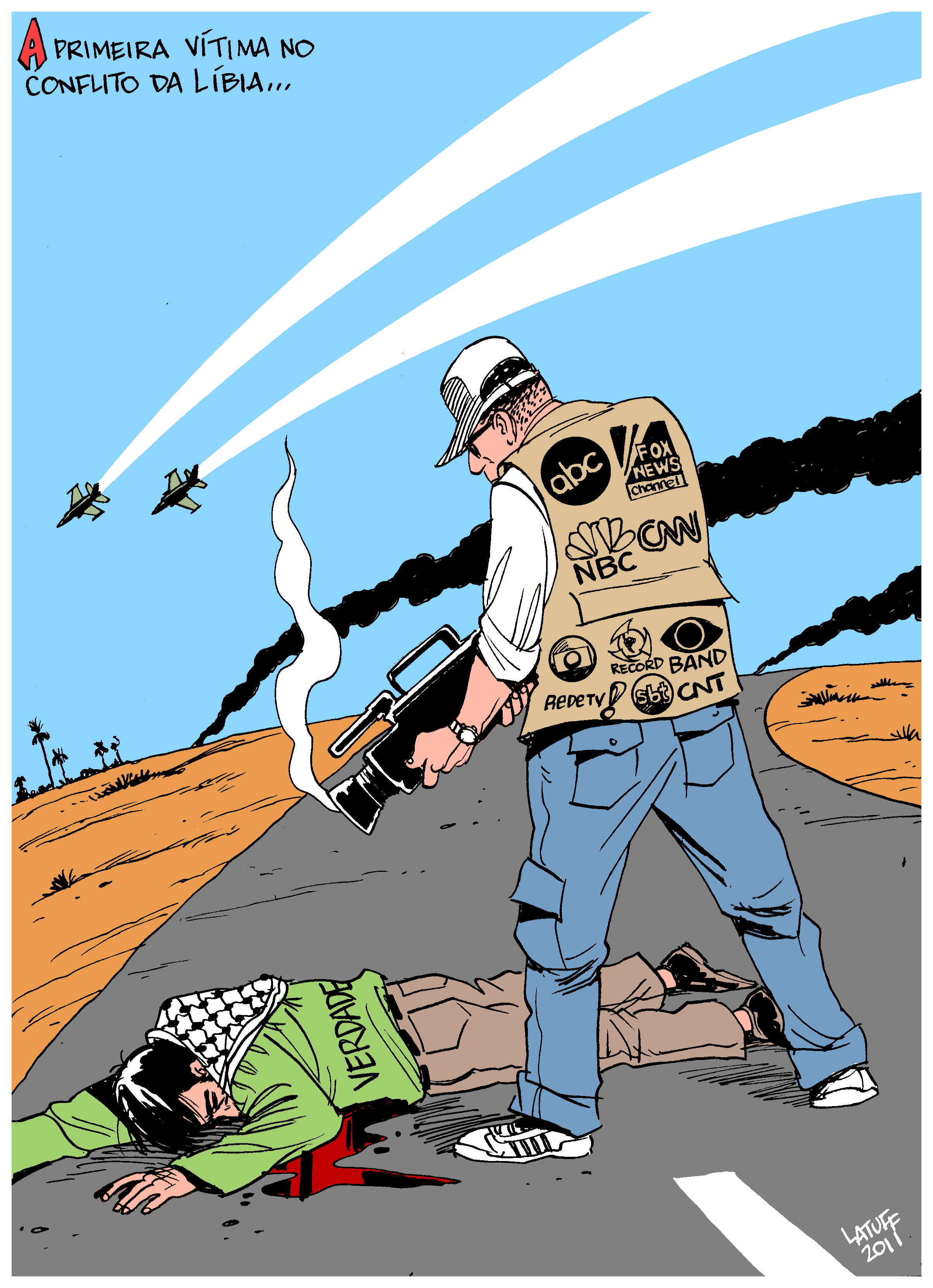
The first casualty of the Libya war...truth.

Except they preceded that sentence with this one: “Several alliance members…have been pushing NATO to be more aggressive in striking Gaddafi’s center of power, despite concerns about possible civilian casualties.”

So what appeared was: “Several alliance members…have been pushing NATO to be more aggressive in striking Gaddafi’s center of power, despite concerns about possible civilian casualties. NATO’s mission in Libya is to prevent civilian deaths.”

We could quibble with the duo failing to point out that NATO only says its mission is to prevent civilian deaths, contrary to the standard Western media practice of treating all Libyan government statements as possibly untrue.

For example, we might be told that a Libya government spokesman said NATO air strikes killed three civilians, rather than: NATO air strikes killed three civilians. The “said” part implies that maybe the civilians weren’t killed and that the Libyans are making it up. There’s nothing wrong with this. The Libyans could be making it up.

But the standard is applied unevenly. Apparently, Birnbaum and Warrick never considered that NATO could be making it up too. Or perhaps they did, but chose not to acknowledge it.

Whatever the mechanism that produces this double standard, the double standard exists, and that it exists helps to make the case for NATO’s bombing mission. NATO is protecting civilians. Civilians may have been killed, or not. We only know what the Libyans are telling us.

But there is a bigger problem than double standards. The obvious inconsistency in NATO’s claim that it is protecting civilians while killing them isn’t even remarked upon by the two journalists, even though they’ve made the inconsistency clear enough.

It’s as if the pair wrote: Several members of the medical team have been pushing for a more aggressive intervention, despite concerns it could possibly block blood flow to the patient’s left leg that would require its amputation. The team’s goal is to save the patient’s right leg.

And we can speculate that had the two journalists been around at the time they may have felt no unease at Japan’s justification for its East Asian wars of aggression during the first half of the 20th century. They may have written: Several top members of the government pushed for more invasions, followed by occupations to bring all of East Asia under Japanese control. Japan’s mission is to liberate the region from Western imperialism.

It’s strange that The Washington Post should promote the fiction that NATO’s mission in Libya is to prevent civilian deaths, considering the newspaper and other media have offered ample coverage of the unapologetic acknowledgements of NATO leaders that their mission is to drive Gaddafi from power.

Obama, March 29: “We will deny the regime arms, cut off its supply of cash, assist the opposition, and work with other nations to hasten the day when Gadhafi leaves power.”

The New York Times, March 28: “The strategy for White House officials …is to hit Libyan forces hard enough to force them to oust Colonel Qaddafi, a result that Mr. Obama has openly encouraged.”

Hilary Clinton, April 11: “There needs to be a transition that reflects the will of the Libyan people and the departure of Qaddafi from power and from Libya.”

Italian Foreign Minister Franco Frattini, April 11: “The future of Libya should include the departure of Qaddafi.”

More could be added, including French president Nicolas Sarkozy’s and British prime minister David Cameron’s admissions that a NATO objective is to topple Gaddafi.

It’s clear then that the goal of NATO countries is to oust the Libyan leader. In fact, as Richard Lance Keeble pointed out in a Media Lens piece, they’ve been at it for some time. But with the desired goal still distant, some alliance members are prepared to step up the attacks, even if it means more civilian casualties. The lie that the bombing campaign is somehow divorced from the larger goal of regime change, and is limited to protecting civilians, is punctured.

By any measure, except that of sanitizing the naked pursuit of regime change in Libya on behalf of the investor interests The Washington Post represents, the newspaper follows a curious standard of logic and evidence in declaring as fact that NATO’s mission is humanitarian.

The standard is, however, one any employee of a top-flight PR firm understands implicitly.

The ICNC: Propagating Uncle Sam’s Narrative

By Stephen Gowans

“The narrative we want to come out of this is that the Libyan people overthrew a dictator, not that we came in and toppled a despot,” said Stephen J. Hadley, a former national security adviser to President George W. Bush.

“And that’s the problem with going after command and control if it results in the death of Qaddafi, because what we really want him to do is for him to leave or to die at a Libyan hand, not an American hand,” said Mr. Hadley, speaking on CNN’s “State of the Union.” (1)

To explain the 2000 overthrow of Slobodan Milosevic in the former Yugoslavia, the International Center on Nonviolent Conflict promotes the very same narrative Hadley wants for Libya.

Through its video, Bringing Down A Dictator, and articles written by scholars on its academic advisory board–at least one of whom has met with the CIA and RAND Corporation–the organization brazenly rewrites history to put forward the narrative that an indigenous pro-democracy movement overthrew a dictator, not that NATO intervened massively to topple an elected president.

At least three facts are at odds with the ICNC narrative:

• NATO carried out a 78-day terror bombing campaign whose purpose was to induce “Milosevic’s own people…to turn on him,” according to the commander of US Air Force units in Europe at the time, General John P. Jumper. (2). In 1999, US General Michael Short told The New York Times that the bombing campaign was based on “hopes that the distress of the Yugoslav public will undermine support for the authorities in Belgrade.” (3)
• The West engineered a sanctions campaign that uniquely targeted areas in which Milosevic had strong support. This added to pressure on Milosevic’s own supporters to oust their president.
• Washington spent $10 million in 1999 and $31 million in 2000 to train, equip and advise an overthrow movement to destabilize the former Yugoslavia and oust Milosevic. [4] It is this movement that the ICNC celebrates as a largely indigenous pro-democracy movement.

Wherever Washington is trying to topple an independent government, the ICNC’s scholars can be counted on to help build a narrative that says the people overthrew a dictator, not that Washington allied with part of the population to sweep the old government from office. Invariably the replacement governments have aligned themselves closely with US financial, commercial and military interests.

Of the ICNC founder and chairman Peter Ackerman, Edward Herman and David Peterson note: He “was a board member and eventual chairman of Freedom House (September 2005 – January 2009), an institution that has been as clear an instrument of U.S. foreign policy as has the CIA itself.” (5) Ackerman is also a board member of the Council on Foreign Relations, equally as clear an instrument of US foreign policy.

On Stephen Zunes, the organization’s chief scholar, the pair add: “It is disturbing to watch Zunes repeatedly downplay the role of foreign money, knowledge, and power at work behind regime-change campaigns, and hype the democratic credentials of the opposition to targeted regimes.” (6)

This, indeed, is another way of saying that Zunes works to make the narrative of US regime change operations come out the way Hadley wants it to come out in Libya – with a targeted leader’s fall seen to come at the hands of his own people with US complicity erased from history.

Herman and Peterson condemn this narrative-setting as “an especially powerful cocktail for sowing confusion among leftists and progressives, whose minds tell them to oppose imperial causes, but whose hearts warm to emotionally manipulative rhetoric about the ‘homegrown’ nature of ‘pro-democracy’ movements.” (7)

Zunes and other ICNC scholars claim to be on the left. Some even anti-imperialist. If so, what’s left?

1. Kareem Fahim and Mark Mazzetti, “Allies defending actions in Libya after airstrike”, The New York Times, May 1, 2011.
2. Thom Shanker and David E. Sanger, “Nato says it is stepping up attacks on Libya targets”, The New York Times, April 26, 2011.
3. New York Times, May 13, 1999. Cited in William Blum’s Rogue State: A Guide to the World’s Only Superpower.
4. Dobbs, Michael, “US advice guided Milosevic opposition,” The Washington Post, December 11, 2000.
5. Edward S. Herman and David Peterson, “Reply to Stephen Zunes”, December 30, 2010. http://www.zcommunications.org/reply-to-stephen-zunes-by-edward-herman
6. Herman and Peterson.
7. Herman and Peterson.

Analysis of Syrian Protest Movement

Here’s Mazda Majidi, always worth reading, on Syria. A refreshing alternative to Gilbert Achcar.

The revolutions in Egypt and Tunisia have thrown into question all established authorities in the Arab world and unleashed political forces everywhere that see this as a golden opportunity to make their bid for power. This does not mean each one of these forces is progressive.

It is not possible at this point to weigh the relative strength, or politically characterize, all the various trends within the Syrian opposition movement. The current protest movement appears to have begun with a spontaneous protest against an incident of police brutality in a working-class Damascus neighborhood. It undoubtedly includes many thousands who simply a desire a society free of poverty and state repression. But it has also included sectarian religious forces who want to overthrow the country’s secular orientation, and have chanted “Alawis to the coffins, Christians to Beirut.” The Alawis are a religious minority group—about 12 percent of the population—to which many of the leading Ba’ath officials belong.

Read Majidi’s analysis in full here.

Edward Herman and David Peterson on Peter Ackerman and Stephen Zunes.

On Ackerman

“ICNC founder and chairman Peter Ackerman was a board member and eventual chairman of Freedom House (September 2005 – January 2009), an institution that has been as clear an instrument of U.S. foreign policy as has the CIA itself. While U.S. anti-war activists were still organizing to oppose the then-just-initiated U.S. aggression against Iraq, Ackerman joined with 21 other Freedom House trustees to issue a statement in support of the war…”

On Zunes

“It is disturbing to watch Zunes repeatedly downplay the role of foreign money, knowledge, and power at work behind regime-change campaigns, and hype the “democratic” credentials of the opposition to targeted regimes. Indeed, the latter is an especially powerful cocktail for sowing confusion among leftists and progressives, whose minds tell them to oppose imperial causes, but whose hearts warm to emotionally manipulative rhetoric about the ‘homegrown’ nature of ‘pro-democracy’ movements. “

And…

“We find it highly revealing…that one month before the March 2003 U.S. invasion of Iraq, while opponents of the imminent war were organizing protests on the streets of America’s cities, Zunes was extremely harsh towards Act Now to Stop War and End Racism (ANSWER), which had successfully mounted some of the major protests. “It’s one of the Leninist, Trotskyist organizations that has emerged in the past few decades,” he told the Washington Times, and exercises a “disproportionate influence in some sectors of the peace movement.” But Zunes identified an even more serious problem with ANSWER and related anti-war organizations: Their leaders “are not willing to say a bad thing about Saddam Hussein and Slobodan Milosevic. And if you ask questions, they accuse you of red-baiting.” Hence, no glowing rhetoric about “people power” and the genius of “civilian-based movements” where opposition to the U.S. war machine was the issue. Only comments that discredited the anti-war movement in a manner that Zunes never extended to protesters against one of the regimes targeted by the United States.

Full article can be found here.