Wars for Profits: A No-Nonsense Guide to Why the United States Seeks to Make Iran an International Pariah

By Stephen Gowans

Flipping idly through my morning newspaper, my eyes fell upon a headline, which, given its significance, should have appeared on the front page, but instead was tucked away at the back, on page A9.

“Israel won’t rule out attack on Iran”. (1)

Now, it’s true that Israel’s threatening to attack Iran is hardly news. Here was Ehud Barak, Israeli defense minister, over two years ago, talking about measures to dissuade Iran from continuing to process uranium: “We clearly believe that no option should be removed from the table. This is our policy. We mean it.” (2) And here was Barak just the other day: “We strongly believe that…no option should be removed from the table.” (3) Same defense minister. Same words. Same threat.

Yet while the threat may be old, its significance remains undiminished. One country is threatening to commit the supreme international crime: to attack another even though it, itself, has not been attacked by the country it rattles its saber at. Were Iran to threaten Israel, the headline “Iran won’t rule out attack on the Jewish state” wouldn’t be tucked away inconspicuously in the back pages of my newspaper. Instead, it would be shouted in bold letters across the front page. “My God!”, NATO state officials and editorialists would cry. “Iran is threatening to attack the Jewish state. Something must be done!”

But in this case it is Israel that is issuing the threat against a country which has, since its escape from US domination in 1979, been limned as dark and menacing, and so while no one wants war, surely it’s all perfectly understandable that the plucky Israelis should be declaring their determination to stand against the Judeophobic menace of the Islamic Republic. After all, isn’t Iran building nuclear weapons to wipe Israel off the map? Well, if you listen to the Israelis and their US protector, the answer is yes.

The Strangelovian Israeli historian Benny Morris declares that Israel is “threatened almost daily with destruction by Iran’s leaders.” To eclipse this threat, Iran must be wiped off the map before Iran does any wiping of its own. “Israel has no option,” Morris chillingly says, “but to use its nuclear arsenal to destroy Iran, unless the US uses its formidable military to destroy Iran’s nuclear facilities first.” (4)

Israeli prime minister Benjamin Netanyahu warns: “Iran is even arming itself with nuclear weapons to realize that goal (the obliteration of the Jewish state), and until now the world has not stopped it. The threat to our existence, is not theoretical. It cannot be swept under the carpet; it cannot be reduced. It faces us and all humanity, and it must be thwarted.” (5)

Ominous. But the idea that Iran intends to acquire nuclear weapons to obliterate Israel is pure flummery; a work of fiction, intended to create a frisson of fear.

So, why do I say this? First, we don’t know whether Iran intends to acquire nuclear weapons, or only the capability of producing them, or even that. An International Atomic Energy Agency report, released yesterday, tables evidence that Iran is secretly working on a nuclear bomb. So let’s assume for the moment that Iran’s leaders do indeed intend to build nuclear weapons.

It’s widely agreed that it’s highly unlikely that Iran would be able to build nuclear weapons while its nuclear energy program is still under the scrutiny of UN inspectors. A more likely scenario is that Tehran would develop the capability to produce a bomb from within the Nuclear Non-Proliferation Treaty (NPT), and once it had reached the point of being able to do so, would turn its capability into reality by withdrawing from the treaty, ejecting inspectors, and making a mad dash to develop a rudimentary arsenal. That’s what North Korea did, when, following the demise of the Soviet Union, the United States decided to re-target some its nuclear missiles from the USSR to the DPRK.

But would Iran ever get as far as being able to make a mad dash to status as the world’s newest nuclear-weapons state? The United States and Israel have made plenty of noise about bombing Iran’s nuclear facilities before Iran’s nuclear scientists ever reach the point of having the capability of producing nuclear weapons. Indeed, the threat to attack Iran’s nuclear facilities has been trotted out anew because the steps the United States and Israel have taken to sabotage Iran’s nuclear program–from the Stuxnet computer virus to the assassination of Iran’s nuclear scientists to punitive sanctions–haven’t stopped the program’s development, although they have certainly slowed it.

But let’s make another assumption. Let’s assume that despite US and Israeli efforts to cripple Iran’s ability to produce nuclear weapons, that Iran, despite these impediments, brings this capability to fruition, and furthermore, manages against the concerted opposition of the United States and Israel to develop a few nuclear warheads. Does the possession of warheads mean that Iran will use them–either to wipe Israel off the map or attack the United States?

No, it does not.

The idea that Iran is an “existential” threat to Israel comes from Iranian president Mahmoud Ahmadinejad’s alleged promise to wipe Israel off the map. US and Israeli political leaders have been invoking this chestnut for years to justify the assassinations, economic warfare, covert destabilization, and threats of military intervention used to undermine Iran’s nuclear energy program. The problem is, the allegation is groundless.

The firestorm started when Nazila Fathi, then the Tehran correspondent of The New York Times, reported a story almost six years ago that was headlined: “Wipe Israel ‘off the map’ Iranian says.” The article attributed newly elected Iranian President Mahmoud Ahmadinejad’s remarks to a report by the ISNA press agency.

Specialists such as Juan Cole of the University of Michigan and Arash Norouzi of the Mossadegh Project pointed out that the original statement in Persian did not say that Israel should be wiped from the map, but instead that it would collapse.

Khamenei stated, “Iran’s position, which was first expressed by the Imam [Khomeini] and stated several times by those responsible, is that the cancerous tumor called Israel must be uprooted from the region.” He went on to say in the same speech that “Palestinian refugees should return and Muslims, Christians and Jews could choose a government for themselves, excluding immigrant Jews.”

Khamenei has been consistent, stating repeatedly that the goal is not the military destruction of the Jewish state but “the defeat of Zionist ideology and the dissolution of Israel through a ‘popular referendum.’” (6)

To be sure, anyone who regards Israel as a “cancerous tumor” that “must be uprooted from the region” and replaced by a government freely chosen by the people who lived in Palestine prior to its conquest by Zionist settlers, is an existential threat to the idea of Israel as a Jewish state. But while the designation of Iran as an existential threat to the idea of Israel is literally true (in the sense that Iran doesn’t accept Zionism and therefore works against it by supporting such anti-Zionist groups as Hamas), the phrase “existential threat” is twisted to mean something more than intended: military destruction rather than collapse through a referendum.

Political leaders are in the habit of presenting non-threats into dire ones. A not particularly egregious example is provided by US Defense Secretary Leon Panetta, who, needing to defend the Pentagon’s Brobdignagian budget against possible cuts, recently “cited North Korea and Iran as persistent threats, and said that the military had to maintain ‘the ability to deter and defeat them.’” (7) Yet North Korea and Iran are not threats to the physical safety and welfare of a single US civilian.

First, Iran’s military is built for self-defense. It doesn’t have aircraft carriers, a large fleet of warships, strategic bombers, foreign military bases or a naval presence near US waters. The United States, by contrast, bases its Fifth Fleet in Bahrain, within shouting distance of Iran, directly across the Persian Gulf. Iranian warships won’t be found lingering menacingly in the Gulf of Mexico or patrolling the edges of US territorial waters.
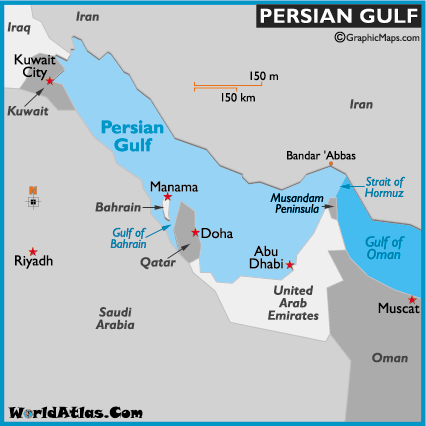
Second, a graph nearby shows that Iran’s military spending, at $20B per annum, pales in comparison to the budgets of the United States ($700B) and even that of the United States’ regional allies ($102B). The US military budget is 35 times larger than Iran’s, and the sum of that of the United States, its invariable co-belligerent the United Kingdom, and Washington’s regional allies, is 43 times larger. The gulf in fighting ability supported by these expenditures is as yawning as the one between the New York City Police Department and a troop of Boy Scouts armed with BB guns.

As regards North Korea, the idea that it is a threat to the security of a single US civilian is even more absurd. Like Iran, North Korea’s military is built for defense, and it too has no foreign military bases, no aircraft carriers, no nuclear armed submarines and no strategic bombers, and it has never—unlike its compatriot neighbor to the south—sent troops abroad to fight in other country’s wars (as South Korean troops have fought in US wars.)

North Korean military expenditures are even more modest than Iran’s. Pyongyang spends an estimated $10B on its military (and that’s probably stretching it), many of whose members are engaged in agriculture and other civilian activities. (8) By comparison, South Korea (on whose soil are resident close to 30,000 US troops), spends $39B, while nearby Japan (home to 40,000 US troops) spends $34B. Together, these two US allies outspend Pyongyang on their militaries by a factor of 7 to 1. Add to this US defense expenditures and those of Britain—a country that can be counted on to docilely follow the United States into any war–and North Korea, surrounded by US troops and warships and whose air borders are incessantly menaced by the US Air Force, is outspent over 80 to 1. A threat? The claim is laughable.

And that understates the imbalance. What military budgets don’t reveal is the vastly superior destructive power of US military hardware (and that of many of its allies) compared to Iran’s and North Korea’s. The kill capacity of US strike aircraft, cruise missiles, and battleships is far in excess of the heavy artillery that figures so prominently in the North Korean armamentarium, for example.

And then there’s nuclear weapons. North Korea may (or may not) have an arsenal of a few warheads, and Iran may (or may not) be seeking one, but these rudimentary collections pale in comparison with the US, British, and Israeli arsenals arrayed against them. Would Iran attack Israel, or North Korea attack South Korea, with one or two nuclear missiles, knowing that to do so would invite a retaliatory tsunami of missiles from the target (in the case of an attack on Israel) or its hyper-armed patron, the United States, or both? The outcome of so foolhardy an attack would be game-over for either country.

“During the Democratic primaries, then candidate Hilary Clinton (now US Secretary of State) warned that if Iran attacked Israel, the United States would ‘totally obliterate’ Iran.” (9) Three years ago, Israeli “Infrastructure Minister Benjamin Ben-Eliezer went on record saying, ‘We must tell them: ‘If you so much as dream of attacking Israel, before you even finish dreaming there won’t be an Iran anymore.’” (10) It’s doubtful that the Iranians failed to get the message.

And then there’s the matter of Washington’s 2010 Nuclear Posture Review (NPR). If read superficially, the NPR would lead one to believe that US policy makers have finally figured out that the cardinal rule of nonproliferation is to abjure military aggression against non-nuclear states. Countries that aren’t threatened by nuclear powers have no need to develop nuclear weapons for self-defense. However, a closer reading of the review shows that nothing has changed. US president Barack Obama has stayed true to form, obscuring his pursuit of his predecessors’ policies beneath honeyed phrases that create the impression of change, where no change of substance exists.

The NPR declares “that the United States will not use or threaten to use nuclear weapons against non-nuclear weapons states”, even if they attack the United States, its vital interests or allies and partners with chemical or biological weapons. This differs, but only on the surface, from the policy of preceding administrations which refused to renounce the use of nuclear weapons against non-nuclear states. There are a number of reasons why the difference is apparent only.

While nuclear weapons are widely regarded as unparalleled in their destructive power, the United States is able to deliver overwhelming destructive force through its conventional military capabilities. A promise not to use or threaten to use nuclear weapons against non-nuclear states is not the same as an assurance not to use or threaten to use devastating military force. Six decades ago it was possible to obliterate a city through conventional means, as the Western Allies demonstrated in the firebombing of Dresden. If a city could be destroyed by conventional means more than half a century ago, imagine what the Pentagon could do today through conventional forces alone. Indeed, the NPR makes clear that the United States is prepared to shrink its nuclear arsenal partly because “the growth of unrivalled U.S. conventional military capabilities” allows Washington to fulfill its geostrategic goals “with significantly lower nuclear force levels and with reduced reliance on nuclear weapons.”

The NPR also provides a number of escape hatches that allow Washington to continue to dangle a nuclear sword of Damocles over the heads of Iran and North Korea. One is that nuclear weapons can be used, or their use threatened, against a country that is not “party to the NPT” even if the country doesn’t yet have nuclear weapons, or it is unclear whether it does. This is the North Korea escape clause. It allows Washington to continue to threaten North Korea with nuclear obliteration, just as it has done since the early 1990s when the US Strategic Command announced it was re-targeting some of its strategic nuclear missiles on the DPRK (the reason why North Korea withdrew from the NPT.)

Another escape clause allows Washington to reach for the nuclear trigger whenever it deems a country to have fallen short of “compliance with [its] nuclear non-proliferation obligations,” even if the country doesn’t have nuclear weapons and is a party to the NPT. This is the Iran escape hatch, intended to allow Washington to maintain the threat of nuclear annihilation vis-à-vis Iran or any other country Washington unilaterally declares to be noncompliant with the treaty’s obligations.

As for the United States’ commitment to refrain from reaching for its nuclear arsenal in response to a chemical or biological attack on itself, its vital interests (a term that defies geography and democracy, for how is it that the United States’ vital interests extend to other people’s countries?) its allies and its partners, this too is verbal legerdemain. As a careful reading of the NPR makes clear, the truth of the matter is that the United States will attack any country with nuclear weapons if such an attack is deemed necessary by Washington to protect its interests. According to the NPR, “the United States reserves the right to make any adjustment in [its commitment] that may be warranted…” Translation: We won’t attack non-nuclear weapons states with nuclear weapons unless we decide it’s in our interests to do so.

Finally, we need to ask whether either Iran or North Korea have a motive to attack the United States, and whether Iran has a motive to attack Israel. Iran’s leaders may abhor the Zionist conquest of what they see as territory important to Islam, but that doesn’t mean they’re willing to take on a suicide mission to deal a one- or two-nuclear missile blow to Israel—one which, by the way, probably wouldn’t destroy Israel, but would in all likelihood elicit a hail of retaliatory blows that would produce devastating damage to Iran. As for tangling with the United States, neither Iran nor North Korea want that. What they want is peaceful coexistence—to be left alone to develop in their own way.

The trouble is, the United States hasn’t the barest interest in peaceful coexistence, and the reason why is the key, not only to understanding US foreign policy, but to understanding why a US-led NATO spent months bombing Libya to drive Muamar Gaddafi from power.

But first, a digression. Critiques of US foreign policy often involve exposes of US hypocrisy. For example, critics might point out that the United States defends Israel, which has nuclear weapons and doesn’t belong to the NPT, while threatening to attack Iran, which belongs to the NPT, and doesn’t have nuclear weapons. Or that NATO bombed Libya to prevent the government there from using its military to put down an uprising but condoned Bahrain and Saudi Arabia using their militaries to put down an uprising in Bahrain. Some critics stop there, reasoning that if they’re going to muster opposition to US foreign policy, it’s enough to show that it’s built on hypocrisy. Or they show US behavior to be immoral, undemocratic or against international law and figure that showing this will rouse the indignation of people of good conscience. Other US foreign policy critics cogently show why US foreign policy couldn’t possibly be guided by the objectives US leaders say it is. But they stop there, leaving their audiences to scratch their heads, wondering, if not for the reasons stated, then why?

Liberals insist that US foreign policy makes no sense and that US leaders are confused, myopic, poorly motivated, or just plain dumb. An example of this point of view is offered by former US president Jimmy Carter, who contends that the conflict with North Korea can be resolved in half a day (11). Apparently US leaders have neither the political will nor smarts to do so.

The truth of the matter is that there is nothing to be gained for the corporations, investors and banks that dominate US foreign policy—the one percent who really matter in the United States–from peaceful coexistence with North Korea. Peaceful coexistence implies that each side poses a threat to the other, but North Korea, despite the rhetorical nonsense of political leaders seeking to justify Pentagon budgets, poses no threat to the United States. A $10B defense budget against a $700B one; aging aircraft whose pilots are grounded most of the time due to shortages of fuel; a puny arsenal of nuclear weapons; an army whose training time is partly displaced by engagement in farming; the most sanctioned country on earth, whose economy has been crippled by six decades of US economic warfare; a country of 24 million hemmed in to the south and east by US allies and US troops; no, North Korea is not a threat.

So how is it that peaceful coexistence would deliver anything in the way of improved security for Americans, which they already have in abundance anyway? It wouldn’t. The demand for peaceful coexistence is little more than a Quixotic plea from Pyongyang to be left alone to develop in a self-directed manner in exchange for giving up a few nuclear weapons that at best, are, to use an Edward Herman term, a “threat of self-defense.” The benefits of peaceful coexistence are all on the North Korean side.

What does the United States get for promising to leave North Korea to develop in its own way? An open door for exports and investments? North Korea’s integration into a US-dominated system of global capitalism? US troops on North Korean soil? North Korea’s incorporation into a US-led military alliance against China? No. What it gets is North Korea giving up a deterrent to attack in exchange for the United States promising not to attack. This is a one-sided deal. No wonder North Korea wants it, and Washington keeps turning it down. David Straub, director of the US State Department’s Korea desk from 2002 to 2004 sums up nicely why peaceful coexistence isn’t on Washington’s Korea agenda. “North Korea’s closed economic and social system means the country has virtually nothing of value to offer the United States.” (12) What the United States wants from North Korea (an open door to investment, exports, ownership and political influence) is the opposite of what North Korea offers (a closed door and a prickly sense of independence—both political and economic). Washington abandoned the policy of peaceful coexistence with the USSR, which was militarily strong enough to make the US a miserable place if the Pentagon ever decided to start a US-Soviet war. So why would it accept peaceful coexistence with a hated closed system that poses a minor threat at best?

Other critics of US foreign policy explain their subject in terms of power. US leaders want to preserve or expand US power (or primacy or hegemony) against such “peer competitors” as China or Russia or such regional powers as Iran. Of course, it’s never said what US leaders (or Chinese or Russian leaders) want power for. To believe these critics, power is what everyone wants, and the quest for it, as an end in itself, is what makes the world go around. But the trick here is to inquire into why power is sought. Washington doesn’t seek to enlarge its power to strong-arm governments around the world into furnishing their citizens with public healthcare, guaranteed employment and free education. On the contrary, it seeks power to do the very opposite. Power serves some end, and in the case of US state power, it serves the end of protecting and enlarging the big business interests of the big business people who run the state of a big business country; it protects profits and establishes the conditions that allow them to grow—both at home and overseas.

It’s curious that the power-is-the-alpha-and-omega-of-world-politics view should hold such a strong sway among critics of US foreign policy, when in the internal affairs of capitalist countries the organizing principle is private business, and the alpha and omega of private business, is profits. Sure, it’s understood that business leaders want power, but not so they can lord it over others, and take pleasure in its trappings, but so they can enlarge their capital. Power is a means to an end.

So why should foreign policy be any different? The moment Gaddafi was toppled by NATO bombs, a stream of NATO foreign ministers traipsed to Benghazi, their countries’ corporate CEOs in tow, to line up new business deals. It was clear the National Transitional Council (NTC), whose key members—one, an exile who had been teaching economics in the United States for years; another, who earned his PhD in 1985 from the University of Pittsburgh under the late Richard Cottam, a former US intelligence official in Iran; and a third, who had been living within hailing distance of CIA headquarters in Langley, Virginia, before being spirited back to Libya– would be a good deal more accommodating of US business interests than Gaddafi had ever been. For all his turning over a new leaf to befriend the West, Gaddafi had irked the US State Department by practicing “resource nationalism” and trying to “Libyanize” the economy, (13) which is to say, turn foreign investment to the advantage of Libyans. His threat in 2009 to re-nationalize Libya’s oil fields, stirred up old fears. (14) Now, the NTC—with its US-friendly principals–promises juicy plums to the countries whose bombs ousted Gaddafi.

The US ambassador to Libya, Gene A. Cretz, channeling the ghost of uber-imperialist, Cecil Rhodes, acknowledged that Libyan oil was “the jewel in the crown” but that there would be broader profit-making opportunities to lay hold of, now that Gaddafi had been bombed from power. Even “in Qaddafi’s time,” he observed, the Libyans “were starting from A to Z in terms of building infrastructure and other things. If we can get American companies here on a fairly big scale, which we will try to do everything we can to do that, then this will redound to improve the situation in the United States with respect to our own jobs.” (15) US Senator John McCain, for his part, noted that “American investors were watching Libya with keen interest and wanted to do business” in Libya as soon as the country was pacified. (16)

The New York Times’ Scott Shane summed up the excitement.

Western security, construction and infrastructure companies that see profit-making opportunities receding in Iraq and Afghanistan have turned their sights on Libya, now free of four decades of dictatorship. Entrepreneurs are abuzz about the business potential of a country with huge needs and the oil to pay for them, plus the competitive advantage of Libyan gratitude toward the United States and its NATO partners.

A week before Colonel Qaddafi’s death on Oct. 20, a delegation from 80 French companies arrived in Tripoli to meet officials of the Transitional National Council, the interim government. Last week, the new British defense minister, Philip Hammond, urged British companies to “pack their suitcases” and head to Tripoli. (17)

Shane’s summing up provides a pretty good account of what the NATO bombing campaign had been all about, with one exception. Western security, construction and infrastructure companies aren’t turning their sights on Libya because it is now free of four decades of dictatorship, but because it is now free of four decades of economic nationalism—an economic nationalism that once privileged Libyans over Western banks, investors and corporations. The country is now open for business…on the West’s terms.

The view that US foreign policy is shaped by considerations related to preserving and enlarging profit-making opportunities for investors, banks and corporations headquartered in the United States is based on two realities.

• The formulation of US foreign policy is dominated by the CEO’s, corporate lawyers and major investors who circulate between Wall Street and Washington.
• The countries that the United States has singled out for regime change, without exception, pursue self-directed economic policies aimed at fostering self-development and therefore deny or limit US investment and export opportunities.

Every rich country, with the exception of Britain, became rich through active state intervention in their economies to create industries, subsidize them and protect them from competition while they grew. The United States, as much as Germany, Japan, and other now rich industrialized countries, followed this path. (18) At one point, the United States had the world’s highest tariff barriers, which it used to shelter its nascent manufacturing industries against competition from established British firms. As protected industries matured under the guiding hand of a dirigiste state, they naturally sought to expand beyond their borders, as the possibilities offered by national markets were exhausted. Now, the policies that served their development so ably in the past, became fetters. Rather than protected markets at home, they needed open markets abroad. Poor countries couldn’t be allowed to emulate the policies that made the rich countries rich, because state-ownership, subsidies and trade barriers would eclipse the further development of the once protected industries of the rich countries. Poor countries would have to open themselves up as fields for exploitation by the banks, investors and corporations of the rich countries that had grown fat on the dirigiste policies some poor countries were now seeking to emulate.

A glance through the US Library of Congress’s country study on Iran reveals a truth that US officials never mention and that US foreign policy critics seem unaware of. Iran is not the kind of place an enterprising US business can hope to make money in. “The public sector dominates the economic scene, and the subordination of the private sector is observed in all industries and commerce.” (19) Worse, “Public-sector investments in transportation…utilities, telecommunications, and other infrastructure have grown over time.” (20) “The government plays a significant role in Iran’s economy, either directly through participation in the production and distribution of goods and services, or indirectly through policy intervention.” (21) Indeed, Iran’s constitution defines the public sector as primary, and “the private sector as the means of furnishing the government’s needs rather than responding to market requirements.” (22) Democratic socialists will be shocked to discover that this is the very same economic model that such New Left socialists as Ralph Miliband defined as emblematic of what a democratic socialism ought to be (which isn’t to say that Iran is a democratic socialist state, only that economically it is very close to what many socialist thinkers have envisaged for Western socialism.) In any event, it will be conceded that any economy that bears even a passing resemblance to that favored by radical democratic socialists is not likely to get a ringing endorsement from the kinds of people who formulate US foreign policy.

Other reasons why Iran’s economic policies are likely to have provoked the animosity of the US State Department: Despite its leaders making noises about going on a privatizing binge, Iran’s public sector has soberly grown rather than shrunk. (23) What’s more, large sectors of Iran’s economy remain off-limits to private ownership. ”Since the Revolution, the government has retained monopoly rights to the extraction, processing, and sales of minerals from large and strategic mines.” (24) Iran’s “agricultural policy is intended to support farmers and encourage production of strategically important crops” (25), not to open doors to US agribusiness. ”After the Revolution, many transportation companies, banks, and insurance companies were nationalized” (26) while price controls and subsidies have been used to make important consumer goods affordable (though many subsidies have been lifted recently.)

Wall Street and the US State Department dislike state-owned enterprises that serve the self-directed development goals of independent foreign countries, because they displace private investment by US capital. They abhor the practice of foreign governments subsidizing and protecting local business enterprises because it makes the task of US firms competing in overseas markets more difficult, and thereby limits the overseas profits of US firms. They revile regulations that protect local populations from pollution, desperation wages and deplorable working conditions, because they cut into profits. Some or all of these practices form significant parts of the economic policies of every country in the cross-hairs of US foreign policy, including Libya under Gaddafi and Iran today.

Washington doesn’t want to bring about a change of regime in Tehran to install a pliant government that will help expand US power. It wants to bring about a change of regime in Tehran that will cancel economic policies aimed at Iran’s self-development and replace them with policies that will open up the country’s resources, markets, labor and land to US banks, corporations and investors. It wants the holy trinity of free-trade, free-enterprise and free-markets at the center of poor countries’ economic policies, not protected trade, not state-owned and subsidized enterprises, and not trade barriers. (But while preaching the holy trinity abroad, the United States reserves the right to deploy subsidies, impede imports, and rely on state-intervention to support key industries at home. Consistency doesn’t matter. Profits do.)

To reach the goal of turning Iran into a country that can disgorge a bonanza of profits to US corporations and investors, Iran must first be denied the capability of mounting an effective defense against military intervention by the United States and its allies. It is for this reason that the United States and its Middle Eastern Doberman, Israel, have embarked upon a program of sabotage, assassinations and threats of aerial bombing aimed at crippling even the possibility of Iran acquiring a nuclear deterrent. The idea that Tehran is bent on lobbing a few nuclear-tipped missiles toward Israel, to complete what the Fuhrer had left undone, is demagogic nonsense, intended to provide a compelling justification for aggression against Iran. Evoking Hitler’s campaign of genocide against the Jews to invest contrived existential threats with gravitas has been a standard operating procedure of Zionist leaders dating to 1948. (27) Iran has no intention of attacking Israel, and would commit suicide if it did, a reality we can be certain has not escaped its leaders’ ken.

All of this to say that in order to understand US foreign policy it’s necessary to examine who rules in the United States, who formulates its foreign policy, and how the policy the rulers formulate intersects with their economic interests. (28) This is an inquiry into class. For if an economic elite dominates foreign policy, we should expect to find that the outcomes of foreign policy favor elite economic interests, and that foreign countries that pursue economic policies that are not agreeable to those interests will be harassed, sabotaged, sanctioned, destabilized, and possibly bombed or invaded, until the policies are changed.

It may be objected that the cost to the United States of military intervention in Iran would surely exceed any economic gain that would accrue to the country as a whole. For liberals, this would count as evidence that US foreign policy makers had once again made an error. For others, it would stand as a challenge to the idea that a war on Iran would be a war for profits.

But the costs of military intervention are what economists call externalities—costs created by a firm, an industry or a class, but borne by others. Hydraulic fracturing—the high-pressure injection of fluids into rock to release fossil fuels—creates costs in water pollution and wear and tear on roads used by trucks and heavy machinery. If these costs are internalized—borne by the oil companies whose activities have created them—then hydraulic fracturing makes no sense economically–its costs exceed its returns. But if the costs are externalized—left to society as a whole to absorb—hydraulic fracturing becomes an attractive way for oil companies to turn a profit. (29)

Here’s the parallel with military intervention. The giant engineering firm Bechtel would absorb virtually none of the costs of a successful war on Iran, but if one happens, Bechtel is likely to reap enormous profits in contracts to rebuild the infrastructure that the US Air Force would raze to the ground. For Bechtel, then, US military intervention in Iran would be highly profitable, even though it might not make sense economically when viewed from the perspective of the United States as a whole. Lockheed-Martin, Boeing, Northrop Grumman, General Dynamics and Raytheon—the top five defense contractors–don’t foot the Pentagon’s massive $700B per annum bill, but large portions of that budget are transferred to them in the form of contracts for military hardware. While bloated military expenditures make no sense from the point of view of the country as a collectivity, major defense contractors reap enormous profits from them.

The problem, then, of arguing that military intervention in Iran would make no sense because the costs would exceed the economic gains that would accrue to the United States as a whole, is failure to recognize that the country is class-divided, and that the gains of war are internalized within the dominant class while the costs are externalized to the bottom 99 percent. Hence, war doesn’t make sense for the bulk of us, but the problem is that decisions about military expenditures, foreign policy and war are in the hands of the top one percent and their loyal servants, who privatize the benefits and socialize the costs. When liberals say US foreign policy makes no sense, they’re being misguided by a set of erroneous assumptions: that the United States has only one class, the middle-class, that it is not class-divided, that everyone within it has the same middle-class interests, and that the state rules in the interests of all.

Like all US wars, the war on Iran of sanctions, sabotage, assassinations and saber-rattling is a class war. It is a war of class in two respects. First, it is waged on behalf of a class of bankers, major investors, and corporate titans, to knock down walls in Iran that deny this elite access to markets and investment opportunities. Second, it is a war carried out on the back of a class of employees, pensioners, unemployed, and armed forces members—the bottom 99 percent–who bear the cost, through their taxes (and in the future their lives.)

The aim is to install local politicians, most of whom have been educated at US universities where they have been instilled with imperialist values, who can, assisted by US advisors, make over Iran into an agricultural, natural resources, low-wage appendage of the US economy in the service of Wall Street and the class of owners and high-level managers who occupy its commanding heights. In short, a war for profits.

1. Adam Blomfield, “Israel won’t rule out attack on Iran,” The Ottawa Citizen, November 7, 2011.
2. Associated Press, July 27, 2009.
3. Blomfield.
4. Benny Morris, “Using Bombs to Stave Off War,” The New York Times, July 18, 2008.
5. Isabel Kershner, “Israeli strike on Iran would be ‘stupid,’ ex-spy chief says”, The New York Times, May 8, 2011.
6. Glenn Kessler, “Did Ahmadinejad really say Israel should be ‘wiped off the map’?” The Washington Post, October 6, 2011.
7. Thom Shanker and Elisabeth Bumiller, “Weighing Pentagon cuts, Panetta faces deep pressures”, The New York Times, November 6, 2011.
8. Bruce Cumings. Korea’s Place in the Sun: A Modern History. W.W. Norton & Company. 2005.
9. Mark Landler, “Iran policy now more in sync with Clinton’s views,” The New York Times, February 17, 2010.
10. Mazda Majidi, “What lies behind US policy toward Iran?” Liberation, June 12, 2008.
11. Tim Beal. Crisis in Korea: America, China and the Risk of War. Pluto Press.2011. p. 71.
12. Kim Hyun, “US ‘Has No Intention to Build Close Ties with N Korea’: Ex-official,” Yonhap News, September 2, 2009.
13. Steven Mufson, “Conflict in Libya: U.S. oil companies sit on sidelines as Gaddafi maintains hold”, The Washington Post, June 10, 2011.
14. Thomas Walkom, “What Harper and co. got from the Libyan war”, The Toronto Star, October 21, 2011.
15. David D. Kirkpatrick, “U.S. reopens its embassy in Libya”, The New York Times, September 22, 2011.
16. Kareem Fahim and Rick Gladstone, “U.S. Senate delegation offers praise and caution to Libya’s new leaders”, The New York Times, September 29, 2011.
17. Scott Shane, “West sees opportunity in postwar Libya for businesses”, The New York Times, October 28, 2011.
18. Erik S. Reinert. How Rich Countries Got Rich and Why Poor Countries Stay Poor. Public Affairs. New York. 2007; Ha-Joon Chang. Bad Samaritans: The Myth of Free Trade and the Secret History of Capitalism. Bloomsbury Press. 2008.
19. The Library of Congress. Iran: A Country Study. 2008. p. 143. http://lcweb2.loc.gov/frd/cs/irtoc.html
20. Iran: A Country Study, p. 145.
21. Iran: A Country Study, p. 150.
22. Iran: A Country Study, p. 151.
23. Iran: A Country Study, p. 152.
24. Iran: A Country Study, p. 167.
25. Iran: A Country Study, p. 170.
26. Iran: A Country Study, p. 181.
27. Ilan Pappe. The Ethnic Cleansing of Palestine. Oneworld Publications. 2006.
28. Albert Szymanski. The Capitalist State and the Politics of Class. Winthrop Publishers. 1978.
29. Paul Krugman, “Here comes the sun,” The New York Times, November 6, 2011.

I recognize that in my views and even use of certain phrases that I have been influenced by Michael Parenti, and that needs to be acknowledged here. Of particular influence is Parenti’s latest book, The Face of Imperialism, Paradigm Publishers, 2011 and his earlier Against Empire, City Light Books, 1995.

Social Democracy, Soviet Socialism and the Bottom 99 Percent

By Stephen Gowans

A measure of just how far to the right US electoral politics are is that the country doesn’t have a mainstream social democratic party. This absence prompted Seymour Martin Lipset and Gary Marks to write It Didn’t Happen Here (1), the “it” being a social democratic party that could count on the ongoing support of a sizeable fraction of the working class population. By contrast, Western Europe and Canada have long had such parties, and social democratic parties have formed governments in Britain, France, Germany, Italy, Spain, Greece and Canada as well as in Scandinavia and other places.

Many left-leaning US citizens are envious of countries that have strong social democratic parties, but their envy is based mainly on romantic illusions, not reality. Western Europe and Canada may be represented by mass parties at the Socialist International, but the subtitle of Lipset and Marks’ book, Why Socialism Failed in the United States, is just as applicable to these places as it is to the United States. For socialism—in the sense of a gradual accumulation of reforms secured through parliamentary means eventually leading to a radical transformation of capitalist society–not only failed in the United States, it failed too in the regions of the world that have long had a strong social democratic presence. Even a bourgeois socialism, a project to reform (though not transcend) capitalism, has failed.

This essay explores the reasons for this failure by examining three pressures that shape the agendas of social democratic parties (by which I mean parties that go by the name Socialist, Social Democrat, Labour, NDP, and so on.) These are pressures to:

• Broaden the party’s appeal.
• Avoid going to war with capital.
• Keep the media onside.

These pressures are an unavoidable part of contesting elections within capitalist democracies, and apply as strongly to parties dominated by business interests as they do to parties that claim to represent the interests of the working class, labour, or these days, ‘average’ people or ‘working families’. The behaviour and agenda of any party that is trapped within the skein of capitalist democracy and places great emphasis on electoral success—as social democratic parties do–is necessarily structured and constrained by the capitalist context. As such, while social democratic parties may self-consciously aim to represent the bottom 99 percent of society, they serve–whether intending to or not—the top one percent.

So how is it, then, that egalitarian reforms have been developed in capitalist democracies if not through the efforts of social democratic parties? It’s true that social democrats pose as the champions of these programs, and it’s also true that conservatives are understood to be their enemies, yet conservatives have played a significant role in pioneering them, and social democrats, as much as right-wing parties, have been at the forefront of efforts to weaken and dismantle them. Contrary to the mythology of social democratic parties, the architects of what measures exist in capitalist democracies for economic security and social welfare haven’t been social democrats uniquely or even principally, but often conservatives seeking to calm working class stirrings and secure the allegiance to capitalism of the bottom 99 percent of society against the counter-example (when it existed) of the Soviet Union.

Pressure to Broaden the Party’s Appeal

Social democratic parties are usually made up of core supporters drawn from the bottom 99 percent of society who are committed to an underlying set of principles that they are unwilling to move away from, and an opposing faction, also drawn from the 99 percent, that is ready to compromise on principle to make the party more popular and increase its chances of electoral success.

The latter group is typically made up of the party’s candidates and elected officials, who have a direct personal interest in expanding the party’s base of support to win public office and secure its attendant perquisites. Owing to this interest, they are often willing to sacrifice principle for immediate electoral gain.

On the other hand, supporters of core principles tend to be non-elected members. Their role is to furnish the party with cash and volunteer labour. Without a direct personal interest in sacrificing principle to broaden the party’s appeal, they insist that principle be adhered to, even at the expense of limiting the party’s popularity. To these party members, politics is about changing popular sentiment to match the party’s principles, not changing the party’s principles to match popular sentiment.

Of course, these are only tendencies. Some elected members are uncompromisingly committed to principle, while some grassroots members are prepared to sacrifice principle for electoral gain.

The conflict between the two factions is hardly an equal one. Since social democratic parties exist to select candidates and get them elected, the party’s parliamentary caucus, and its aides and advisors, wield outsize influence. The party leader and key advisers determine the party’s electoral platform, its strategy in opposition, and its agenda in government. The grassroots members of the party have little or no influence over the party’s parliamentary agenda. Except for electing candidates and a leader, they play an indirect and very limited role in setting the party’s direction.

Hence, social democratic parties are dominated by a stratum whose direct personal interests are defined by the electoral successes of the party. Since electoral success depends on the degree of overlap between party principles and popular sentiment—and since it is often easier to change the party’s platform than public opinion– this faction will often find itself ready to compromise on principle as the easiest way to expand the party’s popularity. And since it is this stratum that sets the party’s parliamentary and electoral agenda, it is almost inevitable that founding principles will be sacrificed to electoral expediency.

Avoiding War with Capital

If that weren’t enough, even a social democratic party that comes to power with undiluted reformist ambitions will find that compromise is necessary for political survival. Social democrats believe that it is possible to reform society in egalitarian directions within the context of capitalism. Even democratic socialists, who favour a radical socialist transformation of capitalist society, pledge to bring this about in a gradual, parliamentary fashion. This means working within the political institutions of capitalist society.

But egalitarian reforms are never in the direct interests of capital, although they may be it its indirect, defensive, interests, if its dominant position in society is threatened. Under these circumstances, banks, corporations and major investors—the top one percent—may, either directly, or through the governments they dominate, offer concessions and reforms to the bottom 99 percent as a necessary sop to preserve their place at the top. This only happens, however, in the face of impending revolutionary upheavals, or where an alternative system threatens to illuminate the failings of the capitalist system and undermine its legitimacy.

But absent an inspiring counter-example or threat of insurrectionary disturbance, compromises are unnecessary. And social democratic parties are nothing if not adverse to revolutionary upheavals and alternatives that operate outside a capitalist framework. Consequently, members of the top one percent have no fear that social democratic parties will seek to topple them from their privileged position at the apex of society. On the contrary, social democratic parties are more likely to strive to demonstrate that they can be relied upon to act as trustworthy guardians of the capitalist economy (and therefore of the interests of the one percent who own and control it.) The action of Greece’s Socialist government to protect the investments of lenders at a considerable cost to the Greek working class, and over the class’s fierce resistance, is a case in point.

Meaningful efforts to transfer part of the profits of capital to funds for improving the economic security and social welfare of the bottom 99 percent (that is, efforts to reclaim part of the surplus the 99 percent produce) never get very far before meeting determined resistance. And capital’s ability to combat threats to its profits and property is formidable. Its control over the media and interests in public relations firms allow it to launch public opinion assaults on egalitarian reforms to bleed them of popular support. A social democratic government might back off its reforms, reasoning that its chances of future electoral success are unpromising in the face of a harshly negative media climate.

More significantly, capital may relocate to other, more accommodating jurisdictions, or threaten to do so, thereby touching of or threatening to touch off an economic crisis, in turn destabilizing the rule of any government that challenges it. Corporations may also curtail investments, either as a punitive measure, or because reforms have attenuated returns on investment. In either case, a social democratic party that seeks to undertake reforms within a capitalist framework must bend to the logic of capitalism–and the logic is hardly friendly to egalitarian reforms.

Egalitarian reforms, however, have been achieved over the years in Western capitalist societies, despite these obstacles, and this reality would seem to call my argument into question. Yet the number and nature of the reforms have fallen short of the original ambitions of social democracy, and in recent decades, have been abridged, weakened and sometimes cancelled altogether, often by social democratic governments themselves.

The first social insurance schemes were developed in Germany, not by social democrats, but by Prince Otto von Bismarck, a conservative who understood the value of social insurance in pacifying a restive working class. The British Liberal governments of 1906-1914 followed with their own ambitious schemes of pensions and health and unemployment insurance to calm working class stirrings. (2) In the United States, the idea of social security didn’t come from unions or the Democrats but from the Rockefellers, who were searching for ways to avert labour unrest and avoid unionization. Likewise, collective bargaining wasn’t the brainchild of unions, but of corporate leaders who wanted to reduce the violence and uncertainty of labour relations. (3) Social democracy often claims credit for these gains, but it was conservatives who conceded them to protect the tranquil digestion of the profits, interest and rents of the top one percent from the disturbances of the bottom 99 percent.

Many reforms were introduced after World War II, at a time Western Europe lay in ruins, and was struggling to pick itself up from the devastation of the war. Liberal democracy had lost its sheen, and in the face of economic tribulations and the rising star of the Soviet Union, socialism had gripped the popular imagination. There was a very real possibility that Western Europeans would turn away from capitalism, and the United States, and the new Western European post-war governments, laboured to inoculate Europe against the threat of socialism. Part of the effort involved the introduction of major social welfare reforms, such as the National Health Service in Britain. True, the NHS was introduced by a Labour government, but conservative governments in Western Europe introduced similar programs at the same time—and for the same reasons. (4) It was the need to secure the allegiance of Western Europeans to capitalism against the threat of socialism, not social democratic parliamentary activism, that brought forward important concessions to the majority.

Thus, conservatives seeking to eclipse threats to the stability of capitalist society posed by extra-parliamentary agitation and the counter-example of the Soviet Union have been the principal architects of ambitious schemes of social insurance. Social democrats may have been involved, however not as instigators, but as participants in essentially conservative schemes aimed at safeguarding the top one percent from the potential revolutionary action of the bottom 99 percent. With labour largely quiescent in recent decades and far from revolutionary, and the demise of the Soviet Union (and China’s taking the capitalist road) leaving the world with few living counter-examples to capitalism, capital has been able to revoke reforms it conceded in more restive times. The Occupy Wall Street movement, and anti-austerity agitations in Europe, are early signals of a possible reversal of tide.

The Soviet Counter-Example

It is instructive to consider Soviet social welfare, to understand what capitalist democracies once competed against, and to appreciate its breadth and depth. Although it is certainly unfashionable in capitalist democracies to say so, it is true all the same that the Soviet Union was organized to serve the interests of the mass of its people, and not to enrich an elite of bankers, major investors and corporate titans, as is true in our own societies, and in Russia and other countries of the former Soviet Union today.

Some will object that the USSR was organized to serve the interests of the Communist Party elite, and that it too was divided between the 99 percent and the one percent. To be sure, the Soviet Union was not built along anarchist lines. There was an elite, but the advantages the elite enjoyed were picayune by the standards of capitalist democracies. The elite lived in modest apartments and had incomes relative to the average industrial worker that were no greater than the incomes of physicians in the United States relative to the average US industrial wage. Top Communist Party officials did not own productive property and therefore could not transfer it, and neither could they transfer position or privilege, across generations to their children. Moreover, the very mild level of income disparity in the Soviet Union was mitigated by the reality that many necessities were available free of charge or at highly subsidized rates. (5)

Employment in the USSR was guaranteed—indeed, obligated (an important point to correct one of the cruder misconceptions that socialism amounts to the unemployed collecting welfare cheques.) Work was considered a social duty. Living off of rent, profits, speculation or the black market – social parasitism – was illegal. Education was free through university, with living stipends for post-secondary students. The USSR had a lower teacher to student ratio than the United States. Healthcare was free, and drugs prescribed in the hospital or for chronic illness were also free. The Soviet Union had the greatest number of doctors per capita of any country in the world and had more hospital beds per person than the United States or Britain. That US citizens have to pay for their healthcare was considered extremely barbaric in the Soviet Union, and Soviet citizens “often questioned US tourists quite incredulously on this point.” (6) Soviet workers received an average of three weeks of paid vacation per year. Necessities, such as food, clothing, transportation and housing were subsidized. By law, rent could exceed no more than five percent of a citizen’s income, compared to 25 to 30 percent or more in the United States. Women were granted paid maternity leave as early as 1936. The constitution of 1977 guaranteed that “The state (would help) the family by providing and developing a broad system of childcare…by paying grants on the birth of a child, by providing children’s allowances and benefits for large families.” All Soviet citizens were eligible for generous retirement pensions—men at age 60, women at 55. Concerning women’s rights: “The Soviet Union was the first country to legalize abortions, develop public child care, and bring women into top government jobs. The radical transformation of women’s position was most pronounced in the traditionally Islamic areas, where an intense campaign liberated women from extremely repressive conditions.” (7) The work week was limited to 41 hours and overtime work was prohibited except under special circumstances. Night-shift workers worked only seven hours per day (but were paid for eight), and people who worked at dangerous jobs (coal miners, for example) or jobs that required constant alertness (physicians, for example) worked shorter shifts but received full pay. (8)

To be sure, life could be harder in the Soviet Union compared to what it was for middle- and upper-income citizens of the rich capitalist democracies (but not the poor of these countries nor the millions of Blacks and Hispanics in US ghettoes nor the denizens of the capitalist global south, i.e., the bulk of humanity.) Housing was guaranteed and rents extremely low, but the housing stock was limited. The Nazis had destroyed much of the country’s living accommodations, and the USSR’s emphasis on heavy industry slowed the building of replacement stock. Incomes, too, were lower, but the Soviet Union had started at a particularly low level of economic development, and despite rapid gains, had not caught up to the West at the point of its demise. Still, life was more certain. And on such human development measures as infant mortality, life expectancy, doctors per capita, adult literacy, daily calories per person, and educational attainment, the Soviet Union and other communist countries performed at the same level as richer, industrialized capitalist countries, and better than capitalist countries at the same level of economic development. (9)

But didn’t the Soviet Union come to an end because its publicly-owned and planned economy broke down? Not at all. Excluding the war years, the Soviet economy grew every year from the point socialism was introduced in 1928 until the last Soviet leader, Mikhail Gorbachev, began to dismantle it in the late 1980s. And for most of those years it grew faster than the capitalist economies of North America and Western Europe. (10) Indeed, by the mid 1970s, there was serious concern in Washington that the Soviet economy would soon surpass that of the United States. (11)

The Soviet Union’s demise is more aptly described as a capitulation (some say suicide (12)) rather than an economic collapse. The torrid pace of Soviet economic growth began to slow in the 1970s, for a variety of reasons. An exhaustive examination of all the reasons would require more space than is available here. But there is one reason worth quickly mentioning. The country’s efforts to keep pace militarily with the United States and NATO monopolized research & development, depriving the civilian economy of the fuel it needed to innovate to overtake the US economy. (13) (Complaints may have frequently been made about the quality of Soviet consumer goods, but no one complained about the quality of Soviet military hardware. (14)) If the Soviets failed to surpass capitalism, or worse, fell behind, the commitment of Soviet citizens to socialism would weaken. What’s more, the country’s ability to defend itself would either atrophy, or the country would be called upon to allocate increasingly larger proportions of its budget to defence. Neither option was sustainable.

To address these looming problems, Gorbachev formulated a two-prong solution. First, he would yield to the Americans on a number of foreign policy fronts. Second, he would reduce the role of planning in the economy in favour of enterprise autonomy and markets. The first prong would reduce military tension with the United States and lessen the burden on the Soviet economy of military spending and aid to national liberation movements and socialist allies. The second, it was hoped, would kick the economy into a higher gear. Neither worked. Gorbachev’s capitulations on foreign policy and abandonment of socialist allies emboldened counter-revolutionary forces in Eastern Europe and dispirited Communist parties on the USSR’s western borders. Eastern Europe’s governments fell. The successor governments reoriented their economies to the West, disrupting the Soviet economy, which had been tightly integrated with them. At the same time, the abrupt transition to enterprise autonomy and markets sent the Soviet economy into a tail-spin. GDP fell sharply—not because the socialist economy had broken down, but because it was being torn apart. Gorbachev’s conciliation with US foreign policy and steps toward market socialism transformed a manageable difficulty into a catastrophe. As one wag put it, Stalin found the Soviet Union a wreck and by building socialism left it a superpower. Gorbachev found it a superpower and by abandoning socialism left it a wreck.

The point, however, isn’t to explore the reasons for the Soviet Union’s demise, but to show that while it existed, the USSR provided a successful counter-example to capitalism. The ideological struggle of the capitalist democracies against the Soviet Union entailed the provision of robust social welfare programs and the translation of productivity gains into a monotonically rising standard of living. Once the ideological struggle came to an end with the closing of the Cold War, it was no longer necessary to impart these advantages to the working classes of North America, Western Europe and Japan. Despite rising productivity, growth in household incomes was capped, and social welfare measures were systematically scaled back.

Social democracy did nothing to reverse or arrest these trends. It was irrelevant. When strong social welfare measures and rising incomes were needed by the top one percent to undercut working class restlessness and the Soviet Union’s counter-example, these advantages were conferred on the bottom 99 percent by both social democratic and conservative governments. When these sops were no longer needed, both conservative and social democratic governments enacted measures to take them back.

Keeping the Media Onside

Capitalist domination of the mass media also acts to pressure social democratic parties to move toward the right. This happens because:

• The mass media define the legitimate range of policy options, and public opinion settles within it.
• Ambitious social democratic leaders shift the party’s agenda to the right to intersect with mass media-shaped public opinion.
• Party leaders keep the party’s agenda within the confines of the legitimate range of policy options to avoid negative, or no, media coverage during elections.

Since capitalist forces would use the high-profile and visible platform of their mass media to vilify and discredit any party that openly espoused socialism or strongly promoted uncompromisingly progressive policies, social democratic parties willingly accept the capitalist straitjacket, embracing middle-of-the-road, pro-capitalist policies, while shunting their vestigial socialist ambitions to the side or abandoning them altogether. They planted themselves firmly on the left boundary of the possible, the possible being defined by conservative forces.

Conclusion

When social democratic parties espoused socialism as an objective, even if a very distant one, the socialism they espoused was to be achieved with the permission of capital on capital’s terms–an obvious impossibility. It is perhaps in recognizing this impossibility that most social democratic parties long ago abandoned socialism, if not in their formal programs, then certainly in their deeds. That social democratic parties should have shifted from democratic socialist ambitions to the acceptance of capitalism and the championing of reforms within it, and then finally to the dismantling of the reforms, is an inevitable outcome of the pressures cited above.

But the outcome is ultimately traceable to what history surely reveals to be a bankrupt strategy: trying to arrive at socialism, or at least, at a set of robust measures congenial to the interests of the bottom 99 percent, within the hostile framework of a system that is dominated by the top one percent. The best that has been accomplished, and its accomplishment cannot be attributed to social democratic parliamentary activism, is a set of revocable reforms that were conceded under the threat, even if unlikely, of revolution and in response to capitalism’s need to compete ideologically with the Soviet Union. These reforms are today being revoked, by conservative and social democratic governments alike. The reality is that social democracy, which had set out to reform capitalism on behalf of the bottom 99 percent, was reformed by it, and acts now to keep the top one percent happy in return for every now and then championing mild ameliorative measures that conservative forces would concede anyway under pressure.

There are three lessons to be drawn from social democracy’s failure.

• Measures of economic security and social welfare within capitalism come not from social democracy but from militant, extra-parliamentary activity which threatens business’s tranquil digestion of profits.
• These measures—granted by conservative forces, not taken by the bottom 99 percent–remain revocable within capitalism, and are munificent as the degree of working class stirrings and presence of counter-examples allow.
• In absolute terms, the Soviet system of public-ownership and economic planning proved to be as successful and often more successful than the capitalism of the richest countries in providing employment and secure access to health care, education, housing and child care and was more successful relative to its level of economic development.

What social democrats claimed to achieve (but didn’t), Soviet socialism did achieve. And what Soviet socialism did achieve was lost the moment the last Soviet leader steered his country along the path of social democracy.

1. Seymour Martin Lipset and Gary Marks. It Didn’t Happen Here: Why Socialism Failed in the United States. W.W. Norton & Company. 2000.

2. Eric Hobsbawm. The Age of Empire: 1875-1914. Abacus. 1987. P 103.

3. G. William Domhoff, Who Rules America? Power & Politics. Fourth Edition. McGraw Hill. 2002. pp 164-169

4. Albert Szymanski. The Capitalist State and the Politics of Class. Winthrop Publishers, Inc. 1978. p .268

5. David Kotz and Fred Weir. Revolution from Above: The Demise of the Soviet System. Routledge, 1997, pp. 26-28

6. Howard J. Sherman. The Soviet Economy. Little, Brown and Company, 1969.

7. Albert Szymanski. Human Rights in the Soviet Union, Zed Books Ltd, London, 1984.

8. I’ve drawn from numerous sources on Soviet social welfare and employment policy. Albert Szymanski. Is the Red Flag Flying? The Political Economy of the Soviet Union Today, Zed Press, London, 1979; Michael Parenti. Blackshirts & Reds: Rational Fascism and the Overthrow of Communism. City Light Books, 1997; Roger Keeran and Thomas Kenny. Socialism Betrayed: Behind the Collapse of the Soviet Union, International Publishers, New York, 2004; David Kotz and Fred Weir. Revolution from Above: The Demise of the Soviet System. Routledge, 1997.

9. Shirley Cereseto, “Socialism, Capitalism and Inequality,” The Insurgent Sociologist. Vol. XI, No. 2, Spring 1982.

10. David M. Kotz. “The Demise of the Soviet Union and the International Socialist Movement Today”. Paper written for the International Symposium on the 20th Anniversary of the Former Soviet Union and its Impact, Beijing, April 23, 2011.11.

11. David M. Kotz. “Socialism and Capitalism: Are They Qualitatively Different Socioeconomic Systems?” Paper written for the symposium “Socialism after Socialism: Economic Problems,” sponsored by the Institute of Economics of the Russian Academy of Sciences, Moscow, December 6-8, 2006.

12.”Socialism,” Castro said, “did not die from natural causes; it was a suicide.” Roger Keeran and Thomas Kenny. Socialism Betrayed: Behind the Collapse of the Soviet Union, International Publishers, New York, 2004. P 222.

13. On the role of R&D in the slowdown of the Soviet economy see: Robert C. Allen. Farm to Factory: A Reinterpretation of the Soviet Industrial Revolution, Princeton University Press, 2003; Peter Schweizer. Victory: The Reagan Administration’s Secret Strategy that Hastened the Collapse of the Soviet Union, The Atlantic Monthly Press, New York, 1994; and Howard J. Sherman. The Soviet Economy. Little, Brown and Company, 1969.

14. David M. Kotz. “What Economic Structure for Socialism?” Paper written for the Fourth International Conference “Karl Marx and the Challenges of the XXI Century, Havana, May 5-8, 2008.

Gaddafi’s Oppressions

By Stephen Gowans

My local newspaper informed me this morning that with the killing of Muammar Gaddafi the “Libyan people can finally turn the page on 42 years of vicious oppression.”

The oppression began with Gaddafi liberating Libya from the tyranny of the puppet ruler King Idris I, whose flag has become the banner of the rebels.

It continued with Gaddafi’s expulsion of foreign military bases and his nationalization of the country’s oil.

Further oppression was heaped upon Libyans when under Gaddafi’s rule living standards rose to surpass those of every other country in Africa.

Certainly, Gaddafi’s fight to suppress the Libyan Islamic Fighting Group—whose members fought the Americans in Afghanistan and Iraq and struggled alongside Osama bin Laden against the Soviets in Afghanistan—added to the oppression.

The leader of the LIFG, Abdel Hakim Belhaj, once jailed by the Americans for terrorism, is now the military ruler of Tripoli.

Gaddafi’s insistence over the objections of US oil company executives and State Department officials that the Libyan economy be “Libyanized” (that foreign investment be turned to the advantage of Libyans) cranked up the oppression a notch or two further.

And Gaddafi’s generous aid to national liberation movements and to sub-Saharan African countries expanded his oppressions worldwide.

Which pro-democracy forces fought back against these oppressions?

• Qatar, an absolute monarchy, which sent guns and ammunition to Islamist rebels.

• Monarchists, still incensed at the overthrow of their king.

• Islamists, who for years had struggled to bring an Islamist regime to power in Tripoli.

• CIA-connected dissidents, who hold key positions in the National Transitional Council, and promise Western oil companies first dibs on oil concessions.

• Nato, whose warplanes and special operation forces proved decisive in toppling Gaddafi.

Over the last few weeks, Nato warplanes occupied themselves with reducing the town of Sirte to rubble – in the name of protecting civilians. It turns out that it’s all right for Nato to bomb civilians, but not for the leaders of independent governments to put down insurgencies.

While these forces battled Gaddafi’s oppressions, US-provisioned Saudi tanks rolled into Bahrain to crush a popular uprising, the US-backed ruler of Yemen, Ali Abdullah Saleh, turned his guns on his own people, and US-approved Mubarakism continued in Egypt, under Mubarak’s henchmen.

These events—all involving US allies–have been little remarked upon. More importantly, none have been met with military intervention or indictments by the International Criminal Court, these attentions being reserved uniquely for Gaddafi.

It’s true that the Libyan people can finally turn the page on 42 years, but of independence, not of vicious oppression.

Nato military bases, an economy subservient to Western oil companies, and the oppressive yoke of US imperialism, await them.

US Ambassador Echoes Cecil Rhodes

By Stephen Gowans

When in 1916 Bolshevik leader Vladimir Lenin expounded what historian V.G. Kiernan would later call virtually the only serious theory of imperialism, despite its shortcomings (1), Lenin cited Cecil Rhodes as among the “leading British bourgeois politicians (who) fully appreciated the connection between what might be called the purely economic and the political-social roots of modern imperialism.” (2)

Rhodes, founder of the diamond company De Beers and of the eponymous Rhodesia, had made the following remarks, which Lenin quoted at length in his Imperialism: The Highest Stage of Capitalism.

I was in the East End of London yesterday and attended a meeting of the unemployed. I listened to the wild speeches, which were just a cry for ‘bread,’ ‘bread,’ ‘bread,’ and on my way home I pondered over the scene and I became more than ever convinced of the importance of imperialism … My cherished idea is a solution for the social problem, i.e., in order to save the 40,000,000 inhabitants of the United Kingdom from a bloody civil war, we colonial statesmen must acquire new lands to settle the surplus population, to provide new markets for the goods produced by them in factories and mines. The Empire, as I have always said, is a bread and butter question. If you want to avoid civil war, you must become imperialists. (3)

Skip ahead 95 years. Here’s US ambassador to Libya, Gene A. Cretz:

We know that oil is the jewel in the crown of Libyan natural resources, but even in Qaddafi’s time they were starting from A to Z in terms of building infrastructure and other things. If we can get American companies here on a fairly big scale, which we will try to do everything we can to do that, then this will redound to improve the situation in the United States with respect to our own jobs. (4)

New York Times’ reporter David D. Kirkpatrick noted that “Libya’s provisional government has already said it is eager to welcome Western businesses (and)…would even give its Western backers some ‘priority’ in access to Libyan business.” (5)

A bread and butter question. Also a profit-making one.

What Ahmadinejad really said at the UN

Mahmoud Ahmadinejad’s address to the 66th UN General Assembly meeting provided the Iranian president with the usual occasion to make the usual points and the Western media the usual occasion to misrepresent them.

Wall Street Journal reporter Jay Solomon wrote that Ahmadinejad “sought to stoke controversy by again questioning the Holocaust,” (6) reminding readers that Ahmadinejad had once called for Israel to be “wiped off the map”, a distortion that will live on in history through its mere retelling. (What the Iranian president really said was that Israel would dissolve as the Soviet Union had.)

I read the transcript of Ahmadinejad’s address, but found no questioning of the Nazi-engineered holocaust.

Here are his remarks on Zionism and the Holocaust.

They view Zionism as a sacred notion and ideology. Any question of its very foundation and history is condemned by them as an unforgivable sin.

Who imposed, through deceits and hypocrisy, the Zionism and over sixty years of war, homelessness, terror and mass murder on the Palestinian people and countries of the region?

If some European countries still use the Holocaust, after six decades, as the excuse to pay fine or ransom to the Zionists, should it not be an obligation upon the slave masters or colonial powers to pay reparations to the affected nations?

By using their imperialistic media network which is under the influence of colonialism they threaten anyone who questions the Holocaust and the September 11 events with sanctions and military action. (7)

It would have been more accurate for Solomon to have written that Ahmadinejad sought to stoke controversy by again questioning the legitimacy of Zionism and the manipulative use of the Nazi-perpetrated holocaust to justify it.

But these themes are unmentionable in the Western corporate media.

It is common practice to capitalize the Nazi-engineered effort to exterminate the Jews as the ‘Holocaust’, as if there had never been any other holocaust—or any at rate, any other worth mentioning. Even the transcript of Ahmadinjad’s address refers to ‘the Holocaust’ rather than ‘a holocaust.’

The Justice Process

It seems that the only argument US president Barack Obama could muster for why Palestinian Authority president Mahmoud Abbas shouldn’t seek recognition of a Palestinian state at the UN is that the ‘peace process’ would be derailed.

Let’s lay aside the obvious difficulty of Barak the Bomber caring about peace, and that the ‘peace process’ has been off the rails for some time. His objection missed the point. Recognition of a Palestinian state isn’t a question of the peace process but of the justice process, and hardly a very satisfying one at that. What justice is there in Palestinians settling for one fifth of their country? Which is what, in any practical sense, UN recognition of the Palestinian territories as a state would amount to.

But it’s better than the status quo and a starting point.

For Zionists, the peace process is a little more appealing, but is the opposite of the justice process. It means getting Palestinians to settle for even less than one-fifth of their country, and to acknowledge the theft of it as legitimate.

An aside: Over 30 countries do not recognize Israel, among them Cuba, Venezuela, North Korea, Iran and Syria.

Rational Ignoramuses?

Do those who promote what Keynes called the fallacy of thrift (or fallacy of austerity, to give it a contemporary spin) really believe what they preach: that cutting pensions, laying off public servants, raising taxes on the poor, and closing government programs, is the way to avert a deeper economic crisis for the bulk of us?

Do they even care about the bulk of us?

Or is austerity simply a way of bailing out bankers and bondholders by bleeding the rest of us dry?

British prime minister David Cameron, on a trip to Canada to compare notes with fellow deficit-hawk Stephen Harper, the Canadian PM, remarked that “Highly indebted households and governments simply cannot spend their way out of a debt crisis. The more they spend, the more debts will rise and the fundamental problem will grow.” (8)

This was reported with tacit nods of approval in Canada’s corporate press, as if Cameron’s utterings were incontrovertible, rather than the ravings of an economic illiterate (in the view of economists), or the words of a political con artist (in the view of class struggle literates.)

Highly indebted governments simply cannot cut their way out of an economic crisis. The more they cut, the more aggregate demand weakens and the worse it gets. Greece’s continued slide into economic ruin underscores the point. The United States’ inability to drag itself out of the depths of the Great Depression, until arms orders brought the economy back to life, strikes an historical cautionary note.

But recessions are not without benefits for corporate plutocrats. It’s easier to cut wages, salaries and benefits during downturns, and to enjoy bigger profits as a result. Small competitors can be driven out of business. Unions can be weakened. And governments have an excuse to slash social programs that have pushed the balance of power a little too far in labor’s direction. Indeed, all manner of sacrifices can be extracted from most of us if we’re persuaded that debt is the cause of the problem and that belt-tightening is the physic that will cure it.

My bet is that Cameron and his fellow water carriers for moneyed interests are no dummies — but they’re hoping the rest of us are.

Knowing Who Your Friends Are
Here is the widely reviled (by Western governments) Robert Mugabe, president of Zimbabwe, at the 66th session of the UN General Assembly.

After over twenty thousand NATO bombing sorties that targeted Libyan towns, including Tripoli, there is now unbelievable and most disgraceful scramble by some NATO countries for Libyan oil, indicating thereby that the real motive for their aggression against Libya was to control and own its abundant fuel resources. What a shame!

Yesterday, it was Iraq and Bush and Blair were the liars and aggressors as they made unfounded allegations of possessions of weapons of mass destruction. This time it is the NATO countries the liars and aggressors as they make similarly unfounded allegations of destruction of civilian lives by Gaddafi.

We in Africa are also duly concerned about the activities of the International Criminal Court (ICC) which seems to exist only for alleged offenders of the developing world, the majority of them Africans. The leaders of the powerful Western States guilty of international crime, like Bush and Blair, are routinely given the blind eye. Such selective justice has eroded the credibility of the ICC on the African continent.

My country fully supports the right of the gallant people of Palestine to statehood and membership of this U.N. Organisation. The U.N. must become credible by welcoming into its bosom all those whose right to attain sovereign independence and freedom from occupation and colonialism is legitimate. (9)

It’s clear why he’s reviled by imperialists, but also by leftists?

If the Movement for Democratic Change’s Morgan Tsvangirai, favorite of the West, ever becomes president, expect a very different kind of address at future General Assembly meetings.

1. V.G. Kiernan, Marxism and Imperialism, St. Martin’s Press, New York, 1974.

2. V. I. Lenin, Imperialism: The Highest Stage of Capitalism, International Publishers, New York. 1939. p 78.

3. Ibid. p 79.

4. David D. Kirkpatrick, “U.S. reopens its embassy in Libya”, The New York Times, September 22, 2011.

5. Ibid.

6. Jay Solomon, “Iran adds Palestine statehood wrinkle”, The Wall Street Journal, September 23, 2011.

7. http://www.president.ir/en/?ArtID=30573

8. Campbell Clark, “Cameron, Harper preach restraint in teeth of global ‘debt crisis’”, The Globe and Mail, September 22, 2011

9. http://nehandaradio.com/2011/09/24/full-text-of-robert-mugabe-speech-at-un-assembly/

Libya: Imperialism and the Left

By Stephen Gowans

While the class character of regimes under siege by Western powers is often explored in analyses of imperialist interventions and is frequently invoked to justify them, it neither explains why capitalist imperialist powers intervene nor stands as a justification for their actions.

The relevant consideration in explaining why interventions occur is not the political orientation of the government under siege, nor its relations with its citizens, but whether it accommodates the profit-making interests of the dominant class in the intervening countries. Does it welcome foreign investment, allow repatriation of profits, demand little in the way of corporate income tax, open its markets, and offer abundant supplies of cheap labor and raw materials? Or does it impose high tariffs on imports, subsidize domestic production, operate state-owned enterprises (displacing opportunities for foreign-private-owned ones), force investors to take on local partners, and insist that workers be protected from desperation wages and intolerable working conditions?

Much as it might be supposed that imperialist interventions target worker and peasant-led governments alone, this is not the case. Regimes that promote national bourgeois interests by denying or limiting the profit-making interests in their own countries of the dominant class of other countries are routinely targeted for regime change, especially if they are militarily weak or have pluralist political systems that afford space for destabilization and political interference. Since the effects are the same in imperialist countries of a local regime, say, expropriating a foreign-privately-owned oil company, no matter whether the company is turned over to local business people, the state, or the company’s employees, it is a matter of supreme indifference to imperialist countries whether the expropriation is carried out by communists, socialists or radical nationalists. Whether you’re inspired by Marx and Lenin, 21st century socialism, or the actually-existing capitalist policies that the United States, Germany and Japan followed to challenge Britain’s industrial monopoly in the 19th and early 20th centuries, if you’re going to mess with the profit-making opportunities of an imperialist country’s capital class, it will mess with you.

Gaddafi was faulted by the US State Department for his “increasingly nationalistic policies in the energy sector” and for trying to “Libyanize” the economy. (1) He “proved to be a problematic partner for international oil companies, frequently raising fees and taxes and making other demands.” (2) And his pro-Libya trade and foreign investment policies were irritants to Western banks, corporations and major investors as they surveyed the globe for lucrative profit-making opportunities.

Equally likely to be targets of imperialist designs are capitalist rivals that compete for access to investment and trade opportunities in third countries. They too may become the objects of destabilization, economic warfare, and military encirclement.

This is evidenced in one of Nato’s roles: to contest spheres of exploitation. The organization’s secretary-general Anders Fogh Rasmussen, explaining why Nato countries need to spend more on their militaries, remarked that: “If you’re not able to deploy troops beyond your borders, then you can’t exert influence internationally, and then that gap will be filled by emerging powers that don’t necessarily share your values and thinking.” (3) You can interpret this to mean that when it comes to Africa and the Middle East—which are likely the regions Rasmussen alludes to–the alliance’s raison d’être is to keep North Americans and Western Europeans in, the Russians, Chinese and Brazilians out, and the natives down. But however you interpret it, it’s clear that the alliance’s secretary general doesn’t understand Nato to be an organization of mutual self-defense, but an instrument to be used by developed countries to compete with emerging ones.

Concerning the validity of interventions by Nato countries, here too reference to the class character of targeted governments misses the point. It is not a regime’s class character, nor how it treats its citizens, that explains the reasons for intervention against it, but the class character of the countries that intervene. This in turn illuminates whether the intervention is valid or not.

The principal Nato countries are all incontestably class societies in which major corporations, banks and ultra-wealthy investors wield out-sized influence over their societies. Their representatives and loyal servants hold key positions in the state, including and especially in the military and foreign affairs, and the corporate rich have access to resources that allow them to lobby governments far more vigorously than any other class or interest can. Accordingly, the foreign policy of these countries reflects the interests of the class that dominates them.

It would be exceedingly odd were this not so. Profit-making concerns don’t melt away when corporate CEOs, corporate lawyers and bankers are assigned to key foreign policy posts in the state; when they develop foreign policy recommendations for governments in elite-consensus-making organizations, like the Council on Foreign Relations; or when they lobby presidents, premiers, and cabinet secretaries and cabinet ministers.

For this reason, US and Nato interventions, while billed as humanitarian for obvious PR reasons, are at their heart, exercises in protecting and advancing the interests of the class that dominates foreign policy. This is clear enough in the business pages of major newspapers.

In recent days, the business section of The New York Times announced that “The scramble for access to Libya’s oil wealth begins.” Eric Reguly, a business columnist with The Globe & Mail, the newspaper of Canada’s financial elite, echoed the point.

“The oil industry’s biggest players, meanwhile, are salivating to reclaim their old concessions and nab new ones, all the more so since their own oil production has been in decline. The vast Ghadames and Sirte basins, largely off limits to foreign oil companies since Col. Gadhafi swept to power 42 years ago, are especially attractive. So is Libya’s offshore area.

“Who will get the prizes? The (National Transitional Council) has already said it will reward the countries that bombed Col. Gadhafi’s forces. ‘We don’t have a problem with Western countries like Italians, French and U.K. companies,’ Abdeljalil Mayouf, a spokesman for the rebel oil company Agogco, was quoted by Reuters as saying. ‘But we may have some political issues with Russia, China and Brazil.’”

Reguly’s column ran under the headline, “They bombed and therefore they shall reap.” They shall reap, too, in another way. “The head of the Transitional National Council, Mustafa Abdel-Jalil, explicitly promised to reward those nations that backed Libya’s revolt with contracts in the state’s postwar reconstruction.” (4) This is the charmed circle of aggressive imperialism.

Billions of dollars are sucked out of taxpayers and into the pockets of arms manufacturers to build a war machine. The war machine is pressed into service against countries whose governments have denied or limited the profit-making opportunities of the imperialist country’s corporations, banks and major investors (many of whom have interests in arms manufacturing), causing significant damage to the victim countries’ infrastructure. Comprador regimes are installed, which throw their country’s doors wide open to the intervening country’s exports and investments and invite the intervening country to set up military bases on their territories. At the same time, the new regimes funnel reconstruction contracts to the intervening country to rebuild what its war machine has destroyed. So it is that the capitalist class of the intervening country profits in three ways: From defense contracts; new investment and export opportunities; and post-war rebuilding. A peaceful resolution of Libya’s civil war would have disrupted this charmed circle. Is it any wonder, then, that Washington, Paris, and London ignored all proposals for a negotiated settlement?

An alternative explanation might be offered. While the major oil and engineering companies of the leading Nato countries will profit from Gaddafi’s downfall, the motivation to intervene was nevertheless independent of crass commercial concerns, and was humanitarian at its core.

But if this were so you would have to explain how it was that Nato’s humanitarian concern was uniquely invested in a country in which there are still Western oil-industry-profit-making opportunities to be had, while Nato remained unmoved by humanitarian concern over the plight of Shiite Bahrainis whose peaceful protests were violently suppressed by an absolute monarchy — with the help of the tanks and troops of three other absolute monarchies, including Saudi Arabia and the United Arab Emirates.

A third contributor to the violent suppression of the Bahraini revolt, Qatar, deserves special mention. It is celebrated in the Western press for its contribution to the Libyan rebels in arms, warplanes, training, diplomatic recognition, and (in the Qatar-state-owned Al Jazeera) propaganda–a real friend of democracy in its struggle against dictatorship and repression. The New York Times referred to Al Jazeera as an “independent news channel” (5) though it is not clear what Al Jazeera is independent of. The Times has never, to my knowledge, referred to the state-owned media of countries under imperialist siege as “independent,” this laudatory and impossible adjective (all media are dependent—whether on the state or private investors) is reserved for media that have adopted a perspective that is pleasing to the interests of The New York Times’ board of directors and its major owner.

Bahrain—a paragon society for Western investors—is already a profit-making bonanza for Western oil companies. It is also home to the US Fifth Fleet. It is therefore a de facto extension of the US economy, indeed, of US territory, and so its government can do whatever it likes, so long as it continues to keep Wall Street happy. Bombing, sanctions, destabilization and International Criminal Court indictments are reserved for governments that “raise fees and taxes” on US oil firms and try to nationalize their economies, a clear red-line.

In the view of one sector of the left, imperialist interventions are supportable so long as they lead to the toppling of a capitalist regime, irrespective of its succession by another. Of course, the outcome of any successful imperialist intervention against a bourgeois nationalist regime is its replacement by a comprador one. This hardly amounts to an advance.

For still another sector, the character of the besieged government is all that matters. The character of the intervening state, by contrast, matters not at all – not its domination by corporate, banking and investor interests; not its record of pursuing wars of conquest; and not its resort to fabrication to justify its aggressions. For these leftists, such as they are, the targeted government is reprehensible, while their own is either angelic or well-meaning. In this frame, Gaddafi’s attempts to crush an uprising is understood to be on a more barbaric plane than, say, the war on Iraq, which created a humanitarian catastrophe on a scale Gaddafi’s repressions could never match. What manner of delusion leads one to believe that the United States and Britain, the architects of rapacity and slaughter on a global scale, are (a) angelic and well-meaning, (b) motivated in their foreign policy by humanitarianism, and (c) playing a constructive role in Libya?

The most pusillanimous of leftists are those who condemn the brutalized and brutalizers equally. They take a comfortable though craven moral stance, but their condemnation of targeted governments is irrelevant. Since the character of governments under siege has nothing whatever to do with the reasons for the intervention, and does not, in the case of capitalist imperialist interventions, justify it, there can be one reason alone for singling out the victim for equal condemnation in the context of his assault: a desire for respectability and a penchant for knuckling under to mainstream opinion, not challenging it and offering an alternative, counter-hegemonic, explanation.

Suppose you live next door to an ill-mannered, thoroughly dislikeable woman who has managed to alienate everyone you know. One day her husband beats her. You can condemn the husband for beating his wife, and say nothing of his wife’s character. Why would you? It doesn’t excuse the husband’s behavior. Or you can condemn both equally, noting that as much as you deplore wife-beating, you also deplore the victim for her bad manners and irksome ways. To do the latter is unsupportable and anyone who did this would be deservedly rebuked. Yet left fence sitters do the same when they insist on condemning the governments of countries that capitalist imperialist countries intervene in to show that they don’t support the crimes of which those governments are accused. Worse, they refuse to even investigate the veracity of the accusations, and then challenge them if they fail to stand up to scrutiny, for fear of being denounced as apologists. Instead, they simply accept the accusations as true, even though similar accusations against other victims on similar occasions have been shown to be fabrications (Iraq’s weapons of mass destruction, for example.) This is apologetics of another kind, on behalf of the left fence sitters’ own ruling class. It keeps them on safe ground. They can say later, as so many did in connection with the Iraqi WMD scam, “We didn’t know. I’m shocked, shocked!, that the government deceived us.”

However, the analogy suggests that interventions only happen in countries where governments behave in reprehensible ways, and this isn’t the case. Certainly, the impression produced by the propaganda assault that accompanies interventions is one of targeted regimes being thoroughly detestable and their demise consequently to be wished for, even if the intervention that brings it about is undertaken for the wrong reasons. And leftists, if they’re to be taken seriously in the court of respectable mainstream opinion, are expected to genuflect before the depiction of targeted countries as criminal lest they be accused of being apologists for dictators, or useful idiots. But it sometimes happens that the crimes of which targeted regimes are accused are not crimes at all, or if they are, are mild ones at worst.

The narrative used to explain the need for intervention in Libya is that a peaceful uprising of democracy-loving Libyans against the Gaddafi dictatorship was about to be crushed in blood. A narrative that navigates closer to the truth is that the uprising, touched off by surrounding events in Tunisia and Egypt, originates in the longstanding rift between a nationalist, government on the one hand, and Islamists and comprador elements on the other. While this fails to explain the uprising in full, it explains a good part of it. Is the repression of reactionary forces that threaten the state a crime? If you’re a Libyan Islamist, monarchist or CIA-backed exile, the answer is yes, just as it is if you’re an ideologue for this particular imperialist intervention. But if you’re Gaddafi, and his nationalist supporters, the answer is no.

Significantly, few people are seriously calling for Nato to mount an operation to protect Bahraini civilians from the violent repression of an absolute monarchy. However much the Khalifa regime’s crackdown on Bahraini protestors is considered a crime, it is not a crime on a large enough scale to warrant a Nato intervention. Indeed, it is difficult to conceive of any justification for a Nato intervention, since Nato countries are only good at undertaking interventions as investments. There has to be a promise of a lucrative payoff for an elite of capitalist masters if the investment in blood and treasure is to be justified: oil concessions free from profit-reducing taxes and fees; new export and investment opportunities; reconstruction contracts. Humanitarianism doesn’t add to the bottom line. But let’s assume for the moment, as the naïve do, that Nato can intervene for selfless reasons, and that this is not, like the lion lying down with the lamb, an impossibility. Why would we call for intervention against Gaddafi but not Khalifa? The reasons why bankers, corporations and major investors who dominate foreign policy in the Nato countries would do this is clear. That leftists do the same raises questions about what is meant by the “left”.

Diana Johnstone and Jean Bricmont lambasted significant sections of the European left for failing to vigorously oppose the Nato intervention in Libya’s civil war and in many cases for supporting it. (6) But this is like faulting sheep for grazing on grass. While regrettable, there is nothing strange or unprecedented about people who consider themselves to be of the political left, even socialists, siding with their own government’s imperialist eruptions. It has been happening since at least WWI. Lenin offered an explanation — and whether you find his explanation compelling or not the phenomenon he set out to explain cannot be denied. A sector of the left regularly sides with its own government’s imperialism, while another sector finds ways to subtly support it while professing opposition. The only sector of the Western left, with one or two exceptions, that can be counted upon to reliably oppose imperialism, and to have some kind of sophisticated understanding of it, are the Leninists.

Max Elbaum points to the phenomenon in his book about the 1960s New Communist Movement, Revolution in the Air. “Late-sixties activists,” he writes, “felt a powerful political and emotional bond” with the Leninist wing of the socialist movement. During WWI, this wing broke decisively “with those socialists who supported the war, or at least did little or nothing to oppose it.” They were drawn to Leninism because, like the original followers of Lenin, “they too had spent years in frustrating fights with more prestigious left forces that had dragged their feet—or worse—in the antiwar campaign.”

Elbaum credits democratic socialism’s refusal to vigorously oppose the US war on Vietnam with building support for the New Communist Movement. “Though today’s democratic socialists don’t talk about it much,” writes Elbaum, “the U.S. social democrats played a sluggish or even backward role in the anti-Vietnam War movement.” The official US affiliate of the Socialist International, the Socialist Party, “actually supported the war” and “was all but absent from antiwar activity.” Editor of Dissent, Irving Howe, among the most prominent of US social democrats, “long opposed the demand for immediate withdrawal from Vietnam.” Michael Harrington, perhaps the most widely known US social democrat, never offered a full-throated denunciation of the war. According to his sympathetic biographer, Maurice Isserman, Harrington referred to the war as if it were a force of nature rather than a product of human agency (a tragedy, like a hurricane or earthquake, rather than an instrument of US imperialism) for fear of alienating “his closest and long-standing political comrades who were supporting the slaughter…” Harrington regarded his pro-war social democratic colleagues not as backward, reactionary collaborationists but as “good socialists with whom he differed on peripheral issues.” (7)

Internationally, democratic socialists acted in ways that provoked disgust. “French Socialists, while in power had conducted the colonial war in Algeria—complete with torture. The Harold Wilson-led Labour Party government in Britain backed US Vietnam policy despite its misgivings.” And “social democrats worldwide were among the most vocal supporters of Zionism and opponents of Palestinian self-determination.”

Sound familiar?

In the late-sixties, writes Elbaum, “it seemed only natural to identify with the tendency that had fought against similar social democratic backwardness during an earlier imperialist bloodletting.”

So too in 2011.

1. Steven Mufson, “Conflict in Libya: U.S. oil companies sit on sidelines as Gaddafi maintains hold”, The Washington Post, June 10, 2011.
2. Clifford Kraus, “The scramble for access to Libya’s oil wealth begins”, The New York Times, August 22, 2011.
3. Stephen Fidler and Alistair MacDonald, “Europeans retreat on defense spending”, The Wall Street Journal, August 24, 2011.
4. Steven Lee Myers and Dan Bilefsky, “U.N. releases $1.5 billion in frozen Qaddafi assets to aid rebuilding of Libya”, The New York Times, August 25, 2011.
5. David D. Kirkpatrick and Kareem Fahim, “Inside a Libyan hospital, proof of a revolt’s costs”, The New York Times, August 25, 2011.
6. Jean Bricmont and Diana Johnstone, “Who will save Libya from its Western saviours?” http://www.counterpunch.org, August 16, 2011.
7. Max Elbaum, Revolution in the Air: Sixties Radicals turn to Lenin, Mao and Che, Verso, 2006, p. 46

In Libya, Lies and Imperialism on the Verge of Victory

By Stephen Gowans

Nato’s mandate in Libya was to protect civilians, not to take sides in a civil war between secular nationalists on one side and Al Qaeda Islamists and CIA backed-exiles on the other. (1) But all pretence that the organization was neutral was swept aside in the Western media’s celebration of the rebel march into Tripoli.

Now it is acknowledged that “NATO warplanes had flown overhead for days, bombing targets in the capital and its surroundings to clear the (rebel’s) path to Tripoli” (2); that “intensification of American aerial surveillance in and around the capital city (was) a major factor in helping to tilt the balance after months of steady erosion of Col. Muammar el-Qaddafi’s military”; that “coordination between NATO and the rebels…had become more sophisticated and lethal in recent weeks”; that “Britain, France and other nations deployed special forces on the ground inside Libya to help train and arm the rebels”; and that the rebels had become “more effective in selecting targets and transmitting their location, using technology provided by individual NATO allies, to NATO’s targeting team in Italy.“ (3)

In effect, the rebels—aided by Nato special forces—acted as Nato’s army. It was a Nato regime change operation all along, with Libyan rebels as pawns. Gaddafi won’t be swept from power by a popular uprising, but by nine parts Nato bombs and special forces and one part Libyan rebels from the east.

Some will rationalize Nato’s violation of its UN mandate by pointing to the probable outcome: the toppling of a dictator. But Nato has little concern for the type of government a country has, so long as it is open to exploitation by Western banks, corporations and investors.

One need only contrast the Nato war on Libya with the West’s muted response to the violent suppression of a popular uprising in Bahrain to see this is so.

British Prime Minister David Cameron, who has played a key role in the Nato war on Libya, greets Bahrain's crown prince in May, soon after Bahraini authorities, with the help of Saudi tanks and troops, violently suppressed a popular uprising . Photograph: Kirsty Wigglesworth/AP

The Khalifa tyranny’s killing of its own people—with the help of Saudi tanks and troops–merited no punitive action by Nato and no indictments from the International Criminal Court. On the contrary, Bahrain’s absolutist monarch, King Hamid, was invited by Queen Elizabeth II to the royal wedding in April, while British Prime Minister David Cameron welcomed “Crown Prince Sheikh Salman bin Hamad bin Isa al-Khalifa to London in May, greeting him on the doorstep of No 10 (Downing Street) with a firm handshake and bringing a whole new meaning to the phrase ‘blood on our hands’.” (4)

Why the double standard?

Significantly, Bahrain—home to the US Fifth Fleet–is a virtual wet dream for Western investors, boasting no restrictions on repatriation of profits, no corporate income taxes (except on oil companies), absent regulation, no restrictions on foreign investment, and no minimum wage.

Libya, on the other hand, provoked Washington’s ire by practicing “resource nationalism” and amending labor laws to “Libyanize” the economy, as a leaked State Department cable revealed.(5) Gaddafi’s insistence on screening foreign investment, imposing performance requirements on foreign investors, and demanding that Libyans have a 35 percent stake in the country’s economy, did little to help his cause in Washington, London and Paris, even if it did help Libyans enjoy the highest standard of living in Africa.

It appears as if Gaddafi’s days are numbered. But we shouldn’t delude ourselves that this represents an advance of democracy. All that has happened is that a local dictatorship, one which at least had the merit of promoting Libya’s independent economic development, is about to be succeeded by a puppet government answerable to a dictatorship of foreign corporations, banks and investors.

1. For Al Qaeda involvement in the uprising see particularly, David Pugliese, “DND report reveals Canada’s ties with Gadhafi”, The Ottawa Citizen, April 23, 2011 and Rod Nordland and Scott Shane, “Libyan shifts from detainee to rebel, and U.S. ally of sorts”, The New York Times, April 24, 2011.
2. Kareem Fahim, “Instead of a bloody struggle, a headlong rush into a cheering capital”, The New York Times, August 21, 2011.
3. Eric Schmitt and Steven Lee Meyers, “Surveillance and coordination with NATO aided rebels”, The New York Times, August 21, 2011.
4. Mehdi Hasan, “Let them eat doughnuts: the US response to Bahrain’s oppression”, The Guardian (UK), July 11, 2011.
5. Steven Mufson, “Conflict in Libya: U.S. oil companies sit on sidelines as Gaddafi maintains hold”, The Washington Post, June 10, 2011.

Socialism’s Agenda Time

By Stephen Gowans

From 1928, when the Soviet Union laid the foundations of its socialist economy, until the late 1980s, when Gorbachev began to dismantle them, the Soviet economy grew without pause, except during the period of the Nazi war machine’s scorched-earth invasion. Unemployment and later economic insecurity became ills of the past.

True, growth slowed beginning in the 1970s, but the major culprits were the diversion of budgets and R&D to the military to counter threats of US and NATO aggression, and growing resource extraction costs, not the alleged inefficiencies of public ownership and central planning, as is now widely believed. (1)

In fact, Soviet socialism—while it existed–worked better than capitalism in producing economic growth.

From 1928 to 1989, GDP per capita grew in the USSR by a factor of 5.2, compared to 4.0 in Western Europe and 3.3 in the major industrial offshoots of Western Europe—the United States, Canada, Australia and New Zealand.

And importantly, Soviet growth happened without the recurrent recessions—and their attendant pain in unemployment, hunger, and despair–that were routine features of the capitalist economies over the same period.

Indeed, while capitalism was mired in a major depression during the 1930s, leaving hundreds of millions without work, the Soviet economy was expanding rapidly, absorbing all available manpower. And while the dual ills of inflation and unemployment ran rampant in the stagflation crisis that roiled the capitalist economies during the 1970s, the Soviet economy expanded without interruption and without inflation or joblessness.

But that’s not what we’re told today. The received wisdom—rooted not in reality but Cold War propaganda—is that the Soviet economy collapsed under the weight of it inefficiencies, and that the demise of the USSR proves that an economic system based on public ownership, central planning and production for use, is unworkable. Even many Marxists believe this, touting the merits of “market socialism” as the only workable alternative.

And yet the Soviet economy’s record of peacetime expansion and full employment remained unblemished until Gorbachev began to experiment with the very same market socialism that many Marxists now embrace.

Hence, Soviet socialism’s reputation for being unworkable is underserved. A slow-down in economic growth—having as much to do with US efforts to cripple the USSR by embroiling it in a ruinous arms race as it did with internal problems–has been transformed into a myth about economic collapse.

Myths work both ways. While they can turn successes into what appear to be failures, then can also turn failures into what appear to be successes.

So it is with capitalism. With a major bank bailout needed to rescue it, the US economy in recession on Main Street, European economies falling like dominoes under the weight of stagnation and mounting debt, and long-term unemployment stuck at alarmingly high levels with no sign of improvement, few people are pointing out the obvious: capitalism isn’t working. Had the Soviet economy’s record been as bad, it would have long ago been judged, not as inefficient, but as an inhumane disaster—a pox on humanity to be eradicated as quickly as possible.

And yet, in a period of deep crisis for capitalism, many of the Marxist organizations that you would think would be hammering home the point that surely, we can do better than capitalism, aren’t. Instead—with notable and inspiring exceptions–they’re talking about other things—about how the main battle is against “the Right”, by which is meant Republicans and Conservatives, and how socialism won’t be on the agenda for another 500 years.

Another 500 years?

There’s a self-fulfilling prophesy here. Socialism doesn’t boil up spontaneously and come knocking at the door asking politely to be put on the agenda. Like any agenda item, someone has to put it there. If socialism is always deferred to a distant future, no matter how deeply capitalism sinks into crisis, no matter what toll capitalism needlessly takes on the lives of hundreds of millions, no matter how pressing the need for socialism’s arrival, it will never show up on the agenda – not in 500 years, not in 1,000.

The future—as mass unemployment, worsening economic malaise, and austerity make clear–has arrived.

Surely we can do better than capitalism. The time to put socialism on the agenda is now.

1. For discussions of Soviet economic performance see: Robert C. Allen. 2003. Farm to Factory: A Reinterpretation of the Soviet Industrial Revolution. Princeton University Press, 2003; David M. Kotz. “The Demise of the Soviet Union and the International Socialist Movement Today”. Paper written for the International Symposium on the 20th Anniversary of the Former Soviet Union and its Impact, Beijing, April 23, 2011; and Roger Keeran and Thomas Kenny. “A Rejoinder to Erwin Marquit’s Critique of Socialism Betrayed”. Nature, Society, and Thought, vol. 17, no. 3. 2004.

Cuba: Still Making It Tough To Screw Others

By Stephen Gowans

New York Times reporter Damien Cave has written an article about changes that will allow Cubans to buy and sell their homes.

Cave seems to criticize the plans because they’ll likely outlaw real-estate-related social parasitism, limit “opportunities for profits and loans,” and prohibit foreign ownership.

Havana, 2011. Stephen Gowans.

“The plan outlined by the state media,” he writes, “would suppress the market by limiting Cubans to one home or apartment and requiring full-time residency.”

Gasp!

Cave seems ruefully pessimistic that budding entrepreneurs—both Cuban and foreign—will have much chance to get rich flipping Cuban properties. “Some Cubans expect rules forcing buyers to hold properties for five or 10 years,” he writes.

“Others say the government will make it hard to take profits off the island, through exorbitant taxes or limits on currency exchange.”

And Cave points to one Cuban who “cannot imagine a real open market,” anticipating, instead, that the government will set a per square foot price.

Finally, there’s a “thorny” issue that threatens to dampen the zeal of even the most ambitious social parasite: Evictions are outlawed.

How’s anyone to get rich on the backs of others under this plan?

Obama Better than Bush? Yes, But for Who?

By Stephen Gowans

The view of the New York Times and its columnist Paul Krugman is that the Obama presidency isn’t proceeding the way it was supposed to. The president has failed his liberal Democratic supporters and capitulated to the Republicans.

Here’s their charge sheet:

Obama failed to end the Bush-era tax cuts for the wealthy, failed to create a government-run health insurance system, and failed in his negotiations with Congress on raising the debt-ceiling to shelter Social Security, Medicare and Medicaid.

And in a yet-to-be approved deal to avoid default of the US government’s debt, Obama agreed to automatic cuts in social programs and defense spending if a bipartisan panel fails to agree on a deficit-reduction package, or its recommendations are rejected by Congress. Conspicuously missing are tax increases on the wealthy as one of the automatic triggers.

The ultra-wealthy will continue to avoid paying their share of taxes, loaning their spare cash, instead, to Washington, to be repaid in full with interest — an attractive deal for the rich, a swindle for everyone else. The upward redistribution of wealth continues as strongly as it ever did under Bush, the only difference being that Bush admitted the ultra-wealthy were his “base,” while Obama doesn’t.

On foreign policy, Obama’s record is no better. He has failed to close Guantanamo Bay, stepped up the war in Afghanistan, extended the war to Yemen, and wages war in Libya without Congressional authorization — which is only slightly worse than the fact that he’s waging war on Libya. What’s more, he has failed to prosecute his predecessor for authorizing the use of torture, arguing pathetically that he prefers to look forward, not backward.

All this means that for liberal Democrats, Obama is a clear disappointment. But that sure doesn’t mean they won’t vote for him. And Obama knows it. Liberal Democrats, progressives and even Communists are so terrified of the Republican Party right-wing, that they’ll vote for anyone to the left of it, even if “to the left”, means a long way toward right.

Which leaves Obama plenty of room to manoeuvre to advance the agenda of his ultra-wealthy backers. Michael Moore and others lambasted Ralph Nader for his third party presidential bid. It allowed Bush and his pro-war, pro-wealthy agenda to come to power, they charged. Okay, so now that a Democrat has succeeded him, what’s different?

To be fair, this kind of political dynamic isn’t unique to the United States. In Canada, a left-wing party with Marxist-Leninist roots greets every election campaign with the same rallying cry: Let’s stop the Conservatives. By which is meant: Vote for whoever can stop the Tories, even if it means a vote for the Liberals, whose record, policies, and class affinities are virtually indistinguishable from those of the Conservative bogeymen.

And in Britain, the Communist Party of Britain backs Labour against the Conservatives.

Which means that the parties of the nominally liberal wing of the business establishment can count on the support of everyone to left of conservatives, even while trampling all over them.

That liberal Democrats in the United States would quickly become disappointed with Obama can hardly be a surprise except to the politically naive and to those who put their brains in park and let wishful thinking take the wheel.

It was always clear that a president backed by corporate money and surrounded by a cabinet of ruling class partisans was going to advance the corporate agenda and champion the privileges of the ultra-wealthy. After all, that’s who bankrolled his presidential bid, and is bankrolling his re-election bid.

Trouble is, desperate for some kind of respite from the depressing string of defeats the left has endured (or inflicted upon itself) no one on the left wanted to hear this.

Neither did anyone else for that matter. The day after Obama was elected, a TV news crew showed up at my son’s school. A small group of students, my son included, was assembled and asked what they thought of Obama’s election. All gushed about how inspired they were and how relieved they were that the Bush era had come to a close, to be succeeded by a new, more hopeful, day. Except my son. He pointed out that it was unlikely that an Obama presidency would be much different from a McCain one. Obama was backed massively by corporate money, and he would depend on Wall Street to get re-elected. The piece aired with comments from all the students …but one.

“Oh sure,” it will be said, “Obama’s just a handmaiden of the establishment, but even if he’s only a little better than a Republican president, he’s still a little better.” And a little better can, as Noam Chomsky once said, make a big difference. I guess that’s true, depending on what your goal is. If your goal is to keep public pensions intact for another three years instead of one, little differences do count.

But there’s a point at which goals can go from difficult to reach but achievable to so modest that setting them amounts to capitulation. What’s more, it’s doubtful that the Democrats are even a little better.

The view on the left that they are comes from the belief that the Democrats and Republicans differ only in the degree to which they’re willing to make concessions to labor to buy social peace. Democrats will go further, we’re told.

But there’s another view, which liberals, progressives and timid radicals impatiently dismiss as “ultra-left.” It says that because they’re widely but erroneously supposed to be the party of the common man, the Democrats can go further in advancing the agenda of the ultra-wealthy—and do. The reason why is that once in office the common man goes to sleep.

Ultra-left or not, this view seems to more closely fit the facts than the competing view that the Democrats are friendlier to the average person (if only to serve ruling class purposes) compared to the Republicans.

Commenting on the difference between Labour and Conservative governments in Britain, the radical sociologist Albert Szymanski once remarked that Labour “followed the same sort of conservative economic policies vis-a-vis balancing the budget, reducing the trade deficit and resisting workers’ demands for wage increases as the Conservative and Liberal governments that came before and after.” But the “main difference between the two types of governments was that a Labour prime minister was better able to get the working class to accept” sacrifices that benefited banks, investors and corporations. (1)

In other words, if you want to pacify labor and the left while ramming through measures that advance the interests of capital at the expense of everyone else, bring in a Labour or Democrat or (in Canada) NDP government. Sure, they’re more apt to guarantee social peace, but only because voters think they’re in their corner.

So, what did Bush do that Obama hasn’t done?

Obama, the Nobel Peace Prize-winning president, escalated Bush’s war agenda, but faced no concerted public opposition. Parts of the antiwar movement have been in hibernation since Obama stepped over the White House threshold. The Communists are heartened that Obama initiated a troop withdrawal from Iraq (seemingly oblivious to the reality that he needed to transfer troops from Iraq to Afghanistan where the occupation was going badly.)

While Guantanamo Bay was an embarrassment under Bush, its continued operation is not even remarked upon under Obama. And nowadays, the United States is prepared to carry out extra-judicial assassinations of its own citizens. Even Bush didn’t go that far.

Bush was scorned for lying about WMDs to justify an illegal war on Iraq, but Obama lies about the reasons for war on Libya. No one even maintains the pretence it’s about protecting civilians anymore—except when NATO covers up the war crime of bombing civilian infrastructure, claiming the heinous deed was necessary to protect civilians. There has hardly been a peep of protest. On the contrary, liberals, progressives and many leftists have fallen into step with the peace president on Libya.

Of course, in reality, Obama isn’t the peace president. He’s the pacifying president. And it seems a great injustice, to consistency at least, that the Nobel committee didn’t award its peace prize to Bush. After all, Obama’s contribution to peace is no greater than Bush’s was. Indeed, it’s marginally worse.

Today, 25 million US citizens want full time jobs but can’t find them. By agreeing to cut spending when the US economy is stagnant (its annualized rate of growth for the first half of the year is no better than US population growth), Obama will add to the Himalaya of idleness that has gripped his country, courtesy of capitalism, but exacerbated by a lack of political will to significantly palliate the problem.

And why palliate it? There’s no restiveness on the streets and an expanding reserve army of labor offers the welcome promise (to Obama’s real base) of downward pressure on wages, benefits and working conditions. Profits will soar – as they have been.

True, it can always be said that McCain would have encroached even further on working class interests, and that the Tea Party’s strength is a factor, but as Krugman points out, Obama has staked out positions even further to the right than the average Republican is comfortable with. And it’s doubtful that McCain could have got even half as far as Obama in stepping up the war and agreeing to budget positions that are indulgent to the wealthy and harsh to the poor without provoking pressure from below.

Obama is a failure? For the vast majority of US citizens, yes. But not for an elite of owners and high level managers of income producing property. Which is the way it was always supposed to be.

Albert Szymanksi, The Capitalist State and the Politics of Class, Winthrop Publishers Incorporated, 1978. P. 268.