Western Leaders Fear-Monger to Mobilize Support for Air-Strikes on Syria

By Stephen Gowans

One of the roles of leading politicians and top officials of the state is to enlist public support for policies which serve the goals of the upper stratum of the population from whose ranks they sometimes come and whose interests they almost invariably promote. When these policies are at odds with the interests of the majority, as they often are, the mobilization of public consent is possible only through deception. The deception is carried out through prevarication, equivocation, and fear-mongering, crystallized into misleading narratives which the mass media can be reliably counted on to amplify. So it is that Western officials have ramped up a campaign of deception to provide a pretext for military intervention in Syria to combat ISIS but which may very well serve as a Trojan horse to escalate the war on the Syrian government.

The foundations of the campaign were laid in March, when US officials began warning that Islamists bent on launching strikes against Europe and the United States were massing in Syria. [1] The campaign kicked into high gear with ISIS’s territorial gains in Iraq and the organization’s beheading of US journalist James Foley. Now US officials say they are contemplating air strikes against ISIS targets in Syria.

To justify the possibility of an air-war in Syria, US officials employ nebulous language about safeguarding US “security interests,” but neglect to spell out what those interests are or how they’re threatened. US defense secretary Chuck Hagel calls ISIS an “imminent threat to every interest we have,” adding that ISIS “is beyond anything that we’ve seen.” [2] Hagel doesn’t say how ISIS is a threat to even one US interest, let alone all of them, while his elevation of ISIS to a threat “beyond anything that we’ve seen” is transparent fear-mongering. Clearly, ISIS’s brutality in Iraq, its beheading of Foley, and its ability to seize and control territory, have been no more shocking than what has transpired in Syria, where ISIS and its fellow Islamists have carried out equally bloody displays of depraved cruelty, while seizing and controlling sizeable swaths of Syrian territory, amply assisted by members of the US-led Friends of Syria.

Hagel also invokes 9/11, suggesting that ISIS “is more of a threat than al Qaeda was before the Sept. 11, 2001 attacks.” [3] Invoking 9/11 invites the conclusion that without airstrikes on Syria to eliminate ISIS, that an attack on the United States on an order greater than 9/11 is a serious possibility, if not inevitable. France’s foreign minister, Laurent Fabius, also points to 9/11 to buttress the case for airstrikes, noting that “The attacks in New York on Sept. 11, 2001, cost $1 million. Today, we estimate the Islamic State has several billions.” The obvious conclusion Fabius wants us to draw is that ISIS will launch thousands of 9/11s. [4] The implied conclusion, however, is no more credible than the implied conclusion that the United States is on the brink of vaporizing the planet because it now has a nuclear arsenal that is vastly greater than the tiny one it had when it atom-bombed Hiroshima and Nagasaki. Capability does not necessarily equate to motivation or action. What’s more, the “FBI and Homeland Security Department say there are no specific or credible terror threats to the U.S. homeland from the Islamic State militant group.” [5]

General Martin E. Dempsey, chairman of the US Joint Chiefs of Staff, offered his own contribution to the emerging campaign of fear-mongering. Dempsey observed that ISIS aspires to absorb “Israel, Jordan, Kuwait and Syria into its caliphate.” [6] This is manifestly beyond ISIS’s capabilities, and merits no serious discussion. Dempsey nevertheless adds that if ISIS “were to achieve that vision, it would fundamentally alter the face of the Middle East and create a security environment that would certainly threaten us in many ways.” [7] This is tantamount to saying “If Haiti had an arsenal of 200 thermonuclear weapons and an effective anti-ballistic missile defense system it would certainly threaten us in many ways.” What’s important here is the word “if.” If Barack Obama was a woman he would be the first female US president. If ISIS has the capability of absorbing a large part of the Middle East into a caliphate, it would be a threat to US control of the Middle East. But ISIS does not have this capability. Still, even if it did, it would not be a threat to US security, but to the security of Western oil industry profits.

For its part, The Wall Street Journal suggested that James Foley’s beheading was reason enough to warrant US airstrikes on Syria. [8] Yet beheadings, carried out by ISIS and other Islamists in Syria, and those carried out by US-ally Saudi Arabia against its own citizens, have hardly galvanized Washington to action. Washington’s Saudi ally “beheaded at least 19 convicted criminals since Aug. 4, nearly half of them for nonviolent offenses, including one for sorcery.” [9] These beheadings have been passed over by Western leaders in silence. They certainly haven’t been invoked as a reason to launch air strikes on the Saudi tyranny.

Also passed over in silence by the same Western states is the brutal, misogynist, medieval character of the anti-democratic Saudi regime, one of the principal “Friends of Syria.” In contrast, The New York Times reported that “The president and his top cabinet officials have all denounced the Islamic State as a medieval menace,” adding that US “Secretary of State John Kerry said the group should be destroyed.” [10] What the newspaper didn’t point out was that Saudi Arabia is just as much a “medieval menace” yet no US president or secretary of state would ever use this language to describe their ally, nor, more importantly, undertake a campaign to eliminate the medieval regime. This underscores the reality that Washington bears no animus toward medieval menaces—not when, as in the case of Syria, they operate against the government of a country targeted for regime change, not when they govern a source of immense petrochemical profits on terms favourable to Western oil companies, and not when, as in Afghanistan in the 1980s, they fight against a progressive, pro-Soviet government.

Washington’s campaign to mobilize public opinion for air strikes on Syria, then, has nothing whatever to do with eradicating medieval menaces. Nor has it anything to do with preventing the rise of a caliphate in the greater part of the Middle East, since ISIS hasn’t the capability to accomplish this aim. Even if it did, the rise of a caliphate is a matter for the people of the Middle East to decide, not Western powers. Lastly, until ISIS achieved startling territorial gains in Iraq, Washington was perfectly willing to allow, indeed, even to foster (what it now calls) “the cancer” of ISIS to “metastasize” throughout Syria. It expressed no apprehensions then about ISIS launching 9/11-style attacks on the United States, and did nothing to stop the flow of money to the anti-Assad group from supporters based in countries that make up its Friends of Syria (read Friends of US Imperialism) coalition. Warnings of an ISIS-engineered 9/11-style attack are, therefore, pure fear-mongering.

In light of the above, we ought to ask whether, once launched, a US air-war in Syria will expand its target list from ISIS to Syrian government forces? Is the campaign to mobilize public support for an air war against ISIS in Syria a Trojan horse to escalate the war on the Assad government, and on a broader level, against the interlocked Hezbollah-Syria-Iran resistance against US domination of Western Asia?

1. Eric Schmitt, “Qaeda militants seek Syria base, U.S. official say”, The New York Times, March 25, 2014.

2. Mark Mazzetti and Helene Cooper, “U.S. isn’t sure just how much to fear ISIS,” The New York Times, August 22, 2014.

3. Dion Nissenbaum, “U.S. considers attacks on ISIS in Syria”, The Wall Street Journal, August 22, 2014.

4. David Dauthier-Villars, “France calls for action to cut off ISIS money supply”, The Wall Street Journal, August 22, 2014.

5. Eileen Sullivan, “FBI: No credible threats to US from Islamic State,” The Associated Press, August 22, 2014.

6. Mazzetti and Cooper.

7. Mazzetti and Cooper.

8. Nissenbaum.

9. Rick Gladstone, “Saudi Arabia: Executions draw rebukes”, The New York Times, August 21, 2014.

10. Nissenbaum.

West’s Inaction on Gaza Underscores Bankruptcy of Doctrine of Humanitarian Intervention

By Stephen Gowans

After 26 days of Israeli aggression against the 1.8 million people of the Gaza Strip, the right-to-protect (R2P) advocates are conspicuously silent. Israeli occupation forces have slaughtered 1,669 Palestinians, possibly as many as 1,405 of them civilians, according to the United Nations, and 363 of them children. [1] The aggressor state has destroyed civilian infrastructure including Gaza’s lone power plant, disrupting power needed to run machinery to desalinate drinking water and pump human waste. Sewage, along with blood, runs in the streets.

There are no plans for the ‘international community’ to intervene in Gaza to protect civilians. R2P has always been a cover for imperialist conquest, a way to organize regime change—almost invariably to foster a free-trade, free-market, free enterprise economy friendly to investor interests–behind lofty humanitarian goals. It’s not needed for use against Israel. Israel is already a member in good standing of the US imperium. Indeed, it is one of its principal props.

Accordingly, intervention on behalf of Palestinians won’t be happening. Humanitarian intervention is carried out selectively, never against brutish regimes in Israel, Egypt, Saudi Arabia, Bahrain, or Kiev (whose army, assisted by neo-fascist paramilitaries, is shelling Russian-speaking Ukrainians in the country’s east.) These are all US allies, and US allies get R2P exemptions.

The doctrine of humanitarian intervention is a cover for assaults on states that Washington designates it enemies. Intervention doesn’t depend on whether a country’s government tramples human rights, or threatens its own citizens, or practices terrorism, or eschews liberal democracy, or violates international law. It depends on whether rulers are willing to allow their country to become fully integrated into the US-led global economy and bow to the international dictatorship of the United States.

If US foreign policy was really inspired by lofty principles, Washington could hardly count Saudi Arabia, Bahrain, South Korea and Egypt as key allies. All of these countries’ governments exhibit severe shortcomings in the protection of civil and political liberties. Egypt is effectively a military dictatorship and Saudi Arabia and Bahrain are absolutist states. If Washington cared one whit about international law and states that practice terrorism, it could hardly continue to send Israel $3 billion every year in military and economic aid. Indeed, it would have to address its own foreign policy shortcomings, from regularly trampling on international law to protecting anti-Cuban terrorists to carrying out terrorist bombing and missile strikes around the globe.

The West could intervene to stop the Israeli massacre in Palestine. To begin, Washington could cancel military and economic aid to Tel Aviv. Western governments could stop providing Israel with diplomatic cover. But none of this is happening.

Instead, Washington has done the opposite, intervening on Israel’s side, not against it, by replenishing the store of munitions Israel forces have used to destroy homes, mosques, hospitals and people in Gaza. According to The Wall Street Journal, the Pentagon is allowing Israel to tap an ammunition stockpile to replace the 120 mm tanks rounds and 40 mm illumination rounds it has used to carry out a massacre in Gaza. [2] Behind the slaughter in Gaza stands a complicit Washington.

Of course, Washington might perversely argue that this is an R2P project of another sort—protecting Israeli civilians. But Israeli civilians don’t appear to be in much danger. Not a single Israeli civilian died from rocket or mortar fire from Gaza from the November 2012 ceasefire until Israel renewed its assault on Gaza last month. Three Israeli civilians have died from rocket fire since—one-fifth of one percent of the total civilian casualties of Operation Protective Edge. For every Israeli civilian killed, 467 Palestinian non-combatants have been effaced by Israeli forces.

As to the tunnels that have been invoked, along with rocket fire, to justify the slaughter, not one Israeli civilian has been killed by Palestinian resistance fighters using subterranean pathways into Israel. Indeed, it’s unlikely the tunnels are aimed at civilians at all. According to a senior Israeli intelligence official cited by The Times of Israel, Palestinian resistance fighters “aim primarily to abduct soldiers and not to penetrate into civilian communities along the border with Gaza. “

“The central objective is to kidnap a soldier,” the intelligence official said, “to replicate the success of Gilad Shalit,” the Israeli solider abducted by Palestinian resistance fighters to bargain for the release of Palestinian political prisoners incarcerated in Israeli dungeons.

In fact, “of the nine cross-border tunnels detected, none actually stretches into the grounds of a civilian community.” Referring to one of these tunnels, the intelligence source said: “They could have gone 500 meters more, into the kibbutz. Why didn’t they do that?” [3]

If Israel had a genuine interest in protecting its citizens from Palestinian rocket fire, it would never have broken its ceasefire with Hamas, blockaded Gaza to collectively punish Palestinians for electing Hamas in 2006 elections, continued its illegal occupation of the West Bank and effective occupation of Gaza, or continued to illegally expand Jewish settlements on the tiny fraction of historic Palestine Zionists forces haven’t already gobbled up.

Former Israeli ambassador to the United States, Michael Oren said: “It’s very difficult to feel compassion for the other when you have rockets aimed at your family.” [4] It’s also very difficult to feel compassion for the other when he has stolen your land, made you a refugee, and is in his seventh decade of waging a colonial war of aggression against yourself, your family, your neighbors, and your people.

1. Nicholas Casey and Joshua Mitnick, “Gaza truce in tatters, Obama blames Hamas”, The Wall Street Journal, August 1, 2014; “90 Palestinians killed, dozens injured on 26th day of Israeli Aggression on Gaza”, WAFA, August 2, 2014; ”Ban ‘shocked’ at collapse of Gaza ceasefire, urges maximum restraint by all parties,” UN News Centre. August 1, 2014.

2. Jay Solomon, Joshua Mitnick, and William Mauldin, “Israel-Hamas, agree to 3-day cease-fire”, The Wall Street Journal, July 31, 2014.

3. Aaron J. Klien and Mitch Ginsburg, “Could Israeli soldiers, not civilians, be the target of the attack tunnels?” The Times of Israel, July 29, 2014.

4. Jodi Rudoren, “In Gaza, epithets are fired and euphemisms give shelter,” The New York Times, July 20, 2014.

Israel’s illegitimate, terrorist and criminal violence against Palestinians

By Stephen Gowans

Pro-Israeli propagandists on the front lines of Israel’s flagging public relations war label the Palestinian resistance as a terrorist movement that threatens Israeli civilians. But the labels “terrorist” and “war criminal” are more aptly applied to Israel.

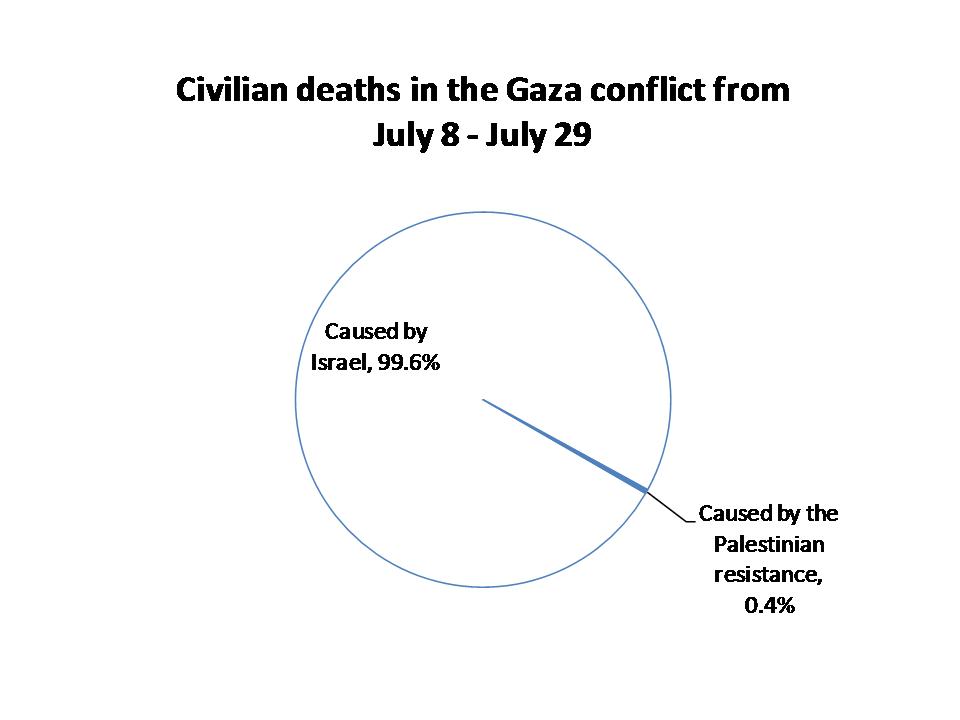
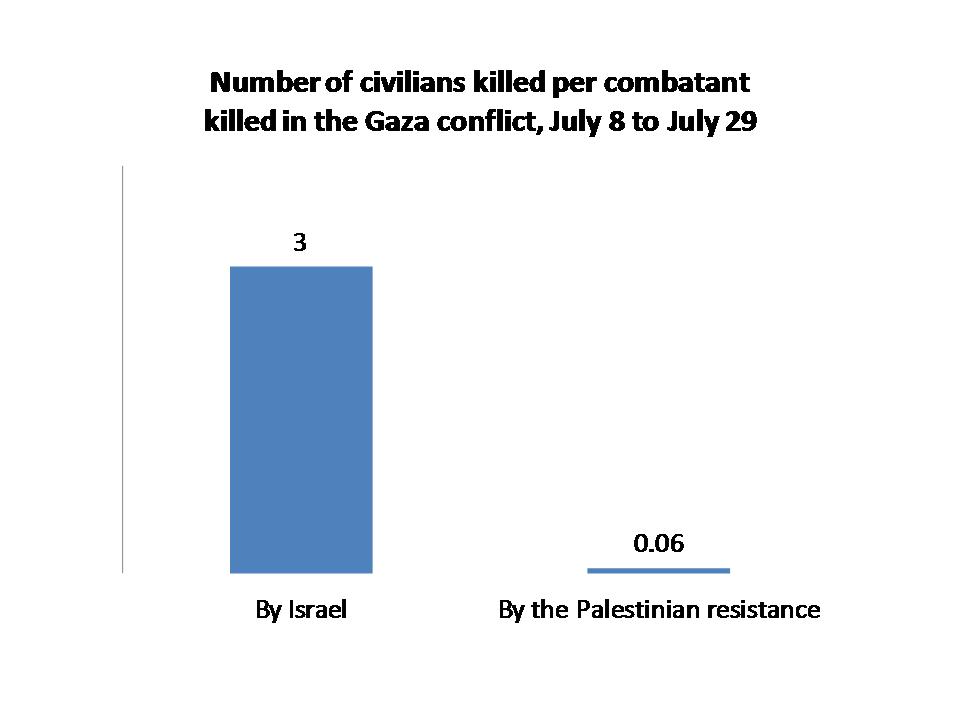
Prior to Israel launching Operation Protective Edge, not a single Israeli citizen had been killed by rocket or mortar fire out of Gaza since November 2012, when Israel had launched an earlier assault on the territory. Only a small fraction (one-twentieth) of Israelis killed by the Palestinian resistance in the current Gaza conflict have been civilians. By contrast, Israel has killed three Palestinian civilians for every militant it has killed.

Slide1

Over 99 percent of civilian deaths in the conflict have come at the hands of Israeli forces.

Slide 2

Yesterday, Israel bombed Gaza’s lone power plant. Gazans rely on the plant to power machinery to desalinate their drinking water. Israeli forces also bombed government offices, a radio and TV broadcast building, and the prime minister’s residence. Deliberately destroying civilian infrastructure is a war crime. Israel’s aim in disrupting Gaza’s power supply and disturbing its supplies of drinking water is to exacerbate the already intolerable conditions in the Gaza Strip to turn the population against Hamas. This is terrorism—violence used against a civilian population to achieve political goals.

Israel says it’s pummelling Gaza, killing civilians, and destroying civilian infrastructure to destroy tunnels the Palestinian resistance could use to kill or kidnap civilians. But how many times has the Palestinian resistance emerged from tunnels to kidnap or kill civilians? None. And how many Israeli civilians were killed by rocket fire in the year and half before Operation Protective Edge? Zero.

The use of violence by the Palestinian resistance against Israel is legitimate. Over 700,000 Palestinians fled or were driven from their homes by Jewish settlers in a massive ethnic cleansing operation over six decades ago. None were permitted to return. Today, the exile and diaspora community stands at five million. Palestinians who remained in the 80 percent of their country seized by Zionist settlers are second class citizens—non-Jews in a Jewish state. The remaining 20 percent of historic Palestine remains under the heel of a brutal Israeli military occupation.

To sum up: The violence of the Palestinian resistance is legitimate. The harm it has caused Israeli civilians is minimal. The violence of Israel against Palestinians is illegitimate. It is the violence of the oppressor enforcing its domination. The harm it has caused Palestinian civilians is immense.

**

Charts based on “Israel destroys home of top political leader for Hamas,” The New York Times, July 29, 2014 and “Dozens die as fighting intensifies in Gaza”, CNN, July 29, 2014 cited by Glen Greenwald, “Terrorism in the Israeli attack on Gaza”, The Intercept, July 29, 2014.

White House says Obama culpable in Gaza massacre

By Stephen Gowans

At least, that was the implication of words spoken by White House press secretary Josh Earnest on Friday.

Earnest was doing his best to mobilize public opinion against what he called “the Putin regime.” That included holding Russian president Vladimir Putin responsible for downing Malaysian Airlines Flight 17. The White House spin doctor explained: “Whether it is the Russians themselves that pulled the trigger or Russian separatists trained by Russians, it’s all the same. It all goes back, ultimately, to Vladimir Putin.”

By the same reasoning, “Whether it is the Americans themselves that pulled the trigger in Gaza, so far killing over 1,000, most non-combatants, or Israeli soldiers equipped with US-supplied weapons, it’s all the same. It all goes back, ultimately, to Barack Obama.”

The difference, however, is that we know the US supplied the Israelis with the weapons that are killing Palestinians, flattening their homes, destroying their mosques, terrorizing their children, and damaging their hospitals, but we don’t know whether the Russians actually provided rebels in Ukraine with missiles capable of bringing down an airliner flying at 33,000 feet. Washington says they did, but has presented no evidence. We don’t even know for sure what brought the airliner down.

We don’t know either whether Russian forces are firing artillery into Ukraine, though the Pentagon says they are. But, again, no evidence is presented.

A Pentagon spokesman says civilian casualties in Ukraine are “of great concern” because artillery fire is imprecise. But the Pentagon doesn’t seem to be concerned about a Human Rights Watch report that says that Ukrainian forces fired unguided missiles into Donetsk, killing 16 civilians. Nor do they appear to be concerned about the casualties in Gaza—that is, concerned enough to pressure the Israelis to stop the slaughter. After all, if the Obama regime can demand that Putin press the Ukrainian rebels to lay down their weapons, surely it can press its Israeli client to do the same.

Comfortable in its accustomed role as the unofficial propaganda arm of US foreign policy, The New York Times reported today that the destruction of Flight 17 “stunned the world.” Nearly 300 were killed. But the newspaper has yet to place the Israeli assault on Gaza in the world-stunning category, even though the Gaza death toll is over three times greater.

That’s not to diminish the airline tragedy, but one does wonder why deaths over Ukraine are said to have “stunned the world” while the higher death toll in Gaza is of an entirely different order…regrettable, but ultimately justifiable.

That, anyway, is how Western leaders spin it. Obama say he mourns the civilian casualties in Gaza but adds that “no nation should be subjected to a hail of rockets or underground incursions.” So, the carnage in Gaza is justified, to protect Israeli civilians.

But as researcher David Morrison points out in a recent report on his website, while all three Israeli assaults on Gaza carried out after Hamas was elected by Palestinians in 2006 have been justified as necessary to protect Israeli civilians, not one resident of Israel was killed by Palestinian rocket attacks or mortar fire in the months leading up to these assaults.

It was only in the midst of the three Israeli military operations that Israelis died. If Operations Cast Lead, Pillar of Cloud, and Protective Edge, were designed to protect Israelis, they failed miserably.

Morrison reminds us that:

o When (the December 2008 to January 2009) Operation Cast Lead was launched, no resident of Israel had been killed by rocket and mortar fire out of Gaza for over six months. Four were killed during it.
o When (the November 2012) Operation Pillar of Cloud was launched, no resident of Israel had been killed by rocket and mortar fire out of Gaza for over a year. Six were killed during it.
o When Operation Protective Edge was launched, no resident of Israel had been killed by rocket and mortar fire out of Gaza since the last major offensive in November 2012. As of this writing, 43 Israelis have been killed during it.

Morrison makes the point that if the Israeli government were genuinely concerned about the safety of its citizens it would abide by the terms of the cease-fires it agrees to with Hamas. The trouble is, it always violates them.

Why, then, does Tel Aviv fail to honor its commitments, repeatedly setting off cycles of violence that slaughter Palestinians, and inevitably produce some Israeli deaths? The answer to that question is the same as the answer to this one: Why did Israel immediately blockade Gaza when Hamas emerged triumphant in the 2006 Palestinian elections? To destroy Hamas. Why? Because Hamas refuses to recognize the Zionist dispossession of the Arabs in Palestine as legitimate.

So here’s the pattern. Israel regularly wheels out its lawn mower (its war machine, paid for by US taxpayers) to weaken resistance to Israel—to do what it calls “mowing the grass.” The result is periodic carnage, misery, and destruction, in which many Palestinians suffer, and a handful of Israelis are killed.

It all goes back to Israel’s arms-supplier Washington. On top of furnishing Israel with a formidable military machine to crush the resistance of Palestinians who legitimately seek self-determination, it vetoes Security Council Resolutions that call Israel to account. Obama and other US presidents may not pull the trigger, but they make the trigger-pulling possible. And that makes Obama culpable in another Gaza slaughter.

Another Eruption in Israel’s Permanent Colonial War on Palestinians

“You need an event along the scale of the current event in order for you to be able to go in. After all, had we gone into Gaza three months ago, out of the blue, everyone would have said: Why are you entering Gaza?” Israeli finance minister, Yair Lapid, July 19, 2014 [1]

By Stephen Gowans

The most recent eruption of Israeli military aggression against the Palestinians of the West Bank and Gaza, and the Palestinians’ consequent retaliation, is part of a permanent war of Zionist aggression against Arabs in Palestine that began soon after the UN promulgated its partition plan for Palestine on November 29, 1947. Formulated over the vehement objections of the Arabs, the plan allocated 56 percent of Palestine to a Jewish state, though Jews made up only one-third of the population and owned only six percent of the land, and 42 percent of the land to the Arabs, who made up the majority. By May 15, 1948, when Jewish settlers proclaimed the state of Israel, the Zionist colonial project, through war and ethnic cleansing, had placed four-fifths of Palestine in the hands of Jewish settlers, and created a refugee population of 700,000 Arabs, displaced to Gaza, the West Bank, Lebanon, Syria, Jordan and beyond. Today, the Palestinian exile and diaspora community stands at five million, many leading lives—66 years after the Nakba, or day of catastrophe— of forced idleness in teeming refugee camps. In 1967, Israel brought Gaza and the West Bank under its military control, at the same time conquering Syria’s Golan Heights and occupying Egypt’s Sinai Peninsula (since returned to Egypt in exchange for Cairo’s absorption into the US orbit and cooperation with Israel.)

The Palestinians who live within Israel—or occupied Palestine ’48, in the terminology of the Palestinian resistance—have formal rights, but live de facto existences as second class citizens, non-Jews in the Jewish state. Meanwhile, their co-nationals in Gaza and the West Bank, the divided one-fifth of Palestine that is supposed to become the Palestinian side of the two-state solution, lead stifled lives under the heel of the Israeli military. Gaza, the most densely populated territory on the planet, is an open-air prison, its population subjected to an ongoing siege. The West Bank, as Jerusalem, is a stage on which a drama is played out daily of creeping annexation, as Israeli settlements snake out into the remaining Palestinian land, enlarging the frontiers of the Jewish state. What’s left of Palestine, for the endlessly promised Palestinian state which never materializes, is about one-tenth of the land Palestinians began with, before Zionists launched their project of expelling the occupants to make way for Jewish settlers.

There are three days of infamy in the Palestinian calendar.

• November 2, 1917, when the British foreign secretary , Arthur Balfour, whose country had conquered Palestine from the decaying Ottoman Empire, promised the land of one people (the Arabs) to another (the Jews.)
• November 29, 1947, when the UN promulgated its partition plan, effectively denying Palestinians the right of self-determination, and promising the better and best parts of Palestine to a Jewish state.
• May 15, 1948, the Nakba, or proclamation of the state of Israel on four-fifths of Palestinian territory, more than even the indefensible UN partition plan had envisaged.

Nakba Day 2014 saw two Palestinian youths killed by Israeli soldiers while commemorating the anniversary of the catastrophe. Video footage captured the last moments of the life of 16 year-old Nadim Siam Abu Nuwara. Walking placidly, he suddenly falls to the ground, his life extinguished by an Israeli army bullet. [2] Unlike the abduction of three Israeli settler youths, to come only weeks later, this event was barely registered in the Western media.

Meanwhile, Hamas, the Islamic resistance movement that governs Gaza, was abiding by a cease-fire agreed to with Israel which had held for 20 months. Hamas hadn’t fired a single rocket since the last Israeli army attack on the territory in November 2012, the eight-day Operation Pillar of Defense, which killed 167 Palestinians and left six Israelis dead, emblematic of the gross imbalance of casualties in Israeli-Palestinian confrontations. [3]

Hamas had agreed to a unity pact with Palestinian Authority president Mahmoud Abbas in April, after a seven year rift. Israel and its arms supplier the United States—Washington gives the settler state $3 billion in military aid yearly, more than it gives any other country—had reacted angrily to the accord, excoriating Abbas for forging a deal with Hamas. Tel Aviv and Washington oppose Hamas above all else because the resistance group—which blends religious, military, political and social welfare functions—refuses to recognize the Zionist dispossession of Palestinians as legitimate.

Whether Hamas is a terrorist organization—as it is demonized by Israel and Western governments— is a matter of definition. Washington arbitrarily excludes states from its own (and therefore mainstream) definition of terrorism, thereby sanitizing the Pentagon’s and CIA’s violence against non-combatants. No matter how many civilians the United States terrorizes through drone strikes, carpet bombing, “shock and awe”, threats of nuclear annihilation, assassinations and air wars, it cannot, by its own definition, be burdened with the label “terrorist”, since Washington conveniently deems terrorism to be the exclusive preserve of sub-state actors. But surely, what ought to matter in any definition of terrorism is not who uses violence, but the purpose for which violence is used (political change) and who it’s used against (non-combatants.) If we drop the arbitrary provision that terrorism is purely a phenomenon of sub-state actors, and define terrorism as political violence aimed at civilians, then, to be sure, Hamas is a terrorist organization. But so too are the states of Israel and the United States.

Were Palestinian resistance organizations to renounce violence, could they effectively resist the oppression of a racist, settler, colonial, occupation state and oppose the creeping annexation of the remaining Palestinian territory? How many could honestly say that the French Resistance ought to have renounced the use of violence against German occupation of French territory during WWII? Anyone who counselled this would have been justifiably accused of encouraging capitulation. The demand that Hamas renounce violence is no different. It is a demand that Hamas give up its resistance, accept the dispossession of the Palestinians, and endorse the denial of Palestinian self-determination.

Elaborating on this theme, As’ad AbuKhalil writes:

Acts of resistance against Nazi occupation in Europe (are) remembered with fondness and admiration and no one questions the methods even when innocent civilians were killed. Even in the struggle against apartheid South Africa, Americans refrain from questioning the methods in which collaborators were dealt with (necklacing, for those who remember). Yet, the Palestinians are asked…to achieve the impossible: to adhere to standards of combat that no armies and no liberation movements have ever adhered to. [4]

Referring to demands that Hamas refrain from operating inside populated areas, AbuKhalil rejoins: “This is like asking the members of the French resistance in WWII to live away from population centers and to concentrate in an open field to facilitate their elimination by [the] German air force.” [5]

Israel sanctimoniously places itself on a higher moral plane than Palestinian resistance groups, arguing that unlike its adversaries who fire missiles into civilian areas, Israeli attacks are never intended to harm non-combatants. That’s debatable. But even were it true that Israel intends no harm to civilians, the reality is that Israeli military operations have produced many times more civilian casualties than the Palestinian resistance ever has. If minimizing harm to civilians is valued, then we should be far more accepting of Hamas’s ‘terrorism’ than Israel’s allegedly international humanitarian law-compliant military campaigns.

The Palestinian Authority’s Mahmoud Abbas has gone a long way to acceding to Western demands to live peacefully with his oppressor, carrying out what some would call a program of collaboration. The kindest description of Abbas’s conciliation with Zionism—he says Arabs should never have rejected the UN’s 1947 partition plan, [6] concedes that Palestinians have no claim to the greater part of Palestine occupied by Jewish settlers before 1967, [7] and would deny the right of Palestinians to return to the homes they were dispossessed of in what is now Israel [8]—is that it’s based on the belief that 10 percent of a loaf is better than none. But the so-called peace process—to which Abbas is committed— goes nowhere. It has, instead, turned out to be a delaying tactic used by Israel to devour more Palestinian territory through the construction of new settlements and expansion of existing ones.

Abbas’s unity pact with Hamas was a retaliatory strike at Israel’s play-acting at negotiating. But with one of the world’s largest militaries, Israel is hardly motivated to negotiate. Backed militarily and diplomatically by the world’s hegemonic power, Israel has overwhelming bargaining power. Why would it make even a millimeter’s breadth concession? Better, in the view of the settler state, to use its US-supplied military machine to crush resistance and advance its colonial-settler agenda.

Netanyahu kicked off his new campaign to squeeze Hamas—or “mow the grass”, an Israeli reference to regular offensives against Palestinian resistance—by cutting off the $100 million of monthly tax revenue it collects on the Authority’s behalf. [9]

Next, Tel Aviv ordered a June 11 airstrike on Gaza, violating the ceasefire, negotiated after the November 2012 Israeli assault on Gaza. Netanyahu said the airstrike was targeted at a Hamas police officer who had been involved in numerous rocket attacks against Israel. “This is the true face of Hamas,” thundered the Israeli prime minister. “It is continuing to plan terrorist attacks against Israeli citizens even as it is inside the Palestinian government.” [10]

To intensify pressure, Israel announced it would build 1,500 new housing units in Jewish settlements in the West Bank and East Jerusalem, “saying it was retaliation for the creation of a Palestinian unity government with the militant group Hamas.” Israel’s housing minister Uri Ariel called the new construction—illegal under international law—”an appropriate Zionist response to the Palestinian terrorist government. I believe that these homes will be just the beginning.” [11]

On June 12, Israel was handed a pretext to further heighten its crackdown on Hamas. Three Israeli youths, Eyal Yifrach, 19, and two 16-year-olds, Naftali Frankel and Gilad Shaar, were abducted in the West Bank. Netanyahu immediately accused Hamas of kidnapping the teens. While Hamas welcomed the abductions, as did other Palestinian resistance organizations—on grounds that the youths could be used to bargain for the release of Palestinian political prisoners in Israeli jails—it denied that it had carried out the abduction. That didn’t deter Netanyahu. Producing not a speck of evidence to substantiate his claim, the Israeli prime minister insisted Hamas was responsible. Netanyahu, it should be noted, has a long record of fabrication in the service of political goals. As a parliamentarian, the future prime minister announced with utmost certainty that Iran was only three to five years away from making a nuclear weapon. That was in 1991. [12] In 2002, Netanyahu testified before the US Congress that: “There is no question whatsoever that Saddam is seeking and is working and is advancing towards the development of nuclear weapons–no question whatsoever.” [13] And now there was no question whatsoever that Hamas had abducted the three teens. And yet, Israel has yet to arrest any suspects. [14]

The outcome of Israel’s military offensive was consistent with an operation to degrade Hamas more than it was a police operation to locate abductees. The Israelis abducted 640 Palestinians, including Hamas’s top West Bank leadership, but charged none of them with kidnapping the three youths. They re-arrested and re-sentenced 75 Palestinians previously released in a 2011 prisoner exchange for Israeli soldier Gilad Shalit. They raided 1,000 homes, universities and other facilities, including 10 Hamas-run institutions. And they heaped punishment on Palestinian political prisoners, subjecting them to extra cruelties, including cutting back on visits from their families. Additionally, they killed five Palestinians, and imposed restrictions on Palestinian exit from the West Bank to Jordan and Gaza, at the same time limiting travel around Hebron. [15] Israeli Brigadier General Moti Almoz explained on July 8 that: “We have been instructed by the political echelon to hit Hamas hard.” [16]

But hitting Hamas hard also meant hitting the broader population hard, that is, collective punishment. This was a reality the Israeli army acknowledged, and welcomed. A senior Israeli army commander told the Wall Street Journal:

There is a dilemma of how much pressure to put on the terrorists themselves and how much to put on the population. I think the Palestinians understand the situation: Someone did something outside the rules of the game. If there is kidnapping in Hebron, then they will suffer. [17]

This, by the way, meets the definition of terrorism considered above, namely, visiting misery on a civilian population to create pressure to bring about a desired political goal. It is the terrorism of the oppressor.

With Hamas’s senior West Bank leadership locked up in Israeli jails, the offensive now turned to Gaza, a Hamas stronghold. The impact has been devastating. From July 8 to July 21 [18]:

• 584 Gazans were killed;
• 3,650 were injured;
• More than 1,134 homes were completely or partially demolished;
• 67 mosques were completely or partially destroyed;
• Property damage was inflicted on:
o 14,500 homes;
o 81 schools;
o 5 health centers;
o 3 hospitals;
• 100,000 were displaced;
• 900,000 were affected by the destruction of electricity, water and waste water infrastructure.

Over the same period 25 Israeli soldiers were killed and two Israeli civilians died by rocket and mortar fire. [19] The destruction continues.

US and Israeli political figures justified the carnage by pointing to Palestinian rocket attacks. Defending the Israeli massacre in Gaza, US president Barack Obama said “no nation should be subjected to a hail of rockets or underground incursions.” [20] He didn’t say that no nation should be subjected to 66 years of dispossession, abridgment of its rights, ethnic cleansing, repression, occupation, and racism.

Former Israeli ambassador to the United States, Michael Oren said: “It’s very difficult to feel compassion for the other when you have rockets aimed at your family.” [21] He didn’t say it’s very difficult to feel compassion for the other when he has stolen your land and made you a refugee.

What’s the solution? It’s not two states. Palestinians don’t accept it, and nor should they. According to a survey conducted from June 15-17 by the Washington Institute for Near East Policy:

• 70 percent of Palestinians in Gaza and the West Bank believe that the Palestinian national goal for the next five years should be reclaiming all of historic Palestine or establishing one state in which Arabs and Jews have equal rights.
• Two-thirds believe that even if a two-state solution is successfully negotiated that efforts should continue to liberate all of historic Palestine from Zionist control. [22]

Officials of the settler state know that Palestinians will never accept the permanent colonial war against them and accordingly count on Abbas and other Palestinian conciliators to accept crumbs from the Zionist feast on Palestine and ride herd on Palestinians who object to the selling off of their rights. Abbas and company accept a two-state solution because they think it’s the only measure of independence that can be practicably secured. This, however, is unrealistic. First, Israel evinces no genuine interest in accepting even a tiny Palestinian state on a small fraction of the land Palestinians originally inhabited before the ethnic cleansing of 1948. [23] Instead, Tel Aviv uses on-again-off-again negotiations over a two-state solution to gradually devour more of Palestine. Secondly, two states—a large, militarily powerful Jewish state occupying the better and best parts of Palestine dominating a tiny, fractured Palestinian state—will never mollify Palestinians and slake their thirst for justice. A resistance will continue, even if a Palestinian state is negotiated, as the polling data above indicate. No justice, no peace.

The solution–if it can be put that way, or inevitable outcome if it can be put another–is a single, secular, democratic state, in which all are accorded equal rights, regardless of religion or national origin—not a racist state, not a Jewish state, but a democratic one. This is a moral, just, and democratic alternative to the plague of a racist, settler, colonial ideology of dispossessing indigenous people, driving them into exile, denying them the right of return, and blocking their right of self-determination. The solution to Zionism is the same as the solution to fascism: its repudiation and conquest by democracy.

[1] Anne Barnard and Jodi Rudoren, “Despite Israeli push in Gaza, Hamas fighters slip through tunnels”, The New York Times, July 19, 2014.
[2] Ramzy Baroud, “Israel awakens the Palestine it tried to crush”, The Palestine Chronicle, July 11, 2014.
[3] J.J. Goldberg, “How politics and lies triggered an unintended war in Gaza,” the Jewish Daily Forward, July 10, 2014.
[4] As’ad AbuKhalil, “Western standards of Palestinian justice,” Al Akhbar, July 22, 2014.
[5] Ibid.
[6] “Arab rejection of ’47 partition plan was error, Palestinian leader says”, The Associated Press, October 28, 2011.
[7] Joel Greenberg, “Israel’s Netanyahu cool to Abbas’s hint at waiving Palestinian ‘right of return’”, The Washington Post, November 4, 2012.
[8] Joshua Mitnick, “Abbas signals flexibility on Palestinian refugees”, Wall Street Journal, Feb. 16, 2014.
[9] Nicholas Casey, “Palestinian unity deal creates stir in Middle East”, The Wall Street Journal, May 2, 2014.
[10] Isabel Kershner and Fares Akram, “Israeli airstrike in Gaza strip kills Palestinian”, The New York Times, June 11, 2014.
[11] Nicholas Casey, “Israel plans expanded settlement in retaliation for Palestinian government with Hamas,” The Wall Street Journal, June 5, 2014.
[12] Scott Peterson, “Imminent Iran nuclear threat? A timeline of warnings since 1979, ”The Christian Science Monitor, November 8, 2011.
[13] Peter Hart, “Netanyahu can disinform on Iran just as well as Iraq,” FAIR, June 23, 2014.
[14] Nicolas Casey, Tamer El-Ghobashy and Joshua Mitnick, “Israel launches ground invasion of Gaza”, The Wall Street journal, July 18, 2014.
[15] Jodi Rudoren, “Israeli troops kill Palestinian teenager protesting arrests in the West Bank,” The New York Times, June 20, 2014; “The threat is growing of a new, wider war against the Palestinian people”, ANSWER, July 3, 2014; “Palestinian teen abducted, killed in Jerusalem”, Al Akhbar English, July 2, 2014; Nicholas Casey and Joshua Mitnick, “Israel crackdown on Hamas shows new path”, June 18, 2014, “Israel rearrests 51 freed Palestinian prisoners”, Al Akhbar English, June 18, 2014.
[16] J.J. Goldberg, “How politics and lies triggered an unintended war in Gaza,” The Jewish Daily Forward, July 10, 2014.
[17] Nicholas Casey, “Hebron bears brunt of Israel’s search for missing teenagers”, The Wall Street Journal, June 20, 2014.
[18] Palestine News and Information Agency, July 18, 2014; Joshua Mitnick, Tamer El-Ghobashy and Nicholas Casey, “Gaza battles take heavy death toll”, The Wall Street Journal, July 20, 2014; “Hundreds Killed, Thousands Injured, as Israeli Massacre in Gaza Continues,” Palestinian News and Information Agency, July 20, 2014; “520 Palestinians killed, 3162 injured as Israel’s aggression on Gaza continues,” Palestinian News and Information Agency, July 21, 2014; Nicholas Casey and Tamer El-Ghobashy, “Gaza battle deadliest in conflict”, The Wall Street Journal, July 21, 2014; “Death toll hits 584 as Israel kills 13 in Gaza,” Palestinian News and Information Agency, July 21, 2014; Tamer El-Ghobashy and Nicholas Casey, “Humanitarian toll rises as Gazans flee”, The Wall Street Journal, July 21, 2014.
[19] Joshua Mitnick, Tamer El-Ghobashy and Nicholas Casey, “Gaza battles take heavy death toll”, The Wall Street Journal, July 20, 2014; Jodi Rudoren, “Israel is facing difficult choice in Gaza conflict,” The New York times, July 21, 2014.
[20] Jodi Rudoren, “A push into Gaza, but the ground has shifted”, The New York Times, July 18, 2014.
[21] Jodi Rudoren, “In Gaza, epithets are fired and euphemisms give shelter,” The New York Times, July 20, 2014.
[22] http://www.washingtoninstitute.org/uploads/Documents/other/PalestinianPollingReport_June2014.pdf
[23] A study prepared by Republican pollster and political strategist Frank Luntz for pro-Israeli propagandists “who are on the front lines of fighting the media war for Israel,” “admits that the Israeli government does not really want a two-state solution.” Luntz says “this should be masked because 78 percent of Americans do.” Patrick Cockburn, “How Israel spins war crimes”, counterpunch.com, July 28, 2014

If Maliki’s a good guy, then so is Assad

Maliki’s “anti-Sunni policies have blown up in his face — literally”–Former US Defense Secretary Robert Gates, January, 2014

By Stephen Gowans

The armed rebellion in Iraq is a broad-based attempt by Sunnis to press for the resolution of legitimate grievances against a Shiite-dominated government in Baghdad which has marginalized them and treated them as second class citizens. Prime minister Nouri al-Maliki’s government reacted to largely peaceful Sunni demonstrations earlier this year with mass arrests, torture and violence. This sparked an armed rebellion, of which ISIS, the Islamist group which has dominated Western media coverage of the conflict, acts as only one part of a larger alliance of Sunni rebel organizations. The Iraqi army has met the armed rebellion with barrel bombs and indiscriminate shelling of residential targets, including a hospital in Fallujah.

Maliki’s policies have marginalized Iraq’s Sunni minority politically and economically. He has targeted Sunni politicians for arrest, manoeuvred to transform political power into a Shiite monopoly, and alienated ordinary Sunnis, who say they’re discriminated against in housing, employment, and education. Sunnis complain of being treated as second class citizens.

Sunni frustration with Maliki’s policies boiled over into mass demonstrations in five major cities last January. Tens of thousands of Sunnis participated. The Maliki government met the protests with violence (killing 51 protesters at one demonstration) and invoking anti-terrorism laws to scoop up protesters in mass arrests. According to Human Rights Watch, “detainees reported prolonged detentions without a judicial hearing and torture during interrogations.” The rights organization cited multiple abuses by Iraqi security forces, including the rape of female prisoners.

It was Baghdad’s draconian crackdown on peaceful protests that sparked the armed rebellion, not the aspirations of ISIS, the formerly al-Qaeda-linked Islamist rebel group which aims to carve a Sunni Islamist state out of parts of Syria and Iraq. Baghdad’s response to the armed rebellion has been no less draconian than its response to the largely peaceful demonstrations. Earlier this month, government forces “abandoned previous pledges not to harm civilians” and began to indiscriminately shell parts of Fallujah, including a hospital and residential areas, which had been captured by Sunni rebels. Human Rights Watch reported that “indiscriminate government attacks have included the use of barrel bombs, dropped from helicopters, on populated areas of Fallujah.” The attacks have “caused civilian casualties and forced thousands of residents to flee.” The rights group also says that Maliki’s forces have “illegally detained, tortured and extra-judicially executed an unknown number of” Sunnis since the conflict began in January.

It’s small wonder, then, that Sunnis regard Iraqi security forces as “an occupation army” and as “a foreign force in their own country.”

While early reports of the uprising reduced the armed rebellion to an ISIS campaign, it has become clear that ISIS is only one part of a broad-based and co-ordinated Sunni armed struggle. Human Rights Watch reported last month that “11 armed opposition groups are fighting in Anbar,” the Sunni-majority province of Western Iraq which borders Syria. These include fighters affiliated with Anbar’s tribes. Veteran foreign correspondent Patrick Cockburn points to “Jaish Naqshbandi, led by Saddam Hussein’s former deputy Izzat Ibrahim al-Douri, former members of the Baath party, the Mukhbarat security services and the Special Republican Guard,” as groups that are also involved in the armed rebellion. “It is these groups,” reports Cockburn, “rather than ISIS, which captured Tikrit.” The New York Times’s Tim Arango and Washington Post’s Joby Warrick have also reported that the rebellion cuts across a number of Sunni groups, encompassing tribal militias and former Ba’ath Party members, as well as ISIS.

In many respects Iraq’s Sunni rebellion resembles the conflict in neighboring Syria. A protest movement quickly transforms into an armed rebellion, with armed Sunni jihadists assuming a highly visible role on the ground, and the government facing accusations of using mass arrests, torture, barrel bombs, and indiscriminate shelling against rebel forces and civilians. Of course, there are important differences, too, but the differences are not so large as to warrant the vastly different ways in which Damascus and Baghdad are treated by Western state officials and mass media.

To begin, there has been a tendency to try to minimize the role played by Islamist takfiri elements in the Syrian rebellion in favor of emphasizing the largely illusory “moderate” rebels, while in the Iraqi case, the role played by non-takfiri Sunni militants has been downplayed in favor of presenting the rebellion as an almost exclusively ISIS affair.

What’s more, Maliki has never been subjected to the demonization Assad has endured at the hands of Western state officials and mass media. And yet, much of what Assad has been accused of to warrant his demonization has been done by Maliki too. First, there’s the matter of the Iraqi prime minister failing to resolve Sunni grievances through discussion, negotiation, and inclusion, preferring instead to use anti-terrorism laws to target Sunni leaders for arrest and to try to repress mass demonstrations. Second, there are the reports of the Iraqi army’s indiscriminate shelling of residential areas and use of barrel bombs against the civilian population. Even Human Rights Watch, an organization which is linked to the US foreign policy establishment and tends to go easy on US allies, has raised the question of whether Maliki’s security forces have committed serious violations of the laws of war. Yet none of this has received more than passing mention in Western media, and no mention at all by Western state officials, who have loudly denounced Assad for the same behavior.

Similarly, the Western mass media have demonized ISIS for destabilizing Iraq, but not for destabilizing Syria. Their use of the label “terrorist” is reserved for ISIS when the organization operates in Iraq (against a US client) but not when it operates in Syria (against an officially designated enemy.) So it is that the Wall Street Journal could run an opinion piece titled “The terrorist army marching on Baghdad” when it’s inconceivable that the Journal, or any other Western newspaper, would run an opinion piece titled “The terrorist army marching on Damascus.”

ISIS and other Jihadi groups in Syria are armed and funded by reactionary Arab regimes, including the feudal tyrannies of Saudi Arabia, Kuwait and Qatar, all warmly embraced as allies by Washington, despite their complete contempt for democracy. According to Wall Street Journal reporters Adam Entous and Julian E. Barnes, Qatari officials have assured Washington that Islamist militants in Syria can be eliminated once they’ve served the useful purpose of toppling Assad, yet, while Assad remains president, ISIS in Syria is safe from US attack. By contrast, as part of a coalition to redress legitimate Sunni grievances in Iraq against a US satellite government, ISIS has become a target of possible US air strikes.

If ever there were an example of governments (and mass media) dishonestly invoking charges of terrorism to justify a war against people with legitimate grievances, this is it. As one tribal leader of a Sunni rebel tribal council in Anbar put it: “It is an exaggeration and an attempt to stop the revolution against the Maliki government to say that ISIS is leading the fight. This is a rebellion against the unfairness and marginalization” of Sunnis by Baghdad.

It’s also a demonstration of Western double-standards and the complete bankruptcy of the official Western discourse on antiterrorism, human rights, democracy and the Arab Spring.

Egypt’s Illegitimate President

By Stephen Gowans

Abdel Fattah el-Sisi, the former head of the military that overthrew Egypt’s legitimately elected president Mohammed Morsi in a 2013 coup d’état, is almost certain to win a landslide victory in today’s presidential election. Sisi’s victory, however, won’t be due to a groundswell of popular support. In fact, a Pew Research poll conducted in April found that only a narrow majority of Egyptians support him. [1] Instead, Sisi will win because he has banned the main opposition, the Muslim Brotherhood, the organization from which the legitimate president, Morsi, sprang. Just as importantly, Morsi supporters are boycotting the vote, reasoning that they already have a legitimate president, even if he has been illegally locked away in the regime’s prisons. [2] So, with the only substantial opposition viciously suppressed, and Morsi supporters staying away from the polls, a Sisi landslide victory is a virtual certainty. But it will confer no legitimacy on the Egyptian strongman.

Under Sisi’s leadership, the military government has massacred thousands of demonstrators who took to the streets in protest against the coup. It has also jailed tens of thousands of other Morsi supporters, banned demonstrations, and discouraged dissent by locking up journalists who oppose the military take-over.

If you’ve forgotten how closely Sisi cleaves to the model of the brutal authoritarian tyrant that Western governments and media profess to abominate, think back to last summer. Here are New York Times reporters Kareem Fahim and Mayy el Sheik describing one Sisi-led massacre:

The Egyptian authorities unleashed a ferocious attack on Islamist protesters early Saturday, killing at least 72 people in the second mass killing of demonstrators in three weeks and the deadliest attack by the security services since Egypt’s uprising in early 2011.

The tactics — many were killed with gunshot wounds to the head or the chest — suggested that Egypt’s security services felt no need to show any restraint.

In the attack on Saturday, civilians joined riot police officers in firing live ammunition at the protesters as they marched toward a bridge over the Nile. By early morning, the numbers of wounded people had overwhelmed doctors at a nearby field hospital. [3]

Carried out by Muamar Gadaffi, a brutal crackdown on this scale would have been enough to raise alarms of an impending genocide and calls for humanitarian intervention. When it happens in Egypt, it’s mentioned in the back pages of some (though not all or even most) newspapers and forgotten the next day.

In October, “Clashes between protesters and security forces…left at least 51 people dead and more than 246 injured…as supporters of ousted President Mohammed Morsi rallied to press for his reinstatement despite a months-long crackdown on their ranks. Activists from Mr. Morsi’s Muslim Brotherhood said the police used live ammunition to subdue the pro-Morsi crowds.” [4] By the end of October, an estimated 1,000 Morsi supporters had been shot dead by security forces and 6,000 herded into prisons. [5] Today, it’s acknowledged that the regime has “killed more than a thousand of Mr. Morsi’s … supporters at street protests and jailed tens of thousands of others.” [6]

Sadly, the crackdown isn’t limited to pumping live ammunition into the skulls of the ousted president’s backers. In March, an Egyptian court sentenced hundreds of Morsi supporters to death, finding them all guilty of killing a single police officer at a demonstration. The judgment was so flagrantly political that it moved the United Nations high commissioner for human rights, Navi Pillay, to denounce it. “The mass imposition of the death penalty after a trial rife with procedural irregularities is in breach of international human rights law,” the commissioner concluded. [7] This evident repression of Morsi supporters was duly noted by some Western media, though never denounced as an outrage, and quickly forgotten. We needn’t wonder how the same event would have been treated had it occurred in Syria.

Egypt’s military government also launched an assault on journalists who failed to toe the regime’s line on the appropriate attitude to the Muslim Brotherhood—now banned as a “terrorist” organization. (Additionally, the April 6 movement, considered the most effective left-leaning protest group, has been outlawed on espionage charges. [8]) A reporter who steps over the line is liable to be tossed into jail and tried with crimes against the state, a fate that befell 20 Al-Jazeera employees. [9] The jailing of journalists for what they report by a state that isn’t an ally of Washington would be thoroughly denounced by Western officials and deplored by Western media. Carried out by Egypt’s military rulers, it’s quietly noted, then forgotten.

What, then, accounts for the blatant double-standard?

As the Wall Street Journal’s Adam Entous explains, “Washington has long viewed its military ties with Cairo, backed by more than $40 billion in military aid since 1948 along with annual military exercises and extensive officer exchanges, as an anchor of one of its most important relationships in the Arab world.” [10] Which is to say that Egypt—or more specifically, its military—does Washington’s bidding. Notably, Syria, North Korea, Venezuela and Zimbabwe, reject US domination and pursue independent paths. When the leaders of these countries use their state’s repressive apparatus to quell opposition (often encouraged by dollops of “pro-democracy” funding funnelled by Western governments to opposition forces through NGOs), they are demonized.

Apart from underpinning Egypt’s role as an agent of US influence in the Arab world, Washington’s military aid program to the country—surpassed only by aid to Israel—is a source of handsome profits to US military contractors. Every year US taxpayers fork over $1.3 billion to the Egyptian military to submit large orders for weaponry and equipment to US arms manufacturers. [11] In concrete terms, the bullets Egyptian soldiers used to mow down Morsi supporters were purchased by US taxpayers.

Adding to Cairo’s value as a US ally is that fact that it grants the Pentagon virtual carte-blanche access to its territory.

Most nations, including many close allies of the United States, require up to a week’s notice before American warplanes are allowed to cross their territory. Not Egypt, which offers near-automatic approval for military overflights…American warships are also allowed to cut to the front of the line through the Suez Canal in times of crisis, even when oil tankers are stacked up like cars on an interstate highway at rush hour. [12]

Accordingly, Sisi’s brutal rise to power is tolerated by Western governments and his undemocratic and illiberal methods passed over in near silence by the Western media, because he can be counted on to maintain Egypt as a reliable agent of US influence in the Arab world, provide valuable services to the US military, and fatten the bottom lines of US arms manufacturers with weapons orders. None of this is to say that Morsi wouldn’t have performed the same valuable services. The reality of US domination would have structured the decision-making environment to hem Morsi in and limit his room for manoeuvre. But it’s doubtful he could have been counted on to be as reliable a servant as Sisi, who trained at the US Army War College, and has extensive connections to the US military. Hence, rather than denouncing Sisi, Western politicians and media mobilize the energies of social justice-advocates against countries whose leaders reject the international dictatorship of the United States and refuse to provide valuable services to the Pentagon, not against those that do.

Caught up in mass media-manipulated campaigns of indignation against targets of US imperialist designs, the beautiful souls of the left ignore the deplorable activities of the West’s faithful local agents in the Arab world, from the hereditary tyrannies of the Gulf states to the blood-stained US-backed strongman in Cairo, while at the same time protesting the resistance of the Syrian government and its Hezbollah ally against Western efforts to crush an independent Arab political project. Immersed in a fantasy world structured by the mass media’s promotion of Western foreign policy agendas, they line up with the US-aligned Arab royal dictatorships against the only organized Arab forces prepared to resist domination by the United States and its Zionist client.

While dispassionately documenting Sisi’s affronts against liberal democratic ideals, the Western media have not demonized him, as they invariably do leaders of governments who refuse to act as ductile agents of US power. Even so, Sisi’s actions would certainly warrant the same media treatment meted out to the West’s favorite international villains were he standing on his feet against US domination, rather than kneeling before it as a loyal servant. If Western conceptions of democracy and human rights mean anything, Sisi would long ago have occupied center stage in the West’s pantheon of demons. That he is allowed to fly under the radar—despite cancelling democracy, murdering protesters, executing political opponents, and jailing journalists—reveals much about US foreign policy, the Western media that support it, and social-justice advocates who are deceived by it.

1. “One Year after Morsi’s Ouster, Divides Persist on El-Sisi, Muslim Brotherhood,” Pew Research Global Attitude Project, May 22, 2014. http://www.pewglobal.org/2014/05/22/one-year-after-morsis-ouster-divides-persist-on-el-sisi-muslim-brotherhood/
2. David D. Kirkpatrick, “In Egyptian Town, Cheers for Sisi but Murmurs of Discontent,” The New York Times, May 25, 2014.
3. Kareem Fahim and Mayy el Sheik, “Crackdown in Egypt kills Islamists as they protest”, The New York Times, July 27, 2013/
4. Matt Bradley, “Egyptian clashes leave at least 51 dead”, The Wall Street Journal, October 6, 2013.
5. Tamer El-Ghobashy and Matt Bradely, “Egypt arrests Brotherhood official ahead of Morsi trial”, The Wall Street Journal, Oct 30, 2013.
6. David. D. Kirkpatrick, “Egypt’s new strongman, Sisi knows best”, The New York Times, May 24, 2014.
7. Nick Cumming-Bruce, “U.N. expresses alarm over Egyptian death sentences”, The New York Times, March 25, 2014.
8. David D. Kirkpatrick, “Uproar in Egypt after judge sentences more than 680 to death”, The New York Times, April 28, 2014.
9. Tamer El-Ghobashy, “Egypt to charge Al Jazeera journalists”, The Wall Street Journal, January 28, 2013.
10. Adam Entous, “U.S. defense chief mans hot line to Cairo”, The Wall Street Journal, The Wall Street Journal, July 10, 2013.
11. Eric Schmitt, “Cairo military firmly hooked to U.S. lifeline”, The New York Times, August 20, 2013.
12. Thom Shanker and Eric Schmitt, “Ties with Egypt army constrain Washington”, The New York Times, August 16, 2013.

US Policy on Ukraine: Follow the Money

Don’t underestimate the role played by Yanukovych’s foreign-investor-unfriendly economic policy in spurring the US intervention in Ukraine

By Stephen Gowans

A favored leftist explanation of the United States’s and European Union’s intervention in Ukraine revolves around the geopolitical imperative for Washington of containing a US military rival, Russia, and bringing NATO up to its borders by integrating Ukraine into the US-led military alliance. What’s rarely mentioned is that the role played by the United States and its European subalterns in supporting the Maidan uprising and the consequent rise to power of the pro-Western coup government has also been motivated by the goal of building a more congenial climate in Ukraine for the profit-making activities of Western corporations and investors.

While Ukraine’s economy is understood by leftists to be capitalist and therefore not to raise a red flag at the US State Department, it is far from true that Ukraine’s economic policies under the ousted former president Victor Yanukovych were warmly accepted, even tolerated, in Western foreign policy circles. Indeed, from the point of view of the West, Ukraine’s economy left much to be desired. It needed, IMF managers said, to be reorganized by “structural reforms” to “improve the business climate.” [1] What’s important here is not that Ukraine was viewed as infertile ground for capitalist profit-making—but that it was viewed as infertile ground for the profit-making activities of Western corporations specifically.

The Heritage Foundation-Wall Street Journal 2014 Index of Economic Freedom rates Ukraine’s economy as “repressed” along with those of such perennial US regime change targets as North Korea, Cuba, Zimbabwe, Venezuela and Iran—all unfriendly to the idea that economic policy should be formulated to pad bank accounts and bottom lines in New York, London, Frankfurt and Paris. [2] Ukraine’s economic freedom—that is, its adherence to the free enterprise, open markets, free trade agenda favored on Wall Street—is even ranked behind that of Belarus, a country reviled in Western foreign policy circles for its nostalgic attachment to Soviet economic forms. Of 43 countries in Europe, the US ruling class foundation and newspaper rank Ukraine’s friendliness to Western corporate interests dead last, and only a little better than that of communist North Korea and Cuba, socialist Venezuela and economically nationalist Zimbabwe and Iran. So where, in the view of the West’s corporate elite, has Ukraine gone wrong?

The Heritage Foundation and its Wall Street Journal partner have a number of complaints. “Contracts are not well enforced, and expropriation is always a possibility.” “The labor code” they grouse, “is outmoded and lacks flexibility,” meaning it offers too many protections to workers. Government procurement policies are denounced for sometimes favoring domestic firms, and hence, limiting the profit-making opportunities of North American and European corporations. Exception is taken to Ukraine’s state-owned firms, which crowd out private (mainly Western) enterprise, and Kiev’s restrictions on foreign investment, which give a leg up to domestic businesses but cut foreign corporations out of the action.

Some of these noxious-to-Wall-Street barriers to Western profit-making would have been dismantled had Yanukovych not backed away from an agreement with the European Union that would have seen Ukraine get preferential access to EU markets in return for turning over Ukraine’s labor, markets and resources to Western business interests. But, alas, Yanukovych balked and Washington took advantage of the ensuing protests to foment an uprising to bring a biddable pro-foreign-investment stooge to power, backed by fascists and militant Russophobes.

The coup government quickly signed on to an IMF economic reform program which promises to replace the set of economic policies Washington and Brussels have long derogated for being unfriendly to Western investors with one aimed at pushing Ukraine into Wall Street’s good books. Reza Moghadam, director of the IMF’s European Department, explained that “the program…is expected to…help restore confidence among private investors,” to which he might have added, investors of the sort who own mansions in and around New York City and other Western financial capitals. Moghadam adds that “Ukraine needs to undertake deep-reaching structural reforms” to improve Ukraine’s business climate. That roughly translates into holding the line on wages, laying off public sector workers, gutting protections for employees, hiking taxes on ordinary people while bringing them down for businesses, rolling back social services, and throwing open the doors of the economy to Western corporations.

Here are the details. Public sector wages will be held in check while increases in the minimum wage will be capped. At the same time, “expenditure restraint will be exercised through the suspension of” (what the IMF calls) “unaffordable wage and pension increases planned by the previous” (i.e., Yanukovych) “government, public employment reduction…and rationalization of social assistance spending.” So far this is shaping up to mean that “24,000 state workers and 80,000 police officers nationwide are set to be laid off,” [3] with more austerity to follow. And while public expenditures are being reined in in the interests of creating an improved business environment, tax revenues will be hiked, not through increases in corporate taxes and income tax, but on regressive consumption taxes, which fall most heavily on those with the lowest incomes. The wealthy will be spared the burden of contributing to state coffers by measures to “facilitate value-added tax refunds for businesses.” And while ordinary Ukrainians are being squeezed to give more to businesses and investors, a new procurement law will be adopted to deny domestic firms preferential treatment in the awarding of government contracts. North American and European firms will be the principal beneficiaries.

The coup government’s principals, explains Moghadam, “believe there is a window of opportunity for bold and ambitious reforms in order to transform Ukraine” into “a vibrant business environment”—yes, and one that pays dividends to foreigners on the backs of Ukrainians. The sole reason for the existence of Ukrainians (and most of humanity) under the logic of the US-superintended system of global capitalism is to be screwed over in order to make a thin upper layer of Western society fabulously wealthy.

If we accept that the United States’s wealthiest citizens as a class exercise inordinate influence over public policy—a point supported by research presented in an upcoming paper in Perspectives on Politics by Martin Gilens and Benjamin Page [4]–it follows that the principal function of the US State Department and the Pentagon is to support the overseas profit-making activities of US corporations. Hence, what likely lies at the root of US interventions abroad is the defense and promotion of US investor and corporate interests contra the economic nationalist (Ukraine, Zimbabwe, Iran), socialist (Venezuela) or communist (Cuba and North Korea) economic policies of foreign states. Yanukovych’s government gave too many breaks to Ukrainian investors, businesses, and even ordinary citizens, and therefore committed the cardinal sin in the church of US global hegemony: interfering in the profit-maximization of US corporations. That, perhaps more than US geopolitical and military interests, explains why the United States backs the coup in Kiev and opposes the forces arrayed against it.

Russia’s repatriation of Crimea—backed by the peninsula’s largely Russophone population, as it had also been overwhelmingly backed in a 1991 plebiscite [5]—was simply a defensive reaction by Moscow against the danger that the coup government in Kiev would seek to eject it from its naval base on the Black Sea. It was not the aggressive act Western figures of state and their mass media echo-chambers have made it out to be. The true aggressor here is US foreign policy in pursuit of its principal function of promoting the overseas profit-making interests of corporate America.

Postscript

Yanukovych’s successor as president, Petro Poroshenko, announced that “We will do the absolutely unique transformation of our country…with a very good investment climate…with all the necessary things to attract business.” (David M. Herszenhorn, “Pro-European businessman claims victory in Ukraine presidential vote”, The New York Times, May 25, 2014)

1. Interview with Reza Moghadam: Ukraine Unveils Reform Program with IMF Support, IMF Survey, April 30, 2014
2. http://www.heritage.org/index/
3. Anthony Faiola, “In Ukraine, a crisis of bullets and economics,” The Washington Post, April 16, 2014
4. Martin Gilens and Benjamin I. Page, “Testing Theories of American Politics: Elites, Interest Groups, and Average Citizens,” forthcoming Fall 2014 in Perspectives on Politics. http://www.princeton.edu/~mgilens/Gilens%20homepage%20materials/Gilens%20and%20Page/Gilens%20and%20Page%202014-Testing%20Theories%203-7-14.pdf
5. Peter Hart, “Radioactive Putin is ‘Stalin’s Spawn’”, Extra!, May 1, 2014

UN Report on North Korea could be about the United States or South Korea

By Stephen Gowans

Surely one could be forgiven for thinking that when the Washington Post’s Chico Harlan (February 17) described the conclusions reached by the UN Human Rights Commission’s investigation into North Korea that he was really describing his own country, the United States. Harlan wrote, “The report makes for devastating reading, laying out the way North Korea conducts surveillance on its citizens (see Edward Snowden’s revelations about the NSA’s spying on US citizens…and everyone else), bans them from travel (anyone up for a visit to Cuba?), discriminates against them based on supposed ideological impurities (has the United States ever been kind to Marxist-Leninists?), tortures them (water boarding and Abu Ghraib) and sometimes banishes them to isolated prison camps, where they are held incommunicado” (recently Guantanamo and other CIA torture camps around the world to which opponents of the US regime have been rendered, more distantly, the incarceration of German-, Italian- and Japanese-Americans during WWII.)

The report recommends that North Korea be referred to the International Criminal Court at The Hague, but if the charges against North Korea are true, then surely the case for referring the United States to the same court is at least as compelling. Add the United States’ record of extrajudicial assassination, its world-leading rate of incarceration, its illegal wars, and its support for the most vile human rights violators on the planet, among them Saudi Arabia, Qatar, and Bahrain, and the case for referring US leaders to The Hague is overwhelming.

The UN report says that North Korea is committing human rights violations “without any parallel in the contemporary world,” a conclusion that could only be reached by wilful blindness to the human rights violations of the United States, its democracy-abominating allies in the Gulf, and its south Korean neo-colony. South Korea, whose affronts against human rights are passed over largely in silence by the Western media (and it seems by the UN Human Rights Commission too), conducts surveillance on its citizens, bans them from travel to North Korea, discriminates against them if they hold views sympathetic to North Korea, its official Juche ideology or Marxism-Leninism, and uses its highly repressive National Security Law to lock up and intimidate anyone who has a good word to say about North Korea.

The UN report can hardly be taken seriously. It is a transparent effort to discredit a government that has, for more than half a century, been in the cross-hairs of a US program of military intimidation, economic warfare, diplomatic isolation and ideological assault, targeted for regime change for rejecting participation in a US-superintended global capitalist order. More than that, by passing over regimes that do what North Korea is accused of doing, it sanitizes the behavior of the United States and its allies, buttressing the ideological fiction that anti-capitalist governments are uniquely human rights violators, while upholders of global capitalism are uniquely champions of human rights.

If a case is to be pressed to refer North Korea to the ICC, then referrals of the United States, Saudi Arabia, and South Korea to The Hague—to start—are long overdue. Until this oversight is rectified, it is impossible to regard the UN report—and the western media’s coverage of it—as anything but sops to the propaganda imperatives of US foreign policy.