Why the United States has a special relationship with Israel. It’s not the Israeli lobby.

Israel does Washington’s dirty work in Syria where US law limits the Pentagon’s actions, former US envoy reveals

 April 23, 2019

By Stephen Gowans

In his book A World Without Islam, former Kabul CIA station chief, Graham E. Fuller, argues that the 9/11 and other attacks on the United States by aggrieved Muslims would have occurred even in a world without Islam, because the attacks were a reaction against US imperialism, and were not a product of the attackers’ religion. It “would be a mistake,” wrote Fuller, “to consider Islam as the source of the resistance; otherwise we would have to believe that if these Muslims were not Muslims, they would not be rebelling against foreign domination.” [1]

http://www.barakabooks.com

US domination of the Middle East is attributable, above all, writes Fuller, to “the Muslim world’s oil and energy-resources.” Oil is the “key driver for incessant Western intervention.” US Middle East policy is shaped by concerns about “ownership of oil, control of the oil companies, pricing policies and shares of prices [and] political manipulation of leaders in order to obtain the best deals on oil,” [2] according to Fuller, who also served as the vice chairman of the US National Intelligence Council at the CIA.

What’s more, there’s the reality that “The United States today is, by its own reckoning, the overwhelmingly dominant power of the globe in nearly all spheres, with the determination to impose its will by one means or another.” [3] This, it does, far beyond the Middle East. As a country that began as 13 colonies on the Atlantic seaboard, but expanded across a continent, and added colonies in the Pacific and Caribbean, the United States is, and always has been, an imperialist country.

In contrast, some people believe that US domination of the Muslim world is traceable to the influence of wealthy Jews and the Jewish lobby on US foreign policy decision-makers, and that, in a world without Israel, the United States would not intervene militarily and politically in the Middle East.  John Mearsheimer and Stephen Walt famously made this case in a 2006 article in The London Review of Books, “The Israel Lobby,” and in a book the following year. Others, including Jean Bricmont and Diana Johnstone, have gone further, arguing that “as far as the drive to war with Syria is concerned, it is Israel that directs U.S. policy.” [4] According to these analysts, the processes that made the United States an imperialist behemoth the world over are somehow absent in the Middle East. But to paraphrase Fuller, it would be a mistake to consider the Israeli lobby or Tel Aviv as the source of US foreign policy decisions; otherwise we would have to believe that if Israel didn’t exist, the United States would not seek to dominate the oil-rich Muslim world.

The United States has used Israel as an instrument for protecting and advancing its economic and related strategic interests in the Middle East since 1967, when the self-proclaimed Jewish state did a great service to Washington and US oil interests by handily defeating Arab nationalism—which opposed US domination of the region under the slogan “Arab oil for the Arabs” —in the June War.

Ever since, the role that Israel has played as an instrument of US power has been overlooked in the West, but rarely in the Third World. Arab opponents of US imperialism, from Gamal Abdel Nasser to Leila Khaled to Hassan Nasrallah, have understood Israel to be a cudgel used by the United States against the Arabs. For Hugo Chavez, Israel was one of the United States’ “imperialistic instruments.” [5] Even Israel’s political and military leaders, from Moshe Dayan to Benjamin Netanyahu, agreed. Dayan said that Israel’s mission is to “be a rock, an extension of the West, against which the waves of… Arab nationalism [bearing the banner Arab oil for the Arabs] will be broken.” [6] Netanyahu described his country as the “West’s outpost in the Middle East.” [7]

Only in the West has Israel’s role as an apparatus of the United States been difficult to grasp. That’s partly because the contribution of Israel to US power projection has sometimes been inconspicuous. At other times, it has hidden behind false claims of self-defense, with Israel’s actions on behalf of its US patron appearing to be motivated by purely Israeli concerns for self-preservation rather than shared US-Israeli goals of weakening forces inspired by the idea that the Arab world should exist for the Arabs, not Jewish settlers and US oil companies.

For example, Syria and Iraq declined to back the PLO in 1970 against Jordan’s King Hussein, fearing that if they acted to help topple a US puppet, that Washington would order Israeli attacks against both countries. Both Syria and Iraq knew they were no match for the powerful Israeli military, and had no intention of precipitating Israeli retaliation. As Sun Tzu observed, the best general is the one who wins without fighting, and Israel has often used its US-supplied military edge to deter local forces of independence and national assertiveness. But because in these instances it doesn’t have to fight to win, its contribution to cementing US domination of the region is difficult to see.

Israel played the lead role in preventing Iraq and Syria from acquiring a nuclear weapons capability, destroying nuclear reactors in both countries, thereby facilitating the US invasion and conquest of Iraq in 2003 and the recent US invasion and occupation of one-third of Syria. The airstrikes which destroyed the reactors were presented by Israel and its US patron as self-defensive, but since Israel was already nuclear-armed, the development of a nuclear weapons capability by either Arab country would only have established nuclear parity, not an offensive threat to Israel. Nuclear arms in the hands of Iraq or Syria, would at best, have deterred US and Israeli attacks. This was confirmed by Major General Amir Eshe, chief of the Israeli army’s planning division, who asked whether the United States would have “dared deal with …Saddam Hussein if [he] had a nuclear capability?” “No way,” he replied. [8] The same question can be asked about Syria. Would the United States have so freely installed itself in one-third of Syria had Assad possessed a nuclear capability? Doubtful.

More recently, Israel has acted as a US instrument by carrying out airstrikes in Syria against forces aligned with Damascus. The attacks—Israel carried out thousands of bombing raids in Syria in 2017 alone [9]—are portrayed as defensive strikes against Iranian efforts to establish a military presence in Syria to threaten Israel. But that’s a cover.

The truth of the matter is that the United States has no domestic legal authorization to attack Syrian and Iranian forces, both of which seek militarily to recover on Damascus’s behalf Syrian territory under US occupation. To conduct its ongoing fight to shape Syria’s post-war environment, Washington has recruited Israel, unconstrained by US law, to act as its proxy. As Brett McGurk, until recently the United States’s special envoy in Iraq and Syria, revealed a few days ago in Foreign Affairs, “The United States coordinated its approach with Israel, which in 2017 began launching air strikes against Iranian military assets in Syria [because] Washington had no legal authority to target Iranian forces inside Syria.” McGurk notes that the “combination of Israeli hard power, American diplomacy, and the U.S. military presence [in northeastern Syria have given] Washington a powerful bargaining chip with the Russians” to influence what McGurk calls “post-civil war” Syria. [10]

None of this is to say that Israeli actions on behalf of its US patron are inimical to its interests; they aren’t. Israeli and U.S. objectives in the Middle East largely overlap, which is why the two states have a special relationship. Both are keenly interested in suppressing local forces of independence and national assertiveness, though their reasons for doing so differ. Washington aspires to control the region’s petroleum resources and the sea and land routes to and from them on behalf of the US business elite, monopolizing the benefits at the expense of the local population. Israel seeks to contain, weaken, and undermine local forces of independence and national assertiveness in order to preserve its Herrenvolk democracy on land plundered from the Arabs. Both states rely on the other to achieve their respective goals.

While U.S. and Israeli objectives mesh, US foreign policy goals in the Arab world exist independently of Israel. A Middle East without Israel would still be a region bursting with “a stupendous source of strategic power, and one of the greatest material prizes in world history” [11], as a US State Department analysis described the Arab world before there was an Israel. What’s more, a world without Israel would still be a world in which the United States was dominated by titans of industry and masters of finance, scouring the globe for profit-making opportunities, acutely interested in great material prizes.

As I explain in the final paragraph of my new book Israel, A Beachhead in the Middle East,

At the heart of the unceasing wars on the Middle East reposes the question of who owns and controls Arab and Persian oil and the marine and overland routes to and from it—the natives, or the US government and the investors it represents? The Zionist answer has always been clear: Western political and economic interests must have supremacy in the Middle East. Israel began as a European colony, established anachronistically just as the great wave of decolonization was getting underway. As the United States superseded Britain and France as the dominant imperialist power in the region, Israel transitioned from the formers’ outpost of terror in the Arab world into a power projection platform for US investor interests. Throughout this transition Israel has remained interlocked with imperial power, unfailingly serving as the West’s beachhead in the Middle East.

These arguments are developed more fully in Israel, A Beachhead in the Middle East, now available from Baraka Books.

1) Graham E. Fuller. A World Without Islam, (Little, Brown & Company, 2010), 256.

2) Fuller, 262.

3) Fuller, 252.

4) Jean Bricmont and Diana Johnstone, “The People Against the 800 Pound Gorilla,” counterpunch.org, September 13, 2013.

5) “President of Venezuela Hugo Chavez: Israel Uses the Methods of Hitler, the U.S. Uses the Methods of Dracula. I’m a Nasserist who Has Crossed the Deserts, Ridden Camels, and Sung Along with the Bedouins. Al-Jazeera Plays a Role in Liberating the World,” Middle East Media Research Institute TV Monitor Project, August 4, 2006, https://www.memri.org/tv/president-venezuela-hugo-chavez-israel-uses-methods-hitler-us-uses-methods-dracula-im-nasserist/transcript August 4, 2006.

6) Benjamin Beit-Hallahmi. The Israeli Connection: Who Israel Arms and Why, Pantheon Books, 1987), 5.

7) Adam Shatz, “The sea is the same sea,” The London Review of Books, (Vol. 40 No. 16 · 30 August 2018).

8) Ethan Bronner, “Israel sense bluffing in Iran’s threats of retaliation”, The New York Times, January 26, 2012.

9) David Morrison, “Israel complains about violation of its sovereignty while being a serial violator,” Open Democracy, March 1, 2018; Gregory Shupak, “Painting an Israeli attack on Syria as Israeli ‘retaliation’,” Fair.org, February 21, 2018.

10) Brett McGurk, “Hard truths in Syria: America can’t do more with less, and it shouldn’t try,” Foreign Affairs, April 16, 2019.

11) Quoted in Noam Chomsky, Fateful Triangle: The United States, Israel, and the Palestinians, (Pluto Press, 1999), 61.
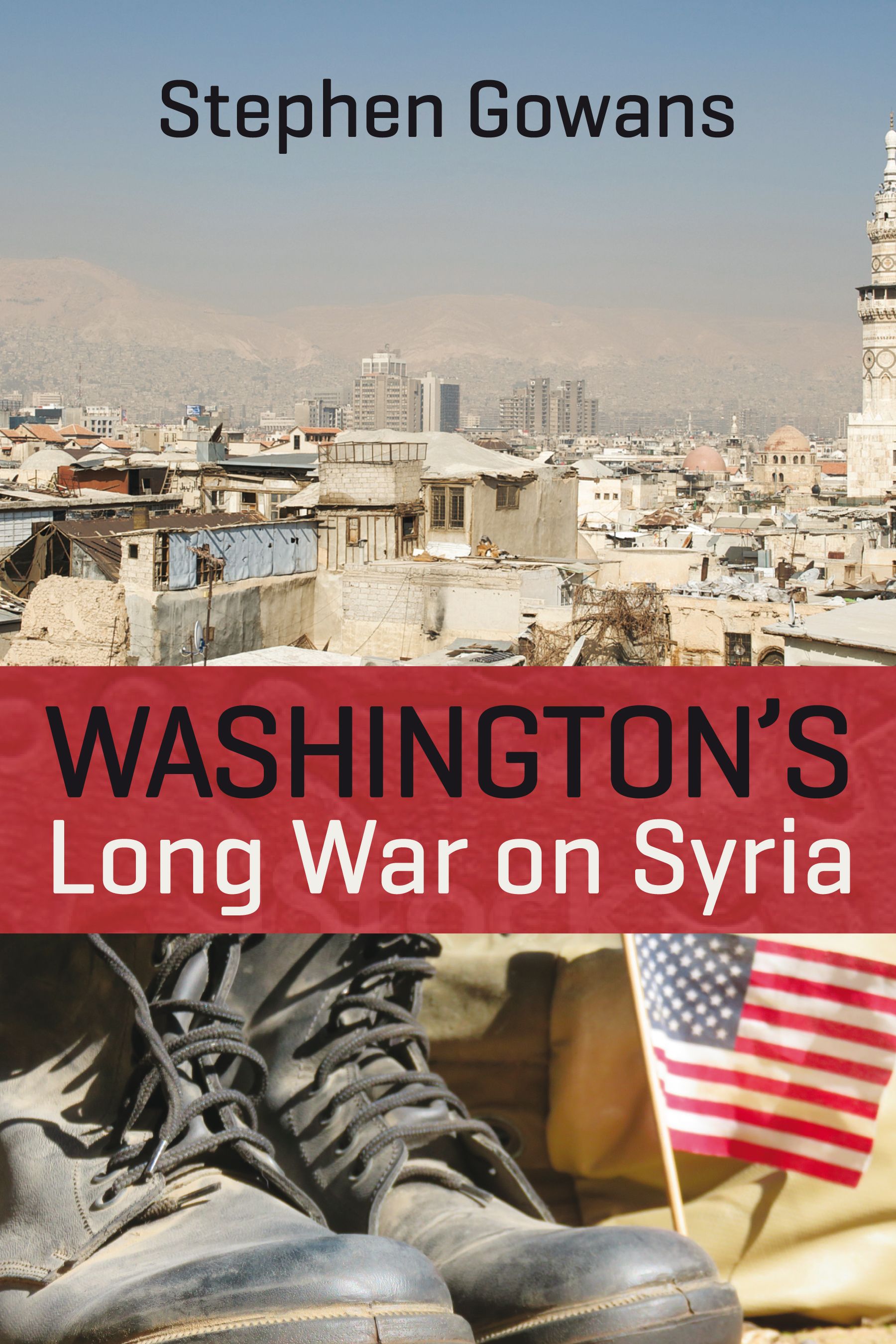
So, you think Washington’s long war on Syria is almost over. Think again.

April 11, 2019

 By Stephen Gowans

If you think Washington’s long war on Syria has been largely defeated by the combined opposition of Syria, Russia, Iran, and Hezbollah, think again.

While attention turns to another US regime change campaign, this one in Venezuela, the long war on Syria grinds on.

http://www.barakabooks.com

“The United States still has cards to play in Syria,” concludes two analysts linked to the US foreign policy establishment. “If it plays them well, the U.S. intervention in Syria may yet become an enduring American success.”

Indeed, the US intervention in Syria has already been a success in at least one respect.

“Syria is currently in a state of de-facto partition,” observe Merve Tahiroglu and Andrew Gabel, research analysts at the Foundation for the Defense of Democracies, a think-tank that is interlocked with the US government.

The SDF, the 60,000-strong US-superintended Kurd-led army, controls about one-third of the country, containing “more than 90 percent of Syria’s remaining oil reserves and a significant portion of its viable agricultural land.”

To repeat: Through its SDF proxy army, Washington controls a substantial part of Syria—and not just any part, but the richest part. What’s more, Washington has no intention of giving this territory back to any government not under its sway. Indeed, one of the United States’ goals is “to prevent the Syrian [government] from attempting to [recover] the country’s northeast with Iranian and Russian assistance.”

And with Washington’s 60,000 SDF boots on the ground and the United States Air Force’s unchallenged supremacy over northeastern Syria, Washington is much farther along the road to calling the shots in Syria than it was in 2011. Why, then, would anyone believe that Washington’s war on Syria has failed?

Writing in Foreign Affairs, the unofficial journal of the US foreign policy establishment, Tahiroglu and Gabel point out that without northeastern Syria, Assad lacks “access to almost all of Syria’s remaining oil reserves, in addition to much of its arable land, on the heels of Syria’s worst crop yield since 1989.”

Denying Damascus access to the country’s oil and arable land ties in with US sanctions that have ravaged Syria’s economy for the past 40 years—and were put in place long before the 2011 Islamist uprising that is mistakenly believed to mark the beginning of US efforts to oust the Assad government. By strangling the economy, the United States is hurting not only Syria, “but its backers in Moscow and Tehran, who [are] stuck propping up an expensive, economically moribund partner.”

These are the other respects in which the US intervention has scored successes. It has greatly weakened Syria, a pole of opposition to US hegemony in the Middle East. And it has drawn Russia and Iran into a conflict that strains their treasuries.

No less part of the US war on Syria is Washington’s recent declaration of two-thirds of the Syrian Golan as part of Israel, an event greeted with yawns by much of the world.

Golan, a New York Times reporter once observed, is the forgotten occupied territory. By contrast, northeastern Syria may become the occupation that will never be forgotten for the simple reason that it was never noticed.

As to Washington’s long war on Syria, it was largely unnoticed until 2011, and appears to be returning to an unnoticed-in-the-West phase, partly because it depends in large measure on economic coercion (which attracts far less attention than does kinetic warfare, even though economic ‘atom bombs’ can be equally, if not more, devastating) and partly because it relies on diplomatic measures, like recognizing Israel’s annexation of Syrian territory, which also largely fly under the radar of public attention. Also, the US and other Western forces in Syria are mainly special operations forces that operate covertly.

Another factor explaining the near invisibility of the US war on Syria is that it is hardly talked about anymore in the Western mass media. As the White House-driven media agenda diverts attention to other matters, the real business of extending the reach of the international dictatorship of the United States goes on unobserved.

http://www.barakabooks.com

Meanwhile, some friends of Syria are in raptures over the possibility of Tulsi Gabbard, the US representative for Hawaii, capturing the Democratic nomination for US president. Gabbard, who volunteered to join the US occupation force in Iraq, recycles US war propaganda about Syrian president Bashar al-Assad. “There is no disputing the fact that Bashar al-Assad in Syria is a brutal dictator,” she announced on the TV talk show The View. “There is no disputing the fact that he has used chemical weapons and other weapons against his people.”

Gabbard believes US interventions are motivated by humanitarian goals, but are misguided because they fail to achieve their humanitarian objectives. Presumably, she would favor any US intervention that lived up to the humanitarian ideals she believes undergird US foreign policy. It’s not imperialism or the international dictatorship of the United States she opposes—just US imperialism that produces outcomes that make the United States look bad.

You cannot turn US citizens away from policies that facilitate their country’s imperialism by reinforcing the myths that are used to justify them. Rather than challenging these myths, Gabbard accepts them, and offers, instead, an appeal to US citizens’ self-interest. The interventions are costly, she says, and cause harm to US military personnel.

The trouble with this approach is that Washington uses tools deliberately designed to minimize and disguise the burden on US citizens of its interventions in order not to arouse public opposition. These tools include economic warfare, cyber-warfare, covert CIA operations, special operations forces, mercenaries, proxy armies, and reliance of proxies to act in place of US boots of the ground—weapons of war that can be concealed behind a cloak of secrecy and which minimize the involvement of the US public. For example, we don’t know how many US troops are in Syria, but we do know that the number is greater than Washington will say. The Pentagon has admitted that its number of 2,000 troops is an “artificial construct”—that is, a low-ball figure that excludes special operations forces and other troops on secret missions. It also excludes the British, French, and German special operations forces that work under US leadership. For all we know, there could be 10,000 Western troops and mercenaries or more occupying northeastern Syria, on top of the 60,000 strong SDF proxy army.

Gabbard also invokes the idea that US interventions make matters worse for the people of the countries in which the interventions take place. This inevitably invites the reply, “But how can we stand by idly while brutal dictators gas babies?’ Having reinforced the very myth that enkindles these concerns (for example, Gabbard’s assertion that there is no question that Assad is a brutal dictator who has used chemical weapons against his own people), she offers nothing but, what can only appear to be, cruel, hard-hearted counsel that, tough as it may be to turn away, turn away we must. Her advice fails to comport with the myth US citizens imbibe from birth, that the United States is a force for good in the world, and has a duty to lead for the greater welfare of humanity. So long as US interventions imposes no visible burdens, the country’s citizens will gladly accept them as moral crusades that exemplify US moral superiority.

Curiously, Gabbard excites the imaginations of some of the very same people who rail bitterly against Noam Chomsky for similarly characterizing Assad as a brutal dictator. But Gabbard’s sins appear to have been cancelled by her virtues: youth, undoubted good looks, eloquence, and a pleasing personality. “She’s very charming,” one besotted friend of Syria put it. Plus, she has a superficially pleasing patter about avoiding interventions. Were Chomsky female, 50 years younger, and whole lot better looking, he too might be setting hearts aflame.

Trump’s support for Zionism includes defining US Jews as foreigners

April 8, 2019

By Stephen Gowans

A core Zionist principle is that Jews are foreigners in their own countries, and belong in Israel, a principle many Jews reject for obvious reasons, as do all people committed to human progress and equality.

By contrast, Donald Trump embraces the Zionist vision. On Saturday the US president referred to Israel’s leader Benjamin Netanyahu as ‘your prime minister’ while addressing a group of US Jews. [1] This wasn’t the first time Trump defined US Jews as Israelis. “At a Hanukkah celebration at the White House” Trump “told American Jews…that his vice president had great affection for ‘your country,’ Israel.” [2]

http://www.barakabooks.com

In 1917, British cabinet member, Edwin Montagu, a Jew, strenuously opposed the Balfour Declaration—Britain’s pledge to create a Jewish homeland in Palestine—for precisely the reason evinced in Trump’s remark.

Montagu foresaw that the creation of a Jewish homeland would reinforce the prejudice that Jews are a nation (rather than a religious community) and that, therefore, they are foreigners in the lands in which they reside, a prejudice Hitler nurtured into what historian Arno J Mayer has called the Judeocide. [3]

“Montagu saw Zionism as a threat to the position in British society that he and his family had so recently, and with so much exertion, attained. Judaism, he argued, was a religion, not a nationality, and to say otherwise was to say that he was less than 100 percent British.” [4]

Anti-Semites would find Zionism to be a simpatico creed. It encourages the emigration of Jews. Indeed, Theodore Herzl, the ideological forefather of the Israeli state, offered this as a reason why Europe ought to support the creation of a Jewish state;  it would rid the continent of Jews, something he believed non-Jews—who he viewed as incorrigible anti-Semites—fervently wished for. [5]

Mike Pence and US secretary of state Mike Pompeo are Christian Zionists, [6] as indeed were many early supporters of the Zionist movement, including Arthur Balfour and US president Woodrow Wilson. Christian Zionists believe the settlement of Jews in historical Palestine will hasten the rapture, that is, the return of Jesus; and so they have done all they can to encourage Jews to settle in the Holy Land. Many evangelical Christians see the founding of the state of Israel as an act of their God.

Trump’s designation of US Jews as properly Israeli and not American (‘Netanyahu is your prime minister’ and ‘your country’ Israel), is as much a gift to Israeli Zionism as is his declaration that Jerusalem and the Syrian Golan belong to Jews.

Israeli Zionists are as keen to see ‘diaspora’ Jews take up residence in Israel, as they are for US presidents to present Israel as the state of the Jews and official representative of world Jewry.

To be sure, Trump is not the first US president to vigorously support either Israel or Zionism. The West’s outpost in the Middle East, as Benjamin Netanyahu once called Israel [7], has, from day one, been used by imperialist powers as an instrument to achieve their own end, namely, protecting their profit-making and profit-making-related strategic interests in the petroleum-rich Arab and Persian worlds.

It is not Christian Zionism, or a sincere (though misplaced) effort to protect Jews from anti-Semitism, that motivate Western governments to support Israel. Nor is US foreign policy in thrall to wealthy Jews and their lobbying efforts, a theory propounded by people whose grasp of the forces that shape US imperialism is tenuous at best. Instead, Western support for Israel is grounded in economic interests.

This point of view was clearly articulated by the British author Rajani Palme Dutt, six months before the infant UN, at the time dominated by colonial powers, served up part of Palestine to a European colonial movement, Zionism, that had pledged to champion Western interests in the Arab world in return for Western sponsorship and protection.

Dutt authored a declaration adopted on 3 March 1947. [8] The declaration adumbrates the arguments presented in my forthcoming book, Israel, A Beachhead in the Middle East: From European Colony to US Power Projection Platform.

Dutt called for “the ending of the imperialist policy which seeks to retain Palestine, not only as an [outpost for dominating the petroleum resources of the Middle East] and point for the military control of Suez, but as the strategic base protecting imperialist interests throughout the Middle East, against the interests and rights of its peoples.”

He warned Jews that Zionism “seeks to make … a Jewish state an ally of the imperialist powers and their base in the Middle East.” It also seeks, he warned, to divert “Jewish people from the real solution of the problem of anti-Semitism,” which he defined as “full equality of rights within the countries where they live.”

Dutt pointed out that it was in the interests of Jews residing in Palestine “to oppose the Zionist conception which seeks to put them in the position of being an instrument of [imperialist powers] in the Middle East [and] in opposition to the struggle for national liberation in Palestine.”

Zionism, he observed, was a tool used by Britain and the United States in pursuit of their “policy of divide and rule; it also seeks to secure the support of reactionary Arab elements to strengthen the Middle East as a base for operations … against the liberation movement of the masses throughout the Middle East,” he wrote. Today, Israel works with the principals of Arab reaction—the kings of Saudi Arabia, the UAE, and Jordan, and the military dictator of Egypt—to safeguard Western business interests against the aspirations of the Arabs to take control of their land, resources, labour, and markets for their own welfare.

In place of an ethnically-cleansed exclusivist Jewish settler state, Dutt proposed “the creation of a free, independent and democratic Palestinian state”—one that would “guarantee equal rights of citizenship with full religious freedom and full opportunities to develop their culture to all its inhabitants, Arab and Jewish.”

Dutt’s proposal for a single state in Palestine based on equality—once also the vision of the PLO—has increasingly come to be seen as the only practicable and morally defensible position, superior to the misnamed two-state ‘solution,’ whose implicit basis is the assumption that Palestinians will eventually capitulate to the denial of their fundamental rights.

In place of the negation of one people’s rights, Dutt offered the realization of all people’s rights. A free, independent and democratic Palestinian state would deliver Jews from anti-Semitism, and at the same time, deliver Palestinians from anti-Hamitism and the scourge of colonialism.

Zionism, with its nineteenth century vision of an ethnic state, where one ethnic group imposes a lordly rule over another, is an anachronism; the idea of the ethnic state has happily given way in large parts of the world to the idea of universal equality, an idea pioneered by the French Revolution (which emancipated the Jews of France) and brought forward by the Russian Revolution (which emancipated the Jews of Russia).

The notion implied in Trump’s remarks that US Jews are foreigners in their own country is hardly one that anyone who cares about authentic liberal democracy and a world of universal equality ought to be pleased about. Perhaps Netanyahu and other devotees of ethnic Jewish rule in Palestine are pleased, but they are the bearers of an ugly ideology of colonialism and ethnic rule that has been overcome throughout most of the world, and equally deserves to be overcome in the land between the Mediterranean Sea and the Jordan River.

1) Emily Cochrane, “Pushing for tighter borders, president asks Jews for support,” The New York Times, April 6, 2019.

2) Jonathan Weisman, “American Jews and Israeli Jews Are Headed for a Messy Breakup,” The New York Times, January 4, 2019.

3) Arno J. Mayer, Why Did the Heavens Not Darken? The Final Solution in History, Verso, 2012.

4) David Fromkin, A Peace to End All Peace, Holt, 2009, p 292.

5) Theodore Herzl, The Jewish State, Quid Pro Books, 2014, p. 20.

6) Edward Wong, “The rapture and the real world: Mike Pompeo blends beliefs and policy,” The New York Times, March 30, 2019.

7) Quoted in Adam Shatz, “The sea is the same sea,” The London Review of Books, (Vol. 40 No. 16 · 30 August 2018).

8) Declaration on Palestine, 1947, https://www.marxists.org/archive/dutt/1947/03/palestine.htm .