Obama and Miracles that Never Happen

By Gowans

If 10 times more people claimed to have attended Woodstock than were actually there, I suspect 10 times more people claim to have wept at Obama’s election victory than actually did. Weeping on the night of November 4 – or claiming you did — has now become a fashion. I, too, wept, though not because Obama won, but because the number of times I heard the words “Obama is the embodiment of hope” was too much to bear.

The day before the election, my son called me from school.

“I was just interviewed on Obama for the national news,” he related excitedly.

“”How’d that happen?”

“Actually, it was a group of us who were interviewed. I’m not sure I’m going to make it on the newscast, though. The reporter was looking for gushing reactions, and I pointed out that I had some concerns about Obama because he had received more in corporate donations than McCain had. I don’t think that’s quite what she was looking for.”

No mistake there. Two days later the segment aired in the last 10 minutes of an hour-long news show devoted to documenting (and manufacturing) excited reactions to the Obama victory. After 50 minutes of Europeans, Asians, Africans and Latin Americans delivering encomia on the Obama victory, my son’s chance at a brief moment of public exposure arrived. A group of high-school students, my son among them, is seen walking into a room. The reporter turns to each in turn and asks, “What do you think of Obama?” The first, a young man born in Canada to Chinese parents, says he identifies with Obama, because they’re both ethnic minorities. Another talks of hope. A third says she gets shivers down her spine whenever she hears Obama talk. (Demonstrating a talent for prophecy, my son predicts two days earlier that “She’ll make it on the newscast for sure.”) And so it goes, each student joining in the celebration, because, wasn’t that the implicit contract? Gush over Obama, and see yourself on TV. My son, whose concerns over Obama’s netting more corporate donations than McCain clashed impolitely with the intoxicated atmosphere of Obama worship, became a voiceless image; the one student who, for reasons never explained, was seen, but not heard, on camera.

To those grasping at straws, the election of a black man as president signals the recession of anti-black racism in the United States. For the gullible, it signals the dawn of a new age of hope.

There have been black people in numerous positions of power in the US before, from CEOs to mayors to governors to secretaries of state to the country’s top soldier. Now we can add president. Will anything of substance change because of this? Obama’s victory hasn’t caused anti-black racism to recede; it is, instead, a consequence of this. Will a black man in the White House make clear to the romantics who haven’t figured it out yet that black people are no different from white people, equally capable of oppressing, exploiting, plundering and killing on a massive scale? Add that liberals are as capable of these things as conservatives, and Obama, the black liberal president, offers no hope of departure from the accustomed trajectory.

Despite its recession, anti-black racism has only receded to the point where a privileged black man with rare forensic talents, the massive backing of the corporate community, and the help of the best marketing talent money can buy, can get elected; it has by no means disappeared, nor receded enough to make a substantial difference in the lives of most black people.

But for black people there’s inspiration to be found in one of their own ascending to the highest office in the land. The joy is misplaced. The only thing Obama shares in common with 99 percent of blacks in the United States is the color of his skin, and skin color, when you get right down to it, is only of consequence to bigots who continue to embrace the echo of a racist ideology once used by slave-owners (who happened to be white) to justify exploitation of slaves (who happened to be black.) If you’re going to screw people over, it’s useful to have a body of legitimizing ideas; after all, who wants to come face to face with the reality that he’s an unconscionable prick living off the toil of others? That’s where racism comes in handy. And if we’re talking about people exploiting others of the same skin color, there’s a whole other body of ideas to justify that, which, in these days of thin class consciousness, most of us mistake for common sense. To be sure, skin color does matter to the victims of racism because they can’t escape the fact that the bigots who continue to embrace the echo of a racist ideology keep making a fuss about it. But that makes Obama as much like them as George Bush is like me.

Come to think of it, George and I are alike in many ways. We’re middle aged; we both trip over words; we’re white; we’re male. But so what? George comes from a ruling class family; my forebears worked in factories, did manual labor, and in recent years, ascended to the ranks of the white-collar proletariat, deluding themselves that by wearing a tie and acting “professional” they had transcended their class. George snorted coke; I worked in a pharmaceutical factory for his friend Donald Rumsfeld. George went to Yale and the Harvard Business School on his family’s money; I went to two undistinguished public universities, one located in the gritty industrial city of Hamilton, Ontario, paying subsidized tuition with money saved up working at a grocery store. Whatever we have in common is picayune next to what sets us apart.

The very best comment I’ve heard on the Obama victory comes from Mickey Z. Obama’s ascendancy, he said in a Dec 1 interview published in the British newspaper, The Morning Star, “is an excellent illustration of how the system handles dissent. A black face, a soothing voice and a vague message of change – all designed to keep the rabble pacified without changing anything at all.”

While a debate whirled around me during the days leading up to the election over the question of whether leftists ought to vote for Obama or opt for someone who wasn’t going to put more boots on Afghan soil and rattle the Pentagon’s sabre at Iran, I kept my counsel. For one thing, I’m not a US citizen. The job of everyone else in the world is to bear the brunt of the stupid decisions Americans make. As much as the rest of us wish the consequences of their choices were limited to the US, sadly, what happens in the United States often has dire consequences for those living everywhere else. For another, all the reasons for not voting for a Democrat or Republican had been made cogently and repeatedly before, apparently, to no avail, and having exceeded my limit in flogging dead horses, I was tapped out. What’s more, it was clear that the Obama-supporters had formed an impermeable seal around their brains that admitted no appeal to reason. This was to be a purely emotional choice; hence, the tears of joy on election night.

While a vote for Nader had its merits, I couldn’t help but wonder whether the Nader-supporters shared a delusion with the Obama-backers – that of believing that the right person in the Oval Office would make a difference. Americans might be excused for this delusion; after all, they’ve never elected a leftwing president and therefore have been spared the cold blast of reality that disappoints those who’ve worked to elect a leftwing government. Had they not been deprived of this sobering experience, they would recognize their faith in third party politics for the naïveté it is. A quick survey of what has happened when social democrats, socialists and even communists have won elections and formed governments with a program of reforming the system from within, leaves no doubt as to the possible outcomes. A new socialist age is not one of them. Either the new government:

o Recognizes that it must cater to the imperatives of the system it has chosen to work within to prevent its rule from being destabilized, and therefore behaves as any other pro-capitalist government does.

o Boldly introduces anti-capitalist reforms, only to suffer a backlash as investors and businesses withdraw their capital and refuse to make further investments. This provokes an economic crisis, and the government’s supporters, menaced by rising unemployment or shortages or rampant inflation, withdraw their support.

o Is ousted in a military or fascist coup.

o Is destabilized by outside forces.

Only where the energy of the bulk of people has been mobilized to tear the system down and replace it with one friendly to popular interests, have leftwing forces prevailed for any substantial period.

How is it, then, that substantial reforms, such as the public health care systems of Western Europe and Canada, came into being, if not by the agency of leftwing governments voted into power to reform the system from within? The truth of the matter is that reforms were just as likely to be introduced by conservatives as social democrats (and none of the reforms ushered in by Western governments, often as Cold War expediency, ever matched the programs established under Marxist-Leninist governments in the Soviet Union and Eastern European.) It was Bismark and Gladstone – hardly lefties — who introduced the first modern social welfare programs. The basis for social security in the US came not from the Democrats or organized labor, but from the Rockefeller-founded Industrial Relations Counselors Inc., to head off labor unrest. While a Labour government was introducing the NHS in Britain, conservative governments on the continent were introducing their own NHS equivalents. And in Canada, it was the conservative government of John Diefenbaker that introduced the Hospital Insurance and Diagnostic Services Act of 1957. Social democrats have claimed social programs as their own, but they can lay no claim to being the sole parents, and have just as often been involved in dismantling the reforms predecessor (and often conservative) governments had introduced.

The programs pursued by governments are shaped by the circumstances they encounter, surrounding events, and for those with reformist aims, by the constraints of the constitutional system and the logic of the capitalist system they’ve chosen to work within. Left-leaning governments bow to the demands of the capitalist economy to survive; conservative governments introduce reforms and concessions to head off labor militancy. Often these constraints are ignored by critics, who assume implicitly that the right person, once elevated to a position of power, is free to make history as he pleases. “Once our man is in power, just wait to see what happens.” The answer is often, more of the same, or policies the government’s backers revile.

Across from me sits a book on whose spine is written “Giving Away a Miracle.” It’s the story of the unlikely election in the 90s of a social democratic government in Ontario (the miracle.) The giving away began the very same night the party was elected, as its leader began beating a hasty retreat from the party’s campaign promises. It ended with the party, the supposed voice of organized labor, tearing up collective agreements it had negotiated with public sector unions.

The transformation from rhetorical champion of the average worker to just another pro-capitalist government was inevitable. The promises made – among them public auto insurance — would have ended in a messy fight with corporate Canada. Investments would be delayed, capital would be taken out of the province, and jobs would be lost. The news media, which exert a powerful influence in shaping public opinion, were uniformly hostile, warning that the new government would turn Ontario into an economic basket-case. The only way the government could have pursued its agenda was to have had massive popular support, toughened by the people’s readiness to suffer the inevitable blows that the corporations whose interests would be encroached upon, would rain upon the province. This, the government didn’t have, nor could have for long under circumstances in which conservative forces were allowed to continue to control the means of production and means of persuasion. What would have truly been a miracle is if the powerful opponents of the government’s agenda had stepped aside in deference to the people’s will and allowed anti-capitalist reforms to go ahead. But this never happens. The problem, then, wasn’t that a miracle had been given away; the problem was that the miracle of absent opposition never materialized.

The same can be said about Obama. Even if he were pro-labor and anti-war — which even a superficial look at his voting record, campaign statements, and cabinet choices will reveal he is not –- the course he pursued would have infinitely more to do with the socio-economic forces that press upon him than the color of his skin, his political leanings, or the fact that he belongs to one party of business rather than another. The same goes for Nader. If by some miracle he had won, his good intentions would prove no match for the system he chose to work within.

Obama’s election is no miracle, just what was needed to create the illusion of change. Any chance of meaningful change will require more than the election of another exhibitionist lawyer whose charm, forensic skills and ambition allowed him to catch the eye of people with the connections and resources to get him elected – the people who really rule America. The United States’ first black president is just another instrument of moneyed interests whose decisions will be structured by his obligations to the people who put him power and the logic of the capitalist system in which he must work — a charming Bush, with darker skin and a liberal pedigree. A better alternative than McCain? If you prefer the used car salesman who sells you a piece of crap while making you feel good about yourself, to the one who’s less talented in hiding his guile, yes. But shit is shit, whether you mask the odor with perfume or not.

Obama

Obama’s “ascendancy is an excellent illustration of how the system handles dissent. A black face, a soothing voice and a vague message of change – all designed to keep the rabble pacified without changing anything at all.” — Mickey Z

Prominent progressive intellectuals

By Gowans

James Petras has taken issue with progressive public intellectuals (PPIs) who endorsed the Obama candidacy on pragmatic grounds and who argued the Democratic candidate is a lesser evil, while at the same time condemning lesser evils abroad. In particular, Petras wonders why there’s not a single PPI who supports “the democratically elected Hamas in Palestine or Hezbollah in Lebanon, or the popularly supported nationalist Muqtada al-Sadr in Iraq, the anti-occupation Taliban in Afghanistan or even the right, recognized under international law, of the Iranian people to the peaceful development of nuclear energy.” Whatever their defects, continues Petras, “these are the ‘lesser evil’.” (1)

To Petras’ list can be added Zimbabwe’s Zanu-PF, a lesser evil no PPI would publicly support. While the secular nature of Zimbabwe’s party of national liberation makes it marginally more attractive to secular leftists than Hamas, Hezbollah, the Taliban and the Sadrists of Iraq, it is still shunned for its failings. Its failings, however, do not erase two realities: (a) with its land reform and economic indigenization policies it is a more progressive alternative than the opposition MDC, which is virtually run from Western capitals and, not surprisingly, promotes a comprador program; (b) there is no other progressive alternative with any realistic chance of coming to power in the foreseeable future. (2) In other words, the situation in Zimbabwe parallels the situation in the US, in which PPIs concluded the progressive alternative, Nader, couldn’t win, that Obama was marginally better than McCain, and, therefore, that an Obama presidency deserved their endorsement on pragmatic grounds. If PPIs are willing to sacrifice their moral hymens at home, why do they keep their legs tightly crossed when surveying the political landscape abroad?

Support for the lesser evil at home but never abroad is a manifestation of an older PPI double-standard: eschewing communist organizations for their ‘crimes’ and hierarchical structure while supporting, working within, endorsing or voting for the Democrats, an organization that can hardly be considered non-hierarchical or free from moral failure. PPIs are forever condemning organizations that effectively oppose imperialist spoliation, while justifying support for a major party of imperialist predation whose commitment to civil and political liberties is no more absolute than that of communist organizations. As Michael Parenti points out:

“Left anticommunists find any association with communist organizations morally unacceptable because of the ‘crimes of communism.’ Yet many of them are themselves associated with the Democratic party in this country, either as voters or as members, apparently unconcerned about the morally unacceptable political crimes committed by leaders of that organization. Under one or another Democratic administration, 120,000 Japanese Americans were torn from their homes and livelihoods and thrown into detention camps; atomic bombs were dropped on Hiroshima and Nagasaki with an enormous loss of life; the FBI was given authority to infiltrate political groups; the Smith Act was used to imprison leaders of the Trotskyist Socialist Workers Party and later on leaders of the Communist party for their political beliefs; detention camps were established to round up political dissidents in the event of a ‘national emergency’; during the late 1940s and 1950s, eight thousand federal workers were purged from government because of their political associations and views, with thousands more in all walks of life witchhunted out of their careers; the Neutrality Act was used to impose an embargo on the Spanish Republic that worked in favor of Franco’s fascist legions; homicidal counterinsurgency programs were initiated in various Third World countries; and the Vietnam War was pursued and escalated. And for the better part of a century, the Congressional leadership of the Democratic party protected racial segregation and stymied all anti-lynching and fair employment bills. Yet all of these crimes, bringing ruination and death to many, have not moved the liberal, the social democratic, and the ‘democratic socialist’ anticommunists to insist repeatedly that we issue blanket condemnation of either the Democratic party or the political system that produced it, certainly not with the intolerant fervor that has been directed against existing communism.” (3)

Petras amplifies Parenti’s point:

“PPIs justified their support for Obama on the basis of his campaign rhetoric in favor of peace and justice, even as he voted for Bush’s war budgets and foreign aid programs funding the murder of hundreds of thousands of Iraqis, Afghanis, Palestinians, Colombians, Somalis and Pakistanis and the dispossessing and displacement of at least 10 million people from their towns, farms and homes.” (4)

PPIs like victims, so it’s fitting that they’ve endorsed or voted for a candidate who as president will continue to produce victims in abundance. They’re always springing to the defense of innocent civilians, but rarely to the defense of those who fight back (who in doing so, in the view of PPIs, are no longer innocent). The problem with Hamas, Hezbollah, the Taliban and the Sadrists, from the point of view of the PPIs, is three-fold: (i) they’re religious-based, (ii) they use violence, and (iii) they’re not victims. The secular Zanu-PF earns the PPIs’ enmity because it uses the wrong tactics to resist imperialist pressure (presumably it should remove all impediments to the US and Britain using civil society and the MDC as instruments of Western foreign policy.)

To be sure, secular socialist alternatives would be preferable to these lesser evils, but those that exist command insufficient support to mount effective oppositions, and, in many cases, are supporting larger, religious-based, anti-imperialist organizations. And while nonviolent direct action alone is preferable to violence, it has yet to prove effective against armed occupations, except in circumstances in which the violence of war has weakened the oppressor (Britain in India).

There is both a moral and tactical argument for supporting existing organizations which have mounted effective anti-imperialist oppositions. First, they have a right to resist occupation, aggression, and intervention. That their political orientations may be repellent is irrelevant. We don’t deny the right to a fair trial on the basis of the accused’s views, no matter how offensive they are. Second, to the extent these organizations are successful in exercising their right, they weaken the ruling class forces against which progressive at home struggle. The anti-occupation Taliban is reactionary, and is an organization one would bitterly oppose at home, but in its resistance to occupation, and in this alone, it is objectively progressive from the standpoint of Western working class populations; a Taliban that is successful in its efforts to oppose occupation weakens the class forces that both exploit foreign populations by conquest and economically exploit populations at home.

Petras attributes the PPIs’ double standards to what aspiring PPI Stephen Zunes called “the sad reality of capitalism” (5) – “supporters of the millions of victims of Western and Israeli butchery do not live off foundation handouts,” while those who condemn organizations that have mounted effective opposition to imperialist predations receive “invitations to speak at universities with offers of five-figure honorariums.” (6)

There’s a principle governing which political ideas bubble to the surface of public awareness: the prominence of a political idea and of whoever can articulately express it, is proportional to the degree to which it is congenial to the interests of those who have the wealth to bring it to prominence.

Conservative intellectuals (CIs) enjoy the greatest degree of prominence because they articulate ideas that closely match the interests, and justify the privileges, of the wealthy. For example, a CI writing in my daily newspaper said Obama will back away from his pledge to hike taxes on Americans who earn over $250,000 per year and that this is prudent because the wealthy are “the most productive element of society.” It should be no surprise that intellectuals who articulate these kinds of legitimating ideas have no problems securing access to platforms capable of giving their views prominence.

PPIs are far less prominent than PCIs (prominent conservative intellectuals) because they articulate ideas that are often hostile to the interests of the wealthy. But their condemnations of any effective opposition to the interests of the wealthy are congenial to the interests of predatory capital. Whatever the failings of communist governments, they remained effective oppositions to capitalist interests. Whatever the failings of national liberation and anti-occupation movements, they act as effective oppositions to imperialist aims. And whatever the regrettable and grim outcomes of violence, movements and governments that use violence to defend themselves against the aggressions and predatory pursuits of capital, have enjoyed more success than their counterparts who won’t or can’t use violence. Progressive intellectuals who are able to set forth compelling cases against communism, really-existing national liberation and anti-occupation movements, and political violence, earn access to platforms which allow their views to be widely circulated within the progressive community. In this way, they become PPIs.

There is a parallel in the control of insect populations. If you want to reduce the mosquito population, you introduce sterile mosquitoes who mate with fertile counterparts and produce no offspring. This doesn’t eliminate successful fertile pairings, but it does reduce the probability, and checks population growth. Favoring sterile PIs with foundation grants, invitations to lectures, and ready access to progressive media (much of which operates on foundation grants), is equivalent to overwhelming mating populations with sterile mosquitoes.

Articulating a compelling case for effective organization against the wealthy at home is, to those who dole out foundation grants, also undesirable; accordingly, PIs who promote engagement with the Democratic party while condemning effective anti-imperialist movements aboard, are highly valued, and earn access to platforms capable of raising the visibility of their ideas. The question of whether PPIs alter their ideas to cater to foundation and progressive media gatekeepers is beside the point; all that matters is that the right ideas, articulated in compelling ways, earn their bearers prominence.

What we need to do is examine ideas on a case-by-case basis, immune from the halo effect of someone’s admirable political stance on other issues. Aspiring PPI Stephen Zunes makes much of the fact that he’s earned his progressive stripes, but his political stance on the IMF, World Bank, debt peonage or the Bush administration does not mean his stance on ruling class funded nonviolent pro-democracy activism is sound. In particular, we should ask:

• What movements and forms of organization have been historically effective in opposing exploitation and oppression?
• What political positions have PPIs taken on these movements and forms of organization?
• Are there systemic imperatives that push to prominence PIs who can persuasively argue against effective movements and forms of organization?

It might be argued that capitalist forces centered in the Western world are a common enemy of Western working class populations and the Taliban. Failure of the West’s popular forces to forge contingent, ad hoc, alliances with the Taliban weakens their common fight. From a purely self-interested standpoint, Western working classes stand to profit from such an alliance, in the same way the US state profited from an alliance with reactionary Islam in opposing a pro-Soviet government in Afghanistan. This does not mean, however, that, from the standpoint of Afghans opposed to the Taliban, or the progress of humanity, that the Taliban is the lesser evil; nor that it is preferable from the perspective of a large number of Afghans to a secular comprador regime which guarantees the equality of the sexes, makes provision for the education of females, and expunges the remnants of feudal institutions. The question of who is the lesser evil, then, is necessarily relative. For women and peasants in Afghanistan, it’s difficult to imagine what the Taliban could be the lesser evil to.

My interest, however, isn’t in the normative question of whether Western working classes ought to pursue their own interests by supporting the Taliban in it fight against occupation, even if an alliance with the Taliban means sacrificing the interests of the peasant and female populations that face Taliban oppression. It is, rather, in the empirical question of whether PPI opposition to the Taliban serves the interests of imperialist forces, and whether PIs become PPIs as a consequence of their hostility to movements and forms of organization that have been historically effective in combating exploitation and oppression. The weakness of Petras’ argument lies, I think, in its reliance on the idea of the lesser evil, which is a contingent idea reflecting class interests in a particular place and time. The elevation to PPI from PI of those who favor support for the Democrats while condemning effective anti-imperialist oppositions abroad, can best be understood, not from the perspective of double standards, but as a necessary outcome of the way wealth operates to bring ideas acceptable to the interests of the wealthy to prominence in progressive communities.

1. James Petras, “Western Progressive Opinion: Bring on the Victims! Condemn the Fighters!” November 22, 2008, http://petras.lahaine.org/articulo.php?p=1763&more=1&c=1
2. While PPIs argue that Zimbabwe civil society is a progressive third force in Zimbabwe, the country’s NGOs are in thrall to the Western governments, capitalist foundations and wealthy individuals who provide their funding. They are no more a progressive alternative than the MDC is, which shares the same backers.
3. Michael Parenti, Blackshirts & Reds: Rational Fascism and the Overthrow of Communism, City Lights Books, San Francisco, 1997; pp.48-49.
4. Petras.
5. Stephen Gowans, “Zunes compromising with capitalism’s sad reality,” What’s Left, https://gowans.wordpress.com/2008/02/25/zunes%e2%80%99-compromising-with-capitalism%e2%80%99s-sad-reality/
6. Petras.

Western Media Bias in Coverage of Contested Elections

By Gowans

While elections that bring populists and reformers to power are often contested as fraudulent by Western-backed opposition coalitions which receive favourable and substantial coverage in the Western media, when pro-foreign investment parties come to power in disputed elections, the event barely merits a footnote in the back pages of Western newspapers.

The latest example of the almost complete Western media silence on contested elections that pro-foreign investment parties win, can be found in the October 30 election of Rupiah Banda as president of Zambia.

Banda’s election has been “welcomed by foreign leaders and investors who praise his government’s conservative fiscal policies.”

By contrast, opposition leader Michael Sata, “a populist with strong support among workers and the poor,” has raised concerns among foreign investors by “the strident anti-investment tone of his last campaign for the presidency in 2006.”

Sata, who leads the Patriotic Front, “branded the election a fraud” after a late surge of votes erased his lead. The Patriotic Front noted “discrepancies between vote tallies and the number of voters on registration lists.”

In the former Yugoslavia, Belarus and Zimbabwe, elections which have brought, or have threatened to bring, leaders to power who are not prepared to welcome Western exports and investments on entirely favourable terms and without restriction, have been denounced as unfair before the first ballot is cast.

When this happens, the Western media routinely provide the pro-investment opposition wide and sympathetic coverage.

In what little Western media coverage the Patriotic Front has received, Sata’s charges of electoral fraud have been treated as the whining of a poor loser.

According to the official tally, Banda won 40 percent of the 1.79 million votes cast, versus 38 percent for the leader of the Patriotic Front.

It’s unclear whether Banda’s election victory was fraudulent, but the double standard evident in Western media coverage of contested elections evinces an institutional bias consistent with the view that media coverage reflects the class interests of its owners.

Were Sata the comprador champion of foreign investment and Banda the populist backed by working people and the poor, we would have expected visible and sympathetic coverage of the opposition’s complaint that the election had been stolen.

“Zambia opposition to contest Banda election, Reuters, November 2, 2008.
“Zambia swears in a new president,” Reuters, November 3, 2008.

The Old Chauvinist Con

By Stephen Gowans

Japanese politicians and military leaders have been revisiting their country’s wartime history, concluding that Japan’s imperialism wasn’t the bundle of unalloyed negatives the Chinese, Koreans and other East Asians – victims of Japanese aggressions — would have us believe.

Former Prime Minister Shinzo Abe insisted that Japan’s wartime military had never forced East Asian women into prostitution. They had voluntarily signed up as euphemistically titled “comfort women” to service the sexual desires of Japanese soldiers. At least, there was no documentary proof of official coercion, he said.

Trouble is, scores of official documents put the Japanese military at the scene of the crime, building brothels and recruiting women.

Former prime minister Taro Aso enraged Koreans when he said what amounted to, “Oh sure, maybe colonizing Korea wasn’t the best moment of our history, but that’s only if you look at the negatives. We did a lot of good things, too.”

And last week General Toshio Mamogami put a positive spin on Japan’s wartime history when he attributed advances in racial equality to the colonization of Korea and the Imperial Army’s invasions of China, the Philippines, Indochina, Indonesia, and Malaya. In an essay that won a hotel company’s $30,000 “true modern history” contest, the head of Japan’s air force (until he was fired Friday night) wrote:

“If Japan had not fought the Great East Asia War at the time, it might have taken another 100 or 200 years before we could have experienced the world of racial equality we have today.” [1]

Mamogami’s attributing growing racial equality to Japanese imperialism stirs up memories of Washington painting US imperialism in Iraq as an exercise in dictator-cleansing. Despite the contrived reasons for war, the piles of bodies, and the humanitarian catastrophe that makes Darfur look like a fender-bender, the Iraq predation is supposed to be a net gain for humanity because the dictator and his rape rooms are gone.

What has been most troubling about Mamogami’s views in the US is his thesis that US president Franklin D. Roosevelt tricked the Japanese into attacking Pearl Harbor, to justify breaking a pledge he had made to US citizens to stay out of the war.

You might look at it that way. But the game Mamogami is playing, and the one his American counterparts play when they insist the attack on Pearl Harbor was an event of pure infamy that materialized fully-formed out of nothing, is to angelize one side and demonize the other.

The truth is far more complex.

When Japan invaded Mongolia in 1931, and then started moving south through China, it invoked the necessity of cleansing East Asia of Western domination as its justification.

It’s true that Western powers regarded East Asia as theirs to possess (as they did the rest of Asia, Latin America and Africa.) The British were in Malaya and Burma, the French in Indochina, the Dutch in Indonesia, and the US in the Philippines and Guam. And China was divided up among European powers into separate spheres of influence.

What the Japanese didn’t say was that while they were driving Western powers out of East Asia, they had no intention of bringing an end to imperialism. Instead, in place of Western imperialism, a new Japanese imperialism would take its place. China would become an exclusive domain of exploitation for Japan.

Washington, then a rising industrial power with few colonial possessions, and a compulsion to find new markets, could hardly regard this development with equanimity, especially since the Nazis were also intent on shutting the US out of their own closed market in occupied Europe.

Washington insisted on an open door in China for its exports and investments and imposed an oil embargo on Japan to give its demand teeth.

The Japanese countered with a demand for reciprocity — an open door in China for an open door in Washington’s informal Central American empire. Washington demurred.

Desperate for a secure source of oil to power its military machine and industrial economy, Japan looked to neighboring Indonesia and Malaya, both of which boasted rich supplies of oil.

But before Japan could secure these prizes, it would have to neutralize the US Pacific Fleet, based at Hawaii. Hence, the attack on Pearl Harbor.

There were, then, no white hats and black hats. Just two imperialist powers, maneuvering for economic advantage. Sure, outright war between the two countries hadn’t broken out before 1941, but in the age of great power rivalries, peace was simply war by other means.

After Japan’s defeat, the US moved to supplant Japan as East Asia’s hegemonic power. Part of Korea was occupied, its nascent national liberation government crushed by US forces in the south, and the US took the imperialist baton from France in Vietnam.

With the blood of millions on its hands, the US government had much to apologize for.

But rather than apologize, one US president, George H. W. Bush, boasted that:

“When I say I’ll never apologize for America, I really believe that. And I believe that we are the most decent, fairest, most honorable country in the world.” [2]

Bush’s words reflected the same sentiment that lies behind Japanese attempts to salvage their sullied reputation from the rogues’ gallery of history.

When Bush Senior said he’d never apologize for America, US citizens applauded. When Shinzo Abe said Japan hadn’t recruited comfort women, the US Congress passed legislation demanding he apologize for Japan.

It seems that in the US, chauvinism is all right, as long as it’s stamped Made in America. Stamped Made in Japan, it’s deplorable.

But chauvinism of any stripe, US or Japanese, is deplorable. And more than that, it is a con.

People say “we invaded Iraq,” or that they “support our troops,” though they’ve had no say over the decision to dispatch troops to far away lands, and, significantly, reap none of the benefits of military intervention. In the US, Bechtel, Lockheed-Martin, General Electric and other corporate titans do. The rest simply furnish their bodies and pay the taxes to make it happen.

My country right or wrong means nothing more than my government right or wrong, but why should anyone feel compelled to stand behind the wrong decisions of a government they have no practical control over?

The idea that capitalist governments speak in one’s name is equally untenable, unless one happens to be part of the intermarrying elite of investment bankers, corporate board members and corporate lawyers, who, through their virtual monopoly over society’s resources, dominate political life. No capitalist government speaks in my name, or in the names of billions more like me.

“Working men have no country,” remarked a pair of 19th century intellectuals, whose status has recently been elevated by the financial crisis. With corporations dominating political life through their extensive lobbying, funding of policy formulation think tanks, appointments of executives to key political positions, financing of major political parties, and ability to extort concessions from governments by threats of capital flight and strike, ordinary people do indeed have no country – and no reason, therefore, for chauvinism.

1. Blaine Harden, “WWII Apologists Persist Despite Japanese Policy,” Washington Post, November 3, 2008.
http://www.washingtonpost.com/wp-dyn/content/article/2008/11/02/AR2008110201937.html
2. “The Republicans ‘I’ve Been Underestimated’”, Time, August 2, 1988. http://www.time.com/time/magazine/article/0,9171,968176-1,00.html

West Takes Aim at Belarus’ Pro-Social Policies

Belarus is one of the few remaining genuine alternatives to the neo-liberal economic order. A US nurtured and bankrolled fifth column is working with Washington to topple it from within.

By Stephen Gowans

The US government has nurtured a fifth column in Belarus to help overthrow the Lukashenko government to replace its socialist-oriented policies with a made-in-the-USA neo-liberal regime that favours US investors and corporations.

The US State Department last year provided funding to five opposition parties and 566 opposition activists, and support and training to over 70 civil society organizations, 71 antigovernment journalists and 21 opposition media outlets in Belarus. On top of that, 900 Belarusian youth were enrolled tuition-free at US government-expense at the European Humanities University. The university is an alternative to Belarusian state schools which the US government condemns for failing to “support the country’s transformation to a free-market democracy.” [1]

The US government has been nurturing Belarus’s anti-Lukashenko coalition since President George W. Bush signed the Belarus Democracy Act in October 2004. The act authorizes the US government to spend millions of dollars to create antigovernment media in Belarus, train election monitors to discredit Belarus’s elections, and back civil society organizations opposed to the Lukashenko government. [2] Washington pledged nearly $12 million to Belarusian antigovernment forces to fight the March 2006 presidential election. [3] The opposition candidate, Alexander Milinkevich, lost badly, an outcome Washington attributed to vote fraud. But even Western newspapers and polls paid for by the Republican Party’s international arm, the IRI, acknowledged that Lukashenko would win the vote handily and that the opposition’s support was in the single digits. Having failed to meet its regime change objective in 2006, Washington authorized further spending of $27 million in each of 2007 and 2008 to support opponents of the Lukashenko government. [4]

The mantra from Washington, echoed by dodgy leftists close to the US ruling class, is that Belarus is governed by an authoritarian president who abuses power to win elections. As we’ll see, this is an invention used to justify US meddling in Belarus’ internal politics. What authoritarian measures the Lukashenko government have taken have been defensive reactions to blatant Western attempts to engineer a free-market coup d’etat.

Contrary to the charge that he is Europe’s last dictator, Lukashenko is an elected president whose electoral victories have been based on wide popular support, earned by promoting the interests of the vast majority of Belarus’ citizens. Washington’s real grievance with the Belarusian government is that its policies are at odds with the interests of US investors and corporations.

Here’s what’s wrong with Belarus, according to the CIA:

• Not enough structural reform.
• Market socialism.
• Private companies have been re-nationalized.
• A wide range of income redistributive policies has produced levels of income equality almost unmatched in the world, but these policies have made Belarus unattractive as a destination for US investment. [5]

Here’s the view of the Heritage Foundation and Wall Street Journal:

• Foreign banks are virtually shut out of the country.
• US investors are barred from buying land.
• Basic goods and services are subsidized by the state.
• Retail prices are regulated.
• The government continues to rely on state-owned enterprises.
• Tariff barriers and subsidies make it difficult for US companies to compete in Belarus. [6]

The Economist’s Intelligence Unit complains that:

• Belarus follows active policies of import suppression and export promotion.
• Lukashenko “pursues a policy of pervasive state involvement in the economy.”
• The government denies ownership rights to the commons, keeping natural resources, waters, forests and land under public control. [7]

The Washington Post says “The economy of Belarus is still state-controlled (and) the nation’s food is grown on collective farms.” [8] And The New York Times points out that “Mr. Lukashenko…has steadily turned Belarus into a miniature version of the Soviet Union itself, with a state-run economy.” [9]

Is Belarus under Lukashenko really as socialist-oriented as US establishment sources say?

Tatyana Golubeva, general secretary of the Communist Party of Belarus, part of a governing coalition with Lukashenko, says “Belarus is still on the socialist path of development. We are one of the few that never gave up.”
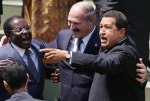
Venezuela’s President Hugo Chavez praises Belarus “as a model of a social state,” likening it to the society Chavez’s Bolivarian revolutionaries are building in South America. [10] Chavez, who calls Lukashenko “a brother in arms” [11] awarded the Belarusian leader Venezuela’s highest award for foreigners, the Order of the Liberator. Lukashenko has also been awarded the highest honor Cuba bestows on foreigners, the Order of Jose Marti.

Belarus retains the symbols and social supports of its Soviet past. An imposing monument to Lenin still guards the approaches to the government headquarters. Education through university is still free, and university students continue to enjoy living stipends as they did in Soviet days. [12] Much of the economy remains under public control.

Clearly, Belarus isn’t the kind of place the CEO’s, corporate board members and investment bankers who dominate decision-making in Washington can warm up to. Sure, Minsk’s policies are good for ordinary Belarusians. Basic goods and services are kept affordable, the public controls the commanding heights of the economy, and income equality is virtually unmatched in the world. But what about the interests of American investors and exporters? Where are the profitable investment opportunities? Where are the lucrative export markets?

Building an opposition

To oust Lukashenko and his socialist-leaning policies, the US government set out to mold a disparate group of opposition parties and activists into a single, coherent unit, guided by a single executive with authority to enforce common goals and strategy. The international arm of the Republican Party, the IRI, has assumed a leadership role in focusing “primarily on the process of consolidating and unifying all of the pro-democratic elements in the country into a single coalition.” [13]

True to the game plan the US government has followed in engineering soft coups in other countries, the opposition has been given a name that underscores its professed struggle for democracy against an alleged dictatorship. While the West created the Democratic Opposition of Serbia to oppose what it called the dictatorship of Slobodan Milosevic, and the Movement for Democratic Change to oppose the misnamed dictatorship of Robert Mugabe in Zimbabwe, in Belarus the US-backed and funded opposition goes by the name of the United Democratic Forces (UDF). Its goal is to oppose and topple the alleged dictatorship, and socialist-oriented policies, of Alexander Lukashenko.

The US government uses the word “dictatorship” in a unique way. Belarus is decried by Washington as a dictatorship even though the country’s political system is a multi-party democracy with universal adult suffrage. [14] Dictatorship is to be understood in the world of Washington’s regime changers, not as rule by an individual or committee, where suffrage is absent, but as rule by elected officials the US government opposes because their policies are either immediately or indirectly at odds with the interests of US capital. Branding a socialist or nationalist leader as a dictator provides the US government with a pretext to sanitize its interference in the internal politics of foreign countries by misrepresenting its meddling as democracy-promotion.

The US government has likewise tried to discredit the government of Hugo Chavez in Venezuela, referring to Chavez as a would-be autocrat, to justify nurturing and bankrolling the “democratic” opposition. Chavez, Milosevic, Mugabe and Lukashenko have all pursued policies that have rejected, in various degrees, the free-market, free-enterprise, free-trade orthodoxy Washington insists all countries (but itself) adopt.

The UDF comprises 10 opposition parties and more than 200 NGOs. In 2005, the coalition selected Alexander Milinkevich as its candidate for president. Terry Nelson, national political director of the 2004 Bush-Cheney campaign, practically ran Milinkevich’s 2006 campaign, according to The New York Times. [15] But help from the Republicans was not enough to overcome Milinkevich’s failure to resonate with the public. The UDF’s own polling, paid for by the IRI, “showed the ratings of Milinkevich and other opposition leaders in the single digits.” [16] Lukashenko won the election handily with 83 percent of the vote, a lopsided victory the US government immediately attributed to vote rigging, on grounds that no one could be that popular.

But there are plenty of elections elsewhere won by higher margins which the US government has endorsed as fair reflections of the democratic will. The US-educated and fiercely pro-US ruling class Mikhail Saakashvili polled 97 percent in Georgia’s 2004 presidential elections, without Washington batting an eye. Kurmanbek Bakiyev won 89 percent of the vote in Kyrgyzstan’s Tulip Revolution, without incurring Washington’s disapproval. And Eduard Shevardnadze, when he was still Washington’s man in Georgia, polled 92 percent of the vote in Georgia’s 1992 election, without repercussions.

Laying aside US government double standards, there are a number of reasons to believe the 2006 presidential vote in Belarus was free and fair. All the polls, including the opposition’s IRI-paid poll, anticipated a Lukashenko victory as a virtual certainty. This reflected Lukashenko’s enormous popularity, something even members of the opposition acknowledge. [17] “Even his fiercest opponents don’t question the accuracy of independent polls that rate him the most popular politician in the country.” [18]

Lukashenko’s popularity derives from policies which favour the working class over Western investors. He has,

“presided over a continual increase in real wages for several years…He has also cut (the value added tax), brought down inflation, halved the number of people in poverty” and created “the fairest distribution of incomes of any country in the region.” [19]

Belarus’ egalitarianism has been a particular irritant to the US government. While the Lukashenko government’s income-redistribution policies have maintained a narrow gap between the rich and poor, they have also reduced the attractiveness of Belarus to the US corporate rich as a venue for profitable investment. With a choice of serving ordinary Belarusians or catering to corporate America, Lukashenko chose the former and incurred the wrath of the latter.

Beginning in April 2007, the IRI, along with the Democratic Party’s international arm, the NDI, and the Council of Europe, hosted a series of meetings with UDF members, culminating in a national congress attended by 693 delegates. The purpose of the meetings was to formulate coalition strategy and to draft a transitional constitution to be rolled out if and when the UDF topples the government and seizes the reins of power [20] (at which point it will sell off public enterprises, end subsidies for basic goods and services, and reverse Lukashenko’s income redistribution policies.)

Uncle Sam’s NGOs

The US government also provides “extensive support, grant making, leadership and capacity building to over 60 indigenous NGOS.” The US State Department, PACT and the NDI have assisted 60 NGOs in various ways, purchasing goods and services for the organizations, setting up cross-border exchanges with other NGOs, offering advice on strategic planning, and doling out over 40 grants. To strengthen connections among NGOs, the sponsors established a Leadership Fellows Program, to build leadership skills among members of the anti-Lukashenko opposition. [21]

The NDI, “held a youth conference in February 2007 to assist youth groups in their efforts to mobilize, build organizational capacity, (and) improve cooperation.” Not to be outdone, the IRI hosted 10 sessions for more than 300 Belarusian youths, to train “the next generation of political leaders.” These sessions were led by “trainers from across democratic Europe,” [22] non-violent pro-democracy activists trained to foment uprisings in Serbia, Georgia and Ukraine. Every few months, disciples of Gene Sharp, the US-based guru of non-violent regime change, are “deployed abroad to teach democracy activists how to agitate for change…going everywhere from Eastern Europe to train Belarusians to Turkey to coach Iranians.” The Center for Applied Nonviolent Action and Strategies, bankrolled in part by the IRI and the CIA-interlocked-Freedom House, plays a leadership role in these training sessions. [23]

Along with Renaissance, Pontis, and the Eurasia Foundations, the US State Department helped found the Belarusian Institute for Strategic Studies, a think tank of pro-US ideologues prepared to disgorge policy advice congenial to the US government’s free-market, free-enterprise, free-trade ideology. [24] When the media need quotes from “experts,” they turn to BISS.

As part of efforts to shape public opinion, the US State department funds European Radio for Belarus, an anti-Lukashenko radio station, joining Radio Free Europe/Radio Liberty, US-government-sponsored propaganda radio stations, in preaching the anti-Lukashenko, anti-socialist, pro-neo-liberal gospel. On top of ERB, Western regime changers doled out $24 million to Media Consulta, a German-led consortium to broadcast anti-government news into Belarus. Individual European countries have also kicked in. [25]

The fifth column goes to Washington

The Republican Party has been heavily involved in nurturing Belarus’s opposition, meeting frequently with its key activists. In April 2005, US Secretary of State Condoleezza Rice held meetings in Lithuania with members of the opposition, discussing the use of “mass pressure for change,” [26] and pledging $5 million in backing, to be provided through the IRI. [27] It is typical of color revolutions, including the Rose Revolution in Georgia, the Orange Revolution in Ukraine, and the ouster of Milosevic in the former Yugoslavia, for the US-sponsored opposition to accuse the government of electoral fraud. This provides an occasion to mobilize opposition supporters to take to the streets to force the government to step down. At her meetings in Lithuania, Rice told opposition representatives that the impending presidential election would be an “excellent opportunity” to challenge the government. [28] The opposition followed Rice’s strategy to a tee, not as much “running an election campaign as…trying to organize an uprising.” [29] The New York Times commented that Milinkevich was “campaigning not for the presidency but for an uprising.” [30] For the opposition, an uprising was the only realistic path to power. Polls paid for by the IRI “showed the ratings of Milinkevich and other opposition leaders in the single digits.” [31]

Opposition activists have unique access to high US State officials through the IRI, and have been provided a platform from which to deliver persuasive communications to a wide audience – a platform they would not have without US government influence.

The IRI hosted a delegation of opposition activists over eight days in December, 2007. The delegation had private meetings with Rice and a nearly one-hour meeting with US President Bush, after which each delegate had his photograph taken with the president. The IRI also arranged for the delegation to meet with the Washington Post editorial board, to answer questions on a Radio Free Europe/Radio Liberty call-in show beamed into Belarus, and set up radio and television interviews with the official US overseas propaganda service, Voice of America. [32]

This came on the heels on another UDF visit to Washington hosted by the IRI from February 26 to March 2. On this trip, delegates met with State Department, White House, and Congressional officials, and shared their points of view with the media, including The Washington Post, Voice of America and Radio Free Europe/Radio Liberty. In its meetings with US officials, the delegation expressed its gratitude “for the support of the US government.” [33]

Supporting a working class-friendly alternative

There are a few reasons to oppose US interference in Belarus’ democracy.

Belarus is one of the few remaining places on earth in which the commanding heights of the economy are publicly owned, where robust income redistribution narrows the gap between rich and poor, where essential goods and services are subsidized so they remain affordable to all, and where education is free and university students receive a living stipend.

US government interference in Belarus is not aimed at promoting democracy. Belarus already has a democracy, both in the narrow, technical, sense of offering universal adult suffrage and regular elections featuring a multiplicity of parties, and in the broader, more meaningful, sense of being a place in which the interests of the bulk of people predominate.

US government interference in Belarus is aimed at the very opposite of democracy: promoting the interests of a super-privileged minority comprising US and Western investment bankers, CEOs, corporate board members, and hereditary capitalist families, who seek unfettered access to Belarus’ resources, markets, labor and public assets. Corporate America wants to own Belarus’ banks, waters, forests and other natural resources; to buy Belarus’ state-owned enterprises; to sell goods and services unimpeded by tariff barriers and unhindered by subsidies to domestic firms. It wants a low-tax environment, no restrictions on expatriation of profits, and a low-wage and biddable workforce held in check by a reserve army of the unemployed. From the point of view of the US ruling class, Belarus should be investor-friendly, not working class-friendly.

US citizens and citizens of other Western countries that contribute to nurturing Belarus’ fifth column should oppose the use of their tax dollars to bring down one of the few remaining challenges to the neo-liberal economic order. Taxpayer dollars should be used to help fund public health care, provide free education, and subsidize basic goods and services at home, not to undermine working class gains abroad.

1. United States Department of State, “Belarus 2007 Performance Report,” November 16, 2007. http://pdf.usaid.gov/pdf_docs/PDACL044.pdf
2. The Los Angeles Times, September 25, 2005; “Belarus Democracy Act Will Help Cause of Freedom, Bush Says,” October 21, 2004. http://www.america.gov/st/washfile-english/2004/October/20041022100536btrueveceR0.8822595.html
3. The New York Times, December 17, 2005.
4. Russian Information Agency Novosti, July 13, 2007.
5. Central Intelligence Agency, The World Factbook, Belarus. https://www.cia.gov/library/publications/the-world-factbook/geos/bo.html
6. The Heritage Foundation, 2008 Index of Economic Freedom. http://www.heritage.org/research/features/index/country.cfm?ID=Belarus
7. Cited in The Heritage Foundation, 2007 Index of Economic Freedom.
8. The Washington Post, September 23, 2005.
9. The New York Times, January 1, 2006.
10. The New York Times, July 24, 2006.
11. The Financial Times (London), August 2, 2007.
12. The Morning Star (UK), January 7, 2008.
13. Remarks by Stephen B. Nix, Director of Eurasia Program, International Republican Institute, Conference on European Union and Democracy Assistance, Center for European Studies, the University of Florida, March 30, 2007, http://www.iri.org/eurasia/belarus/2007-03-30-Belarus.asp
14. The IRI’s Belarus page describes Belarus’ type of government as a dictatorship. On the same page, under the rubric “suffrage” is written: universal, age 18. http://www.iri.org/eurasia/belarus.asp The CIA’s World Factbook lists 19 political parties in Belarus.
15. “Bringing Down Europe’s Last Ex-Soviet Dictator,” New York Times, February 26, 2006.
16. Ibid.
17. The Washington Post, March 21, 2006.
18. The Los Angeles Times, September 25, 2005.
19. Times Online, March 10, 2006.
20. United States Department of State, “Belarus 2007 Performance Report,” November 16, 2007. http://pdf.usaid.gov/pdf_docs/PDACL044.pdf
21. Ibid.
22. Ibid.
23. “A Georgian soldier of the Velvet Revolution,” The Los Angeles Times, September 2, 2008.
24. United States Department of State, “Belarus 2007 Performance Report,” November 16, 2007. http://pdf.usaid.gov/pdf_docs/PDACL044.pdf
25. The New York Times, February 26, 2006.
26. The New York Times, April 22, 2005.
27. Xinhua News Agency, May 13, 2005.
28. The New York Times, April 22, 2005.
29. The New York Times, January 1, 2006.
30. The New York Times, February 26, 2006.
31. Ibid.
32. “IRI Host Belarusian Democratic Leaders,” IRI News Release, December 12, 2007. http://www.iri.org/eurasia/belarus/2007-12-12-Belarus.asp
33. “IRI Host Belarusian Democratic Leaders,” IRI News Release, March 9, 2007. http://www.iri.org/eurasia/belarus/2007-03-09-Belarus.asp

The U.S. Department joins the CIA, the Heritage Foundation, The Wall Street Journal and The Economist in complaining about Belarus’s refusal to establish conditions congenial to foreign investment:

“After an initial outburst of capitalist reform from 1991-94, including privatization of state enterprises, creation of institutions of private property, and development of entrepreneurship, Belarus under Lukashenko has greatly slowed, and in many cases reversed, its pace of privatization and other market reforms, emphasizing the need for a ‘socially oriented market economy.’ About 80% of all industry remains in state hands, and foreign investment has been hindered by a climate hostile to business. The banks, which had been privatized after independence, were renationalized under Lukashenko. The government has also renationalized companies using the ‘Golden Share’ mechanism–which allows government control in all companies with foreign investment–and through other administrative means.

“The U.S. Government continues to support the development of the private sector in Belarus and its transition to a free market economy. With the advent of the Lukashenko regime, Belarusian authorities have pursued a generally hostile policy toward the private sector and have refused to initiate the basic economic reforms necessary to create a market-based economy. Most of the Belarusian economy remains in government hands. The government, in particular the presidential administration, exercises control over most enterprises in all sectors of the economy. In addition to driving away many major foreign investors–largely through establishment of a ‘Golden Share’ requirement, which allows government control in all companies with foreign investment–Belarus’ centralization and command approach to the economy has left only a trickle of U.S. Government and international assistance programs in this field.

“The United States has encouraged Belarus to conclude and adhere to agreements with the International Monetary Fund (IMF) on macroeconomic stabilization and related reform measures, as well as to undertake increased privatization and to create a favorable climate for business and investment.

“Because of the unpredictable and at times hostile environment for investors, the U.S. Government currently does not encourage U.S. companies to invest in Belarus. Belarus’ continuing problems with an opaque, arbitrary legal system, a confiscatory tax regime, cumbersome licensing system, price controls, and lack of an independent judiciary create a business environment not conducive to prosperous, profitable investment. In fact, several U.S. investors in Belarus have left, including the Ford Motor Company.” (My emphasis.) US Department of State, http://www.state.gov/r/pa/ei/bgn/5371.htm .

US Government Report Undermines Zimbabwe Opposition’s Claim of Independence

By Stephen Gowans

The US government had a hand in formulating the policy platform of the Tsvangirai faction of the Movement for Democratic Change, Zimbabwe’s main opposition party, and funded community-based newsletters to create a platform to persuade Zimbabweans to accept Washington’s point of view, according to a US government report. The report boasts that Washington is the undisputed leader in nurturing anti-government civil society organizations in Zimbabwe, operating through a CIA-interlocked organization led by former New York investment banker and Michael Milken right-hand man, Peter Ackerman.

In a November 16, 2007 letter accompanying the US State Department’s “Zimbabwe 2007 Performance Report,” US ambassador to Zimbabwe James McGee wrote that,

“Working closely with like-minded governments, we continued diplomatic efforts to maintain pressure on the Government of Zimbabwe and to remind the regime that fundamental changes…are a prerequisite to reengagement with the international community.”

McGee called for economic reform, translated as abandonment of Harare’s economic program of favoring Zimbabweans over foreign investors, an end to price controls, and privatization of state-owned enterprises.

The neo-liberal, foreign investor-friendly economic policies Washington favors are central to the policy platform of the Tsvangirai faction of the MDC. The State Department document reveals that the MDC’s policy orientation may be based more on US government direction than its own deliberations. According to the report,

“The (US government)…assisted the MDC to effectively identify, research, and articulate policy positions and ideas within Zimbabwe, in the region, and beyond. In particular, (US government) technical assistance was pivotal in supporting (the) MDC’s formulation and communication of a comprehensive policy platform.”

Critics of the party point to the absence of any difference between its policy proposals and those favored in Washington for African countries, an absence that may be explained in the US government’s helping “the MDC to identify, research, and articulate policy positions and ideas, and develop and communicate a policy platform.”

US government assistance to the MDC’s Tsvangirai faction didn’t stop at formulating and articulating a policy platform, the report says, but extended to helping the MDC formulate strategy to oppose the Mugabe government. According to the State Department, the US government,

“provided technical assistance to the MDC…to enable it to conduct regular strategic planning meetings to establish goals, identify key objectives, prioritize activities, and determine performance benchmarks.”

The tone of the report paints Zimbabweans as being incapable of establishing goals, setting priorities, and measuring performance themselves and therefore requiring US assistance to perform basic organizational tasks. It may be that the assistance US advisors provided is more accurately, and less tactfully, called direction.

The technical aid was furnished by the International Republican Institute, the Republican Party arm of the US Congress’s National Endowment for Democracy, whose chairman is John McCain. According to the State Department document, the,

“IRI held a workshop for Tsvangirai’s shadow government at which each shadow minister presented and defended his/her policy positions. A panel of technical experts grilled presenters on the technical content of their policies.”

This assistance was deemed by the State Department to be “critical to building the capacity of (the MDC) to operate effectively and to enable (it) to contend in the (2008) Presidential and Parliamentary elections, and to be prepared to govern.”

On top of helping the MDC shape its policy platform, the report also reveals that the US government helped shape public opinion in Zimbabwe through support for Voice of America broadcasting and community-based newsletters.

While portraying its role as simply one of delivering assistance, the State Department makes clear in its report that the newsletters provided the US government with a platform “to inform Zimbabweans about issues important to them.” Rather than funding community-based journalism, the report reveals that the State Department underwrote the newsletters to use them as vehicles for disseminating US government propaganda.

The State Department report also offers insight into the financial lengths Washington was prepared to go to create and sustain a civil society apparatus to oppose the Mugabe government. In 2007, Washington gave Freedom House and PACT a total of $1.8 million to back civil society organizations that were hostile to the Mugabe government. Freedom House, headed by former Michael Milken right-hand man, Peter Ackerman, is interlocked with the CIA, according to Edward Herman and Noam Chomsky in Manufacturing Consent.

In addition, over $400,000 was funnelled to Voice of America to counter Harare’s efforts to jam VOA anti-government broadcasts. Washington had been supporting VOA’s Studio 7, an anti-Mugabe radio program, since 2002. According to the report, “the program consisted of English, Shona and Ndebele broadcasts for an hour and a half per day, five days per week, until July 2007, when broadcasts were expanded to seven days a week.”

To thwart Harare’s jamming efforts, VOA’s broadcast time was expanded, and shortwave radios were distributed to Zimbabweans. In addition, publicity campaigns were undertaken to build Studio 7’s profile “via the distribution of calendars and pens, advertising in the print media and a text messaging campaign.”

The State Department describes Studio 7 as providing a platform for groups opposed to the Mugabe government and its land reform and economic indigenization policies: “the political opposition, exile groups, democracy activists and human rights proponents” – largely the same groups the US government was funding through Freedom House and PACT.

Conspicuously absent from the report’s list of political parties the US government provided “democracy and governance” assistance to in 2007 was Mugabe’s Zanu-PF party. Defenders of US democracy promotion insist that the US government promotes democratic processes aboard, not political parties, but only one party in Zimbabwe received US government assistance: the Tsvangirai faction of the MDC.

That, however, wasn’t Washington’s goal. The report says the US government planned to aid two political parties in Zimbabwe: presumably Tsvangirai’s MDC faction and the MDC faction led by Arthur Mutambara. But when the US government approached Mutamabara’s party, it was “rebuffed.” Mutambara has complained publicly about US imperialism and hypocrisy in its foreign policy and has manoeuvred to keep himself free from the taint of being an instrument of Western foreign policy.

To square the circle, and prove that it is promoting democracy and not political parties, the US government calls Tsvangirai’s MDC faction the “democratic opposition.” It is not by accident that the MDC’s full name is “the Movement for Democratic Change,” or that another party that once received US government assistance, Serbia’s the DOS, the Democratic Opposition of Serbia, also incorporated the word democracy into its name. The Western mass media mimic the US government designation of the foreign political parties Washington supports as being a “democratic opposition”, thus reinforcing the deception that US support for selected foreign political parties is democracy promotion, not illegitimate interference in the internal politics of other countries.

The report boasts that the US has been “the undisputed leader among the donor community in providing assistance to civil society,” providing “technical assistance and small grants to 29” civil society organizations through its “implementing partners”, Freedom House and PACT. Grants and assistance were provided to improve “strategic planning, communication, proposal writing (and) platform development.”

Proposal writing is emphasized, the report explains, to equip civil society organizations with the skills necessary to land additional grants from private foundations. According to the State Department,

“youth organizations like the Zimbabwe National Students’ Union (ZINASU) and Youth Initiatives for Democracy in Zimbabwe (YIDEZ) are two good examples of…(civil society organizations that were) nurtured through US (State Department) funding from an idea to a level where they are able to stand on their own and attract other funders.”

Defenders of the idea that civil society organizations are not created and guided by US government funding, but represent spontaneously arising grassroots organizations that would exist even if they hadn’t received US government largesse, paint a picture far different from the report’s reference to Washington nurturing civil society organizations from an idea to a level where they’re able to attract other funders and stand on their own.

The MDC insists it is an independent political party, and anti-Mugabe civil society organizations and their defenders are adamant that Zimbabwe’s civil society is not under foreign control. Scholar Patrick Bond has declared an underground anti-Mugabe organization that receives US government-funding to be part of an independent left, while scholar Stephen Zunes says Women of Zimbabwe Arise, a group singled out in the State Department report as receiving US government funding, can in no way be considered an agent of the US government. These defenders of anti-Mugabe organizations appear to be unfamiliar with the pivotal role played by the US government in nurturing and sustaining Zimbabwe’s civil opposition.

The MDC has received considerable assistance and guidance from Washington and the John McCain-led IRI, in developing and articulating its policy platform, and in formulating strategy to defeat the Mugabe government.

In its opposition to Zanu-PF, it has been helped by civil society organizations funded by the US government through Freedom House and PACT, and by US government-funded community-based newsletters and the VOA’s Studio 7, which have served as platforms for disseminating the point of view of the US government and the views of Mugabe-opponents.

The report, then, reveals how the US government has taken advantage of Zimbabwe’s relative openness to intervene in the country’s internal political affairs to try to bring to power a party whose platform it had a hand in formulating.

Harare has taken steps to counter Washington’s illegitimate interventions, including jamming VOA broadcasts, barring journalists and election observers from the US, and banning some NGOs. These measures have been denounced by Washington as “undemocratic” and “authoritarian” and therefore as reasons for intervention. But the causal sequence is backwards.

The measures Washington calls anti-democratic and authoritarian didn’t cause the US to help the MDC write and communicate its policy platform, to nurture and fund government-hostile civil society organizations, and to provide Mugabe’s opponents a vehicle through Studio 7 and community-based newsletters to shape public opinion. On the contrary, all these things caused Harare to take the measures that have been denounced as anti-democratic and authoritarian as a means to limit Washington’s illegitimate interference in Zimbabwe’s democratic space.

Anyone who was truly interested in promoting democracy would press Washington to stop its interference in Zimbabwe, rather than lionize US-backed civil society organizations as a spontaneously arising pro-democracy people’s movement, as an independent left that people should look to understand what’s going on in Zimbabwe (Bond), or as groups that can in no way be considered agents of the US government (Zunes).

Stephen Zunes’ False Statements on Zimbabwe and Woza

By Stephen Gowans

Stephen Zunes is making a career of legitimizing fundamental US government assessments of all but a few of its foreign policy targets, uncritically mimicking State Department slanders of target countries and falsely declaring US funded regime change organizations to be “progressive organizations which could by no means be considered American agents.”

Reacting to a Netfa Freeman article in the Black Agenda Report criticizing his position on Zimbabwe, Zunes refers to “Mugabe’s election fraud, mismanagement of the economy, and human rights abuses.” This is State Department boilerplate. While it would be too much to ask Zunes to back up his statements in his brief reply to Freeman’s article, I cannot recall that he has ever produced evidence of any of his charges against US foreign policy targets in his longer articles, or has ever shown the slightest hint of scepticism regarding the charges Washington has levelled against “outposts of tyranny.” Instead, Zunes freely apes State Department rhetoric, defending from the left fundamental State Department views.

Particularly galling is his reference to Mugabe’s “mismanagement of the economy,” standard fare from US Secretaries of State, the CIA and New York Times, but hardly what one would expect from a critical and sceptical progressive who claims to be independent of US establishment positions. Attributing Zimbabwe’s economic difficulties to Mugabe’s policy errors whitewashes the role of the US in sabotaging Zimbabwe’s economy through the US Zimbabwe Democracy and Economic Recovery Act, which effectively cuts Harare off from balance of payment loans, development assistance and lines of credit from international lending agencies.

In his reply to Freeman, Zunes falsely states that Women of Zimbabwe Arise can by no means be considered American agents. The group’s leader, Jenni Williams, was presented with the State Department’s 2007 International Woman of Courage Award for Africa by Condoleezza Rice in a March, 2007 ceremony in Washington. The US State Department does not give out awards to people who work against the interests of the US economic elite. It does, however, award those who advance the elite’s positions.

A US government report on the activities in 2007 of its mission to Zimbabwe reveals that the “US Government continued its assistance to Women of Zimbabwe Arise.” US government assistance to Woza and other civil society organizations was channeled through Freedom House and PACT. Freedom House, which is interlocked with the CIA and is a “virtual propaganda arm of the (US) government and international right wing,” according to Noam Chomsky’s and Edward Herman’s Manufacturing Consent, is headed by Peter Ackerman, who also heads up the International Center on Nonviolent Conflict (ICNC). Stephen Zunes is chair of the board of academic advisors to the ICNC. Ackerman’s wife, Joanne Leedom-Ackerman, is a former director of the Albert Einstein Institute, an organization which trained activists in popular insurrection techniques to overthrow Venezuela’s Bolivarian Revolution. Zunes has vigorously defended the AEI. She is also currently a director of the US foreign policy establishment-dominated Human Rights Watch, which recently launched a dishonest attack on Venezuelan President Hugo Chavez’s human rights record.

Woza supports two US State Department propaganda vehicles: SW Radio Africa, a US State Department funded short-wave radio station that beams anti-Mugabe propaganda into Zimbabwe, and the Voice of America’s Studio 7, also funded by the State Department to broadcast US foreign policy positions into Zimbabwe. All political parties in Zimbabwe have, in their recent Memorandum of Understanding, urged journalists to abandon these pirate radio stations to “start working for the good of the country rather than for its enemies.” Jenni Williams and Woza are not, as Zunes falsely claims, working independently of the US government.

Zunes is close to individuals and organizations that are members of the US foreign policy establishment (Freedom House head and Council on Foreign Relations member Peter Ackerman) and have received funding from the US government and ruling class foundations to train popular insurrection groups to overthrow US foreign policy targets (Gene Sharp and the Albert Einstein Institute). He has been criticized from the left by Michael Barker, Monthly Review editor John Bellamy Foster, and George Ciccariello-Maher and Eva Golinger. He is intolerant of criticism, asking WordPress to shut down my blog for criticisms of his association with Ackerman.

His modus operandi is to accept State Department denunciations of most US foreign policy targets as true, while attacking Washington’s foreign policy for being based on hypocrisy. He denies that insurrectionary movements trained by organizations that are funded by wealthy individuals, ruling class foundations and Western governments are agents of US imperialism, portraying them instead as independent grassroots groups.

There is much about Zunes to raise doubts about his politics.

Heidi Holland’s Dinner with Mugabe: Failed Demonography

By Stephen Gowans

Journalist Heidi Holland’s biography of Zimbabwe’s president Robert Mugabe, Dinner with Mugabe, begins with the assumption that Zimbabwe’s long-standing president is a monster. In addition, Mugabe, who recently struck a deal with factions of the opposition MDC to share power, is accused by his biographer of creating “a de facto one party state,” [1] and of “failings and excesses” that have left Zimbabweans “starving” [2] – standard fare from Western journalists.

The fact that Zimbabwe’s opposition now controls the legislature and is due to hold a majority of cabinet posts clashes violently with Holland’s depiction of the country as a de facto one party state. By comparison, no one, much less Holland, complains about South Africa, truly a de facto one party state, which suggests that whatever beefs she has with Zimbabwe have nothing to with it being a de facto one party state, (which it isn’t) otherwise we might expect South Africa, and not just Zimbabwe, to fall within her sights (which it hasn’t.)

As for the hunger of Zimbabweans being due to what Holland describes as Mugabe’s failings and excesses, this too clashes violently with reality. Western sanctions have blocked Zimbabwe’s access to balance of payment support, development aid and other lines of credit. Additionally, drought and electricity shortages have created food insecurity throughout southern Africa, including Zimbabwe. [3] Only if bad weather and standing up to Western bullying count as failings, have Holland’s charges substance.

Proving that Mugabe is a monster, as opposed to uncritically accepting his status as one, isn’t on Holland’s agenda, any more than proving any of her other charges is. All accusations are to be taken as given, starting points for exploring “the untold story of how a freedom fighter became a tyrant.” Holland’s quest, then, isn’t to challenge the received, though unsubstantiated, wisdom, but to affirm it, offering a “psychobiography of a man whose once-brilliant career has ruined Zimbabwe and cast shame on the African continent.”

This reveals much about Holland. Mugabe’s “once brilliant career”, happens to coincide with the period during which he played by the West’s rules, while his subsequent “ruining” of Zimbabwe, coincides with his breaking the rules to redress historical wrongs related to land ownership and to carry out other measures to invest Zimbabwe’s break with colonialism with substantive content. In other words, the view that says Mugabe was once a paragon who has become a tyrant equates his early “brilliance” to keeping former colonists in London and international lenders happy while chalking up as a “failure and excess” his measures to reverse Western domination. This is a curious view from the perspective of democracy, but perfectly understandable from the point of view of imperialism.

Dinner with Mugabe is a “psychobiography,” the standard form favored by authors who want to avoid substantive policy issues, in favor of dwelling in a comic-book world of heroes and villains. There is a shocking absence of policy mentioned in most discussions of politics, including – if not especially – among many on the left, who think the brilliance of any political analysis can be measured by the number of times the author uses the words “thug,” “brutal dictator” and “tyrant.” Holland’s biography is in this mold.

What of policies? It is worthwhile to quote Michael Parenti on this.

“One of the things I try to do is find out what leaders actually do when they’re in power. That’s one of the great hidden questions in history. You can read about six or seven different biographies of Stalin, and they never tell you what he actually did in terms of the programs of the country. You read about his purges of Bukharin and Zinoviev and his fight with Trotsky and this and that. But what were the socio-economic policies he actually pursued? The same with Hitler. I’ve read numerous biographies of Hitler. What did Hitler actually do? What was his political economic program? You find out it was a program in which he cut the taxes for the rich, he cut back wages, he destroyed unions and privatized everything.” [4]

Silence on the political and economic programs of leaders is particularly evident in the case of Zimbabwe, where Western political analyses almost invariably ignore the policies of Zimbabwe’s main political parties and the differences between them. In extreme cases, not only are the policies of the parties ignored, their differences are denied. For example, Shawn Hattingh, a research and education officer at the International Labor Research and Information Group, wrote an August 14, 2008 MRZine article, describing Zanu-PF and the MDC as two sides of the same neo-liberal coin.

There’s no question the MDC is neo-liberal. The party’s 2000 “Social and Economic Policies for a New Millennium,” makes a commitment to a program of privatization. Foreign direct investment, under a MDC government, would be courted by the appointment of a “fund manager to dispose of government-owned shares in publicly quoted companies.” [5]

Eddie Cross, then the MDC’s Secretary of Economic Affairs, explained the party’s economic plan.

“First of all, we believe in the free market. We do not support price control. We do not support government interfering in the way people manage their lives. We are in favor of reduced levels of taxation. We are going to fast track privatization. All fifty government (enterprises) will be privatized within a two-year frame, but we are going far beyond that. We are going to privatize many of the functions of government. We are going to privatize the Central Statistics Office. We are going to privatize virtually the entire school delivery system. And you know, we have looked at the numbers and we think we can get government employment down from about 300,000 at the present time to about 75,000 in five years.” [6]

Eight years later, the MDC’s fondness for neo-liberalism remains undiminished. The party set out its core beliefs and proposals in its 2008 election platform, declaring an unwavering commitment to the safety and security of individual and corporate property rights and the opening of industry to foreign direct investment. Expatriation of profits is favored, without restriction. The party promised to privatize postal services, telecom and electronic media and to remove the price controls the Mugabe government has introduced to protect Zimbabweans from the ravages of hyperinflation. The Zanu-PF government’s economic indigenization program, which seeks to place control of the country’s resources in the hands of Zimbabweans, would also be cut by an MDC government. Private enterprise would be the engine of economic growth in a new Zimbabwe – particularly private enterprise owned by foreign investors. [7]

Zanu-PF, contrary to Hattingh’s delusions, is not neo-liberal. If it were, there would be no public companies for the MDC to promise to privatize, no subsidies for basic goods the MDC could propose to eliminate, and no differential treatment of foreign investors for the MDC to pledge to abolish. Moreover, were Zanu-PF neo-liberal, it would be the first and only case of a neo-liberal party that has rejected, and has been rejected by, the IMF, and the only neo-liberal party that restricts foreign ownership levels in key sectors, pursues public policy goals through state ownership of key enterprises, provides subsidized food baskets, imposes price controls and rejects national treatment of foreign investors.

The fact of the matter is that it is precisely because the Zanu-PF government is not neo-liberal that the US, Britain and EU have campaigned vigorously to drive Mugabe – and his non-neo-liberal policies – out of Harare. No Third World government can generate the following record without running afoul of Washington, London and Brussels.

o “Total government expenditures, including consumption and transfer payments, are very high. In the most recent year, government spending equaled 50.3 percent of GDP. Privatization has stalled, and the government remains highly interventionist;

o “The government sets price ceilings for essential commodities such as agricultural seeds, bread, maize meal, sugar, beef, stock feeds, and fertilizer; controls the prices of basic goods and food staples; influences prices through subsidies and state-owned enterprises and utilities;

o “The government will consider foreign investment up to 100 percent in high-priority projects but applies pressure for eventual majority ownership by Zimbabweans;

o “Zimbabwe has burdensome tax rates. The top income tax rate is 47.5 percent, and the top corporate tax rate is 30 percent.” [8]

To be sure, the policies that have been pursued by the Zanu-PF government are not socialist, but they are, at the same time, deeply hostile to neo-liberalism, and lean more strongly in the direction of social democracy than the economic policies of many social democratic and socialist governments elsewhere.

At one point, in the 1990s, the Mugabe government did accept the neo-liberal economic structural adjustment program demanded by the IMF, with devastating consequences. From 1991 to 1995, Mugabe’s government implemented the IMF program as a condition of receiving balance of payment support and the restructuring of its debt. The program required the government to cut its spending deeply, fire tens of thousands of civil servants, and slash social programs. Zimbabwe’s efforts to nurture infant industries were to be abandoned. Instead, the country’s doors were to be opened to foreign investment. Harare would radically reduce taxes and forbear from any measure designed to give domestic investors a leg up on foreign competitors, even though the US, Germany, Japan and South Korea, as young developing countries, had become capitalist powerhouses by adopting the very same protectionist and import substitution policies the IMF was forbidding.

The effect of the IMF program was devastating. Manufacturing employment tumbled nine percent between 1991 and 1996, while wages dropped 26 percent. Public sector employment plunged 23 percent and public sector wages plummeted 40 percent. [9] In contrast to the frequent news stories today on Zimbabwe’s fragile economy, the Western press barely noticed the devastation the IMF’s disastrous economic policies brought to Zimbabwe. By 1996, the Mugabe government was starting to back away from the IMF prescriptions. By 1998, it was in open revolt, imposing new tariffs to protect infant industries and providing incentives to black Zimbabwean investors as part of an affirmative action program to encourage African ownership of the economy. These policies were diametrically opposed, not only to the IMF’s program of structural adjustment, but to the open door goals of US foreign policy. By 1999, the break was complete. The IMF refused to extend loans to Zimbabwe. By February, 2001, Zimbabwe was in arrears to the Bretton Woods institution. Ten months later, the US introduced the Zimbabwe Democracy and Economic Recovery Act, a dagger through the heart of Zimbabwe’s economy, which denied the country lines of credit from international lending institutions and pushed the economy into a tailspin. “Zimbabwe,” says Mugabe, “is not a friend of the IMF and is unlikely to be its friend in the future.” [10]

While Holland’s goal in writing Dinner with Mugabe is to reinforce the campaign of vilifying Mugabe begun in London, Washington, and Brussels, her biography only accomplishes its aim if the starting assumption of the book – that Mugabe is a monster – is accepted. If you don’t accept it, the book does quite the opposite of what it sets out to do. Through a series of interviews with people who have played significant roles in Mugabe’s life, texture, context and understanding, deeply at odds with the comic-book caricature of the man, emerge. If you read only the transcripts of the interviews Holland builds her book around, and not her interpretation of the transcripts, you come away with an entirely different impression than the one Holland intends. In this, Holland has utterly failed as a demonographer.

Through the lens of people who have known him, Mugabe is portrayed as a revolutionary forced to make concessions and compromises to deal with the world as it is, not as he would like it to be. Britain often plays the role of spoiling, blocking and undermining the revolutionary aims of Zimbabwe’s national liberation struggle. “Mugabe,” explains Holland, “was not just a political leader, but a revolutionary one, pledged to righting the wrongs of the past.” [11] Britain, however, has made the journey a difficult one.

To balance her sensationalist and demonical caricature of her subject, Holland details the social gains Zimbabwe has achieved under Mugabe’s leadership.

“His administration guaranteed educational opportunities for Zimbabwe’s black population where few had existed before. High school enrollment, which had been about two percent at the time of independence, grew to 70 percent by 1990, and Zimbabwe’s literacy rate rose from 45 percent to nearly 80 percent in the same period.” [12] He “did more to educate his people during his early years in office than any other leader in Africa.’ [13]

She notes, too, that “Mugabe also developed public health facilities to the point where rural dwellers were able to receive medical attention within walking distance of their villages.” [14]

While Mugabe is sometimes portrayed as an anti-white racist, Holland sets the record straight, pointing out that Mugabe “did his best to persuade the country’s 200,000 whites, including its 45,000 commercial farmers, to remain in Zimbabwe.” [15] She cites Mac McGuiness, the former leader of the notorious anti-insurgency unit of the Rhodesian army, the Selous Scouts. Mugabe

“undertook at independence to let bygones be bygones and he never lifted a finger against his former enemies, including Ian Smith, who was allowed to live in Zimbabwe as long as he pleased and to criticize Mugabe whenever he chose for the rest of his life. He was more generous to Smith than Smith was to him, that’s for sure.” [16]

Lady Soames, whose husband Lord Soames was the British governor of Zimbabwe until the first elections in 1980, told Holland that Mugabe was a “Marxist utopian…determined to promote state socialism even if he knew he couldn’t practice it.” [17]

On this score, Lord Carrington, the former British foreign minister who represented Britain at the Lancaster House talks which led to Zimbabwe’s independence, noted in conversation with Mugabe’s psychobiographer that Mugabe was forced to rein in his Marxist aspirations after witnessing the experiences of revolutionary governments in neighboring countries. During his exile in Tanzania and Mozambique, Carrington explained that,

“Mugabe had seen exactly what had happened to the economies of those two countries as a result of kicking out the whites and generally introducing pan-African socialism…So I thought, what with him being a Marxist…he was going to be very different indeed in office (but) once in office he became a capitalist, didn’t he?” [18]

This wasn’t Mugabe’s first encounter with compromise. Lord Carrington explained to Holland that,

“Everyone wanted some sort of solution (at Lancaster House) except Mugabe, who didn’t think it was necessary. And he was probably right. There is no doubt that Mugabe would not have signed the Lancaster House Agreement if presidents Julius Nyerere of Tanzania and Samora Machel of Mozambique hadn’t prompted him to. [19]

They more than prompted him to. The two leaders told Mugabe that the guerilla forces fighting for the principle of one-man-one-vote and return of land confiscated by British settlers could no longer use their countries as bases from which to launch attacks against the Smith regime, forcing Mugabe to the negotiating table just when a military victory was in view. Had the liberation forces been allowed their military victory, much would have been different.

Mugabe was also forced into a compromise over the IMF’s economic structural adjustment program, Esap. Father Fidelis Mukonori, leader of Zimbabwe’s Jesuits, and a friend of Mugabe’s, told Holland that,

“Mugabe accepted Esap, saying he had little choice because it was imposed by northern hemisphere big-wings who never questioned its wisdom or side effects and who would refuse to work with you – if you didn’t…it caused a lot of suffering and Mugabe believed it marked the beginning of Zimbabwe’s dissatisfaction with Zanu-PF.” [20]

On the MDC, whose founding in 2000 was largely directed by Britain, Holland concedes what Mugabe has complained about for years: that the MDC is a vehicle of Britain and the white commercial farmers. She writes:

“It appears that Mugabe was correct in his belief that the former colonist was aiding and abetting the forces that opposed him, namely the MDC, in cahoots with the predominantly white Zimbabweans who had colonized and financed the party.” [21]

And further:

“Some European countries, including Britain, had given financial and other forms of support to the MDC. White farmers gave cheques to Morgan Tsvangirai on television during the 2000 election campaign.” [22]

If Holland’s book is largely unintentionally sympathetic to Mugabe in the reflections of those she interviews, it is most sympathetic in its consideration of land reform. Blame for the crises that have attended the Mugabe government’s efforts to democratize patterns of land ownership is laid squarely at the feet of the British government.

Holland begins by eliciting a favorable assessment of Mugabe by Clare Short, Tony Blair’s secretary of state for international development, who earned notoriety in Zimbabwe for backing away from the commitment made by the Thatcher government to help Harare defray the costs of land redistribution. In a letter to the Zimbabwe government, she wrote, “I should make it clear that we do not accept that Britain has a special responsibility to meet the costs of land purchases in Zimbabwe.” She closed by expressing concern that Mugabe’s land reform policies would impair foreign investor confidence. Interviewed by Holland, Short noted that, “Land was the point of colonialism and all the ugly power issues that went with it. Mugabe was a giant of history who liberated his country from oppression.” [23]

One of the most revealing parts of Holland’s book concerns the experience of Rajan Soni, hired by the British government as a land reform consultant. Once New Labour was in charge, Soni discovered that,

“It was absolutely clear from the attitude of (Clare Short’s) staff towards his recommendations that Labour’s strategy was to accelerate Mugabe’s unpopularity by failing to provide him with funding for land redistribution…They thought that if they didn’t give him money for land reform his people in the rural areas would start to turn against him. That was their position. They wanted him out, and they were going to do whatever they could to hasten his demise.” [24]

Land reform was a pressing issue in Zimbabwe that could not be ignored. Father Mukonori told Holland that,

“Everywhere…from town to town and village to village, the cry was the same as it had been during the war and throughout our history: ‘The soil is ours. The land question was never resolved. We want it resolved. The constitution was declared in London. We did not vote for it.’” [25]

While Holland attributes Zimbabwe’s economic meltdown to Mugabe’s excesses, her interview with the Selous Scout’s Mac McGuiness reveals a different view. “I think,” McGuiness told Holland, “that had the promises made to Mugabe been kept by the…British and others, Zimbabwe would not be in the state it is in today.” (26) Dennis Norman, a white farmer who became Zimbabwe’s first agriculture minister, agrees. “Mugabe couldn’t solve the land issue without money and he didn’t have money. I do blame Britain for that.” [27]

The texture, context and understanding offered by McGuiness, Norman and others are nowhere evident in Holland’s own depiction of Mugabe post-1999. While she portrays the early Mugabe as a hero of national liberation keen on righting historical wrongs, she turns sour on him at the point Mugabe takes the first bold post-independence steps to establish a substantive independence by expropriating the land of white commercial farmers for redistribution to black Zimbabweans. Liberation heroes can be feted so long as their actions leave the basic structure of Western economic domination in place. Encroach on capitalist property rights, impose conditions on foreign investment, wall off parts of the economy to foreign investors, favor domestic investors over Western ones, and reclaim stolen land, and honors and admiration soon turn to execration.

Since independence in 1980, Zimbabwe has been, to a diminishing degree, dominated by the West. Its economy, natural resources and land have historically been controlled by outsiders and settlers who came from outside and took what they wanted. Over the years, the Mugabe government has gradually asserted Zimbabwe’s independence, resisting US and British imperialist intrigues in southern Africa, ultimately rejecting the economic prescriptions of the Bretton Woods institutions (though accepting them at first), promoting black ownership of Zimbabwe’s resources and economy, and democratizing patterns of land ownership. Western governments, representing corporations and investors with interests in open door access to Zimbabwe, and white commercial farmers seeking to recover privileges established under racist Rhodesian rule, have used their considerable resources to thwart the Zanu-PF government’s efforts to build a truly independent Zimbabwe. An important part of the campaign has been to vilify Mugabe, to portray him as liberation hero turned tyrant. In its goals, Heidi Holland’s, Dinner with Mugabe, is part of this campaign. However, anyone who reads the book critically will discover there is much in it to challenge the comic-book caricature the author sets out to reinforce.

1. Heidi Holland, Dinner with Mugabe, Penguin Books, 2008. p. xx.
2. Holland, p. xv.
3. Stephen Gowans, “The real cause of Zimbabwe’s food crisis,” Race & History, June 4, 2005. http://www.raceandhistory.com/selfnews/viewnews.cgi?newsid1117908112,43270,.shtml
4. Michael Parenti in Joel Wendland, “Interview with Michael Parenti,” Political Affairs, December, 2004. http://www.politicalaffairs.net/article/articleview/387/
5. Social and Economic Policies for a New Millennium,” MDC policy paper, May 26, 2000.
6. Patrick Bond and Masimba Manyanya, Zimbabwe’s Plunge – Exhausted Nationalism, Neoliberalism and the Search for Social Justice, Merlin Press, 2002.
7. Noah Tucker, “In the Shadow of Empire,” 21st Century Socialism, August 3, 2008, http://21stcenturysocialism.com/article/in_the_shadow_of_empire_01694.html
8. http://www.heritage.org/Index/country.cfm?id=Zimbabwe
9. Antonia Juhasz, “The Tragic Tale of the IMF in Zimbabwe,” Daily Mirror of Zimbabwe, March 7, 2004.
10. Herald (Zimbabwe) September 13, 2005.
11. Holland, p. 73.
12. Holland, p. xx.
13. Holland, p. 71.
14. Holland, p. xx.
15. Ibid.
16. Holland, p. 36.
17. Holland, p. 74.
18. Holland, p. 65.
19. Holland, p. 60.
20. Holland, p. 136.
21. Holland, p. 104.
22. Holland, p. 139.
23. Holland, p. 102.
24. Holland, p. 105.
25. Holland, p. 138.
26. Holland, p. 36.
27. Holland, p. 121.

The War over South Ossetia

By Stephen Gowans

On August 4, 2008, Russia’s deputy foreign minister Grigory Karasin phoned US assistant secretary of state Daniel Fried to complain about the build-up of Georgian troops in the vicinity of South Ossetia. [1] Two days later, South Ossetian leader Eduard Kokoity, having evidence that Georgia planned a military strike before the month was out, told Denis Keefe, Britain’s ambassador to Georgia, that a Georgian invasion was imminent. [2]

Georgia had increased its military budget from $30 million to $1 billion per year, under its US-aligned president, Mikhail Saakashvili, relying on deep infusions of aid from Washington. [3] A country of only 8 million, Georgia had sent 2,000 troops to help US forces occupy Iraq, the third largest occupation force in the oil-rich country, after the US and Britain. Tbilisi “considered participation in Iraq as a sure way to prepare the Georgian military for ‘national reunification’ – the local euphemism of choice for restoring Abkhazia and South Ossetia to Georgian control.” [4]

Georgia’s attack was emboldened by three US moves: the sending of “advisers to build up the Georgian military, including an exercise” in July “with more than 1,000 American troops”; Washington’s “pressing hard to bring Georgia into the NATO orbit;” and the US “loudly proclaiming its support for Georgia’s territorial integrity in the battle with Russia over Georgia’s separatist enclaves.” [5]

On the eve of the war, Russia convoked an emergency meeting of the UN Security Council, presenting a resolution that called on both sides to renounce the use of force. [6] The US, Britain and France refused to back the resolution, arguing that it was unbalanced. Only South Ossetia and Russia should be called upon to renounce the use of force, they said. Georgia should be allowed to defend herself. [7]

The above shows that far from restraining the Georgian hand, the US was facilitating, even encouraging, an attack; that the South Ossetians and Russians anticipated an attack and that the Russians used their position at the United Nations to try to stop it; and that the West was setting the stage to blame the attack on the victims.

The war was swift, and for the Georgians, ignominious. Georgian forces were rapidly pushed back, their positions easily over-run and much of their equipment captured or destroyed. In the end, Saakashvili would rail against Russian aggression, and wonder histrionically who was next.

The Russians did not strike first, as Georgian officials now claim. The New York Times cited evidence from an extensive set of witnesses that Georgia’s military began to pound South Ossetia’s capital, Tskhinvali, with heavy barrages of rocket and artillery fire, after Saakashvili gave the order and before Russian troops entered Georgia. The result was hundreds of civilian deaths. Among the targets of the Georgian assault was a Russian peacekeeping base. There “has been no independent evidence, beyond Georgia’s insistence that its version is true, that Russian forces were attacking before the Georgian barrages,” reported The New York Times. [8] Moreover, an unnamed senior US official told the newspaper that Russia’s response didn’t look “premeditated, with a massive staging of equipment,” adding that “until the night before the fighting, Russia seemed to be playing a constructive role.” [9]

On August 26, Moscow recognized South Ossetia and Abkhazia as independent. Meanwhile, Saakashvili vowed to rebuild his army to try again at a later date. [10]

Origin of Tensions

Ossetians have their own language and, in recognition of this, enjoyed autonomy within Soviet Georgia. Abkhazia, too, was an autonomous region. When the Soviet Union dissolved, Georgia declared the autonomous status of both regions to be void, and attempted to integrate them. This sparked fighting between the Georgians on one side, and the South Ossetians and Abkhaz on the other. The two regions “settled into a tenuous peace monitored by Russian peacekeepers,” in which both enjoyed a de facto independence. But “frictions with Georgia increased sharply in 2004,” when Saakashvili was elected,“ pledging “to restore Tbilisi’s rule over South Ossetia and Abkhazia.” [11]

Pipelines

There are two overland routes for pumping petroleum resources from the oil- and gas-rich Caspian basin to markets in Europe: through Russia, and alternatively, through Western-built pipelines that run through Georgia. Washington would like Caspian oil and gas to be delivered to European markets through the pipelines Western oil companies control in Georgia; Moscow would like Europe to continue to rely on pipelines that transit Russia. [12]

Two Western pipelines run through Georgia: “the 1,000-mile Baku-Tbilisi-Ceyhan line, which can deliver up to one million barrels of crude a day from the Azerbaijani coast on the Caspian Sea, through Georgia and Turkey to the port of Ceyhan on the Mediterranean Sea”; and the BP-operated Western Route Export pipeline, capable of carrying up to “160,000 barrels of oil a day from Baku on the Caspian Sea in Azerbaijan to the Georgian Black Sea port of Supsa.” [13]

For Washington, the routes through Georgia represent a way of checking “Russia’s control over pipelines and energy resources.” Pipeline projects through Georgia are valued owing to their potential “to loosen Russia’s grip over European energy supplies”, and to fatten the bottom lines of US oil companies. [14]

From Moscow’s perspective, control of Georgia and its pipelines puts it in a position to establish an “energy chokehold on Europe.” [15]

Georgia, then, is of strategic importance to Washington because Western oil companies can transport “oil, and soon also gas, that lies not only in Azerbaijan, but beyond it in the Caspian Sea, and beyond it in Central Asia” to European markets, through Georgia, thereby cutting the Russians out of the action and giving Washington control over Europe’s energy resources. [16] Equally, Georgia is of strategic importance to Moscow for the same reasons.

Encircling Russia

When the Soviet Union dissolved in 1991, the United States found itself in a unique position. As the lone remaining superpower, it had the potential to dominate the world for the foreseeable future. To maintain its primacy, it would have to prevent potential rivals from growing strong enough to challenge US pre-eminence. The route to remaining top dog lay in unchallenged military supremacy, and the determination to use military force to eclipse the rise of potential competitors.

The Pentagon set out its strategy in the Defense Planning Guide, a 16-page Pentagon policy statement leaked to The New York Times, on March 18, 1992.

“Our first objective is to prevent the re-emergence of a new rival…First, the U.S. must show the leadership necessary to establish and protect a new order that holds the promise of convincing potential competitors that they need not aspire to a greater role or pursue a more aggressive posture to protect their legitimate interests.
We must account sufficiently for the interests of the advanced industrial nations to discourage them from challenging our leadership or seeking to overturn the established political and economic order. Finally, we must maintain the mechanism for deterring potential competitors from even aspiring to a larger regional or global role.” [17]

In 2000, a group of US ruling class activists established The Project for a New American Century, a think-tank whose aim was to press the Clinton administration to more closely follow the 1992 Defense Planning Guide’s blueprint for US primacy. Members of the group — investment bankers and CEOs who had circulated between top jobs in Washington and corporate America — furnished the personnel for key positions in the Bush administration and would soon become the principal architects of the war on Iraq. They urged the Pentagon to eclipse the rise of new greater power competitors, and to adopt this as its main 21st century mission. [18]

Russia was, and remains, of particular concern to the US ruling class. While weak compared to the Soviet Union, it remains the country most able to challenge the US. To preserve US military pre-eminence, Washington seeks to build a ring around Russia, integrating countries on Russia’s periphery into the Nato military alliance. Despite promises that it would not expand toward Russia’s borders, Nato’s policy since the demise of the Soviet Union has been to aggressively expand, dismissing the alarm raised by Russian leaders as paranoia. Expansion serves the purpose of hemming Russia in militarily and expands markets for US arms manufacturers who supply the standardized military equipment Nato countries buy as part of the alliance’s equipment interoperability requirement.

A continuing strategy

While it seems as if Washington’s encirclement strategy is new, dating from the early aftermath of the Soviet Union’s collapse, it is, on the contrary, an extension of a Western policy pursued since the beginning of the Cold War.

The Cold War, remarked R. Palme Dutt in 1962, was “directed against the Soviet Union” since it, and the countries it liberated in WWII “remained…completely independent of American domination and control. The aims of American world domination required the overthrow of this independent power.” [19] The new Cold War is no less directed at Russia, and is no less perpetrated by the US, than the old one (or the continuing one) was.

These “ultimate major aims,” Dutt continued, “required as their presupposition and first step the building up of a coalition of governments and armed forces under American control.” The “long-term strategic plan required the preliminary conquest of (the Soviet Union’s) periphery, and establishment of a chain of bases and hinterland territories from which to launch the offensive.” [20]

Thus, it has been US policy since the beginning of the Cold War to encircle Russia with a chain of bases and armies under US domination. The strategy was not born in 1992 and cannot be said to be the brainchild of neo-conservatives of either the Bush I or Bush II administrations. Its origins stretch back to the 1940s.

In the West, the spat between Georgia and the Ossetians appears to be rooted in longstanding ethnic animosity, but in Russia, it is seen quite differently. Russians understand that the United States is gradually encircling their country, and that Georgia is an important link in the chain. [21] Russian president Dmitri Medvedev complains of “being surrounded by bases on all sides” and of the “growing number of states…being drawn into the North Atlantic bloc.” [22] He and Prime Minister Vladimir Putin protest vehemently against US plans to site antimissile systems in Poland and the Czech Republic, on Russia’s doorstep. They fear, justifiably, that the missile shield is aimed at Russia, and provides the US with a new offensive capability.

Saakashvili and the Rose Revolution

Mikhail Saakashvili is typical of local rulers Washington brings to power to act as its proxy on the ground. He is US-educated, fanatically pro-American, and implicitly shares the imperialist values of his backers in Washington. It is not by chance that the Saakashvili government enthusiastically pledged troops to the occupation of Iraq, and named a street in honor of George W. Bush.

With aid from the US National Endowment for Democracy (NED) and billionaire financier George Soros’ Open Society Institute, Saakashvili was carried to power by the so-called Rose Revolution of 2004, a US ruling class-financed overthrow movement that forced Georgia’s then president Eduard Shevardnadze, to step down. Soros’ intimate connection to Saakashvili’s rise to power is evidenced in his helping finance the Georgian government once Saakashvili was installed in the president’s office, and in Georgia’s designation as Sorositan by critics of the financier’s meddling. [23]

Washington was happy to partner with Soros to rid Georgia of Shevardnadze, a former Soviet foreign minister who was too close to Russia and not close enough to Washington. Intent on extending its ring of armies and military bases around its potential great power competitor, the US finagled Shevardnadze’s ouster and replaced him with the biddable puppet, Saakashvili.

The name for our profits is democracy

While the official propaganda holds Saakashvili to be a champion of democracy, the real story is quite different. The Georgian president is in reality a champion of Western investment interests who is prepared to suspend political and civil liberties to crush opposition to his pro-US economic policies.

The World Bank recognizes Saakashvili’s Georgia to be “the number one economic reformer in the world,” having climbed to 18th place from a shameful 112th under Shevardnadze, by creating “a friendly business environment.” Saakashvili earned the bank’s high praise by replacing Georgia’s progressive income tax system with a regressive flat tax; [24] privatizing publicly-owned assets; and gutting the civil service. The latter action sparked huge street protests last autumn, which Saakashvili put down with riot police, rubber bullets and truncheons, charging that the protesters were planning to stage a coup, with Russia’s collusion. [25] Ruling with an iron fist, he had no qualms about dispatching masked police officers to ransack an opposition television station, forcing it off the air. [26] Soon after, he declared a state of emergency, suspending advocacy rights and freedom of assembly – an action which, had it been done by his predecessor Shevardnadze, would have called forth howls of outrage and new infusions of aid for pro-democracy activists from Western governments, imperialist foundations and billionaires. On Saakashvili’s watch, by contrast, abridgments of civil and political liberties are met with fond reminiscences of the Rose Revolution and paeans to Saakashvili’s pro-American leanings and supposed democratic credentials.

Saakashvili won snap elections held two months after he cracked down on protestors, but his victory was secured under a cloud of accusations of blackmail and vote-buying. The government accused two opposition leaders of treason, charging they were conspiring with Russia to overthrow Saakashvili. [27] Having himself come to power with the aid of outside forces, Saakashvili more than anyone else knew the danger of foreign-directed overthrow movements, and perhaps knew better than others, how to defeat them.

Post Rose Revolution

Once Saakashvili had been installed as president, Washington scaled back funding to the civil society organizations that had been instrumental in destabilizing Shevardnadze’s rule, shifting aid instead to building up the central government, now under Saakashvili’s control. [28] Achieving the policy aim of installing a local proxy quite naturally led Washington to channel funding away from the manipulated “pro-democracy” civil society groups on the ground who paved the way for Saakashvili’s rise to power, to the government forces that would secure the friendly economic and military environment Washington desired. In other words, once civil society served its purpose, it was cut free.

Today, Rose Revolution true-believers are embittered. “Georgia is a semi-democracy. We have traded one kind of semi-democratic system for another,” laments Lincoln Mitchell, who worked for the Rose Revolution-funding Democratic Party-arm of the NED in Georgia from 2002 to 2004. “There is a real need to understand that what happened is another one-party government emerged.” [29]

Naïve do-gooders who thought money pitch-forked into the coffers of civil society groups by wealthy individuals and the US government would create democracy in Georgia now complain that Georgia under Saakashvili is no better, and probably worse, than it was under Shevardnadze.

Mitchel, for example, points out that under Shevardnadze, there was freedom of assembly and the press, the government was too weak to crack down on dissent, and the parliament could lay a restraining hand on the president. Under Saakashvili, the media have far fewer freedoms, civil society has been weakened, the government is strong enough to crack down on dissent with ease, and the parliament is less able to restrain the president. As regards elections, they’re run no better under Saakashvili. [30]

Exporting color revolutions

The Los Angeles Times of September 2, 2008 ran a story on Nini Gogiberidze, a Georgian who “is deployed abroad to teach democracy activists how to agitate for change against their autocratic governments, going everywhere from Eastern Europe to train Belarusians to Turkey to coach Iranians.” She is not, predictably, deployed within her own semi-democratic country, working to bring down the liberal democracy-disdaining Saakashvili.

Gogiberidze’s salary is paid by the Soros-linked Center for Applied Nonviolent Action and Strategies, funded by the Republican Party arm of the US Congress’s National Endowment for Democracy, headed by John McCain, a friend of Saakashvili. Freedom House, a US ruling class organization that is interlocked with the CIA and is headed by former Michael Milken right-hand man Peter Ackerman, also chips in.

Gogiberidze is hardly the kind of grassroots, left-leaning, radical democracy activist one is led to believe make up the officer corps of the Soros-funded international army against autocracy. Like one of her Zimbabwean colleagues, who is a white conservative businessman with a penchant for good manners and the British royals (who we’re to believe is working underground to overthrow the Mugabe government because he’s keenly interested in democracy), Gogiberidze sounds more like a conservative interested in promoting Western economic interests on behalf of Uncle Sam. She studied at the London School of Economics and is married to an investment banker. She’s also on the payroll of US ruling class foundations. Moscow “views the so-called color revolutions as US sponsored plots using local dupes to overthrow governments” Washington is unfriendly to “and install American vassals.” [31] Is it any wonder?

The Los Angeles Times reporter who brought the Gogiberidze story to light, mocks Moscow’s assessment of the color revolutions, while at the same time documenting the manifold connections Gogiberidze and her fellow color revolutionaries have to US ruling class organizations. The only way to square this circle – to explain how color revolutionaries can be on the regime changer’s payroll while mocking the idea that color revolutions are US-sponsored plots to overthrow governments Washington has targeted for regime change – is to believe billionaire financiers, CIA pass through organizations, and foundations dominated by US investment bankers and CEO’s, are really concerned with promoting democracy.

Conclusion

US ruling class activists and George Soros, sponsored dupes in Georgia to overthrow the Shevardnadze government to bring the ardently pro-US, pro-foreign investment, pro-imperialist Mikhael Saakashvili to power. Since ascending to the presidency, Saakashvili has gone on a neo-liberal binge, privatizing formerly publically-owned assets, replacing the country’s progressive income tax system with a regressive flat tax, and firing civil servants in heaps. While this has earned him the admiration of the World Bank, it has created unrest at home, which Saakashvili has put down with truncheons, rubber bullets, police attacks on opposition media, and abridgements of political and civil liberties.

At the same time, Saakashvili has acted to further his US-sponsor’s military designs, deploying 2,000 Georgian troops to Iraq, bulking up his military, clamoring to join Nato, and keeping Russia off kilter with incessant threats to annex South Ossetia and Abkhazia militarily, now acted upon.

The great democrat, in the eyes of color revolution hagiographers, is hardly a democrat. Leaders who deploy troops to occupy conquered countries, who attempt to integrate regions that don’t want to be integrated, and who limit political and civil liberties when they threaten to derail the building of a business friendly environment, are not democrats, no matter how many dollars their supporters receive from Freedom House, George Soros and the National Endowment for Democracy.

The US seeks to expand its sphere of influence to hem Russia in militarily in order to preserve US pre-eminence; to draw new countries into the Nato alliance to expand markets for US arms manufacturers; and to secure new markets and investment opportunities for US investors and corporations in countries whose economic ties have historically been oriented toward Russia. Russia seeks to resist the encroachment, to hang on to as much as the former Soviet sphere of influence as possible.

To expand its influence into the former Soviet domain, Washington deploys a number of tactics. In Belarus, it sponsors a civil society-based overthrow movement to destablize the Russia-aligned government of Alexander Lukashenko. In Ukraine, it sponsored the Orange Revolution to force the Russian-aligned leader Viktor Yanukovich to yield power to the US-oriented Viktor Yushchenko. Washington is very likely to have sponsored, encouraged and aided the secessionist movement in Chechnya, with the aim of breaking the territory away from Russia.

To maintain, or in an attempt to restore, its influence in these regions, Moscow backs Lukashenko in Belarus and Yanukovich in Ukraine, facilitates Abkhazia’s and South Ossetia’s remaining independent of Georgia, and militarily crushed the Chechen secessionists.

The struggle to expand spheres of influence (the US) and to maintain or restore them (Russia) inevitably leads powers to take hypocritical positions: the US insists on Georgia’s territorial integrity (South Ossetia and Abkhazia) but denies that of Serbia (Kosovo); Russia insists on its own territorial integrity (Chechnya) but denies that of Georgia.

There is no doubt that the US is the more aggressive party in this clash, but it can be, because it is by far the stronger of the two. The jingoist depiction in the Western media of Russia as provoking a new Cold War and seeking to expand militarily into neighboring countries is without foundation and is an inversion of reality. The US pursuit of a Cold War against Russia has been carried on without interruption since the 1940s. It is not Russia that is aggressively acting to expand its sphere of influence, it is the US. And yet this reality is so infirmly grasped that it is possible for the leader of a country whose scores of thousands of troops occupy conquered Iraq and Afghanistan to lecture Russia that countries don’t invade other countries in the 21st century.

The Rose Revolution was not a people power-driven rebellion against autocracy but a movement of dupes sponsored and manipulated by Washington whose purpose was to pave the way for the rise to power of a US-educated lawyer with connections to Washington and Wall Street.

Saakashvili is not a hero of democratic reform, but a representative of US ruling class interests who is prepared to suspend civil and political liberties, tinker with elections, and commit war crimes if that’s what it takes to secure his patron’s economic and military objectives.

Russia did not initiate an attack on Georgia. Georgia launched an artillery and rocket barrage on the capital of South Ossetia and on Russian peacekeepers before Russia entered Georgia.

The US did not try to defuse tensions in the region; it has actively moved to inflame them.

Russia has not provoked a new Cold War; the US has allowed the Cold War is had pursued against Russia since the 1940s to heat up, using its puppet, Saakashvili to fan the embers.

1. RIA Novosti, August 4, 2008.
2. RIA Novosti, August 6, 2008.
3. Russia Today, August 8, 2008. US assistance to Georgia is about to increase significantly, with Washington announcing on September 3 that it is hiking economic aid to Georgia to $1 billion per year from $63 million in 2007, placing the country among the top recipients of US aid, along with Israel, Egypt, Turkey and Colombia: The Guardian (UK), September 3, 2008.
4. New York Times, August 10. 2008.
5. New York Times, August 13, 2008.
6. Independent (UK), August 8, 2008.
7. New York Times, August 10, 2008.
8. New York Times, September 3, 2008.
9. New York Times, August 10, 2008.
10. New York Times, August 26, 2008.
11. New York Times, August 10, 2008.
12. Los Angeles Times, August 13, 2008.
13. Ibid.
14. Ibid.
15. Ibid.
16. Zbginiew Brzinski, quoted in Serge Halimi, “The Return of Russia,” MRZine, August 28, 2008,
http://www.monthlyreview.org/mrzine/halimi280808.html .
17. Nato in the Balkans, International Action Center, New York, 19998. p. 4.
18. http://www.newamericancentury.org/RebuildingAmericasDefenses.pdf
19. R. Palme Dutt, “Problem of Contemporary history,” International Publishers, New York, 1962.
20. Ibid.
21. View of Russia’s representative to NATO, New York Times, August 28, 2008.
22. New York Times, August 28, 2008.
23. Los Angeles Times, September 2, 2008.
24. “The political realities of ‘democratic’ Georgia,” World Socialist Website, August 18, 2008. http://www.wsws.org/articles/2008/aug2008/saak-a18.shtml
25. New York Times, August 12, 2008.
26. New York Times, August 14, 2008.
27. “The political realities of “democratic” Georgia,” World Socialist Website, August 18, 2008. http://www.wsws.org/articles/2008/aug2008/saak-a18.shtml
28. Glenn Kessler, “Georgian Democracy A Complex Evolution,” The Washington Post, August 24, 2008. http://www.washingtonpost.com/wp-dyn/content/article/2008/08/23/AR2008082301817_pf.html
29. Ibid.
30. Ibid.
31. Los Angeles Times, September 2, 2008.