From one apartheid state to another: Israel’s secret military alliance with apartheid South Africa

By Stephen Gowans

Israel has been called an apartheid state. Now its links to the original apartheid state have been brought to light. In a new book, The Unspoken Alliance, Sasha Polakow-Suransky, a senior editor at Foreign Affairs, the principal journal of the US foreign policy establishment, cites declassified South African documents that reveal that Israel forged a secret military alliance with South Africa in the 1970s, and offered to sell the apartheid state nuclear weapons. (1)

From its founding in 1948 until the mid 1970s, Israel was critical of South Africa’s apartheid, and sought allies among the newly independent black African states. But for many African countries, Israel was the replication in Palestine of the same European colonial settler model they had struggled to break free from. They weren’t going to become allies of a colonial power.

Then Israeli defense minister (and now president) Shimon Peres, accompanied South African prime minister John Vorster, a Hitler-admirer who had been jailed during WWII for supporting the Nazis and belonging to the fascist Ossewabrandwag, on a 1975 visit to the Holocaust memorial. Peres signed an agreement with Vorster’s government to establish a secret military alliance, and offered to sell Pretoria nuclear warheads.

South Africa, a white racist state, proved to be more amenable to Israel’s offers of alliance, seeing in the Zionist state a kindred country of European settlers “situated in a predominantly hostile world inhabited by dark people.”

The cementing of the alliance was helped along by an existing relationship: South Africa was already shipping yellow cake to Israel. Now, safeguards against nuclear proliferation were lifted, allowing the Israelis to divert the yellow cake to their nuclear weapons program.

The strength of the new relationship was signalled by the 1976 visit to Jerusalem of South Africa’s prime minister, John Vorster. Accompanied by Yitzhak Rabin and then defense minister (now president) Shimon Peres, Vorster visited the Holocaust memorial, a grotesque spectacle considering the South African prime minister was a Hitler-admirer who had been jailed during the war for supporting the Nazis and belonging to the fascist Ossewabrandwag.

In 1975, South Africa’s defense minister, P.W. Botha met with Peres to buy Israeli nuclear warheads. While the deal fell through – the South Africans thought the asking price too high – the two men signed an agreement to establish a secret military alliance. Israel also arranged to send Pretoria 30 grams of tritium, which South Africa later used to build a number of atomic bombs.

Alon Liel, a former Israeli ambassador to South Africa, told the British newspaper The Guardian that South Africa used its mineral wealth (based on the exploitation of oppressed black miners) to fund joint military projects while the Israelis provided the technical know-how. South Africa would soon become Israel’s largest arms customer. According to Liel, “After 1976, there was a love affair between the security establishments of the two countries and their armies. We were involved in Angola as consultants to the [South African] army. You had Israeli officers there cooperating with the army. The link was very intimate.”

Israel regarded the relationship as based on more than just convenience, but on a common position as colonial oppressor, under pressure from national liberation movements. The two countries shared “unshakeable foundations of…common hatred of injustice and…refusal to submit to it,” wrote Peres to South Africa’s information minister, Eschel Rhoodie. The “injustice” each refused to submit to was ending apartheid (South Africa) and reversing the Nakbah (Israel), in both cases the subordination of indigenous people to the interests of settlers from Europe. Rafael Eitan, Israel’s then military chief of staff and Ariel Sharon, a future prime minister, sympathized with the “plight” of the South Africa’s apartheid regime, presumably seeing in it a reflection of the difficulties faced by Israel in enforcing its own racist regime.

By the late 1980s, the apartheid regime in Pretoria was bleeding support, and it was no longer tenable to back South Africa. Israel decided that it would “have to switch from white to black.” The security estblishment balked, pointing out that South Africa, as Israel’s chief arms customer, had “saved Israel,” a conclusion Liel says is “probably true.”

Chris McGreal, a reporter at The Guardian who has written a series of articles on the revelations in Polakow-Suranky’s book, points out that the fact that Israel was willing to act as a nuclear proliferator “undermines Israel’s attempts to suggest that, if it has nuclear weapons, it is a ‘responsible’ power that would not misuse them, whereas countries such as Iran cannot be trusted.”

But how responsible was France? It probably played a role in Israel’s development of nuclear weapons, transferring technology to Israel in return for its role in the attempted 1956 British-French take-over of Egypt (the Suez Canal crisis.) (2) How responsible, for that matter, is the United States, which dropped atomic bombs on Hiroshima and Nagasaki during WWII, despite the reality that a Japanese surrender was imminent, and, even if it weren’t, could have been obtained easily without the use of atomic bombs? (3) What’s more, the United States continues to threaten to use nuclear weapons against non-nuclear states (4) – hardly the acts of a responsible nuclear power, and nothing less than nuclear terrorism.

Polakow-Suransky’s book, and McGreal’s reporting, reveal that Israel entered into a military alliance with an overtly racist regime – and aided South Africa in its attempt to smash Angola’s national liberation movement — the foundations of the alliance all the stronger for being based on shared problems related to the maintenance of oppressive rule over dispossessed indigenous majorities.

1. The bulk of this article is based on Chris McGreal’s articles for The Guardian: “Israel and apartheid: a marriage of convenience and military might” May 23, 2010; “Revealed: how Israel offered to sell South Africa nuclear weapons”, May 24, 2010.
2. See Richard Becker, “A turning point in the Middle East balance of forces”, PSLWeb.org, November 1, 2006.
3. See Jacques R. Pauwels, The Myth of the Good War: America in the Second World War, James Lorimer & Company Ltd., Toronto, 2002, p 172-173
4. Stephen Gowans, “Nuclear Posture Review 2010“, what’s left, April 10, 2010.

Iran’s acknowledged nuclear fuel plant and Israel’s secret nuclear weapons plant

By Stephen Gowans

Western press accounts of the existence of an unfinished Iranian nuclear fuel plant near Qum have subtly changed, drawing closer to a view more compatible with Washington’s aim of marshalling support for stepped up sanctions against Iran.

While early press reports acknowledged that Iran had on Monday, September 22 notified the International Atomic Energy Agency of the plant’s existence [1] (that is, days before the Obama administration drew attention to it) stories in major dailies now omit any mention of the Iranian notification. Instead, the reporting on the issue now creates the impression that the existence of the facility was unknown outside of Iran until US officials revealed it on Friday, September 26. For example, New York Times reporters David E. Sanger and William J. Broad write of “the revelation Friday of the secret facility at a military base near the holy city of Qum.” [2] The facility could hardly be secret, since it existence had been revealed by Iran itself five days earlier.

U.S. media have also omitted any mention of a secret nuclear weapons plant in another West Asian country, Israel.

Israel’s secret nuclear weapons plant, long in existence, is located in the Negev desert near Dimona. [3] I.A.E.A inspectors have never visited it and never will unless Israel becomes a signatory to the Nuclear Nonproliferation Treaty, a treaty Iran has voluntarily submitted to. (While the United States is a nominal signatory, it acts as if it’s not bound by the treaty’s provisions, and therefore is effectively no more a member than Israel is.)

Neither are Israel and the United States members of the International Criminal Court (sharing non-membership with Russia and China.) I.C.C. non-membership, however, doesn’t mean the court can’t pursue prosecutions in connection with non-member states. It can, if ordered to by the U.N. Security Council (i.e., by the United States, Russia and China, the same countries that won’t join the court themselves.) The Security Council ordered the I.C.C. to investigate crimes committed in connection with fighting in Darfur. That’s why the president of Sudan is wanted by the I.C.C., even though Sudan isn’t a member of the court. Washington’s de jure and de facto power to veto the Security Council (the overwhelming strength of the U.S. military pretty much allows the United States to operate by its own rules) are ultimately the reasons why the former president of the United States, George W. Bush, isn’t wanted by the court and not because Bush is free of the taint of massive war crimes. It only matters that you commit crimes if you aren’t the United States or don’t have its backing. And even then not having Washington’s backing is frequently all that matters. After all, Iraq was attacked, invaded, and occupied even though it wasn’t concealing the banned weapons Washington said it was failing to come clean on.

When the U.N. Human Rights Commission’s fact-finding mission on war crimes committed in Gaza from December 2008 to January 2009 said Israel should carry out serious, independent investigations, and if it didn’t, the Security Council should refer the matter to the I.C.C., [4] Israel immediately rejected the demand. Not widely reported was that the United States said there was no chance it would allow the Security Council to refer the matter to the I.C.C., arguing the U.N. report was “unbalanced.” U.S. officials noted that 85 percent of the commission’s report detailed Israeli war crimes, and only 15 percent those committed by Hamas. [5] But the “imbalance” reflected the imbalance in the struggle, with Israel using its formidable war machine to cause considerable civilian death, injury and destruction, while Hamas fired crude, home-made rockets whose effect was hardly registered. If the report was mostly about Israeli war crimes, it was because Israel committed most the war crimes.

Owing to the protection it receives from Washington, Israel won’t be answering to the I.C.C., and nor will it be sanctioned for failing to sign up to the non-proliferation treaty or for having a secret nuclear weapons program. These penalties are solely reserved for countries that are resisting U.S. domination, not facilitating its extension, the role Israel plays as U.S. attack dog in West Asia and northern Africa.

Israel already has an attack on another country’s nuclear facilities under its belt (the 1981 bombing of Iraq’s Osirak reactor.) Over the last year it has issued a series of military threats against Iran’s civilian nuclear facilities. That is, a nuclear weapons state has repeatedly threatened a non-nuclear weapons state. And yet Iran not Israel is presented in the Western media as dangerous and aggressive.

Israel has always relied on the deception that it is under existential threat to justify its numerous aggressions, when always it has had at its command military force in excess of that its opponents can marshal. This is true even going back to its founding in 1948, when it faced off against ragtag Arab volunteers, and then a disorganized agglomeration of Arab armies, while claiming it was defending itself against a second holocaust.

While it’s true that the government of Iran is hostile to the Zionist occupation of Palestine, Iran poses no serious military threat to Israel, and wouldn’t, even if it were capable of quickly producing nuclear weapons. The best it could do is present a threat of self-defense. It would take years for Iran to match Israel’s current nuclear arsenal, and in the intervening period, Israel could vastly expand its own. Plus, Israel, already possessing a formidable military – it receives $3 billion in U.S. military aid every year — is backed by history’s most formidable military power, the United States. Iran, even with the rudimentary arsenal of nuclear weapons it may have the capability (though perhaps never the intention) of producing at some point, is no match for Israel – and this its leaders know well. The country, remarked Uzi Rubin, a private defense consultant who ran Israel’s missile shield program in the 1990s, “is radical, but radical does not mean irrational. They want to change the world, not commit suicide.” [6]

1. David E. Sanger, “U.S. to accuse Iran of having secret nuclear fuel facility,” The New York Times, September 26, 2009.
2. See for example David E. Sanger and William J. Broad, “U.S. to demand inspection of new Iran plan ‘within weeks’”, The New York Times, September 27, 2009.
3. http://en.wikipedia.org/wiki/Negev_Nuclear_Research_Center
4. Neil MacFarquhar, “Inquiry finds Gaza war crimes from both sides,” The New York Times, September 16, 2009.
5. Colum Lynch, “U.S. faces doubts about leadership on human rights,” The Washington Post, September 22, 2009.
6. Howard Schneider, “Israel finds strength in its missile defenses,” The Washington Post, September 19, 2009.

On Middle East, Obama tries a new tactic, but goal remains unchanged

By Stephen Gowans

The Obama administration’s recent get tough policy on Israel over expansion of West Bank settlements may seem to signal a welcome reversal in Washington’s Israel-first foreign policy, but it is anything but. On the contrary, it drives toward the same aims that have structured US Middle Eastern policy for decades: pacifying the Palestinians.

The program of quieting Palestinian resistance was set back when Hamas, an uncompromising opponent of the Zionist project of colonial settlement of historic Palestine, won Palestinian Legislative Council elections in 2006. Israel, which had warned it would not tolerate a Hamas government, whether democratically elected or not, garnered US and EU support for a blockade to destabilize the newly elected government.

A Palestinian civil war eventually split the population, with Hamas, disinclined to sacrifice fundamental goals to immediate gains, ruling in the Gaza Strip, and Fatah, willing to compromise on just about everything, ruling in the West Bank.

Israel and Egypt imposed a total blockade on Gaza. The blockade prohibits entry of all goods – including the building materials Gaza’s residents need to rebuild hospitals, homes and infrastructure destroyed by Israeli forces earlier this year. The only goods that make their way in are those which can be smuggled through tunnels and the food and medicine that Israel and Egypt allow in.

“The aim is to keep Gaza at subsistence and offer a contrast with the West Bank, which in theory benefits from foreign aid and economic and political development. Hamas supporters will then realize their mistake,” (1) withdraw their support of Hamas, and overthrow the government. In subsequent elections, Gazans will vote for Hamas’s rival, Fatah, fearing a return of the blockade if they repeat the mistake of voting for Hamas. Hosannas will be sung to the birth of democracy in the West Bank and Gaza Strip, and all — from the narrow perspective of the Western media – will be well.

The problem with this scenario – and the reason why the blockade hasn’t worked — is that it ignores the reasons Palestinians voted for Hamas in the first place. Under Fatah’s watch, poverty and misery got worse, while Fatah’s leaders lived lives of growing extravagance. By contrast, Hamas’s leaders continued to live modestly, side by side with ordinary Palestinians.

Equally vexing were Fatah’s conspicuous political failures. Fatah led Palestinians into the “peace process” but had nothing to show for it. Israel continued to expand its settlements, was adamant that it would never honor the right of Palestinian refugees to return to their homes, and insisted Jerusalem would remain in Israeli hands – the eternal and permanent capital of a Jewish state. Fatah had presented the peace process as a way of making compromises to secure concrete gains. Compromises were made, but the promised gains never materialized.

Instead, Palestinians were presented with an increasingly collaborationist Fatah leadership, ever more willing to settle for a state comprised of an agglomeration of disconnected areas, making up a tiny fraction of the land Palestinians had been dispossessed of, its borders controlled by the Israeli military, without a capital, and with no adequate redress for refugees.

What’s more, Fatah’s leader, Mahmoud Abbas, owes his allegiance more to Washington, which funds and trains his security force and keeps him in power in the West Bank, than to the goals of Palestinian national liberation and self-determination. Abbas recently appointed himself president of the Palestinian Authority (with the full support of the self-declared champion of democracy, the United States), and, as leader of the dominant party of the PLO, sole legitimate spokesman for the Palestinians. This, despite his electoral mandate having lapsed and despite his party having lost the last elections.

With Abbas unable to command much popular support, Washington is in the position of having to do something to make their man in Ramallah more appealing to Palestinians. The latest tactic is to demand Israel cease expansion of its settlements in the West Bank. Washington has made this demand countless times before, only everyone knew US officials didn’t mean it, and there were no consequences if Israel chose to ignore it (which it always did.) But this time Washington means it, or says it does. Not because it has leaned a tiny fraction toward the Palestinians and away from the Israelis, but because administration officials believe this stance “will bolster Mr. Abbas.” (2) If Abbas is going to dance to Washington’s tune, he had better get something – even a lagniappe – to show for it; otherwise his credibility with Palestinians will continue to falter.

We shouldn’t, therefore, think that the US administration’s latest moves represent a victory for the Palestinians or a shift in US foreign policy objectives. On the contrary, by coming down firmly on the side of Abbas, Washington is trying to strengthen the position of a leader favored for his willingness to compromise, capitulate and collaborate. The intended victor is Israel, who, if Washington is successful, will have a tractable and more attractive Palestinian Authority, led by Abbas and whatever fellow Quislings follow.

(1) Ethan Bronner, “Misery hands over Gaza despite pledges of help,” The New York Times, May 29, 2009.

(2) Helene Cooper, “Obama calls for swift move toward Mideast peace talks,” The New York times, May 29, 2009.

Criminalizing self-defense, whitewashing aggression

By Stephen Gowans

When Iraq invaded Kuwait in 1990, Washington replied by launching the Gulf War to reverse the invasion and punish Baghdad for its serial aggressions. Or so Washington said. Iraq was indeed a serial aggressor, having attacked and waged a long war with Iran in the 1980s, followed by an invasion of Kuwait. What Washington and the compliant US media minimized was that the US had prodded Iraq to attack Iran, soon after the country sloughed off US domination by toppling the Pahlavi regime through which US influence in the country was exercised. With prodding came military aid to Iraq and the weapons of mass destruction that Washington would later use as the basis for a murderous sanctions regime that killed over one million Iraqis, many of them children. In 1989, when Iraq sounded out the US ambassador, April Glaspie, about a possible invasion of Kuwait, she raised no objection. How odd it must have seemed to Iraq, then, that after fighting one war with US prodding, and launching another with what seemed like implicit US support, that Washington should point to Iraq’s serial aggressions as a pretext for launching its own string of anti-Iraq aggressions beginning in 1990 and lasting to the current day.

The US itself is no stranger to serial aggressions, having intervened militarily in countless countries, often without provocation and with the sole objective of enforcing US domination. Whereas the Nazi’s serial aggressions were limited to Europe (and direct military assistance to their Italian allies in northern Africa), those of the US have been carried out on a global scale. The tenth anniversary of one such US-inspired aggression, the 78-day Nato terror bombing of Yugoslavia, has recently passed, without the fanfare usually associated with the exercise of US military power. Where were the media retrospectives, the self-adulation commending the West for its humanitarian intervention? If any mainstream news organization ran a story on how much better off Serbia is 10 years after Nato’s humanitarian bombing, I haven’t seen it. Perhaps the absence is due to the reality that anyone setting foot in Belgrade today would be forced to confront what Serbia has become – a state dismembered from a multicultural federation whose once publically- and socially-owned assets have been sold off to investors and corporations from the same countries that sent their air forces to drop ordnance on schools, factories, bridges, a radio-TV building, the Chinese embassy, and civilians.

Perhaps it is because the US has woven a long string of aggressions into its history that its media are inclined to ignore the aggressions of Uncle Sam’s extension in the Middle East, Israel. When they’re not ignoring them, they’re excusing them. It is a matter of some astonishment that Israel can launch attack after attack outside its ceaselessly expanding and amorphous borders and it hardly registers on the consciousness of North Americans, whose media hide these aggressions in plain view.

Israeli warplanes violated Sudanese airspace in January, on a mission to destroy a convoy of trucks said to be carrying arms to be smuggled to resistance fighters in Gaza. While Iranian warplanes bombing a convoy of trucks in Iraq would be met by howls of outrage by the White House and State Department, Israel’s bombing raid in Sudan was sanitized, even celebrated, in The New York Times, as a “daring military operation,” and then quickly forgotten. Official enemies launch illegal attacks; allies carry out daring military operations.

The bombing of Iraq’s Osirak nuclear reactor in 1981 was another of Israel’s vaunted military operations. This illegal act remains accepted in Western media discourse as a legitimate operation, justified as a preventive measure against Iraq acquiring a nuclear weapon. According to official doctrine, it was only a matter of time before Saddam Hussein acquired the means to send a nuclear warhead hurtling toward Tel Aviv. What makes this scenario implausible is that such a temerarious act would trigger an obliterating counter-strike by the United States. Unless you believe the Iraqi president was insane or had a death wish, neither of which propositions rest on the slightest evidence, this is pure political fantasy.

Iraq may indeed have intended to develop nuclear weapons, but its reasons for doing so probably (if indeed it was heading in this direction) had much to do with the reality that Israel, a country with no shortage of aggressive military operations under it belt, has an estimated 200 nuclear weapons, receives $3 billion annually in military aid from Uncle Sam, and has a penchant for sending its troops and warplanes into battle.

Let’s consider Israel’s serial aggressions, all of which have been motivated by the desire to acquire territory to expand the borders of the Jewish colonial state, or to defend itself against the backlash its expansionist aggressions provoke. We can begin with the 80 percent of Palestinian territory Zionist forces seized by force in 1948, after the UN allocated 56 percent to a Jewish state, a more than generous allotment, considering that Jews made up only one-third of the population, owned less than 10 percent of the land, and were favored by the UN with the fertile coastal areas. There was nothing fair or legitimate about the UN offer. It was carried out over the objections of the majority, but even this corruption of justice was not enough to satisfy the Zionist craving for other people’s land.

In 1956, Israel struck a deal with France and Britain to invade Egypt. France was irritated by Egyptian President Gamal Nasser’s support for the national liberation movement in Algeria, and Britain wanted the return of the recently nationalized Suez Canal to the hands of British capital. In exchange for marching on the Suez Canal, France would transfer nuclear technology to Israel, providing the Zionist state with the basis for its nuclear arsenal. The operation proved to be a contretemps, with the US ordering the conspirators to withdraw. But it did demonstrate to Washington that Israel could be a useful tool in enforcing US foreign policy in the region.

In 1967, Israel seized Gaza from Egypt, the West Bank from Jordan and the Golan Heights from Syria. Later, it launched a series of operations in Lebanon beginning with Operation Litani in 1978, aimed at driving the PLO north of the Litani River. This culminated in an occupation of southern Lebanon that lasted 18 years, from 1982 to 2000, followed by yet another attack in the summer of 2006. Lebanon today has the highest per capita debt in the world, largely thanks to the costs of rebuilding infrastructure Israel destroyed. (1)

Added to Israel’s aggressions are its amply documented violations of the laws of war. Israeli war crimes are a delicate matter in North America, where politicians and the media either steer clear of mentioning them, or step nimbly around them, seeking to avoid the inevitable backlash against anyone who suggests that Israel may not be the shining beacon of democracy in what’s calumniated as the otherwise benighted Middle East. The British press, The Guardian in particular, show fewer reservations. Condemnatory reports by Amnesty International and Human Rights Watch on Israel’s January 2009 assault on Gaza barely received any attention in the North American media, in stark contrast to the high profile that similarly condemnatory reports receive when they’re aimed at official enemies. By comparison, The Guardian covered a February 23, 2009 Amnesty International report that called on the US to cut off military aid to Israel, because “as a major supplier of weapons to Israel, the USA has a particular obligation to stop any supply that contributes to gross violations of the laws of war and human rights.” (2) Last week, The Guardian reported on a Human Rights Watch investigation that found that Israel had repeatedly and indiscriminately fired white phosphorus over crowded areas of Gaza, killing and injuring civilians, a war crime. White phosphorus burns through tissue and can’t be extinguished. It must burn itself out, a process that may take days. In a 71-page report, the rights group concluded that Israel’s “repeated use of air-burst white phosphorus artillery shells in populated areas of Gaza was not incidental or accidental.” (3) Significantly, Israel initially denied it had used white phosphorus. When the evidence became overwhelming, it admitted it had, but countered that its use was fully in accord with international law. When that was disproved, Israel announced it would launch its own investigation.

In a move that would be considered foolishly gutsy in the United States, The Guardian undertook its own investigation of Israeli war crimes in Gaza, concluding that Israel violated the laws of war. (4) The conclusions drawn by Amnesty International, Human Rights Watch and The Guardian were corroborated by Israeli soldiers themselves. An Israeli squad commander said,

“What’s great about Gaza — you see a person on a path, he doesn’t have to be armed, you can simply shoot him. In our case it was an old woman on whom I did not see any weapon when I looked. The order was to take down the person, this woman, the minute you see her. There are always warnings, there is always the saying, ‘Maybe he’s a terrorist.’ What I felt was, there was a lot of thirst for blood.” (5)

Worse than being brutally indifferent to Palestinians, Israeli soldiers are completely morally calloused, wearing t-shirts bearing messages that evince absolute contempt for Arabs. “A shirt designed for the Givati Brigade’s Shaked battalion” depicted “a pregnant Palestinian women with a bull’s-eye superimposed on her belly, with the slogan, in English, ‘1 shot, 2 kills.’” (6)

While the utter brutality of Israeli troops was being laid bare in the pages of The Guardian, across the Atlantic, Israeli war crimes were being minimized in The Globe and Mail, Canada’s newspaper of record. Foreign correspondent Patrick Martin wrote that the failure to distinguish between combatants and civilians “is found in almost every military force (think Serbs in Bosnia, Americans at Abu Ghraib and Canadians in Somali) and has existed as long as there has been war.” (7) What Martin didn’t point out was that Serbs were prosecuted by Nato’s Hague Tribunal for failures to distinguish civilians from combatants, but that US and Canadian atrocities – including those in connection with the terror bombing of Yugoslavia in 1999 — have gone unpunished. Martin also failed to mention the warrant issued by the International Criminal Court for the arrest of Sudanese President Omar al-Bashir. Omar, too, is accused of war crimes, but unlike those committed by Americans, Canadians and Israelis, his have become the subject of prosecution by an international court, one that has yet to issue indictments against anyone but Africans. The court will never prosecute Americans, Russians, and Chinese, who have chosen not to be bound by the court and are able, by virtue of being permanent members of the UN Security Council, to veto any Security Council resolution ordering the court to undertake an inquiry. Likewise, these countries can veto court inquiries into crimes committed by nationals of allied countries, like Israel, which have also rejected the court’s authority. War crimes, it seems, are intolerable when committed by countries the West seeks a pretext to dominate, but when the same crimes are committed by Americans, Canadians and Israelis, the “everyone is doing it” defense applies.

Meanwhile, as nuclear-armed Israel adds to its string of outrages on the sovereignty of neighboring countries with its bombing raid into Sudan, the Western media spotlight shines on north Korea, the northern half of a peninsula whose division was imposed by outsiders, and has never attacked another country. While official doctrine holds that north Korea invaded south Korea in 1950, it’s hardly possible for Koreans to have invaded Korea. What’s more, the question of who started the war – both sides clashed on and off for up to a year before major hostilities broke out – remains murky. Deciding on what event precipitated the war is like deciding when a hill becomes a mountain. Any attempt to abstract a discrete event from a complex of richly interconnected events as the cause of the war is to play with arbitrariness. Even deciding when the war began and ended (has it ended?) involves an arbitrary demarcation. Hugh Deane argued that the war began in 1945, the moment the US army arrived and suppressed the national liberation People’s Committees. Conceived as a struggle to free the peninsula from foreign domination, the war has never ended, and has lasted 99 years.

Korea, it should be recalled, was colonized by Japan from 1910 to 1945. No sooner had Koreans declared their independence, did US military forces arrive to establish a military government, shot through with former Japanese collaborators. While the Soviets, who agreed to the division of the peninsula, occupied the north, they withdrew their forces in 1948 and allowed the maximal guerrilla leader, Kim Il Sung, to rise to power, rather than imposing their own man, as the United States was to do in the south, when it brought the anti-communist Sygman Rhee, a long-time US resident, to Korea. US troops remain on Korean soil to this day.

The reason the Democratic People’s Republic of Korea, (DPRK is the north’s official name), is receiving considerable Western media attention is because it plans to launch a satellite. The launching, it is said by US officials, and repeated uncritically by the US media, is a cover for testing an intercontinental ballistic missile that could deliver a nuclear payload as far away as the shores of Alaska. In case north Korea’s launching a satellite strikes anyone as being far from belligerent – certainly not in the same league as flying bombers into another country to destroy its nuclear facilities (as Israel did in Iraq and threatens to do in Iran) the new US Secretary of State, Hilary Clinton, assures us that, appearances aside, the launching is “a provocative act.” This is duly reported, but nobody asks why. Why should the launching of a satellite, even if the rocket technology is dual-purpose (it can be used to launch satellites and warheads) be provocative? Doesn’t the United States have rockets, satellites and warheads in abundance? The cause for alarm certainly can’t be because the DPRK has launched aggressions against other countries. It hasn’t. On the other hand, the United States and Japan, both with notorious records of employing military force to violate other conutries’ sovereignty, are sounding the alarm. The real reason the DPRK’s satellite launching is depicted as provocative is the same reason its nuclear test was depicted as provocative. Having nuclear warheads and the technology to deliver them expresses the threat of potential self-defense.

So it is that the North American media, playing its accustomed role as private propagandist for US foreign policy, has striven to elevate north Korea’s satellite launching to the provocative act Clinton says it is. The launching of a satellite has become, in The New York Times’ headlines, a missile launching (8), inducing the Japanese to ready their missile interceptors. (9) The Washington Post does The New York Times one better by calling the launching a nuclear test. (10) Even if the DPRK is testing rocket technology that could be used to deploy a nuclear warhead, is this any more reason to be alarmed than the reality that Israel can annihilate its neighbors with nuclear weaponry in numbers and sophistication far greater than north Korea can ever hope to match? The idea that Israel is a responsible country committed to the stability of the Middle East is a fiction; Israel is the main source of instability in the Middle East and has been since 1948. Had Zionists not arrived in Palestine to displace an Arab majority that had lived peacefully with Jews and Christians for centuries, there never would have been an armed struggle waged by the PLO, or an Islamic Jihad and Hamas to carry it on once the PLO’s dominant party, Fatah, faltered with a series of capitulations. Nor would there have been an Israeli invasion and occupation of southern Lebanon aimed at destroying the PLO, and therefore no basis for the rise of Hezbollah. As for the idea that Israeli leaders are level headed, look at the carnage Israel visited upon Gaza, ostensibly to deter rocket attacks that have killed 20 people in the last eight years. (11) Or consider this:

“The winter assault on the Gaza Strip was officially portrayed in Israel as an attempt to quell rocket fire by militants of Hamas. But some soldiers say they also were lectured about a more ambitious aim: to banish non-Jews from the biblical land of Israel. ‘This rabbi comes to us and says the fight is between the children of light and the children of darkness,’ a reserve sergeant said, recalling a training camp encounter. ‘His message was clear: ‘This is a war against an entire people, not against specific terrorists.’ The whole thing was turned into something very religious and messianic.’” (12)

Lebensraum comes to mind.

While US officials may contrive to regard north Korea’s satellite launching as provocative, it pales in comparison to the provocation of the United States and south Korea holding annual war games exercises along north Korea’s borders, this year larger than ever, and after the new government in Seoul of Lee Myung Bak has departed from the conciliatory line of the previous government, adopting a decidedly hostile posture.

Lest anyone think that north Korea’s impending satellite launching amounts to even a slight threat, consider the testimony of US Navy Admiral Timothy J. Keating before the Senate Armed Services Committee on March 19, 2009. Keating said he does not regard the planned north Korean launching as a threat. “’It is a normal notification process, which they didn’t do in 2006, when they attempted a launch from the same facility,’ Keating said. Keating added that U.S. intelligence cannot yet say whether the launch will be of a communications satellite, as North Korea has asserted, or of a missile with intercontinental range. But he and two other commanders said they think it will be a satellite launch because of the public announcements from Pyongyang, including coordinates of the ocean area where the booster rocket is likely to fall.” (13)

Nuclear armed Israel carries out a massacre in Gaza, backed by a rabbinate echoing the Nazi’s rationale for territorial expansion, while Israeli soldiers wear t-shirts depicting Palestinians as vermin to be exterminated, and Israeli warplanes violate the sovereign airspace of Sudan. Soon after, the hostile Lee Myung Bak government of south Korea, more interested in picking fights with the north than seeking peaceful reunification, escalates the country’s annual war games with the United States, aimed at intimidating the north. These aggressive and provocative acts are minimized by the North American media – either barely acknowledged, sanitized or celebrated. In the meantime, north Korea’s planned satellite launching is depicted as a provocation meriting stepped up sanctions and escalated efforts to bring down the government in Pyongyang. It can be hardly doubted that the North American media are an apparatus of public persuasion in the service of US foreign policy. In its hands black becomes white, the oppressed become oppressor, serial aggressors become keepers of the peace, and self-defense becomes provocation.

1. Augustus Richard Norton, Hezbollah: A Short History, Princeton University Press, 2007.
2. Rory McCarthy, “Amnesty calls on US to suspend arms sales to Israel,” The Guardian (UK), February 23, 2009.
3. Rory McCarthy, “Israel accused of indiscriminate phosphorus use in Gaza,” The Guardian (UK), March 25, 2009.
4. Clancy Chassay and Julian Borger, “Guardian investigation uncovers evidence of alleged Israel war crimes in Gaza,” The Guardian (UK), March 24, 2009.
5. Ethan Bronner, “Soldiers’ accounts of Gaza killings raise furor in Israel,” The New York Times, March 20, 2009.
6. Peter Beaumont, “Gaza war crime claims gather pace as more troops speak out,” The Observer (UK), March 22, 2009.
7. Patrick Martin, “Israel’s principle of purity of arms sacrificed in Gaza, soldiers say,” The Globe and Mail (Toronto), March 20, 2009‏.
8. “N. Korean missile reportedly in place,” New York Times, March 26, 2009.
9. “Japan readies missile interceptor” New York Times, March 29, 2009.
10. “North Korean nuclear test a growing possibility,” The Washington Post, March 27, 2009.
11. Rory McCarthy, “Amid the ruins, a fragile truce and a fragile future for Gaza,” The Guardian (UK), January 18, 2009.
12. Richard Boudreaux, “Israeli army rabbis criticized for stance on Gaza assault,” The Los Angeles Times, March 25, 2009.
13. “US could hit N. Korean missile, says commander,” The Washington Post, March 20, 2009.

The criminals are running the court

By Stephen Gowans

The International Criminal Court, the body which has jurisdiction over grave crimes committed under international law, is expected to issue a warrant for the arrest of Sudanese President Omar al-Bashir on charges of war crimes and genocide in the coming weeks.

This will happen not too long after over 200 organizations, including the Palestinian Authority, asked the ICC to investigate war crimes committed by Israel in its three week long assault on the Gaza Strip.

While we don’t know for sure that warrants for the arrest of Bashir will be issued, or that the ICC will turn down the request to investigate Israeli war crimes, both are widely expected to happen.

So why is Sudan caught it the ICC’s web, while Israel looks like it will easily brush it aside?

The answer lies in the nature of the ICC’s jurisdiction.

The court has jurisdiction in two areas. The first is over states that voluntarily submit to its authority. Many countries have signed the treaty that established the court, thereby agreeing to allow the ICC to investigate and try grave crimes committed on their territories. But there are notable exceptions: the United States, Russia and China, refuse to ratify the treaty. Israel also rejects the ICC. And so too does Sudan.

Media reports have made much of the fact that Israel does not accept the court’s jurisdiction. Appeals to the ICC for a war crimes investigation are therefore viewed as frivolous and little more than a publicity stunt. How can the ICC investigate Israeli war crimes, if Israel rejects the court?

The groups that have brought the appeals either naïvely believe that the court is neutral and capable of taking on Israel (and therefore the US), or know the score and are hoping that raising the issue with the ICC will reinforce a point that Israel has made, itself, many times over – that its greatest export is war crimes.

But Sudan no more accepts the court’s jurisdiction than Israel does. So how is it that Bashir has been indicted on war crimes charges and could be dragged before the court, while the Middle East branch of War-Crimes-R-Us enjoys its usual impunity?

The reason is that the ICC also “has jurisdiction over situations in any State where the situation is referred by the United Nations (UN) Security Council,” as the court’s web site explains. This means that the US, China and Russia can use their permanent presence on the Security Council to order the ICC (whose jurisdiction they themselves do not accept over their own territories), to investigate war crimes in countries that similarly reject the court’s authority over their territories.

In other words, the ICC can investigate grave crimes under international law in any country so long as the UN Security Council tells it to.

This works out well for the big three — the US, Russia and China. They’ll never have to answer for grave crimes before the ICC because they refuse to recognize the court – that is, they refuse to recognize its jurisdiction over their own territory, but when it comes to other countries’ territories, well, that’s an entirely different kettle of fish.

It’s like your dad telling you not to drink, even though he’s plastered every afternoon by 4:00, and has arranged for the local psychiatric hospital to force feed you daily doses of Antabuse to keep you on the straight and narrow while he pops off to the pub for another pint.

At the same time, the terrible trio can fail to order the ICC to investigate war crimes committed by allies, or to veto resolutions that do.

It is because the US can veto any effort to refer Israel’s grave crimes in Gaza to the ICC, and because the US, far from being an honest broker, has always acted to facilitate Israel’s crimes, that no one in Israel is breaking out in a sweat over scores of groups beseeching the ICC to look into what no one could have avoided seeing over three weeks in January – that Israel ran a clinic on how to violate every article of war. Anyway, isn’t calling for an investigation into whether Israel committed war crimes kind of like demanding an inquiry into whether McDonald’s sells hamburgers?

UN Secretary General Ban Ki-moon broke off contact with Bashir on the advice of legal counsel, who told him he should limit contact with an alleged war criminal. The Secretary General has since resumed contact, but Ban never struck George W. Bush from his Rolodex and he continues to dialogue with Israeli Prime Minister Ehud Olmert, though the evidence both men have committed war crimes is mountainous.

The key here, however, is that neither man is alleged by the ICC to be a war criminal. And because Washington has considerable influence over the ICC, they never will be. The criminals are effectively running the court.

Where are the R2P advocates now?

By Stephen Gowans

More than 1,000 residents of Gaza are dead, over 300 of them children, and nearly 5,000 are wounded as a result of the continuing Israeli assault on the blockaded Gaza Strip. Some 90,000 Gazans have been forced to flee their homes, according to al-Mezan human rights centre. [1]

“Residents of Gaza City and the north have no water. They have no electricity. They’re trapped, traumatized and terrorized.” [2]

There are shortages of several basic foods, including food for infants. Unsafe drinking water, garbage piling up in the streets, and disrupted vaccinations, have increased the risk of epidemics. [3]

There is a shortage of hospital equipment. Monitors, anaesthesia, surgical equipment, heaters and spare parts are in short supply. Hospital windows have been blown out by Israeli bombs. [4]

Norwegian doctors Mads Gilbert and Erik Fosse, who worked at the al-Shifa hospital in Gaza City, say they,

“witnessed the most horrific war injuries in men, women and children of all ages in numbers almost too large to comprehend. The wounded, dying and dead have streamed into the overcrowded hospital in endless convoys of ambulances and private cars and wrapped in blankets in the caring arms of others. The endless and intense bombardments from Israeli air, ground and naval forces have missed no targets, not even the hospital.” [5]

Israel says it is destroying military targets, but has razed government buildings, apartment buildings, mosques and has struck UN schools, the compound of the UN Relief and Works Agency, a cemetery, ambulances and hospitals. [6]

Charlos Latuff
Charlos Latuff

“Navi Pillay, the UN high commissioner for human rights, has called for ‘credible, independent and transparent’ investigations into possible violations of humanitarian law.” [7]

The International Committee for the Red Cross “accused Israel of breaches of humanitarian conventions for failing to bring assistance to wounded and starving civilians and preventing ambulance access for four days.”

B’Tselem, Physicians for Human Rights, and other Israeli human rights groups “have described civilians being fired on in doorways (by Israeli soldiers); attacks on ambulance crews, aid workers and schools being used as civilian refuges.” [8]

Human Rights Watch, which usually takes a kid-gloves approach to the US and its allies, accused Israel of using “white phosphorous munitions over densely populated areas of Gaza in violation of international humanitarian law.” [9]

The UN’s Human Rights Council has condemned the Israeli offensive for “massive violations of human rights”. [10]

Amnesty International says that Israeli shelling of residential areas is “prima facie evidence of war crimes”. The organization has also accused Israeli soldiers of using Palestinians as human shields.

“It’s standard practice for Israeli soldiers to go into a house, lock up the family in a room on the ground floor and use the rest of the house as a military base, as a sniper’s position. That is the absolute textbook case of human shields.” [11]

Richard Falk, the UN’s special rapporteur on the Palestinian territories and professor emeritus of international law at Princeton University, says Israel is in breach of the UN charter, the Geneva conventions, international law and international humanitarian law. He has previously compared Israel’s treatment of the Palestinians to Nazi atrocities, a comparison that led to his being barred by Israel from access to Gaza and the West Bank. Falk says that,

“If there were the political will there could be an ad-hoc tribunal established to hear allegations of war crimes. This could be done by the general assembly acting under article 22 of the UN charter which gives them the authority to establish subsidiary bodies.” [12]

If ever there was a group in need of protection from war crimes, crimes against humanity and ethnic cleansing it is the Palestinians. And yet the Palestinians receive little outside help, relying on themselves, for the most part, for whatever little protection they can provide. Realpolitick prevents them from falling within the ambit of the responsibility to protect doctrine, the idea that “the international community,” that is, Western governments led by the United States, should intervene in other countries to prevent genocide, mass killings and massive human rights abuses. Responsibility to protect (R2P) has given rise to campaigns for humanitarian intervention in Darfur, Myanmar and Zimbabwe, but not Gaza or the West Bank.

If ever there was a group in need of protection from war crimes, crimes against humanity and ethnic cleansing it is the Palestinians.

That there are no R2P campaigns to safeguard Palestinians exposes the concept as a fig leaf for Western imperialism – a way of justifying intervention in countries that pursue policies at odds with the economic and strategic interests of Western investment banks, corporations and investors, while ignoring the ethnic cleansing, massive human rights violations and predatory aggressions of allies (and of Western countries themselves.)

Predictably, those who call for interventions in Darfur, Myanmar and Zimbabwe haven’t called for R2P campiagns to safeguard Palestinians from Israel’s continuing breaches of international law, humanitarian law, the Geneva conventions and the UN charter.

For example, the plight of the Palestinians is nowhere to be found on the website of the World Federalist Movement-Institute for Global Policy’s Responsibility to Protect, Engaging Civil Society project, R2PCS, though R2PCS has much to say about “the crisis in Darfur,” “the crisis in Myanmar” and “the crisis in Zimbabwe,” as well as the “genocides in Cambodia, Rwanda and Bosnia, (and) crimes against humanity in Kosovo.” [13] That the humanitarian catastrophe visited upon the Palestinians is absent from the R2PCS’s concerns hardly jibes with its professed mission to “promote concrete policies to better enable governments, regional organizations and the U.N. to protect vulnerable populations.” [14]

A major backer of R2PCS is the government of Canada, the principal sponsor of the concept of the responsibility to protect. Other R2PCS sponsors include the governments of Britain, the European Union, billionaire financier George Soros’ Open Society Institute and the Ford Foundation. [15]

Former Canadian prime minister Jean Chretien put forward the R2P idea so that US coalitions, such as the NATO coalition that bombed the former Yugoslavia for 78 days in 1999, could claim a legal basis for their aggressions. Chrétien was embarrassed that Canada’s participation in the NATO assault on Yugoslavia had been carried out without the imprimatur of the UN or international law. In the future, if it could be shown that a population deemed vulnerable was menaced by abridgment of rights, mass killings or ethnic cleansing – often the outcome of civil wars engineered by the West – a legal cover could be provided for intervention.

That Canada has no intrinsic interest in protecting vulnerable populations is evidenced by its failure to make the slightest effort to prevent Israel’s massive human rights violations against Palestinians and ethnic cleansing of historic Palestine. Even today, in the face of Israel’s use of Palestinians as human shields, its meting out of collective punishment and its bombardment of civilians and civilian infrastructure, the Canadian government obstructs all attempts in international forums to protect the Palestinian population, instead adopting a policy of unconditional support for Israel.

And while Canada and other members of the North Atlantic alliance fail to protect the Palestinians from Israeli depredations, and indeed facilitate them, they demonize as terrorists the groups that genuinely act to protect the Palestinian population from Israel’s massive human rights violations and ethnic cleansing. These include Hamas, the Popular Front for the Liberation of Palestine, and other Palestinian resistance organizations and their allies.

On the one hand, then, the R2P community is silent on the plight of the Palestinians. On the other hand, it agitates for Western intervention in countries that maintain unfriendly business and foreign investment climates (Sudan, Myanmar and Zimbabwe) or have coveted strategic assets (oil in Darfur and a geostrategic position close to China in Myanmar.)

While the R2P community’s foot soldiers may be genuinely motivated by a desire to protect vulnerable populations, their energies are harnessed by the ruling class interests that lay behind their campaigns to press for interventions that ultimately serve imperial, not humanitarian, goals. At the same time, they’re diverted from any cause that threatens the economic and strategic interests of Western states and the corporate and financial communities that dominate them.

There are R2P campaigns to promote Western interventions in Darfur, Myanmar and Zimbabwe, but not in Gaza or the West Bank.

The R2P community’s foot soldiers are also, sadly, bamboozled — convinced that Western intervention can be a force for good, when the historical record, both distant and recent, contradicts the view unequivocally.

Those who are galvanized to demand that Western powers exercise a responsibility to protect vulnerable populations in Darfur, Myanmar and Zimbabwe should first acquaint themselves with the track record of Western interventions in the former Yugoslavia, Iraq (home to an intervention-induced humanitarian catastrophe of almost unparalleled magnitude by current standards) and Afghanistan. In all these cases, the West invoked humanitarian imperatives to justify military conquest, and in each case massively biased the post-intervention conditions against the domestic populations.

As regards the Palestinians, supporters of R2P should ask themselves:

1. Why is the responsibility to protect not invoked to protect the men, women and children of Gaza?

2. Should the Palestinian resistance, which is comprised of grassroots groups that genuinely act to protect themselves and their families from ethnic cleansing, human rights abuses and violations of humanitarian and international law, be demonized as terrorists or recognized as a legitimate resistance?

3. Should the provision of material support to these groups be criminalized in the West, or should provision of support be recognized as the genuine exercise of the responsibility to protect a vulnerable population?

1. Rory McCarthy, “Offensive has forced 90,000 to flee their homes, says rights group,” The Guardian (UK), January 13, 2009.
2. Hazem Balousha, “Tanks, rockets, death and terror: a civilian catastrophe unfolding,” The Guardian (UK), January 5, 2009.
3. Rory McCarthy, “Israeli forces close in on Gaza city,” The Guardian (UK), January 13, 2009.
4. Taghreed el-Khodary, “Gaza hospital fills up, mainly with civilians,” The New York Times, January 5, 2009.
5. Rory McCarthy, “Israeli human rights groups speak out as death toll passes 1,000,” The Guardian (UK), January 15, 2009.
6. Hazem Balousha, “Tanks, rockets, death and terror: a civilian catastrophe unfolding,” The Guardian (UK), January 5, 2009; Rory McCarty and Peter Walker, “Israel hits UN refugee agency in Gaza,” The Guardian (UK), January 15, 2009.
7. Rory McCarthy, “UN human rights chief accuses Israel of war crimes,” The Guardian, January 10, 2009.
8. Peter Beaumonth, “Does the world have the appetite to prosecute Israel for war crimes in Gaza?” The Guardian (UK), January 10, 2009.
9. Rory McCarthy, “Hamas leader: Israel’s Gaza attacks have killed peace talks,” The Observer (UK), January 12, 2009.
10. Chris McGreal, “Demands grow for Gaza war crimes investigation,” The Guardian (UK), January 13, 2009.
11. Ibid.
12. Afua Hirsch, “Israel may face UN court ruling on legality of Gaza conflict.” The Guardian (UK), January 14, 2009.
13. Website of the Institute for Global Policy’s Responsibility to Protect, Engaging Civil Society project, R2PCS, http://www.responsibilitytoprotect.org/index.php, accessed January 14, 2009.
14. Ibid.
15. World Federalist Movement website, http://www.wfm.org/site/index.php/pages/40, access January 14, 2009.

Israel Defined

By Stephen Gowans

Israel, n. [L., fr. Gr. Israel, fr. Hbr. Yisra’el, lit., contender with God.] 1. An illegitimate and racist colonial, settler regime, founded on ethnic cleansing, maintaining a military occupation of 85 percent of Palestinian territory, relying on generous military aid from the United States, whose interests in the Middle East it looks after. The regime criminalizes legitimate resistance to its occupation and regularly flouts humanitarian and international law. 2. The territory occupied by this regime.

Illegitimate

The basis of the regime is the Zionist goal of a Jewish homeland on territory inhabited by a Palestinian Arab majority. Everything about the regime and the resistance of Arab Palestinians can be understood as the inevitable outcome of the irreconcilable contradiction between the desire of Zionists to establish a democratic Jewish state requiring a preponderant Jewish majority on land in which Jews were a decided minority, and the reaction of Palestinians to their dispossession and oppression which the Zionists enforced as a necessary condition of achieving their goal.

In 1947, after Britain transferred its mandate to the UN, the world body introduced a plan to partition Palestine into three parts: a Jewish state, a Palestinian state, and Jerusalem, which was to be an international territory. While Palestinian Arabs made up two-thirds of Palestine’s population, under the UN plan, they were to be allocated only 42 percent of the territory. Having long sought self-determination, they were implacably opposed to the partition of their land. As the historian Ilan Pappe remarked, you don’t have to be a great jurist to see that forcing partition on a country to which the majority of its population is opposed is illegal and immoral.

1947-partition

The plan was more favorable to the Jewish state. It would comprise 56 percent of the territory and would be home to 500,000 Jews and 400,000 Palestinians. Recognizing that a Jewish state would not be viable with Palestinians making up over 40 percent of the population, David Ben-Gurion and other settlers executed a plan to expel Palestinians from the territory the UN assigned to Zionist forces. When the British left in May, 1948, ending their mandate, Zionists seized 80 percent of Palestine (more than the UN plan had envisioned), driving 800,000 Palestinians from the seized territory and barring their return. In 1967, the regime conquered the remaining 20 percent in the Six Day War, along with parts of Egypt and Syria.

Racist

The regime is based on exclusion. Jews from anywhere in the world are permitted to immigrate to occupied Palestine, while Palestinians who fled or were driven from their homes in the now occupied territory are prohibited from returning. The Palestinians who remained in the territory seized by the regime, the so-called Arab Israelis, are treated as second class citizens.

Mixed couples cannot be buried together in a state-funded Jewish cemetery. Even more absurd, Israel is probably the only country in the world that does not recognize its own nationality. Israelis cannot be inscribed as Israelis in the state population register, but must be recorded according to their religious or ethnic origin. Every request by Israelis — Jewish and Arab — to be listed simply as Israeli has so far been rejected. The government argues that this would undermine the principle of Israel as a Jewish state. Meanwhile, ‘unrecognized’ Arab villages languish for decades without municipal services, while governments of both left and right have spent $15 billion on settlements beyond the 1967 border. (1)

Several right-wing rabbis have forbidden Jews from renting apartments to Arabs or giving them jobs. (2) Arabs inside Israel are denied security clearances, and, therefore, are denied the many jobs that require them. Compared to Jewish families, three times more Arab families live below the poverty line. According to polls, a majority of Israeli Jews favor expulsion of Arabs from occupied Palestine. [3] More than three-quarters say they wouldn’t live in the same neighborhood as Arabs. And three-quarters of Jewish youth describe Arabs as dirty. [4]

More important, however, than these day-to-day expressions of anti-Arab racism, is the racist character of Zionism itself – the idea that Palestine belongs to the Jews and not to the Arab majority that lived there, an idea which places one group of people, the Jews, above another, the Palestinians.

Colonial settler regime

Most of the Jews who lived on Palestinian territory before 1948 were recent settlers, having arrived after WWI. After hundreds of thousands of Palestinians were ethnically cleansed from the territory under the regime’s control, these settlers, and those who came later, took over Palestinian homes and property.

After 1967, Jewish settlements were established in the remaining 20 percent of Palestine the regime had failed to conquer in 1948 (Gaza and the West Bank). While Jewish settlers have since withdrawn from Gaza, Jewish settlements continue to expand in the West Bank, further reducing Palestinian territory to about 15 percent of British Mandate Palestine.

Peace Now, the Israeli advocacy group, said in a report released August 26, 2008, that in the past year Israel has nearly doubled its settlement construction in the occupied West Bank in violation of its obligations under an American-backed peace plan. The Peace Now report…says that more than 1,000 new buildings are going up in the West Bank, including 2,600 housing units. It says that for the first five months of 2008, construction in the settlements was 1.8 times greater than in the same period of 2007. According to its report, more than half of the building is going on beyond the separation barrier that Israel has built in recent years along the border of and inside the West Bank. [5]

Ethnic cleansing

The combination of the UN plan, with its near demographic balance of Jews and Palestinians in the envisaged Jewish state, and Zionist ideology, which insists on a Jewish homeland in Palestine, guaranteed that Zionist forces would ethnically cleanse those parts of Palestine it could conquer by force. The regime’s refusal to allow the return of Palestinians is no less a form of ethnic cleansing.

US military aid

Israel receives billions of dollars every year in military aid from the United States. On top of using the combat aircraft and tanks it receives from the US to oppress the Palestinians and enforce its occupation of Palestine, the regime uses its US-furnished military might to intimidate neighboring countries on behalf of Washington. It threatens to bomb Iran, recently bombed an alleged nuclear power plant in Syria, and destroyed Iraq’s Osirak nuclear reactor in 1981.

Criminalizing resistance

Everyone has the right to take up arms to resist military occupation – except, if you listen to Western governments, Palestinians (and also the Iraqis and Afghans who resist the occupation of their countries by US forces and their allies.) In order to discredit the organized resistance of Palestinians, Israel, the US, Canada and Western Europe demonize Palestinians who fight to liberate Palestine from the racist, colonial, settler occupation.

Meanwhile, many Westerners, including liberals, deplore the violence of Palestinians while proudly boasting that if their own country were invaded, they would be in the front line, guns blazing. Organized Palestinian resistance groups, including the Popular Front for the Liberation of Palestine, which seeks a democratic and secular Palestine, are officially designated as terrorist organizations by Western governments. Anyone who materially assists these groups faces stiff penalties. Criminalizing resistance deters people living in North America and Western Europe from expressing solidarity with the Palestinian resistance and dishonestly submerges the political character of its struggle.

terroristdessm

Palestinians who take on the might of the US-furnished Israeli military, firing crude, largely ineffective rockets into occupied Palestine, are not criminals; they are the dispossessed fighting for justice with the few means at their disposal.

Flouting humanitarian and international law

The regime flouts all humanitarian and international law that stands in the way of preserving its racist, settler state, and it has being doing so from the moment in 1948 it rejected UN Resolution 194 calling for the unconditional return of Palestinians. The Universal Declaration of Rights holds that no one shall be subjected to arbitrary arrest, detention or exile and that everyone has the right to leave any country, including his own, and to return to his country. The regime has denied Palestinians these rights for over 60 years.

Conclusion

Jewish settlers from Europe arrived in Palestine, most after WWI, seeking to establish a Jewish homeland on territory inhabited by an Arab majority. When the British left in 1948, the settlers seized 80 percent of the territory, expelling 800,000 Palestinians, barring their return. The Palestinians who weren’t driven out or didn’t flee were, and continue to be, treated as second class citizens. Later, in 1967, the settler regime conquered the remaining 20 percent of Palestine it failed to expropriate in 1948. Jewish settlements were established in these additionally occupied territories – with settlements continuing to grow in one of them, the West Bank – squeezing Palestinians into an ever tighter space. A resistance developed, but has been criminalized, denounced as terrorist and targeted under the US war on terrorism (that is, war on organized, armed resistance to the imperialist encroachments of the US and its allies.)

An imperative solution

The moral imperative of liberating Palestine from occupation is no less compelling than the moral imperative of liberating any other conquered territory. A liberated Palestine would ideally be secular, democratic, egalitarian, multiethnic and independent, not a military extension of the United States. The historic land of Palestine belongs to all who live in it and to those who were expelled or exiled from it since 1948 and their descendents, regardless of religion, ethnicity, national origin or current citizenship status. The character of a liberated Palestine is up to all who have a legitimate claim to live in Palestine to decide. It should never have been decided by the UN over the objection of the majority of its population, or by Zionists at the majority’s expense. The continued occupation of Palestine and the oppression of Palestinians and abridgment of their rights (without which the occupation could not continue) remains a blight on humanity whose end is long overdue.

1. The New York Times, June 28, 2008.
2. The New York Times, May 2, 2008.
3. Ibid.
4. Haaretz newspaper, December 9, 2007; Haaretz TV news, December 12, 2007.
5. The New York Times, August 27, 2008.

Recommended reading:

Ilan Pappe, The Ethnic Cleansing of Palestine, One World, Oxford, 2006.
Ilan Pappe, A History of Modern Palestine, Cambridge University Press, 2006.

Gaza: A little context

By Stephen Gowans

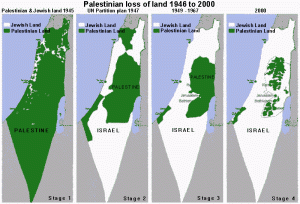
Unlike press reports which almost never provide context, I’ll begin with context. Figure 1 shows the percentage of British Mandate Palestine seized by Jewish forces through war, terrorism and ethnic cleansing, and the remaining territory (about 15 percent) that now comprises the Palestinian territories. In 1947, Arab Palestinians formed a two-thirds majority. Even so, the UN, over the objection of the Arab majority, pledged 56 percent of Mandate Palestine to a Jewish state. The Jews, most having arrived after WWI, comprised only one-third of the population (about 510,000 people) and owned only six percent of the land. In late 1947 and into 1948, through a systematic program of ethnic cleansing, and by barring the return of the 800,000 Arabs who fled or were forced from their homes, Zionist forces established Israel on 80 percent of the territory that comprised Mandate Palestine. In 1967, Israel seized Gaza and the West Bank – the only parts of Mandate Palestine they had failed to conquer in 1948 – and brought them under military occupation.

Figure 1. The encroachment of the Jewish state on Palestinian territory.

Hamas grew out of the first intifada (shaking off) of 1987. The intifada was an attempt to shake off the Israeli military presence in Gaza and the West Bank. It began in Gaza’s refugee camps, home to Palestinians and their descendants who had been driven out of what was now Israeli territory, or had fled, and were prevented from returning. Their return would undermine the demographic reality the Zionist forces had painstakingly created in 1947 and 1948 – a Jewish majority. The camps were bedeviled by mass unemployment and grinding poverty. The average family of five lived in cramped quarters with an outdoor toilet. (1)

Hamas grew to prominence in the camps for a number of reasons. First, it built up support by providing social services. Second, it profited from the material support it received from Israel. By building up Hamas, a religious-based, social services organization, Israel hoped to weaken the secular, politically-oriented PLO. Third, the PLO lost support when it pledged to end armed struggle and recognize Israel.

Hamas is criticized in the West for five reasons.

1. Because it is an Islamic organization. The West, however, had few qualms about Hamas’s religious character when the organization was being built up as a way to divert support from the secular PLO. In fact, it was Hamas’s religious character (thought to inspire passivity rather than militancy) that recommended it as an organization to be nurtured.

2. Because it will not recognize Israel. To do so would legitimate the UN’s immoral and illegitimate partition of Mandate Palestine and the ethnic cleansing which cleared the way for the formation of a Jewish state. Hamas, and many others, seek the end of a Jewish state on Palestinian territory. The US and other Western powers describe this as seeking the destruction of Israel, which it is, metaphorically, but for purposes of manipulating public opinion, the words “destruction of Israel” are carefully chosen to suggest the goal of physical obliteration. Palestinians who refuse to legitimate the crimes of 1948 by recognizing Israel do not seek Israel’s physical destruction per se, but seek to restore their legitimate claim to the land they were driven from, a goal which, if successful, would mean the end of a Jewish state (i.e., Israel’s destruction.)

3. Because Hamas engages in terrorism. Israel has a large arsenal of combat aircraft and tanks to oppress the Palestinians. “Terrorism” is the word the powerful use to discredit the resistance of the oppressed. Hamas would gladly swap its crude and largely ineffective rockets for Israel’s tanks and combat aircraft.

4. Because it “took over” Gaza. An Israeli security official told The New York Times that,

“What happened in Gaza a year ago was not really a coup. Hamas’s takeover was a kind of natural process. Hamas was so strong, so deeply rooted in Palestinian society through its activities in the economy, education, culture and health care, and Fatah was so weak, so corrupt, that the takeover was like wind blowing over a moth-infested structure.” [2]

5. Because it unilaterally abandoned the ceasefire. On the contrary, despite the ceasefire, Israel refused to lift the bloackade of Gaza (one of the conditions of the truce), killed 1,300 Palestinians in the nearly three years since Hamas came to power, and in November conducted three raids on Gaza, killing 12. [3]

Figure 2 shows the gross imbalance in deaths over the first eight days of Israeli terror bombing compared to Israeli deaths from Palestinian rocket attacks. This imbalance is emblematic of the yawning gap in casualties in all confrontations between the Israelis and Palestinians. Israel kills, maims and imprisons many; Palestinians barely make a scratch.

Figure 2. Comparison of number of deaths over the first eight days of Israeli air strikes.

Echoing his Secretary of State who attributed the recent outbreak in violence to Hamas, US President George W. Bush castigated the oppressed. In his January 2 radio address, he said,

This recent outburst of violence was instigated by Hamas — a Palestinian terrorist group supported by Iran and Syria…In response to these attacks on their people, the leaders of Israel have launched military operations on Hamas positions in Gaza.

The first eight days of Israeli air strikes – “with air strikes averaging one every 20 minutes” – has created “a humanitarian crisis and more,” according to Max Gaylard, the UN humanitarian coordinator for the Palestinians. [4]

Contrast the reaction to the humanitarian crisis in Gaza, where 450 lay dead, close to 2,000 are wounded, where electricity has been cut off by Israel, and where medical services are stretched to the limit, with the calls for military intervention in Zimbabwe in response to a cholera outbreak (a not uncommon event in Third World countries.)

The defrocked priest of peace, Desmond Tutu, who urged the West to intervene militarily in Zimbabwe to solve its humanitarian emergency, has not called for a military intervention in Israel to prevent the massacre of Gazans. He hasn’t even called for Washington to cut off its billions of dollars in annual military aid to Israel. Instead, he is calling for dialogue and confidence building measures, and for “Israel’s need for security (to) be understood by all sides.” [5]

1. Ilan Pappe, A History of Modern Palestine, Cambridge University Press, 2006.
2. New York Times, June 15, 2008.
3. Chris McGreal, “Why Israel went to war in Gaza,” The Observer (UK), January 4, 2009.
4. Rory McCarthy, “’Critical emergency’ after air strike every 20 minutes,” The Guardian, January 3, 2009.
5. Vaclav Havel, El Hassan bin Talal, Hans Kung, Desmond Tutu, Karel Schwarzenberg and Yohei Sasakawa, “Humanity’s stake in Gaza,” The Sunday Times (Sri Lanka), January 4, 2008.

Why Palestinians Hate Israel

If you were Palestinian, you would too.

By Stephen Gowans

Mandate Palestine, the territory that now comprises Israel, the West Bank and Gaza Strip, was still very much Arab when the British transferred its control of the territory to the UN in 1947. Two-thirds of the population was Arab and only six percent of the cultivable land was in Jewish hands.

The UN initially considered creating one democratic state in Palestine whose future would be determined by a majority vote of the population, the same proposal put forward by Iran’s president Mahmoud Ahmadinejad today.

But the UN abandoned the proposal in favor of partition, which the British favored and the Jewish population accepted. The views of the Arabs – the majority – were ignored.

The UN plan assigned over one-half of the territory to the Jewish one-third of the population and 42 percent to the Arab two-thirds – a highly unbalanced and unfair partition, but more than that, illegal and immoral for being forced on the majority over its vehement objections.

The Arabs, understandably, were aggrieved. But their reasons to be aggrieved were soon to grow more numerous.

War broke out between the two populations soon after the UN partition plan was announced in 1947. Six months later, 800,000 Palestinians had either been forcibly expelled from their homes by the Jewish militia, the Haganah, or had fled, later to be prevented from returning. The Jewish population now claimed 80 percent of the territory, an addition of a further 24 percent to the already unbalanced 56 percent pledged by the UN.

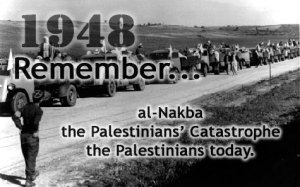
1948 – the root of Palestinian hatred of Israel.

It doesn’t take an ethicist or jurist to see that the creation of Israel was an illegal and immoral act, and that Arab Palestinian hatred of Israel, and a desire to see Israel’s dissolution, is not rooted in irrational hatred or anti-Semitism, but in dispossession.

In 1967, Israel gobbled up the remaining 20 percent of ex-Mandate Palestine it hadn’t conquered in 1948. The call for Israel to withdraw to its pre-1967 borders – a plea made by many liberals and progressives as a solution for “peace in the Middle East” – does nothing to address the original ethnic cleansing of 1948, and could hardly, therefore, constitute a just, equitable or even practical solution.

Partition, the solution put forward since 1947, has never worked, not even when the Arab majority was promised 42 percent of the territory. To declare as workable a partition plan that promises a Bantustan-like state on 15 percent of ex-Mandate Palestine and a permanent surrender of the Palestinian right to return is astonishingly naïve.

Apart from dispossession as a reason for hating Israel, Palestinians have other, more quotidian and visceral reasons. These are starkly illustrated in an October 21 2007 Observer article by Conal Urquhart, excerpted below. The article describes, in the words of Israeli soldiers, the brutal and inhuman treatment they mete out to Arab Palestinians in the occupied Gaza Strip and West Bank.

“Nufar Yishai-Karin, a clinical psychologist at the Hebrew University in Jerusalem, interviewed 21 Israeli soldiers and heard confessions of frequent brutal assaults against Palestinians, aggravated by poor training and discipline. In her recently published report, co-authored by Professor Yoel Elizur, Yishai-Karin details a series of violent incidents, including the beating of a four-year-old boy by an officer.

“The soldiers described dozens of incidents of extreme violence. One recalled an incident when a Palestinian was shot for no reason and left on the street. ‘We were in a weapons carrier when this guy, around 25, passed by in the street and, just like that, for no reason – he didn’t throw a stone, did nothing – bang, a bullet in the stomach, he shot him in the stomach and the guy is dying on the pavement and we keep going, apathetic. No one gave him a second look,’ he said.

Brutal mistreatment by Israeli soliders intensifies Palestinian hostility.

“The soldiers developed a mentality in which they would use physical violence to deter Palestinians from abusing them. One described beating women. ‘With women I have no problem. With women, one threw a clog at me and I kicked her here [pointing to the crotch], I broke everything there. She can’t have children. Next time she won’t throw clogs at me. When one of them [a woman] spat at me, I gave her the rifle butt in the face. She doesn’t have what to spit with any more.’

“Yishai-Karin found that the soldiers were exposed to violence against Palestinians from as early as their first weeks of basic training. On one occasion, the soldiers were escorting some arrested Palestinians. The arrested men were made to sit on the floor of the bus. They had been taken from their beds and were barely clothed, even though the temperature was below zero. The new recruits trampled on the Palestinians and then proceeded to beat them for the whole of the journey. They opened the bus windows and poured water on the arrested men.

“Yishai-Karin, in an interview with Haaretz, described how her research came out of her own experience as a soldier at an army base in Rafah in the Gaza Strip. She interviewed 18 ordinary soldiers and three officers whom she had served with in Gaza. The soldiers described how the violence was encouraged by some commanders. One soldier recalled: ‘After two months in Rafah, a [new] commanding officer arrived… So we do a first patrol with him. It’s 6am, Rafah is under curfew, there isn’t so much as a dog in the streets. Only a little boy of four playing in the sand. He is building a castle in his yard. He [the officer] suddenly starts running and we all run with him. He was from the combat engineers.

“’He grabbed the boy. I am a degenerate if I am not telling you the truth. He broke his hand here at the wrist, broke his leg here. And started to stomp on his stomach, three times, and left.”

Liberal Israelis fervently deplore the treatment of Palestinians by the Israel military and find revelations such as these to be deeply distressing. Most, however, are Zionist, and no matter how much they disapprove of the brutality of the occupation are not prepared to consider, or provide redress, to the events of 1948 – the root of Palestinian hatred of Israel. Forcing the Israeli military to live up to its rhetoric about being the most ethical military in the world, will not put an end to Palestinian hatred.