The War in Ukraine Didn’t Split the Left—It Exposed Pre-Existing Divisions

September 13, 2023

By Stephen Gowans

In his latest Berlin Bulletin the Leftist writer Victor Grossman describes “further splits in weak, divided peace and leftist movements around the world” as the byproduct of the war in Ukraine. If the war has, indeed, fragmented the Left (rather than simply exposed pre-existing divisions), Grossman lets us know on which side of the divide he can be found. Putin’s decision to invade Ukraine, the US expatriate insists, is “primarily motivated by the wish to defend Russia against encirclement, suffocation followed by subservience or dismemberment.” Brendan Simms made the case, explored in a post I wrote yesterday, that Hitler’s decision to invade Ukraine in 1941 was motivated by his wish to defend Germany against encirclement, and suffocation followed by subservience or dismemberment by the far stronger Anglo-American alliance. In other words, the proximal cause of Putin’s invasion of Ukraine is precisely the same as the proximal cause of Hitler’s invasion of the same territory. Yet no Leftist, much less a communist, would have adduced this motivation as an apology for an act of aggression. Grossman, however, does.

Notwithstanding Grossman, the war in Ukraine has produced no split in the Left. It has simply exposed a rift that has existed at least as far back as the Second international, and indeed, was the reason for the organization’s dissolution. The split can be described as one of reform vs. revolution, or a disagreement about what the Left should do in times of war: Support one side against the other, or work to bring about the demise of the very system that gives rise to war?

The split can also be described as a disagreement over what causes war and therefore over how war can be brought to an end.  One side says that wars are caused by belligerent states that have an inherent drive to war. To prevent these states from acting on their belligerent compulsion, popular opposition must be mobilized to act as a restraining hand.

Grossman is clearly on this side. Responsibility for the war in Ukraine falls squarely on the shoulders of the US state. He writes,

[M]ost of the violence in the world was a product of the intrigues, the aggression, the weapons managed and controlled by those powerful clusters who maintain such a tight control of congressmen and senators, half of them millionaires, of Supreme Court majorities, almost always of the White House, also of the Pentagon, CIA, NED, FBI and dozens of other institutions.  It is they, a tiny number, less than 0.1%, whose wealth outweighs that of half the world’s population, but who can never be sated. They want to rule the whole world.

In Grossman’s view, it is not capitalism, or the nature of international system, that caused the war in Ukraine, but the US ruling class, which, uniquely, in his view, wants to rule the world. Apparently, neither the Russian or Chinese ruling classes are gripped by the same ambition.

This calls to mind an observation the classicist scholar Mary Beard made about the Romans: They were no more belligerent than their neighbors and no more voracious for the spoils of war. They operated, as did the states with whom they went to war, within a system of international relations in which disputes, usually traceable to the clashing economic ambitions of their ruling classes, were usually resolved by violence. Their belligerence and lust for booty was no different from that of rival states. The Romans, however, were just more successful.

The reality that the US ruling class has had more success than its Russian counterpart in projecting economic, political, military, and ideological power abroad does not explain why there is a war. Grossman might as well say that Muhammad Ali caused the violence of boxing because he was the most successful pugilist.

The opposing position, the classical Marxist view, locates the cause of war in the system of international relations within a capitalist world economy. The Bolsheviks Bukharin and Preobrazhensky developed a succinct summary of this position:  Each “producer wants to entice away the others’ customers, to corner the market. This struggle assumes various forms: it begins with the competition between two factory owners; it ends in the world wherein capitalist States wrestle with one another for the world market.”

Yes, indeed, the US capitalist class wants to rule the whole world. But so too does the Russian and the Chinese.

At the core of the classical Marxist theory of war are two propositions:

  • Capitalism incessantly drives states to seek expanded profit-making opportunities beyond their borders.
  • In a world divided among states, where each competes against the other, war is inevitable.

This view was expressed in the resolution of the 1907 Stuttgart Congress of the Second International, which Lenin and Luxemburg took a hand in writing. “Wars between capitalist states are as a rule the consequence of their competition in the world market, for every state is eager to preserve its markets but also to conquer new ones.”

The theory follows naturally from Marx and Engel’s observation in the Communist Manifesto about the expansionary nature of capitalism. “It must nestle everywhere, settle everywhere, establish connections everywhere.”  Significantly, all of capitalism’s nestling, settling, and connecting, has been orchestrated by states, each vying with the other.

The classical view was hardly new or unique to Lenin and Luxemburg. It was expressed at the Second International’s London Congress as early as 1896. “Under capitalism the chief causes of war are not religious or national differences but economic antagonisms.” In 1910, the Copenhagen Conference reiterated this view: “Modern wars are the result of capitalism, and particularly of rivalries of the capitalist classes of the different countries over the world market.”

The solutions to the problem of war differ between Grossman’s analysis of the cause of war and that of Lenin et al. If the causes of war are, as Lenin argued, the division of humanity into classes and nations, then the solution to war is to overcome the divisions which set humanity against itself, beginning with the socialist revolution. That’s why Lenin and his colleagues always maintained that the problem of war should be met, not by choosing sides in disputes between bourgeois states, but by overthrowing them all.

If, on the other hand, you believe that war is caused by bad actors following their bad urges, then the solution to war lies in pressuring bad actors to behave more congenially and erecting guardrails to prevent disputes from getting out of hand.

Here’s Grossman:

The world needs to drop a curtain on this confrontation, increasingly threatening in Ukraine, increasingly dangerous in East Asia. Regardless of differences it must be halted. … Such a cease fire and successful negotiations must be the world’s immediate and urgent goal. Ultimately it must face a deeper imperative; not only reining in the super-rich, super-powerful intriguers – but, as they are an outdated but constant source of danger and dismay, their total banning from the world stage.

There’s little substance here. Grossman’s endorsement of a cease fire and successful negotiations is nothing more than an expression of pious benevolence. Who doesn’t want a cease fire and successful negotiations? Everyone wants a resolution to the war—but on their own terms, which is the problem. Cease fires and negotiations, are, then, never ends in themselves, but means to ends, and wishing they weren’t, won’t make them so.

Grossman’s hope that the “super-rich and super-powerful intriguers,” i.e., the US ruling class, will be restrained, and then banned, is utopian nonsense. How will it be restrained, and then banned? By moral suasion? If it can be restrained, haven’t we the power to ban it? And why only the US ruling class? Brecht’s observation that the bitch that gave birth to fascism is still in heat, can be extended: the bitch that gave birth to war is still in heat, which is why wars, like the one in Ukraine, continue to happen. Grossman seems to think that the bitch only gives birth to American pups.

The split in the Left over the war in Ukraine is reflected in the world’s Communist parties.  The European Communist Initiative, a grouping of European Communist and Workers parties, recently dissolved over differences related to the war in Ukraine, but the differences go much deeper than the war itself. The Greek Communist Party (KKE), which vigorously champions the classical Marxist position, objected to the positions taken by some member parties. In the party’s view:

Positions were expressed that limited imperialism to the USA and its foreign policy and disputed that each capitalist state participates in the imperialist system according to its economic, political and military power, in the context of uneven development.

A number of Parties sided with capitalist Russia in the imperialist war. They justified and supported the Russian leadership and the invasion of the Ukrainian territory by claiming that this war is anti-fascist, opposing the position that the war is imperialist, expresses acute capitalist rivalries and is waged for the control of markets and wealth-producing resources, for energy and transport routes, leading the peoples to the slaughterhouse of war.

Furthermore, some parties presented China as a socialist state, while capitalist relations of production have long prevailed in China and the exploitation of the working class and of man by man, which is the very definition of capitalism, is intensifying. Chinese monopolies are leading in the international market, exporting capital and commodities, while China and the USA are competing for supremacy in the capitalist system.

The split recapitulates a division within the Second International circa 1914—one  which led to the creation of the Third International and the Communist parties to which the current internal communist movement is its nominal heir. 

Last year, Eliseos Vagenas, a member of the KKE’s central committee, argued that the Russian invasion of Ukraine didn’t foster a split in the international communist movement; the split had existed long before the Russian invasion.

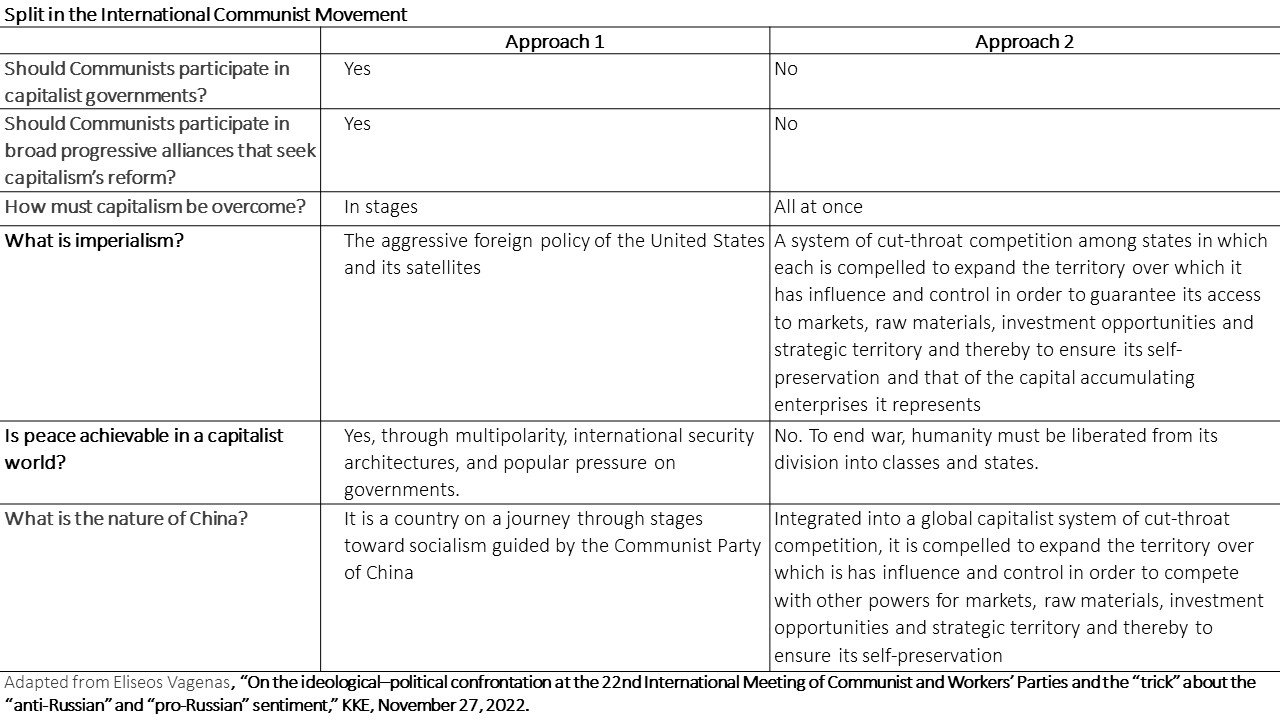
According to the Greek communist, communist parties had been split for some time on a least five questions, summarized below. When Russia invaded Ukraine, the parties moved to support or oppose Moscow, based on their pre-existing orientations, defined by either approach 1 or approach 2.

Two questions are critical to the positions the various ICM parties have taken on the war in Ukraine:

  • What causes war?
  • Is peace achievable in a capitalist world?

Communist parties that have either leaned toward outright support of Russia or greater condemnation of the United States and NATO, tend to view war in a manner that departs significantly from the classical Marxist view and have developed an understanding of how to end war that revises Marx and borrows from liberalism. These parties see war as developing from the aggressive foreign policy of one capitalist state, the United States (and its satellites), and regard Russia as a victim of a US drive to war. For them, the term ‘US imperialism’ is redundant, because imperialism is a monopoly of the United States.

What’s more, these parties tend to equate imperialism with war, and reject the notion that it has other dimensions, including peaceful capitalist competition, diplomacy, and even international security architectures. (Ask the North Koreans whether the UN Security Council is an expression of imperialism.) For these parties, imperialism is US war-making and little else. 

In contrast, parties that view the war in Ukraine as an inter-imperialist conflict cleave to the classical Marxist view of imperialism. For them, imperialism is a system of cut-throat competition among states in which each is compelled to expand the territory over which it has influence and control in order to guarantee its access to markets, raw materials, investment opportunities and strategic territory and thereby to ensure its self-preservation and that of the capital accumulating enterprises it represents. The competition is expressed in multiple ways, including war, but not limited to it. It may be, and has more often than not been, expressed in trade and investment agreements. See, for example, Robinson’s and Gallagher’s The Imperialism of Free Trade.

Kenneth Waltz’s review of the split in the socialist movement precipitated by WWI, which he presents in his classic Man, The State, and War, calls to mind the current split in the international communist movement as identified by Vagenas.

Parties which support Russia in its war on Ukraine tend to embrace, as Waltz puts it, “the techniques of the bourgeois peace movement—arbitration, disarmament, open diplomacy” as well as the belief that popular opinion “can exert enough pressure upon national governments to ensure peace.” This, Waltz argues, is a revision of Marx’s view, which “points to capitalism as the devil.” The “socialism that would replace capitalism was for Marx the end of capitalism and the end of states,” and it was the end of states, for Marx, that meant the end of war. An anti-war movement founded on the notion that popular pressure and international security architectures can ensure peace, is a tradition that Waltz identifies as originating in the Second international as a revision of Marx.

Waltz elaborates: Members of the Second International “were united in that they agreed that war is bad, yet they differed on how socialists were to behave in a war situation. … Jean Jaures and Keir Hardie eloquently urged a positive program of immediate application. Socialists, they said, can force capitalist states to live at peace.”  

In contrast, some “French and most German socialists argued that capitalist states are by their very nature wedded to the war system; the hope for the peace of the world is then to work for their early demise.” It is not, to bring the argument up to date, to support the weaker capitalist states in order to balance the strongest in a multipolar system. Indeed, this view is anti-Marxist in the extreme. For Marx, war ends when states end, not when weaker states balance the strongest and the world becomes multipolar.

The precursors of the Third International, Communists avant la lettre, argued that wars “are part and parcel of the nature of capitalism; they will cease only when the capitalist system declines, or when the sacrifices in men and money has become so great as a result of the increased magnitude of armaments that the people will rise in revolt against them and sweep capitalism out of existence.”

Compare this view with that of Vagenas, advocating for approach 2 as presented in the table above: The “capitalist world cannot be ‘democratized’.” It “cannot escape from wars no matter how many ‘poles’ it has.” War can only be escaped through “the struggle for the overthrow of capitalism, for the new, socialist society.”

Approach 1, then, looks very much like that embodied in the deeds of the Second International, while approach 2 resonates with that of the Third International (and the words of the Second). It is regrettable that some Communist parties have suffered an ideological drift toward positions that the founders of the international communist movement, Lenin and his colleagues, repudiated. Indeed, it can be said that there is no coherent international communist movement, except the one that comprises parties that have kept faith with Lenin’s view and have rallied around the KKE. As to the others, they have willingly become (to borrow Lenin’s phrase) playthings in the hands of belligerent powers and apologists for capitalism.

Is the Communist Split on the War in Ukraine an Echo of An Earlier Division?

December 2, 2022

By Stephen Gowans

Eliseos Vagenas, a member of the central committee of the Greek Communist party (KKE), has written an interesting article in the party’s newspaper, Rizospastis, refuting the claim that the Russian invasion of Ukraine fostered a split in the international communist movement (ICM). Vagenas contends that the split existed well before the Russian invasion.

One can also argue that the split recapitulates a division within the Second International circa 1914—one which led to the creation of the Third International and the Communist parties to which the current ICM is its nominal heir.  

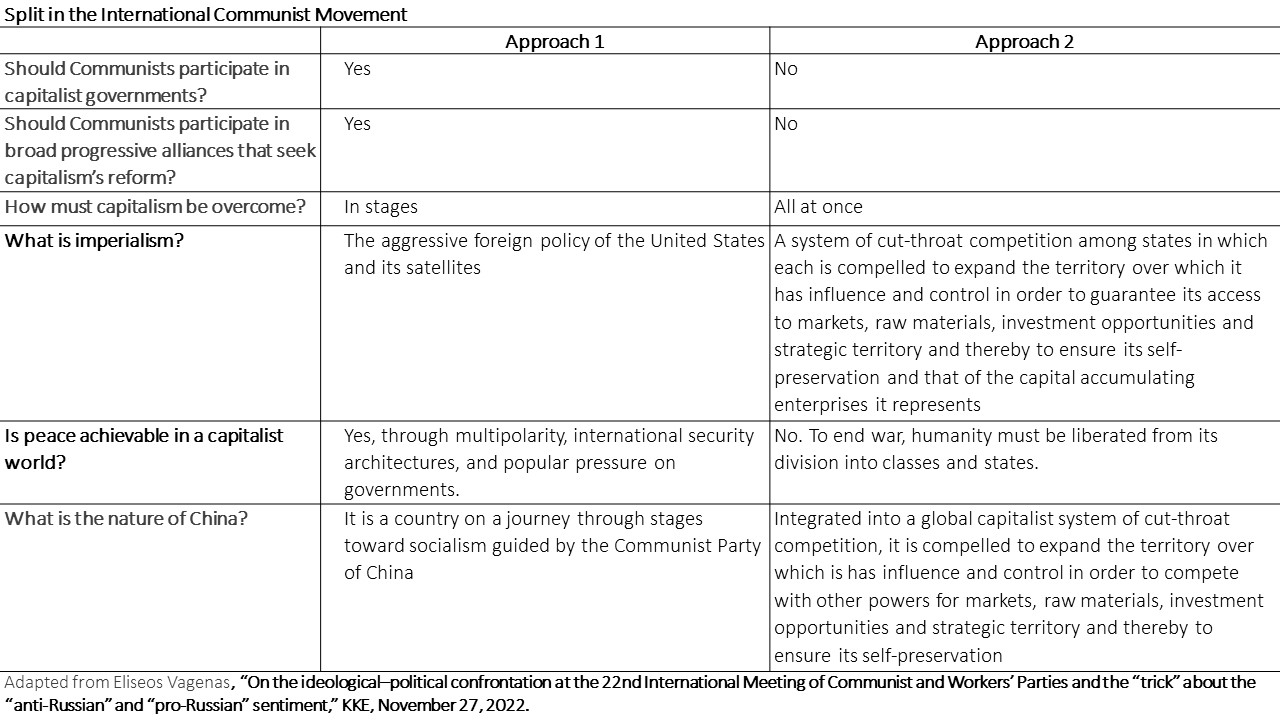
According to the Greek communist, the ICM has been split for some time on a least six questions, summarized below. When Russia invaded Ukraine, the parties moved to support or oppose Moscow, based on their pre-existing orientations, defined by either approach 1 or approach 2.

Two questions are critical to the positions the various ICM parties have taken on the war in Ukraine:

  • What does imperialism mean?
  • Is peace achievable in a capitalist world?

Communist parties that have either leaned toward outright support of Russia or greater condemnation of the United States and NATO, tend to view imperialism in a manner that departs significantly from the classical Marxist view and have developed an understanding of how to end war that revises Marx and borrows from liberalism. These parties see imperialism as the aggressive foreign policy of one capitalist state, the United States (and its satellites), and regard Russia as a victim of US imperialism. For them, the term ‘US imperialism’ is redundant, because imperialism is a monopoly of the United States.

What’s more, these parties tend to equate imperialism with war, and reject the notion that it has other dimensions, including peaceful capitalist competition, diplomacy, and even international security architectures. (Ask the North Koreans whether the UN Security Council is an expression of imperialism.) For these parties, imperialism is US war-making and little else.  

In contrast, parties that view the war in Ukraine as an inter-imperialist conflict adopt the classical Marxist view of imperialism. For them, imperialism is a system of cut-throat competition among states in which each state is compelled to expand the territory over which it has influence and control in order to guarantee its access to markets, raw materials, investment opportunities and strategic territory and thereby to ensure its self-preservation and that of the capital accumulating enterprises it represents. The competition is expressed in multiple ways, including war, but not limited to it. It may be, and has more often than not been, expressed in trade and investment agreements. (See, for example, Robinson’s and Gallagher’s The Imperialism of Free Trade.)

Kenneth Waltz’s review of the split in the socialist movement precipitated by WWI, which he presents in his classic Man, The State, and War, calls to mind the current split in the ICM as identified by Vagenas.

Parties which support Russia in its war on Ukraine tend to embrace, as Waltz describes them, “the techniques of the bourgeois peace movement—arbitration, disarmament, open diplomacy” as well as the belief that popular opinion “can exert enough pressure upon national governments to ensure peace.” This, Waltz argues, is a revision of Marx’s view, which “points to capitalism as the devil.” The “socialism that would replace capitalism was for Marx the end of capitalism and the end of states,” and it was the end of states, for Marx, that meant the end of war. An anti-war movement founded on the notion that popular pressure and international security architectures can ensure peace, is a tradition that Waltz identifies as originating in the Second International as a revision of Marx. It is also a tradition that Waltz pointedly notes failed to keep the peace in 1914.

Waltz elaborates. Members of the Second International “were united in that they agreed that war is bad, yet they differed on how socialists were to behave in a war situation. … Jean Jaures and Keir Hardie eloquently urged a positive program of immediate application. Socialists, they said, can force capitalist states to live at peace.”  As history shows, they couldn’t. Indeed, most socialists facilitated the war by supporting one of the belligerents.

In contrast, some “French and most German socialists argued that capitalist states are by their very nature wedded to the war system; the hope for the peace of the world is then to work for their early demise.” It is not, to bring the argument up to date, to support the weaker capitalist states in order to balance the strongest in a multipolar system. Indeed, this view is anti-Marxist in the extreme. For Marx, war ends when states end, not when weaker states balance the strongest and the world becomes multipolar.

The precursors of the Third International, Communists avant la lettre, argued that wars “are part and parcel of the nature of capitalism; they will cease only when the capitalist system declines, or when the sacrifices in men and money have become so great as a result of the increased magnitude of armaments that the people will rise in revolt against them and sweep capitalism out of existence.”

This resonates with the view of Vagenas, advocating for approach 2 as presented in the table above: The “capitalist world cannot be ‘democratized’.” It “cannot escape from wars no matter how many ‘poles’ it has.” War can only be escaped through “the struggle for the overthrow of capitalism, for the new, socialist society.”

Approach 1, then, evokes the Second International, while approach 2 appears to be consistent with the positions of the Third International.

On the basis of the foregoing, it would seem fitting to label approach 1 as “Liberal Bourgeois,” consistent with its tolerance of Communist participation in capitalist governments and broad progressive movements for capitalism’s reform; its penchant for a stepwise journey toward socialism; the absence of capitalism from its analysis of imperialism; its embrace of a peace movement whose techniques originate in a liberal theory of war; and its acceptance–indeed, its celebration–of China’s robust capitalism. Liberal Bourgeois Communists are nothing if not enthusiastic in their panegyrics to Chinese capitalism as “the world’s greatest anti-poverty machine” and never sparing in their praise of Chinese capitalism for “lifting hundreds of millions out of poverty.” In their devotion to capitalism as a cure for poverty they have outmatched even the staunchest Republican.

Approach 2 can be labelled “Communist,” reflecting its resonance with classical Marxist positions.

It is regrettable that some Communist parties have suffered an ideological drift toward positions that the founders of the ICM, Lenin and his colleagues, repudiated.

It is equally regrettable that as self-proclaimed heirs of Marx, these same parties espouse a view of how to ensure a peaceful world that originates, as Waltz argues, not in Marx, but in a liberal bourgeois theory of war.

The Last True Communist

By Stephen Gowans

July 9, 2022

Below is a quick summary of a July 8 speech on the war in Ukraine by Dimitris Koutsoumbas, General Secretary of the Greek Communist Party (KKE), delivered to a conclave of communist parties from Greece, Mexico, Spain, and Turkey.

Earlier this year, Koutsoumbas’s party initiated a statement on the war in Ukraine, characterizing the war as the outcome of a struggle between capitalist classes. The statement was supported by a significant number of Communist Parties and Communist Youth Organizations, but rejected by others.

Koutsoumbas’s address elaborated on the KKE view, which has been summarized by one of its deputies in the European Parliament as follows: “The imperialist conflict in Ukraine is between two camps of robbers: The US-NATO-EU and the bourgeoisie of Ukraine against capitalist Russia, for the control of pipelines and markets.”

Here are some of the points Koutsoumbas made:

The war in Ukraine is a conflict between bourgeois states.

Bourgeois states engage in rivalries over raw materials, mineral wealth, commodity transport routes, geopolitical pillars, and market shares. These rivalries lead to war.

The causes of the imperialist war in Ukraine lie in the confrontation between bourgeois classes.

The USA, NATO, and EU are pursuing war in Ukraine to further their interests in Eurasia before embarking on a major conflict with China over which capitalist power will be supreme in the world economy.

People in all the belligerent countries and alliances—Russians, Ukrainians, Europeans, North Americans— are already paying the price for the war, either with their blood or in an unbearable economic burden.

The price they pay has been imposed on them by the bourgeoisie of all the belligerent powers.

Communists are engaged in a debate over the meaning of imperialism. One view limits imperialism to its reactionary–aggressive foreign policy, resulting in its identification with the USA and the most powerful EU member states. This view is too narrow.

[My note: The classical Marxist view of imperialism has always held that imperialism is an ineluctable outgrowth of capitalism and that it is expressed in rivalry among capitalist powers for access to raw materials, and to dominate markets, spheres of investments, and strategic territory. In the classical view, this rivalry eventually escalates to war.]

Capitalist relations of production now prevail entirely in China.  Moreover, Russia, among the most powerful capitalist military powers in the world, and supported by powerful monopolies, is unquestionably capitalist. Imperialism is inseparable from capitalism. As capitalist powers, neither China or Russia, therefore, are outside the imperialist system. 

Multipolaristas fantasize about a ‘peaceful cooperation’ in the framework of international capitalist competition through a utopian ‘non-aggressive’ rivalry, or a rivalry whose aggression will be held in check through various ‘security architectures’

[My note: Hilferding expresses the classical Marxist view on security architectures. “What an illusion,” it is, he wrote, “to preach international law in a world … of capitalist struggle where [the] superiority of weapons is the final arbiter.”]

Some communists have been deceived by the pretexts used by one or another ruling bourgeois class—North American, Russian, European, or Ukrainian—and have allowed themselves to become instruments of the pursuits of one or another bourgeois class.

We should not align with one or the other capitalist camp in the war, but instead work (1) to disengage our countries from the war and (2) most importantly, to overthrow the cause of the war: capitalism.

Do Communist-Led States Protect Public Health Better Than Capitalism?

Subscribe to continue reading

Subscribe to get access to the rest of this post and other subscriber-only content.

The Catastrophes of the Pandemic are the Catastrophes of Capitalism

Subscribe to continue reading

Subscribe to get access to the rest of this post and other subscriber-only content.

‘We want what we had’

July 20th, 2015

The Taylor Report

Stephen Gowans reviews Kristen Ghodsee’s book, “The Left Side of History: World War II and the Unfulfilled Promise of Communism in Eastern Europe.” Ghodsee interviewed Eastern Europeans about socialism and their situation two decades after dissolution of the Soviet Union, including activists at an Occupy-styled protest in Bulgaria.

From these activists, we learn that many people want free education (like they had in the Soviet Union), and free child care (like they had in the Soviet Union), but they reject the term ‘communism’ and the Soviet Legacy. “We don’t want communism” it has been said, “we just want to have a normal life.”

But lack of all these nice things is ‘normal life’ under capitalism. There is little understanding of the difficulties in providing social wealth in former-fascist, war-torn countries like Bulgaria.

This attempt to grapple with the disappearing welfare state and Soviet legacy comes at a time of heightened official anti-communism. The new capitalist states in East Europe are trying to portray an equivalence between fascism and communism, so as to generate fear of socialism. The effect is that people yearn for the policies of socialism, but not the name.

Ghodsee herself succumbs to the fear of ghosts, drawing from the new capitalist historiography in which Soviets are simply portrayed as demons. She contrasts the ‘good communists’ in Bulgaria to the demon Stalin.

She has to, because if she accepts the achievements of Bulgarian communists, she will be tarred as a Stalinist. Instead, she calls for a merging of the Soviet welfare state with Western political institutions. Yet it is these Western institutions that block socialism in their own countries, and in Eastern Europe. Ghodsee and others need to take a lesson from E.H. Carr, who refused to submit to the moral blackmail of being labelled a ‘Stalinist’ for reviewing the progress of the Soviet Union.

Audio Files:

Interview with Stephen Gowans

MP3 Page:

http://www.radio4all.net/index.php/program/81858

Link:
Submitting to Moral Blackmail? Kristen Ghodsee’s “The Left Side of History

Submitting to Moral Blackmail? Kristen Ghodsee’s “The Left Side of History”

July 19, 2015

By Stephen Gowans

Kristen Ghodsee’s “The Left Side of History: World War II and the Unfulfilled Promise of Communism in Eastern Europe,” is a variegated reflection on socialism as practiced in Eastern Europe, and especially Bulgaria, in the four and half decades following WWII. It is, at one and the same time, a meditation on the purpose of official anti-communism; a near hagiography of the British communist Frank Thompson, the elder brother of the famed historian E.P. Thompson, who died fighting with Bulgarian partisans in WWII; a history of the Lagadinovas, three brothers and a sister (the latter of whom would become famous throughout the socialist bloc as the “Amazon”), who joined the ranks of communist partisans struggling against Bulgaria’s Nazi-allied government; a Philippic against the contemporary political left for being comfortable only with opposition, and lacking any clear sense of what it’s for; and paradoxically, given the foregoing, an execration of communism, filled with the crude anti-communist diatribes one would expect from The Black Book of Communism, and not from one who sets out to explore the heroism of communist partisans and a British communist who fought with them.

Ghodsee is an ethnographer whose prior works include “three books on how non-elite Bulgarian men and women experienced the economic transition from communism.” (Ghodsee, 2012)

Function of official anti-communism

Left Side of HistoryIn writing The Left Side of History, Ghodsee set out to show there was much good about communism in Bulgaria. She felt that the achievements of communist Bulgaria were hidden beneath an avalanche of official anti-communist demonization. In this, she has responded to a danger foretold by the great historian of the Russian Revolution, E.H. Carr. Referring specifically to the Bolshevik revolution, Carr warned in 1978 that there was little danger that a veil would be drawn “over the enormous blots on the record of the Revolution, over its costs in human suffering, over the crimes committed in its name.”

Indeed, every effort has been made by those who would discredit the Bolsheviks and all they stood for to bring these to the fore. The greater danger, warned Carr, was that

“we shall be tempted to forget altogether, and to pass over in silence, (the Revolution’s) immense achievements…I am thinking of the transformation since 1917 in the lives of ordinary people: the transformation of Russia from a country more than eighty per cent of whose population consisted of illiterate or semi-literate peasants into a country with a population more than sixty per cent urban, which is totally literate and is rapidly acquiring the elements of urban culture…and these things have been brought about by rejecting the main criteria of capitalist production—profits and the laws of the market—and substituting a comprehensive economic plan aimed at promoting the common welfare.” (Carr, 1978)

For her part, Ghodsee celebrates the achievements of Bulgarian communism. It “provided support for working mothers and promoted programs to ensure the de jure and de facto equality of men and women. Communism promoted literacy and education and health care and guaranteed full employment for anyone able to work. Communism gave people jobs, homes, and daily routines that were predictable and stable…” (Ghodsee, 2015: 192)

Nowadays, communism is presented, not as a type of society that stressed the common welfare and the end of exploitation of man by man, but as an abomination equal to Nazism. In 2009, the European Union created a new holiday, the European Day of Remembrance for Victims of Stalinism and Nazism. Ghodsee condemns this as an attempt to discredit communism at a time the global financial crisis is inspiring austerity-weary populations to seek political alternatives. She cites also as further evidence of the efforts to blot out the rich contribution communists have made to the progress of humanity, a June 2013 decision by a Madrid court ordering the dismantling of a monument that commemorated the sacrifices of the mainly communist International Brigades, volunteers burning with passion for a new, more humane and democratic world, who fought against Franco’s fascists.

In my country, Canada, plans are afoot to erect a monument to the “victims” of communism, leaving ordinary Canadians puzzled as to why. Canada has never been Communist.

But there is a chance that Canadians, and others in the world, bedevilled by unemployment, economic insecurity, diminished economic opportunity and growing material deprivation, will increasingly look to the model provided by the really-existing socialism of the Soviet bloc as an alternative. “Communism may be making a bit of a comeback in Europe,” Ghodsee writes, “but it is also the case that some political elites are working harder than ever to stop it by blackwashing its history.” (Ghodsee, 2015: viii-xix) She adds, “At the exact moment when ordinary people are searching for political alternatives, many official historical institutes are supported (often with funds from the West) to discredit communism.”

Victims of communism, promoters of fascism

Ghodsee effectively punctures the growing movement to commemorate the ‘victims’ of communism by showing that the ‘victims’ were hardly innocents, but in many cases, were xenophobes, Judeophobes, and fascists responsible for the deaths, oppression and exploitation of numberless people.

Every year some Bulgarians lay wreaths at a wall inscribed with the names of many who died at the hands of communists. “The victims memorialized on the wall include many political opponents of communism executed after September 1944, when Bulgaria’s communists seized power in this tiny Balkan country,” reported the Associated Press. (Ghodsee, 2015: 192) Ghodsee points out that ‘Nowhere was it mentioned, even in passing, that Bulgaria’s ‘political and military elite’ were allied with Nazi Germany.” (Ghodsee, 2015: 192)

The ‘victims’ of communism memorialized in Bulgaria include:

o Bogdan Filov, a passionate and committed ally of Hitler, who as Bulgarian prime minister from 1940 to 1943, deported 11,000 Jews to their deaths at Treblinka;

o Petar Gabrovski, minister of the interior under Filov, and briefly prime minister; a vicious Judeophobe who started his political career as a Nazi;

o Nikola Zhekov, head of the Bulgarian far-right legionnaires and a personal friend of Hitler;

o General Hristo Lukov, the Bulgarian minister of war, who has become an inspiration for today’s neo-Nazis. (Ghodsee, 2015:194-196)

What are we fighting for?

Ghodsee writes of an encounter with students at an Occupy-like encampment.

“I spoke to some students sitting on the ground in front of one of the tents. There was a sign in Bulgarian. It read ‘This is not a protest. This is a process. Revolution for a New Bulgaria.’

“I asked the students why they were protesting. One young woman said, ‘I love my country, but I have no future here. While the Mafia governments stay in power, Bulgaria will never develop, I don’t want to leave. I want to stay and fight and make my country a better place.’

“’Do you have any concrete proposals?” I said. The protestors I had spoken to thus far all had very different ideas about what needed to be done.

“’Free university education,’ she said. The other students nodded. ‘And practical training placements for three years after you graduate.’

“’You mean like it was before?’ I said. Before 1989, the state paid for all university education, and all students completed three years of national service upon graduation. The state guaranteed a job in the student’s area of speciality…

“’Yes,’ the woman said…

“A second woman in the group waited until there was a lull in the conversation before she spoke. ‘There should be more kindergartens,’ she said. ‘Every mother should have a safe place for her child when she works.’

“’You mean like they had under communism?’ I said.

“At the word ‘communism,’ the students tensed.

“’We don’t want communism back,” the first young woman said. ‘We just want a normal country.” (Ghodsee, 2015:166-168)

In a similar vein, Ghodsee recounts a conversation between two elderly Bulgarian women, Elena Lagadinova, who joined the Bulgarian partisans at age 14 and later became a member of the Bulgarian Communist Party Central Committee, and Maria Zneopolska, author of a book on Frank Thompson.

“’Look at these protestors,’ Elena said, ‘They are against the monopolies and the corruption and the foreign capitalists. These are the same things (the communist partisans) were against.’

‘It’s the same fight,” Maria agreed. She looked to Elena and then back at me. ‘But it’s not enough to protest against. Nothing ever changes until the people have something to fight for.’” (Ghodsee, 2015: 175)

Ghodsee’s anticommunism

While Ghodsee laments that “strident anticommunist rhetoric demonizes anyone who once called himself or herself a ‘communist’ or who believed in the communist ideal” (Ghodsee, 2015: xvi) and regrets the hegemony of an anti-communist ideology that makes it “easier to assert that the moon landing was staged than it would be to argue that there was anything good about the communist past,” (Ghodsee, 2015: 133) she, herself, reinforces the anti-communism she deplores.

This, she does, subtly, in earlier publications, through the use of language that implicitly accepts communism as a danger implanted from without. For example, in Lost in Transition: Ethnographies of Everyday Life after Communism, Ghodsee writes that “the revolution in Cuba (just 90 miles from Florida) brought the communist threat closer than it had ever been to the United States” (emphasis added; Ghodsee, 2011: xi) rather than writing “the Cuban revolution brought communism (sans threat) closer than it had ever been to the United States”, or that it “brought the communist threat closer than it had ever been to the capitalist elite of the United States.” She wrote too of how “Many countries in Latin America and Africa were constantly fighting communist insurgencies” (Ghodsee, 2011: xi) as if the insurgencies were separate from the countries that battled them. Here she equates country with the state. It would have been more apt for Ghodsee to have written that many states in Latin America and Africa, backed by Western economic and political elites, fought to suppress rebellions from their populations against their oppression and exploitation. Of the other September 11, September 11, 1973, Ghodsee writes “Chile would elect a socialist leader, leaving the United States no choice but to support a coup d’état” (Ghodsee, 2011: xi), leaving one to muse over why she felt the United States government had no choice. Indeed, formally, it did have a choice, though it might be argued that the imperatives of the US economic system created a compulsion for Washington to intervene.

In The Left Side of History Ghodsee abandons subtle anti-communist language for crude, and shockingly puerile, anti-communist rhetoric. After touting the achievements of Bulgaria’s communism, she brands communist Bulgaria “a brutal dystopia ruled by paranoid dictators.” (Ghodsee, 2015: 129) Rather than examining the history of Stalin’s Soviet Union from the perspective of the multiple and almost insuperable challenges the country’s leadership faced, she offers a sophomoric psychological reductionism, transforming Stalin into a kind of cartoon character Dr. Evil, who she depicts as a “megalomaniac” who “hijacked the communist cause” (Ghodsee, 2015: 129) to pursue his “dreams of world domination.” (Ghodsee, 2015; 128) It appears that it is not only the European Union that has drawn an equal sign between Hitler and Stalin.

Against the Stalinist Beelzebub Ghodsee juxtaposes the pure and angelic heroes of her book, Frank Thompson and the Lagadinovas, the ‘good’ communists betrayed by their iniquitous leaders. “I needed to remind myself,” she writes, “that not all who fought or found themselves on the left side of history were radical Marxist zealots bent on world domination.” (Ghodsee, 2015: 199) Ghodsee wants us to believe that everything good about communism in Bulgaria is traceable to Thompson, the Lagadinovas, and the good communists, and all the bad is due to “Stalinists.”

This, however, is completely indefensible. The Bulgarian partisans and Frank Thompson had very little to do with the gains communism implanted in Bulgaria. The Bulgarian partisans were, by Ghodsee’s own admission, largely ineffective. They spent most of their time eking out a bare existence, frequently betrayed by peasants who didn’t support them. Unlike in neighboring Greece and Yugoslavia, where foreign occupations galvanized people to support the communist-led guerrilla resistance, Bulgaria was allied with Nazi Germany and endured no foreign occupation. The lives of most Bulgarians during the war were quiet, and they did not support the communist guerrillas. It was the Red Army, under Stalin’s leadership, that ultimately toppled Hitler’s allies in Sofia, and brought communism to Bulgaria. Stalin, far more than the Lagadinovas, and especially the hapless (though admirable) Frank Thompson, is responsible for the immense social gains Bulgaria enjoyed during the communist period.

Ghodsee’s politics

Ghodsee’s political ideal, revealed in her various other writings, is “a more socially oriented state akin to the Scandinavian welfare state—states that combine democracy with social security.” (Ghodsee, 2004) She doesn’t say what she means by ‘democracy,” though it appears that she means a multiparty state, or at least, not the socialist states of central and eastern Europe in which one party, that of the Communists, was hegemonic. What she’s against is “the overly-individualistic, savage capitalism of the United States and the United Kingdom,” (Ghodsee, 2004) but is also against “one-party rule and leaders who remained unchallenged for thirty-five years” (Ghodsee, 2015: 191). She favors a combining of the full-employment, social welfare, egalitarian politics of the communist states (democracy as a type of society) with the procedural democracies of North America and Western Europe (democracy as a set of rules for electing representatives.) In this she is guilty of what she faults the contemporary left for: being clear on what she’s against (‘savage’ capitalism* and the one-party state), but having no concrete proposal for how to bring about the implied alternative, namely, socialism within a multi-party state—nor any sense, one suspects, of whether a socialist state with a Western-style parliamentary democracy is at all possible in a world profoundly dominated politically, economically, militarily and ideologically by a capitalist elite, who will no more accept a “democratic” socialism than an “undemocratic” one. The only difference between the socialism Ghodsee lionizes and the socialism she deplores is that the first has never existed. It’s as if, like the supporters of Syriza, Ghodsee believes that all one has to do is vote against capitalism (or austerity) and the capitalist elite, its institutions, and imperatives will meekly step aside. Jean Bricmont offers a refreshing corrective to Ghodsee’s naiveté. “If it is true, as often said, that most socialist regimes turn out to be dictatorships that is largely because a dictatorship is much harder to overthrow or subvert than a democracy.” (Bricmont, 2006)

Conclusion

The Left Side of History is not without its charms. Ghodsee does stress the importance for the left of having a clear idea of what it’s for and concrete proposals for how to get there. She makes the case, cogently I think, that the upsurge in official anticommunism is linked to the financial crisis and austerity and the need of ruling elites to eclipse, what from their point of view, is a danger that in a searching for political alternatives, people will turn to the really-existing socialism of the Soviet bloc for inspiration. She has shown that many of the so-called victims of communism were hardly innocent, but instead were victimizers—often fascists, racists and xenophobes, responsible for the persecution, oppression and deaths of numberless people. And in exploring the lives of Frank Thomson and the Lagadinovas, she challenges official anti-communism by pointing to communists who were not the “red scum” of official anticommunist demonology but selfless heroes with a burning passion for a more humane, democratic world.

The weakness of The Left Side of History lies in Ghodsee’s occasional substitution of anti-communist slogans for critical analysis, as in her portrayal of Stalin as a paranoid bent on world domination who hijacked a good cause and turned it to evil ends. In this she concedes to the official demonology. To be sure, in her view, Thompson and the Lagadinovas were communist heroes but Stalin and Stalinists were red scum. What Ghodsee loses sight of was that Thompson and the Lagadinovas were members of a movement in which Stalin played a central role, and could therefore, themselves, be called “Stalinists.” What’s more, Stalin, to far greater degree than Ghodsee’s chosen heroes, brought the achievements of communism to Eastern Europe.

Another weakness is Ghodsee’s depiction of communist Eastern Europe as a brutal dystopia. Indeed, this borders on bizarre, considering that she attributes the rise in official anticommunism to a need on the part of ruling elites to discredit communism as a model. Why would anyone feel compelled to discredit a brutal dystopia?

One could speculate that in writing The Left Side of History, Ghodsee was filled with a dread that her favorable assessments of communism would inevitably mean she would be denounced as a Stalinist. Could it be that as a prophylaxis, she armored herself with anti-Stalinist rhetoric? Her rhetoric is fevered, of a more rabid variety than even conservatives are capable of. I’m not sure I’ve ever heard anyone seriously accuse Stalin—the champion of socialism in one country, the man who dismantled the Comintern and pursued what his leftist critics called an overly cautious foreign policy–of having had an agenda of world domination.

If indeed fear of being denounced as a Stalinist led Ghodsee to the missteps that have almost fatally weakened The Left Side of History, she might have looked to E.H. Carr for inspiration. After publicly declaring his concern that the achievements of communism would be expunged from history, Carr acknowledged that, “Of course, I know that anyone who speaks of the achievements of the Revolution will at once be branded as a Stalinist. But I am not prepared to submit to this kind of moral blackmail.” (Carr, 1978)

*Savage capitalism implies there’s some other kind of capitalism, perhaps a gentle one. But this is tantamount to distinguishing a gentle slavery from a savage slavery, as if indeed, a gentle slavery (or a gentle capitalism) is anything but an oxymoron.

References

Jean Bricmont. Humanitarian Imperialism: Using Human Rights to Sell War. 2006

Kristen Ghodsee, “The Specter Still Haunts: Revisiting 1989,” Dissent, Spring 2012

E.H. Carr, “The Russian Revolution and the West,” New Left Review 1/111/ September-October 1978.

Kristen Ghodsee, “Red Nostalgia? Communism, Women’s Emancipation, and Economic Transformation in Bulgaria,” L,Homme Z. F. G. 15, 1 (2004)

Kristen Ghodsee, Lost in Transition: Ethnographies of Everyday Life after Communism. Duke University Press Books, 2011.

Kristen Ghodsee. The Left Side of History: World War II and the Unfulfilled Promise of Communism in Eastern Europe. Duke University Press. 2015.

Seven Myths about the USSR

By Stephen Gowans

http://www.barakabooks.com/catalogue/patriots-traitors-and-empires/
The Soviet Union was dissolved 22 years ago, on December 26, 1991. It’s widely believed outside the former republics of the USSR that Soviet citizens fervently wished for this; that Stalin was hated as a vile despot; that the USSR’s socialist economy never worked; and that the citizens of the former Soviet Union prefer the life they have today under capitalist democracy to, what, in the fevered parlance of Western journalists, politicians and historians, was the repressive, dictatorial rule of a one-party state which presided over a sclerotic, creaky and unworkable socialist economy.

None of these beliefs is true.

Myth #1. The Soviet Union had no popular support. On March 17, 1991, nine months before the Soviet Union’s demise, Soviet citizens went to the polls to vote on a referendum which asked whether they were in favor of preserving the USSR. Over three-quarters voted yes. Far from favoring the breakup of the union, most Soviet citizens wanted to preserve it. [1]

Myth #2. Russians hate Stalin. In 2009, Rossiya, a Russian TV channel, spent three months polling over 50 million Russians to find out who, in their view, were the greatest Russians of all time. Prince Alexander Nevsky, who successfully repelled an attempted Western invasion of Russia in the 13th century, came first. Second place went to Pyotr Stolypin, who served as prime minister to Tsar Nicholas II, and enacted agrarian reforms. In third place, behind Stolypin by only 5,500 votes, was Joseph Stalin, a man that Western opinion leaders routinely describe as a ruthless dictator with the blood of tens of millions on his hands. [2] He may be reviled in the West, not surprisingly, since he was never one after the hearts of the corporate grandees who dominate the West’s ideological apparatus, but, it seems, Russians have a different view—one that fails to comport with the notion that Russians were victimized, rather than elevated, by Stalin’s leadership.

In a May/June 2004 Foreign Affairs article, (Flight from Freedom: What Russians Think and Want), anti-communist Harvard historian Richard Pipes cited a poll in which Russians were asked to list the 10 greatest men and women of all time. The poll-takers were looking for significant figures of any country, not just Russians. Stalin came fourth, behind Peter the Great, Lenin, and Pushkin…much to Pipes’ irritation. [3]

Myth #3. Soviet socialism didn’t work. If this is true, then capitalism, by any equal measure, is an indisputable failure. From its inception in 1928, to the point at which it was dismantled in 1989, Soviet socialism never once, except during the extraordinary years of World War II, stumbled into recession, nor failed to provide full employment. [4] What capitalist economy has ever grown unremittingly, without recession, and providing jobs for all, over a 56 year span (the period during which the Soviet economy was socialist and the country was not at war, 1928-1941 and 1946-1989)? Moreover, the Soviet economy grew faster than capitalist economies that were at an equal level of economic development when Stalin launched the first five year plan in 1928—and faster than the US economy through much of the socialist system’s existence. [5] To be sure, the Soviet economy never caught up to or surpassed the advanced industrial economies of the capitalist core, but it started the race further back; was not aided, as Western countries were, by histories of slavery, colonial plunder, and economic imperialism; and was unremittingly the object of Western, and especially US, attempts to sabotage it. Particularly deleterious to Soviet economic development was the necessity of diverting material and human resources from the civilian to the military economy, to meet the challenge of Western military pressure. The Cold War and arms race, which entangled the Soviet Union in battles against a stronger foe, not state ownership and planning, kept the socialist economy from overtaking the advanced industrial economies of the capitalist West. [6] And yet, despite the West’s unflagging efforts to cripple it, the Soviet socialist economy produced positive growth in each and every non-war year of its existence, providing a materially secure existence for all. Which capitalist economy can claim equal success?

Myth #4. Now that they’ve experienced it, citizens of the former Soviet Union prefer capitalism. On the contrary, they prefer the Soviet system’s state planning, that is, socialism. Asked in a recent poll what socio-economic system they favor, Russians answered [7]:

• State planning and distribution, 58%
• Private property and distribution, 28%
• Hard to say, 14%
• Total, 100%

Pipes cites a poll in which 72 percent of Russians “said they wanted to restrict private economic initiative.” [8]

Myth #5. Twenty-two years later, citizens of the former Soviet Union see the USSR’s demise as more beneficial than harmful. Wrong again. According to a just-released Gallup poll, for every citizen of 11 former Soviet republics, including Russia, Ukraine and Belarus, who thinks the breakup of the Soviet Union benefited their country, two think it did harm. And the results are more strongly skewed toward the view that the breakup was harmful among those aged 45 years and over, namely, the people who knew the Soviet system best. [9]

According to another poll cited by Pipes, three-quarters of Russians regret the Soviet Union’s demise [10]—hardly what you would think of people who were reportedly delivered from a supposedly repressive state and allegedly arthritic, ponderous economy.

Myth #6. Citizens of the former Soviet Union are better off today. To be sure, some are. But are most? Given that more prefer the former socialist system to the current capitalist one, and think that the USSR’s breakup has done more harm than good, we might infer that most aren’t better off—or at least, that they don’t see themselves as such. This view is confirmed, at least as regards life expectancy. In a paper in the prestigious British medical journal, The Lancet, sociologist David Stuckler and medical researcher Martin McKee, show that the transition to capitalism in the former USSR precipitated a sharp drop in life-expectancy, and that “only a little over half of the ex-Communist countries have regained their pre-transition life-expectancy levels.” Male life expectancy in Russia, for example, was 67 years in 1985, under communism. In 2007, it was less than 60 years. Life expectancy plunged five years between 1991 and 1994. [11] The transition to capitalism, then, produced countless pre-mature deaths—and continues to produce a higher mortality rate than likely would have prevailed under the (more humane) socialist system. (A 1986 study by Shirley Ciresto and Howard Waitzkin, based on World Bank data, found that the socialist economies of the Soviet bloc produced more favorable outcomes on measures of physical quality of life, including life expectancy, infant mortality, and caloric intake, than did capitalist economies at the same level of economic development, and as good as capitalist economies at a higher level of development. [12])

As regards the transition from a one-party state to a multi-party democracy, Pipes points to a poll that shows that Russians view democracy as a fraud. Over three-quarters believe “democracy is a facade for a government controlled by rich and powerful cliques.” [13] Who says Russians aren’t perspicacious?

Myth #7. If citizens of the former Soviet Union really wanted a return to socialism, they would just vote it in. If only it were so simple. Capitalist systems are structured to deliver public policy that suits capitalists, and not what’s popular, if what’s popular is against capitalist interests. Obamacare aside, the United States doesn’t have full public health insurance. Why not? According to the polls, most Americans want it. So, why don’t they just vote it in? The answer, of course, is that there are powerful capitalist interests, principally private insurance companies, that have used their wealth and connections to block a public policy that would attenuate their profits. What’s popular doesn’t always, or even often, prevail in societies where those who own and control the economy can use their wealth and connections to dominate the political system to win in contests that pit their elite interests against mass interests. As Michael Parenti writes,

Capitalism is not just an economic system, but an entire social order. Once it takes hold, it is not voted out of existence by electing socialists or communists. They may occupy office but the wealth of the nation, the basic property relations, organic law, financial system, and debt structure, along with the national media, police power, and state institutions have all been fundamentally restructured. [14]

A Russian return to socialism is far more likely to come about the way it did the first time, through revolution, not elections—and revolutions don’t happen simply because people prefer a better system to the one they currently have. Revolutions happen when life can no longer be lived in the old way—and Russians haven’t reached the point where life as it’s lived today is no longer tolerable.

Interestingly, a 2003 poll asked Russians how they would react if the Communists seized power. Almost one-quarter would support the new government, one in five would collaborate, 27 percent would accept it, 16 percent would emigrate, and only 10 percent would actively resist it. In other words, for every Russian who would actively oppose a Communist take-over, four would support it or collaborate with it, and three would accept it [15]—not what you would expect if you think Russians are glad to get out from underneath what we’re told was the burden of communist rule.

So, the Soviet Union’s passing is regretted by the people who knew the USSR firsthand (but not by Western journalists, politicians and historians who knew Soviet socialism only through the prism of their capitalist ideology.) Now that they’ve had over two decades of multi-party democracy, private enterprise and a market economy, Russians don’t think these institutions are the wonders Western politicians and mass media make them out to be. Most Russians would prefer a return to the Soviet system of state planning, that is, to socialism.

Even so, these realities are hidden behind a blizzard of propaganda, whose intensity peaks each year on the anniversary of the USSR’s passing. We’re supposed to believe that where it was tried, socialism was popularly disdained and failed to deliver—though neither assertion is true.

Of course, that anti-Soviet views have hegemonic status in the capitalist core is hardly surprising. The Soviet Union is reviled by just about everyone in the West: by the Trotskyists, because the USSR was built under Stalin’s (and not their man’s) leadership; by social democrats, because the Soviets embraced revolution and rejected capitalism; by the capitalists, for obvious reasons; and by the mass media (which are owned by the capitalists) and the schools (whose curricula, ideological orientation and political and economic research are strongly influenced by them.)

So, on the anniversary of the USSR’s demise we should not be surprised to discover that socialism’s political enemies should present a view of the Soviet Union that is at odds with what those on the ground really experienced, what a socialist economy really accomplished, and what those deprived of it really want.

1.”Referendum on the preservation of the USSR,” RIA Novosti, 2001, http://en.ria.ru/infographics/20110313/162959645.html
2. Guy Gavriel Kay, “The greatest Russians of all time?” The Globe and Mail (Toronto), January 10, 2009.
3. Richard Pipes, “Flight from Freedom: What Russians Think and Want,” Foreign Affairs, May/June 2004.
4. Robert C. Allen. Farm to Factory: A Reinterpretation of the Soviet Industrial Revolution, Princeton University Press, 2003. David Kotz and Fred Weir. Revolution From Above: The Demise of the Soviet System, Routledge, 1997.
5. Allen; Kotz and Weir.
6. Stephen Gowans, “Do Publicly Owned, Planned Economies Work?” what’s left, December 21, 2012.
7. “Russia Nw”, in The Washington Post, March 25, 2009.
8. Pipes.
9. Neli Espova and Julie Ray, “Former Soviet countries see more harm from breakup,” Gallup, December 19, 2013, http://www.gallup.com/poll/166538/former-soviet-countries-harm-breakup.aspx
10. Pipes.
11. Judy Dempsey, “Study looks at mortality in post-Soviet era,” The New York Times, January 16, 2009.
12. Shirley Ceresto and Howard Waitzkin, “Economic development, political-economic system, and the physical quality of life”, American Journal of Public Health, June 1986, Vol. 76, No. 6.
13. Pipes.
14. Michael Parenti, Blackshirts & Reds: Rational Fascism and the Overthrow of Communism, City Light Books, 1997, p. 119.
15. Pipes.

Do Publicly Owned, Planned Economies Work?

Subscribe to continue reading

Subscribe to get access to the rest of this post and other subscriber-only content.

We Lived Better Then

Over two decades ago Vaclav Havel, the pampered scion of a wealthy Prague family, helped usher in a period of reaction, in which the holdings and estates of former landowners and captains of industry were restored to their previous owners, while unemployment, homelessness, and insecurity—abolished by the Reds– were put back on the agenda. Havel is eulogized by the usual suspects, but not by his numberless victims, who were pushed back into an abyss of exploitation by the Velvet revolution and other retrograde eruptions. With the fall of Communism allowing Havel and his brother to recover their family’s vast holdings, Havel’s life—he worked in a brewery under Communism—became much richer. The same can’t be said for countless others, whose better lives under Communism were swept away by a swindle that will, in the coming days, be lionized in the mass media on the occasion of the 20th anniversary of the Soviet Union’s demolition. The anniversary is no time for celebration, except for the minority that has profited from it. For the bulk of us it ought to be an occasion to reflect on what the bottom 99 percent of humanity was able to achieve for ourselves outside the strictures, instabilities and unnecessary cruelties of capitalism.

Over the seven decades of its existence, and despite having to spend so much time preparing, fighting, and recovering from wars, Soviet socialism managed to create one of the great achievements of human history: a mass industrial society that eliminated most of the inequalities of wealth, income, education and opportunity that plagued what preceded it, what came after it, and what competed with it; a society in which health care and education through university were free (and university students received living stipends); where rent, utilities and public transportation were subsidized, along with books, periodicals and cultural events; where inflation was eliminated, pensions were generous, and child care was subsidized. By 1933, with the capitalist world deeply mired in a devastating economic crisis, unemployment was declared abolished, and remained so for the next five and a half decades, until socialism, itself was abolished. Excluding the war years, from 1928, when socialism was introduced, until Mikhail Gorbachev began to take it apart in the late 1980s, the Soviet system of central planning and public ownership produced unfailing economic growth, without the recessions and downturns that plagued the capitalist economies of North America, Japan and Western Europe. And in most of those years, the Soviet and Eastern European economies grew faster.

The Communists produced economic security as robust (and often more so) than that of the richest countries, but with fewer resources and a lower level of development and in spite of the unflagging efforts of the capitalist world to sabotage socialism. Soviet socialism was, and remains, a model for humanity — of what can be achieved outside the confines and contradictions of capitalism. But by the end of the 1980s, counterrevolution was sweeping Eastern Europe and Mikhail Gorbachev was dismantling the pillars of Soviet socialism. Naively, blindly, stupidly, some expected Gorbachev’s demolition project to lead the way to a prosperous consumer society, in which Soviet citizens, their bank accounts bulging with incomes earned from new jobs landed in a robust market economy, would file into colorful, luxurious shopping malls, to pick clean store shelves bursting with consumer goods. Others imagined a new era of a flowering multiparty democracy and expanded civil liberties, coexisting with public ownership of the commanding heights of the economy, a model that seemed to owe more to utopian blueprints than hard-headed reality.

Of course, none of the great promises of the counterrevolution were kept. While at the time the demise of socialism in the Soviet Union and Eastern Europe was proclaimed as a great victory for humanity, not least by leftist intellectuals in the United States, two decades later there’s little to celebrate. The dismantling of socialism has, in a word, been a catastrophe, a great swindle that has not only delivered none of what it promised, but has wreaked irreparable harm, not only in the former socialist countries, but throughout the Western world, as well. Countless millions have been plunged deep into poverty, imperialism has been given a free hand, and wages and benefits in the West have bowed under the pressure of intensified competition for jobs and industry unleashed by a flood of jobless from the former socialist countries, where joblessness once, rightly, was considered an obscenity. Numberless voices in Russia, Romania, East Germany and elsewhere lament what has been stolen from them — and from humanity as a whole: “We lived better under communism. We had jobs. We had security.” And with the threat of jobs migrating to low-wage, high unemployment countries of Eastern Europe, workers in Western Europe have been forced to accept a longer working day, lower pay, and degraded benefits. Today, they fight a desperate rearguard action, where the victories are few, the defeats many. They too lived better — once.

But that’s only part of the story. For others, for investors and corporations, who’ve found new markets and opportunities for profitable investment, and can reap the benefits of the lower labor costs that attend intensified competition for jobs, the overthrow of socialism has, indeed, been something to celebrate. Equally, it has been welcomed by the landowning and industrial elite of the pre-socialist regimes whose estates and industrial concerns have been recovered and privatized. But they’re a minority. Why should the rest of us celebrate our own mugging?

Prior to the dismantling of socialism, most people in the world were protected from the vicissitudes of the global capitalist market by central planning and high tariff barriers. But once socialism fell in Eastern Europe and the Soviet Union, and with China having marched resolutely down the capitalist road, the pool of unprotected labor available to transnational corporations expanded many times over. Today, a world labor force many times larger than the domestic pool of US workers — and willing to work dirt cheap — awaits the world’s corporations. You don’t have to be a rocket scientist to figure out what the implications are for North American workers and their counterparts in Western Europe and Japan: an intense competition of all against all for jobs and industry. Inevitably, incomes fall, benefits are eroded, and working hours extended. Predictably, with labor costs tumbling, profits grow fat, capital surpluses accumulate and create bubbles, financial crises erupt and predatory wars to secure investment opportunities break out.

Growing competition for jobs and industry has forced workers in Western Europe to accept less. They work longer hours, and in some cases, for less pay and without increases in benefits, to keep jobs from moving to the Czech Republic, Slovakia and other former socialist countries — which, under the rule of the Reds, once provided jobs for all. More work for less money is a pleasing outcome for the corporate class, and turns out to be exactly the outcome fascists engineered for their countries’ capitalists in the 1930s. The methods, to be sure, were different, but the anti-Communism of Mussolini and Hitler, in other hands, has proved just as useful in securing the same retrograde ends. Nobody who is  subject to the vagaries of the labor market – almost all of us — should be glad Communism was abolished.

Maybe some us don’t know we’ve been mugged. And maybe some of us haven’t been. Take the radical US historian Howard Zinn, for example, who, along with most other prominent Left intellectuals, greeted the overthrow of Communism with glee [1]. I, no less than others, admired Zinn’s books, articles and activism, though I came to expect his ardent anti-Communism as typical of left US intellectuals. To be sure, in a milieu hostile to Communism, it should come as no surprise that conspicuous displays of anti-Communism become a survival strategy for those seeking to establish a rapport, and safeguard their reputations, with a larger (and vehemently anti-Communist) audience.

But there may be another reason for the anti-Communism of those whose political views leave them open to charges of being soft on Communism, and therefore of having horns. As dissidents in their own society, there was always a natural tendency for them to identify with dissidents elsewhere – and the pro-capitalist, anti-socialist propaganda of the West quite naturally elevated dissidents in socialist countries to the status of heroes, especially those who were jailed, muzzled and otherwise repressed by the state. For these people, the abridgement of civil liberties anywhere looms large, for the abridgement of their own civil liberties would be an event of great personal significance. By comparison, the Reds’ achievements in providing a comfortable frugality and economic security to all, while recognized intellectually as an achievement of some note, is less apt to stir the imagination of one who has a comfortable income, the respect of his peers, and plenty of people to read his books and attend his lectures. He doesn’t have to scavenge discarded coal in garbage dumps to eke out a bare, bleak, and unrewarding existence. Some do.

Karol, 14, and his sister Alina, 12, everyday trudge to a dump, where mixed industrial waste is deposited, just outside Swietochlowice, in formerly socialist Poland. There, along with their father, they look for scrap metal and second grade coal, anything to fetch a few dollars to buy a meager supply of groceries. “There was better life in Communism,” says Karol’s father, 49, repeating a refrain heard over and over again, not only in Poland, but also throughout the former socialist countries of Eastern Europe and the former Soviet Union. “I was working 25 years for the same company and now I cannot find a job – any job. They only want young and skilled workers.” [2] According to Gustav Molnar, a political analyst with the Laszlo Teleki Institute, “the reality is that when foreign firms come here, they’re only interested in hiring people under 30. It means half the population is out of the game.” [3] That may suit the bottom lines of foreign corporations – and the overthrow of socialism may have been a pleasing intellectual outcome for well-fed, comfortable intellectuals from Boston – but it hardly suits that part of the Polish population that must scramble over mountains of industrial waste – or perish. Maciej Gdula, 34, a founding member of the group, Krytyka Polityczna, or Political Critique, complains that many Poles “are disillusioned with the unfulfilled promises of capitalism. They promised us a world of consumption, stability and freedom. Instead, we got an entire generation of Poles who emigrated to go wash dishes.” [4] Under socialism “there was always work for everybody” [5] – at home. And always a place to live, free schools to go to, and doctors to see, without charge. So why was Howard Zinn glad that Communism was overthrown?

That the overthrow of socialism has failed to deliver anything of benefit to the majority is plain to see. One decade after counterrevolution skittered across Eastern Europe, 17 former socialist countries were immeasurably poorer. In Russia, poverty had tripled. One child in 10 – three million Russian children – lived like animals, ill-fed, dressed in rags, and living, if they were lucky, in dirty, squalid flats. In Moscow alone, 30,000 to 50,000 children slept in the streets. Life expectancy, education, adult-literacy and income declined. A report by the European Children’s Trust, written in 2000, revealed that 40 percent of the population of the former socialist countries – a number equal to one of every two US citizens – lived in poverty. Infant mortality and tuberculosis were on the rise, approaching Third World levels. The situation, according to the UN, was catastrophic. And everywhere the story was the same. [6, 7, 8, 9]

Paul Cockshot points out that:

The restoration of the market mechanism in Russia was a vast controlled experiment. Nation, national character and culture, natural resources and productive potential remained the same, only the economic mechanism changed. If Western economists were right, then we should have expected economic growth and living standards to have leapt forward after the Yeltsin shock therapy. Instead the country became an economic basket-case. Industrial production collapsed, technically advanced industries atrophied, and living standards fell so much that the death rate shot up by over a third leading to some 7.7 million extra deaths.

For many Russians, life became immeasurably worse.

If you were old, if you were a farmer, if you were a manual worker, the market was a great deal worse than even the relatively stagnant Soviet economy of Brezhnev. The recovery under Putin, such as it was, came almost entirely as a side effect of rising world oil prices, the very process that had operated under Brezhnev. [10]

While the return of capitalism made life harsher for some, it proved lethal for others.  From 1991 to 1994, life expectancy in Russia tumbled by five years. By 2008, it had slipped to less than 60 years for Russian men, a full seven years lower than in 1985 when Gorbachev came to power and began to dismantle Soviet socialism. Today “only a little over half of the ex-Communist countries have regained their pretransition life-expectancy levels,” according to a study published in the medical journal, The Lancet. [11]

“Life was better under the Communists,” concludes Aleksandr. “The stores are full of things, but they’re very expensive.” Victor pines for the “stability of an earlier era of affordable health care, free higher education and housing, and the promise of a comfortable retirement – things now beyond his reach.” [12] A 2008 report in the Globe and Mail, a Canadian newspaper, noted that “many Russians interviewed said they still grieve for their long, lost country.” Among the grievers is Zhanna Sribnaya, 37, a Moscow writer.  Sribnaya remembers “Pioneer camps when everyone could go to the Black Sea for summer vacations. Now, only people with money can take those vacations.” [13]

Ion Vancea, a Romanian who struggles to get by on a picayune $40 per month pension says, “It’s true there was not much to buy back then, but now prices are so high we can’t afford to buy food as well as pay for electricity.” Echoing the words of many Romanians, Vancea adds, “Life was 10 times better under (Romanian Communist Party leader Nicolae) Ceausescu.” [14] An opinion poll carried out last year found that Vancea isn’t in the minority. Conducted by the Romanian polling organisation CSOP, the survey found that almost one-half of Romanians thought life was better under Ceauşescu, compared to less than one-quarter who thought life is better today. And while Ceauşescu is remembered in the West as a Red devil, only seven percent said they suffered under Communism.  Why do half of Romanians think life was better under the Reds? They point to full employment, decent living conditions for all, and guaranteed housing – advantages that disappeared with the fall of Communism. [15]

Next door, in Bulgaria, 80 percent say they are worse off now that the country has transitioned to a market economy. Only five percent say their standard of living has improved. [16] Mimi Vitkova, briefly Bulgaria’s health minister for two years in the mid-90s, sums up life after the overthrow of socialism: “We were never a rich country, but when we had socialism our children were healthy and well-fed. They all got immunized. Retired people and the disabled were provided for and got free medicine. Our hospitals were free.” But things have changed, she says. “Today, if a person has no money, they have no right to be cured. And most people have no money. Our economy was ruined.” [17] A 2009 poll conducted by the Pew Global Attitudes Project found that a paltry one in nine Bulgarians believe ordinary people are better off as a result of the transition to capitalism. And few regard the state as representing their interests. Only 16 percent say it is run for the benefit of all people. [18]

In the former East Germany a new phenomenon has arisen: Ostalgie, a nostalgia for the GDR. During the Cold War era, East Germany’s relative poverty was attributed to public ownership and central planning – sawdust in the gears of the economic engine, according to anti-socialist mythology. But the propaganda conveniently ignored the fact that the eastern part of Germany had always been less developed than the west, that it had been plundered of its key human assets at the end of World War II by US occupation forces, that the Soviet Union had carted off everything of value to indemnify itself for its war losses, and that East Germany bore the brunt of Germany’s war reparations to Moscow. [19] On top of that, those who fled East Germany were said to be escaping the repression of a brutal regime, and while some may indeed have been ardent anti-Communists fleeing repression by the state, most were economic refugees, seeking the embrace of a more prosperous West, whose riches depended in large measure on a history of slavery, colonialism, and ongoing imperialism—processes of capital accumulation the Communist countries eschewed and spent precious resources fighting against.

Today, nobody of an unprejudiced mind would say that the riches promised East Germans have been realized. Unemployment, once unheard of, runs in the double digits and rents have skyrocketed. The region’s industrial infrastructure – weaker than West Germany’s during the Cold War, but expanding — has now all but disappeared. And the population is dwindling, as economic refugees, following in the footsteps of Cold War refugees before them, make their way westward in search of jobs and opportunity. [20] “We were taught that capitalism was cruel,” recalls Ralf Caemmerer, who works for Otis Elevator. “You know, it didn’t turn out to be nonsense.” [21] As to the claim that East Germans have “freedom” Heinz Kessler, a former East German defense minister replies tartly, “Millions of people in Eastern Europe are now free from employment, free from safe streets, free from health care, free from social security.” [22] Still, Howard Zinn was glad communism collapsed. But then, he didn’t live in East Germany.

So, who’s doing better? Vaclav Havel, the Czech playwright turned president, came from a prominent, vehemently anti-socialist Prague family, which had extensive holdings, “including construction companies, real estate and the Praque Barrandov film studios”. [23] The jewel in the crown of the Havel family holdings was the Lucerna Palace, “a pleasure palace…of arcades, theatres, cinemas, night-clubs, restaurants, and ballrooms,” according to Frommer’s. It became “a popular spot for the city’s nouveau riches to congregate,” including a young Havel, who, raised in the lap of luxury by a governess, doted on by servants, and chauffeured around town in expensive automobiles, “spent his earliest years on the Lucerna’s polished marble floors.” Then, tragedy struck – at least, from Havel’s point of view. The Reds expropriated Lucerna and the family’s other holdings, and put them to use for the common good, rather than for the purpose of providing the young Havel with more servants. Havel was sent to work in a brewery.

“I was different from my schoolmates whose families did not have domestics, nurses or chauffeurs,” Havel once wrote. “But I experienced these differences as disadvantage. I felt excluded from the company of my peers.” [24] Yet the company of his peers must not have been to Havel’s tastes, for as president, he was quick to reclaim the silver spoon the Reds had taken from his mouth. Celebrated throughout the West as a hero of intellectual freedom, he was instead a hero of capitalist restoration, presiding over a mass return of nationalized property, including Lucerna and his family’s other holdings.

The Roman Catholic Church is another winner. The pro-capitalist Hungarian government has returned to the Roman Catholic Church much of the property nationalized by the Reds, who placed the property under common ownership for the public good. With recovery of many of the Eastern and Central European properties it once owned, the Church is able to reclaim its pre-socialist role of parasite — raking in vast amounts of unearned wealth in rent, a privilege bestowed for no other reason than it owns title to the land. Hungary also pays the Vatican a US$9.2 million annuity for property it has been unable to return. [25]  (Note that a 2008 survey of 1,000 Hungarians by the Hungarian polling firm Gif Piackutato found that 60 percent described the era of Communist rule under Red leader Janos Kadar as Hungary’s happiest while only 14 percent said the same about the post-Communist era.  [26])

The Church, former landowners, and CEOs aside, most people of the former socialist bloc aren’t pleased that the gains of the socialist revolutions have been reversed. Three-quarters of Russians, according to a 1999 poll [27] regret the demise of the Soviet Union. And their assessment of the status quo is refreshingly clear-sighted. Almost 80 percent recognize liberal democracy as a front for a government controlled by the rich. A majority (correctly) identifies the cause of its impoverishment as an unjust economic system (capitalism), which, according to 80 percent, produces “excessive and illegitimate inequalities.” [28] The solution, in the view of the majority, is to return to socialism, even if it means one-party rule.  Russians, laments the anti-Communist historian Richard Pipes, haven’t Americans’ taste for multiparty democracy, and seem incapable of being cured of their fondness for Soviet leaders. In one poll, Russians were asked to list the 10 greatest people of all time, of all nations. Lenin came in second, Stalin fourth and Peter the Great came first. Pipes seems genuinely distressed they didn’t pick his old boss, Ronald Reagan, and is fed up that after years of anti-socialist, pro-capitalist propaganda, Russians remain committed to the idea that private economic activity should be restricted, and “the government [needs] to be more involved in the country’s economic life.” [29] An opinion poll which asked Russians which socio-economic system they favor, produced these results.

•             State planning and distribution, 58%;

•             Based on private property and distribution, 28%;

•             Hard to say, 14%. [30]

So, if the impoverished peoples of the formerly socialist countries pine for the former attractions of socialism, why don’t they vote the Reds back in? Socialism can’t be turned on with the flick of a switch. The former socialist economies have been privatized and placed under the control of the market. Those who accept the goals and values of capitalism have been recruited to occupy pivotal offices of the state. And economic, legal and political structures have been altered to accommodate private production for profit. True, there are openings for Communist parties to operate within the new multiparty liberal democracies, but Communists now compete with far more generously funded parties in societies in which their enemies have restored their wealth and privileges and use them to tilt the playing field strongly in their favor. They own the media, and therefore are in a position to shape public opinion and give parties of private property critical backing during elections. They spend a king’s ransom on lobbying the state and politicians and running think-tanks which churn out policy recommendations and furnish the media with capitalist-friendly “expert” commentary. They set the agenda in universities through endowments, grants and the funding of special chairs to study questions of interest to their profits. They bring politicians under their sway by doling out generous campaign contributions and promises of lucrative post-political career employment opportunities. Is it any wonder the Reds aren’t simply voted back into power? Capitalist democracy means democracy for the few—the capitalists—not a level-playing field where wealth, private-property and privilege don’t matter.

And anyone who thinks Reds can be elected to office should reacquaint themselves with US foreign policy vis-a-vis Chile circa 1973. The United States engineered a coup to overthrow the socialist Salvador Allende, on the grounds that Chileans couldn’t be allowed to make the ”irresponsible” choice of electing a man Cold Warriors regarded as a Communist. More recently, the United States, European Union and Israel, refused to accept the election of Hamas in the Palestinian territories, all the while hypocritically presenting themselves as champions and guardians of democracy.

Of course, no forward step will be taken, can be taken, until a decisive part of the population becomes disgusted with and rejects what exists today, and is convinced something better is possible and is willing to tolerate the upheavals of transition. Something better than unceasing economic insecurity, private (and for many, unaffordable) health care and education, and vast inequality, is achievable. The Reds proved that. It was the reality in the Soviet Union, in China (for a time), in Eastern Europe, and today, hangs on in Cuba and North Korea, despite the incessant and far-ranging efforts of the United States to crush it.

It should be no surprise that Vaclav Havel, as others whose economic and political supremacy was, for a time, ended by the Reds, was a tireless fighter against socialism, and that he, and others, who sought to reverse the gains of the revolution, were cracked down on, and sometimes muzzled and jailed by the new regimes. To expect otherwise is to turn a blind eye to the determined struggle that is carried on by the enemies of socialism, even after socialist forces have seized power. The forces of reaction retain their money, their movable property, the advantages of education, and above all, their international connections. To grant them complete freedom is to grant them a free hand to organize the downfall of socialism, to receive material assistance from abroad to reverse the revolution, and to elevate the market and private ownership once again to the regulating principles of the economy. Few champions of civil liberties argue that in the interests of freedom of speech, freedom of assembly and freedom of the press, that Germans ought to be allowed to hold pro-Nazi rallies, establish a pro-Nazi press, and organize fascist political parties, to return to the days of the Third Reich. To survive, any socialist government, must, of necessity, be repressive toward its enemies, who, like Havel, will seek their overthrow and the return of their privileged positions. This is demonized as totalitarianism by those who have an interest in seeing anti-socialist forces prevail, regard civil and political liberties (as against a world of plenty for all) as the pinnacle of human achievement, or have an unrealistically sanguine view of the possibilities for the survival of socialist islands in a sea of predatory capitalist states.

Where Reds have prevailed, the outcome has been far-reaching material gain for the bulk of the population: full employment, free health care, free education through university, free and subsidized child care, cheap living accommodations and inexpensive public transportation. Life expectancy has soared, illiteracy has been wiped out, and homelessness, unemployment and economic insecurity have been abolished. Racial strife and ethnic tensions have been reduced to almost the vanishing point. And inequalities in wealth, income, opportunity, and education have been greatly reduced. Where Reds have been overthrown, mass unemployment, underdevelopment, hunger, disease, illiteracy, homelessness, and racial conflict have recrudesced, as the estates, holdings and privileges of former fat cats have been restored. Communists produced gains in the interest of all humanity, achieved in the face of very trying conditions, including the unceasing hostility of the West and the unremitting efforts of the former exploiters to restore the status quo ante.

1. Howard Zinn, “Beyond the Soviet Union,” Znet Commentary, September 2, 1999.

2. “Left behind by the luxury train,” The Globe and Mail, March 29, 2000.

3. “Support dwindling in Czech Republic, Hungary, Poland,” The Chicago Tribune, May 27, 2001.

4. Dan Bilefsky, “Polish left gets transfusion of young blood,” The New York Times, March 12, 2010.

5. “Support dwindling in Czech Republic, Hungary, Poland,” The Chicago Tribune, May 27, 2001.

6. “An epidemic of street kids overwhelms Russian cities,” The Globe and Mail, April 16, 2002.

7. “UN report says one billion suffer extreme poverty,” World Socialist Web Site, July 28, 2003.

8. Associated Press, October 11, 2000.

9. “UN report….

10. Paul Cockshott, “Book review: Red Plenty by Francis Spufford”, Marxism-Leninism Today, http://mltoday.com/en/subject-areas/books-arts-and-literature/book-review-red-plenty-986-2.html

11. David Stuckler,  Lawrence King  and Martin McKee, “Mass Privatization and the Post-Communist Mortality Crisis:  A Cross-National Analysis,”   Judy Dempsey, “Study looks at mortality in post-Soviet era,” The New York Times, January 16, 2009.

12. “In Post-U.S.S.R. Russia, Any Job Is a Good Job,” New York Times, January 11, 2004.

13. Globe and Mail (Canada), June 9, 2008.

14. “Disdain for Ceausescu passing as economy worsens,” The Globe and Mail, December 23, 1999.

15. James Cross, “Romanians say communism was better than capitalism”, 21st Century Socialism, October 18, 2010. http://21stcenturysocialism.com/article/romanians_say_communism_was_better_than_capitalism_02030.html “Opinion poll: 61% of Romanians consider communism a good idea”, ActMedia Romanian News Agency, September 27, 2010. http://www.actmedia.eu/top+story/opinion+poll%3A+61%25+of+romanians+consider+communism+a+good+idea/29726

16. “Bulgarians feel swindled after 13 years of capitalism,” AFP, December 19, 2002.

17. “Bulgaria tribunal examines NATO war crimes,” Workers World, November 9, 2000.

18. Matthew Brunwasser, “Bulgaria still stuck in trauma of transition,” The New York Times, November 11, 2009.

19. Jacques R. Pauwels, “The Myth of the Good War: America in the Second World War,” James Lorimer & Company, Toronto, 2002. p. 232-235.

20. “Warm, Fuzzy Feeling for East Germany’s Grey Old Days,” New York Times, January 13, 2004.

21. “Hard lessons in capitalism for Europe’s unions,” The Los Angeles Times, July 21, 2003.

22. New York Times, July 20, 1996, cited in Michael Parenti, “Blackshirts & Reds: Rational Fascism & the Overthrow of Communism,” City Light Books, San Francisco, 1997, p. 118.

23. Leos Rousek, “Czech playwright, dissident rose to become president”, The Wall Street Journal, December 19, 2011.

24. Dan Bilefsky and Jane Perlez, “Czechs’ dissident conscience, turned president”, The New York Times, December 18, 2011.

25. U.S. Department of State, “Summary of Property Restitution in Central and Eastern Europe,” September 10, 2003. http://www.state.gov/p/eur/rls/or/2003/31415.htm

26. “Poll shows majority of Hungarians feel life was better under communism,” May 21, 2008, www.politics.hu

27. Cited in Richard Pipes, “Flight from Freedom: What Russians Think and Want,” Foreign Affairs, May/June 2004.

28. Ibid.

29. Ibid.

30. “Russia Nw”, in The Washington Post, March 25, 2009.