Stephen Gowans is the author of The Killer's Henchman: Capitalism and the Covid-19 Disaster (2022); Israel, A Beachhead in the Middle East: From European Colony to US Power Projection Platform (2019); Patriots, Traitors and Empires: The Story of Korea's Struggle for Freedom (2018); and Washington's Long War on Syria (2017).
For notification of updates, send an e-mail to stephen.roy.gowans@gmail.com with "subscribe" in the subject line.
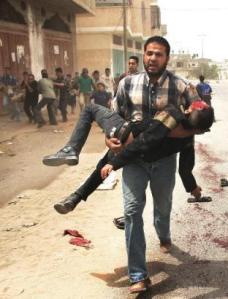
More than 1,000 residents of Gaza are dead, over 300 of them children, and nearly 5,000 are wounded as a result of the continuing Israeli assault on the blockaded Gaza Strip. Some 90,000 Gazans have been forced to flee their homes, according to al-Mezan human rights centre. [1]
“Residents of Gaza City and the north have no water. They have no electricity. They’re trapped, traumatized and terrorized.” [2]
There are shortages of several basic foods, including food for infants. Unsafe drinking water, garbage piling up in the streets, and disrupted vaccinations, have increased the risk of epidemics. [3]
There is a shortage of hospital equipment. Monitors, anaesthesia, surgical equipment, heaters and spare parts are in short supply. Hospital windows have been blown out by Israeli bombs. [4]
Norwegian doctors Mads Gilbert and Erik Fosse, who worked at the al-Shifa hospital in Gaza City, say they,
“witnessed the most horrific war injuries in men, women and children of all ages in numbers almost too large to comprehend. The wounded, dying and dead have streamed into the overcrowded hospital in endless convoys of ambulances and private cars and wrapped in blankets in the caring arms of others. The endless and intense bombardments from Israeli air, ground and naval forces have missed no targets, not even the hospital.” [5]
Israel says it is destroying military targets, but has razed government buildings, apartment buildings, mosques and has struck UN schools, the compound of the UN Relief and Works Agency, a cemetery, ambulances and hospitals. [6]
Charlos Latuff
“Navi Pillay, the UN high commissioner for human rights, has called for ‘credible, independent and transparent’ investigations into possible violations of humanitarian law.” [7]
The International Committee for the Red Cross “accused Israel of breaches of humanitarian conventions for failing to bring assistance to wounded and starving civilians and preventing ambulance access for four days.”
B’Tselem, Physicians for Human Rights, and other Israeli human rights groups “have described civilians being fired on in doorways (by Israeli soldiers); attacks on ambulance crews, aid workers and schools being used as civilian refuges.” [8]
Human Rights Watch, which usually takes a kid-gloves approach to the US and its allies, accused Israel of using “white phosphorous munitions over densely populated areas of Gaza in violation of international humanitarian law.” [9]
The UN’s Human Rights Council has condemned the Israeli offensive for “massive violations of human rights”. [10]
Amnesty International says that Israeli shelling of residential areas is “prima facie evidence of war crimes”. The organization has also accused Israeli soldiers of using Palestinians as human shields.
“It’s standard practice for Israeli soldiers to go into a house, lock up the family in a room on the ground floor and use the rest of the house as a military base, as a sniper’s position. That is the absolute textbook case of human shields.” [11]
Richard Falk, the UN’s special rapporteur on the Palestinian territories and professor emeritus of international law at Princeton University, says Israel is in breach of the UN charter, the Geneva conventions, international law and international humanitarian law. He has previously compared Israel’s treatment of the Palestinians to Nazi atrocities, a comparison that led to his being barred by Israel from access to Gaza and the West Bank. Falk says that,
“If there were the political will there could be an ad-hoc tribunal established to hear allegations of war crimes. This could be done by the general assembly acting under article 22 of the UN charter which gives them the authority to establish subsidiary bodies.” [12]
If ever there was a group in need of protection from war crimes, crimes against humanity and ethnic cleansing it is the Palestinians. And yet the Palestinians receive little outside help, relying on themselves, for the most part, for whatever little protection they can provide. Realpolitick prevents them from falling within the ambit of the responsibility to protect doctrine, the idea that “the international community,” that is, Western governments led by the United States, should intervene in other countries to prevent genocide, mass killings and massive human rights abuses. Responsibility to protect (R2P) has given rise to campaigns for humanitarian intervention in Darfur, Myanmar and Zimbabwe, but not Gaza or the West Bank.
If ever there was a group in need of protection from war crimes, crimes against humanity and ethnic cleansing it is the Palestinians.
That there are no R2P campaigns to safeguard Palestinians exposes the concept as a fig leaf for Western imperialism – a way of justifying intervention in countries that pursue policies at odds with the economic and strategic interests of Western investment banks, corporations and investors, while ignoring the ethnic cleansing, massive human rights violations and predatory aggressions of allies (and of Western countries themselves.)
Predictably, those who call for interventions in Darfur, Myanmar and Zimbabwe haven’t called for R2P campiagns to safeguard Palestinians from Israel’s continuing breaches of international law, humanitarian law, the Geneva conventions and the UN charter.
For example, the plight of the Palestinians is nowhere to be found on the website of the World Federalist Movement-Institute for Global Policy’s Responsibility to Protect, Engaging Civil Society project, R2PCS, though R2PCS has much to say about “the crisis in Darfur,” “the crisis in Myanmar” and “the crisis in Zimbabwe,” as well as the “genocides in Cambodia, Rwanda and Bosnia, (and) crimes against humanity in Kosovo.” [13] That the humanitarian catastrophe visited upon the Palestinians is absent from the R2PCS’s concerns hardly jibes with its professed mission to “promote concrete policies to better enable governments, regional organizations and the U.N. to protect vulnerable populations.” [14]
A major backer of R2PCS is the government of Canada, the principal sponsor of the concept of the responsibility to protect. Other R2PCS sponsors include the governments of Britain, the European Union, billionaire financier George Soros’ Open Society Institute and the Ford Foundation. [15]
Former Canadian prime minister Jean Chretien put forward the R2P idea so that US coalitions, such as the NATO coalition that bombed the former Yugoslavia for 78 days in 1999, could claim a legal basis for their aggressions. Chrétien was embarrassed that Canada’s participation in the NATO assault on Yugoslavia had been carried out without the imprimatur of the UN or international law. In the future, if it could be shown that a population deemed vulnerable was menaced by abridgment of rights, mass killings or ethnic cleansing – often the outcome of civil wars engineered by the West – a legal cover could be provided for intervention.
That Canada has no intrinsic interest in protecting vulnerable populations is evidenced by its failure to make the slightest effort to prevent Israel’s massive human rights violations against Palestinians and ethnic cleansing of historic Palestine. Even today, in the face of Israel’s use of Palestinians as human shields, its meting out of collective punishment and its bombardment of civilians and civilian infrastructure, the Canadian government obstructs all attempts in international forums to protect the Palestinian population, instead adopting a policy of unconditional support for Israel.
And while Canada and other members of the North Atlantic alliance fail to protect the Palestinians from Israeli depredations, and indeed facilitate them, they demonize as terrorists the groups that genuinely act to protect the Palestinian population from Israel’s massive human rights violations and ethnic cleansing. These include Hamas, the Popular Front for the Liberation of Palestine, and other Palestinian resistance organizations and their allies.
On the one hand, then, the R2P community is silent on the plight of the Palestinians. On the other hand, it agitates for Western intervention in countries that maintain unfriendly business and foreign investment climates (Sudan, Myanmar and Zimbabwe) or have coveted strategic assets (oil in Darfur and a geostrategic position close to China in Myanmar.)
While the R2P community’s foot soldiers may be genuinely motivated by a desire to protect vulnerable populations, their energies are harnessed by the ruling class interests that lay behind their campaigns to press for interventions that ultimately serve imperial, not humanitarian, goals. At the same time, they’re diverted from any cause that threatens the economic and strategic interests of Western states and the corporate and financial communities that dominate them.
There are R2P campaigns to promote Western interventions in Darfur, Myanmar and Zimbabwe, but not in Gaza or the West Bank.
The R2P community’s foot soldiers are also, sadly, bamboozled — convinced that Western intervention can be a force for good, when the historical record, both distant and recent, contradicts the view unequivocally.
Those who are galvanized to demand that Western powers exercise a responsibility to protect vulnerable populations in Darfur, Myanmar and Zimbabwe should first acquaint themselves with the track record of Western interventions in the former Yugoslavia, Iraq (home to an intervention-induced humanitarian catastrophe of almost unparalleled magnitude by current standards) and Afghanistan. In all these cases, the West invoked humanitarian imperatives to justify military conquest, and in each case massively biased the post-intervention conditions against the domestic populations.
As regards the Palestinians, supporters of R2P should ask themselves:
1. Why is the responsibility to protect not invoked to protect the men, women and children of Gaza?
2. Should the Palestinian resistance, which is comprised of grassroots groups that genuinely act to protect themselves and their families from ethnic cleansing, human rights abuses and violations of humanitarian and international law, be demonized as terrorists or recognized as a legitimate resistance?
3. Should the provision of material support to these groups be criminalized in the West, or should provision of support be recognized as the genuine exercise of the responsibility to protect a vulnerable population?
1. Rory McCarthy, “Offensive has forced 90,000 to flee their homes, says rights group,” The Guardian (UK), January 13, 2009.
2. Hazem Balousha, “Tanks, rockets, death and terror: a civilian catastrophe unfolding,” The Guardian (UK), January 5, 2009.
3. Rory McCarthy, “Israeli forces close in on Gaza city,” The Guardian (UK), January 13, 2009.
4. Taghreed el-Khodary, “Gaza hospital fills up, mainly with civilians,” The New York Times, January 5, 2009.
5. Rory McCarthy, “Israeli human rights groups speak out as death toll passes 1,000,” The Guardian (UK), January 15, 2009.
6. Hazem Balousha, “Tanks, rockets, death and terror: a civilian catastrophe unfolding,” The Guardian (UK), January 5, 2009; Rory McCarty and Peter Walker, “Israel hits UN refugee agency in Gaza,” The Guardian (UK), January 15, 2009.
7. Rory McCarthy, “UN human rights chief accuses Israel of war crimes,” The Guardian, January 10, 2009.
8. Peter Beaumonth, “Does the world have the appetite to prosecute Israel for war crimes in Gaza?” The Guardian (UK), January 10, 2009.
9. Rory McCarthy, “Hamas leader: Israel’s Gaza attacks have killed peace talks,” The Observer (UK), January 12, 2009.
10. Chris McGreal, “Demands grow for Gaza war crimes investigation,” The Guardian (UK), January 13, 2009.
11. Ibid.
12. Afua Hirsch, “Israel may face UN court ruling on legality of Gaza conflict.” The Guardian (UK), January 14, 2009.
13. Website of the Institute for Global Policy’s Responsibility to Protect, Engaging Civil Society project, R2PCS, http://www.responsibilitytoprotect.org/index.php, accessed January 14, 2009.
14. Ibid.
15. World Federalist Movement website, http://www.wfm.org/site/index.php/pages/40, access January 14, 2009.
Israel, n. [L., fr. Gr. Israel, fr. Hbr. Yisra’el, lit., contender with God.] 1. An illegitimate and racist colonial, settler regime, founded on ethnic cleansing, maintaining a military occupation of 85 percent of Palestinian territory, relying on generous military aid from the United States, whose interests in the Middle East it looks after. The regime criminalizes legitimate resistance to its occupation and regularly flouts humanitarian and international law. 2. The territory occupied by this regime.
Illegitimate
The basis of the regime is the Zionist goal of a Jewish homeland on territory inhabited by a Palestinian Arab majority. Everything about the regime and the resistance of Arab Palestinians can be understood as the inevitable outcome of the irreconcilable contradiction between the desire of Zionists to establish a democratic Jewish state requiring a preponderant Jewish majority on land in which Jews were a decided minority, and the reaction of Palestinians to their dispossession and oppression which the Zionists enforced as a necessary condition of achieving their goal.
In 1947, after Britain transferred its mandate to the UN, the world body introduced a plan to partition Palestine into three parts: a Jewish state, a Palestinian state, and Jerusalem, which was to be an international territory. While Palestinian Arabs made up two-thirds of Palestine’s population, under the UN plan, they were to be allocated only 42 percent of the territory. Having long sought self-determination, they were implacably opposed to the partition of their land. As the historian Ilan Pappe remarked, you don’t have to be a great jurist to see that forcing partition on a country to which the majority of its population is opposed is illegal and immoral.
The plan was more favorable to the Jewish state. It would comprise 56 percent of the territory and would be home to 500,000 Jews and 400,000 Palestinians. Recognizing that a Jewish state would not be viable with Palestinians making up over 40 percent of the population, David Ben-Gurion and other settlers executed a plan to expel Palestinians from the territory the UN assigned to Zionist forces. When the British left in May, 1948, ending their mandate, Zionists seized 80 percent of Palestine (more than the UN plan had envisioned), driving 800,000 Palestinians from the seized territory and barring their return. In 1967, the regime conquered the remaining 20 percent in the Six Day War, along with parts of Egypt and Syria.
Racist
The regime is based on exclusion. Jews from anywhere in the world are permitted to immigrate to occupied Palestine, while Palestinians who fled or were driven from their homes in the now occupied territory are prohibited from returning. The Palestinians who remained in the territory seized by the regime, the so-called Arab Israelis, are treated as second class citizens.
Mixed couples cannot be buried together in a state-funded Jewish cemetery. Even more absurd, Israel is probably the only country in the world that does not recognize its own nationality. Israelis cannot be inscribed as Israelis in the state population register, but must be recorded according to their religious or ethnic origin. Every request by Israelis — Jewish and Arab — to be listed simply as Israeli has so far been rejected. The government argues that this would undermine the principle of Israel as a Jewish state. Meanwhile, ‘unrecognized’ Arab villages languish for decades without municipal services, while governments of both left and right have spent $15 billion on settlements beyond the 1967 border. (1)
Several right-wing rabbis have forbidden Jews from renting apartments to Arabs or giving them jobs. (2) Arabs inside Israel are denied security clearances, and, therefore, are denied the many jobs that require them. Compared to Jewish families, three times more Arab families live below the poverty line. According to polls, a majority of Israeli Jews favor expulsion of Arabs from occupied Palestine. [3] More than three-quarters say they wouldn’t live in the same neighborhood as Arabs. And three-quarters of Jewish youth describe Arabs as dirty. [4]
More important, however, than these day-to-day expressions of anti-Arab racism, is the racist character of Zionism itself – the idea that Palestine belongs to the Jews and not to the Arab majority that lived there, an idea which places one group of people, the Jews, above another, the Palestinians.
Colonial settler regime
Most of the Jews who lived on Palestinian territory before 1948 were recent settlers, having arrived after WWI. After hundreds of thousands of Palestinians were ethnically cleansed from the territory under the regime’s control, these settlers, and those who came later, took over Palestinian homes and property.
After 1967, Jewish settlements were established in the remaining 20 percent of Palestine the regime had failed to conquer in 1948 (Gaza and the West Bank). While Jewish settlers have since withdrawn from Gaza, Jewish settlements continue to expand in the West Bank, further reducing Palestinian territory to about 15 percent of British Mandate Palestine.
Peace Now, the Israeli advocacy group, said in a report released August 26, 2008, that in the past year Israel has nearly doubled its settlement construction in the occupied West Bank in violation of its obligations under an American-backed peace plan. The Peace Now report…says that more than 1,000 new buildings are going up in the West Bank, including 2,600 housing units. It says that for the first five months of 2008, construction in the settlements was 1.8 times greater than in the same period of 2007. According to its report, more than half of the building is going on beyond the separation barrier that Israel has built in recent years along the border of and inside the West Bank. [5]
Ethnic cleansing
The combination of the UN plan, with its near demographic balance of Jews and Palestinians in the envisaged Jewish state, and Zionist ideology, which insists on a Jewish homeland in Palestine, guaranteed that Zionist forces would ethnically cleanse those parts of Palestine it could conquer by force. The regime’s refusal to allow the return of Palestinians is no less a form of ethnic cleansing.
US military aid
Israel receives billions of dollars every year in military aid from the United States. On top of using the combat aircraft and tanks it receives from the US to oppress the Palestinians and enforce its occupation of Palestine, the regime uses its US-furnished military might to intimidate neighboring countries on behalf of Washington. It threatens to bomb Iran, recently bombed an alleged nuclear power plant in Syria, and destroyed Iraq’s Osirak nuclear reactor in 1981.
Criminalizing resistance
Everyone has the right to take up arms to resist military occupation – except, if you listen to Western governments, Palestinians (and also the Iraqis and Afghans who resist the occupation of their countries by US forces and their allies.) In order to discredit the organized resistance of Palestinians, Israel, the US, Canada and Western Europe demonize Palestinians who fight to liberate Palestine from the racist, colonial, settler occupation.
Meanwhile, many Westerners, including liberals, deplore the violence of Palestinians while proudly boasting that if their own country were invaded, they would be in the front line, guns blazing. Organized Palestinian resistance groups, including the Popular Front for the Liberation of Palestine, which seeks a democratic and secular Palestine, are officially designated as terrorist organizations by Western governments. Anyone who materially assists these groups faces stiff penalties. Criminalizing resistance deters people living in North America and Western Europe from expressing solidarity with the Palestinian resistance and dishonestly submerges the political character of its struggle.
Palestinians who take on the might of the US-furnished Israeli military, firing crude, largely ineffective rockets into occupied Palestine, are not criminals; they are the dispossessed fighting for justice with the few means at their disposal.
Flouting humanitarian and international law
The regime flouts all humanitarian and international law that stands in the way of preserving its racist, settler state, and it has being doing so from the moment in 1948 it rejected UN Resolution 194 calling for the unconditional return of Palestinians. The Universal Declaration of Rights holds that no one shall be subjected to arbitrary arrest, detention or exile and that everyone has the right to leave any country, including his own, and to return to his country. The regime has denied Palestinians these rights for over 60 years.
Conclusion
Jewish settlers from Europe arrived in Palestine, most after WWI, seeking to establish a Jewish homeland on territory inhabited by an Arab majority. When the British left in 1948, the settlers seized 80 percent of the territory, expelling 800,000 Palestinians, barring their return. The Palestinians who weren’t driven out or didn’t flee were, and continue to be, treated as second class citizens. Later, in 1967, the settler regime conquered the remaining 20 percent of Palestine it failed to expropriate in 1948. Jewish settlements were established in these additionally occupied territories – with settlements continuing to grow in one of them, the West Bank – squeezing Palestinians into an ever tighter space. A resistance developed, but has been criminalized, denounced as terrorist and targeted under the US war on terrorism (that is, war on organized, armed resistance to the imperialist encroachments of the US and its allies.)
An imperative solution
The moral imperative of liberating Palestine from occupation is no less compelling than the moral imperative of liberating any other conquered territory. A liberated Palestine would ideally be secular, democratic, egalitarian, multiethnic and independent, not a military extension of the United States. The historic land of Palestine belongs to all who live in it and to those who were expelled or exiled from it since 1948 and their descendents, regardless of religion, ethnicity, national origin or current citizenship status. The character of a liberated Palestine is up to all who have a legitimate claim to live in Palestine to decide. It should never have been decided by the UN over the objection of the majority of its population, or by Zionists at the majority’s expense. The continued occupation of Palestine and the oppression of Palestinians and abridgment of their rights (without which the occupation could not continue) remains a blight on humanity whose end is long overdue.
1. The New York Times, June 28, 2008.
2. The New York Times, May 2, 2008.
3. Ibid.
4. Haaretz newspaper, December 9, 2007; Haaretz TV news, December 12, 2007.
5. The New York Times, August 27, 2008.
Recommended reading:
Ilan Pappe, The Ethnic Cleansing of Palestine, One World, Oxford, 2006.
Ilan Pappe, A History of Modern Palestine, Cambridge University Press, 2006.
Unlike press reports which almost never provide context, I’ll begin with context. Figure 1 shows the percentage of British Mandate Palestine seized by Jewish forces through war, terrorism and ethnic cleansing, and the remaining territory (about 15 percent) that now comprises the Palestinian territories. In 1947, Arab Palestinians formed a two-thirds majority. Even so, the UN, over the objection of the Arab majority, pledged 56 percent of Mandate Palestine to a Jewish state. The Jews, most having arrived after WWI, comprised only one-third of the population (about 510,000 people) and owned only six percent of the land. In late 1947 and into 1948, through a systematic program of ethnic cleansing, and by barring the return of the 800,000 Arabs who fled or were forced from their homes, Zionist forces established Israel on 80 percent of the territory that comprised Mandate Palestine. In 1967, Israel seized Gaza and the West Bank – the only parts of Mandate Palestine they had failed to conquer in 1948 – and brought them under military occupation.
Figure 1. The encroachment of the Jewish state on Palestinian territory.
Hamas grew out of the first intifada (shaking off) of 1987. The intifada was an attempt to shake off the Israeli military presence in Gaza and the West Bank. It began in Gaza’s refugee camps, home to Palestinians and their descendants who had been driven out of what was now Israeli territory, or had fled, and were prevented from returning. Their return would undermine the demographic reality the Zionist forces had painstakingly created in 1947 and 1948 – a Jewish majority. The camps were bedeviled by mass unemployment and grinding poverty. The average family of five lived in cramped quarters with an outdoor toilet. (1)
Hamas grew to prominence in the camps for a number of reasons. First, it built up support by providing social services. Second, it profited from the material support it received from Israel. By building up Hamas, a religious-based, social services organization, Israel hoped to weaken the secular, politically-oriented PLO. Third, the PLO lost support when it pledged to end armed struggle and recognize Israel.
Hamas is criticized in the West for five reasons.
1. Because it is an Islamic organization. The West, however, had few qualms about Hamas’s religious character when the organization was being built up as a way to divert support from the secular PLO. In fact, it was Hamas’s religious character (thought to inspire passivity rather than militancy) that recommended it as an organization to be nurtured.
2. Because it will not recognize Israel. To do so would legitimate the UN’s immoral and illegitimate partition of Mandate Palestine and the ethnic cleansing which cleared the way for the formation of a Jewish state. Hamas, and many others, seek the end of a Jewish state on Palestinian territory. The US and other Western powers describe this as seeking the destruction of Israel, which it is, metaphorically, but for purposes of manipulating public opinion, the words “destruction of Israel” are carefully chosen to suggest the goal of physical obliteration. Palestinians who refuse to legitimate the crimes of 1948 by recognizing Israel do not seek Israel’s physical destruction per se, but seek to restore their legitimate claim to the land they were driven from, a goal which, if successful, would mean the end of a Jewish state (i.e., Israel’s destruction.)
3. Because Hamas engages in terrorism. Israel has a large arsenal of combat aircraft and tanks to oppress the Palestinians. “Terrorism” is the word the powerful use to discredit the resistance of the oppressed. Hamas would gladly swap its crude and largely ineffective rockets for Israel’s tanks and combat aircraft.
4. Because it “took over” Gaza. An Israeli security official told The New York Times that,
“What happened in Gaza a year ago was not really a coup. Hamas’s takeover was a kind of natural process. Hamas was so strong, so deeply rooted in Palestinian society through its activities in the economy, education, culture and health care, and Fatah was so weak, so corrupt, that the takeover was like wind blowing over a moth-infested structure.” [2]
5. Because it unilaterally abandoned the ceasefire. On the contrary, despite the ceasefire, Israel refused to lift the bloackade of Gaza (one of the conditions of the truce), killed 1,300 Palestinians in the nearly three years since Hamas came to power, and in November conducted three raids on Gaza, killing 12. [3]
Figure 2 shows the gross imbalance in deaths over the first eight days of Israeli terror bombing compared to Israeli deaths from Palestinian rocket attacks. This imbalance is emblematic of the yawning gap in casualties in all confrontations between the Israelis and Palestinians. Israel kills, maims and imprisons many; Palestinians barely make a scratch.
Figure 2. Comparison of number of deaths over the first eight days of Israeli air strikes.
Echoing his Secretary of State who attributed the recent outbreak in violence to Hamas, US President George W. Bush castigated the oppressed. In his January 2 radio address, he said,
This recent outburst of violence was instigated by Hamas — a Palestinian terrorist group supported by Iran and Syria…In response to these attacks on their people, the leaders of Israel have launched military operations on Hamas positions in Gaza.
The first eight days of Israeli air strikes – “with air strikes averaging one every 20 minutes” – has created “a humanitarian crisis and more,” according to Max Gaylard, the UN humanitarian coordinator for the Palestinians. [4]
Contrast the reaction to the humanitarian crisis in Gaza, where 450 lay dead, close to 2,000 are wounded, where electricity has been cut off by Israel, and where medical services are stretched to the limit, with the calls for military intervention in Zimbabwe in response to a cholera outbreak (a not uncommon event in Third World countries.)
The defrocked priest of peace, Desmond Tutu, who urged the West to intervene militarily in Zimbabwe to solve its humanitarian emergency, has not called for a military intervention in Israel to prevent the massacre of Gazans. He hasn’t even called for Washington to cut off its billions of dollars in annual military aid to Israel. Instead, he is calling for dialogue and confidence building measures, and for “Israel’s need for security (to) be understood by all sides.” [5]
1. Ilan Pappe, A History of Modern Palestine, Cambridge University Press, 2006.
2. New York Times, June 15, 2008.
3. Chris McGreal, “Why Israel went to war in Gaza,” The Observer (UK), January 4, 2009.
4. Rory McCarthy, “’Critical emergency’ after air strike every 20 minutes,” The Guardian, January 3, 2009.
5. Vaclav Havel, El Hassan bin Talal, Hans Kung, Desmond Tutu, Karel Schwarzenberg and Yohei Sasakawa, “Humanity’s stake in Gaza,” The Sunday Times (Sri Lanka), January 4, 2008.
In March 2007 US Secretary of State Condoleezza Rice invited Jenni Williams to Washington to receive the US State Department’s 2007 International Woman of Courage Award for Africa [1]. Williams is an anti-Mugabe activist who leads Women of Zimbabwe Arise, a group which, according to a US State Department report [2], receives US government funding through Freedom House, a CIA-interlocked [3] organization headed by Peter Ackerman, junk bond trader Michael Milken’s former right hand man.
Let’s do a thought experiment. Imagine an American being invited to Harare by Robert Mugabe to receive the International Person of Courage Award for the North Atlantic. Imagine further that the recipient is the leader of a civil society group called Women of America Arise and that the group is financially assisted by the Zimbabwean government. How believable would the claim be that our person of courage is not an agent of the Zimbabwean government? How much scorn would be heaped upon her for accepting an accolade – and money — from the “monster”, Mugabe, in Harare, no less? How likely would it be that our person of courage would escape calls to be sanctioned or deported? And what would we think of a progressive scholar who dismissed the idea that our person of courage could in any way be considered an agent of Zimbabwe, or that she represented an independent left?
In reply to a September 25, 2008 Netfa Freeman article in the Black Agenda Report, “Zimbabwe and the Battle of Ideas”, progressive scholar Stephen Zunes declared that it was impossible to consider Jenni Williams, the woman who is feted in Washington by the monster Condoleezza Rice, to be an American agent. Zunes heads up the board of academic advisors of the International Center for Nonviolent Conflict, a body which trains people to use nonviolence to bring down governments that refuse to accept the free trade, free enterpise, free market demands that are the cornerstone of US foreign policy. The ICNC is run by Peter Ackerman – the same Peter Ackerman, who, pursuing a post-Michael Milken career, also runs the CIA interlocked Freedom House, the same Freedom House that funnels Uncle Sam’s lucre to Jenni Williams. And Stephen Zunes, working with Freedom House head Peter Ackerman at the ICNC says Jenni Williams can in no way be considered an American agent.
“…against those who substitute moral certainty for knowledge, and who feel virtuous even when acting on the basis of total ignorance.”*
By Stephen Gowans
Mahmood Mamdani’s largely sympathetic analysis of the Mugabe government, “Lessons of Zimbabwe,” published in the December 4, 2008 London Review of Books, has been met with a spate of replies from progressive scholars who are incensed at the Ugandan academic throwing out the rule book to present an argument based on rigor and analysis, rather than on the accustomed elaboration of comfortable slogans and prejudices that has marked much progressive scholarship on Zimbabwe. Their criticism of Mamdani has been characterized by ad hominem assaults, arguments that either lack substance or sense, and the substitution of cynicism for scholarship.
Mahmood Mamdani: Criticized by progressive scholars for shunning crude anti-Mugabe sloganeering.
At the heart of what might be called the anti-Mugabe ideology lays the idea that the Zimbabwean leadership clings to power through crude anti-imperialist rhetoric used to divert blame for problems of its own making. This is an elaboration of elite theory — the idea that a small group seeks power for power’s sake, and manipulates the public through lies and rhetoric to stay on top. For example, one group of progressive scholars [1] complains about “Mugabe’s rhetoric of imperialist victimization,” while Horace Campbell argues that,
”The Zimbabwe government is very aware of the anti-imperialist and anti-racist sentiments among oppressed peoples and thus has deployed a range of propagandists inside and outside the country in a bid to link every problem in Zimbabwe to international sanctions by the EU and USA.” [2]
Contrary to the empty rhetoric school of thought, Mugabe’s anti-imperialist rhetoric is not unattended by anti-imperialist action, but in some extreme versions of anti-Mugabe thought, (for example, that put forward by Patrick Bond), Mugabe is an errand boy for Western capital. [3] The Zimbabwean leader’s anti-imperialist reputation is, according to this view, smoke and mirrors, an illusion conjured by a deft magician.
The Mugabe government’s anti-imperialist and anti-neo-colonial credentials rest on the following:
o In the late 1990s, intervening militarily in the Democratic Republic of Congo on the side of the young government of Laurent Kabila, to counter an invasion by Rwandan and Ugandan forces backed by the US and Britain.
o Rejecting a pro-foreign investment economic restructuring program established by the IMF as a condition for balance of payment support (after initially accepting it.)
o Expropriating farms owned by settlers of European origin as part of a program of land redistribution aimed at benefiting the historically disadvantaged African population.
o Establishing foreign investment controls and other measures to increase black Zimbabwean ownership of the country’s natural resources and enterprises.
Progressive scholars typically avoid mention of these anti-imperialist actions, for to do so would clash violently with the idea that Harare’s anti-imperialism is based on empty rhetoric. A few, however, do acknowledge these actions, but insist they were undertaken to enrich Mugabe and, aping US State Department and New York Times rhetoric, “his cronies.” Zimbabwe is said to have intervened militarily in the DRC to profit from the Congo’s rich mineral resources. Land is said to have been redistributed to reward Mugabe’s lieutenants (in which case, with 400,000 previously landless families resettled, Mugabe’s lieutenants comprise a sizeable part of the rural population). And measures to increase black Zimbabwean ownership in Zimbabwe’s economy are said to have no other aim than to enrich Mugabe’s friends.
This substitutes cynicism for analysis. Has there been corruption in the land resettlement program? Asbolutely. But what human enterprise is free from corruption? What’s more, is the presence of corruption in a program, proof the program was undertaken for corrupt reasons? Measures to increase black Zimbabwean ownership in the economy are scorned by progressive scholars for being capitalist. Fine, but a failure to be anti-capitalist is not equal to a failure to be anti-imperialist; nor is it proof of being pro-imperialist.
The foreign policy of capitalist governments is based in large measure on protecting their nationals’ ownership rights to foreign productive assets and promoting their access to foreign investment and export opportunities. Under the Mugabe government, ownership rights have not been safeguarded and foreign investment and export opportunities have been limited by tariff policies, foreign investment controls, subsidies and discrimination against foreign investors. Absent in the analyses of progressive scholars is the understanding of the Mugabe government’s policies from the point of view of the banks and corporations of the imperialist center. One key US ruling class foundation, The Heritage Foundation, complains that Zimbabwe’s “average tariff rate is high” and that “non-tariff barriers are embedded in the labyrinthine customs service;” that “state influence in most areas is stifling, and expropriation is common as the executive pushes forward its economic plan of resource distribution”; that Zimbabwe has “burdensome tax rates” and that “privatization has stalled”…”with slightly over 10 percent of targeted concerns privatized”…”and the government remains highly interventionist.” Of equal concern is Harare’s practice of setting “price ceilings for essential commodities,” “controls (on) the prices of basic goods and food staples,” and influence over “prices through subsidies and state-owned enterprises and utilities” – odd practices for what we’re to believe is a group of errand boys for Western capital. But perhaps of greatest concern to Western corporations and banks is Harare’s investment policies. “The government will consider foreign investment up to 100 percent in high-priority projects but applies pressure for eventual majority ownership by Zimbabweans and stresses the importance of investment from Asian countries, especially China and Malaysia, rather than Western countries.” [4] This paints a picture of the Mugabe government, not as a facilitator of Western economic penetration, but as economically nationalist, pursuing a program aimed at placing control of Zimbabwe’s land, natural resources and enterprises in the hands of black Zimbabweans. It is, in short, a black nationalist government. Clearly, Western investors don’t think Mugabe is working on their behalf. The only people who do are progressive scholars.
Progressive scholar Horace Campbell: Confuses ZDERA with targetted sanctions.
The Mugabe government’s pursuit of black nationalist interests, which clashes in important ways with the interests of Western banks and corporations as well as with the minority population of settlers of European origin, has been met by a strong, multi-faceted response from the US, Britain and the EU. This has included the denial of balance of payment support and development aid, the building up of civil society as a pole of opposition to the Mugabe government, the creation of and subsequent direction of an opposition party, and an international campaign of vilification aimed at discrediting the Mugabe government. [5] Progressive scholars barely acknowledge the Western response, treating it more as an invention of the Mugabe government, used to manipulate the population and to deflect attention from its failings, than as a reality – a bowing to elite theory, rather than to the facts.
Campbell, for example, complains that,
“The Mugabe government blames all of its problems on the economic war launched by the USA and Britain. For the Mugabe regime, at the core of this economic war, are the targeted sanctions against Mugabe’s top lieutenants under its Zimbabwe Democracy and Economic Recovery Act (ZDERA), passed by the Bush administration in 2001.” [6]
Campbell confuses targeted sanctions aimed at senior members of the Mugabe government, with ZDERA, an act which blocks Zimbabwe’s access to international credit, and, therefore, affects all Zimbabweans, not just Zanu-PF grandees. According to the act,
The Secretary of the Treasury shall instruct the United States executive director to each international financial institution to oppose and vote against–
(1) any extension by the respective institution of any loan, credit, or guarantee to the Government of Zimbabwe; or
(2) any cancellation or reduction of indebtedness owed by the Government of Zimbabwe to the United States or any international financial institution.” [7]
Zimbabwe’s economy, like that of any other Third World country, was never robust to begin with, and inasmuch as it has always relied heavily on Western inputs and access to Western exports, was never too difficult to push into crisis by Western governments intent on making a point. To pretend Washington, London and Brussels haven’t sought to sabotage Zimbabwe’s economy, or are incapable of it, is absurd. ZDERA effectively reduces Zimbabwe’s access to the foreign exchange it needs to import necessities from abroad, including chemicals to treat drinking water, a significant point in the recent cholera outbreak. Development aid from the World Bank is also cut off, denying the country access to funds to build and repair the infrastructure needed to run a modern economy. Rather than banning the export of goods to Zimbabwe (the popular understanding of sanctions), the US has made importing goods a challenge. This doesn’t mean that Zimbabwe can’t import goods, or that there is no outside investment. What it does mean, however, is that Zimbabwe is denied access to the kind of financial support poor countries depend on to get by. The intended effect is to make Zimbabwe’s economy scream, and it has. Campbell, who, based on his equating ZDERA with targeted sanctions on individuals, doesn’t understand it, or hasn’t read it, dismisses the idea that the West’s economic warfare accounts for Zimbabwe’s economic troubles. He writes that,
“What has been clear from the hundreds of millions of dollars of investments by British, Chinese, Malaysian, South African and other capitalists in the Zimbabwe economy since 2003 is that the problems in Zimbabwe haven’t been caused by an economic war against the country.” [8]
This is like saying anyone exposed to an influenza virus couldn’t possibly be ill because he has received mega-doses of vitamins. Investment from non-Western sources may mitigate some of the problems created by ZDERA, but it doesn’t eliminate them. Chinese investment in platinum mines, for example, will not eliminate a balance of payment problem.
Understating the effects of ZDERA is not the only area in which progressive scholars go wrong; their failure to acknowledge Western efforts to build up a civil society with a mandate to destabilize Zimbabwe is another. This is inexcusable, since the efforts of Western governments to create, nurture, support, direct, and mentor opposition to the Mugabe government, including overthrow movements, is well documented [9] – mainly because these governments have been open about it — and is hardly new. It has been used elsewhere, famously in Chile, and recently in Venezuela, Belarus, and the former Yugoslavia.
One reason for the failure of progressive scholars to acknowledge the role played by Western governments and ruling class foundations in destabilizing Zimbabwe may be because they too benefit from the same sources of funding. Campbell’s critique of Mamdani, for example, was published at Pambazuka News. Pambazuka News is a project of the US ruling class Ford Foundation and of the Open Society Institute [10], a vehicle of billionaire financier George Soros to promote color-coded revolutions, under the guise of democracy promotion, in countries whose governments have been less than open to Western exports and investments. Pambazuka News is also sponsored by Fahamu [11]. While Fahamu no longer lists Western governments as funders, it has, in the past, been funded by the US State Department through USAID, by the British Parliament through the Westminster Foundation for Democracy, by the British government through the British Foreign and Commonwealth Office and the British Department of International Development, and by the European Union. The US, Britain and EU are on record as seeking the overthrow of the Mugabe government. They fund the organizations that disseminate anti-Mugabe analyses and sloganeering. They do so with one aim: to overthrow the Mugabe government. Campbell’s protesting that he is opposed to imperialist interventions is a bit like buying crack on the street while professing opposition to drug dealing, or placing a Think Green sticker on the bumper of your new SUV. Similarly, progressive scholar Patrick Bond, whose anti-Mugabe diatribes can also be found at Pambazuka News, describes the overthrow movement Sokwanele as an independent left, seemingly unaware it is on the US government payroll. [12]
Progressive scholar Patrick Bond: Hails Sokwanele as an independent left, seemingly unaware it is funded by the US government.
Not only do progressive scholars ignore the links of Zimbabwe’s opposition to imperialist governments and foundations, they celebrate the opposition. Campbell refers to members of Women of Zimbabwe Arise (WOZA) as “brave fighters.” [13] Brave fighters they may be, but Campbell does not let on (or know) what Woza is fighting for. The group’s leader, Jenni Williams, won the US State Department’s 2007 International Woman of Courage Award for Africa, a plaudit presented to Williams by Condoleezza Rice in a March, 2007 ceremony in Washington. [14] It shouldn’t have to be pointed out that the US State Department’s priority is to secure the interests of US corporations and banks abroad, not the interests of the women of Zimbabwe. So why is the US State Department recognizing Williams? Not for her service to women’s rights, but because her activities help to destabilize Zimbabwe and bring closer the day the black nationalist program of the Mugabe government can be swept aside to clear the way for the unfettered pursuit of US corporate and banking interests. A US government report on the activities in 2007 of its mission to Zimbabwe reveals that the “US Government continued its assistance to Women of Zimbabwe Arise.” [15] US government assistance to Woza and other civil society organizations is channelled through Freedom House and PACT. Freedom House is interlocked with the CIA and is a “virtual propaganda arm of the (US) government and international right wing,” according to Noam Chomsky and Edward Herman. [16] It is headed by Peter Ackerman. Ackerman runs the International Center on Nonviolent Conflict, of which Stephen Zunes, another progressive scholar, is chair of the board of academic advisors. Ackerman’s wife, Joanne Leedom-Ackerman, is a former director of the Albert Einstein Institute, an organization which trained activists in popular insurrection techniques to overthrow Venezuela’s Bolivarian Revolution, and has consulted with members of Zimbabwe’s civil society opposition on how to use non-violence to overthrow the Mugabe government. [17] Woza supports two US State Department propaganda vehicles: SW Radio Africa, a US State Department funded short-wave radio station that beams anti-Mugabe propaganda into Zimbabwe, and the Voice of America’s Studio 7, also funded by the US State Department to broadcast US foreign policy positions into Zimbabwe. [18] Zunes says Woza can by no means be considered American agents [19], echoing the progressive scholars’ line that there are no Western efforts to overthrow the Mugabe government; it’s all part of the anti-imperialist rhetoric Mugabe uses to stay in power.
Progressive scholar Stephen Zunes: Says Woza can by no means be considered American agents. The US government disagrees.
One of the biggest problems for progressive scholars is that their wish to see the Mugabe government brought down inevitably means its replacement by the Morgan Tsvangirai-led faction of the MDC. If Zanu-PF is deplored by some progressive scholars and demonized from the left for being capitalist, the MDC should have two strikes against it: it’s not only capitalist, it is unquestionably the errand boy of the imperialist center, a point one doesn’t have to twist oneself into knots to make, as is done whenever progressive scholars claim Mugabe, despite being sanctioned and vilified by the West, is kept afloat by and works on behalf of Western capital. The MDC’s subservience to Western corporate and banking interests is amply evidenced in its origins (Britain and British wealth provided the seed money), policy platform (decidedly pro-foreign investment), [20] and its advisors (the John McCain-led international arm of the Republican Party, the IRI [21]). Under an MDC government, the stalled privatization program the Heritage Foundation complains about will quickly be restarted. Foreign investment controls, subsidies, tariffs, and price controls will be terminated. Reversal of land reform, while it may come slowly, will inevitably happen, as a condition of ending ZDERA. IMF and World Bank loans will be extended, and the pro-foreign investment measures which are the inevitable condition of these loans will gladly be acceded to.
So, what do progressive scholars like Campbell offer as an antidote? “That Zimbabweans…oppose the neoliberal forces within the MDC to ensure that the suffering of working people does not continue after the ultimate departure of Robert Mugabe.” [22] There is more naiveté in this single sentence than there is in the average five year old. Please! Neoliberal forces have controlled the MDC from day one [22], and they’ve controlled the party because they hold its purse strings. Their control won’t disappear the moment Mugabe is gone; on the contrary, it is at that moment it will be strongest. But suppose, for a moment, that Campbell’s naive fantasy comes true, and that the forces that provide the funding that is the lifeblood of the MDC, yield to pressure from Zimbabweans, who, at one moment, vote the MDC into power, despite its neo-liberal platform, and at the next, ask the MDC to abandon the platform it was elected on. Were the MDC to yield to this pressure, it would face exactly the same response the Mugabe government faced when it backed away from neo-liberal policies: sanctions, destabilization, demonization and the threat of military intervention. The failure of Campbell to understand this evinces an unsophisticated understanding of the foreign policies of Western countries.
How droll, then, is the pairing of this breathtaking naiveté with the utter arrogance of progressive scholars. They dismiss Mamdani for failing “to look more deeply at the crisis” and for being “fooled by Mugabe’s rhetoric of imperialist victimization,” and then moan that preventing non-experts from falling for Mugabe’s rhetoric is “one of the more difficult tasks for scholars working on Zimbabwe.” And yet a far more difficult task, it would seem, is for the same scholars to acquaint themselves with the basics: what ZDERA is; why the West is waging economic warfare; what the policies of ZANU-PF are compared to the MDC’s and how these policies align, or fail to align, with the interests of Western banks and corporations; and who created and guides the opposition. Indeed, it could be said that one of the most difficult tasks for anti-imperialists working on Zimbabwe is to persuade progressive scholars to look more deeply into the crisis and not be fooled by imperialist rhetoric.
1. Timothy Scarnecchia, Jocelyn Alexander et al, “Lessons of Zimbabwe,” Letters, London Review of Books, Volume 31, No. 1, January, 2009.
2. Horace Campbell, “Mamdani, Mugabe and the African scholarly community,” Pambazuka News, December 18, 2008. http://www.pambazuka.org/en/category/features/52845
3. Bond, Patrick, “Mugabe: Talks Radical, Acts Like a Reactionary: Zimbabwe’s Descent,” Counterpucnh.org, March 27, 2007, http://www.counterpunch.org/bond03272007.html
4. Heritage Foundation, Index of Economic Freedom, 2008, http://www.heritage.org/research/features/index/country.cfm?ID=Zimbabwe)
5. Stephen Gowans, “Zimbabwe at War,” What’s Left, June 24, 2008. https://gowans.wordpress.com/2008/06/24/zimbabwe-at-war/
6. Campbell.
7. US Zimbabwe Democracy and Economic Recovery Act of 2001. http://frwebgate.access.gpo.gov/cgi-bin/getdoc.cgi?dbname=107_cong_bills&docid=f:s494enr.txt.pdf
8. Campbell.
9. See the section titled “Regime Change Agenda” in Stephen Gowans, “Zimbabwe at War,” What’s Left, June 24, 2008. https://gowans.wordpress.com/2008/06/24/zimbabwe-at-war/
10. Look under funders at Pambazuka News’ “About” page at http://www.pambazuka.org/en/about.php .
11. Ibid.
12. See Stephen Gowans, “Grassroot Lieutenants of Imperialism,” What’s Left, April 2, 2007, https://gowans.wordpress.com/2007/04/02/grassroots-lieutenants-of-imperialism/ and Stephen Gowans, “Talk Left, Funded Right,” What’s Left, April 7, 2007, https://gowans.wordpress.com/2007/04/07/talk-left-funded-right/.
13. Campbell.
14. Jim Fisher-Thompson, “Zimbabwean receives International Woman of Courage Award,” USINFO, March 7, 2007. http://www.america.gov/st/hr-english/2007/March/200703071523081EJrehsiF0.7266962.html
15. http://pdf.usaid.gov/pdf_docs/PDACL121.pdf . See also Stephen Gowans, “Stephen Zunes’ false statements on Zimbabwe and Woza,” What’s Left, September 30, 2008. https://gowans.wordpress.com/2008/09/30/stephen-zunes%e2%80%99-false-statements-on-zimbabwe-and-woza/
16. Noam Chomsky and Edward Herman, Manufacturing Consent: The Political Economy of the Mass Media, Pantheon Books, New York, 1988, p. 28
17. Michael Barker, “Sharp Reflection Warranted: Non-violence in the Service of Imperialism,” Swans, June 30, 2008. http://www.swans.com/library/art14/barker01.html
18. See Woza’s website, http://wozazimbabwe.org/?page_id=29 ; “Studio 7, launched in 2003, is the Zimbabwe program of Voice of America, which is funded by the United States. The program is broadcast in Shona, Ndebele and English, and is beamed into Zimbabwe from a transmitter in Botswana on the AM signal and by shortwave.” Globe and Mail (Toronto), March 26, 2005. In an April 5, 2007 report, the US Department of State revealed that it had worked to expand the listener base of Voice of America’s Studio 7 radio station. On SW Radio Africa see http://www.sourcewatch.org/index.php?title=SW_Radio_Africa .
19. See Stephen Gowans, “Stephen Zunes’ false statements on Zimbabwe and Woza,” What’s Left, September 30, 2008. https://gowans.wordpress.com/2008/09/30/stephen-zunes%e2%80%99-false-statements-on-zimbabwe-and-woza/
20. In 2000, the (British Parliament’s Westminster Foundation for Democracy) provided the MDC with $10 million. Herald (Zimbabwe), September 4, 2001 cited in Gregory Elich, Strange Liberators:Militarism, Mayhem and the Pursuit of Profit, Llumina Press, 2006; “WFD has been involved in over 80 projects aiding the MDC, and helped plan election strategy. It also provides funding to the party’s youth and women’s groups.” Herald (Zimbabwe), January 2, 2001, cited in Gregory Elich, Strange Liberators: Militarism, Mayhem and the Pursuit of Profit, Llumina Press, 2006; “In a clandestinely filmed interview, screened in Australia on February 2002 on the SBS Dateline program, MDC leader Morgan Tsvangirai was caught on camera admitting that his organization was financed by European governments and corporations, the money being channelled through a British firm of political consultants, BSMG.” Rob Gowland, “Zimbabwe: The struggle for land, the struggle for independence,” Communist Party of Australia; Civil society groups “and the Movement for Democratic Change…have broad Western support, and, often, financing.” New York Times, December 24, 2004; The International Republican Institute, the international arm of the Republican Party, “is using (the US State Department’s) USAID and the US embassy in Harare to channel support to the MDC, circumventing restrictions of Zimbabwe’s Political Parties Finance Act. Herald (Zimbabwe) August 12, 2005; USAID bankrolls sixteen civil society organizations in Zimbabwe, with emphasis on supporting the MDC’s parliamentary activities. “Zimbabwe Program Data Sheet,” U.S. Agency for International Development, cited in Gregory Elich, Strange Liberators: Militarism, Mayhem and the Pursuit of Profit, Llumina Press, 2006; “USAID has a long and successful history of working with Zimbabwe’s civil society, democratic political parties, the Parliament and local government.” Testimony of Katherine Almquist, USAID Assistant Administrator for Africa, The Crisis in Zimbabwe and Prospects for Resolution. Subcommittee on African Affairs, Committee on Foreign Relations, United States Senate, July 15, 2008.
From the MDC’s 2008 policy platform: The MDC does not believe that government should be involved in running businesses and it will restore title in full to all companies; Private enterprise in general, and industry in particular, will be the engine of economic growth in a new Zimbabwe; The MDC government will remove price controls and reverse the coercive indigenization proposals recently adopted; (An MDC government will show) an unwavering commitment to:
* The safety and security of individual and corporate property rights.
* Opening industry to foreign direct investment and the unfettered repatriation of dividends.
* The repeal of all statutes that inhibit the establishment and maintenance of a socio-economic environment conducive to the sustained growth and development of the industrial sector.
The MDC will…(open)…up private sector participation in postal and telecommunication services; (The MDC believes) the private sector is in a better position to finance new development and respond to customer needs (in telecommunications); (An MDC government will) look into…the full privatization of the electronic media.
According to progressive scholar Patrick Bond: “…very quickly, what had begun as a working-class party … was hijacked by international geopolitical forces, domestic (white) business and farming interests, and the black petite bourgeoisie.” Noah Tucker, “In the Shadow of Empire,” 21st Century Socialism, August 3, 2008, http://21stcenturysocialism.com/article/in_the_shadow_of_empire_01694.html
21. The “IRI held a workshop for Tsvangirai’s shadow government at which each shadow minister presented and defended his/her policy positions. A panel of technical experts grilled presenters on the technical content of their policies.” US State Department report. See Stephen Gowans, “US government report undermines Zimbabwe opposition’s claim of independence,” What’s Left, October 4, 2008. https://gowans.wordpress.com/2008/10/04/us-government-report-undermines-zimbabwe-opposition%e2%80%99s-claim-of-independence/
22. Campbell.
23. That Campbell thinks there’s any possibility of the MDC being budged from its neo-liberal position shows that he should spend less time worrying about whether others are falling for Mugabe’s anti-imperialist rhetoric and more time worrying about whether he has fallen for the rhetoric of the MDC and its imperialist backers. The nascent MDC appointed an official of the Confederation of Zimbabwe Industries, Eddie Cross, as its Secretary of Economic Affairs. In a speech delivered shortly after his appointment, Cross articulated the MDC economic plan. “First of all, we believe in the free market. We do not support price control. We do not support government interfering in the way people manage their lives. We are in favor of reduced levels of taxation. We are going to fast track privatization. All fifty government parastatals will be privatized within a two-year frame, but we are going far beyond that. We are going to privatize many of the functions of government. We are going to privatize the Central Statistics Office. We are going to privatize virtually the entire school delivery system. And you know, we have looked at the numbers and we think we can get government employment down from about 300,000 at the present time to about 75,000 in five years.” Patrick Bond and Masimba Manyanya, Zimbabwe’s Plunge – Exhausted Nationalism, Neoliberalism and the Search for Social Justice, Merlin Press, 2002.
A policy paper issued by the party in 2000 spelled out its plans to attract “foreign direct investment…on a substantial scale.” The party planned to: “Appoint a “fund manager to dispose of government-owned shares in publicly quoted companies”; “Privatize all designated parastatals [public companies] within two years”; Encourage “foreign strategic investors … to bid for a majority stake in the enterprises being privatized.”
“Social and Economic Policies for a New Millennium,” MDC policy paper, May 26, 2000.
* Mahmoud Mamdani, Saviors and Survivors: Darfur, Politics, and the War on Terror, Pantheon Books, 2009.
In political contests the objective of each side is to discredit the opposition, and when that can’t be done, to silence it. This is done to prevent the opposition from persuading others to take its point of view. If one side can persuade others to its position, it can count on their support and possibly gain an advantage over the other side.
While all sides seek to silence their opposition, or at least, to marginalize it, they often present themselves as being champions of free speech, prepared to jump into the rough and tumble of the free market of ideas, confident their ideas will, through their sheer force, prevail. If they seek to silence the other side, it’s not because they oppose free speech, but because they’re against “propaganda” and providing platforms to “monsters.” By contrast, their own propagandists are not to be understood as propagandists. Nor do they promote the views of monsters. Instead, they are neutral, objective and balanced.
Coverage of foreign affairs in the West is almost wholly dominated by news media that are controlled by the wealthy, operating to amplify the views of the Council on Foreign Relations and high state officials who are either wealthy themselves or owe their position to the patronage of the wealthy and will likely end up at the CFR when they leave their government positions. But for a few obscure publications, coverage of foreign affairs is dominated by the interests of the rich; that is, of investment bankers, corporate lawyers, the chairmen of corporations and members of hereditary capitalist families. Even those who write for obscure publications that profess to take an alternative view are usually so immersed in the received media wisdom that they either can’t escape it on all matters, or are afraid to escape it on some, for fear of being dismissed as extreme.
In countries that have taken a strong anti-imperialist stand, the Western media monopoly is often broken. In these countries, some media outlets, usually state-controlled, provide a point of view that radically departs from that of Western ruling classes. This deprives the wealthy in the West of monopoly control of the means of persuasion. Accordingly, they try to disrupt and disorganize media that challenge their monopoly.
In Zimbabwe, state owned newspapers, including The Herald and The Sunday Mail, reliably present the point of view of the Mugabe government. The Western media criticize these newspapers as “Mugabe’s mouthpieces,” which, in large measure, they are. But while Western media criticize The Herald and The Sunday Mail for reflecting the point of view of the Zimbabwe government, they hide the fact that they too are mouthpieces – not of governments directly, but of the wealthy interests that own them, and indirectly, through the inordinate influence the wealthy exert on Western governments, of Western governments, too. Some of the competing media outlets in Zimbabwe, from community newspapers to SW Radio Africa and the Voice of America’s Studio 7, are mouthpieces of the US and British governments that fund them. The rabidly anti-Mugabe SW Radio Africa, for example, bills itself as the independent voice of Zimbabwe, but operates on funds from the British and other Western governments and Western ruling class foundations. There is nothing independent about it.
Arrayed against Zimbabwe’s state-owned newspapers are “six anti-Mugabe weekly newspapers, three based in Harare, two from South Africa and one from the UK, and all freely distributed in Zimbabwe’s rural areas.” [1] On top of these are the US government’s Studio 7 and the British government’s SW Radio Africa, plus the ubiquitous – and uniformly anti-Zanu-PF – Western media.
Despite the formidable weight the West has thrown behind anti-Mugabe media, it has still found virtue in going beyond countering The Herald’s and The Sunday Mail’s content, to seeking to intimidate its journalists. In July 2008 the EU announced it was expanding sanctions to include Munyaradzi Huni, the political editor of The Sunday Mail, and Caesar Zvayi, the former political editor of The Herald and a frequent contributor to the newspaper.
Zvayi is nothing, if not anti-imperialist and committed to the Mugabe government’s efforts to invest Zimbabwe’s nominal political independence with real economic content. He describes the Movement for Democratic Change, the Western-created and -guided opposition party, as “a counter-revolutionary Trojan horse that is working with outsiders to subvert the logical conclusion of the Zimbabwean revolution,” [2] rather than as an organic expression of grassroots Zimbabwean opposition, as Western propagandists would have it. He likens Zanu-PF’s political platform to “getting beyond the façade of flag independence to full socio-economic empowerment of the historically disadvantaged Africans,” [3] rather than as a program to enrich Mugabe and his cronies, the Western media line. To Zvayi “Zimbabwe represents the last frontier in Africa for the struggle between black nationalist resistance and Western neo-colonial encroachment by proxy,” [4] rather than the accustomed Western media view of the country as a former breadbasket that has become a failed state owing to “disastrous” land reform policies.
Caesar Zvayi: Zimbabwean journalist targetted by the West.
The Media Institute of Southern Africa (MISA), which says it “seeks ways in which to promote the free flow of information and co-operation between media workers,” refused to condemn the sanctions the EU slapped on Zvayi and Huni. MISA is funded through USAID by the US State Department, through The Westminster Foundation for Democracy by the British Parliament, and through Fahamu by the European Union, the British Department for International Development, and the British Foreign and Commonwealth Office. Small wonder then that MISA refused to condemn the EU’s sanctions on journalists. [5] Zvayi, who landed a job as lecturer at the University of Botswana, was later fired and booted out of the country by its president for his association with The Herald. [6] It seems Botswana puts as little store in the free flow of information as MISA does. Predictably, MISA uttered not a word of protest about Botswana’s actions.
The Zimbabwe Guardian, also known as TalkZimbabwe.com, is a British-based online newspaper that offers a radically different take on what’s going on in Zimbabwe than found in the Western media, or in Western government-funded “independent” news sources, like Studio 7. While it would be going too far to say the newspaper is a Mugabe mouthpiece, it is conspicuously absent of the hysterical anti-Mugabe line that marks the British-based SW Radio Africa. This refusal to contribute to the limitless demonization of Mugabe has landed the online newspaper in hot water in the UK. On December 14, the UK newspaper, The Observer, reported that,
“…there are concerns that a website that carries articles written by UK-based Zimbabweans is acting as a propaganda machine for the Mugabe regime. Talkzimbabwe.com started life as a critic of Mugabe but in recent months has positioned itself strongly behind him and against his rival, Morgan Tsvangirai. Sekai Holland, a veteran political activist who has been targeted by the Mugabe regime, said she was worried the site had been ‘infiltrated’ by Zanu-PF supporters. ‘It’s very dangerous,’ Holland said. ‘This website is being used to spread stories in support of Mugabe.’” [7]
This portended the beginnings of a campaign of intimidation to disrupt The Zimbabwe Guardian for refusing to toe the West’s anti-Mugabe line. The campaign was given momentum when Lance Guma invited the website’s founder, Itayi Garande, onto SW Radio Africa’s “Reporters Forum.” Guma told Garande,
“A lot of people are saying in view of targeted sanctions that target people who are said to be aiding and abetting the regime and Mugabe, you qualify under that criteria, because you are supporting the regime from here in the United Kingdom and as a result you should be deported. What’s your response?” [8]
It was clear from what followed that Guma wasn’t particularly interested in Garande’s response; what he was interested in was building momentum for Garande’s eviction from the country and demonizing anyone who publicly challenges Western propaganda. This echoed an earlier media campaign to have an expatriate Zimbabwean who writes opinion pieces for The Herald fired from his job as a London transit worker for “aiding and abetting Mugabe,” that is, challenging the West’s campaign of vilifying the Mugabe government.
Itayi Garande: Talkzimbabwe.com founder targetted in Britain.
Interestingly, SW Radio Africa Guma’s view boils down to this: if you’re not writing propaganda for us (i.e., SW Radio Africa’s sponsors, the former colonial master, Britain) you’re writing propaganda for the other side. Guma would never use the word “propaganda” in connection with SW Radio Africa, though it’s clear that’s what Radio SW Africa does: it propagates a point of view (one congenial to British financial and corporate interests.) Garande, too, writes propaganda, as does anyone who writes to persuade others. The relevant question is: is the content of the persuasive communication true or false, and should someone be fired from his job, deported or sanctioned for writing it? The normative question can be skirted by pointing out that whether it ought to happen or not, it does happen, and it happens often. There is no free environment of public advocacy, no limitless freedom for one to say whatever he pleases with impunity, and there never has been. As George Galloway points out, no one could have marched through the streets of London in 1941 urging support for Hitler and escaped punishment. Today, it many places, no one can deny that Nazi Germany sought to systematically exterminate Jews without facing a jail sentence. You can say that journalism is different from persuasive communications related to political views, but that accepts the fiction that journalism is politically neutral. It never is, whether in the journalism of The Herald, The Zimbabwean Guardian, Radio SW Africa or The New York Times.
Political battles can be waged as much at the level of ideas as on the streets or in the battlefield. Those who engage in battle accept that as a consequence of joining the battle they may face adverse consequences, including death. While those who wage the battle from the field of persuasive communications face less severe penalties (though some are occasionally killed) they’re no more immune from some form of injury than a guerilla or insurrectionist is; they may be fired, deported or sanctioned.
As to the normative question, the answer depends on which value you place higher: the victory of your side in a political battle, or the right of others to advocate an opposing view to marshal support to defeat your side? When conflict represents exploitation versus the end of it, the question becomes, which is senior: The right to be free from exploitation or the right to justify it? There are similar conflicts: between protection of children from sexual exploitation and the right of pedophiles to advocate the production of child pornography; between the right of Africans to achieve true independence and the right of imperialists to demonize anti-imperialist movements to undermine them. Public advocacy rights ought never to be senior to the right to be free from exploitation and oppression. If they are, free expression becomes more important than freedom from exploitation. Inasmuch as exploiters, by virtue of the wealth that is the fruit of their exploitation of others, are likely to have greater access to platforms that allow their free expression of ideas to count, the view that the right of public advocacy is inviolable and absolute is congenial to their interests, but not to those of the exploited. The exploited and oppressed need to struggle to create their own platforms, and preserve the few they have, from the depredations of exploiters who would silence them, by intimidation or otherwise; at the same time, they must be prepared, where they have the upper hand, to subordinate the right of free expression to the right to be free from exploitation and oppression.
1. New African, May 2008.
2. TalkZimbabwe.com, August 1, 2008.
3. The Herald (Zimbabwe), May 29, 2008.
4. Ibid.
5. The Sunday Mail (Zimbabwe), July 26, 2008.
6. The Herald (Zimbabwe), August 9, 2008.
7. Jamie Doward, “Key Mugabe ally is free to live in London,” The Observer (UK), December 14, 2008.
8. http://www.swradioafrica.com/audio221208/rf221208.wma
Western media have recently raised alarm over the arrest of anti-Mugabe activist Jestina Mukoko, leader of the Zimbabwe Peace Project. Mukoko has been accused of trying to recruit government opponents for military training to overthrow the Mugabe government. [1] Mukoko’s arrest has been condemned as illegitimate by the Western media, and the Zimbabwe government’s accusations against Mukoko have been dismissed as unfounded.
Anti-Mugabe activist Jestina Mukoko has been accused of trying to recruit a militia to overthrow the Mugabe government.
Unlike the Western media, which is certain that any charge by Mugabe against his opponents is false, (and that any charge by Mugabe opponents against Mugabe is true), I have no idea whether Mukoko has been involved in a plot to recruit government adversaries for military training or not. I do believe, however, that the accusation can’t be dismissed out of hand. There is sufficient evidence to tie Mukoko to efforts to overthrow the Mugabe government. The accusation must, therefore, be regarded as credible on the surface. At the same time, however, it must be acknowledged that plausibility does not equal proof, and that Mukoko may indeed be innocent.
Let’s place the accusation in context.
Mugabe’s government is trying to free Zimbabwe from neo-colonialism. Neo-colonialism is the condition in which a former colony, while winning a nominal political independence, has failed to achieve economic independence. Under neo-colonialism, the pattern of ownership of a country’s productive assets remains largely unchanged from colonial times. The newly “independent” government takes over the country’s administrative tasks, while settlers and the former colonial masters continue to reap the benefits of owning the country’s productive assets and natural resources. Since challenging the pattern of ownership threatens to touch off an economic crisis and invite intervention from outside, newly independent governments typically shy away from anti-neo-colonial measures, seeking to accommodate, rather than antagonize, settlers and outside owners. This has not been the Mugabe government’s approach since the late 1990s.
After independence, a tiny minority of people of European descent continued to own the most productive farmland, while ownership of the country’s mineral wealth remained largely in the hands of outsiders. Access to credit and development aid from international lending institutions was made contingent on adopting economic policies that favored the economic elite of donor countries, i.e., the same outsiders who already dominated the economy. The prospect for the indigenous population, then, was one of continued life as either landless peasants or employees of companies controlled from afar. This, in fact, was the same condition most people lived under, under colonial rule.
Mugabe’s government began to challenge Zimbabwe’s neo-colonial status around 2000, with the predictable consequence of economic backlash, as the US, Britain and the European Union imposed sanctions and blocked Zimbabwe’s access to international lines of credit, and built up an internal opposition to destabilize the country. The Mugabe government’s challenge to neo-colonialism came in the form of a fast track land reform program to redistribute land owned by 4,000 famers of European descent to 300,000 landless families [2] and indigenization laws that would see either the government or indigenous Zimbabweans take controlling stakes in all foreign-owned banks and companies.” [3]
To derail the Mugabe government’s efforts, Western powers, whose banks and corporations benefit from neo-colonialism, created a new political party out of Zimbabwe’s civil society. The MDC, the Movement for Democratic Change, would seek to remove Mugabe’s government and reverse its offending anti-neo-colonial policies, through electoral challenges, and by crying foul whenever electoral challenges failed. Mugabe would be accused of rigging elections (long before they had been held), and supporters of the MDC would be called into the streets whenever their party lost, in an effort to recreate the color-coded revolutions that Western governments had promoted to topple governments elsewhere. Like the parties that had benefited from Western-guided color revolutions in other countries, Zimbabwe’s MDC was in favour of keeping the levers of the economy firmly in the hands of outsiders (which is to say, in the hands of the same forces that back the party and shape its policies. [4])
At the same time, the US Congress, through its National Endowment for Democracy (NED), and the US State Department, through its United States Agency for International Development (USAID), took a hand in nurturing and strengthening Zimbabwe’s civil society as a pole of opposition to the Mugabe government. This is where Mukoko comes in. While anti-Mugabe activists are depicted as independents who challenge the government through grassroots efforts, they are almost invariably funded, aided, advised and mentored by Western governments working through foundations and agencies. There is very little that is independent or spontaneous about them.
Mukoko is a member of the board of the Zimbabwe Election Support Network (ZESN), an organization which is interlocked with a number of other Western-funded anti-Mugabe groups, and which receives its funding from the NED and USAID. The NED was established after the CIA was implicated in the covert funding of foreign political parties, trade unions, journals, newspapers, church groups and in the publication of anti-Communist literature, including George Orwell’s Animal Farm. Rather than getting out of the illegitimate business of nurturing foreign organizations to advance US financial and corporate interests abroad, Washington decided that the taint of covert CIA backing could be avoided by separating these activities from the CIA and bringing them out into the open. And so the NED was born. [5] Mukoko, then, is a senior member of an organization whose funding comes from the successor to a CIA program which shares the same mandate – to nurture organizations which operate, whether consciously or not, to advance the interests of US banks and corporations overseas. The ZESN’s other funder, USAID, boasts that it is the undisputed leader in nurturing anti-government civil society opposition in Zimbabwe. It operates through a CIA-interlocked organization led by former New York investment banker and Michael Milken right-hand man, Peter Ackerman. [6] Revealing the organization’s true mandate, USAID Assistant Administrator for Africa, Katherine Almquist, says her agency is prepared to re-engage with Zimbabwe (in a friendly way) once Zimbabwe shows “respect for property rights” [7] – that is, once the Mugabe government’s challenges to the patterns of ownership established under colonialism are reversed.
Nobel Peace Prize Laureate Archbishop Desmond Tutu, who has called for military intervention to topple the Mugabe government, with another bogus advocate of peace, the Dalai Lama.
The Mugabe government has gone beyond simply accusing Mukoko of wanting to overthrow the government – it has accused her of wanting to do so violently by recruiting government opponents for military training. Is this credible? The Western media dismiss the accusation out of hand, as if violence is the farthest thing from the minds of Mugabe’s opponents, and could hardly be embraced by the leader of a “peace project.” But is it? A Nobel Peace Prize Laureate and men of the cloth have been among the most bloodthirsty proponents of military intervention in Zimbabwe. And one in particular, South African Nobel Peace Prize Laureate Archbishop Desmond Tutu, is among the most ardent advocates of the use of violence to topple the Mugabe government. On June 27, Tutu announced that “the world had the right to intervene in Zimbabwe and that African countries should blockade landlocked Zimbabwe.” [8] Earlier this month he “said on Dutch TV that Mugabe must stand down or be removed ‘by force’.” [9] A few days later he told BBC radio that the African Union should launch a military assault to oust the Zimbabwean president. [10] But when the MDC warned before the last elections that a Mugabe victory would spark violence, Tutu’s lust for violence was nowhere in evidence. Instead, he urged Mugabe to step down to avert the threat of bloodshed. “Anything that would save the possibilities of bloodshed, of conflict, I am quite willing to support,” he said, adding that “the people of Zimbabwe have suffered enough, and we don’t…want any more possibilities of bloodshed.” [11] And yet today Tutu calls for the bloodshed and violence of a military invasion and wishes a blockade upon the people of Zimbabwe who “have suffered enough.” He’s for peace, when peace means Mugabe stepping down, and for war, when war means Mugabe being toppled. In other words, he’s for Mugabe’s ouster, whether brought about peacefully or not. In July, 2007, the now discredited Archbishop of Bulawayo, Pius Ncube, one of Tutu’s fellow clergymen, urged Zimbabweans to take up arms against their government, claiming he was “ready to lead the people, guns blazing.” [12] When he realized his charge, guns blazing, would be a lonely one, he urged “Britain to raid Zimbabwe and remove Mugabe.” [13] For his part, the Archbishop of York, Dr. John Sentamu, a black Ugandan, has urged Britain to bury its “colonial guilt” and lead a charge to remove Mugabe by violence. [14] The strategy is clear: Recruit black Africans to demand a military assault to grant the West permission (more than that, to beseech the West) to oust Mugabe by force. And so, we can ask: If black African Churchmen acting on behalf of Western masters can advocate violence to topple the Mugabe government, is the idea of a black African civil society activist bound up with the NED and USAID acting to do the same really so absurd?
Of course, what’s credible is not always what is. Mukoko may indeed be innocent of the charge of participating in the recruitment of a militia. But we shouldn’t be prepared to dismiss the accusation as unfounded, simply because the Western media has. We can be clear on a few points: Mukoko is an adversary of the Zimbabwe government — she would like to see it toppled; the successor to the Mugabe government, if it is brought down, will be the Morgan Tsvangirai-led MDC; the MDC will immediately move to reverse the Mugabe government’s anti-neo-colonial policies; land reform will be halted, if not reversed, pro-foreign investment policies will be implemented to secure IMF and World Bank loans, and foreign ownership controls will be abandoned; black Zimbabweans will return to the colonial condition of being landless peasants and employees of companies controlled from outside.
Zimbabweans, then, face a choice: between breaking free from neo-colonialism or giving free reign to civil society activists, like Mukoko, to bring down the only government that, at this point, will realistically pursue anti-neo-colonial policies. If Mukoko is guilty of recruiting a militia, she should be jailed. At this point, the idea that the accusation against her is a preposterous one carries no weight.
Update, September 28, 2009.
Mukoko and her co-accused were granted a permanent stay of criminal prosecution by Chief Justice Chidyausiku, who ruled the state violated their constitutional rights when it detained them unlawfully and failed to bring them to court within 48 hours of their arrest, as mandated under the Police Act.
1. Associated Press, December 24, 2008.
2. Robert Mugabe. Address to the FAO, June 3, 2008.
3. Ranganai Chidemo, “Mugabe warns industry and the financial sector,” talkzimbabwe.com, December 21, 2008.
4. Stephen Gowans, “US Government Report Undermines Opposition’s Claim of Independence,” What’s Left, October 4, 2008, https://gowans.wordpress.com/2008/10/04/us-government-report-undermines-zimbabwe-opposition%e2%80%99s-claim-of-independence/
5. Michael Barker, “The New York Times “Reports”
On The National Endowment For Democracy,” swans.com, October 20, 2008. http://www.swans.com/library/art14/barker06.html#24
6. Stephen Gowans, “US Government Report Undermines Opposition’s Claim of Independence,” What’s Left, October 4, 2008, https://gowans.wordpress.com/2008/10/04/us-government-report-undermines-zimbabwe-opposition%e2%80%99s-claim-of-independence/
7. Testimony of Katherine Almquist, USAID Assistant Administrator for Africa, “The Crisis in Zimbabwe and Prospects for Resolution.” Subcommittee on African Affairs, Committee on Foreign Relations, United States Senate, July 15, 2008.
8. Reuters, June 27, 2008.
9. Tracy McVeigh, “Mugabe must be toppled now – Archbishop of York,” The Guardian (UK), December 7, 2008.
10. “Tutu calls for threat of force to deal with Mugabe,” Associated Press, December 14, 2008.
11. “Mugabe must step down with dignity,” The Times (London) April 2, 2008.
12. Sunday Times (UK), July 1, 2007.
13. Ibid.
14. Observer (UK), September 16, 2007.
The government of the Bolivarian Republic of Venezuela, on behalf of the Venezuelan people, expresses its solidarity with the people of the Republic of Zimbabwe during this public health crisis caused by a cholera epidemic that is hitting this brother country in southern Africa. Likewise, the government of the Bolivarian Republic of Venezuela manifests its firm rejection of the use of this emergency situation by outside factors to politically destabilize Zimbabwe, its government, and the twisting of national dialogue and regional mediation taking place in this Republic for a Zimbabwean agreement. (Emphasis added.)
The people of the Bolivarian Republic of Venezuela, upset over the 1,111 victims of cholera and nearly 20,000 cases of infected people, offer their condolences to affected families, and expresses their solidarity during this difficult time.
President Hugo Chávez, on behalf of the Venezuelan people, calls upon the international community to contribute medicine and doctors to control the cholera epidemic in Zimbabwe. He also manifests his solidarity with the people of Zimbabwe, hopes this difficult situation will be overcome, and expresses his support for the independent government of Zimbabwe in its efforts for stability and peace in this brother country of Africa. Axis of resistance: Mugabe, Belarus President Lukashenko and Chavez
Angola reported 82,000 cases of cholera last year and over 3,000 deaths – five times as many cases as Zimbabwe has experienced this year and four times as many deaths. [1] The West, which has substantial investments in Angolan oil, did not say that Angola was approaching failed state status, call for its government to step down, or seek authorization to forcibly remove it.
The Nigerian Supreme Court recently ruled that the country’s April 2007 elections were marred by widespread voting irregularities. Election observers declared the elections to be fraudulent and criticized the government for using violence and intimidation. Despite being the second wealthiest country in Africa, most Nigerians have no access to clean drinking water and basic healthcare. Western oil firms have substantial investments in Nigeria. They profit, while most Nigerians live in abject poverty. [2] The West has not said that Nigeria is approaching failed state status, called for its government to step down, or sought authorization to forcibly remove it.
I’ve elaborated elsewhere on the reasons why Western powers have sought Mugabe’s ouster. [6] The reasons can be briefly summarized as follows: the Mugabe government has acted to thwart imperialist designs on the Democratic Republic of Congo; it opposed the pro-foreign investment policies of the International Monetary Fund; it expropriated income-producing property (farms owned by Europeans and descendants of white settlers) without compensation — an affront against private property that the United States, the guarantor of the imperialist system, could not let stand.
The way the Western media tell the story, Zimbabweans are eager to see Mugabe go. But despite Western powers acting to poison public opinion against Mugabe, the Zanu-PF government retains considerable popular support. One indication that Mugabe commands the backing of at least a sizeable minority of the population is that the United States has acknowledged that “a popular Zimbabwean uprising against Mugabe is unlikely.” [7] In elections earlier this year, which featured massive Western interference on the side of the opposition, Mugabe’s Zanu-PF party won roughly half of the legislative assembly seats and roughly half of the Senate seats. In the first round of presidential voting, Mugabe got over 40 percent of the vote – despite the considerable pressure Western powers put on Zimbabweans to reject the national liberation hero. With the president retaining strong backing, Western powers are now using a cholera outbreak — a not uncommon event in poor countries — to argue that Zimbabwe has become a failed state. By making the case that Zimbabwe’s government is no longer able to provide its citizens with basic hygiene and access to safe drinking water, Western powers hope to either secure a United Nations Security Council Resolution authorizing the use of force to oust Mugabe, or to pressure Zimbabwe’s neighbors to close their borders to the landlocked country, starving the government – and the people of Zimbabwe — into submission. “The closure of the borders, literally, in a week, would bring this country to its knees,” said a US official. [8] The readiness to escalate the misery Zimbabweans already endure with a total blockade undermines the Western powers’ own claim that they are galvanized to act by humanitarian concern. One needn’t be reminded that the greatest existing humanitarian catastrophes – to wit, Iraq and the Democratic Republic of Congo – have been authored by the United States and Britain (directly in Iraq and through Rwanda and Uganda in the Congo). These are the very same powers that claim a “responsibility to protect.”
The inadequacies of Zimbabwe’s health care system are due, in part, to doctors being lured away by the higher wages and better working conditions of the West. There are more than 13,000 doctors trained in sub-Saharan Africa who are now practicing in the United States, Britain, Canada and Australia. [15] This, according to the British medical journal, The Lancet, has led to the “dilapidation of health infrastructure” and has threatened to produce a “public health crisis.” The West’s pilfering of sub-Saharan Africa’s doctors is “an international crime.” [16]
Zimbabwe’s health care system is also affected by the economic devastation wrought by the United States denying the country access to balance of payment support and development aid. If doctors are lured to the West under the best of circumstances, the incentives for abandoning a Zimbabwe in a virtual state of economic collapse are irresistible. Add to that the reality that hyperinflation – a by-product of Harare’s attempts to deal with foreign exchange shortages caused by the act – has eroded the purchasing power of Zimbabwe’s currency, deterring medical staff (and employees generally) from showing up for work. The act has also undermined the government’s ability to secure funds to make needed repairs to water and sewage treatment infrastructure and to import water purification chemicals. While the purveyors of misinformation at the New York Times and other Western media outlets attribute the cholera outbreak to what are called Mugabe’s “disastrously failed policies,” the origins lie closer to home.