West seeks to intimidate Mugabe supporters

By Stephen Gowans

In political contests the objective of each side is to discredit the opposition, and when that can’t be done, to silence it. This is done to prevent the opposition from persuading others to take its point of view. If one side can persuade others to its position, it can count on their support and possibly gain an advantage over the other side.

While all sides seek to silence their opposition, or at least, to marginalize it, they often present themselves as being champions of free speech, prepared to jump into the rough and tumble of the free market of ideas, confident their ideas will, through their sheer force, prevail. If they seek to silence the other side, it’s not because they oppose free speech, but because they’re against “propaganda” and providing platforms to “monsters.” By contrast, their own propagandists are not to be understood as propagandists. Nor do they promote the views of monsters. Instead, they are neutral, objective and balanced.

Coverage of foreign affairs in the West is almost wholly dominated by news media that are controlled by the wealthy, operating to amplify the views of the Council on Foreign Relations and high state officials who are either wealthy themselves or owe their position to the patronage of the wealthy and will likely end up at the CFR when they leave their government positions. But for a few obscure publications, coverage of foreign affairs is dominated by the interests of the rich; that is, of investment bankers, corporate lawyers, the chairmen of corporations and members of hereditary capitalist families. Even those who write for obscure publications that profess to take an alternative view are usually so immersed in the received media wisdom that they either can’t escape it on all matters, or are afraid to escape it on some, for fear of being dismissed as extreme.

In countries that have taken a strong anti-imperialist stand, the Western media monopoly is often broken. In these countries, some media outlets, usually state-controlled, provide a point of view that radically departs from that of Western ruling classes. This deprives the wealthy in the West of monopoly control of the means of persuasion. Accordingly, they try to disrupt and disorganize media that challenge their monopoly.

In Zimbabwe, state owned newspapers, including The Herald and The Sunday Mail, reliably present the point of view of the Mugabe government. The Western media criticize these newspapers as “Mugabe’s mouthpieces,” which, in large measure, they are. But while Western media criticize The Herald and The Sunday Mail for reflecting the point of view of the Zimbabwe government, they hide the fact that they too are mouthpieces – not of governments directly, but of the wealthy interests that own them, and indirectly, through the inordinate influence the wealthy exert on Western governments, of Western governments, too. Some of the competing media outlets in Zimbabwe, from community newspapers to SW Radio Africa and the Voice of America’s Studio 7, are mouthpieces of the US and British governments that fund them. The rabidly anti-Mugabe SW Radio Africa, for example, bills itself as the independent voice of Zimbabwe, but operates on funds from the British and other Western governments and Western ruling class foundations. There is nothing independent about it.

Arrayed against Zimbabwe’s state-owned newspapers are “six anti-Mugabe weekly newspapers, three based in Harare, two from South Africa and one from the UK, and all freely distributed in Zimbabwe’s rural areas.” [1] On top of these are the US government’s Studio 7 and the British government’s SW Radio Africa, plus the ubiquitous – and uniformly anti-Zanu-PF – Western media.

Despite the formidable weight the West has thrown behind anti-Mugabe media, it has still found virtue in going beyond countering The Herald’s and The Sunday Mail’s content, to seeking to intimidate its journalists. In July 2008 the EU announced it was expanding sanctions to include Munyaradzi Huni, the political editor of The Sunday Mail, and Caesar Zvayi, the former political editor of The Herald and a frequent contributor to the newspaper.

Zvayi is nothing, if not anti-imperialist and committed to the Mugabe government’s efforts to invest Zimbabwe’s nominal political independence with real economic content. He describes the Movement for Democratic Change, the Western-created and -guided opposition party, as “a counter-revolutionary Trojan horse that is working with outsiders to subvert the logical conclusion of the Zimbabwean revolution,” [2] rather than as an organic expression of grassroots Zimbabwean opposition, as Western propagandists would have it. He likens Zanu-PF’s political platform to “getting beyond the façade of flag independence to full socio-economic empowerment of the historically disadvantaged Africans,” [3] rather than as a program to enrich Mugabe and his cronies, the Western media line. To Zvayi “Zimbabwe represents the last frontier in Africa for the struggle between black nationalist resistance and Western neo-colonial encroachment by proxy,” [4] rather than the accustomed Western media view of the country as a former breadbasket that has become a failed state owing to “disastrous” land reform policies.
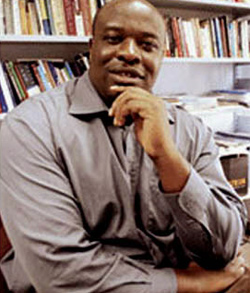
Zimbwean journalist targetted by the West.
Caesar Zvayi: Zimbabwean journalist targetted by the West.

The Media Institute of Southern Africa (MISA), which says it “seeks ways in which to promote the free flow of information and co-operation between media workers,” refused to condemn the sanctions the EU slapped on Zvayi and Huni. MISA is funded through USAID by the US State Department, through The Westminster Foundation for Democracy by the British Parliament, and through Fahamu by the European Union, the British Department for International Development, and the British Foreign and Commonwealth Office. Small wonder then that MISA refused to condemn the EU’s sanctions on journalists. [5] Zvayi, who landed a job as lecturer at the University of Botswana, was later fired and booted out of the country by its president for his association with The Herald. [6] It seems Botswana puts as little store in the free flow of information as MISA does. Predictably, MISA uttered not a word of protest about Botswana’s actions.

The Zimbabwe Guardian, also known as TalkZimbabwe.com, is a British-based online newspaper that offers a radically different take on what’s going on in Zimbabwe than found in the Western media, or in Western government-funded “independent” news sources, like Studio 7. While it would be going too far to say the newspaper is a Mugabe mouthpiece, it is conspicuously absent of the hysterical anti-Mugabe line that marks the British-based SW Radio Africa. This refusal to contribute to the limitless demonization of Mugabe has landed the online newspaper in hot water in the UK. On December 14, the UK newspaper, The Observer, reported that,

“…there are concerns that a website that carries articles written by UK-based Zimbabweans is acting as a propaganda machine for the Mugabe regime. Talkzimbabwe.com started life as a critic of Mugabe but in recent months has positioned itself strongly behind him and against his rival, Morgan Tsvangirai. Sekai Holland, a veteran political activist who has been targeted by the Mugabe regime, said she was worried the site had been ‘infiltrated’ by Zanu-PF supporters. ‘It’s very dangerous,’ Holland said. ‘This website is being used to spread stories in support of Mugabe.’” [7]

This portended the beginnings of a campaign of intimidation to disrupt The Zimbabwe Guardian for refusing to toe the West’s anti-Mugabe line. The campaign was given momentum when Lance Guma invited the website’s founder, Itayi Garande, onto SW Radio Africa’s “Reporters Forum.” Guma told Garande,

“A lot of people are saying in view of targeted sanctions that target people who are said to be aiding and abetting the regime and Mugabe, you qualify under that criteria, because you are supporting the regime from here in the United Kingdom and as a result you should be deported. What’s your response?” [8]

It was clear from what followed that Guma wasn’t particularly interested in Garande’s response; what he was interested in was building momentum for Garande’s eviction from the country and demonizing anyone who publicly challenges Western propaganda. This echoed an earlier media campaign to have an expatriate Zimbabwean who writes opinion pieces for The Herald fired from his job as a London transit worker for “aiding and abetting Mugabe,” that is, challenging the West’s campaign of vilifying the Mugabe government.

Talkzimbabwe.com founder targetted in Britain.
Itayi Garande: Talkzimbabwe.com founder targetted in Britain.

Interestingly, SW Radio Africa Guma’s view boils down to this: if you’re not writing propaganda for us (i.e., SW Radio Africa’s sponsors, the former colonial master, Britain) you’re writing propaganda for the other side. Guma would never use the word “propaganda” in connection with SW Radio Africa, though it’s clear that’s what Radio SW Africa does: it propagates a point of view (one congenial to British financial and corporate interests.) Garande, too, writes propaganda, as does anyone who writes to persuade others. The relevant question is: is the content of the persuasive communication true or false, and should someone be fired from his job, deported or sanctioned for writing it? The normative question can be skirted by pointing out that whether it ought to happen or not, it does happen, and it happens often. There is no free environment of public advocacy, no limitless freedom for one to say whatever he pleases with impunity, and there never has been. As George Galloway points out, no one could have marched through the streets of London in 1941 urging support for Hitler and escaped punishment. Today, it many places, no one can deny that Nazi Germany sought to systematically exterminate Jews without facing a jail sentence. You can say that journalism is different from persuasive communications related to political views, but that accepts the fiction that journalism is politically neutral. It never is, whether in the journalism of The Herald, The Zimbabwean Guardian, Radio SW Africa or The New York Times.

Political battles can be waged as much at the level of ideas as on the streets or in the battlefield. Those who engage in battle accept that as a consequence of joining the battle they may face adverse consequences, including death. While those who wage the battle from the field of persuasive communications face less severe penalties (though some are occasionally killed) they’re no more immune from some form of injury than a guerilla or insurrectionist is; they may be fired, deported or sanctioned.

As to the normative question, the answer depends on which value you place higher: the victory of your side in a political battle, or the right of others to advocate an opposing view to marshal support to defeat your side? When conflict represents exploitation versus the end of it, the question becomes, which is senior: The right to be free from exploitation or the right to justify it? There are similar conflicts: between protection of children from sexual exploitation and the right of pedophiles to advocate the production of child pornography; between the right of Africans to achieve true independence and the right of imperialists to demonize anti-imperialist movements to undermine them. Public advocacy rights ought never to be senior to the right to be free from exploitation and oppression. If they are, free expression becomes more important than freedom from exploitation. Inasmuch as exploiters, by virtue of the wealth that is the fruit of their exploitation of others, are likely to have greater access to platforms that allow their free expression of ideas to count, the view that the right of public advocacy is inviolable and absolute is congenial to their interests, but not to those of the exploited. The exploited and oppressed need to struggle to create their own platforms, and preserve the few they have, from the depredations of exploiters who would silence them, by intimidation or otherwise; at the same time, they must be prepared, where they have the upper hand, to subordinate the right of free expression to the right to be free from exploitation and oppression.

1. New African, May 2008.
2. TalkZimbabwe.com, August 1, 2008.
3. The Herald (Zimbabwe), May 29, 2008.
4. Ibid.
5. The Sunday Mail (Zimbabwe), July 26, 2008.
6. The Herald (Zimbabwe), August 9, 2008.
7. Jamie Doward, “Key Mugabe ally is free to live in London,” The Observer (UK), December 14, 2008.
8. http://www.swradioafrica.com/audio221208/rf221208.wma


Jestina Mukoko

By Gowans

Western media have recently raised alarm over the arrest of anti-Mugabe activist Jestina Mukoko, leader of the Zimbabwe Peace Project. Mukoko has been accused of trying to recruit government opponents for military training to overthrow the Mugabe government. [1] Mukoko’s arrest has been condemned as illegitimate by the Western media, and the Zimbabwe government’s accusations against Mukoko have been dismissed as unfounded.

Anti-Mugabe activist Jestina Mukoko has been accused of trying to recruit a militia to overthrow the Mugabe government.

Unlike the Western media, which is certain that any charge by Mugabe against his opponents is false, (and that any charge by Mugabe opponents against Mugabe is true), I have no idea whether Mukoko has been involved in a plot to recruit government adversaries for military training or not. I do believe, however, that the accusation can’t be dismissed out of hand. There is sufficient evidence to tie Mukoko to efforts to overthrow the Mugabe government. The accusation must, therefore, be regarded as credible on the surface. At the same time, however, it must be acknowledged that plausibility does not equal proof, and that Mukoko may indeed be innocent.

Let’s place the accusation in context.

Mugabe’s government is trying to free Zimbabwe from neo-colonialism. Neo-colonialism is the condition in which a former colony, while winning a nominal political independence, has failed to achieve economic independence. Under neo-colonialism, the pattern of ownership of a country’s productive assets remains largely unchanged from colonial times. The newly “independent” government takes over the country’s administrative tasks, while settlers and the former colonial masters continue to reap the benefits of owning the country’s productive assets and natural resources. Since challenging the pattern of ownership threatens to touch off an economic crisis and invite intervention from outside, newly independent governments typically shy away from anti-neo-colonial measures, seeking to accommodate, rather than antagonize, settlers and outside owners. This has not been the Mugabe government’s approach since the late 1990s.

After independence, a tiny minority of people of European descent continued to own the most productive farmland, while ownership of the country’s mineral wealth remained largely in the hands of outsiders. Access to credit and development aid from international lending institutions was made contingent on adopting economic policies that favored the economic elite of donor countries, i.e., the same outsiders who already dominated the economy. The prospect for the indigenous population, then, was one of continued life as either landless peasants or employees of companies controlled from afar. This, in fact, was the same condition most people lived under, under colonial rule.

Mugabe’s government began to challenge Zimbabwe’s neo-colonial status around 2000, with the predictable consequence of economic backlash, as the US, Britain and the European Union imposed sanctions and blocked Zimbabwe’s access to international lines of credit, and built up an internal opposition to destabilize the country. The Mugabe government’s challenge to neo-colonialism came in the form of a fast track land reform program to redistribute land owned by 4,000 famers of European descent to 300,000 landless families [2] and indigenization laws that would see either the government or indigenous Zimbabweans take controlling stakes in all foreign-owned banks and companies.” [3]

To derail the Mugabe government’s efforts, Western powers, whose banks and corporations benefit from neo-colonialism, created a new political party out of Zimbabwe’s civil society. The MDC, the Movement for Democratic Change, would seek to remove Mugabe’s government and reverse its offending anti-neo-colonial policies, through electoral challenges, and by crying foul whenever electoral challenges failed. Mugabe would be accused of rigging elections (long before they had been held), and supporters of the MDC would be called into the streets whenever their party lost, in an effort to recreate the color-coded revolutions that Western governments had promoted to topple governments elsewhere. Like the parties that had benefited from Western-guided color revolutions in other countries, Zimbabwe’s MDC was in favour of keeping the levers of the economy firmly in the hands of outsiders (which is to say, in the hands of the same forces that back the party and shape its policies. [4])

At the same time, the US Congress, through its National Endowment for Democracy (NED), and the US State Department, through its United States Agency for International Development (USAID), took a hand in nurturing and strengthening Zimbabwe’s civil society as a pole of opposition to the Mugabe government. This is where Mukoko comes in. While anti-Mugabe activists are depicted as independents who challenge the government through grassroots efforts, they are almost invariably funded, aided, advised and mentored by Western governments working through foundations and agencies. There is very little that is independent or spontaneous about them.

Mukoko is a member of the board of the Zimbabwe Election Support Network (ZESN), an organization which is interlocked with a number of other Western-funded anti-Mugabe groups, and which receives its funding from the NED and USAID. The NED was established after the CIA was implicated in the covert funding of foreign political parties, trade unions, journals, newspapers, church groups and in the publication of anti-Communist literature, including George Orwell’s Animal Farm. Rather than getting out of the illegitimate business of nurturing foreign organizations to advance US financial and corporate interests abroad, Washington decided that the taint of covert CIA backing could be avoided by separating these activities from the CIA and bringing them out into the open. And so the NED was born. [5] Mukoko, then, is a senior member of an organization whose funding comes from the successor to a CIA program which shares the same mandate – to nurture organizations which operate, whether consciously or not, to advance the interests of US banks and corporations overseas. The ZESN’s other funder, USAID, boasts that it is the undisputed leader in nurturing anti-government civil society opposition in Zimbabwe. It operates through a CIA-interlocked organization led by former New York investment banker and Michael Milken right-hand man, Peter Ackerman. [6] Revealing the organization’s true mandate, USAID Assistant Administrator for Africa, Katherine Almquist, says her agency is prepared to re-engage with Zimbabwe (in a friendly way) once Zimbabwe shows “respect for property rights” [7] – that is, once the Mugabe government’s challenges to the patterns of ownership established under colonialism are reversed.

Nobel Peace Prize Laureate Archbishop Desmond Tutu, who has called for military intervention to topple the Mugabe government, with another bogus advocate of peace, the Dalai Lama.

The Mugabe government has gone beyond simply accusing Mukoko of wanting to overthrow the government – it has accused her of wanting to do so violently by recruiting government opponents for military training. Is this credible? The Western media dismiss the accusation out of hand, as if violence is the farthest thing from the minds of Mugabe’s opponents, and could hardly be embraced by the leader of a “peace project.” But is it? A Nobel Peace Prize Laureate and men of the cloth have been among the most bloodthirsty proponents of military intervention in Zimbabwe. And one in particular, South African Nobel Peace Prize Laureate Archbishop Desmond Tutu, is among the most ardent advocates of the use of violence to topple the Mugabe government. On June 27, Tutu announced that “the world had the right to intervene in Zimbabwe and that African countries should blockade landlocked Zimbabwe.” [8] Earlier this month he “said on Dutch TV that Mugabe must stand down or be removed ‘by force’.” [9] A few days later he told BBC radio that the African Union should launch a military assault to oust the Zimbabwean president. [10] But when the MDC warned before the last elections that a Mugabe victory would spark violence, Tutu’s lust for violence was nowhere in evidence. Instead, he urged Mugabe to step down to avert the threat of bloodshed. “Anything that would save the possibilities of bloodshed, of conflict, I am quite willing to support,” he said, adding that “the people of Zimbabwe have suffered enough, and we don’t…want any more possibilities of bloodshed.” [11] And yet today Tutu calls for the bloodshed and violence of a military invasion and wishes a blockade upon the people of Zimbabwe who “have suffered enough.” He’s for peace, when peace means Mugabe stepping down, and for war, when war means Mugabe being toppled. In other words, he’s for Mugabe’s ouster, whether brought about peacefully or not. In July, 2007, the now discredited Archbishop of Bulawayo, Pius Ncube, one of Tutu’s fellow clergymen, urged Zimbabweans to take up arms against their government, claiming he was “ready to lead the people, guns blazing.” [12] When he realized his charge, guns blazing, would be a lonely one, he urged “Britain to raid Zimbabwe and remove Mugabe.” [13] For his part, the Archbishop of York, Dr. John Sentamu, a black Ugandan, has urged Britain to bury its “colonial guilt” and lead a charge to remove Mugabe by violence. [14] The strategy is clear: Recruit black Africans to demand a military assault to grant the West permission (more than that, to beseech the West) to oust Mugabe by force. And so, we can ask: If black African Churchmen acting on behalf of Western masters can advocate violence to topple the Mugabe government, is the idea of a black African civil society activist bound up with the NED and USAID acting to do the same really so absurd?

Of course, what’s credible is not always what is. Mukoko may indeed be innocent of the charge of participating in the recruitment of a militia. But we shouldn’t be prepared to dismiss the accusation as unfounded, simply because the Western media has. We can be clear on a few points: Mukoko is an adversary of the Zimbabwe government — she would like to see it toppled; the successor to the Mugabe government, if it is brought down, will be the Morgan Tsvangirai-led MDC; the MDC will immediately move to reverse the Mugabe government’s anti-neo-colonial policies; land reform will be halted, if not reversed, pro-foreign investment policies will be implemented to secure IMF and World Bank loans, and foreign ownership controls will be abandoned; black Zimbabweans will return to the colonial condition of being landless peasants and employees of companies controlled from outside.

Zimbabweans, then, face a choice: between breaking free from neo-colonialism or giving free reign to civil society activists, like Mukoko, to bring down the only government that, at this point, will realistically pursue anti-neo-colonial policies. If Mukoko is guilty of recruiting a militia, she should be jailed. At this point, the idea that the accusation against her is a preposterous one carries no weight.

Update, September 28, 2009.

Mukoko and her co-accused were granted a permanent stay of criminal prosecution by Chief Justice Chidyausiku, who ruled the state violated their constitutional rights when it detained them unlawfully and failed to bring them to court within 48 hours of their arrest, as mandated under the Police Act.

1. Associated Press, December 24, 2008.
2. Robert Mugabe. Address to the FAO, June 3, 2008.
3. Ranganai Chidemo, “Mugabe warns industry and the financial sector,” talkzimbabwe.com, December 21, 2008.
4. Stephen Gowans, “US Government Report Undermines Opposition’s Claim of Independence,” What’s Left, October 4, 2008, https://gowans.wordpress.com/2008/10/04/us-government-report-undermines-zimbabwe-opposition%e2%80%99s-claim-of-independence/
5. Michael Barker, “The New York Times “Reports”
On The National Endowment For Democracy,” swans.com, October 20, 2008. http://www.swans.com/library/art14/barker06.html#24
6. Stephen Gowans, “US Government Report Undermines Opposition’s Claim of Independence,” What’s Left, October 4, 2008, https://gowans.wordpress.com/2008/10/04/us-government-report-undermines-zimbabwe-opposition%e2%80%99s-claim-of-independence/
7. Testimony of Katherine Almquist, USAID Assistant Administrator for Africa, “The Crisis in Zimbabwe and Prospects for Resolution.” Subcommittee on African Affairs, Committee on Foreign Relations, United States Senate, July 15, 2008.
8. Reuters, June 27, 2008.
9. Tracy McVeigh, “Mugabe must be toppled now – Archbishop of York,” The Guardian (UK), December 7, 2008.
10. “Tutu calls for threat of force to deal with Mugabe,” Associated Press, December 14, 2008.
11. “Mugabe must step down with dignity,” The Times (London) April 2, 2008.
12. Sunday Times (UK), July 1, 2007.
13. Ibid.
14. Observer (UK), September 16, 2007.

Venezuelan goverment on Zimbabwe’s cholera epidemic

The government of the Bolivarian Republic of Venezuela, on behalf of the Venezuelan people, expresses its solidarity with the people of the Republic of Zimbabwe during this public health crisis caused by a cholera epidemic that is hitting this brother country in southern Africa. Likewise, the government of the Bolivarian Republic of Venezuela manifests its firm rejection of the use of this emergency situation by outside factors to politically destabilize Zimbabwe, its government, and the twisting of national dialogue and regional mediation taking place in this Republic for a Zimbabwean agreement. (Emphasis added.)

The people of the Bolivarian Republic of Venezuela, upset over the 1,111 victims of cholera and nearly 20,000 cases of infected people, offer their condolences to affected families, and expresses their solidarity during this difficult time.

President Hugo Chávez, on behalf of the Venezuelan people, calls upon the international community to contribute medicine and doctors to control the cholera epidemic in Zimbabwe. He also manifests his solidarity with the people of Zimbabwe, hopes this difficult situation will be overcome, and expresses his support for the independent government of Zimbabwe in its efforts for stability and peace in this brother country of Africa.

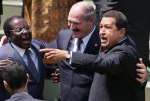
Mugabe, Belarus President Lukashenko and Chavez
Axis of resistance: Mugabe, Belarus President Lukashenko and Chavez

Ministry of People’s Power for Foreign Affairs, Unofficial translation by the Embassy of the Bolivarian Republic of Venezuela Press Office / December 19, 2008

Three questions to ask about Zimbabwe’s cholera outbreak

Angola reported 82,000 cases of cholera last year and over 3,000 deaths – five times as many cases as Zimbabwe has experienced this year and four times as many deaths. [1] The West, which has substantial investments in Angolan oil, did not say that Angola was approaching failed state status, call for its government to step down, or seek authorization to forcibly remove it.

The Nigerian Supreme Court recently ruled that the country’s April 2007 elections were marred by widespread voting irregularities. Election observers declared the elections to be fraudulent and criticized the government for using violence and intimidation. Despite being the second wealthiest country in Africa, most Nigerians have no access to clean drinking water and basic healthcare. Western oil firms have substantial investments in Nigeria. They profit, while most Nigerians live in abject poverty. [2] The West has not said that Nigeria is approaching failed state status, called for its government to step down, or sought authorization to forcibly remove it.

By Gowans

Western powers have tried many ways to bring down the Mugabe government of Zimbabwe. They’ve created a political party, the MDC, whose policy platforms they’ve had a hand in shaping, to contest elections. They’ve nurtured human rights and other civil society groups to oppose the Mugabe government. They’ve funded community newspapers to spread anti-government propaganda. They’ve financed short-wave radio programs to broadcast anti-Mugabe programming. [3] They’ve materially backed campaigns of civil disobedience, in failed attempts to foment a color revolution. [4] And they’ve blocked, through the US Zimbabwe Democracy and Economic Recovery Act of 2001 (the act), Zimbabwe’s access to balance of payment support and development aid. [5] All of these attempts to force the Mugabe government into submission have failed.

I’ve elaborated elsewhere on the reasons why Western powers have sought Mugabe’s ouster. [6] The reasons can be briefly summarized as follows: the Mugabe government has acted to thwart imperialist designs on the Democratic Republic of Congo; it opposed the pro-foreign investment policies of the International Monetary Fund; it expropriated income-producing property (farms owned by Europeans and descendants of white settlers) without compensation — an affront against private property that the United States, the guarantor of the imperialist system, could not let stand.

The way the Western media tell the story, Zimbabweans are eager to see Mugabe go. But despite Western powers acting to poison public opinion against Mugabe, the Zanu-PF government retains considerable popular support. One indication that Mugabe commands the backing of at least a sizeable minority of the population is that the United States has acknowledged that “a popular Zimbabwean uprising against Mugabe is unlikely.” [7] In elections earlier this year, which featured massive Western interference on the side of the opposition, Mugabe’s Zanu-PF party won roughly half of the legislative assembly seats and roughly half of the Senate seats. In the first round of presidential voting, Mugabe got over 40 percent of the vote – despite the considerable pressure Western powers put on Zimbabweans to reject the national liberation hero. With the president retaining strong backing, Western powers are now using a cholera outbreak — a not uncommon event in poor countries — to argue that Zimbabwe has become a failed state. By making the case that Zimbabwe’s government is no longer able to provide its citizens with basic hygiene and access to safe drinking water, Western powers hope to either secure a United Nations Security Council Resolution authorizing the use of force to oust Mugabe, or to pressure Zimbabwe’s neighbors to close their borders to the landlocked country, starving the government – and the people of Zimbabwe — into submission. “The closure of the borders, literally, in a week, would bring this country to its knees,” said a US official. [8] The readiness to escalate the misery Zimbabweans already endure with a total blockade undermines the Western powers’ own claim that they are galvanized to act by humanitarian concern. One needn’t be reminded that the greatest existing humanitarian catastrophes – to wit, Iraq and the Democratic Republic of Congo – have been authored by the United States and Britain (directly in Iraq and through Rwanda and Uganda in the Congo). These are the very same powers that claim a “responsibility to protect.”

According to the World Health Organization, there were over 16,000 cases of cholera in Zimbabwe as of December 9, and 775 deaths. The WHO attributes the outbreak to an under-resourced and under-staffed health care system, and to inadequate access to safe drinking water. We should ask three questions. [9]

1. How common are cholera outbreaks in the Third World?

2. Have Western powers sought to forcibly remove governments in other countries that have suffered comparable or greater cholera outbreaks?

3. Why is Zimbabwe’s health care system under-resourced and under-staffed and why do Zimbabweans have inadequate access to safe drinking water?

Cholera outbreaks are hardly rare in the Third World. Between 13 February 2006 and 9 May 2007, there were over 82,000 cases of cholera and almost 3,100 deaths in Angola [10]. Since May, there have been 13,781 cases of cholera in Guinea-Bisseau, with 221 deaths as of November. [11] There were 14,297 cases and 254 deaths in Tanzania in 2006 [12]. Last year, there were 30,000 cases of cholera in Iraq [13], almost twice as many as in Zimbabwe this year. In 2005, cholera swept through Western Africa, affecting 45,000 people in eight countries. [14] In none of these cases did Western powers call for the governments of the affected countries to step down, or seek authorization to remove them by force.

The inadequacies of Zimbabwe’s health care system are due, in part, to doctors being lured away by the higher wages and better working conditions of the West. There are more than 13,000 doctors trained in sub-Saharan Africa who are now practicing in the United States, Britain, Canada and Australia. [15] This, according to the British medical journal, The Lancet, has led to the “dilapidation of health infrastructure” and has threatened to produce a “public health crisis.” The West’s pilfering of sub-Saharan Africa’s doctors is “an international crime.” [16]

Zimbabwe’s health care system is also affected by the economic devastation wrought by the United States denying the country access to balance of payment support and development aid. If doctors are lured to the West under the best of circumstances, the incentives for abandoning a Zimbabwe in a virtual state of economic collapse are irresistible. Add to that the reality that hyperinflation – a by-product of Harare’s attempts to deal with foreign exchange shortages caused by the act – has eroded the purchasing power of Zimbabwe’s currency, deterring medical staff (and employees generally) from showing up for work. The act has also undermined the government’s ability to secure funds to make needed repairs to water and sewage treatment infrastructure and to import water purification chemicals. While the purveyors of misinformation at the New York Times and other Western media outlets attribute the cholera outbreak to what are called Mugabe’s “disastrously failed policies,” the origins lie closer to home.

1. http://www.who.int/cholera/countries/Angola%20country%20profile%202007.pdf

2. Will Connors, “Legal victory can’t erase Nigerian leader’s troubles,” The New York Times, December 13, 2008.

3. http://pdf.usaid.gov/pdf_docs/PDACL121.pdf ; https://gowans.wordpress.com/2008/10/04/us-government-report-undermines-zimbabwe-opposition%e2%80%99s-claim-of-independence/

4. https://gowans.wordpress.com/2008/04/27/expressions-of-imperialism-within-zimbabwe/

5. http://frwebgate.access.gpo.gov/cgi-bin/getdoc.cgi?dbname=107_cong_bills&docid=f:s494enr.txt.pdf

6. https://gowans.wordpress.com/2008/12/08/cholera-outbreak-outcome-of-west%e2%80%99s-war-on-zimbabwe/

7. US Government, “Zimbabwe approaching ’failed state’ status, U.S. ambassador says,” December 11, 2008. http://www.america.gov/st/democracy-english/2008/December/20081211164826esnamfuak0.6706354.html?CP.rss=true

8. Ibid.

9. http://www.who.int/mediacentre/news/releases/2008/pr49/en/index.html

10. http://www.who.int/cholera/countries/Angola%20country%20profile%202007.pdf

11. http://www.who.int/cholera/countries/GuineaBissauCountryProfile2008.pdf

12. http://www.who.int/cholera/countries/TanzaniaCountryProfile2008.pdf

13. http://www.who.int/cholera/countries/IraqCountryProfile2007.pdf

14. http://www.who.int/csr/don/2005_09_23/en/index.html

15. The Lancet, cited in Reuters, February 22, 2008.

16. Ibid.

Cholera Outbreak Outcome of West’s War on Zimbabwe

By Gowans

The crisis in Zimbabwe has intensified. Inflation is incalculably high. The central bank limits – to an inadequate level – the amount of money Zimbabweans can withdraw from their bank accounts daily. Unarmed soldiers riot, their guns kept under lock and key, to prevent an armed uprising. Hospital staff fail to show up for work. The water authority is short of chemicals to purify drinking water. Cholera, easily prevented and cured under normal circumstances, has broken out, leading the government to declare a humanitarian emergency.

In the West, state officials call for the country’s president, Robert Mugabe, to step down and yield power to the leader of the largest faction of the Movement for Democratic Change, Morgan Tsvangirai. In this, the crisis is directly linked to Mugabe, its solution to Tsvangirai, but it’s never said what Mugabe has done to cause the crisis, or how Tsvangirai’s ascension to the presidency will make it go away.

The causal chain leading to the crisis can be diagrammed roughly as follows:

• In the late 90s, Mugabe’s government provokes the hostility of the West by: (1) intervening militarily in the Democratic Republic of Congo on the side of the young government of Laurent Kabila, helping to thwart an invasion by Rwandan and Ugandan forces backed by the US and Britain; (2) it rejects a pro-foreign investment economic restructuring program the IMF establishes as a condition for balance of payment support; (3) it accelerates land redistribution by seizing white-owned farms and thereby committing the ultimate affront against owners of productive property – expropriation without compensation. To governments whose foreign policy is based in large measure on protecting their nationals’ ownership rights to foreign productive assets, expropriation, and especially expropriation without compensation, is intolerable, and must be punished to deter others from doing the same.

• In response, the United States, as prime guarantor of the imperialist system, introduces the December 2001 Zimbabwe Democracy and Economic Recovery Act. The act instructs US representatives to international financial institutions “to oppose and vote against any extension by the respective institution of any loan, credit, or guarantee to the Government of Zimbabwe; or any cancellation or reduction of indebtedness owed by the Government of Zimbabwe to the United States or any international financial institution.”

• The act effectively deprives Zimbabwe of foreign currency required to import necessities from abroad, including chemicals to treat drinking water. Development aid from the World Bank is also cut off, denying the country access to funds to upgrade its infrastructure. The central bank takes measures to mitigate the effects of the act, creating hyper-inflation as a by-product.

The cause of the crisis, then, can be traced directly to the West. Rather than banning the export of goods to Zimbabwe, the US denied Zimbabwe the means to import goods — not trade sanctions, but an act that had the same effect. To be sure, had the Mugabe government reversed its land reform program and abided by IMF demands, the crisis would have been averted. But the trigger was pulled in Washington, London and Brussels, and it is the West, therefore, that bears the blame.

Sanctions are effectively acts of war, with often equivalent, and sometimes more devastating, consequences. More than a million Iraqis died as a result of a decade-long sanctions regime championed by the US following the 1991 Gulf War. This prompted two political scientists, John and Karl Mueller, to coin the phrase “sanctions of mass destruction.” They noted that sanctions had “contributed to more deaths in the post Cold War era than all the weapons of mass destruction in history.”

The Western media refer to sanctions on Zimbabwe as targeted – limited only to high state officials and other individuals. This ignores the Zimbabwe Democracy and Economic Recovery Act and conceals its devastating impact, thereby shifting responsibility for the humanitarian catastrophe from the US to Mugabe.

The cholera outbreak has a parallel in the outbreak of cholera in Iraq following the Gulf War. Thomas Nagy, a business professor at George Washington University, cited declassified documents in the September 2001 issue of The Progressive magazine showing that the United States had deliberately bombed Iraq’s drinking water and sanitation facilities, recognizing that sanctions would prevent Iraq from rebuilding its water infrastructure and that epidemics of otherwise preventable diseases, cholera among them, would ensue. Washington, in other words, deliberately created a humanitarian catastrophe to achieve its goal of regime change. There is a direct parallel with Zimbabwe – the only difference is that the United States uses the Zimbabwe Democracy and Economic Recovery Act – that is, sanctions of mass destruction – in place of bombing.

Harare’s land reform program is one of the principal reasons the United States has gone to war with Zimbabwe. Zimbabwe has redistributed land previously owned by 4,000 white farmers to 300,000 previously landless families, descendants of black Africans whose land was stolen by white settlers. By contrast, South Africa’s ANC government has redistributed only four percent of the 87 percent of land forcibly seized from the indigenous population by Europeans.

In March, South Africa’s cabinet seemed ready to move ahead with a plan to accelerate agrarian reform. It would abandon the “willing seller, willing buyer” model insisted on by the West, following in the Mugabe government’s footsteps. Under the plan, thirty percent of farmland would be redistributed to black farmers by 2014. But the government has since backed away, its reluctance to move forward based on the following considerations.

1. Most black South Africans are generations removed from the land, and no longer have the skills and culture necessary to immediately farm at a high level. An accelerated land reform program would almost certainly lower production levels, as new farmers played catch up to acquire critical skills.

2. South Africa is no longer a net exporter of food. An accelerated land reform program would likely force the country, in the short term, to rely more heavily on agricultural imports, at a time food prices are rising globally.

3. There is a danger that fast-track land reform will create a crisis of capital flight.

4. The dangers of radical land reform in provoking a backlash from the West are richly evident in the example of Zimbabwe. South Africa would like to avoid becoming the next Zimbabwe.

Zimbabwe’s economic crisis is accompanied by a political crisis. Talks on forming a government of national unity are stalled. Failure to strike a deal pivots on a single ministry – home affairs. In the West, failure to consolidate a deal between Mugabe’s Zanu-PF party and the two MDC factions is attributed to Mugabe’s intransigence in insisting that he control all key cabinet posts. It takes two to tango. Tsvangirai has shown little interest in striking an accord, preferring instead to raise objections to every solution to the impasse put forward by outside mediators, as Western ambassadors hover nearby. It’s as if, with the country teetering on the edge of collapse, he doesn’t want to do a deal, preferring instead to help hasten the collapse by throwing up obstacles to an accord, to clear the way for his ascension to the presidency. When the mediation of former South African president Thambo Mbeki failed, Tsvangirai asked the regional grouping, the SADC, to intervene. SADC ordered Zanu-PF and the MDC to share the home affairs ministry. Tsvangirai refused. Now he wants Mbeki replaced.

At the SADC meeting, Mugabe presented a report which alleges that MDC militias are being trained in Botswana by Britain, to be deployed to Zimbabwe early in 2009 to foment a civil war. The turmoil would be used as a pretext for outside military intervention. This would follow the model used to oust the Haitian government of Jean-Bertrand Aristide. Already, British officials and clergymen are calling for intervention. British prime minister Gordon Brown says the cholera outbreak makes Zimbabwe’s crisis international, because disease can cross borders. Since an international crisis is within the purview of the “international community,” the path is clear for the West and its satellites to step in to set matters straight

Botswana is decidedly hostile. The country’s foreign minister, Phando Skelemani, says that Zimbabwe’s neighbors should impose an oil blockade to bring the Mugabe government down.

Meanwhile, representatives of the elders, Jimmy Carter, Kofi Anan and Graca Machel sought to enter Zimbabwe to assess the humanitarian situation. Inasmuch as an adequate assessment could not be made on the whistle-stop tour the trio had planned, Harare barred their entry, recognizing that the trip would simply be used as a platform to declaim on the necessity of regime change. The elders’ humanitarian concern, however, didn’t stop the trio from agreeing that stepped up sanctions – more misery for the population — would be useful.

The Mugabe government’s pursuit of land reform, rejection of neo-liberal restructuring, and movement to eclipse US imperialism in southern Africa, has put Zimbabwe on the receiving end of a Western attack based on punitive financial sanctions. The intention, as is true of all Western destabilization efforts, has been to make the target country ungovernable, forcing the government to step down, clearing the way for the ascension of the West’s local errand boys. Owing to the West’s attack, Zimbabwe’s government is struggling to provide the population with basic necessities. It can no longer provide basic sanitation and access to potable water at a sufficient level to prevent the outbreak of otherwise preventable diseases.

The replacement of the Mugabe government with one led by the Movement for Democratic Change, a party created and directed by Western governments, if it happens, will lead to an improvement in the humanitarian situation. This won’t come about because the MDC is more competent at governing, but because sanctions will be lifted and access to balance of payment support and development aid will be restored. Zimbabwe will once again be able to import adequate amounts of water purification chemicals. The improving humanitarian situation will be cited as proof the West was right all along in insisting on a change of government.

The downside is that measures to indigenize the economy – to place the country’s agricultural and mineral wealth in the hands of the black majority – will be reversed. Mugabe and key members of the state will be shipped off to The Hague – or attempts will be made to ship them off – to send a message to others about what befalls those who threaten the dominant mode of property relations and challenge Western domination. Cowed by the example of Zimbabwe, Africans in other countries will back away from their own land reform and economic indigenization demands, and the continent will settle more firmly into a pattern of neo-colonial subjugation.

Obama and Miracles that Never Happen

By Gowans

If 10 times more people claimed to have attended Woodstock than were actually there, I suspect 10 times more people claim to have wept at Obama’s election victory than actually did. Weeping on the night of November 4 – or claiming you did — has now become a fashion. I, too, wept, though not because Obama won, but because the number of times I heard the words “Obama is the embodiment of hope” was too much to bear.

The day before the election, my son called me from school.

“I was just interviewed on Obama for the national news,” he related excitedly.

“”How’d that happen?”

“Actually, it was a group of us who were interviewed. I’m not sure I’m going to make it on the newscast, though. The reporter was looking for gushing reactions, and I pointed out that I had some concerns about Obama because he had received more in corporate donations than McCain had. I don’t think that’s quite what she was looking for.”

No mistake there. Two days later the segment aired in the last 10 minutes of an hour-long news show devoted to documenting (and manufacturing) excited reactions to the Obama victory. After 50 minutes of Europeans, Asians, Africans and Latin Americans delivering encomia on the Obama victory, my son’s chance at a brief moment of public exposure arrived. A group of high-school students, my son among them, is seen walking into a room. The reporter turns to each in turn and asks, “What do you think of Obama?” The first, a young man born in Canada to Chinese parents, says he identifies with Obama, because they’re both ethnic minorities. Another talks of hope. A third says she gets shivers down her spine whenever she hears Obama talk. (Demonstrating a talent for prophecy, my son predicts two days earlier that “She’ll make it on the newscast for sure.”) And so it goes, each student joining in the celebration, because, wasn’t that the implicit contract? Gush over Obama, and see yourself on TV. My son, whose concerns over Obama’s netting more corporate donations than McCain clashed impolitely with the intoxicated atmosphere of Obama worship, became a voiceless image; the one student who, for reasons never explained, was seen, but not heard, on camera.

To those grasping at straws, the election of a black man as president signals the recession of anti-black racism in the United States. For the gullible, it signals the dawn of a new age of hope.

There have been black people in numerous positions of power in the US before, from CEOs to mayors to governors to secretaries of state to the country’s top soldier. Now we can add president. Will anything of substance change because of this? Obama’s victory hasn’t caused anti-black racism to recede; it is, instead, a consequence of this. Will a black man in the White House make clear to the romantics who haven’t figured it out yet that black people are no different from white people, equally capable of oppressing, exploiting, plundering and killing on a massive scale? Add that liberals are as capable of these things as conservatives, and Obama, the black liberal president, offers no hope of departure from the accustomed trajectory.

Despite its recession, anti-black racism has only receded to the point where a privileged black man with rare forensic talents, the massive backing of the corporate community, and the help of the best marketing talent money can buy, can get elected; it has by no means disappeared, nor receded enough to make a substantial difference in the lives of most black people.

But for black people there’s inspiration to be found in one of their own ascending to the highest office in the land. The joy is misplaced. The only thing Obama shares in common with 99 percent of blacks in the United States is the color of his skin, and skin color, when you get right down to it, is only of consequence to bigots who continue to embrace the echo of a racist ideology once used by slave-owners (who happened to be white) to justify exploitation of slaves (who happened to be black.) If you’re going to screw people over, it’s useful to have a body of legitimizing ideas; after all, who wants to come face to face with the reality that he’s an unconscionable prick living off the toil of others? That’s where racism comes in handy. And if we’re talking about people exploiting others of the same skin color, there’s a whole other body of ideas to justify that, which, in these days of thin class consciousness, most of us mistake for common sense. To be sure, skin color does matter to the victims of racism because they can’t escape the fact that the bigots who continue to embrace the echo of a racist ideology keep making a fuss about it. But that makes Obama as much like them as George Bush is like me.

Come to think of it, George and I are alike in many ways. We’re middle aged; we both trip over words; we’re white; we’re male. But so what? George comes from a ruling class family; my forebears worked in factories, did manual labor, and in recent years, ascended to the ranks of the white-collar proletariat, deluding themselves that by wearing a tie and acting “professional” they had transcended their class. George snorted coke; I worked in a pharmaceutical factory for his friend Donald Rumsfeld. George went to Yale and the Harvard Business School on his family’s money; I went to two undistinguished public universities, one located in the gritty industrial city of Hamilton, Ontario, paying subsidized tuition with money saved up working at a grocery store. Whatever we have in common is picayune next to what sets us apart.

The very best comment I’ve heard on the Obama victory comes from Mickey Z. Obama’s ascendancy, he said in a Dec 1 interview published in the British newspaper, The Morning Star, “is an excellent illustration of how the system handles dissent. A black face, a soothing voice and a vague message of change – all designed to keep the rabble pacified without changing anything at all.”

While a debate whirled around me during the days leading up to the election over the question of whether leftists ought to vote for Obama or opt for someone who wasn’t going to put more boots on Afghan soil and rattle the Pentagon’s sabre at Iran, I kept my counsel. For one thing, I’m not a US citizen. The job of everyone else in the world is to bear the brunt of the stupid decisions Americans make. As much as the rest of us wish the consequences of their choices were limited to the US, sadly, what happens in the United States often has dire consequences for those living everywhere else. For another, all the reasons for not voting for a Democrat or Republican had been made cogently and repeatedly before, apparently, to no avail, and having exceeded my limit in flogging dead horses, I was tapped out. What’s more, it was clear that the Obama-supporters had formed an impermeable seal around their brains that admitted no appeal to reason. This was to be a purely emotional choice; hence, the tears of joy on election night.

While a vote for Nader had its merits, I couldn’t help but wonder whether the Nader-supporters shared a delusion with the Obama-backers – that of believing that the right person in the Oval Office would make a difference. Americans might be excused for this delusion; after all, they’ve never elected a leftwing president and therefore have been spared the cold blast of reality that disappoints those who’ve worked to elect a leftwing government. Had they not been deprived of this sobering experience, they would recognize their faith in third party politics for the naïveté it is. A quick survey of what has happened when social democrats, socialists and even communists have won elections and formed governments with a program of reforming the system from within, leaves no doubt as to the possible outcomes. A new socialist age is not one of them. Either the new government:

o Recognizes that it must cater to the imperatives of the system it has chosen to work within to prevent its rule from being destabilized, and therefore behaves as any other pro-capitalist government does.

o Boldly introduces anti-capitalist reforms, only to suffer a backlash as investors and businesses withdraw their capital and refuse to make further investments. This provokes an economic crisis, and the government’s supporters, menaced by rising unemployment or shortages or rampant inflation, withdraw their support.

o Is ousted in a military or fascist coup.

o Is destabilized by outside forces.

Only where the energy of the bulk of people has been mobilized to tear the system down and replace it with one friendly to popular interests, have leftwing forces prevailed for any substantial period.

How is it, then, that substantial reforms, such as the public health care systems of Western Europe and Canada, came into being, if not by the agency of leftwing governments voted into power to reform the system from within? The truth of the matter is that reforms were just as likely to be introduced by conservatives as social democrats (and none of the reforms ushered in by Western governments, often as Cold War expediency, ever matched the programs established under Marxist-Leninist governments in the Soviet Union and Eastern European.) It was Bismark and Gladstone – hardly lefties — who introduced the first modern social welfare programs. The basis for social security in the US came not from the Democrats or organized labor, but from the Rockefeller-founded Industrial Relations Counselors Inc., to head off labor unrest. While a Labour government was introducing the NHS in Britain, conservative governments on the continent were introducing their own NHS equivalents. And in Canada, it was the conservative government of John Diefenbaker that introduced the Hospital Insurance and Diagnostic Services Act of 1957. Social democrats have claimed social programs as their own, but they can lay no claim to being the sole parents, and have just as often been involved in dismantling the reforms predecessor (and often conservative) governments had introduced.

The programs pursued by governments are shaped by the circumstances they encounter, surrounding events, and for those with reformist aims, by the constraints of the constitutional system and the logic of the capitalist system they’ve chosen to work within. Left-leaning governments bow to the demands of the capitalist economy to survive; conservative governments introduce reforms and concessions to head off labor militancy. Often these constraints are ignored by critics, who assume implicitly that the right person, once elevated to a position of power, is free to make history as he pleases. “Once our man is in power, just wait to see what happens.” The answer is often, more of the same, or policies the government’s backers revile.

Across from me sits a book on whose spine is written “Giving Away a Miracle.” It’s the story of the unlikely election in the 90s of a social democratic government in Ontario (the miracle.) The giving away began the very same night the party was elected, as its leader began beating a hasty retreat from the party’s campaign promises. It ended with the party, the supposed voice of organized labor, tearing up collective agreements it had negotiated with public sector unions.

The transformation from rhetorical champion of the average worker to just another pro-capitalist government was inevitable. The promises made – among them public auto insurance — would have ended in a messy fight with corporate Canada. Investments would be delayed, capital would be taken out of the province, and jobs would be lost. The news media, which exert a powerful influence in shaping public opinion, were uniformly hostile, warning that the new government would turn Ontario into an economic basket-case. The only way the government could have pursued its agenda was to have had massive popular support, toughened by the people’s readiness to suffer the inevitable blows that the corporations whose interests would be encroached upon, would rain upon the province. This, the government didn’t have, nor could have for long under circumstances in which conservative forces were allowed to continue to control the means of production and means of persuasion. What would have truly been a miracle is if the powerful opponents of the government’s agenda had stepped aside in deference to the people’s will and allowed anti-capitalist reforms to go ahead. But this never happens. The problem, then, wasn’t that a miracle had been given away; the problem was that the miracle of absent opposition never materialized.

The same can be said about Obama. Even if he were pro-labor and anti-war — which even a superficial look at his voting record, campaign statements, and cabinet choices will reveal he is not –- the course he pursued would have infinitely more to do with the socio-economic forces that press upon him than the color of his skin, his political leanings, or the fact that he belongs to one party of business rather than another. The same goes for Nader. If by some miracle he had won, his good intentions would prove no match for the system he chose to work within.

Obama’s election is no miracle, just what was needed to create the illusion of change. Any chance of meaningful change will require more than the election of another exhibitionist lawyer whose charm, forensic skills and ambition allowed him to catch the eye of people with the connections and resources to get him elected – the people who really rule America. The United States’ first black president is just another instrument of moneyed interests whose decisions will be structured by his obligations to the people who put him power and the logic of the capitalist system in which he must work — a charming Bush, with darker skin and a liberal pedigree. A better alternative than McCain? If you prefer the used car salesman who sells you a piece of crap while making you feel good about yourself, to the one who’s less talented in hiding his guile, yes. But shit is shit, whether you mask the odor with perfume or not.

Obama

Obama’s “ascendancy is an excellent illustration of how the system handles dissent. A black face, a soothing voice and a vague message of change – all designed to keep the rabble pacified without changing anything at all.” — Mickey Z

Prominent progressive intellectuals

By Gowans

James Petras has taken issue with progressive public intellectuals (PPIs) who endorsed the Obama candidacy on pragmatic grounds and who argued the Democratic candidate is a lesser evil, while at the same time condemning lesser evils abroad. In particular, Petras wonders why there’s not a single PPI who supports “the democratically elected Hamas in Palestine or Hezbollah in Lebanon, or the popularly supported nationalist Muqtada al-Sadr in Iraq, the anti-occupation Taliban in Afghanistan or even the right, recognized under international law, of the Iranian people to the peaceful development of nuclear energy.” Whatever their defects, continues Petras, “these are the ‘lesser evil’.” (1)

To Petras’ list can be added Zimbabwe’s Zanu-PF, a lesser evil no PPI would publicly support. While the secular nature of Zimbabwe’s party of national liberation makes it marginally more attractive to secular leftists than Hamas, Hezbollah, the Taliban and the Sadrists of Iraq, it is still shunned for its failings. Its failings, however, do not erase two realities: (a) with its land reform and economic indigenization policies it is a more progressive alternative than the opposition MDC, which is virtually run from Western capitals and, not surprisingly, promotes a comprador program; (b) there is no other progressive alternative with any realistic chance of coming to power in the foreseeable future. (2) In other words, the situation in Zimbabwe parallels the situation in the US, in which PPIs concluded the progressive alternative, Nader, couldn’t win, that Obama was marginally better than McCain, and, therefore, that an Obama presidency deserved their endorsement on pragmatic grounds. If PPIs are willing to sacrifice their moral hymens at home, why do they keep their legs tightly crossed when surveying the political landscape abroad?

Support for the lesser evil at home but never abroad is a manifestation of an older PPI double-standard: eschewing communist organizations for their ‘crimes’ and hierarchical structure while supporting, working within, endorsing or voting for the Democrats, an organization that can hardly be considered non-hierarchical or free from moral failure. PPIs are forever condemning organizations that effectively oppose imperialist spoliation, while justifying support for a major party of imperialist predation whose commitment to civil and political liberties is no more absolute than that of communist organizations. As Michael Parenti points out:

“Left anticommunists find any association with communist organizations morally unacceptable because of the ‘crimes of communism.’ Yet many of them are themselves associated with the Democratic party in this country, either as voters or as members, apparently unconcerned about the morally unacceptable political crimes committed by leaders of that organization. Under one or another Democratic administration, 120,000 Japanese Americans were torn from their homes and livelihoods and thrown into detention camps; atomic bombs were dropped on Hiroshima and Nagasaki with an enormous loss of life; the FBI was given authority to infiltrate political groups; the Smith Act was used to imprison leaders of the Trotskyist Socialist Workers Party and later on leaders of the Communist party for their political beliefs; detention camps were established to round up political dissidents in the event of a ‘national emergency’; during the late 1940s and 1950s, eight thousand federal workers were purged from government because of their political associations and views, with thousands more in all walks of life witchhunted out of their careers; the Neutrality Act was used to impose an embargo on the Spanish Republic that worked in favor of Franco’s fascist legions; homicidal counterinsurgency programs were initiated in various Third World countries; and the Vietnam War was pursued and escalated. And for the better part of a century, the Congressional leadership of the Democratic party protected racial segregation and stymied all anti-lynching and fair employment bills. Yet all of these crimes, bringing ruination and death to many, have not moved the liberal, the social democratic, and the ‘democratic socialist’ anticommunists to insist repeatedly that we issue blanket condemnation of either the Democratic party or the political system that produced it, certainly not with the intolerant fervor that has been directed against existing communism.” (3)

Petras amplifies Parenti’s point:

“PPIs justified their support for Obama on the basis of his campaign rhetoric in favor of peace and justice, even as he voted for Bush’s war budgets and foreign aid programs funding the murder of hundreds of thousands of Iraqis, Afghanis, Palestinians, Colombians, Somalis and Pakistanis and the dispossessing and displacement of at least 10 million people from their towns, farms and homes.” (4)

PPIs like victims, so it’s fitting that they’ve endorsed or voted for a candidate who as president will continue to produce victims in abundance. They’re always springing to the defense of innocent civilians, but rarely to the defense of those who fight back (who in doing so, in the view of PPIs, are no longer innocent). The problem with Hamas, Hezbollah, the Taliban and the Sadrists, from the point of view of the PPIs, is three-fold: (i) they’re religious-based, (ii) they use violence, and (iii) they’re not victims. The secular Zanu-PF earns the PPIs’ enmity because it uses the wrong tactics to resist imperialist pressure (presumably it should remove all impediments to the US and Britain using civil society and the MDC as instruments of Western foreign policy.)

To be sure, secular socialist alternatives would be preferable to these lesser evils, but those that exist command insufficient support to mount effective oppositions, and, in many cases, are supporting larger, religious-based, anti-imperialist organizations. And while nonviolent direct action alone is preferable to violence, it has yet to prove effective against armed occupations, except in circumstances in which the violence of war has weakened the oppressor (Britain in India).

There is both a moral and tactical argument for supporting existing organizations which have mounted effective anti-imperialist oppositions. First, they have a right to resist occupation, aggression, and intervention. That their political orientations may be repellent is irrelevant. We don’t deny the right to a fair trial on the basis of the accused’s views, no matter how offensive they are. Second, to the extent these organizations are successful in exercising their right, they weaken the ruling class forces against which progressive at home struggle. The anti-occupation Taliban is reactionary, and is an organization one would bitterly oppose at home, but in its resistance to occupation, and in this alone, it is objectively progressive from the standpoint of Western working class populations; a Taliban that is successful in its efforts to oppose occupation weakens the class forces that both exploit foreign populations by conquest and economically exploit populations at home.

Petras attributes the PPIs’ double standards to what aspiring PPI Stephen Zunes called “the sad reality of capitalism” (5) – “supporters of the millions of victims of Western and Israeli butchery do not live off foundation handouts,” while those who condemn organizations that have mounted effective opposition to imperialist predations receive “invitations to speak at universities with offers of five-figure honorariums.” (6)

There’s a principle governing which political ideas bubble to the surface of public awareness: the prominence of a political idea and of whoever can articulately express it, is proportional to the degree to which it is congenial to the interests of those who have the wealth to bring it to prominence.

Conservative intellectuals (CIs) enjoy the greatest degree of prominence because they articulate ideas that closely match the interests, and justify the privileges, of the wealthy. For example, a CI writing in my daily newspaper said Obama will back away from his pledge to hike taxes on Americans who earn over $250,000 per year and that this is prudent because the wealthy are “the most productive element of society.” It should be no surprise that intellectuals who articulate these kinds of legitimating ideas have no problems securing access to platforms capable of giving their views prominence.

PPIs are far less prominent than PCIs (prominent conservative intellectuals) because they articulate ideas that are often hostile to the interests of the wealthy. But their condemnations of any effective opposition to the interests of the wealthy are congenial to the interests of predatory capital. Whatever the failings of communist governments, they remained effective oppositions to capitalist interests. Whatever the failings of national liberation and anti-occupation movements, they act as effective oppositions to imperialist aims. And whatever the regrettable and grim outcomes of violence, movements and governments that use violence to defend themselves against the aggressions and predatory pursuits of capital, have enjoyed more success than their counterparts who won’t or can’t use violence. Progressive intellectuals who are able to set forth compelling cases against communism, really-existing national liberation and anti-occupation movements, and political violence, earn access to platforms which allow their views to be widely circulated within the progressive community. In this way, they become PPIs.

There is a parallel in the control of insect populations. If you want to reduce the mosquito population, you introduce sterile mosquitoes who mate with fertile counterparts and produce no offspring. This doesn’t eliminate successful fertile pairings, but it does reduce the probability, and checks population growth. Favoring sterile PIs with foundation grants, invitations to lectures, and ready access to progressive media (much of which operates on foundation grants), is equivalent to overwhelming mating populations with sterile mosquitoes.

Articulating a compelling case for effective organization against the wealthy at home is, to those who dole out foundation grants, also undesirable; accordingly, PIs who promote engagement with the Democratic party while condemning effective anti-imperialist movements aboard, are highly valued, and earn access to platforms capable of raising the visibility of their ideas. The question of whether PPIs alter their ideas to cater to foundation and progressive media gatekeepers is beside the point; all that matters is that the right ideas, articulated in compelling ways, earn their bearers prominence.

What we need to do is examine ideas on a case-by-case basis, immune from the halo effect of someone’s admirable political stance on other issues. Aspiring PPI Stephen Zunes makes much of the fact that he’s earned his progressive stripes, but his political stance on the IMF, World Bank, debt peonage or the Bush administration does not mean his stance on ruling class funded nonviolent pro-democracy activism is sound. In particular, we should ask:

• What movements and forms of organization have been historically effective in opposing exploitation and oppression?
• What political positions have PPIs taken on these movements and forms of organization?
• Are there systemic imperatives that push to prominence PIs who can persuasively argue against effective movements and forms of organization?

It might be argued that capitalist forces centered in the Western world are a common enemy of Western working class populations and the Taliban. Failure of the West’s popular forces to forge contingent, ad hoc, alliances with the Taliban weakens their common fight. From a purely self-interested standpoint, Western working classes stand to profit from such an alliance, in the same way the US state profited from an alliance with reactionary Islam in opposing a pro-Soviet government in Afghanistan. This does not mean, however, that, from the standpoint of Afghans opposed to the Taliban, or the progress of humanity, that the Taliban is the lesser evil; nor that it is preferable from the perspective of a large number of Afghans to a secular comprador regime which guarantees the equality of the sexes, makes provision for the education of females, and expunges the remnants of feudal institutions. The question of who is the lesser evil, then, is necessarily relative. For women and peasants in Afghanistan, it’s difficult to imagine what the Taliban could be the lesser evil to.

My interest, however, isn’t in the normative question of whether Western working classes ought to pursue their own interests by supporting the Taliban in it fight against occupation, even if an alliance with the Taliban means sacrificing the interests of the peasant and female populations that face Taliban oppression. It is, rather, in the empirical question of whether PPI opposition to the Taliban serves the interests of imperialist forces, and whether PIs become PPIs as a consequence of their hostility to movements and forms of organization that have been historically effective in combating exploitation and oppression. The weakness of Petras’ argument lies, I think, in its reliance on the idea of the lesser evil, which is a contingent idea reflecting class interests in a particular place and time. The elevation to PPI from PI of those who favor support for the Democrats while condemning effective anti-imperialist oppositions abroad, can best be understood, not from the perspective of double standards, but as a necessary outcome of the way wealth operates to bring ideas acceptable to the interests of the wealthy to prominence in progressive communities.

1. James Petras, “Western Progressive Opinion: Bring on the Victims! Condemn the Fighters!” November 22, 2008, http://petras.lahaine.org/articulo.php?p=1763&more=1&c=1
2. While PPIs argue that Zimbabwe civil society is a progressive third force in Zimbabwe, the country’s NGOs are in thrall to the Western governments, capitalist foundations and wealthy individuals who provide their funding. They are no more a progressive alternative than the MDC is, which shares the same backers.
3. Michael Parenti, Blackshirts & Reds: Rational Fascism and the Overthrow of Communism, City Lights Books, San Francisco, 1997; pp.48-49.
4. Petras.
5. Stephen Gowans, “Zunes compromising with capitalism’s sad reality,” What’s Left, https://gowans.wordpress.com/2008/02/25/zunes%e2%80%99-compromising-with-capitalism%e2%80%99s-sad-reality/
6. Petras.

Western Media Bias in Coverage of Contested Elections

By Gowans

While elections that bring populists and reformers to power are often contested as fraudulent by Western-backed opposition coalitions which receive favourable and substantial coverage in the Western media, when pro-foreign investment parties come to power in disputed elections, the event barely merits a footnote in the back pages of Western newspapers.

The latest example of the almost complete Western media silence on contested elections that pro-foreign investment parties win, can be found in the October 30 election of Rupiah Banda as president of Zambia.

Banda’s election has been “welcomed by foreign leaders and investors who praise his government’s conservative fiscal policies.”

By contrast, opposition leader Michael Sata, “a populist with strong support among workers and the poor,” has raised concerns among foreign investors by “the strident anti-investment tone of his last campaign for the presidency in 2006.”

Sata, who leads the Patriotic Front, “branded the election a fraud” after a late surge of votes erased his lead. The Patriotic Front noted “discrepancies between vote tallies and the number of voters on registration lists.”

In the former Yugoslavia, Belarus and Zimbabwe, elections which have brought, or have threatened to bring, leaders to power who are not prepared to welcome Western exports and investments on entirely favourable terms and without restriction, have been denounced as unfair before the first ballot is cast.

When this happens, the Western media routinely provide the pro-investment opposition wide and sympathetic coverage.

In what little Western media coverage the Patriotic Front has received, Sata’s charges of electoral fraud have been treated as the whining of a poor loser.

According to the official tally, Banda won 40 percent of the 1.79 million votes cast, versus 38 percent for the leader of the Patriotic Front.

It’s unclear whether Banda’s election victory was fraudulent, but the double standard evident in Western media coverage of contested elections evinces an institutional bias consistent with the view that media coverage reflects the class interests of its owners.

Were Sata the comprador champion of foreign investment and Banda the populist backed by working people and the poor, we would have expected visible and sympathetic coverage of the opposition’s complaint that the election had been stolen.

“Zambia opposition to contest Banda election, Reuters, November 2, 2008.
“Zambia swears in a new president,” Reuters, November 3, 2008.