
Brendan Stone and Stephen Gowans, Unusual Sources Radio Program
Author: Stephen Gowans
Stephen Gowans is the author of The Killer's Henchman: Capitalism and the Covid-19 Disaster (2022); Israel, A Beachhead in the Middle East: From European Colony to US Power Projection Platform (2019); Patriots, Traitors and Empires: The Story of Korea's Struggle for Freedom (2018); and Washington's Long War on Syria (2017).
For notification of updates, send an e-mail to stephen.roy.gowans@gmail.com with "subscribe" in the subject line.
The politics of the U.S. envoy for war crimes
“Some senior British military officials…suggested privately that Blair, Donald Rumsfeld and others should be charged with war crimes…” [1]
By Stephen Gowans
Through countless wars – Korea, Vietnam, the Gulf War, Yugoslavia, Afghanistan, Iraq, and yes, even WWII – the United States has amassed a long record of war crimes, from the abuse and torture of prisoners to the bombing of civilians and the deliberate destruction of hydroelectric dams, sewage and water treatment facilities, factories, bridges, roads, schools, hospitals, and dwellings.
The United States has also played an active role in facilitating Israel’s war crimes, while at the same time obstructing efforts to bring Israeli war criminals to account.
But not only is the United States one of history’s boldest war criminal states, it is also one of the most brazenly hypocritical.
Only an Israeli ambassador at large for the promotion of Palestinian rights, or a Nazi ambassador at large for the defense of national sovereignty in Europe, could match for jaw-dropping chutzpah the existence in the United States of an ambassador at large for war crimes.
And yet the office exists, occupied by Stephen Rapp, who has tried former Liberian president Charles Taylor at The Hague, and plans to keep his efforts focussed on Africa, with prosecutions planned for Congo, Guinea and Kenya. [2]
A U.S. envoy on war crimes is like a U.S. envoy on capital punishment, or waterboarding, or hunger (considering that 50 million U.S. citizens struggle to get enough to eat. [3])
Rapp won’t be going after Israeli officials for war crimes committed in Gaza nearly a year ago, nor will he be looking into the trail of death and destruction that U.S. and allied forces have blazed through Afghanistan and Iraq.
That’s because in the twisted world of Stephen Rapp, war crimes are the exclusive preserve of people on the other side of U.S. foreign policy, while anyone on Rapp’s side is innocent by definition.
Rapp’s mandate is to drag before war crimes tribunals any leader who has failed to do Washington’s bidding, as a warning against defying the United States, while remaining silent on the war crimes Washington’s stooges have carried out, usually on Washington’s behalf.
For example, Ethiopian prime minister Meles Zenawi, who not long ago sent his army into neighboring Somalia on U.S. orders, presides over a military that Human Rights Watch accuses “of extrajudicial killings, rape, torture, forcibly displacing thousands of civilians and using food as a weapon.” [4]
“We don’t like to rank abuses in different parts of the world” said Georgette Gagnon, Africa director at Human Rights Watch, “but we are talking about village elders being strangled, and women raped until the point of unconsciousness. And it is being done with complete impunity, and with a blind eye from the international community.” [5]
Ethiopian and Israeli war criminals are exempt from Rapp’s scrutiny, as too are the Americans who torture detainees, bomb civilians, and give the orders. According to Rapp, “No legitimately motivated international prosecutor…should ever have a legitimate cause to take a case against an American citizen.” [6]
An intelligent chimp could do Rapp’s job. Wrong side of U.S. foreign policy, guilty. Right side, innocent.
Rapp could only be a credible envoy for war crimes, rather than a transparent tool for advancing U.S. interests, were he to focus first on the considerable crimes of his own country and its allies. Until then, the greatest contribution the United States can make to eliminating war crimes is to stop committing them, or better yet, to stop making war.
1. Richard Norton-Taylor, “Iraq: the legacy – Ill equipped, poorly trained, and mired in a ‘bloody mess’”, The Guardian (UK), April 17, 2009.
2. Colum Lynch, “War crimes envoy has personal touch,” The Washington Post, November 27, 2009.
3. Amy Goldstein, “America’s economic pain brings hunger pangs,” The Washington Post, November 17, 2009.
4. The Guardian (UK), June 12, 2008.
5. Ibid.
6. Lynch.
The bootstrap theory of propaganda
By Stephen Gowans
The New York Times and U.S. politicians are, through assertion and repetition, attempting to create as common knowledge the idea that Iran has a nuclear weapons program and that the last presidential election in Iran was fraudulent, even though there is no evidence to back either claim.
In today’s (November 23, 2009) New York Times, reporter Alexei Barrionuevo writes that “Brazil’s ambitions to be a more important player on the global diplomatic stage are crashing headlong into the efforts of the United States and other Western powers to rein in Iran’s nuclear arms program” (my emphasis.)
This treats the existence of a nuclear arms program in Iran as an established finding.
Yet, Tehran denies it has a nuclear weapons program and the U.N nuclear watchdog, the International Atomic Energy Agency, says it “‘has no concrete proof’ that Iran ever sought to make nuclear arms…” [1] The 2007 U.S. National Intelligence Estimate disagrees, in part, claiming that Iran had a nuclear weapons program in 2003, but says that Iran has since disbanded it. In February, “US officials said that…no new evidence has surfaced to undercut the findings of the 2007 (estimate).” [3]
According to the head of the I.A.E.A, Mohamed ElBaradei, the agency has
“not seen concrete evidence that Tehran has an ongoing nuclear weapons program… But somehow, many people are talking about how Iran’s nuclear program is the greatest threat to the world… In many ways, I think the threat has been hyped. Yes, there’s concern about Iran’s future intentions and Iran needs to be more transparent with the IAEA and the international community… But the idea that we’ll wake up tomorrow and Iran will have a nuclear weapon is an idea that isn’t supported by the facts as we have seen them so far.” [3]
Barrionuevo isn’t alone in asserting, without evidence, that Iran is building nuclear arms. U.S. Representative Eliot Engel, chairman of the House Subcommittee on the Western Hemisphere, told Barrionuevo that “the world is trying to figure out how to prevent Iran from having nuclear weapons,” assuming, as a given, that Iran is trying to have nuclear weapons.
Engel also says that Iran’s president Mahmoud Ahmadinejad “is illegitimate with his own people,” a reference to the disputed presidential election Iran’s opposition claims Ahmadinejad won through fraud. Barrionuevo points to critics who worry that a planned visit to Brazil by Ahmadinejad will “legitimize” the Iranian president “just five months after what most of the world sees as his fraudulent re-election.”
Yet there is no evidence the election was stolen. All that backs the allegation is the assertion of the opposition that the election was fraudulent and “what most of the world” believes, this being based on the Western media treating opposition claims as legitimate.
This is a circular process. Most of the world believes the election was fraudulent because that’s what the principal source of information on this matter, the media, led it to believe. Now the New York Times offers the fact that the assertion is widely believed as evidence it is true. This might be called the bootstrap theory of propaganda: legitimize an assertion by treating it as true, and when most of the world believes it’s true, offer the reality that everyone believes it to be true as evidence it is.
The only relevant evidence that would allow us to determine whether the outcome of the election was crooked or fair is provided by the sole methodologically rigorous poll conducted prior to the election. It was sponsored by the international arm of the U.S. Republican Party, the International Republican Institute, hardly a booster of Ahmadinejad. Carried out three weeks prior to the election, the poll “showed Ahmadinejad leading by a more than 2 to 1 margin – greater than his actual apparent margin of victory”. [4] The pollsters, Ken Ballen and Patrick Doherty, concluded that “Ahmadinejad is who Iranians want.”
The process of creating commonly held beliefs that have no evidentiary basis, and doing so through assertion and repetition, is not new. To justify an illegal war on Yugoslavia, Western politicians, and the Western media in train, asserted without evidence that a genocide was in progress in Kosovo in 1999. Tens of thousands of corpses were expected to be found littering the “killing fields” of the then-Serb province. But when forensic investigators were dispatched to Kosovo after the war to document the genocide, the bodies never turned up. By frequently repeating unsubstantiated claims, people were led to believe that systematic killings on a mass scale were being carried out, and that the West had a moral obligation to intervene. The public was duped.
Similarly, Western politicians “sexed up” intelligence on weapons of mass destruction to justify the 2003 invasion of Iraq. The Western media went along, acknowledging only after public support for the war had been engineered by the media’s propagation of U.S. and British government lies, that it got it wrong. The politicians said they had been misled by the C.I.A. The C.I.A said it was pressured by the politicians. All that mattered was that many people believed that Saddam Hussein was hiding banned weapons. When none were found, a new pretext for dominating Iraq militarily was trotted out, and acceptance of the pretext was aided by the repetition of more unsubstantiated assertions.
The bootstrap theory of propaganda is at work again, this time in connection with Iran.
1. William J. Broad and David E. Sanger, “Report says Iran has data to make a nuclear bomb,” The New York Times, October 4, 2009.
2. Greg Miller, “US now sees Iran as pursuing nuclear bombs,” The Los Angeles Times, February 12, 2009.
3. William J. Cole, “UN nuclear watchdog says Iran threat hyped,” The Boston Globe, September 2, 2009.
4. Ken Ballen and Patrick Doherty, “Ahmadinejad is who Iranians want,” The Guardian (UK), June 15, 2009.
Dracula censures mosquito for feasting on human blood
Despite revelations of complicity in major human rights abuses, Canada takes lead role in U.N. rebuke of Iran.
By Stephen Gowans
Canada sponsored on November 20 a U.N. General Assembly Resolution censuring Iran for human rights abuses, only three days after a senior Canadian diplomat testified before a Canadian House of Commons committee that the Canadian military had been complicit in the torture of Afghans.
Richard Colvin, who served 17 months in Afghanistan, testified that Afghans who were detained by Canadian soldiers were tortured after they were turned over to Afghan authorities. Colvin says that when he raised the matter with higher authorities, he was ignored and later told to remain silent.
In his testimony, Colvin asked Canadian members of parliament, “If we are complicit in the torture of Afghans in Kandahar, how can we credibly promote human rights in Tehran or Beijing?” [1]
As early as May 2006, Colvin informed Lieutenant-General Michel Gauthier, then-commander of Canadian Expeditionary Force Command, that he had reason to believe ”the likelihood is that all the Afghans we handed over were tortured.” [2]
Despite repeated attempts to red-flag his concerns to higher authorities, Colvin was ignored. Then in April 2007, he received “written messages from the senior Canadian government co-ordinator for Afghanistan to the effect that (he) should be quiet and do what (he) was told.” [3]
Canada had defended its transfer policy, arguing that if detainees were tortured, the Red Cross would let Canadian military officials know. But Colvin testified that when the Red Cross tried to alert the Canadian military, the “Canadian Forces in Kandahar wouldn’t even take their phone calls.” [4]
After Colvin raised the alarm, it took more than a year for Ottawa to negotiate a new transfer agreement. Under the new agreement, Canadian officials were able to visit detainees to determine whether they were being tortured. An Afghan human rights organization that receives funding from the Canadian government, reported this year that 98 percent of detainees are tortured, an indication that torture continues, despite the amended transfer agreement. [5]
While Colvin condemned Canada’s complicity in torture on the grounds that it is “a very serious violation of international and Canadian law” and is “a war crime,” [6] the Canadian media have largely overlooked the principal wrong, focusing instead on how the revelation could strengthen the insurgency and complicate efforts to win the hearts and minds of Afghans. That Canada’s military has committed a serious violation of international law – a war crime — is barely acknowledged.
Colvin is partly to blame for deflecting attention from the principal crime to tactical considerations. In his testimony, he offered four reasons Canadians ought to care about Afghan detainees being tortured. (That he felt he had to offer any reason, is shocking.) Violating Canadian and international law ranked only second. What concerned Colvin more – and what the Canadian media have picked up on as the principal crime – is that most of the detainees were “innocent,” that is, weren’t insurgents. In other words, implicit in much of the media coverage, and Colvin’s testimony, is the idea that the real scandal isn’t that detainees were tortured, but that the wrong people were tortured, and that this strengthens the insurgency by turning large numbers of Afghans, who would have otherwise acquiesced to the occupation, against it. Based on the additional concern Colvin has shown for the “farmers, truck drivers, tailors, peasants” and “random human beings in the wrong place at the wrong time; young men in their fields and villages who were completely innocent but were nevertheless rounded up,” [7] torturing those who resist a foreign military occupation isn’t the problem; it’s the torture of “innocents” that is troubling, and it’s troubling because it stirs up the natives. Canadian soldiers, then, are being criticized, not, as they should be, for committing a war crime, but for acting in a way that undermines the mission’s goal of pacifying the Afghan population.
The use of the word “innocents” to describe those who aren’t resisting occupation, and by implication, “guilty” for those who are, is a criminalization of a behavior that, while inconvenient to the goals of the Canadian military in helping to enforce U.S. domination of Afghanistan, is hardly criminal at all. It is what some part of a population will reliably do, and has every right to do, when confronted by an uninvited foreign military presence. Complicity in the torture of insurgents is every bit as much a crime as complicity in the torture of non-insurgents.
As other Western countries, Canada presents itself as having the moral authority to call non-Western nations to account for human rights abuses. Its condemnations, however, are selective, directed exclusively at countries that resist Western domination, while passing over those that are firmly within the orbit of U.S. imperialism. Canada is prepared to censure Iran, Zimbabwe and China, but not Haiti (where it acts as part of a foreign occupation force), Egypt, Saudi Arabia, Israel and countries of North Africa, despite regular and flagrant human rights violations in these countries. It is difficult to understand how a country that participates in the military occupation of Afghanistan for reasons that are contrived and indefensible, joined an unprovoked and illegal air war against Yugoslavia in 1999, is complicit in torture, and has treated its aboriginal people abominably, has the moral authority to lecture anyone on human rights.
By contrast, Iran, the object of Canada’s censure, hasn’t attacked any country in the modern era, doesn’t act as a janissary to an imperialist bully, and isn’t complicit in torture as an occupying force in foreign territory.
Were Canada genuinely interested in promoting human rights it would have long ago sponsored U.N. General Assembly resolutions to censure the United States for its notorious abuses of prisoners at Guantánamo Bay, Abu Ghraib in Iraq, and at the largest U.S. detention facility in Afghanistan, Bagram air base, where US “military personnel who know Bagram and the prison at Guantánamo Bay, Cuba, describe the Afghan site as tougher and more Spartan” and where “many are still held communally in big cages.” [8] But, then, the abuse of prisoners carried out in the service of U.S. foreign policy goals doesn’t seem to rank high on Canada’s list of human rights violations.
Canadian officials defend their country’s military presence in Afghanistan as necessary to back up the “democratic” government of Hamid Karzai, and yet Karzai’s government routinely tortures prisoners, and without the slightest censure by Canada in international forums. Karzai recently won a second term as president in an election marred by fraud engineered in part by his brother, Ahmed Wali Karzai, a C.I.A. operative who is “a suspected player in the country’s booming illegal opium trade.” [9] While vote fraud in the last presidential election in Iran is only alleged, and without much supporting evidence, the fraudulent nature of the last Afghan presidential election is nowhere in dispute. [10] The Afghan president should be denounced as a dictator, (and would be, were he not a puppet of the United States and therefore immune from the demonizing criticism the Western media and Western governments dole out to leaders of countries that resist U.S. control and domination.) And yet, far from censuring the Afghan government for its human rights abuses and vote fraud, Canada helps prop up the country’s deeply unpopular government through an illegitimate military presence.
Despite calls in parliament for an inquiry into Colvin’s allegations, the Canadian government refuses to pursue the matter publicly, preferring instead to engage in attempts to discredit Colvin as unreliable, an effort undermined by its having seen fit to appoint him to a senior diplomatic post in Washington. Ottawa insists there is no evidence that Afghan officials tortured detainees turned over by Canadian soldiers. But the Afghanistan Human Rights Commission, which receives substantial funding from the Canadian government, reported this year that a survey it conducted of detention center inmates found that 98 percent had been tortured. [11]
On top of complicity in the torture of the people of a country it is guilty of participating in an indefenesible military occupation of, the Canadian government is guilty of torturing the truth, in the service of the fiction that it has the moral authority to rebuke other countries for their human rights abuses. We in the West, and particularly those of us in Canada, ought to be more concerned about the behavior of the Canadian government and its military, than of the Iranian government, whose censurable activities (related to political survival in the face of an overthrow movement Western powers have had a hand in organizing [12]) are by far the lesser crimes, if indeed, they can even be called crimes.
Canada, then, is waging an unjust war, within which, the evidence suggests, it has committed a war crime. On top of this, it has been silent on the crimes and human rights abuses of its Western allies and non-Western countries that operate, as it does, under the umbrella of U.S. imperialism.
The only way Canada can begin to establish moral authority is to withdraw from Afghanistan, offer restitution to the Afghans it has been complicit in the torture of, and hold the United States, Britain, Israel and other allies to account for their crimes and human rights abuses. And that’s just for starters. It also needs to refrain from sponsoring movements to overthrow governments, such as Iran’s, that pursue an independent course outside the domination of other countries. (Tehran’s arrest of political activists who have sought, with Western assistance and encouragement, to overthrow the Ahmadinejad government, would never have happened had Canada and other Western countries not interfered in Iran’s affairs by financing regime change NGOs.) Until Ottawa makes these amends, its censure of Tehran remains tantamount to Dracula rebuking a mosquito for feasting on human blood.
1. “Transcript: Explosive testimony on Afghan detainees,” The Canadian Press, November 18, 2009.
2. Steve Chase, “Canada complicit in torture of innocent Afghans, diplomat says,” The Globe and Mail (Toronto), 2009.
3. Ibid.
4. Ibid.
5. Steve Chase and Campbell Clark, “Many detainees were just farmers, Afghan official says,” The Globe and Mail (Toronto), November 20, 2009.
6. “Transcript: Explosive testimony on Afghan detainees,” The Canadian Press, November 18, 2009.
7. Ibid.
8. Eric Schmitt, “Pentagon seeks prison overhaul in Afghanistan,” The New York Times, July 20. 2009.
9. Dexter Filkins, Mark Mazzetti and James Risen, “Brother of Afghan leader is said to be on C.I.A payroll,” The New York Times, October 28, 2009.
10. Stephen Gowans, “When election fraud is met by congratulations,” What’s Left, November 3, 2009. https://gowans.wordpress.com/2009/11/03/when-electoral-fraud-is-met-by-congratulations/
11. Steve Chase and Campbell Clark, “Many detainees were just farmers, Afghan official says,” The Globe and Mail (Toronto), November 20, 2009.
12. Stephen Gowans, “The role and aims of US democracy promotion in the attempted color revolution in Iran,” What’s Left, July 4, 2009. https://gowans.wordpress.com/2009/07/04/the-role-and-aims-of-us-democracy-promotion-in-the-attempted-color-revolution-in-iran/
Polls show a spectre is haunting Europe…and much of the rest of the world
By Stephen Gowans
Just two months before the West celebrated the 20th anniversary of the events that would lead to the collapse of communism in Eastern Europe, the Pew Global Attitudes Project, a polling organization funded by a tax-exempt trust established by the founder of the Sun Oil company, conducted a poll that showed that Eastern Europeans are decidedly gloomy about their lives under capitalist democracy.
The poll revealed that what Eastern Europeans really think about life under capitalism is a far cry from the picture painted by US and British journalists, who, in their celebration of the 20th anniversary of the opening of the Berlin Wall, mostly presented the events of 1989 to 1991 through the eyes of dissidents and business owners rather than ordinary people. “Our voice, the voice of those whose lives were improved by communism,” remarked Zsuzsanna Clark, who has written a book about her life growing up in communist Hungary, “is seldom heard when it comes to discussions of what life was like behind the Iron Curtain. Instead, the accounts we hear in the West are nearly always from the perspectives of wealthy émigrés or anti-communist dissidents with an axe to grind.” [1]
The poll of 14,760 Eastern Europeans was conducted in August and September in eight countries: Bulgaria, the Czech Republic, Hungary, Lithuania, Poland, Russia, Slovakia and Ukraine. [2]
According to the poll, one-half of Eastern Europeans say they’re worse off today than they were under communism. Only one-third say they’re better off. [3]
The chief beneficiaries of the collapse of communism, according to eight of 10, have been business owners. More than 90 percent say politicians have also benefited. But less than one-quarter say ordinary people have reaped any advantage.
Other findings:
• Only one-third of Eastern Europeans believe their country is run for the benefit of all people.
• Only one in three is satisfied with capitalist democracy.
• Only one-quarter believes that most elected officials care what ordinary people think.
The failure of Eastern Europeans to laud their retrogression from full employment and freedom from economic insecurity under communism to high rates of unemployment and the tyranny of the market under capitalism was chalked up to cultural retardation in one New York Times article. “We have created democratic institutions, but we are missing the democratic-political culture to make them effective,” a Bulgarian academic explained. [4]
Rather than being a neutral observer, the Pew Global Attitudes Project is an integral part of a public relations program of imbuing Eastern Europeans with the right culture – a public relations project that has failed miserably.
Funded by the wealth sweated out of oil industry labor by Sun Oil Company founder, Joseph Pew, the Pew Charitable Trust channels money to organizations and individuals that work toward propping up, legitimizing and disseminating capitalist ideology and weakening capitalism’s opponents.
The Pew Global Attitudes Project is part of this wider project. It monitors global attitudes, as an early warning system, to detect growing dissatisfaction with capitalism so that defensive measures can be taken to pre-empt possible challenges to the capitalist state. It also sets benchmarks, to monitor progress in inculcating global populations with attitudes favorable to capitalism.
What is likely to trouble the poll’s sponsors is the continued commitment of Eastern Europeans to the values of solidarity and welfare that characterized communism. Two-thirds of the residents of the former Warsaw Pact countries continue to cleave to one of the defining values of communism: that it’s more important that the state play an active role in guaranteeing that nobody is in need than it is for everyone to be free to pursue their life’s goals without interference from the state.
If the Pew poll points to the tenacity of pro-socialist values in Eastern Europe, a GlobeScan poll conducted in 27 countries, representing 70 percent of the world’s population, shows that most people in the world are social democrats, while a sizeable number are anti-capitalist. [5]
One-half of the world’s population living in areas in which capitalism is the dominant economic system hold social democratic views, believing that capitalism’s problems can be solved through reforms and stricter regulation, while one in five are radicals, believing capitalism is fatally flawed and a new economic system is required. The remainder, 30 percent, hold laissez-faire capitalist views, believing capitalism works well and should not be subject to reforms and government oversight. [6]
GlobeScan is a strategic issues management firm that provides public relations advice to governments and transnational corporations. To survey global attitudes toward capitalism, GlobeScan partnered with the Program on International Policy Attitudes, an organization funded by the Ford, Carnegie, Rockefeller and other capitalist foundations, which largely exist to burnish the reputation of capitalism. GlobeScan also does work for the World Bank and World Trade Organization.
The poll found that a clear majority of the world’s population favors policies traditionally associated with socialism, including public ownership of major industries, redistribution of wealth, and an active role for governments in regulating businesses.
According to the poll, 62 percent of adults living in the world’s capitalist areas would like governments to play some role in owning or controlling major industries, while 44 percent believe governments should play an even more active role than they play today.
At the same time, three-quarters want governments to distribute wealth more evenly and 60 percent favor governments being more active in redistributing income.
Seven of 10 of the 29,000 people polled by GlobeScan say governments should play at least as much of a role in regulating businesses as they play today, while 55 percent believe governments should play an even stronger role.
The poll, which sampled opinion in the Americas, Europe, Asia, Africa and Australia, revealed that the greatest percentage of radicals is in France, where 43 percent believe capitalism should be replaced by a different system. (Three-quarters of French citizens, according to the Pew poll, believe that government providing for the basic needs of all is more important than ensuring individuals can pursue personal goals without government interference.) By contrast, Japan, Germany and the United States have the smallest percentage of radicals. Only 10 percent in these countries believe capitalism is fatally flawed and needs to be replaced.
On balance, the GlobeScan survey of world opinion shows that in the world’s capitalist areas, a majority remains unwilling to write capitalism off as fatally flawed, but recognizes the system’s problems are severe enough to warrant public ownership, income redistribution and regulatory measures as correctives. While this may appear to be a pessimistic finding to those who favour a clear break with capitalism, public ownership, regulation of enterprises (through central planning) and a sharp reduction in income inequality were central planks of the economic policies of countries that broke decisively with capitalism after 1917 and World War II. Despite a reluctance to reject capitalism entirely, the world’s majority favors decidedly socialist policies.
Taken together, the two polls show that the political attitudes of the world’s population reflect the majority’s position in the world economy as sellers of their own labor, vulnerable to the vicissitudes of the labor market and faced by growing economic insecurity. Eastern Europeans recognize that capitalist democracy benefits business owners and politicians, not ordinary people, and that elected officials are not responsive to the majority. They are also dissatisfied with capitalist democracy and believe that life was better under communism. A majority of the world’s population favours a traditional socialist policy of government ownership and control of the commanding heights of the economy and calls for governments to play more of a role in distributing wealth evenly, an expression of a commitment to egalitarian values. And while half of the world’s population believes that capitalism’s flaws are remediable, a large majority, 70 percent, recognizes that capitalism is a flawed system.
The polls suggest that most people are socialists, whether they recognize themselves as such, or would use the word to describe their core political values. That they routinely vote for parties of private property is not indicative of the majority’s political orientation. A substantial number of people don’t vote, recognizing, as Eastern Europeans do, that elected officials do not work on behalf of the interests of ordinary people and that the state operates in the interests of business owners. Those who do vote, often vote against parties and policies they don’t want, finding no parties that advocate policies they do want, settling for the lesser evil. Pro-capitalist parties command a virtual monopoly on the resources required to run the marketing campaigns necessary to win elections, meaning they are often the only choice voters are aware of. And many people shy away from parties that advocate anti-capitalist positions for fear that if the parties come to power they will provoke businesses to move elsewhere or curtail investment, thereby touching off an economic crisis, leading to the loss of their jobs.
The polls underscore that the goal for those who advocate a radical solution to capitalism’s problems is to show that the widely-favoured policies of public ownership, income redistribution and tighter regulation, without a wholesale rejection of capitalism, cannot bring about the intended benefits in any lasting way.
The Pew poll also shows that history’s lone top-to-bottom alternative to capitalism, the socialist states of Eastern Europe, were not rejected holus-bolus by the people who lived in them, and that the popular reaction to the successor capitalist regimes does not warrant the celebratory retrospectives on the “fall of the Berlin Wall” and the collapse of communism favoured by the Western media.
Notes
1. Zsuzsanna Clark, “Oppressive and grey? No, growing up under communism was the happiest time of my life,” The Mail on Sunday (UK), October 17, 2009.
2. The Pew Global Attitudes Project, “Two decades after the Wall’s fall: End of Communism cheered but now with more reservations,” November 2, 2009. http://pewglobal.org/reports/pdf/267.pdf
3. All figures represent averages weighted by country population.
4. Matthew Brunwasser, “Bulgaria still stuck in trauma of transition,” The New York Times, November 11, 2009.
5. PIPA and GLobeScan, “Wide Dissatisfaction with Capitalism — Twenty Years after Fall of Berlin Wall,” November 9, 2009, http://www.globescan.com/news_archives/bbc2009_berlin_wall/bbc09_berlin_wall_release.pdf
6. All figures represent averages weighted by country population.
When election fraud is met by congratulations
By Stephen Gowans
It has become standard practice in many parts of the world for opposition candidates to decry as fraudulent election results that favor the incumbent. Charges of vote fraud are routinely levelled against governing parties that win elections contested by opposition parties backed by Western governments.
For example, after (and even before) Zimbabwe’s last set of elections, the governing Zanu-PF party was accused of vote fraud, but the evidence for the opposition’s claim was gathered by organizations funded by the United States, a major backer of the opposition movement. Washington makes no secret of its desire to drive the incumbent president, Robert Mugabe, from power, by hook or crook, not because he’s corrupt, despotic or a human rights abuser, as Washington alleges, but because he has done what all foreign leaders back to Lenin have done who have fallen astray of Washington – failed to honor contracts and safeguard private property. (That’s not to say Mugabe and Lenin are alike in any way other than having committed what in Washington’s view is the supreme crime.) A cooked exit poll is not beyond the motivations and capabilities of US and British-backed anti-Mugabe forces, but that’s largely beside the point. Mugabe’s Zanu-PF did poorly in the election, and Mugabe, himself, failed to win a first round victory in the presidential election. If Zanu-PF rigged the vote, it blundered badly.
Similarly, the outcome of the last Iranian presidential election, which saw the return to power of the incumbent president Mahmoud Ahmadinejad, was denounced by the opposition as a fraud. The charge was taken up by Western politicians, journalists and a substantial fraction of the Western left, despite the opposition’s failure to produce a single jot of credible evidence that the election was stolen. Worse, the sole methodologically sound public opinion poll taken prior to the election – funded by the international arm of the Republican Party, the IRI – predicted that Ahmadinejad would win by a wide margin – wider, it turns out, than the margin he actually did win by. This was a case of widespread distaste for Ahmadinejad and Iran’s Islamic Revolution leading to the collective dulling of critical faculties. To be sure, if one hated Ahmadinejad and fundamentalist Islam (or fundamentalist religion, period), witnessing Iranians embrace secular Western enlightenment values was bracing indeed. The only problem was there was no evidence it actually happened.
We might expect, then, that charges of vote fraud will be routinely levelled against governing parties that win elections contested by opposition parties backed by Western governments, and that the Western media will accept the charges uncritically. This happens regularly.
But what of cases in which the weight of evidence points to an incumbent, backed by the US government, winning an election by fraud? How might we expect Western politicians, Western media, and even the UN, to react? One would predict that they would try to cover it up, and failing that, minimize its significance. Conspicuously absent would be the indignant denunciations that attend the electoral losses of parties backed by Western governments.
In Afghanistan’s August presidential elections, the incumbent, Hamid Karzai, who had initially been installed in his position by the US government, failed to win a first round victory. This we know now, largely owing to the efforts of the UN’s former number two man in Afghanistan, Peter Galbraith, who blew the whistle on extensive fraud perpetrated by the Karzai-appointed Independent Electoral Commission. [1] Also involved in the fraud, according to a recent New York Times report, was the president’s brother, Ahmed Wali Karzai. [2]
Galbraith charged that the Karzai appointed electoral commission abandoned “its published anti-fraud policies, allowing it to include enough fraudulent votes in the final tally to put Karzai over the 50 percent threshold needed to avoid a runoff.” Galbraith estimated that “as many as 30 percent of Karzai’s votes were fraudulent.” But when he “called the chief electoral officer to urge him to stick with the original guidelines, Karzai issued a formal protest accusing” Galbraith of foreign interference. Galbraith’s boss, Kai Eide “sided with Karzai”, effectively concealing the electoral fraud. [3] Eide told Galbraith that “the UN mandate was only to support the Afghan institutions in their decisions, not to tell them to hold an honest election.” [4]
At the centre of the fraud were ghost polling centres (1,500 inaccessible locations that were physically impossible to confirm the existence of), a corrupt election commission, [5] and the president’s brother. Ahmed Wali Karzai, “a suspected player in the country’s booming illegal (drug) trade” receives “regular payments from the Central Intelligence Agency.” He “orchestrated the manufacture of hundreds of thousands of phony ballots” [6] and “is also believed to have been responsible for setting up dozens of so-called ghost polling stations — existing only on paper — that were used to manufacture tens of thousands of phony ballots.” [7]
In other words, the UN was involved in an attempt to cover up vote fraud, while the CIA, through the president’s brother, was at least indirectly involved in perpetrating it.
Some US news analysts, dismissing the affair as of little consequence, insist the runner-up, Abdullah Abdullah, stood no chance against Karzai in a fair vote anyway. But an honest account of the initial vote “would have had Karzai at 41% and Abdullah at 34%,” [8] putting Abdullah within striking distance of victory in a run-off election. Abdullah, however, refused to participate, arguing that there was no reason to believe the run-off would be any less corrupt than the initial vote. He has a point. While Karzai’s electoral commission was asked to eliminate “the ghost polling centres and to replace staff who committed fraud,” Karzai increased the number of centres and rehired the authors of the initial fraud. [9]
The sole concern of officials in Washington – who, when their favored candidates abroad fail to win elections, present themselves as champions of fair elections and lead the charge to have the allegedly fraudulent election overturned — has not been that the Afghan election was stolen, or that Abdullah withdrew because the prospects for a fair run-off were slim. On the contrary, with Karzai winning another term as president only because Abdullah withdrew over legitimate fears the run-off election would be unfair, the official US response has been to “congratulate President Karzai on his victory in this historic election and look forward to working with him.” [10] Instead, Washington’s sole concern has been the exposure of electoral fraud, and its effect in undermining the legitimacy of their man in Kabul (who never had much legitimacy in the first place.)
Contrast the US reaction with the sharp Western criticism of Robert Mugabe after Morgan Tsvangirai withdrew from the run-off round of Zimbabwe’s last presidential election, claiming the conditions were not conducive to a fair vote. The difference is as wide as night and day.
Where are the stern lectures, the US-government and ruling class foundation-assisted nonviolent pro-democracy activists, the blanket mass media coverage of Afghanistan’s stolen election, the denunciations of Karzai as a dictator – all which attend the defeat of US-backed opposition movements in elections where the charges of fraud have become routine and the evidence for fraud bare to non-existent?
The reaction to electoral fraud, then, depends on the answer to a single question: Does Washington back the beneficiary of the alleged fraud or not? Or more fundamentally, does the beneficiary promote the sanctity of contracts, private property, free trade, free enterprise and free markets? If the answer is no, the reaction will be one of indignation and outrage, even where the evidence of fraud is thin to absent. If the answer is yes, the reaction will be muted, even where the evidence of fraud is voluminous and incontrovertible. Between Zimbabwe and Iran on the one hand, and Afghanistan on the other, official outrage, and therefore the outrage of the media, and therefore the outrage of the people, including a substantial part of the left, has been inversely proportional to the weight of evidence that fraud has actually occurred.
Washington cares not one whit about democracy — only about the interests of the corporations, investors and banks that dominate its policy-making. If “democracy” comports to those interests, well and good. If not, there are no phoney allegations of electoral fraud Washington is not prepared to take a hand in propagating, and no genuine electoral fraud it is unwilling to live with.
1. Peter W. Galbraith, “What I saw at the Afghan election,” The Washington Post, October 4, 2009.
2. Dexter Filkins, Mark Mazzetti and James Risen, “Brother of Afghan leader is said to be on C.I.A payroll,” The New York Times, October 28, 2009.
3. Galbraith, October 4.
4. Peter Galbraith, “Karzai was hellbent on victory. Afghans will pay the price,” The Guardian (UK), November 2, 2009.
5. Ibid.
6. Filkins, Mazzetti and Risen, October 28.
7. Ibid.
8. Galbraith, November 2.
9. Ibid.
10. Statement of U.S. Embassy in Kabul, reported in Michael Muskal, “U.S. congratulates Afghan President Karzai on another term in office,” Los Angeles Times, November 2, 2009.
Democracy, East Germany and the Berlin Wall
The GDR was more democratic, in the original and substantive sense of the word, than eastern Germany was before 1949 and than the former East Germany has become since the Berlin Wall was opened in 1989. It was also more democratic in this original sense than its neighbor, West Germany. While it played a role in the GDR’s eventual demise, the Berlin Wall was at the time a necessary defensive measure to protect a substantively democratic society from being undermined by a hostile neighbor bent on annexing it.
By Stephen Gowans
The Western powers divide Germany
While the distortions of Cold War history would lead one to believe it was the Soviets who divided Germany, the Western powers were the true authors of Germany’s division. The Allies agreed at the February 1945 Yalta conference that while Germany would be partitioned into British, US and Soviet occupation zones, the defeated Germany would be administered jointly. [2] The hope of the Soviets, who had been invaded by Germany in both first and second world wars, was for a united, disarmed and neutral Germany. The Soviet’s goals were two-fold: First, Germany would be demilitarized, so that it could not launch a third war of aggression against the Soviet Union. Second, it would pay reparations for the massive damages it inflicted upon the USSR, calculated after the war to exceed $100 billion. [3]
The Western powers, however, had other plans. The United States wanted to revive Germany economically to ensure it would be available as a rich market capable of absorbing US exports and capital investment. The United States had remained on the sidelines through a good part of the war, largely avoiding the damage that ruined its rivals, while at the same time acting as armorer to the Allies. At the end of the war, Britain, France, Germany, Japan and the USSR lay in ruins, while the US ruling class was bursting at the seams with war industry profits. The prospects for the post-war US economy, however, and hence for the industrialists, bankers and investors who dominated the country’s political decision-making, were dim unless new life could be breathed into collapsed foreign markets, which would be needed to absorb US exports and capital. An economically revived Germany was therefore an important part of the plan to secure the United States’ economic future. The idea of a Germany forced to pour out massive reparation payments to the USSR was intolerable to US policy makers: it would militate against the transformation of Germany into a sphere of profit-making for US capital, and would underwrite the rebuilding of an ideological competitor.
The United States intended to make post-war life as difficult as possible for the Soviet Union. There were a number of reasons for this, not least to prevent the USSR from becoming a model for other countries. Already, socialism had eliminated the United States’ access to markets and spheres of investment in one-sixth of the earth’s territory. The US ruling class didn’t want the USSR to provide inspiration and material aid to other countries to follow the same path. The lead role of communists in the resistance movements in Europe, “the success of the Soviet Union in defeating Nazi Germany,” and “the success of the Soviet Union in industrializing and modernizing,” [4] had greatly raised the prestige of the USSR and enhanced the popularity of communism. Unless measures were taken to check the USSR’s growing popularity, socialism would continue to advance and the area open to US exports and investment would continue to contract. A Germany paying reparations to the Soviets was clearly at odds with the goals of reviving Germany and holding the Soviet Union in check. What’s more, while the Soviets wanted Germany to be permanently disarmed as a safeguard against German revanchism, the United States recognized that a militarized Germany under US domination could play a central role in undermining the USSR.
The division of Germany began in 1946, when the French decided to administer their zone separately. [5] Soon, the Western powers merged their three zones into a single economic unit and announced they would no longer pay reparations to the Soviet Union. The burden would have to be borne by the Soviet occupation zone alone, which was smaller and less industrialized, and therefore less able to offer compensation.
In 1949, the informal division of Germany was formalized with the proclamation by the Western powers of a separate West German state, the FRG. The new state would be based on a constitution written by Washington and imposed on West Germans, without their ratification. (The GDR’s constitution, by contrast, was ratified by East Germans.) In 1954, West Germany was integrated into a new anti-Soviet military alliance, NATO, which, in its objectives, aped the earlier anti-Comintern pact of the Axis powers. The goal of the anti-Comintern pact was to oppose the Soviet Union and world communism. NATO, with a militarized West Germany, would take over from where the Axis left off.
The GDR was founded in 1949, only after the Western powers created the FRG. The Soviets had no interest in transforming the Soviet occupation zone into a separate state and complained bitterly about the Western powers’ division of Germany. Moscow wanted Germany to remain unified, but demilitarized and neutral and committed to paying war reparations to help the USSR get back on its feet. As late as 1954, the Soviets offered to dissolve the GDR in favour of free elections under international supervision, leading to the creation of a unified, unaligned, Germany. This, however, clashed with the Western powers’ plan of evading Germany’s responsibility for paying war reparations and of integrating West Germany into the new anti-Soviet, anti-communist military alliance. The proposal was, accordingly, rejected. George Kennan, the architect of the US policy of ‘containing’ (read undermining) the Soviet Union, remarked: “The trend of our thinking means that we do not want to see Germany reunified at this time, and that there are no conditions on which we would really find such a solution satisfactory.” [6]
This placed the anti-fascist working class leadership of the GDR in a difficult position. The GDR comprised only one-third of German territory and had a population of 17 million. By comparison, the FRG comprised 63 million people and made up two-thirds of German territory. [7] Less industrialized than the West, the new GDR started out poorer than its new capitalist rival. Per capita income was about 27 percent lower than in the West. [8] Much of the militant section of the working class, which would have ardently supported a socialist state, had been liquidated by the Nazis. The burden of paying war reparations to the Soviets now had to be borne solely by the GDR. And West Germany ceaselessly harassed and sabotaged its neighbor, refusing to recognize it as a sovereign state, regarding it instead as its own territory temporarily under Soviet occupation. [9] Repeatedly, West Germany proclaimed that its official policy was the annexation of its neighbor to the east.
The GDR’s leaders faced still other challenges. Compared to the West, East Germany suffered greater losses in the war. [10] The US Army stripped the East of its scientists, technicians and technical know-how, kidnapping “thousands of managers, engineers, and all sorts of experts, as well as the best scientists – the brains of Germany’s East – from their factories, universities, and homes in Saxony and Thuringia in order to put them to work to the advantage of the Americans in the Western zone – or simply to have them waste away there.” [11]
As Pauwels explains,
“During the last weeks of the hostilities the Americans themselves had occupied a considerable part of the Soviet zone, namely Thuringia and much of Saxony. When they pulled out at the end of June, 1945, they brought back to the West more than 10,000 railway cars full of the newest and best equipment, patents, blueprints, and so on from the firm Carl Zeiss in Jena and the local plants of other top enterprises such as Siemens, Telefunken, BMW, Krupp, Junkers, and IG-Farben. This East German war booty included plunder from the Nazi V-2 factory in Nordhausen: not only the rockets, but also technical documents with an estimated value of 400 to 500 million dollars, as well as approximately 1,200 captured German experts in rocket technology, one of whom being the notorious Wernher von Braun.” [12]
The Allies agreed at Yalta that a post-war Germany would pay the Soviet Union $10 billion in compensation for the damages inflicted on the USSR during the war. This was a paltry sum compared to the more realistic estimate of $128 billion arrived at after the war. And yet the Soviets were short changed on even this meagre sum. The USSR received no more than $5.1 billion from the two German states, most of it from the GDR. The Soviets took $4.5 billion out of East Germany, carting away whole factories and railways, while the larger and richer FRG paid a miserable $600 million. The effect was the virtual deindustrialization of the East. [13] In the end, the GDR would compensate both the United States (which suffered virtually no damage in World War II) through the loss of its scientists, technicians, blue-prints, patents and so on, and the Soviet Union (which suffered immense losses and deserved to be compensated), through the loss of its factories and railways. Moreover, the United States offered substantial aid to West Germany to help it rebuild, while the poorer Soviet Union, which had been devastated by the German invasion, lacked the resources to invest in the GDR. [14] The West was rebuilt; the East stripped bare.
The GDR’s democratic achievements
Despite the many burdens it faced, the GDR managed to build a standard of living higher than that of the USSR “and that of millions of inhabitants of the American ghettoes, of countless poor white Americans, and of the population of most Third World countries that have been integrated willy-nilly with the international capitalist world system.” [15]
Over 90 percent of the GDR’s productive assets were owned by the country’s citizens collectively, while in West Germany productive assets remained privately owned, concentrated in a few hands. [16] Because the GDR’s economy was almost entirely publicly owned and the leadership was socialist, the economic surplus that people produced on the job went into a social fund to make the lives of everyone better rather than into the pockets of shareholders, bondholders, landowners and bankers. [17] Out of the social fund came subsidies for food, clothing, rent, public transportation, as well as cultural, social and recreational activities. Wages weren’t as high as in the West, but a growing number of essential goods and services were free or virtually free. Rents, for example, were very low. As a consequence, there were no evictions and there was no homelessness. Education was free through university, and university students received stipends to cover living expenses. Healthcare was also free. Childcare was highly subsidized.

Differences in income levels were narrow, with higher wages paid to those working in particularly strenuous or dangerous occupations. Full gender equality was mandated by law and men and women were paid equally for the same work, long before gender equality was taken up as an issue in the West. What’s more, everyone had a right to a job. There was no unemployment in the GDR.
Rather than supporting systems of oppression and exploitation, as the advanced capitalist countries did in Africa, Latin America and Asia, the GDR assisted the people of the global South in their struggles against colonialism. Doctors were dispatched to Vietnam, Mozambique and Angola, and students from many Third World countries were trained and educated in the GDR at the GDR’s expense.
Even the Wall Street Journal recognized the GDR’s achievements. In February, 1989, just months before the opening of the Berlin Wall, the US ruling class’s principal daily newspaper announced that the GDR “has no debt problem. The 17 million East Germans earn 30 percent more than their next richest partners, the Czechoslovaks, and not much less than the English. East Germans build 32-bit mini-computers and a socialist ‘Walkman’ and the only queue in East Berlin forms at the opera.” [18]
The downside was that compared to West Germany, wages were lower, hours of work were longer, and there were fewer consumer goods. Also, consumer goods tended to be inferior compared to those available in West Germany. And there were travel restrictions. Skilled workers were prevented from travelling to the West. But at the same time, vacations were subsidized, and East Germans could travel throughout the socialist bloc.
Greater efficiencies
West Germany’s comparative wealth offered many advantages in its ideological battle with socialism. For one, the wealth differential could be attributed deceptively to the merits of capitalism versus socialism. East Germany was poorer, it was said, not because it unfairly bore the brunt of indemnifying the Soviets for their war losses, and not because it started on a lower rung, but because public ownership and central planning were inherently inefficient. The truth of the matter, however, was that East German socialism was more efficient than West German capitalism, producing faster growth rates, and was more responsive to the basic needs of its population. “East Germany’s national income grew in real terms about two percent faster annually that the West German economy between 1961 and 1989.” [19]
The GDR was also less repressive politically. Following in the footsteps of Hitler, West Germany banned the Communist Party in the 1950s, and close tabs were kept by West Germany’s own secret police on anyone openly expressing Marxist-Leninist views. Marxist-Leninists were barred from working in the public service and frequently lost private sector jobs owing to their political views. In the GDR, by contrast, those who expressed views at odds with the dominant Marxist-Leninist ideology did not lose their jobs, and were not cut off from the state’s generous social supports, though they too were monitored by the GDR’s state police. The penalty for dissenting from the dominant political ideology in the West (loss of income) was more severe than in the East. [20]
The claim that the GDR’s socialism was less efficient than West Germany’s capitalism was predicated on the disparity in wealth between the two countries, but the roots of the disparity were external to the two countries’ respective systems of ownership, and the disparity existed prior to 1949 (at which point GDP per capita was about 43 percent higher in the West) and continued to exist after 1989 (when unemployment – once virtually eliminated — soared and remains today double what it is in the former West Germany.) Over the four decades of its existence, East German socialism attenuated the disparity, bringing the GDR closer to West Germany’s GDP per capita. Significantly, “real economic growth in all of Eastern Europe under communism was estimated to be higher than in Western Europe under capitalism (as well as higher than that in the USA) even in communism’s final decade (the 1980s).” After the opening of the Berlin Wall, with capitalism restored, “real economic output fell by over 30 percent in Eastern Europe as a whole in the 1990s.” [21]
But the GDR’s faster growth rates from 1961 to 1989 tell only part of the story. It’s possible for GDP to grow rapidly, with few of the benefits reaching the bulk of the population. The United States spends more on healthcare as a percentage of its GDP than all other countries, but US life expectancy and infant mortality results are worse than in many other countries which spend less (but have more efficient public health insurance or socialized systems.) This is due to the reality that healthcare is unequally distributed in the United States, with the wealthy in a position to buy the best healthcare in the world while tens of millions of low-income US citizens can afford no or only inadequate healthcare. By contrast, in most advanced capitalist countries everyone has access to basic (though typically not comprehensive) healthcare. In socialist Cuba, comprehensive healthcare is free to all. What’s important, then, is not only how much wealth (or healthcare) a society creates, but also how a society’s wealth (or healthcare) is distributed. Wealth was far more evenly distributed in socialist countries than it was in capitalist countries. The mean Gini coefficient – a measure of income equality which runs from 0 (perfect equality) to 1 (perfect inequality) – was 0.24 for socialist countries in 1970 compared to 0.48 for capitalist countries. [22]
Socialist countries also fared better at meeting their citizens’ basic needs. Compared to all capitalist countries, socialist countries had higher life expectancies, lower levels of infant mortality, and higher levels of literacy. However, the comparison of all socialist countries with all capitalist countries is unfair, because the group of capitalist countries comprises many more countries unable to effectively meet the basic needs of their populations owing to their low level of economic development. While capitalism is often associated with the world’s richest countries, the world’s poorest countries are also capitalist. Desperately poor Haiti, for example, is a capitalist country, while neighboring Cuba, richer and vastly more responsive to the needs of its citizens, is socialist. We would expect socialist countries to have done a better job at meeting the basic needs of their citizens, because they were richer, on average, than all capitalist countries together. But the conclusion still stands if socialist countries are compared with capitalist countries at the same level of economic development; that is, socialist countries did a better job of meeting their citizens’ basic needs compared to capitalist countries in the same income range. Even when comparing socialist countries to the richest capitalist countries, the socialist countries fared well, meeting their citizens’ basic needs as well as advanced capitalist countries met the needs of their citizens, despite the socialist countries’ lower level of economic development and fewer resources. [23] In terms of meeting basic needs, then, socialism was more efficient: it did more with less.
Why were socialist countries, like the GDR, more efficient? First, socialist societies were committed to improving the living standards of the mass of people as their first aim (whereas capitalist countries are organized around profit-maximization as their principle goal – a goal linked to a minority that owns capital and land and derives its income from profits, rent and interest, that is, the exploitation of other people’s labor, rather than wages.) Secondly, the economic surplus the citizens of socialist countries produced was channelled into making life better for everyone (whereas in capitalist countries the economic surplus goes straight to shareholders, bondholders, landowners and bankers.) This made socialism more democratic than capitalism in three ways:
• It was more equal. (Capitalism, by contrast, produces inequality.)
• It worked toward improving as much as possible the lot of the classes which have no other means of existence but the labor of their hands or brains and which comprise the vast majority of people. (Capitalist societies, on the other hand, defend and promote the interests of the minority that owns capital.)
• It guaranteed economic and social rights. (By comparison, capitalist societies emphasize political and civil liberties, i.e., protections against the majority using its greater numbers to encroach upon the privileges of the minority that owns and controls the economy.)
As will be discussed below, even when it came to political (as distinct from social and economic) democracy, the differences between East and West Germany were more illusory than real.
Stanching the outward migration of skilled workers
Despite the many advantages the GDR offered, it remained less affluent throughout its four decades compared to its capitalist neighbor to the west. For many “the lure of higher salaries and business opportunities in the West remained strong.” [24] As a result, in its first decade, East Germany’s population shrunk by 10 percent. [25] And while higher wages proved to be an irresistible temptation to East Germans who stressed personal aggrandizement over egalitarian values and social security, the FRG – keen to weaken the GDR – did much to sweeten the pot, offering economic inducements to skilled East Germans to move west. Working-age, but not retired, East Germans were offered interest-free loans, access to scarce apartments, immediate citizenship and compensation for property left behind, to relocate to the West. [26]
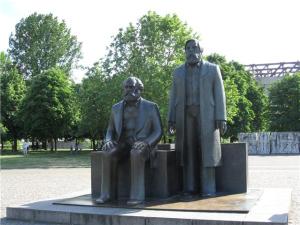
By 1961, the East German government decided that defensive measures needed to be taken, otherwise its population would be depleted of people with important skills vital to building a prosperous society. East German citizens would be barred from entering West Germany without special permission, while West Germans would be prevented from freely entering the GDR. The latter restriction was needed to break up black market currency trading, and to inhibit espionage and sabotage carried out by West German agents. [27] Walls, fences, minefields and other barriers were deployed along the length of the East’s border with the West. Many of the obstacles had existed for years, but until 1961, Berlin – partitioned between the West and East – remained free of physical barriers. The Berlin Wall – the GDR leadership’s solution to the problems of population depletion and Western sabotage and espionage — went up on August 13, 1961. [28]
From 1961 to 1989, 756 East German escapees, an average of 30 per year, were either shot, drown, blown apart by mines or committed suicide after being captured. By comparison, hundreds of Mexicans die every year trying to escape poor Mexico into the far wealthier United States. [29] Approximately 50,000 East Germans were captured trying to cross the border into West Germany from 1961 to 1989. Those who were caught served prison sentences of one year. [30]
Over time, the GDR gradually relaxed its border controls, allowing working-age East Germans to visit the West if there was little risk of their not returning. While in the 1960s, only retirees over the age of 65 were permitted to travel to the West, by the 1980s, East Germans 50 years of age or older were allowed to cross the border. Those with relatives in the FRG were also allowed to visit. By 1987, close to 1.3 million working-age East Germans were permitted to travel to West Germany. Virtually all of them – over 99 percent – returned. [31]
However, not all East Germans were granted the right to cross the border. In 1987, 300,000 requests were turned down. East Germans only received permission after being cleared by the GDR’s state security service, the Stasi. One of the effects of loosening the border restrictions was to swell the Stasi’s ranks, in order to handle the increase in applications for visits to the West. [32]
Pauwels reminds us that,
“A hypothetical capitalist East Germany would likewise have also had to build a wall in order to prevent its population from seeking salvation in another, more prosperous Germany. Incidentally, people have fled and continue to flee, to richer countries also from poor capitalist countries. However, the numerous black refugees from extremely poor Haiti, for example, have never enjoyed the same kind of sympathy in the United States and elsewhere in the world that was bestowed so generously on refugees from the GDR during the Cold War…And should the Mexican government decide to build a ‘Berlin Wall’ along the Rio Grande in order to prevent their people from escaping to El Norte, Washington would certainly not condemn such an initiative the way it used to condemn the infamous East Berlin construction project.” [33]
GDR sets standards for working class in FRG…and abroad
Despite its comparative poverty, the GDR furnished its citizens with generous pensions, free healthcare and education, inexpensive vacations, virtually free childcare and public transportation, and paid maternity leave, as fundamental rights. Even so, East Germany’s standard of living continued to lag behind that of the upper sections of the working class in the West. The comparative paucity and lower quality of consumer goods, and lower wages, were the product of a multitude of factors that conspired against the East German economy: its lower starting point; the need to invest in heavy industry at the expense of light industry; blockade and sanctions imposed by the West; the furnishing of aid to national liberation movements in the global South (which benefited the South more than it did the GDR. By comparison, aid flows from Western countries were designed to profit Western corporations, banks and investors.) What East Germany lacked in consumer goods and wages, it made up for in economic security. The regular economic crises of capitalist economies, with their rampant underemployment and joblessness, escalating poverty and growing homelessness, were absent in the GDR.
The greater security of life for East Germans presented a challenge to the advanced capitalist countries. Intent on demonstrating that capitalism was superior to socialism, governments and businesses in the West were forced to meet the standards set by the socialist countries to secure the hearts and minds of their own working class. Generous social insurance, provisions against lay-offs and representation on industrial councils were conceded to West German workers. [34] But these were revocable concessions, not the inevitable rewards of capitalism.
East Germany’s robust social wage acted in much the same way strong unions do in forcing non-unionized plants to provide wages and benefits to match union standards. [35] In the 1970s, Canada’s unionized Stelco steel mill at Hamilton, Ontario set the standard for the neighboring non-unionized Dofasco plant. What the Stelco workers won through collective bargaining, the non-unionized Dofasco workers received as a sop to keep the union out. But once the union goes, the motivation to pay union wages and provide union benefits disappears. Likewise, with the demise of East Germany and the socialist bloc, the need to provide a robust social safety net in the advanced capitalist countries to secure the loyalty of the working class no longer existed. Hence, the GDR not only furnished its own citizens with economic security, but indirectly forced the advanced capitalist countries to make concessions to their own workers. The demise of the GDR therefore not only hurt Ossis (East Germans), depriving them of economic security, but also hurt the working populations of the advanced capitalist countries, whose social programs were the spill-over product of capitalism’s ideological battle with socialism. It is no accident that the claw back of reforms and concessions granted by capitalist ruling classes during the Cold War has accelerated since the opening of the Berlin Wall.
The collapse of the GDR and the socialist bloc has proved injurious to the interests of Western working populations in another way, as well. From the Bolshevik Revolution in 1917 to the opening of the Berlin Wall in 1989, the territory available to capitalist exploitation steadily diminished. This limited the degree of wage competition within the capitalist global labor force to a degree that wouldn’t have been true had the forces of socialism and national liberation not steadily advanced through the twentieth century. The counter-revolution in the Soviet Union and Eastern Europe, and China’s opening to foreign investment, ushered in a rapid expansion worldwide in the number of people vying for jobs. North American and Western European workers didn’t compete for jobs with workers in Poland, Romania, Slovakia and Russia in 1970. They do today. The outcome of the rapid expansion of the pool of wage-labor worldwide for workers in the advanced capitalist countries has been a reduction in real wages and explosive growth in the number of permanent lay-offs as competition for jobs escalates. The demise of socialism in Eastern Europe (and China’s taking the capitalist road) has had very real – and unfavourable – consequences for working people in the West.
Going backward
Since the opening of the Berlin Wall and the annexation of the GDR by the FRG in 1990, the former East Germany has been transformed from a rapidly industrializing country where everyone was guaranteed a job and access to a growing array of free and nearly free goods and services, to a de-industrialized backwater teeming with the unemployed where the population is being hollowed out by migration to the wealthier West. “The easterners,” a New York Times article remarked in 2005, “are notoriously unhappy.” Why? “Because life is less secure than it used to be under Communism.” [36]
During the Cold War East Germans who risked their lives to breach the Berlin War were depicted as refugees from political repression. But their escape into the wealthier West had little to do with flight from political repression and much to do with being attracted to a higher standard of living. Today Ossis stream out of the East, just as they did before the Berlin Wall sprang up in 1961. More than one million people have migrated from the former East Germany to the West since 1989. But these days, economic migrants aren’t swapping modestly-paid jobs, longer hours and fewer and poorer consumer goods in the East for higher paying jobs, shorter hours and more and better consumer goods in the West. They’re leaving because they can’t find work. The real unemployment rate, taking into account workers forced into early retirement or into the holding pattern of job re-training schemes, reaches as high as 50 percent in some parts of the former East Germany. [37] And the official unemployment rate is twice as high in the East as it is in the West. Erich Quaschnuk, a retired railroad worker, acknowledges that “the joy back then when the Berlin Wall fell was real,” but quickly adds, “the promise of blooming landscapes never appeared.” [38]
Twenty years after the opening of the Berlin Wall, one-half of people living in the former East Germany say there was more good than bad about the GDR, and that life was happier and better. Some Ossis go so far as to say they “were driven out of paradise when the Wall came down” while others thank God they were able to live in the GDR. Still others describe the unified Germany as a “slave state” and a “dictatorship of capital,” and reject Germany for “being too capitalist or dictatorial, and certainly not democratic.” [39]
Much as the GDR was faulted for being less democratic politically than the FRG, the FRG’s claim to being more democratic politically is shaky at best.
“East Germany…permitted voters to cast secret ballots and always had more than one candidate for each government position. Although election results typically resulted in over 99 percent of all votes being for candidates of parties that did not favour revolutionary changes in the East German system (just as West German election results generally resulted in over 99 percent of the people voting for non-revolutionary West German capitalist parties), it was always possible to change the East German system from within the established political parties (including the communist party), as those parties were open to all and encouraged participation in the political process. The ability to change the East German system from within is best illustrated by the East German leader who opened up the Berlin Wall and initiated many political reforms in less than two months in power.” [40]
West Germany outlawed many anti-capitalist political parties and organizations, including, in the 1950s, the popular Communist Party, as Hitler did in the 1930s. (On the other side of the Berlin Wall, no party that aimed to reverse socialism or withdraw from the Warsaw Pact was allowed.) The West German parties tended to be pro-capitalist, and those that weren’t didn’t have access to the resources the wealthy patrons of the mainstream political parties could provide to run the high-profile marketing campaigns that were needed to command significant support in elections. What’s more, West Germans were dissuaded from voting for anti-establishment parties, for fear the victory of a party with a socialist platform would be met by capital strike or flight, and therefore the loss of their jobs. The overwhelming support for pro-capitalist parties, then, rested on two foundations: The pro-capitalist parties uniquely commanded the resources to build messages with mass appeal and which could be broadcast with sufficient volume to reach a mass audience, and the threat of capital strike and capital flight disciplined working class voters to support pro-business parties.
Conclusion
No one would have built a Berlin Wall if they didn’t have to. But in 1961, with the GDR being drained of its working population by a West Germany that had skipped out on its obligations to indemnify the Soviet Union for the losses the Nazis had inflicted upon it in World War II, there were few options, apart from surrender. The Berlin Wall was, without question, regrettable, but it was at the same time a necessary defensive measure. If the anti-fascist, working class leadership of the GDR was to have any hope of building a mass society that was responsive to the basic needs of the working class and which channelled its economic surplus into improving the living conditions and economic security of all, drastic measures would have to be taken; otherwise, the experiment in German democracy — that of building a state that operated on behalf of the mass of people, rather than a minority of shareholders, bondholders, landowners and bankers — would have to be abandoned. And yet, by the history of drastic measures, this was hardly drastic. Wars weren’t waged, populations weren’t expelled, mass executions weren’t carried out. Instead, people of working-age were prevented from resettling in the West.

The abridgment of mobility rights was hardly unique to revolutionary situations. While the needs of Cold War propaganda pressed Washington to howl indignantly over the GDR’s measures to stanch the flow of its working-age population to the West, the restriction of mobility rights had not been unknown in the United States’ own revolution, where the ‘freedoms’ of dissidents and people of uncertain loyalty had been freely revoked. “During the American Revolution…those who wished to cross into British territory had to obtain a pass from the various State governments or military commanders. Generally, a pass was granted only to individuals of known and acceptable ‘character and views’ and after their promise neither to inform or otherwise to act to the prejudice of the United States. Passes, even for those whose loyalty was guaranteed, were generally difficult to acquire.” [41]
Was the GDR worth defending? Is its demise to be regretted? Unquestionably. The GDR was a mass society that channelled the surplus of the labor of all into the betterment of the conditions of all, rather than into the pockets of the few. It offered its citizens an expanding array of free and virtually free goods and services, was more equal than capitalist countries, and met its citizens’ basic needs better than did capitalist countries at the same level of economic development. Indeed, it met basic needs as well as richer countries did, with fewer resources, in the same way Cuba today meets the basic healthcare needs of all its citizens better than the vastly wealthier United States meets (or rather fails to meet) those of tens of millions of its own citizens. And while the GDR was poorer than West Germany and many other advanced capitalist countries, its comparative poverty was not the consequence of the country’s public ownership and central planning, but of a lower starting point and the burden of having to help the Soviet Union rebuild after the massive devastation Germany inflicted upon it in World War II. Far from being inefficient, public ownership and central planning turned the eastern part of Germany into a rapidly industrializing country which grew faster economically than its West German neighbor and shared the benefits of its growth more evenly. In the East, the economy existed to serve the people. In the West, the people existed to serve the minority that owned and controlled the economy. Limiting mobility rights, just as they have been limited in other revolutions, was a small price to pay to build, not what anyone would be so naïve as to call a workers’ paradise, but what can be called a mass, or truly democratic, society, one which was responsiveness to the basic needs of the mass of people as its principal aim.
1. Austin Murphy, The Triumph of Evil: The Reality of the USA’s Cold War Victory, European Press Academic Publishing, 2000.
2. Henry Heller, The Cold War and the New Imperialism: A Global History, 1945-2005, Monthly Review Press, New York, 2006.
3. Jacques R. Pauwels, The Myth of the Good War: America in the Second World War, James Lorimer & Company Ltd., Toronto, 2002; R. Palme Dutt, The Internationale, Lawrence & Wishart Ltd., London, 1964.
4. Melvyn Leffler, “New perspectives on the Cold War: A conversation with Melvyn Leffler,” November, 1998. http://www.neh.gov/news/humanities/1998-11/leffler.html)
5. Heller.
6. John Wight, “From WWII to the US empire,” The Morning Star (UK), October 11, 2009.
7. John Green, “Looking back at life in the GDR,” The Morning Star (UK), October 7, 2009.
8. Shirley Ceresto, “Socialism, capitalism, and inequality,” The Insurgent Sociologist, Vol. XI, No. 2, Spring, 1982.
9. Dutt; William Blum, Killing Hope: U.S. Military and CIA Interventions Since World War II, Common Courage Press, Maine, 1995.
10. Pauwels.
11. Ibid.
12. Ibid.
13. Ibid.
14. Murphy.
15. Pauwels.
16. Green.
17. Ibid.
18. The Wall Street Journal, February 22, 1989.
19. Murphy.
20. Ibid.
21. Ibid.
22. Ceresto.
23. Ibid.
24. Green.
25. Murphy.
26. Ibid.
27. Ibid.
28. Ibid.
29. Ibid.
30. Ibid.
31. Ibid.
32. Ibid.
33. Pauwels.
34. Fred Goldstein, Low-Wage Capitalism, World View Forum, New York, 2008.
35. Ibid.
36. The New York Times, December 6, 2005.
37. The Guardian (UK), November 15, 2006.
38. “Disappointed Eastern Germans turn right,” The Los Angeles Times, May 4, 2005.
39. Julia Bonstein, “Majority of Eastern Germans felt life better under communism,” Der Spiegel, July 3, 2009.
40. Murphy.
41. Albert Szymanski, Human Rights in the Soviet Union, Zed Book Ltd., London, 1984
Iran’s acknowledged nuclear fuel plant and Israel’s secret nuclear weapons plant
By Stephen Gowans
Western press accounts of the existence of an unfinished Iranian nuclear fuel plant near Qum have subtly changed, drawing closer to a view more compatible with Washington’s aim of marshalling support for stepped up sanctions against Iran.
While early press reports acknowledged that Iran had on Monday, September 22 notified the International Atomic Energy Agency of the plant’s existence [1] (that is, days before the Obama administration drew attention to it) stories in major dailies now omit any mention of the Iranian notification. Instead, the reporting on the issue now creates the impression that the existence of the facility was unknown outside of Iran until US officials revealed it on Friday, September 26. For example, New York Times reporters David E. Sanger and William J. Broad write of “the revelation Friday of the secret facility at a military base near the holy city of Qum.” [2] The facility could hardly be secret, since it existence had been revealed by Iran itself five days earlier.
U.S. media have also omitted any mention of a secret nuclear weapons plant in another West Asian country, Israel.
Israel’s secret nuclear weapons plant, long in existence, is located in the Negev desert near Dimona. [3] I.A.E.A inspectors have never visited it and never will unless Israel becomes a signatory to the Nuclear Nonproliferation Treaty, a treaty Iran has voluntarily submitted to. (While the United States is a nominal signatory, it acts as if it’s not bound by the treaty’s provisions, and therefore is effectively no more a member than Israel is.)
Neither are Israel and the United States members of the International Criminal Court (sharing non-membership with Russia and China.) I.C.C. non-membership, however, doesn’t mean the court can’t pursue prosecutions in connection with non-member states. It can, if ordered to by the U.N. Security Council (i.e., by the United States, Russia and China, the same countries that won’t join the court themselves.) The Security Council ordered the I.C.C. to investigate crimes committed in connection with fighting in Darfur. That’s why the president of Sudan is wanted by the I.C.C., even though Sudan isn’t a member of the court. Washington’s de jure and de facto power to veto the Security Council (the overwhelming strength of the U.S. military pretty much allows the United States to operate by its own rules) are ultimately the reasons why the former president of the United States, George W. Bush, isn’t wanted by the court and not because Bush is free of the taint of massive war crimes. It only matters that you commit crimes if you aren’t the United States or don’t have its backing. And even then not having Washington’s backing is frequently all that matters. After all, Iraq was attacked, invaded, and occupied even though it wasn’t concealing the banned weapons Washington said it was failing to come clean on.
When the U.N. Human Rights Commission’s fact-finding mission on war crimes committed in Gaza from December 2008 to January 2009 said Israel should carry out serious, independent investigations, and if it didn’t, the Security Council should refer the matter to the I.C.C., [4] Israel immediately rejected the demand. Not widely reported was that the United States said there was no chance it would allow the Security Council to refer the matter to the I.C.C., arguing the U.N. report was “unbalanced.” U.S. officials noted that 85 percent of the commission’s report detailed Israeli war crimes, and only 15 percent those committed by Hamas. [5] But the “imbalance” reflected the imbalance in the struggle, with Israel using its formidable war machine to cause considerable civilian death, injury and destruction, while Hamas fired crude, home-made rockets whose effect was hardly registered. If the report was mostly about Israeli war crimes, it was because Israel committed most the war crimes.
Owing to the protection it receives from Washington, Israel won’t be answering to the I.C.C., and nor will it be sanctioned for failing to sign up to the non-proliferation treaty or for having a secret nuclear weapons program. These penalties are solely reserved for countries that are resisting U.S. domination, not facilitating its extension, the role Israel plays as U.S. attack dog in West Asia and northern Africa.
Israel already has an attack on another country’s nuclear facilities under its belt (the 1981 bombing of Iraq’s Osirak reactor.) Over the last year it has issued a series of military threats against Iran’s civilian nuclear facilities. That is, a nuclear weapons state has repeatedly threatened a non-nuclear weapons state. And yet Iran not Israel is presented in the Western media as dangerous and aggressive.
Israel has always relied on the deception that it is under existential threat to justify its numerous aggressions, when always it has had at its command military force in excess of that its opponents can marshal. This is true even going back to its founding in 1948, when it faced off against ragtag Arab volunteers, and then a disorganized agglomeration of Arab armies, while claiming it was defending itself against a second holocaust.
While it’s true that the government of Iran is hostile to the Zionist occupation of Palestine, Iran poses no serious military threat to Israel, and wouldn’t, even if it were capable of quickly producing nuclear weapons. The best it could do is present a threat of self-defense. It would take years for Iran to match Israel’s current nuclear arsenal, and in the intervening period, Israel could vastly expand its own. Plus, Israel, already possessing a formidable military – it receives $3 billion in U.S. military aid every year — is backed by history’s most formidable military power, the United States. Iran, even with the rudimentary arsenal of nuclear weapons it may have the capability (though perhaps never the intention) of producing at some point, is no match for Israel – and this its leaders know well. The country, remarked Uzi Rubin, a private defense consultant who ran Israel’s missile shield program in the 1990s, “is radical, but radical does not mean irrational. They want to change the world, not commit suicide.” [6]
1. David E. Sanger, “U.S. to accuse Iran of having secret nuclear fuel facility,” The New York Times, September 26, 2009.
2. See for example David E. Sanger and William J. Broad, “U.S. to demand inspection of new Iran plan ‘within weeks’”, The New York Times, September 27, 2009.
3. http://en.wikipedia.org/wiki/Negev_Nuclear_Research_Center
4. Neil MacFarquhar, “Inquiry finds Gaza war crimes from both sides,” The New York Times, September 16, 2009.
5. Colum Lynch, “U.S. faces doubts about leadership on human rights,” The Washington Post, September 22, 2009.
6. Howard Schneider, “Israel finds strength in its missile defenses,” The Washington Post, September 19, 2009.
Iran’s not so secret, ‘secret’ fuel plant
By Stephen Gowans
The construction of a uranium enrichment facility by Iran outside of Qum, which Tehran notified the International Atomic Energy Agency of days ago, has been seized upon dishonestly by Washington “as a chance to…persuade other countries to support the case for stronger sanctions” against Iran. [1]
Washington is seeking an international sanctions regime to pressure Iran into abandoning its enrichment of uranium. So far Washington has had little success in marshalling the support of Russia and China, whose cooperation is needed for a United Nations Security Council resolution to escalate sanctions against the Islamic republic.
The United States and the European Union want Iran to import nuclear fuel for its power plants, rather than enrich its abundant supplies of domestic uranium itself. While Iran insists its fuel program is for civilian use, the means to enrich uranium at home provides Tehran with a nuclear weapons capability. It’s a short step from enriching uranium for use in commercial reactors to enriching it to a higher grade for use in nuclear weapons.
There are, then, two reasons why Washington wants to force Tehran to abandon its enrichment program:
A. The potential to quickly develop nuclear weapons would equip Tehran with the means to deter Washington and its allies from using the threat of military force to coerce the country into surrendering its independence.
B. Were Tehran forced to look abroad for sources of nuclear fuel, its independence would be sharply limited by Washington’s ability to cut off its nuclear fuel supply.
To advance its aims of securing backing for an international sanctions regime, Washington has accused Iran of secretly building, with the intention of producing weapons grade uranium, an undisclosed facility in violation of the Nuclear Non-Proliferation Treaty. There are a number of problems with this accusation.
1. There is no operating fuel plant. The enrichment facility is unfinished and is not expected to be operational until some time next year. [2]
2. It is not secret. Iran notified the IAEA that it was building the facility days before Washington contrived to use the acknowledgement as evidence of a secret nuclear weapons program. A September 26 David E. Sanger New York Times article ran under the headline “U.S. to accuse Iran of having secret nuclear fuel facility,” inviting the question, how can a nuclear fuel facility be secret, if its existence is already publicly acknowledged? The headline should have read, “U.S. to accuse Iran of having a nuclear fuel facility that was unacknowledged before it was acknowledged.” That The New York Times has taken a tautology and turned it into an apparently damning revelation points to the ever compliant U.S. media’s role as one of equivocation in the service of marshalling support for U.S. foreign policy positions.
3. Under the terms of Iran’s agreement with the IAEA, Tehran is required to report when nuclear material is introduced into a facility, not when construction of the facility begins. [3] Iran reiterated this point with the nuclear agency in March 2007 [4]. When centrifuges (which are used to process nuclear fuel) began to be moved into the unfinished plant, Iran let the IAEA know of the facility’s existence, in accordance with its agreement.
4. Lost amid Washington’s spin is the reality that “even United States intelligence officials acknowledge that there is no evidence that Iran has taken the final step toward creating a bomb.” [5] And yet the Obama administration is treating Iran’s public disclosure of the existence of the unfinished fuel plant as evidence of a secret weapons program. While news reports now suggest that U.S. intelligence “had been tracking the covert project for years” [6] and that the facility is too small to be used for enriching uranium to commercial grade, only two weeks ago The New York Times reported that “new intelligence reports delivered to the White House say that the country has deliberately stopped short of the critical last steps to make a bomb.” [7] If Iran has deliberately stopped short, then the facility could hardly be intended to produce bomb fuel. Isn’t the construction of such a facility a step in making a bomb?
Not so hidden in Washington’s accusation is a threat of war. United States President Barack Obama announced that “the alternative to (the Iranian’s) giving up their program…is to ‘continue down a path that is going to lead to confrontation.’” [8] Obama added that the ‘secret’ (though publicly acknowledged) Iranian plant “represents a direct challenge to the basic foundation of the nonproliferation regime.” [9] This is nonsense, and it is so for all the reasons cited above. But it’s also nonsense for another reason: the real direct challenge to the basic foundation of the nonproliferation regime is the United States itself. It tolerates the nuclear arsenals of its allies — not being particularly vexed by proliferation to Israel, India and Pakistan — while threatening non-allies militarily, and thereby providing them with an incentive to acquire nuclear weapons as a means of self-defense.
The true foundation of the nonproliferation treaty is a quid pro quo, whereby nuclear weapons states agree to give up their weapons while non-nuclear states agree not to acquire them. Part of the agreement is that non-nuclear states are to have access to nuclear energy for civilian use, as long as they abide by the provisions of the nonproliferation treaty. Iran has abided by the agreement, though for Washington and the EU, it’s not enough. Iran is expected to renounce its right to an independent civilian nuclear power industry, to prevent it from acquiring the capability of developing nuclear weapons, should it ever need to counter U.S. or Israeli military (and possibly nuclear) blackmail. It also forces Iran into a dependence on the West for nuclear fuel. The selective enforcement of the non-proliferation treaty in the interests of U.S. foreign policy represents the real challenge to the nonproliferation regime.
1. Helene Cooper and Mark Mazzetti, “Cryptic Iranian note ignited an urgent nuclear strategy debate,” The New York Times, September 26, 2009.
2. David E. Sanger, “U.S. to accuse Iran of having secret nuclear fuel facility,” The New York Times, September 26, 2009.
3. Neil MacFarquhar, “Iran’s leader mocks West’s accusations,” The New York Times, September 26, 2009.
4. “Tehran’s nuclear ambitions: A timeline,” The Washington Post, September 26, 2009.
5. Cooper and Mazzetti.
6. Sanger, “U.S. to accuse Iran…”
7. David E. Sanger, “US says Iran could expedite nuclear bomb,” The New York Times, September 10, 2009.
8. David E. Sanger and William J. Broad, “U.S. allies warn Iran over nuclear deception,” The New York Times, September 26, 2009.
9. Ibid.
 What's Left