Nuclear Posture Review 2010

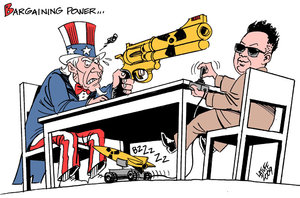
Inducing potential victims to surrender their right to self-defense under threat of nuclear annihilation

By Stephen Gowans

In the wake of the 9/11 attacks, Washington named Iraq, Iran and north Korea as forming an axis of evil. Soon after, the first of these countries was invaded by US and British forces on entirely spurious grounds. The invading forces met little resistance, for Iraq had effectively disarmed under a regime of international sanctions championed by Washington and London that led to the deaths of more than one million over its decade-plus-long existence. The pretext for the aggression was that Iraq retained weapons of mass destruction. It had none.

Around the same time, Washington tore up an accord with north Korea that committed the latter to shuttering its plutonium reactor at Yongbyon and forswearing the pursuit of nuclear weapons, and the former to building light water reactors and delivering fuel oil while the reactors were being built. Washington tarried on the reactor construction, convinced the Juche regime would collapse before the United States had to make good on its commitment. As the date for completion of the reactors drew near, and with only the foundations of the reactors having been built, Washington declared that north Korea had admitted to operating a secret uranium enrichment program. Pyongyang denied the charge. One Bush administration official warned the north Koreans to draw the appropriate lesson from the Anglo-American invasion of Iraq. They did. North Korea fired up its Yongbyon reactor and embarked upon development of a nuclear deterrent.

US president Barack Obama has stayed true to form, obscuring his pursuit of his predecessors’ policies beneath honeyed phrases that create the impression of change, where no change of substance exists.

Whether Iran drew the same lesson is unclear. The National Intelligence Estimate, the consensus of the US intelligence community, is that Iran pursued a nuclear weapons program until 2003, the year of the US-British invasion of Iraq, but has since abandoned it. Iran has worked to develop its own capability to generate enriched uranium for use in civilian nuclear power plants, while at the same time working on long range missiles. Irrespective of its nuclear weapons intentions, which Tehran says it doesn’t have, both activities converge on providing the country with the capability of developing nuclear warheads and the means of delivering them. While Tehran is not in the position to present a nuclear deterrent today, it may in the not too distant future be able to rapidly develop one to deter a US or Israeli attack.

There are two conclusions to be drawn from the above and a third that is axiomatic.

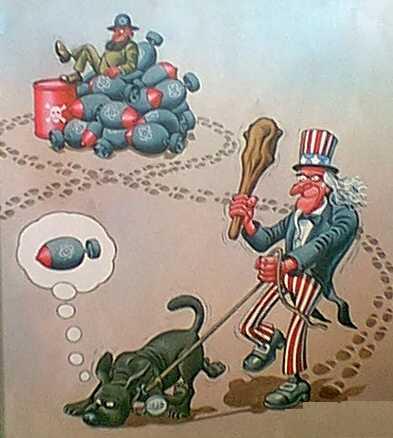
1. The United States and Britain have long records of highly provocative behavior based on policies of military aggression, the most conspicuous recent example of which is the invasion of Iraq. Naming countries as forming an axis of evil is a virtual declaration of war. Invading one of them, without provocation and on entirely contrived grounds, is a repugnant act and an international crime of the highest order. North Korea and Iran, the two remaining countries of the US-designated axis, have reasonable cause to fear military aggression by the United States or its proxies.

2. If the case of Iraq is definitive, US policy is to pressure its targets to surrender their means of self-defense to facilitate US pursuit of a subsequent war of aggression.

3. Countries that possess a nuclear weapons capability reduce the Pentagon’s room for manoeuvre and therefore reduce the probability that they will become the object of US military aggression.

From these three points may be drawn a fourth: The United States, as the world’s major agent of military aggression, is the principal cause of nuclear proliferation.

If read superficially, Washington’s 2010 Nuclear Posture Review (NPR) would lead you to believe that US policy makers have finally figured out that the cardinal rule of nonproliferation is to abjure military aggression. Countries that aren’t threatened by nuclear powers have no need to develop nuclear weapons for self-defense. However, a closer reading of the review shows that nothing has changed. US president Barack Obama has stayed true to form, obscuring his pursuit of his predecessors’ policies beneath honeyed phrases that create the impression of change, where no change of substance exists.

The NPR declares “that the United States will not use or threaten to use nuclear weapons against non-nuclear weapons states”, even if they attack the United States, its vital interest or allies and partners with chemical or biological weapons. This differs, but only on the surface, from the policy of preceding administrations which refused to renounce the use of nuclear weapons against non-nuclear states. There are a number of reasons why the difference is apparent only.

While nuclear weapons are widely regarded as being unparalleled in their destructive power (and they are), the United States is able to deliver overwhelming destructive force through its conventional military capabilities. A promise not to use or threaten to use nuclear weapons against non-nuclear states is not the same as an assurance not to use or threaten to use devastating military force. Six decades ago it was possible to obliterate a city through conventional means, as the United States and Britain demonstrated in the firebombing of Dresden. If a city could be destroyed by conventional means more than half a century ago, imagine what the Pentagon could do today through conventional forces alone. Indeed, the NPR makes clear that the United States is prepared to shrink its nuclear arsenal partly because “the growth of unrivalled U.S. conventional military capabilities” allows Washington to fulfill its geostrategic goals “with significantly lower nuclear force levels and with reduced reliance on nuclear weapons.”

The NPR also provides a number of escape hatches that allow Washington to continue to dangle a nuclear sword of Damocles over the heads of the two remaining axis of evil countries. One is that nuclear weapons can be used, or their used threatened, against a country that is not “party to the NPT” (the nuclear non-proliferation treaty) even if the country doesn’t yet have nuclear weapons, or it is unclear whether it does. This is the north Korea escape clause. It allows Washington to continue to threaten north Korea (which may or may not have a working crude nuclear weapon) with nuclear obliteration, just as it has done since the early 1990s when the US Strategic Command announced it was re-targeting some of its strategic nuclear missiles on the DPRK (the reason why north Korea withdrew from the NPT.)

Another escape hatch allows Washington to reach for the nuclear trigger whenever it deems a country to have fallen short of “compliance with [its] nuclear non-proliferation obligations,” even if the country doesn’t have nuclear weapons and is a party to the NPT. This is the Iran escape hatch, intended to allow Washington to maintain the threat of nuclear annihilation vis-à-vis Iran or any other country Washington unilaterally declares to be noncompliant with the treaty’s obligations. Washington has a history of fabricating casus belli. 10-100,000 Kosovo Albanian dead and Saddam Hussein’s weapons of mass destruction, neither of which were ever found, represent recent examples of the United States waging war on entirely fictitious grounds. Washington could readily produce “sexed up” intelligence to declare Iran or any other NPT signatory to be in breach of its treaty obligations, thereby justifying the use of nuclear weapons against a non-nuclear state.

As for the United States’ commitment not to reach for its nuclear arsenal in response to a chemical or biological attack on itself, its vital interests (a term that defies geography and democracy, for how is it that the United States’ vital interests extend to other people’s countries?) its allies and its partners, this too is verbal legerdemain. As a careful reading of the NPR makes clear, the truth of the matter is that the United States will attack any country with nuclear weapons if such an attack is deemed necessary by Washington to protect its interests, which is to say, the interests of the corporations, banks and investors whose senior officials and representatives dominate policy formulation in Washington and provide the major funding, and post-political jobs, to the country’s politicians. According to the NPR, “the United States reserves the right to make any adjustment in [its commitment] that may be warranted…” Translation: We won’t attack non-nuclear weapons states with nuclear weapons unless we decide it’s in our interests to do so.

Washington’s attachment of escape clauses and reservations to its commitment calls to mind Rajani Palme Dutt’s description of how the great powers made a mockery of the Kellog Pact, an agreement to renounce recourse to war as an instrument of foreign policy.

“The United States government exempted from its operation any action for the maintenance of the Monroe Doctrine. The French Government insisted that the pact must not be understood to refer to wars of self-defense or in fulfillment of treaty obligations. The British Government made the most sweeping reservation of all…

“Not content with the ‘defense’ of the Empire, covering a quarter of the world, Britain…reserved for itself full ‘freedom of action’ in any unspecified ‘regions of the world,’ where it might at any time claim ‘a special and vital interest.’ This sweeping claim of British imperialism left the Monroe Doctrine behind as a parochial affair in comparison. Needless to say, this claim was thereafter taken as equally applicable to themselves by the other Powers: thus the Italian representative at Geneva specifically referred to it as justifying Italy’s claim that its war on Abyssinia was no breach of the Kellog Pact.

“What, then, remained of the Kellog Pact even on the day that it was signed? Wars of ‘defense’ were clearly understood to be excluded from its operation. Wars for the maintenance of colonial possession or in execution of treaties were equally understood to be excluded. So were wars on behalf of ‘special and vital interests’ in any ‘regions of the world.’ With these small exceptions the imperialist signatories ‘renounced’ war.” (R. Palme Dutt, World Politics: 1918-1936, Random House, New York, pp. 151-152.)

What, then, remains of the Obama administration’s assurance, even on the day the NPR was published, that Washington won’t attack non-nuclear states with nuclear weapons? Countries that may or may not have nuclear weapons are excluded. Countries that don’t have nuclear arms and are party to the NPT, but which may develop a nuclear arms capability, and importantly, are independent of the United States, are excluded. Countries which, through their pursuit of independent economic development policies, threaten the special and vital interests of the United States in any region of the world, are excluded. With these small exceptions, Washington has renounced the use of nuclear weapons against non-nuclear states.

US foreign policy carries on in its characteristic imperialist and war-like manner, despite the elevation of a black Democrat, and now Nobel Peace Prize winner, to the highest elected office of the land.

The NPR is said to be based on “the President’s agenda for reducing nuclear dangers and pursuing the goal of a world without nuclear weapons.” But it’s clear from the very beginning of the review that US policy stands in the way of the president’s ostensible aim. “As long as nuclear weapons exist,” the review begins, “the United States will maintain a safe, secure, and effective arsenal…to deter potential adversaries…” The implication is that the country to first develop nuclear weapons, and the only country to have ever used them, intends to be the last country to have them, arrogating onto itself the monopoly right to maintain a nuclear arsenal to deter potential adversaries. Only if every other country surrenders their rights to deter potential adversaries, and yields this right exclusively to the United States, can the implications of the president’s aim be realized. But given the United States’ sanguinary history of busting down the doors of weak countries to lay claim to their land, labor, resources and markets on behalf of its economic elite, only the insane, opportunistic, unprincipled, cowardly or co-opted would yield their right to self-defense to such a predatory country. The president’s agenda for reducing nuclear dangers and pursuing the goal of a world without nuclear weapons is more aptly described as an agenda for inducing potential victims to surrender their right of self-defense, and under the threat of nuclear annihilation. In other words, US foreign policy carries on in its characteristic imperialist and war-like manner, despite the elevation of a black Democrat, and now Nobel Peace Prize winner, to the highest elected office of the land.

Washington Post: North Korean, Iranian nuclear capability threatens US imperialism

By Stephen Gowans

Washington Post columnist Walter Pincus has put his finger on what’s wrong with north Korea and Iran developing nuclear weapons, or having the capability to do so.

The problem is that nuclear weapons are a deterrent, which means that if either country possesses a credible nuclear arsenal and the means of delivering warheads, their conquest by US forces isn’t in the cards. And that is something Pincus seems to regard as regrettable.

In his March 30 column Pincus points to General Kevin P. Chilton, head of the US Strategic Command.

Chilton reminded US legislators that, “Throughout the 65-year history of nuclear weapons, no nuclear power has been conquered or even put at risk of conquest, nor has the world witnessed the globe-consuming conflicts of earlier history.” [1]

Pincus regarded this as a warning, “a thought others in government ought to ponder as they watch Iran and North Korea seek to develop nuclear capability.” [2]

Washington Post columnist Walter Pincus thinks north Korea and Iran should be conquered before their pursuit of nuclear capability makes them unconquerable.

In other words, the implication of Chilton’s view, as Pincus interprets it, is that there is little chance that a nuclear-armed north Korea or Iran could be conquered or even put at risk of conquest, a prospect so alarming to him, that he urges government officials to think through what would happen if Tehran and Pyongyang developed a credible threat of self-defense.

Pincus’s circularity (we ought to conquer these countries before they’re no longer conquerable) invites the question: Why conquer them at all? The standard answer, that both countries are threats to their neighbors, doesn’t work, for two reasons.

First, the real threat, as Pincus implicitly acknowledges, isn’t one of north Korea endangering south Korea or Iran wiping Israel off the map, but of both countries acquiring the means to make themselves effectively unconquerable.

Second, other countries have acquired large nuclear arsenals, and far from being treated as threats that must be pressed to relinquish their nuclear arms, are aided by the United States in acquiring more of them.

Consider India. The very same issue of The Washington Post that found Picus worrying about north Korea and Iran becoming unconquerable carried an article on negotiations between the United States and India, the outcome of which is that the latter will soon import spent nuclear fuel from the former. [3]

India will be able to extract plutonium from the fuel it imports to make nuclear weapons. Although India has pledged not to do so, “it diverted civilian nuclear fuel to build its first nuclear weapons three decades ago.” [4] Already India has manufactured weapons-grade plutonium for an estimated 100 warheads and has “has built weapons with yields of up to 200 kilotons.” [5]

Washington portrays the nuclear programs of north Korea and Iran as threats, while preparing to export spent fuel to India, a country that refuses to join the nonproliferation treaty.

What’s more, the country is not part of the Nuclear Nonproliferation Treaty. Iran, portrayed by Pincus’s colleagues as a looming nuclear threat is a treaty signatory, while north Korea was, until Chilton’s predecessors at Strategic Command announced in 1993 that the DPRK would be targeted with strategic nuclear missiles.

Strange that Pincus wasn’t warning government officials to ponder Chilton’s words about nuclear powers avoiding the risk of conquest as they watch India strengthen its nuclear capability, with US assistance.

But then India is already part of Washington’s informal empire. Plus, exporting nuclear fuel to India promises to fatten the bottom line of the US nuclear industry.

It’s not so curious to discover that north Korea, a country Pincus seems to think really should be conquered before it’s too late, comes in dead last on the Heritage Foundation’s economic freedom index, a ranking of how congenial countries are to the profit-making interests of banks, corporations and wealthy investors. Countries that have low tax rates, welcome foreign investment and trade, and spend little on government programs are considered economically free, while countries whose governments intervene in the economy to achieve public policy goals, or to prohibit exploitation, are relegated to the basement of the list.

Generally speaking, where a country appears on the list, offers a pretty good gauge of whether a country is in or out of favor with Washington, whose foreign policy since the Bolshevik Revolution and before has been guided by how open other countries are to US investment and exports. US policy leans toward prying open closed economies and rhapsodizing about open ones.

The places of selected countries on the Heritage Foundation 2010 Index of Economic Freedom, are shown below. (The index ranks 179 countries.)

• North Korea, 179
• Zimbabwe, 178
• Cuba, 177
• Myanmar (Burma), 175
• Venezuela, 174
• Iran, 168

Notice that the bottom dwelling countries are the objects of various Western efforts of regime change, some involving the threat of military intervention and all involving destabilization carried out, in most cases, with the participation of “pro-democracy nonviolence activists,” groups that profess to be progressive and anti-imperialist but are in reality lieutenants of the US foreign policy estblishment. No surprise that their major funding comes from such wealthy individuals as Peter Ackerman and George Soros, who play prominent roles in US ruling class circles. Ackerman is a member of the elite Council on Foreign Relations and was head of the CIA-interlocked Freedom House. Soros is a veteran anti-communist warrior.

It’s no accident that the countries that are on Washington’s regime change hit list also happen to be on the Heritage Foundation’s list of countries that are least accommodating to business interests, no accident because US corporations, investors and banks dominate the formulation of US foreign policy. It makes sense that they would go after “closed economies” (i.e., closed to export of capital and commodities on favorable terms) since these economies represent an unrealized potential for profit-making, and also the threat of a bad example if they’re allowed to get away with shaping economic policy to serve local interests rather than those of foreign capital.

While not among the Index of Economic Freedom stars, India ranks much higher on the list (124) and has been praised for moving “forward with market-oriented economic reforms” and opening its trade regime.

North Korea, Cuba and Zimbabwe: Dead last on the Heritage Foundation’s index of countries that offer themselves up as profitable investment opportunities for US capital. Iran is also among the basement-dwellers. It’s no accident that the same countries are on Washington’s regime change hit list.

We might ask why anyone would create an index of economic freedom in the first place. It is safe to say that the only people interested in creating a map of favourable opportunities for the export of capital and commodities are those with capital and commodities to export. You won’t find north Koreans, Cubans or Zimbabweans surveying the world to find out whose policies are geared toward promoting attractive returns for investors, largely because they haven’t surplus capital to export. In these countries, the development of internal productive forces is the top priority. And north Korea and Cuba haven’t structural compulsions to export capital. But imperialist countries have plenty of surplus capital, which is why “economic freedom” and rolling over governments that oppose it, is an obsession in Washington and other major capitals.

Pincus strays from the script in calling for north Korea and Iran to be conquered before they can make themselves unconquerable, rather than repeating the accustomed nonsense about the dangers of first strikes launched against neighbors, Europe or even the United States. At the same time, his employer makes US hypocrisy plain by running a story about the United States preparing to export spent nuclear fuel to a country that refuses to join the nonproliferation treaty and has amassed a substantial nuclear arsenal. Finally, the failure of north Korea and Iran to serve themselves up as profitable fields for US investment, while India displays a greater willingness to cater to the profit-making requirements of US corporations, offers a glimpse into the real reasons behind Washington’s double-standard.

1. Walter Pincus, “As missions are added, Stratcom commander keeps focus on deterrence”, The Washington Post, March 30, 2010.
2. Ibid.
3. Rama Lakshmi and Steven Mufson, “US, India reach agreement on nuclear fuel reprocessing”, The Washington Post, March 30, 2010.
4. Ibid.
5. James Lamont and James Blitz, ‘India raises nuclear stakes,’ Financial Times, September 27, 2009.

The NED, Tibet, north Korea and Zimbabwe

By Stephen Gowans

Vin Weber, a former chairman and current board member of the US National Endowment for Democracy, has written an article in The Washington Times defending the NED against calls to eliminate its funding. [1]

The NED was established by the Reagan administration after the CIA’s role in covertly funding efforts to overthrow foreign governments was brought to light, leading to the discrediting of the parties, movements, journals, books, newspapers and individuals that received CIA funding. This undermined the efficacy of these agents as tools of US foreign policy.

As a bipartisan endowment, with participation from the two major parties, as well as the AFL-CIO and US Chamber of Commerce, the NED took over the financing of foreign overthrow movements, but overtly and under the rubric of “democracy promotion.”

As the NED’s president Carl Gershman explained,

“It would be terrible for democratic groups around the world to be seen as subsidized by the C.I.A. We saw that in the 60’s, and that’s why it has been discontinued. We have not had the capability of doing this, and that’s why the endowment was created.” [2]

Thus, the NED was founded, as New York Times reporter John Broder explained in 1997, “to do in the open what the Central Intelligence Agency has done surreptitiously for decades.” [3]

As part of the NED-program of regime change, governments the US foreign policy establishment targets for overthrow are demonized as anti-democratic while the recipients of NED largesse are angelized as pro-democratic. What links targeted governments is not their electoral democratic practices – which can range from absent to present — but their economic policies, which tend to be restrictive of foreign investment, imports, and property rights. What links the recipients of NED grants is not their attitude to electoral democracy, but their embrace of US policy.

Tibet

The NED’s angelization of the Dalai Lama is a case in point. The Dalai Lama is hardly a democrat, yet he has received Washington’s lucre for decades, including from the CIA and later the NED. Tibet’s “spiritual leader”, as he has been anointed in the West, presided over a backward theocratic feudal society, before fleeing to India after a botched uprising against the Chinese government, which had supported the dismantling of Tibetan feudalism. As Michael Parenti explains,

“Until 1959, when the Dalai Lama last presided over Tibet, most of the arable land was still organized into manorial estates worked by serfs. These estates were owned by two social groups: the rich secular landlords and the rich theocratic lamas…The Dalai Lama himself ‘lived richly in the 1000-room, 14-story Potala Palace.’

“There also were slaves, usually domestic servants, who owned nothing. Their offspring were born into slavery. The majority of the rural population were serfs. Treated little better than slaves, the serfs went without schooling or medical care, They were under a lifetime bond to work the lord’s land–or the monastery’s land–without pay, to repair the lord’s houses, transport his crops, and collect his firewood. They were also expected to provide carrying animals and transportation on demand. Their masters told them what crops to grow and what animals to raise. They could not get married without the consent of their lord or lama. And they might easily be separated from their families should their owners lease them out to work in a distant location.

“As in a free labor system and unlike slavery, the overlords had no responsibility for the serf’s maintenance and no direct interest in his or her survival as an expensive piece of property. The serfs had to support themselves. Yet as in a slave system, they were bound to their masters, guaranteeing a fixed and permanent workforce that could neither organize nor strike nor freely depart as might laborers in a market context. The overlords had the best of both worlds.” [4]

The NED calls the former feudal overlord, the Dalai Lama, seen here with George W. Bush, “a devoted democrat.” The slaves and serfs of the old Tibet might disagree.

The old Tibet, then, was hardly a society of peace and tranquility ruled over by a benign ruler. It was a class society torn by conflict and predicated on brutal, naked, exploitation. Despite this, a February 16, 2010 NED press release describes the former Tibetan feudal overlord “not only as a moral and religious leader respected throughout the world but as a fellow democrat who shares America’s deepest values.” [5]

In the same press release, the NED urged the Obama administration “to express America’s strong support for him” (a “devoted democrat”) “and what he represents – genuine autonomy for the Tibetan people.” [6] But why should the NED urge the US administration to express support for autonomy in Tibet, when Washington has never supported autonomy for the Basques, Corsicans, the Kurds in Turkey, the Scots and Irish nationalists, or the South Ossetians?

“The answer is obvious: the United States does not support separatist movements in countries they consider their allies. The targets are either countries they consider rivals, like Russia or China, or countries that are too weak to resist, and where they can obtain totally dependent client states from the breakup – which is what happened with Yugoslavia.” [7]

Weber’s defense of the NED comes in response to a call from Shika Dalmia, a senior analyst at the Reason Foundation, urging the Obama administration to cut funding to the NED on grounds the organization has outlived its original mandate, overthrowing communism.

In a Washington Times article, Dalmia wrote that the NED,

“…was founded by President Reagan in the heyday of the Cold War to contain communism. Communism has since evaporated, and democracy has spread like wildfire in the former Soviet Union, Still, President Obama proposes to hand the NED $109 million this year. This despite the fact that NED has been dogged by controversy, the least of which being that it once spent $1.5 million to defend democracy in the Soviet bastion called France. Worse, although NED gets all its funding from the government, it is structured like a private entity over whose board – an improbable hybrid of representatives of business, unions, and other concerns—Congress has little control. The upshot is that sitting presidents have used it to do things abroad that Congress wouldn’t approve. In the mid-1980s, for instance, it directed funding to the political opponents of the then-president of Costa Rica—long a beacon of democracy—simply because he opposed Reagan’s Nicaragua policy.” [8]

Predictably, Weber rejects Dalmia’s arguments. “Take the example of her contention that communism has ‘evaporated’,” he counters, “and tell that to the defectors who have risked everything to escape the hell on earth that is nuclear-armed North Korea.” [9]

Hell on earth? Is this like the hell on earth that is a ghetto in the hyper-nuclear-armed United States, or the hell on earth that is the Gaza blockaded by a nuclear-armed Israel backed by the hyper-nuclear-armed Pentagon?

North Korea

As a member of the US foreign policy establishment, Weber ought to be careful about talking of hell on earth, for Washington is among the principal authors of unnecessary torment in this world. Iraq, site of the greatest contemporary humanitarian catastrophe, is a hell on earth, and it was created by the United States, for reasons that have nothing whatever to do with what Washington said motivated the country’s Iraq sanctions policy and invasion. What did US B52 bombers create in Vietnam, Laos and Cambodia if not hell on earth? And what condition prevailed after the atomic bombings of Hiroshima, and Nagasaki, and the fire-bombing of Dresden?

Hell on earth in north Korea didn’t begin with the US demolishing every building over one-story, but it did nothing to relieve it. The torment didn’t end either when Washington practiced nuclear terrorism by deploying battlefield nuclear weapons on the Korean peninsula or when in 1993 it announced it was targeting strategic nuclear missiles on north Korea, a country which, at the time, had no nuclear weapons.

The NED’s role in overthrowing communism played its own part in creating hell on earth in north Korea by bringing about the collapse of the country’s markets. Decades-long sanctions have also made life tougher, precisely as intended by US policy makers. And unremitting military pressure from the United States, a military behemoth, has forced north Korea, a military pipsqueak, to channel a punishingly high percentage of its meagre resources into self-defense, depriving the country of the capital it needs for productive investment. If there is a hell on earth in north Korea, it exists because the United States has created one, deliberately, systematically, and with the intention of crushing a top-to-bottom alternative to Third World dependency on the United States.

Jestina Mukoko

Meanwhile, the NED has celebrated Jestina Mukoko, a Zimbabwean who was arrested in December 2008 by Zimbabwe state security agents, who Mukuko claims tortured her.

Mukoko is variously connected in leadership roles with organizations funded by the NED and United State Agency for International Development (USAID.) She is, for example, “the executive director of the Zimbabwe Peace Project, a grantee of the” NED [10], as well as a member of the board of the Zimbabwe Election Support Network, an organization interlocked with a number of other Western-funded anti-Mugabe groups, and which receives its funding from the NED and USAID.

Jestina Mukoko, center, feted in Washington for her role as a US government-funded regime change agent. Honored by US Secretary of State Hilary Clinton and US First Lady Michelle Obama for services to the empire.

To understand why Mukoko was arrested, it helps to place her activities in the context of the Mugabe government’s efforts to carry through land reform, the West’s opposition to the expropriation of white settler farmland, and the efforts of the United States to enforce respect for private property rights through a campaign of regime change in which Mukoko plays a role.

The following points, therefore, are salient:

1. The United States is openly working to exclude Zimbabwe’s Zanu-PF party (which champions land reform and economic indigenization) from government, and to replace it with the Movement for Democratic Change (which advocates policies that would inevitably strengthen foreign domination of Zimbabwe’s land, labor and natural resources.)
2. The US-sponsored regime change campaign operates through the NED and USAID-financing of domestic activists, like Mukoko.
3. While the ostensible objective of NED and USAID-sponsored activities in Zimbabwe is the promotion of democracy and human rights, the real aim is the installation of a government committed to facilitating the pursuit of US and Western interests, including allowing the sale of agricultural land to foreign investors. That the United States and its foundations have the slightest concern for promoting democracy and human rights is belied by the US practices of detaining people without charge in secret prisons, the scandals of Abu Ghraib, Bagram and Guantanamo, the furnishing of aid and support to such notorious autocracies as Egypt and Saudi Arabia, and the backing of the Israeli blockade of Gaza to punish Gazans for exercising their democratic rights in electing Hamas. The NED does, however, care deeply about the interests of US corporations, banks and investors which, after all, play the dominant role in shaping US policy and whose representatives staff the key positions of the US state.

In other words, Mukoko is deeply connected to a US state which is openly hostile to Zimbabwe and its land reform and economic indigenization programs, and seeks to oust the Zanu-PF element of the current government. Is it any wonder she has drawn the attention of the Zimbabwe’s security services?

This mercenary on behalf of US interests recently travelled to Washington where she was feted by US Secretary of State Hilary Clinton and US First Lady Michelle Obama, an act not too much different from Petain traveling to Berlin to be showered with honors by Ribbentrop and Eva Braun. What would the US security state do to a US-based jihadist who took money from a foundation financed by the Iranian government to promote the rise of an Islamic Republic in the United States and who would later travel to Tehran to be personally presented with official honors by Mabouchehr Mottaki, the Iranian foreign minister?

At the ceremony honouring Mukoko’s services to the empire, Michelle Obama expressed shock that Mukoko “was interrogated (by Zimbabwe security agents) for hours while forced to kneel on gravel…” [11] This was precious, coming from the wife of a president whose country has spent the last decade kidnapping militants who oppose their southwest Asian countries being dominated by the United States and its corrupt puppet regimes and then subjecting them to stress positions, water-boarding and other “enhanced” interrogation techniques, when they’re not being shipped off to allied countries to face more unrestrained forms of torture, or are simply being assassinated. Belaboring the Eva Braun analogy, Obama’s shock was like Hitler’s partner complaining about the Soviets exchanging territory with Finland by force, long after the Nazis had gone on their rampage through Europe.

In his book Age of Empire, historian Eric Hobsbawm observed that,

“The age of democracy turned into an era of public political hypocrisy, or rather duplicity, where those who held power only said what they really meant in the obscurity of the corridors of power. Thus was born an enormous gap between public discourse and political reality”…

…a disparity all too evident in the NED’s public pronouncements.

[1] Vin Weber, “Vin Weber: Defending the well-endowed,” The Washington Times, March 11, 2010.

[2] David K. Shipler, “Missionaries for Democracy: U.S. Aid for Global Pluralism,” The New York Times, June 1, 1986.

[3] John M. Broder, “Political Meddling by Outsiders: Not New for U.S.,” The New York Times, April 1, 1997.

[4] Michael Parenti, “Friendly Feudalism: The Tibet Myth,” Michael Parenti Political Archive, http://www.michaelparenti.org/Tibet.html

[5] National Endowment for Democracy, “How to welcome the Dalai Lama to Washington,” February 16, 2010.

[6] Ibid.

[7] Diana Johnstone, “Breaking Yugoslavia,” New Left Project, March 3, 2010, http://www.newleftproject.org/index.php/site/article_comments/breaking_yugoslavia/

[8] Shikha Dalmia, “Busting the well-endowed,” The Washington Times, March 4, 2010.

[9] Weber.

[10] Michael Allen, “Activist demands accountability and end to impunity in Zimbabwe,” Democracy Digest, March 12, 2010.

11. Ibid.

The Revolution Will Not Be Assisted By The ICNC (The Counter-Revolution Is Another Matter)

By Stephen Gowans

I confess that when Michael Barker sent me a link to nonviolence advocate Brian Martin’s Gandhi Marg article “Dilemmas in promoting nonviolence” I wasn’t too keen on reading it. [1] With a pile of unread books threatening to bury me under an avalanche, I thought my time could be better spent on avalanche control. Plus, I was hoping to get around to mowing the tufts of hair that advancing age have brought to my ears.

It was, therefore, with scant enthusiasm that I flipped desultorily through Martin’s article. Undecided as to whether to plunge in, I skipped to the conclusion. If anything there grabbed my attention I would read the article in full. Otherwise, I would toss “Dilemmas in promoting nonviolence” on my not-worth-the-time pile, along with the stack of Stephen Zunes articles I had accumulated.

The first sentence of Martin’s conclusion read: “Proponents of nonviolence have come under attack for supporting bad causes, in particular US imperialism.”

My attention shifted more firmly to the article, away from a precariously balanced book teetering atop my book pile.

The next sentence brought me fully awake. “[F]ew of the claims of the critics stand up to scrutiny and many lack evidence.”

I was immediately interested. Which claims lack evidence? Which don’t? Which stand up to scrutiny? Which wither under Martin’s analysis?

Laying a brace against the tottering mountain of books beside me, I dove into Martin’s article, anxious to discover how the claims of nonviolence critics fell apart under careful examination.

Hmmm. Nothing on page 1. Oh well, he’s just getting started. Page 5 – Still nothing, but there are 15 pages of text to go. It’s early. Page 10 – A bus rumbles by and shakes the Himalaya of books beside me. A book hurtles to the floor. I move quickly to avoid it. Nothing yet. Page 15 – Still nothing. Did I read the conclusion correctly? I skip ahead to check. Proponents of nonviolence…under attack…supporting US imperialism…lack evidence. No mistake. Page 16. Nothing. Pages 17 and 18. Still nothing. Page 19. Ah, there it is. In the final paragraph before the conclusion. A single sentence: “the stance of the anti-imperialist critics is seriously flawed, including by the absence of any proof that nonviolent movements are pawns of the US government.”

What? I just cancelled a much needed date with my ear-hair scissors to learn that “[F]ew of the claims of the critics stand up to scrutiny and many lack evidence” because “the stance of the anti-imperialist critics is seriously flawed”?

Nonviolence advocate Brian Martin: His Gandhi Marg article should have been tossed on the not-worth-the-time pile.

This is like being told that the secret to getting rich is to accumulate a lot of money. Or that when people lose their jobs, unemployment happens. I should have trusted my instincts and tossed Brian Martin on the not-worth-the-time pile.

Problems with Martin’s Case

Here are the problems, if they’re not already evident.

First, the ICNC (International Center on Nonviolent Conflict), one of the proponents of nonviolence that has come under attack for supporting bad causes, has been criticized for its connections to ruling class organizations and for aiding groups whose aim is to bring down foreign governments whose policies are not conducive to the interests of Western economic elites. Of this there is considerable evidence and documentation. Michael Barker has catalogued a lot of it. Click here.

Rather than dealing with the criticism above and the evidence that supports it, Martin deflects attention. Those who criticize the ICNC for its ruling class connections are deemed champions of the idea that “nonviolent movements are pawns of the US government.” This has demagogic potential. No one wants to be called a dupe, and accusing the ICNC’s critics of branding grassroots activists as victims of a swindle serves two purposes: it turns grassroots activists against the critics and takes attention away from the central issue: the ICNC’s ties to the US foreign policy establishment.

The second problem is that Martin fails to show that the critic’s case falters under close examination and lacks evidence. In fact, he doesn’t examine it at all. Instead, he simply asserts that the case lacks substance, footnoting the conclusion with a reference to a personal communication from “Hardy Merriman – of the International Center on Nonviolent Conflict.” Merriman told Martin that “the burden of proof should be on those making the assertion that recent nonviolent movements are fronts for Western powers. They never provide such proof.”

Just to make this clear: Martin’s careful examination of the critics’ case boils down to an assurance from good old Hardy Merriman, of the ICNC, that the ICNC’s critics haven’t got a case. This is like a George W. Bush supporter declaring that few of the claims of Bush’s critics stand up to scrutiny, because Dick Cheney told him so in a personal communication. No wonder Martin buried this in a footnote.

The ICNC's Hardy Merriman. Told Martin that the critics' case against the ICNC is baseless. Like Dick Cheney assuring a Bush supporter that criticisms of Bush fail to stand up to scrutiny and lack evidence.

But that’s just the start of the problems with this dishonest piece of scholarship. ICNC critics have never said that nonviolent movements are fronts for Western powers (at least, the ones I know haven’t.) What they’ve said is that the ICNC (and Western powers) are fronts for the US ruling class, of which ICNC supremo Peter Ackerman, is a charter member. You can find out more about the ex-leveraged buyout specialist, former head of the CIA-interlocked Freedom House, and now Council on Foreign Relations board member, here. When Ackerman isn’t teaching foreign activists how to use nonviolent civil disobedience to overthrow Third World governments, he’s running Rockport Capital Inc., a private investment firm. Just the kind of guy you would expect to be assisting progressive causes.

ICNC supremo Peter Ackerman. Runs Rockport Capital Inc., is an ex-leveraged buyout specialist, has headed the CIA-interlocked Freedom House, and is a member of the Council on Foreign Relations. Just the kind of guy you would expect to be assisting progressive causes.

Nor do the critics of the ICNC criticize the organization for promoting nonviolence, though Martin would have you believe that nonviolence is the burr under their saddles. The truth is that what bothers the ICNC’s critics is the organization’s integration into the US foreign policy estblishment. It’s not the tactics the ICNC promotes, but the reasons it promotes them, and on whose behalf, that galvanizes the center’s critics. Martin misses this, whether deliberately or not, is unclear.

The Case Against the ICNC

Martin doesn’t name me in his article, and he may never have had me in mind. But all the same, let me summarize my own objections to the ICNC, and its siblings, the AEI (Albert Einstein Institution) and CANVAS (Center for Applied Nonviolent Actions and Strategies), and more broadly, “democracy” promoting organizations like the NED (National Endowment for Democracy, established to take up the former CIA function of meddling in foreign countries’ elections.)

The ICNC and NED are fronts for Western ruling class interests.

These organizations engage with movements abroad to influence them and use them to achieve Western foreign policy goals.

Nonviolent civil disobedience movements can be effective in bringing down governments that have been demoralized or weakened by war, threats of war, sanctions, economic crisis or outside propaganda (delivered via Radio Liberty, Voice of America, NED-funded ‘independent’ media, the Western mass media, and so on) or some combination of the above. Nonviolent civil disobedience movements, by themselves, without outside intervention to disorganize and weaken the governments they seek to change, are usually ineffective. (I provide an example later on in this article.)

By promoting nonviolent civil disobedience the ICNC and CANVAS:

(A) provide tools for activists abroad to overthrow their governments. These tools become effective when Western powers first disorganize and weaken the foreign governments they have targeted for overthrow;

(B) encourage activists at home to adopt nonviolent civil disobedience, pointing to its successes abroad, but ignoring the role played by war, sanctions, economic crisis and propaganda as softening up interventions that help nonviolent civil disobedience to work. This channels domestic activists into a set of activities that, while they may often be successful when used in conjunction with intervention to weaken target governments, are likely to be far less successful otherwise, and may well be completely ineffective and inappropriate to the circumstances.

The problem with pragmatic nonviolence (the nonviolence based on strategic, not ethical considerations that Gene Sharp, the ICNC’s intellectual godfather champions) is not that it is always ineffective, but that it is not unconditionally more effective than violence, as its promoters claim. It is easy to conceive of circumstances in which nonviolence is the method of choice, but equally easy to conceive of other circumstances in which nonviolence will fail miserably. The position of the ICNC, AEI and Brian Martin is that nonviolence is always more effective than violence, a claim which, to throw Martin’s words back at him, withers under scrutiny and lacks evidence. The complaint against Martin and his fellow pragmatic nonviolence promoters, then, is that what they are promoting is a position that locks domestic activists into a nonviolence that is not always the best tactic for the circumstances at hand.

To strengthen their case, Martin et al point to recent successes abroad, intimating that domestic activists can be equally effective if they use the same techniques. This, however, completely ignores the role Western intervention has played in these countries of weakening governments and providing funding to activists to organize civil disobedience and build media support. No Western government is going to sanction itself, threaten to bomb its own population, distribute anti-government propaganda calling for its overthrow, or pay local activists to agitate for its downfall. Absent these conditions, the chances of civil disobedience working in the United States, Britain, Canada and elsewhere in the Western world to achieve anything close to what has been achieved elsewhere, are slim at best. It’s kind of like saying building a roof will keep you safe from the elements, because, look, those people over there built a roof and now they’re warm and dry, ignoring all the preceding work in building a foundation, frame and walls.

Georgia

Indeed, the efficacy of these techniques absent help from rich outside donors can be measured by what happened in Georgia, after the Rose Revolutionaries, using techniques of nonviolent civil disobedience, ousted Eduard Shevardnadze, clearing the way for Washington’s new man, Mikheil Saakashvili, to come to power.

A second nonviolence-based revolution should have happened when Saakashvili turned out to be little better than the man he replaced. Instead, nothing.

“Georgia is a semi-democracy,” explains Lincoln Mitchell, who worked for the National Democratic Institute in Georgia from 2002 to 2004. “We have traded one kind of semi-democratic system for another. There is a real need to understand that what happened is another one-party government emerged.” [2]

According to Mitchell, “under Shevardnadze, there was freedom of assembly and the press, and the government was too weak to crack down on dissent. But the state was rife with corruption, and elections were poorly run. Under Saakashvili, the central government is stronger and official corruption has been reduced, but the media have far fewer freedoms and there are fewer civil organizations. Elections still don’t function well.” What’s more, “parliament has been weakened through constitutional changes mandated by Saakashvili, making it difficult for the legislative branch to restrain executive power.” [3]

So why don’t the Rose Revolutionaries dust off their nonviolence skills, and oust Saakashvili, the way they did Shevardnadze?

One reason is that many Rose Revolutionaries have moved on to do Uncle Sam’s work in other countries whose governments Washington has slated for regime change.

“Every few months” explains the Los Angeles Times’ Borzou Daragahi, Nini Gogiberidze, a Rose Revolutionary employed by the nonviolence promoter CANVAS, “is deployed abroad to teach democracy activists how to agitate for change against their autocratic governments, going everywhere from Eastern Europe to train Belarusians to Turkey to coach Iranians.” [4] Apparently, with their fires of indignation burning against the autocracies of Victor Lukashenko and Mahmoud Ahmadinejad, Gogiberidze and her CANVAS colleagues have failed to notice that Saakashvili is also an autocrat.

George Bush with Georgian autocrat Mikheil Saakashvili: Rose Revolution activists are too busy working to overthrow autocrats on Uncle Sam's regime change hit list to notice the autocrat at home.

Another reason is that the Rose Revolutionaries’ rich donors have withdrawn their funding, and diverted it to the whole point of the Rose Revolution – Saakashvili. As the Washington Post’s Glenn Kessler reported in 2008, “the Bush administration scaled back funding for voluntary civil and social organizations” (i.e., the Rose Revolutionaries) “in order to devote resources to building up the central government.” [5] Saakashvili got more help from Washington to consolidate his position, while the nonviolence movement sputtered to a halt, starved of the funding that once fueled it. Money helps in organizing, and organization is critically important in both strengthening governments and overthrowing them.

Conclusion

As I finished Martin’s article I reflected on its title: Dilemmas in promoting nonviolence. One of the dilemmas Martin failed to address is that of defending the ICNC, an organization that is bound up with US ruling class interests and at the same time promotes nonviolent civil disobedience (mainly in Third World countries), and which is condemned not for its promotion of nonviolent activism but for its integration into the US foreign policy establishment and its assistance to the pursuit of US foreign policy goals. As Franklin Foer reported in The New Republic, “When some of State’s desk officers don’t want to create international incidents by advising activists on how to overthrow governments, they gently suggest visiting [ICNC chief] Ackerman, who has fewer qualms about lending a helping hand.” [5] Nonviolence promoters have found themselves springing to the defense of this dodgy organization (which does what the CIA used to do but tries to make it appear progressive) because they’ve misinterpreted attacks on the ICNC as attacks on nonviolence.

Stephen Zunes. Fronts for the ICNC in leftwing circles.

The real dilemma for independent nonviolence promoters is to figure out how to build a firewall between the Western ruling class interests that lurk behind seemingly neutral organizations like the ICNC, fronted by the soi-disant progressive and anti-imperialist Stephen Zunes, and genuine grassroots movements. The solution is summed up clearly in the epigram: the revolution will not be funded (or selflessly assisted by ultrawealthy members of the Council on Foreign Relations.) Genuine grassroots revolutions and movements will only achieve genuine grassroots goals if they reject engagement with fronts for Western ruling class interests. Otherwise, activists abroad may find themselves helping to bring another Saakashvili to power. Another US client, eager to transform his country into a profit center for US investors, may be congenial to the interests of investment firms, like Rockport Capital Inc., but will hardly be congenial to the interests of the bulk of grassroots activist who clear the way for his ascension to power. As for activists at home, they may find themselves straitjacketed into a mode of achieving social change that is not always well suited to the circumstances at hand, and which succeeds only when backed by the massive intervention of Western states, an intervention that clearly won’t be happening at home. The warning, beware of ultra-rich establishment figures bearing gifts, and even more so their progressive lieutenants, scarcely needs justification.

ADDENDUM

In March 2010 the ICNC revealed on its website who its board of academic advisors is. Among the names was Brian Martin.

1. Brian Martin,” Dilemmas in Promoting Nonviolence,” Gandhi Marg, October-December, 2009.
2. Glenn Kessler, “Georgian Democracy A Complex Evolution,” The Washington Post, August 24, 2008. http://www.washingtonpost.com/wp-dyn/content/article/2008/08/23/AR2008082301817_pf.html
3. Ibid.
4. Borzou Daragahi, “A Georgian soldier of the Velvet Revolution”, The Los Angeles Times, September 2, 2008.
5. Kessler
6. Foer, Franklin, “Regime Change Inc. Peter Ackerman’s quest to topple tyranny,” The New Republic, April 16, 2005.

Behind Washington’s Iran policy: Myths and reality

By Stephen Gowans

While Washington’s Iran policy is often described as oriented toward containment of Iran’s nuclear ambitions, the aims are much broader, and the assumption that Iran has nuclear weapons ambitions is without foundation. US policy is directed at eclipsing the rise of Iran as an independent economic, military and political power, and seeks as an ultimate objective the subordination of Iran to Washington, economically, militarily and politically. Washington’s short-term goal is to prevent Tehran from developing an independent nuclear power industry that is sufficiently advanced to establish a breakout capability — the potential to rapidly manufacture nuclear arms in response to a crisis. An Iran able to rapidly add a nuclear deterrent to its defensive capabilities threatens Washington’s containment policy by taking away the option of low US and ally casualty level military aggression. Since the Vietnam War the United States has avoided engagements or combat modes that would imperil the lives of large numbers of US soldiers. A war waged against a non-nuclear Iran could be long and drawn out, but is unlikely to produce US casualties of such magnitude as to touch off major resistance within the United States. A war waged against a nuclear-armed Iran, however, would be an altogether more dangerous affair.

The US containment policy is built on four planks: sanctions, sabotage of Iran’s nuclear industry, destabilization, and the threat of military aggression. The threat of military aggression has dual, competing, possibilities. It has the potential to encourage Tehran to develop a breakout capability as a deterrent against the possibility of US or Israeli military aggression or both. On the other hand, it could encourage moderate elements within the country to acquiesce to demands that Iran accept dependence on the West as its source for enriched uranium. Destabilization, that is, the funding and training of opposition groups, especially those engaged in democracy promotion (what a Bush administration official once called a rubric to get people to support regime change that cannot be accomplished through military means [1]) aims at replacing the current government with one that is amenable to subordination to US corporate, banking and military interests. Sanctions and threats of military aggression can have either positive or negative effects; they may demoralize the government and increase the likelihood of its capitulation, or strengthen the resolve of the government and people to resist. In this, a key question is whether the population attributes the painful consequences of sanctions and the terror of threatened war to failures of their own government or to the rapacity of the outside powers that have imposed the sanctions and issued the threats. This in turn depends on the success of the government in putting forward its case, and the success of the intervening powers in putting forward theirs. This is the battle of propaganda. To make their case, the intervening powers fund misnamed ‘independent’ media, broadcast anti-government programming across international borders, and rely on nationals trained and educated in the West to return to their country of origin as promoters of pro-imperialist values and champions of regime-change. The government counters with its own media and public relations, locked in competition with outside powers for the hearts and minds of its citizens.

To justify its program of sanctions, sabotage, destabilization and the possibility of future war against Iran, Washington has built a charge sheet against Iran’s president Mahmoud Ahmadinejad. Ahmadinejad is accused of Holocaust-denial, Jew-hating, and seeking to acquire nuclear weapons to wipe Israel off the map. Israel-booster Elie Wiesel summarizes the case.

“Ahmadinejad is a danger to the world and pathologically sick. He is dangerous because he openly wants to destroy Israel, meaning, to destroy another six million Jews. We all know that Ahmadinejad – an open anti-Semite and the world’s biggest Holocaust denier – intends to destroy Israel and bring disaster to the entire world. Governments must stop Ahmadinejad and put him on trial at the International Court of Justice in The Hague on charges of open incitement for genocide.” [2]

These themes are amplified in pot-boiler writer Stephen Coonts’ latest novel, The Disciple. Here’s how The Ottawa Citizen of February 28, 2010 described the plot:

“Is Iran building nuclear weapons and if so, what do its fanatical President Mahmoud Ahmadinejad and his equally fanatical clerical backers intend to do with them?

Coonts is in little doubt of Ahmadinejad’s jihadist intentions: Turn Iran into a ‘Martyr Nation’ by reducing Israel -‘the Zionist problem’ — to nuclear dust, firing a couple of warheads at the forces of Satan (i.e., American bases) in Iraq and…vaporizing the Iranian capital Tehran and blaming it on the Americans, thereby inspiring a massive jihad that the United States could not possibly hope to survive.”

A recent addition to the charge sheet is the claim that Ahmadinejad won re-election as president last year through fraudulent means and no longer enjoys popular support among Iranians. He is, then, in the view of Western politicians, a mimetic media, and top-selling novelists, a vicious and fanatical anti-Semite, who rules illegitimately on behalf of a backward theocracy, and is bent on laying his hands on nuclear weapons to incinerate Israel. As is now common practice in the demonization programs that routinely precede Western campaigns of military and economic warfare, the leader of the targeted country is made to resemble no less a demon than Adolph Hitler.
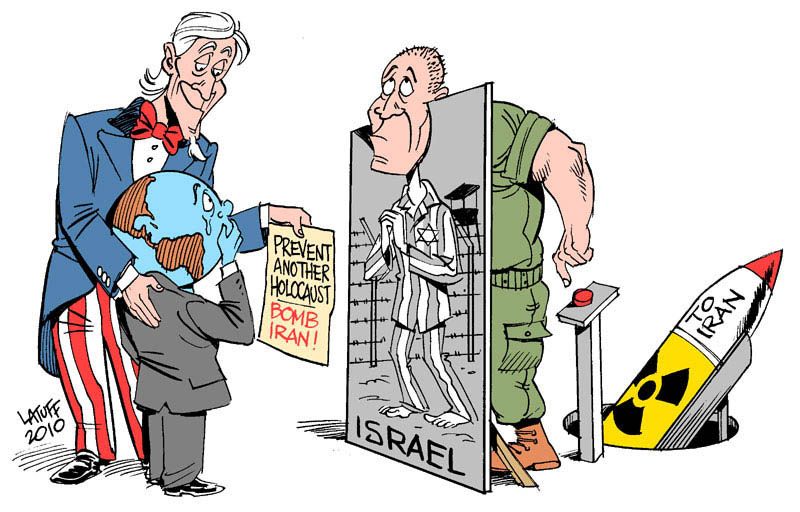
Briefly, on the charge that Ahmadinejad is a Holocaust-denier who wants to wipe Israel off the map: Much of what Ahmadinejad has said about the Holocaust concerns its illegitimacy as a justification for Israel and the Zionist project. If the Nazis perpetrated the Holocaust, why are Palestinians paying the price? he asks. [3] And while there is no doubt that Ahmadinejad would like to see the destruction of Israel, he desires the country’s destruction as a Zionist state, in the same way many sought the destruction of South Africa as an apartheid state. There is no implication in Ahmadinejad’s prediction that Israel will disappear (be wiped off the map) that the country, as a physical entity, and the people within it, will be turned to dust, much less that Israel’s collapse will come about as a result of a nuclear strike by Iran. Explaining what he meant when he said Israel will be destroyed, Ahmadinejad asked, “What befell the Soviet Union? It disappeared, but was it done through war? No. It was through the voice of the people.” [4] Ahmadinejad challenges Israel’s legitimacy, and Zionists, like Wiesel, don’t like it. To deflect attention from the legitimate issues the Iranian president raises about how Zionists exploit the Holocaust to justify the ethnic cleansing of Palestine, he is portrayed as a warmonger who seeks the destruction of the Jews. Screaming “Holocaust” every time Israel’s legitimacy is challenged is a hoary Zionist tactic. [5]

In any event, the idea of Iran launching a nuclear first-strike on Israel is ridiculous in the extreme. First, a nuclear attack on Israel, indeed any attack on Israel by Iran, would be met by a devastating counter-strike by Israel and the United States. Israel is stronger militarily than Iran, the happy consequence (for Israel, though hardly for Palestinians) of the $3 billion in military aid it receives annually from the United States. Israel also possesses an arsenal of some 200 nuclear weapons (the basis for which was provided by France in return for Israeli participation in the war on Nasser’s Egypt that would become the 1956 Suez Canal crisis. [6]) What’s more, Israel has the backing of the largest military power on the planet, the United States. During the last Democratic primaries, then candidate Hilary Clinton warned that if Iran attacked Israel, the United States would “totally obliterate” Iran [7], a warning not to be taken lightly, even if Clinton isn’t president. Uzi Rubin, a private defense consultant who ran Israel’s missile shield program in the 1990s, reminds us that Iran “is radical, but radical does not mean irrational. They want to change the world, not commit suicide.” [8] Moreover, since Ahmadinejad’s opposition to Israel has much to do with the suffering of Palestinians at the hands of Zionism, incinerating Israel makes no sense. This would obliterate the larger part of the Palestinian population, which lives within and on the edge of Israel.

Indeed, contrary to the nonsense of pro-war bamboozlers, the destruction of Israel qua Zionist state is a matter to be achieved, in Ahmadinejad’s view, by democratic, not military, means.

“We have no problem with people and nations. Of course, we do not recognize a government or a nation for the Zionist regime…We are opposed to the idea that the people who live there should be thrown into the sea or be burnt. We believe that all the people who live there, the Jews, Muslims and Christians, should take part in a free referendum and choose their government.” [9]

Is Iran working toward an atomic bomb?

Last September, the international nuclear watchdog, the IAEA, issued a “statement cautioning that it ‘has no concrete proof’ that Iran ever sought to make nuclear arms, much less to perfect a warhead.” According to the then top inspector, Mohamed ElBaradei, the agency had,

“not seen concrete evidence that Tehran has an ongoing nuclear weapons program … But somehow, many people are talking about how Iran’s nuclear program is the greatest threat to the world … In many ways, I think the threat has been hyped. Yes, there’s concern about Iran’s future intentions and Iran needs to be more transparent with the IAEA and the international community … But the idea that we’ll wake up tomorrow and Iran will have a nuclear weapon is an idea that isn’t supported by the facts as we have seen them so far.” [10]

Dennis Blair, the United States Director of National Intelligence, told the US Senate in February that “Tehran was following a ‘cost-benefit approach’ to its nuclear decision-making and that it remained unclear whether Iran’s leadership would make a political calculation to begin producing weapons-grade uranium.” [11] In other words, Iran has not begun to produce weapons-grade uranium and it is unclear it ever will.

The US National Intelligence Estimate of November 2007, a summary of the views of the US intelligence community, concluded that Iran no longer has a nuclear weapons program (but once did.) [12] Every now and then the Obama administration points to ‘new evidence’ that supposedly contests the conclusion, but the US intelligence community has yet to revise its 2007 findings, despite the administration’s frequent claims of having unearthed fresh indications of Iran’s nuclear weapons ambitions.

However, the fact that Washington’s own intelligence community won’t say Iran has a nuclear weapons program hasn’t stopped the administration’s warmongers from talking to the media as if the question is beyond dispute. US war secretary Robert Gates remarked that the “reality is that they have done nothing to…stop their progress toward a nuclear weapon,” [13] as if it is clear that progress is being made. At the same time, US secretary of state Hilary Clinton “referred to Iran’s ‘pursuit of nuclear weapons’ and said …’we don’t want to be engaging while they’re building their bomb.’” [14]

In recent days, more ‘new evidence’ has come forward, brought to public attention by The New York Times, always eager to turn an evidentiary sow’s ear into a silk purse if it means giving further impetus to the drive to war. According to the newspaper, an IAEA report “cited new evidence, much of it collected in recent weeks that appeared to paint a picture of a concerted drive in Iran toward a weapons capability.” The new evidence is “an escalating series of steps by Iran: the enrichment to 20 percent, its acknowledgment of a secret enrichment plant in Qum, its efforts to metalize uranium and its rejection of a deal to enrich its uranium outside the country.” [15] There’s a lot of straw-clutching going on here.

First, Iran is enriching uranium to 20 percent (not the 93 percent needed for a weapon.) It is doing so to produce medical isotopes. Iran’s supply is running short and is expected to be exhausted by the end of the year. Iranians could import the isotopes but sanctions bar the way. Tehran, then, has few options but to produce the isotopes itself – and that means enriching uranium beyond levels needed for use in civilian power plants. Washington proposed that Iran ship its stockpile of low-enriched uranium to Russia and France for processing into fuel rods, which would then be returned once the processing was complete. This would take a year or so. Afraid Washington could renege on the deal once it got its hands on its stockpile, Tehran issued a counterproposal. Fuel rods would be exchanged for enriched uranium simultaneously, on Iranian soil, and in installments. This would prevent the United States from using the uranium-for-fuel-rods swap as a ruse to cheat Iran out of its stockpile of low-enriched uranium. Paranoia or prudence? Before the 1979 Islamic Revolution, the United States built a small research reactor in Iran, and supplied it with weapons-grade uranium (yes, weapons-grade uranium. When Iran was ruled by the dictator, the Shah, Washington was happy to equip Iran with bomb fuel.) After the revolution, Washington refused to provide more fuel, and still owes Iran millions of dollars for fuel that wasn’t delivered. [16] Significantly, Washington has rejected Iran’s counterproposal, but puts the blame for the breakdown on Tehran.

Second, the Obama administration has made much of the so-called secret enrichment facility at Qum, a plant whose ‘secret’ existence Obama first revealed to the world, days after Iran had already acknowledged its existence to the IAEA. How can a plant be secret, if it has already been acknowledged? [17]

Third, while Iran’s efforts to metalize uranium could be aimed at making the core of an atom bomb, turning uranium into a metallic form is also a step in civilian applications. [18] The claim, then, that metalizing uranium is evidence of an intention to make a bomb is no more compelling than the claim that importing chlorine signals an intention to make chlorine gas for military use. Chlorine can also be used for water purification. In the same vein, it could be pointed out that a head can be bashed in with a hammer, but buying one from a hardware store doesn’t necessarily or even often make the purchaser a would-be murderer. Nevertheless, in conformity with the requirements of pre-war demonization campaigns, all Iranian actions are now automatically assigned a sinister interpretation. For example, in a February 25 meeting with Syrian president Bashar al-Assad, Ahmadinejad vowed that the countries of southwest Asia would create a future “without Zionists and without colonialists.” “We tell [the United States] that instead of interfering in the region’s affairs, to pack their things and leave,” he said. While an expression of a desire for an end to Zionist domination of Palestine and freedom from outside interference, The Washington Post’s report on the meeting led with this headline: “Iran, Syria mock U.S. policy; Ahmadinejad speaks of Israel’s ‘annihilation’.” [19] The equivalent in the 1990s would have been a headline declaring that the anti-apartheid movement sought South Africa’s annihilation. Worse, contradictory evidence is interpreted as confirming evidence. An egregious example of this is provided by The New York Times interpretation of the following statement from Ahmadinejad.

“Please pay attention and understand that the people of Iran are brave enough that if it wants to build a bomb it will clearly announce it and build it and not be afraid of you. When we say we won’t build it that means we won’t.” [20]

Iran has repeatedly said it has no intention of building a bomb. Despite this, the writer of one version of the newspaper’s story wondered whether Ahmadinejad’s words were a possible acknowledgement of a nuclear weapons program!

In any event, Iran told international inspectors about its metallization efforts; they’re hardly secret. [21]

Still, it remains unclear whether Iran is secretly building a bomb, is seeking a breakout capability, or is doing neither. No compelling evidence of a secret nuclear weapons program has been brought forward, though there has been much innuendo and unsubstantiated and sometimes ridiculous claims of the sort the Bush administration plied the media with during the run-up to the invasion of Iraq and the Clinton administration foisted on a compliant press prior to the terror bombing of Yugoslavia. That Tehran seeks a breakout capability is a possibility. The US goal of eclipsing the continued rise of Iran as a southwest Asian power necessitates the threat of military aggression. The US containment policy may have motivated the Iranian leadership to begin building a civilian nuclear energy industry in order to acquire a breakout capability, but whether Iran’s nuclear program has this as an ultimate end, or whether Tehran simply wants a cost-efficient way of producing electricity using its own abundant reserves of uranium, is unclear.

In any event, if Iran is building a bomb, or if its civilian program is motivated by the goal of developing a breakout capability, we should ask:

o What kind of a threat would this pose — a threat to us, or what Edward Herman calls the threat of self-defense [22], that is, a threat to overt US and Israeli military aggression against Iran?

o Is an Iran with a nuclear weapons capability more dangerous than an Israel [23], an India, a Pakistan or, indeed, a United States with nuclear weapons?

RT News recently ran billboard advertising in US airports which superimposed an image of Obama upon Ahmadinejad. Next to the images ran this question: “Who poses the greater nuclear threat?” The ads were banned [24] (in a country that frequently condemns other countries for repressing political free speech), and perhaps so because the answer is clear. Given a choice between a country that has numberless nuclear weapons, has used them twice, and threatened their use many more times, and another that doesn’t have any, and if it did, doesn’t have the means to deliver them, and if it could deliver them, would commit suicide in doing so, the clear choice is the former…Obama, not Ahmadinejad.

Against this backdrop it’s easy to see that the energies of those who are truly interested in a nuclear free world are least effectively channelled into campaigns against Iran and more effectively channeled into campaigns against the United States and its fellow nuclear powers. Campaigns ought to be aimed at eliminating the root causes of nuclear proliferation. Immediately, these are the refusal of existing nuclear weapons powers to work toward the elimination of their nuclear arsenals, as they committed to do in the Nuclear Non-Proliferation Treaty. This was to be the quid-pro-quo that removed incentives for non-nuclear powers to develop their own nuclear weapons. Another proliferation incentive is the US practice of threatening non-nuclear states militarily. US threats make the development of nuclear weapons a strategic necessity for targeted countries.

Does Ahmadinejad lack popular support?

Three weeks prior to Iran’s disputed presidential election, Ken Ballen and Patrick Doherty conducted a poll for the international arm of the US Republican Party, the International Republican Institute, hardly a booster of Ahmadinejad. The poll showed that “Ahmadinejad led by a more than 2 to 1 margin – greater than his actual apparent margin of victory”. Ahmadinejad is who Iranians want, they concluded. [25]

Subsequently, the Program on International Policy Attitudes, a program of the Center for International and Security Studies at the University of Maryland, published a study titled “Analysis of Multiple Polls Finds Little Evidence Iranian Public Sees Government as Illegitimate.” [26] The study was based on an analysis of multiple polls from three different sources, some from within Iran and others from outside: a series of 10 polls conducted by the University of Tehran; eight based on telephone interviews conducted by the North American firm GlobeScan; and a poll by the University of Maryland.

The polls found that:

o In the week prior to and weeks after the election, a majority said it planned to, or did, vote for Ahmadinejad.

o “In several post-election polls, more than seven in ten said they saw Ahmadinejad as the legitimate president.”

o “About eight in ten said the election was free and fair.”

o None of the polls found any indication of anything close to majority support for regime change.

o “Large majorities, including majorities of (opposition) supporters, continue to endorse the Islamist character of the government.”

There may have been fraud, but if there was, it’s clear the outcome didn’t misrepresent the popular will. The idea, then, that Ahmadinejad has no popular support and that the Green Movement represents a majority of Iranians, or even close to one, is a myth.

Destabilization

Many people have become so entranced by the apparent ‘people power’ character of the mass demonstrations and protests that followed last year’s disputed election, that they’ve turned a blind eye to the very real possibility that the unrest – and the fact that the election was disputed at all – may owe much to behind-the-scenes machinations of the US government.

“According to the US Senate Select Committee on Intelligence there was a series of clandestine meetings in Rome and Paris between Pentagon officials and Iranian dissidents in 2001 and 2003. The meetings included discussions about possible covert actions to destabilize the government in Tehran…” [28]

On May 23, 2007, ABC News reported: ‘The CIA has received secret presidential approval to mount a covert ‘black’ operation to destabilise the Iranian government.’

On May 16, 2007, the London Daily Telegraph reported that Bush administration operative John Bolton said that a US military attack on Iran would “be a ‘last option’ after economic sanctions and attempts to foment a popular revolution had failed”. (My emphasis.)

On May 27, 2007, the same newspaper reported that: “Mr. Bush has signed an official document endorsing CIA plans for a propaganda and disinformation campaign intended to destabilize, and eventually topple, the theocratic rule of the mullahs.”

On July 7, 2008, Seymour Hersh reported in the New Yorker that, “Late last year, Congress agreed to a request from President Bush to fund a major escalation of covert operations against Iran…These operations, for which the President sought up to four hundred million dollars…are designed to destabilise the country’s religious leadership.” [27]

Individuals and organizations involved in fomenting regime change uprisings in Serbia, Georgia, Ukraine and attempts to do so in Venezuela, Zimbabwe and Belarus, are involved in these destabilization campaigns as advisers to and trainers of Green Movement activists. One of the principal figures is Gene Sharp, head of the Albert Einstein Institution, who advised right-wing Venezuelans on how to use civil disobedience to overthrow Hugo Chavez. [29] More than two years ago, in a March, 2007 interview in The Progressive, Sharp acknowledged that he has been working since 2004 with Iranian dissidents on how to bring down the government in Tehran. [30] One of the hallmarks of democracy promotion is to create the myth that an election is stolen, to justify an attempted overthrow through civil disobedience.

Is war imminent?

It may come next year. Here’s Richard N. Haass, the president of the Council on Foreign Relations, and formerly director of policy planning for the US State Department, where he was a principal adviser to then secretary of state Colin Powell: “I think we can get through 2010 without a military strike. But 2011 could be more dicey.” [31] The Council on Foreign Relations is the premier US ruling class think-tank. It brings together CEOs, corporate lawyers, scholars, and military and government officials, to write policy papers, which are then sent to the State Department. CFR statements should never be taken lightly. [32]

Another indication that war could come by next year is the steps Washington has begun to take to build a defensive shield around its clients in southwest Asia. Missile defense systems are being deployed in Qatar, the United Arab Emirates, Bahrain and Kuwait, additions to US-supplied systems that already exist in Saudi Arabia and Israel. Aegis cruisers are now permanently on patrol in the Persian Gulf. [33]

The purpose of these new deployments isn’t to protect US allies from first-strike attacks from Iran, but from retaliatory strikes that would follow a US (or Israeli) attack. The United States and Israel have threatened a first strike attack on Iran repeatedly. Iran has not threatened to attack any country (except if attacked first.)

The real case against Ahmadinejad

Washington, dominated by CEOs, corporate lawyers, investment bankers, and their toadies, despises Ahmadinejad because corporate America despises him. And corporate America despises him because he is bad for US business.

He is opposed politically because he asserts Iran’s right to a self-reliant civilian nuclear power industry. The United States and Europe are willing to allow Iran to have nuclear energy for civilian use, so long as they control Iran’s access to the enriched uranium needed to power it. This would put the West in the position of being able to extract concessions from Iran by threatening to turn off the tap, on top of providing Western capital with a lucrative investment opportunity.

Ahmadinejad is also opposed politically because he backs Hamas and Hezbollah, opponents of Washington’s attack dog in southwest Asia, Israel. Both organizations are portrayed as terrorist groups that threaten Israel’s existence, but neither are anywhere near large or strong enough or have sufficient backing to pose even the faintest existential military threat to Israel. They do, however, pose the threat of self-defense, which is to say they are capable of inflicting some retaliatory harm on Israel and are therefore seen as impediments to Israel’s free movement in asserting US interests in the Middle East on Washington’s behalf.

Economically, Ahmadinejad earns Wall Street’s disapproval for maintaining Iran’s “high tariff rates and non-tariff barriers,” failing to dismantle “import bans” and leaving regulations in place. Neither does his “weak enforcement of intellectual property rights,” “resistance to privatization,” and insistence on keeping the oil sector entirely within state hands, earn him friends among Wall Street investors and bankers. [34]

In Wall Street’s view, Ahmadinejad’s sins against the profit-making interests of foreign banks and corporations are legion. He “halted tentative efforts to reform the state-dominated economy” — begun by Rafsanjani and favored by Mousavi — “and has greatly expanded government spending.” He maintains an income tax rate that, in Wall Street’s opinion, is too high, and controls “the prices of petroleum products, electricity, water and wheat for the production of bread,” provides “economic subsidies,” and influences “prices through regulation of Iran’s many state-owned enterprises.” [35]

Equally troubling is that on Ahmadinejad’s watch, foreign investment faces “considerable hostility.” “The state remains the dominant factor in the economy.” That means US capital is denied profitable investment opportunities. “Foreign investment is restricted or banned in many activities, including banking, telecommunications, transport, oil and gas.” And when foreign investors are allowed in, ceilings are placed on their share of market. [36]

Banking is another sore spot for Wall Street’s deal-makers. The government keeps banks under tight rein and the insurance sector is dominated by five state-owned companies. Plus, Iranian workers have enjoyed considerable rights within their jobs. The state imposes strict limits on the number of hours an employee can work in a single week, and firing a worker isn’t left to the discretion of capital, to meet its profit-making needs. It “requires approval of the Islamic Labor Council.” [37]

This doesn’t mean that Iran is socialist; far from it. But you don’t have to be socialist to earn Wall Street’s, and therefore, Washington’s, enmity. Imposing tariffs, restricting foreign investment, providing subsidies to domestic firms, and placing performance requirements on foreign investment, are often enough to place a foreign government on Washington’s regime change hit list. Refusing to integrate into the US military machine doesn’t help either. Forcing change on independent governments is easier when they are small, feeble and mostly defenseless, which is why, from Washington’s point of view, it is imperative to eclipse the rise of potential regional competitors before they become too large to deal with readily.

Conclusion

The two major justifications for aggressive action against Iran — that the country is pursuing the development of nuclear weapons and that Ahmadinejad’s re-election was illegitimate – are baseless. There is no compelling evidence to support either accusation. Even if true, these matters would not be justifiable grounds for war, sanctions or destabilization. US and Israeli hostility to Iran and the threat both countries’ nuclear arsenals pose to Iran establish conditions that make Iran’s acquisition of its own nuclear arms as a means of self-defense a virtual necessity. (That doesn’t mean Tehran is seeking to acquire nuclear weapons, but the incentive conditions are certainly in place.) And were there indeed evidence that Ahmadinejad had stolen the last election and is governing without popular support, we could hardly expect US interference, in the form of government and corporate foundation-backed democracy promotion, to have anything other than the interests of Washington and its corporate patrons in mind.

The real reasons for US sanctions, destabilization, sabotage and threats of war are ultimately rooted in economics. The Iranian economy offers too few profit-making opportunities to US corporations, banks and investors and could offer more. Moreover, Iran maintains a military, political and economic independence that Washington – keen to preserve its hegemonic status – cannot abide. Accordingly, Washington has implemented a program aimed at denying Iran an independent source of civilian nuclear energy and breakout nuclear weapons capability – a source both of economic growth and a potential means of self-defense – while at the same time attempting to bring down the government in Tehran, to replace it with one amenable to a role subordinate to US military, corporate and banking interests. To justify these actions, Washington has created a distorted image of Ahmadinejad as a Persian Hitler, keen on carrying out the Final Solution by nuclear means. This is utter nonsense. It is war propaganda of no solidity, on par with deceptions of Saddam Hussein’s weapons of mass destruction and genocide in Kosovo used to justify earlier US-led wars of aggression.

1. Guy Dinmore, “US and UK develop democracy strategy for Iran,” Financial Times (UK), April 21, 2006.

2. “Wiesel: If Ahmadinejad were assassinated, I wouldn’t shed a tear,” Haaretz, February 9, 2010.

3. Ahmadinejad: “Iran condemns fabricating such a pretext (the Holocaust) for the Zionist regime to commit genocide against the Palestinian nation and occupy Palestine. Europeans cannot tolerate the Zionist regime’s presence in their own region but want to impose it on the Middle East. Give (the Zionists) the vast land of Canada and Alaska to build themselves a home and resettle there.” Financial Times (UK), October 5, 2007.

According to the New York Times of September 19, 2008, Ahmadinejad called the Holocaust a “fake.” Exactly one year later, September 19, 2009, the following headline appeared on The New York Times website: “Amid protests, Iran leader calls Holocaust a myth.” The accompanying story, however, was short on details. While the article extended to 18 paragraphs, this is all that was said about Ahmadinejad’s reputed Holocaust denial: Ahmadinejad “called the Holocaust a myth as his country marked an annual pro-Palestinian demonstration… […] Several reports quoted him as saying the Holocaust was a false pretext for the establishment of Israel in 1948. ‘It is a lie’ based on unprovable and ‘mythical claim,’ he was quoted as saying in the speech.” (Alan Cowell, “Amid protests, Iran leader calls Holocaust a myth,” The New York Times, September 19, 2009.)

The Iranian government’s English-language PressTV had another version. It said that after Ahmadinejad denounced Israel as a “symbol of lies and deception” which was founded on ‘colonialist’ attitudes,” he “question[ed] the story behind the Holocaust and urged a probe into it. If the Holocaust, as you claim, is true, why don’t you allow a probe into the issue?’” (“Ahmadinejad wants global front against Israel,” PressTV, September 18, 2009.)

4. The New York Times, September 26, 2007.

5. See Ilan Pappe’s The Ethnic Cleansing of Palestine, Oneworld Publications, 2006 on how the founders of Israel often invoked the danger of a second Holocaust to justify their fight against opponents who had no interest in wiping out the Jews, only protecting their homes and land from expropriation by a Jewish state, and who Jewish forces outnumbered.

6. Richard Becker, “1956 Suez War: Turning point in Middle East balance of forces,” PSLWeb.org, October 3, 2006, http://www.pslweb.org/site/News2?page=NewsArticle&id=5839

7. Mark Landler, “Iran policy now more in sync with Clinton’s views,” The New York Times, February 17, 2010.

8. Howard Schneider, “Israel finds strength in its missile defenses,” The Washington Post, September 19, 2009.

9. The New York Times, September 19, 2008.

10. William J. Cole, “UN nuclear watchdog says Iran threat ‘hyped’,” Associated Press, September 2, 2009. http://abcnews.go.com/International/wireStory?id=8469192

11. “Gates disputes Iran nuclear deal,” Reuters, February 6, 2010.

12. “Intelligence on Iran: The new U.S. assessment has some good news — but the reaction to it could be bad,” The Washington Post, December 5, 2007, http://www.washingtonpost.com/wp-dyn/content/article/2007/12/04/AR2007120401772.html .

13. “Gates disputes Iran nuclear deal,” Reuters, February 6, 2010.

14. Mark Landler, “Clinton pleads for patience at U.S.-Islamic world forum,” The New York Times, February 15, 2010.

15. David E. Sanger and William J. Broad, “Inspectors say Iran worked on warhead,” The New York Times, February 19, 2010.

16. Glenn Kessler, “Iran seeks a deal for reactor,” The Washington Post, October 11, 2009.

17. Stephen Gowans, “Iran’s acknowledged nuclear fuel plant and Israel’s secret nuclear weapons plant,” what’s left, September 28, 2009, https://gowans.wordpress.com/2009/09/28/iran%E2%80%99s-acknowledged-nuclear-fuel-plant-and-israel%E2%80%99s-secret-nuclear-weapons-plant/

18. Sanger and Broad, February 19, 2010.

19. Howard Schneider, “Iran, Syria mock U.S. policy, Ahmadinejad speaks of Israel’s ‘annihilation’”, The Washington Post, February 26, 2010.

20. Michael Slackman, “Iran boasts of capacity to make bomb fuel,” The New York Times, February 11, 2010.

21. Sanger and Broad, February 19, 2010.

22. Edward S. Herman, “Iran’s Dire Threat (It might be able to defend itself),” Z Magazine, October, 2004.

23. It is instructive to note the absence in the West of hysteria over Israel possessing an estimated 200 nuclear warheads and its refusal to sign the Nuclear Non-proliferation Treaty. By contrast, Iran, a signatory to the treaty, and free from nuclear weapons, is greeted with hysteria for seeking to exercise its treaty rights to harness the atom for peaceful, civilian purposes. Iran’s nuclear sites are open to international inspectors. On the other hand, “Israel has rejected the call by the International Atomic Energy Agency (IAEA) to join the Nuclear Non-Proliferation Treaty (NPT) and open up its atomic sites to international inspection.” (Mark Weiss, ‘Israel spurns nuclear watchdog’s call to open atomic sites to inspection,’ Irish Times, September 19, 2009; http://www.irishtimes.com/newspaper/world/2009/0919/1224254860406.html)

The United States and the European Union, which profess to be opposed to nuclear proliferation, initially tried to block the vote, and then voted against it. (http://english.aljazeera.net/news/middleeast/2009/09/2009918173136830771.html It seems the United States and European Union aren’t opposed to nuclear proliferation; they’re opposed to Iran exercising its NPT rights.

24. Globe and Mail reporter Mark MacKinnon described the advertising this way: “The head is a jumble of brown skin, greying hair and oddly incongruous features. You have to stop and stare for a second to understand that two men’s faces are blurred together in the picture. One belongs to Iranian President Mahmoud Ahmadinejad, the other to U.S. President Barack Obama. […] Its tagline upset many who saw it, and got the poster banned from airports across the United States: “Who poses the greater nuclear threat?” […] It’s part of an advertising campaign for RT News, an English-language television station headquartered in Moscow and newly arrived in Canada. The idea that the U.S. may be more dangerous than Iran doesn’t come up often on Western networks such as CBC, CNN or BBC World. And that is exactly the station’s point.”
(Mark MacKinnon, “Big Brother 2.0?” The Globe and Mail (Toronto), February 8, 2010.)

25. Ken Ballen and Patrick Doherty, “Ahmadinejad is who Iranians want,” The Guardian (UK), June 15, 2009.

26. “Analysis of Multiple Polls Finds Little Evidence Iranian Public Sees Government as Illegitimate,” worldpublicopinion.org, February 3, 2010, http://www.worldpublicopinion.org/pipa/articles/brmiddleeastnafricara/652.php

27. The New York Times, June 6, 2008.

28. Seymour M. Hersh, “Annals of National Security: Preparing the Battlefield: The Bush Administration steps up its secret moves against Iran,” The New Yorker, July 7, 2008, http://www.newyorker.com/reporting/2008/07/07/080707fa_fact_hersh

29. Michael Barker, “Sharp Reflection Warranted Nonviolence in the Service of Imperialism,” June 30, 2008, http://www.swans.com/library/art14/barker01.html; Eva Golinger, Making Excuses for Empire:
A Reply to the Self-Appointed Defenders of the AEI , MRZIne, August 5, 2008.

The Albert Einstein Institution revealed the extent of its involvement with anti-Chavez groups, as well as its distaste for the Venezuelan president, in its Annual Report, 2000-2004, pp. 20-21.

“After his failed coup attempt in 1992, Hugo Chávez emerged victorious from the presidential elections in December 1998. Since then the regime has become increasingly authoritarian despite having been democratically elected. Soon after coming into office, Chávez drafted a new constitution, which significantly increased the powers of the presidency. Chávez’s popularity began to wane in December 2001 when he announced by decree a set of 49 new laws affecting industries including banking, agriculture and oil. People reacted by taking to the streets for a one day nationwide civil strike. The government responded with violent repression against the protesters. In this climate, the opposition has had difficulty mobilizing. Venezuelan society is extremely polarized as a result, and poised for the potential outbreak of violence. Venezuelans opposed to Chávez met with Gene Sharp and other AEI staff to talk about the deteriorating political situation in their country. They also discussed options for opposition groups to further their cause effectively without violence. These visits led to an in-country consultation in April 2003. The nine-day consultation was held by consultants Robert Helvey and Chris Miller in Caracas for members of the Venezuelan democratic opposition. The objective of the consultation was to provide them with the capacity to develop a nonviolent strategy to restore democracy to Venezuela. Participants included members of political parties and unions, nongovernmental organization leaders, and unaffiliated activists. Helvey presented a course of instruction on the theory, applications and planning for a strategic nonviolent struggle. Through this, the participants realized the importance of strategic planning to overcome existing shortcomings in the opposition’s campaign against Chávez. Ofensiva Ciudadana, a pro-democracy group in Venezuela, requested and organized the workshop. This workshop has led to continued contact with Venezuelans and renewed requests for additional consultations.” http://aeinstein.org/organizations/org/2000-04rpt.pdf

30. Amitabh Pal, “Gene Sharp Interview,” The Progressive Magazine, March, 2007, http://www.progressive.org/mag/intv0307.

Sharp said, “Our work is available in Iran and has been since 2004. People from different political positions are saying that that’s the way we need to go. And that kind of struggle broadly has important precedence in Iranian/Persian history, both in the 1906 democratic revolution and in the 1979 struggle against the Shah—all predominantly nonviolent forms of struggle. If somebody doesn’t decide to use military means, then it is very likely that there will be a peaceful national struggle there.”

For more on the role of democracy promoters in Iran see Stephen Gowans, “The Role and Aims of US Democracy Promotion in the Attempted Color Revolution in Iran,” what’s left, July 4, 2009, https://gowans.wordpress.com/2009/07/04/the-role-and-aims-of-us-democracy-promotion-in-the-attempted-color-revolution-in-iran/

31. David E. Sanger, “Obama takes several gambles in bid to defend nuclear standoff with Iran,” The New York Times, February, 11, 2010.

32. For more on the Council on Foreign Relations see G. William Domhoff, Who Rules America? Power & Politics, McGraw Hill, Fourth Edition, 2002, pp. 85-88.

33. David E. Sanger and Eric Schmitt, “U.S. speeding up missile defenses in Persian Gulf,” The New York Times, January 31, 2010.

34. 2009 Index of Economic Freedom. http://www.heritage.org/Index/Country/Iran

35. Ibid.

36. Ibid.

37. Ibid.

Iran Myths

In an Unusual Sources radio program, Brendan Stone and Stephen Gowans discuss three myths about Iran: (1) That there’s compelling evidence that Iran is building nuclear arms; (2) that Iranian President Mahmoud Ahmadinejad governs without popular support; and (3) that the Green movement represents a majority of Iranians. Click here to listen.

Sophists for sanctions

By Stephen Gowans

Tony Hawkins, a professor of economics at the University of Zimbabwe, thinks that Western sanctions on Zimbabwe should be maintained but that their effects “are minimal” and that “their continued existence really plays into the hands of some people in Zanu-PF.”

You would think, then, that Hawkins would favor the lifting of sanctions. After all, why continue to play into the hands of Zanu-PF, if, like Hawkins, you’re opposed to the party, its direction and its program, and the sanctions’ effects are minimal anyway?

For decades, supporters of the U.S. economic war on Cuba have lied that a near total U.S. blockade of the island has had little effect on the Cuban economy. On the contrary, they say, the blockade has actually worked against the U.S., by handing Fidel Castro, and now his brother, Raul, a way of diverting attention from their “failed” economic policies. The Castros, they say, blame Cuba’s problems on the blockade and thus evade responsibility for their much larger role in crippling the island’s economy.

Yet none of these people has recommended that the blockade be lifted, a measure you would think Cuba-opponents would immediately latch onto for its supposed benefits in making clear to Cubans that socialism, not the U.S. blockade, is the source of their poverty, something that might impel them to fulfill U.S. foreign policy goals by overturning socialism. So, why aren’t these people, if they truly believe what they’re saying, pressing for the blockade to be lifted?

The answer is simple: they don’t really believe the blockade has minimal effects, but have to say it does, so they can blame Cuba’s poverty on the Castros.

Likewise, people like Hawkins don’t really believe sanctions on Zimbabwe have minimal effects, but have to say they do, so they can blame Zimbabwe’s economic troubles on Zanu-PF policies, particularly land reform.

Hawkins acknowledges his position is “a bit of a contradiction” (a bit?) but that he opposes the lifting of sanctions because ending them “would convince Zanu-PF that they are winning and make them even more intransigent than they are already.”

But you would think that if the effects of the sanctions were truly minimal, that Hawkins could scarcely care if lifting them allowed Zanu-PF something so insignificant as to think it was winning, when, by being denied the sanctions issue, it would really be losing. For how could Zanu-PF blame Zimbabwe’s troubles on sanctions if sanctions no longer existed? Surely, Hawkins can see that ending the sanctions has little downside (the effects are minimal anyway, he says) and a huge upside (Mugabe would no longer be able to blame the country’s difficulties on sanctions.)

To be effective, a sanctions regime requires more than sanctions alone. It also requires an understanding of the sanctions’ effects: are they devastating the economy or only creating inconvenience for a few highly placed political operatives? And what is the cause of the country’s economic woes: sanctions or failed policies?

The purpose of sanctions is to force a change of government. It’s critical that the people the sanctions are imposed on attribute the effects of the sanctions to their government’s policies, not to the sanctions themselves, otherwise, they won’t act to change their government, as the imposers of the sanctions intend.

This is where Hawkins comes in. Washington, London and the E.U. impose sanctions to wreck the economy. Hawkins’ task is to persuade Zimbabweans that sanctions aren’t devastating, and that the problems Zimbabweans face, come from within the country (Zanu-PF’s policies), not outside (sanctions). But in trying to make his case, he ties himself into knots – just as proponents of the U.S. blockade on Cuba do.

Hawkins wants Zanu-PF gone for the same reason the U.S. State Department, Whitehall and other supporters of the U.S. blockade on Cuba want the Castros gone: to create political jurisdictions congenial to Western investors, where the interests of the domestic population don’t matter. Hawkins says Zimbabweans “need a return to conditions that will attract investment that will foster confidence and so on.”

A return? Does he mean to go backward, to a time when the land and resources were in the hands of the British and their descendants, when indigenous Zimbabweans were relegated to roles as farm-workers, miners and employees, never owners?

It should be recalled that the British government, in the person of Clare Short, refused to back Zimbabwe’s fast-track land reform program because returning the land to the people British settlers stole it from would, she said, damage “prospects for attracting investment.”

Returning to conditions that will attract investment is code for undoing Zimbabwe’s land reform program, and giving the country back to the British. Making the case for so regressive a program could only rest on the kind of sophistry Hawkins, and other promoters of neo-colonialism, are prepared to try to bamboozle the Zimbabwe population with. Pity for them they keep tripping over their own contradictions.

Nobel Peace Price Winner Scorns North Korean Peace Offer

Peace is “not what we’re offering,” says U.S. secretary of state

By Stephen Gowans

North Korea recently let Washington know that it will dismantle its nuclear weapons if the United States signs a formal peace treaty ending the Korean War. This, offered Pyongyang, could be negotiated through bilateral talks between the United States and north Korea.

Alternatively, Pyongyang said it was prepared to return to six-nation talks, aimed at denuclearizing the Korean peninsula, if the United Nations removes the sanctions it imposed after north Korea launched a satellite and conducted a nuclear test.

North Korea regards the sanctions as unjust, and with good reason – they are. Neither the satellite launch nor the nuclear test were illegal under international law.

No law prohibits a country from launching satellites, or even testing ballistic missiles — what Washington accuses north Korea of doing under cover of a satellite launch.

And since north Korea is no longer a signatory to the Nuclear Non-Proliferation Treaty – it withdrew after the United States re-targetted some of its strategic nuclear weapons from the defunct Soviet Union to north Korea in the early 1990s — it is not prohibited from developing and testing nuclear arms.

The reality that north Korea’s satellite launch and nuclear test were not illegal, did not, however, stop the United Nations Security Council from imposing sanctions, while at the same time overlooking Washington’s repeated violations of international law, a double-standard made inevitable by Washington’s veto and domination of the council.

North Korea says that it would not have built nuclear weapons had the United States not threatened it with military aggression. This is almost certainly true.

In the early 1990s, long before north Korea developed a rudimentary nuclear weapons capability, Washington announced it was targeting north Korea with nuclear weapons. A month later, Pyongyang withdrew from the non-proliferation treaty. Cause and effect.

Washington, which quashed the basis for a nascent independent Korean government in 1945, has stationed tens of thousands of troops on Korean soil since (but for a single brief hiatus.) U.S. warships patrol the fringes of north Korea’s territorial waters, and U.S. warplanes patrol the margins of north Korean airspace … and not infrequently, intrude upon it. The U.S. military conducts annual war games with south Korea – the south’s military budget is much larger than the north’s – keeping the north off balance and on an unremitting war footing.

Soon after 9/11, the United States ratcheted up its sabre rattling when the Bush administration listed north Korea as one of three countries making up an axis of evil, along with Iraq and Iran. The illegal invasion of Iraq, carried out soon after and for fabricated reasons, made two things clear:

• North Korea could be next.
• Disarming – as Iraq had done – was not a good idea.

In the face of Washington’s threats — indeed, because of them — Pyongyang stepped up its entreaties to Washington to sign a peace treaty.

At the same time, it worked on developing a nuclear weapons capability that would make the Pentagon think twice about another illegal war.

But Washington was dismissive of Pyongyang’s overtures of peace. Colin Powell, then Secretary of State, said “We don’t do peace treaties.”

North_Korea_by_Latuff2Today, a U.S. administration led by a Nobel Peace Prize laureate who wages wars in Iraq, Afghanistan, Pakistan, Somalia and Yemen, says it will only discuss a peace treaty if north Korea dismantles its nuclear weapons first. Washington promises only to discuss, not sign, a peace treaty. If Pyongyang delivers what the United States demands, Washington will think about signing a peace treaty…maybe. The United States, of course, won’t be dismantling its own nuclear weapons.

Washington also says that north Korea’s “appalling” human rights record stands in the way of normalizing relations, even though the appalling human rights records of Egypt, Israel, Saudi Arabia, Ethiopia, Colombia and Afghanistan, hasn’t prevented Washington from maintaining normal, if not favored, relations with these countries, including showering Israel, Egypt and Colombia with billions of dollars in annual aid. And that’s to say nothing about Washington’s own appalling human rights record – one replete with restrictions on mobility rights (i.e., travel to Cuba), secret prisons, prisoner abuse, extrajudicial assassination, unlawful detention and torture.

Clearly, the United States is not interested in peace on the Korean peninsula. Its military intimidation leaves north Korea no option, short of surrender, but to allocate a punishingly high percentage of its meagre budget to defense, with unhappy consequences for the well-being of north Koreans and the civilian economy.

Washington uses north Korea (and a few other sanctioned and threatened countries) to send a message about what happens when countries try to chart an independent course, especially one that is a top-to-bottom alternative to Washington’s prescribed US investor-friendly free market, free trade, and free enterprise regime.

Washington’s real interest is to engineer the collapse or surrender of the pro-independence government in the north, to clear the way for U.S. domination of the Korean peninsula up to China’s borders.

And so it is that an offer of peace and denuclearization on the Korean peninsula – one that would seem to appeal to any administration led by a deserving Nobel Peace Prize laureate – has been summarily rejected. “That is what they want,” sniffed the peace prize-winning warmonger’s secretary of state, “but that is not what we’re offering.”

Obama and New York Times Working to Give Solidity to Groundless Iran Nuclear Weapons Charge

By Stephen Gowans

I have no idea whether Iran has a secret nuclear weapons program, and neither does the Obama administration, but that hasn’t stopped Obama’s advisers from claiming that Iran remains determined to develop nuclear weapons. Nor has it stopped The New York Times from working with the Obama administration to create the impression that Iran has a covert nuclear arms program, despite the country’s insistence it hasn’t, and absent any compelling evidence it has.

In a January 3 article (“U.S. sees an opportunity to press Iran on nuclear fuel”) New York Times’ reporters Steven Erlanger and William Broad cite the views of U.S. and other Western officials that dispute Tehran’s claim that Iran’s nuclear program is for civilian use only. Erlanger and Broad note that:

o Obama’s strategists believe that “Iran’s top political and military leaders [remain] determined to develop nuclear weapons.”
o “Iran’s insistence that its nuclear program is for civilian purposes only is roundly rejected by Western officials and, in internal reports, by international nuclear inspectors.”
o “After reviewing new documents that have leaked out of Iran and debriefing defectors lured to the West, Mr. Obama’s advisers say they believe the work on weapons design is continuing on a smaller scale — the same assessment reached by Britain, France, Germany and Israel.”
o “In early September, the American ambassador to the International Atomic Energy Agency, Glyn Davies, warned that Iran had ‘possible breakout capacity.’”
o “Mr. Obama’s top advisers say they no longer believe the key finding of a much disputed National Intelligence Estimate about Iran, published a year before President George W. Bush left office, which said that Iranian scientists ended all work on designing a nuclear warhead in late 2003.”

In these five paragraphs Erlanger and Broad manage to reveal nothing that isn’t already known: that Iran says it isn’t seeking nuclear weapons and that U.S and Israeli politicians say it is. But they’ve written the article in a way that creates the impression that the existence of a nuclear weapons program in Iran is almost beyond dispute.

At no point do The New York Times’ reporters cite contradictory evidence, except to acknowledge that Iran denies it seeks nuclear weapons. However, they immediately counter Iran’s denial, noting that it is rejected by Western officials.

It is, however, untrue that Iran’s denials are uniformly rejected. The United Nations nuclear watchdog, the IAEA, says there is no solid evidence that Iran has ever had a nuclear arms program. Erlanger and Broad themselves reported this on October 4, 2009. “In September, the IAEA issued a ‘statement cautioning it ‘has no concrete proof’ that Iran ever sought to make nuclear arms, much less to perfect a warhead.’” [1] Added Mohamed ElBaradei, the chief nuclear watchdog at the time: “We have not seen concrete evidence that Tehran has an ongoing nuclear weapons program… But somehow, many people are talking about how Iran’s nuclear program is the greatest threat to the world. In many ways, I think the threat has been hyped.” [2]

While the U.S. intelligence community hasn’t gone so far as to say there is no concrete proof that Tehran ever had a nuclear weapons program, in its 2007 National Intelligence Estimate (NIE) it did say that Iran hasn’t had a nuclear weapons program since 2003.

In a September 10, 2009 article, Erlanger reported that “new intelligence reports delivered to the White House say that [Iran] has deliberately stopped short of the critical last steps to make a bomb,” and “The new intelligence information collected by the Obama administration finds no convincing evidence that the design work has resumed.” [3]

It could be that new evidence compiled since September has led the Obama administration to adopt a revised view. Certainly, Obama’s advisers say they no longer believe the NIE, but they’ve been saying that since February. Back then, they acknowledged that “no new evidence (had) surfaced to undercut the findings of the (NIE)” but that they didn’t believe it, all the same. [4]

Significantly, Erlanger and Broad report that, “The administration’s (current) review of Iran’s program … (does) not amount to a new formal intelligence assessment.” In other words, the new intelligence, information from allies, and analyses that have led Obama’s advisers to conclude that Iran remains determined to develop nuclear weapons, isn’t of sufficient weight or credibility to revise the NIE. Just as was true in February.

Sanger and Broad reported as recently as December 16 that the “Institute for Science and International Security, a group in Washington that tracks nuclear proliferation” urged “caution and further assessment” of some of the evidence Obama advisers say has led them to reject the NIE, because “we have seen no evidence of an Iranian decision to build” nuclear weapons. [5]

The Obama administration’s recent actions smack of the former Bush administration’s practice of glomming on to any evidence, no matter how dubious, to make the case that Iraq had banned weapons. Bush may have been replaced by Obama, but the practice of sexing up intelligence to fabricate a case for war, or in this case, more sanctions in the short term — and of The New York Times playing a role in uncritically circulating pretexts for U.S. aggression — continue.

It would appear that while there is no credible evidence to revise the NIE, it is convenient for the Obama administration to claim that Iran is bent on acquiring nuclear arms. So it simply says it has new evidence that Iran is secretly working on building nuclear weapons. The New York Times, frequently complicit in U.S. foreign policy deceptions, plays along.

One other matter: Would an Iran with a nuclear weapons capability be a threat that warrants a pre-emptive strike?

Any nuclear arms capability Iran developed would be rudimentary and pose what U.S. foreign policy critic Edward Herman has called the threat of self-defense. Nuclear weapons would offer Iran a way of making the United States and Israel, both with vastly larger arsenals than Iran could ever develop in decades, and track records of attacking countries that threaten to disturb the balance of power in the Middle East (i.e., that threaten to challenge U.S. domination of the region), to think twice about overt aggression. A few nuclear weapons wouldn’t turn Iran into the new bully on the block, capable of throwing its weight around, and getting its way. Israel, with its estimated 200 nuclear warheads, is the region’s biggest bully, and, backed by the bully extraordinaire, the United States, will continue to be for some time. Iran, even a nuclear-armed one, is a military pipsqueak, by comparison.

As Uzi Rubin, a private defense consultant who ran Israel’s missile shield program in the 1990s, reminds us: Iran “is radical, but radical does not mean irrational … They want to change the world, not commit suicide.” [6] The United States, on the other hand, wants to rule the world, and will resort to whatever baseless charges are necessary to justify its actions.

1. “Report says Iran has data to make a nuclear bomb,” The New York Times, October 4, 2009.
2. http://www.boston.com/news/world/europe/articles/2009/09/02/un_nuclear_watchdog_says_iran_threat_hyped/
3. “US says Iran could expedite nuclear bomb,” The New York Times, September 10, 2009.
4. Greg Miller, “US now sees Iran as pursuing nuclear bombs,” Los Angeles Times, February 12, 2009.
5. “Nuclear memo in Persian puzzles spy agencies,” The New York Times, December 16, 2009.
6. Howard Schneider, “Israel finds strength in its missile defenses,” The Washington Post, September 19, 2009.

The Limits of Progressive Thought: A Review of Donald Gutstein’s Not a Conspiracy Theory: How Business Hijacks Democracy

By Stephen Gowans

Progressive media analyst Donald Gutstein, a professor in the school of communication at Canada’s Simon Fraser University, and a former co-director of Project Censored, has written what appears to be a promising analysis of the state in contemporary capitalist society. Not a Conspiracy Theory: How Business Hijacks Democracy, examines the role of business in shaping public opinion, but is a disappointing farrago of misconceptions, faulty logic, and contradictions, whose prescriptions offer the left no way out of the cul-de-sac it finds itself in. Gutstein, a liberal with a hazily radical air, argues from a vaguely Marxist and radical standpoint, but his horizons are limited to targeting “radical” conservatives in an effort to restore the social welfare gains of the post-war period. Gutstein wants to relegate business to the role he imagines it once played: as just once voice in a pluralist society presided over by a neutral state.

In short, Gutstein’s argument is that “In Canada and the United States, corporate power and the free market were reined in after the Second World War” [1] in favor of building a mixed economy. “Business signed on to the welfare state because it feared working class activism and a return to Depression-era conditions. It supported nearly-full employment for males, expanded trade union rights and the construction of a social safety net.” [2] The mixed economy produced “unprecedented growth and prosperity,” but “in the 1970s…profits declined and inflation rose” [3] as oil prices skyrocketed and competition from a revived Japan and Western Europe intensified. This prompted business to launch a counteroffensive to restore profits. Business recruited and funded “radical” conservatives to build a propaganda machine to change people’s attitudes and beliefs about unions, the mixed economy and the welfare state. The propaganda worked astonishingly well, allowing business to hijack the media and government, both of which have become instruments of corporate power. Business needs to be reined in so that it is only one of many voices in a pluralist debate (as it was in the post-war period.) The way to accomplish this goal is for progressives to build their own propaganda machine to restore the credibility of the mixed economy and welfare state, relying on grassroots donations and funding from wealthy liberals.

Has business propaganda been successful?

Gutstein argues that business propaganda is used to shape public opinion in ways that favor the interests of business owners against the majority. Propaganda, in his view, keeps the majority from using its numbers to pressure governments to adopt policies that encroach upon business interests.

“A democratically elected government with a mandate from voters to protect jobs, regulate environmentally destructive industry and ensure business pays its fair share of taxes, presents great risks to businesses, limiting a company’s ability to produce ever increasing profits for its share-holders. The risk to business is that…the public…will conclude that business is too powerful and needs to be reined in. The purpose of business propaganda is to ensure that these ideas do not arise.” [4]

Has business propaganda worked? While Gutstein says it has, the examples he cites show it hasn’t. For instance, while he argues that one of the goals of business propaganda is to persuade the public that business isn’t too powerful, he writes,

“A poll commissioned by (Business Week) found that 72 percent of Americans said business ‘had gained too much power over too many aspects of their lives.’ Surprisingly to the Business Week editors, respondents seemed to agree with the sentiments expressed at the 2000 Democratic convention, when presidential nominee Al Gore declared that Americans must ‘stand up and say no’ to ‘Big Tobacco, Big Oil, the big polluters, the pharmaceutical companies, the HMOs’.” [5]

Gutstein argues that the business “propaganda machine…was astonishingly successful in reversing the gains of the welfare state.” [6] But if business propaganda works by changing people’s attitudes and beliefs, it could only have achieved astonishing success in reversing the gains of the welfare state by changing the attitudes and beliefs of the majority about the welfare state. And yet, as Gutstein himself shows, the majority’s support of the welfare state has never wavered. “Despite thirty years of (business) propaganda for tax cuts,” he writes, “people still want spending on social programs.” [7]

In Gutstein’s view, if the majority recognizes that business is too powerful, it will act to rein business in. But popular action doesn’t always or even often follow a correct understanding of a problem. That’s because more than a correct understanding is needed before people take action. Also important is motivation, understanding of what action can be taken, and a belief that the action will make a difference. Furthermore, the action of the majority doesn’t always or even often change public policy. A majority of the world’s population opposed the US-UK invasion of Iraq, and filled the streets in protest on the eve of the invasion in the largest demonstrations in human history. Public opinion was elevated to the status of a second superpower. Yet public opinion turned out to be a rather feeble superpower. The invasion went ahead. Seven years later, Iraq remains under military occupation. Polls show a majority in Canada, Italy, France, Germany, Spain, Britain and even the United States either oppose deployment of their countries’ troops to Afghanistan or favor withdrawal [8], and yet the missions continue, and the U.S. mission will likely continue indefinitely. It could be argued that U.S. President Barack Obama was elected by voters because they believed he was committed to ending the war, yet there are more U.S. troops deployed abroad in combat zones today than under former U.S. president George W. Bush. Public policy seems to have little to do with the attitudes and beliefs of the majority, much less its actions, or votes. Gutstein’s belief that putting the business genie back in the bottle depends on the majority recognizing that business is too powerful is unduly optimistic.

What’s more, a majority of the world’s population already favors progressive policies, despite decades of business propaganda, and yet progressive policies continue to be dismantled. A GlobeScan poll conducted in 27 countries from June to October, 2009, and representing 70 percent of the world’s population, shows that most people in the world are social democrats, while a sizeable number are anti-capitalist, in their attitudes and beliefs. The poll found that a clear majority of the world’s population favors policies traditionally associated with socialism, including public ownership of major industries, redistribution of wealth, and an active role for government in regulating enterprises. [9] Gutstein himself acknowledges that “most people believe…that the acquisition of civil, political, and social rights is an inherently good thing”, [10] and that despite intensive propaganda against Medicare, “the public still backs the system.” [11] Business propaganda, it seems, has been astonishingly unsuccessful. All the same, the welfare state in advanced capitalist countries has been greatly weakened. To understand why, we have to look beyond business propaganda.

Is business propaganda new?

Gutstein can’t seem to decide when business propaganda began. Was it in the 1970s, when declining profits galvanized business to try to get out from under the burden of the welfare state, strong unions and rising popular demands, or did it begin earlier? The answer depends on which page of Gutstein’s book you consult. At one point he writes that the business propaganda machine was first established in the early seventies [12] but points to earlier business-directed campaigns aimed at winning support for a public policy climate favorable to business. He cites a 1949 American Medical Association campaign “to defeat attempts to create universal, federally-insured health care” [13] and a “massive, pro-capitalism grassroots campaign” carried out by “the Advertising Council and the PR industry” between 1945 and 1950. [14] “In 1947 alone,” he writes, the Advertising Council “spent over $100 million to ‘sell’ the American people on the wonders of the American economic system. The campaign, which continued into the 1950s, had two aims: to re-win the loyalty of the workers who had switched to the union, and to halt ‘creeping socialism.’” [15] Gutstein also points out that after World War I many people involved in the propaganda effort to mobilize support for the U.S. entry into the war “turned their efforts to a new crusade: making the world safe for business.” [16] According to Gutstein’s own review, then, the origins of business propaganda date to the period immediately following World War I and not the seventies. [17] If business propaganda has been around since at least the end of World War I, could it be that the domination of government and the media by business began much earlier than 30 years ago?

Have the media and government been hijacked?

Gutstein seems to think that the media and government have been hijacked by corporate interests, rather than created by them (the media) or dominated by them (government.) He misrepresents Noam Chomsky’s and Edward Herman’s propaganda model, outlined in their Manufacturing Consent, as one in which “the prevailing power elites co-opt intellectuals and large media companies and transform them into instruments of shaping public opinion.” [18] (Chomsky and Herman describe media corporations as businesses, whose very nature as businesses, structure their reporting. They have not been co-opted.) Similarly, Gutstein speaks of the corporate agenda becoming the government agenda, as if governments in capitalist society are capable of escaping the imperative of aiding business in its pursuit of profit. Gutstein’s thinking, then, implies that the media and government are capable of playing a neutral role in the clash of labor and business, with government mediating the conflict and the media siding with neither labor nor capital. But the media, for one, are clearly not independent of corporate interests, a point Gutstein himself makes: Media corporations, he writes, are “profit-seeking businesses owned by very wealthy families and by other companies. Owners are generally very conservative politically and favour the dominant North American private enterprise ideology.” [19]

For all of his optimism that business can be relegated to the role of one of many participants in a pluralist debate, [20] Gutstein recognizes that business “has significant influence over government, and controls the debate” [21] because it is able to use its wealth to press for a public policy climate favourable to its interests. Business-sponsored think-tanks, he writes, have,

“greater financial resources. Business sponsored think-tanks can hire more staff, fund more scholars, cover a wider range of topics and produce more studies and reports (than progressive think-tanks, with more limited financial resources, can.) They are also more effective because they have the ear of a sympathetic corporate media far more frequently than progressive think-tanks.” [22].

However, Gutstein focuses too much on the role business think-tanks play in shaping public policy, and too little on the movement of the same individuals back and forth between top corporate and government jobs, [23] the overwhelming role corporations and the wealthy play in funding major political parties, and the work of lobbyists on behalf of individual corporations and business as a whole. [24] He also ignores the limited room for manoeuvre of governments that work within the framework of capitalism. Unless they mobilize the energies of a significant portion of the population to overthrow the system, governments in capitalist society are constrained to act in ways that do no harm to the interests of business. If they do cause harm, business will stop investing, either because it is no longer profitable to do so, or to sabotage the government’s anti-business policies. Capital strike, or the flight of capital to business-friendly jurisdictions, will either bring the government back in line, or prompt voters to change the government. Either way, no government that willingly works within a capitalist framework can privilege lower classes at the expense of business for long without being reined in or replaced. It’s highly likely that governments in capitalist society would act to continue to defend and promote business interests whether business think-tanks – and business propaganda — existed or not.

The counteroffensive

At times, Gutstein seems to paint a picture of a world in which ideas are disconnected from the material world. At other times, he seems more firmly grounded in reality. But always ideology has primacy in his analysis. Ideas, if skilfully expressed by able and well-funded propagandists, have the power to compel action. For example, he attributes the Canadian government’s abandonment of social welfare policies and adoption of a neo-liberal program to a single report by Harvard professor Michael Porter. “After the Porter study (on Canada’s competitiveness in the world) made the rounds of senior officials, the corporate agenda became the government agenda.” [25] This supposes that the government’s agenda hadn’t always been the corporate agenda. An alternative view is that the Porter study didn’t cause the Canadian government to adopt a new agenda. The imperatives of the capitalist system did. What the Porter study did was justify the new agenda.

Gutstein’s emphasis on ideology is also expressed in his discussion of class conflict. Progressive movements, he notes, have “been followed by ideological counterthrusts of extraordinary force … sponsored by the entrenched interests of the day, fighting to protect their privileges and wealth, block progress toward a more just, equal and enlightened society, and undo the reforms already achieved.” [26]

It’s true that progressive movements have been followed by ideological counterthrusts, but more importantly, they have been followed by changes in policy. These changes have occurred when business’s ability to turn a profit has been damaged by a crisis of the capitalist system or by the insupportable encroachment of the demands of progressive movements on business interests.

Social welfare capitalism succeeded laissez faire capitalism as a result of the Great Depression, (though it was the massive spending on the war that brought the United States out of the crisis.) North America’s post-war growth and prosperity was largely caused by pent-up demand following the restraint and shortages of the war, the Marshall Plan, the Cold War, the space race and the rise of the automobile industry, (with its ramifying effects in touching off the growth of steel, glass, petroleum and rubber industries, and the construction of highways and the suburbs.) [27] Additionally, having escaped any major war damage, North American industry enjoyed a virtual monopoly for the greater part of the post-war period, as its competitors rebuilt. At the same time, ideological competition with the Soviet Union dictated that the working class in North America be granted concessions to meet the social welfare standards set by the Communist countries, with their full employment and robust social wage. [28] Strong unions and expanding social programs were easy for business to tolerate as the economy expanded, the price of raw materials was low, and foreign competition was modest.

By the mid-1970s, growth was slowing, the creation of the OPEC cartel sent oil prices skyrocketing, labor had become increasingly militant, and popular demands were being made for further expansion of the welfare state. The top shareholders and executives of major corporations decided that social democracy had gone too far. They used advances in transportation and telecommunications to shift production to non-union areas and later to low-wage countries, to escape the limits strong unions and minimum wage laws imposed on capital accumulation. Publicly-owned assets were sold off, generating new opportunities for profitable investment. Corporate taxes were slashed to fatten bottom lines, reducing the tax revenue base needed to fully support social programs. The welfare state capitalism of the post-war period was being dismantled. But the reason it was being dismantled was not because “radical” conservatives had organized themselves into corporate-funded think-tanks, which had then hijacked the media and government, but because business interests could no longer tolerate the social welfare gains of the post-war years. It was this that caused business to use its agents to both implement and justify a new agenda.

A false solution

Gutstein believes that progressives can achieve success by aping conservatives. Where conservatives identify liberals and leftists as their enemies, “progressives have to make…radical conservatives…the enemy” [29] abandoning their historical focus on “poverty, homelessness, inequality, poor healthcare, racism and sexism.” [30] These evils should never be lost sight of, he writes, but at the same time, they shouldn’t get in the way of targeting “radical” conservatives.

One of the implications of targeting “radical” conservatives is to vote strategically to stop their rise to elected office. But strategic voting by left-wing voters strengthens conservatives by pushing politics increasingly to the right. This happens in two ways. First, those who would otherwise vote for an authentic left alternative throw their weight behind a party which represents a position to the right of their views, in order to defeat conservatives who are even further to the right. This alone represents the skewing of political positions in electoral contests to the right of the base of political positions held by the voting population. Second, the parties that receive the votes of left-wing strategic voters (Labour in Britain, the Democrats in the United States, the Liberals and NDP in Canada), are given permission to move further to the right, in an effort to expand their appeal to cover right-wing voters, since they know that no matter how far right they move, left voters will move with them, so long as there are conservatives even further to the right who must be blocked. Targeting “radical” conservatives, then, rather than promoting authentic left-wing positions, is a self-defeating strategy that only guarantees further migration to the right.

In elaborating this approach, Gutstein urges progressive foundations to take a leaf from the playbooks of conservative foundations. Progressive foundations, he says, spend their money on “thousands of grassroots groups disconnected from one another and from national politics,” while conservative foundations fund a smaller number of “well-chosen think-tanks and advocacy organizations.” [31] Conservatives have “demonstrated that a successful political movement required building multi-issue organizations,” while progressive foundations spread their resources thin, distributing their more limited funding on “organizations engaged in one or a few issues.” [32] Gutstein assumes that once this truth is apprehended, progressive foundations will change their funding practices. But what he misses is the possibility that progressive foundations fund a multiplicity of disparate, single-issue organizations, by design. What wealthy liberals want no more than wealthy conservatives is an effective multi-issue political movement capable of challenging the privileges of corporations and the wealthy. Keeping the left fractured and disorganized, by doling out small donations to disparate groups working on single issues, is one way of preventing the rise of an effective, multi-issue organization. [33]

A multi-issue movement of the left that united its fractured parts would be more effective than the current agglomeration of single-issue groups, but what would it be united in pursuit of? In Gutstein’s view, it would unite to discredit “radical” conservatives, an enterprise which, if successful, would force governments to see the light and rein business in, so that business would be forced to return to the status of equal player in a pluralist debate mediated by a neutral government. This, however, flies in the face of reality. Business has always dominated the state in capitalist society. It may have appeared at certain points to many members of the corporate elite that the state was encroaching upon business interests more than was necessary to stabilize the society and secure the support of the working class, and at the same time, it may have appeared to members of the working class that the state was trying to balance the interests of labor and business, but there has never been any doubt that in a capitalist society the interests of capital are pre-eminent. There may be disagreements among the top shareholders and key executives of major corporations about the best way forward. Some may favor government intervention to stabilize the economy and to secure a basic level of economic security for the working class in order to build a stable society conducive to capital accumulation. Others may regard these interventions as unnecessary and prohibitively costly. Still others may look to permanent war, the mobilization of society against external threats (real or fabricated) and the promotion of religion, nationalism, racism and patriotism as alternatives to class, as the best way to stabilize society and perpetuate the rule of business. But in all cases, it is capital that is the dominant force.

Who is in the driver’s seat – and who ought to be?

Gutstein believes that there has been a fundamental shift in the balance of power over the last 30 years, where business, once reined in by government, has since slipped its reins, hijacked the government and media, and turned the corporate agenda into the government agenda. Let us accept Gutstein’s view for the moment, that it is indeed only in the last three decades that business has emerged to dominate government and the media. Whether corporate domination is inherent in capitalist society or only of recent origin, it remains the case that the present reality, as Gutstein notes, is that “Corporate power is in the driver’s seat. It has the money, organization and access to the media.” [34] How, then, does Gutstein propose that business be pushed from the driver’s seat? And who should replace it?

It would seem that the surest way to solve the problems of “poverty, homelessness, inequality, poor healthcare, racism and sexism” that Gutstein lists as the historical concerns of the left, is to replace business in the driver seat with the class that suffers most from these afflictions: the working class. Indeed, where the working class was, and currently is, in the driver’s seat, these evils were and have been nearly eliminated, if not abolished. In Cuba today and the socialist bloc before its demise, homelessness, poor healthcare, racism, sexism and extremes of income were largely eliminated, if not eradicated altogether. Since it is in the interest of the working class to deal with these problems but not in the interests of business to do the same, (except insofar as these problems threaten to destabilize society and business’s ability to accumulate capital), it would seem that the working class is the agent for this change. But that is not Gutstein’s view. As a pluralist, he wants to replace business in the driver’s seat with “neutral” elected politicians who will reconcile the clash between labor and capital. But can politicians be neutral in capitalist society? Since electoral success is highly sensitive to how much money and media support a candidate for elected office can command, and because business is in the best position to furnish candidates with the resources and media support they need to get elected, the capitalist system does not tend toward the production of neutral politicians. On the contrary, it tends toward the production of errand boys for business. What’s more, as already mentioned, politicians who operate within the framework of capitalism have no option but to make capitalism work, and that means, in the first instance, ensuring that the profit-making requirements of business are met above all else. This is true whether the government is conservative, centrist or social democratic. No government that operates within a capitalist framework is neutral.

If business is in the driver’s seat, “the money, organization and access to the media” that allowed it to move into the driver’s seat in the first instance, allows it, at the same time, to maintain its position and beat back challengers. How then does Gutstein propose that business be forced from its commanding position at the apex of society? The answer he offers is for progressives to unite to discredit “radical” conservatives and restore the credibility of the mixed economy and social welfare. This is shallow.

We have already seen, and Gutstein himself has shown, that social welfare, regulation, and public ownership never lost credibility with the bulk of people in capitalist society. The majority continues to regard these things as desirable, and yet these things are no longer part of the government agenda. This is so because public ownership, regulation and social welfare, lost credibility with business, and with its media and government agents, beginning in the mid-1970s. Indeed, the fundamental shift in the balance of power that Gutstein claims happened 30 years ago was really the loss in credibility of the welfare state among business and its representatives who dominate the state. This is why a conservative agenda was implemented despite continuing popular support for social welfare. Calling for a campaign to restore the credibility of the mixed economy and the welfare state can only mean restoring the credibility of social welfare capitalism among members of the ruling class, since this is the only class for which the credibility of public ownership, income redistribution and regulation, was lost. In other words, what Gutstein is proposing is that the public petition business and its agents in government to recreate the world as it was in North America from the end of World War II to the mid-1970s.

Since business and its agents will only implement a welfare state if it’s in their interests to do so, and since objectively, it’s not always or even often in their interests to grant a full panoply of concessions and reforms, the likelihood of this approach being successful is entirely dependent on the interests of business. If there are times when it would suit the profit-making imperatives of business to strengthen social welfare, concede advances in unionization, and allow a measure of public ownership, these reforms and concessions will be made…but at the discretion of the same business interests that are in the driver’s seat. Reform and concessions will, therefore, be contingent and revocable, and will be taken back at the earliest moment the welfare state is no longer judged by business to be in its interests. The lesson of the last three decades for the left is not to work to restore the credibility of social welfare capitalism, but for the working class itself to take control of the economy and to replace business in the driver seat. This is the only way to permanently end the evils that Gutstein calls the historical concerns of the left.

It should be noted that Gutstein’s views are representative of those of progressives who aim to persuade business and its agents that income redistribution, strong unions, and robust social programs are a pathway to growth and prosperity, not burdens which reduce profit-margins. This Panglossian view, which also seeks an equal status for, or partnership between, labor and capital, holds that social democracy is a win-win for both classes. This view carries little weight with business, which recognizes that an irreconcilable antagonism exists between its interests and labor’s, and that if it can get away with paying less tax and lower wages, so much the better. The progressive argument that business could reap higher profits if it paid more taxes and raised wages is, not surprisingly, dismissed by business as nonsense. As to the view that a partnership between business and labor is democratic, this can be dismissed as nonsense too, for even if we were to suppose that labor and capital could have an equal status in capitalist society, it would be a strange democracy in which the 90 percent or more of the population that makes up labor had a voice only equal to the 10 percent or less that constitutes capital.

The limits of progressive thought

To summarize the problems with Gutstein’s analysis:

1. The post-war period may have been a time of robust growth and prosperity in Canada and the United States, but it does not follow that robust growth and prosperity were caused by a mixed economy, expanded union rights and the construction of a social safety net. What’s more, the United States economy has never been mixed, and the Canadian economy has only ever been mildly so. Pent-up demand following the restraint and shortages of the war years, the stepped up military spending of the Cold War, the space race and the expansion of the automobile and allied industries, contributed to making the post-war period a time of growth and prosperity. The role these factors played in creating growth and prosperity, alongside the industrial monopoly enjoyed by North American business for the greater part of the post-war period, allowed a social safety net to be built. The ideological imperative of meeting the social welfare standards established by the Communist countries provided the impetus to do so. The smaller size of the global capitalist workforce prior to its doubling with the collapse of the socialist bloc and the opening of China and India to foreign investment, checked the strong downward pressure on wages that would soon follow. The location of production in advanced industrial countries prior to the advances in telecommunications and transportation that allowed production to be relocated to non-union areas and low-wage countries also supported strong unions and higher wages.

2. While business recruited “radical” conservatives to promote neo-liberal and neo-conservative ideologies, the business propaganda machine has not been the astonishing success Gutstein say it has been. On the contrary, it has failed miserably in changing the beliefs and attitudes of the majority about social welfare, regulation and public ownership. And yet, the social welfare state has been largely dismantled and unions weakened. Business and is errand boys in government didn’t manufacture consent among members of the working class for these changes; they simply went ahead and made them.

3. Business did not hijack the media and government after profits declined and inflation rose in the 1970s. Media corporations, business themselves, are by their very nature corporate agents, while governments have long acted in the interests of business, because they have regularly been led by ambitious lawyers (typically), recruited, trained and financed by the corporate rich, and often by the corporate rich themselves, and because any government that willingly works within the context of capitalism must accommodate the profit-making interests of business, or risk its rule being destabilized.

4. By virtue of its ownership and control of the economy, business is in a position to use its immense wealth to undermine laws intended to rein in it, and to tilt the playing field in its favor. In a capitalist society, business wields too much power for it ever to be but one voice in a pluralist contest mediated by a neutral state. Business control of the economy and the wealth it allows it to accumulate furnishes business with the means to buy the media, lobbyists and politicians to undermine regulation.

5. Wealthy liberals are no more interested in building effective movements to challenge their wealth and privileges than wealthy conservatives are. While a coordinated, organized and disciplined multi-issue organization is necessary to successfully advance left-wing goals, the role traditionally played by liberal philanthropists in their relationship with the left has been one of co-opting moderates and splintering the left into disparate, single-issue groups, organized around concerns other than class (gender, race, poverty, environmentalism, and so on.) Any serious effort to secure advances for the working class will not be funded by those most likely to be adversely affected.

While each of the above issues is important alone, all can be more readily addressed within a publicly-owned, rationally planned economy than within the framework of capitalism. Progress in eliminating racism, sexism and in providing basic economic security came much faster and went much further in the Soviet Union and other socialist countries than in advanced capitalist countries. While progress toward the resolution of important problems does happen within capitalism, it happens in a slow, fitful manner, without the determined energy that has characterized the history of socialist countries. A commitment to building socialism is a more certain and rapid path to eliminating these scourges than attempting to secure gradual, piecemeal change within capitalism. With the world being driven headlong into environmental disaster by the competitive lash of capitalism, gradual, piecemeal reforms are not an option.

Conclusion

Contrary to Gutstein’s thesis, government and the media weren’t hijacked three decades ago. They have always been agents of corporate rule. However, three decades ago, the welfare state lost credibility with business and its representatives in government and the media because it no longer served business interests. Strong unions, labor militancy, rising popular expectations and demands for the expansion of the welfare state, and the crisis of stagflation, combined to encroach upon business interests to a degree business was no longer willing to tolerate. In a backlash against labor, unions were attacked, social safety nets were shredded, and the taxes of corporations and the wealthy were slashed. The backlash was facilitated by advances in shipping and telecommunications, which allowed production to be relocated to non-union areas and low-wage countries. The doubling of the global capitalist workforce, which occurred as a result of the opening of China and India to foreign investment, and the collapse of the Warsaw Bloc, helped to drive wages down. [35] The ideology propagated by “radical” conservatives who organized themselves into corporate-funded think-tanks justified the new agenda, but didn’t cause it.

Gutstein and other progressives think it’s possible to turn back the hands of time. They want to return North America to a post-war capitalism. But returning to the post-war welfare state means recreating the material conditions of the post-war years, something no amount of counter-hegemonic progressive propaganda can achieve. Those days are gone, and while they may have been comfortable for white, male workers in the United States and Canada, they were not a nostalgic period for women and racial minorities in the global north, nor for the greater part of humanity in the global south whose oppression the social welfare gains of the north partly defrayed.

The lesson of the last three decades for the left is not, as Gutstein concludes, to work to restore the credibility of welfare capitalism, but to face up to the reality of what happens when working class movements fail to take the driver’s seat themselves, and allow business to keep its hands on the wheel. Left in place to drive the car, the major shareholders and board members of the top corporations steer in the direction that suits themselves, veering only slightly off course when the passengers, or the conditions of the road, leave them no other choice. But the road of capitalism is narrow, and business absolutely will not steer off the road, though it is in another direction that the interests of the car’s working class passengers lie. As Gutstein points out, “poverty, homelessness, inequality, poor healthcare, racism and sexism” are the traditional concerns of the left, and it is in societies in which the working class has come to power that these evils have been greatly reduced, if not eradicated altogether. By contrast, in societies in which business has been left in the driver’s seat or where labor attempts to share power with business, progressive gains, if they’ve gone far at all, are almost always temporary, revoked the moment business needs to take them back and is strong enough to do so. No, the lesson of the last three decades for the left is not to work to restore the credibility of social welfare capitalism, but for the working class itself to take control of the economy and to replace business in the driver seat. This is the only way to permanently secure the benefits business temporarily ceded to one section of the global working class during the post-war period, and to make them a reality for all.

1. Donald Gutstein, Not a Conspiracy Theory: How Business Hijacks Democracy, Key Porter Books, 2009, p. 315.
2. Gutstein, p. 59.
3. Gutstein, p. 57.
4. Gutstein, p. 17.
5. Gutstein, p. 315.
6. Gutstein, p. 58.
7. Gutstein, p. 304.
8. Jennifer Agiesta and Jon Cohen, “Public opinion in U.S. turns against the war,” The Washington Post, August 20, 2009; John F. Burns, “Brown pledges to maintain Britain’s Afghan forces,” The New York Times, September 5, 2009; Julian E. Barnes, “Doubt raised on troop boost in Afghanistan war,” The Los Angeles Times, September 11, 2009; Linda McQuaig, “NATO is an unwelcome wedding guest,” The Toronto Star, July 28, 2009; “Just 40% of US back Afghan conflict,” The Morning Star (UK), October 8, 2009; Eric Schmitt and Steven Erlanger, “U.S. seeks 10,000 troops from its allies in Afghanistan,” The New York Times, November 26, 2009.
9. GlobeScan, “Wide Dissatisfaction with Capitalism — Twenty Years after Fall of Berlin Wall,” November 9, 2009, http://www.globescan.com/news_archives/bbc2009_berlin_wall/bbc09_berlin_wall_release.pdf
10. Gutstein, p. 80.
11. Gutstein, p. 303.
12. Gutstein, p. 58.
13. Gutstein, p. 66.
14. Ibid.
15. Gutstein, p. 92.
16. Gutstein, p. 63.
17. Ibid. One of the people involved in the post-World War I campaign was Ivy Ledbetter Lee who “helped John D. Rockefeller clean up his reputation.” This was done by establishing the Rockefeller Foundation. Being liberal, Rockefeller’s philanthropy escapes Gutstein’s critical gaze.
18. Gutstein, p. 70.
19. Ibid. It’s curious that Gutstein considers private enterprise ideology to be uniquely dominant in North America. While it’s true that social programs and unions are stronger in other places (Western Europe, for example), it would be an exaggeration to say that private enterprise ideology isn’t dominant among mainstream journalists and media commentators, top level civil servants and political parties, including labor, socialist and social democratic parties, outside of North America. It is not, however, dominant among the majority, as shown above.
20. Gutstein, p. 315.
21. Gutstein, p. 11-12.
22. Gutstein, p. 73.
23. Paul Sweezy, “Power elite or ruling class?” Monthly Review Pamphlet Series, No. 13.
24. G. William Domhoff, Who Rules America? Power, Politics and Social Change, McGraw-Hill, 2005.
25. Gutstein, p. 30.
26. Gutstein, p. 56.
27. Paul A. Baran and Paul M. Sweezy, Monopoly Capital: An Essay on the American Economic and Social Order, Monthly Review Press, April, 2009.
28. Fred Goldstein, Low-Wage Capitalism: Colossus with Feet of Clay, World View Forum, New York, 2008.
29. Gutstein, p. 309.
30. Ibid.
31. Gutstein, p. 318.
32. Ibid.
33. Joan Roelofs, Foundations and Public Policy: The Mask of Pluralism, State University of New York Press, 2003; See also Michael James Barker’s web-log, http://michaeljamesbarker.wordpress.com/. Barker has written extensively on liberal philanthropies and their role in manipulating democracy.
34. Gutstein, p. 292.
35. Goldstein.