
During an audience with Ho Chi Minh in Hanoi, Tariq Ali asked what Western radicals and student activists could do to best support the Vietnamese resistance against U.S. forces. Ho replied: “Make your own revolution.”
7 June 2026
By Stephen Gowans
When it comes to Cuba, the accustomed practice of the establishment press is to document in detail the measures Washington has taken to sabotage the country’s economy, and then to relegate these measures to third place, behind mismanagement and corruption, as the causes of the socialist state’s economic crisis. Here’s how The Wall Street Journal puts it:
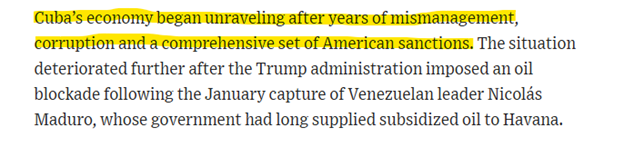
While the press regularly documents in detail the numerous measures the US has taken to sabotage the Cuban economy, I have yet to see any reporting on mismanagement or corruption.
The most parsimonious explanation of why the Cuban economy is collapsing, and the only one with any empirical support, is:
1. The toll taken by over six decades of US economic warfare.
2. The fact that Cuba has no great power support to help it endure US pressure.
3. The US oil embargo.
4. The threat of new secondary sanctions that is precipitating a flight of foreign businesses from Cuba.
Over six decades of US economic warfare
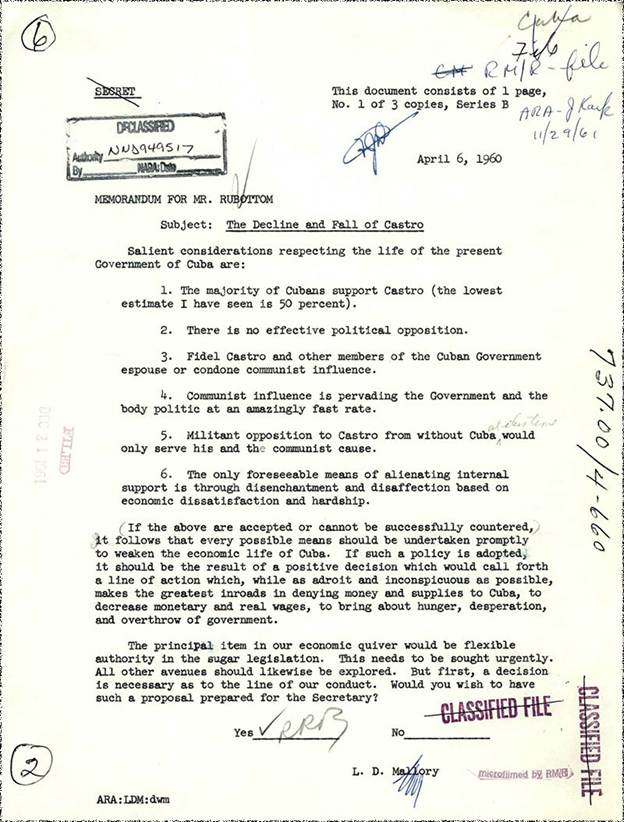
Almost from the moment of the Cuban Revolution’s birth, Washington has acted “to weaken the economic life of Cuba” with the aim of bringing about “hunger, desperation, and the overthrow of the government.” From 1960 to today, not a moment has elapsed without Washington working in some way to pauperize Cubans. Unless we think Washington has been totally incompetent in engineering the unravelling of the Cuban economy, it is unreasonable to minimize the role played by US economic warfare in Cuba’s immiseration.
Cuba no longer has great power support
For three decades the Soviet Union provided Cuba with significant aid, both economic and military. This was sufficient to counteract some of the measures the United States introduced to undermine the Cuban economy.
The demise of the Soviet Union in 1991 plunged Cuba into crisis. Relying on its own limited resources, along with joint ventures with European, Canadian, and other non-US businesses, Cuba was able to keep the lights on, and more.
During this period, Washington’s foreign policy agenda was focused on efforts to maintain US unipolar dominance, and prevent the rise of hegemonic regional powers in West Asia, East Europe, and East Asia. Cuba flew under the radar. It was too small, too weak, too significant, and too caught up in its own desperate struggle to survive, to pose any threat to the United States.
Moreover, compared to the strategic significance of controlling Persian Gulf oil, the promise of profitable access to vast commodity, investment, and cheap labor markets in East Asia, and rivalry with Russia over East Europe, Cuba had little to offer the capitalist interests that shaped US foreign policy. Why bother with Cuba when there were much bigger fish to fry?
Another factor that inclined Washington to leave Cuba alone to struggle under the mountain of sanctions it had imposed, was the fact that the existence of the island country as an example of socialism was an important part of US anti-socialist propaganda. The poverty of Cubans (relative to the capitalist metropolis but not its periphery) could be pointed to as evidence of the failure of socialism and its inability to offer anything like the good life Americans enjoyed at home.
There were two problems with this narrative.
First, the expected consequence of decades of US economic warfare was poverty. Indeed, US foreign policy officials said in private that their goal was to make Cubans hungry and desperate by weakening the country’s economic life. US predation, not socialism, caused Cubans to struggle economically.
Second, there were scores of capitalist countries in the world that were as poor or poorer than Cuba. If turning its back on capitalism was making Cuba poor, why were there so many poor capitalist countries in the world? Indeed, the number of poor capitalist countries vastly exceeds the number of rich ones. And why was Cuba faring better in human development terms than countries of comparable income? What’s more, for a time, Cuba had a lower infant mortality rate than did the United States itself.
Hence, it seemed like there were more reasonable explanations for Cuba’s relative poverty than socialism. In fact, the evidence that socialism made Cuba poor was exactly zero. All the same, the narrative that pointed to “mismanagement” of the economy, i.e., socialism, was, and continues to be, universally accepted by establishment figures and media in the United States as the gospel truth, despite the narrative’s glaring deficiencies and absence of evidence.
With the Soviet Union gone, and Russia returning to great power status, and China returning to the ranks after a centuries-long absence, the possibility arose that these powers could backstop Cuba.
But the conditions weren’t right. At least two of the following things would need to be true for China or Russia to offer Cuba sufficient economic aid to enable the island country to survive a determined effort by the United States to finally bring about its economic collapse:
- An ideological commitment to aiding the workers and peoples of the world to liberate themselves;
- A sufficient economic surplus to cover both the great power’s strategic needs and substantial aid to Cuba;
- The existence of some meaningful benefit the great power could derive from helping Cuba.
Neither of these conditions was true. The reality is that the benefits Cuba can offer China and Russia are miniscule compared to the costs of giving the socialist island sufficient aid to keep its economy afloat in the face of a resolute US effort to sink it.
The US oil embargo
While previous US administrations have been content to largely ignore Cuba as an immediate target for regime collapse, and to focus on larger opportunities, the Trump administration has set its sights on Cuba as an easy target. This is a project that appeals to Marco Rubio’s domestic base and the secretary of state’s presidential ambitions, and presents a vainglorious and egomaniacal Donald Trump with the prospect of being able to boast that he has accomplished something no other president before him was able to achieve.
Having eliminated Venezuela’s Maduro through abduction, and installed in his place a biddable Delcy Rodriquez as the country’s quisling acting-president, Washington has proceeded to halt Venezuelan oil shipments to Cuba. It has also imposed an embargo on oil shipments from any country. With Cuba producing only 40 percent of its energy needs domestically, the consequences are devastating.
US secondary sanctions
Having greatly weakened Cuba by denying it oil imports, Washington has introduced what it hopes will be the coup de grace: threats of sanctions on any foreign company that does business with GAESA, the body that controls a substantial part of the Cuban economy. Canadian and European hotel operators are pulling out, and the future in Cuba of the Canadian mining giant Sherritt is in question. On top of that, Mastercard and Visa transactions have been suspended.
Socialism in One Country
The imminent collapse of the Cuban economy raises the question of whether socialism can survive in one country, especially a small one like Cuba.
Even Stalin thought that it couldn’t over the long term (not because there’s something inherently unworkable about socialism but because one socialist country in a world of many capitalist predators has little hope of survival.)
Here’s how Stalin put it. (I cite him only because he’s most strongly associated with the view that socialism can be built in one country.)
Leninism teaches that ‘the final victory of Socialism, in the sense of full guarantee against the restoration of bourgeois relations, is possible only on an international scale’. This means that the serious assistance of the international proletariat is a force without which the problem of the final victory of Socialism in one country cannot be solved.
Building socialism and defending it in a country like the Soviet Union—with its large population and vast continental territory that contained within it every natural resource needed to build an industrial economy—was of an order of magnitude easier than building socialism and defending it in Cuba, a small island, with a small population, and few resources. And even the Soviet Union, with its advantages, failed to withstand the incessant threats, sabotage, and pressure of the United States and its capitalist allies.
Can Cuba survive as an independent socialist state in the face of the US onslaught? Perhaps. But only as one reduced to abject poverty.
To use Stalin’s terminology, the serious assistance of the international proletariat is a force without which the problem of the survival of an independent socialist Cuba cannot be solved.
Inasmuch as it is the United States that is bent on erasing both Cuba’s independence and its socialism, whatever hope it has for existing as a socialist country in other than an economically unviable state depends, not only on the resilience and resolution of the Cuban people, but on the energy and determination of the American people to fundamentally change the nature of their own society. For it is their society that stands in the way of any prospect of even mild Leftism in the Western Hemisphere, and any endurable socialism outside it.

