

Subscribe to continue reading
Subscribe to get access to the rest of this post and other subscriber-only content.
Subscribe to get access to the rest of this post and other subscriber-only content.
By Stephen Gowans
May 6, 2022
Carlos Martinez, a friend of what he believes to be a socialist China, but is in reality a very capitalist China, has a very simple view of imperialism, or, to be more precise, a view that clashes with what I consider to be more complex.
According to Martinez, “’the imperialist system’” is expressed as “’an imperialist alliance led by the U.S. (and incorporating Canada, Western Europe, Australia and Japan) which engages precisely in a global ‘process of domination guided by economic interests.’ This takes the form of a network of 800 military bases; unilateral sanctions against dozens of countries; wars of regime change; proxy wars; destabilisation campaigns; structural adjustment programs; nuclear threats; and more.” In other words, imperialism is a specifically US alliance of domination based on military and economic power.
My view of imperialism follows along the lines of those developed by Hilferding in Finance Capital, Bukharin in Imperialism and World Economy, and Lenin in Imperialism, the Highest State of Capitalism.
In the era of advanced capitalism, imperialism is a world economic system of rivalry among states for access to markets, raw materials, investment opportunities and strategic territory on behalf of their capital accumulating enterprises. Importantly, in this view, imperialism is defined as a system of rivalry, in which all major capitalist powers are compelled to take part by the system’s imperatives.
Carlos views the United States as a capitalist behemoth that has taken an aggressive attitude toward China, which it seeks to contain. I agree with this assessment. Where I disagree with Carlos is in this: He sees China’s defense against US predation as anti-imperialism, rather than as an expression of the antagonism that is inevitable between two large capitalist powers competing in a global capitalist system. The rivalry touches competition for markets, raw materials, investment opportunities, and strategic territory (including maritime routes.) China’s actions may be defensive, and those of the US and its satellites aggressive, but China’s actions, defensive though they may be, are nonetheless competitive actions, part of the capitalist-driven rivalry between the two powers.
As a major, and by some accounts the major, actor in the global capitalist system, China has no option but to compete against other capitalist powers for profit-accumulating opportunities around the world. Its compulsion to engage in capitalist competition on a global scale is all the stronger for the Chinese Communist Party pursuing a model of raising China and recovering its greatness through capitalist, and specifically Listian, methods.
While China may face fierce and aggressive competition from the United States (and other major capitalist powers) it is not outside of that competition. Carlos has essentially defined imperialism as highly aggressive competition led by the United States based on military and economic power. In excluding economic antagonism and focusing exclusively on the strength of the US and its satellites (and excluding two major actors in the world economic system, China and Russia), Carlos’s view is at odds with the model developed by the three Marxists cited above. Curiously, he defines this model as “pseudo-Marxism.”
One embarrassing implication of Carlos’ definition is that it excludes the Axis powers as imperialists. 1930s Germany, Italy, and Japan complained bitterly that the major imperialist powers of the day, Britain, France, and the United States, sought to contain the trio’s development and deny them their place in the sun. In other words, they argued for greater multipolarity. To be sure, in the capitalist competition for profit-making opportunities around the world, the Axis’ powers fared poorly by the standards of their more powerful rivals. Their bristling against US, British, and French encroachments on what they viewed as their neighborhoods and spheres of influence were seen in Axis’ capitals as imperialist predations. By Carlos’s definition, the efforts of the Axis’ powers to recalcitrate against the stronger powers (to defend themselves, they said) and redivide the world, was anti-imperialism, not the expression of antagonism between one set of weaker capitalist powers against another set of stronger ones.
Carlos’s definition of imperialism emerges from a view that the world would be a better place were the overwhelming power of the United States checked by the emergence of peer competitors. This is, in a way, a simple inversion of Washington’s view. Washington sees the re-emergence of great power rivalry as a threat. In the view of the multipolar advocates, whatever is a threat to the United States must be a blessing for the people whom the dominant power tyrannizes.
The problem with this view is that it fails to take the context of a world capitalist economy into account. If three yahoos engage in fisticuffs in a small room in which tens of people are entrapped, and one yahoo is very strong and the other two are weaker, and as they fight, they trample and fall upon those who can’t escape, then building the strength of the weaker two at the expense of the stronger isn’t going to make the people in the room any safer. The only way to bring calm and safety to the room is to bring the fighting to an end. In less metaphorical language, that means ending capitalism and its ineluctable antagonisms among classes and states, not seeking a more equal development among capitalist powers to continue their war of capitalist rivalry.
Far from being a step forward, a midpoint on the road to revolution, as some seem to think, a multipolar world is in fact a return to conditions that brought us the industrial exterminations of two world wars. It is a regression, a worsening of existing conditions. The answer is not a return to a more intense antagonism among equally balanced capitalist states, a more perilous world even than the one in which we’re already mired, but an end to classes and states altogether.
A nonpolar world in which imperialism has been transcended, in contradistinction to a multipolarity of roughly equally balanced capitalist powers, is not, pace Carlos, a pseudo-Marxist aspiration. It is the very essence of Marxism.
Subscribe to get access to the rest of this post and other subscriber-only content.
By Stephen Gowans
May 1, 2022
What’s more important? Addressing the climate emergency or entangling Russia in an exhausting war? For Washington—which plans to invest more in keeping the war in Ukraine going than in arresting the threat to humanity of climate change—the answer is the latter.
To avert a war in Ukraine, the US could have accepted Russia’s reasonable proposals for a new security architecture in Europe. It declined. Now that war has broken out, it could be working on a negotiated peace in Ukraine. (Even the IMF urges it to do so.) Washington prefers not to.
Instead, the US is investing heavily in keeping the war going as long as possible, in order, it says, to weaken Russia. The US lured Russia into the trap of war. Moscow stupidly took the bait. Now, much of the world, arms manufacturers excepted, suffer.
In what does the contest between the US and Russia originate?
It originates in a struggle over the questions of whether:
Which side do you want to be on?
In other words, whose billionaires are more important to you? The US’s or Russia’s?
Or are billionaires, and their contests for profits on a world scale, the problem? And is choosing sides in their contests, rather than eliminating them altogether, a grave error?

The war in Ukraine offers no benefit to ordinary people that I can think of.
But it does present multiple harms:
Ordinary Ukrainians face the threats of death, injury, homelessness, and economic harm. The standard of living of ordinary Russians is declining, and will decline further. There is nothing good in this war for ordinary people, anywhere.
What’s more, based on the way the war is unfolding, it appears that the United States and NATO will emerge stronger. Anyone who thinks this war will be a blow to US primacy is sorely mistaken.
Who could possibly support this war? The answer is:
Alongside these bourgeois supporters of the war, stand a few proletarian supporters. Among them are:
The only wars worth supporting are wars against oppression. The struggle between Washington and Moscow for control of Ukraine and the supply of energy to Europe does not fall into this category. Ukrainians are not oppressing Russians.
Choosing sides in a contest between national groups of billionaires vying for business opportunities in Ukraine and Europe is, for ordinary people, an exercise in self-harm. If we’re going to chose a side in a war, let it be the side of you and me, not the side of billionaires.
And let the war be a battle against the menaces of climate change, precarious work, unaffordable housing, exploitation, racial oppression, and pandemics, not a contest over whether US billionaires or Russian billionaires will dominate Ukraine’s profit-making opportunities and the European energy market.
By Stephen Gowans
April 21, 2022
In Lenin’s view, imperialism is immanent in capitalism as a global system. Inasmuch as China is one of the most significant players in this system, if not the most significant, the implication of Lenin’s view is that imperialism is also immanent in China.
A number of people who claim to be anti-imperialists and to understand the concept thoroughly, to the point of holding workshops, participating in panels, and writing articles to instruct others on what it means, have, despite their professed knowledge, defined the concept in a manner that departs significantly from the way in which imperialism has been understood historically. Until Russia invaded Ukraine, there was little mystery about what imperialism is. Now, it has become altogether different from what it has always been understood to mean. And while many of these same people claim at least a passing knowledge of Lenin’s view of imperialism, the Bolshevik leader would have been baffled by their understanding.
In opposition to commonly accepted definitions and the Leninist tradition, the anti-imperialist docents have developed a view of imperialism that resonates less with Lenin and more with a view developed by Shintoist Japan in the 1930s. According to this view, imperialism is North American and Western European domination of the world. Anti-imperialism is the effort of a rising power to liberate its neighbors from this domination by folding nearby states into its own (declared or undeclared) regional empire (the Greater East Asian Co-Prosperity Sphere in Japan’s case.)

Hence, Russia’s efforts to “liberate” Ukraine from the United States and Europe, and to incorporate parts or all of it into a palingenetic Russian empire, is viewed as anti-imperialist. Likewise, China’s new security agreement with the Solomon Islands is seen as anti-imperialist—a weakening of US and Australian domination of the islands. While it certainly is this, it is also an effort to define a security architecture that allows Beijing to protect Chinese investments abroad and to safeguard shipping routes that are vital to the unimpeded access of Chinese billionaires to foreign markets and sources of raw materials.
The Leninist view of imperialism as inherent in a globalized capitalism can be used as a lens to parse the New York Times’ reporting on the recent China-Solomon Islands security agreement. According to a leaked draft of the accord, Beijing is empowered to dispatch police, troops, and warships to the islands to protect Chinese investments and Chinese citizens, an agreement that resonates with multiple similar accords struck between Washington and countries in Latin America and beyond.
The Times, tacitly defining US ruling class interests as humanity’s interests, presents the accord as a danger to the world. “China’s leader, Xi Jinping, and his army now have a foothold in an island chain that played a decisive role in World War II and could be used to block vital shipping lanes,” the newspaper warns. What isn’t mentioned is that the United States and its satellites control the shipping lanes. The deal allows China to challenge US control of the maritime routes on which it depends—or more precisely, on which its capitalist economy depends—for access to foreign markets and sources of raw materials. The deal doesn’t threaten humanity so much as it threatens US leverage over a capitalist rival.
The Times continues its diatribe against the accord by noting the pact’s imperialist features, all the while avoiding any mention of the similar accords Washington, London, Paris, and other imperialist capitals have signed with numberless governments around the world for centuries, sometimes at the point of a gun.
“To start,” the accord “provides a broad mandate for China to potentially intervene when its foreign investments and diaspora are under threat, as it stretches its projection of military power.”
The newspaper quotes Richard Herr, a law professor at the University of Tasmania, who observes that “With the pact, China is essentially trying to establish a principle of using military force to protect its economic presence in places where it claims the government does not have the capacity.” In this, China acts no differently than the United States.
“What the Solomons’ deal tells the world, at the very least,” he adds, “is that China believes that if its major projects are threatened, it wants a right to protect them.” Again, this is standard US procedure, or, to put it another way, standard procedure for major capitalist powers. Consider also France’s intervention in Africa to protect access to and investments in uranium mines, vital to an important form of French energy.
“The lesson for the rest of the world is that China is looking to rebalance the global order in its favor,” Herr continues. “And whether that means opening trade routes, establishing a military facility or signing a security agreement, Beijing will act to benefit its own interests.” Herr goes on to say that Beijing will do so at the expense of “democracy and an open and free world”, euphemisms for the US empire. In other words, the expansion of a Chinese empire comes at the expense of a US empire.
What the Times’ article shows, albeit in a clearly chauvinist way, is that large capitalist powers and blocs—the United States and its satellites, Europe (to the extent it acts independently of the United States), China, and Russia—seek to fashion the world order in their favor. They seek to bring as much of the world economy as possible under their own control. This means security arrangements and treaties to protect their investments abroad, and to safeguard their access to foreign markets, sources of raw materials, strategic territory, and investment opportunities. To be sure, the United States is by far the strongest of the rivals, but that doesn’t mean that Russia and China are not driven by capitalist compulsions to dominate the planet every much as strong as those that drive US expansion—a compulsion to settle everywhere, to nestle everywhere, to establish connections everywhere.
With multiple capitalist power centers existing within the framework of a globalized economy, rivalry for profit-making opportunities is inevitable. The rise of one power center at the expense of another may appear to be anti-imperialist, but only so far as the declining power is erroneously viewed as the sole imperialist, i.e., as the lone capitalist power in search of investment opportunities, markets, and raw materials. The decline of US and Western European influence in East Asia with the rise of Japan beginning in the 1930s may have appeared to the naïve as an anti-imperialist victory—this was certainly the illusion Tokyo aimed to create—but it was an illusion all the same. So too is China’s rise an illusory anti-imperialist victory. It may be a victory against China’s domination by the United States, as the rise of the United States was a victory against US domination by Britain, or Germany’s rise was a challenge to British hegemony, but it is in no way a victory over the persistence of capitalist rivalry for markets, raw materials, investment opportunities, and strategic territory. It is simply a continuation of this process.
Imperialism within a globalized capitalist economy can be envisaged along two axes. One axis concerns the process of large countries exploiting profit-making opportunities in smaller countries. The anti-imperialist docents err in thinking of imperialism in these terms alone. The other axis concerns the rivalry among large countries for profit-making opportunities within the borders of the countries its rivals dominate and within the borders of its rivals themselves. The first axis is one of large countries dominating weaker ones. The second is of large countries competing among themselves to monopolize the sum total of the world’s profit-making opportunities—to shape the global order in their favor, to use terminology favored by the New York Times.
The security pact between China and the Solomon Islands is a manifestation of imperialism, in three acts:
Capitalism need not be invoked to define China and Russia, along with the United States, France, and Great Britain—the permanent members of the UN Security Council—as imperialist states. As victors of WWII, these self-defined “model” nations have assigned to themselves rights and privileges senior to those of all other nations. Russia, for example, can test a new ballistic missile with impunity, by virtue of its permanent membership on the council and access to veto powers, while participating, along with China, in the imposition of international sanctions on a small country, North Korea, for doing precisely the same.
Large countries, including the largest of all, China, have historically dominated their weaker neighbors, even if some of them, China not excepted, were dominated themselves. A fortiori, we would expect large capitalist countries, driven by an expansionary capitalist logic, to continue in this manner. China shows no evidence that it is an anomaly or a departure from expectation.
Subscribe to get access to the rest of this post and other subscriber-only content.
Subscribe to get access to the rest of this post and other subscriber-only content.
Know yourself, know your enemies. A thousand battles, a thousand victories. — Sun Tzu
By Stephen Gowans
March 1, 2022
Few people read Mein Kampf, Hitler’s autobiography, but it ought to be required reading, along with the other canons of conservatism. How can the enemy be fought, without knowing how it thinks or what it seeks or even who it is?
I was thinking about Mein Kampf this morning after reading a New York Times’ story titled “Threats Emerge in Germany as Far Right and Pandemic Protesters Merge.”
Reporter Katrin Bennhold had interviewed a 57-year-old accountant named Betina Schmidt at an anti-Covid restrictions rally in Dresden. Schmidt told Bennhold that “she was not just protesting government plans for a general vaccine mandate — but also a broader conspiracy by powerful globalists to ‘destroy the German nation.’”
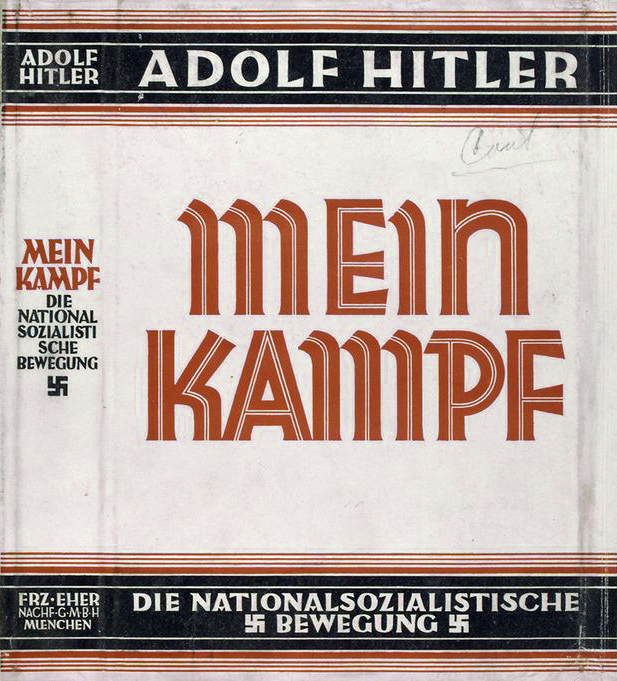
The idea of powerful globalists conspiring to destroy the German nation is straight out of Mein Kampf.
In Hitler’s view, the Jews were the original globalists. They were a nation without a country, a reality that inclined them toward globalism and a preference for one world government. This was before Zionists created a national territory for Jews (or in their parlance “recovered” one) by stealing the land of Arabs in Palestine and parts of Syria (Golan).
As a “nation” without a country, Jews, in the National Socialist leader’s view, gravitated toward and controlled international business, with its globe-girding mission, and also gravitated toward and controlled Marxism, with its bold declaration that “The working men have no country” and its call for workers to unite across national lines.
Globalism, of both the bourgeois and proletarian kinds, was a bugbear for the Fuhrer. The idea of world Jewry controlling the globalization of business and, through its Marxist apostles in the working class movement, undermining the proletariat’s attachment to patriotism, fit into a theory that Jews were secretly conspiring to create a world government over which they would rule.
The idea among Covid-denialists that globalists are plotting to create a world government and destroy nations is “the clearest indication yet,” reported Bennhold, “that a protest movement against Covid measures that has mobilized tens of thousands in cities and villages across [Germany is] increasingly merging with the far right, each finding new purpose and energy and further radicalizing the other.”
But the merger of Covid-denialism with the far-right isn’t a purely German phenomenon.
“The dynamic is much the same whether in Germany or Canada, and the protests in various countries have echoes of one another. On the streets of Dresden one recent Monday, the signs and slogans were nearly identical to those on the streets of Ottawa: ‘Freedom,’ ‘Democracy’ and ‘The Great Resist.’”
Bennhold continues:
“Like many others, Ms. Schmidt cited ‘The Great Reset,’ a book by Klaus Schwab, the founder of the World Economic Forum in Davos, which Ms. Schmidt says reads like ‘a script for how a group of powerful globalists plan to destroy the German nation and create a mishmash of people that can be led easily.’”
I recall watching a pandemic protester in Ottawa earnestly tell a police officer that “this has all been planned—it’s called the Great Reset.”
Not only is the idea of a global conspiracy to destroy nations and create a mishmash of people straight out of Mein Kampf, it’s also straight out of a small online publication by Michel Chossudovsky, titled The 2020-22 Worldwide Corona Crisis: Destroying Civil Society, Engineered Economic Depression, Global Coup d’État and the “Great Reset.”
It’s very likely that Chossudovsky’s writings inspired the Ottawa pandemic protester who thought he could bring the police to his side by citing a Klaus Schwab paper. The former University of Ottawa economics professor has dedicated his pamphlet to what he calls a “Freedom Convoy”, whose collection of white nationalists, Islamophobes, and far right People’s Party supporters denied Ottawa residents their freedom for three weeks last month, blocking roadways, refusing to comply with public health rules, browbeating residents who wore masks, and forcing the shutdown of businesses.
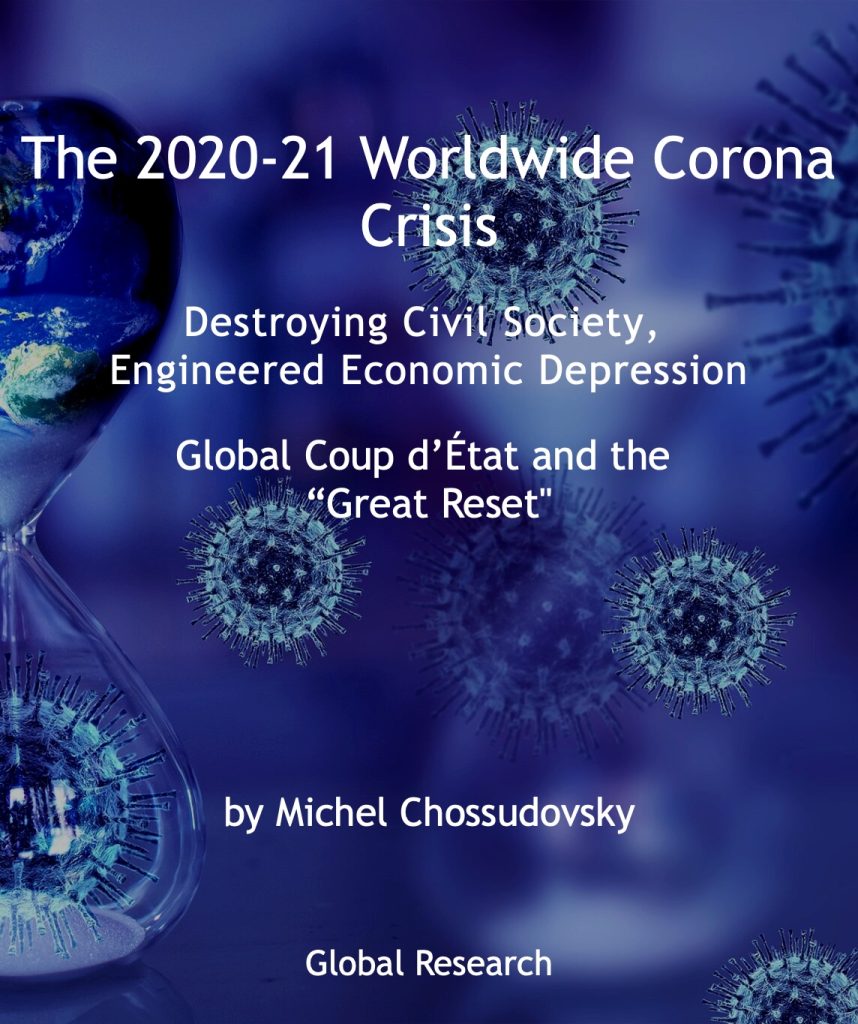
Chossudovsky makes Hitler’s globalist conspiracy theory palatable by giving it a 21st century gloss and removing its anti-Semitism. Gone are the Jews, replaced by a conspiracy of billionaires, led by the “diabolical” Klaus Schwab (yes, Chossudovsky really uses that word.) Whereas in Hitler’s febrile imagination, the Jews controlled both the international bourgeoisie and their opposition (the trade unions and Marxist political parties), in Chossudovsky’s conspiratorial delirium, it is a cabal of World Economic Forum billionaires that does the same. Covid-19, along with climate change, and identity politics, are presented by Chossudovsky as fabricated crises and plots to divide people, engineered by a complot of billionaires to carry out “a diabolical project of Global Capitalism.”
Reading Chossudovsky is like reading what I imagine Mein Kampf would be like had it been published by The Weekly World News. “The World Economic Forum’s Great Reset consists in installing a Worldwide totalitarian regime,” thunders Chossudovsky. “What is contemplated is a system of ‘Global Governance’,” he rails, shouting out for a string of exclamation marks, suitably in bold. “190+ UN member nation states are slated to be weakened and undermined.” Note the word “slated,” as in, this has all been planned by a cabal of Jews (1925) or cabal of billionaires (2022).
If you’re alarmed, there’s cause for more alarm. The “diabolical plot” won’t be stopped by the Left. That’s because the Left is controlled by the globalist billionaires, just as, to Hitler, it was controlled by the globalist Jews. The unions, community organizations, and communist and socialist parties that have organized against the truckers’ convoys—the “lockdown Left” as a Chossudovsky-simpatico Max Blumenthal calls it—are mere tools of the diabolical Schwab and his coterie of ultrarich globalists.
Unfortunately, Hitler is understood these days as an aberration, yet he is anything but. Mein Kampf, beyond the biographical details, is a synthesis of ideas culled from the Western conservative tradition dating to Burke and de Maistre and shared by the moustachioed Austrian’s conservative contemporaries, including Churchill. Because so few have taken the time to acquaint themselves with Hitler’s thought, and because his thinking is erroneously understood today as sui generis, it’s impossible to use the shorthand “this idea is straight out of Mein Kampf” without being accused of resorting to rhetorical hyperbole.
All the same, the reality is that one of the central ideas that animates the Covid-denialist movement comes straight out of Hitler’s autobiography, though with a few nips and tucks here and there to bring the style up to date. Small wonder, then, that as Chossudovsky supplies pandemic protesters with a Hitler-inspired conspiracy theory, a movement calling itself patriotic socialism—evoking obvious parallels with the national socialism of Hitler—rhapsodizes about the truckers’ convoys, celebrates Russia’s war of aggression on Ukraine, and promotes the thought of Russian reactionary Alexander Dugin.
Know your enemies.
By Stephen Gowans
February 28, 2022
The Japanese attack on Pearl Harbor was the culmination, to that point, of the struggle between the United States and Japan for control of China and the Pacific. Pearl Harbor, a naval base located at the US colony of Hawaii (Hawaii did not become a state until 1959), is a synecdoche for a larger Japanese attack on US and British colonial possessions in East Asia and the Pacific. Not only did Japan attack Hawaii on December 7, 1941, home to the US Pacific Fleet, it also attacked the US colonies of Philippines, Guam, Midway Island, Wake Island and the British colonies of Malaya, Singapore, and Hong Kong.

The United States, Britain, the Netherlands, and other Western powers had increasingly encroached on Japan’s backyard, creating colonies and spheres of influence that not only threatened Japan’s access to the markets and raw materials of East Asia, but also stood as potential threats to Japan’s own sovereignty and territorial integrity.
“In Japanese eyes,” wrote historian John Dower, “it was the non-Axis West that aimed at world domination and had been engaged in that quest, with conspicuous success, for centuries; and it was the value system of the modern West…that explained a large part of its bloody history of war and repression, culminating in the current world crisis.” Later, “the American bombing of Japanese cities was offered as proof beyond any conceivable question of the bestial nature of the enemy.”
In August 1941, Japan laid the ideological groundwork for its impending attack. In a manifesto titled The Way of the Subject, Tokyo pointed to what it saw as a crisis that was enveloping East Asia, one traceable to the value system of the West. Western values included ways of thinking that “regard the strong preying on the weak as reasonable…and stimulate the competition for acquiring colonies and securing trade, thereby leading the world to a veritable hell of fighting and bloodshed.”
If war was to ensue, Japan warned, it would only be because the West had pushed it inevitably along war’s path.
Japan’s neighborhood, East Asia, was teeming with Western military bases and shot through with Western influence. It was a place, complained the Japanese, “where a half million British ruled 350 million Indians, and another few score thousands of Englishmen ruled 6 million Malayans; where two hundred thousand Dutchmen governed a native population of 60 million in the East Indies; where twenty thousand Frenchmen controlled 23 million Indochinese, and a few tens of thousands of Americans ruled over 13 million Filipinos. Eight hundred thousand white men, the tally went, controlled 450 million Asians.”
Tokyo noted that Japan, unlike the United States, Britain, France, and the Netherlands, was linked to the region by natural ethnic and geopolitical ties. As such, and as an avowed opponent of Western imperialism, Japan had an historical mission: to liberate its ethnic brethren—one Asian people—from the yoke of Western colonialism and fold them into a Greater East Asia Co-Prosperity Sphere under Japanese leadership.
As Japan pushed into China in pursuit of its vision, upsetting Washington’s own designs on the country, the United States imposed an oil embargo. Dependent on the United States for oil, Tokyo cast its gaze upon the oil rich Dutch East Indies, which produced enough oil to satisfy Japanese needs. But Japan would first have to knock out the US fleet in the Pacific, based at Pearl Harbor, if it was to achieve its aim. The result would be the December 7 attack.
Some have argued that Washington deliberately provoked Tokyo to war and welcomed the attack, since it provided a justification for US entry into the war. Public opinion in the United States was against foreign entanglements and Japanese aggression would surely rally US Americans around the flag.
Historical parallels
There are parallels between the US and Japanese struggle over East Asia, and the current US and Russian struggle over Eastern Europe.
Japan was a weak imperialist power, with limited colonial possessions, surrounded by strong Western powers which had pushed into Japan’s neighborhood over many decades. Tokyo had a number of grievances against its stronger imperialist rivals, and believed that as a Pacific country it had a geopolitical and ethnic affinity with the region. What’s more, Western rivalry threatened Japan’s economic success, since the country depended on access to raw materials and markets that Western powers either controlled, or could soon control. The Japanese, posing as anti-imperialists of the first order, lambasted the West for its imperialism in East Asia—an imperialism which, through successive waves, had pushed right up to Japan’s borders.
Japan’s critique of Western imperialism, did not, however, make Japan any less of an imperialist power itself, however much it might have wanted the world to believe otherwise. Nor did Tokyo’s Greater East Asia Co-Prosperity Sphere liberate the peoples of Asia from imperialism. It only liberated them for a time from Western imperialism, but visited upon them a Japanese imperialism that was even more vicious in some places and at some times than what it replaced.
We cannot know how antiwar organizations operating under principles that guide many North American antiwar organizations today would have responded to the events of December 7, 1941, but we can make a guess, based on the following principles and beliefs that appear to guide these organizations.
In regards to Pearl Harbor, today’s North American antiwar organizations would likely have quite fittingly condemned Washington for its imperialism and provoking a Japanese escalation to war, but at the same time, would likely have either apologized for the Japanese attacks as an unavoidable response to US provocation or would have simply ignored them. A demand would be made that the United States, Britain, the Netherlands, and other Western powers dismantle their colonies and renounce their spheres of influence, but no call would be made for Japan to cease its military operations or refrain from imposing its rule on the territories it attacked.
None of this would comprise an authentic anti-war analysis and set of demands, but would represent a one-sided, anti-Western-war view, that would happily leave Japan off the hook for its imperialism and for initiating a war of aggression.
An organization that is only against the wars of its own country and not those of other countries, is not antiwar, anymore than an organization that is only against the wars of other countries and not its own, has a tenable claim to the title of peace organization.
The War in the Pacific was an inter-imperialist struggle. If North American antiwar organizations operating under their current principles had shaped the view of that war, the story of Japan as a vicious, imperialist power, committed to aggressive war to achieve its aims, would never be told.
February 25, 2022
By Stephen Gowans
The “military operation” announced by Russian president Vladimir Putin on February 24, is the latest episode in a struggle between two powers, the United States and Russia, for control of Ukraine. There is little good that can be said about either of these powers.
Russia is no more a progressive state than is the United States, and, indeed, is a good deal less so. The country’s president, Vladmir Putin, an anti-Bolshevik apostle of “traditional values”, i.e., homophobia, misogyny, and religious superstition, is admired by the Tucker Carlsons and Donald Trumps of the world, as well as some supporters of the trucker convoys, for his “anti-woke stance.” Trump thinks the world of Putin, much as US reactionaries of another time admired Hitler and Mussolini for their “strong” leadership and anti-Bolshevism. Putin has little good to say about Lenin and Stalin, disapproving of the Bolsheviks’ nationalities policies and criticizing Stalin for not pre-emptively attacking Nazi Germany. Putin proudly announced that he wouldn’t make in connection with Ukraine what he sees as Stalin’s mistake in connection with Germany.
Nor is Russia any less an imperialist state than the United States, though it is, to be sure, much less powerful than its US rival, far less dangerous, and its domains far less extensive. But it is imperialist, all the same, however much it is opposed to the prospect of its own domination by the United States. For all its anti-hegemonism, Moscow is not opposed to subjugating other countries. Russia intervened militarily in Syria in 2015, not out of a selfless commitment to rescuing the government in Damascus, but to advance Russian aims. Syria is a vassal of Moscow, and while Damascus may (or may not) find the terms of its vassalage preferable to those the United States would impose, it remains a Russian vassal state all the same.
As to Ukraine, it has the unfortunate fate of finding itself in the middle of an inter-imperialist struggle. Through subterfuge and machination, the United States in 2014 installed a pro-US, anti-Russian puppet government in Kyiv. That government has acted to integrate the territory, people, military, and markets of Ukraine into the United States’ informal empire. In insisting on membership in NATO, participating with NATO forces in military exercises along Russia’s borders, refusing to implement the Minsk II agreement, vigorously engendering opposition to the Nord Stream 2 pipeline, and proclaiming its intention to reclaim Crimea, home to the Russian Black Fleet, the US puppet government in Kyiv has done much to provoke Russian aggression. Indeed, it is difficult to conclude that this wasn’t its aim, since Kyiv played it cards as if it was. Moscow would rather Ukraine be integrated into its own informal empire, the Eurasian Economic Union, though faute de mieux, it has been prepared to accept Ukraine neutrality. An independent Ukraine, one not under the de facto control of Washington, would likely have opted to join neither the (vast) informal empire of the United States nor the (much smaller) informal empire of Russia. But a Ukraine under the informal control of the United States has recklessly crossed so many Russian red lines.
On a moral and legal plane, Russia’s invasion of Ukraine is indefensible. Putin’s invoking Article 51, Chapter VII of the UN Charter, (the right of self-defense in response to an attack) is a total farce, as is Putin’s claim that the Kyiv government is a neo-Nazi government and that Kyiv is carrying out a genocide against Russians. These claims demonstrate that Moscow can stoop as low as Washington in inventing totally ridiculous pretexts for wars of aggression. To be clear, there are neo-Nazis in Ukraine, a few in government, and more than a few in the military, but they tend to be Russophobes first and neo-Nazis second; that is, they’re neo-Nazis because they hate Russians—as in, the greatest enemy (the Nazis) of my enemy (Russia) is my greatest friend. That’s not to defend Russophobia, but the neo-Nazi reference is frequently invoked, not out of respect for the truth, but because its utility in shaping public opinion against Ukraine is greater, at least in the West, than pointing out that there are many Ukrainian nationalists who dislike Russia for its history of dominating Ukrainians, some of whom are neo-Nazis, and others who are not. Moreover, the presence of neo-Nazis in government and in the military is hardly unique to Ukraine.
As to Ukraine carrying out a genocide against its ethnic Russian population, this is only true if we accept the kind of infinitely flexible definition of genocide that the United States, in the person of Adrian Zenz, is infamous for deploying against China as an exercise in mobilizing public opinion against a rival. To be sure, the Ukrainian nationalist Russophobes in Kyiv have hardly sought to find an amicable way to co-exist with their ethnic Russian compatriots, but when Putin likens this behavior to genocide, he takes a page from the execrable Adrian Zenz, and shows himself to be just as execrable for doing so.
The Russian president says he has no plans to occupy Ukraine, and this may be true. Certainly, it would ill-serve Russia to become bogged down in a second Afghanistan. But Moscow says it intends to de-Nazify and de-militarize Ukraine, which means, it intends to install its own puppet government in Kyiv, after it jails or murders the Ukrainian nationalists who, whether neo-Nazi or not, are painted with a broad neo-Nazi brush. Thereafter, the Russian president will try to persuade ethnic Ukrainians that they’re part of the same Russian family, and should feel at home with their pro-Russian Quisling government.
The United States’ role in this tragedy is as much about its relationship with its former imperial rivals, Germany, Italy, and France, as it is about its attempts to weaken Russia. These three powers, and the Europe they lead, incessantly threaten to spin out of the US orbit. Increasingly, they talk of strategic autonomy, while pursuing economic integration with Russia and China, to US dismay. Russian aggression provides the occasion to bind Europe more firmly to the United States, by rallying Europe against Russia through the US instrument of NATO, and pressing the continent to sever some economic ties with Russia. Germany will be expected to cancel the Nord Stream 2 pipeline, to its great disadvantage, since it will lose an inexpensive source of energy, and to the great advantage of the US liquid natural gas industry, which will fill the void with a more expensive product. While certification of the pipeline has only been suspended for now, Washington will continue to pressure Germany to cancel the pipeline altogether. The benefits of Russian aggression against Ukraine for the US investor class are so numerous, that champagne bottles must have popped in Washington and on Wall Street when the Russian president announced the beginning of his country’s military operation in Ukraine. European drift toward the Russian economy is eclipsed. NATO is strengthened, with indubitable benefits in new orders from NATO countries for arms from US weapons makers. Calls for more weapons purchases to bolster the US military will escalate; yesterday, for example, a Wall Street Journal op-ed demanded a naval build up. And the arms industry will run at full-tilt pumping weapons into Ukraine to fuel an insurgency, as Washington fights Russia to the last Ukrainian. Wars for which the United States has not participated except to act as an arms supplier have always been kind to the country’s investors; this one promises to be the same. Finally, Russian military operations, along with Western sanctions, will drain the Russian economy, weakening Russia, or at least stifle its growth, and make it less a formidable US rival. How could Wall Street not look with pleasure upon the prospects?
Information warfare
Most Left pundits and “anti-imperialists” thought Russia wouldn’t invade, and that Washington’s warning that an invasion was imminent was utter nonsense, along the lines of the Iraqi WMD scare. Patrick Cockburn, though hardly alone, dismissed the possibility of a Russian invasion, arguing that Russia had assembled too few troops along its borders to invade Ukraine. This was just Washington hype and war hysteria, he wrote. Others took as gospel the words of Russia’s Foreign Ministry spokeswoman, Maria Zakharova. “It’s been a while since I’ve seen so many fakes, disinformation, leaks, slander and lies” she said—a self-referential statement, it turns out. The lesson here is that governments lie but sometimes they don’t, and that it is unwise to assume that governments always lie or that ones that are in the cross-hairs of US aggression don’t. Putin talked of a US empire of lies. He omitted mention of a Russian empire of lies.
Before leaving the topic of information warfare, something ought to be said about RT (Russia Today). RT exists in the first instance to serve Russian ends, and specifically to propagate information favorable to the attainment of the goals of the Russian state. The modus operandi of RT’s US network is to act as a platform for anyone with a compelling critique of US policy or who will go to bat to defend Russia. There may be a partial overlap between the pursuit of Russian state aims, and the provision of progressive discourse and analysis, but no one should be mistaken that RT’s raison d’etre is to promote a progressive point of view. It is doubtful that RT would long provide a platform to persons whose critique of US society and foreign policy was matched by an equally rigorous critique of the Russian side. I may be wrong, but we may soon find out if this is true if anyone tries to advance, on RT, the kind of analysis I’m presenting here.
What ought to be done?
First, Ukraine should be neither the means to US ends nor the means to Russian ends. Ukraine ought to be the means to Ukrainian ends. The country must be allowed to develop independently and to choose its own government freely, without foreign interference or involvement. The country’s leaders must be answerable to the people of Ukraine, not to the president of the United States, nor the president of Russia. To achieve this, Russia must immediately withdraw its forces from Ukraine and cease interfering in Ukrainian affairs. The United States and its satellites must do the same. Next, the countries of Europe, along with Canada, must withdraw from NATO. NATO is not a defensive alliance. Europe can readily defend itself against Russia. Its military expenditures are four times greater than those of the Russian Federation, (France’s alone are equal to Russia’s), and France has an independent nuclear force. NATO is a cover for the United States to maintain a military presence in Europe, on the territory of its former imperialist rivals. Al Haig, former NATO Supreme Commander and Secretary of State in the Reagan administration, once acknowledged that US troops are in Europe (stationed at what are called NATO bases to hide the fact that US bases are scattered across the continent) to ensure that European markets remain open to US exports and investment. Fourth, the United States and Canada must withdraw their forces from Europe (and from elsewhere abroad.) North American militaries must be re-oriented to self-defense, not power projection. The same demand must be made of all the world’s militaries; they must exist for one reason alone: to defend national sovereignty and territorial integrity.
The struggle against reactionaries who masquerade as anti-imperialists
Finally, regarding the variegated group that calls itself anti-imperialists. Anti-imperialists come in many hues. Marxists of various stripes are almost always anti-imperialist but tend to self-identify as Marxists (Marxists, Marxist-Leninists, Communists, socialists, and so on.) It is taken as a given that if you’re a Marxist, you’re anti-imperialist, and, hence, that the anti-imperialist moniker is unnecessary. But the converse isn’t always true—anti-imperialists are not always Marxists. Some people who self-identify as anti-imperialists, but not as Marxists (and I say some, not all), practice an anti-imperialism of a sort favored by Charles Lindbergh and others in the late 1930s and 1940s, and expressed as America First, a name that has resonance with Trump. Supporters of the America First cause admired Hitler and Mussolini, especially their opposition to bolshevism and the “wokeism” of the day, and opposed US war against fascism in Europe. Their intellectual descendants exist today. Some of them can be found on the conspiracy theory web site, Global Research. They admire Putin’s commitment to “traditional values,” including faith, homophobia, misogyny, submission to authority, and strong leadership. While they call themselves anti-imperialist, they’re really only opposed to US imperialism. The imperialism of Russia and few other countries never shows up on their radar. They are, in reality, anti-Marxist conservatives, who falsely identify as anti-imperialists to create a progressive façade to mobilize the energies of Marxist anti-imperialists to a reactionary agenda. These are the same frauds who have celebrated the far-right truckers’ convoys, and are very likely at this very moment denouncing anyone who has an unkind word to say about Vladimir Putin and his imperialist war on Ukraine. In its statement on the Russian aggression, the Party for Socialism and Liberation argued sagely that the role of anti-imperialists “is not to follow the line of countries in conflict with U.S. imperialism, but to present an independent program of peace and solidarity and anti-imperialism.” That is the hallmark of Marxist-inspired anti-imperialism. We can do without the other kind.
 What's Left