The Multipolaristas’ Theory of Ultra-Imperialism Doesn’t Fit a Multipolar World

December 27, 2022

By Stephen Gowans

Recently, The Wall Street Journal reported that “Mr. Putin” is “convinced Russia’s Western enemies” are “seeking to yank Ukraine from Russia’s orbit.” Clearly, the United States and Russia are locked in a struggle over Ukraine; each wants the territory in its own orbit—that is, in its own empire. US efforts to yank Ukraine from the Russian orbit have been largely successful. Russia is yanking back, but it’s unlikely to win the tug of war.

The idea that the war in Ukraine is but one battlefield in a larger war between two empires is difficult to grasp for people whose understanding of imperialism is influenced by dependency theories developed in the immediate post-WWII period. That period was characterized by one capitalist empire, that of the United States, absorbing most of its former capitalist rivals into its orbit. Under US supervision, the now combined powers, once rivals, jointly exploited the periphery.

People who subscribe to this view, whether consciously or through osmosis, look at the world through a lens whose purpose, when the lens was crafted, was to explain the international system at a time when neither Russia nor China existed as capitalist powers and rivalry among capitalist powers was muted by US primacy. Glimpsed through this lens, Russia and China appear as what they once were, but are no longer: socialist counterweights to a capitalist metropolis.

This, to be sure, is a view of a world that expired 30 years ago, when the Soviet Union was succeeded by a capitalist Russia, and China was at least a decade along the path of capitalist development and integration into the US economy as a low-wage manufacturing center.

Today, Russia and China are capitalist powers. But if they appear to some, not as metropolitan powers keen on integrating regions into their own expanding economies, but as powers lying outside the metropolis, as opposed to merely outside the US empire, it’s because they are understood incorrectly as being what they once were, rather than what they have since become. Both powers are external to the US empire (to some degree; China is so only partially), but the US empire is no longer equal to the metropolis; it is now only one part of it.

Karl Kautsky developed a theory of ultra-imperialism. Kautsky argued that the stress might shift from conflict between imperialist powers to maintenance of a world system of exploitation, i.e., conflict between the metropolis and periphery. It is surely the latter, the worldwide exploitation of colonial peoples by the metropolitan bourgeoisie, observed Anthony Brewer, which is generally understood by the term ‘imperialism’ today. At the time, the very suggestion that such a shift was possible aroused vehement hostility from the left. For the left, inter-imperialist rivalry leading to war was the very essence of imperialism. The concept of imperialism has shifted its meaning between then and now, but the emergence of a multipolar international system, or of great power rivalry in Washington’s terms, means that the understanding of imperialism now lags developments in international relations. Contemporary international relations now bear a greater affinity with the classical Marxist theory of imperialism than with Kautsky’s ultra-imperialism.

None of this is to say that theories about metropolitan exploitation of the periphery are wrong, only that the notion that Russia and China are external to the capitalist metropolis is mistaken. The former socialist giants have joined the metropolis, not as a part of a Kautskyist ultra-imperialism led by Washington, but as rivals of the USA, EU, and Japan.

Is there a better theory?

In its emphasis on rivalry among capitalist powers, the classical Marxist theory of imperialism comports more fully with contemporary developments than dependency theories. If we accept that the contemporary international system is marked by an emerging multipolarity, and that the principal powers in the multipolar system are capitalist, then the world of today bears a much stronger resemblance to the late 19th and early 20th centuries, to which the classical Marxist theories of imperialism referred, than it does to the 20th century period of US-led ultra-imperialism.  

That’s not to say that the classical Marxist theory is without its problems. But it does say that despite its problems, the classical theory is a better fit with an emerging multipolar world than theories which were developed to explain a world characterized by a US-led metropolis exploiting a periphery, opposed by a socialist Russia and socialist China.

Continuing to see Russia and China as socialist powers that lie outside the metropolis, when they are now large capitalist powers with unconcealed projects of integrating regions into their own economies, is tantamount to applying the geology of the desert to the rainforest, and on this basis, declaring that trees (i.e., an imperialist Russia and an imperialist China) don’t exist.

To summarize, here are four errors that are made by seeing the contemporary multipolar world through a Kautskyist ultra-imperialist lens.

  1. Adopting the now extremely dated view that Russia and China are socialist, rather than capitalist.
  2. Seeing Russian and Chinese opposition to the US empire as rooted in socialism, rather than capitalist rivalry for economic territory.
  3. Perceiving the US empire as equal to the metropolis, rather than as only one part of it, along with Russia and China.
  4. Regarding the periphery as exploited by the US empire alone, rather than by Russia and China, as well.

There Are No Lesser Evils in Imperialism

December 19, 2022

By Stephen Gowans

According The New York Times, the US arms industry is profiting handsomely from the war in Ukraine.

  • The Pentagon has awarded at least $6 billion to arms companies to resupply weapons sent to Ukraine.
  • Raytheon has secured $2 billion in contracts to expand or replenish weapons used to help Ukraine.
  • Lockheed has secured nearly $1 billion to refill stockpiles being used in Ukraine.
  • The share prices of Lockheed and Northrop Grumman have jumped more than 35% this year.
  • US arms sales to foreign militaries—many of which have boosted military spending in response to the Russian invasion of Ukraine—total $81 billion this year.

In response I tweeted the following.

Had Moscow not pulled the trigger on war in Ukraine, the conditions would never have been set for Lockheed Martin and Raytheon to swim in a sea of new orders.

This elicited the following reply: “The bigger thanks goes to all the people who have blocked or refused to negotiate to end this war. Like the state department, Biden etc.”

Why would we expect the people who desired the war, viz., “the state department, Biden etc.”, to have the slightest inclination to want the war to end, when its clients—the US arms industry, the US oil and gas industry, and US industry generally—profit handsomely from it? Expecting Washington to negotiate the end of the war is tantamount to expecting wolves to become vegetarians—especially when the wolves have discovered a toothsome feast.

Did I mention that with Europe looking for a new energy supplier, after Washington pressed the EU to wean itself off Russian energy in the wake of the Kremlin’s assault on Ukraine, that the United States has become the world’s leading exporter of liquid natural gas? It is also the planet’s top petroleum producer.

At the same time, we wouldn’t expect Russia, the party that instigated the war and has failed to achieve its war aims, to have much desire to bring its assault to an end. It too is a wolf, with a hunger for sheep, so far unsated.

The notion that either the Russian wolf or a lupine Washington have, at this point, strong motivations to end their hunt for Ukrainian sheep is Quixotic.

The additional notion that the Fata Morgana of “the antiwar movement” can pressure “the state department, Biden etc.” or Moscow to negotiate an end to the war is equally illusory.

In the West, there exists a farrago of Washington-haters who call themselves antiwar but are merely anti-US. They flatter themselves that they are the nucleus of an antiwar movement. If capitalist imperialism is one of the greatest causes of human misery, they don’t know it. The critical problem, in their minds, is the people who run US foreign policy. If only the right people were elected, or the current set of leaders were pressured by popular opinion to conduct the country’s foreign policy differently, all would be well.

Almost to a person, this group of activists argued vehemently before the war, and with unbridled certitude, that Moscow would never invade Ukraine. In their astigmatic and decidedly un-Marxist Weltanschauung, military aggression, like imperialism, is a US monopoly. Russia would never, therefore, behave in so scurvy a (US) manner. To US warnings that Russia was about to invade Ukraine, they thundered scornfully, “US propaganda!” Despite Putin providing them with ample reason to revise their view of Moscow’s nature and capabilities, and notwithstanding the egg that still drips from their faces, they cling tenaciously to the now discredited theory that Putin’s Russia is not imperialist. They have discovered a multitude of reasons why it was obvious from 2014 that an invasion was not only predictable but desirable…and un-imperialist, of course. But if before the war they denounced the claim that Russia was capable of launching a war of aggression on its neighbor as a slander against Moscow, viz., that Moscow would never carry out so heinous an act (after all, wasn’t Moscow a member of the now forgotten Friends of the UN Charter?), how is that they have so quickly come to regard what they once saw as heinous as justifiable and even desirable?

If states were free to act just as they pleased, Russia could end the war now by reversing the act that instigated it. But true to their inability to see beyond Washington to rivalry among states as an immanent characteristic of the capitalist world economy, and one with a high probability of ending in war, the Friends of Neo-Imperial Russia demand Biden negotiate an end to the war, not that Russia do the same, and not that Putin withdraw his forces from Ukraine. They believe implicitly that the Kremlin is champing at the bit to negotiate a peace, out of a strong devotion to international harmony, and all that prevents the flower of peace from blooming is Washington’s intransigence. What they fail to mention is that the peace Putin aspires to is a peace in which Russia is allowed to digest those parts of Ukraine it has already gobbled up. In other words, it wants to achieve at least some of its war aims, and then to be left in peace to enjoy them. It is a commonplace that all belligerents want peace. What’s rarely acknowledged is that they want peace on their own terms. Peace preferably; war if necessary.

An antiwar movement, if one existed in either the West or Russia, would seek to end the war in order to lift the burden it has imposed on ordinary people. People everywhere, in Russia as much as Europe and North America, struggle to make ends meet as the war sends energy, food, and housing costs soaring.

Instead, Westerners who say they are against the war, but are really against the US part in it, seek fecklessly to mobilize energy for an antiwar movement based on the following arguments:

  • Putin’s cause is just.
  • The war escalates the risk of a nuclear exchange.
  • A world where Russia and China, and not just the United States, can throw around their weight, is desirable.

The trouble is that the power of any of these arguments to arouse opposition to the war is approximately zero, which is why there is no antiwar movement.

First, it is difficult enough to justify a war of aggression with good arguments. But the arguments for war offered by Moscow have been so risible that no one, except Russian chauvinists and a few mental defectives in the West, have taken them seriously. If we accept the argument that Russia has been provoked by escalating NATO military threats and that Moscow’s efforts to project influence into Ukraine through diplomatic means were rebuffed by Washington and NATO, there remain two objections: (1) Being provoked is not a legitimate reason for war; and (2) imperialist goals achieved through diplomatic means are still imperialist goals; they are no more acceptable for being achieved through soft power than hard.

Second, the threat of nuclear annihilation is a constant. People have learned to live with it. It will not move them to action and the intensity and scope of this war has not been great enough to meaningfully escalate the risk of a nuclear exchange.

Third, you can put lipstick on the idea of Russia and China having as much clout as the United States by calling three-power imperialism “multipolarity”, but the idea remains a pig no matter how much lipstick the sow is forced to wear. Anyone who thinks it’s possible to mobilize large numbers of people under the banner “we need three strong imperialist powers instead of one”, is detached from reality.

But what if people were mobilized for reasons that resonate with their suffering to oppose the war in numbers large enough to pressure governments to act? Would the movement not also be large enough to bring about a social revolution to overcome the very roots of the problem, namely, capitalist-driven competition for markets, raw materials, investment opportunities and strategic territory? In other words, wouldn’t a movement large enough and powerful enough to end a symptom of the disease also not be large enough and powerful enough to end the disease itself? Should the goal be to end this particular war, or to significantly reduce the probability of war by overthrowing the conditions that conduce to it?

Finally, is there much point in calling for an antiwar movement here, and not one there? The war affects all working people, Russians as much, indeed more than North Americans and (Ukrainians excepted) Europeans. An antiwar movement ought to unite, across international lines, all people affected deleteriously by it against the class that wills it and the system of capital accumulation that demands it. It must be international, not confined to one side.

People who call for Washington to negotiate an end to the war, but not Russia to reverse the act that instigated it; who argue that the ultimate responsibility for the war lies with US foreign policy and not the global capitalist economy (like saying flu is caused by a sore throat); whose reasons for opposing the war having nothing to do with the effect it has on ordinary people, and only on the effect it has on the imperialist aspirations of Moscow; and who call, not for a union of antiwar voices across international lines, but an antiwar parochialism confined to the West, are arguing for the side of the Russian ruling class against that of the United States.

Marxism, socialism, the workers’ movement, are not movements against US foreign policy alone, but against the capitalist class, no matter what its postal address. These movements are also for something: Not the rise of two great capitalist powers, Russia and China, against a third, the United States, but for socialism and workers of the world uniting. They are for an end to the division of humanity into classes and nations, and not, as the bogus antiwar activists would have it, the persistence of class and the rise of great nation states.

For the Friends of Socialist China, a Very Bad Week

Subscribe to continue reading

Subscribe to get access to the rest of this post and other subscriber-only content.

A Brief Critique of Anti-War Activism

Subscribe to continue reading

Subscribe to get access to the rest of this post and other subscriber-only content.

Would a Plan for a Just Peace in Ukraine Make Any Difference?

December 5, 2022

By Stephen Gowans

Would a peace plan for Ukraine that addresses each parties’ ostensible concerns about security and ethnic rights create a lasting peace?

In my view, it would not.

The parties’ substantive concerns are economic. Concerns about security and ethnic rights, while real, conceal more profound issues.

A plan that addresses the surface concerns but not the substantive ones is bound to fail.

What might the contours of a peace plan for Ukraine look like?

  • Russia withdraws from all Ukrainian territory, including Crimea.
  • Ukraine
    • Pledges neutrality, foreswearing membership in any military bloc.
    • Agrees to an irrevocable long-term lease of Russia’s naval base at Sevastopol.
    • Guarantees languages rights for Russophones and declares Ukraine to be a country for all its citizens, not a national Ukrainian state, and not one in which ethnic Ukrainians have superior rights. Instead, all citizens are guaranteed equal rights regardless of their language, religion, or ethnicity.

This proposal meets Russia’s stated concerns about security and the rights of Russian-speakers in Ukraine. At the same time, it restores all Ukraine’s territory.

But the plan fails to address key areas of tension.

First, it says nothing about whether the Nord Stream 1 and Nord Stream 2 pipelines, built to circumvent Ukraine as a transitway for Russian natural gas, will be re-engaged to fulfill their originally intended role.  If so, Ukraine will be denied a major source of revenue in transit fees.  After the United States, Ukraine had been the major opponent of the pipelines. Kyiv would be expected to oppose any move to open the pipelines. So too would Washington.

It is unlikely that Moscow would agree to a plan that doesn’t see Russia’s return to Europe as a hydrocarbons vendor. Washington, conversely, is likely to oppose Russia’s re-engagement with Europe as an energy provider, considering that Europe’s renunciation of Russian gas has provided Washington with a much-needed market for US LNG.  The United States is now the world’s top LNG exporter.

Second, the plan fails to address perhaps the key issue underlying tensions since 2014: Whether Ukraine’s economy will be oriented toward the West or Russia.

Bearing an antipathy to Russia, a country they see as an historical oppressor, nationalist ethnic Ukrainians have pressured Kiev to orient their country toward the West, not only militarily, but economically. In contrast, Russophone Ukrainians have inclined more strongly to economic integration with Russia. For these reasons, Washington and Brussels have supported nationalist ethnic Ukrainians, and Moscow has backed Russophone Ukrainians. Both ethnic groups are used as tools by their superpower patrons to advance great power goals in Ukraine.

Thus, the cultural struggle between ethnic Ukrainians and Russophone Ukrainians is not only a struggle over nationalism and linguistic rights, but also a struggle over economics, with both the West and Russia intervening in Ukraine’s affairs for self-serving economic ends. A plan that addresses the surface linguistic and cultural concerns, but fails to tackle the key issue of Ukraine’s integration into one or the other economic bloc, will not produce a durable peace.

Cut-throat competition for markets, raw materials, pipeline routes, investment opportunities, and strategic territory is an enduring feature of capitalism. It is unlikely that a workable plan for peace can be found in a world in which capitalist competition is a constant. 

To sum up, a peace plan that addresses the ostensible reasons for war will make little difference. Ostensible reasons mask deeper motives—motives whose taproot is capitalist competition.

To end the fighting, one of two things must happen:

  • Russia, the United States, the European Union, and Ukraine pledge not to conduct themselves as capitalist powers. This isn’t going to happen.
  • The competition for Ukraine weakens one or both of the sides until one or both decides the potential gains are outweighed by the costs.

That’s how competitions end. In the victory of one side, in both sides simultaneously withdrawing, or in the mutual ruin of both. They don’t end in a just peace.

Is the Communist Split on the War in Ukraine an Echo of An Earlier Division?

December 2, 2022

By Stephen Gowans

Eliseos Vagenas, a member of the central committee of the Greek Communist party (KKE), has written an interesting article in the party’s newspaper, Rizospastis, refuting the claim that the Russian invasion of Ukraine fostered a split in the international communist movement (ICM). Vagenas contends that the split existed well before the Russian invasion.

One can also argue that the split recapitulates a division within the Second International circa 1914—one which led to the creation of the Third International and the Communist parties to which the current ICM is its nominal heir.  

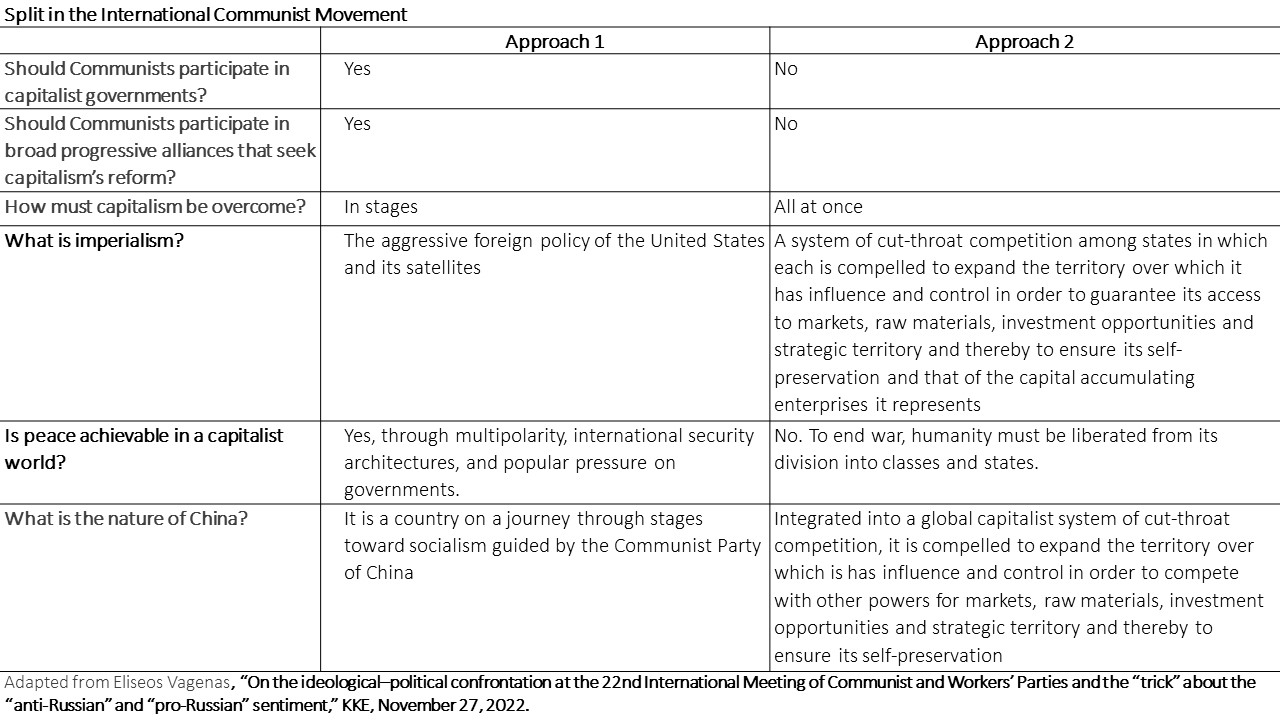
According to the Greek communist, the ICM has been split for some time on a least six questions, summarized below. When Russia invaded Ukraine, the parties moved to support or oppose Moscow, based on their pre-existing orientations, defined by either approach 1 or approach 2.

Two questions are critical to the positions the various ICM parties have taken on the war in Ukraine:

  • What does imperialism mean?
  • Is peace achievable in a capitalist world?

Communist parties that have either leaned toward outright support of Russia or greater condemnation of the United States and NATO, tend to view imperialism in a manner that departs significantly from the classical Marxist view and have developed an understanding of how to end war that revises Marx and borrows from liberalism. These parties see imperialism as the aggressive foreign policy of one capitalist state, the United States (and its satellites), and regard Russia as a victim of US imperialism. For them, the term ‘US imperialism’ is redundant, because imperialism is a monopoly of the United States.

What’s more, these parties tend to equate imperialism with war, and reject the notion that it has other dimensions, including peaceful capitalist competition, diplomacy, and even international security architectures. (Ask the North Koreans whether the UN Security Council is an expression of imperialism.) For these parties, imperialism is US war-making and little else.  

In contrast, parties that view the war in Ukraine as an inter-imperialist conflict adopt the classical Marxist view of imperialism. For them, imperialism is a system of cut-throat competition among states in which each state is compelled to expand the territory over which it has influence and control in order to guarantee its access to markets, raw materials, investment opportunities and strategic territory and thereby to ensure its self-preservation and that of the capital accumulating enterprises it represents. The competition is expressed in multiple ways, including war, but not limited to it. It may be, and has more often than not been, expressed in trade and investment agreements. (See, for example, Robinson’s and Gallagher’s The Imperialism of Free Trade.)

Kenneth Waltz’s review of the split in the socialist movement precipitated by WWI, which he presents in his classic Man, The State, and War, calls to mind the current split in the ICM as identified by Vagenas.

Parties which support Russia in its war on Ukraine tend to embrace, as Waltz describes them, “the techniques of the bourgeois peace movement—arbitration, disarmament, open diplomacy” as well as the belief that popular opinion “can exert enough pressure upon national governments to ensure peace.” This, Waltz argues, is a revision of Marx’s view, which “points to capitalism as the devil.” The “socialism that would replace capitalism was for Marx the end of capitalism and the end of states,” and it was the end of states, for Marx, that meant the end of war. An anti-war movement founded on the notion that popular pressure and international security architectures can ensure peace, is a tradition that Waltz identifies as originating in the Second International as a revision of Marx. It is also a tradition that Waltz pointedly notes failed to keep the peace in 1914.

Waltz elaborates. Members of the Second International “were united in that they agreed that war is bad, yet they differed on how socialists were to behave in a war situation. … Jean Jaures and Keir Hardie eloquently urged a positive program of immediate application. Socialists, they said, can force capitalist states to live at peace.”  As history shows, they couldn’t. Indeed, most socialists facilitated the war by supporting one of the belligerents.

In contrast, some “French and most German socialists argued that capitalist states are by their very nature wedded to the war system; the hope for the peace of the world is then to work for their early demise.” It is not, to bring the argument up to date, to support the weaker capitalist states in order to balance the strongest in a multipolar system. Indeed, this view is anti-Marxist in the extreme. For Marx, war ends when states end, not when weaker states balance the strongest and the world becomes multipolar.

The precursors of the Third International, Communists avant la lettre, argued that wars “are part and parcel of the nature of capitalism; they will cease only when the capitalist system declines, or when the sacrifices in men and money have become so great as a result of the increased magnitude of armaments that the people will rise in revolt against them and sweep capitalism out of existence.”

This resonates with the view of Vagenas, advocating for approach 2 as presented in the table above: The “capitalist world cannot be ‘democratized’.” It “cannot escape from wars no matter how many ‘poles’ it has.” War can only be escaped through “the struggle for the overthrow of capitalism, for the new, socialist society.”

Approach 1, then, evokes the Second International, while approach 2 appears to be consistent with the positions of the Third International.

On the basis of the foregoing, it would seem fitting to label approach 1 as “Liberal Bourgeois,” consistent with its tolerance of Communist participation in capitalist governments and broad progressive movements for capitalism’s reform; its penchant for a stepwise journey toward socialism; the absence of capitalism from its analysis of imperialism; its embrace of a peace movement whose techniques originate in a liberal theory of war; and its acceptance–indeed, its celebration–of China’s robust capitalism. Liberal Bourgeois Communists are nothing if not enthusiastic in their panegyrics to Chinese capitalism as “the world’s greatest anti-poverty machine” and never sparing in their praise of Chinese capitalism for “lifting hundreds of millions out of poverty.” In their devotion to capitalism as a cure for poverty they have outmatched even the staunchest Republican.

Approach 2 can be labelled “Communist,” reflecting its resonance with classical Marxist positions.

It is regrettable that some Communist parties have suffered an ideological drift toward positions that the founders of the ICM, Lenin and his colleagues, repudiated.

It is equally regrettable that as self-proclaimed heirs of Marx, these same parties espouse a view of how to ensure a peaceful world that originates, as Waltz argues, not in Marx, but in a liberal bourgeois theory of war.

What’s Stopping the World from Stopping the War in Ukraine?

November 30, 2022

By Stephen Gowans

Apart from hardliners in Moscow, Washington, and Eastern Europe, no one wants a war in Ukraine. And for good reason: It’s damaging most peoples’ lives.

According to The New York Times, “The combination of punishing sanctions, championed by Mr. Biden and his allies, and Russia’s retaliation has ricocheted through global food and energy markets, exacerbating already high inflation and undercutting global growth.”

The IMF and World Bank have been sounding alarms for months. Recently they were joined by the G20 (sans Russia).

“The war, leaders of the Group of 20 nations said in a declaration at the end of their summit in Bali, ‘is causing immense human suffering and exacerbating existing fragilities in the global economy — constraining growth, increasing inflation, disrupting supply chains, heightening energy and food insecurity and elevating financial stability risks.’”

The “war needs to end,” said Gita Gopinath, the first deputy managing director of the International Monetary Fund, “because the consequences for the economy are very high.” This view was “a common refrain from everybody” at the G20 summit, she added.

Not too long ago, a common refrain from everyone was that the Covid-19 pandemic needed to end, because the consequences were very high. What’s more, the World Health Organization’s secretary general said humanity had all the tools to end the pandemic.

So why is it, that despite consensus, and despite having the tools, the pandemic didn’t end? And why is that the war in Ukraine continues with no end in sight?

What are the G20 countries doing to bring the war to an end?  Nothing.

The United States and its NATO subalterns are prolonging the war by pumping billions of dollars of weapons into Ukraine.

Russia continues to fight a war it hasn’t the resources to win.

Allies Who Are Not Aligned

While the G20 collectively is doing precious little to end the war, the leader of one its members, France, is. Emmanuel Macron “wants to find a way of ending the war around the negotiation table, not the battlefield.” No wonder. The war has not been kind to Europe. (The US is another matter.)

“The U.S. has stepped in to help replace Russia as one of the continent’s biggest natural-gas purveyors, but its shipments of liquefied natural gas have come with much higher prices, straining Europe’s manufacturing base.”

“French officials worry that manufacturers stung by Europe’s high energy prices are starting to think about shifting production to the U.S. to reap the subsidies on top of cheaper fuel supplies.”

Macron recently entreated a host of giant European firms “not to move production to the U.S.”, where energy prices are cheaper, and Biden’s Inflation Reduction Act, incents firms to produce in the USA.

“We need a Buy European Act like the Americans,” said Macron. “You have China protecting its industry, the United States protecting its industry, and Europe is an open house.”

A senior adviser to the French president said of US-France relations, “we are allies who are not aligned.”

Is it because the US is not suffering that Washington is willing to tolerate a continuing war in Ukraine, or because the US stands to gain?

Biden’s “aides note the United States, as a large energy producer, is not suffering like Europe from a lack of access to Russian oil or natural gas.” What Biden’s aides don’t acknowledge is that not only is the United States not suffering, it’s reaping innumerable benefits from the war. The Wall Street Journal recently mentioned just two: (1) a reinvigorated North Atlantic Treaty Organization, which will mean a gusher of profits for US arms makers. (For example, the war has spurred Germany to commit billions of dollars to Lockheed Martin for F35 warplanes); and (2) “a boom in trade and investment between the U.S. and Europe.” An important part of the boom in trade involves reorienting Europe’s energy markets from Russia to the US.

Another benefit: With Europe dependent on the US for energy, Washington can extract concessions from Brussels by threatening to close the tap.

Doing what is right for who?

“Mr. Biden has repeatedly said that” the threats the war in Ukraine pose to the world economy “would not deter him from doing what he believed was right in Ukraine.” Yet threats to US oil company profits have deterred one US president after another, including Joe Biden, from doing what is right in Saudi Arabia and Palestine. What Biden really means is that threats to the world economy, which largely affect Europe, low income countries, and ordinary people in the US, won’t stop him from doing what is right in Ukraine, for US LNG exporters and US arms manufacturers.

 “Global Poor Lose Services as Developing Countries Face Higher Debt Payments” reads a Wall Street Journal headline

Here’s the causal sequence that ends in the world’s poorest people facing even harsher conditions as the war in Ukraine grinds on.

  • Cut-throat competition among major capitalist powers for markets, raw materials, investment opportunities, and strategic territory breaks out into a war between the United States and Russia over the question of who will control Ukraine.  
  • The war disrupts supply chains and energy markets.
  • Food and energy prices soar, in turn pushing up general price levels.
  • Most people worldwide see their standard of living start to decline.
  • To fight inflation, central banks tighten the money supply, driving up the cost of borrowing, in order to slow economic activity.
  • Tighter money drives up housing costs and tips the world into recession.
  • Higher debt payments force low income countries into retrenchment, making the lives of the poor even harsher, at a time they’re already struggling with rising food and energy prices.

Existential threat?

Russia has the world’s largest nuclear arsenal.

According to a June 2022 report by the Stockholm International Peace Research Institute,

  • Russia has 5,977 warheads,
  • the U.S. has 5,428, and
  • China has 350.

Moscow says that NATO expansion is an existential threat. Seriously?

Setting a Precedent

“A perceived victory for Moscow” would set “a dangerous precedent that political goals can be achieved through brute force,” remarked NATO general secretary Jens Stoltenberg, offering an excuse for why the war in Ukraine cannot be brought to an end short of Russia’s humiliation, despite the growing economic damage the war is causing around the world.

But didn’t the organization Stoltenberg serves as Washington’s errand boy already set the precedent when it used brute force to achieve US political aims in Yugoslavia, Afghanistan, and Libya?  

That’s not to justify Moscow’s use of brute force; only to condemn NATO as equally repugnant (and equally full of shit. Regarding Moscow’s own addiction to mendacity, it will be recalled that in “the tense weeks before Russia invaded Ukraine on Feb. 24, Russian officials denied that it planned anything of the sort, denouncing the United States and its NATO allies for stoking panic and anti-Russian hatred. When it did invade, the officials denied it was at war.”)

Antiwar Activism: Scientific or Futile

November 20, 2022

By Stephen Gowans

This post examines the ongoing war between the United States (via Ukraine) and Russia, and the threat of war between the United States and China, with a view to identifying the cause of these conflicts, and, on this basis, to deduce the most effective way to oppose inter-State violence.

The War in Ukraine

The war in Ukraine following on the Russian invasion of that country is in its tenth month. The war pits an invading Russia against a Ukraine that is fully supported by, and is an instrument of, the United States. The end of the war is not in sight. But the war must end, if we are to have any chance of escaping the hardships the war imposes on all but a tiny fraction of humanity.

The crossing of an international frontier by Russian forces may be, in the deceptive language of Moscow, a “special military operation”, but it is, at the same time, an inexcusable invasion and an odious act of aggression. The impact is felt world-wide, outside Europe as much as within. Russia alone, however, is not solely to blame for the turmoil. Equally consequential have been the responses of the United States, its NATO satellites, and its cat’s paw, Ukraine. 

The invasion itself has disrupted the export of grain from Ukraine, with grim consequences for world food prices, made all the worse by US-organized sanctions on exports of Russian grain and fertilizer. US-led efforts to destroy the critical Russian oil and gas industry through sanctions, and Russian retaliation, have sent energy prices soaring.

Keen to protect the assets of the wealthy from the corrosive effects of inflation, monetary authorities have tightened credit, paving the way to recession, growing joblessness, and escalating mortgage rates. Climbing housing, food, and energy prices reduce expenditures on other goods, with effects that ripple through the world economy. As The New York Times notes: “Consumer spending is set to collapse as households’ disposable income vanishes to pay for larger mortgage payments on top of higher energy bills and rising food prices.” The upshot: disposable income adjusted for inflation is sinking. The outlook through 2023, according to the IMF and World Bank, is grim. The major cause: the war in Ukraine. “Large-scale war is simultaneously destructive of productive capacity, disruptive of trade, and destabilizing of fiscal and monetary policies,” Niall Ferguson reminds us. War, he notes, “is history’s most consistent driver of inflation, debt defaults — even famines.” 

People struggle to pay for groceries, heat their homes, fill their gas tanks, and pay their mortgages or landlords. People will lose their jobs as the recession bites. The citizens of low-income countries—hundreds of millions of them—teeter on the brink of starvation. A number of their governments will default on their debt as national currencies depreciate against a rising US dollar, buoyed by tight money.

Those with assets—the wealthy—have a vigorous defender in central banks, whose bourgeois masters are prepared to swell the ranks of the unemployed to curb inflation. Meanwhile, the demands of employees for higher wages and salaries to offset the rising cost of living are resisted by governments and businesses and reviled by the court philosophers of the bourgeois media. With the looming prospect of growing unemployment, workers’ demands for pay increases will soon yield to the fear of joblessness. Capitalism has so structured the existence of the employee class to offer it an unpalatable choice: declining real wages or no wages at all.

In contrast, governments and the bourgeois press heap no disdain upon businesses that hike prices under the lash of inflation. The burden of resolving economic crises in capitalist society is always borne disproportionally by labor. Workers will be forced to accept a reduced standard of living, in the interests of safeguarding the fortunes of shareholders, bondholders, and high-level corporate executives.

As a result of the fracking revolution, the United States now sits upon vast oceans of saleable natural gas. Under US pressure, Europe is re-orienting its energy supply from inexpensive Russian piped-gas to higher-priced US liquified natural gas (LNG). A bonanza of profits awaits the US energy industry, so long as the war can be dragged on long enough to completely wean Europe off Russian petroleum, and attach the continent to the US LNG teat. The war, on one level, is a fight for market share.

US arms-manufacturers are also set to make a killing, literally as well as figuratively. To date, Washington has committed $52 billion in military and financial aid to help Ukraine fight Russia. The White House is asking Congress for $40 billion more.  Further requests are likely to follow. A large part of the aid represents a transfer of dollars from the pockets of US workers to the pockets of the high-level executives and shareholders of Raytheon, Lockheed Martin, and other US weapons-manufacturers. The war is also a fight for arms industry market share.

Pressed by Washington to contribute to the war, Germany, the world’s fourth largest economy, has pledged to increase its military spending—it will soon spend more than Russia on arms and troops—starting with the purchase of US-manufactured F-35s. Germany has chosen the US-made aircraft over jet fighters made by its European partner, France. Here too the war is about market share, as well as making product markets grow.

Sweden and Finland, poised to join NATO, will contribute additional funds to the coffers of the US arms industry. NATO countries tend to source their equipment from US arms manufacturers in order to assure their militaries are able to “interoperate” with that of the United States. Anything that strengthens NATO, boosts the profits of Lockheed Martin, Raytheon, Boeing, Northrop Grumman, General Dynamics, and other US armorers.

Under pressure from France, Europe has increasingly explored the possibilities of strategic and military autonomy. i.e., independence from the United States in foreign and military affairs. This has been accompanied by a desire to do business with Russia and China to a degree Washington judges to be incompatible with the interests of its main client, corporate USA.

To combat Europe’s dalliance with the notion of independence, Washington has exploited Russia’s invasion of Ukraine to discredit any further talk of strategic autonomy and to bring Europe more firmly under US control, through a strengthened NATO organized around opposition to Russia (and China), and made dependent on North American energy. Much has been made in the US press about the so-called folly of Europe, Germany especially, allowing itself to become dependent on Russian natural gas, glossing over the reality that the proposed solution, reorientation to North America, simply shifts the dependency across the Atlantic Ocean, and puts Washington more firmly in control. By making Russia a pariah State, the integration of the vast European market with the vast land on Europe’s eastern periphery has not only been arrested, it is being reversed, with Europe now spurred to transition to a tighter economic integration with North America.

A territory teeming with natural resources, North America has always stood as a potential competitor with natural resources-abundant Russia for the raw materials and energy needs of a large and prosperous European market. But Russia has always had a distinct advantage: proximity. Natural resources can be transported to European manufacturers at a lower cost from nearby Russia than distant North America. Economically, it makes more sense for Europe to access its resources from the raw materials treasure trove on its eastern rim than from the natural resources-storehouse across the Atlantic.

The war has allowed Washington to negate the economic logic of Europe buying oil and gas from Russia. Washington has turned Russian aggression into a reason for Europe to eschew its neighbor as its natural-resources-supplier, to the greater glory of North American miners and energy producers.

The IMF and World Bank have sounded multiple alarms about how the war is slowing economic growth and sending prices spiralling. But, as we’ve seen, as a pretext to expel Russian businesses from the European market, the war promises a cornucopia of advantages to North American corporations and investors, whose returns will surely grow as Russian competitors are barred from the European arena. One way to win the cut-throat competition for customers is to eliminate the competition altogether.

From the vantage point of Wall Street and Bay Street, the war needs to continue for two reasons: (1) to weaken Russia economically, militarily, and diplomatically, in order to cripple the ability of Moscow to act on behalf of Russia’s profit-making enterprises on world markets in competition with their North America rivals; and (2) to consolidate Russia’s occlusion from European markets in favor of US and Canadian corporations.  Weaning Europe off Russian oil and gas, along with coal, fertilizer, and ammonia, and reorienting its energy markets to North America, is a project that cannot be accomplished overnight. The fillip of war must be maintained to ensure the project is carried to completion.

In fine, a protracted war benefits the US arms industry; strengthens NATO, and, in the process, generates more business for US weapons-makers; knocks Russia out of the European market, creating new opportunities for North American enterprises; and brings Europe more firmly under the US thumb. It also raises European energy costs, putting European manufacturers at a disadvantage relative to their North American competitors. Relatedly, it encourages European manufacturers to relocate to North America to take advantage of lower energy costs. 

From Moscow’s point of view, the war must continue in order to send a message to countries on Russia’s periphery that a Ukraine-style move to reorient their economies away from Russia toward one or more of its economic rivals will not be tolerated.

To be sure, Russia is fighting a defensive war, but not in the defense of the security of its territory. The war is fought in the defense of the profits of Russian investors and enterprises. The territory of Russia, a country equipped with a vast array of nuclear weapons, has never, for a second, faced a substantial security threat from Ukraine or even an expanding NATO; the threat posed by Ukraine is loss of economic territory. This threat has grown ever larger now that Moscow has handed Washington the gift of providing it a reason to organize Russia’s expulsion from the European market. The threat Ukraine and NATO pose to Russia remains one aimed directly at the owners of major Russian enterprises that do business in Europe, not the physical security of Russian citizens. To the contrary, it is Moscow itself that poses a more significant threat to the physical safety of Russians. The Kremlin has doubly placed its citizens in harms-way—first, by sacrificing some of them to the Moloch of war (an estimated 100,000 Russians have been killed or wounded in combat in Ukraine); and second, by exposing them to an escalating risk of becoming a direct target in a nuclear war.

While Russia’s naval base at Sevastopol on the Crimean Peninsula has strategic significance, its loss as a result of a complete victory by Ukraine would in no way be fatal to the security of the Russian State. It is highly unlikely in the extreme that any State or group of States would attempt an invasion of Russia; Moscow’s formidable nuclear force makes the country virtually unassailable. This key fact has been ignored in the rush of some to defend or at least falsely explain Russia’s inexcusable actions. The security threat posed to Russia of NATO’s expansion toward its western border, while not trivial, has been highly exaggerated.

The war in Ukraine is the elevation of the competition between North American and Russian profit-making enterprises for the European market to the level of violence between States. Firmly ensconced in a reticulation of capitalist pressures, neither Washington nor Moscow can, at the moment, abandon the war without abandoning something more fundamental—the capitalist nature of their societies. To be sure, at some point the war will have to be abandoned, but only when one side, bearing in mind a capitalist calculus, judges the prospects of gain relative to loss to be too unfavorable to continue. That point has yet to be reached.

Capitalist societies will always work on behalf of capitalist class interests at the expense of the working class. Hence, wars over the question of which country’s enterprises will dominate the world market will persist a tout prix, indifferent to the harm they cause working people, focussed only on the rewards they promise the working class’s exploiters.

The Threat of a Sino-American Conflagration

For a number of years now, lawmakers, analysts, and journalists in the United States have talked about a US war with China, as if a clash between the world’s two largest powers is as inevitable as the ebb and flow of the tides.

While some historians talk of the Great Powers sleep-walking into the First World War, as if the Grande Guerre was an accident, portents of that war were sounded well before it began. It was widely know in the years immediately preceding the Great War’s outbreak that the kindling of tensions and grievance in competition among countries for economic advantage attached to colonies, markets, and strategic territory, had piled high. All that remained was a spark to light a fire.

If you read major US newspapers today, it’s hard not to get the sense that, if history does not repeat itself, at least it rhymes. In press accounts, a second Sarajevo looms menacingly large on the horizon (Taiwan, perhaps?) For example, The Wall Street Journal has reported that “Chinese and U.S. officials” have conceded that “Beijing and Washington must work out how to coexist—and avoid, or at least postpone, a conflagration” (my emphasis).

If his Economic Interdependence and War, international relations scholar Dale C. Copeland argues that Germany supplied the spark that touched off WWI with the aim of weakening Russia before the Tsarist state grew strong enough to threaten Germany’s economic supremacy in Europe.

There’s little doubt that Washington’s concerns about China parallel those of Berlin in 1914 about its Tsarist rival. “Many lawmakers and analysts in Washington are convinced China poses a grave threat to U.S. interests,” observes The Wall Street Journal—those interests being manifestly economic, as evidenced by the steps Washington has already taken to “contain” China.

Here’s the Journal’s two-sentence summary of Washington’s anti-China containment efforts: “Mr. Trump imposed tariffs on Chinese goods in an effort to restore American industrial might. Mr. Biden has kept those tariffs in place and imposed new measures aimed at curbing exports of advanced semiconductors to China.”

On top of Trump’s efforts to restore US industrial might, the Biden administration is acting to freeze Chinese firms out of competition for emerging and lucrative profit-making opportunities in robotics, artificial intelligence, electronic vehicles, super-computing, 5G, and more, by denying them access to critical technology. US strategy, as articulated by national security advisor Jake Sullivan, is to maintain “’as large of a lead as possible’ over competitors like China in foundational technologies.” Washington also aims to shift supply chains (that is, low-wage manufacturing) from China to India and Vietnam while undermining leading Chinese firms, among them Huawei.

US efforts to “contain”, which is to say “hobble”, China – principally as an economic rival—prompted Chinese leader Xi Jinping to “chide” US president Joe Biden for introducing “a suite of economic policies that” he said “completely violate the principles of market economy and undermine the rules of international trade.”

Xi’s description of the Biden administration’s anti-China polices is accurate, but amusing. Xi, who leads a country that is said to be Communist and calls itself socialist, demands adherence to Hayekian principles. Rhetoric aside, Xi is no more a socialist than Biden is a Hayekian. Both are leaders of States whose mission is to obtain advantages for their major enterprises in the competition for world markets.

The rule here, followed by both leaders, is that market principles and free trade are great for other countries, but not your own. Political economy, the mystification of capitalism, may be about comparative advantage and laissez-faire, but the real world of capitalism is about making money whichever way you can. Often, if not almost always, the best way to help national firms accumulate capital is to intervene in markets and tilt the international playing field in their favor. In Washington, it’s called protecting US interests. In China, it’s called protecting Chinese interests. In either case, the interests of a country’s profit-making enterprises are (1) identified with the national interest and (2) antagonistic to those of other nations. In bourgeois ideology, the bourgeoisie is the nation. Conflict between nations is conflict between competing national groups of bourgeoisie.

Theory of War

Will the keen competition between the United States and China for world markets escalate to violence? Given that both US and Chinese officials talk of “at least postponing a conflagration”, the answer must be that economic competition between major States has a high-probability of escalating to war. “We’re going to compete vigorously,” Biden has said, adding that he “is looking to manage this competition responsibly.” If this sounds like a madman saying “I’m going to shake this bottle of nitroglycerine vigorously, but I’m going to do so responsibly,” it ought to.

How might a conflagration be avoided altogether, rather than simply postponed? It should be clear that if the roots of the conflict lie in capitalist competition among rival national groups of bourgeoisie for economic advantage in the world market, then preventing a conflagration unavoidably means changing the system that gives rise to capitalist competition. What begins as a competition between two sets of capitalists for the local market becomes a competition between states on behalf of their profit-making enterprises for the world market—a competition that may—and frequently has—led to war. It has, indeed, in Ukraine.

Capitalism is a society in which its material needs are met, to the extent they are met, as the unintended side-effect of the competition among private owners of capital for opportunities to exploit commodified labor in pursuit of capital accumulation.

The question of how to avoid a conflagration, or how to end the war in Ukraine, is, au fond, a question about where war comes from. Is it inherent in a system, like capitalism, as some Marxists argue, or in the anarchic nature of international relations, as the Realists argue? Or is it to be found in the failings, not of systems, but of individuals? These questions are important, because they dictate how best to bring war to an end and how prevent it.

Most antiwar activism is, unfortunately, inspired by the erroneous notion that war does not arise as the inevitable working out of the internal logic of a system, but in the flawed freely-made choices of political leaders. By this thinking, war is like crime, a departure from morality, international norms, or international law, freely chosen by high-level officials of the State. The job of the antiwar activist is to pressure political leaders to exercise their free will to act legally and morally.  War, thus, is seen as a choice, not an imperative, or high-probability-outcome of a system of competition for markets, natural resources, investment opportunities, and strategic territory, or for security in an anarchic system of international relations.

Contrast the approach of trying to catalyze pressure on leaders, or promote antiwar activists and peace candidates in elections, with one that views war as a high-probability-outcome of conflict among States, engendered by competition among profit-making enterprises on a world-scale to exploit commodified labor in pursuit of capital accumulation.

Political leaders, if they’re not members of the capitalist class themselves, have often risen to their positions in the State with the considerable assistance of the business elite. Not only do they owe their positions to wealthy contributors to their election campaigns, they know that if they serve the capitalist class ably while in power, it will ensure they enjoy a comfortable and rewarding post-political life.     

More significantly, to avoid crisis and instability, political leaders in capitalist societies have no option but to make capitalism work. The range of policies they can pursue without touching off a major economic crisis is limited. They must cater to the interests of capital to avoid precipitating an investment strike or capital flight. They cannot, for example, enact policies that reduce the degree to which labor is exploited so much that the incentive for future investment disappears.  Political leaders, thus, are not free, if they are to continue to preside over capitalist economies, to choose any policy they wish. They must, no matter their political stripe, pursue policies that are favorable to capitalism. In the realm of foreign affairs, that means implementing policies that aid owners of capital to compete in the world market against the owners of capital represented by other States.

Let us suppose that the Biden administration, in order to avoid war with Russia, decided that Russia’s oil and gas industry ought to continue to dominate Europe’s energy markets: despite the fracking revolution unlocking access to oceans of natural gas beneath US soil, creating a bonanza of potential profits if markets can be found; despite the fact that Washington could strengthen its hold over Europe by making the continent dependent on US LNG, giving Washington extra leverage to extract concessions from Europe favorable to corporate USA; despite the reality that a proxy war with Russia could hand the US arms industry a handsome source of profits. Despite all these toothsome delights, suppose the Biden administration, in order to live in a world of peace, declined to act as any government presiding over a capitalist economy must act, or be replaced—by creating conditions favorable to capital accumulation.  Avoiding a war that could bring tremendous benefit to investors and corporations out of a humanitarian devotion to peace is a dereliction of the duty of the capitalist State, one that will not long go unpunished.

The capitalist class exercises considerable sway over the State, through: campaign contributions; ownership and control of the media, giving it significant influence over public opinion; major lobbying efforts, far in excess of any that can be mustered by grass-root groups, popular organizations, and labor; funding of think-tanks, to recommend corporate policy preferences to government; the hiring of court philosophers, intellectuals who can present capitalist class interests as universal; the placement of capitalist class representatives in key positions in the State; and the vast over-representation of the millionaire class in elected positions, the judiciary, upper levels of the civil service, and journalism.  If that weren’t enough, the ability of investors, bondholders, and shareholders, to destabilize capitalist societies if bourgeois needs are not met, by simply refusing to invest, or taking their investments to other jurisdictions, virtually guarantees that the State will promote the interests of its major profit-making enterprises, even to the point of war.  

If Biden said, let Russian energy and natural resources companies profit at the expense of the potential future profits of their US competitors, in order to avoid war, and at the same time, let Chinese enterprises dominate the Eurasian market and the industries of tomorrow, at the expense of their US rivals, to avoid a future conflagration with China, he would be ushered into retirement by the State’s major shareholders, the capitalist class, as swiftly as a corporate CEO who decided he no longer had an appetite for the class war would be defenestrated by his company’s directors.  And yet, a sizable proportion of antiwar activists believe that through a combination of moral suasion, demonstrations, and the election of peace candidates to political office, that political leaders can be persuaded to negate the interests of the capitalist class in order to appease the demands of the people for peace. One might as well petition wolves to become vegetarians.

It could be argued that the foregoing has little relevance for understanding China, even if it is germane to Russia. Russia makes no pretense of being anything other than a capitalist society, even if certain “Marxist-Leninist” Russophiles find it comforting to believe otherwise. Vladimir Putin makes no secret of his contempt for Russia’s socialist past, and has made clear that as long as he remains president, socialism does not lie in Russia’s future.

But China does make a pretense of being Communist, and certain “Marxist-Leninist” supporters believe that China is socialist. China is socialist so far as words can be made to mean anything one wants them to mean. “Socialism with Chinese characteristics”—the qualification is a dead give-away that we’re talking about something other than socialism as it has been understood historically—is a capitalist society governed by the Communist Party of China (and ruled by capitalist imperatives), where the party’s principal goal is national rejuvenation through capitalist development, not the emancipation of the proletariat and elimination of class. This makes Communist China something like Japan under the Meiji emperor and Germany under Bismarck.  

To be sure, the mechanisms of capitalist class influence that characterize US society hardly seem to characterize China. Lay aside the fact that China’s Communist party admits capitalists and boasts not a few billionaires. But is this so odd? China is a People’s Republic, not a Workers’ Republic. The Communist party’s main newspaper is the People’s Daily, not the Workers’ Daily. Capitalists and billionaires, if they’re Chinese, are thus part of the Chinese people, the basic unit of analysis for the Chinese Communist Party, and therefore have a role to play—indeed, the principal one—in China’s economic development under the capitalist path the party has chosen. The party does not set as its goal the elimination of the wage system, the emancipation of the proletariat from the capitalist yoke, or an end to the exploitation of humans by humans—historical goals of socialism. It sets instead as its aim the economic development of China.   

Because the party has chosen economic development by capitalist means, the pressures that bear on any capitalist society bear equally on Beijing, just as they did on other countries that set State-led capitalist economic development at the top of their agendas (South Korea, and Germany and Japan from the late nineteenth century through the first half of the twentieth). If China is to achieve its goal of rising prosperity through capitalist development it cannot afford to absent itself from the industries of tomorrow anymore that it can be expected to yield profit-making opportunities to corporate USA. Capitalist development is impossible without capitalist competition for markets, raw materials, and investment opportunities. As we’ve seen, competition for these prizes, at least incubate the possibility of war, and often leads to it. So long as Beijing is committed to the continued division of humanity into nations, with the Chinese nation competing against other nations in the world capitalist market, it cannot avoid the friction between nations that increases the probability of inter-State violence.

Scientific Antiwar Activism

Central to the aim of socialism is the elimination of war: (1) war between classes, to be achieved by doing away with the division of humanity into classes; and (2) war between nations, to be achieved by abolishing the division of humanity into nations. From this perspective, opposing war and promoting peace, begins with education, specifically, instilling in the class of people who depend on wages and salaries for a living, awareness of the reality:

  • That war between nations is a high-probability outcome of the competition for economic advantage that is an ineluctable feature of capitalism.
  • On the basis of the above, that capitalism, as a breeder of war between nations, is a threat to humanity.
  • That the employee class bears the greatest burden of war and is its greatest victim (evidenced today by the cost-of living crisis and the growing economic hardship created by disturbances to the world economy set in motion by the actions of the participants in the war in Ukraine).
  • That the probability of war among States can be reduced by eliminating the division of humanity into classes, that is, by means of socialist revolution.
  • That the probability of war can be eliminated altogether by eliminating the division of humanity into nations, the longer-term project of socialist revolution.

Opposing war and promoting peace becomes effective at the point it becomes a project of opposing capitalism and promoting socialism. It is feckless when it fails to:

  • Show that capitalism creates conditions favorable to war between nations;
  • Identify war as one of a number of morbid symptoms of modern capitalism;
  • Promote socialism as the liberation of humanity from its war-promoting divisions. 

Antiwar rallies whose first aim is to pressure political leaders to take the peaceful path (to use moral suasion to discourage the wolves from eating the sheep) is bound to be ineffective. The idea that pickets waved in the face of velociraptors can deter the hunter from stalking its prey is Quixotic. The education of the working class about how capitalism conduces to war, not to speak of a whole suite of other social maladies, and the task of organizing the employee class to bring about a radical overhaul of society in favor of socialism, has a greater chance of success.

Lenin argued that modern war could not be understood without understanding “the economic essence of imperialism”, i.e., modern capitalism. Likewise, modern war cannot be overcome without overcoming its economic essence.

By overcoming the economic conditions that promote inter-State violence, socialism promises a significant reduction in the likelihood of war. Creating a world of peace, therefore, means, first and foremost, creating a world of socialism. An antiwar campaign that is not, first, a socialist campaign is futile. Peace activism, if it is to be effective, must be socialist activism above all else.

Follow-up

The Wall Street Journal, (“U.S.-Europe Trade Booms as Old Allies Draw Closer”, November 20, 2022), echoes some of the points made in the foregoing, namely:

  • The U.S. is turning into one of Europe’s biggest energy and military suppliers, replacing Russia as a natural-gas purveyor and helping Europeans to beef up their defenses [my emphasis].
  • Germany plans to buy 35 U.S. F-35 jet fighters, built by Lockheed Martin Corp.
  • U.S. services exports to the European Union are surging, up 17% in 2021 year-over-year to 305 billion euros, equivalent to $315 billion, according to EU data.
  • The burgeoning trans-Atlantic relationship is part of a reorganization of the global economy along East-West lines.
  • The EU-U.S. economic relationship is stronger than it has been in quite some time.
  • European foreign direct investment in the U.S. increased by 13.5% to about $3.2 trillion last year from a year earlier.
  • FDI in Europe increased by about 10% last year to roughly $4 trillion. Those sums dwarf investment flows between the U.S. and China.
  • Some of the rebound in European investments in the U.S. is driven by concerns among Europeans about the prospects of their economy. German chemical group Lanxess AG is focusing future investments in the U.S. … largely due to high energy prices.

Engels’ Anti-Duhring and the COVID-19 Calamity

Subscribe to continue reading

Subscribe to get access to the rest of this post and other subscriber-only content.

750 Million Europeans Suffer So A Few Wealthy North Americans Can Get Richer

September 2, 2022

By Stephen Gowans

Commercially, Ottawa’s backing of multilateral sanctions on Russian oil and gas makes sense. Canada is a major oil and gas producer whose corporate sector could benefit from a growing share of the world energy market, one in which Russia is a major rival.

A fortiori, Washington’s championing of the same sanctions also makes sense. The shale revolution has unlocked ample supplies of oil and gas beneath US soil, returning the country to its historic role as an energy superpower. One oil field in Texas is now the second largest in the world.

Sanctions on Russian oil and gas are attractive commercially as a way of eliminating a major rival from the lucrative European energy market. Considering the realities of cutthroat commercial competition, we should consider the ardent support of Washington and Ottawa for sanctions on Russian energy to be part of a great game for economic and strategic advantage.

We might also expect that neither capital is much interested in helping Moscow and Kyiv arrive at a modus vivende, even though a negotiated peace between the two belligerents would end the unnecessary suffering of countless millions of people around the world. With the war in full flower, it’s much easier to maintain sanctions on Russia, and to inveigle Europe to accept them.

It’s understandable, then, that Washington and Ottawa should exploit the war in Ukraine to press Europe to cut its energy ties with Russia. But is it understandable that Europe should go along? After all, sanctions are visiting great harm and suffering on European consumers and businesses. Belgium’s prime minister has warned Europeans to brace for up to five years of hardship.

That hardship largely comes in the form of higher energy prices, the prospects of rationing and business closures this winter, a looming recession, and a declining standard of living.

If and when Europe decouples from Russian energy, and reorients its energy supply to North America and other countries in the US orbit, it will pay higher prices than it pays today. In terms of winners and losers, Europe clearly comes out on the losing end, while a handsome payday awaits corporate North America.

If Europe’s leaders are behaving in a way that benefits investors across the Atlantic at the expense of their own citizens and businesses, it’s because that’s the price subordinate units pay for being part of an empire.  The interests of the imperial center prevail. Junior members sacrifice.

Imperialism hurts Europeans in two ways. First, it exposes them to the danger of great power rivalries; these can escalate, by accident or intention, into nuclear war. Second, it subordinates their interests to those of corporate North America.

This isn’t unique to the US empire.  The same happens to secondary powers in other imperialist conglomerations. Belarussians and Syrians, for example, may reap rewards from membership in the Russian empire, but they also incur penalties. Both, by virtue of sheltering under Moscow’s aegis, are entangled in a great power competition in which they serve as pawns to be moved about a great chessboard by Kremlin planners whose goal is to protect the Russian king. The interests of the citizens of both countries come second, or matter hardly at all.

A better alternative is the end of great powers and their rivalries. But that means attacking the problem at its root—the ceaseless hunt for profits that plunges states into wars and intrigues to secure for their profit-accumulating enterprises advantages over the profit-accumulating enterprises of other states.