Would a peace plan for Ukraine that addresses each parties’ ostensible concerns about security and ethnic rights create a lasting peace?
In my view, it would not.
The parties’ substantive concerns are economic. Concerns about security and ethnic rights, while real, conceal more profound issues.
A plan that addresses the surface concerns but not the substantive ones is bound to fail.
What might the contours of a peace plan for Ukraine look like?
Russia withdraws from all Ukrainian territory, including Crimea.
Ukraine
Pledges neutrality, foreswearing membership in any military bloc.
Agrees to an irrevocable long-term lease of Russia’s naval base at Sevastopol.
Guarantees languages rights for Russophones and declares Ukraine to be a country for all its citizens, not a national Ukrainian state, and not one in which ethnic Ukrainians have superior rights. Instead, all citizens are guaranteed equal rights regardless of their language, religion, or ethnicity.
This proposal meets Russia’s stated concerns about security and the rights of Russian-speakers in Ukraine. At the same time, it restores all Ukraine’s territory.
But the plan fails to address key areas of tension.
First, it says nothing about whether the Nord Stream 1 and Nord Stream 2 pipelines, built to circumvent Ukraine as a transitway for Russian natural gas, will be re-engaged to fulfill their originally intended role. If so, Ukraine will be denied a major source of revenue in transit fees. After the United States, Ukraine had been the major opponent of the pipelines. Kyiv would be expected to oppose any move to open the pipelines. So too would Washington.
It is unlikely that Moscow would agree to a plan that doesn’t see Russia’s return to Europe as a hydrocarbons vendor. Washington, conversely, is likely to oppose Russia’s re-engagement with Europe as an energy provider, considering that Europe’s renunciation of Russian gas has provided Washington with a much-needed market for US LNG. The United States is now the world’s top LNG exporter.
Second, the plan fails to address perhaps the key issue underlying tensions since 2014: Whether Ukraine’s economy will be oriented toward the West or Russia.
Bearing an antipathy to Russia, a country they see as an historical oppressor, nationalist ethnic Ukrainians have pressured Kiev to orient their country toward the West, not only militarily, but economically. In contrast, Russophone Ukrainians have inclined more strongly to economic integration with Russia. For these reasons, Washington and Brussels have supported nationalist ethnic Ukrainians, and Moscow has backed Russophone Ukrainians. Both ethnic groups are used as tools by their superpower patrons to advance great power goals in Ukraine.
Thus, the cultural struggle between ethnic Ukrainians and Russophone Ukrainians is not only a struggle over nationalism and linguistic rights, but also a struggle over economics, with both the West and Russia intervening in Ukraine’s affairs for self-serving economic ends. A plan that addresses the surface linguistic and cultural concerns, but fails to tackle the key issue of Ukraine’s integration into one or the other economic bloc, will not produce a durable peace.
Cut-throat competition for markets, raw materials, pipeline routes, investment opportunities, and strategic territory is an enduring feature of capitalism. It is unlikely that a workable plan for peace can be found in a world in which capitalist competition is a constant.
To sum up, a peace plan that addresses the ostensible reasons for war will make little difference. Ostensible reasons mask deeper motives—motives whose taproot is capitalist competition.
To end the fighting, one of two things must happen:
Russia, the United States, the European Union, and Ukraine pledge not to conduct themselves as capitalist powers. This isn’t going to happen.
The competition for Ukraine weakens one or both of the sides until one or both decides the potential gains are outweighed by the costs.
That’s how competitions end. In the victory of one side, in both sides simultaneously withdrawing, or in the mutual ruin of both. They don’t end in a just peace.
Eliseos Vagenas, a member of the central committee of the Greek Communist party (KKE), has written an interesting article in the party’s newspaper, Rizospastis, refuting the claim that the Russian invasion of Ukraine fostered a split in the international communist movement (ICM). Vagenas contends that the split existed well before the Russian invasion.
One can also argue that the split recapitulates a division within the Second International circa 1914—one which led to the creation of the Third International and the Communist parties to which the current ICM is its nominal heir.
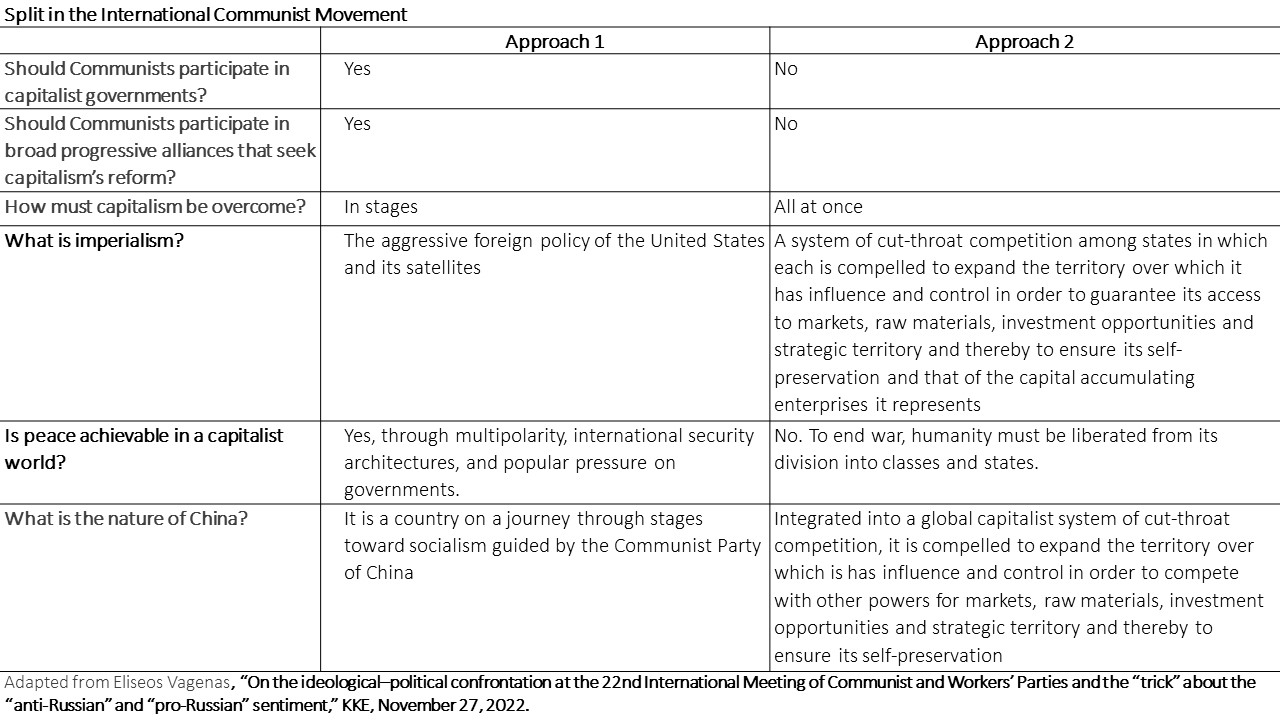
According to the Greek communist, the ICM has been split for some time on a least six questions, summarized below. When Russia invaded Ukraine, the parties moved to support or oppose Moscow, based on their pre-existing orientations, defined by either approach 1 or approach 2.
Two questions are critical to the positions the various ICM parties have taken on the war in Ukraine:
What does imperialism mean?
Is peace achievable in a capitalist world?
Communist parties that have either leaned toward outright support of Russia or greater condemnation of the United States and NATO, tend to view imperialism in a manner that departs significantly from the classical Marxist view and have developed an understanding of how to end war that revises Marx and borrows from liberalism. These parties see imperialism as the aggressive foreign policy of one capitalist state, the United States (and its satellites), and regard Russia as a victim of US imperialism. For them, the term ‘US imperialism’ is redundant, because imperialism is a monopoly of the United States.
What’s more, these parties tend to equate imperialism with war, and reject the notion that it has other dimensions, including peaceful capitalist competition, diplomacy, and even international security architectures. (Ask the North Koreans whether the UN Security Council is an expression of imperialism.) For these parties, imperialism is US war-making and little else.
In contrast, parties that view the war in Ukraine as an inter-imperialist conflict adopt the classical Marxist view of imperialism. For them, imperialism is a system of cut-throat competition among states in which each state is compelled to expand the territory over which it has influence and control in order to guarantee its access to markets, raw materials, investment opportunities and strategic territory and thereby to ensure its self-preservation and that of the capital accumulating enterprises it represents. The competition is expressed in multiple ways, including war, but not limited to it. It may be, and has more often than not been, expressed in trade and investment agreements. (See, for example, Robinson’s and Gallagher’s The Imperialism of Free Trade.)
Kenneth Waltz’s review of the split in the socialist movement precipitated by WWI, which he presents in his classic Man, The State, and War, calls to mind the current split in the ICM as identified by Vagenas.
Parties which support Russia in its war on Ukraine tend to embrace, as Waltz describes them, “the techniques of the bourgeois peace movement—arbitration, disarmament, open diplomacy” as well as the belief that popular opinion “can exert enough pressure upon national governments to ensure peace.” This, Waltz argues, is a revision of Marx’s view, which “points to capitalism as the devil.” The “socialism that would replace capitalism was for Marx the end of capitalism and the end of states,” and it was the end of states, for Marx, that meant the end of war. An anti-war movement founded on the notion that popular pressure and international security architectures can ensure peace, is a tradition that Waltz identifies as originating in the Second International as a revision of Marx. It is also a tradition that Waltz pointedly notes failed to keep the peace in 1914.
Waltz elaborates. Members of the Second International “were united in that they agreed that war is bad, yet they differed on how socialists were to behave in a war situation. … Jean Jaures and Keir Hardie eloquently urged a positive program of immediate application. Socialists, they said, can force capitalist states to live at peace.” As history shows, they couldn’t. Indeed, most socialists facilitated the war by supporting one of the belligerents.
In contrast, some “French and most German socialists argued that capitalist states are by their very nature wedded to the war system; the hope for the peace of the world is then to work for their early demise.” It is not, to bring the argument up to date, to support the weaker capitalist states in order to balance the strongest in a multipolar system. Indeed, this view is anti-Marxist in the extreme. For Marx, war ends when states end, not when weaker states balance the strongest and the world becomes multipolar.
The precursors of the Third International, Communists avant la lettre, argued that wars “are part and parcel of the nature of capitalism; they will cease only when the capitalist system declines, or when the sacrifices in men and money have become so great as a result of the increased magnitude of armaments that the people will rise in revolt against them and sweep capitalism out of existence.”
This resonates with the view of Vagenas, advocating for approach 2 as presented in the table above: The “capitalist world cannot be ‘democratized’.” It “cannot escape from wars no matter how many ‘poles’ it has.” War can only be escaped through “the struggle for the overthrow of capitalism, for the new, socialist society.”
Approach 1, then, evokes the Second International, while approach 2 appears to be consistent with the positions of the Third International.
On the basis of the foregoing, it would seem fitting to label approach 1 as “Liberal Bourgeois,” consistent with its tolerance of Communist participation in capitalist governments and broad progressive movements for capitalism’s reform; its penchant for a stepwise journey toward socialism; the absence of capitalism from its analysis of imperialism; its embrace of a peace movement whose techniques originate in a liberal theory of war; and its acceptance–indeed, its celebration–of China’s robust capitalism. Liberal Bourgeois Communists are nothing if not enthusiastic in their panegyrics to Chinese capitalism as “the world’s greatest anti-poverty machine” and never sparing in their praise of Chinese capitalism for “lifting hundreds of millions out of poverty.” In their devotion to capitalism as a cure for poverty they have outmatched even the staunchest Republican.
Approach 2 can be labelled “Communist,” reflecting its resonance with classical Marxist positions.
It is regrettable that some Communist parties have suffered an ideological drift toward positions that the founders of the ICM, Lenin and his colleagues, repudiated.
It is equally regrettable that as self-proclaimed heirs of Marx, these same parties espouse a view of how to ensure a peaceful world that originates, as Waltz argues, not in Marx, but in a liberal bourgeois theory of war.
Apart from hardliners in Moscow, Washington, and Eastern Europe, no one wants a war in Ukraine. And for good reason: It’s damaging most peoples’ lives.
According to The New York Times, “The combination of punishing sanctions, championed by Mr. Biden and his allies, and Russia’s retaliation has ricocheted through global food and energy markets, exacerbating already high inflation and undercutting global growth.”
The IMF and World Bank have been sounding alarms for months. Recently they were joined by the G20 (sans Russia).
“The war, leaders of the Group of 20 nations said in a declaration at the end of their summit in Bali, ‘is causing immense human suffering and exacerbating existing fragilities in the global economy — constraining growth, increasing inflation, disrupting supply chains, heightening energy and food insecurity and elevating financial stability risks.’”
The “war needs to end,” said Gita Gopinath, the first deputy managing director of the International Monetary Fund, “because the consequences for the economy are very high.” This view was “a common refrain from everybody” at the G20 summit, she added.
Not too long ago, a common refrain from everyone was that the Covid-19 pandemic needed to end, because the consequences were very high. What’s more, the World Health Organization’s secretary general said humanity had all the tools to end the pandemic.
So why is it, that despite consensus, and despite having the tools, the pandemic didn’t end? And why is that the war in Ukraine continues with no end in sight?
What are the G20 countries doing to bring the war to an end? Nothing.
The United States and its NATO subalterns are prolonging the war by pumping billions of dollars of weapons into Ukraine.
Russia continues to fight a war it hasn’t the resources to win.
Allies Who Are Not Aligned
While the G20 collectively is doing precious little to end the war, the leader of one its members, France, is. Emmanuel Macron “wants to find a way of ending the war around the negotiation table, not the battlefield.” No wonder. The war has not been kind to Europe. (The US is another matter.)
“The U.S. has stepped in to help replace Russia as one of the continent’s biggest natural-gas purveyors, but its shipments of liquefied natural gas have come with much higher prices, straining Europe’s manufacturing base.”
“French officials worry that manufacturers stung by Europe’s high energy prices are starting to think about shifting production to the U.S. to reap the subsidies on top of cheaper fuel supplies.”
Macron recently entreated a host of giant European firms “not to move production to the U.S.”, where energy prices are cheaper, and Biden’s Inflation Reduction Act, incents firms to produce in the USA.
“We need a Buy European Act like the Americans,” said Macron. “You have China protecting its industry, the United States protecting its industry, and Europe is an open house.”
A senior adviser to the French president said of US-France relations, “we are allies who are not aligned.”
Is it because the US is not suffering that Washington is willing to tolerate a continuing war in Ukraine, or because the US stands to gain?
Biden’s “aides note the United States, as a large energy producer, is not suffering like Europe from a lack of access to Russian oil or natural gas.” What Biden’s aides don’t acknowledge is that not only is the United States not suffering, it’s reaping innumerable benefits from the war. The Wall Street Journal recently mentioned just two: (1) a reinvigorated North Atlantic Treaty Organization, which will mean a gusher of profits for US arms makers. (For example, the war has spurred Germany to commit billions of dollars to Lockheed Martin for F35 warplanes); and (2) “a boom in trade and investment between the U.S. and Europe.” An important part of the boom in trade involves reorienting Europe’s energy markets from Russia to the US.
Another benefit: With Europe dependent on the US for energy, Washington can extract concessions from Brussels by threatening to close the tap.
Doing what is right for who?
“Mr. Biden has repeatedly said that” the threats the war in Ukraine pose to the world economy “would not deter him from doing what he believed was right in Ukraine.” Yet threats to US oil company profits have deterred one US president after another, including Joe Biden, from doing what is right in Saudi Arabia and Palestine. What Biden really means is that threats to the world economy, which largely affect Europe, low income countries, and ordinary people in the US, won’t stop him from doing what is right in Ukraine, for US LNG exporters and US arms manufacturers.
“Global Poor Lose Services as Developing Countries Face Higher Debt Payments” reads a Wall Street Journal headline
Here’s the causal sequence that ends in the world’s poorest people facing even harsher conditions as the war in Ukraine grinds on.
Cut-throat competition among major capitalist powers for markets, raw materials, investment opportunities, and strategic territory breaks out into a war between the United States and Russia over the question of who will control Ukraine.
The war disrupts supply chains and energy markets.
Food and energy prices soar, in turn pushing up general price levels.
Most people worldwide see their standard of living start to decline.
To fight inflation, central banks tighten the money supply, driving up the cost of borrowing, in order to slow economic activity.
Tighter money drives up housing costs and tips the world into recession.
Higher debt payments force low income countries into retrenchment, making the lives of the poor even harsher, at a time they’re already struggling with rising food and energy prices.
Existential threat?
Russia has the world’s largest nuclear arsenal.
According to a June 2022 report by the Stockholm International Peace Research Institute,
Russia has 5,977 warheads,
the U.S. has 5,428, and
China has 350.
Moscow says that NATO expansion is an existential threat. Seriously?
Setting a Precedent
“A perceived victory for Moscow” would set “a dangerous precedent that political goals can be achieved through brute force,” remarked NATO general secretary Jens Stoltenberg, offering an excuse for why the war in Ukraine cannot be brought to an end short of Russia’s humiliation, despite the growing economic damage the war is causing around the world.
But didn’t the organization Stoltenberg serves as Washington’s errand boy already set the precedent when it used brute force to achieve US political aims in Yugoslavia, Afghanistan, and Libya?
That’s not to justify Moscow’s use of brute force; only to condemn NATO as equally repugnant (and equally full of shit. Regarding Moscow’s own addiction to mendacity, it will be recalled that in “the tense weeks before Russia invaded Ukraine on Feb. 24, Russian officials denied that it planned anything of the sort, denouncing the United States and its NATO allies for stoking panic and anti-Russian hatred. When it did invade, the officials denied it was at war.”)
Commercially, Ottawa’s backing of multilateral sanctions on Russian oil and gas makes sense. Canada is a major oil and gas producer whose corporate sector could benefit from a growing share of the world energy market, one in which Russia is a major rival.
A fortiori, Washington’s championing of the same sanctions also makes sense. The shale revolution has unlocked ample supplies of oil and gas beneath US soil, returning the country to its historic role as an energy superpower. One oil field in Texas is now the second largest in the world.
Sanctions on Russian oil and gas are attractive commercially as a way of eliminating a major rival from the lucrative European energy market. Considering the realities of cutthroat commercial competition, we should consider the ardent support of Washington and Ottawa for sanctions on Russian energy to be part of a great game for economic and strategic advantage.
We might also expect that neither capital is much interested in helping Moscow and Kyiv arrive at a modus vivende, even though a negotiated peace between the two belligerents would end the unnecessary suffering of countless millions of people around the world. With the war in full flower, it’s much easier to maintain sanctions on Russia, and to inveigle Europe to accept them.
It’s understandable, then, that Washington and Ottawa should exploit the war in Ukraine to press Europe to cut its energy ties with Russia. But is it understandable that Europe should go along? After all, sanctions are visiting great harm and suffering on European consumers and businesses. Belgium’s prime minister has warned Europeans to brace for up to five years of hardship.
That hardship largely comes in the form of higher energy prices, the prospects of rationing and business closures this winter, a looming recession, and a declining standard of living.
If and when Europe decouples from Russian energy, and reorients its energy supply to North America and other countries in the US orbit, it will pay higher prices than it pays today. In terms of winners and losers, Europe clearly comes out on the losing end, while a handsome payday awaits corporate North America.
If Europe’s leaders are behaving in a way that benefits investors across the Atlantic at the expense of their own citizens and businesses, it’s because that’s the price subordinate units pay for being part of an empire. The interests of the imperial center prevail. Junior members sacrifice.
Imperialism hurts Europeans in two ways. First, it exposes them to the danger of great power rivalries; these can escalate, by accident or intention, into nuclear war. Second, it subordinates their interests to those of corporate North America.
This isn’t unique to the US empire. The same happens to secondary powers in other imperialist conglomerations. Belarussians and Syrians, for example, may reap rewards from membership in the Russian empire, but they also incur penalties. Both, by virtue of sheltering under Moscow’s aegis, are entangled in a great power competition in which they serve as pawns to be moved about a great chessboard by Kremlin planners whose goal is to protect the Russian king. The interests of the citizens of both countries come second, or matter hardly at all.
A better alternative is the end of great powers and their rivalries. But that means attacking the problem at its root—the ceaseless hunt for profits that plunges states into wars and intrigues to secure for their profit-accumulating enterprises advantages over the profit-accumulating enterprises of other states.
The Union of Communists of Ukraine (UCU), a communist party banned in Ukraine, published a statement on the war in their country on SolidNet, subsequently republished in English on The Defense of Communism site on July 12, 2022.
The following is a summary of the party’s analysis, which closely follows the classical Marxist view of imperialism.
The UCU characterizes the war in Ukraine as a clash of two imperialist alliances: One led by the United States, and the other led by Russia.
The UCU contests the reasons offered for war on both sides.
From the Russia side, the party disagrees that the war “is in the interests of ‘Russians,’” or for the “‘protection of the Russian-speaking population’” in Ukraine, or for the “‘denazification’ of the Ukrainian state.” Instead, it is “in the interests of Russian capital, which has sensed the danger and a necessity for the creation of new international conditions to provide further opportunities for profits and the growth of its capital.”
From the Ukrainian side, the war is not “about ‘the Ukrainian nation,’” or “‘the Ukrainian language and culture,’” or “even about ‘European values.’” In the party’s view, it is a war pursued by the EU, Ukraine, and North America, under US-leadership, “to destroy the economic and political power of the Russian bourgeoisie.” The “interests or rights of Ukrainian workers” are not a consideration. On the contrary, they are abridged and damaged by the war.
“Both Ukrainian and Russian workers in this war have only the right and obligation to go to the front and die so that one group of the world bourgeoisie defeats the other and gains more monopoly rights to oppress the workers, both in their own country and in the defeated countries.”
The war offers nothing of value to working people of the world. Indeed, the “consequences of this imperialist war … are catastrophic for the proletarian masses of all” countries. “A world war cannot but have world consequences: hunger, impoverishment, unemployment, and falling wages are already pacing the planet.”
[Energy and food prices are increasing as a direct consequence of the war. This has, in turn, led central banks to tighten money supplies to control inflation. The predictable consequence of central bank action is to tip economies into recession and visit further economic pain on working families worldwide.
Almost 50 million people have been pushed to the brink of starvation since the war began, as disruptions to grain supplies and soaring transportation costs push food prices out of the reach of the poor. At the same time, real incomes around the world are falling as wages stagnate and prices rise.]
As bad as these sequelae of the war are, a calamity of far greater significance lurks in the wings.
“The development of the military conflict in Ukraine has shown that its leading trend is its escalation into an open clash between the two imperialist blocs: Russia and its allies on one side, and NATO on the other side. This means the escalation of the war into a nuclear conflict and the emergence of a real threat of annihilation of humankind.”
The UCU invokes the classical Marxist view of imperialism as a system of rivalry among capitalist powers to dominate markets, raw materials, investment opportunities, and strategic territory. The “competition of capital inevitably leads to crises and wars.” Thus, the competition of capital must be eliminated to reduce the chances of humanity’s annihilation.
The “struggle against war” is “a struggle against the power of capitalists who wage wars.” It is based on “fighting against the capitalists in each of the warring states,” not supporting one bourgeoisie against the other [and not denying the imperialist character of one side or the other.]
“The UCU sees the way out of imperialist war for the working class not in abstract calls for peace and disarmament (which, at best, can only provide a reprieve from war for the parties to build up forces for an even fiercer clash), but in the need to eliminate capitalism as a parasitic and destructive social system, in which the competition of capital inevitably leads to crises and wars.”
To that end, the party proposes to turn the international war into a civil, or class, war, echoing Lenin’s slogan. At the same time, it appeals “to the Russian workers” to do the same, viz., “to turn the imperialist war into a class war against the power of capital and for the communist revolution.”
“The only thing we can oppose to the bourgeois nationalism …. which pits peoples against each other in war, is proletarian internationalism,” the party argues.
Below is a quick summary of a July 8 speech on the war in Ukraine by Dimitris Koutsoumbas, General Secretary of the Greek Communist Party (KKE), delivered to a conclave of communist parties from Greece, Mexico, Spain, and Turkey.
Earlier this year, Koutsoumbas’s party initiated a statement on the war in Ukraine, characterizing the war as the outcome of a struggle between capitalist classes. The statement was supported by a significant number of Communist Parties and Communist Youth Organizations, but rejected by others.
Koutsoumbas’s address elaborated on the KKE view, which has been summarized by one of its deputies in the European Parliament as follows: “The imperialist conflict in Ukraine is between two camps of robbers: The US-NATO-EU and the bourgeoisie of Ukraine against capitalist Russia, for the control of pipelines and markets.”
Here are some of the points Koutsoumbas made:
The war in Ukraine is a conflict between bourgeois states.
Bourgeois states engage in rivalries over raw materials, mineral wealth, commodity transport routes, geopolitical pillars, and market shares. These rivalries lead to war.
The causes of the imperialist war in Ukraine lie in the confrontation between bourgeois classes.
The USA, NATO, and EU are pursuing war in Ukraine to further their interests in Eurasia before embarking on a major conflict with China over which capitalist power will be supreme in the world economy.
People in all the belligerent countries and alliances—Russians, Ukrainians, Europeans, North Americans— are already paying the price for the war, either with their blood or in an unbearable economic burden.
The price they pay has been imposed on them by the bourgeoisie of all the belligerent powers.
Communists are engaged in a debate over the meaning of imperialism. One view limits imperialism to its reactionary–aggressive foreign policy, resulting in its identification with the USA and the most powerful EU member states. This view is too narrow.
[My note: The classical Marxist view of imperialism has always held that imperialism is an ineluctable outgrowth of capitalism and that it is expressed in rivalry among capitalist powers for access to raw materials, and to dominate markets, spheres of investments, and strategic territory. In the classical view, this rivalry eventually escalates to war.]
Capitalist relations of production now prevail entirely in China. Moreover, Russia, among the most powerful capitalist military powers in the world, and supported by powerful monopolies, is unquestionably capitalist. Imperialism is inseparable from capitalism. As capitalist powers, neither China or Russia, therefore, are outside the imperialist system.
Multipolaristas fantasize about a ‘peaceful cooperation’ in the framework of international capitalist competition through a utopian ‘non-aggressive’ rivalry, or a rivalry whose aggression will be held in check through various ‘security architectures’
[My note: Hilferding expresses the classical Marxist view on security architectures. “What an illusion,” it is, he wrote, “to preach international law in a world … of capitalist struggle where [the] superiority of weapons is the final arbiter.”]
Some communists have been deceived by the pretexts used by one or another ruling bourgeois class—North American, Russian, European, or Ukrainian—and have allowed themselves to become instruments of the pursuits of one or another bourgeois class.
We should not align with one or the other capitalist camp in the war, but instead work (1) to disengage our countries from the war and (2) most importantly, to overthrow the cause of the war: capitalism.
“A large part of the story involves shocks like rising oil and food prices … that are outside the control of policymakers,” writes the Nobel prize-winning economist. “These nonpolicy shocks explain why inflation has soared almost everywhere — for example, British inflation just clocked in at 9.1 percent.”
But rising oil and food prices are not outside the control of policymakers.
Oil prices are rising largely because US, Canadian, and EU policymakers imposed an embargo on imports of Russian hydrocarbons.
And food prices likely wouldn’t be rising had the US and NATO negotiated a new security architecture in Europe when Moscow pleaded for one in December. The West summarily dismissed Moscow’s overtures, seeing greater advantage in letting Russia—which Washington views as a great power rival—weaken itself by stepping into the quagmire of a war in Ukraine. The war is disrupting Ukraine grain exports, putting upward pressure on food prices globally.
If energy and food inflation is beyond the control of Western policymakers, as Krugman alleges, how do we explain this: The Washington Post revealed that the Biden administration anticipated that its response to a Russian invasion of Ukraine would precipitate rising energy prices and a food crisis, but was prepared to “countenance” these outcomes, despite the widespread pain they would cause.
The Post says Biden believed the stakes of allowing Russia to swallow up Ukraine were greater than the harm of spiraling energy and food prices.
The newspaper, however, didn’t explain what the stakes are, in the administration’s view. A good guess is that they are seen as the possible failure of the longstanding project of the United States absorbing Ukraine—seen in Moscow as part of the Russian sphere of influence and vital to its prosperity—into a US-led anti-Russia alliance.
Is a US victory in the game of grab really worth the pain of a growing affordability crisis, to say nothing of a looming food crisis in Africa and the Middle East?
Monetary authorities are now jacking up interest rates to extirpate underlying inflationary pressures, running the risk of precipitating a global recession. But Fed chair Jerome Powell admits that a tighter monetary policy won’t tame rising energy and food costs. In other words, Powell is on the cusp of producing a full-fledged stagflation.
The truth of the matter is that soaring oil, gas, and grocery prices—and a looming recession accompanied by climbing energy and food bills—are sequalae of decisions made by policymakers.
Krugman wants to lay the blame for the economic train-wreck on Putin. His “invasion of Ukraine has seriously damaged the world economy,” he writes.
This is too simple.
The proximal cause of the train-wreck is not the Russian invasion of Ukraine. It’s the West’s response to it. US, Canadian, and EU policymakers didn’t have to impose a fossil fuel embargo on Russia. Nor were they compelled to bolster Kyiv with tens of billions of dollars of aid, ensuring the war would drag on. (The longer the war lasts, the longer Ukraine’s grain exports will be disrupted, and the longer food prices will remain artificially high.) This was a decision policymakers freely took, with foreknowledge of the consequences.
The sad reality is that Western policymakers decided to become embroiled in a war they might have averted, had they seized the opportunity when offered. In maneuvering to weaken Russia by imposing a hydrocarbons ban, and furnishing Ukraine with aid to draw out the war (fighting Russia to the last Ukrainian), they have knowingly imposed substantial costs on their own citizens.
High inflation, then, is not the uncontrollable consequence of Putin’s decision to invade Ukraine. It is the anticipated and countenanced corollary of the pursuit of the US foreign policy goal of weakening Russia.
What should happen?
Russia should end its war on Ukraine and withdraw its forces.
The United States, Canada, and European Union should lift their embargo on imports of Russian oil, gas, and coal and cease other measures of economic warfare against the country.
NATO, little more than an instrument of US foreign policy and the means by which Washington dominates Europe, should be disbanded. The European Union, whose combined military spending and armed forces overshadow Russia’s, is capable of defending itself.
US and Canadian troops should be withdrawn from Europe and reoriented to territorial defense from power projection.
Brussels should negotiate a security architecture for Europe with Russia.
This is what we might wish to happen, but realistically, none of it is likely to happen. The expansionary imperatives of capitalism compel each state to compete on behalf of their capital-accumulating enterprises for investment opportunities, markets, sources of raw materials, and strategic opportunity on a world scale. Capitalism-induced rivalry creates tensions among countries—antagonisms that have a high likelihood of escalating to war. Therein is found the roots of the struggle among the United States, Europe, Russia, and Ukraine—a struggle that has burst forth in overt violence and produced a looming economic catastrophe.
Until economies are re-oriented to satisfying human needs rather than investors’ needs for handsome returns, until capitalism is overcome, there is no real hope for any meaningful turning away from the inauspicious path on which humanity now treads.
Journalist Patrick Cockburn decries Russian president Vladmir Putin’s decision to invade Ukraine as manifestly dumb. Putin, “convinced himself,” writes Cockburn, “that a Russian army of inadequate size would easily topple the government in Kyiv and the Ukrainian army would meekly surrender.” [1]
If Putin believed about Ukraine that he only had to kick in the doors and the whole rotten structure would come tumbling down (as Hitler believed about the Soviet Union), the expectation has, to be sure, turned out to be decidedly wrong. But we’ll have to wait to find out whether the invasion represents “the most disastrous decision in Russian history,” as Cockburn contends. The key question, from the perspective of Russian raison d’état, is whether the decision makes the Russian state and the elites it represents stronger relative to what they would have been had the invasion not been carried out. It’s too early to tell.
If Putin has blundered, and he may have, then so too, on the surface, has Biden. Biden’s decision to embargo Russian hydrocarbons, and to pressure Canada and the EU to do the same, has hurt Western consumers far more than it has hurt Russia.
According to the New York Times, “oil and refined fuel prices” in the United States “have risen to their highest levels in 14 years, due largely to sanctions on Russia oil.” Gasoline prices are up by more than 60 percent over last year. And higher fuel prices are rippling through the US economy, contributing to record high inflation. [2]
The Eurozone is dealing with a similar set of problems. “High prices are already sending shudders through an economy that is geared up to run on cheap Russian energy,” reports the Wall Street Journal. This has fueled record-high inflation and prompted some industrial companies to close. [3]
With monetary authorities raising interest rates to temper strong upward pressure on prices, Western economies are on the brink of a recession, and tens of millions teeter on the precipice of economic hardship. [4]
Meanwhile, this month alone, Moscow’s “coffers were expected to receive $6 billion more in oil and gas revenue than anticipated because” embargo-induced supply restrictions sent oil prices soaring. As the New York Times reports, “China and India, the world’s most populous countries, have swooped in to buy roughly the same volume of Russian oil that would have gone to the West. Oil prices are so high that Russia is making even more money now from sales than it did before the war began four months ago. And its once-flailing currency has surged in value against the dollar.” [5]
An embargo to punish Russia that ends up punishing Western consumers with higher energy prices, but allows Russia to reap the benefit of rising prices, surely rivals Putin’s decision to invade Ukraine for sheer stupidity.
Or does it?
If Biden’s goal is to punish Russia while protecting Western consumers, then his embargo decision has clearly backfired. But are these his goals?
Another view is that the US aim is to shift Europe’s energy dependence from Russia to sources under US control, in order to weaken Russia, and its oil and gas industry, and strengthen the oil and gas industries of the United States and its allies. Europe stands to lose big time, since sourcing energy from further afield will raise the continent’s energy bill. Additionally, by shifting Europe’s energy dependence to US-controlled suppliers, Washington increases its leverage over a Europe that increasingly seeks strategic autonomy at US expense. Washington has complained about Russia’s ability to use its energy supplies to blackmail Europe. Dependence on US-controlled suppliers simply shifts the role of potential blackmailer from Moscow to Washington.
According to the Washington Post, the Biden administration had discussed, even before Russia launched its invasion in February, the possibility that its response to the invasion would cause global spillover effects, in rising energy costs, food shortages, and a global recession. Moreover, US officials said they were willing to countenance these consequences. [6] (Fine for them; buffered by great wealth, they’ll hardly feel the effects themselves.)
If Western consumers are paying more for gasoline, natural gas, and groceries; if Africa and the Middle East are on the brink of a food crisis; if hundreds of millions are teetering on the edge of joblessness as the world economy slips closer to recession; it’s not because a stupid decision was made by a blundering Biden administration that has had calamitous unanticipated consequences; it’s because these are the anticipated and countenanced consequences of a US strategy to weaken Russia and bring Europe more firmly under the US thumb.
If Biden is stupid, his stupidity promises to produce welcome results for US energy companies, to say nothing of corporate America as a whole, which, on balance, stands to profit from Washington gaining greater leverage over Europe, one of the world’s largest economies and rival for world economic supremacy with corporate USA.
If there’s stupidity at play here, it’s the stupidity of believing that Washington’s actions are aimed at protecting and enlarging the interests of ordinary people. On the contrary, you and I are merely the means to the ends of—and collateral damage of the decisions taken to benefit—the elite of billionaires and wealthy investors who are the only people who really matter in Washington.
The war in Ukraine didn’t have to happen. For months, Moscow pressed Washington and NATO to negotiate a new security architecture in Europe. Moscow’s entreaties were dismissed out of hand. Once the war began, Washington could have launched efforts to bring about a diplomatic solution. Instead, it did the opposite, pumping billions of dollars of arms into Ukraine, and pressing its allies to do the same. This has been a boon for investors in US arms manufacturing, but a menace to the world, which now lives under a sword of Damocles in an elevated risk of nuclear war with Russia.
Tally up the consequences of Washington’s response to Russia’s invasion of Ukraine.
Rising energy prices.
Record-high inflation.
A world economy on the brink of a recession.
A looming food crisis.
An increased risk of nuclear war.
These consequences harm you and me, and everyone else like us, but they hardly affect the wealthy, if they affect them at all (with the exception of the last.)
But there are other consequences—effects that are hardly calamitous but, on the contrary, are pleasing to a narrow spectrum of the population, namely, corporate USA and wealthy US investors. These are:
Soaring demand for US arms.
The promise of a cornucopia of future profits for US weapons makers as NATO members hike their military outlays and two new members, Finland and Sweden, join the alliance. (To ensure interoperability of forces, NATO members largely buy their equipment from a common provider, the US arms industry.)
Growing opportunity for the US hydrocarbons industry.
US control of Europe’s energy supplies and therefore greater US political leverage over Europe.
Higher energy costs for European businesses, reducing their competitiveness relative to US firms.
Government decisions that hurt you and me may appear to be evidence of government stupidity. It’s more likely that the consequences are not calamitous for everyone, and the calamity for the rest of us is anticipated and countenanced.
2. Clifford Krauss and Marie Solis, “U.S. Gas Prices Hit a New High: $5 a Gallon,” The New York Times, June 11, 2022.
3. Joe Wallace and Eric Sylvers, “European Natural-Gas Prices Jump as Russia Cuts Supplies Again,” The Wall Street Journal, June 15, 2022.
4. Paul Hannon, Yuliya Chernova and Georgi Kantchev, “Russian Inflation Makes U.S. Price Rises Look Tame,” The Wall Street Journal May 20, 2022.
5. Victoria Kim, Clifford Krauss and Anton Troianovski, “Western Move to Choke Russia’s Oil Exports Boomerangs, for Now,” The New York Times, June 21, 2022.
6. Missy Ryan and Dan Lamothe, “With scant options in Ukraine, U.S. and allies prepare for long war,” The Washington Post, June 17, 2022.
“Capitalism can pursue no other policy than that of imperialism.” Rudolph Hilferding
“Imperialism is an inevitable accompaniment of capitalist development.” Nikolai Bukharin
“Colonial politics and imperialism are … the inevitable consequences of the very foundations of capitalism.” V.I. Lenin
By Stephen Gowans
June 18, 2022
Blaming the war in Ukraine on Russian aggression or, alternatively, NATO provocations, represents a failure to understand capitalist imperialism as a system of rivalry among states for economic advantage. Imperialism is not what Russia alone does, or only what the United States and its janissaries do, but is, instead, a system in which all capitalist powers and blocs are enmeshed. It is not a policy choice, but the inevitable outcome of rivalry among states that originates in the expansionary imperatives of capitalism. To borrow from Lenin, capitalist imperialism is “the struggle for the sources of raw materials, for the export of capital, for spheres of influence, i.e., for spheres for profitable deals, concessions, monopolist profits, and so on, in fine, for economic territory in general.” [1] Blame for wars that spring from this system cannot be assigned to only one state or alliance. The blame lies with capitalism itself. Capitalism inevitably creates antagonisms among states, and the antagonisms can, and often do, escalate to war.
The historian William Appleman Williams explained this well.
The issue is not whether capitalism is a unique cause of war. It is not. The causes of war, including the economic ones, operate within capitalism just as they have within other systems of political economy. It does seem demonstrable, however, that capitalism heightens and intensifies the role and impact of economic factors in causing wars. The essential dynamic engine of capitalism, after all, is held to be a never-ending economic competition within a world marketplace. … the competition has an inherent tendency to escalate into political tension and conflict, and that exacerbates and reinforces other causes of such contention. For this reason, capitalism reveals a strong propensity to produce or result in organized violence … [The] capitalist outlook structures the world in such a way that capitalist leadership often sees itself as being confronted with a choice between war or defeat in the competitive marketplace. [2]
Assigning blame for war to one bloc or state, rather than to the internal workings of capitalism, was denounced by all leading Bolsheviks, and much later, by Domenico Losurdo, who faulted the historian Fritz Fischer for blaming WWI on Germany alone. Losurdo wrote: “Fritz Fischer’s weighty monograph, [Germany’s Aims in the First World War] published in the early 1960s, makes the mistake of always defining imperialism in the singular, as if the German variety alone were operative.” [3] In a similar vein, we can fault many contemporary Marxists and anti-imperialists for making Fischer’s mistake of always defining imperialism in the singular, in this case, as if the US variety alone is operative.
Lenin wrote of one imperialist war, WWI, as “the natural continuation of the policies of the capitalist class and of the governments of all countries” (emphasis added). [4] Commenting on the same war, Lenin’s colleagues, Bukharin and Preobrazhensky, contended that “Undisputedly, the game of grab played by all the great powers was the real cause of the war. Only an idiot can continue to believe that the war took place because the Serbs killed the Austrian crown prince or because the Germans invaded Belgium” (emphasis added). [5]
They continued:
“The German capitalists maintained that Russia was the aggressor, whereas the Russians proclaimed everywhere that Germany began it. In Britain word went round that the British had entered the struggle on behalf of ‘gallant little Belgium.’ In France, everyone was writing, screaming, and singing to prove how gloriously France was behaving in defense of the heroic Belgian nation. Simultaneously in Austria and Germany it was being trumpeted that these two countries were repelling a Cossack invasion and were waging a purely defensive war.” [6]
“This “was all nonsense,” declared the two Bolsheviks, “a fraud.” [7] In truth, they said, “The essence of the imperialist war was … that in it, all were aggressors” (emphasis added). [8] That’s because the “essential desire of every one of the financial capitalist [States] is to dominate the world; to establish a world empire, wherein the small group of capitalists belonging to the victorious nations shall hold undivided sway” (emphasis added). [9] “In this manner,” Bukharin and Preobrazhensky argued, “the reign of financial capital must inevitably hurl all mankind into the bloody abyss of war for the benefit of bankers and [billionaires]; a war which is not for a people’s own land but for the plunder of other lands; a war that is waged in order that the world be subjugated by the financial capital of the conquering country.” [10]
It’s a surprise, then, to find that a Communist-led organization should make the same error the Bolsheviks and Losurdo condemned. “The West – driven by the imperialist ambitions of the United States and its NATO allies … provoked the actions of the Russian government,” declares the Canadian Peace Congress. [11] This is no different from saying, Germany, driven by imperialist ambitions, provoked the actions of the Entente. In a prize fight, the fighter who lands the first blow has not—driven by his ambition to win the fight—provoked the actions of his opponent. If we want to understand prize fighting, we have to understand it as an institution, as a system of rivalry in which the actors seek the same prize at the expense of their rivals. The same is true of capitalism on a world stage.
In concert with the Peace Congress’s attempt to identify the guiltier party, a recent online discussion panel, sponsored by the Toronto Association for Peace and Solidarity [12], also promoted an erroneous understanding of imperialism. Rather than locating the root cause of the war in rivalry among states driven by capitalist compulsions, it focused, in a climate of febrile attention to the war on Ukraine, exclusively on NATO, as if a war that is at the fore of public awareness can be understood in the motivations of one belligerent alone, or that the central problem is NATO (just one of many instruments of imperialism) rather than the capitalism-driven system of rivalry itself.
One cannot help but think that were the Bolshevik intellectuals transported across time to the present, they would, contrary to the approach of the Peace Congress, take a whole-system perspective, examining the role of capitalism and its imperatives in creating multiple antagonisms among the United States and its NATO alliance, the EU, Russia, and Ukraine.
The Canadian Peace Congress tries to explain the war in Ukraine as an outcome of the United States’ “imperialist ambitions,” but says nothing about the source of these ambitions (where do they come from?) and nothing about the imperialist ambitions of Russia (as if Russia, a country as thoroughly capitalist as any of those of the NATO alliance, is somehow immune to ambitions to defend and expand its economic territory.) That’s odd, considering the Congress is Communist-led. You might expect Communists to point out that:
Imperialist ambitions arise inevitably from the internal workings of capitalism.
Capitalism compels business people to nestle everywhere, settle everywhere, and set up connections everywhere, as the Communist Manifesto explained, which means that capitalists from various countries are always bumping up against each other in pursuit of the same profit-making opportunities in the world market.
The compulsive drive for markets, investment opportunities, and raw materials creates antagonisms among states.
Capitalism is a danger because it incubates imperialist ambitions that conduce to war.
Blame for capitalism-driven war lies, not in the actions of a single belligerent state or bloc, but in capitalism itself.
Ending the seemingly interminable succession of capitalism-driven wars will only happen when, as Lenin put it, “the class which is conducting the imperialist war, and is bound to it by millions of economic threads (and even ropes), is really overthrown and is replaced at the helm of state by the really revolutionary class, the proletariat” (emphasis in the original).[13]
These wars won’t be ended by cheering on one or more of the contestants, hoping that in the struggle for the world market one side grows stronger and the other weaker, as the apostles of multipolarity do today.
Instead of a communist, or class, analysis of the war in Ukraine we have been presented, not only by the Canadian Peace Congress, but by many groups and people who present themselves as Marxist-Leninists, with a Fritz Fischer-like perspective—one that makes the mistake of always defining imperialism in the singular, as if the US variety alone or the Russian variety alone is operative. This perspective transforms the meaning of imperialism from a system of rivalry for markets, raw materials, investment opportunities, and strategic territory into a denunciatory label to be attached to whichever bourgeois power one happens to dislike.
Similarly indefensible and often sophistical arguments are presented by soi-disant Marxist-Leninists to justify departures from class analyses.
For example, some say that while they recognize all parties to the war in Ukraine to be aggressors, they reserve their condemnation for their own country’s government because it is the only one over which they can exert some influence. There are two problems with this argument.
First, people can, and have, exerted influence over foreign governments. The movements to pressure South Africa to abandon apartheid, and the similar BDS movement aimed at apartheid Israel, represent such efforts. The worldwide demonstrations for peace in the lead-up to the 2003 Anglo-American invasion of Iraq, were also efforts to influence what, for most of the participants, was a foreign government: that of the United States. Those who refuse to condemn Russia on the grounds that it is a foreign country over which they have no control, have had no reservations in the past about condemning the United States, Israel, and South Africa, and seeking to alter these countries’ courses of action. The argument they make to justify their silence on Russia, therefore, lacks credibility.
Second, even if it were true that no pressure can be exerted on foreign governments, it does not follow that this binds one to omerta, a code of silence on the actions of foreign governments. The related argument that one’s main duty is to oppose one’s own government fails for the same reason; opposing one’s own government is not equal to refusing to acknowledge that other states, also enmeshed in a system of rivalry for markets, investment opportunities, and strategic territory, also behave, as a consequence, in repugnant ways. What’s on trial, or ought to be, is not the United States or Russia, but imperialism, a system of rivalry in which all states under the sway of capitalism (including China) are ensconced. As much as I can walk and talk at the same time, so too can I condemn Russia for its aggression in Ukraine and oppose my own government’s contributions to the war, while at the same time locating the source of their imperialist ambitions and belligerent actions in the systemic imperatives and logic of capitalism.
Others say they fault all belligerents, but refuse to cite Russia’s aggression for fear of adding to the weight of pro-war sentiment in their own country. This view is problematic. Failing to acknowledge Russia’s aggression when it has been visibly brought to the public’s attention, in no way challenges one’s own government’s arguments for war or makes the argument against war any stronger. It does, however, guarantee that, in failing to acknowledge the obvious, building credibility with the larger public becomes unnecessarily difficult. It seems far more likely that a public, in Europe anyway, that already sees Russia as an aggressor, but favors a rapid end to the war and opposes military build-ups [13], will be more receptive to an argument that acknowledges the apodictic reality of Russian aggression. A sounder approach to refusing to acknowledge Russia’s belligerent actions, or worse, to defend or excuse them, is to argue thus: Russia’s attempt to retain Ukraine within its sphere of influence by war is indefensible, but at the same time, so too are the actions of the United States and its allies, to draw Ukraine into the EU sphere, and therefore, the larger US ambit. Two blocs are fighting over the profit-making opportunities and strategic assets that repose within the borders of Ukraine, and the victims are the ordinary people around the world who are paying, if not in their lives or displacement through war, through their pocket books, in increasingly unaffordable energy and food, and higher taxes or foregone social expenditures due to increased military outlays, to say nothing of facing an elevated threat of nuclear war. This is not a war of justice, where one bloc has virtue on its side, but a war against humanity in which all participating governments are aggressors.
Perhaps thinking wrongly that organizing against the war in Ukraine amounts to supporting Russia, the Peace Congress avers that it takes courage to promote “peace and solidarity in moments of crisis and in an atmosphere of pro-war frenzy and propaganda.” But what courage is really needed to say what a majority of the population already thinks, namely, that
Russia’s actions are deplorable;
the US and NATO should have accommodated Russia’s request to negotiate a security architecture in December;
Washington should not be taking measures to prolong and intensify the war; it should be working toward a diplomatic solution.
(The Congress doesn’t say who it is promoting solidarity with, but one gets the sinking feeling it’s Russia. No wonder it thinks courage is required.)
One especially vacuous argument presented by those who misunderstand imperialism holds that failing to take a side in a rivalry among capitalist states for markets, spheres of influence, and investment opportunities is an exercise in cowardice. A side must be taken, these imbeciles insist. As a matter of logic, there is no compelling reason why one must take a side in a conflict. This is particularly true if the disputants pursue goals that are either indifferent or inimical to one’s own interests. In point of fact, the Bolshevik view of imperialism does take a side: that of the proletariat. What it doesn’t do is take the side of one bourgeoisie against another. The imbeciles demand we do.
Finally, some have dismissed the Bolsheviks’ analysis of imperialism as outdated, faulting it for being specific to conditions that prevailed in WWI, and therefore incapable of capturing the dynamics of a world dominated by a single hegemon. Two points can be made about this objection.
First, the early twentieth century was characterized by the predominance of the British Empire, which held large parts of the world under its sway, if not in its thrall. Britain’s primacy may not have been as strong as that of the United States today, but the empire was unquestionably first among great powers. The difference between a world dominated in the early twentieth century by the British Empire and the world dominated by the United States today, is quantitative, not qualitative, a matter of degree, not kind.
Second, while for a very brief period the United States was almost completely unchallenged as a global leviathan, both Russia and China have emerged as “revisionist” capitalist powers, to challenge the primacy of the United States and “revise” the US-superintended world order. By revise the world order, I mean repartition the world’s economic and strategic territory. Some people think there’s something progressive about this. If so, then World Wars I and II were progressive events, for they were the outcomes of Germany’s and Japan’s attempts to revise the world order to create greater multipolarity.
Germany and Japan, driven by the needs of their growing capitalist economies, emerged in the early twentieth century to challenge the British Empire, and to revise the global order London led—that is, to take from Britain and other great powers, the economic territory Berlin and Tokyo said they needed to thrive. Germany at a minimum lusted after a sphere of influence in all of continental Europe, while Japan sought pre-eminence in East Asia. Russia, today, is driven to protect its economic territory from US-led encroachments, while China’s capitalism-driven need for foreign markets and secure access to raw materials entangles it in a rivalry (along with complementarity) with the United States and the European Union. The rivalry may lead to war.
The period of conflict between the United States as the leader of the capitalist world, and the Soviet Union and Maoist China, as large powers, is different in one fundamental respect from the great power rivalry that marks the present: Russia is not a socialist country (and neither, by any common definition of the word “socialist”, is China.) That it is necessary to make a statement as blindingly obvious as this, one on par with, the earth is a sphere, is testament to the fact that some Marxist-Leninists are in the grips of an extraordinary delusion about the political economy of Russia and China. No, Russia is not the Soviet Union, and China, highly integrated into the US economy as a sphere of exploitation for US corporate behemoths seeking low-wage labor, while at the same time, a hot house for a growing clutch of billionaires with interests around the world, are not tribunes of the people, as some luftmenschen would like to believe.
The world politics on which the Bolsheviks cut their analytical teeth bears a much stronger resemblance to that of the world today than to the post-1945 twentieth century struggle between capitalist and communist blocs. Today, capitalist Russia and a China very much under the sway of capitalism, appear more like Germany and Japan during the so-called Second Thirty Year War, 1914-1945, namely, as rising capitalist powers with a mission, developed under the lash of capitalist expansionary imperatives, to repartition the world, than they resemble the Soviet Union and Mao’s China.
While NATO has unquestionably played a role in bringing about the war in Ukraine, focusing on NATO, and identifying the United States and its allies as bearing the greater guilt for the conflict, presents imperialism as if it were a policy that governments can adopt or reject at will rather than a capitalism-driven rivalry for the world market in which antagonisms among states are inevitable and wars are nearly ineluctable. We ought to be at a place where we can, to borrow from Bukharin and Preobrazhensky, explain the cause of the war in Ukraine as the outcome of “the game of grab played by all the great powers” and not—as “only an idiot can continue to believe”—either NATO provocations or Russian aggression.
[1] V.I. Lenin, Imperialism: The Highest Stage of Capitalism. International Publishers. 1939. P. 124.
[2] William Appleman Williams. The Great Evasion. Quadrangle Books. 1964. P. 75.
[3] Domenico Losurdo. War and Revolution. Verso. 2015. P. 137.
[4] “Resolution introduced by the delegation of the central committee of the RSDLP to the International Socialist Women’s Conference at Berne”, in Lenin: The Imperialist War. International Publishers. 1930. P. 472.
[5] N. Bukharin and E. Preobrazhensky. The ABC of Communism.Penguin Books. 1970. P. 158.
[12] https://www.youtube.com/watch?reload=9&v=7bFEdpj5dYU While this may not be true of the Toronto Association for Peace and Solidarity, some solidarity groups see their mission in connection with the war in Ukraine as one of expressing solidarity with one capitalist country, Russia, against an alliance of other capitalist countries, NATO, rather than solidarity with the proletariat, whose blood, labor, and future, is threatened by the struggle between these two bourgeois blocs.
[13] V.I Lenin, “The Proletarian Revolution and the Renegade Kautsky,” 1918, in Lenin’s Collected Works, Progress Publishers, Moscow, Volume 28, 1974, pp. 227-325.
In what does the contest between the US and Russia originate?
It originates in a struggle over the questions of whether:
The profit-making opportunities of Ukraine will belong to the EU or a customs union with Russia.
Europe will depend for its energy on US-controlled suppliers or Russia.
Which side do you want to be on?
The side seeking Ukraine’s integration into the EU and Europe’s energy dependence on US-controlled suppliers?
The side seeking Ukraine’s integration into a customs union with Russia and Europe’s continued energy dependence on Russia?
In other words, whose billionaires are more important to you? The US’s or Russia’s?
Or are billionaires, and their contests for profits on a world scale, the problem? And is choosing sides in their contests, rather than eliminating them altogether, a grave error?
The war in Ukraine offers no benefit to ordinary people that I can think of.
But it does present multiple harms:
Higher energy and food costs.
A migrant crisis.
Supply chain disruptions.
A significantly heightened risk of nuclear war.
Higher government expenditures on arms at the expense of spending on health care, education, housing, and addressing the climate emergency.
Ordinary Ukrainians face the threats of death, injury, homelessness, and economic harm. The standard of living of ordinary Russians is declining, and will decline further. There is nothing good in this war for ordinary people, anywhere.
What’s more, based on the way the war is unfolding, it appears that the United States and NATO will emerge stronger. Anyone who thinks this war will be a blow to US primacy is sorely mistaken.
Who could possibly support this war? The answer is:
Investors in arms and energy companies.
Investors in businesses that stand to gain from securing new profit-making opportunities in Ukraine.
Operatives of any of the belligerent states.
Alongside these bourgeois supporters of the war, stand a few proletarian supporters. Among them are:
The ignorant.
The confused.
Class traitors.
People who pose as socialists, peace-activists, or “independent journalists,” but are in reality propagandists of the belligerent governments.
The only wars worth supporting are wars against oppression. The struggle between Washington and Moscow for control of Ukraine and the supply of energy to Europe does not fall into this category. Ukrainians are not oppressing Russians.
Choosing sides in a contest between national groups of billionaires vying for business opportunities in Ukraine and Europe is, for ordinary people, an exercise in self-harm. If we’re going to chose a side in a war, let it be the side of you and me, not the side of billionaires.
And let the war be a battle against the menaces of climate change, precarious work, unaffordable housing, exploitation, racial oppression, and pandemics, not a contest over whether US billionaires or Russian billionaires will dominate Ukraine’s profit-making opportunities and the European energy market.






 What's Left