World War III is not about to erupt; it has already begun; indeed, it began as long ago as 2015, when Russia, at the request of the Syrian government, intervened in the conflict in that country, whose government was under attack by Islamist insurgents encouraged, armed, and resourced by the United States and its allies.
The war in Syria, one that counts among its participants the United States, Russia, Britain, France, Turkey, Saudi Arabia, Israel, Iran, Jordan, Qatar and others, is no less a world war for being confined to the borders of Syria. A world war is not defined by the multiplicity of its theaters but by the multiplicity of its actors.
Ultimately, the war is a conflict over two types of international order: on the one hand, a hierarchy of states, with the United States at the top, endowed with de facto authority to impose its will on all other states; on the other, a network of sovereign and independent states, linked by mutual benefit—a US-dictated global order vs. a democratic UN-defined international order. This is a battle of tyranny versus democracy at the level of international relations.
The war over these two contending conceptions of how the world’s affairs should be organized—the Third World War in action—is now threatening to spill beyond Syria’s borders.
The US president has threatened to attack the Syrian government in response to an alleged chemical weapons incident that is almost certainly a hoax perpetrated by partisan sources, the White Helmets and Syrian American Medical Society. These are jihadi-aligned groups, funded by Western governments, which have an interest in pressuring the United States to maintain its illegal occupation of nearly one-third of Syrian territory, or to provide a pretext for continued or even escalating US intervention in Syria.
The same Western governments that fund the White Helmets and Syrian American Medical Society have openly called for regime change in Damascus and have invested time and money in an effort to bring it about. The two outfits they bankroll are neither independent nor neutral, and can hardly be judged to be trustworthy sources, any more than the United States, and its allies France, the UK, Saudi Arabia and Israel, can be.
Russia has warned the United States not to carry through on its threat to attack the Syrian government. An attack ordered by the US president would violate international law, to say nothing of US domestic law, which vests authority to wage war in Congress. The president does not plan to seek Congress’s authorization.
This, however, is all of a piece. It is difficult to point to any aspect of the US intervention in Syria that has not been illegal, from the occupation of Syrian territory, to the violation of its airspace, to the funding of guerrillas to overthrow its government.
The United States’ newspaper of record, the New York Times, urges the US president to commit another illegal act, namely, to punish Syria militarily, without Security Council or Congressional authorization, for an unverified transgression against international law. The New York Times, thus, no less than other major Western media, has chosen a side in World War III—four-square behind the fight for an international order based on the arbitrary rule of the US administration in preference to a global order based on sovereign and equal states governed by the rule of law.
Russia has vowed to intercept incoming US missiles. Its warning has been met by a belligerent reply from the US president. The situation is fraught with danger. The United States, and its major media, which connive in the likely chemical weapons deception and elevate a planned illegal act of war into a moral crusade, are playing a very dangerous game. They’re willing to bring the world to the brink of a general conflagration to fulfil their vision of a hierarchy of states subordinate to the US administration’s rule—an undisputed global US empire.
#1. The fundamental question of whether a chemical weapons (CW) attack took place last Saturday in the Syrian town of Douma has yet to be independently addressed. The Organization for the Prevention of Chemical Weapons (OPCW), the one neutral body that is qualified to investigate the use of chemical weapons, has yet to begin its investigation.
#2. While the OPCW can determine whether a chemical attack has occurred, it is beyond its capability to assign responsibility. The allegation that the Syrian government perpetrated a CW attack is not verifiable in principle by a neutral body.
#3. The sole evidence for the claim against the Syrian government consists of allegations from two partisan sources: the White Helmets and Syrian American Medical Society.
http://www.barakabooks.com/#4. Both groups are allied with jihadists seeking to overthrow the Syrian government and both are funded by Western states which openly call for regime change in Damascus. These outfits are neither neutral nor independent.
#5. As parties to the conflict, both groups have an interest in fabricating atrocity stories to defame their enemy and create a pretext for the continued and even escalated intervention of Western militaries in Syria.
#6. As parties to the conflict, Western states have an interest in legitimating the atrocity stories to defame the government they seek to change and to furnish a pretext for their continued and even escalated intervention in Syria.
#7. While early media reports referred to the White Helmets and Syrian American Medical Society as the sources of the allegations, explicit references to these partisan sources have now mostly disappeared from media coverage.
#8. Instead, the White Helmets and Syrian American Medical Society are now referred to by more neutral-sounding terms, such as “medical professionals and human rights groups,” or “relief workers”* disguising their partisan character and creating the illusion that they are independent humanitarian organizations free from a vested interest in the outcome of the conflict.
#9. Following the tenet cui prodest scelus, is fesit (he has committed the crime who has received the profit) suspicion falls more heavily on the White Helmets and Syrian American Medical Society, as perpetrators of a hoax, than on the Syrian government, as perpetrators of a crime. While it’s easy to attribute a motive to the White Helmets and Syrian American Medical Society to fabricate a story, no credible motive or benefit has been adduced to explain why the Syrian government would carry out the alleged CW attack. Those explanations that have been advanced fail on either of two grounds: they’re circular, or implausible and free from evidence.
A favored circular explanation holds that Assad ordered an attack because he’s an “animal.” How do we know he’s an animal? Because he ordered an attack.
Another line of argument attributes the alleged attack to a desire on the part of the Syrian government “to terrorize the population.”** Apart from the reality that no evidence for this claim is adduced, it is wholly unsatisfying as an explanation. Populations can be far more effectively terrorized by carpet bombing (also known, fittingly, as terror bombing.) If the Syrian government sought to terrorize the population, why use chemical weapons, when far more effective means are at hand, ones, morever, that don’t cross a red line?
#10. The bottom line is that there is no independent verification that an attack even took place, let alone that the Syrian government is responsible for one. What’s more, the sources of the allegations are wholly untrustworthy, have an interest in perpetrating a hoax, and no credible motivation has been cited to explain why the Syrian government would undertake the alleged CW attack.
The only reasonable conclusion in light of the above is that there’s not a speck of credible evidence that the Syrian government perpetrated a CW attack at Douma last Saturday, and that there are strong grounds to suspect the White Helmets and Syrian American Medical Society have created a deception.
* See for example “The US presses allies to back military strike on Syria,” The Wall Street Journal, April 10, 2018 or “Russia warns it will shoot down US missiles fired at Syria, target launch sites,” Reuters, April 11, 2018. Two days earlier the Wall Street Journal’s reporting identified the Syrian American Medical Society and the White Helmets as the sources of the allegations, as did The Associated Press and the New York times.
** See for example “Syria gas attack echoes Assad’s gamble that gains outweigh risks,” Wall Street Journal, April 9, 2018.
Ideologues of US power, notably those ensconced in the editorial offices of the New York Times and Wall Street Journal, believe that the United States has an imprescriptible right to exercise an absolutist tyranny over the world, to define the boundary between civilization and barbarism, and that Washington is unbound by international law, but free to wield it as a tool against the barbarians. In the ideology of US despotism, the compass of civilization includes states that submit to “US leadership”, a euphemized version of “US tyranny,” while states which favor an international order based on the UN Charter’s ideal of the sovereignty and equality of states (Syria, North Korea, Cuba, Iran and Venezuela are among the supporters of this alternative, democratic, order) are relegated to the category of barbarism. Once a state has been located outside of civilization, Western legal traditions—testing accusations against evidence and the assumption of innocence until culpability is credibly demonstrated— no longer apply. The “barbaric” state becomes guilty of all acts of which it is accused, regardless of whether there exists credible evidence to corroborate the accusation.
http://www.barakabooks.com/In a 9 April editorial “In Syria, Trump faces the limits of bluster” The New York Times attributes a global leadership role to the United States, which it urges the Trump administration to exercise by creating “an independent investigation that could lead to prosecution” of the Syrian leadership “in a tribunal like the International Criminal Court,” a court the United States itself rejects and refuses to be bound by.
The New York Times’ editors lay out steps Washington ought to take if “the Syrian regime’s guilt is determined,” but conclude all the same that the Syrian government is guilty on all charges, contrary to the reality that the US State Department, British Foreign Office, and its own reporters, have acknowledged that the chemical attack allegations against the Syrian government are unverified and unconfirmed. What’s more, the sources of the allegations are the White Helmets and Syrian American Medical Society, partisan outfits, funded by Western governments, and allied with anti-government insurgents, who have an interest in fabricating atrocities to defame their enemy and to justify continued and even elevated Western intervention in Syria.
Additionally, US Defense Secretary Jim Mattis, at a 2 February news conference, admitted that the Pentagon has no evidence that the Syrian military has ever used chemical weapons. This, however, didn’t stop the New York Times’ editors from declaring that Syria has failed to honor its agreement to destroy its chemical weapons under a 2013 pact or that it is responsible “for most of the 85 chemical attacks in the country over the past five years.” A newspaper which proclaims itself to live up to the highest standards of journalism, indeed, to set the gold standard, appears to have no trouble creating facts out of thin air.
The editors lay out steps the Trump administration should take once a legal imprimatur is conferred upon a pre-judgement of guilt. Inevitably, military action is called for. “If a Russian veto prevents Security Council action, then Mr. Trump needs to work with our allies, through NATO or otherwise,” the editors counsel—a call for the US administration to violate international law (again.)
“The use of poison gas,” the newspaper of record observes one paragraph later, “is a war crime under international law,” a curious observation given the editors’ dim view of international law as evidenced by their urging Washington to act without Security Council authorization in order to exercise “America’s traditional leadership role.” It should be recalled that the Third Reich, Fascist Italy, and Imperial Japan also claimed leadership roles, to say nothing of imperial Britain and imperial France, the latter of which is eager to rehabilitate its colonial tyranny over its former Syrian mandate under the guise of punishing the “barbarian” Assad for outrages against civilization.
The Pentagon has the world’s largest stockpile of weaponized poison gas. The point of having it is to possibly use it, despite its prohibition under the very same international law the New York Times condemns Syria (without evidence) of violating. Thus, the ideologues of US tyranny reveal that international law is a matter of significance only to countries the United States defines as its enemies (the barbarians), and not to the United States itself, which is free to act as it pleases against the barbarians, according to its own laws, as the guarantor of a global moral order. Needless to say, the idea that the United States, the principle source of disorder, suffering and decay in the world, has even a soupcon of moral authority, is risible, if not a sick joke—a truth of which most of the world’s population is only too aware.
In 1970, the United Nations General Assembly passed Resolution 2625, which, inter alia, declared that “States have the duty to refrain from propaganda for wars of aggression,” a resolution of apparently no significance to the New York Times, which is only too happy to spread propaganda for wars of aggression in the service of a US tyranny which, far from exercising moral authority, continues to spread its dark wings over the whole world, led by a madman at the top of a system of global oppression and exploitation, from which has sprung a program of neo-colonial warfare and escalating confrontation with China and Russia.
There is much ambiguity surrounding the alleged chemical weapons attack in Douma, said to have taken place late Saturday, but there are a few matters that are clear.
First, the reports are “unverified”, according to The Wall Street Journal [1] and British Foreign Office [2] and are unconfirmed, according to the US State Department [3]. What’s more, The New York Times noted that it “was not possible to independently verify the reports,” [4] while The Associated Press added that “the reports could not be independently verified.” [5]
Second, according to The Wall Street Journal, it isn’t “clear who carried out the attack” [6] assuming even that one was carried out.
http://www.barakabooks.com/Third, the “unverified photos and videos” [7] which form the body of (unverified) evidence, were produced by two groups which have an interest in fabricating atrocities to draw the United States more deeply into the Syrian conflict. Both groups, the White Helmets and Syrian American Medical Society, are funded by Western governments [8], which openly seek regime change in Syria and therefore have an interest in producing a humanitarian pretext to justify stepping up their intervention in the country. The Western government-funded White Helmets and Syrian American Medical Society are allied with anti-government jihadists and are active only “in opposition-controlled areas.” [9] They, too, are clearly interested parties.
Fourth, The New York Times indirectly revealed a possible motivation for the two groups to bring forward fabricated atrocity stories. “A new confirmed chemical attack in Syria,” the newspaper noted, “would pose a dilemma for President Trump, who … recently said he wants to get the United States out of Syria.” [10]
Trump’s recent musings about ending the US military occupation of nearly one-third of Syrian territory, including the country’s richest oil fields, was swiftly met by Pentagon opposition, led by US Defense Secretary Jim Mattis. The US president reluctantly accepted a continued occupation, so long as it ends in a matter of months rather than years.
Fabricating an atrocity would pressure Trump to maintain the US occupation indefinitely and possibly escalate US military intervention in Syria, much to the pleasure of Islamist insurgents, their White Helmet and Syrian American Medical Society allies, and US war planners.
If that is the intention, the maneuver appears to have met with success. Trump reacted on Twitter to the unverified (and unverifiable) reports, by dehumanizing Syrian president Bashar al-Assad as an “animal,” who the US president said was responsible for a “humanitarian disaster for no reason whatsoever.” That the US State Department acknowledged that the reports were unconfirmed failed to restrain the “shoot-from-the-hip” Trump.
Fifth, a chemical attack by the Syrian government would be manifestly self-defeating, and therefore would seem to be highly unlikely. The Syrian Arab Army is on the cusp of an all but inevitable victory in Eastern Ghouta. Why would it cancel its gains by handing the United States a pretext to continue its military intervention in Syria, in the aftermath of Trump signalling his intention to withdraw US troops?
Sixth, it is difficult to conceive of any military benefit to the Syrian Arab Army of deploying chemical weapons. The Syrian military has more lethal conventional ways of killing than using chemical agents, whose effects are unpredictable and typically small scale. In all the alleged chemical attack incidents in Syria, the claimed number of victims is always smaller than that which could easily be produced by air strikes and artillery. Why, then, would the Syrian government use relatively ineffective chemical weapons, creating a pretext for continued US intervention, when it could use more deadly conventional weapons, without a crossing a red line?
Seventh, much of the discourse about chemical weapons in Syria implicitly assumes the Syrian government has them, despite the country cooperating with the Organization for the Prevention of Chemical Weapons to eliminate them years ago.
Finally, allegations of chemical weapons use are routinely made against the Syrian government, and while, through repetition, have been transfigured into received truths, have all proved to be unverified. Jim Mattis acknowledged this at a February 2 news conference.
Q: Just make sure I heard you correctly, you’re saying you think it’s likely they have used it and you’re looking for the evidence? Is that what you said?
SEC. MATTIS: … We do not have evidence of it…we’re looking for evidence of it….
Q: So the likelihood was not what your — you’re not characterizing it as a likelihood? I thought I used — you used that word; I guess I misunderstood you.
SEC. MATTIS: Well, there’s certainly groups that say they’ve used it. And so they think there’s a likelihood, so we’re looking for the evidence.
Q: So there’s credible evidence out there that both sarin and chlorine —
SEC. MATTIS: No, I have not got the evidence, not specifically. I don’t have the evidence.
What I’m saying is that other — that groups on the ground, NGOs, fighters on the ground have said that sarin has been used. So we are looking for evidence. I don’t have evidence, credible or uncredible. [11]
Absence of evidence is not evidence of absence, but neither is it evidence of guilt. The complete lack of evidence, along with a political context that favors the production of spurious allegations, suggests that the latest chemical weapons claims are—like all that have preceded them—dubious at best.
1. Raja Abdulrahim, “Dozens killed in alleged chemical-weapons attack in Syria,” The Wall Street Journal, April 8, 2018.
2. Ben Hubbard, “Dozens suffocate in Syria as government is accused of chemical attack,” The New York Times, April 8, 2018.
3. Hubbard.
4. Hubbard.
5. Zeina Karam and Philip Issa, “Syrian rescuers say at least 40 people killed in eastern Ghouta has attack,” The Associated Press, April 8, 2018.
6. April 8.
7. Abdulrahim, April 8.
8. Raja Abdulrahim, “Syria airstrikes hit hospitals in rebel territory,” The Wall Street Journal, February 5, 2018; Louisa Loveluck and Erin Cunningham, “Dozens killed in apparent chemical weapons attack on civilians in Syria, rescue workers say,” The Washington Post, April 8, 2018.
9. Abdulrahim, April 8; Abdulrahim, February 5.
10. Hubbard.
11. Media Availability by Secretary Mattis at the Pentagon, Secretary of Defense James N. Mattis, Feb. 2, 2018, https://www.defense.gov/News/Transcripts/Transcript-View/Article/1431844/media-availability-by-secretary-mattis-at-the-pentagon/
The United States has invaded Syria with a significant military force, is occupying nearly one-third of its territory, has announced plans for an indefinite occupation, and is plundering the country’s petroleum resources. Washington has no authorization under international or even US law to invade and occupy Syria, much less attack Syrian forces, which it has done repeatedly. Nor has it a legal warrant to create new administrative and governance structures in the country to replace the Syrian government, a project it is undertaking through a parallel invasion of US diplomatic personnel. These actions—criminal, plunderous, and an assault on democracy at an international level—amount to a retrograde project of recolonization by an empire bent on extending its supremacy to all the Arab and Muslim worlds, including the few remaining outposts of resistance to foreign tyranny. Moreover, US actions represent an escalation of Washington’s long war on Syria, previously carried out through proxies, including the Muslim Brotherhood and Al Qaeda, into a full-scale conventional war with direct US military involvement. Yet, despite the enormity of the project, and the escalation of the war, the US occupation of Syria has largely flown under the radar of public awareness.
March 11, 2018
By Stephen Gowans
Atop multiple indignities and affronts to liberty and democracy visited upon the Arab world by the West, including the plunder of Palestine by European settlers and the political oppression of Arabs by a retinue of military dictators, monarchs, emirs and sultans who rule largely at the pleasure of Washington and on its behalf, now arrives the latest US transgression on the ideals of sovereignty, independence, and the equality of nations: marauders in Washington have pilfered part of the territory of one of the last bastions of Arab independence—Syria. Indeed, Washington now controls “about one-third of the country including most of its oil wealth”, [1] has no intention of returning it to its rightful owners, has planned for an indefinite military occupation of eastern Syria, and is creating a new Israel, which is to say, an new imperialist outpost in the middle of the Arab world, to be governed by Kurdish proxies backed by US firepower. [2] The crime has been carried out openly, and yet has hardly been noticed or remarked upon.
Here are the facts:
http://www.barakabooks.com/In January, US Secretary of State Rex Tillerson announced that US “troops will remain in Syria” indefinitely “to ensure that neither Iran nor President Bashar al-Assad of Syria will take over areas” [3] the United States captured from ISIS, even though these areas belong to the Syrian Arab Republic, by law and right, and not to Washington, or to Washington’s Kurdish proxy, the SDF. The SDF, or Syrian Democratic Force, is a US-constructed outfit which, in journalist Robert Fisk’s words, is neither Syrian (it’s dominated by Kurds, including those of Turkish origin) nor democratic (since it imposes Kurdish rule over traditionally Arab areas and dances to a tune called by a foreign master.) Moreover, it’s not much of a force, since, without US airpower, artillery, and Special Operations support, it is militarily inconsequential. [4] “US President Donald Trump’s rollout of an updated Syria policy,” reports Aaron Stein, writing in the unofficial journal of the US State Department, Foreign Affairs, “commits US forces to maintaining a presence” in northeast Syria in order to “hedge against” any attempt by Damascus to assert sovereignty over its own territory. [5]
The Pentagon officially admits to having 2,000 troops in Syria [6] but a top US general put the number higher, 4,000, in an October press briefing. [7] But even this figure is an “artificial construct,” as the Pentagon described a previous low-ball figure. On top of the infantry, artillery, and forward air controllers the Pentagon counts as deployed to Syria, there is an additional number of uncounted Special Operations personnel, as well as untallied troops assigned to classified missions and “an unspecified number of contractors” i.e., mercenaries. Additionally, combat aircrews are not counted, even though US airpower is critical to the occupation. [8] There are, therefore, many more times the officially acknowledged number of US troops in Syria, operating out of 10 bases in the country, including “a sprawling facility with a long runway, hangars, barracks and fuel depots.” [9]
In addition to US military advisers, Army Rangers, artillery, Special Operations forces, satellite-guided rockets and Apache attack helicopters [10], the United States has deployed US diplomats to Syria to create government and administrative structures to supersede the legitimate government of the Syrian Arab Republic. [11] Plus, the United States “is now working to transform Kurdish fighters into a local security force” to handle policing [12] while US diplomats on the ground work to establish local governments to run the occupied territory’s affairs. [13]
“The idea in US policy circles” is to create “a soft partition” of Syria between the United States and Russia along the Euphrates, “as it was among the Elbe [in Germany] at the end of the Second World War.” [14] On top of the 28 percent of Syria the United States occupies, it controls “half of Syria’s energy resources, the Euphrates Dam at Tabqa, as well as much of Syria’s best agricultural land.” [15]
During the war against ISIS, US military planning called for the Kurds to push south along the Euphrates River to seize Syria’s oil-and gas-rich territory. [16] While the Syrian Arab Army and its allies focussed mostly on liberating cities from Islamic State, the Kurds, under US direction, went “after the strategic oil and gas fields”, [17] “robbing Islamic State of key territory,” as The Wall Street Journal put it. The US newspaper correctly designated the seizure of key territory as a robbery, but failed to acknowledge the victim, not Islamic State, which itself robbed the territory, but the Syrian Arab Republic. But this skein of equivocation needs to be further disentangled. It was not the Kurds who robbed ISIS which earlier robbed the Syrians, but the United States which robbed ISIS which robbed Syria. The Kurds, without the backing of the US armed forces, are a military cipher incapable, by their own efforts, of robbing the Arab republic. The Americans are the robbers, the Syrians the victims.
The United States has robbed Syria of “two of the largest oil and gas fields in Deir Ezzour”, including the al-Omar oil field, Syria’s largest. [18] Last September, the United States plundered Syria of “a gas field and plant known in Syria as the Conoco gas plant” (though its affiliation with Conoco is historical; the plant was acquired by the Syrian Gas Company in 2005.) [19] Russia observed that “the real aim” of the US forces’ (incontestably denominated) “illegal” presence in Syria has been “the seizure and retention of economic assets that only belong to the Syrian Arab Republic.” [20] The point is beyond dispute: the United States has stolen resources vital to the republic’s reconstruction (this from a country which proclaims property rights to be humanity’s highest value.)
Joshua Landis, a University of Oklahoma professor who specializes in Syria, has argued that by “controlling half of Syria’s energy resources…the US will be able to keep Syria poor and under-resourced.” [21] Bereft of its petroleum resources, and deprived of its best farmland, Syria will be hard-pressed to recover from the Islamist insurgency—an operation precipitated by Washington as part of its long war on nationalist influence in the Arab world—a war that has left Syria in ruins. The conclusion that “Assad has won” and that the war is over except for mopping up operations is unduly optimistic, even Pollyannaish. There is a long road ahead.
Needless to say, Damascus aspires to recover its lost territory, and “on February 7 sent a battalion-sized column to [recuperate] a critical gas plant near Deir Ezzour.” [22] This legitimate exercise of sovereignty was repulsed by an airstrike by US invaders, which left an estimated 100 Syrian Arab Army troops and their allies dead. [23] The significance of this event has been under-appreciated, and perhaps because press coverage of what transpired disguised its enormity. An emblematic Wall Street Journal report, for example, asserted that the US airstrike was a defensive response to an unprovoked attack by Syrian forces, as if the Syrians, on their own soil, were aggressors, and the invading Americans, victims. [24] We might inquire into the soundness of describing an aggression by invaders on a domestic military force operating within its own territory as a defensive response to an unprovoked attack. Likewise, we can inquire into the cogency of Washington’s insistence that it does not intend to wage war on the Syrian Arab Army. That this statement can be accepted as reasonable suggests the operation of what Charles Mills calls an epistemology of ignorance—a resistance to understanding the obvious. It should be evident—indeed, it’s axiomatic—that the unprovoked invasion and occupation of a country constitutes an aggression, but apparently this is not the case in the specially constructed reality of the Western media. Could Russia invade the United States west of the Colorado River, control the territory’s airspace, plunder its resources, establish new government and administrative structures to supplant local, state, and federal authority, and then credibly declare that it does not seek war with the United States and its armed services? Invasion and occupation are aggressive acts, a statement that shouldn’t need to be made.
Washington’s February 7 attack on Syrian forces was not the first. “American troops carried out strikes against forces loyal to President Bashar Assad of Syria several times in 2017,” reported the New York Times. [25] In other words, the United States has invaded Syria, is occupying nearly a third of its territory, and has carried out attacks on the Syrian military, and this aggression is supposed to be understood as a defensive response to Syrian provocations.
It is incontestable that US control of the airspace of eastern Syria, the invasion of the country by untold thousands of US military and diplomatic personnel, the plunder of the Levantine nation’s resources, and attacks on its military forces, are flagrant violations of international law. No country has more contempt for the rule of law than the United States, yet, in emetic fashion, its government incessantly invokes the very rule of law it spurns to justify its outrages against it. But what of US law? If, to Washington, international law is merely an impediment to be overcome on its way to expanding its empire, are the US invasion and occupation of Syria, and attacks on Syrian forces, in harmony with the laws of the United States? If you ask the White House and Pentagon the answer is yes, but that is tantamount to asking a thief to rule on his or her theft. The question is, does the US executive’s claim that its actions in Syria comport with US law stand up to scrutiny? Not only does it not, the claim is risible. “Under both Mr. Obama and Mr. Trump,” explains the New York Times’ Charlie Savage, “the executive branch has argued that the war against Islamic State is covered by a 2001 law authorizing the use of military force against the perpetrators of the Sept. 11 attacks [my emphasis] and a 2002 law authorizing the invasion of Iraq.” However, while “ISIS grew out an offshoot of Al Qaeda, the two groups by 2014 had split and became warring rivals,” and ISIS did not perpetrate the 9/11 attacks. What’s more, before the rise of ISIS, the Obama administration had deemed the Iraq war over. [26]
Washington’s argument has other problems, as well. While the 2001 law does not authorize the use of military force against ISIS, it does authorize military action against Al Qaeda. Yet from 2011 to today, the United States has not only failed to use force against the Syrian-based Jabhat al-Nusra, Al Qaeda’s largest branch, it has trained and equipped Islamist fighters who are intermingled with, cooperate on the battle field with, share weapons with, and operate under licence to, the group, as I showed in my book Washington’s Long War on Syria, citing the Wall Street Journal, New York Times, and Washington Post, which have extensively reported on the interconnections between US trained and armed fighters and the organization founded by Osama bin Laden. [27]
Finally, by implication, since the law does not authorize the use of force against ISIS, it does not authorize the presence of US aircrews in Syrian airspace or US military and diplomatic personnel on Syrian soil. In addition, it certainly does not authorize the use of force against a Syrian military operating within its own borders.
Let’s look again at Washington’s stated reasons for its planned indefinite occupation of Syria: to prevent the return of ISIS; to stop the Syrian Arab Republic from exercising sovereignty over all of its territory; and to eclipse Iranian influence in Syria. For only one of these reasons, the first, does Washington offer any sort of legal justification. The latter two objectives are so totally devoid of legal warrant that Washington has not even tried to mount a legal defense of them. Yet, these are the authentic reasons for the US invasion and occupation of Syria. As to the first reason, if Washington were seriously motivated to use military force to crush Al Qaeda, it would not have armed, trained and directed the group’s auxiliaries in its war against Arab nationalist power in Damascus.
Regarding Washington’s stated aim of eclipsing Iranian influence in Syria, we may remind ourselves of the contents of a leaked 2012 U.S. Defense Intelligence Agency report. That report revealed that the insurgency in Syria was sectarian and led by the Muslim Brotherhood and al-Qaeda in Iraq, the forerunner of Islamic State. The report also disclosed that the United States, Arab Gulf oil monarchies and Turkey supported the insurgents. The analysis correctly predicted the establishment of a “Salafist principality,” an Islamic state, in eastern Syria, noting that this was desired by the insurgency’s foreign backers, which wanted to see the secular Arab nationalists isolated and cut-off from Iran. [28] The United States has since decided to take on the role that it had once planned for a Salafist principality. A planned Saudi-style state dividing Damascus from Tehran has become an indefinite US occupation, from whose womb US planners hope to midwife the birth of a Kurd mini-state as a new Israel.
The reality that the US operation in Syria is illegal may account for why, with Washington’s misdirection and the press’s collusion, it has largely flown under the radar of public awareness. Misdirection is accomplished by disguising the US occupation of eastern Syria as a Kurd-, or SDF-effort, which the United States is merely assisting, rather than directing. The misdirection appears to be successful, because the narrative has been widely mentally imbibed, including by otherwise critical people. There are parallels. The United States is prosecuting a war of aggression in Yemen, against a movement that threatens US hegemony in the Middle East, as the Syrian Arab Republic, Iran and Hezbollah do. The aggression against Yemen is as lacking in legal warrant as is the US war on Syria. It flagrantly violates international law; the Houthis did not attack Saudi Arabia, let alone the United States, and therefore there is no justification for military action on international legal grounds against them. What’s more, the Pentagon can’t even point to authorization for the use of force against Yemen’s rebels under US domestic law since they are not Al Qaeda and have no connection to the 9/11 attacks. To side step the difficulty of deploying military force without a legal warrant, the war, then, is presented as “Saudi-led”, with the involvement of the United States relegated in the hermeneutics to the periphery. Yet Washington is directing the war. The United States flies its own drones and reconnaissance aircraft over Yemen to gather intelligence to select targets for Saudi pilots. [29] It refuels Saudi bombers in flight. Its warships enforce a naval blockade. And significantly, it runs an operations center to coordinate the bombing campaign among the US satellites who participate in it. In the language of the military, the United States has command and control of the aggression against Yemen. The only US absence is in the provision of pilots to drop the bombs, this role having been farmed out to Arab allies. [30] And that is the key to the misdirection. Because Saudi pilots handle one visible aspect of the multi-dimensional war, (whose various other dimensions are run by the Americans), it can be passed off to the public as a Saudi affair, while those who find the Saudi monarchy abhorrent (which it is) can vent their spleen on a scapegoat. We do the same to the Kurds, hurling rhetorical thunderbolts at them, when they are merely pawns of the US government pursuing a project of empire-building. Jeremy Corbyn, the British Labour Party leader, has seen through the misdirection, declaring that it is the West, not the Saudis, who are ‘directing the war’ in Yemen. [31]
It would profit us to heed the words of Ibrahim Al-Amin, who, on the occasion of the White House recognizing Al-Quds (Jerusalem) as the capital of Israel, asked Arabs whether it wasn’t time to realize that the United States is the origin of all that plagues them. Let us leave ‘Israel’ aside, he counseled. “Whatever is said about its power, superiority and preparation, it is but an America-British colony that cannot live a day without the protection, care and blind support of the West.” [32] The same can be said of the Saudi monarchy and the SDF.
I leave the last word to the Syrian government, whose voice is hardly ever heard above the din of Western war propaganda. The invasion and occupation of eastern Syria is “a blatant interference, a flagrant violation of [the] UN Charter’s principles…an unjustified aggression on the sovereignty and independence of Syria.” [33] None of this is controversial. For his part, Syrian president Bashar al-Assad has pointed out incontestably that foreign troops in Syria “without our invitation or consultation or permission…are invaders.” It is time the US invasion and occupation of Syria—illegal, anti-democratic, plunderous, and a project of recolonization—was recognized, opposed, and ended. There is far more to Washington’s long war on Syria than Al Qaeda, the White Helmets and the Kurds. As significant as these forces are, the threat they pose to the Syrian center of opposition to foreign tyranny has been surpassed by a more formidable challenge—the war’s escalation into a US military and diplomatic occupation accompanied by direct US military confrontation with the Syrian Arab Army and its allies.
1. Neil MacFarquhar, ‘Russia’s greatest problem in Syria: It’s ally president Assad,’ The New York Times, March 8, 2018.
2. Anne Barnard, “US-backed force could cement a Kurdish enclave in Syria,” The New York Times, January 16, 2018; Domenico Losurdo, “Crisis in the Imperialist World Order,” Revista Opera, March 2, 2018.
3. Gardiner Harris, “Tillerson says US troops to stay in Syria beyond battle with ISIS, The New York Times, January 17, 2018.
4. Robert Fisk, “The next Kurdish war is on the horizon—Turkey and Syria will never allow it to create a mini-state,” The Independent, January 18, 2018.
5. Aaron Stein, “Turkey’s Afrin offensive and America’s future in Syria: Why Washington should be eying the exit,” Foreign Affairs, January 23, 2018.
6. Nancy A. Yousef, “US to remain in Syria indefinitely, Pentagon officials say, The Wall Street Journal, December 8, 2017.
7. Andrew deGrandpre, “A top US general just said 4,000 American troops are in Syria. The Pentagon says there are only 500,” The Washington Post, October 31, 2017.
8. John Ismay, “US says 2,000 troops are in Syria, a fourfold increase,” The New York Times, December 6, 2017; Nancy A. Yousef, “US to remain in Syria indefinitely, Pentagon officials say,” The Wall Street Journal, December 8, 2017.
9. Dion Nissenbaum, “Map said to show locations of US forces in Syria published in Turkey,” The Wall Street Journal, July 19, 2017.
10. Michael R. Gordon, “In a desperate Syrian city, a test of Trump’s policies,” The New York Times, July 1, 2017.
11. Nancy A. Yousef, “US to send more diplomats and personnel to Syria,” The Wall Street Journal, December 29, 2017.
12. Dion Nissenbaum, “US moves to halt Turkey’s drift toward Iran and Russia,” the Wall Street Journal, February 21, 2018.
13. Nancy A. Yousef, “Some US-backed Syrian fighters leave ISIS battle to counter Turkey,” The Wall Street Journal, February 6, 2018.
14. Yaroslav Trofimov, “In Syria, new conflict looms as ISIS loses ground,” The Wall Street Journal, September 7, 2017.
15. Gregory Shupak, “Media erase US role in Syria’s misery, call for US to inflict more misery,” FAIR.org, March 7, 2018.
16. Trofimov, September 7, 2017.
17. Raj Abdulrahim and Ghassan Adnan, “Syria and Iraq rob Islamic State of key territory,” The Wall Street Journal, November 3, 2018.
18. Raj Abdulrahim and Ghassan Adnan, “Syria and Iraq rob Islamic State of key territory,” The Wall Street Journal, November 3, 2018.
19. Abdulrahim and Adnan, November 3, 2018.
20. Raja Abdulrahim and Thomas Grove, “Syria condemns US airstrike as tension rise,” the Wall Street Journal, February 8, 2018.
21. Joshua Landis, “US policy toward the Levant, Kurds and Turkey,” Syria Comment, January 15, 2018.
22. Yaroslav Trofimov, “As alliances shift, Syria’s tangle of war grows more dangerous,” The Wall Street Journal, February 15, 2018.
23. Raja Abdulralhim and Thomas Grove, “Syria condemns US airstrike as tensions rise,” The Wall Street Journal, February 8, 2018; Nancy A. Yousef and Thomas Grove, “Russians among those killed in US airstrike is eastern Syria,” The Wall Street Journal, February 13, 2018.
24. Yousef and Grove, February 13, 2018.
25. Charlie Savage, “US says troops can stay in Syria without new authorization,” The New York Times, February 22, 2018.
26. Savage, February 22, 2018.
27. Stephen Gowans. Washington’s Long War on Syria. Baraka Books. 20017. Pp. 149-150.
28. DIA document leaked to Judicial Watch, Inc., a conservative, non-partisan educational foundation, which promotes transparency, accountability and integrity in government, politics and the law.
29. Mark Mazzetti and Eric Schmitt, “Quiet support for Saudis entangles U.S. in Yemen,” The New York Times, March 13, 2016.
30. Stephen Gowans, “The US-Led War on Yemen, what’s left, November 6, 2017.
31. William James, “May defends Saudi ties as Crown Prince gets royal welcome in London,” Reuters, March 7, 2018.
32. Ibrahim Al-Amin, “Either America or Al-Quds,” Alahednews, December 8, 2017.
33. Syria condemns presence of French and German special forces in Ain al-Arab and Manbij as overt unjustified aggression on Syria’s sovereignty and independence, SANA, June 15, 2016.
A barbed criticism aimed at the International Socialist Organization, shown nearby, under the heading “If the ISO Existed in 1865” encompasses a truth about the orientation of large parts of the Western Left to the Arab nationalist government in Damascus. The truth revealed in the graphic is that the ISO and its cognates will leave no stone unturned in their search for an indigenous Syrian force to support that has taken up arms against Damascus, even to the point of insisting that a group worthy of support must surely exist, even if it can’t be identified.
If the ISO existed in 1865.Of course, Washington lends a hand, helpfully denominating its proxies in the most laudatory terms. Islamist insurgents in Syria, mainly Al Qaeda, were not too many years ago celebrated as a pro-democracy movement, and when that deception proved no longer tenable, as moderates. Now that the so-called moderates have been exposed as the very opposite, many Leftists cling to the hope that amid the Islamist opponents of Syria’s secular, Arab socialist, government, can be found votaries of the enlightenment values Damascus already embraces. Surely somewhere there exist armed anti-government secular Leftists to rally behind; for it appears that the goal is to find a reason, any reason, no matter how tenuous, to create a nimbus of moral excellence around some group that opposes with arms the government in Damascus; some group that can be made to appear to be non-sectarian, anti-imperialist, socialist, committed to the rights of women and minorities, and pro-Palestinian; in other words, a group just like Syria’s Ba’ath Arab Socialists, except not them.
Stepping forward to fulfill that hope is the PKK, an anarchist guerrilla group demonized as a terrorist organization when operating in Turkey against a US ally, but which goes by the name of the YPG in Syria, where it is the principal component of the lionized “Syrian Democratic Force.” So appealing is the YPG to many Western Leftists that some have gone so far as to volunteer to fight in its units. But is the YPG the great hope it’s believed it to be?
Kurds in Syria
It’s difficult to determine with precision how many Kurds are in Syria, but it’s clear that the ethnic group comprises only a small percentage of the Syrian population (less than 10 percent according to the CIA, and 8.5 percent according to an estimate cited by Nikolaos Van Dam in his book The Struggle for Power in Syria. [1] Estimates of the proportion of the total Kurd population living in Syria vary from two to seven percent based on population figures presented in the CIA World Factbook. Half of the Kurd community lives in Turkey, 28 percent in Iran and 20 percent in Iraq. A declassified 1972 US State Department report estimated that only between four and five percent of the world’s Kurds lived in Syria [2]. While the estimates are rough, it’s clear that Kurds make up a fairly small proportion of the Syrian population and that the number of the group’s members living in Syria as a proportion of the Kurd community as a whole is very small.
The PKK
Kurdish fighters in Syria operate under the name of the YPG, which is “tied to the Kurdistan Workers’ Party, or PKK, a radical guerrilla movement combining [anarchist ideas] with Kurdish nationalism. PKK guerrillas [have] fought the Turkish state from 1978” and the PKK is “classified as a terrorist organization by the European Union, Turkey and the U.S.” [3]
Cemil Bayik is the top field commander of both the PKK in Turkey and of its Syrian incarnation, the YPG. Bayik “heads the PKK umbrella organization, the KCK, which unites PKK affiliates in different countries. All follow the same leader, Abdullah Ocalan, who has been in prison in Turkey” [4] since 1999, when he was apprehended by Turkish authorities with CIA assistance.
Ocalan “was once a devotee of Marxism-Leninism,” according to Carne Ross, who wrote a profile of the Kurdish nationalist leader in The Financial Times in 2015. But Ocalan “came to believe that, like capitalism, communism perforce relied upon coercion.” Imprisoned on an island in the Sea of Marmara, Ocalan discovered “the masterwork of a New York political thinker named Murray Bookchin.” Bookchin “believed that true democracy could only prosper when decision-making belonged to the local community and was not monopolized by distant and unaccountable elites.” Government was desirable, reasoned Bookchin, but decision-making needed to be decentralized and inclusive. While anarchist, Bookchin preferred to call his approach “communalism”. Ocalan adapted Bookchin’s ideas to Kurd nationalism, branding the new philosophy “democratic confederalism.” [5]
Labor Zionism has similar ideas about a political system based on decentralized communes, but is, at its core, a nationalist movement. Similarly, Ocalan’s views cannot be understood outside the framework of Kurdish nationalism. The PKK may embrace beautiful utopian goals of democratic confederalism but it is, at its heart, an organization dedicated to establishing Kurdish self-rule—and, as it turns out, not only on traditionally Kurdish territory, but on Arab territory, as well, making the parallel with Labour Zionism all the stronger. In both Syria and Iraq, Kurdish fighters have used the campaign against ISIS as an opportunity to extend Kurdistan into traditionally Arab territories in which Kurds have never been in the majority.
The PKK’s goal, writes The Wall Street Journal’s Sam Dagher, “is a confederation of self-rule Kurdish-led enclaves in Iran, Iraq, Syria and Turkey” [6] countries in which Kurdish populations have a presence, though, as we’ve seen, an insignificant one in Syria. In pursuit of this goal “as many as 5,000 Syrian Kurds have died fighting alongside the PKK since the mid-1980s, and nearly all of YPG’s top leaders and battle-hardened fighters are veterans of the decades-long struggle against Turkey.” [7]
In Syria, the PKK’s goal “is to establish a self-ruled region in northern Syria,” [8] an area with a significant Arab population.
When PKK fighters cross the border into Turkey, they become ‘terrorists’, according to the United States and European Union, but when they cross back into Syria they are miraculously transformed into ‘guerrilla” fighters waging a war for democracy as the principal component of the Syrian Democratic Force. The reality is, however, that whether on the Turkish or Syrian side of the border, the PKK uses the same methods, pursues the same goals, and relies largely on the same personnel. The YPG is the PKK.
An Opportunity
Washington has long wanted to oust the Arab nationalists in Syria, regarding them as “a focus of Arab nationalist struggle against an American regional presence and interests,” as Amos Ma’oz once put it. The Arab nationalists, particularly the Ba’ath Arab Socialist party, in power since 1963, represent too many things Washington deplores: socialism, Arab nationalism, anti-imperialism, and anti-Zionism. Washington denounced Hafez al-Assad, president of Syria from 1970 to 2000, as an Arab communist, and regards his son, Bashar, who succeeded him as president, as little different. Bashar, the State Department complains, hasn’t allowed the Syrian economy—based on Soviet models, its researchers say—to be integrated into the US-superintended global economy. Plus, Washington harbors grievances about Damascus’s support for Hezbollah and the Palestinian national liberation movement.
US planners decided to eliminate Asia’s Arab nationalists by invading their countries, first Iraq, in 2003, which, like Syria, was led by the Ba’ath Arab Socialists, and then Syria. However, the Pentagon soon discovered that its resources were strained by resistance to its occupations of Afghanistan and Iraq, and that an invasion of Syria was out of the question. As an alternative, Washington immediately initiated a campaign of economic warfare against Syria. That campaign, still in effect 14 years later, would eventually buckle the economy and prevent Damascus from providing education, health care and other essential services in some parts of the country. At the same time, Washington took steps to reignite the long-running holy war that Syria’s Islamists had waged on the secular state, dating to the 1960s and culminating in the bloody takeover of Hama, Syria’s fourth largest city, in 1982. Beginning in 2006, Washington worked with Syria’s Muslim Brotherhood to rekindle the Brother’s jihad against Assad’s secular government. The Brothers had two meetings at the White House, and met frequently with the State Department and National Security Council.
The outbreak of Islamist violence in March of 2011 was greeted by the PKK as an opportunity. As The Wall Street Journal’s Yaroslav Trofimov recounts, “The PKK, once an ally of…Damascus…had long been present among Kurdish communities in northern Syria. When the revolutionary tide reached Syria, the group’s Syrian affiliate quickly seized control of three Kurdish-majority regions along the Turkish frontier. PKK fighters and weapons streamed there from other parts of Kurdistan.”[9] The “Syrian Kurds,” wrote Trofimov’s colleagues, Joe Parkinson and Ayla Albayrak, viewed “the civil war as an opportunity to carve out a self-governing enclave—similar to the one established by their ethnic kin in neighboring Iraq.” [10] That enclave, long backed by the United States and Israel, was seen as a means of weakening the Iraqi state.
Damascus facilitated the PKK take-over by withdrawing its troops from Kurdish-dominated areas. The Middle East specialist Patrick Seale, who wrote that the Kurds had “seized the opportunity” of the chaos engendered by the Islamist uprising “to boost their own political agenda” [11] speculated that the Syrian government’s aims in pulling back from Kurd-majority areas was to redirect “troops for the defence of Damascus and Aleppo;” punish Turkey for its support of Islamist insurgents; and “to conciliate the Kurds, so as to dissuade them from joining the rebels.” [12] The PKK, as it turns out, didn’t join the Islamist insurgents, as Damascus hoped. But they did join a more significant part of the opposition to Arab nationalist Syria: the puppet master itself, the United States.
By 2014, the PKK had “declared three self-rule administrations, or cantons as they call them, in northern Syria: Afreen, in the northwest, near the city of Aleppo; Kobani; and Jazeera in the northeast, which encompasses Ras al-Ain and the city of Qamishli. Their goal [was] to connect all three.” [13] This would mean controlling the intervening spaces occupied by Arabs.
A Deal with Washington
At this point, the PKK decided that its political goals might best be served by striking a deal with Washington.
The State Department had “allowed for the possibility of a form of decentralization in which different groups” — the Kurds, the secular government, and the Islamist insurgents — each received some autonomy within Syria. [14] Notice the implicit assumption in this view that it is within Washington’s purview to grant autonomy within Syria, while the question of whether the country ought to decentralize, properly within the democratic ambit of Syrians themselves, is denied to the people who live and work in Syria. If we are to take seriously Ocalan’s Bookchin-inspired ideas about investing decision-making authority in the people, this anti-democratic abomination can hardly be tolerated.
All the same, the PKK was excited by the US idea of dividing “Syria into zones roughly corresponding to areas now held by the government, the Islamic State, Kurdish militias and other insurgents.” A “federal system” would be established, “not only for Kurdish-majority areas but for all of Syria.” A Kurd federal region would be created “on all the territory now held by the” PKK. The zone would expand to include territory the Kurds hoped “to capture in battle, not only from ISIS but also from other Arab insurgent groups.” [15]
The PKK “pressed U.S. officials” to act on the scheme, pledging to act as a ground force against ISIS in return. [16] The group said it was “eager to join the U.S.-led coalition against Islamic State in return for recognition and support from Washington and its allies for the Kurdish-dominated self-rule administrations they [had] established in northern Syria.” [17]
The only people pleased with this plan were the PKK, the Israelis and the Americans.
“US support for these Kurdish groups” not only in Syria, but in Iraq, where the Kurds were also exploiting the battle with ISIS to expand their rule into traditionally Arab areas, helped “to both divide Syria and divide Iraq,” wrote The Independent’s veteran Middle East correspondent Robert Fisk. [18] Division redounded to the benefit of the United States and Israel, both of which have an interest in pursuing a divide and rule policy to exercise a joint hegemony over the Arab world. Patrick Seale remarked that the US-Kurd plan for Kurdish rule in northern Syria had been met by “quiet jubilation in Israel, which has long had a semi-clandestine relationship with the Kurds, and welcomes any development which might weaken or dismember Syria.” [19]
For their part, the Turks objected, perceiving that Washington had agreed to give the PKK a state in all of northern Syria. [20] Meanwhile, Damascus opposed the plan, “seeing it as a step toward a permanent division of the nation.” [21]
Modern-day Syria, it should be recalled, is already the product of a division of Greater Syria at the hands of the British and French, who partitioned the country into Lebanon, Palestine, Transjordan, and what is now Syria. In March, 1920, the second Syrian General Congress proclaimed “Syria to be completely independent within her ‘natural’ boundaries, including Lebanon and Palestine.” Concurrently “an Arab delegation in Palestine confronted the British military governor with a resolution opposing Zionism and petitioning to become part of an independent Syria.” [22] France sent its Army of the Levant, mainly troops recruited from its Senegalese colony, to quash by force the Levantine Arabs’ efforts to establish self-rule.
Syria, already truncated by British and French imperial machinations after WWI “is too small for a federal state,” opines Syria’s president Bashar al-Assad. But Assad quickly adds that his personal view is irrelevant; a question as weighty as whether Syria ought to become a federal or confederal or unitary state, he says, is a matter for Syrians to decide in a constitutional referendum, [23] a refreshingly democratic view in contrast to the Western position that Washington should dictate how Syrians arrange their political (and economic) affairs.
Tip of the US Spear
For Washington, the PKK offers a benefit additional to the Kurdish guerrilla group’s utility in advancing the US goal of weakening Syria by fracturing it, namely, the PKK can be pressed into service as a surrogate for the US Army, obviating the necessity of deploying tens of thousands of US troops to Syria, and thereby allowing the White House and Pentagon to side-step a number of legal, budgetary and public relations quandaries. “The situation underscores a critical challenge the Pentagon faces,” wrote The Wall Street Journal’s Paul Sonne; namely, “backing local forces…instead of putting American troops at the tip of the spear.” [24]
Having pledged support for Kurdish rule of northern Syria in return for the PKK becoming the tip of the US spear, the United States is “providing “small arms, ammunition and machine guns, and possibly some nonlethal assistance, such as light trucks, to the Kurdish forces.” [25]
The arms are “parceled out” in a so called “drop, op, and assess” approach. The shipments are “dropped, an operation [is] performed, and the U.S. [assesses] the success of that mission before providing more arms.” Said a US official, “We will be supplying them only with enough arms and ammo to accomplish each interim objective.” [26]
PKK foot soldiers are backed by “more than 750 U.S. Marines,” Army Rangers, and US, French and German Special Forces, “using helicopters, artillery and airstrikes,” the Western marionette-masters in Syria illegally, in contravention of international law. [27]
Ethnic Cleansing
“Large numbers of Arab residents populate the regions Kurds designate as their own.” [28] The PKK has taken “over a large swath of territory across northern Syria—including predominantly Arab cities and towns.” [29] Raqqa, and surrounding parts of the Euphrates Valley on which the PKK has set its sights, are mainly populated by Arabs, observes The Independent’s veteran foreign correspondent Patrick Cockburn—and the Arabs are opposed to Kurdish occupation. [30]
Kurdish forces are not only “retaking” Christian and Muslim Arab towns in Syria, but are doing the same in the Nineveh province of Iraq—areas “which were never Kurdish in the first place. Kurds now regard Qamishleh, and Hassakeh province in Syria as part of ‘Kurdistan’, although they represent a minority in many of these areas.” [31]
The PKK now controls 20,000 square miles of Syrian territory [32], or roughly 17 percent of the country, while Kurds represent less than eight percent of the population.
In their efforts to create a Kurdish region inside Syria, the PKK “has been accused of abuses by Arab civilians across northern Syria, including arbitrary arrests and displacing Arab populations in the name of rolling back Islamic State.” [33] The PKK “has expelled Arabs and ethnic Turkmen from large parts of northern Syria,” reports The Wall Street Journal. [34] The Journal additionally notes that human rights “groups have accused [Syrian and Iraqi Kurdish fighters] of preventing Arabs from returning to liberated areas.” [35]
Neither Syrian nor Democratic
The PKK dominates the Syrian Democratic Forces, a misnomer conferred upon a group of mainly Kurdish fighters by its US patron. The group is not Syrian, since many of its members are non-Syrians who identify as Kurds and who flooded over the border from Turkey to take advantage of the chaos produced by the Islamist insurgency in Syria to carve out an area of Kurdish control. Nor is the group particularly democratic, since it seeks to impose Kurdish rule on Arab populations. Robert Fisk dismisses the “Syrian Democratic Forces” as a “facade-name for large numbers of Kurds and a few Arab fighters.” [36]
The PKK poses as a Syrian Democratic Force, and works with a token force of Syrian Arab fighters, to disguise the reality that the Arab populated areas it controls, and those it has yet to capture, fall under Kurd occupation.
A De Facto (and Illegal) No Fly Zone
In August, 2016, after “Syrian government bombers had been striking Kurdish positions near the city of Hasakah, where the U.S. [had] been backing Kurdish forces” the Pentagon scrambled “jets to protect them. The U.S. jets arrived just as the two Syrian government Su-24 bombers were departing.” This “prompted the U.S.-led coalition to begin patrolling the airspace over Hasakah, and led to another incident…in which two Syrian Su-24 bombers attempted to fly through the area but were met by coalition fighter jets.” [37]
The Pentagon “warned the Syrians to stay away. American F-22 fighter jets drove home the message by patrolling the area.” [38]
The New York Times observed that in using “airpower to safeguard areas of northern Syria where American advisers” direct PKK fighters that the United States had effectively established a no-fly zone over the area, but noted that “the Pentagon has steadfastly refused to” use the term. [39] Still, the reality is that the Pentagon has illegally established a de facto no-fly zone over northern Syria to protect PKK guerillas, the tip of the US spear, who are engaged in a campaign of creating a partition of Syria, including through ethnic cleansing of the Arab population, to the delight of Israel and in accordance with US designs to weaken Arab nationalism in Damascus.
An Astigmatic Analogy
Some find a parallel in the YPG’s alliance with the United States with Lenin accepting German aid to return from exile in Switzerland to Russia following the 1917 March Revolution. The analogy is inapt. Lenin was playing one imperialist power off against another. Syria is hardly an analogue of Imperial Russia, which, one hundred years ago, was locked in a struggle for markets, resources, and spheres of influence with contending empires. In contrast, Syria is and has always been a country partitioned, dominated, exploited and threatened by empires. It has been emancipated from colonialism, and is carrying on a struggle—now against the contrary efforts of the PKK—to resist its recolonization.
The PKK has struck a bargain with the United States to achieve its goal of establishing a Kurdish national state, but at the expense of Syria’s efforts to safeguard its independence from a decades-long US effort to deny it. The partition of Syria along ethno-sectarian lines, desired by the PKK, Washington and Tel Aviv alike, serves both US and Israeli goals of weakening a focus of opposition to the Zionist project and US domination of West Asia.
A more fitting analogy, equates the PKK in Syria to Labor Zionism, the dominant Zionist force in occupied Palestine until the late 1970s. Like Ocalan, early Zionism emphasized decentralized communes. The kibbutzim were utopian communities, whose roots lay in socialism. Like the PKK’s Syrian incarnation, Labor Zionism relied on sponsorship by imperialist powers, securing their patronage by offering to act as the tips of the imperialists’ spears in the Arab world. Zionists employed armed conquest of Arab territory, along with ethnic cleansing and denial of repatriation, to establish an ethnic state, anticipating the PKK’s extension by armed force of the domain of a Kurdish state into Arab majority territory in Syria, as well as Kurd fighters doing the same in Iraq. Anarchists and other leftists may have been inspired by Jewish collective agricultural communities in Palestine, but that hardly made the Zionist project progressive or emancipatory, since its progressive and emancipatory elements were negated by its regressive oppression and dispossession of the indigenous Arab population, and its collusion with Western imperialism against the Arab world.
Conclusion
Representing an ethnic community that comprises less than 10 percent of the Syrian population, the PKK, a Kurdish anarchist guerrilla group which operates in both Turkey and Syria, is using the United States, its Air Force, Marine Corps, Army Rangers and Special Forces troops, as a force multiplier in an effort to impose a partition of Syria in which the numerically insignificant Kurd population controls a significant part of Syria’s territory, including areas inhabited by Arabs in the majority and in which Kurds have never been in the majority. To accomplish its aims, the PKK has not only struck a deal with a despotic regime in Washington which seeks to recolonize the Arab world, but is relying on ethnic cleansing and denial of repatriation of Arabs from regions from which they’ve fled or have been driven to establish Kurdish control of northern Syria, tactics which parallel those used by Zionist forces in 1948 to create a Jewish state in Arab-majority Palestine. Washington and Israel (the latter having long maintained a semi-clandestine relationship with the Kurds) value a confederal system for Syria as a means of weakening Arab nationalist influence in Arab Asia, undermining a pole of opposition to Zionism, colonialism, and the international dictatorship of the United States. Forces which resist dictatorship, including the most odious one of all, that of the United States over much of the world, are the real champions of democracy, a category to which the PKK, as evidenced by its actions in Syria, does not belong.
1. Nikolaos Van Dam, The Struggle for Power in Syria: Politics and Society under Assad and the Ba’ath Party, IB Taurus, 2011, p.1.
3. Sam Dagher, “Kurds fight Islamic State to claim a piece of Syria,” The Wall Street Journal, November 12, 2014.
4. Patrick Cockburn, “War against ISIS: PKK commander tasked with the defence of Syrian Kurds claims ‘we will save Kobani’”, The Independent, November 11, 2014.
5. Carne Ross, “Power to the people: A Syrian experiment in democracy,” Financial Times, October 23, 2015.
6. Dagher, November 12, 2014.
7. Dagher, November 12, 2014.
8. Dagher, November 12, 2014.
9. Yaroslav Trofimov, “The State of the Kurds,” The Wall Street Journal, June 19, 2015.
10. Joe Parkinson and Ayla Albayrak, “Syrian Kurds grow more assertive”, The Wall Street Journal, November 15, 2013.
11. Patrick Seale, “Al Assad uses Kurds to fan regional tensions”, Gulf News, August 2, 2012.
12. Seale, August 2, 2012.
13. Dagher, November 12, 2014.
14. David E. Sanger, “Legacy of a secret pact haunts efforts to end war in Syria,” the New York Times, May 16, 2016.
15. Anne Barnard, “Syrian Kurds hope to establish a federal region in country’s north,” The New York Times, March 16, 2016.
16. Dagher, November 12, 2014.
17. Dagher, November 12, 2014.
18. Robert Fisk, “This is the aim of Donald Trump’s visit to Saudi Arabia – and it isn’t good for Shia communities,” The Independent, May 18, 2017.
19. Seale, August 2, 2012.
20. Yaroslav Trofimov, “U.S. is caught between ally Turkey and Kurdish partner in Syria,” The Wall Street Journal, May 4, 2017.
21. Anne Barnard, “Syrian Kurds hope to establish a federal region in country’s north,” The New York Times, March 16, 2016.
22. David Fromkin, A Peace to End All Peace: The Fall of the Ottoman Empire and the Creation of the Modern Middle East, Henry Holt & Company, 2009, p. 437.
23. “President al-Assad to RIA Novosti and Sputnik: Syria is not prepared for federalism,” SANA, March 30, 2016.
24. Paul Sonne, “U.S. seeks Sunni forces to take militant hub,” The Wall Street Journal, April 29, 2016.
25. Dion Nissenbaum, Gordon Lubold and Julian E. Barnes, “Trump set to arm Kurds in ISIS fight, angering Turkey,” The Wall Street Journal, May 9, 2017.
26. Nissenbaum et al, May 9, 2017.
27. Dion Nissenbaum and Maria Abi-Habib, “Syria’s newest flashpoint is bringing US and Iran face to face,” The Wall Street Journal, June 15, 2017; “Syria condemns presence of French and German special forces in Ain al-Arab and Manbij as overt unjustified aggression on Syria’s sovereignty and independence,” SANA, June 15, 2016; Michael R. Gordon. “U.S. is sending 400 more troops to Syria.” The New York Times. March 9, 2017.
28. Matt Bradley, Ayla Albayrak, and Dana Ballout, “Kurds declare ‘federal region’ in Syria, says official,” The Wall Street Journal, March 17, 2016.
29. Maria Abi-Habib and Raja Abdulrahim, “Kurd-led force homes in on ISIS bastion with assent of U.S. and Syria alike,” The Wall Street Journal, May 11, 2017.
30. Patrick Cockburn, “Battle for Raqqa: Fighters begin offensive to push Isis out of Old City,” The Independent, July 7, 2017.
31. Robert Fisk, “This is the aim of Donald Trump’s visit to Saudi Arabia – and it isn’t good for Shia communities,” The Independent, May 18, 2017.
32. Dion Nissenbaum and Maria Abi-Habib, “U.S. split over plan to take Raqqa from Islamic state,” The Wall Street Journal. March 9, 2017.
33. Raja Abdulrahim, Maria Abi_Habin and Dion J. Nissenbaum, “U.S.-backed forces in Syria launch offensive to seize ISIS stronghold Raqqa,” The Wall Street Journal, November 6, 2016.
34. Margherita Stancati and Alia A. Nabhan, “During Mosul offensive, Kurdish fighters clear Arab village, demolish homes,” The Wall Street Journal, November 14, 2016.
35. Matt Bradley, Ayla Albayrak, and Dana Ballout, “Kurds declare ‘federal region’ in Syria, says official,” The Wall Street Journal, March 17, 2016.
36. Robert Fisk, “The US seems keener to strike at Syria’s Assad than it does to destroy ISIS,” The Independent, June 20, 2017.
37. Paul Sonne and Raja Abdulrahim, “Pentagon warns Assad regime to avoid action near U.S. and allied forces,” The Wall Street Journal, August 19, 2016.
38. Michael R. Gordon and Neil MacFarquhar, “U.S. election cycle offers Kremlin a window of opportunity in Syria,” The New York Times, October 4, 2016.
39. Michael R. Gordon and Neil MacFarquhar, “U.S. election cycle offers Kremlin a window of opportunity in Syria,” The New York Times, October 4, 2016.
A day before my book Washington’s Long War on Syria was sent to the press, I read a short essay by a notable Canadian, Norman Bethune. The essay was titled Wounds. Bethune was a skilled and innovative surgeon who was at the forefront of the fight for public health care in Canada. But he’s mainly known for participating in two wars in the late 1930s: The Spanish Civil War and the Second Sino-Japanese War. In the Second Sino-Japanese War Bethune joined Mao’s forces as a frontline surgeon in the resistance against Japanese efforts to colonize China.
In an April 27, 2017 Telesur interview, Syrian President Bashar al-Assad argued that US presidents “merely implement” policies formulated by US “financial institutions,” “big arms and oil companies,” as well as “the intelligence agencies” and “the Pentagon.”It was in China that Bethune wrote his essay, a meditation on the causes of the war in which he was entangled which produced the wounds he was called upon everyday to operate on.
As I read Bethune’s essay, it struck me that what he was saying, in very few words, was what I had tried in a whole book to say. So I quickly asked my publisher if he would include a short quote from Wounds as the epigraph of the book. He readily agreed. The epigraph reads:
Are wars of aggression, wars for the conquest of colonies … just big business? Yes, it would seem so, however much the perpetrators of such national crimes seek to hide their true purpose under banners of high-sounding abstractions and ideals. [1]
The idea that wars of aggression, wars for the conquest of colonies, are motivated by the profit-making interests of big business strike many as facile. But once you strip away the high-sounding abstractions and ideals Washington invokes to justify its wars of aggression, an obvious question remains: If the reasons Washington cites to justify its wars are bogus, what, then, are the real reasons?
In his book Towards a New Cold War: U.S. Foreign Policy from Vietnam to Reagan, Noam Chomsky argues that:
If we hope to understand anything about the foreign policy of any state, it is a good idea to begin by investigating the domestic social structure. Who sets foreign policy? What interests do these people represent? What is the domestic source of their power? It is a reasonable surmise that the policy that evolves will reflect the special interests of those who design it. [2]
In an article published yesterday in The New York Times, reporter Kate Kelly reveals that nearly 300 top executives have visited the White House in the president’s first 100 days, an average of three per day. [3] That offers a clue about who influences the public policy direction of the United States.
Here’s another: After examining over 1,700 policy issues, the political scientists Martin Gilens and Benjamin Page concluded that “economic elites and organized groups representing business interests have substantial impacts on government policy, while average citizens and mass-based interests groups have little or no independent influence.” [4]
The shoguns of finance and industry who have enjoyed access to the White House in Trump’s first 100 days include multi-billionaire Stephen Schwarzman, head of the giant equity manager Blackstone Group; near billionaire Jack Welch, the former chairman and chief executive of General Electric; billionaire Jamie Dimon, head of JPMorgan Chase; multi-millionaire Larry Fink, head of BlackRock, the world’s largest money-management firm; billionaire Eric Schmidt, head of Google’s parent company Alphabet; multimillionaire Andrew Liveris, head of Dow Chemical; Roy Harvey, chief executive of Alcoa. [5] The list goes on.
Not only is the administration lobbied directly by the heads of corporate America, but measures have been taken to systematize their influence. Blackstone’s Schwarzman, writes the New York Times’ Kelly, “recruited a range of business leaders, economists and policy experts for the president’s strategic and policy forum, which regularly meets at the White House and has emerged as the most elite outside counsel.” [6]
On top of titans of corporate America enjoying unfettered access to the president, Trump has appointed to posts in his administration billionaires and multi-millionaires whose fortunes come from the business world. A number of his top advisers had careers in the pharaonicly wealthy investment bank Goldman Sachs, known on Wall Street as “Government Sachs” for its history of placing top executives in commanding posts in the US state. [7]
Goldman Sachs’ ties to the White House (and to aspiring presidents) date back to the Clintons, if not earlier. As president, Bill Clinton appointed Goldman co-chair Robert Rubin to the post of Treasury Secretary. (The current Treasury Secretary, Steven Mnuchin had a 17 year career with Goldman, rising to the post of the firm’s Chief Information Officer.) Goldman chair and CEO Lloyd Blankfein raised funds for Hillary Clinton’s first presidential bid, and also paid Clinton $675,000 to deliver three speeches at Goldman events after she left the State Department. Blankfein was one of the guests at Clinton’s 64th birthday celebration. (Blankfein’s predecessor as Goldman’s top executive was Henry Paulson, who served as Treasury Secretary in the George W. Bush administration.) “Over 20-plus years,” observed The New York Times, “Goldman provided the Clintons with some of their most influential advisors, millions of dollars in campaign contributions and speaking fees, and financial support to the family foundation’s charitable programs.” [8]
Obama’s administration was no less in thrall to Wall Street. Seventeen members of the previous president’s administration were members of the Council on Foreign Relations, Wall Street’s foreign policy think tank. Council members included national security advisors James Jones Jr., Thomas Donilon, and Susan Rice, Defense Secretaries Robert Gates, Chuck Hagel and Ashton Carter, and CIA director David Petraeus.
Council members also include most of the captains of finance and industry who have paraded through Trump’s White House since the beginning of the year. The think tank is the chief interlock between Wall Street and US administrations, bringing together giants of US finance, banking and industry with scholars, military officers and ambitious politicians to address questions of US foreign policy. As of 2016 over 70 council members held key cabinet positions and were usually members of the Council before they were appointed or elected to these posts, including 10 National Security Advisers, 9 US Ambassadors to the United Nations, 8 Secretaries of State, 8 Secretaries of Defense, 8 CIA Directors, 4 Chairmen of the Joint Chiefs, 3 World Bank Presidents and 2 Presidents of the United States.
Given that Wall Street’s tentacles reach everywhere in Washington it is hardly surprising that successive US administrations have been hostile to the Syrian government. Since 1963, Syria has been ruled by the very antithesis of the world-leading financiers and industrialists who rule in Washington; Syria has been governed in contrast by people who call themselves and are called in Washington socialists.
Norman BethuneFor over half a century, Syria has been governed by the Baath Arab Socialist Party, which is guided by the party’s motto of unity (of the Arab world), freedom (from Western domination), and socialism (in contrast to Washington’s preferred paradigm of free enterprise, free markets and free trade.) The party presided over the drafting of Syria’s constitutions, which mandate government ownership of the commanding heights of the economy and a significant role for government in the guidance of the economy, i.e., socialism.
Ba’ath Arab Socialists have been seen in Washington as “Arab communists” [9] and the state they lead as “socialist Syria.” [10]
Indeed, Washington and Wall Street have long complained about Damascus’s refusal to fully integrate into a US-led global neo-liberal economic order, and about the “ideologues” in the Syrian government who refuse to disavow their commitment to socialism. The Wall Street Journal-Heritage Foundation Index of Economic Freedom is replete with grievances about the Syrian government’s economic policies, from its subsidies to local businesses, tariff barriers, state-owned enterprises, and restrictions on foreign investment. These policies are designed to overcome the injuries of under-development visited about the Arab world by colonialism, but severely limit US investment and trade opportunities, and are therefore anathema in free enterprise, profit-hungry, Washington.
That the US government is—as two German philosophers once described the governments of business-driven societies—a committee for managing the common affairs of the country’s business owners, is not lost on the current Syrian president, Bashar al-Assad. In an April 27, 2017 interview with Telesur, Assad described US foreign policy as being set by US “financial institutions” and “the big arms and oil companies” as well as “the intelligence agencies” and “the Pentagon.”
The American President merely implements these policies, and the evidence is that when Trump tried to move on a different track, during and after his election campaign, he couldn’t. He came under a ferocious attack. As we have seen in the past few weeks, he changed his rhetoric completely and subjected himself to the terms of the deep American state, or the deep American regime…[The president] ultimately does what these institutions dictate to him. This is not new. This has been ongoing American policy for decades. [11]
Bethune denounced as an enemy of the human race the very same class which rules in Washington. In his view, in its hunt for profits, this class starts the wars which create the wounds which he was, and all frontline surgeons are, called upon to heal. What do the members of this class, these enemies of humanity, look like, he wondered.
Do they wear on their foreheads a sign so that they may be told, shunned and condemned as criminals? No. On the contrary. They are the respectable ones. They are honoured. They call themselves, and are called, gentlemen. …They are the pillars of the state, of the church, of society. They support private and public charity out of the excess of their wealth. They endow institutions. In their private lives they are kind and considerate. …. But there is one sign by which these gentlemen can be told. Threaten a reduction [in their profits] and the beast in them awakes with a snarl. They become ruthless as savages, brutal as madmen, remorseless as executioners. [12]
Muamar Gaddafi was inspired by the same Baath Arab Socialist goals of unity, freedom and socialism that guide the Syrian state. A year after he was violently removed from power by Islamists backed by NATO (Canadian fighter pilots quipped that they were al-Qaeda’s air force), The Wall Street Journal revealed that Western oil companies had agitated for Gaddafi’s removal because he was driving hard bargains and insisting that Libyans benefit from their own oil resources. [13] Gaddafi had effectively threatened a reduction in the oil companies’ profits, awakening the beast in the respectable burghers and pillars of US society.
Bethune ended his essay with this: “Such an organization of human society as permits [these enemies of humanity] to exist must be abolished.” [14]
The overarching theme of my book follows along the very same lines: Washington’s long war on Syria can only be understood within the context of the organization of human society—one in which economic power, driven by profit-hunger, is coterminous with political power—as permits these enemies of humanity to exist.
A final thought. Many in the West have taken a stand against the Syrian government, arguing that it is not democratic, nor engaged in a fight for democracy. They also argue that amid the alliance of business-driven US foreign policy, the Arab monarchs who funnel support to the al-Qaeda and ISIS insurgents, and the US-backed guerrillas who are enmeshed with, cooperate on the battlefield with, and exchange weapons with, the former, that there can be found a pro-democratic element. The problem is that no one has ever been able to adduce the slightest evidence that such an element exists, and nor are the proponents of this view bold enough to assert that this hypothetical element plays anywhere near a consequential role in the conflict.
A more sophisticated view holds that there exists in Syria an indigenous Islamist movement which—though rejecting democracy as a man-made ideology and seeking rule by the Quran (Islam’s holy book) and Sunna (the record of the Islamic prophet Mohammad’s thought and actions)—is fundamentally democratic insofar as it represents the aspirations of the majority. This view, however, suffers from two fatal defects: (1) There is no evidence that a majority of Syrians hold Islamist aspirations; and (2) a significant part of the Islamist opposition to the secular Syrian government is of foreign origin.
Even if a genuinely democratic opposition element did exist, it does not follow that support for the Syrian government in its efforts to assert its sovereignty against neo-colonial efforts to negate it, is undemocratic. On the contrary:
If we are seriously concerned with the question of democracy [we should be concerned about] the democratization of international relations. If a country or a group of countries declare and decide that they have the right to provoke a war…without the authorization of the Security Council, they are developing a theory in which the West has the right to exercise despotism over the rest of humanity. It is open despotism; the United States and the West declare openly that they have the right to intervene in every corner of the world. That is despotism. [Washington] already said at the start of the century that Assad should be toppled. They said that they should carry out a change of regime in Syria because Assad is against Israel, against the West, etc. That is despotism, and those [who] struggle against such despots are the real defenders of democracy. [15]
1. Norman Bethune, “Wounds,” in Roderick Stewart, The Mind of Norman Bethune, Fitzhenry & Whiteside, 2002, pp. 183-186.
3. Kate Kelly, “Persuasive business leaders parade through White House,” The New York Times, April 29, 2017
4. Martin Gilens and Benjamin I. Page, “Testing Theories of American Politics: Elites, Interest Groups, and Average Citizens,” Perspectives on Politics, Fall, 2014
5. Kelly
6. Kelly
7. Julie Creswell and Ben White, “The Guys from ‘Government Sachs’,” The New York Times, October 19, 2008
8. Nicholas Confessore and Susanne Craig, “2008 crisis deepened the ties between Clintons and Goldman Sachs,” The New York Times, September 24, 2016
9. Robert Baer, Sleeping with the Devil: How Washington Sold Our Soul for Saudi Crude, Three Rivers Press, 2003, p. 123
10. Baer, p. 193
11. President al-Assad to Telesur: Stopping outside support to terrorists and reconciliation among Syrians are means to restore security to Syria,” SANA, April 27, 2017, http://sana.sy/en/?p=105108
12. Bethune
13. Benoit Faucon, “For big oil, the Libya opening that wasn’t”, The Wall Street Journal, May 4, 2012
14. Bethune
15. Attributed to Domenico Losurdo. I cannot find the original source, and therefore cannot vouchsafe that Losurdo is the author. All the same, the words are worthy of repeating, whether they are those of Losurdo or not.
Washington has added a new dimension to its long war on Syria: direct military intervention.
Since the mid 1950s, the United States has tried to purge Damascus of an Arab nationalist leadership which has zealously guarded Syria’s freedom from US domination and follows an Arab socialist development path which is at odds with the global free enterprise project advanced by Washington on behalf of its Wall Street patron.
Available from Baraka Books http://www.barakabooks.com/catalogue/washingtons-long-war-on-syria/Until now, Washington has refrained from directly attacking Syrian forces, though it has intervened manu militari in Syria to hold the Islamic State in check so that the militant group remains strong enough to weaken Syrian forces but not so strong that it captures the Syrian state. [1]
This limited Islamic State-directed US intervention in Syria has involved both airstrikes and an estimated 1,000 boots on the ground. [2] However, the principal modus operandi of Washington’s long war on Syria has been war waged through proxies, both Israel, which annexed Syria’s Golan Heights and has carried out innumerable small-scale attacks since, and Islamist guerrillas, who, from the 1960s, have waged a jihad against what they view as Syria’s heretical government. [3]
The United States contemplated direct military intervention in Syria in 2003, as a follow-up to its invasion of neighbouring Iraq, but found that its resources were strained by efforts to pacify Afghanistan and Iraq and that other means of regime change would have to be pursued. [4]
In place of a muscular boots on the ground strategy, Washington imposed an economic blockade in 2003, which, by 2012, had caused Syria’s economy to buckle, according to the New York Times. [5]
By the spring of 2012, sanctions-induced financial haemorrhaging had “forced Syrian officials to stop providing education, health care and other essential services in some parts of the country.” [6]
By 2016, “US and EU economic sanctions on Syria” were “causing huge suffering among ordinary Syrians and preventing the delivery of humanitarian aid, according to a leaked UN internal report.” [7] The report revealed that aid agencies were unable to obtain drugs and equipment for hospitals because sanctions prevented foreign firms from conducting commerce with Syria.
Veteran foreign correspondent Patrick Cockburn wrote that “the US and EU sanctions” resembled the Iraqi sanctions regime, and were “an economic siege on Syria”—a siege it might be recalled that led to the deaths of more than 500,000 Iraqi children, according to the UN, a death toll greater than that produced by all the weapons of mass destruction in history. [8] Cockburn surmised that the Syrian siege was killing numberless people through illness and malnutrition. [9]
On top of its merciless campaign of economic warfare, Washington enlisted the Arab nationalists’ longstanding foe, the Muslim Brotherhood, to provoke a civil revolt in Syria. The revolt, inaugurated by Islamist-instigated riots in Daraa in mid-March 2011, soon mushroomed into an all-out campaign of guerrilla warfare, fueled by Saudi, Qatari, Turkish, Jordanian and US money. U.S. and Western intelligence services trained thousands of guerrillas in Jordan and Qatar. [10]
In 2012, the US Defense Intelligence Agency reported that the insurgency was Islamist, led by the Muslim Brotherhood and Al-Qaeda in Iraq, Islamic State’s forerunner, and that Western powers and the kings, emirs and sultans who preside tyrannically over Gulf oil states, were the backers. According to the intelligence agency, Turkey’s Reccep Tayyip Erdogan, a man infatuated with dreams of becoming a neo-Ottoman sultan, and himself an Islamist, was also a major backer. [11]
But until Washington ordered cruise missiles to rain down on Shayrat Airfield near Homs on April 6, the United States had relied on proxies and siege to bring about regime change in a country which Moshe Ma’oz had termed “a focus of Arab nationalistic struggle against an American regional presence and interests.” [12]
The Shayrat Airfield attack was presented for world opinion as a response to Syrian forces allegedly gassing civilians at Khan Shaykum on 4 April. The allegations were levelled by blatantly partisan sources.
One source was the White Helmets, which bills itself as a neutral civil defense outfit, but is in reality funded by governments entangled with Washington in its long war on Syria. It is enmeshed, too, or at the very least, cooperates with, al-Qaeda. The Syrian Observatory for Human Rights, a one-person outfit based in the UK which overtly supports the guerrillas, was another source.
Significantly, no one even remotely impartial has investigated the allegations to determine whether (a) chemical agents were indeed used, (b) whether they were used deliberately, and (c) who used them? The Organization for the Prohibition of Chemical Weapons refuses to weigh in on any of these questions until an investigation has been completed, the only sound course of action.
All the same, Washington and its lickspittle allies, exuding colonial arrogance, immediately pronounced in Olympian fashion that the accusations were beyond dispute, an outcome which was hardly surprising given that the Western champions of neo-colonialism share with the White Helmets and Syrian Observatory for Human Rights a common goal of overthrowing Syria’s Arab nationalist government. Washington can always be counted on to publicize any calumny against its Syrian enemy, no matter how untenable.
Despite assurances that a gas attack had been undertaken at Khan Shaykum on 4 April, and that Syrian forces were responsible, the United States, France and Britain, if they, were not themselves implicated, could have had no certain knowledge of this, since these matters take weeks of on the ground investigation to offer sound judgment, and even then the question of attribution—that is, who did it?—is often unanswerable. The reality, of course, is that Western powers have no idea whether the accusation is valid but seized the opportunity to claim it was to establish a pretext for military action in furtherance of the United States’ long war on Syria.
Mainstream journalists also rushed to judgement in advance of even the barest resemblance of an impartial investigation, their assessments aligning with the assessments, sans evidence, of their own governments.
On top of being predicated on an untested allegation by unquestionably partial sources, the US attack was illegal—and on two levels: internationally, because it was undertaken without UN Security Council assent, and domestically, because it represented an unauthorized act of war. The act of war was ordered unilaterally by the White House, notwithstanding the fact that declarations of war are the exclusive remit of Congress, which did not confer—indeed, was not asked for—its authorization.
But the point is academic.
The United Sates has already amassed a sizable record of crimes in Syria, and an even more sizeable record in the larger Arab world, not the least of which crimes is the intrusion of US military personnel on Syrian soil, an act of war itself.
As a military colossus, the United States is at liberty to violate international law with impunity, since there exists no higher authority capable of enforcing international law through the threat of a force greater than that which the Pentagon itself can wield. Expecting the United States to yield to international law is naïve and therefore any discussion of whether this or that act of the United States violates international law is a discussion of no consequence.
The White House is able to violate US law without punishment by eliciting at least the passive acceptance of the US public and its representatives for its wars of aggression; accordingly, with the Congress and the US public on side, there’s no one to hold the White House to account before the US constitution.
White House efforts to secure the acquiescence of the public, if not its jingoistic support, are facilitated by the measures the Pentagon takes to limit US troop casualties, so that no matter how devastating US military operations are for the victims, the US public is not inconvenienced or traumatized psychologically by an accumulation of US combat casualties.
Equally helpful from the point of view of mobilizing support for war in violation of US law is the demonization of Washington’s targets, an activity in which the news media, which accept the pronouncements of US officials on foreign policy at face value, engage with enthusiasm. Witness how easily the Bush administration and Blair government were able to dupe the Western mainstream media into believing (or if they weren’t duped, to ardently propagate) fairy tales about Arab nationalist Iraq concealing chemical and biological weapons.
Moreover, witness how easily Washington shapes the intellectual environment. It has persuaded the world that chemical and biological weapons (which can kill tens or at most hundreds of people under ideal conditions, and many fewer under typical ones) belong to the same class of weapons as nuclear arms (which can kill tens or hundreds of thousands.) This false conflation of minor weapons with authentic weapons of mass destruction has proved useful in portraying such military non-threats as Arab nationalist Iraq under Saddam as signal threats whose elimination is imperative for the safety of the world.
Demonizing targets—often by accusing them of having, using, or intending to use either falsely classified or genuine weapons of mass destruction—creates, from the vantage point of the public, a moral obligation for the United States to act. The Leftists who have an insatiable appetite for moral lapidation and florid language about “murderous regimes,” brutal dictators,” and “moral disgrace,” in connection with the leaders of former colonies which the United States is endeavouring to re-colonize, contribute to the mobilization of consent for war and to an international class struggle from above.
Left collaborators see only the completely powerless as occupying morally tenable ground. Any state which pursues emancipatory goals is denounced as brutal, murderous, or a moral disgrace and arguments are mounted that the state’s emancipatory goals are a sham. Only people without formal power, by this way of thinking, engage in class struggle against oppression and exploitation, while those who exercise formal authority are viewed as agents of oppression by definition.
This view is too simple.
The Italian philosopher Domenic Losurdo argues for a tripartite model of class struggle linked to the division of labour on (1) an international level, (2) a national level and (3) within the household. [13]
Class struggle on an international level corresponds to the exploitation of the people of one nation by another nation; for example, by the relegation of one country by another to a subordinate role in the international division of labour.
Class struggle on a national level corresponds to the exploitation of labour by the owners of capital within a country, while class struggle within the household pertains to the exploitation of female domestic labour by males.
Class struggle so conceived can be coterminous as when, for example, the people in one country are exploited en masse as a source of labour by the owners of capital of a second.
Washington’s long—and now expanded—war on Syria, is a class struggle on an international level. It is a class struggle in which the United States, as champion of the profit-making interests of corporate America and the class of billionaires who lead it, seeks to permanently relegate Syrians to a subordinate role in the international division of labour, one in which they will be limited to low wage jobs in extractive and basic manufacturing industries, if not subsistence farming.
Washington aspires to sweep away the Arab socialist impediments to the free enterprise, free trade, and free market capitalist nirvana it seeks to establish on a global scale, where US corporations have space to dominate the commanding heights of every country’s economy, and local labour is relegated to low-wage roles, and permanent penury.
Former chief economist of the World Bank Joseph Stiglitz put it this way:
Colonialism left a mixed legacy in the developing world—but one clear result was the view among people there that they had been cruelly exploited…the political independence that came to scores of colonies after World War II did not put an end to economic colonialism. In some regions…the exploitation—the extraction of natural resources and the rape of the environment all in return for a pittance—was obvious. Elsewhere it was more subtle. In many parts of the world, global institutions such as the International Monetary Fund and the World Bank came to be seen as instruments of post-colonial control. These institutions pushed market fundamentalism…a notion idealized by Americans as ‘free and unfettered market.’ … Free-market ideology turned out to be an excuse for new forms of exploitation. [14]
Arab nationalists in Iraq and Libya waged a class war on an international scale, aiming to free the people of their countries from the disadvantages that colonialism had visited upon them and to end their continued economic exploitation by the West. Their struggle, while successful for a time, ultimately ended in failure, as the United States and its allies, through demonization, siege and warfare, overcame these struggles from below. These victories by Washington were victories in favor of exploitation.
The class struggle fought by Arab nationalists in Syria continues, despite the concerted efforts of Washington, its neo-colonial allies, its Arab satraps, apartheid Israel, and Leftist collaborators, to crush it. Concurrently, the Islamic Republic of Iran is conducting its own class struggle against Western efforts of re-colonization, though on a grander scale, with the larger Islamic world as the object of liberation.
The struggle between Iran and the United States is a class struggle on a colossal scale, with Washington seeking to open Iran while keeping the remainder of the Muslim world open to continued exploitation by US financial, industrial, commercial and petrochemical concerns, and Tehran leading a project to build “resistance” economies that prioritize the uplift of the people who live and work in the Muslim world over shareholders of US corporations. This struggle is intertwined with the class struggle at which Syria is the center.
Washington’s expanded war on Syria is, then, an expanded class war from above against an emancipatory struggle from below. Washington’s war-making relies on multiple weapons, from siege, to proxy war, to direct military intervention, and no less to information warfare aimed at demonizing Syria’s Arab nationalists.
1. See my Washington’s Long War on Syria. Baraka Books. 2017, chapter 4.
2. Thomas Walkom, “Putting Donald Trump’s strike against Syria in context,” The Toronto Star, April 7, 2017.
3. Washington’s Long War, chapter 2.
4. Ibid.
5. Nada Bakri, “Sanctions pose growing threat to Syria’s Assad”, The York Times, October 10, 2011.
6. Joby Warrick and Alice Fordham, “Syria running out of cash as sanctions take toll, but Assad avoids economic pain,” The Washington Post, April 24, 2012.
7. Patrick Cockburn, “US and EU sanctions are ruining ordinary Syrians’ lives, yet Bashar al-Assad hangs on to power,” The Independent, October 7, 2016.
8. John Mueller and Karl Mueller, “Sanctions of Mass Destruction,” Foreign Affairs, May/June 1999.
9. 60 Minutes, May 12, 1996; Patrick Cockburn, “US and EU sanctions are ruining ordinary Syrians’ lives, yet Bashar al-Assad hangs on to power,” The Independent, October 7, 2016.
10. Washington’s Long War, chapters 2, 3 and 4.
11. http://www.judicialwatch.org/wp-content/uploads/2015/05/Pg.-291-Pgs.-287-293-JW-v-DOD-and-State-14-812-DOD-Release-2015-04-10-final-version11.pdf
12. Moshe Ma’oz, Bruce Cumings, Ervand Abrahamian and Moshe Ma’oz, Inventing the Axis of Evil: The Truth about North Korea, Iran, and Syria, The New Press, 2004, p .207.
13. Domenico Losurdo. Class Struggle: A Political and Philosophical History. Palgrave MacMillan. 2006.
14. Quoted in Graham E. Fuller. A World without Islam. Back Bay Books. 2010. p. 262.
“Stephen Gowans paints a very clear portrait of the Syrian Arab Republic, and documents the extensive efforts from the Pentagon to bring it down. With the mainstream media spewing regime change propaganda 24-hours a day, Gowans’ book is a must-read. It tells the true story of the Syrian people and their struggles for independence and development, a story that desperately needs to be heard. This book would make even the most ardent interventionist question Washington’s policies. Gowans tells truths that are so deeply hidden in western countries, but yet are so vital in understanding world events.” – Caleb Maupin
When in the summer of 2011 US President Barack Obama demanded that Syrian President Bashar al-Assad step down, it was not the first time Washington had sought regime change in Damascus. The United States had waged a long war against Syria from the very moment the country’s fiercely independent Arab nationalist movement came to power in 1963. Assad, and his father Hafez al-Assad, an “Arab communist” in the view of hardliners in Washington, were committed to independence, both for Syria and the larger Arab world.
Washington sought to purge Arab nationalist influence from the Syrian state and the Arab world more broadly. It was a threat to Washington’s agenda of establishing global primacy and promoting business-friendly investment climates for US banks, investors and corporations. Arab nationalists aspired to unify the world’s 400 million Arabs into a single super-state, strong enough, wealthy enough, and large enough to allow Arabs to chart their own course, in politics, economics, and diplomacy, free from the interference of foreign powers.
Washington had also waged long wars on the other leaders of the Arab nationalist movement, including Egypt’s Gamal Abdel Nasser, Iraq’s Saddam Hussein, and Libya’s Muammar Gaddafi, often allying, as in its war on Syria, with political Islam. By 2012, only one pan-Arabist state remained in the region—the self-proclaimed Den of Arabism, Syria.
In Washington’s Long War on Syria, Stephen Gowans examines the decades-long struggle of Ba’ath Arab Socialists, political Islamists, and US imperialists for control of Syria, the last redoubt of secular Arab nationalism.
“Gowans’ book is a timely and indispensable resource for those seeking to understand recent events in Syria.”Eva Bartlett
“The war over Syria has been, in truth, a fight for control over the global economic and political order—a last, failing stand for a declining American empire to forestall the current shift toward a new global balance of power. Unlike so many hastily-written books on Syria that miss this point, Stephen Gowans’ work will prove to be an essential primer on the Syrian conflict for years to come. A must read.” —Sharmine Narwani
“Gowans is a thorough researcher and top-notch writer with a deep knowledge of the Syrian situation and that of the broader Middle East.” – Dan Lazare
“A substantial body of research conducted over many decades highlights the proximity between western news media and their respective governments, especially in the realm of foreign affairs,” writes Piers Robinson, Chair in Politics, Society and Political Journalism at the University of Sheffield. “For reasons that include overreliance on government officials as news sources, economic constraints, the imperatives of big business and good old-fashioned patriotism, mainstream western media frequently fail to meet democratic expectations regarding independence.” Robinson’s study of news coverage of the 2003 US-UK war on Arab nationalist Iraq found that mainstream media reinforced official views rather than challenged them. [1]
Available from Baraka Books http://www.barakabooks.com/catalogue/washingtons-long-war-on-syria/One of the ways in which the mainstream media reinforce official views is by characterizing foreign governments which reject the United States’ self-proclaimed role as leader of the global order as violating Western democratic norms, regardless of whether they do or do not. At the same time, foreign governments which categorically reject Western democratic norms, but which agree that the United States “can and must lead the global economy” (as the 2015 National Security Strategy of the United States insists) are treated deferentially by the Western press. “We give a free pass to governments which cooperate and ream the others as best as we can,” a U.S. official explained, [2] a statement of modus operandi which applies as much to the New York Times, Wall Street Journal, Washington Post and other Western news media, as it does to the US government.
That there exists a glaring double-standard on democratic norms, under which lies a consistent standard of demonizing governments which reject US primacy while refusing to demonize governments that do not, is exemplified in a recent juxtaposition.
On December 18, US secretary of state John Kerry was in Riyadh, rhapsodizing about “His Majesty King Salman,” the head of an absolutist state which is the very antithesis of Western democratic norms. It “is good to have solid friends” in the Saudi monarchy, said the United States’ top diplomat. The “United States partnership with Saudi Arabia is, frankly, so valuable,” added Kerry. The “relationship between our countries remains strong in every dimension. It is a relationship that’s been a priority for President Obama and myself. We’re partners, but we’re also friends.” [3]
The US government’s friend and partner is a tyranny which crushed a 2011 Arab Spring uprising for democracy that erupted on the Arabian Peninsula, while sending tanks into Bahrain to crush a related uprising there. Saudi authorities suppressed a movement for democratic rule by executing the uprising’s leadership, relying on decapitation as the favored method of liquidating democratic trouble-makers. The regime practices an official misogyny that goes so far as to deny women the right to drive automobiles. Saudi clerics propagate worldwide an austere, hate-filled, anti-Shia strain of Islam that, along with Muslim Brotherhood ideology, inspires Al Qaeda, the Islamic State, and Jabhat al Nusra. And the House of Saud, the family dictatorship which tyrannizes the Arabian Peninsula, has not, for one second, tolerated the slightest democratic challenge to its autocratic and sectarian rule.
In short, Salman—good friend and partner of US presidents and secretaries of state, to say nothing of US arms dealers, the CIA, US oil companies, and New York investment bankers—is a dictator and a strongman who uses Western-supplied tanks to crush calls for democracy and leads a regime that is aptly characterized as a dictatorship. If ever these terms have been used by the mainstream media and US government officials to refer to the head of the Saudi state and the government he leads, I’m not aware of them. Yet these terms fit to a tee.
On the very same day Kerry was paying tribute to the anti-democratic strongman in Riyadh and celebrating the bonds of friendship between the United States and the despot in Riyadh, an article appeared in the Wall Street Journal, titled “The Dictator Who Stole Christmas.” [4] Therein Wall Street Journal editor Mary Anastasia O’Grady, a practitioner of journalism for the world’s “freest press,” labelled the subject of her article a “strongman” at the head of a government she called a “regime” and a “dictatorship.” O’Grady’s broadside was not targeted at an absolute monarch but at the president of a republic. It concerned not a leader who had assumed his role as head of state through hereditary succession, but through an election no one of an unbiased mind thought was coerced or unfair. Astonishingly, the alleged dictator O’Grady was writing about was Nicolas Maduro, the president of Venezuela, who was elected on April 14, 2013, defeating opposition candidate Henrique Capriles (much beloved by the Wall Street Journal and other Wall Street-types) in a free and fair election. The democratically-elected Maduro, according to O’Grady, contrary to what you and the Venezuelans who elected him may think, is a dictator and strongman who leads a regime.
That O’Grady can so easily label Maduro as an aberration from Western democratic norms in egregious contradiction of the facts only underscores “the proximity between western news media and their respective governments,” as Robinson put it, or the propaganda role played by the mainstream media on behalf of US foreign policy. This should remind us that other leaders of governments, who, like Maduro, govern with the consent of their people, but who refuse to kowtow to the international dictatorship of the United States, have also been demonized in the same manner, namely as dictators and strongmen at the head of regimes, not governments. The most salient current example of this style of propaganda is the depiction of Syrian president Bashar al-Assad along the same lines.
The depiction is completely undeserved, and is a reflection of US distaste for governments which insist on self-determination and sovereignty, instead of submission to its international dictatorship (which the mainstream media euphemize as the “Washington-led global order,” and Washington as “American global leadership.”)
Washington’s hostility to the Assad government is ideological, and is unrelated to the Syrian government’s response to the Islamist insurrection which broke out (afresh, given that similar insurrections have plagued Syria since the 1960s) in March, 2011, in no small measure helped along by the United States. Washington has conspired to oust the government of Bashar al-Assad since at least 2003, when it launched a vicious campaign of economic warfare against the country with the intention of undermining popular support for the government by making life miserable for ordinary Syrians. Soon after Washington began to conspire with the Syrian Muslim Brotherhood, historically the main internal opposition to the secular Arab nationalist governments of Bashar al-Assad, and his predecessor, Hafaz al-Assad, to resume jihad against secularism in Damascus. [5]
The Muslim Brothers, and their ideological descendants, the Islamic State, Jabhat Fatah al-Sham, Ahrar al-Sham, and the other Al Qaeda spinoffs, allies and auxiliaries which make up the main armed Syrian opposition, hate the Assad government because it is secular and non-sectarian, and because it rejects the Brotherhood tenet that the Quran and Sunna, the latter the record of the Prophet Muhammad’s actions and sayings, are a sufficient (and coming from God, perfect) legal foundation for Syrian society, jurisprudence and politics.
For its part, Washington hates the Syrian government for three reasons, which can be summed up in the three major goals of the Ba’ath Arab Socialist Party, the party Assad leads: unity of the Arab nation, which threatens US domination of the petroleum-rich Middle East and North Africa; freedom from foreign domination, a position that is inimical to the principle, expressed in multiple US strategy documents that “American leadership” is “indispensable,” [6] “U.S. leadership is essential,” [7] and that the United States “will lead the world” [8]; and socialism, a form of economic organization Washington abhors, to the point that it has been willing to carry out economic warfare against its practitioners with the explicit intention of coercing its abandonment.
For example, US president Eisenhower approved economic sanctions against Cuba, anticipating “that, as the situation unfolds, we shall be obliged to take further economic measures which will have the effect of impressing on the Cuban people the cost of this Communist orientation.” [9] Similarly, the reason some US sanctions have been imposed on North Korea is listed as either “communism”, “non-market economy” or “communism and market disruption,” according to the United States Congressional Research Service. [10] In other words, the US government believes it has a right to dictate to the people of other countries how they can organize their own economic affairs and to punish them by carrying out campaigns of economic warfare—and sometimes worse—if they fail to comply.
In short, Washington is hostile to the Syrian government because Damascus safeguards its sovereignty, insists on self-determination, and in its Arab nationalist aspirations, challenges US hegemony over the Arab world. “Syria,” Assad told an Argentine journalist, “is an independent state working for the interests of its people, rather than making the Syrian people work for the interests of the West.” [11] Washington abhors independent states.
Prior to 2012, Assad governed with the consent of the people obtained in a presidential referendum. While this fell short of the multi-candidate presidential elections favored in the West, it was far more democratic than the hereditary succession that brought the king of Saudi Arabia and emir of Qatar, key U.S. allies in the war against Syria, to power in their countries. In 2012, Assad led efforts to move Syria closer to Western-style representative democracy, amending the country’s constitution to transform presidential elections into multi-candidate contests. Assad stood for election against other candidates and won handily. This was not unexpected, since he is popular.
On the eve of the Islamist insurrection’s most recent outbreak, in March 2011, Time magazine reported that even “critics concede that Assad is popular” and that he had endeared himself, “personally, to the public.” [12] A week after the eruption of violence in Daraa, Time’s Rania Abouzeid would report that “there do not appear to be widespread calls for the fall of the regime or the removal of the relatively popular President.” [13] Moreover, the demands issued by the protesters and clerics did not include calls for Assad to step down. And the protests never reached a critical mass. On the contrary, the government continued to enjoy “the loyalty” of “a large part of the population,” reported Time. [14] Over a month after the outbreak of violence in Daraa, the New York Times’ Anthony Shadid would report that the protests fell “short of the popular upheaval of revolutions in Egypt and Tunisia.” [15]
That the government commanded popular support was affirmed when the British survey firm YouGov conducted a poll in late 2011 showing that 55 percent of Syrians wanted Assad to stay. The poll received almost no mention in the Western media, prompting the British journalist Jonathan Steele to ask: “Suppose a respectable opinion poll found that most Syrians are in favor of Bashar al-Assad remaining as president, would that not be major news?” Steele described the poll findings as “inconvenient facts” which were suppressed because Western media coverage of the events in Syria had ceased “to be fair” and had turned into “a propaganda weapon.” [16]
Hence, in 2011 Syria was closer to the Western model of democracy than virtually any other Arab country, and was certainly closer to Western-style democracy than were Washington’s principal Arab allies, which were all monarchical or military dictatorships.
Nevertheless, just days before flying to Riyadh to praise the Saudi dictatorship and wax rhapsodic about the strong bonds between King Salman’s regime and the United States, John Kerry offered remarks on Syria in which he referred repeatedly to the Syrian government as a regime. [17] Descriptions of Assad in the mainstream media as a dictator and strongman are commonplace.
The Syrian government is not a regime. Syria is a multi-party representative democracy headed by an elected president. Its leader is neither a strongman nor a dictator, anymore than is Venezuela’s president Nicolas Maduro. While the US government may not like the Arab nationalist orientation of the Syrian government as a repudiation of Washington’s self-appointed role as leader of a global order, this does not make the Assad government a dictatorship headed by a strongman. Syria, on the contrary, is closer to Western democratic norms than virtually any other Arab country, and is far closer to those norms than are the monarchies, sultanates, emirates, military dictatorships and settler colonial religious tyrannies which constitute Washington’s principal Middle Eastern allies.
If the Western mainstream media need to denounce heads of state as dictators and strongmen and foreign governments as dictatorships and regimes, they will find the list of their own governments’ strong allies and partners teeming with suitable candidates. Of course, asking them to draw from this list is to expect too much. They won’t. As Robinson notes, mainstream media are “overly deferential to the political and economic order.” [18] The reason why is that as large businesses themselves, owned by wealthy investors, news media are integral parts of the very same political and economic order they profess to police, but which they, in reality, defend, justify and promote. Labelling democrats dictators, and ignoring the dictatorships of allies, is simply part of the ideological role Western news media play to defend and promote the foreign policy interests of the interlocked US political and economic elite.
1. Piers Robinson, “Russian news may be biased—but so is much western media,” The Guardian, August 2, 2016
2. Craig Whitlock, “Niger rapidly emerging as a key U.S. partner,” The Washington Post, April 14, 2013

 Ultimately, the war is a conflict over two types of international order: on the one hand, a hierarchy of states, with the United States at the top, endowed with de facto authority to impose its will on all other states; on the other, a network of sovereign and independent states, linked by mutual benefit—a US-dictated global order vs. a democratic UN-defined international order. This is a battle of tyranny versus democracy at the level of international relations.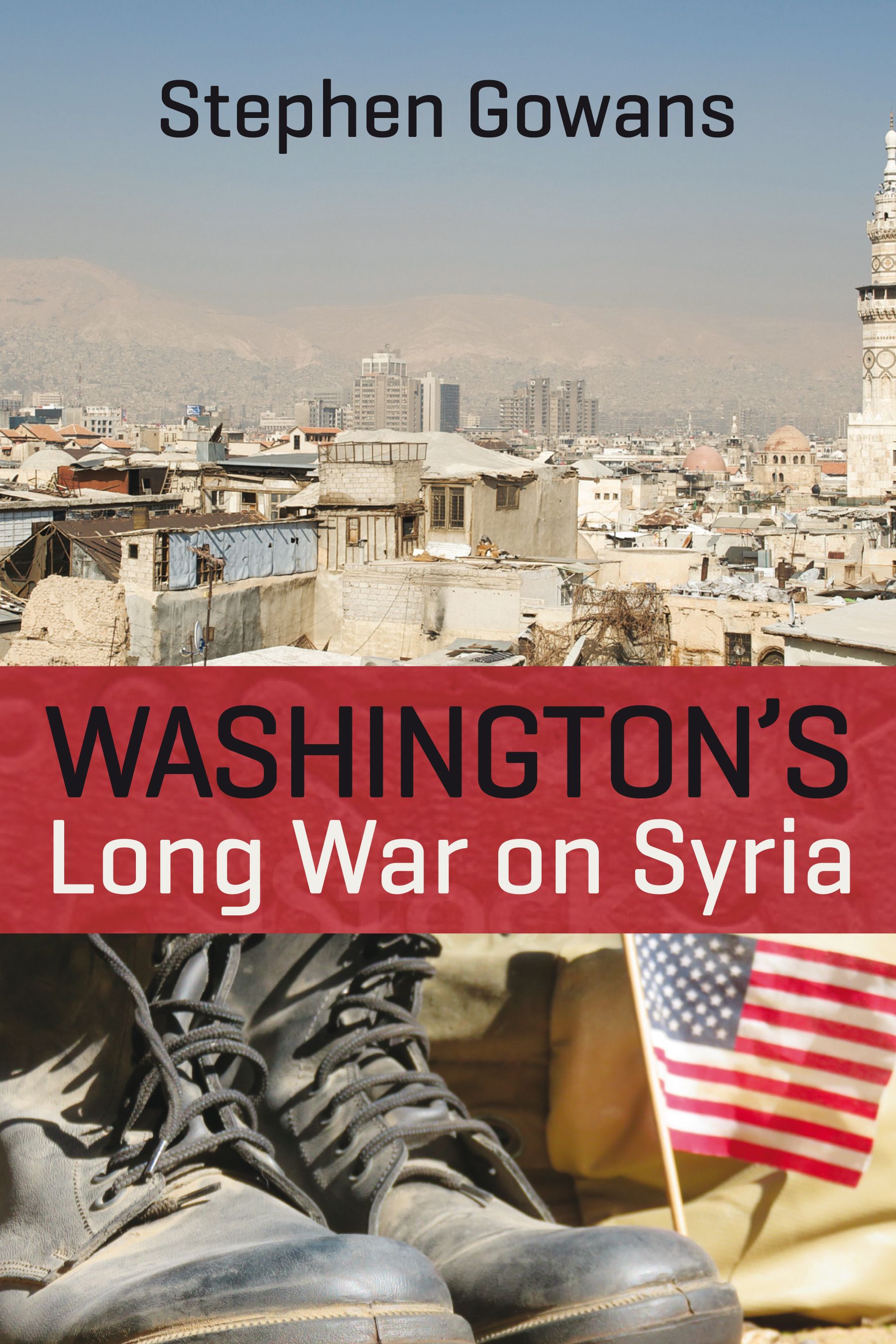


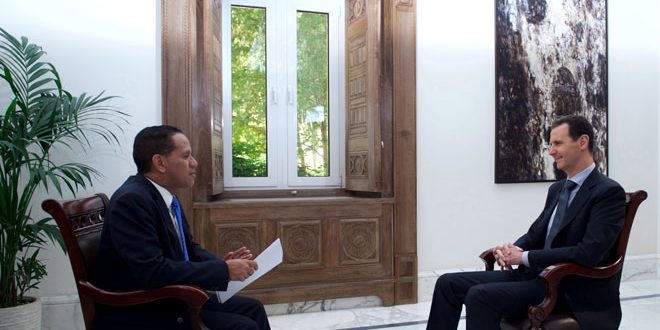
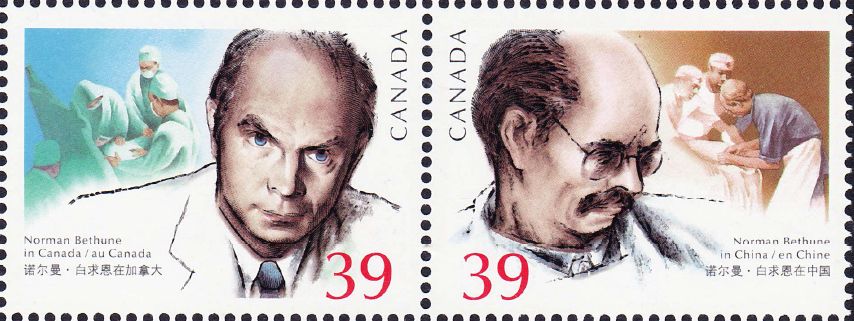
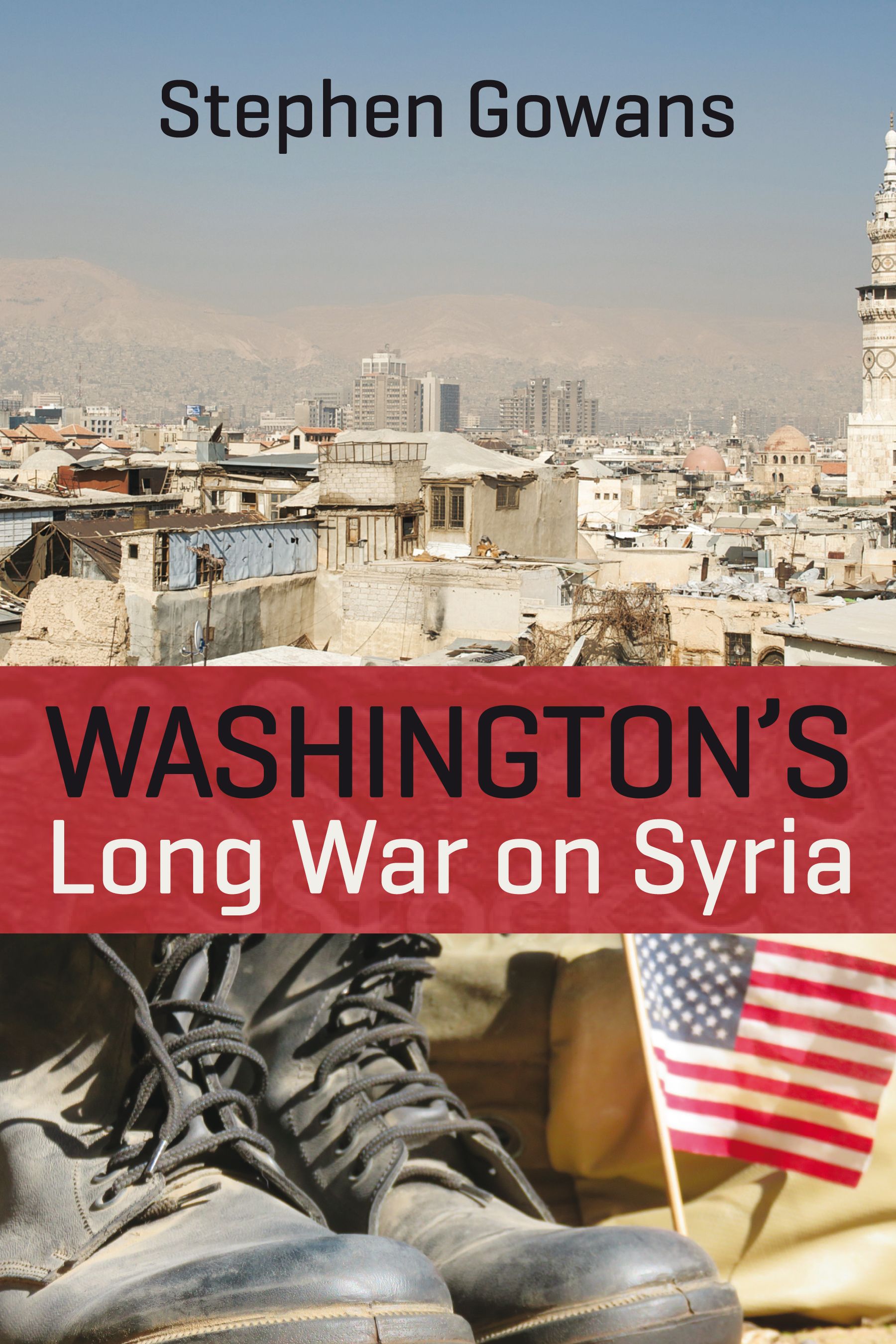
 What's Left