Intervention in Libya May Lead to More Deaths, Not Fewer

By Stephen Gowans

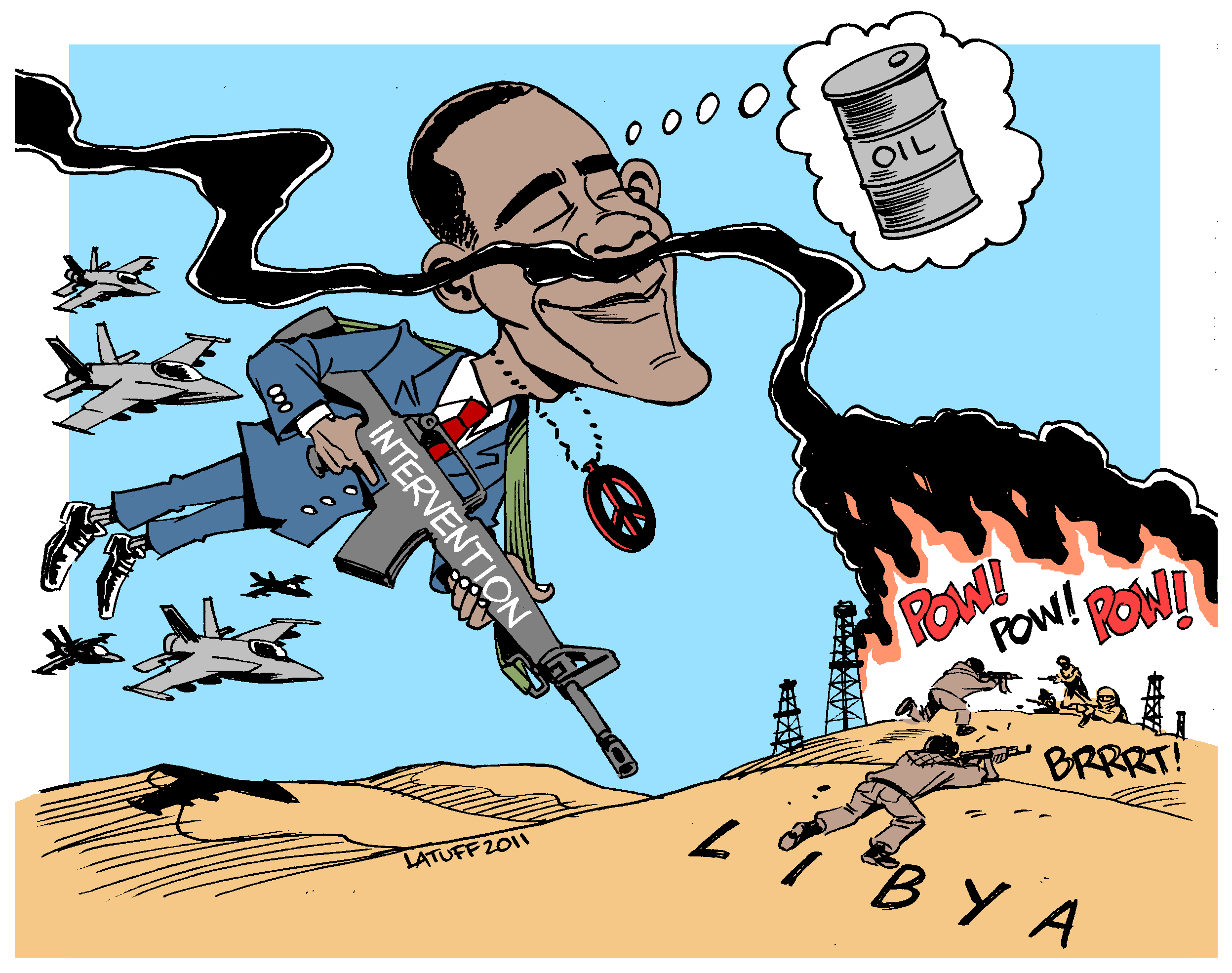
In explaining why his government supported the UN Security Council resolution authorizing all necessary measures to protect Libyan civilians, US president Barack Obama explained: “The U.S. doesn’t want a war. But we want to prevent a slaughter.”

Noble sentiments, but the Security Council resolution could lead to more deaths, not fewer.

Libyan government forces were well on their way to defeating the rebel forces (which may have been the trigger for the resolution.) Had they done so, the conflict would have ended.

Intervention may prevent a slaughter of rebel forces, but it could lead to a prolonged civil war, with more bodies piling up than would have, had the conflict been allowed to quickly culminate in a resolution. Among the corpses will be the civilian collateral damage that Western bombers are so proficient at producing.

Another possible outcome (perhaps more likely) is that Western military intervention tips the scales overwhelmingly in the rebels’ favor. Others have noted the similarities with Kosovo, where NATO signed on as the KLA’s air force in the guerrilla army’s fight with Serb forces. This time, however, the intervention has UN authorization, though whether it does or doesn’t hardly makes a difference. This one is no more defensible than the Kosovo intervention and is no less motivated by Western geo-political and elite economic interests.

Membership has its privileges

Meanwhile, the firing of live ammunition at protesters by Bahraini forces, backed by Saudi troops and tanks, has drawn no calls for all necessary measures to protect Bahraini citizens. There haven’t even been calls for mild measures. The best Washington can do is “express distress” and urge “the government (in Bahrain) to negotiate with the opposition and pursue change.”

Why the double standard?

As the New York Time’s Helene Cooper and Mark Landler explain, “Bahrain is an American ally. The Navy’s Fifth Fleet is based here and the Khalifa royal family has warm relations with Washington.”

Libya, of course, is neither a US ally (though it has in recent years cooperated with Washington on some matters), isn’t the site of US military bases, and its leader hasn’t had warm relations with Washington.

Had any of these things been true, we can take it that Qaddafi would now be free to slaughter as many Libyans as he pleased (though Washington would publically profess distress, while sitting on its hands.)

For bloodthirsty leaders, membership in the club of US allies has its privileges. The same can’t be said for the people who live under them.

Postscript, March 21, 2011.

From today’s Wall Street Journal (“Leaders struggle to define next moves”):

Security analysts fear Western airpower could decapitate Tripoli’s military command but not swing the balance of power firmly in the rebels’ favor, leading to protracted civil strife and a splintering of the Mediterranean country. Ungoverned areas, meanwhile, could provide sanctuary for al Qaeda and other militant Islamist groups that are active in northern Africa.

“The risk is that the no-fly zone became a cover for a widening civil war,” said Emile El-Hokayem, a Bahrain-based Mideast analyst for the International Institute for Strategic Studies. “It’s not clear if the Obama administration has firmly grasped this.”
What of Bahrain?

By Stephen Gowans

For weeks, demonstrators opposed to the absolute rule of the king Hamad bin Isa al-Khalifa have taken to the streets of Bahrain to demand reforms. At one point more than 100,000 people in a country of only a half million massed in the capital, Manama, shouting “Down, Down Hamad!”

The following is from Ethan Bronner’s report in today’s New York Times.

“Two days after the king of Bahrain called in 2,000 troops from Saudi Arabia and other neighboring allies, and the day after he declared martial law, his forces roared through downtown Manama, wresting it from the protesters who had in recent days taken charge of neighborhoods and nearby villages.

“…hundreds of Bahraini troops, backed by helicopters and tanks, forcefully cleared the capital’s central square of demonstrators clamoring for reform.

“Plumes of black smoke choked the city landscape as troops repeatedly fired tear gas canisters, rubber bullets and what sounded like live ammunition in their dawn assault.”

This invites the following questions.

When can we expect impassioned pleas for a UN- or NATO-enforced no-flight zone over Bahrain – or perhaps a no-drive zone — to protect Bahrainis from their brutal government and thuggish Saudi backers?

Will the Arab League demand a no-flight zone over Bahrain, as it did one over Libya?

When will Bahraini assets be frozen and travel sanctions imposed on the king, the crown prince, and their advisors?

When will Saudi Arabia be sanctioned for sending tanks into Bahrain – and for cracking down on its own pro-democracy demonstrators?

Will the UN Security Council demand the immediate withdrawal of Saudi forces from Bahrain?

Will the editors of newspapers who demand a no-flight zone over Libya – and once demanded Iraq’s immediate withdrawal from Kuwait – call for the immediate withdrawal of Saudi troops and tanks from its Gulf neighbor?

When will France recognize the leaders of the Bahraini opposition – jailed by Bahraini authorities – as Bahrain’s legitimate government?

When will the Bahraini king and the crown prince be denounced as thugs and tyrants?

Why does the soft left – which has so much to say about Libya and how the rebels should be supported – have so little to say about Bahrain?

Speaking of the soft left, world systems theorist Immanuel Wallerstein has been sighing heavily about “so much confused analysis about what is going on in Libya.” He “hardly knows where to begin” to correct it all.

Wallerstein says that if Libya’s government puts down the armed revolt in its own country other Arab governments will be encouraged to use force to put down peaceful revolts in theirs.

He makes it sound as if the Arab autocracies are rooting for Qaddafi.

But wasn’t it the Arab League that appealed for a no-flight zone over Libya? And do governments really need the example of Qaddafi to tell them if and when to use force against rebellions in their own countries?

Maybe Wallerstein should turn his attention to Washington.

Whether Arab autocracies use force to crack down on the revolts sweeping their countries has less to do with the success or failure of Qaddafi’s efforts to suppress the rebellion in Libya, and more to do with whether they get a green light from Washington – or at least its passive acceptance.

It’s of no small moment that Bahrain and Saudi Arabia are US clients, that Bahrain is home to the US Fifth Fleet, and that both countries are accommodating of the profit-making interests of US coroporations and investors. Nor is it inconsequential that Libya is neither of these things.

These facts go a long way toward explaining the double standard; a febrile reaction to the crackdown in Libya, and the comparative silence of the UN Security Council, Washington, Paris, London, newspaper editorial writers and the soft left on what is going on in Bahrain.

By the way, only 14 percent of the oil consumed in the United States comes from the Middle East and North Africa (see the table below). Most of the country’s oil comes from North America, so access to North Africa and the Middle East isn’t vital to the energy requirements of the United States. What access to the region is vital for, however, is the profits of Western oil companies, which extract, refine and sell the region’s oil to other countries, particularly those in Western Europe and Japan.

Retaining favorable access to the oil reserves of the Gulf states in order to continue to rake in profits from oil sales to other countries (not to secure oil for the home market) is the primary motivation for Washington’s historical – and continued – backing of Gulf monarchies and its total lack of sympathy for the pro-democracy movements inside them.

The media, predictably, follow Washington docilely in vociferously condemning Qaddafi while remaining comparatively silent and being decidedly less judgmental about events in Bahrain. France, Britain, the UN Security Council, responsibility-to-protect hawks, and the soft left, also predictably, do the same.

US oil supply in December 2010
Million barrels per day

US onshore production, 5.5, 37%
Middle East-North Africa, 2.1, 14%
Canada, 2.0, 14%
Mexico, 1.1, 7%
Nigeria, 1.0, 7%
US offshore, 0.1, 0%
Other, 3.0, 20%

Source: Sheila McNulty and Ed Crooks, “US groups unlock secret recipe for oil”, The Financial Times, March 3, 2011.