The ICNC: Propagating Uncle Sam’s Narrative

By Stephen Gowans

“The narrative we want to come out of this is that the Libyan people overthrew a dictator, not that we came in and toppled a despot,” said Stephen J. Hadley, a former national security adviser to President George W. Bush.

“And that’s the problem with going after command and control if it results in the death of Qaddafi, because what we really want him to do is for him to leave or to die at a Libyan hand, not an American hand,” said Mr. Hadley, speaking on CNN’s “State of the Union.” (1)

To explain the 2000 overthrow of Slobodan Milosevic in the former Yugoslavia, the International Center on Nonviolent Conflict promotes the very same narrative Hadley wants for Libya.

Through its video, Bringing Down A Dictator, and articles written by scholars on its academic advisory board–at least one of whom has met with the CIA and RAND Corporation–the organization brazenly rewrites history to put forward the narrative that an indigenous pro-democracy movement overthrew a dictator, not that NATO intervened massively to topple an elected president.

At least three facts are at odds with the ICNC narrative:

• NATO carried out a 78-day terror bombing campaign whose purpose was to induce “Milosevic’s own people…to turn on him,” according to the commander of US Air Force units in Europe at the time, General John P. Jumper. (2). In 1999, US General Michael Short told The New York Times that the bombing campaign was based on “hopes that the distress of the Yugoslav public will undermine support for the authorities in Belgrade.” (3)
• The West engineered a sanctions campaign that uniquely targeted areas in which Milosevic had strong support. This added to pressure on Milosevic’s own supporters to oust their president.
• Washington spent $10 million in 1999 and $31 million in 2000 to train, equip and advise an overthrow movement to destabilize the former Yugoslavia and oust Milosevic. [4] It is this movement that the ICNC celebrates as a largely indigenous pro-democracy movement.

Wherever Washington is trying to topple an independent government, the ICNC’s scholars can be counted on to help build a narrative that says the people overthrew a dictator, not that Washington allied with part of the population to sweep the old government from office. Invariably the replacement governments have aligned themselves closely with US financial, commercial and military interests.

Of the ICNC founder and chairman Peter Ackerman, Edward Herman and David Peterson note: He “was a board member and eventual chairman of Freedom House (September 2005 – January 2009), an institution that has been as clear an instrument of U.S. foreign policy as has the CIA itself.” (5) Ackerman is also a board member of the Council on Foreign Relations, equally as clear an instrument of US foreign policy.

On Stephen Zunes, the organization’s chief scholar, the pair add: “It is disturbing to watch Zunes repeatedly downplay the role of foreign money, knowledge, and power at work behind regime-change campaigns, and hype the democratic credentials of the opposition to targeted regimes.” (6)

This, indeed, is another way of saying that Zunes works to make the narrative of US regime change operations come out the way Hadley wants it to come out in Libya – with a targeted leader’s fall seen to come at the hands of his own people with US complicity erased from history.

Herman and Peterson condemn this narrative-setting as “an especially powerful cocktail for sowing confusion among leftists and progressives, whose minds tell them to oppose imperial causes, but whose hearts warm to emotionally manipulative rhetoric about the ‘homegrown’ nature of ‘pro-democracy’ movements.” (7)

Zunes and other ICNC scholars claim to be on the left. Some even anti-imperialist. If so, what’s left?

1. Kareem Fahim and Mark Mazzetti, “Allies defending actions in Libya after airstrike”, The New York Times, May 1, 2011.
2. Thom Shanker and David E. Sanger, “Nato says it is stepping up attacks on Libya targets”, The New York Times, April 26, 2011.
3. New York Times, May 13, 1999. Cited in William Blum’s Rogue State: A Guide to the World’s Only Superpower.
4. Dobbs, Michael, “US advice guided Milosevic opposition,” The Washington Post, December 11, 2000.
5. Edward S. Herman and David Peterson, “Reply to Stephen Zunes”, December 30, 2010. http://www.zcommunications.org/reply-to-stephen-zunes-by-edward-herman
6. Herman and Peterson.
7. Herman and Peterson.

Analysis of Syrian Protest Movement

Here’s Mazda Majidi, always worth reading, on Syria. A refreshing alternative to Gilbert Achcar.

The revolutions in Egypt and Tunisia have thrown into question all established authorities in the Arab world and unleashed political forces everywhere that see this as a golden opportunity to make their bid for power. This does not mean each one of these forces is progressive.

It is not possible at this point to weigh the relative strength, or politically characterize, all the various trends within the Syrian opposition movement. The current protest movement appears to have begun with a spontaneous protest against an incident of police brutality in a working-class Damascus neighborhood. It undoubtedly includes many thousands who simply a desire a society free of poverty and state repression. But it has also included sectarian religious forces who want to overthrow the country’s secular orientation, and have chanted “Alawis to the coffins, Christians to Beirut.” The Alawis are a religious minority group—about 12 percent of the population—to which many of the leading Ba’ath officials belong.

Read Majidi’s analysis in full here.

NATO’s Kosovo Air War Redux

By Stephen Gowans

NATO’s military intervention in Libya began, in theory, as an enforcement of a no-fly zone to protect civilians but has in reality morphed into an attack on civilian targets to undermine the morale of Gaddafi loyalists in order to turn them against the country’s leader.

NATO has struck Gaddafi’s residence repeatedly, and in recent days attacked a TV broadcast center.

If it sounds like a rerun of NATO’s 1999 air war on Yugoslavia, when NATO showered bombs on civilian targets in order to “protect” civilians, that’s because NATO has dusted off an old script.

The campaign over Libya, according to senior US officers, draws on lessons from 1999. (1)

Here was US General Michael Short 12 years ago on the logic of the NATO bombing campaign.

If you wake up in the morning and you have no power to your house and no gas to your stove and the bridge you take to work is down and will be lying in the Danube for the next 20 years, I think you begin to ask, “Hey, Slobo, what’s this all about? How much more of this do we have to withstand?” (2)

Short told The New York Times that the bombing campaign was based on “hopes that the distress of the Yugoslav public will undermine support for the authorities in Belgrade.” (3)

Here’s US General John P. Jumper today, who was commander in 1999 of US Air Force units in Europe.

It was when we went in and began to disturb important and symbolic sites in Belgrade, and began to bring to a halt the middle-class life in Belgrade, that Milosevic’s own people began to turn on him. (4)

Jumper says NATO is following the same logic in Libya today.

How NATO got away with bombing civilian targets in Belgrade in 1999 offers insight into how it’s getting away with bombing civilian targets in Tripoli in 2011.

First, then as now, no one was big enough and strong enough to stop them.

Second, NATO bamboozled enough people into believing Serb forces were slaughtering ethnic Albanians in Kosovo to win support for an intervention as the only way to avert a bloodbath. Sound familiar? The tens of thousands of corpses NATO ministers warned would be found scattered across Kosovo and buried in the Trepca mines, were never found.

Third, NATO simply made the definition of a military target so malleable that it could fit just about any site NATO planners wished to destroy. Roads and railways were said to be legitimate quarry, because they were used by military vehicles. Bridges allowed military units to move easily from one point to another, and therefore could be taken down as legitimate military targets. Radio-television buildings were fair game because they were deemed to be part of the enemy’s “propaganda apparatus” (which means, if we’re to apply a consistent standard, that The New York Times’ building is a legitimate target for any country the United States attacks.) Government buildings were part of the enemy’s command and control infrastructure, and as a consequence could be obliterated as lawful targets. And the schools, hospitals and people destroyed by NATO bombs that couldn’t be passed off as legitimate military targets were dumped into the convenient category of “collateral damage.”

Peter Ackerman, the moneybags who hobnobs with Zbigniew Brzezinski and Robert Gates on the US foreign policy elite’s Council on Foreign Relations, and who founded an organization to promote color revolutions, created a documentary about the downfall of Milosevic, called Bringing Down a Dictator. It credits so-called nonviolent pro-democracy activists—not NATO’s bombing of civilian targets to turn Milosevic’s supporters against him–with bringing about Milosevic’s ouster.

Maybe Ackerman’s definition of non-violence (and of dictator: Milosevic was elected in multiparty elections which continued to be carried out after he became president) is as malleable as NATO’s definition of a military target.

What’s clear is that NATO and the color revolution outfit Ackerman founded have the same goal: to sweep leaders of non-satellite countries from power in order to integrate their countries unconditionally into the global economy as Western vassal states.

If the goal can be achieved by bombing civilians to weaken their morale, NATO is up for it, as much today as it was in 1999.

1. Thom Shanker and David E. Sanger, “Nato says it is stepping up attacks on Libya targets”, The New York Times, April 26, 2011.
2. Washington Post, May 24, 1999.
3. New York Times, May 13, 1999. Cited in William Blum’s Rogue State: A Guide to the World’s Only Superpower.
4. Shanker and Sanger.

Gilbert Achcar’s Fantasy World

By Stephen Gowans

Gilbert Achcar hates Libyan leader Muammar Gaddafi. That much is clear from Achcar’s three Z-Net articles, the latest published on April 23, in which the Lebanese socialist and sometimes “anti-war activist” urges the left to support the rebel uprising in Libya and not to oppose the NATO-enforced no-fly zone. In his latest article, which amounts to a defense of his position against the firestorm of criticism he has drawn for urging the left not to oppose Western military intervention in Libya, Achcar denounces Gaddafi as a psychopath. By demonizing Gaddafi, Achcar acts to legitimize the Benghazi rebellion and therefore Western support of it. There are likely to be more than a few psychopaths among the rebels. And applying Achcar’s amateur political psychography, we could probably denounce the Saudi monarchy, which has brutally suppressed the rebellion in Bahrain, as being as rife with psychopaths as Libya’s leadership. But Achcar appears to be more agitated by the Libyan psychopaths than the Saudi, Bahraini, Israeli, or indeed, even US, British and French ones. Politics based on the presumed psychological failings or mental states of leaders is illegitimate, and no genuine socialist, at least no Marxist one, practices it.

On top of demonizing Gaddafi, Achcar tries to make the rebels more palatable than they are. The rebellion, Achcar assures us, is made up of “the same mix of political forces that are active in most other uprisings in North Africa and the Middle East, i.e., liberal democrats, various types of Islamic currents from moderate to extreme, former members of the regime…and left-oriented groups and persons.” Doubtlessly, some “left-oriented groups and persons” count themselves among the Libyan rebels, but there is no evidence that their numbers are large and that they have any influence within the insurrection. Even Achcar questions whether the left has a significant presence. In a footnote, he writes: “The last time there was any indication about an organized left in Libya, to my knowledge, was in the early 1970s when news came out about the repression of a Trotskyist group there.”

One of the less palatable elements of the rebellion, whose presence Achcar does acknowledge, are radical Islamists, about whom evidence is growing that they are playing key roles in the revolt. Rod Nordland and Scott Shane, writing in the New York Times of April 24, 2011 (1) profile Abu Safian Ibrahim Ahmed Hamuda bin Qurnu, a “tank driver in the Libyan Army in the 1980s” who joined Osama bin Laden in Afghanistan in the early 1990s, was incarcerated by the United States at Guantanamo after September 11, 2011, released to Libya in 2007, and has since become “a notable figure in the Libyan rebels’ fight to oust” Gaddafi. He leads the Darnah Brigade, named after a port town in northeast Libya which “has a long history of Islamic militancy, including a revolt against Colonel Gaddafi’s rule led by Islamists in the mid-1990s.” “Activists from here,” note Nordland and Shane, “are credited with starting the Libyan Islamic Fighting Group.”

Last week, Ottawa Citizen reporter David Pugliese obtained Canadian military documents which reveal that Canada’s Department of National Defence considers the Libyan Islamic Fighting Group to be a terrorist group associated with al-Qaeda. (2) The US State Department has also designated the group as a terrorist organization, a point Nordland and Shane might have made, considering the group plays an important role in the rebellion against Gaddafi. The organization was set up in Afghanistan in the early 1990s, and “had tried to assassinate Gaddafi on several occasions.” Gaddafi perceives the group to be “a mortal enemy.” Abdel-Moneim Mokhtar, “a leading member of the NATO backed rebels,” according to Pugliese, “had also been a top commander in the Libyan Islamic Fighting Group.” And according to the Combatting Terrorism Center at West Point, 52 of 440 suicide bombers in Iraq were from the group’s hometown of Darnah. (3) These are not leftists or even liberal democrats trying to bring about a more progressive alternative to Gaddafi.

Quoting Pugliese at length:

A Canadian intelligence report written in late 2009 also described the anti-Gadhafi stronghold of eastern Libya as an “epicentre of Islamist extremism” and said “extremist cells” operated in the region. That is the region now being defended by a Canadian-led NATO coalition.

The report by the government’s Integrated Threat Assessment Centre said “several Islamist insurgent groups” were based in eastern Libya and mosques in Benghazi were urging followers to fight in Iraq.

But extremists operating in eastern Libya were not the only forces Gadhafi had to deal with.

DND’s report notes that in 2004 Libyan troops found a training camp in the country’s southern desert that had been used by an Algerian terrorist group that would later change its name to al-Qaeda in the Islamic Maghreb or AQIM.

That group was behind the 2008 kidnapping of Canadian diplomats Robert Fowler and Louis Guay.

Still other reports have come to light about Islamic extremists in rebel ranks. The Wall Street Journal reported that Sufyan Ben Qumu, a Libyan army veteran who worked for Osama bin Laden’s holding company in Sudan and later for an al-Qaeda-linked charity in Afghanistan, is training rebel recruits.

He spent six years at the U.S. prison in Guantanamo Bay.

Abdel Hakim al-Hasady, an influential Islamic preacher who spent five years at a training camp in eastern Afghanistan, also oversees recruitment and training for some rebels. (4)

I daresay it would be easy enough to decry radical Islamists as psychopaths, though it’s interesting that Achcar reserves this obloquy for Gaddafi, and prefers to attach a non-emotional descriptive label to the al-Qaeda-associated rebels. In Achcar’s hands, whereas Gaddafi is a psychopath, the Libyan Islamic Fighting Group is nothing more than an Islamic current. It’s unlikely that the aims of the Islamists in seeking the overthrow of Gaddafi have much to do with establishing a liberal democracy, let alone socialism. Nevertheless, Achcar urges the left to back their rebellion.

Taking care to keep other less savory elements of the Benghazi rebel force from complicating his call for left support for the rebels, Achcar omits to mention that royalists make up a significant part of the mix of political forces seeking Gaddafi’s ouster, as do people with key connections to the US state, who have managed to secure important roles in the insurrection. These include:

• Khalifa Heftir, a former Libyan Army colonel, who spent the last 25 years living seven miles from CIA headquarters in Langley, Virginia with no obvious means of support. (5) Heftir says “he had often talked to the Central Intelligence Agency while he lived in exile in suburban Virginia.” (6) He is one of, if not the rebels’, top military leader.
• Mahmoud Jibril “earned his PhD in 1985 from the University of Pittsburgh under the late Richard Cottam, a former US intelligence official in Iran who became a renowned political scientist specializing in the Middle East.” Jibril “spent years working with Gaddafi’s son Saif on political and economic reforms … (b)ut after hardliners in the regime stifled the reforms, Jibril quit in frustration and left Libya about a year ago.” (7) Jibril has been out of Libya since the uprising began, meeting with foreign leaders. (8)
• Ali Tarhouni, the rebel government’s finance minister, had been in exile for the last 35 years. His latest job was teaching economics at the University of Washington.

Achcar’s description of the rebels as a mix of political forces from liberal democrats to left-oriented groups hardly seems to accord with the reality that (a) there is no evidence that the left plays a significant role in the rebellion, and that (b) the largest part of the rebel mix is comprised of al-Qaeda-connected radical Islamists, royalists, and political and military leaders linked to the US intelligence community. There may be some ambiguity about how left Gaddafi is, and far less about his anti-imperialism, but whatever ambiguity there is about Gaddafi’s political position, there is certainly none about how left the rebels are. They aren’t.

Achcar’s Position

Achcar’s position amounts to this: Gaddafi is a demon; his ouster, therefore, is welcome; whatever comes after Gaddafi must be better than Gaddafi; the left shouldn’t support the NATO no-fly zone, but nor should it oppose it; this position would have raised the Western left’s credibility among left forces in North Africa and Western Asia; the left should now pressure Western governments to arm the rebels.

Let’s consider each point in turn.

Gaddafi is a demon.

Demonization is a hoary practice that governments have long used to mobilize support for war, and which anyone on the left should be on guard against. In addition to being used by imperialist governments to drum up support for war and other interventions, demonization is also often used by left writers associated with Z-Net and the Campaign for Peace and Democracy, and was used, too, by many members of the Second International to support their own countries’ participation in WWI. [Plekhanov, the father of Russian Marxism, became a fervent supporter of freedom and democracy against despotism and militarism when war clouds rolled in, despite agreeing before the war to mount a principled opposition to it should it come.] As shown by Achcar’s readiness to denounce Gaddafi as a “psychopath,” these writers have become as zealous as the State Department and major media, if not more so, in branding targets of Washington’s imperial designs as demons. This, unfortunately, happens during every major mobilization of Western diplomatic, intelligence and military forces against non-satellite countries. Left politics should not be based on legitimizing the pretexts for war of imperialist governments, nor on the alleged failings or virtues of leaders. They should be based on an analysis of class forces.

“If I were not old and sick I would join the army,” declared Plekhanov. “To bayonet our German comrades would give me great pleasure.” (9) Achcar expressed horror at the prospect of loyalist forces perpetrating a bloodbath in Benghazi, and in his first article in the series called for the left not to oppose a NATO no-fly zone on the grounds that it was the only way to avert a bloodbath. But his horror at bloodletting doesn’t seem to extend to that which promises to be brought about by the rebels, who he urges Western governments to arm. Hence, despite raising fears about a bloodbath, avoidance of bloodshed really doesn’t seem to weigh heavily in Achcar’s considerations. He doesn’t mention the efforts of the African Union to bring about a cease-fire or urge that the left support it. He’s silent on Gaddafi’s acceptance of the AU proposal and on the rebels’ rejection of it. It would appear, then, that it is not avoiding bloodbaths that galvanizes Achcar so much as avoiding the defeat of the rebels. One suspects that, as was true of Plekhanov, to bayonet our comrades on the other side would give Achcar great pleasure.

Whatever comes after Gaddafi must be better than Gaddafi.

In the lead up to the 2003 invasion of Iraq, some left writers insisted the world—and Iraq– would be a better place without Saddam Hussein. It’s one thing to say Hussein was hardly a heroic figure and that he had blood on his hands, but quite another to brand him as so vile that nothing could be worse, as many left writers did. It should have, however, been clear that Iraq would be no better off under a US occupation—and would probably be substantially worse off, and indeed, this prediction has been borne out. Likewise, Gaddafi’s ouster will not be followed by a liberal democracy, much less socialism, but likely a new neo-colonial arrangement, in which Libya becomes an impoverished satellite of the West, as Serbia and Iraq have become. The idea that the Libyan rebels either want to, or are in a position to bring about, a progressive alternative to Gaddafi is pure fantasy. In order for this to happen, an organized political left would need to exist in Libya that was capable of mobilizing popular support, not against the current regime alone, but also for a qualitatively different regime that is either fiercely hostile to being placed in chains by outside forces, represents the interests of the mass of people, or both. But there is, by Achcar’s own admission, no such left political force in the country. The best the rebels can do is force Gaddafi’s ouster, but it is very likely that his successor, will, as was true in Serbia and Iraq, lead a neo-colonial puppet regime. For all its failings and recent willingness to cooperate with the West, the Gaddafi government has not gone so far as to integrate Libya’s land, labor and resources unconditionally into the global economy and has a history of acting for the benefit of its own people—which enjoys the highest standard of living in Africa. That it hasn’t unconditionally catered to the profit-making interests of foreign corporations and investors is the reason why Washington has long been hostile to the Gaddafi government, and explains its willingness to assist an armed rebellion to overthrow Gaddafi, while taking no such steps to aid a peaceful rebellion to throw off the weight of the Khalifa despotism in Bahrain, which runs its country as an annex to the United States, letting the US Fifth Fleet operate from there, while maintaining a low-tax, worker-unfriendly, foreign-investment friendly regime.

The left shouldn’t support the NATO no-fly zone, but nor should it oppose it.

What Achcar is really saying is that the left should line up with the rebellion in Libya, but not with Washington and not with Tripoli. Thus, supporting the rebels means not opposing their call for a no-fly zone. But at the same time, the left shouldn’t support the no-fly zone, because that would mean it supports NATO. This is the Campaign for Peace and Democracy’s fence-straddling approach. In the 1980s, it was manifest in the position of: We’re not for Washington and we’re not for the Polish government, but we are for the Solidarity trade union. The validity of this approach, however, depends on the question of whether the rebels ought to be supported, just as in the 1980s it depended on the question of whether the left should have thrown in its lot with the Wall Street Journal, the CIA, Margaret Thatcher and Ronald Reagan in supporting Solidarity. Solidarity, it turned out, wasn’t the harbinger of the kind of socialism it was safe to discuss at the dinner table that the CPD and other leftist groups naively thought it would be. On the contrary, it was the nucleus for a neo-liberal make-over of Poland as a dependent US satellite – what’s likely to be in store for Libya if the rebels prevail.

The key questions are: Who are the rebels? What are their goals? Who is the government? What are its goals? Achcar’s answers seem to be: The government is led by a psychopath who has an insatiable hunger for power which drives him to extremes of violence. (In the 1980s: the Polish government is communist and hungry for power.) The rebels are against this, and therefore, must be worthy of support. (Solidarity is against the government and therefore must be worthy of support.) But this line of reasoning is no different from the logical blunder of assuming the enemy of my enemy is my friend, a blunder that anti-imperialists are routinely accused of making. It doesn’t follow that rebels are worthy of support simply because they’re rebels or simply because they’re rebelling against a government led by someone you don’t like.

This position would have raised the Western left’s credibility among left forces in North Africa and Western Asia.

Many members of the Second International argued that they had to vote for war credits otherwise they would have lost credibility with their base which had become infected by pro-war chauvinism. Failing to support their own governments in war would mean losing influence with a jingoism-besotted working class for decades to come. Lenin, who Achcar has portrayed as a compromiser who would have gladly accepted a NATO no-fly zone, and who did indeed make compromises where necessary, was doctrinaire, just as much as he was willing to make necessary compromises; which is to say, he was unwilling to yield on principle for short-term gain, but would yield, if he had to, to safeguard fundamental positions. In the debates about whether to tear up their agreements to withhold support for their governments in war, Lenin stood out among socialist leaders, arguing that the leaders’ role was to lead, not to follow. Refusing to oppose the no-fly zone as a means of gaining influence with left organizations in Western Asia and North Africa that called for one, reverses the roles of influence and principle. The point isn’t to abandon principle to gain influence, but to use influence to advance principle.

The left should now pressure Western governments to arm the rebels.

The idea that pressure from the left will persuade Western governments to arm the rebels, who will then pursue their rebellion free from Western control, is pure fantasy. The left exerts approximately zero influence on Western foreign policy, and even if it exerted more, on a matter as fundamental as this to the geostrategic interests of Western governments, it would be ignored. Western governments won’t arm rebel groups they can’t control and which are working toward objectives they don’t share. Achcar may as well say the left’s position ought to be to pressure Washington, London and Paris, to introduce ground forces into Libya to sweep Gaddafi from power and to install a new Marxist government.

Conclusion

Achcar has added nothing new in his third attempt to drum up left support for the Libyan rebels, apart from ratcheting up the demonization of Gaddafi by calling him a psychopath, a dubious practice favored by Western governments and major media, and which shouldn’t be the basis of the political positions of the left. Gaddafi may indeed be a psychopath, but so too may be many other leaders, including those who have key roles in the Libyan insurrection. It’s doubtful that Achcar would surrender his support for the rebels, if it were revealed that its leaders were psychopaths, or if they were to drench Gaddafi’s supporters in blood. Whether Gaddafi is or isn’t a psychopath is unclear, but more importantly, is irrelevant. What is relevant to a discussion of what position the left ought to take is class analysis, none of which Achcar provides. Instead, the Z-Net favorite leans toward the rogues’ gallery view of left politics, a kind of up-to-date left version of the great man theory of history, where monsters, psychopaths and thugs—and the US governments that fight them– have replaced great men as the fundamental agents of history. The practice that depends on this theory is to visibly demonize the leaders the US State Department brands as thugs, despots, and dictators, while saying little about the thugs, despots, and dictators the State Department doesn’t want to talk about (like the Saudis, Israelis, and Egypt’s military rulers.) Achcar may denounce all of these from time to time, but he hasn’t written a series of articles urging the left to pressure Western governments to arm the Palestinians against the Israelis and nor Egyptian or Bahraini rebels against their governments.

Achcar also seeks to demonize those who have criticized his position in what he considers to be less than a comradely way by suggesting that, were they in power, they would have had him sent to the gulag. Were Achcar in power, would he send Gaddafi and his supporters to that modern Western gulag, the ICC? Whether any of his critics would banish Achcar to the gulag is unclear, but that he brings it up seems in keeping with his preference for building political positions around demonization, fantasy and conjecture. It is a fantasy that left pressure will compel Western governments to arm the rebels; a fantasy that even were this true that Western governments would arm the rebels unconditionally; a fantasy that with Western fingers in the Libyan pie that Gaddafi’s ouster will be succeeded by a more progressive alternative; and a fantasy that liberal democrats and left-oriented groups and persons preponderate the royalists, al-Qaeda connected terrorists and suicide bombers, and US intelligence community-linked political and military leaders in the rebel ranks.

Finally, it is a fantasy to think that no one sees through Achcar’s I-don’t-support-Western-military-intervention-but-neither-do-I-oppose-it position as the dissembling of a coward who has convinced himself that he has brilliantly finessed the problem of how to support the rebels without looking like he’s also supporting their imperialist backers. This is the kind of dishonest double-talk that one normally expects from unctuous politicians, not socialist anti-war activists. As he has doubtlessly discovered, judging by the firestorm of criticism he’s called upon himself, his no-fly zone position just doesn’t fly. All that Achcar has succeeded in doing in championing the case on three occasions for the left to back the Libyan rebels is to demonstrate that he is neither anti-war nor anti-imperialist nor particularly adverse to bloodbaths. Maybe he shouldn’t be sent to the gulag, but he should certainly be sent to the corner, along with every other socialist who seeks to enlist the left in the support of its own governments in pursuit of their own bourgeoisies’ interests.

1. Rod Nordland and Scott Shane, “Libyan shifts from detainee to rebel, and U.S. ally of sorts”, The New York Times, April 24, 2011.
2. David Pugliese, “DND report reveals Canada’s ties with Gadhafi”, The Ottawa Citizen, April 23, 2011.
3. Nordland and Shane.
4. Pugliese.
5. “Professor: In Libya, a civil war, not uprising”, NPR, April 2, 2011. http://www.npr.org/2011/04/02/135072664/professor-in-libya-a-civil-war-not-uprising
6. Rod Nordland, “As British help Libyan rebels, aid goes to a divided force”, The New York Times, April 19, 2011.
7. Farah Stockman, “Libyan reformer new face of rebellion”, The Boston Globe, March 28, 2011.
8. Kareem Fahim, “Rebel leadership in Libya shows strain”, The New York Times, April 3, 2011.
9. Neil Harding. Lenin’s Political Thought: Theory and Practice in the Democratic and Socialist Revolutions. Volume II, Haymarket Books. 1978. P. 12.

Peace, On Our Own Terms

Everyone wants peace. It’s just that they want it on their own terms. Libyan leader Muammar Gaddafi wants peace in Libya, so long as it means he remains in power. At a later date, his terms may change: peace in return for exile in a country that will keep him out of the clutches of the International Criminal Court. The rebels and NATO countries want peace too, but only so long as Gaddafi leaves and the rebels form a new government. Peace on your own terms really means victory. Indeed, that’s how victory could be defined.

In Libya, Protecting Profits from an Outbreak of Peace

Obama, Cameron and Sarkozy sent a message to the African Union in their jointly written April 14 op-ed: They’ll block any attempt to negotiate peace in Libya that doesn’t include Gaddafi’s ouster and the opening of Libya’s economy.
By Stephen Gowans

On April 14 US president Barak Obama, British prime minister David Cameron and French president Nicolas Sarkozy wrote an op-ed titled “Libya’s pathway to peace.” Appearing in the International Herald Tribune and two other newspapers, the op-ed set out US, British and French goals for Libya. One would be peace, but the pathway was to be Gaddafi’s exit, and his replacement by the Benghazi rebels.

While not presented as such, the op-ed was in fact a rejection of an African Union proposal for a negotiated settlement.

Obama, Cameron and Sarkozy: On guard against an outbreak of peace in Libya.

The AU had dispatched a delegation to Tripoli to meet with Gaddafi four days earlier, on April 10. The delegation proposed an immediate cease-fire, delivery of humanitarian aid, and negotiations between the Libyan government and the Benghazi rebels. Gaddafi accepted. But when the delegation arrived in Benghazi the next day, the rebels let it be known that the only peace they were interested in was one that saw Gaddafi, “his sons and his inner circle leave immediately.” (1)

US secretary of state Hilary Clinton quickly echoed the rebels’ position. Nothing could be resolved, she said, without “the departure of Gaddafi from power, and from Libya.” (2)

Peace was impossible in Libya without Gaddafi’s exit, the leaders insisted in their op-ed, because Gaddafi was the main threat to peace. It was “impossible to imagine a future for Libya with Gaddafi in power” they wrote, and added that “so long as Gaddafi is in power, NATO must maintain its operations.” Their case was based on the fiction that the conflict in Libya isn’t a civil war between rebels in the east and loyalists in the west but between the state and the people, as was true in Tunisia and Egypt and is true in Bahrain and Yemen.

As for Gaddafi being an obstacle to peace, that was belied by his acceptance of the AU peace proposal. But the armed uprising has, from the beginning, had nothing to do with peace. It has always been about regime-change.

Gaddafi is wrongly fit by the three leaders, as well as by supporters of the Western military intervention, into the mold of Bahrain’s Khalifa regime, which has used armed force to violently suppress a popular peaceful revolt. The uprising in Libya was armed, not peaceful, and while it may be popular in the east among tribalists, royalists, and radical Islamists led by neo-liberals connected to the United States, it has little popular support elsewhere in the country.

Despite casting the Gaddafi government in the role of the Khalifa regime, the leaders make no reference to the latter, which remains largely invisible in discussions of the “Arab spring” and which provides the Pentagon with a headquarters for its Fifth Fleet and runs a low-tax, no minimum-wage, foreign investment-friendly economy. If the US, British and French leaders were truly interested in protecting civilians they would have long ago imposed a no-fly zone over Bahrain and ordered the Saudi monarchy, surely the most regressive force on the planet, to withdraw its troops from Bahrain. But what they’re really interested in achieving in Libya is what was long ago achieved in Bahrain: a neo-colonial puppet regime that opens its country to Western military bases and unconditional exploitation by foreign corporations and investors.

And so Obama, Cameron, and Sarkozy used their op-ed to declare that there must be “a genuine transition” in Libya “led by a new generation of leaders” and that “in order for that transition to succeed, Gaddafi must go and go for good.” Significantly, the transition would usher in the new Western puppet. There are two indications of this.

The first is the nature of the rebel leadership. Its key members have important connections to the United States. Khalifa Heftir, a former Libyan Army colonel, has spent the last 25 years living seven miles from CIA headquarters in Langley, Virginia with no obvious means of support. (3) Mahmoud Jibril “earned his PhD in 1985 from the University of Pittsburgh under the late Richard Cottam, a former US intelligence official in Iran who became a renowned political scientist specializing on the Middle East.” Jibril “spent years working with Gaddafi’s son Saif on political and economic reforms … (b)ut after hardliners in the regime stifled the reforms, Jibril quit in frustration and left Libya about a year ago.” (4) Jibril has been out of Libya since the uprising began, meeting with foreign leaders. (5) Then there is the rebel government’s finance minister, Ali Tarhouni, who has been in exile for the last 35 years. His latest job was teaching economics at the University of Washington.

The second indication is provided in the three leaders’ op-ed. Libya, they write, must “develop the institutions to underpin a prosperous and open society.” Revealingly, the three leaders tell Libyans what institutions they should develop. But what if Libyans don’t want an open society at this point in their development? What if they want what the United States, Britain and France have had through long parts of their history (and still do have): a society closed to outsiders in strategic areas?

While the institutions of an open society aren’t exclusively economic, an open society is understood to be one whose doors are open to unconditional integration into the global economy. This differs from the Gaddafi government’s strategic integration, based on linkages aimed at increasing real wages in Libya rather than maximizing returns to foreign investors. This isn’t to say that Libya hasn’t welcomed foreign investment where it makes sense for the development of the country, but it is likely that the open society Obama, Cameron and Sarkozy foresee for Libya, has little to do with what makes sense for Libya, and everything to do with what makes sense for US, British and French investors and corporations.

1. Kareem Fahim, “Truce plan for Libya is rejected by rebels”, The New York Times, April 11, 2011.
2. David E. Sanger, “Possible Libya stalemate puts stress on U.S. policy”, The New York Times, April 11, 2011.
3. “Professor: In Libya, a civil war, not uprising”, NPR, April 2, 2011. http://www.npr.org/2011/04/02/135072664/professor-in-libya-a-civil-war-not-uprising
4. Farah Stockman, “Libyan reformer new face of rebellion”, The Boston Globe, March 28, 2011.
5. Kareem Fahim, “Rebel leadership in Libya shows strain”, The New York Times, April 3, 2011.

Achcar Turns Lenin on His Head

By Stephen Gowans

Gilbert Achcar has invoked the authority of Lenin to claim that support for Western military intervention in Libya is the only defensible anti-imperialist position. Lenin made compromises, Achcar says, and like him, so must we.

Achcar doesn’t deny that the intervention is imperialist, but believes that imperialist or not, it was necessary to prevent a slaughter. His logic, however, is elusive. If the intervention is imperialist, even if it did prevent a slaughter (and it’s likely instead to have created the conditions for a protracted civil war) how can support of it be anti-imperialist? This is like saying that support for coal-fired generators is the only defensible pro-clean-air position, because nuclear could produce a catastrophe. You can argue about the relative merits of coal versus nuclear, and decide that coal is better than nuclear on balance, but that doesn’t make your position pro-clean air.

Lenin once said that he would ally with the devil himself if the devil was opposed to British imperialism. Where Achcar differs with Lenin is that he, Achcar, has allied with imperialism because imperialism says it opposes the devil.

Looking Out for Western Business and Investor Rights: Why the West Approves Military Interventions to Topple One Arab Government and Prop Up Another

By Stephen Gowans

In a previous article I pointed to three factors to explain the West’s decision to intervene militarily in Libya to prevent the government there from putting down an armed rebellion while it tacitly approves the Gulf Cooperation Council’s military intervention in Bahrain to put down a peaceful rebellion there. The double-standard, I argued, reflects dramatic differences between Libya and Bahrain in their relationship with the United States and its dominant investor and corporate class.

Bahrain is the home of the US Fifth Fleet, has long-standing warm relations with Washington, and strongly caters to Western corporate and investor interests. Since the Khalifa regime supports US corporate profit-making and military interests, and a new regime might not do the same to the same degree, Washington is prepared to allow Saudi and other GCC troops and tanks to assist Bahraini authorities in violently quelling a peaceful rebellion.

Libya, I pointed out, doesn’t provide bases for the US or other Western militaries, hasn’t had long-standing warm relations with Washington, and isn’t particularly accommodating of Western corporate and investor interests. From a neo-colonialist standpoint, Western powers could do better in Libya.

Some readers objected, arguing that in recent years Libya has sought to open itself to Western corporations and investors and has struck a number of deals with Western oil companies. It cannot be concluded, they continued, that the West’s decision to intervene military in Libya was motivated by Western profit-making considerations, for Libya is already catering to Western business interests.

To be sure, Libya has opened itself to the West, but doing deals with Western corporations is not the same as engineering a wholesale subordination of domestic interests to those of foreign bankers and corporations — typically, what corporate-and investor-oriented Western governments look for in Third World “partners”. For the wealthy scouring the globe for investment opportunities and corporations seeking export markets, an opening door in Libya doesn’t necessarily mean that Libya’s business climate is fully conducive to maximizing profits. That Libya allows some Western corporations to operate in the country doesn’t guarantee that investments are safe from expropriation, that performance requirements aren’t imposed on foreign investments, that repatriation of profits isn’t controlled, that taxes aren’t high, or that there is a commitment to labor market “flexibility.” In short, the Kaddafi government may, in recent years, have sought to expand Western access to investment opportunities in Libya, but that alone doesn’t mean that the conditions of access were regarded by corporations and investors as being as desirable as they could be, or as desirable, for example, as those provided by the government of Bahrain, or as desirable as those a future government might provide.

The Heritage Foundation provides a guide to how accommodating countries are to the profit-making interests of US corporations and investors. Every year the foundation publishes an Index of Economic Freedom, which ranks countries on how open they are to exports and foreign investment, how low their taxes are, how committed they are to protecting property rights, and so on; in short, how strongly a country favors foreign businesses and investors over its own people. Significantly, governments that are perennially targets of US government regime change efforts rank at or near the bottom of the index. This year’s list identifies the following 10 countries as the least economically free (i.e., least accommodating to foreign businesses), in order, from worst to slightly better:

• North Korea
• Zimbabwe
• Cuba
• Eritrea
• Venezuela
• Myanmar
• Libya
• Democratic Republic of Congo
• Iran
• Timor-Leste

Seven of the bottom 10 (North Korea, Zimbabwe, Cuba, Venezuela, Myanmar, Libya and Iran) are the targets of open regime change operations by the United States and its allies, carried out ostensibly because the targeted countries are not protecting human rights, threaten regional stability, or in the case of Libya, because the government is said to be attacking its own people. That these countries happen to be considered the least accommodating of foreign business profit-making points to an ulterior motive on the part of Western governments to bring about regime change, and to use human rights and humanitarian rhetoric as a cover for pursuing the economic interests of Western corporate and investor elites.

Significantly, not one country in the top 10 is a target of Western regime change efforts. If regime change were linked to human rights concerns and not unfavorable investment and export conditions, we might expect to find regime change targets scattered throughout the rankings, rather than bunched up at the bottom. One counter-explanation is that economically free countries tend to respect human rights, which is why the worst offenders on both counts are found at the bottom of the list. However, this couldn’t possibly be true, for the United States, which has an atrocious human rights record (Guantanamo, Abu Ghraib, torture and rendition of prisoners, arrest and detention without charge, extrajudicial assassination, weakening of Miranda rights, spying on its own citizens, restrictions on travel to Cuba, and so on) ranks as the 9th freest country in the world in economic terms, while Saudi Arabia, the least free country in terms of political and civil liberties and perhaps the most contemptuous of human rights, ranks in the top half.

Bahrain, as it turns out, is ranked number 10 of 179 countries on the Heritage Foundation list, next to the United States. Regionally, Bahrain is top ranked in North Africa and West Asia, while Libya, ranked 173 over all countries, falls dead last in regional rankings. Bahrain’s higher ranking is based on an array of government policies aimed to please foreign businesses. Property ownership is secure and expropriation is unlikely, whereas in Libya foreign companies are vulnerable to expropriation. Bahrain welcomes foreign investment and allows new businesses to be 100 percent foreign owned and controlled, while Libya screens foreign investment, imposes performance requirements on foreign investors that domestic investors are not required to meet, and demands that Libyans have a 35 percent stake in foreign companies that operate in the country. And while Bahrain imposes no restrictions on repatriation of profits, Libya does.

On trade, Bahrain imposes few restrictions on imports, while Libya maintains a variety of tariff and non-tariff barriers to help local firms develop. With the exception of oil companies, businesses that operate in Bahrain pay no corporate tax, while businesses in Libya are subject to a tax rate as high as 40 percent. Personal income tax is extremely low in Bahrain, but can reach as high as 90 percent in Libya. And while Bahrain provides businesses maximum flexibility in dealing with employees, even allowing them to pay desperation-level wages, Libya provides protection for workers on pay and working conditions.

In short, the Bahraini monarchy runs a foreign-investment- and import-friendly regime, while Libya’s economic policies favor local investors and businesses and provide some protections for labor. A government that was more like Bahrain’s, and less like Kaddafi’s, would unquestionably be congenial to foreign business interests.

Some readers contend that Western military intervention in Libya is aimed at preventing the slaughter of Libyan civilians. But a stronger case can be made that Western military intervention is aimed at regime change, and that far from protecting civilians, NATO bombing is only setting the stage for a prolonged civil war by weakening loyalist forces and thereby allowing the rebels to contest for power.

There are a number of reasons why the NATO operation in Libya can be seen as a regime change effort, on top of the motivation of replacing the current government with one more congenial to Western profit-making interests, discussed above.

First, the decision of the French government to recognize the rebel opposition as the legitimate government was a declaration that France, at least, is manoeuvring to install a new government in Libya. (1) Indeed, both France and Britain have acknowledged that they are seeking the ouster of Kaddafi. (2)

Second, US secretary of state Hilary Clinton said “Kaddafi’s ouster was the ultimate goal of the UN resolution” (3) and while US president Barack Obama denied this, he did say that the military “campaign will likely continue as long as Libyan leader Moammar Gadhafi is in power.” (4) If the intervention’s goal is to protect civilians and not install a new government, how can the aims of France and Britain and the comments of Clinton and Obama be reconciled?

Third, Washington hopes that sanctions “combined with NATO air power, will be enough to turn the tide militarily.” While the UN Security Council resolution authorizes the use of military means to protect civilians, it doesn’t authorize the use of military means to aid rebel forces. Yet newspapers on March 23, 2011 were full of stories on how fresh airstrikes were allowing rebel forces to recover lost ground. For example, The Wall Street Journal commented that,

“The hope for the West is that a continuation of military pressure on Col. Gadhafi’s forces, even at somewhat lower levels in coming days, combined with continued forward movement by the rebels, will be enough to make the Libyan army either buckle or turn on the Libyan leader. That would produce the outcome the West hopes for – the removal of Col. Gadhafi.” (5)

Meanwhile, the New York Times reported that “the airstrikes have lifted the rebels back from the brink of defeat in the eastern city of Benghazi and enabled them to rush west along the coast past their farthest gains of the previous peak weeks ago.” (6)

It is clear that the intention of the military intervention, which was authorized when the rebels’ defeat by loyalist forces was imminent, was to weaken the government side to allow the rebels to rally and seize the momentum. This hardly favors a quick resolution of the conflict. The conflict could go on for some time, perhaps taking more lives than would have been lost had the UN sent a fact-finding mission in return for a cease-fire, or had loyalist forces successfully put down the uprising weeks ago. The potential for the conflict to drag on, fuelled by the aid NATO provides the rebels through its airstrikes, was acknowledged by US secretary of defense Robert Gates. The Pentagon boss said “he couldn’t be sure NATO would have finished its mission by year-end.” (7)

The idea, then, that the UN Security Council authorized military intervention to protect civilians has no substance. Furthermore, the idea that the intervention is protecting civilians, whether that is the real intention of the intervention or not, seems unlikely, since the outcome so far has been to create the conditions for a protracted civil war – one moreover, that will be worsened by civilian deaths caused by NATO bombing on behalf of rebel forces.

If the rebel forces prevail and extend their control to all of Libya, or eventually settle for partition of the country, we can expect the economic policies of the future government to be closer to those of Bahrain, and therefore closer to the profit-making interests of Western corporations and investors. In this sense, the UN Security Council, and the military operation it authorizes, can be seen as investments in making Libya a more attractive place to do business in.

Finally, it might be pointed out, as Johnstone has (8), that the Gaddafi government has invested a considerable part of its oil revenues in sub-Saharan Africa, contrary to the usual practice among Arab oil states of shipping the proceeds of their oil sales to New York investment banks, the London Stock Exchange, and US arms manufacturers. These practices are more conducive to Western business interests than Gaddafi’s investments in Africa, and might be expected to become the standard practice in Libya if the rebel movement succeeds in ousting the current government.

1. Diana Johnstone, “Why are they making war on Libya?” Counterpunch, March 24, 2011.
2. Jay Solomon and Carol E. Lee, “Obama bets on limited engagement”, The Wall Street Journal, March 24, 2011.
3. Keith Johnson, Yaroslav Trofimov and Sam Dagher, “Allies rally against Gadhafi”, The Wall Street Journal, March 19, 2011.
4. Nathan Hodge, Sam Dagher, Stephen Fidler and Stacy Meichtry, “Allies strain to mend split”, The Wall Street Journal, March 23, 2011.
5. Sam Dagher and Stephen Fiddler, “Fresh airstrikes aid rebels” The Wall Street Journal, March 28, 2011.
6. David D. Kirkpatrick and Kareem Fahim, “Libyan rebels march toward Qaddafi stronghold”, The New York Times, March 27, 2011.
7. Sam Dagher and Stephen Fiddler, “Fresh airstrikes aid rebels” The Wall Street Journal, March 28, 2011.
8. Diana Johnstone, “Why are they making war on Libya?” Counterpunch, March 24, 2011.

Sanitizing the Bahraini Crackdown

By Stephen Gowans

One of the many ways in which establishment media bias is evidenced is in the selection of the perspectives journalists adopt to relate the events they’re reporting on. This shouldn’t be surprising. As Canadian journalist and author Linda McQuaig points out, we would expect a newspaper owned by environmentalists to have an environmentalist point of view. We would expect a labor newspaper to report on the world from the perspective of labor. For the same reason, we should expect newspapers owned by US corporations with connections to the US foreign policy elite to present the world from perspectives congenial to corporate and US foreign policy interests.

In major US media, US foreign affairs are always presented from Washington’s perspective. This happens because the least expensive and most “patriotic” way to cover US foreign affairs is to assign reporters to the White House, State Department and Pentagon to record what US state officials say. In this way, what happens outside the United States is presented through the prism of official US state interests. Corporate-funded think-tanks make their “impartial experts” readily available to major media to hold forth on a variety of foreign policy topics. Accordingly, corporate perspectives—which almost always align with official US state perspectives-help define media coverage of foreign events.

In establishment media, the conflict between the Israelis and Palestinians is overwhelmingly presented from the perspective of Israel (a US client and key apparatus of US foreign policy in Western Asia and North Africa.) Many people in the West sympathize with Israel’s point of view, because it’s the one they’re exposed to most often.

Coverage of the conflict in Libya between loyalist Tripoli (not a US client) and rebel Benghazi (on whose behalf the United States, France, Britain, Canada and Qatar have provided an air force) is presented from the rebel’s vantage point. Rarely are the motivations, thinking, and perceptions of the Libyan government explored in any kind of non-judgmental way, although government pronouncements, especially those of Libyan leader Muammar Gaddafi, are presented if they serve the purpose of backing up Washington’s claim that he is insane, brutal and “a creature”. And depiction of Gaddafi in unfavorable terms, offers a popular justification for military intervention in the country.

On the other hand, Libyan rebels are presented in a favorable light. This is true too of Islamists who have fought against US forces in Iraq and Afghanistan, and are now taking part in the rebellion against Tripoli. That Islamic fighters can be demonized in one instance, and lionized in another, shows that what counts in major media coverage is whether Islamists fight for, or against, the United States. When they’re fighting against the United States in Iraq and Afghanistan they’re insurgents, illegal combatants and terrorists. When they’re fighting on the US side in Afghanistan against the Soviets, in Bosnia against the Serbs, and now in Libya against Gaddafi, they’re freedom fighters, rebels, and pro-democracy activists.

With questions being raised about Bahrain’s brutal crackdown on its own pro-democracy movement, and Washington’s silence, the New York Times’ Ethan Bronner has weighed in on Washington’s side with an article from the Khalifa regime’s perspective: “Crackdown Was Only Option, Bahrain Sunnis Say” (March 20, 2011). As far as I know neither the New York Times, nor any other Western newspaper, has run an article with a headline like “Crackdown Was Only Option, Libyan Government Says”.

Lest anyone get it into their head that Bahrain’s deadly Saudi and UAE-assisted suppression of the Gulf state’s pro-democracy movement is deplorable, Bronner — acting as de facto PR representative of the Khalifa monarchy — explains:

“To many around the world, the events of the past week — the arrival of 2,000 troops from Saudi Arabia and other neighbors, the declaration of martial law, the forceful clearing out of Pearl Square, the military takeover of the main hospital and then the spiteful tearing down of the Pearl monument itself — seem like the brutal work of a desperate autocracy.

“But for Sunnis, who make up about a third of the country’s citizenry but hold the main levers of power, it was the only choice of a country facing a rising tide of chaos that imperiled its livelihood and future.”

Bronner personalizes the story through Atif Abdulmalik, a US-educated investment banker who was initially supportive of the pro-democracy movement, but changed his mind when the “mainly Shiite demonstrators moved beyond Pearl Square, taking over areas leading to the financial and diplomatic districts of the capital.” Abdulmalik said he sympathized “with many of the demands of the demonstrators. But no country would allow the takeover of its financial district. The economic future of the country was at stake.”

Bronner allows Abdulmalik to conclude with the article’s apparent take-away message: “What happened this week, as sad as it is, is good.”

To be sure, Bronner’s article isn’t a blatant pro-Bahraini puff piece. There’s a lot in it that is critical of the Bahraini government. But that it provides some evidence of balance is what makes it effective. A Bahraini supportive of his government’s position is allowed to tell his story in a way that treats his views as legitimate and rational. In Bronner’s hands, the views of Atif Abdulmalik—which are really the views of the Khalifa family–are easy to sympathize with.

A former TV journalist once told me that the way to present your own views under the guise of impartially reporting the facts is to find someone who agrees with you, and then build a story around that person’s point of view. That way you can craft a story to meet your own agenda, while maintaining the illusion that you don’t have one.

Bronner’s defenders will say the reporter is only presenting the facts. But there is always an infinitude of facts a reporter can present, and only a very limited space in which to present them. Distortion, which self-respecting journalists rarely do, isn’t half as important as selection, which self-respecting journalists always do. The facts that Bronner chooses to relate, and the ones he chooses to ignore, speak volumes about his political position and that of the newspaper he writes for. It is a bias the newspaper’s ownership structure, and its connections to the US foreign policy elite, mandate.

It is little wonder, then, that Bahrain, home to the US Fifth Fleet, and source of considerable wealth for the US corporate and financial elite, should get more favorable treatment in the United States’ newspaper of record than Libya, which is neither a site for the US military nor particularly accommodating to US bankers and corporate interests.

Imperialism or Barbarism! (Bahrain Doesn’t Count)

By Stephen Gowans

The renegade Achcar

Lebanese socialist Gilbert Achcar (author with Noam Chomsky of Perilous Power: The Middle East and U.S. Foreign Policy) can cite chapter and verse on why the US-French-British-Canadian military intervention on the side of the armed uprising in Libya is imperialist, but that doesn’t mean he’s against it. On the contrary, in this fight he’s lining up with the imperialists.

Gilbert Achcar: Imperialism is anti-imperialist.

In an interview featured in Z-Net, Achcar writes: “The Western response, of course, smacks of oil” and “We all know about the Western powers’ pretexts and double standards.”

Still, Achcar, who somehow has managed to build a reputation as an anti-war activist, says “I believe that from an anti-imperialist perspective one cannot and should not oppose the no-fly zone, given that there is no plausible alternative for protecting the endangered population.”

Achcar stands at the head of a long line of renegades who talk the anti-imperialism talk, but when push comes to shove, walk the imperialist walk.

Their stock-in-trade is to justify their nonsense by turning reality on its head. That’s why, in Achcar’s world, anti-war activism and anti-imperialism now mean the opposite of what we always thought they meant.

We’re bombing to protect civilians—but we might kill them

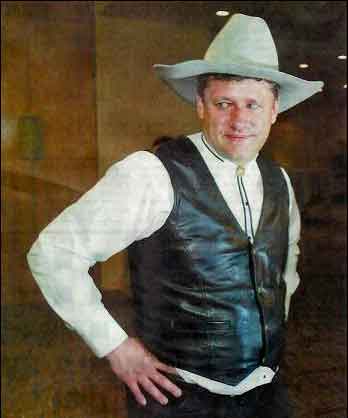
Canadian prime minister Stephen (cowboy) Harper: We're protecting civilians, but expect civilian casualties.

Canada’s prime minister, Stephen Harper, who is contributing six fighter-bombers to the hastily assembled Libyan rebel air force, as well as a frigate to lead a naval blockade, is warning Canadians that while “Canada is at war to protect innocent Libyan civilians…there are no guarantees that they…can avoid getting hurt.” [1] Harper must be channelling the US Army officer who infamously said during the Vietnam War that US forces had to destroy a village to save it. Canadians, Harper is warning, will be killing some Libyans to protect them.

The other allied military intervention

In the rush to climb aboard the let’s bomb Tripoli bandwagon, we mustn’t forget the other allied military intervention. Tanks and soldiers from Saudi Arabia and the United Arab Emirates are already in Bahrain, to protect the absolutist monarchy of the Khalifa family from the pro-democracy movement there. Saudi and Emirate’s troops will soon be joined by foreign troops from the six-member Gulf Cooperation Council. The GCC is made up of Saudi Arabia, the UAE, Bahrain, Qatar, Oman and Kuwait. [2].

The Khalifa regime says it’s not waging war against its people. It’s only restoring order. [3]
Kaddafi on the other hand isn’t restoring order. He’s waging war.

That’s the way things work now. When the US and its allies wage war they’re restoring order and protecting civilians. When countries targeted by the US try to restore order, they’re waging war and attacking civilians.

Three for the price of one

The Wall Street Journal reported today that “western officials worried that a victory for Col. Kaddafi could prevent the movement from spreading to places they would like to see it reach, such as Syria and Iran.” [4]

I believe the part about Western officials wanting to see uprisings spreading to Syria and Iran – countries they like no more than they like Libya. But if they were truly worried that a successful crackdown on rebellion could discourage uprisings in other countries, they wouldn’t be tacitly endorsing the crackdowns in Bahrain and Yemen. Do they think the opposition in Syria and Iran is oblivious to what’s going on in Bahrain, Saudi Arabia and Yemen, where US allies are brutally cracking down on rebellions in those countries with impunity?

The concern of Western officials is more likely this: Intervening on behalf of rebel forces sends a signal to opposition movements in Syria and Iran that if they take up arms against their governments, the West will help them too.

Charter, we don’t need no stinking charter

It doesn’t really matter that the UN Charter says that the UN Security Council can’t intervene in the internal affairs of its members. Who’s going to stop the biggest, most powerful countries, from doing whatever they want? Sure, they talk a good game about the rule of law. But the rule of law is for chumps. It is, as someone once said, a spider-web for catching the weak. The powerful simply push through it.

They picked the wrong guy

Jean-Paul Sartre turned down a Nobel Prize in 1964 on the grounds that it was a distinction reserved for “the writers of the West or the rebels of the East,” i.e., that it was used as an instrument of Cold War propaganda.

Immanuel Wallerstein: "There is not going to be any significant military involvement of the western world in Libya."

The Nobel Peace Prize is no less political today for the Cold War having ended. It is used, now as then, as an instrument of pro-imperialist propaganda. How else to explain the peace prize being conferred on a man who can only be described as an imperialist warmonger, now with, what – three, four, five wars under his belt: Barack Obama?
Contrast Obama’s giving the green-light to a declaration of war on Libya with the words of the Venezuelan president Hugo Chavez (who, by the way, could teach Gilbert Achcar, and another Z-Net favorite, Immanuel Wallerstein, a thing or two about what anti-imperialism really means. Wallerstein, it should be remembered, sought last week, in supercilious tones, to disabuse the anti-imperialist left, and Hugo Chavez in particular, of its confused analysis of Libya. Sighing heavily, and wondering where to begin to instruct the ignoramuses who were sounding the alarm about an impending Western military intervention, Wallerstein declared that the US was not about to intervene in Libya. “The … point missed by Hugo Chavez’s analysis is that there is not going to be any significant military involvement of the western world in Libya,” instructed Wallerstein. [7])

Here’s Chavez, whose analysis has turned out to be a good deal more insightful than Wallerstein’s:

“More death, more war. They are the masters of war. What irresponsibility. And behind that is the hand of the United States and its European allies.

“They want to seize Libya’s oil. The lives of Libya’s people don’t matter to them at all.

“It is deplorable that the United Nations lends itself to supporting war, infringing on its fundamental principles instead of urgently forming a commission to go to Libya.

“We know what’s going to happen: bombs, bombs, war, more suffering for the people, more death.” [5]

I think Chavez would have been a more fitting candidate for a genuine peace prize. But, then, his imperialist credentials aren’t in order.

Mass Delusions

I thought I had become so accustomed to the depth of US hypocrisy that I could no longer be surprised by it. But the following words, from today’s Wall Street Journal, left me speechless: “Potential Republican presidential candidates for 2012 have criticized the president in recent days for…not pushing America’s traditional role of international peacekeeper.” [6] Peacekeeper! What planet have these people been living on? Has their drinking water been contaminated by a hallucinogen? They might as well have said that WWII put an end to Hitler’s role as international peacekeeper.

Egypt Stagnation, Libya Intervention

Stephen Gowans and Brendan Stone talk about Egypt, Libya and Bahrain. Recorded March 16.

1. Mike Blanchfield, “Risks inherent in helping protect Libyans, Harper says”, The Canadian Press, March 19, 2011.
2. Alex Delmar-Morgan and Nicholas Casey, “Bahrain razes iconic square”, The Wall Street Journal, March 19, 2011.
3. Ibid.
4. Sam Dagher and Adam Entous, “Allied forces attack Libya”, The Wall Street Journal, March 20, 2011.
5. Hugo Chavez condemns military strikes in Libya”, The Associated Press, March 19, 2011.
6. Adam Entous and Laura Meckler, “Libyan raids show Obama doctrine in action”, The Wall Street Journal, March 20, 2011.
7. Immanuel Wallerstein, “Libya and the world left”, Z-Net, March 16, 2011. Z-Net advertises itself as a community of people committed to social change. Social change, yes, but in which direction, and in whose interests?