Sense and Nonsense About Ukraine

January 21, 2022

By Stephen Gowans

Joe Biden thinks, or at least says he thinks, that a Russian invasion of Ukraine would “be the most consequential thing that’s happened in the world in terms of war and peace since World War II.” Biden is either delusional, or supremely confident in the power of US propaganda to turn black to white, otherwise he couldn’t possibly summon the chutzpah to utter such arrant nonsense. Unless Russia plans (a) to invade Ukraine and then (b) burn it to the ground, as the United States did to North Korea from 1950 to 1953, or napalm and exfoliate the country, as Washington did to Vietnam, or bomb and sanction it into the stone age, as the Pentagon did to Iraq twice, or spend 20 years killing civilians in drone strikes as four US administrations did to Afghanistan, then Russia could hardly match the United States in producing consequential markers on the record of post-World War II war and peace.    

Equally absurd are the remarks of the leader of one of Washington’s favorite lickspittles, the government of Canada. “We are working with our international partners and colleagues to make it very, very clear that Russian aggression is absolutely unacceptable,” intoned the popinjay Justin Trudeau, a man whose servility to US interests is without limit. “We are standing there with diplomatic responses, with sanctions, with a full court press to ensure Russia respects the people of Ukraine.” Too bad Canada hadn’t acted to ensure the United States respected the peoples of Korea, Vietnam, Indonesia, Iraq, and Afghanistan, to say nothing of the peoples of Iran, Cuba, Venezuela, and Palestine, among others.   

The emperor and his Canadian viceroy

To avoid the terrible fate of being excommunicated from the church of respectable bourgeois politics, Canada’s peace and love party, the NDP, advocated the use of “sanctions” rather than “war” to deter what is said by governments and respectable (i.e., bourgeois) media in the West to be an anticipated Russian “aggression” against Ukraine, thus accepting as legitimate and propagating two spurious claims: (1) that sanctions—which regularly produce death and misery in excess of what is wrought by bullets, shells, bombs, and missiles—are a peaceful and desirable alternative to war, rather than a means of warfare itself, and a particularly vicious one at that; and that (2) Russian aggression lies at the heart of the dispute over Ukraine.

At its base, the conflict between Russia and the United States pivots on the question of security guarantees. Russia has asked for them and the United States refuses to grant them. Why does Russia feel insecure?

For one thing, the country, along with China, is at the center of the US reticle—Russia constituting what Washington calls a “revisionist power.” “Revisionist”, in US hands, means seeking to revise the international rules-based order—an order based on a set of shifting rules of which the United States alone is the architect and which it invokes whenever convenient, for its own benefit. Revising the international order is refusing to do whatever the US commands. The US president, uncrowned king of the world, or much of it, might as well intone, “The international rules-based order, c’est moi.”  US politicians and journalists are quick to use the words “dictator” and “authoritarian” to refer to the targets of US aggression, but, skilled propagandists to a person, refuse to use the words in reference to Washington’s own relationship with the rest of the world. Yet the words fit to a tee. The United States seeks a relationship of prepotency vis-à-vis other countries. Ewan MacColl and Peggy Seeger described the relationship this way, in an amusing 1970s song, sung to the tune Yankee Doodle.

Yankee Doodle came to town

H-bombs in his pocket

Says chum if you don’t toe the line

I’ll blast you with my rockets

To be sure, the dictator’s tools of coercion have always surpassed H-bombs alone and include sanctions (more aptly known as starving people into submission, a favorite of Canada’s “peace-loving” NDP), fomenting rebellions, and declaring US toadies to be the legitimate leaders of countries that defy the US  dictatorship (Juan Guaidó, for example.)

In 2019, the RAND Corporation, the Pentagon’s think tank, drew up a list of measures the United States and its satellites, such as henchman Canada, could take to “overextend and unbalance” Russia as a means of coercing Moscow to toe the US line. The measures were:

  • Expand U.S. energy production to stress Russia’s economy, potentially constraining its government budget and, by extension, its defense spending. By adopting policies that expand world supply and depress global prices, the United States can limit Russian revenue.
  • Increase Europe’s ability to import gas from suppliers other than Russia to economically extend Russia.
  • Impose deeper trade and financial sanctions to degrade the Russian economy. 
  • Challenge the legitimacy of the state. Create the perception that Moscow is not pursuing the public interest by focussing on widespread, large-scale corruption.
  • Encourage domestic protests and other nonviolent resistance to distract or destabilize the Russian government.
  • Undermine Russia’s image abroad to diminish Moscow’s standing, influence and prestige. 
  • Encourage the emigration from Russia of skilled labor and well-educated youth.
  • Relocate bombers and missiles within easy striking range of key Russian strategic targets to raise Russian anxieties.

The point is that the United States views Russia as a challenge to what the late Hugo Chavez once called the international dictatorship of the United States and Washington has not allowed the challenge to its dictatorship to stand.

The second reason for Russia to feel insecure, if the first isn’t enough, is that the United States is the world’s greatest menace to peace, contrary to the efforts of Joe Biden, Justin Trudeau, sanctions-loving social democrats, and the Western bourgeois media to flip this reality on its head. The United States’ addiction to war—according to Washington’s own Congressional Research Service, “the US military has waged war, engaged in combat, or otherwise employed its forces aggressively in foreign lands in all but eleven years of its existence”, that is, in more than 95 of every 100 years since 1783—is brushed aside. Twenty years in Afghanistan, the destruction of Iraq, the illegal occupation of Syria, the air war on Yugoslavia, the bombing of Panama and invasion of Grenada, wars on the peoples of Vietnam and Korea, to say nothing of wars of economic aggression on these and countless other countries—all these US aggressions are forgotten. Instead, we’re led to believe that, motivated by a desire to recover territory lost to the Russian empire, Vladimir Putin has asked for security guarantees he knows Washington cannot grant, and will use the denial of these guarantees as a pretext to invade Ukraine. Why the United States cannot guarantee Russia’s security, and why security guarantees are “non-starters”, is never explained. However, the undeniable US record of worshiping Mars is explanation enough: The United States cannot provide security guarantees, because the rules-based international order, of which the United States is the sole architect and its plutocrats the principal beneficiaries, depends on military threat and aggression as its ultima ratio. The alluring goal of integrating Russia into the US economy as a complement to, rather than as a rival of, corporate USA, offers too many lucrative profit-making opportunities for Washington to voluntarily surrender its program of anti-Russian military pressure.

Moscow has presented its request for security guarantees in the form of two proposed treaties, one with the United States and the other with the United States’ instrument, NATO. As far as I can tell, the details of the proposed treaties have never been presented in major US media, perhaps because they contradict the Western narrative of Russian belligerence.

Draft treaty with the United States: 

  1. Russia and the US shall not use the territory of other countries to prepare or conduct attacks against the other; 
  2. Neither party shall deploy short- or intermediate-range missiles abroad or in areas where these weapons could reach targets inside the other’s territory; 
  3. The US shall not open military bases in the post-Soviet countries that are not already NATO members, use their military infrastructure, or develop military cooperation with these states;
  4. Neither party shall deploy nuclear weapons abroad, and any such weapons already deployed must be returned. Both parties shall eliminate any infrastructure for deploying nuclear weapons outside their own territories; 
  5. Neither party shall conduct military exercises with scenarios involving the use of nuclear weapons; and, 
  6. Neither party shall train military or civilian personnel from non-nuclear countries to use nuclear weapons. 

Draft treaty with NATO.

  1. NATO shall not expand further east and must commit to excluding Ukrainian membership; 
  2. NATO shall not deploy additional forces or arms outside the borders of its members as of May 1997 (before the alliance started admitting Eastern European countries); 
  3. NATO shall not conduct any military activity in Ukraine, Eastern Europe, the South Caucasus, or Central Asia; 
  4. Russia and NATO shall not deploy short- or intermediate-range missiles within range of each other’s territories; 
  5. All parties shall refrain from conducting military actions above the brigade level which shall be confined to a border zone to be mutually agreed upon; and,  
  6. Neither party shall regard the other as an adversary or create threats to the other, and all parties shall commit to settling disputes peacefully, refraining from the use of force.

The provisions of the proposed treaties are in no way aggressive. On the other hand, the expansion of an anti-Russian military alliance up to the border of Russia, a country the alliance-leader, the United States, defines as a challenger to its hegemony, is unquestionably menacing to Russia. As to the canard that NATO cannot possibly pose a threat to Russia, for, after all, it’s merely a defensive alliance, that too depends on historical amnesia. An alliance that was at the center of unprovoked wars on Yugoslavia, Libya, and Afghanistan, is, ipso facto, an instrument of aggression. It is also an instrument of US domination, used (a) to keep Washington’s former imperialist rivals Germany, Britain, France, and Italy under US tutelage; (b) to create markets for US weapons manufacturers by demanding that NATO lackeys buy weapons systems that interoperate with the US military; and (c) to enlist NATO subalterns in the US project of “overextending and unbalancing” states that remain outside the US empire.

It may, contrary to what one reads in the press, be very much in the interest of Washington to provoke a Russian invasion of Ukraine. What better way to overextend and unbalance the Eurasian giant? A Russian invasion of the east European country would be a march into a quagmire. Washington welcomes the opportunity to overextend and unbalance Russia via a Ukrainian proxy—that is, to carry on the US war on Russia to the last Ukrainian. What’s more, and referring back to the RAND Corporation’s proposals, what better way than by provoking an invasion of Ukraine to do the following?

  • Undermine Russia’s image abroad to diminish Moscow’s standing, influence and prestige. 
  • Create a justification to impose deeper trade and financial sanctions to degrade the Russian economy. 
  • Provide a pretext to relocate bombers and missiles within easy striking range of key Russian strategic targets to raise Russian anxieties.
  • Pressure Germany to cancel Nord Stream 2 to increase Europe’s ability to import gas from suppliers other than Russia as a means of economically weakening Russia.

“Strobe Talbott, the original choreographer of NATO expansion in the post-cold war order,” as  M.K. Bhadrakumar describes him, has “triumphantly congratulated Blinken and Jake Sullivan for cornering Russia.” And well he should. In Ukraine, Washington has created an anti-Russian state on Russia’s border, which, while not formally integrated in NATO, is a de facto NATO asset. Left alone, Ukraine poses a threat to Russia. Invaded by Russia, it remains equally a threat.   

Provoking a robust Russian reply to an advancing and predatory NATO offers other benefits to Washington as well. France and Germany—the principal EU actors—evince a growing desire to achieve a strategic autonomy that would allow them to take advantage of the economic opportunities a closer relationship with Russia would create. Growing Russian-European economic integration would disadvantage US corporations. For example, in preference to reliance on Russian natural gas, Washington has pressed Europe to purchase liquid natural gas from the United States, even though the cost is much higher. Washington has also balked at the prospect of EU military autonomy on the grounds that it would cut US arms companies out of contracts for military provisioning. In other words, the United States uses its dominance over its former imperial rivals to tilt the field in favor of corporate USA (and also to keep former and therefore potential future imperialist rivals in check.) There’s a cost, then, of belonging to the US empire—sacrificing one’s own economic interests to those of the US plutocracy. A Russian invasion of Ukraine would provide Washington with a moral argument to pressure Germany and France into renouncing their growing openness to Russia in favor of more openness to corporate USA, while cementing Europe’s place in the US empire and countering the gravitational pull of Russia on European economies.  

Russia is clearly threatened by the United States and its NATO alliance, and the treaties proposed by Russia to guarantee its security would desirably stay the hand of an aggressive Washington, to the benefit not only of Russia, but to those of us who live in NATO countries who have nothing to gain, and much to lose, from the US plutocracy’s continuing predatory advance on its rivals. Our enemies are the leaders of the column in whose ranks we are invited to march.

+++

Coming soon. The Killer’s Henchman: Capitalism and the Covid-19 Disaster. Available for pre-order from Baraka Books.

THE KILLER’S HENCHMAN: Capitalism and the Covid-19 Disaster

Subscribe to continue reading

Subscribe to get access to the rest of this post and other subscriber-only content.

What Makes the United States Richer than its G7 Partners? Imperialism, not Lower Taxes

September 17, 2021

By Stephen Gowans

Every country that has more colonies, capital, armies, than we have, deprives us of certain privileges, certain profits or super-profits, so among nations, the one that is economically better situated than others receives super-profits. It is the business of the bourgeoisie to fight for privileges and advantages for its national capital.–Lenin*

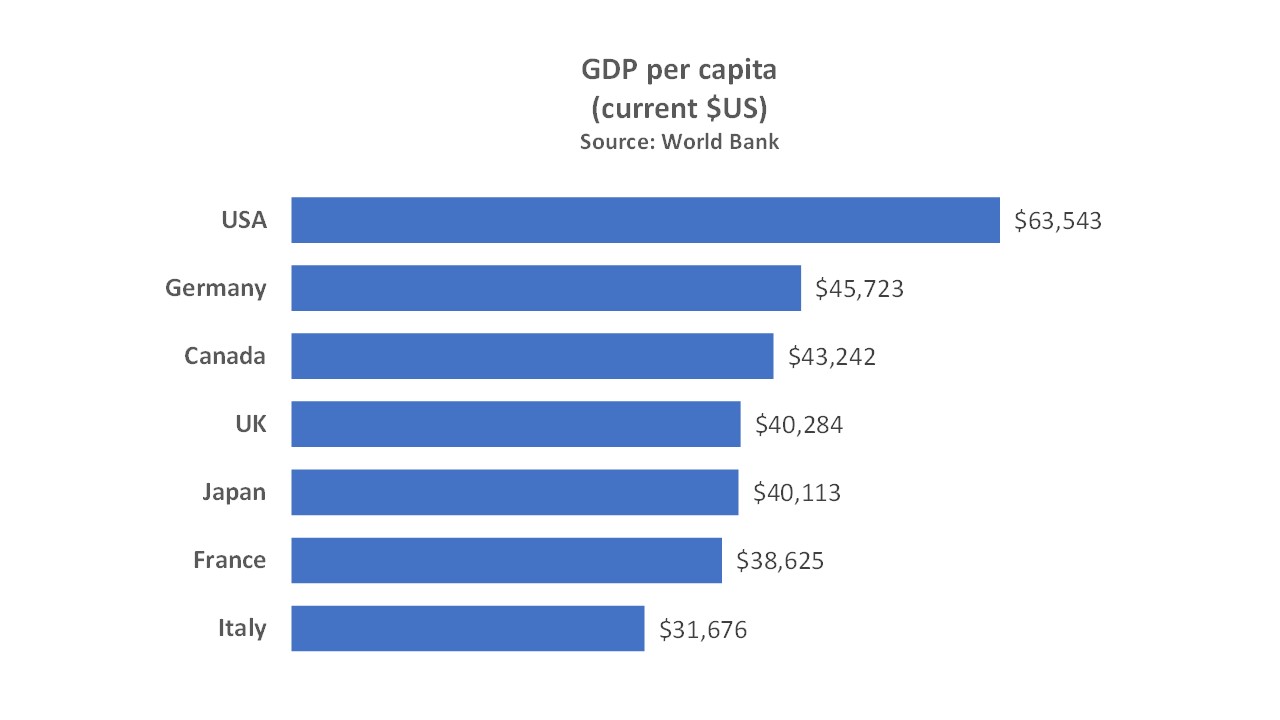
The Harvard economics professor, N. Gregory Mankiw, who served as chairman of the Council of Economic Advisers to the US president from 2003 to 2005, points to lower GDPs per capita in Western Europe to warn against US Americans emulating Western Europe’s welfare states. The higher taxes that Western Europeans pay for robust social supports, he cautions, undermine incentives to work, leading to lower incomes. “Europeans work less than [US] Americans because they face higher taxes to finance a more generous social safety net,” Mankiw argues.

While it’s true that the United States’ G7 partners are less affluent in GDP per capita terms, to what extent is this due to higher taxes versus the United States’ ability to shape the international economic order to suit the interests of US investors and businesses at the expense of its G7 partners?

US politicians endlessly point to the post-World War II economic order, of which Washington was the chief architect, as the key to US prosperity. For example, in 2017, John McCain, a major figure in the US foreign policy establishment, remarked: “We are the chief architect and defender of an international order governed by rules derived from our political and economic values. We have grown vastly wealthier and more powerful under those rules.” McCain warned that challenges to the US-created order threatened US prosperity.

Today, McCain’s “rules” are variously referred to as “the rules of the road,” the “rules-based international order,” and “international rules and norms.” What they refer to are US-created rules that make the United States “vastly wealthier and more powerful”—indeed, vastly wealthier and more powerful than even its G7 allies.

In an important article he wrote for the March/April 2020 edition of Foreign Affairs–the journal of the influential Wall Street-funded and directed policy formulation group, the Council on Foreign Relations–soon-to-be president Joe Biden noted that for the last 70 years, the United States has “played a leading role in writing the rules, forging the agreements, and animating the institutions that guide relations among nations.”

As McCain acknowledged, Washington constructed the rules to serve US economic interests.

US military might and economic leverage have allowed Washington to define the rules and enforce them. Our “ability to project power [is inter alia] the basis of how we … advance U.S. interests,” declared the Chairman of the Joint Chiefs of Staff in 2017.

Washington’s obsession with “the rules,” who writes them, and who benefits from them, lies at the heart of US hegemonism, but also US hostility to China. China, and other powers such as Russia, North Korea, and Iran, which Washington denounce as revisionist, want to revise the rules of the road that put the United States ahead of all other countries, politically, militarily, and economically. These countries, along with others, have formalized their opposition to a global order based on US rules and US supremacy by founding The Group of Friends in Defense of the Charter of the United Nations, an 18-nation alliance that promotes an international order based on international law and the equality of nations.

“Who writes the rules that govern trade? … The United States, not China, should be leading that effort,” insists Biden.

Until the end of World War II, Washington’s G7 partners, Germany, Japan, Italy, France, the UK, and Canada, were independent competitors of the United States, each seeking to carve up the world into their own spheres of trade, investment, and economic advantage. (Canada, as part of the British Commonwealth, followed London’s lead.)

The postwar international order, authored by the newly emergent hegemonic power, the United States, integrated the defeated Axis powers, along with the weakened French and British Empires, into an international order, defined by Washington, informed by Wall Street’s values, and aimed at promoting corporate USA’s prosperity.  

To ensure its former imperial rivals would now accommodate, rather than compete with, US economic interests in a new US-defined world order, the United States occupied militarily Germany, Japan, Italy, and the UK. For almost 80 years, the United States has maintained a robust military presence in each of these countries. Why? In 2002, in an interview with United Press International, Alexander Haig, former Supreme Commander of NATO and US Secretary of State in the Reagan administration, explained.  

Q — Why is the United States still stationing 70,000 troops in Germany?

A — A lot of good reasons for that. This presence is the basis for our influence in the European region and for the cooperation of allied nations…. A lot of people forget it is also the bona fide of our economic success. The presence of U.S. troops keeps European markets open to us. If those troops weren’t there, those markets would probably be more difficult to access.

Q — I didn’t forget. I just didn’t know that if the United States didn’t maintain 70,000 troops in Germany, European markets might be closed to American goods and services.

A — On occasion, even with our presence, we have confronted protectionism in a number of industries, such as automotive and aerospace. 

In other words, the markets of former imperial rivals were integrated into the US market, and the glue that bound them to the United States, and continues to bind them–as The New York Times’ columnist Thomas Friedman once put it–is “the hidden fist” of “the United States Army, Air Force, Navy and Marine Corps.”

Washington would also integrate its former European imperial competitors into NATO, placing their militaries under formal US command, and thereby taking future inter-imperialist military rivalry off the table. At the same time, NATO allows Washington to exploit the fettered militaries of its former rivals as force multipliers in the pursuit of specifically US goals in the US-defined international realm.

After the war, Washington imposed a pacifist constitution on Japan, the United States’ main rival for domination of East Asia and the Pacific, effectively emasculating the country militarily, and ensuring it would not contest US primacy in the region. Washington is now pressuring Japan to lift the pacifist restrictions the United States itself imposed on Tokyo, in order to gear up for war on “revisionist” China, under US direction.

Additionally, the US military controlled, and continues to control, the world’s trade routes, and hence its former rivals’ access to markets and raw materials. “If you have a global economy, I think you need a global navy to look after that economy,” said U.S. Pacific Fleet Commander Admiral Scott Swift. The global navy is none other than the US Navy. Author Gregg Easterbrook notes that “the US Navy is ‘the police force of nearly all blue water.” … It “has made the oceans … safer for commerce.” Specifically, US commerce.

Importantly, Washington keeps its hand on the Middle East oil spigot. Germany, France, Japan, and Italy are highly dependent on oil from West Asia. With Washington able to close the spigot at will, Western Europe and Japan have few options but to accept what Hugo Chavez called “the international dictatorship of the United States empire.”

Hence, the United States’ G7 partners emerged from the war as US vassals. Within the globe-girding US empire, they were assigned roles as junior partners—that is, subordinate components of the US imperium. Their economic interests would be junior and inferior to those of Wall Street and corporate USA.

Mankiw’s analysis is risibly superficial. The idea that taxation undermines incentives to work rests on the notion that effort is proportional to its return. Taxes reduce the return on effort and therefore discourage work. If this is true, the opposite is also true: the greater the return, the greater the effort. By this logic, Mankiw ought to advocate a robust increase in the minimum wage, reasoning that the more money people are able to make, the more likely they are to want to work. But he’s not. Instead, Mankiw’s prescriptions invariably favor employers over workers. The wealthy should not be burdened by high taxes. Governments ought to raise revenue through consumption taxes: those that hit low-income families the hardest and the wealthy the least. In invariably promoting the interests of capital, Mankiw illustrates why Karl Marx described economists of the Harvard professor’s color as “hired prize fighters” of the bourgeoisie, not “disinterested inquirers,” whose only concern was “whether this theorem or that was … useful to capital or harmful.”

Moreover, Mankiw divorces his analysis from the surrounding conditions and events. History, politics, the imbalance in political and military power between the United States and Western Europe, do not enter his field of vision. Notwithstanding Mankiw, the disparity in per capita income between the United States and its G7 partners can be explained by Washington building a post-WWII international order to privilege US economic actors at the expense of its defeated and weakened imperial rivals. In other words, the outcome of the three decades-long, 1914-1945, inter-imperialist struggle, was the emergence of a US leviathan—one that reordered the world to put, not business on top, but US business on top, with the consequence that US GDP per capita would top that of its former competitors.  

Had Germany prevailed in the struggle, and had it subsequently integrated the United States into a German-led global economic order, German GDP per capita would almost certainly be greater than that of the United States, for the simple reason that German-authored rules would favor German businesses. Likewise, had Japan prevailed, the Japanese, not US Americans, would enjoy the higher GDP per capita.

This is not to say that the rivalry has come to an end. It hasn’t. That the G7 countries continue to compete among themselves for markets and investment opportunities can be seen in Germany forging a stronger trading relationship with Beijing than Washington favors; in rivalry between the EU and the United States in connection with Airbus and Boeing; in Germany and France flirting with strategic autonomy for Europe; and between the United States and France in arms sales. These are but a few examples. Even so, while competition persists, it does so within bounds defined by Washington, enforced by its ability to control its rivals’ access to markets and raw materials.     

It is not, then, Western Europe’s welfare states, and the support they receive from higher taxes, that account for why Washington’s G7 partners are poorer. Instead, the lower GDPs per capita of the United States’ former imperial rivals can be explained as the outcome of their losing the inter-imperialist struggle of the first half of the twentieth century. Emerging victorious and strengthened from the thirty-year-war, the United States used its military and economic clout to impose a global economic order on its former rivals—an order which puts corporate USA first, and relegates its G7 partners to junior positions, provides them junior access to profit-making opportunities, and leaves them with junior incomes.    

*V.I. Lenin, “Imperialism and Socialism in Italy” in Lenin: The Imperialist War, International Publishers, 1930, p. 333.

As an anti-pandemic tool, vaccines have turned out to be more mirage than oasis

Subscribe to continue reading

Subscribe to get access to the rest of this post and other subscriber-only content.

The COVID-19 Crisis is The Result of the Death Drive of Capitalism

Subscribe to continue reading

Subscribe to get access to the rest of this post and other subscriber-only content.

The Moral Scandal of Vaccine Inequality Has a Name: Capitalism

Subscribe to continue reading

Subscribe to get access to the rest of this post and other subscriber-only content.

Vaccine Imperialism

Subscribe to continue reading

Subscribe to get access to the rest of this post and other subscriber-only content.

Weaponizing Covid-19: How Washington is Using the Pandemic to Help Destabilize Cuba

Subscribe to continue reading

Subscribe to get access to the rest of this post and other subscriber-only content.

Are the protests in Cuba a struggle between democracy and authoritarianism?

July 13, 2021

Stephen Gowans

Readers of The Wall Street Journal might come to the conclusion that an uprising has erupted in Cuba against ‘authoritarianism’ and the Cuban Communist Party.

But a careful reading of the newspaper paints a more nuanced picture.

There is, according to the Journal, “a pattern of simmering tensions across swaths of the developing world, where people are largely unvaccinated, governments are unable to afford sustained stimulus measures and economies are falling further behind and struggling to rebound from last year’s record contraction.”

In South Africa, for example, the government has “deployed its army … to help quell violent protests” after “hundreds of angry residents ransacked shops and malls, torched cars and blocked major roads.” The police have “arrested nearly 500” protestors.

“At the end of March, 33% of South Africans were unemployed, a figure that rises to 43% when discouraged job seekers are included.” A “record wave of Covid-19 infections across the country….has overwhelmed hospitals and led to shortages of oxygen.”

In another part of the developing world, Cuba, simmering tensions have also spilled over into protests. There, hundreds of “Cubans took to the streets … protesting a lack of food and a shortage of Covid-19 vaccines.” Cubans are registering “their opposition to the economic fallout from Covid-19 … widespread shortages of food and medicine, and numerous daily blackouts from failing electric power.”

Unrest in Cuba matches unrest in South Africa, part of the simmering tension in the global south. The roots are the same.

Yet, despite Cuba’s pandemic-induced economic travails and consequent political distemper fitting a pattern across the global south—exacerbated in Cuba’s case by six decades of US economic strangulation—The Wall Street Journal cast “Cuba’s unrest” as framing the “world’s big struggle: dictators vs. democracies.”

Columnist Gerald F. Seib used the occasion of the Cuban protests to rail against authoritarian regimes, among which he includes Cuba’s government, despite the reality that Cuba has elections and assemblies. But in the US view, an electoral system is not truly democratic unless it bears a close resemblance to the United States’ own plural elite model, one of multiple parties representing the interests of business elites, which periodically vie for the votes of an electorate whose interests are largely ignored.

Bernie Sanders recently referred to the US system as one that doesn’t respond to the needs of the people. Sanders told New York Times’ columnist Maureen Dowd, ‘It’s absolutely imperative if democracy is to survive that we do everything that we can to say, ‘Yes, we hear your pain and we are going to respond to your needs.’’’

The obvious question for Sanders is: how can a system that doesn’t respond to the people’s needs be called a democracy? And how can responding democratically save democracy. If responding to the people’s needs is a new initiative, then democracy is already dead. More accurately, in the US case, it has yet to be born.

Sanders would have hewed closer to the truth had he said, “It’s absolutely imperative if democracy is to be created for the first time that we not only do everything that we can to say, ‘Yes, we hear your pain and we are going to respond to your needs’ but that we also actually respond to their needs.”

Seib opens his storehouse of demons, condemning them for the crime of autocracy on the basis of how long they’ve been in power: Ayatollah Ali Khamenei (32 years); Vladimir Putin (22); Xi Jinping (9). Harvard political scientist Graham Allison calls Xi’s government a “responsive authoritarianism”—which seems to be another of way of saying it’s the democracy that Bernie Sanders says the unresponsive US plural elite system is not.

This “seems a boom time for autocrats,” Seib writes. “Yet the seething unhappiness in Cuba, Venezuela, Iran and Hong Kong [but not South Africa, Haiti, Colombia, Brazil, and Lebanon] raises the question of how long the authoritarian run can last?”

Apparently, for quite some time, if the autocrats are US allies. The Hashemite monarchy of Jordan’s “U.S.-Backed King”, as the Journal describes him—and aptly, too, considering that US taxpayers pay him more than $1.5 billion yearly—has lasted 75 years. The Khalifa family, which allows the US Fifth Fleet to use Bahrain as its home base, has ruled over the Persian Gulf country for 255 years. The House of Saud, which rules US best friend Saudi Arabia, has clung to power with US assistance for more than three-quarters of a century. And we mustn’t forget Abdel Fatah el-Sissi, Egypt’s military ruler, whom Donald Trump once called his favorite dictator. Like the authoritarian government of Jordan’s autocrat King Abdullah, the government of autocrat President el-Sissi, also receives more than $1 billion yearly from an appreciative United States, for services rendered.

In US propaganda, autocrats are not condemned as autocrats so long as they render services to the beneficiaries of the US plural elite system, i.e., Wall Street, while governments that don’t genuflect to US plural elite needs, and choose instead to respond to their own citizens’ needs, are labelled autocrats, whether they are or not.

Owing to the US campaign of strangling the Cuban economy—a campaign now in its seventh decade—Cubans have lived with a lower standard of living than their socialist economy is capable of producing (which is the point of Washington blockading the island.)

Cuba has, nevertheless, done remarkably well in the face of US-imposed adversity. In 2019, the country’s GDP per capita was $9,100 (current $US), according to the World Bank, not far off China’s $10,217. Of course, neither country is anywhere near US GDP per capita, but, having been looted by great powers, they have steep hills to climb. US sanctions, and now the pandemic—which has slashed tourism by nearly 90 percent—makes the climb all the more difficult for Cuba.

“The truth is that if one wanted to help Cuba, the first thing that should be done is to suspend the blockade of Cuba,” Mexico’s president, Andrés Manuel López Obrador, told reporters on Monday. “That would be a truly humanitarian gesture.”

 Unfortunately, neither Wall Street nor the capitalist system at whose center it lies, are humanitarian.

The US War to Destroy China’s Crown Jewel and Secure US Cyber Supremacy

July 6, 2021

Stephen Gowans

When then US president Donald Trump said he would call off US efforts to extradite from Canada Huawei CFO Meng Wanzhou to face bank fraud-related sanctions-evasion charges in exchange for trade concessions from China, he effectively admitted to a political kidnapping. The reality that normal US practice is to fine companies that violate US sanctions, not arrest their officers, strengthened the contention that Washington was conspiring with Canada to abduct Meng for political gain.

The Meng case has become the most high-profile aspect of a US campaign to cripple the Chinese tech champion Huawei. But it is also one of the least consequential elements of a multi-layered operation. Since 2010, Washington has spied on Huawei, declared it a national security threat whose equipment must be banned from telecom networks, starved it of US technology, harassed its employees to gather information to use in law suits against the company, and has even gone so far as to pay Huawei’s potential customers to buy from its competitors instead.

The impetus of the campaign is multidimensional and mutually reinforcing. Washington is trying to block China from achieving success in emerging tech industries. Huawei, a global telecom powerhouse, is seen by Beijing as a key player in China’s industrial strategy, a jewel in the country’s crown. Crippling the company could slow China’s technological ascent, condemn China indefinitely to low-wage manufacturing, and ultimately allow US investors, rather than Chinese enterprises, to reap the bounty of tomorrow’s industries.

Moreover, telecom networks are an important part of the infrastructure the NSA and its counterparts in the Five Eyes signal intelligence alliance—Britain, Canada, Australia, and New Zealand—use to gather political and business intelligence, and conduct cyberattacks, around the world. As the preferred network supplier, Huawei was on track to blanket the world’s telecom networks with its gear. This was hardly an auspicious prospect for the US intelligence community. As a Chinese company, Huawei is far less likely to cooperate with US intelligence than equipment manufacturers based in countries under US influence. The latter can be expected to accede to Washington’s demands to comply with US intelligence community requests for cooperation; not so Huawei.

In 2019, Huawei was the world’s largest telecom equipment manufacturer. It had 180,000 employees and the largest R&D budget of any tech company in China. [1] Over 40 percent of its employees worked in research and development. The company was held privately, with an ownership stake divided among 81,000 employees. [2] Renowned for the quality of its gear and the attractiveness of its prices, Huawei was at the forefront of the next-generation 5G networks. [3]

As a global leader capable of outcompeting its US-allied rivals, Huawei was vitally important to Beijing’s industrial strategy. Indeed, so important was the company to Beijing, that Wall Street Journal reporters Bob Davis and Lingling Wei called the company China’s “crown jewel.” [4]

But to Washington, Huawei was a threat. Referring to 5G, US telecom experts prepared a paper for the White House warning that “For the first time in modern history, the United States has not been the leader in an emerging wave of critical technology.” [5]

Huawei’s US competitors were seen as too small to compete with the Chinese firm. [6] As for Huawei’s main competitors, Nokia, Ericsson, and Samsung, Washington and London worried that the Chinese tech company was so attractive to the world’s telecom providers that it would drive its rivals out of the 5G business. [7]

In 2010, the NSA secretly broke into Huawei’s computers, looking for evidence that the company was covertly controlled by the Chinese military, and that the company’s CEO and founder, Ren Zhengfei—he had once served in the People’s Liberation Army Engineering Corps.—retained an active role in the Chinese military. The NSA was unable to confirm its suspicions. [8]  All the same, two years later, Congress declared Huawei a national security threat, effectively shutting it out of the US market. [9]

A half a decade later, with Huawei defying Congress’s efforts to slow its rise, US National Security Advisor John Bolton decided to step up the war on Huawei. [10] Washington plotted to insert “the federal government deep into the private sector to stiffen global competition against Chinese telecom giant”. [11] Senator Tom Cotton,  author of an attack plan to “roll back Chinese power”, [12] tweeted: “@Huawei 5G, RIP.” [13]

One of the first salvos in the Bolton-initiated operation was to formalize the exclusion of Huawei from the US market. US president Donald Trump signed an executive order prohibiting US companies from doing business with China’s crown jewel. [14]

Next, Washington pressured its allies to declare Huawei’s network equipment a potential instrument of Chinese espionage. At its July, 2018 meeting in Halifax, the US-led eavesdropping network, the Five Eyes, announced it would work to ban Huawei 5G equipment from the core of its telecom networks. [15]

Other US allies were pressured to follow suit. Washington designated foreign telecom providers that shunned Huawei as ‘clean telcos’, and implied that those that did business with Huawei were US national security threats to be dealt with accordingly. [16] Frightened of US reprisals, telecom providers turned cool to the Chinese gear provider.  

US pressure to eschew Huawei was seen by foreign telecom providers as a dishonest ploy to gain leverage in trade negotiations with Beijing, rather than an effort to address legitimate national security concerns. The view was reinforced by Washington’s failure to produce evidence showing Huawei was engaged in espionage or that its equipment could be used by Beijing to eavesdrop on Western governments and businesses.

Some US allies questioned “whether America’s campaign [was] really about national security or if it [was] aimed at preventing China from gaining a competitive edge.” [17] Executives at Canada’s first and third largest telecom providers complained that they were being asked to rip Huawei gear out of their networks to satisfy US trade ambitions and to allay US fears of losing its coveted place as a global technology leader. [18]

While trade ambitions and a desire to reply to China’s challenge to US global technology leadership were playing roles in Washington’s campaign to cripple Huawei, so too was another motivation: Controlling the world’s telecom networks to allow the United States to maintain its dominant role in espionage and cyberwarfare.

When the NSA penetrated Huawei’s computers in 2010, it had two goals: First, to find out whether Huawei was an espionage threat; and second, to look for a backdoor into the company’s network equipment. “Many of our targets communicate over Huawei-produced products,” a N.S.A. document leaked by Edward Snowden said. “We want to make sure that we know how to exploit these products,” in order to “gain access to networks of interest” around the world. According to the New York Times, the NSA’s goal was “to exploit Huawei’s technology so that when the company sold equipment to other countries — including both allies and nations that avoid buying American products — the N.S.A. could roam through their computer and telephone networks to conduct surveillance and, if ordered by the president, offensive cyberoperations.” [19]

Washington argued that as a Chinese company, Huawei is obligated to comply with any request from Beijing to use its equipment as a vehicle for spying and cyberattacks. But Washington’s real concern may have been, not that Huawei was a potential tool of Chinese espionage and cyberwarfare, but that it would be an unwilling tool of US espionage and cyberaggression. In contrast, Nokia, Ericsson, and Samsung, as companies based in US satellite countries, would be far easier to recruit, either knowingly or unwittingly, as instruments of NSA eavesdropping and US cyberoperations. From Washington’s perspective, the ideal intelligence scenario would be one in which the guts of a country’s network are provided by manufacturers under US influence. Since Washington has no sway over Huawei, it is undesirable as a provider of equipment to the world’s networks. From the vantage point of US intelligence, Huawei needs to be crippled and blocked so that ductile US-allied manufacturers—Washington’s ‘security’ partners—can take its place.

In order to promote Huawei’s rivals, Washington is paying network equipment buyers to use Nokia, Ericsson, and Samsung. Acting through the U.S. International Development Finance Corp, Washington offers “financial incentives and other enticements to countries willing to shun Chinese-made telecom gear.” [20] For example, the DFC has provided a $500 million loan to a consortium of telecom companies led by the UK’s Vodaphone to build a mobile network in Ethiopia. A condition of the loan is that it cannot be used to purchase Huawei equipment. [21] Meanwhile, Congress is expected to pass legislation that will allow Eastern European countries to use US aid to build cellular networks, so long as they use Huawei rivals. [22] In effect, Washington is paying countries not to use the Chinese supplier.

The DFC was created by Congress in 2018 to compete with China’s One Belt, One Road initiative. While its  main goal is to invest in US companies, the corporation is willing to support non-US firms, if doing so hurts Huawei, and pushes NSA-compliant manufacturers to the fore . “We’re not out to play defense,” DFC head Adam Boehler told the Wall Street Journal. “We’re out to play offense.” [23]

On top of promoting Huawei’s competitors, Washington has sought to degrade the company’s products, by denying it access to the US technology it needs. In 2019, Washington banned the export of US-made chips to Huawei, and additionally blocked Huawei’s access to chips made anywhere in the world with US equipment. The aim, according to the Wall Street Journal’s editorial board, is to decouple “computer technology supply chains from China” and Huawei. [24]

Washington has also mounted a campaign of harassment against the company. According to Huawei, US officials have instructed US “law enforcement to threaten, menace, coerce, entice and incite both current and former Huawei employees”. [25] US prosecutors have brought charges of racketeering conspiracy and conspiring to steal trade secrets against Huawei and its partners. [26] FBI agents have visited the homes of Huawei employees to pressure them to disclose information that could be used against the company in US courts. [27]

The most high-profile case of harassment has been the arrest of Huawei CFO Meng Wanzhou by Canadian officials at Washington’s request. Meng, the daughter of Huawei CEO, Ren Zhengfei, awaits a Canadian decision on her extradition to the United States. US prosecutors allege that Meng helped Huawei circumvent US sanctions on Iran by lying to banks.

On the surface, the case has a number of curious features.

First, the alleged crime appears to have little to do with the United States. Meng’s putative misdeeds occurred in Hong Kong; one of the alleged victims, HSBC, is a British bank; and the accused is a Chinese national. [28] The US connection is the alleged evasion of US sanctions on Iran, but US law does not apply to Chinese nationals or Chinese enterprises outside US jurisdiction.

Second, Washington’s standard practice is to punish corporations that violate its sanctions laws, not arrest company executives. The economist Jeffrey Sachs produced a long list of US and international banks that have paid fines to the US government for sanctions violations. None of their executives were arrested or charged with crimes. [29] Recently, the software giant SAP paid $8 million in fines for selling software to Iran. Not only were company executives spared arrest, the company wasn’t even prosecuted. Instead, it was let off with a promise to improve its compliance. [30] As Canadian political operative Eddie Goldenberg has argued, the arrest of Meng is not a criminal matter. Instead, it lies in “the realm of geopolitics. That is why Ms. Meng was personally targeted when the normal U.S. practice in similar matters is to charge the corporation, not the individual.” [31]

Third, while the Canadian government has presented the Meng affair as a purely criminal matter, when he was US president, Donald Trump told Reuters that he would intervene in her case if by doing so he could secure a better trade deal with China, suggesting Meng had been arrested as a bargaining chip. [32]

US prosecutors argue that the Huawei CFO committed bank fraud by misleading Huawei’s banks in order to evade US sanctions on Iran. The extradition case hinges on the question of whether bank fraud is a crime in both the United States and Canada. Under Canadian law, Meng cannot be extradited for an act that is not recognized as a crime in Canada.

Meng’s lawyers have argued that, notwithstanding US claims, the case pivots on sanctions-evasion, with bank fraud as a red herring. [33] “It is a fiction to contend that the United States has any general interest in policing private dealings between a foreign bank and a foreign citizen on the other side of the world. However, it is the case that the United States has a global interest in enforcing its sanctions policy. Sanctions drive this case.” [34]

Meng’s lawyers have also argued that if the Huawei CFO had misled the banks—a point they do not concede—the banks would have suffered no harm in Canada, since Ottawa has no extra-territorial sanctions which would prohibit Huawei from selling equipment to Iran, and therefore would have no reason to penalize the banks for their actions. The critical point is that deception is not fraud unless harm befalls the deceived party and a benefit redounds to the party practicing the deception. Since the banks would have suffered no harm in Canada, and neither would Huawei have obtained any gain, the necessary condition for extradition of dual criminality—that the actions of the accused constitute a crime in both Canada and the United States—has not been met. [35]

In March, Canadian officials indicated that there was a “strong possibility” that the US Justice Department would drop its extradition request if Huawei admitted guilt and agreed to pay a substantial fine. [36] Huawei CEO Ren Zhengfei rejected the offer out of hand. His daughter, he said, had “committed no crime,” adding that “the U.S. is the side that should plead guilty.” [37]

While US prosecutors and the Canadian government argue that the Meng case is non-political, and purely criminal, the United States’ top business newspaper, The Wall Street Journal, thinks otherwise. “We might prefer that prosecution of its chief financial officer, Meng Wanzhou … were over something other than violating U.S. sanctions on Iran,” opined editorial writer Holman W. Jenkins, Jr. “But the U.S. is nonetheless positioning itself to destroy China’s shiniest success story.” [38]

If the US operation succeeds, not only will the world’s telecom networks be dominated by US-allied equipment manufacturers, but the United States will have secured its position as the world’s top cyberwarfare and cyberespionage threat, with the power to spy on governments and businesses, and carry out offensive cyberoperations, virtually anywhere in the world.

1 Dan Strumpf, Min Jung Kim and Yifan Wang, “How Huawei took over the world,” The Wall Street Journal, December 25, 2018

2 Ibid

3 Stephen Fidler and Max Colchester, “U.K. to Ban Huawei From Its 5G Networks Amid China-U.S. Tensions,” The Wall Street Journal, July 14, 2020

4 Bob Davis and Lingling Wei, Superpower Showdown: How the Battle Between Trump and Xi Threatens a New Cold War, Harper Business, 2020, p. 26

5 Editorial Board, “Huawei and the U.S.-China Tech War,” The Wall Street Journal, June 9, 2020

6 Ibid

7 Bojan Pancevski and Sara Germano, “In rebuke to US, Germany considers letting Huawei in,” The Wall Street Journal, February 19, 2019

8 Matthew Dalton, “Spy charges put Huawei’s European ambitions in jeopardy,” The Wall Street Journal, January 14, 2019

9 Ibid

10 Bob Davis and Lingling Wei, Superpower Showdown: How the Battle Between Trump and Xi Threatens a New Cold War, Harper Business, 2020, p. 25

11 Drew FitzGerald, Sarah Krouse, “White House Considers Broad Federal Intervention to Secure 5G Future,” The Wall Street Journal, June 25, 2020.

12 Gerald F. Seib, “Tom Cotton Has a China Coronavirus Attack Plan,” The Wall Street Journal, May 11, 2020

13 Bob Davis and Lingling Wei, Superpower Showdown: How the Battle Between Trump and Xi Threatens a New Cold War, Harper Business, 2020, p. 27

14 Parmy Olson, “US would rethink intelligence ties if allies use Huawei technology,” The Wall Street Journal, April 29, 2019

15 Matthew Dalton, “Spy charges put Huawei’s European ambitions in jeopardy,” The Wall Street Journal, January 14, 2019

16 Stephen Fidler and Max Colchester, “U.K. to Ban Huawei From Its 5G Networks Amid China-U.S. Tensions,” The Wall Street Journal, July 14, 2020

17 Matthew Dalton, “Spy charges put Huawei’s European ambitions in jeopardy,” The Wall Street Journal, January 14, 2019

18 Christine Dobby, “Bell, Telus warn of 5G delays, higher costs if Ottawa joins peers in banning Huawei,” The Globe and Mail, December 21, 2018

19 David E. Sanger and Nicole Perlroth, “N.S.A. Breached Chinese Servers Seen as Security Threat,” The New York Times, March 22, 2014

20 Stu Woo and Drew Hinshaw, “U.S. Fight Against Chinese 5G Efforts Shifts From Threats to Incentives,” The Wall Street Journal, June 14, 2021

21 Alexandra Wexler and Stu Woo, “U.S. Fund Set Up to Counter China’s Influence Backs Covid-19 Vaccine Maker in Africa,” The Wall Street Journal, June 30, 2021

22 Stu Woo and Drew Hinshaw, “U.S. Fight Against Chinese 5G Efforts Shifts From Threats to Incentives,” The Wall Street Journal, June 14, 2021

23 Editorial Board, “Huawei and the U.S.-China Tech War,” The Wall Street Journal, June 9, 2020

24 Ibid

25 William Mauldin and Chao Deng, “US-China talks stuck in rut over Huawei,” The Wall Street Journal, July 17, 2019

26 , Jacquie McNish, Aruna Viswanatha, Jonathan Cheng and Dan Strumpf, “U.S. in Talks With Huawei Finance Chief Meng Wanzhou About Resolving Criminal Charges,” The Wall Street Journal, Dec. 4, 2020

27 William Mauldin and Chao Deng, “US-China talks stuck in rut over Huawei,” The Wall Street Journal, July 17, 2019

28 K J Noh, “Why Canada must release Meng Wanzhou,” Asia Times, October 30, 2020

29 Jeffrey D. Sachs, “The U.S., not China, is the real threat to international rule of law,” The Globe and Mail, December 12, 2018

30 Aruna Viswanatha, “SAP Admits Iran Sanction Violations to Justice Department,” The Wall Street Journal, April 29, 2021

31 Eddie Goldenberg, “Want to bring the Michaels home? Send Meng Wanzhou back to China,” The Globe and Mail, January 16, 2020

32 Bob Davis and Lingling Wei, “China moves to address US economic concerns,” The Wall Street Journal, December 11, 2018

33 Sean Fine, Andrea Woo, and Xiao Xu, “Fraud allegations are a façade, lawyers for Meng Wanzhou argue at extradition hearing,” The Globe and Mail, January 20, 2020

34 Ibid

35 Dan Bilefsky, “Huawei executive goes to court, fighting extradition to US,” The New York Times, January 19, 2020

36 Robert Fife and Steven Chase, “Canada held secret U.S. talks in bid to free Kovrig, Spavor jailed in China,” The Globe and Mail, June 7, 2021  

37 Robert Fife, Steven Chase, and Nathan Vanderklippe, “Meng Wanzhou in talks with U.S. Justice Department to allow her to return to China, The Globe and Mail, December 3, 2020

38 Holman W. Jenkins, Jr., “U.S. Can Destroy Huawei, Part Two,” The Wall Street Journal, January 29, 2019