Imperialism or Barbarism! (Bahrain Doesn’t Count)

By Stephen Gowans

The renegade Achcar

Lebanese socialist Gilbert Achcar (author with Noam Chomsky of Perilous Power: The Middle East and U.S. Foreign Policy) can cite chapter and verse on why the US-French-British-Canadian military intervention on the side of the armed uprising in Libya is imperialist, but that doesn’t mean he’s against it. On the contrary, in this fight he’s lining up with the imperialists.

Gilbert Achcar: Imperialism is anti-imperialist.

In an interview featured in Z-Net, Achcar writes: “The Western response, of course, smacks of oil” and “We all know about the Western powers’ pretexts and double standards.”

Still, Achcar, who somehow has managed to build a reputation as an anti-war activist, says “I believe that from an anti-imperialist perspective one cannot and should not oppose the no-fly zone, given that there is no plausible alternative for protecting the endangered population.”

Achcar stands at the head of a long line of renegades who talk the anti-imperialism talk, but when push comes to shove, walk the imperialist walk.

Their stock-in-trade is to justify their nonsense by turning reality on its head. That’s why, in Achcar’s world, anti-war activism and anti-imperialism now mean the opposite of what we always thought they meant.

We’re bombing to protect civilians—but we might kill them

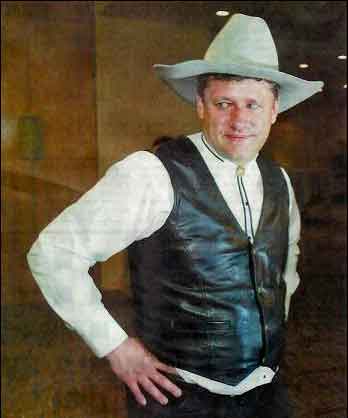
Canadian prime minister Stephen (cowboy) Harper: We're protecting civilians, but expect civilian casualties.

Canada’s prime minister, Stephen Harper, who is contributing six fighter-bombers to the hastily assembled Libyan rebel air force, as well as a frigate to lead a naval blockade, is warning Canadians that while “Canada is at war to protect innocent Libyan civilians…there are no guarantees that they…can avoid getting hurt.” [1] Harper must be channelling the US Army officer who infamously said during the Vietnam War that US forces had to destroy a village to save it. Canadians, Harper is warning, will be killing some Libyans to protect them.

The other allied military intervention

In the rush to climb aboard the let’s bomb Tripoli bandwagon, we mustn’t forget the other allied military intervention. Tanks and soldiers from Saudi Arabia and the United Arab Emirates are already in Bahrain, to protect the absolutist monarchy of the Khalifa family from the pro-democracy movement there. Saudi and Emirate’s troops will soon be joined by foreign troops from the six-member Gulf Cooperation Council. The GCC is made up of Saudi Arabia, the UAE, Bahrain, Qatar, Oman and Kuwait. [2].

The Khalifa regime says it’s not waging war against its people. It’s only restoring order. [3]
Kaddafi on the other hand isn’t restoring order. He’s waging war.

That’s the way things work now. When the US and its allies wage war they’re restoring order and protecting civilians. When countries targeted by the US try to restore order, they’re waging war and attacking civilians.

Three for the price of one

The Wall Street Journal reported today that “western officials worried that a victory for Col. Kaddafi could prevent the movement from spreading to places they would like to see it reach, such as Syria and Iran.” [4]

I believe the part about Western officials wanting to see uprisings spreading to Syria and Iran – countries they like no more than they like Libya. But if they were truly worried that a successful crackdown on rebellion could discourage uprisings in other countries, they wouldn’t be tacitly endorsing the crackdowns in Bahrain and Yemen. Do they think the opposition in Syria and Iran is oblivious to what’s going on in Bahrain, Saudi Arabia and Yemen, where US allies are brutally cracking down on rebellions in those countries with impunity?

The concern of Western officials is more likely this: Intervening on behalf of rebel forces sends a signal to opposition movements in Syria and Iran that if they take up arms against their governments, the West will help them too.

Charter, we don’t need no stinking charter

It doesn’t really matter that the UN Charter says that the UN Security Council can’t intervene in the internal affairs of its members. Who’s going to stop the biggest, most powerful countries, from doing whatever they want? Sure, they talk a good game about the rule of law. But the rule of law is for chumps. It is, as someone once said, a spider-web for catching the weak. The powerful simply push through it.

They picked the wrong guy

Jean-Paul Sartre turned down a Nobel Prize in 1964 on the grounds that it was a distinction reserved for “the writers of the West or the rebels of the East,” i.e., that it was used as an instrument of Cold War propaganda.

Immanuel Wallerstein: "There is not going to be any significant military involvement of the western world in Libya."

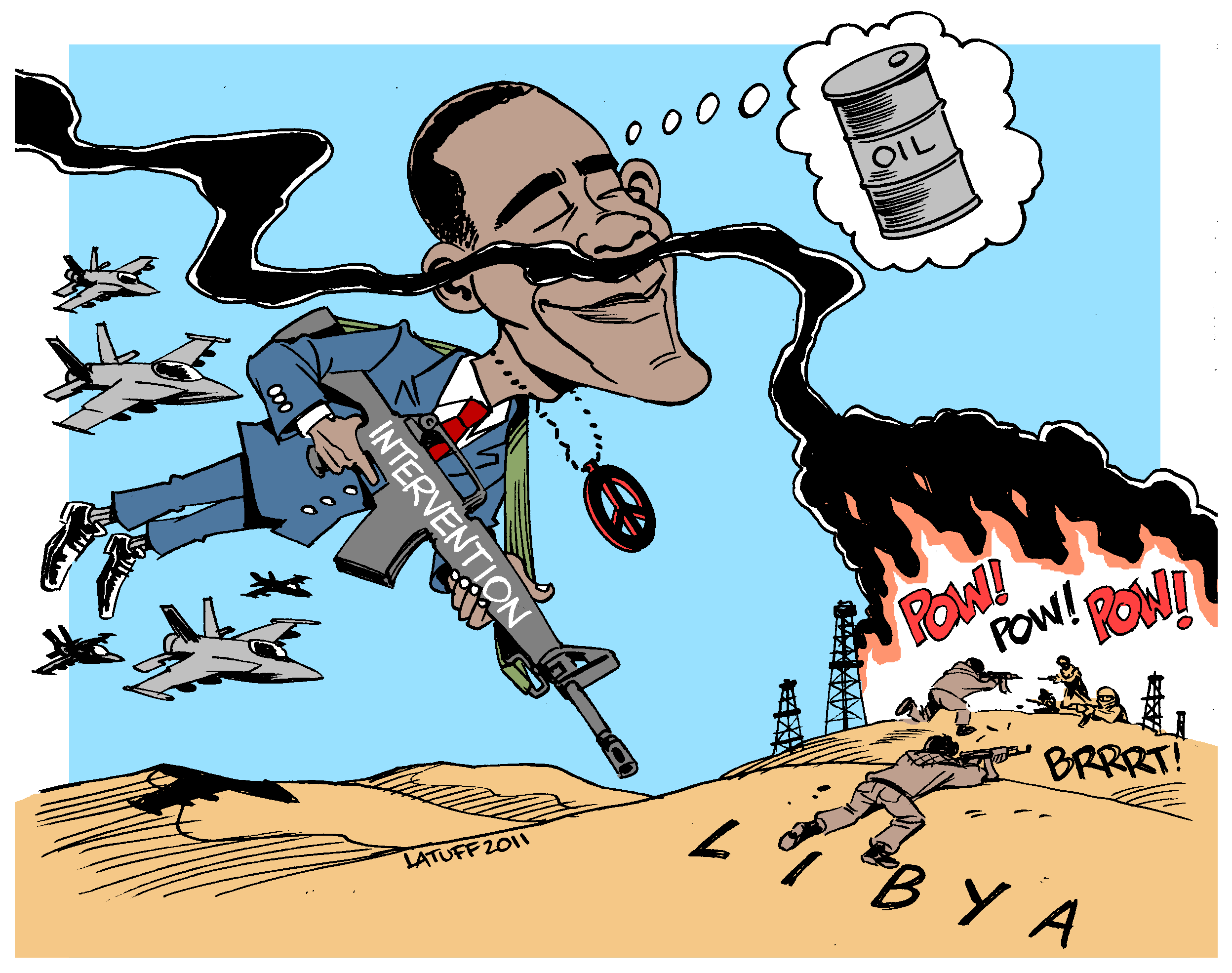
The Nobel Peace Prize is no less political today for the Cold War having ended. It is used, now as then, as an instrument of pro-imperialist propaganda. How else to explain the peace prize being conferred on a man who can only be described as an imperialist warmonger, now with, what – three, four, five wars under his belt: Barack Obama?
Contrast Obama’s giving the green-light to a declaration of war on Libya with the words of the Venezuelan president Hugo Chavez (who, by the way, could teach Gilbert Achcar, and another Z-Net favorite, Immanuel Wallerstein, a thing or two about what anti-imperialism really means. Wallerstein, it should be remembered, sought last week, in supercilious tones, to disabuse the anti-imperialist left, and Hugo Chavez in particular, of its confused analysis of Libya. Sighing heavily, and wondering where to begin to instruct the ignoramuses who were sounding the alarm about an impending Western military intervention, Wallerstein declared that the US was not about to intervene in Libya. “The … point missed by Hugo Chavez’s analysis is that there is not going to be any significant military involvement of the western world in Libya,” instructed Wallerstein. [7])

Here’s Chavez, whose analysis has turned out to be a good deal more insightful than Wallerstein’s:

“More death, more war. They are the masters of war. What irresponsibility. And behind that is the hand of the United States and its European allies.

“They want to seize Libya’s oil. The lives of Libya’s people don’t matter to them at all.

“It is deplorable that the United Nations lends itself to supporting war, infringing on its fundamental principles instead of urgently forming a commission to go to Libya.

“We know what’s going to happen: bombs, bombs, war, more suffering for the people, more death.” [5]

I think Chavez would have been a more fitting candidate for a genuine peace prize. But, then, his imperialist credentials aren’t in order.

Mass Delusions

I thought I had become so accustomed to the depth of US hypocrisy that I could no longer be surprised by it. But the following words, from today’s Wall Street Journal, left me speechless: “Potential Republican presidential candidates for 2012 have criticized the president in recent days for…not pushing America’s traditional role of international peacekeeper.” [6] Peacekeeper! What planet have these people been living on? Has their drinking water been contaminated by a hallucinogen? They might as well have said that WWII put an end to Hitler’s role as international peacekeeper.

Egypt Stagnation, Libya Intervention

Stephen Gowans and Brendan Stone talk about Egypt, Libya and Bahrain. Recorded March 16.

1. Mike Blanchfield, “Risks inherent in helping protect Libyans, Harper says”, The Canadian Press, March 19, 2011.
2. Alex Delmar-Morgan and Nicholas Casey, “Bahrain razes iconic square”, The Wall Street Journal, March 19, 2011.
3. Ibid.
4. Sam Dagher and Adam Entous, “Allied forces attack Libya”, The Wall Street Journal, March 20, 2011.
5. Hugo Chavez condemns military strikes in Libya”, The Associated Press, March 19, 2011.
6. Adam Entous and Laura Meckler, “Libyan raids show Obama doctrine in action”, The Wall Street Journal, March 20, 2011.
7. Immanuel Wallerstein, “Libya and the world left”, Z-Net, March 16, 2011. Z-Net advertises itself as a community of people committed to social change. Social change, yes, but in which direction, and in whose interests?

Intervention in Libya May Lead to More Deaths, Not Fewer

By Stephen Gowans

In explaining why his government supported the UN Security Council resolution authorizing all necessary measures to protect Libyan civilians, US president Barack Obama explained: “The U.S. doesn’t want a war. But we want to prevent a slaughter.”

Noble sentiments, but the Security Council resolution could lead to more deaths, not fewer.

Libyan government forces were well on their way to defeating the rebel forces (which may have been the trigger for the resolution.) Had they done so, the conflict would have ended.

Intervention may prevent a slaughter of rebel forces, but it could lead to a prolonged civil war, with more bodies piling up than would have, had the conflict been allowed to quickly culminate in a resolution. Among the corpses will be the civilian collateral damage that Western bombers are so proficient at producing.

Another possible outcome (perhaps more likely) is that Western military intervention tips the scales overwhelmingly in the rebels’ favor. Others have noted the similarities with Kosovo, where NATO signed on as the KLA’s air force in the guerrilla army’s fight with Serb forces. This time, however, the intervention has UN authorization, though whether it does or doesn’t hardly makes a difference. This one is no more defensible than the Kosovo intervention and is no less motivated by Western geo-political and elite economic interests.

Membership has its privileges

Meanwhile, the firing of live ammunition at protesters by Bahraini forces, backed by Saudi troops and tanks, has drawn no calls for all necessary measures to protect Bahraini citizens. There haven’t even been calls for mild measures. The best Washington can do is “express distress” and urge “the government (in Bahrain) to negotiate with the opposition and pursue change.”

Why the double standard?

As the New York Time’s Helene Cooper and Mark Landler explain, “Bahrain is an American ally. The Navy’s Fifth Fleet is based here and the Khalifa royal family has warm relations with Washington.”

Libya, of course, is neither a US ally (though it has in recent years cooperated with Washington on some matters), isn’t the site of US military bases, and its leader hasn’t had warm relations with Washington.

Had any of these things been true, we can take it that Qaddafi would now be free to slaughter as many Libyans as he pleased (though Washington would publically profess distress, while sitting on its hands.)

For bloodthirsty leaders, membership in the club of US allies has its privileges. The same can’t be said for the people who live under them.

Postscript, March 21, 2011.

From today’s Wall Street Journal (“Leaders struggle to define next moves”):

Security analysts fear Western airpower could decapitate Tripoli’s military command but not swing the balance of power firmly in the rebels’ favor, leading to protracted civil strife and a splintering of the Mediterranean country. Ungoverned areas, meanwhile, could provide sanctuary for al Qaeda and other militant Islamist groups that are active in northern Africa.

“The risk is that the no-fly zone became a cover for a widening civil war,” said Emile El-Hokayem, a Bahrain-based Mideast analyst for the International Institute for Strategic Studies. “It’s not clear if the Obama administration has firmly grasped this.”

What of Bahrain?

By Stephen Gowans

For weeks, demonstrators opposed to the absolute rule of the king Hamad bin Isa al-Khalifa have taken to the streets of Bahrain to demand reforms. At one point more than 100,000 people in a country of only a half million massed in the capital, Manama, shouting “Down, Down Hamad!”

The following is from Ethan Bronner’s report in today’s New York Times.

“Two days after the king of Bahrain called in 2,000 troops from Saudi Arabia and other neighboring allies, and the day after he declared martial law, his forces roared through downtown Manama, wresting it from the protesters who had in recent days taken charge of neighborhoods and nearby villages.

“…hundreds of Bahraini troops, backed by helicopters and tanks, forcefully cleared the capital’s central square of demonstrators clamoring for reform.

“Plumes of black smoke choked the city landscape as troops repeatedly fired tear gas canisters, rubber bullets and what sounded like live ammunition in their dawn assault.”

This invites the following questions.

When can we expect impassioned pleas for a UN- or NATO-enforced no-flight zone over Bahrain – or perhaps a no-drive zone — to protect Bahrainis from their brutal government and thuggish Saudi backers?

Will the Arab League demand a no-flight zone over Bahrain, as it did one over Libya?

When will Bahraini assets be frozen and travel sanctions imposed on the king, the crown prince, and their advisors?

When will Saudi Arabia be sanctioned for sending tanks into Bahrain – and for cracking down on its own pro-democracy demonstrators?

Will the UN Security Council demand the immediate withdrawal of Saudi forces from Bahrain?

Will the editors of newspapers who demand a no-flight zone over Libya – and once demanded Iraq’s immediate withdrawal from Kuwait – call for the immediate withdrawal of Saudi troops and tanks from its Gulf neighbor?

When will France recognize the leaders of the Bahraini opposition – jailed by Bahraini authorities – as Bahrain’s legitimate government?

When will the Bahraini king and the crown prince be denounced as thugs and tyrants?

Why does the soft left – which has so much to say about Libya and how the rebels should be supported – have so little to say about Bahrain?

Speaking of the soft left, world systems theorist Immanuel Wallerstein has been sighing heavily about “so much confused analysis about what is going on in Libya.” He “hardly knows where to begin” to correct it all.

Wallerstein says that if Libya’s government puts down the armed revolt in its own country other Arab governments will be encouraged to use force to put down peaceful revolts in theirs.

He makes it sound as if the Arab autocracies are rooting for Qaddafi.

But wasn’t it the Arab League that appealed for a no-flight zone over Libya? And do governments really need the example of Qaddafi to tell them if and when to use force against rebellions in their own countries?

Maybe Wallerstein should turn his attention to Washington.

Whether Arab autocracies use force to crack down on the revolts sweeping their countries has less to do with the success or failure of Qaddafi’s efforts to suppress the rebellion in Libya, and more to do with whether they get a green light from Washington – or at least its passive acceptance.

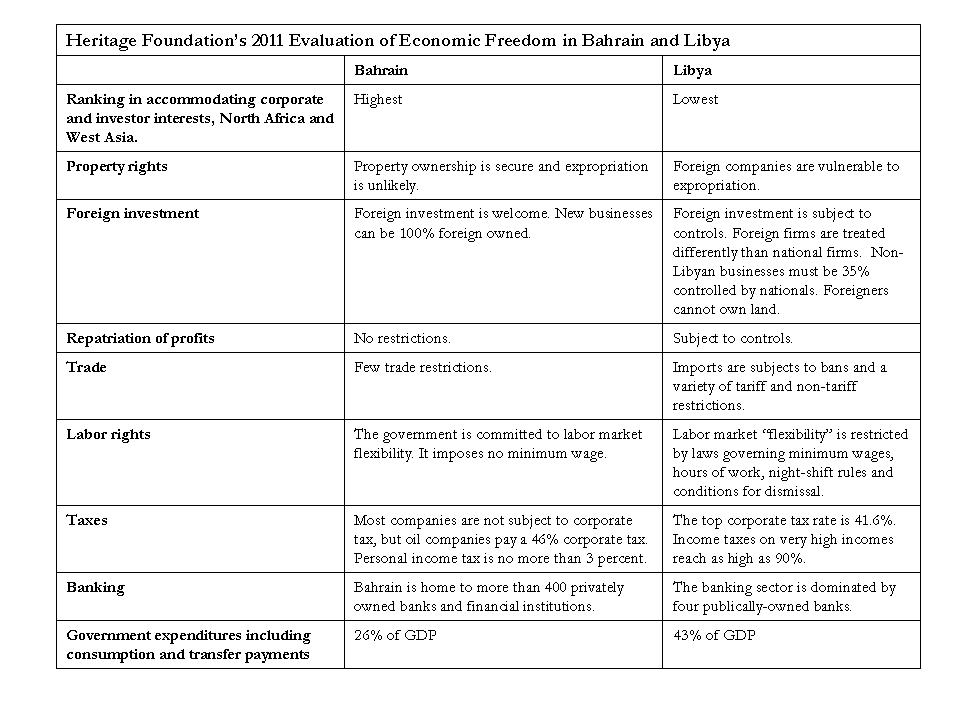
It’s of no small moment that Bahrain and Saudi Arabia are US clients, that Bahrain is home to the US Fifth Fleet, and that both countries are accommodating of the profit-making interests of US coroporations and investors. Nor is it inconsequential that Libya is neither of these things.

These facts go a long way toward explaining the double standard; a febrile reaction to the crackdown in Libya, and the comparative silence of the UN Security Council, Washington, Paris, London, newspaper editorial writers and the soft left on what is going on in Bahrain.

By the way, only 14 percent of the oil consumed in the United States comes from the Middle East and North Africa (see the table below). Most of the country’s oil comes from North America, so access to North Africa and the Middle East isn’t vital to the energy requirements of the United States. What access to the region is vital for, however, is the profits of Western oil companies, which extract, refine and sell the region’s oil to other countries, particularly those in Western Europe and Japan.

Retaining favorable access to the oil reserves of the Gulf states in order to continue to rake in profits from oil sales to other countries (not to secure oil for the home market) is the primary motivation for Washington’s historical – and continued – backing of Gulf monarchies and its total lack of sympathy for the pro-democracy movements inside them.

The media, predictably, follow Washington docilely in vociferously condemning Qaddafi while remaining comparatively silent and being decidedly less judgmental about events in Bahrain. France, Britain, the UN Security Council, responsibility-to-protect hawks, and the soft left, also predictably, do the same.

US oil supply in December 2010
Million barrels per day

US onshore production, 5.5, 37%
Middle East-North Africa, 2.1, 14%
Canada, 2.0, 14%
Mexico, 1.1, 7%
Nigeria, 1.0, 7%
US offshore, 0.1, 0%
Other, 3.0, 20%

Source: Sheila McNulty and Ed Crooks, “US groups unlock secret recipe for oil”, The Financial Times, March 3, 2011.

In Egypt, a New Guard

“There was a revolution, and then we discovered that those in charge of the revolution are not in the least bit revolutionary”–Egyptian newspaper editor, Ibrahim Issa.*

By Stephen Gowans

Field Marshal Mohamed Hussein Tantawi, known to Egyptians as “Mubarak’s poodle,” may be calling the shots in Cairo as head of the country’s military-led government, but the man who sits at his right hand side is the Pentagon’s poodle, and he’s likely to continue to play a key role in Egypt even after a civilian government succeeds the current military one.

Lt. General Sami Hafez Enan, “a favorite of the American military,” according to Elisabeth Bumiller’s piece in today’s New York Times, is second-in-command to Tantawi, the man reviled in Egypt for being a toady to the deposed president Hosni Mubarak.

The Pentagon’s poodle in Egypt, Lt. General Sami Hafez Enan (left) with Admiral Mike Mullen, chairman of the US Joint Chiefs of Staff

Bumiller says Enan—who “remains in close contact with Pentagon officials by phone” and is “a crucial link for the United States”–is considered Tantawi’s likely successor as head of Egypt’s armed forces.

And since the military plays a dominant role in Egypt, Enan is likely to continue to exercise considerable influence, a point Bumiller agrees with. “No one disputes,” she observes, “that General Enan will play a central role in Egypt’s future government, more likely behind the scenes, where the country’s powerful and traditionally secretive armed forces are more comfortable.”

Washington showers $1.3 billion in military aid upon Egypt annually, which the Egyptian military uses to buy “American-made arms and equipment – typically F-16 fighter jets and M1A1 Abrams tanks.” None of the money ever leaves the United States. Instead, Enan and other senior Egyptian military officials present their wish list to the Pentagon, which then transfers US taxpayer dollars into the accounts of US arms merchants, who then deliver the goods.

It’s like an annual gift to General Dynamics. And Egypt. Courtesy of the US taxpayer.

Ever since Egypt agreed to become a prop of US imperialism in North Africa and West Asia—and to allow Israel to run roughshod over Arabs in Palestine and Lebanon–Washington has transferred $35 billion of US taxpayer money to the accounts of US arms manufacturers, on behalf of Egypt’s armed forces.

Bumiller reports that the reforms of General Enan and the military government “have so far been mostly cosmetic.”

Cosmetic is an apt description. Egypt’s revolution has amounted to little more that changing the faces of the state. Mubarak is out, because the people demanded it, and now so too is Mubarak’s old prime minister, also at the behest of the people. But Mubarakism—US domination of Egypt through a local military elite – remains.

This won’t change even if and when the current military government is succeeded by an elected, civilian, one.

What would happen if a future government decided to pursue policies at odds with US foreign policy preferences, especially in connection with Israel? Since a break with Washington on key foreign policy positions would likely disrupt the flow of equipment and training to the Egyptian armed forces, the probable outcome is that the government would lose the confidence of the military, and the military would take over to set Egypt back on the prescribed US foreign policy path. Knowing this, a civilian government is unlikely to step outside the boundaries its military’s benefactor is prepared to tolerate.**

And just how independent of the White House and State Department will a future civilian government be? Already, officials in Washington are “discussing setting aside new funds to bolster the rise of secular political parties.” Sure, Egyptians are free to elect anyone they want, but modern elections are major marketing campaigns. Without strong financial backing, you haven’t a chance. How fitting, then, for the continuation of Mubarakism that Washington’s democracy promoters will be furnishing “acceptable” politicians and political parties with money, strategic advice, polling, and whatever other support they need to prevail over alternatives judged to be incompatible with “US interests”, but which, may, on the other hand, represent the interests of the mass of Egyptians.

Westerners would never tolerate foreign powers backing the West’s political parties, even if it was done in the name of promoting democracy. Strange that so many Westerners think it fine for their own governments to meddle in other countries’ elections –and fall for the deception that the imperialist practice of exerting influence abroad by buying foreign politicians is really a laudable exercise in democracy promotion. If foreign governments meddling in our elections means an outside power is trying to gain advantage at our expense, doesn’t Washington’s setting aside new funds to meddle in Egypt’s elections mean Washington is trying to gain advantage at Egyptians’ expense?

Or are Washington’s and the EU’s motives somehow purer? Given their records of backing Mubarak, other dictatorships, and absolute monarchies, to protect Western “interests,” this can hardly be true.

How then–with Egypt’s armed forces being a virtual extension of the Pentagon and Washington’s democracy promoters preparing to boost funding to pro-US political parties–are we to believe that the Egyptian rebellion will bring about anything more than a cosmetic face-lift of Mubarakism?

A real revolution requires more than replacing Mubarak with Tantawi, Tantawi with Enan, and Enan with a civilian government that needs to keep Enan–and the Pentagon officials he’s in close contact with–happy. A revolution is not a changing of the guard.

* Neil MacFarquhar, “Milestone referendum in Egypt just days away”, The New York Times, March 13, 2011.
**”To wild cheers, Ashraf Huweidar of the Union of Popular Socialism told a crowd of several thousand that his new party would cancel the peace agreement (with Israel) if it came to power — something the military leadership has indicated it won’t allow.” (My emphasis). “Egyptian calls for trials of former leaders”, The Associated Press, April 1, 2011.

Postscript
Below is part of an exchange between The Washington Post and three unnamed members of Egypt’s Supreme Military Council, the body that is currently governing the country. The full interview was carried by the newspaper on May 18, 2011 (“Egyptian generals speak about revolution’).

Q. Do you think that Egypt’s strategic orientation toward Israel will change? Polls show a majority of Egyptians favor abrogating the [1979 peace treaty between Egypt and Israel]. How does the military view this?

A. Egypt fully respects its commitments. This has to be very clear. The peace treaty is part of our commitments and undertakings. It is not possible that 30 years of good relations with the United States will be easily obliterated or canceled.

Is Gene Sharp Superman?

By Stephen Gowans

Samuel P. Jacobs’ Valentine’s Day article in The Daily Beast has a catchy title: “Gene Sharp, the 83 year old who toppled Egypt.” Sharp is a scholar who has spent much of his life developing ideas on how to overthrow authoritarian governments using nonviolence.

While Jacobs’ title is eye-catching, it’s also nonsense. Attributing the toppling of Mubarak to Sharp is like attributing the toppling of the Tsar to Karl Marx. Sure, their ideas may have inspired some of the people who sought the downfall of tyrants, but the connection stops there.

Did an octagenarian nonviolence scholar remotely mobilize millions of Egyptians to bring down Mubarak? If he did we've been misled about Clark Kent. He isn't Superman. Gene Sharp is.

A more realistic description of the nonviolence advocate is provided in the headline of a September 13, 2008 Wall Street Journal article: “Quiet Boston Scholar Inspires Rebels Around the World.” But even this goes too far. Sharp’s techniques of nonviolent direct action may inspire rebels to choose nonviolence, but not to rebel.

The confusion around Sharp is a confusion of means and ends. Sharp and the scholars who work to develop and disseminate his ideas are concerned with means: How to challenge and seize state power. True, the Boston scholar and many other nonviolence advocates appear to embrace liberal democracy as their ideal system, but their work isn’t about singing the praises of regular multi-party elections, the rule of law, and civil and political liberties. Instead, it’s about how to move challenges to the state off a playing field the state has an enormous advantage on: the use of violence.

True, too, the advocates of Sharp’s ideas—and Sharp himself–are often involved in imparting the scholar’s techniques to rebels who are working to bring down governments Washington opposes. And the same rebels often receive generous aid from the US government to facilitate the application of Sharp’s techniques. Still, his ideas are as accessible to Marxists and anarchists looking to overthrow capitalist governments as they are to US-backed street rebels.

Whether Sharp’s ideas played a decisive role in the Tahrir Square uprising, however, is an open question. These days it’s practically impossible for anyone who is seriously interested in challenging the state not to have at least a passing acquaintance with Sharp’s work. It’s just out there. If some people who were active in trying to organize the uprising were Sharp-literate, we shouldn’t be greatly surprised. But what role did they play in shaping the uprising’s actions?

Protestors did not hew strictly to the nonviolent line (they battled violently with police and Mubarak’s thugs when attacked) and the otherwise peaceful nature of the uprising may have had little to do with any conscious commitment to model tactics on Sharp’s advice and more with self-survival. After all, who’s going to storm parliament or the president’s office with the army deployed nearby?

What about the US government? Did it play any role in the uprising?

The short answer is yes. But this shouldn’t be a surprise. It’s almost axiomatic that the United States tries to influence events on the ground in key countries. But that doesn’t mean that it pulled a trigger that set the Egyptian uprising in motion.

States try to influence the affairs of other countries in all sorts of ways: through trade policy; foreign aid; military aid; espionage; media; and so on. If they can gain leverage over an opposition movement, they’ll do that too – either to strengthen it, if they want to destabilize the country in question, or to guide it away from unpalatable alternatives, if the country is an ally. Of course, there is never any guarantee that their investment will pay off.

You can adopt a purist democratic position that says interference in the affairs of other countries is always undemocratic and therefore deplorable, but that’s a moral, not an empirical, position, which involves questions about what type of influence is illegitimate. (Is it illegitimate to use trade policy to influence another country? What about media? Russia Today, the Russian government’s medium for influencing foreign opinion abroad, is every bit as much part of Moscow’s apparatus for influencing affairs in other countries as its diplomatic policy is.) Rather than asking these questions we might be better served by asking which class’s interests are predominant in the efforts of the state to exert its influence overseas.

The United States exerts enormous influence over Egypt in multiple ways, not least of which is through the training, aid, and equipment it provides the Egyptian military. It’s likely that any government in Cairo which pursued measures inimical to the investment and export interests of US corporations and investors would soon be toppled in a coup d’etat engineered by its own US-influenced military. US efforts to influence events abroad typically have the economic interests of US investors, banks and corporations in mind, if not directly, then indirectly.

A favored government that has allowed its rule to become destabilized might also be toppled by its own military to prevent a radical movement from taking advantage of instability to come to power. This may be a fair description of what has happened in Egypt in the last few days. True, the passing of power from Mubarak to the military hasn’t been widely described as a military coup d’etat, but it fits the bill.

One other way in which the United States has tried to influence Egypt’s internal affairs is by providing funding to some sectors of the anti-Mubarak opposition (i.e., the secular, pro-capitalist, pro-foreign investment ones.) Indeed, the Obama administration has provided millions of dollars to pro-democracy groups in Egypt (while showering billions of dollars in military aid upon the Mubarak government, showing where its priorities lie.)

An answer to why Washington has funded the opposition to an autocrat it supported for three decades (and who in turn supported US trade and investment interests) can be found in US policy during the Cold War. It was CIA practice after World War II to covertly fund social democratic groups, parties, newspapers and journals, in order to draw people who were disgruntled with capitalism away from communism—which posed a serious threat to US corporate and banking interests–and to divert their energies into, or cement them in place within, a leftist movement pledged to work within the capitalist system. That’s not to say the US establishment had any particular fondness for social democracy. Quite the contrary is true. But social democracy was preferable to communism, and its role in weakening radical opposition was prized.

Indeed, the Kefaya, or Enough movement in Egypt, which appears to have emerged as a leading player in the anti-Mubarak opposition, embraces a program which is in no way uncongenial with the interests of US banks and corporations. It favors the kind of system Sharp, many nonviolence advocates, and, perhaps the majority of Egyptians, favor. It would not be unreasonable to suggest that if Mubarak’s stable rule was no longer tenable, that Washington would work toward having alternatives in place, one of them being Kafaya and what it appears to aspire to.

Where does that leave Gene Sharp? Well, he would truly be a man of exceptional talents were he able, in his dotage no less, to remotely mobilize a mass uprising to topple an autocrat on the other side of the globe. Equally superhuman must be the former Egyptian police officer who has pulled the strings of the uprising from his command center in a low-rent Virginia apartment using nothing but homemade YouTube videos, as another story goes. And what of Google executive Wael Ghonim? To hear The New York Times tell it, he’s the uprising’s Lenin. So who’s pulling the strings: Sharp, the ex-cop, or Ghonim?

To be sure, the practice of reducing complex social phenomena to the actions of a single individual is commonplace. Reagan brought down the Soviet Union, and Stalin singlehandedly built it and is responsible for all the bad things that ever happened in it. The extermination of six million Jews was authored by a single person, Adolph Hitler, and the Vietnam War is mostly due to Richard Nixon. Great man theories of history may have long been dismissed by scholars for sound reasons, but they continue to thrive in popular discourse in place of explanations based on anonymous social and economic forces.

Unquestionably, Sharp, the ex-cop, Ghonim, and the US government too, played a role in the Tahrir Square uprising, some remotely and indirectly, others more directly. But they alone weren’t the only ones who played a part. So too did Mubarak and his policies and the corruption of his son Gamal, as did Egypt’s military, the Muslim Brotherhood, food prices, the privatization of Egypt’s publically owned enterprises, bloggers, Israel, unemployment, Saudi Arabia, the police, millions of ordinary Egyptians, the media and a vast array of other events, people, relations and systems.

I have no fondness for Sharp. His politics skew far to the right of what I’m comfortable with, though he’s by no means what people in the United States would understand to be right-wing, or Republican. All the same, the depiction of him as a mastermind who mobilizes uprisings around the world is insupportable. He may inspire some rebels to embrace nonviolence, but he no more inspires rebellion than the manufacturers of Grecian Formula inspire the hair of it customers to turn grey.

The Poodle Revolution

It’s an old ploy to defuse an uprising that that could turn into a systemic challenge: Change the guy at the top and call it a revolution.

By Stephen Gowans

We shouldn’t diminish the significance of what the 18-day uprising in Tahrir Square accomplished, but at the same time we shouldn’t overstate its significance either. A US-backed autocrat was forced to step down. But Mubarak’s ouster, much as we would like to call it the beginning of a revolution, is far from that. A revolution, properly so called, goes beyond a mere change in political form and those who govern. It transforms institutions and transfers property from one class to another.

Perhaps a revolution will come to Egypt in time, but so far all that has happened is that power has been transferred from Mubarak to Field Marshall Hussein Tantawi, a long-standing Mubarak loyalist who is a strident opponent of political change, has consistently resisted social reforms and is derided in Wikileaks cables as a “poodle” to Mubarak. (1) Mubarakism hasn’t ended. Mubarak loyalists and Egypt’s military and business establishment remain firmly in charge. (2)

Firmly in charge behind Egypt’s new military rulers is the United States. The Egyptian military is largely an extension of the Pentagon. The Pentagon provides much of its funding and equipment and trains its top officer corps. For the last 30 years, Washington has injected $35 billion in military aid into Egypt, allowed the country to build 1,000 US M1A1 Abrams tanks on its soil, trained Egypt’s officers at US defense colleges, and carried out major military operations from Egyptian bases. (3)

Will Mubarakism—the repressive rule of a US-backed autocrat–be replaced by a multi-party democracy, in which the engineering of consent, rather than the emergency law and secret police, keep the rabble in line? Perhaps. The White House and the State Department are “already discussing setting aside new funds to bolster the rise of secular political parties,” (4) seeking to hem in the outcome of whatever free elections follow.

The opening of political space that a liberal democracy affords is indeed preferable to the Mubarak dictatorship, but if that’s all that comes from the Tahrir Square uprising, the yardsticks will hardly have moved significantly forward.

1. Thom Shanker and Eric Schmitt, “Egypt’s military leaders face power sharing test”, The New York Times, February 11, 2011.
2. Thomas Walkom, “Cairo coup welcomed (sort of) by the West”, The Toronto Star, February 12, 2011.
3. Elisabeth Bumiller, “Calling for restraint, Pentagon faces test of influence with ally”, The New York Times, January 29, 2011.
4. David E. Sanger, “Obama presses Egypt’s military on democracy”, The New York Times, February 11, 2011.

Getting Perilously Close to Truth about US Foreign Policy

By Stephen Gowans

It started off promisingly enough. Over the weekend, the New York Times’ Scott Shane wondered why “the drama unfolding in Cairo” seems “so familiar” if “the United States, as so many presidents have said in so many speeches [is] the world’s pre-eminent champion of democracy.”

Shane never arrived at the obvious explanation: that the United States isn’t the world’s pre-eminent champion of democracy. But he came close.

He touched on some of the more egregious examples of Washington’s dictator-backing: Batista in Cuba; Mahammed Reza Pahlavi in Iran; Ferdinand Marcos in the Philippines (whose “adherence to democratic principles and to the democratic process” then US vice president George H. W. Bush conjured out of a vacuum and then shamelessly praised.)

“The list could be extended,” Shane admitted, to “at least a couple of dozen despots” since World War II alone.

Rarely does the New York Times acknowledge that the United States has a long record of backing dictators, all right-wing and not a few fascist (though the Times brushed over the political character of the dictatorships the US favors.) On the contrary, the newspaper’s accustomed practice is to reinforce what “so many presidents have said in so many speeches”: that the country’s foreign policy is guided by the core US value of spreading democracy.

The reason may be that there is no way the United States can plausibly continue to back its three-decade-long paladin in Egypt, Hosni Mubarak – and the continuation of Mubarak’s regime by his heir apparent Omar Suleiman – and still invoke pro-democracy rhetoric to justify its support (though secretary of state Hilary Clinton, who talks of Suleiman overseeing a transition to democracy, is game to try.)

With US hypocrisy laid bare, the follow-the-flag New York Times has had to make a concession – to truth, at least a partial one.

What Shane concedes is that the United States has values and interests, and that circumstances often conspire to keep the two from intersecting. But that’s as far as he’ll go. Admitting that the United States has “interests” which don’t always align with its “values” comes dangerously close to the truth. But if you follow what Shane has acknowledged to its limit, and ask a key question, dangerously close becomes dangerously there.

Go where Shane fears to tread. US values and interests sometimes conflict. Okay, fine. But when they do – and here are the dots Shane fails to connect — US values take a back seat. In other words, what’s important in US foreign policy are not the country’s values, but its interests.

Okay, but what are its interests? R. Palme Dutt once observed that the idea that countries have interests in other countries was an abomination of geography and democracy. How could the United States have interests in Egypt? Do Egyptians have interests in the United States, to be enforced by shipping billions of dollars to a dictator to hold the interests of US citizens in check, subordinate to their own? If so Americans would surely call this imperialism, rather than failure of values and interests to align. If Egyptians said that they really valued democracy, but that other considerations were senior, Americans would say that Egypt’s commitment to democracy was rhetorical. It’s the other considerations that really matter.

According to Shane, Mubarak has served US interests as “a staunch ally against Soviet expansionism,” by maintaining “a critical peace with Israel,” as “a bulwark against Islamic radicalism” and in promoting “a trade- and tourist-friendly Egypt.” Shane’s New York Times colleague Mark Landler sums it up this way: Mubarak’s regime protects US strategic and commercial interests.

Commercial interests are, of course, business interests, and more specifically, big business interests. They aren’t directly the interests of the bulk of US citizens, nor in many cases do they represent their indirect interests either. An investment by US investors in an existing Egyptian business profits the investors, not other US citizens. A call center set up by a US firm in Egypt to take advantage of low-wage labor benefits the US firm’s wealthy shareholders – many of whom are not even US citizens — while putting downward pressure on US wages and exporting jobs abroad.

In other words, the business interests that Mubarak and other US-backed autocrats protect on behalf of the United States are not the interests of most US citizens, but of an upper stratum of investors, bankers and wealthy shareholders whose sole loyalty is to their bottom lines. The interests of average Americans hardly matter. Indeed, in many cases, their interests are diametrically opposed to those of the investors and shareholders US foreign policy represents (as in the export of jobs).

And who’s footing the bill for the billions of dollars in military aid Mubarak’s regime receives? Given the low corporate tax policies the US government pursues, and the corporations’ skill at minimizing the taxes they pay, the answer is average Americans, not the direct beneficiaries of US foreign policy.

It’s worse. While it might seem that big business interests aren’t the only interests guiding US foreign policy – after all, there are strategic interests too — strategic interests really boil down to the interests of big business. US foreign policy makers weren’t opposed to what they called “Soviet expansionism” because they valued “democracy” but because they valued nearly limitless exploitation of labor, which expanding Soviet influence would have pared back. The problem with Islamic radicalism isn’t that it offends Western values (even if it does), but that it inspires regimes that place national interests above those of US oil companies. Arab peace with Israel is desirable because Israel is beholden to Washington to act on its behalf to prevent an Arab pan-nationalism that might see oil-rich countries balk at domination by US oil interests.

So what of US values? We’re supposed to believe that US policy-makers value liberal democracy, even if they’re willing to place profit-making interests first. But if big business interests win out over liberal democracy when the two collide, what Washington really values – if value is to have any meaning at all – is profit.

It’s like this: I say I value literature, but I always toss my books aside whenever someone turns on the TV. And I never miss an episode of Cribs. So, where do my values really lie?

The significance of this might seem all the greater if it is realized that none of this is bounded by foreign policy. Embracing liberal democracy where it doesn’t conflict with the naked pursuit of profit applies equally in the domestic sphere as well. The readiness of US policy-makers to trash civil liberties in the Red Scare years following the Bolshevik Revolution — when capitalists cowered at the thought of socialist revolution spreading around the world (with little justification it turned out) — attests to this. Civil and political liberties also took a beating later on when fears of spreading Soviet influence also seemed to threaten the capitalist system and the wealth and position of those at the top of it.

As for the democracy Washington is prepared to embrace, it looks good on paper, but comes up short in practice. Washington-friendly democracy is not democracy in its original sense as the rule of a previously oppressed class (the rabble), but democracy of the currently dominant class, the capitalist rich. True, democracy of the kind cabinet secretaries and editorial writers rhapsodize about appears to provide equal opportunity to all to influence the political process, but the reality is that the wealthy use their money to dominate the process through lobbying, funding of political parties and candidates, ownership of the media and placement of their representatives in key positions in the state.

How many cabinet secretaries in Obama’s administration held top corporate jobs and will return to them when their sojourn in Washington ends, replaced by other corporate luminaries who travel in the same circles, sit on the same boards of directors, and whose children go to the same schools and intermarry? The art of politics in capitalist democracy, to paraphrase a key Labour politician of the past, is to enable the wealthy to persuade the rest of us to use our votes to keep the wealthy in power.

Democracy, then, is not a core US value – and it is not, on two counts. First, the democracy Washington embraces isn’t democracy in any substantial sense, but is more aptly termed a plutocracy with democratic trappings. Second, the real core US value is profits. Even Washington’s preferred democracy of the rich gets pushed aside when, for whatever reasons, big business interests cannot be accommodated adequately — that is, whenever real expressions of democracy threaten to break through the restraints the system provides to hold it in check.

New York Times: Democracy is Bad for US Foreign Policy

By Stephen Gowans

Here’s New York Times reporter Mark Landler on Washington’s reaction to the popular uprising in Egypt against the anti-liberal democratic, human rights-abusing Hosni Mubarak, a “staunch ally.”

Washington is “proceeding gingerly, balancing the democratic aspirations of young Arabs with cold-eyed strategic and commercial interests.”

In other words, democracy and human rights are fine, but not when strategic and commercial interests are at stake.

Landler goes on to say that Washington’s cold-eyed commitment to realpolitik and profits “sometimes involves supporting autocratic and unpopular governments — which has turned many of those young people against the United States.”

Well, there’s nothing amiss in Landler’s observation except his downplaying of the frequency with which Washington supports autocratic and unpopular governments – often rather than sometimes.

In Landler’s account of strategic thinking in Washington, it’s all right to support an “upheaval in Tunisia, a peripheral player in the region,” but a “wave of upheaval could uproot valuable allies.” And profits and strategic position demand the possibility be blocked.

After all, the “Egyptian government is a crucial ally to Washington.” And so arrests without charge, including of nearly 500 bloggers, will continue, with Washington maintaining a principled non-interference in Egyptian affairs.

Washington will also continue to tolerate the repressive national emergency law, as it has done since 1981. The law provides the legal cover Washington’s “staunch ally” needs to “arrest people without charge, detain prisoners indefinitely, limit freedom of expression and assembly, and maintain a special security court.” Because this is done in the service of safeguarding US strategic and commercial interests, Mubarak gets US military aid, diplomatic support, and an easy ride in the US media.

Compare that to US treatment of Zimbabwe’s president Robert Mugabe. Even if all the allegations against him were true – and they’re not — the government in Harare wouldn’t come close to matching Mubarak’s disdain for the democratic and human rights values Washington claims to hold dear.

And yet Zimbabwe is deemed by the US president to be a grave threat to US foreign policy, its president denounced as a strongman and dictator, and its people subjected to economic warfare in the form of financial sanctions, while Mubarak is hailed as a staunch ally who must be supported against the democratic aspirations of the Arab street.

The key to this duplicity is that Mubarak has sold out Egypt to US profit and strategic interests, while Mugabe has sought to rectify the historical iniquities of colonialism. Clearly, from Washington’s perspective, Mugabe is serving the wrong interests. Indigenous farmers don’t count. Western investors do.

One wonders where overthrow specialist Peter Ackerman and his stable of nonviolent warrior academic advisors come down on this — on the side of the democratic aspirations of young Arabs or reconciled to the cold-eyed strategic and commercial interests of US corporations and wealthy individuals?

The question, however, may be beside the point. What matters is not whether Ackerman’s janissary Lester Kurtz wants to spout Gandhian bromides to angry Egyptian youths, but whether there’s money to organize and boost the revolutionary energy of the street and how much is being poured into a repressive apparatus to shut it down.
Andrew Albertson and Stephen McInerney (Don’t give up on Egypt,” Foreignpolicy.com, June 2009) have the answer.

The Obama administration has drastically scaled back its financial support for Egyptian activists fighting for political reform. US democracy and governance funding was slashed by 60 percent. From 2004 to 2009, the US spent less than $250M on democracy programs, but $7.8 billion on aid to the Egyptian military.

But even this imbalance overstates the meager support Washington has offered pro-democracy forces. Given Mubarak’s status as a paladin of US commercial and strategic interests, much of Washington’s democracy program spending has probably been allocated to programs that act as a safety valve to divert anger and frustration into safe, non-threatening avenues. Money available to facilitate a real challenge to Mubarak is likely either meager or nonexistent.

With the US establishment vexed by cold-eyed concerns about the need to safeguard imperialist interests against pro-democratic uprisings, champion of nonviolent democracy activism Stephen Zunes can give up whatever dreams he may have had about helping to organize an Egyptian color revolution. When it comes to real democracy, and freedom that counts, the funding cupboard is bare. Color revolutions are for cold-eyed promoters of US strategic and commercial interests, not upheavals against US-backed compradors.

Lester Kurtz’s Duty

By Stephen Gowans

This is the continuation of an exchange between me and Lester Kurtz, a sociology professor and exponent of nonviolent resistance who sits on the academic advisory board of the International Center on Nonviolent Conflict.

Lester Kurtz, an exponent of nonviolent warfare who sits on the academic advisory board of the Council on Foreign Relations-linked International Center on Nonviolent Conflict says he felt it was his duty to meet with members of his country's intelligence community to discuss nonviolent resistance. The ICNC provides information on civil disobedience tactics to groups seeking to take power from foreign governments.

Kurtz’s reply to my “Leftist overthrow advisor Lester Kurtz: ‘I talked with the CIA’” is below, followed by my reply to him.

Kurtz

Stephen Gowans’ commitment to justice and opposition to imperialism is admirable and I wish to thank him for his contribution to that ongoing struggle. I am not convinced, however, that his approach will help him achieve his goals, and would like to offer some friendly suggestions and a gentle critique regarding his approach to what I consider our common endeavor. I welcome a dialogue with him, as well as with anyone wishing to address these vital issues that he raises.

First, I am flattered by his inaccurate headline calling me a “Leftist overthrow advisor,” but that is not me – I am a sociology professor at George Mason University who educates people in the strategies of nonviolent civil resistance. What I teach and write about is not a recipe for taking “power from foreign governments” as Mr. Gowans suggests, but frameworks to understand better a complex phenomenon known as nonviolent conflict and a set of tools that have proved – across various historical cases – effective in resisting different types of oppression. It is a matter of educating and therefore empowering people to stand up to injustice no matter what the source – leftist, right-wing, domestic, or foreign governments, as well as tyranny within the workplace, the home, or the neighborhood.

Mahatma Gandhi, my professor in these matters and the subject of years of research on my part, in addition to being an extraordinary strategist was the genius of anti-imperialism in his day, who set in motion the forces that toppled the colonial system. He wanted everyone to be trained as a Satyagrahi, a nonviolent civil resister who would oppose any kind of injustice in any sphere or at any level, from the micro level (e.g., domestic violence) to the global (e.g., international imperialism).

What is disturbing about Mr. Gowans’ comments is that many of his facts are simply inaccurate. I have never collaborated with the CIA, nor has the ICNC on whose academic advisory board I sit. I spoke as an independent academic and in no way as a representative of the ICNC, when my government asked me to dialogue with members of its intelligence community. I feel that it is my duty as a citizen to educate others when requested, and I was glad to give my modest input, among others, into a greater understanding of nonviolent processes that I think are often so badly misguided and– as Mr. Gowans’ article proves – misinterpreted.

To be completely transparent so Mr. Gowans understands clearly that there are no hidden conspiracies, at the first event, at the Rand office in Washington, I served on a panel with distinguished scholars (including Juan Cole) and spoke about religion and violence (one area of my expertise). Later I was asked to respond to a presentation by UCLA professor David Rapoport about terrorism and then at the National Intelligence Council’s request I gave a presentation on nonviolent movements, which I had mentioned as playing a more significant role than violent ones when examining religious movements. At no time did I provide any information that I did not already present in my publications and courses.

More broadly, Mr. Gowans has a serious misunderstanding of what is being taught by me (and by ICNC), and to whom it is being taught. It would be helpful if he would peruse ICNC’s website or obtain and read its extensive materials on civil resistance before making assumptions about its content. He might also sample my writings and books. Quite the opposite of providing tools for U.S. imperialism, we are offering content much of which is based on struggles that were conducted against regimes supported by the U.S., such as the anti-apartheid movement in South Africa, the movement against Pinochet in Chile, the people power movement against Marcos in the Philippines, and the first Intifada against Israel in occupied Palestine. Moreover, ICNC’s educational materials have been used, and workshops that it supported have been attended, by organizers and participants in the Palestinian struggle against Israeli occupation, in the Maldivians’ successful campaign for democracy, in the West Papuans’ struggle for independence from Indonesia, in the Sahrawis’ struggle for independence from Morocco, in the Egyptian and Ethiopian resistance to dictators in those countries, and in the struggle of Hondurans against the coup regime in that country. All of these nonviolent struggles have been waged against governments supported or assisted by the U.S. government.

As Mr. Gowans essentially concedes, nonviolent civil resistance is empirically proven to be more effective than any other method for bringing about change. The best study demonstrating that is Maria J. Stephan and Erica Chenoweth, “Why Civil Resistance Works: The Strategic Logic of Nonviolent Conflict.” International Security, Vol. 33, No. 1(Summer2008), pp. 7–44. In disseminating information about this phenomenon, the ICNC is merely one of many organizations internationally working to develop nonviolent civil resistance and encouraging its exploration. Training for Change, Nonviolent International, Voices in the Wilderness, the M.K. Gandhi Institute for Nonviolence, and Peaceworkers in the U.S., War Resisters International based in the U.K., and Nova/Center for Social Innovation in Spain, are just a few of the other international organizations that are shouldering the work of global education in nonviolent struggle (and with all of whom ICNC has cooperated).

I wish Mr. Gowans – who I want to believe is as ardent supporter of strategic nonviolent action as I am – would join me and others in creatively developing nonviolent strategies and actions for fighting imperialism and injustice rather than attacking people who are actually providing education for oppressed peoples in hope of helping them mount effective nonviolent resistance.

Gowans’ Response

It is presumptuous of Lester Kurtz to equate his opposition to imperialism to my own. Kurtz’s commitment is not to anti-imperialism but to nonviolent resistance and the thought of Mahatma Gandhi. The two, notwithstanding the efforts of Kurtz, Stephen Zunes, and others to suggest they are the same, are very different.

Embracing nonviolent resistance does not make one an anti-imperialist, anymore than embracing violence does. With equal illogic, we could say that those who take up arms are anti-imperialists, because the use of violence has been central to many past anti-imperialist struggles. But that would imply that the Nazis were anti-imperialists, because they too relied on the use of violence to achieve their political goals. The means used to achieve a goal bear no necessary relationship to the goal to be achieved. The idea that all applications of Gandhian nonviolent resistance are anti-imperialist, because Gandhi led a struggle against British imperialism, is based on the same logical blunder. We can conceive of violence to achieve anti-imperialist ends and nonviolence to do the same. Equally, we can conceive of violence used to strengthen and defend imperialism, and nonviolence used for the same ends.

To be sure, Kurtz’s commitment to nonviolent resistance does not rule out the possibility that he is a committed anti-imperialist. But it would indeed be a strange anti-imperialist who feels that when his government (whose imperialist credentials are beyond dispute) calls upon him to dialogue with members of its intelligence community (who have a lead role in defending and promoting imperialism), that it he is duty-bound to comply. Had he been a German citizen in 1939, would he have felt it his duty to dialogue with members of the SS had he been asked? Apparently, in his felt obligation to meet with the CIA, and in his willingness to provide information on nonviolent struggle to groups with pro-imperialist aims, Kurtz sees himself as having a duty to an imperialist government which is higher than his duty to those struggling against it.

Kurtz takes another logical misstep when he argues: “Quite the opposite of providing tools for U.S. imperialism, we (the ICNC) are offering content much of which is based on struggles that were conducted against regimes supported by the U.S.” It does not follow that the tools the ICNC disseminates are not being used for US imperialism simply because they are based on previous struggles against US imperialism. Logically, Kurtz’s statement is equivalent to saying ICBMs are not weapons of mass destruction because the underlying rocket technology has been used for peaceful space exploration. Or that because guerrilla warfare was central to many anti-imperialist struggles, that the Contras, Mujahedeen, and Kosovo Liberation Army were anti-imperialist.

Kurtz, Zunes and their ICNC colleagues borrow the anti-imperialist prestige of previous nonviolent anti-imperialist struggles, and the progressive prestige of the nonviolent civil rights struggles in the US, to suggest the application of similar techniques is always anti-imperialist and progressive, and to whitewash the applications that aren’t. This is no different, in its political aim, from efforts in the 1980s to marshal support among left-leaning people for the Contras and Afghan Mujahedeen, or in the late 1990s to drum up support for the Kosovo Liberation Army. In doing so, the practitioners of the deception that these guerrilla movements were anti-imperialist used the public relations technique of exploiting a previous association (between guerrilla warfare and anti-imperialism) to suggest that the association is enduring and invariable (and that the Contra, Mujahedeen, and KLA struggles were therefore anti-imperialist.) The reasoning—illogical—follows this form: They must have been anti-imperialist; after all, the tools they used were based on struggles against U.S. imperialism. This anticipates Kurtz’s : “Quite the opposite of providing tools for U.S. imperialism, we are offering content much of which is based on struggles that were conducted against regimes supported by the U.S.”

Kurtz, then, seeks to portray collaboration with imperialism as anti-imperialist by drawing on instances where the use of nonviolent warfare and anti-imperialist struggles intersected. Attempts to breathe life into the false idea that nonviolent warriors are necessarily anti-imperialist can be seen in Kurtz’s attempts to frame his debate with me as one between two people who are committed to the same anti-imperialist goals but disagree on the means to achieve them. That we share very different goals is evident in the contrast between this by Kurtz, and this, by me.

I argued in an article on Peter Ackerman, the founder of the ICNC on whose academic advisory board Kurtz sits, that Ackerman does what the CIA used to do while working to make it seem progressive. In Kurtz’s reply, we can see that he, too, is engaged in the same project.

Finally, Kurtz argues that I essentially concede that nonviolent civil resistance is empirically proven to be more effective than any other method for bringing about change. If he could point out where I conceded this, essentially or otherwise, I would be grateful. I can’t recall ever being interested enough in the point to have either conceded or challenged it. However, now that Kurtz has drawn my attention to the question, let me offer two observations.

First, I shy away from absolutist statements of the kind that any one method is more effective than all others under all conditions, in all places, and at all times. That nonviolent resistance – or any other method of social change — is always the best method, everywhere, under all circumstances, seems highly unlikely to me.

Second, I can’t imagine how the superiority of nonviolent resistance could ever be empirically proven. There are far too many things going on in any struggle for change to disentangle the effects of one form of struggle from all the others that are likely to accompany it and from the effects of the different responses to the struggle that different governments may make.

For example, the Gandhian struggle against British control of India was not unaccompanied by a violent resistance. Moreover, Britain’s exhaustion and depletion following WWII likely figured prominently in the country’s willingness to loosen some control over its colonial possession.

Likewise, it is impossible to isolate the effects of the US-sponsored, aided- and organized-civil disobedience movement on the overthrow of Slobodan Milosevic from the effects of NATO bombing; the US-sponsored and funded KLA insurgency; sanctions; and the differential withholding by NATO of heating oil from areas that supported Milosevic’s Socialist party. Isolating one element of the anti-Milosevic struggle from its many and diverse elements, and then attributing the outcome of the struggle to one element alone, seems to me to be as dishonest as it is methodologically untenable. And yet, this is exactly what the ICNC has done in its paean to nonviolent struggle, Bringing Down a Dictator.

That Kurtz could argue that a method of social change has been “empirically proven” should raise serious questions about his intellectual honesty. Sadly, he seems to be less a social scientist than a kind of salesman for nonviolent resistance who dishonestly exploits his academic credentials to peddle what any intelligent undergraduate would recognize as a conclusion based on methodological nonsense.

To be clear, my view on nonviolent warfare is that it can be effective, but not at all times, in all places, and under all circumstances. Some conditions seem likely to increase the likelihood of a campaign of nonviolent warfare succeeding. These include outside support in the form of funding, training, and organization (what the US government, imperialist foundations and ICNC provide); diplomatic and military pressure on the target government; the use of sanctions and economic warfare to destabilize the economy; and the cooperation of the media to undermine the legitimacy of the target government, as well outside support for so-called “independent” media to do the same. The aim is to weaken and disorganize a government to sap its will to rule. Other governments at other times have been weakened and disorganized by crises (economic catastrophe or the devastation of war, for example) that were not methodically engineered by an outside power. Some of these governments have also been brought down by opposition forces, sometimes violently, sometimes non-violently. The point is that recognizing that nonviolent warfare can be effective in some instances does not amount to essentially conceding that nonviolent civil resistance is empirically proven to be more effective than any other method for bringing about change.

But this is hardly the main concern. Even if I were to concede the point, as Kurtz erroneously claims I have, it wouldn’t erase the collaboration of Kurtz and other exponents of nonviolent warfare with imperialism. That’s the real strike against the ICNC and its agents.