‘We want what we had’

July 20th, 2015

The Taylor Report

Stephen Gowans reviews Kristen Ghodsee’s book, “The Left Side of History: World War II and the Unfulfilled Promise of Communism in Eastern Europe.” Ghodsee interviewed Eastern Europeans about socialism and their situation two decades after dissolution of the Soviet Union, including activists at an Occupy-styled protest in Bulgaria.

From these activists, we learn that many people want free education (like they had in the Soviet Union), and free child care (like they had in the Soviet Union), but they reject the term ‘communism’ and the Soviet Legacy. “We don’t want communism” it has been said, “we just want to have a normal life.”

But lack of all these nice things is ‘normal life’ under capitalism. There is little understanding of the difficulties in providing social wealth in former-fascist, war-torn countries like Bulgaria.

This attempt to grapple with the disappearing welfare state and Soviet legacy comes at a time of heightened official anti-communism. The new capitalist states in East Europe are trying to portray an equivalence between fascism and communism, so as to generate fear of socialism. The effect is that people yearn for the policies of socialism, but not the name.

Ghodsee herself succumbs to the fear of ghosts, drawing from the new capitalist historiography in which Soviets are simply portrayed as demons. She contrasts the ‘good communists’ in Bulgaria to the demon Stalin.

She has to, because if she accepts the achievements of Bulgarian communists, she will be tarred as a Stalinist. Instead, she calls for a merging of the Soviet welfare state with Western political institutions. Yet it is these Western institutions that block socialism in their own countries, and in Eastern Europe. Ghodsee and others need to take a lesson from E.H. Carr, who refused to submit to the moral blackmail of being labelled a ‘Stalinist’ for reviewing the progress of the Soviet Union.

Audio Files:

Interview with Stephen Gowans

MP3 Page:

http://www.radio4all.net/index.php/program/81858

Link:
Submitting to Moral Blackmail? Kristen Ghodsee’s “The Left Side of History

Submitting to Moral Blackmail? Kristen Ghodsee’s “The Left Side of History”

July 19, 2015

By Stephen Gowans

Kristen Ghodsee’s “The Left Side of History: World War II and the Unfulfilled Promise of Communism in Eastern Europe,” is a variegated reflection on socialism as practiced in Eastern Europe, and especially Bulgaria, in the four and half decades following WWII. It is, at one and the same time, a meditation on the purpose of official anti-communism; a near hagiography of the British communist Frank Thompson, the elder brother of the famed historian E.P. Thompson, who died fighting with Bulgarian partisans in WWII; a history of the Lagadinovas, three brothers and a sister (the latter of whom would become famous throughout the socialist bloc as the “Amazon”), who joined the ranks of communist partisans struggling against Bulgaria’s Nazi-allied government; a Philippic against the contemporary political left for being comfortable only with opposition, and lacking any clear sense of what it’s for; and paradoxically, given the foregoing, an execration of communism, filled with the crude anti-communist diatribes one would expect from The Black Book of Communism, and not from one who sets out to explore the heroism of communist partisans and a British communist who fought with them.

Ghodsee is an ethnographer whose prior works include “three books on how non-elite Bulgarian men and women experienced the economic transition from communism.” (Ghodsee, 2012)

Function of official anti-communism

Left Side of HistoryIn writing The Left Side of History, Ghodsee set out to show there was much good about communism in Bulgaria. She felt that the achievements of communist Bulgaria were hidden beneath an avalanche of official anti-communist demonization. In this, she has responded to a danger foretold by the great historian of the Russian Revolution, E.H. Carr. Referring specifically to the Bolshevik revolution, Carr warned in 1978 that there was little danger that a veil would be drawn “over the enormous blots on the record of the Revolution, over its costs in human suffering, over the crimes committed in its name.”

Indeed, every effort has been made by those who would discredit the Bolsheviks and all they stood for to bring these to the fore. The greater danger, warned Carr, was that

“we shall be tempted to forget altogether, and to pass over in silence, (the Revolution’s) immense achievements…I am thinking of the transformation since 1917 in the lives of ordinary people: the transformation of Russia from a country more than eighty per cent of whose population consisted of illiterate or semi-literate peasants into a country with a population more than sixty per cent urban, which is totally literate and is rapidly acquiring the elements of urban culture…and these things have been brought about by rejecting the main criteria of capitalist production—profits and the laws of the market—and substituting a comprehensive economic plan aimed at promoting the common welfare.” (Carr, 1978)

For her part, Ghodsee celebrates the achievements of Bulgarian communism. It “provided support for working mothers and promoted programs to ensure the de jure and de facto equality of men and women. Communism promoted literacy and education and health care and guaranteed full employment for anyone able to work. Communism gave people jobs, homes, and daily routines that were predictable and stable…” (Ghodsee, 2015: 192)

Nowadays, communism is presented, not as a type of society that stressed the common welfare and the end of exploitation of man by man, but as an abomination equal to Nazism. In 2009, the European Union created a new holiday, the European Day of Remembrance for Victims of Stalinism and Nazism. Ghodsee condemns this as an attempt to discredit communism at a time the global financial crisis is inspiring austerity-weary populations to seek political alternatives. She cites also as further evidence of the efforts to blot out the rich contribution communists have made to the progress of humanity, a June 2013 decision by a Madrid court ordering the dismantling of a monument that commemorated the sacrifices of the mainly communist International Brigades, volunteers burning with passion for a new, more humane and democratic world, who fought against Franco’s fascists.

In my country, Canada, plans are afoot to erect a monument to the “victims” of communism, leaving ordinary Canadians puzzled as to why. Canada has never been Communist.

But there is a chance that Canadians, and others in the world, bedevilled by unemployment, economic insecurity, diminished economic opportunity and growing material deprivation, will increasingly look to the model provided by the really-existing socialism of the Soviet bloc as an alternative. “Communism may be making a bit of a comeback in Europe,” Ghodsee writes, “but it is also the case that some political elites are working harder than ever to stop it by blackwashing its history.” (Ghodsee, 2015: viii-xix) She adds, “At the exact moment when ordinary people are searching for political alternatives, many official historical institutes are supported (often with funds from the West) to discredit communism.”

Victims of communism, promoters of fascism

Ghodsee effectively punctures the growing movement to commemorate the ‘victims’ of communism by showing that the ‘victims’ were hardly innocents, but in many cases, were xenophobes, Judeophobes, and fascists responsible for the deaths, oppression and exploitation of numberless people.

Every year some Bulgarians lay wreaths at a wall inscribed with the names of many who died at the hands of communists. “The victims memorialized on the wall include many political opponents of communism executed after September 1944, when Bulgaria’s communists seized power in this tiny Balkan country,” reported the Associated Press. (Ghodsee, 2015: 192) Ghodsee points out that ‘Nowhere was it mentioned, even in passing, that Bulgaria’s ‘political and military elite’ were allied with Nazi Germany.” (Ghodsee, 2015: 192)

The ‘victims’ of communism memorialized in Bulgaria include:

o Bogdan Filov, a passionate and committed ally of Hitler, who as Bulgarian prime minister from 1940 to 1943, deported 11,000 Jews to their deaths at Treblinka;

o Petar Gabrovski, minister of the interior under Filov, and briefly prime minister; a vicious Judeophobe who started his political career as a Nazi;

o Nikola Zhekov, head of the Bulgarian far-right legionnaires and a personal friend of Hitler;

o General Hristo Lukov, the Bulgarian minister of war, who has become an inspiration for today’s neo-Nazis. (Ghodsee, 2015:194-196)

What are we fighting for?

Ghodsee writes of an encounter with students at an Occupy-like encampment.

“I spoke to some students sitting on the ground in front of one of the tents. There was a sign in Bulgarian. It read ‘This is not a protest. This is a process. Revolution for a New Bulgaria.’

“I asked the students why they were protesting. One young woman said, ‘I love my country, but I have no future here. While the Mafia governments stay in power, Bulgaria will never develop, I don’t want to leave. I want to stay and fight and make my country a better place.’

“’Do you have any concrete proposals?” I said. The protestors I had spoken to thus far all had very different ideas about what needed to be done.

“’Free university education,’ she said. The other students nodded. ‘And practical training placements for three years after you graduate.’

“’You mean like it was before?’ I said. Before 1989, the state paid for all university education, and all students completed three years of national service upon graduation. The state guaranteed a job in the student’s area of speciality…

“’Yes,’ the woman said…

“A second woman in the group waited until there was a lull in the conversation before she spoke. ‘There should be more kindergartens,’ she said. ‘Every mother should have a safe place for her child when she works.’

“’You mean like they had under communism?’ I said.

“At the word ‘communism,’ the students tensed.

“’We don’t want communism back,” the first young woman said. ‘We just want a normal country.” (Ghodsee, 2015:166-168)

In a similar vein, Ghodsee recounts a conversation between two elderly Bulgarian women, Elena Lagadinova, who joined the Bulgarian partisans at age 14 and later became a member of the Bulgarian Communist Party Central Committee, and Maria Zneopolska, author of a book on Frank Thompson.

“’Look at these protestors,’ Elena said, ‘They are against the monopolies and the corruption and the foreign capitalists. These are the same things (the communist partisans) were against.’

‘It’s the same fight,” Maria agreed. She looked to Elena and then back at me. ‘But it’s not enough to protest against. Nothing ever changes until the people have something to fight for.’” (Ghodsee, 2015: 175)

Ghodsee’s anticommunism

While Ghodsee laments that “strident anticommunist rhetoric demonizes anyone who once called himself or herself a ‘communist’ or who believed in the communist ideal” (Ghodsee, 2015: xvi) and regrets the hegemony of an anti-communist ideology that makes it “easier to assert that the moon landing was staged than it would be to argue that there was anything good about the communist past,” (Ghodsee, 2015: 133) she, herself, reinforces the anti-communism she deplores.

This, she does, subtly, in earlier publications, through the use of language that implicitly accepts communism as a danger implanted from without. For example, in Lost in Transition: Ethnographies of Everyday Life after Communism, Ghodsee writes that “the revolution in Cuba (just 90 miles from Florida) brought the communist threat closer than it had ever been to the United States” (emphasis added; Ghodsee, 2011: xi) rather than writing “the Cuban revolution brought communism (sans threat) closer than it had ever been to the United States”, or that it “brought the communist threat closer than it had ever been to the capitalist elite of the United States.” She wrote too of how “Many countries in Latin America and Africa were constantly fighting communist insurgencies” (Ghodsee, 2011: xi) as if the insurgencies were separate from the countries that battled them. Here she equates country with the state. It would have been more apt for Ghodsee to have written that many states in Latin America and Africa, backed by Western economic and political elites, fought to suppress rebellions from their populations against their oppression and exploitation. Of the other September 11, September 11, 1973, Ghodsee writes “Chile would elect a socialist leader, leaving the United States no choice but to support a coup d’état” (Ghodsee, 2011: xi), leaving one to muse over why she felt the United States government had no choice. Indeed, formally, it did have a choice, though it might be argued that the imperatives of the US economic system created a compulsion for Washington to intervene.

In The Left Side of History Ghodsee abandons subtle anti-communist language for crude, and shockingly puerile, anti-communist rhetoric. After touting the achievements of Bulgaria’s communism, she brands communist Bulgaria “a brutal dystopia ruled by paranoid dictators.” (Ghodsee, 2015: 129) Rather than examining the history of Stalin’s Soviet Union from the perspective of the multiple and almost insuperable challenges the country’s leadership faced, she offers a sophomoric psychological reductionism, transforming Stalin into a kind of cartoon character Dr. Evil, who she depicts as a “megalomaniac” who “hijacked the communist cause” (Ghodsee, 2015: 129) to pursue his “dreams of world domination.” (Ghodsee, 2015; 128) It appears that it is not only the European Union that has drawn an equal sign between Hitler and Stalin.

Against the Stalinist Beelzebub Ghodsee juxtaposes the pure and angelic heroes of her book, Frank Thompson and the Lagadinovas, the ‘good’ communists betrayed by their iniquitous leaders. “I needed to remind myself,” she writes, “that not all who fought or found themselves on the left side of history were radical Marxist zealots bent on world domination.” (Ghodsee, 2015: 199) Ghodsee wants us to believe that everything good about communism in Bulgaria is traceable to Thompson, the Lagadinovas, and the good communists, and all the bad is due to “Stalinists.”

This, however, is completely indefensible. The Bulgarian partisans and Frank Thompson had very little to do with the gains communism implanted in Bulgaria. The Bulgarian partisans were, by Ghodsee’s own admission, largely ineffective. They spent most of their time eking out a bare existence, frequently betrayed by peasants who didn’t support them. Unlike in neighboring Greece and Yugoslavia, where foreign occupations galvanized people to support the communist-led guerrilla resistance, Bulgaria was allied with Nazi Germany and endured no foreign occupation. The lives of most Bulgarians during the war were quiet, and they did not support the communist guerrillas. It was the Red Army, under Stalin’s leadership, that ultimately toppled Hitler’s allies in Sofia, and brought communism to Bulgaria. Stalin, far more than the Lagadinovas, and especially the hapless (though admirable) Frank Thompson, is responsible for the immense social gains Bulgaria enjoyed during the communist period.

Ghodsee’s politics

Ghodsee’s political ideal, revealed in her various other writings, is “a more socially oriented state akin to the Scandinavian welfare state—states that combine democracy with social security.” (Ghodsee, 2004) She doesn’t say what she means by ‘democracy,” though it appears that she means a multiparty state, or at least, not the socialist states of central and eastern Europe in which one party, that of the Communists, was hegemonic. What she’s against is “the overly-individualistic, savage capitalism of the United States and the United Kingdom,” (Ghodsee, 2004) but is also against “one-party rule and leaders who remained unchallenged for thirty-five years” (Ghodsee, 2015: 191). She favors a combining of the full-employment, social welfare, egalitarian politics of the communist states (democracy as a type of society) with the procedural democracies of North America and Western Europe (democracy as a set of rules for electing representatives.) In this she is guilty of what she faults the contemporary left for: being clear on what she’s against (‘savage’ capitalism* and the one-party state), but having no concrete proposal for how to bring about the implied alternative, namely, socialism within a multi-party state—nor any sense, one suspects, of whether a socialist state with a Western-style parliamentary democracy is at all possible in a world profoundly dominated politically, economically, militarily and ideologically by a capitalist elite, who will no more accept a “democratic” socialism than an “undemocratic” one. The only difference between the socialism Ghodsee lionizes and the socialism she deplores is that the first has never existed. It’s as if, like the supporters of Syriza, Ghodsee believes that all one has to do is vote against capitalism (or austerity) and the capitalist elite, its institutions, and imperatives will meekly step aside. Jean Bricmont offers a refreshing corrective to Ghodsee’s naiveté. “If it is true, as often said, that most socialist regimes turn out to be dictatorships that is largely because a dictatorship is much harder to overthrow or subvert than a democracy.” (Bricmont, 2006)

Conclusion

The Left Side of History is not without its charms. Ghodsee does stress the importance for the left of having a clear idea of what it’s for and concrete proposals for how to get there. She makes the case, cogently I think, that the upsurge in official anticommunism is linked to the financial crisis and austerity and the need of ruling elites to eclipse, what from their point of view, is a danger that in a searching for political alternatives, people will turn to the really-existing socialism of the Soviet bloc for inspiration. She has shown that many of the so-called victims of communism were hardly innocent, but instead were victimizers—often fascists, racists and xenophobes, responsible for the persecution, oppression and deaths of numberless people. And in exploring the lives of Frank Thomson and the Lagadinovas, she challenges official anti-communism by pointing to communists who were not the “red scum” of official anticommunist demonology but selfless heroes with a burning passion for a more humane, democratic world.

The weakness of The Left Side of History lies in Ghodsee’s occasional substitution of anti-communist slogans for critical analysis, as in her portrayal of Stalin as a paranoid bent on world domination who hijacked a good cause and turned it to evil ends. In this she concedes to the official demonology. To be sure, in her view, Thompson and the Lagadinovas were communist heroes but Stalin and Stalinists were red scum. What Ghodsee loses sight of was that Thompson and the Lagadinovas were members of a movement in which Stalin played a central role, and could therefore, themselves, be called “Stalinists.” What’s more, Stalin, to far greater degree than Ghodsee’s chosen heroes, brought the achievements of communism to Eastern Europe.

Another weakness is Ghodsee’s depiction of communist Eastern Europe as a brutal dystopia. Indeed, this borders on bizarre, considering that she attributes the rise in official anticommunism to a need on the part of ruling elites to discredit communism as a model. Why would anyone feel compelled to discredit a brutal dystopia?

One could speculate that in writing The Left Side of History, Ghodsee was filled with a dread that her favorable assessments of communism would inevitably mean she would be denounced as a Stalinist. Could it be that as a prophylaxis, she armored herself with anti-Stalinist rhetoric? Her rhetoric is fevered, of a more rabid variety than even conservatives are capable of. I’m not sure I’ve ever heard anyone seriously accuse Stalin—the champion of socialism in one country, the man who dismantled the Comintern and pursued what his leftist critics called an overly cautious foreign policy–of having had an agenda of world domination.

If indeed fear of being denounced as a Stalinist led Ghodsee to the missteps that have almost fatally weakened The Left Side of History, she might have looked to E.H. Carr for inspiration. After publicly declaring his concern that the achievements of communism would be expunged from history, Carr acknowledged that, “Of course, I know that anyone who speaks of the achievements of the Revolution will at once be branded as a Stalinist. But I am not prepared to submit to this kind of moral blackmail.” (Carr, 1978)

*Savage capitalism implies there’s some other kind of capitalism, perhaps a gentle one. But this is tantamount to distinguishing a gentle slavery from a savage slavery, as if indeed, a gentle slavery (or a gentle capitalism) is anything but an oxymoron.

References

Jean Bricmont. Humanitarian Imperialism: Using Human Rights to Sell War. 2006

Kristen Ghodsee, “The Specter Still Haunts: Revisiting 1989,” Dissent, Spring 2012

E.H. Carr, “The Russian Revolution and the West,” New Left Review 1/111/ September-October 1978.

Kristen Ghodsee, “Red Nostalgia? Communism, Women’s Emancipation, and Economic Transformation in Bulgaria,” L,Homme Z. F. G. 15, 1 (2004)

Kristen Ghodsee, Lost in Transition: Ethnographies of Everyday Life after Communism. Duke University Press Books, 2011.

Kristen Ghodsee. The Left Side of History: World War II and the Unfulfilled Promise of Communism in Eastern Europe. Duke University Press. 2015.

Rethinking Chemical Weapons

It’s highly unlikely that the Syrian military has used chemical weapons in its ongoing fight against foreign-backed jihadists, but if it had, would use of the weapons be uniquely reprehensible, and would it justify an intervention?

“You mention chemical weapons, people immediately freeze and are irrational.”–Hamish de Bretton-Gordon, former commanding officer of the British army’s chemical weapons unit.*

June 27, 2015
Updated July 18, 2015 and August 14, 2015

By Stephen Gowans

There are two problems with the way we think about chemical weapons. The first is the idea that killing with gas is more reprehensible than killing with bullets, shrapnel, and explosives. This position is both intellectually and morally indefensible. The second is our belief that chemical weapons are weapons of mass destruction (WMD). They are not. In fact, they’re no more WMD than are bullets and machetes. [1]

Available from Baraka Books http://www.barakabooks.com/catalogue/washingtons-long-war-on-syria/
Before elaborating on these points, let me address the question of whether the Syrian Army has used chemical weapons. This article is not a defense of the use of chemical weapons by Syrian forces, because I don’t believe the Syrian Army has used them. If it had, I would defend the army’s use of these weapons, but there’s no reason to believe they have been used, and compelling reasons to believe they haven’t. It’s impossible, of course, to say definitively that Syrian forces haven’t used chemical weapons; negatives can’t be proved. But there are compelling political and military reasons that can be cited that any reasonable person would concede amount to formidable constraints on the Syrian military that would prevent it from using chemical weapons. These constraints make the allegations against Syrian forces unconvincing. Plus, there’s no hard evidence, only allegations by states with a record of placing fabrications on the public record as pretexts for illegal aggressions against nationalist, socialist, communist and anti-imperialist governments. As an Arab nationalist state, with a significant public sector, and an independent foreign policy, Syria is a prime target for aggression by the United States, its allies, and its proxies.

Chemical weapons, as will be shown below, are highly ineffective. It’s difficult to conceive of when they would be used when bullets, conventional ordnance, missiles and jet fighters are at hand. Militarily, there are no compelling reasons for the Syrian military to use chemical weapons. This logic is all the stronger in the case of chlorine gas which is more an annoyance (its makes people sick, and rarely kills) than a credible weapon. [2]

Additionally, it made no sense politically for Syrian forces to deploy chemical weapons once their use became a red line drawn by US President Barack Obama. Since the US leader promised that the use of chemical weapons by Syrian forces would trigger missile strikes, any possibility of their use became severely constrained. And since there were no compelling military reasons to use them, allegations that the Syrian military did, indeed, use them are unconvincing in the extreme.

The recent allegation that Syrian forces are using chlorine gas-filled barrel bombs dropped from helicopters suffers from the same lack of credibility. The political reasons against using chlorine gas remain the same as those that militate against the use of banned chemical weapons. And the military reasons that act as restraints on their use are even stronger, since chlorine gas rarely kills. [3]

Let’s acknowledge, then, that the Syrian military almost certainly hasn’t used chemical weapons in Syria in the last four years, and almost certainly isn’t mounting chlorine gas attacks today. Instead, let’s turn to the following questions:

• Are chemical weapons more reprehensible than other weapons?
• Are they legitimately WMD?
• Where did the concept of WMD come from?
• What role, if any, does the concept play in selling Western foreign policy goals to the public?

The idea that killing with gas is more reprehensible than killing with bullets, shrapnel, or explosives is untenable. Why is choking to death from gas inhalation inhumane, while bleeding to death from a bullet wound, being crushed to death by a collapsed building struck by a missile, or being incinerated in an explosion, morally acceptable? Why is killing hundreds of people with sarin or mustard gas bad, when killing a hundred-fold more people through sanctions and economic blockade and their attendant hunger and disease, is all right? In this perverted moral calculus, what matters, it seems, is not the weapon, per se, but who’s wielding it. Our unique weapons are all right. Their unique weapons are morally repugnant. This double standard is glimpsed in the condemnation by Western human rights NGOs of the Palestinians’ home-made rockets as indiscriminate and therefore criminal under international law and the acceptance of Israel’s missiles and bombs as “precise” and therefore acceptable under the rules of war. The trouble is that the “morally repugnant” Palestinian rockets kill few Israelis while the Israeli’s “morally acceptable” precise weapons kill many Palestinians. [4]

To have any meaning at all, the concept of WMD must include weapons that kill massive numbers of people, and exclude those that don’t. A single atom bomb dropped on Hiroshima killed 70,000 people. [5] By contrast, a rocket with a typical payload of nerve gas will kill between 108 and 290 people if delivered under ideal weather conditions (overcast skies with no wind) over a heavily populated area against unprotected people. If there is a moderate wind or the sun is out, the death rate will be 11 to 29 people. [6] WMD kill tens of thousands or hundreds of thousands of people, not tens or hundreds.

Compared to the single atom bomb dropped on Hiroshima, a single rocket with a typical chemical weapons payload perfectly delivered against unprotected people will produce a fatality rate less than one-half of one percent as great under ideal conditions, and less than one-twentieth of one percent as great under realistic conditions. Against those with gas masks, or who have taken shelter indoors, the fatality rate will be infinitesimally small.

In WWI, it took 70,000 tons of gas to produce as many fatalities as were produced in Hiroshima by a single atom bomb. [7]

For the aforesaid reasons, defining chemical weapons as WMD is highly dubious unless the concept is so diluted that bullets and machetes are also included. [8] In large quantities, chemical weapons can kill many people. But in large quantities, bullets and machetes can kill many people, too.

Chemical weapons were introduced by the Germans in 1915. They accounted for less than one percent of battle deaths in WWI. Only 2-3 percent of those gassed on the Western front died, while the fatality rate among those struck by bullets or shrapnel was 10 to 12 times higher. It took a ton of gas to produce a single fatality. After the war, some military analysts argued that gas was comparatively humane—it incapacitated troops without killing them. [9]

Iraq made extensive use of chemical weapons in its war against Iran in the 1980s—to little outside protest. At the time, Iraq was fighting a US enemy, Iran, with US assistance. Hence, for the United States and its allies, chemical weapons were all right—even though they were largely ineffective. Of 27,000 Iranian soldiers gassed, only 268 died—one in 100. [10]

Baghdad’s chemical weapons attack on the Iraqi Kurdish town of Halabja in 1988 is held up as an example of the weapons’ extensive destructive power. The attack is said to have produced 5,000 deaths. However, even if we accept this estimate as reasonable, it isn’t in the tens of thousands, as would be expected from a true WMD, like an atom bomb, but is in the low thousands. And there’s reason to believe that even this number is over-estimated. The source of the estimate was Iranian authorities, who had an interest in exaggerating the number of fatalities, because they were engaged in a conflict with Iraq and were providing aid to the Kurds. Journalists visiting the town after the attack reported seeing hundreds, not thousands, of dead. And the town had been under siege for several days and bombarded by conventional artillery.
Conventional weapons likely accounted for some fraction of the fatalities, and perhaps a large fraction. [11]

A Human Rights Watch report on Iraqi chemical weapon attacks in Iraqi Kurdish areas during the 1980s cited two attacks in which it is suggested that 300-400 may have been killed (again hundreds, and not tens of thousands of fatalities), while estimates for other attacks are under 100, and most are under 20. [12]

The release of sarin gas into a Japanese subway station in 1995 killed only 12 people. [13]

In August 2013, a chemical weapons attack took place in the Syrian town of Ghouta. Fatality estimates range from the low hundreds to low thousands, not tens of thousands. [14]

Thousands were killed in the 1984 Bhopal tragedy in India. This is sometimes cited as an example of the massive destructive power of chemical agents. But 40 tons of toxic gas was released into a heavily populated area after an explosion at a chemical plant, and no chemical weapon carries a payload of 40 tons. [15] To be sure, chemical weapons can be highly destructive if used in massive quantities, but so too can bombs and incendiaries, as witness the tens of thousands of deaths caused by the fire-bombings of Dresden, Hamburg and Tokyo in WWII.

Propaganda

The idea that killing with gas is more reprehensible than killing with bullets and shrapnel comes out of WWI. The Germans were the first to introduce gas in 1915 and the British emphasized the inhuman aspects to try to draw the United States into the war on their side. [16] The British used the deception—to be used by many other states subsequently–that their weapons were humane while the weapons uniquely used by the other side were inhumane. That this was wrong is starkly illustrated by the following: Eighty thousand soldiers died from gas in WWI. Even if all of these fatalities were British, the number would pale in comparison with the hundreds of thousands, and possibly as many as 750,000 German civilians who perished from hunger and disease as a result of Britain’s deployment of its main weapon against Germany—a blockade intended to starve the country into surrender. [17]

Initially, WMD was a term to denote nuclear weapons or weapons of similar destructive capacity that might be developed in the future. [18] In 1989, George HW Bush departed from this convention, using the term WMD in an address to the UN in connection with chemical weapons. [19]

In 1990, on the eve of the Gulf War, the White House began to talk of Iraq as “an emergent regional superpower, bristling with weapons of mass destruction,” a reference to Baghdad’s chemical weapons and ballistic missiles. [20] As shown above, chemical weapons are manifestly not WMD. Nor, by themselves, are ballistic missiles WMD. But it was useful for Washington to transform Iraq from being seen accurately as a comparatively weak country militarily that could carry out chemical weapons attacks, each of which could kill a few thousand at most under favorable conditions, to being seen inaccurately as a WMD threat. The purpose of elevating Iraq from a non-threat to a large threat was to soften public opinion for a series of wars and massively destructive sanctions that would soon be rolled out against the country. Washington’s problem with Iraq wasn’t that it bristled with WMD (it didn’t), but that it bristled against subservience to the interlocked political and economic agendas of Washington and Wall Street. As an Arab nationalist state with a publicly-owned economy sitting atop an ocean of oil, Iraq was a prime target for US aggression. Deceiving the Western public into believing Iraq was a WMD threat would secure public support for, or at least acquiescence to, a campaign of war and sanctions leading to regime change and absorption of Iraq into the United States’ informal empire. The ultimate prize would be the privatization of Iraq’s oil industry. [21]

In 1992, as sanctions against Iraq were beginning to bite, US law defined chemical and biological weapons as WMD. In 1994, radiological weapons and explosives were added to the list. Under the law, almost all weapons apart from modern rifles and pistols now became WMD, a vast extension of the concept, rendering it virtually meaningless. [22]

Chlorine Gas

Bullets kill. Shrapnel kills. Explosives kill. Chlorine gas makes people sick. It is lethal only in very high doses and where medical attention is not immediately available. [23] It’s a nuisance, not a lethal threat. It’s not even in the same category as bullets and machetes.

There are compelling political and military considerations that militate against Syrian forces mounting chlorine gas attacks. Chlorine gas is less effective than bullets and conventional ordnance, so why use it? Moreover, doing so would open up Syria to the risk of the United States claiming that the Syrian military’s use of chlorine gas was uniquely reprehensible and that air and missile strikes on Syrian forces were necessary as a moral response to barbarity.

By contrast, there is a strong reason for the jihadist proxies of the United States and its allies to mount chlorine gas attacks. They would welcome any direct military intervention by US and allied forces that weakens the Assad government. Any evidence of chlorine gas use in Syria can be employed to create a pretext for a US-led air campaign against Syrian forces, or short of that, to further vilify the Syrian government. Pinning blame for chlorine gas attacks on Assad and convincing the Western public that the Syrian president is culpable isn’t difficult to do. The Syrian leader has already been so thoroughly demonized that any charge, no matter how absurd, improbable, or baseless, will stick. All that needs to be done is to produce evidence of chlorine gas use, and then have Western state officials publicly express a “strong suspicion” that the Syrian Army is responsible. No hard evidence need be produced. The allegations will be disseminated uncritically by mass news media, to become, soon enough, the received truth. If the incident isn’t used by Western forces as a pretext for an attack, it can still be added to the growing Himalaya of slanders and black propaganda that has accumulated against the Syrian government over the last four years, and so make a future attack all the easier to sell to Western populations.

Significantly, chlorine gas has been used by jihadists in Iraq since 2003. There was flurry of chlorine gas attacks on US forces carried out by Al Qaeda in Iraq in 2007. [24] The jihadist group later became ISIS and Jabhat al-Nusra, the main anti-government militant groups operating today in Syria. Ask yourself: If chlorine gas attacks have been mounted in Syria, who is more likely to have been the perpetrator—organizations with a history of using the weapon and a motivation to continue [25], or an organization with no military reason to use it and a compelling political reason not to?

Conclusion

The idea that chemical weapons, like nuclear weapons, kill massive numbers of people is wrong. Chemical weapons are no more destructive, and often are far less so, than conventional arms. Calling chemical weapons massively destructive makes the concept of WMD meaningless. WMD has become a hollow term used to manipulate public opinion to secure support for dubious political goals. Developed as a way of justifying a program of aggression against Iraq, its sole function is to connote something bad while denoting almost nothing at all, in order to turn non-threats into seemingly legitimate targets to secure public support for campaigns of aggression against governments whose sole crime is to exercise sovereignty over their country’s politics, natural resources, and economy.

*****

Stephen Gowans discusses chemical weapons and WMD with Brendan Stone on Unusual Sources

Radio: We need to oppose illegal wars, not just weapons

*****

*Adam Entous, “Islamic State suspected of using chemical weapon, U.S. says,” The Wall Street Journal, August 13, 2015.

1. John Mueller, “Erase the Red Line,” Foreign Affairs, April 30, 2013

2. Anne Barnard and Somini Sengupta, “Syria is using chemical weapons again, rescue workers say,” The New York Times, May 6, 2015

3. Barnard and Sengupta

4. See Jonathan Cooke, “Experts: Israel’s weapons are not precise,” The Blog from Nazareth, August 1, 2014. http://www.jonathan-cook.net/blog/2014-08-01/experts-israels-weapons-are-not-precise/

5. John Mueller and Karl Mueller, “Sanctions of Mass Destruction,” Foreign Affairs, May/June 1999

6. “A 1993 analysis by the Office of Technology Assessment of the U.S. Congress finds that a ton of sarin gas perfectly delivered under absolutely ideal conditions over a heavily populated area against unprotected people would cause between 3,000 and 8,000 deaths. Under slightly less ideal circumstances—if there is a moderate wind or if the sun is out, for example—the death rate would be one-tenth as great.” (John Mueller. Overblown: How Politicians and the Terrorism Industry Inflate National Security Threats, and Why We Believe Them. Free Press. 2006. p.18.) The UN estimated that rockets carrying a payload of between 11 and 16 gallons of chemical agent were used in the 2013 chemical weapons attack in Ghouta, Syria. (“Syria chemical attack: What we know,” BBC, September 24, 2013) Assuming an average payload of 13 gallons and 358 gallons per ton, then 13 gallons of sarin gas perfectly delivered under absolutely ideal conditions over a heavily populated area against unprotected people would cause between 108 and 290 deaths.

7. According to Mueller, 2013 it took one ton of gas to produce a single fatality in WWI. If follows, then, that 70,000 tons of gas would produce 70,000 deaths—as many as caused by a single atom bomb dropped on Hiroshima.

8. Mueller and Mueller

9. Mueller, 2013

10. John Mueller. Overblown: How Politicians and the Terrorism Industry Inflate National Security Threats, and Why We Believe Them. Free Press. 2006. pp.19-20

11. Mueller, 2006

12. Mueller, 2006

13. John Mueller. Atomic Obsession: Nuclear Alarmism from Hiroshima to Al-Qaeda. Oxford University Press, 2010. pp 227-228

14. “Syria chemical attack: What we know,” BBC, September 24, 2013

15. Mueller, 2006. p. 20

16. Mueller, 2013

17. Mueller and Mueller

18. Mueller, 2013

19. “Excerpts from Bush’s Speech at the Opening of the UN General Assembly,” The New York Times, September 26, 1989. Bush pledged to eliminate the United States’ chemical weapons within 10 years (since delayed to 2023.) US allies Israel and Egypt also have chemical weapons. In 2003, Syria proposed to the United Nations Security Council that the Middle East become a chemical weapons-free zone. The proposal was blocked by the United States, likely in order to shelter Israel from having to give up its store of chemical arms or from being forced into the embarrassing situation of having to explain to the world why it was keeping them. Numerous calls to declare the Middle East a nuclear weapons-free zone have also been blocked by Washington to shelter Israel from having to give up its nuclear arsenal.

20. Michael Wines, “Confrontation in the Gulf: US explores new strategies to limit weapons of mass destruction,” The New York Times, September 30, 1990

21. See Greg Muttitt. Fuel of the Fire: Oil and Politics in Occupied Iraq. The New Press. 2012

22. Mueller, 2013

23. Barnard and Sengupta

24. Kirk Semple and Eric Schmitt, “U.S. is investigating report that Islamic state used chlorine gas,” The New York Times, October 23, 2014.

25. In a July 17, 2015 New York Times Article, (ISIS has fired chemical mortar shells, evidence indicates) journalist C.J. Chivers reported on indications that Islamic State militants used improvised mortar shells to carry chemical agents in attacks on Kurdish forces in Syria and Iraq.

Chivers wrote:

The Islamic State appears to have manufactured rudimentary chemical warfare shells and attacked Kurdish positions in Iraq and Syria with them as many as three times in recent weeks, according to field investigators, Kurdish officials and a Western ordnance disposal technician who examined the incidents and recovered one of the shells.

Chivers added that Sunni militants have a history of using chemical weapons.

Beginning more than a decade ago, Sunni militants in Iraq have occasionally used chlorine or old chemical warfare shells in makeshift bombs against American and Iraqi government forces. And Kurdish forces have claimed that militants affiliated with the Islamic State, also known as ISIS or ISIL, used a chlorine-based chemical in at least one suicide truck bomb in Iraq this year.

According to Chivers, an investigator found evidence that ISIS militants had used chemical projectiles in attacks in northeastern Syria.

The reporter acknowledged that “Chemical weapons, internationally condemned and banned in most of the world, are often less lethal than conventional munitions.” He didn’t mention that despite the pariah status of the weapons that the United States has one of the world’s largest chemical weapons stockpiles. Israel, too, has chemical weapons.

The Concept of WMD, and its Use against Syria, in the Propaganda Systems of Western States

May 20, 2015

By Stephen Gowans

John Mueller, the US political scientist who coined the term “sanctions of mass destruction,” to show that “economic sanctions…by large states…may have contributed to more deaths during the post-Cold War era than all weapons of mass destruction throughout history” [1], wrote an article two years ago in Foreign Affairs, the major foreign policy journal of the US establishment, challenging the idea that Syria’s chemical weapons (when it had them) were a threat. [2] Mueller examined the history of chemical weapons since WWI to make the point that chemical agents are misclassified as weapons of mass destruction (WMD).

According to Mueller, chemical weapons accounted for less than one percent of battle fatalities during the First World War; it took one ton of Sarin gas on average, during that conflict, to produce a single fatality; and only 2-3% of those gassed on the Western front died, compared to a fatality rate 10 to 12 times higher among those who were struck by bullets or shrapnel from conventional weapons. [3]

In their official history of WWI, the British concluded that “gas made war uncomfortable…to no purpose.” [4] Accordingly, most handsomely funded militaries with generous weapons development programs or the means to purchase highly destructive armaments were quite happy to relinquish their chemical weapons. They are ineffective and conventional arms produce far higher rates of fatalities.

But in the course of challenging the view that chemical weapons are WMD, Mueller came close to making a far more significant point, namely, that the concept of WMD is used for propaganda purposes to vastly exaggerate the threat posed by official enemies that have “weapons of little destruction.” This is done by creating the impression that the ineffective weapons in the enemy’s arsenal are weapons of great destructive power, through the pairing of weapons of little destruction, like chemical agents, with highly destructive armaments, like nuclear weapons. Two auxiliary points are necessary here: (i) These “enemies” are comparatively weak militarily, without the massively destructive conventional arms found in the arsenals of major military powers; (ii) The previous point explains the “enemies’” possession of weapons of little destruction. To exaggerate to make a point, labeling chemical weapons as WMD is like calling the spears of hunting and gathering tribes WMD in order to turn primitive people into threats.

In 1992, the term WMD was explicitly codified in US law to include not only nuclear weapons but chemical and biological weapons, as well. Then, in 1994, radiological weapons—conventional bombs used to disperse radioactive material—were added. [5] But chemical, biological and radiological weapons have nowhere near the destructive capability of nuclear weapons, to say nothing of the destructive capability of the high yield conventional explosives in the arsenals of the US and other large militaries.

So why would the United States subsume a class of highly ineffective weapons under a rubric archetypically defined by nuclear weapons?

For the same reason the British quintupled their gas casualty figures in WWI—to justify a military intervention. For the British, making gas into a uniquely inhuman weapon demonized the Germans, the major users of gas. This could be used, it was hoped, to draw the United States into the war on the side of the Triple Entente. [6]

For the United States, in 1992, investing chemical weapons with the same kind of horrific aura that nuclear weapons have, served the political purpose of making Iraq, which had chemical weapons—furnished by the United States, which condoned their use by Iraq against Iran [7]—appear to be a unique threat—one that had to be dealt with by imposing what amounted to a blockade to starve the population into submission. The blockade contributed to the deaths of hundreds of thousands, if not over a million, Iraqis—more people than could ever be killed by all of the chemical weapons in the US-supplied Iraqi arsenal—truly, sanctions of mass destruction, and far more terrible than chemical weapons.

So, WMD, applied to chemical, biological, and radiological weapons, is by design, a term of deception, whose purpose is the manipulation of public opinion to soften up attitudes to war against countries that (i) are an obstacle to US geopolitical designs and (ii) have one or more types of these weapons of little destruction.

These days, the concept of WMD as part of the propaganda system of Western states has been used against the Syrian government of Bashar al-Assad. The nature of the government in Damascus, and the reason it finds itself in the cross-hairs of the West’s regime-change apparatus, can best be explained in the words of its president. “Syria,” asserts Assad, “is an independent state working for the interests of its people, rather than making the Syrian people work for the interests of the West.” [8] In other words, the Syrian government pursues Syria’s interests, not the interlocked political agendas of Washington and economic agendas of Wall St.

To demonize this obstacle to Western agendas, the charge is leveled at Damascus that it is responsible for at least one chemical weapons attack, for which no clear evidence has ever been adduced that implicates the Syrian army, and for which the use of chemical weapons would have been a transparent tactical blunder since it would have delivered to Washington a pretext to directly intervene militarily in Syria. For this reason it is highly improbable that the Syrian army was behind the attack. An additional charge, made now that Syria has abandoned its chemical weapons, is that it routinely uses chlorine gas as a weapon.

As a weapon, chlorine gas is exceedingly ineffective. It is lethal only in highly concentrated doses and where medical treatment is not immediately available. It is far less effective than conventional weapons. [9] Why, then, would the Syrian army use a highly ineffective weapon, which is deplored by world public opinion, and whose use would provide the United States a pretext to directly intervene militarily in Syria, when it has far more effective conventional weapons, which are not deplored by world public opinion, and whose use does not deliver a pretext to Washington to intervene? Unless we believe the government in Damascus is comprised of a collection of imbeciles, this makes no sense.

On the other hand, let’s look at this from the perspective of the opposition. It has a strong motive to use chlorine gas in order to pin blame for its use on the Syrian army to create a pretext for direct US military intervention. What’s more, the opposition’s major forces have a long history of using chlorine gas as a weapon.

Chlorine gas has been used by Sunni militants in Iraq for over a decade. It has been used intermittently in attacks against US and Iraqi forces and against civilians since 2003. There was a flurry of such attacks in Anbar province in 2007 as US forces were trying to wrest control of the territory from Al-Qaeda in Iraq [10], an organization from which sprang ISIS and al-Nusra, the principal militant groups in Syria today.

In light of the above, you don’t have to be Sherlock Holmes to figure out who’s using chlorine gas in Syria: the forces that have a motive for their use and a history of using them. Nor do you have to be particularly perceptive (only attentive) to determine that the insinuation of US politicians and leading news media that the Syrian government is weaponizing chlorine gas is a deliberate deception, on par with Bush, Cheney, Rumsfeld and Powell inventing a pretext for war on Iraq by concocting a deliberate fiction about Iraq concealing chemical weapons, a fabrication leading news media legitimized.

The concept of WMD provides a context in which the public is manipulated to see governments whose militaries have ineffective weapons, of a destructive capability far below that of the conventional weapons in the arsenals of major militaries, as uniquely inhuman and vastly destructive, thereby depicting these governments as dire threats and consequently as necessary targets for regime change. Syria’s relinquishing its chemical weapons stores has undercut the ability of Western governments to demonize Damascus as a user of WMD. Accordingly, the Western propaganda system, of which governments, leading news media, and leading human rights NGOs are a part, has invoked allegations of chlorine gas use by the Syrian Arab Army to bring WMD back into the picture.

But it should be made clear, first, that it is a corruption of the truth to equate weaponized chlorine gas, a weapon of little destruction, with nuclear weapons and veridical WMD; second, that the allegation that the Syrian military is deploying a weapon of little destruction when it has more effective weapons and use of chlorine gas would deliver a pretext to Washington to directly intervene militarily in Syria, strains credibility; and third, there is, not surprisingly, a complete absence of credible evidence that the Syrian army has used chlorine gas as a weapon. It is the propaganda apparatus of Western states—itself a weapon of mass deception–that advances the antitheses of these points.

1. John Mueller and Karl Mueller, “Sanctions of Mass Destruction,” Foreign Affairs, May/June 1999.

2. John Mueller, “Erase the Red Line: Why WeShouldn’t Care about Syria’s Chemical Weapons,” Foreign Affairs, April 30, 2013.

3. Ibid.

4. Ibid.

5. Ibid; The radiation dispersal range is equal to the blast range. Hence, anyone exposed to radiation would be killed first by the conventional blast. Adding radioactive material, then, to a conventional bomb is pointless—like shooting someone two days after he has been beheaded.

6. Ibid.

7. Glen Kessler, “History lesson: When the United States looked the other way on chemical weapons,” The Washington Post, September 4, 2013

8. President al-Assad: Basis for any political solution for crisis in Syria is what the Syrian people want,” http://www.syriaonline.sy/?f=Details&catid=12&pageid=5835

9. Anne Barnard and Somini Sengupta, “Syria is using chemical weapons again, rescue workers say,” The New York Times, May 6, 2015.

10. Kirk Semple and Eric Schmitt, “U.S. is investigating report that Islamic state used chlorine gas,” The New York Times, October 23, 2014.

Western Hypocrisy Going Naked in the Middle East

May 14, 2015

By Stephen Gowans

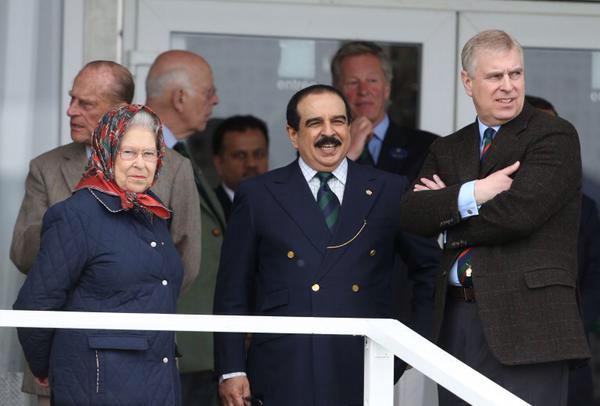
The dictator of Bahrain—who, with the help of Saudi troops and tanks, ruthlessly crushed an Arab Spring uprising that demanded a representative democracy—is spending a leisurely day, today, in Britain, one of the world’s oldest parliamentary ‘democracies’, visiting a horse show with his fellow parasite Queen Elizabeth II. Britain is neck deep in the undemocratic campaign to topple the Syrian government of Bashar al-Assad, amply assisted by Saudi Arabia and other tyrannies of the Persian Gulf, who have provided arms, training and money to al-Qaeda and other Sunni religious fanatics to wage jihad against the secular, anti-sectarian, anti-imperialist, and anti-Zionist government of Assad. Assad must be toppled, the misnamed Friends of Syria aver, because he is a dictator who thwarted an Arab Spring uprising.

ParasitesSensitive to the legitimate demands inhered in the uprising, the Syrian government made major concessions, amending its constitution to open up political participation, and holding a multi-candidate presidential election, which Assad won. Is Syria a democracy? By Western standards, not yet, concedes Assad. But “if you want to compare me to your closest friend, Saudi Arabia, of course we are democratic,” Assad told a French journalist.

In response to news that traces of ricin and sarin have been found in Syria, former US ambassador to Syria Robert Ford, ever vigilant for opportunities to vilify Assad, pronounced the Syrian government guilty of hiding chemical weapons, even though UN inspectors say the discovery is not evidence of “a lingering weapons program” or “new use or production.”

“You’re dealing with a regime that is not very credible on weapons of mass destruction programs,” Ford insisted, to lend weight to his case. To be sure, his observation is incontestable, but not in connection with Syria and only insofar as it refers to the “regime” in Washington, which infamously concocted a fiction about Saddam Hussein concealing weapons of mass destruction as a pretext for war on Iraq. The accusations levelled at Syria are no less baseless, Ford’s transparently politically-inspired arguments notwithstanding.

The Bahraini king’s hobnobbing with ‘Her Majesty’ calls to mind Diderot’s observation that mankind will never be free until the last king is strangled with the entrails of the last priest, though an updated version would need to include the rulers of the world’s currently dominant socio-political system, along with an expanded definition of priests to include mainstream journalists, think-tank experts and PR hacks, to say nothing of former US ambassadors, labouring to mislead public opinion into accepting yet another war on a country that seeks to chart its own course, free from subservience to the dictates of Washington and its political masters on Wall St..

Syria,” asserts Assad, “is an independent state working for the interests of its people, rather than making the Syrian people work for the interests of the West.” And therein is the issue. Ford, the New York Times, and other instruments of the Western ruling class, want the Syrian people to work for the interests of Western bankers, high-level corporate executives and major investors, as the Saudis, Bahrainis, and other puppet Arab monarchies do. And they’re willing to lie, deceive the public, do deals with al-Qaeda, and wage wars of aggression, to get their way. Into the Middle East they stride, their hypocrisy going naked, with the new priests scrambling desperately to drape it with pleasing raiment.

New York Times Complicit in Spreading False Syria Allegations

By Stephen Gowans

The New York Times ran an article on May 12 suggesting that the Syrian government has held back some of its chemical weapons and is using them against rebel fighters. Significantly, the allegation was backed by no evidence, yet the newspaper chose to run the story anyway.

In their story (“Inspectors in Syria find traces of banned military chemicals”) reporters Somini Sengupta, Marlise Simons and Anne Barnard cited a conclusion drawn by an anonymous Western diplomat who was briefed on findings by inspectors from the Organization for the Prohibition of Chemical Weapons. The inspectors had reportedly found traces of toxic nerve agents in Syria. The diplomat was quoted as saying that there’s a “strong suspicion” that the Syrians “are retaining stockpiles which are being held back.”

However, a close reading of the article showed that there was not one whit of evidence to back up the diplomat’s suspicion. Indeed, at various points in the article, the story’s lead was challenged by the journalists themselves.

• “[S]mall amounts of banned agents [have been found. But these findings] do not necessarily indicate a lingering weapons program.”
• “[T]here was no clear evidence of new use or production of forbidden chemicals.”
• “There is no evidence that banned materials were used in weapons after Syria signed the treaty, or that Syria possesses sufficient quantities to use in future weapons.”

A fitting headline would have read “Western diplomat accuses Syrian government of hiding chemical weapons, on no evidence.”

In the same article the reporters refer to “mounting evidence that Mr. Assad’s forces had violated the terms of the international treaty banning use of chemical weapons … by dropping jerry-built chlorine bombs on insurgent-held areas.” The mounting evidence turned out to be the testimony of witnesses who say the bombs have been dropped from government helicopters.

However, the quality of the evidence is untested, and virtually useless. There’s no way to determine whether the witnesses are authentic or simply opponents of the Syrian government who have an interest in spreading false allegations.

What’s more, there’s a compelling reason to believe that Syrian forces have not engaged in the action they’re accused of. Jerry-built chlorine bombs are capable only of briefly incapacitating a few fighters. Conventional bombs—which the Syrians have in abundance—permanently eliminate many more. Why, then, would Syrian forces risk worldwide condemnation to use an ineffective weapon, when they have more effective weapons at their disposable which world opinion does not condemn?

Sensing that their source’s allegation may be treated with suspicion, the New York Times journalists acknowledge that “Evidence of chemical weapons remains a fraught issue for global public opinion more than a decade after false claims of an Iraqi chemical weapons program were used to justify the American invasion that deposed Saddam Hussein.”

No less fraught is the complicity of Western media in propagating similarly baseless allegations to serve an obvious political agenda.

Syria’s Bashar al-Assad on the West’s Quest for a Puppet State in Syria and Its Phony War on Violent Political Islam

Here are excerpts from a Russian media interview with Syrian president Bashar al-Assad.

What the West wants from Syria

Assad: “U.S. demands are…to bring down the Syrian state and replace it with a client state which does their bidding.

united-states-mother-of-terrorism-altagreer“The West does not accept partners. It only wants satellite states. The United States does not even accept partners in the West. It wants Europe to follow the United States. They didn’t accept Russia, although it was a superpower. They didn’t accept it as a partner. Russian officials talk all the time about partnership with the West, and talk positively about the West. In return, the West does not accept Russia as a great power and as a partner on a global level. So, how could they accept a smaller state like Syria which could say no to them? When anything contradicts Syrian interests, we say no. And this is something they do not accept in the West. They asked us for a number of things in the past.

“They used to put pressure on us to abandon our rights in our land occupied by Israel. They wanted us not to support the resistance in Lebanon or Palestine which defends the rights of the Palestinian people. At a later stage, a few years before the crisis, they put pressure on Syria to distance itself from Iran. In another case, some of them wanted to use Syria’s relationship with Iran to influence the nuclear file. We have never been a part of this issue, but they wanted us to convince Iran to take steps against its national interests. We refused to do that. There were other similar things.

“That’s why they wanted in the end to make the Syrian state a satellite state which implements Western agendas in this region. We refused. Had we done these things, we would have become, as I said, a good, moderate, and democratic state. Now, they describe our state as being anti-democratic, while they have the best relations with the Saudi state which has nothing to do with democracy or elections and deprives women of their rights (emphasis added), in addition to many other things well known to the world. This is Western hypocrisy.”

Question: So, what does the West require of Syria today in order to stop arming the Syrian opposition and start the political solution?

Assad: “Simply, to be a puppet. And I’m not convinced that the West has a political solution. They do not want a political solution. When I say the West, I mean a number of countries like the United States, France, and Britain. The other countries play a secondary role. For them, the political solution is changing the state, bringing the state down and replacing it with a client state, exactly like what happened in Ukraine. As far as they are concerned, what happened in Ukraine was a political solution. But, had the former president, who was elected by the people, remained, they would have said that this president is bad, dictatorial, and kills his people. It is the same propaganda. So, the West is not interested in a political solution. They want war, and they want to change states everywhere in the world.”

On the West’s war on terrorism

Assad: “When you follow media reports on daily or weekly basis, you see that the rate of the airstrikes conducted by what they call a coalition against terrorism is sometimes less than ten strikes a day or a little more, in Syria or in Iraq, or in both Syria and Iraq. We are talking about a coalition which includes 60 countries, some of which are rich and advanced. On the other hand, the Syrian air force, which is very small in comparison to this coalition, conducts in a single day many times the number of the airstrikes conducted by a coalition which includes 60 countries.

“This shows the lack of seriousness. Maybe some of these countries do not want ISIS to grow larger than it has become in Syria and Iraq, but at the same time they don’t want to get rid of ISIS completely. They want to retain this terrorist force to be used as a threat to blackmail different countries. That’s why we say simply that there is no serious effort to fight terrorism, and what is being achieved by the Syrian forces on the ground equals in one day what is being achieved by these states in weeks. Once again, this shows that these countries are not serious, not only militarily, but politically speaking. An anti-terrorist coalition cannot consist of countries which are themselves supporters of terrorism (emphasis added.) So, there is a political side and a military side, and the two are linked to each other. The result is the same: ISIS still exists. It is struck in one place but expands in another.”

NATO knew its intervention in Libya would create chaos and aid al-Qaeda-aligned Islamists

March 2, 2015

Canadian military intelligence knew that NATO’s March 2011 intervention in Libya would aid militant theocratic Islamists aligned with al-Qaeda and could create long-term chaos in the country, according to David Pugliese, a reporter with The Ottawa Citizen, who obtained Canadian intelligence documents.

At the time, NATO military leader, U.S. Admiral James Stavridis, denied that opposition to the secular leftist Libyan leader Muamar Gaddafi was dominated by rightwing Islamist theocrats, calling the bulk of the opposition forces “responsible men and women.”

But Canadian intelligence was clear-eyed about the nature of the Libyan opposition.

Pugliese revealed that “A Canadian intelligence report written in late 2009 described the anti-Gadhafi stronghold of eastern Libya,” from which the uprising against Gaddafi erupted, “as an epicentre of Islamist extremism.”

And Canadian pilots joked privately that they were part of al-Qaeda’s air force, “since their bombing runs helped to pave the way for rebels aligned with the terrorist group.”

Pugliese reports that just days before NATO’s intervention in Libya,

Canadian intelligence specialists sent a briefing report shared with senior officers. ‘There is the increasing possibility that the situation in Libya will transform into a long-term tribal/civil war,’ they wrote in their March 15, 2011 assessment. ‘This is particularly probable if opposition forces receive military assistance from foreign militaries.’

Canada’s Prime Minister Stephen Harper later denied that NATO’s intervention created the chaos that has paralyzed Libya, despite his own military’s warning that there was a good chance it would.

This reveals a dishonest attempt to manipulate public opinion through outright deception, in line with Israeli Prime Minister Binyamin Netanyahu’s efforts to mobilize support for military intervention in Iran by warning in 2012 that Iran was only a year away from making a nuclear bomb when his own intelligence agency had concluded that Iran was “not performing the activity necessary to produce weapons”.

Pugliese’s report can be read here.

Saudis Use Leverage Over Oil Pricing To Tempt Russia To Withdraw Support For Syria

February 2, 2015

By Stephen Gowans

The idea that market share concerns are behind Saudi Arabia’s refusal to use supply management to prop up oil prices is challenged in an article in today’s New York Times.

According to the article, the Saudis “believe that there could be ancillary diplomatic benefits to the country’s current strategy of allowing oil prices to stay low — including a chance to negotiate an exit for Mr. Assad” by encouraging Russia to withdraw its support for the embattled Syrian president in return for the Saudis allowing the price of oil to rise.

Saudi Arabia can sway oil prices significantly by cutting back or increasing production. It is the leading player in OPEC, with a fifth of the world’s oil reserves.

The Saudis reportedly “told the United States that they think they have some leverage over Mr. Putin because of their ability to reduce the supply of oil and possibly drive up prices.”

What’s left unspoken, however, is that the leverage didn’t just happen by chance, but came about because the Saudis have refused to exercise their sway, despite substantial harm to themselves.

As the article points out, “Saudi Arabia needs the price of oil to be over $100 a barrel to cover its federal spending, including a lavish budget for infrastructure projects. The current price is about $55 a barrel, and Saudi Arabia has projected a 2015 deficit of about $39 billion.”

Low oil prices mean the Saudis also have leverage over Iran and Venezuela, which, like Russia, are major oil-producers, and like Russia, are objects of enmity in Washington.

The New York Times also reported that former Al Qaeda operative, Zacarias Moussaoui, currently locked up in a US federal supermax prison, testified before a US District Court “that he was directed in 1998 or 1999 by Qaeda leaders in Afghanistan to create a digital database of donors to the group. Among those he said he recalled listing in the database” were three members of the Saudi royal family:

• Prince Turki al-Faisal, then the Saudi intelligence chief;
• Prince Bandar Bin Sultan, the longtime Saudi ambassador to the United States;
• Prince al-Waleed bin Talal, a prominent billionaire investor.

Saudi sources have long been credited with funding the violent fundamentalist Muslim group, but until now news reports have suggested that the funding has come from Saudi civil society, and not the state.

The Saudi royal family, has, throughout its history, been deeply involved in projects to advance British and US foreign policy goals, in return for arms, diplomatic support, and protection of the family’s power and privileges as unelected leaders of the country.

One service the Saudis have provided to the West has been to export Islamist extremism to counter nationalism and socialist and communist movements in the Arab and Muslim worlds.

Another service has been to use oil supply management to intervene in energy markets to facilitate US foreign policy objectives.

For example, The Wall Street Journal pointed out in December that, “During the 1980s, the Reagan administration credited the Saudis with maintaining high oil production to drive down prices and weaken the Soviet Union’s finances.” And “President Barack Obama ’s administration has worked closely with Saudi Arabia to try using energy markets to pressure Iran into constraining its nuclear program, according to U.S. and Saudi officials.”

The newspaper also reported that “U.S. and Arab officials have privately gushed” that the Saudi-assisted price decline is giving Washington greater leverage over Tehran, Moscow and Caracas.

South Korea’s Police State Wages War on Proponents of Democracy

By Stephen Gowans

The South Korean police state has cracked down, with varying degrees of intensity over the years, on virtually any public expression of leftism, including anti-capitalism, anti-colonialism, and anti-imperialism. Some degree of intolerance of leftist dissent is emblematic of all states in capitalist societies. Even in liberal democratic societies, which are believed to tolerate dissent to a higher degree than other societies, the security services have had a long history of surveillance “on the side of the political/economic status quo” and against those “who challenge the powerful and the wealthy.” The history of the political police in such societies is one of “conservatism” where “the targets of state surveillance form a kind of roster of (working class) radicalism” and where those who pursue the class war from the bottom up have been seen as subverting “the proper political and economic order” and therefore are deemed legitimate subjects for surveillance and disruption. This is “an activist conservatism on behalf of capital against its perceived enemies.” [1]

South Korea’s police state differs from that of other liberal democracies in degree only, the difference due to its daily confrontation with a state, parked on its northern borders, which embodies leftism, and which, in its official ideology of self-reliance and rejection of foreign domination—to say nothing of its existing as one of the few top-to-bottom alternatives to capitalism—acts as an inspiration to many South Koreans. It’s virtually impossible to be committed to anti-imperialism and convinced there’s a better alternative to capitalism without espousing values which significantly overlap those of the North Korean state. Consequently, it’s virtually impossible for anyone in South Korea who embraces any kind of serious leftism not to be accused of being a North Korean fellow-traveller—someone who sympathizes with many of North Korea’s aims and values, without having a formal connection to it.

Consider the platform of the Unified Progressive Party (UPP), a leftwing party founded in 2011, which has recently been disbanded by South Korea’s Constitutional Court on grounds that it was intent on pursuing “North Korea-style socialism.” The party sought an end to the US military presence in South Korea (as does Pyongyang), advocated an end to South Korea’s subordinate relationship to the United States (paralleling North Korea’s rejection of foreign domination) and wanted to end the artificial division of the peninsula authored by two US colonels, Dean Rusk and Charles Bondsteel, in 1945, with Soviet compliance (this is also a North Korean goal.) The party talked of “rectifying” Korea’s “shameful history tainted by imperialist invasions, the national divide, military dictatorship, the tyranny and plunder of transnational monopoly capital” and large South Korean conglomerates. [2]

The UPP leader Lee Jung-hee averred that the party rejected North Korea’s political model. Had it not, she told the Constitutional Court, the UPP could never fulfill its ambition to be a mass party since, in her view, South Koreans would never accept North Korean-style socialism. All the same, one would be hard-pressed to argue that the UPP, or at least many of its members, could not be categorized as fellow-travelers of North Korea. And to be guileless about it, it seems very likely that in the event of an outbreak of war with North Korea that some proportion of the UPP membership would have acted as a fifth column—at least, that’s how the South Korean state is likely to have perceived matters, as would any other state—and have states in the past—which share a border with an ideological and military enemy. We can expect that as tensions between the two states heightened, that Seoul’s concern about the dangers of fifth columnists heightened in train. Potential fifth columnists (though not so named) were widely denounced as “jongbuk,” a derogatory term denoting blind followers of North Korea, who conservatives believe are infiltrating South Korean society and spreading subversive ideas challenging the merits of capitalism and South Korea’s subordinate relationship with the United States. [3]

To be understood, the South Korean police state must be situated in the context of South Korea’s relationship with the Democratic People’s Republic of Korea, or DPRK, North Korea’s official name. The DPRK has long been vilified and condemned by the Western news media as bellicose, provocative and unpredictable. But blow away the fog of enduring Cold War propaganda and it’s clear that the DPRK represents something praiseworthy: a tradition of struggle against oppression and foreign domination, rooted in the experience of a majority of Koreans dating back to the end of WWII and the period of Japanese colonial rule. This tradition found expression in the Korean People’s Republic, a national government, created by, for, and of Koreans, that was already in place when US troops landed at Inchon in September, 1945. The new government was comprised of leftists who had won the backing of the majority of Koreans, partly because they had led the struggle against Japan’s colonial occupation, and partly because they promised relief from exploitation by landlords and the Japanese. The USSR, which occupied the north of the country until 1948, worked with the KPR in its occupation zone, but the United States suppressed the KPR in the south, worked to exterminate leftist forces in its zone—which included a significant guerrilla movement under the banner of the People’s Army—and backed conservatives reviled by Koreans for their collaboration with the Japanese. By 1948, the peninsula was divided between a northern government led by guerrillas and activists who fought to liberate Korea from Japanese rule, and a southern government led by a US-installed anti-communist backed by conservatives and landowners tainted by collaboration with the Japanese.

For the next nearly seven decades, the essential character of the competing regimes has remained the same. Park Geun-hye, the current South Korean president is the daughter of a former military dictator, Park Chung-hee, who came to power in a 1961 coup. As a young man Park Chung-hee joined the Japanese military, training at an officers’ school in Japan. He later joined the Kwantung Army, a unit of the Japanese Imperial Army, which enforced Japanese hegemony over Manchuria. Historian Bruce Cumings notes that a biography of Park “subsidized by his supporters (showed) how proud (Park) was to get a gold watch from Emperor Hirohito as a reward for his services, which may have included tracking down Korean guerrillas who resisted the Japanese.” [4] Significantly, it was the very same Korean guerrillas, among them, Kim Il-sung, who founded North Korea, who Park may have been involved in trying to hunt down. Kim Il-sung, grandfather of the DPRK’s current leader, Kim Jong-un, carried out significant guerrilla warfare against the Japanese in Manchuria. Japanese Prime Minister Shinzo Abe also has a familial connection to Manchuria. Abe is the grandson of Nobusuki Kishi, a former prime minister who was a member of Tojo’s wartime cabinet and chief industrial planner in Japanese-occupied Manchuria. An historical continuity is thus evidenced in the current leaders of North Korea, South Korea, and Japan, being direct descendants of men involved in the struggle over Manchuria—Park’s father and Abe’s grandfather on the side of colonial oppression—Kim’s grandfather on the side of liberation.

Indeed, the DPRK represents the traditions of struggle against foreign domination, both political and economic, while South Korea represents the tradition of submission to and collaboration with a foreign hegemon. Significantly, there are no foreign troops stationed in the DPRK, but are in South Korea. DPR Korean troops have never fought abroad, but South Korea’s have, odiously in Vietnam, in return for infusions of mercenary lucre from the United States, and later in Iraq. That South Korea’s conservatives are steeped in a tradition of subservience to foreign domination is evidenced by the views of Moon Chang-keuk, a widely known South Korean newspaper columnist who was nominated by President Park Geun-hye to be her prime minister, but whose nomination was later withdrawn. Moon gave a lecture in 2011 at a Seoul church, in which he described Japan’s colonization of Korea as “God’s will” and a “necessary hardship.” He went on to blame Koreans for “laziness, lack of independence and a tendency to depend on others”—these being qualities he viewed as inhered in Koreans’ “national DNA.” It was necessary, too, that the Americans bisect the peninsula, Moon added, otherwise Korea would have been “communized…given the way we were then.” [5] Historians tend to agree that if Koreans had not been interfered with and left to their own devices they would have freely chosen communism. Moon obviously regards this as an outcome that was fortunately avoided, and would seem to view US intervention in 1945, the US-led war to exterminate the left in the immediate post-war period, and the war with North Korea from 1950 to 1953, as necessary to rescue Koreans from themselves.

As regards repression, South Korea’s authoritarianism on behalf of rightist causes is long and enduring. Its centerpiece is the notorious National Security Law (NSL), a piece of vile anti-leftist legislation created in 1948 officially to criminalize communism and recognition of North Korea and to unofficially suppress leftists. Criticized by Amnesty International [6], Human Rights Watch [7], and the UN [8], the NSL has been variously used to lock up South Koreans “for acts ranging from praising North Korea in casual conversation to running as an opposition candidate in presidential elections.” [9]

South Koreans have run afoul of the NSL for making comments that were construed as supportive of the DPRK, setting up web sites with pro-North Korean content, calling for the establishment of a socialist state, discussing alternatives to capitalism in public forums, re-tweeting messages from North Korea’s Twitter account, possessing books published in the DPRK, listening to radio broadcasts from North Korea, and visiting the DPRK without Seoul’s permission. Other sins against the NSL have included criticizing the official government inquiry into the sinking of the South Korean warship the Cheonan (blamed on North Korea by South Korean authorities), [10] and promoting reconciliation between the South and North.

In the 1970s, the poet Kim Chi-ha was jailed under the NSL because his poems advocated “class division.” In 1976, South Koreans who signed a declaration commemorating an uprising against Japanese rule were imprisoned, courtesy of the NSL. In 1987, a publisher was arrested for distributing travel essays written by Korean-Americans who were reputed to be sympathetic to North Korea. The NSL has been used to jail university students for forming study groups to examine North Korean ideology. In 1989, the South Korean police state arrested an average of 3.3 citizens per day for infractions of the NSL. In the first half of 1998, more than 400 were arrested under NSL provisions for demonstrating against unemployment. In 2001, sociology professor Kang Jeong-koo was jailed on his return to South Korea for visiting the birthplace of Kim Il-sung while on a visit to the DPRK. [11]

A 53 year old was acquitted 30 years after being arrested for violating the NSL. He was convicted of having in his possession “printed matter aiding the enemy.” The offending printed material included E.H. Carr’s The Russian Revolution, Maurice Dobb’s Capitalism Yesterday and Today, Eric Fromm’s Socialist Humanism, and Paul Sweezy’s Theory of Capitalist Development. [12] In 2007, Kim Myung-soo was locked up in a jail cell so small “he could spread his arms and touch the facing walls.” His crime: aiding the enemy by operating a Web site that sold Edgar Snow’s Red Star over China, a biography of Karl Marx, and other titles deemed to be pro-North Korean. [13]

In 2008, members off the South Korean military were banned from reading Ha-Joon Chang’s Bad Samaritans: The Secret History of Capitalism (Chang is no Marxist, just critical of capitalism), Noam Chomsky’s Year 501: The Conquest Continues, and Hyeon Gi-yeong’s novel A Spoon of the Earth, all of which have been labelled as subversive books under an order banning pro-North Korea, anti-capitalist, and anti-US publications. [14]

And if the South Korean police state suppresses books, it no less vigorously wipes out online content it doesn’t want South Koreans to see. “When a computer user in South Korea clicks on an item on the North Korean Twitter account, a government warning against ‘illegal content’ content pops up.” [15] In 2011, South Korean authorities blocked over 53,000 internet posts for infractions which included having a kind word to say about North Korea. [16] In the same year, the South Korean police state deleted over 67,000 Web posts that were deemed favorable to North Korea or which criticized the US or South Korean government. Over 14,000 posts were deleted in 2009. [17]

So militantly anti-leftist is South Korea that “a brand of crayon called Picasso was once banned because of the artist’s Communists associations.” [18] Equally absurd, at one time the South Korean police state would splotch black ink over any photographs of Kim Il-sung that appeared in international magazines, to prevent South Koreans from seeing the face of the reviled leftist. [19]

If that wasn’t enough, South Korea’s police state bona fides go way beyond the NSL. The National Intelligence Service—established to spy on North Korea–has illegally “run an extensive operation of bugging the telephones of politicians, businessmen, journalists, and others.” [20] In 2012, NIS agents “posted more than 1.2 million messages on Twitter and other forums in a bid to sway public opinion in favor of the conservative governing party and its leader” Park Geun-hee, in the lead-up to presidential and parliamentary elections in 2012. [21] The messages NIS agents posted anonymously included praise for government policies, as well as denunciations of Park’s rivals as “servants” of North Korea. The NIS defended its actions, saying the posts were part of a campaign of psychological warfare against North Korea. South Korea’s Cyberwarfare Command, a unit of the military created to guard against hacking threats from North Korea, joined in the campaign of online slander of Park’s opponents. [22]

The vigor with which the South Korean police state acts to snuff out expressions of leftism has increased under the last two administrations, led by Lee Myung-bak, who had been chairman and chief executive officer of Hyundai, one of South Korea’s largest corporations, and Park Geun-hye, the daughter of a dictator and Japanese Imperial Army officer. In August 2011, Prosecutor General Han Sang-dae “declared ‘a war against fellow-travelling pro-north Korean left-wing elements,’ and said, ‘We must punish and remove them.’” [23]

South Korea’s police state has lived up to Han’s promise, recently disbanding the left-wing UPP, stripping its legislators of their parliamentary seats, and jailing a handful of its members, including the lawmaker Lee Seok-ki. Lee was convicted of violating the NSL. His offenses include singing the Song of the Red Flag at a gathering of party members and calling Korea “Chosun,” the country’s last official name before colonization by Japan. North Korea resurrected the name, while South Korea has adopted a new name. Ever since, the use of Chosun in South Korea has become associated with sympathy for North Korea. [24] Conservatives, even liberals, have vociferously criticized “jongbuk,” or followers of North Korea, accusing them of spreading “subversive” ideas and worming their way into positions of influence in South Korean society. In Lee’s view, “a problem far bigger than ‘jongbuk’ is ‘jongmi’—blindly following the United States.” [25] Lee was also accused of calling, at a closed meeting, for the sabotage of South Korean infrastructure in the event of war with North Korea. He was convicted of inciting an insurrection. He’s now serving a nine-year jail term.

While Lee’s case was before the courts, the Park government referred the UPP to the South Korean Constitutional Court, asking for the party’s disbandment on grounds that its program mirrored the aims and values of North Korea. The government called the UPP’s commitment to “overcoming foreign domination and dissolving South Korea’s dependence on the alliance with the US,” as well as its defining South Korea as a “not a society where the workers are master, but the reverse, where a privileged few act as masters,” as “identical to the argument coming from Pyongyang.” [26] The court accepted the government’s brief, ruling that the UPP sought to undermine South Korea’s liberal democracy and pursue North Korea-style socialism. This has provided a basis for a further crackdown on leftism, by defining by implication each and every one of the 100,000 members of the disbanded UPP as an anti-state activist. If they belonged to an officially designated anti-state organization, they must carry the taint of anti-state activity, the reasoning goes.

The banning of the UPP and jailing of Lee Seok-ki can be called the death of democracy in South Korea, but South Korea has never been a democracy, not in any substantive sense, not even when it abandoned open dictatorship and adopted a procedural democracy. Democracy can be construed as a set of procedures (voting, political parties, secret ballots, universal suffrage and so on) or as a type of society. “Democracy” in the second sense is more meaningful. We think of democratic societies as operating in the interests of, and on behalf of, the bulk of the people who make them up. And indeed, this has always been how the word democracy has been understood. Democratic societies reflect and promote mass interests. In contrast, societies that exist to serve the interests of a tiny elite at the apex of society, or of foreign masters, or both, can hardly be said to be democratic, even if they have elections, secret ballots, and so on. South Korea fails the test. It is dominated by a few large conglomerates. “The sales of Korea’s ten largest companies are equal to about 80% of Korea’s GDP.” [27] And few deny that South Korea is locked in a subordinate relationship with the United States, which maintains a significant military presence in the country, and has wartime command of South Korean forces. How can a society dominated by a business elite at home and the United States from abroad be a democracy?

As for the designation of South Korea as a “liberal” democracy, it should be recalled that liberalism represents the conditions necessary for the functioning of a capitalist society, not for the flowering of left-wing dissent and efflorescence of workers’ movements and parties. Historically, “liberal” democracies have not been particularly liberal for anyone but the dominant class. The United States, supposedly a model of liberal democracy, maintained slavery for the first 89 years of its existence. “The self-styled champions of liberty branded taxation imposed without their consent as synonymous with despotism and slavery. But they had no scruples about exercising the most absolute and arbitrary power over the slaves.” [28] So too today, champions of liberal democracy may worry about the liberty to exploit labor, but care not one whit about freedom from exploitation. Even after slavery’s abolition in the United States, it took decades—and the Soviet Union pointing to the United States’ deplorable treatment of its black citizens—to goad the United States to fully recognize the civil and political liberties of the descendants of the slaves. As for leftist movements, the United States accommodated them only insofar as was necessary to co-opt them, and otherwise undertook various campaigns of anti-leftist suppression, which waxed and waned, depending on the need to mobilize for war and confront an external enemy.

Indeed, the history of police state suppression of the left is really not much different between the United States and South Korea. The only difference lies in the degree of threat posed by the left to the established order—mostly unremitting in South Korea and only occasional in the United States; accordingly, the United States appears to be the more liberal society, but is only freer when it’s not facing a perceived threat of significance from the left, or, these days, from the efforts of jihadists to end US domination of their homelands. The latter, it will be acknowledged, has spurred multiple efforts to scale back civil liberties.

Under the presidencies of Kim Dae-jung and Roh Moo-hyun, both liberals—and Kim, himself a victim of the NSL—the South Korean police state’s war on the left was throttled back. All the same, the NSL remained on the books, and leftists continued to be arrested for NSL-violations, though in more modest numbers. Liberals may have reduced the vigor of the war on leftism, but never called it off.

Rather than being the death of democracy, the suppression of the UPP, the jailing of a handful of its members, and efforts to intimidate its former members by threatening to designate them as anti-state activists, represent attempts to abort efforts to bring a real democracy to life in South Korea. Perhaps, it is the North Koreans themselves, watching from across the 38th parallel, who have summed up the eruption of anti-leftism centered on the UPP most aptly. “It is a political coup d’état aimed at stamping out the progressive forces desirous of independence, democracy and peaceful reunification” [29].

1. Reg Whitaker, Gregory S. Kealey, and Andrew Parnaby. Secret Service: Political Policing in Canada from the Fenians to Fortress America. University of Toronto Press. 2012.

2. Choe Sang-hun, “Leftist leaders accused of trying to overthrow South Korean government,” The New York Times, August 28, 2013.

3. Choe Sang-hun, “Leftist leader accused of trying to overthrow South Korean government,” The New York Times, August 28, 2013.

4. Bruce Cumings. Korea’s Place in the Sun.: A Modern History. W.W. Norton & Company. 2005. p. 355.

5. Choe Sang-hun, “Nominee for South Korean premier exits over colonization remark,” The New York Times, June 24, 2014.

6. Amnesty International recommends that “South Korea abolish or substantially amend the NSL in line with the country’s international human rights obligations and commitments.” “The National Security Law: Curtailing freedom of expression, and association in the name of security in the Republic of Korea,” 2012.

7. Human Rights Watch says that “The law clearly violates South Korea’s international human-rights obligations” KaySeok, “South Korea: Abolish or Fix National Security Law,” Joongang Daily, September 17, 2010.

8. “National Security Law again being used in communist witch hunts,” The Hankyoreh, January 13, 2015.

9. Diane Kraft, “South Korea’s National Security Law: A tool of oppression in an insecure world,” Wisconsin International Law Journal, 2006, Vol. 4, No 2.

10. “Police crack down on Cheonan rumors,” The Korea Herald, May 24, 2010.

11. Kraft.

12. “Man acquitted, 30 years later for ‘subversive books’ on capitalism and revolution,” The Hankyoreh, November 26, 2014.

13. Choe Sang-hun, “South Korean law casts wide net, snarling satirists in hunt for spies,” The New York Times, January 7, 2012.

14. “Military expands book blacklist,” The Hankyoreh, July 31, 2008.

15. Choe Sang-hun, “North Korean takes to Twitter and YouTube,” The New York Times, August 17, 2010.

16. Choe Sang-hun, “Korea policing the Net. Twist? It’s south Korea,” The New York Times, August 12, 2012.

17. Choe Sang-hun, “South Korean indicated over Twitter posts from North,” The New York times, February 2, 2012.

18. Choe Sang-hun, “An artist is rebuked for casting South Korea’s leader in an unflattering light,” The New York Times, August 30, 2014.

19. Bruce Cumings. Korea’s Place in the Sun.: A Modern History. W.W. Norton & Company. 2005. p. 365.

20. Choe Sang-hun, “Prosecutors raid South Korean spy agency in presidential election inquiry,” The New York Times, April 30, 2013.

21. Choe Sang-hun, “Former South Korean spy chief convicted in online campaign against liberals,” The New York Times, September 11, 2014.

22. Choe Sang-hun, “Former South Korean spy chief convicted in online campaign against liberals,” The New York Times, September 11, 2014.

23. Choe Sang-hun, “South Korean law casts wide net, snarling satirists in hunt for spies,” The New York Times, January 7, 2012.)

24. “South Korea Police State: National Intelligence Service (NIS) Arrests Rep. Lee Seok-ki: Did ROK Lawmaker Really Try to Overthrow the Government?” Global Research News, October 1, 2013.

25. Choe Sang-hun, “Leftist leader accused of trying to overthrow South Korean government,” The New York Times, August 28, 2013.

26. Jamie Doucette and Se-Woong Koo, “Distorting Democracy: Politics by Public Security in Contemporary South Korea [UPDATE]”, The Asia-Pacific Journal: Japan Focus, February 20, 2014.

27. Kwon Eun-jung, “Top 10 chaebol now almost 80% of Korean economy,” The Hankyoreh, August 28, 2012.

28. Domineco Losurdo. Liberalism: A Counter-History. Verso. 2011. p. 10.

29. “Park Geun Hye Branded as ‘Yusin’ Dictator, KCNA, December 26, 2014.