Soleimani assassination only one of many (and not the most consequential) US acts of war against Iran

January 5, 2020

By Stephen Gowans

While the assassination of an Iranian general by a US drone attack in Iraq has been construed in some quarters as a consequential act of war, it is only one, in a long series of US actions, that constitute de facto acts of war by the United States against Iran that have caused considerable harm to the country.

Ever since Iranians overthrew the US puppet ruler, Mohammad Reza Pahlavi, in 1979, Washington has pursued an unceasing campaign of aggression against the sovereign state with the aim of returning Iran to its orbit. Since 2018, US aggression has intensified. In a stepped up effort to topple the independence-minded government in Tehran, Washington has undertaken campaigns of destabilization on top of information-, cyber-, and economic-warfare—significant aggressions against which the assassination of Major General Qassem Soleimani is but a minor act.

Press TV

The roots of anti-Iranian US hostility can be summed up in one sentence: Tehran rejects the hegemony of the United States and its allies over the Middle East and the Muslim world. [1] This is consistent with the view of the US Joint Chiefs of Staff. Iran, they testified before the US Congress in 2017, seeks to “counter the influence of the U.S. and our Allies.” [2] Accordingly, the Iranian government has been declared an enemy of the United States. In short, Washington insists on imposing its will on the Middle East, and Tehran refuses to submit to US despotism. A former Iranian president, Mahmoud Ahmadinejad, once expressed the Iranian position this way: “We tell [the United States] that instead of interfering in the region’s affairs, to pack their things and leave.” [3] Insisting there should be no limit to its global influence, Washington targets for elimination any force that insists limits must be imposed. Advocacy of local independence and national assertiveness, in the US view, is an act of war against the United States, and must be met by aggression. That, at its base, explains Soleimani’s demise, and explains the character of US foreign policy—thuggery in the service of an international dictatorship.

The immediate goal of Washington’s campaigns of destabilization and information- and economic-warfare “is to spur uprisings in Iran that would lead to the overthrow of the cleric-led government,” according to The New York Times. [4] Washington is using economic tools to destroy the Iranian economy, along with US influence over media to mislead the Iranian population into attributing the collapse of their economy to government mismanagement, and therefore to view the solution to their misery as the overthrow of their own government.

Acts of war I: Economic terrorism

To destroy Iran’s economy, Washington has acted to cut Iran’s oil exports to zero. Additionally, by “sanctioning many of the country’s largest banks, including its central bank, it has severed most of Iran’s financial ties to the world. Other major non-oil sources of revenue have also been targeted—including the auto, aluminum, and petrochemical sectors—and insurers are prohibited from covering Iranian shipments,” according to The Wall Street Journal. [5] The sanctions, in the words of US president Donald Trump, are “massive.” [6] Indeed, the United States has used its economic weight and pressure on other countries to impose a total embargo on Iran, adding the Islamic republic to the list of countries now facing a total US embargo, including Venezuela, North Korea, Syria and Cuba. [7] Significantly, all of these countries share a single thing in common: refusal to submit to US domination.

The “massive” sanctions are hardly limited, surgical, or targeted—that is, restricted to government figures with exemptions for the civilian population. On the contrary, as the Iranian diplomat Majid Takht-Ravanchi explained to the United Nations Security Council in June,

The sanctions are basically designed to harm the general public, particularly those who are vulnerable, such as women, children, the elderly and patients. The sanctions harm the poor more than the rich, the ill more than the healthy and infants and children more than adults. In short, those who are most vulnerable suffer the most. For instance, patients who have severe conditions and therefore need scarce and expensive medicines and advanced medical equipment, which in most cases must be imported, suffer the most. [8]

“Sanctions aren’t an alternative to war,” tweeted Iranian foreign minister Javad Zarif in June. “They ARE war.” [9] Indeed, if we define war as the use of harm to achieve political ends, then harmful coercive economic measures are acts of war. As Takht-Ravanchi told the Security Council,

The United States is weaponizing food and medicine against civilians, which is a clear manifestation of the collective punishment of an entire nation, amounting to a crime against humanity and thus entailing international responsibility. [10]

Terrorism is the deliberate harm of civilians to achieve political goals. Economic warfare is terrorism. Washington’s anti-Iranian sanctions program has a clear political aim: to topple the independence-minded government in Tehran in order to re-assert US hegemony over the country. And there is no question it is aimed at civilians. US Secretary of State, Mike Pompeo, acknowledged the terrorist nature of the US economic warfare campaign when he said “The Iranian leadership has to make a decision that they want their people to eat.” [11]

“These days, the biggest, baddest weapon in the American arsenal isn’t a missile, or a tank, or a fighter jet. It is America’s economic clout,” remarked Gerald F. Seib, a columnist with The Wall Street Journal. [12] Patrick Cockburn, the veteran Middle East correspondent with The Independent, echoed Seib:

Because the media and much of the political establishment in Washington and western capitals are so viscerally anti-Trump, they frequently underestimate the effectiveness of his reliance on American economic might… At the end of the day, the US Treasury is a more powerful instrument of foreign policy than the Pentagon for all its aircraft carriers and drones. [13]

The US drone strike on Soleimani killed a handful of soldiers, people who had devoted their lives to local independence and national assertiveness. The Treasury Department’s sanctions have harmed vastly more people—of a different category: civilians, the victims of the United States’ crazed drive to extend its dictatorship over as many countries as will bow to US coercion.

Pompeo’s threat to starve Iranians unless Tehran capitulates to US demands was anticipated by Martinique-born Algerian revolutionary Frantz Fanon, author of The Wretch of the Earth. ”’When a colonial and imperialist power is forced to give independence to a people, this imperialist power says: ‘you want independence? Then take it and die of hunger.’ Because the imperialists continue to have economic power,” remarked the late Italian philosopher Domenico Losurdo, “they can condemn a people to hunger, by means of blockades, embargoes, or underdevelopment.” [14]

Acts of war II: Information warfare

Annihilating the Iranian economy is easily within the Treasury Department’s power, but misleading tens of millions of Iranians into understanding their misery as originating in their own government’s mismanagement, rather than US economic terrorism, is a task of an altogether different sort. In an effort to “win over the Iranian public” Washington has launched “an information campaign blaming the country’s economic hardship on its leaders and discrediting those who oppose the White House’s policies,” according to The Wall Street Journal. “The campaign aims to erode public support for the leadership in Tehran with hashtags, YouTube videos and traditional pro-U. S. media outlets broadcasting in the Middle East.” [15]

To this end, Washington “has helped anti-Iranian government hashtags to trend on Twitter, including #40YearsofFailure that coincided with the 40th anniversary of the country’s revolution. It has used Persian-language social media to blame deadly floods … on government mismanagement, tapping into a complaint many Iranians have made.” Additionally, Washington relies on its formal propaganda apparatus, the Voice of America, to beam messages aimed at discrediting the Iranian government to 14 million residents of Iran. [16] The propagation of lies to discredit a state in order to destabilize it and bring down its government is every bit as much an act of war as the assassination of Soleimani.

And when Washington isn’t using its influence over information media to try control the minds of Iranians, it’s acting to silence those who present an opposing point of view. Last year, Instagram cancelled Soleimani’s account, after Washington designated him the head of a foreign terrorist organization—an act of stunning hypocrisy, considering that the US government is targeting the entire Iranian population with harm in order to achieve its political goals, i.e., is practicing terrorism. What’s more, US terrorism is carried out on a massive scale, far in excess of anything the insurgents Washington labels as terrorists could ever hope to emulate. Additionally, Washington moved to discredit expatriate Iranians who contested the US war on Iran by dubbing them as propagandists for the Iranian government. According to The Wall Street Journal, “an online platform funded by the State Department, the Iran Disinformation Project, spearheaded a campaign to discredit Iranian journalists and scholars living in the U.S. and Europe, accusing them of being mouthpieces for the Iranian regime.” Their offense was to support the 2015 nuclear deal. [17]

Acts of war III: Covert CIA action

The total embargo of Iran is the principal means by which Washington intends to destabilize the country. But Washington is also relying on CIA covert action to help foster political instability. In 2017, The New York Times, citing multiple US defense and intelligence officials, reported that the Trump administration intended to use US “spies to help oust the Iranian government.” [18] The CIA destabilization program would be led by Michael D’Andrea, nicknamed “the Dark Prince”, who led the hunt for Osama bin Laden. In the years after 9/11, D’Andrea was “deeply involved in the detention and interrogation program,” which resulted in the torture and deaths of a number of prisoners. [19]

Citing a former US military commander, The New York Times reported that “there was a range of options that the Pentagon and the C.I.A. could pursue that could keep Iran off balance but that would not have ‘crystal-clear attribution’ to the United States.” [20] These included putting a bounty “on Iran’s paramilitary and proxy forces” to encourage “mercenary forces to take on Hezbollah and other Iranian proxies.” It could also include spreading “information, either embarrassing truths or deliberate false rumors, aimed at undermining the support that Tehran’s elites have for Iran’s leaders.” Additionally, Washington could provide assistance to Iran’s labor movement to make its protests against the government more effective. [21]

Acts of war IV: Cyber options

On top of these acts of war, Washington has carried on an ongoing campaign of cyberwarfare against the Iranian state. According to The New York Times, “The head of United States Cyber Command, Army Gen. Paul M. Nakasone, describes his strategy as ‘persistent engagement.’” According to a senior US defense official, US operatives “are carrying out constant low-level digital attacks.” [22] One of the most ambitions campaigns of cyberwarfare ever launched, namely, the Stuxnet virus, was developed jointly by the United States and Israel to disrupt Iran’s entirely legal uranium processing activities.

Of the multiple means Washington has used to try to impose its will on Iran and negate the country’s sovereignty—from total embargo, to the deliberate spreading of lies, to the suppression of alternative voices, to aid to dissidents, to persistent harassment of the Iranian state through cyber-operations—the assassination of the Quds Brigade commander has been the least significant in producing harm to Iran and perhaps the most likely to backfire and harm the United States.

Fighting back

What measures may a state legitimately take, in a de facto or de jure state of war, to protect itself from an aggressor? In 1939, the British authorities rounded up and jailed members of Oswald Mosley’s British Union of Fascists. While Mosley’s followers were not accused of crimes, [23] their loyalty was deemed to be questionable. Accordingly, they posed a credible threat to national security during a period of acute crisis, and were duly incarcerated. Few people today would challenge the British government’s decision to lock up British fascists while the country was at war with a fascist state. Neither would they question the decision to suspend elections and confer extraordinary powers on the prime minister, that is, to establish a totalitarian state, while the country was at war.

There is no question that Iran finds itself in a state of emergency and a de facto state of war, arising through no fault of its own, but through Washington’s unceasing efforts to project its influence over the entire face of the globe and negate the sovereignty of other states. Whatever political police state measures Tehran takes to protect itself from US despotism are fully justified under the standards invoked by leading Western democracies during two world wars and other national emergencies.

I make this point because there is a principle that lies at the heart of Iran’s struggle against US tyranny—the principle of independence and local sovereignty, one which partisans of the tradition of equality, liberty, and international solidarity must defend. Defending this principle, however, can be difficult. Witness Washington’s attempts to discredit expatriate Iranians who have spoken out against the de facto US war. To avoid such difficulties, some seek an escape route. A favored tactic is to eschew support for states deemed official enemies of the United States on the grounds that they are police states, or authoritarian, or have abridged human rights. Of course, all of these descriptions fit. But if official enemies are police states, it is because they have been made so by US actions, in the same way the crises of world wars made leading Western democracies into robust police states. If we’re genuinely concerned with human rights, political openness, and political democracy, the way to make these institutions flower is to stop Western governments from poisoning the soil in which the institutions thrive.

Deciding one’s attitude to targets of US aggression on the basis of whether they’re police states sets an impossible standard. It mandates that countries attacked by the West must deny themselves the same defenses their own countries have taken in times of emergency to merit our support. In this view, our solidarity and assistance are available only to those who allow themselves to be victimized, while those who act in the real world, in realistic and consequential ways in defense of laudable principles and aims, are shunned, deplored, ostracized, and excoriated. The consequences of this for the preservation of the principles of democracy on an international scale, for self-determination, and for equality, are not difficult to discern.

Conclusion

While the US assassination of Qassem Soleimani was an act of international barbarity, emblematic of the thuggish nature of US foreign policy, it was neither the only de facto act of war the United States has undertaken against Iran, nor the most harmful. Indeed, against the total embargo Washington has imposed on Iran with the intention of starving Iranians into submission or inducing them to overthrow their government, the killing of Soleimani is a act of little consequence, even if its significance in provoking widespread outrage and galvanizing opposition to US aggression is undoubted.

1. Said K. Aburish, The Rise, Corruption and Coming Fall of the House of Saud, Bloomsbury, 2005, p. 137.

2. Posture statement of 19th Chairman of the joint Chiefs of Staff before the 115th Congress Senate Armed Services Budget Hearing, June 13, 2017.

3. Howard Schneider, “Iran, Syria mock U.S. policy, Ahmadinejad speaks of Israel’s ‘annihilation’”, The Washington Post, February 26, 2010.

4. Edward Wong, “U.S. Turns Up Pressure on Iran With Sanctions on Transportation Firms,” The New York Times, December 11, 2019.

5. Ian Talley and Rebecca Ballhaus, “Trump imposes sanctions on Iran’s supreme leader, others,” The Wall Street Journal, June 24, 2019.

6. Michael R. Gordon, Ian Talley and Laurence Norman, “US plans new Iran sanctions as Europe tries to defuse tensions,” The Wall Street Journal, June 23, 2019.

7. Vivian Salama, “US expands sanctions against Venezuela into an embargo,” The Wall Street Journal, August 5, 2019.

8. Takht Ravanchi (Islamic Republic of Iran) 8564th meeting of the United Nations Security Council, 26 June 2019.

9. Laurence Norman and Stacy Meichtry, “Iran threatens to pull out of nuclear treaty, like North Korea,” The Wall Street Journal, June 27, 2019.

10. Takht Ravanchi.

11. Mike Pompeo, November 7, 2018, quoted in ”Iran letter to the UNSG and UNSC on Pompeo provocative statement,” Permanent Mission of the Islamic Republic of Iran, November 30, 2018.

12. Gerald F. Seib, “The risks in overusing America’s big economic weapon,” The Wall Street Journal, May 13, 2019.

13. Patrick Cockburn, “Europe doesn’t have the power to be much more than a spectator in the escalating US-Iran conflict,” The Independent, May 11, 2019.

14. Domenico Losurdo, “The New Colonial Counter-Revolution,” Revista Opera, October 20, 2017.

15. Sune Engel Rasmussen and Michael Amon, “US aims a megaphone at Iranian public as part of pressure campaign,” The Wall Street Journal, July 25, 2019.

16. Rasmussen and Amon.

17. Ibid.

18. Matthew Rosenberg and Adam Goldman, “CIA names the ‘dark prince’ to run Iran operations, signaling a tougher stance,” The New York Times, June 2, 2017.

19. Ibid.

20. Julian E. Barnes, Eric Schmitt and Thomas Gibbons-Neff, “White House is pressing for additional options, including cyberattacks, to deter Iran,” The New York times, June 23, 2019.

21. Ibid.

22. Julian E. Barnes, “US cyberattack hurt Iran’s ability to target oil tankers, officials say,” The New York Times, August 28, 2019.

23. David A. Price, “’Agent Jack’ review: Tell it to Hitler.” The Wall Street Journal, November 8, 2019.

Kim Jong Un: Until the US shows it’s interested in peace, North Korea will continue to build strategic weapons

“But peace cannot be hoped for on the basis of some making concessions and the others making none. Peace based on the demands of the other side is not peace, it is ignominious surrender, and no revolutionary country sells itself or surrenders.”— Fidel Castro.* 

January 2, 2020 

By Stephen Gowans

On January 1, North Korea’s official news agency, KCNA, presented the DPRK position on the current state of US-North Korean relations, as articulated by Kim Jong Un at a high-level meeting. I’ve summarized the report below, retaining some of the English language text as it originally appeared in the KCNA report, but editing for clarity. I’ve included the Castro quote at the head of this article for the sole reason that, in my opinion, it succinctly sums up the North Korean position.

Kim’s main message is that the DPRK has seen no interest on the US side in peace. On the contrary, despite professing to be interested in a dialogue with the DPRK, the United States has persisted in conducting war games (despite promising to suspend them), has stepped up provocations (by transferring new weapons systems to South Korea), and has intensified it efforts to bring about the collapse of the DPRK (by adding still more sanctions.) This has left North Korea with no option but to continue to build its strategic nuclear defense, while resolving to endure the sanctions. 

http://www.barakabooks.com/

My summary of the KCNA report follows: 

The United States has labelled the DPRK an enemy, part of an “axis of evil,” and a possible target of a pre-emptive nuclear strike. It has applied the most brutal and inhuman sanctions against the country and posed a persistent nuclear threat to the DPRK over the past seven decades. 

Despite the DPRK halting its nuclear tests, suspending the test firing of ICBMs, and shutting down its nuclear-test site—measures taken to build confidence—Washington has not reciprocated with comparable confidence building measures; instead it has continued to conduct joint military drills which US president Donald Trump personally promised to stop. At the same time, Washington has threatened the DPRK by shipping ever more lethal arms and weapons systems to South Korea. On top of these hostile actions, Washington has imposed additional tranches of sanctions on North Korea. The United States’ ambition to stifle the DPRK is undiminished.

In light of the continued US hostility toward the DPRK it can only be concluded that there is no commitment on the US side to arrive at an agreement on denuclearization and that the United States is feigning interest in dialogue and negotiations in order to buy time to allow sanctions to further weaken the DPRK. Accordingly, the DPRK no longer feels bound to take confidence building measures. 

It is true that we urgently need an external environment favourable to our economic development, but the DPRK cannot trade security for visible economic results. Washington’s current posture indicates that the confrontation with the United States will be a long one. 

The DPRK-United States stand-off began in the last century and persists into this one. The DPRK’s nuclear weapons and ballistic missiles are a pretext for US hostility. Absent the nuclear issue, the United States would find fault with the DPRK for some other reason. The United States’ military and political threats will never end. 

This reality urgently requires us to resolve to live with sanctions for as long a necessary and also to actively push forward the project of developing strategic weapons. 

A long history of overcoming difficulties and defending our rights and dignity in the face of harsh opposition has shown us that through self-reliance we can foil the enemies’ sanctions and blockade and preserve our sovereignty and dignity. 

Our goal is to build a national defense strong enough to deter any power from using its armed force against us. We must be sufficiently armed to keep hostile forces at bay so that they will never dare to undermine our sovereignty and security. As part of our continuing effort to achieve this goal, we will soon reveal a new strategic weapon. 

If the United States persists in its hostile policy towards the DPRK, the Korean peninsula will never be denuclearized. Instead, the DPRK will steadily develop strategic weapons for the security of the state. It will continue to do this until the United States rolls back its hostile policy towards the DPRK and a lasting and durable peace-keeping mechanism is built. 

Source: “Report on 5th Plenary Meeting of 7th C.C., WPK,” KCNA, January 1, 2020.

* William R. Long, “Radicalism not necessary, Castro advises Sandinistas,” The Los Angeles Times, January 13, 1985.


Washington’s Xinjiang smear

With help from The New York Times and an anti-communist fanatic of questionable mental competence, Washington orchestrates a smear campaign in an effort to widen one of China’s ethnic fault lines

January 1, 2020

By Stephen Gowans

A Chinese government campaign to bring jobs to a poor region of the country plagued by Islamist-inspired secessionist violence is being depicted by The New York Times as “ethnic subjugation,” “social re-engineering,” and a “crackdown on Muslims.” This echoes the US State Department descriptions of the economic development campaign as “Orwellian,” a “gross human rights violation,” and “one of the worst stains on the world of this century.”

“Chinese leaders have struggled for decades to suffocate separatist sentiment in Xinjiang, a mountainous expanse abutting Central Asia that 12 million Uighurs—nearly half the region’s population—regard as their homeland,” according to The Wall Street Journal. [1] Beijing’s efforts to more fully integrate the predominantly Muslim Uighurs into China’s multi-ethnic community have sparked recriminations in the West. Chinese leaders have been accused of incarcerating a million or more Uighurs in “indoctrination” camps.

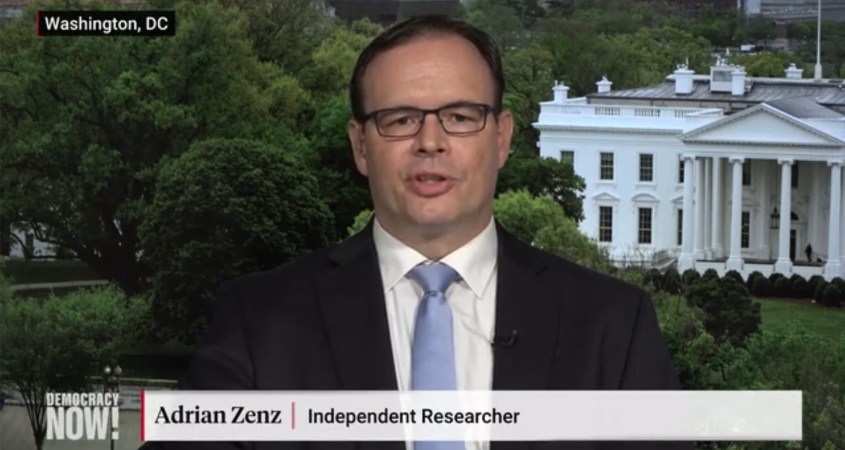
Adrian-Zenz-Uyghurs-China-Christian-fundamentalist
Democracy Now! labels a fanatical anti-communist who is employed by a US government-established foundation and believes he’s on a mission from God to destroy the People’s Republic of China as “an independent researcher.” 

For the past two decades the United States has waged war on Islamist-inspired anti-US violence in the Middle East, a campaign marked by assassinations, invasion, occupation, torture, incarceration of Islamist militants, gross violations of international law, and programs to re-educate Islamist radicals. In contrast, Chinese efforts to deal with Islamist-inspired violence, (and within its own borders, in contrast to a US “war on terror” which is carried out in other peoples’ countries), have been mainly based on job training, job creation, and re-education.

Chinese leaders “attribute ethnic tensions and sporadic violent attacks in Xinjiang to the influence of radical Islam.” [2] Creating jobs has been central to the government’s strategy. “A person with a job will be stable,” said Chinese leader Xi Jinping in 2014. [3]

In a campaign to end poverty nationwide by late 2020, Xi has pushed Xinjiang officials to create economic opportunity for Uighurs, as a way not only of ameliorating the material conditions of China’s Muslim population, but also of more fully integrating it into Chinese society. [4] “The government goals are sweeping,” says The New York Times—up to one million new jobs in Xinjiang by late 2023. [5]

Dozens “of factory zones have emerged across Xinjiang,” The New York Times reports, attesting, it says, to Beijing’s ambitions to end poverty nationwide by late 2020 [6]—a laudable goal.

But rather than depicting the Chinese campaign in meritorious, or even neutral, terms, The New York Times echoes the US State Department, turning what would appear to be a welcome job creation program into something dark, namely, “an aggressive campaign to remold Xinjiang’s Muslim minorities … into an army of workers for factories and other big employers.” [7] A program of job training and placement for “idle villagers” is described as “social re-engineering,” while lifting Xinjiang residents out of poverty is demonized as “a major effort by China’s leader, Xi Jinping, to entrench control over this region.” We would soon enough dismiss as rank propagandists Chinese journalists who would decry a US job creation program for impoverished areas of the United States as a major effort by the US president to entrench control over disadvantaged regions. We ought to do the same when US journalists propagate the same nonsense.

To portray China as the site of a massive assault on human rights, New York Times’ reporters Chris Buckley and Austin Ramzy turn to the Uyghur Human Rights Project [8], an organization backed by the US government-funded National Endowment for Democracy (NED). In an August 2007 article titled “US: overt and covert destabilization,” Le Monde Diplomatique reported that the NED “was created in 1983, ostensibly as a non-profit-making organisation to promote human rights and democracy. In 1991 its first president, the historian Allen Weinstein, confessed to The Washington Post: ‘A lot of what we do today was done covertly 25 years ago by the CIA’.” [9] In other words, the NED overtly works to destabilize governments Washington doesn’t like, under the guise of promoting democracy and human rights. It does so by providing funding and encouragement to dissident groups, like the Uyghur Human Rights Project.

Drawing on the testimony of the CIA-surrogate-funded group, The New York Times depicts Beijing’s vigorous poverty reduction program as an effort to “remold Xinjiang’s minorities into loyal blue-collar workers to supply Chinese factories with cheap labor,” as part of a program of “ethnic subjugation”. [10]

If the negative spin isn’t enough to raise questions about The New York Times’ agenda, the newspaper’s reference to Beijing’s efforts to deal with Islamist-inspired secessionist violence as a “crackdown on Muslims” [11] is. If the campaign could indeed be described fairly in these terms, we would have to redefine ‘crackdown’ to mean ‘education and job creation’ and ‘Muslims’ to mean ‘violent Islamist-inspired secessionists.’ The New York Times would never describe the US ‘war on terror’ as ‘a crackdown on Muslims,’ for the obvious reason that it doesn’t target all Muslims, but only a very small violent, anti-US, subset. The newspaper, however, finds itself unable to make the same distinction where a strategic US competitor is concerned, preferring instead to portray measures of repression against a small, Islamist-inspired violent subset of Chinese Muslims as measures directed at all of them.

In July, “a host of Muslim-majority nations, including Saudi Arabia, Iran, Egypt, Syria and the United Arab Emirates, joined North Korea, Myanmar and others in signing a letter to the United Nations Human Rights Council praising China’s governance of Xinjiang” [12]—an indication that Beijing’s campaign to address secessionist violence in the remote Chinese region is not the Orwellian stain on humanity that US Secretary of State Mike Pompeo would have us believe. A better candidate for ‘gross human rights violation’ – another of Pompeo’s slurs on the Chinese job training program—might be the State Department supremo’s warning that the United States will see to it that the Iranian people–a Muslim-majority people–starve if Tehran continues to refuse to renegotiate its nuclear deal with Washington. [13]

In a resolution on protecting the rights of Muslim minorities around the world, the Organization of Islamic Cooperation — a group of 57 nations that has been a vocal defender of the Rohingyas and Palestinians, praised China for “providing care to its Muslim citizens” [14]—another endorsement at odds with the US campaign to smear its rising strategic competitor as an anti-Muslim power.

Meanwhile, as Washington poses as the champion of China’s Muslims, it has little to say about the litany of abuses heaped upon India’s Muslims by its friend, the Hindu-nationalist prime minister, Narendra Modi. Any unbiased effort to identify crackdowns on Muslims would arrive at India’s doorstep long before it arrived at China’s. In the recent past, Modi—on whom Washington relies to execute its Indo-Pacific Strategy to eclipse the rise of China as a strategic competitor—has been responsible for banning a method of divorce allowed under Muslim religious law and ending the autonomy of India’s only Muslim-majority state, Jammu and Kashmir. To add insult to injury, Modi welcomed a Supreme Court decision that would allow Hindu groups to build a temple in the city of Ayodhya on a site where Muslims want to rebuild a mosque torn down by a Hindu mob in 1992. [15]

On top of these anti-Muslim actions, senior leaders of Modi’s party say they want to introduce a citizen registry that would require all residents to produce documents proving their citizenry. Muslims who are unable to produce the required documents would be treated as immigrants, while all others would be able to naturalize. [16] According to The Wall Street Journal, “Muslims in India say they feel increasingly targeted and vulnerable.” [17]

Washington, then, is prepared to overlook the anti-Muslim actions of an ally, while presenting the efforts of a strategic competitor to improve the material conditions of its Muslim population as a dark, communist-guided Orwellian campaign to brainwash Muslims in order to subordinate them to Han rule. This is the same kind of nonsense Hitler and other counter-revolutionaries used to serve their own reactionary ends, except in their case they depicted communist efforts on behalf of Europe’s working class as a dark, Orwellian campaign by Marxists to bring Germans and Russians under Jewish control.

Some Western newspapers allege that a million Uighurs have been detained in re-education camps, and that the figure is based on a UN report. But as The Grayzone’s Ajit Singh and Max Blumenthal have pointed out, the figure is not based on a UN report, but on a report submitted to the UN Committee on the Elimination of Racial Discrimination by the Network of Chinese Human Rights Defenders, a group backed by the CIA-surrogate NED. It is more apt to label the report, not as a UN-produced document, but as report bankrolled by a US destabilization agency.

Not only does the network’s backing by the US government constitute prima facie evidence of a pro-US, anti-China bias, but the dubious methodology by which the US-backed group arrived at its estimate of one million Uighur detainees further calls its claims into question. The estimate is based on the testimony of eight Uighur opponents of the Chinese government who were asked to guess how many Muslims from their respective villages had been detained by authorities. Their answers were then projected regionally. The methodology, in its reliance on an extremely small and non-random sample—without making the slightest effort to identify who the detainees are (violent radical Islamists or Muslims selected at random?)—is so compromised as to be virtually useless, if not a complete joke. No legitimate researcher or reporter would take it seriously.

Neither would anyone of an unbiased mind take seriously Adrian Zenz, anointed by Western governments and their faithful scribes in the mainstream (and even progressive) media, as a Xinjiang expert. Zenz has become the go-to guy for Western media and governments for commentary on China’s treatment of its Muslim citizens.

According to Singh and Blumenthal, Zenz is “a far-right fundamentalist Christian who opposes homosexuality and gender equality, supports ‘scriptural spanking’ of children,” but more importantly “believes he is ‘led by God’ on a ‘mission’ against China.” [18]

The New York Times bills Zenz as a researcher at the Victims of Communism Memorial Foundation. [19] The foundation’s name speaks volumes about its agenda, but it also helps to know that it was created by the US government, and that its mission is to discredit communist governments, including China, by calling their human rights records into question.

The foundation’s view of the world, according to its website, reposes on the following  premises:

• Communist regimes commit the worst human rights abuses on the widest scale in the world today.
• Communists have killed more than 100 million people over the past century.
• Communism promises to make everyone equal, but delivers radical inequality.
• Every time it is tried, it ends either in economic collapse or a police state. [20]

It’s a virtual certainty that Zenz, as a researcher at an anti-communist foundation, has an a priori anti-China agenda. Laying aside questions about his mental competence—indicated in his belief that “God has sent him on a holy crusade against the People’s Republic of China” [21]—there is no possibility that he is anything but an advocate for a US-friendly, anti-Chinese point of view. In other words, he has zero credibility. All the same, he has appeared before the US Congress and Canadian Parliament as a Xinjiang expert, and has been sought out by Western media from The New York Times to Democracy Now! for commentary. [22] Here’s one of Zenz’s gems from The New York Times: “The long-term strategy [of the Chinese jobs program] is to conquer, to captivate, to win over the young generation from the beginning.” [23]

Washington’s reasons for trying to strengthen secessionism in Xinjiang, and for attempting to discredit Beijing’s efforts to allay it, are not difficult to find. From the Obama Administration forward, US policy has focused on countering the rise of China. A standard tactic states use against rivals is to provide assistance and encouragement to dissident groups to weaken rivals internally. The idea is to find existing fault lines, and then to press on them. In China, Washington has targeted four weak links: Taiwan, Hong Kong, Tibet, and Xinjiang. “Xi told Trump that China is deeply concerned about ‘the negative words and deeds’ of the United States on issues related to” these four regions. [24] The negative deeds include the flow of funding from the CIA-surrogate NED to pro-secessionist groups, as well as Western government and media support for phony China experts who are paraded before global audiences to portray China as a human rights abuser. This is part of the United States’ larger project of eclipsing the rise of a strategic competitor in order to protect US global hegemony.

Scratch the surface, and the US campaign is revealed as a bad joke. It depends on portraying Beijing’s efforts to lift China’s Muslims out of poverty as an Orwellian plot to enforce Han ethnic rule over Uighurs and relies on groups funded by a foundation created to carry out destabilization operations once entrusted to the CIA. At the same time, it elevates a fanatical anti-communist who believes he’s imbued with a mission from God to destroy the People’s Republic of China to the role of the world’s leading expert on Xinjiang.

1. Josh Chin, “China stresses investment, invokes New Zealand massacre in defending treatment of Muslims,” The Wall Street Journal, April 10, 2019.
2. Chin.
3. Eva Dou and Chao Deng, “Western companies get tangled in China’s Muslim clampdown,” The Wall Street Journal, May 16, 2019.
4. Chris Buckley and Austin Ramzy, “Inside China’s Push to Turn Muslim Minorities into an Army of Workers,” The New York Times, December 30, 2019.
5. Buckley and Ramzy.
6. Ibid.
7. Ibid.
8. Ibid.
9. Hernando Calvo Ospina, “US: overt and covert destabilization,” Le Monde Diplomatique, August, 2007, https://mondediplo.com/2007/08/04ned
10. Buckley and Ramzy.
11. Amy Qin, “In China’s crackdown on Muslims, children have not been spared,” The New York Times, December 28, 2019.
12. Jon Emont, “How China persuaded one Muslim nation to keep silent on Xinjiang camps,” The Wall Street Journal, December 11, 2019.
13. Mike Pompeo, November 7, 2018, quoted in “Iran letter to the UNSG and UNSC on Pompeo provocative statement,” Permanent Mission of the Islamic Republic of Iran, November 30, 2018.
14. Jane Perlez, “With pressure and persuasion, China deflects criticisms of its camps for Muslims,” The New York Times, April 8, 2019.
15. Eric Bellman, “India says the path to citizenship will get easier, but Muslims see a Hindu plot,” The Wall Street Journal, December 11, 2019.
16. Vibhuti Agarwal and Krishna Pokharel, “With protests, India Muslims push back against Modi government,” The Wall Street Journal, December 20, 2019.
17. Eric Bellman, “India says the path to citizenship will get easier, but Muslims see a Hindu plot,” The Wall Street Journal, December 11, 2019.
18. Ajit Singh and Max Blumenthal, “China detaining millions of Uyghurs? Serious problems with claims by US-backed GO and far-right researcher ‘led by God’ against Beijing,” The Grayzone, December 21, 2019.
19. Qin.
20. https://www.victimsofcommunism.org/vision
21. Singh and Blumenthal.
22. Ibid.
23. Qin.
24. Steve Holland and Roxanne Liu, “Xi accuses US of interfering in China’s internal affairs in phone call with Trump,” Reuters, December 20, 2019.